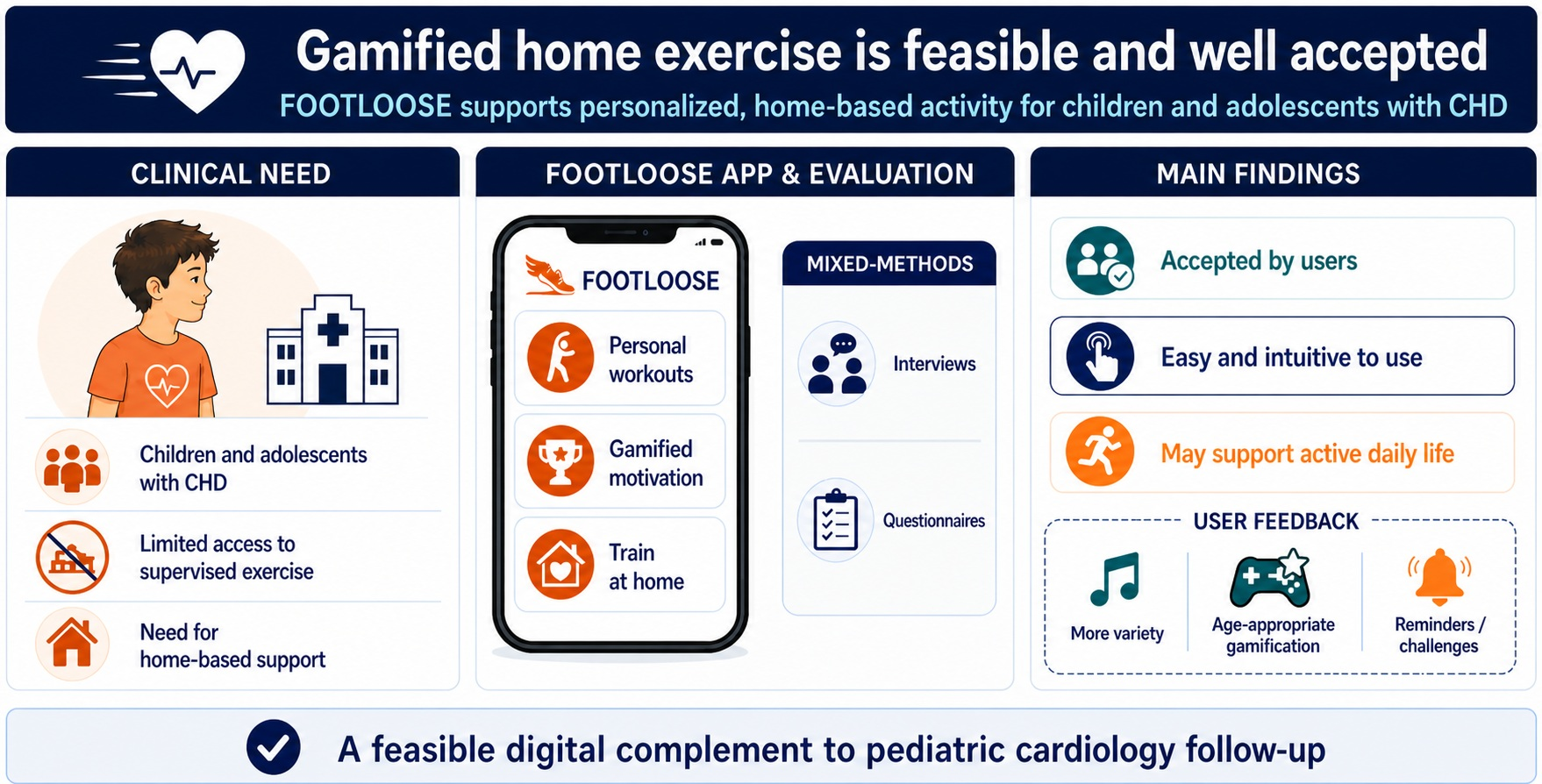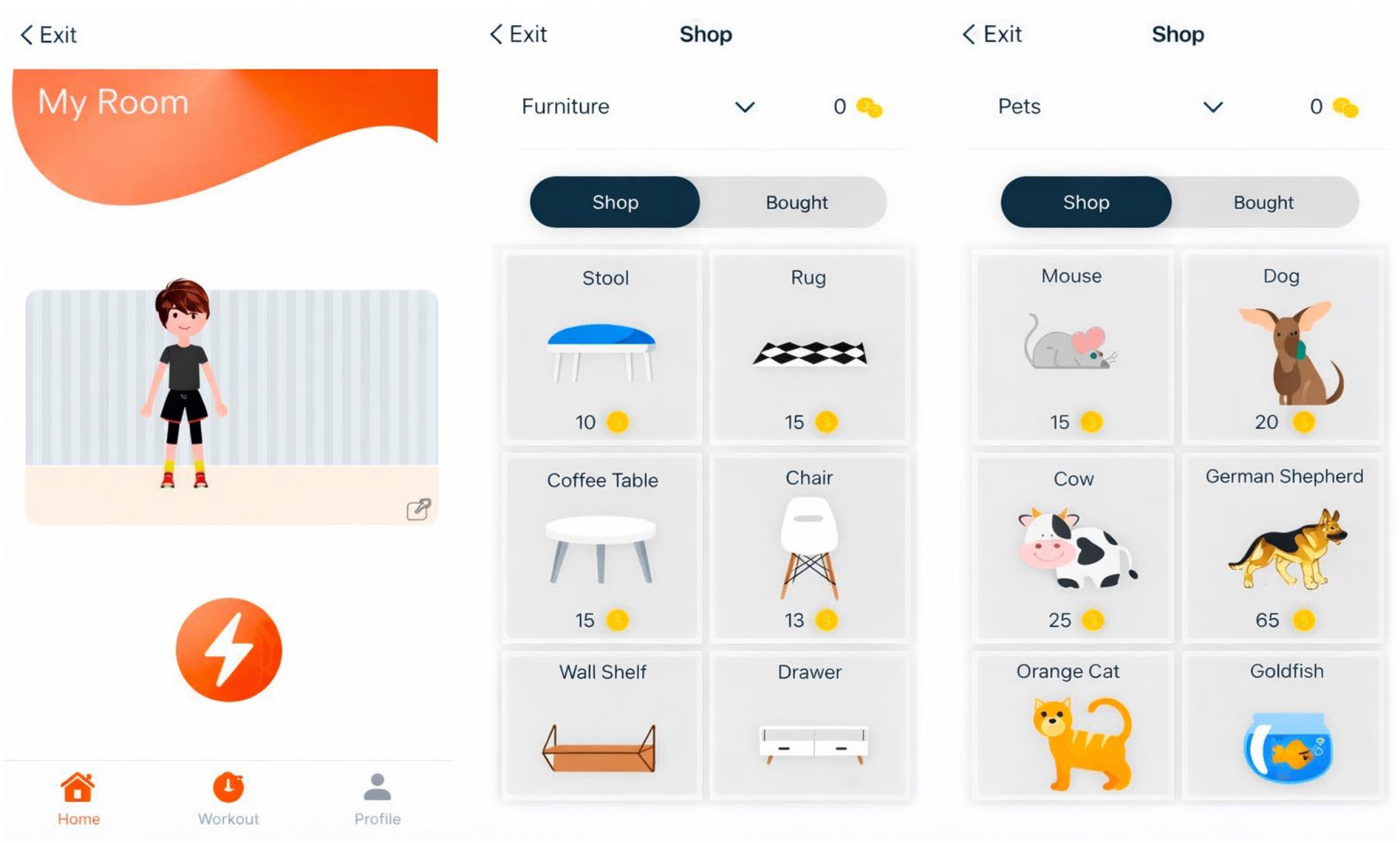

The FOOTLOOSE App: Evaluation of a Gamified App-Based Exercise Intervention for Children and Adolescents with Congenital Heart Disease—A Mixed-Methods Feasibility Study

 , , and
Abstract
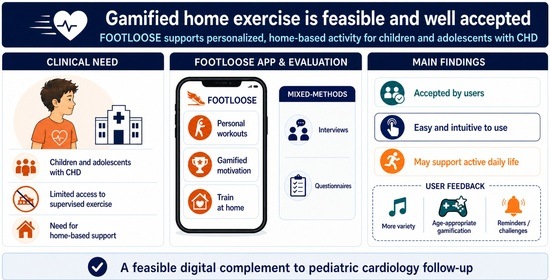
1. Introduction
2. Methods
2.1. Study Design
2.2. Recruitment and Study Sample
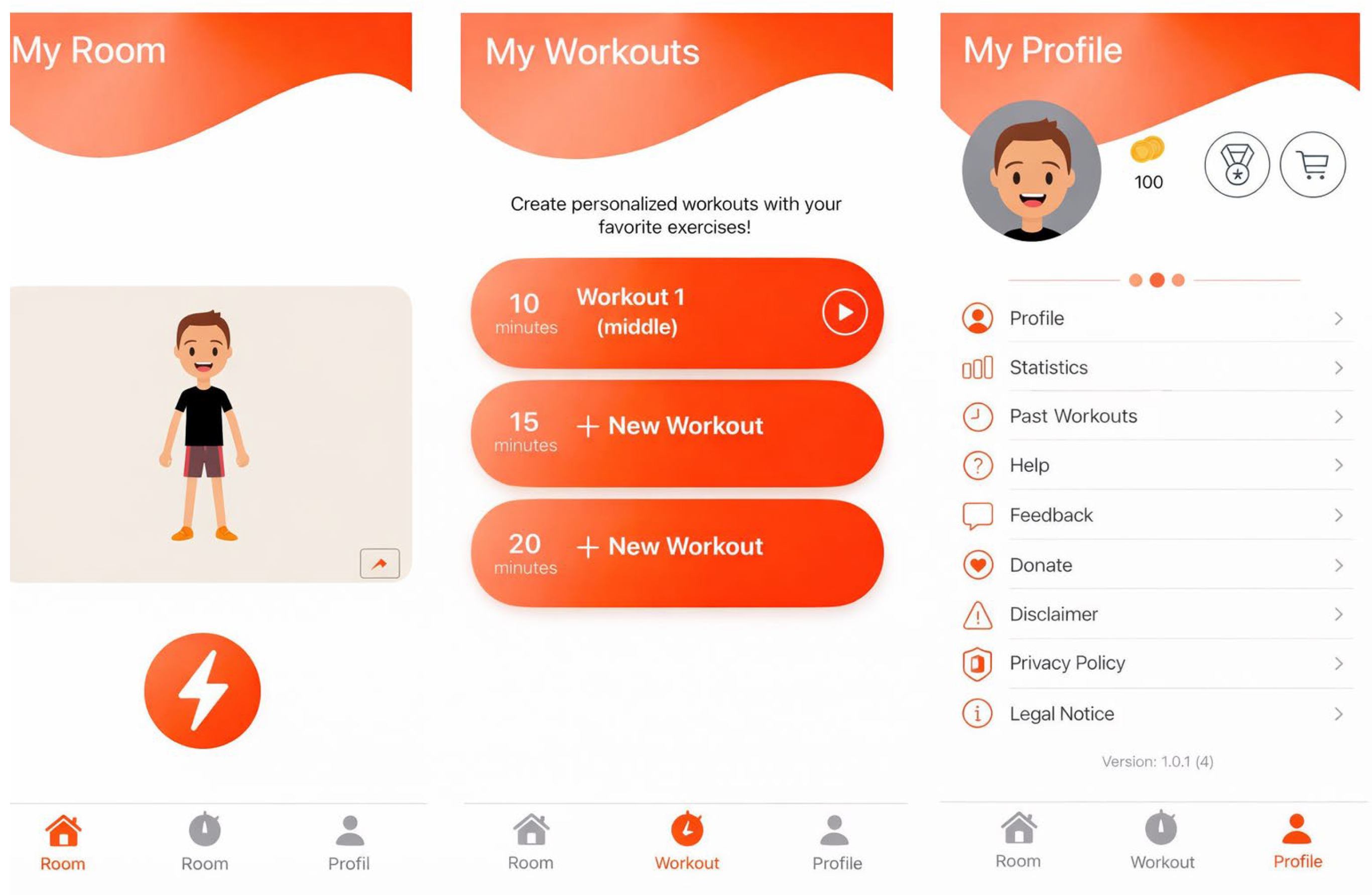
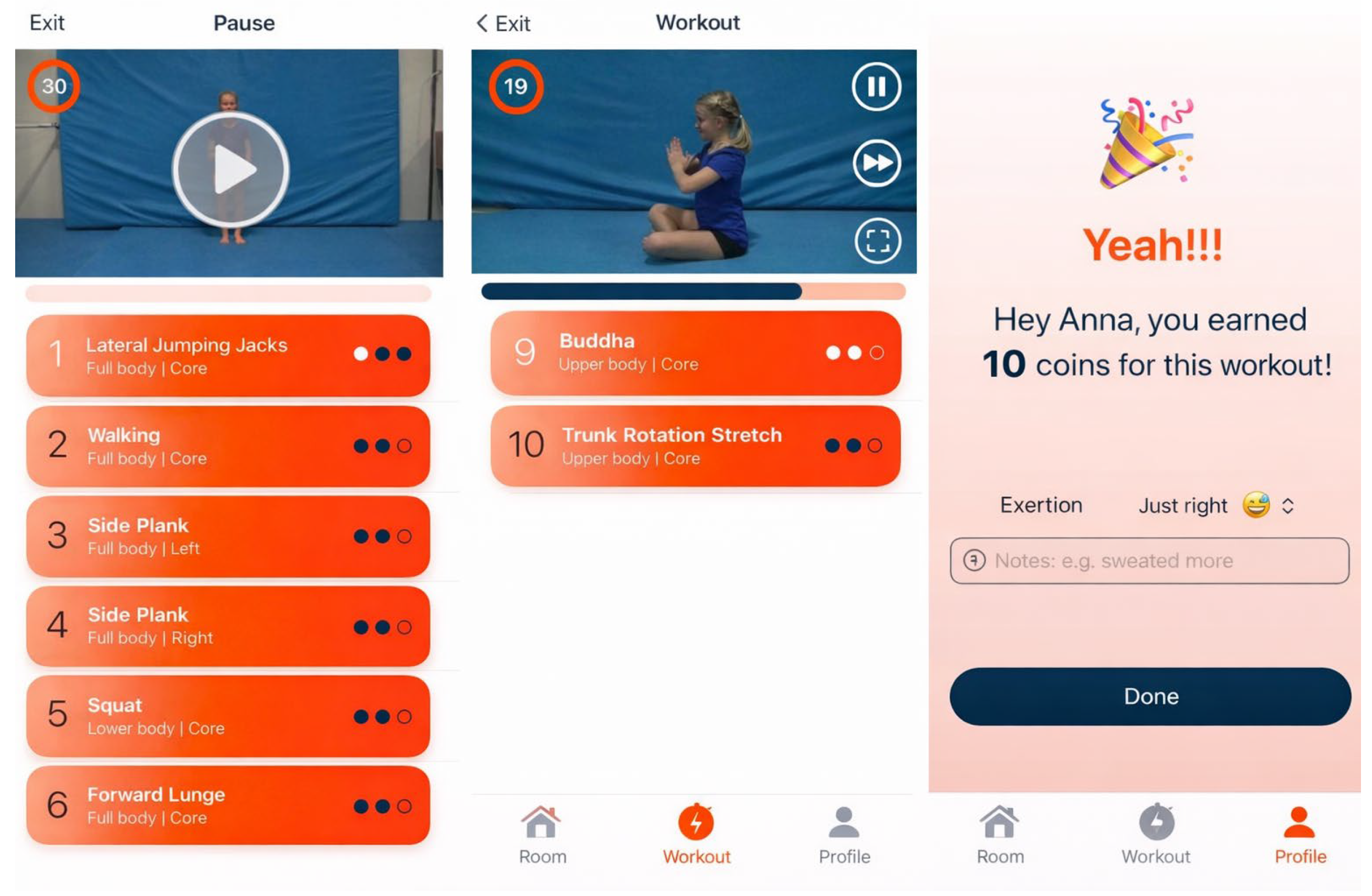
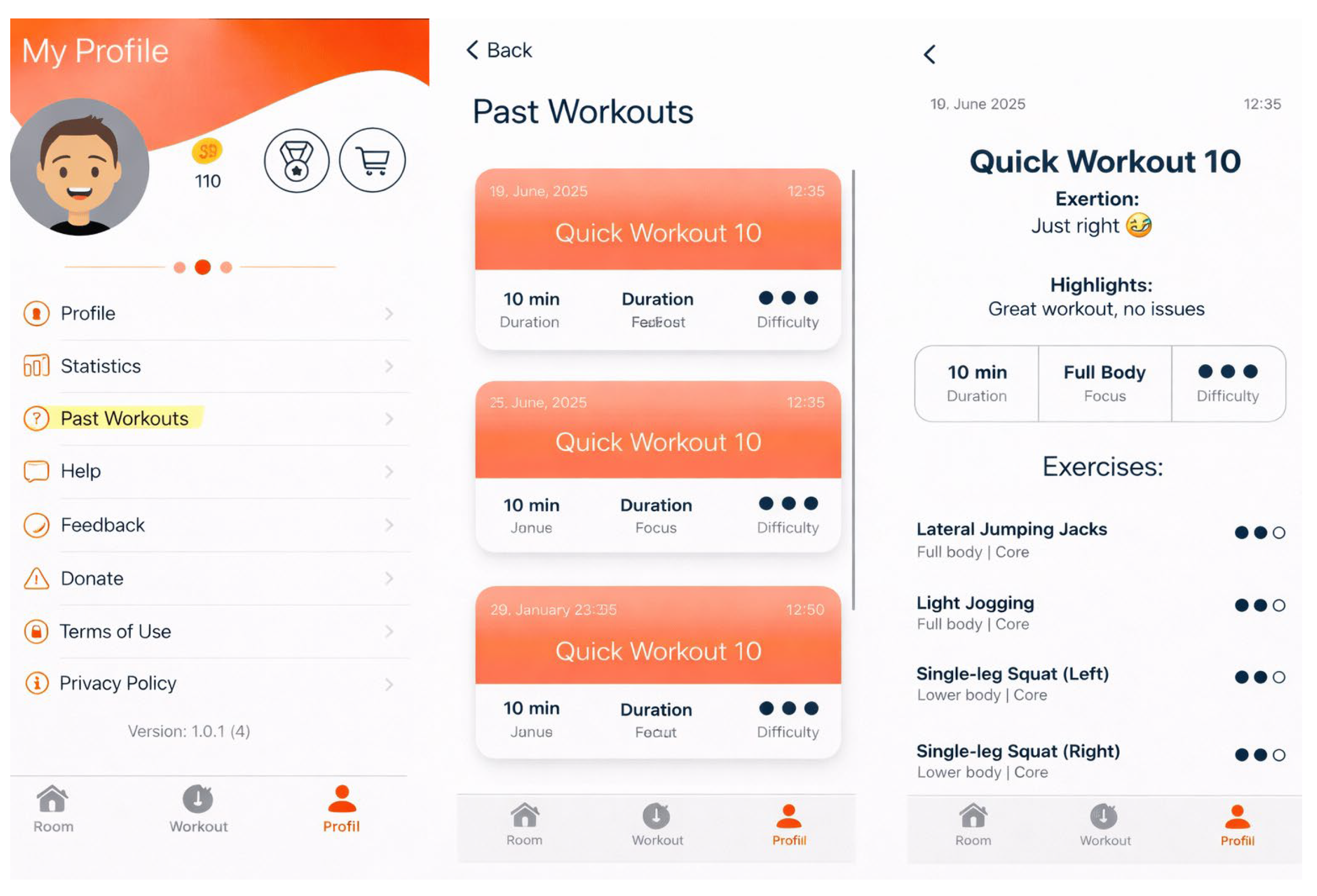
2.3. FOOTLOOSE Intervention
2.4. Qualitative Assessment
2.5. Quantitative Assessment
2.5.1. Physical Activity Self-Efficacy
2.5.2. Enjoyment of Physical Activity
2.5.3. User Experience
2.5.4. Health-Related Quality of Life
2.6. Data Analysis
3. Results
3.1. Qualitative Results
3.2. Smartphone Usage
3.3. Perception of Health Apps
3.4. Attitude to Physical Activity
3.5. Overall Impression
3.6. Strengths and Weaknesses
3.7. Perception of Gamification Elements
3.8. Ideas for Improvement
3.9. Impact of FOOTLOOSE on PA
3.10. Quantitative Results
4. Discussion
Limitations
5. Conclusions
Author Contributions
Funding
Institutional Review Board Statement
Informed Consent Statement
Data Availability Statement
Acknowledgments
Conflicts of Interest
Abbreviations
| WHO | Physical Activity Health Literacy Scale for Children |
| PA | Physical Activity |
| PACE-S | Physical Activity Enjoyment Scale (Short Version) |
| UEQ | User Experience Questionnaire |
| KINDL | Health-Related Quality of Life Questionnaire |
| HRQoL | Health-related quality of life |
| GPA | German physical activity self-efficacy scale |
References
- Biddle, S.J.; Ciaccioni, S.; Thomas, G.; Vergeer, I. Physical activity and mental health in children and adolescents: An updated review of reviews and an analysis of causality. Psychol. Sport Exerc. 2019, 42, 146–155. [Google Scholar] [CrossRef]
- Janssen, I.; LeBlanc, A.G. Systematic review of the health benefits of physical activity and fitness in school-aged children and youth. Int. J. Behav. Nutr. Phys. Act. 2010, 7, 40. [Google Scholar] [CrossRef] [PubMed]
- World Health Organization. WHO Guidelines on Physical Activity and Sedentary Behaviour; World Health Organization: Geneva, Switzerland, 2020. [Google Scholar]
- Guthold, R.; Stevens, G.A.; Riley, L.M.; Bull, F.C. Global trends in insufficient physical activity among adolescents: A pooled analysis of 298 population-based surveys with 1· 6 million participants. Lancet Child Adolesc. Health 2020, 4, 23–35. [Google Scholar] [CrossRef] [PubMed]
- Zelfl, L.; Lutz, J.; Masciangelo, L.; Rathmann, K. Gesundheits-und Risikoverhalten von Kindern und Jugendlichen mit und ohne Behinderung und krankheitsbedingter Einschränkung: Ergebnisse der Kinder und Jugendgesundheitsstudie (KiGGS-Welle 2). Prävention Gesundheitsförderung 2022, 17, 67–74. [Google Scholar] [CrossRef]
- Finger, J.D.; Varnaccia, G.; Borrmann, A.; Lange, C.; Mensink, G. Körperliche Aktivität von Kindern und Jugendlichen in Deutschland–Querschnittergebnisse aus KiGGS Welle 2 und Trends; Robert Koch Institute: Berlin, Germany, 2018. [Google Scholar]
- Sawyer, S.M.; Afifi, R.A.; Bearinger, L.H.; Blakemore, S.-J.; Dick, B.; Ezeh, A.C.; Patton, G.C. Adolescence: A foundation for future health. Lancet 2012, 379, 1630–1640. [Google Scholar] [CrossRef] [PubMed]
- Telama, R.; Yang, X.; Viikari, J.; Välimäki, I.; Wanne, O.; Raitakari, O. Physical activity from childhood to adulthood: A 21-year tracking study. Am. J. Prev. Med. 2005, 28, 267–273. [Google Scholar] [CrossRef]
- Longmuir, P.E.; Brothers, J.A.; De Ferranti, S.D.; Hayman, L.L.; Van Hare, G.F.; Matherne, G.P.; Davis, C.K.; Joy, E.A.; McCrindle, B.W. Promotion of physical activity for children and adults with congenital heart disease: A scientific statement from the American Heart Association. Circulation 2013, 127, 2147–2159. [Google Scholar] [CrossRef]
- Takken, T.; Giardini, A.; Reybrouck, T.; Gewillig, M.; Hövels-Gürich, H.; Longmuir, P.; McCrindle, B.; Paridon, S.; Hager, A. Recommendations for physical activity, recreation sport, and exercise training in paediatric patients with congenital heart disease: A report from the Exercise, Basic & Translational Research Section of the European Association of Cardiovascular Prevention and Rehabilitation, the European Congenital Heart and Lung Exercise Group, and the Association for European Paediatric Cardiology. Eur. J. Prev. Cardiol. 2012, 19, 1034–1065. [Google Scholar]
- Böhm, B.; Karwiese, S.D.; Böhm, H.; Oberhoffer, R. Effects of mobile health including wearable activity trackers to increase physical activity outcomes among healthy children and adolescents: Systematic review. JMIR Mhealth Uhealth 2019, 7, e8298. [Google Scholar] [CrossRef]
- Deterding, S.; Dixon, D.; Khaled, R.; Nacke, L. From game design elements to gamefulness: Defining “gamification”. In Proceedings of the 15th International Academic MindTrek Conference: Envisioning Future Media Environments, Tampere, Finland, 28–30 September 2011. [Google Scholar]
- Pereira, P.; Duarte, E.; Rebelo, F.; Noriega, P. A Review of Gamification for Health-Related Contexts. In International Conference of Design, User Experience, and Usability; Springer: Berlin/Heildeberg, Germany, 2014. [Google Scholar]
- Sardi, L.; Idri, A.; Fernández-Alemán, J.L. A systematic review of gamification in e-Health. J. Biomed. Inform. 2017, 71, 31–48. [Google Scholar] [CrossRef]
- Perron, R.M.; Graham, C.A.; Feldman, J.R.; Moffett, R.A.; Hall, E.E. Do exergames allow children to achieve physical activity intensity commensurate with national guidelines? Int. J. Exerc. Sci. 2011, 4, 257. [Google Scholar] [CrossRef]
- Krath, J.; Schürmann, L.; Von Korflesch, H.F. Revealing the theoretical basis of gamification: A systematic review and analysis of theory in research on gamification, serious games and game-based learning. Comput. Hum. Behav. 2021, 125, 106963. [Google Scholar] [CrossRef]
- Meyer, M.; Brudy, L.; Fuertes-Moure, A.; Hager, A.; Oberhoffer-Fritz, R.; Ewert, P.; Müller, J. E-health exercise intervention for pediatric patients with congenital heart disease: A randomized controlled trial. J. Pediatr. 2021, 233, 163–168. [Google Scholar] [CrossRef] [PubMed]
- Anguera, M.T.; Blanco-Villaseñor, A.; Losada, J.L.; Sánchez-Algarra, P.; Onwuegbuzie, A.J. Revisiting the difference between mixed methods and multimethods: Is it all in the name? Qual. Quant. 2018, 52, 2757–2770. [Google Scholar] [CrossRef]
- Harst, L.; Wollschlaeger, B.; Birnstein, J.; Fuchs, T.; Timpel, P. Evaluation is Key: Providing Appropriate Evaluation Measures for Participatory and User-Centred Design Processes of Healthcare IT. Int. J. Integr. Care 2021, 21, 24. [Google Scholar] [CrossRef]
- Stout, K.K.; Daniels, C.J.; Aboulhosn, J.A.; Bozkurt, B.; Broberg, C.S.; Colman, J.M.; Crumb, S.R.; Dearani, J.A.; Fuller, S.; Gurvitz, M.; et al. 2018 AHA/ACC Guideline for the Management of Adults with Congenital Heart Disease: Executive Summary: A Report of the American College of Cardiology/American Heart Association Task Force on Clinical Practice Guidelines. J. Am. Coll. Cardiol. 2019, 73, 1494–1563. [Google Scholar] [CrossRef]
- Saunders, B.; Sim, J.; Kingstone, T.; Baker, S.; Waterfield, J.; Bartlam, B.; Burroughs, H.; Jinks, C. Saturation in qualitative research: Exploring its conceptualization and operationalization. Qual. Quant. 2018, 52, 1893–1907. [Google Scholar] [CrossRef] [PubMed] [PubMed Central]
- Voskuil, V.R.; Robbins, L.B. Youth physical activity self-efficacy: A concept analysis. J. Adv. Nurs. 2015, 71, 2002–2019. [Google Scholar] [CrossRef]
- Bauman, A.E.; Reis, R.S.; Sallis, J.F.; Wells, J.C.; Loos, R.J.; Martin, B.W. Correlates of physical activity: Why are some people physically active and others not? Lancet 2012, 380, 258–271. [Google Scholar] [CrossRef]
- Cortis, C.; Puggina, A.; Pesce, C.; Aleksovska, K.; Buck, C.; Burns, C.; Cardon, G.; Carlin, A.; Simon, C.; Ciarapica, D. Psychological determinants of physical activity across the life course: A “DEterminants of DIet and Physical Activity” (DEDIPAC) umbrella systematic literature review. PLoS ONE 2017, 12, e0182709. [Google Scholar] [CrossRef]
- Craggs, C.; Corder, K.; van Sluijs, E.M.; Griffin, S.J. Determinants of change in physical activity in children and adolescents: A systematic review. Am. J. Prev. Med. 2011, 40, 645–658. [Google Scholar] [CrossRef]
- Bachner, J.; Sturm, D.J.; Haug, S.; Demetriou, Y. Multi-level validation of the German physical activity self-efficacy scale in a sample of female sixth-graders. BMC Public Health 2020, 20, 979. [Google Scholar] [CrossRef] [PubMed]
- Dishman, R.K.; Hales, D.P.; Sallis, J.F.; Saunders, R.; Dunn, A.L.; Bedimo-Rung, A.L.; Ring, K.B. Validity of social-cognitive measures for physical activity in middle-school girls. J. Pediatr. Psychol. 2010, 35, 72–88. [Google Scholar] [CrossRef] [PubMed]
- Chen, C.; Weyland, S.; Fritsch, J.; Woll, A.; Niessner, C.; Burchartz, A.; Schmidt, S.C.; Jekauc, D. A short version of the physical activity enjoyment scale: Development and psychometric properties. Int. J. Environ. Res. Public Health 2021, 18, 11035. [Google Scholar] [CrossRef]
- Jekauc, D.; Nigg, C.; Nigg, C.R.; Reichert, M.; Krell-Roesch, J.; Oriwol, D.; Schmidt, S.; Wunsch, K.; Woll, A. Measurement properties of the German version of the Physical Activity Enjoyment Scale for adults. PLoS ONE 2020, 15, e0242069. [Google Scholar] [CrossRef]
- Jekauc, D.; Voelkle, M.; Wagner, M.O.; Mewes, N.; Woll, A. Reliability, validity, and measurement invariance of the German version of the physical activity enjoyment scale. J. Pediatr. Psychol. 2013, 38, 104–115. [Google Scholar] [CrossRef]
- Laugwitz, B.; Held, T.; Schrepp, M. Construction and evaluation of a user experience questionnaire. In Symposium of the Austrian HCI and Usability Engineering Group; Springer: Berlin/Heidelberg, Germany, 2008. [Google Scholar]
- Schrepp, M.; Thomaschewski, J. Handbook for the Modular Extension of the User Experience Questionnaire. In Proceedings of the Mensch & Computer, Hamburg, Germany, 8–11 September 2019. [Google Scholar]
- Hinderks, A.; Schrepp, M.; Rauschenberger, M.; Olschner, S.; Thomaschewski, J. Konstruktion eines fragebogens für jugendliche personen zur messung der user experience. In Tagungsband UP12; German UPA ev: Magdeburg, Germany, 2012. [Google Scholar]
- Ravens-Sieberer, U.; Bullinger, M. Assessing health-related quality of life in chronically ill children with the German KINDL: First psychometric and content analytical results. Qual. Life Res. 1998, 7, 399–407. [Google Scholar] [CrossRef]
- Kuckartz, U. Qualitative Inhaltsanalyse: Methoden, Praxis, Computerunterstützung; Beltz Juventa: Weinheim, Germany, 2012. [Google Scholar]
- Callaghan, S.; Morrison, M.L.; McKeown, P.P.; Tennyson, C.; Sands, A.J.; McCrossan, B.; Grant, B.; Craig, B.G.; Casey, F.A. Exercise prescription improves exercise tolerance in young children with CHD: A randomised clinical trial. Open Heart 2021, 8, e001599. [Google Scholar] [CrossRef] [PubMed]
- Khoury, M.; Phillips, D.B.; Wood, P.W.; Mott, W.R.; Stickland, M.K.; Boulanger, P.; Rempel, G.R.; Conway, J.; Mackie, A.S.; Khoo, N.S. Cardiac rehabilitation in the paediatric Fontan population: Development of a home-based high-intensity interval training programme. Cardiol. Young 2020, 30, 1409–1416. [Google Scholar] [CrossRef]
- Kim, H.J.; Kim, J.Y.; Babu, A.S.; Kwak, J.G.; Kim, W.-H.; Jae, S.Y. Effects of a virtual home-based exercise program on physical activity, health-related fitness, and quality of life in children and adolescents with congenital heart disease. J. Cardiopulm. Rehabil. Prev. 2024, 44, 72–74. [Google Scholar] [CrossRef]
- Amedro, P.; Gavotto, A.; Huguet, H.; Souilla, L.; Huby, A.-C.; Matecki, S.; Cadene, A.; De La Villeon, G.; Vincenti, M.; Werner, O. Early hybrid cardiac rehabilitation in congenital heart disease: The QUALIREHAB trial. Eur. Heart J. 2024, 45, 1458–1473. [Google Scholar] [CrossRef]
- Jackson, J.L.; Fox, K.R.; Rausch, J.R.; Swenski, T.N.; Neville, S.P.; Marousis, N.C.; Korth, C.X.; Cua, C.L.; Garg, V.; Vannatta, K. A randomized clinical trial demonstrating feasibility and preliminary efficacy of a videoconference-delivered physical activity lifestyle intervention among adolescents with a congenital heart defect. Ann. Behav. Med. 2022, 56, 673–684. [Google Scholar] [CrossRef]
- Haşıl Korkmaz, N.; Çoruh, H. Time to Move: A 4-Week Gamified Mobile Application Intervention to Promote Physical Activity in Secondary School Students. Eur. J. Sport Sci. 2025, 25, e70027. [Google Scholar] [CrossRef] [PubMed]
- Willinger, L.; Schweizer, F.; Böhm, B.; Scheller, D.A.; Jonas, S.; Oberhoffer-Fritz, R.; Müller, J.; Reimer, L.M. Evaluation of the gamified application KIJANI to promote physical activity in children and adolescents: A multimethod study. Digital Health 2024, 10, 20552076241271861. [Google Scholar] [CrossRef]
- Spence, C.M.; Foshaug, R.; Rowland, S.; Krysler, A.; Conway, J.; Urschel, S.; West, L.; Stickland, M.; Boulanger, P.; Spence, J.C.; et al. Evaluating a Telemedicine Video Game–Linked High-Intensity Interval Training Exercise Programme in Paediatric Heart Transplant Recipients. CJC Pediatr. Congenit. Heart Dis. 2023, 2, 198–205. [Google Scholar] [CrossRef] [PubMed]
- Tolks, D.; Lampert, C.; Dadaczynski, K.; Maslon, E.; Paulus, P.; Sailer, M. Spielerische ansätze in prävention und gesundheitsförderung: Serious games und gamification. Bundesgesundheitsblatt-Gesundheitsforschung-Gesundheitsschutz 2020, 63, 698–707. [Google Scholar] [CrossRef]
- Duppen, N.; Takken, T.; Hopman, M.; Ten Harkel, A.; Dulfer, K.; Utens, E.; Helbing, W. Systematic review of the effects of physical exercise training programmes in children and young adults with congenital heart disease. Int. J. Cardiol. 2013, 168, 1779–1787. [Google Scholar] [CrossRef] [PubMed]
- Harst, L.; Lantzsch, H.; Scheibe, M. Theories predicting end-user acceptance of telemedicine use: Systematic review. J. Med. Internet Res. 2019, 21, e13117. [Google Scholar] [CrossRef]
- Lee, K.; Kwon, H.; Lee, B.; Lee, G.; Lee, J.H.; Park, Y.R.; Shin, S.-Y. Effect of self-monitoring on long-term patient engagement with mobile health applications. PLoS ONE 2018, 13, e0201166. [Google Scholar] [CrossRef]
- Pratt, M.; Ramirez Varela, A.; Salvo, D.; Kohl, H.W., III; Ding, D. Attacking the Pandemic of Physical Inactivity: What Is Holding Us Back? Br. J. Sports Med. 2020, 54, 760–762. [Google Scholar] [CrossRef]
- Stecher, C.; Pfisterer, B.; Harden, S.M.; Epstein, D.; Hirschmann, J.M.; Wunsch, K.; Buman, M.P. Assessing the pragmatic nature of mobile health interventions promoting physical activity: Systematic review and meta-analysis. JMIR mHealth uHealth 2023, 11, e43162. [Google Scholar] [CrossRef] [PubMed]
- Bergen, N.; Labonté, R. “Everything is perfect, and we have no problems”: Detecting and limiting social desirability bias in qualitative research. Qual. Health Res. 2020, 30, 783–792. [Google Scholar] [CrossRef] [PubMed]



| Characteristics | ||
|---|---|---|
| Age (n = 22) (years; mean ± SD) | 13.4 ± 2.3 | |
| Sex (N = 22) | n | Proportion/% |
| Female | 12 | 54.5 |
| Male | 10 | 45.5 |
| CHD severity (N = 22) * | n | Proportion/% |
| Simple | 2 | 9.1 |
| Moderate | 5 | 22.7 |
| Complex | 11 | 50.0 |
| Cardiomyopathy | 2 | 9.1 |
| Cardiac Arrhythmia | 2 | 9.1 |
| Section | Outcome | Key Question | Follow-Up Question |
|---|---|---|---|
| Introduction | General attitude towards smartphone use | What do you normally use your smartphone for? | Roughly how much time do you spend on your smartphone daily? |
| General attitude towards digital health apps | What do you think a health app is? | Which health apps do you know? What do you think they are for? | |
| General attitude towards physical activity | What is your attitude towards sports and physical activity? | Do you have any sports hobbies? Which ones? How do you feel when doing sports? | |
| Main Part | Evaluation of the FOOTLOOSE app | How did you like the FOOTLOOSE app? | What did you particularly like? Which video or exercise did you enjoy the most? What did you not like? What would you change about the app? Were you satisfied with your virtual room and the offers in the app shop? |
| Long-term use/sustainability | Can you imagine using the FOOTLOOSE app long-term? | Which time unit did you like best? (10 min, 15 min, 20 min) How many minutes per week did you train with the app? Or: How often per week did you use the app? Would you like to continue using the app? Why? What would have to change so you would keep using it? | |
| Activity promotion through FOOTLOOSE app | Has the FOOTLOOSE app influenced your activity behaviour? | In what way did the app motivate you to train more? What do you think about doing extra training sessions to collect more coins for your virtual room? | |
| Closing | Closing remarks by interviewer | Do you have any further questions or comments about the app? | Is there anything else you would like to say or ask? |
| Questionnaires | All (n = 18) | Boys (n = 6) | Girls (n = 12) | p-Value * |
|---|---|---|---|---|
| UEQ | ||||
| Attractiveness | 1.3 ± 0.8 | 1.1 ± 0.9 | 1.4 ± 0.7 | 0.533 |
| Perspicuity | 1.7 ± 1.1 | 1.4 ± 1.2 | 1.8 ± 1.0 | 0.554 |
| Efficiency | 1.2 ± 0.9 | 1.1 ± 1.0 | 1.2 ± 0.8 | 0.932 |
| Dependability | 1.4 ± 0.7 | 1.2 ± 0.9 | 1.6 ± 0.6 | 0.404 |
| Stimulation | 1.0 ± 1.1 | 1.0 ± 1.2 | 1.0 ± 1.1 | 0.962 ^ |
| Novelty | 0.6 ± 1.0 | 0.9 ± 0.9 | 0.4 ± 1.1 | 0.672 ^ |
| PACES-S | 4.2 ± 0.7 | 4.3 ± 0.8 | 4.2 ± 0.7 | 0.701 ^ |
| GPA | All (n = 19) | Boys (n = 7) | Girls (n = 12) | |
| 3.5 ± 0.8 | 4.0 ± 0.9 | 3.3 ± 0.8 | 0.111 | |
| KINDL | All (n = 18) | Boys (n = 7) | Girls (n = 11) | |
| Total | 76.6 ± 8.9 | 81.4 ± 8.3 | 73.5 ± 8.0 | 0.068 |
| Physical well-being | 71.5 ± 18.5 | 83.0 ± 12.4 | 64.2 ± 18.4 | 0.019 |
| Psychological well-being | 84.1 ± 12.2 | 82.1 ± 15.1 | 85.3 ± 10.6 | 0.644 |
| Self-worth | 65.3 ± 17.3 | 67.9 ± 17.5 | 63.6 ± 17.9 | 0.628 |
| Family | 88.2 ± 9.8 | 89.3 ± 7.8 | 87.5 ± 11.2 | 0.969 |
| Friends | 77.1 ± 15.0 | 82.1 ± 11.1 | 73.9 ± 16.7 | 0.225 |
| School | 73.3 ± 12.2 | 83.9 ± 4.9 | 66.5 ± 12.3 | 0.003 ^ |
Disclaimer/Publisher’s Note: The statements, opinions and data contained in all publications are solely those of the individual author(s) and contributor(s) and not of MDPI and/or the editor(s). MDPI and/or the editor(s) disclaim responsibility for any injury to people or property resulting from any ideas, methods, instructions or products referred to in the content. |
© 2026 by the authors. Licensee MDPI, Basel, Switzerland. This article is an open access article distributed under the terms and conditions of the Creative Commons Attribution (CC BY) license.
Share and Cite
Schöneburg, C.; Uphoff, I.; Thußbas, A.; Willinger, L.; Oberhoffer, R.; Ewert, P.; Müller, J. The FOOTLOOSE App: Evaluation of a Gamified App-Based Exercise Intervention for Children and Adolescents with Congenital Heart Disease—A Mixed-Methods Feasibility Study. J. Cardiovasc. Dev. Dis. 2026, 13, 199. https://doi.org/10.3390/jcdd13050199
Schöneburg C, Uphoff I, Thußbas A, Willinger L, Oberhoffer R, Ewert P, Müller J. The FOOTLOOSE App: Evaluation of a Gamified App-Based Exercise Intervention for Children and Adolescents with Congenital Heart Disease—A Mixed-Methods Feasibility Study. Journal of Cardiovascular Development and Disease. 2026; 13(5):199. https://doi.org/10.3390/jcdd13050199
Chicago/Turabian StyleSchöneburg, Charlotte, Isabel Uphoff, Anna Thußbas, Laura Willinger, Renate Oberhoffer, Peter Ewert, and Jan Müller. 2026. "The FOOTLOOSE App: Evaluation of a Gamified App-Based Exercise Intervention for Children and Adolescents with Congenital Heart Disease—A Mixed-Methods Feasibility Study" Journal of Cardiovascular Development and Disease 13, no. 5: 199. https://doi.org/10.3390/jcdd13050199
APA StyleSchöneburg, C., Uphoff, I., Thußbas, A., Willinger, L., Oberhoffer, R., Ewert, P., & Müller, J. (2026). The FOOTLOOSE App: Evaluation of a Gamified App-Based Exercise Intervention for Children and Adolescents with Congenital Heart Disease—A Mixed-Methods Feasibility Study. Journal of Cardiovascular Development and Disease, 13(5), 199. https://doi.org/10.3390/jcdd13050199