
Impact of Fitness on Cardiac Torsion and Wall Mechanics in Ischemic Heart Disease Study (FIT-TWIST)

 ,
,
Abstract
1. Introduction
2. Methods
2.1. Study Design
2.2. Study Population
2.3. Clinical Assessment and Data
2.4. Cardiac Rehabilitation Program
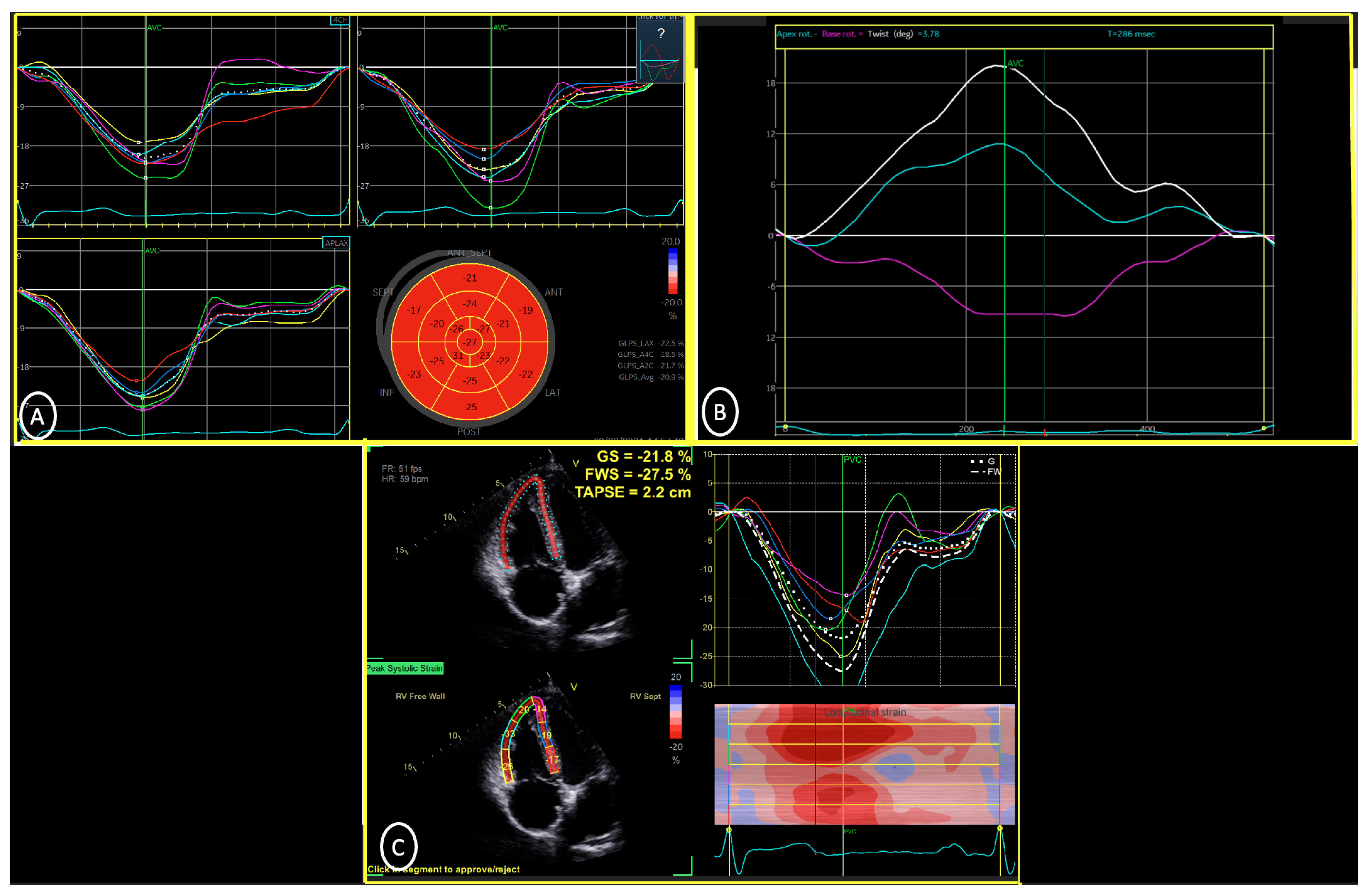
2.5. Two-Dimensional Speckle-Tracking, and Stress Echocardiography
2.6. Statistical Analysis
3. Results
3.1. Study Population Demographics and Clinical Characteristics
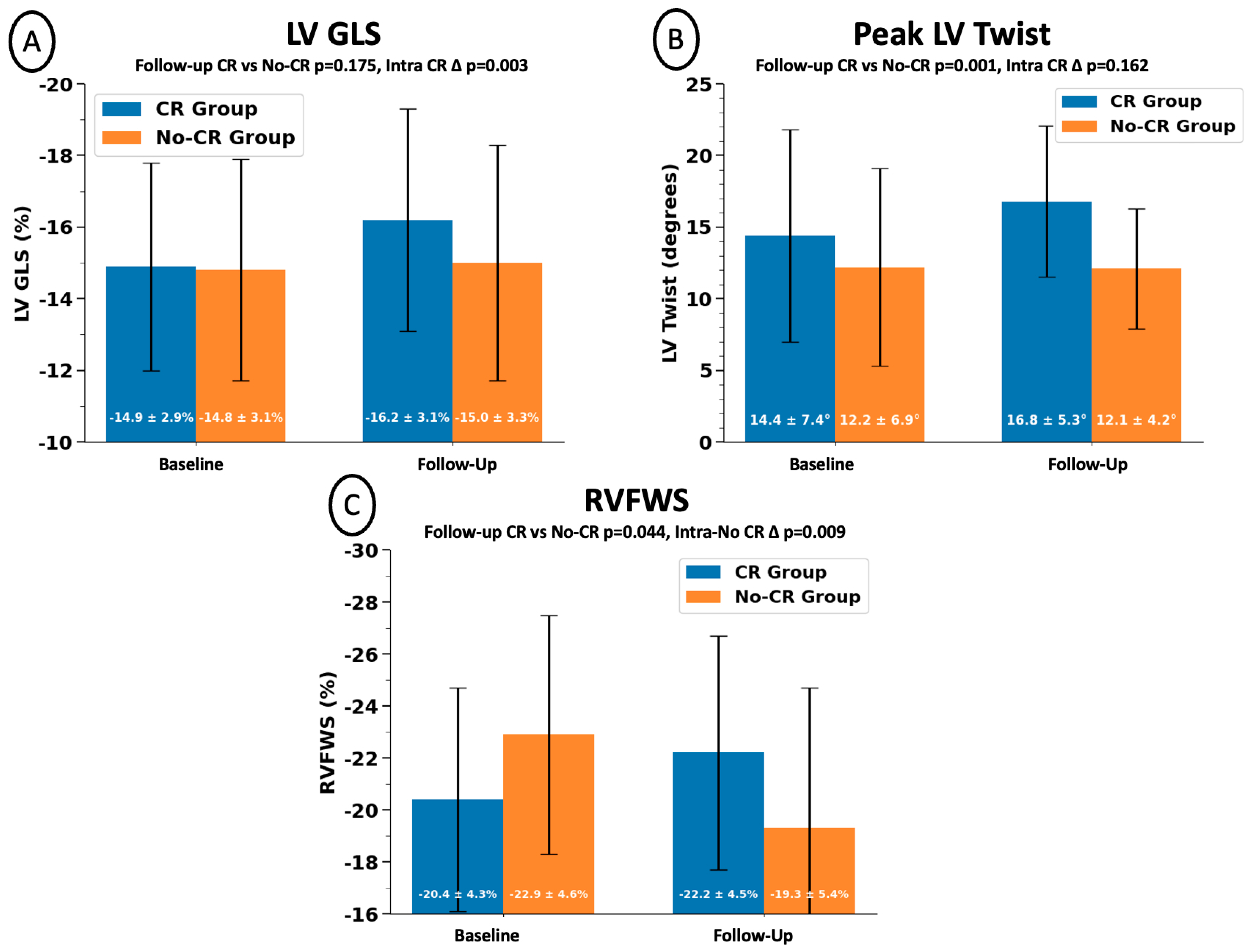
3.2. Two-Dimensional and Speckle-Tracking Echocardiography
3.3. Stress Echocardiography in the CR Group
4. Discussion
4.1. LV Myocardial Architecture and Deformational Mechanics
4.2. Impact of CR on LV GLS and Peak Twist
4.3. RV Mechanics and Impact of CR on RVFWS
4.4. FIT-TWIST and Prior Studies on CR in IHD
4.5. Exercise Training in Patients with Stable IHD
4.6. Study Limitations
5. Conclusions
Supplementary Materials
Author Contributions
Funding
Institutional Review Board Statement
Informed Consent Statement
Data Availability Statement
Acknowledgments
Conflicts of Interest
Abbreviations
| CR | cardiac rehabilitation |
| ECG | electrocardiogram |
| FIT-TWIST | Impact of Fitness on Cardiac Torsion and Wall Mechanics in Ischemic Heart Disease Study |
| GLS | global longitudinal strain |
| IHD | ischemic heart disease |
| LV | left ventricle |
| LVEF | left ventricular ejection fraction |
| METs | metabolic equivalents of task |
| No-CR | no cardiac rehabilitation |
| RV | right ventricle |
| RVFWS | right ventricular free wall strain |
| SD | standard deviation |
References
- GBD 2021 Causes of Death Collaborators. Global burden of 288 causes of death and life expectancy decomposition in 204 countries and territories and 811 subnational locations, 1990–2021: A systematic analysis for the Global Burden of Disease Study 2021. Lancet 2024, 403, 2100–2132. [Google Scholar] [CrossRef]
- Daubert, M.A.; White, J.A.; Al-Khalidi, H.R.; Velazquez, E.J.; Rao, S.V.; Crowley, A.L.; Zeymer, U.; Kasprzak, J.D.; Guetta, V.; Krucoff, M.W.; et al. Cardiac remodeling after large ST-elevation myocardial infarction in the current therapeutic era. Am. Heart J. 2020, 223, 87–97. [Google Scholar] [CrossRef] [PubMed]
- Cohn, J.N.; Ferrari, R.; Sharpe, N. Cardiac remodeling--concepts and clinical implications: A consensus paper from an international forum on cardiac remodeling. J. Am. Coll. Cardiol. 2000, 35, 569–582. [Google Scholar] [CrossRef] [PubMed]
- Thomas, R.J. Cardiac rehabilitation—Challenges, advances, and the road ahead. N. Engl. J. Med. 2024, 390, 830–841. [Google Scholar] [CrossRef] [PubMed]
- Anderson, L.; Oldridge, N.; Thompson, D.R.; Zwisler, A.D.; Rees, K.; Martin, N.; Taylor, R.S. Exercise-based cardiac rehabilitation for coronary heart disease: Cochrane systematic review and meta-analysis. J. Am. Coll. Cardiol. 2016, 67, 1–12. [Google Scholar] [CrossRef]
- Rao, S.V.; O’Donoghue, M.L.; Ruel, M.; Rab, T.; Tamis-Holland, J.E.; Alexander, J.H.; Baber, U.; Baker, H.; Cohen, M.G.; Cruz-Ruiz, M.; et al. 2025 ACC/AHA/ACEP/NAEMSP/SCAI guideline for the management of patients with acute coronary syndromes: A report of the American College of Cardiology/American Heart Association Joint Committee on Clinical Practice Guidelines. Circulation 2025, 151, e771–e862. [Google Scholar] [CrossRef]
- Mihos, C.G.; Liu, J.E.; Anderson, K.M.; Pernetz, M.A.; O’Driscoll, J.M.; Aurigemma, G.P.; Ujueta, F.; Wessly, P. Speckle-tracking strain echocardiography for the assessment of left ventricular structure and function: A scientific statement from the American Heart Association. Circulation 2025, 152, e96–e109. [Google Scholar] [CrossRef]
- Malfatto, G.; Revera, M.; Branzi, G.; Ciambellotti, F.; Giglio, A.; Blengino, S.; Oldani, M.; Facchini, C.; Parati, G.; Facchini, M. A brief period of intensive cardiac rehabilitation improves global longitudinal strain and diastolic function after a first uncomplicated myocardial infarction. Acta Cardiol. 2017, 72, 284–291. [Google Scholar] [CrossRef]
- Xu, L.; Cai, Z.; Xiong, M.; Li, Y.; Li, G.; Deng, Y.; Hau, W.K.; Li, S.; Huang, W.; Qiu, J. Efficacy of an early home-based cardiac rehabilitation program for patients after acute myocardial infarction: A three-dimensional speckle tracking echocardiography randomized trial. Medicine 2016, 95, e5638. [Google Scholar] [CrossRef]
- Van De Heyning, C.M.; De Maeyer, C.; Pattyn, N.; Beckers, P.J.; Cornelissen, V.A.; Goetschalckx, K.; Possemiers, N.; Van Craenenbroeck, E.M.; Voigt, J.U.; Vanhees, L.; et al. Impact of aerobic interval training and continuous training on left ventricular geometry and function: A SAINTEX-CAD substudy. Int. J. Cardiol. 2018, 257, 193–198. [Google Scholar] [CrossRef]
- McGregor, G.; Stöhr, E.J.; Oxborough, D.; Kimani, P.; Shave, R. Effect of exercise training on left ventricular mechanics after acute myocardial infarction-an exploratory study. Ann. Phys. Rehabil. Med. 2018, 61, 119–124. [Google Scholar] [CrossRef]
- Trachsel, L.D.; David, L.P.; Gayda, M.; Henri, C.; Hayami, D.; Thorin-Trescases, N.; Thorin, É.; Blain, M.A.; Cossette, M.; Lalongé, J.; et al. The impact of high-intensity interval training on ventricular remodeling in patients with a recent acute myocardial infarction-A randomized training intervention pilot study. Clin. Cardiol. 2019, 42, 1222–1231. [Google Scholar] [CrossRef] [PubMed]
- Brown, T.M.; Pack, Q.R.; Aberegg, E.; Brewer, L.C.; Ford, Y.R.; Forman, D.E.; Gathright, E.C.; Khadanga, S.; Ozemek, C.; Thomas, R.J. Core components of cardiac rehabilitation programs: 2024 update: A scientific statement from the American Heart Association and the American Association of Cardiovascular and Pulmonary Rehabilitation. Circulation 2024, 150, e328–e347. [Google Scholar] [CrossRef] [PubMed]
- Lang, R.M.; Badano, L.P.; Mor-Avi, V.; Afilalo, J.; Armstrong, A.; Ernande, L.; Flachskampf, F.A.; Foster, E.; Goldstein, S.A.; Kuznetsova, T.; et al. Recommendations for cardiac chamber quantification by echocardiography in adults: An update from the American Society of Echocardiography and the European Association of Cardiovascular Imaging. J. Am. Soc. Echocardiogr. 2015, 28, 1–39. [Google Scholar] [CrossRef] [PubMed]
- Nagueh, S.F.; Sanborn, D.Y.; Oh, J.K.; Anderson, B.; Billick, K.; Derumeaux, G.; Klein, A.; Koulogiannis, K.; Mitchell, C.; Shah, A.; et al. Recommendations for the evaluation of left ventricular diastolic function by echocardiography and for heart failure with preserved ejection fraction diagnosis: An update from the American Society of Echocardiography. J. Am. Soc. Echocardiogr. 2025, 38, 537–569. [Google Scholar] [CrossRef]
- Mor-Avi, V.; Lang, R.M.; Badano, L.P.; Belohlavek, M.; Cardim, N.M.; Derumeaux, G.; Galderisi, M.; Marwick, T.; Nagueh, S.F.; Sengupta, P.P.; et al. Current and evolving echocardiographic techniques for the quantitative evaluation of cardiac mechanics: ASE/EAE consensus statement on methodology and indications endorsed by the Japanese Society of Echocardiography. J. Am. Soc. Echocardiogr. 2011, 24, 277–313. [Google Scholar] [CrossRef]
- Thomas, J.D.; Edvardsen, T.; Abraham, T.; Appadurai, V.; Badano, L.; Banchs, J.; Cho, G.Y.; Cosyns, B.; Delgado, V.; Donal, E.; et al. Clinical applications of strain echocardiography: A clinical consensus statement from the American Society of Echocardiography developed in collaboration with the European Association of Cardiovascular Imaging of the European Society of Cardiology. J. Am. Soc. Echocardiogr. 2025; in press. [Google Scholar] [CrossRef]
- Pellikka, P.A.; Arruda-Olson, A.; Chaudhry, F.A.; Chen, M.H.; Marshall, J.E.; Porter, T.R.; Sawada, S.G. Guidelines for performance, interpretation, and application of stress echocardiography in ischemic heart disease: From the American Society of Echocardiography. J. Am. Soc. Echocardiogr. 2020, 33, 1–41. [Google Scholar] [CrossRef]
- Jakobsen, J.C.; Gluud, C.; Wetterslev, J.; Winkel, P. When and how should multiple imputation be used for handling missing data in randomised clinical trials—A practical guide with flowcharts. BMC Med. Res. Methodol. 2017, 17, 162. [Google Scholar] [CrossRef]
- Buckberg, G.D.; Hoffman, J.I.; Coghlan, H.C.; Nanda, N.C. Ventricular structure-function relations in health and disease: Part I. The normal heart. Eur. J. Cardiothorac. Surg. 2015, 47, 587–601. [Google Scholar] [CrossRef]
- Stanton, T.; Leano, R.; Marwick, T.H. Prediction of all-cause mortality from global longitudinal speckle strain: Comparison with ejection fraction and wall motion scoring. Circ. Cardiovasc. Imaging 2009, 2, 356–364. [Google Scholar] [CrossRef] [PubMed]
- Marwick, T.H. Ejection fraction pros and cons: JACC state-of-the-art review. J. Am. Coll. Cardiol. 2018, 72, 2360–2379. [Google Scholar] [CrossRef] [PubMed]
- Rüssel, I.K.; Götte, M.J.; Bronzwaer, J.G.; Knaapen, P.; Paulus, W.J.; van Rossum, A.C. Left ventricular torsion: An expanding role in the analysis of myocardial dysfunction. JACC Cardiovasc. Imaging 2009, 2, 648–655. [Google Scholar] [CrossRef] [PubMed]
- Kocabay, G.; Muraru, D.; Peluso, D.; Cucchini, U.; Mihaila, S.; Padayattil-Jose, S.; Gentian, D.; Iliceto, S.; Vinereanu, D.; Badano, L.P. Normal left ventricular mechanics by two-dimensional speckle-tracking echocardiography. Reference values in healthy adults. Rev. Esp. Cardiol. (Engl. Ed.) 2014, 67, 651–658. [Google Scholar] [CrossRef]
- Joyce, E.; Hoogslag, G.E.; Leong, D.P.; Debonnaire, P.; Katsanos, S.; Boden, H.; Schalij, M.J.; Marsan, N.A.; Bax, J.J.; Delgado, V. Association between left ventricular global longitudinal strain and adverse left ventricular dilatation after ST-segment-elevation myocardial infarction. Circ. Cardiovasc. Imaging 2014, 7, 74–81. [Google Scholar] [CrossRef]
- Gaibazzi, N.; Bergamaschi, L.; Pizzi, C.; Tuttolomondo, D. Resting global longitudinal strain and stress echocardiography to detect coronary artery disease burden. Eur. Heart J. Cardiovasc. Imaging 2023, 24, e86–e88. [Google Scholar] [CrossRef]
- Jang, J.Y.; Woo, J.S.; Kim, W.S.; Ha, S.J.; Sohn, I.S.; Kim, W.; Bae, J.H.; Kim, K.S. Serial assessment of left ventricular remodeling by measurement of left ventricular torsion using speckle tracking echocardiography in patients with acute myocardial infarction. Am. J. Cardiol. 2010, 106, 917–923. [Google Scholar] [CrossRef]
- Han, W.; Xie, M.X.; Wang, X.F.; Lü, Q.; Wang, J.; Zhang, L.; Zhang, J. Assessment of left ventricular torsion in patients with anterior wall myocardial infarction before and after revascularization using speckle tracking imaging. Chin. Med. J. 2008, 121, 1543–1548. [Google Scholar] [CrossRef]
- Aksakal, E.; Kurt, M.; Oztürk, M.E.; Tanboğa, I.H.; Kaya, A.; Nacar, T.; Sevimli, S.; Gürlertop, Y. The effect of incremental endurance exercise training on left ventricular mechanics: A prospective observational deformation imaging study. Anatol. J. Cardiol. 2013, 13, 432–438. [Google Scholar] [CrossRef][Green Version]
- Weiner, R.B.; Hutter, A.M., Jr.; Wang, F.; Kim, J.; Weyman, A.E.; Wood, M.J.; Picard, M.H.; Baggish, A.L. The impact of endurance exercise training on left ventricular torsion. JACC Cardiovasc. Imaging 2010, 3, 1001–1009. [Google Scholar] [CrossRef]
- Stöhr, E.J.; Shave, R.E.; Baggish, A.L.; Weiner, R.B. Left ventricular twist mechanics in the context of normal physiology and cardiovascular disease: A review of studies using speckle tracking echocardiography. Am. J. Physiol. Heart Circ. Physiol. 2016, 311, H633–H644. [Google Scholar] [CrossRef] [PubMed]
- Buckberg, G.; Hoffman, J.I. Right ventricular architecture responsible for mechanical performance: Unifying role of ventricular septum. J. Thorac. Cardiovasc. Surg. 2014, 148, 3166–3171. [Google Scholar] [CrossRef] [PubMed]
- La Gerche, A.; Roberts, T.J. Straining the RV to predict the future. JACC Cardiovasc. Imaging 2015, 8, 170–171. [Google Scholar] [CrossRef] [PubMed][Green Version]
- Zahedi, M.; Shirmohammadi, M. The effect of cardiac rehabilitation on left and right ventricular function in post primary PCI patients. Ann. Med. Surg. 2022, 79, 104093. [Google Scholar] [CrossRef]
- Kim, J.; Di Franco, A.; Seoane, T.; Srinivasan, A.; Kampaktsis, P.N.; Geevarghese, A.; Goldburg, S.R.; Khan, S.A.; Szulc, M.; Ratcliffe, M.B.; et al. Right ventricular dysfunction impairs effort tolerance independent of left ventricular function among patients undergoing exercise stress myocardial perfusion imaging. Circ. Cardiovasc. Imaging 2016, 9, e005115. [Google Scholar] [CrossRef]
- Winzer, E.B.; Woitek, F.; Linke, A. Physical activity in the prevention and treatment of coronary artery disease. J. Am. Heart Assoc. 2018, 7, e007725. [Google Scholar] [CrossRef]
- Virani, S.S.; Newby, L.K.; Arnold, S.V.; Bittner, V.; Brewer, L.C.; Demeter, S.H.; Dixon, D.L.; Fearon, W.F.; Hess, B.; Johnson, H.M.; et al. 2023 AHA/ACC/ACCP/ASPC/NLA/PCNA Guideline for the management of patients with chronic coronary disease: A report of the American Heart Association/American College of Cardiology Joint Committee on Clinical Practice Guidelines. J. Am. Coll. Cardiol. 2023, 82, 833–955. [Google Scholar] [CrossRef]
- Aimo, A.; Panichella, G.; Barison, A.; Maffei, S.; Cameli, M.; Coiro, S.; D’Ascenzi, F.; Di Mario, C.; Liga, R.; Marcucci, R.; et al. Sex-related differences in ventricular remodeling after myocardial infarction. Int. J. Cardiol. 2021, 339, 62–69. [Google Scholar] [CrossRef]
- Moya, A.; Buytaert, D.; Penicka, M.; Bartunek, J. Vanderheyden State-of-the-art: Noninvasive assessment of left ventricular function through myocardial work. J. Am. Soc. Echocardiogr. 2023, 36, 1027–1042. [Google Scholar] [CrossRef]



| Variable | Cardiac Rehabilitation | No Cardiac Rehabilitation | p-Value |
|---|---|---|---|
| Age | 62 ± 9 | 63 ± 10 | 0.679 |
| Body surface area | 1.96 ± 0.18 | 1.98 ± 0.27 | 0.735 |
| Heart rate (beats/minute) | 65 ± 10 | 71 ± 12 | 0.044 |
| Systolic blood pressure (mmHg) | 126 ± 18 | 135 ± 25 | 0.172 |
| Diastolic blood pressure (mmHg) | 75 ± 12 | 79 ± 14 | 0.279 |
| Male | 22 (82%) | 22 (82%) | 1 |
| Smoking | 7 (26%) | 11 (41%) | 0.248 |
| Hypertension | 20 (74%) | 20 (74%) | 1 |
| Diabetes mellitus | 10 (37%) | 6 (22%) | 0.233 |
| Dyslipidemia | 20 (74%) | 14 (52%) | 0.091 |
| Atrial fibrillation | 3 (11%) | 5 (19%) | 0.704 |
| Peripheral Vascular Disease | 1 (4%) | 2 (7%) | 1 |
| Coronary artery disease | |||
| ST-elevation myocardial infarction | 12 (44%) | 11 (41%) | 0.783 |
| Non-ST-elevation myocardial infarction | 10 (37%) | 12 (44%) | 0.580 |
| Unstable angina | 2 (7%) | 4 (15%) | 0.669 |
| Stable angina | 3 (11%) | 0 | 0.236 |
| Anterior myocardial infarction | 13 (48%) | 11 (41%) | 0.584 |
| Left main coronary artery disease | 2 (7%) | 5 (19%) | 0.420 |
| Left anterior descending artery disease | 24 (89%) | 24 (89%) | 1 |
| 3-vessel coronary artery disease | 9 (33%) | 8 (30%) | 0.770 |
| Coronary revascularization | |||
| Percutaneous coronary intervention | 18 (67%) | 23 (85%) | 0.111 |
| Coronary artery bypass graft surgery | 8 (30%) | 4 (15%) | 0.327 |
| Medical therapy | 1 (3%) | 0 | 1 |
| Medications | |||
| Aspirin | 25 (93%) | 26 (96%) | 0.552 |
| P2Y12-inhibitor | 21 (78%) | 25 (93%) | 0.125 |
| Beta-blocker | 25 (93%) | 22 (82%) | 0.224 |
| Angiotensin converting enzyme | 17 (63%) | 17 (63%) | 1 |
| Inhibitor/receptor blocker | |||
| Statin | 27 (100%) | 26 (96%) | 0.313 |
| Novel oral anticoagulant | 4 (15%) | 4 (15%) | 1 |
| Baseline Assessment | Follow-Up Assessment | |||||
|---|---|---|---|---|---|---|
| Variable | Cardiac Rehabilitation | No Cardiac Rehabilitation | p-Value | Cardiac Rehabilitation | No Cardiac Rehabilitation | p-Value |
| 2-dimensional and Doppler echocardiography | ||||||
| LV ejection fraction (%) | 52 ± 7 a | 52 ± 9 | 0.904 | 55 ± 8 a | 54 ± 9 | 0.639 |
| LV end-diastolic volume index (mL/m2) | 55 ± 23 | 50 ± 19 | 0.420 | 56 ± 17 | 47 ± 16 | 0.040 |
| LV end-systolic volume index (mL/m2) | 26 ± 15 | 25 ± 13 | 0.669 | 25 ± 11 | 22 ± 12 | 0.278 |
| LV internal diastolic diameter index (mm/m2) | 25 ± 5 | 25 ± 3 | 0.842 | 25 ± 5 | 24 ± 3 | 0.052 |
| LV internal systolic diameter index (mm/m2) | 19 ± 4 | 18 ± 4 | 0.432 | 18 ± 3 | 17 ± 4 | 0.284 |
| Interventricular septal thickness (mm) | 10 ± 2 | 11 ± 2 | 0.255 | 10 ± 1 | 13 ± 2 | 0.213 |
| Posterior wall thickness (mm) | 10 ± 1 | 11 ± 2 | 0.723 | 10 ± 1 | 11 ± 2 | 0.449 |
| Transmitral E-wave velocity (m/s) | 0.71 ± 0.14 | 0.74 ± 0.2 | 0.542 | 0.67 ± 0.16 | 0.68 ± 0.19 | 0.866 |
| Transmitral E/A wave ratio | 1.3 ± 0.7 | 1.2 ± 0.7 | 0.623 | 1.1 ± 0.6 | 1 ± 0.4 | 0.544 |
| E/e’ ratio | 10 ± 3 b | 10 ± 3 | 0.779 | 9 ± 3 b | 10 ± 2 | 0.282 |
| Left atrial volume index (mL/m2) | 30 ± 9 | 30 ± 7 | 0.823 | 28 ± 7 | 29 ± 10 | 0.762 |
| Right ventricular basal diameter (mm) | 35 ± 3 | 36 ± 5 | 0.832 | 35 ± 4 | 36 ± 6 | 0.286 |
| Tricuspid annular plane systolic excursion (mm) | 17 ± 4 | 17 ± 5 | 0.598 | 17 ± 4 | 16 ± 6 | 0.402 |
| Speckle-tracking echocardiography | ||||||
| LV global longitudinal strain (%) | −14.9 ± 2.9 c | −14.8 ± 3.1 | 0.947 | −16.2 ± 3.1 c | −15 ± 3.3 | 0.175 |
| Peak LV twist (degrees) | 14.4 ± 7.4 | 12.2 ± 6.9 | 0.266 | 16.8 ± 5.3 | 12.1 ± 4.2 | 0.001 |
| Time to peak LV twist (ms) | 343 ± 59 | 332 ± 93 | 0.619 | 355 ± 57 | 348 ± 62 | 0.685 |
| Time to peak LV untwist (ms) | 988 ± 128 | 931 ± 192 | 0.211 | 978 ± 160 | 901 ± 162 | 0.085 |
| Right ventricular free wall strain (%) | −20.4 ± 4.3 | −22.9 ± 4.6 d | 0.045 | −22.2 ± 4.5 | −19.3 ± 5.4 d | 0.044 |
Disclaimer/Publisher’s Note: The statements, opinions and data contained in all publications are solely those of the individual author(s) and contributor(s) and not of MDPI and/or the editor(s). MDPI and/or the editor(s) disclaim responsibility for any injury to people or property resulting from any ideas, methods, instructions or products referred to in the content. |
© 2026 by the authors. Licensee MDPI, Basel, Switzerland. This article is an open access article distributed under the terms and conditions of the Creative Commons Attribution (CC BY) license.
Share and Cite
Wessly, P.; Larrauri Reyes, M.; Zaidi, S.I.; Sendil, S.; Elajami, T.K.; Mihos, C.G. Impact of Fitness on Cardiac Torsion and Wall Mechanics in Ischemic Heart Disease Study (FIT-TWIST). J. Cardiovasc. Dev. Dis. 2026, 13, 62. https://doi.org/10.3390/jcdd13020062
Wessly P, Larrauri Reyes M, Zaidi SI, Sendil S, Elajami TK, Mihos CG. Impact of Fitness on Cardiac Torsion and Wall Mechanics in Ischemic Heart Disease Study (FIT-TWIST). Journal of Cardiovascular Development and Disease. 2026; 13(2):62. https://doi.org/10.3390/jcdd13020062
Chicago/Turabian StyleWessly, Priscilla, Maiteder Larrauri Reyes, Syed I. Zaidi, Selin Sendil, Tarec K. Elajami, and Christos G. Mihos. 2026. "Impact of Fitness on Cardiac Torsion and Wall Mechanics in Ischemic Heart Disease Study (FIT-TWIST)" Journal of Cardiovascular Development and Disease 13, no. 2: 62. https://doi.org/10.3390/jcdd13020062
APA StyleWessly, P., Larrauri Reyes, M., Zaidi, S. I., Sendil, S., Elajami, T. K., & Mihos, C. G. (2026). Impact of Fitness on Cardiac Torsion and Wall Mechanics in Ischemic Heart Disease Study (FIT-TWIST). Journal of Cardiovascular Development and Disease, 13(2), 62. https://doi.org/10.3390/jcdd13020062