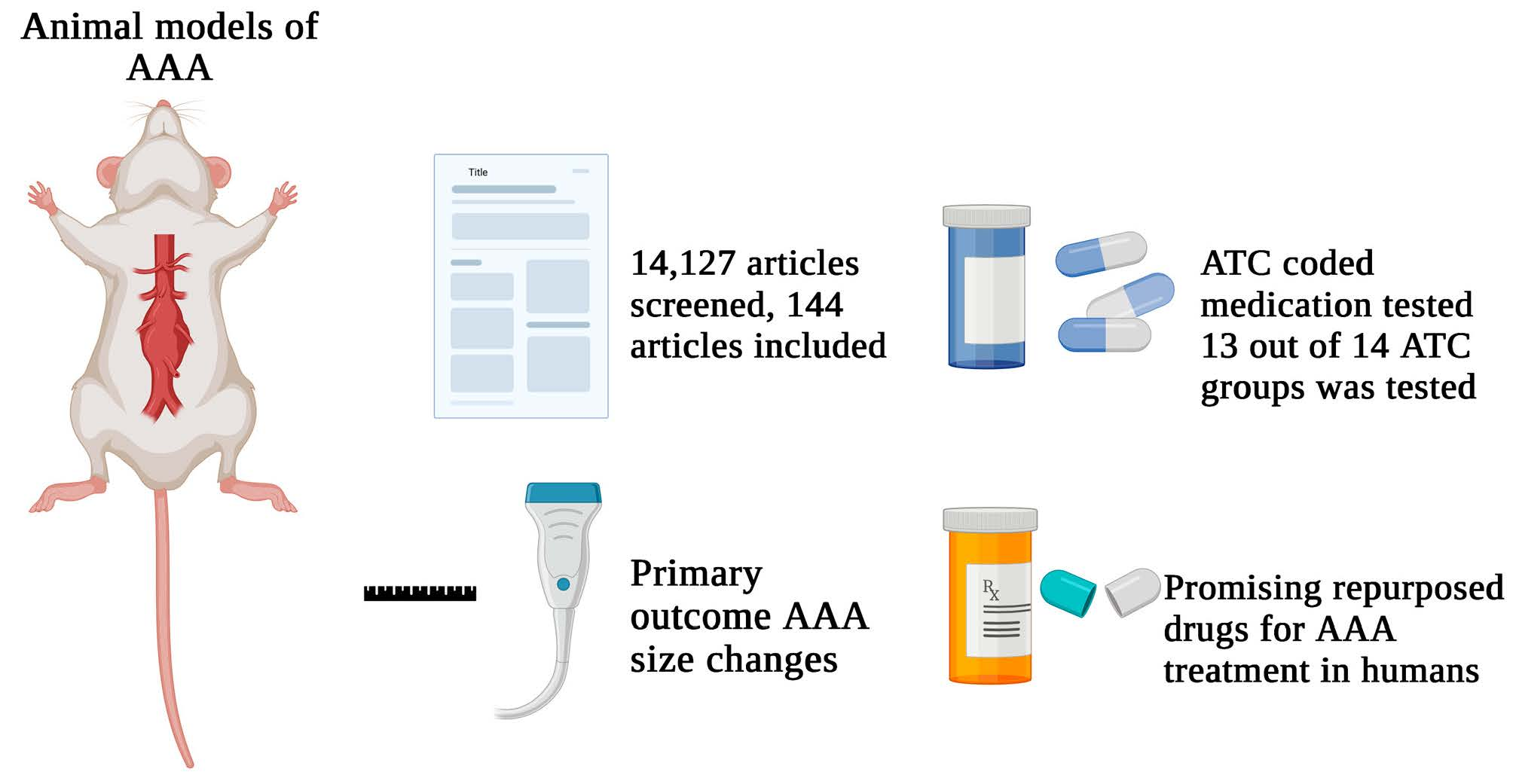

Therapeutic Strategies for Abdominal Aortic Aneurysm: A Comprehensive Systematic Review

 , and
, and
Abstract
1. Introduction
2. Materials and Methods
2.1. Design and Protocol
2.2. Literature Search Strategy
2.3. Inclusion and Exclusion Criteria
2.3.1. Inclusion Criteria
- Preclinical animal studies inducing aortic aneurysms.
- Investigated pharmaceutical drugs classified under the Anatomical Therapeutic Chemical (ATC) system for their effects on AAA progression, development, or growth.
- Reported aneurysm size measurements as an outcome to evaluate treatment effectiveness.
- Included a control group for comparison.
- Published in a peer-reviewed journal.
- Written in English.
2.3.2. Exclusion Criteria
- Investigated treatments that do not have an ATC code.
- Used experimental therapies, including stem cells, nanoparticles, or gene therapy.
- Focused on dietary supplements, vitamins, or nutrition-based interventions.
- Were tissue- or cell-based studies (ex vivo or in vitro research).
- Used genetic modifications unrelated to the AAA model.
- Studied AAA associated with Marfan syndrome, Ehlers–Danlos syndrome, or other genetic disorders.
2.4. Article Selection Process
2.5. Data Extraction
- General Study Information: Title, authors, publication year, journal.
- Animal Model Details: Species, aneurysm induction method, sample size, study duration.
- Pharmacological Intervention: Drug name, ATC classification, dosage, route of administration.
- Outcome Measures: AAA size changes.
- Extracted data were categorized by ATC drug classifications at the 1st level. Any discrepancies were resolved through discussion and reassessment by the two reviewers.
2.6. Risk of Bias Assessment
3. Results
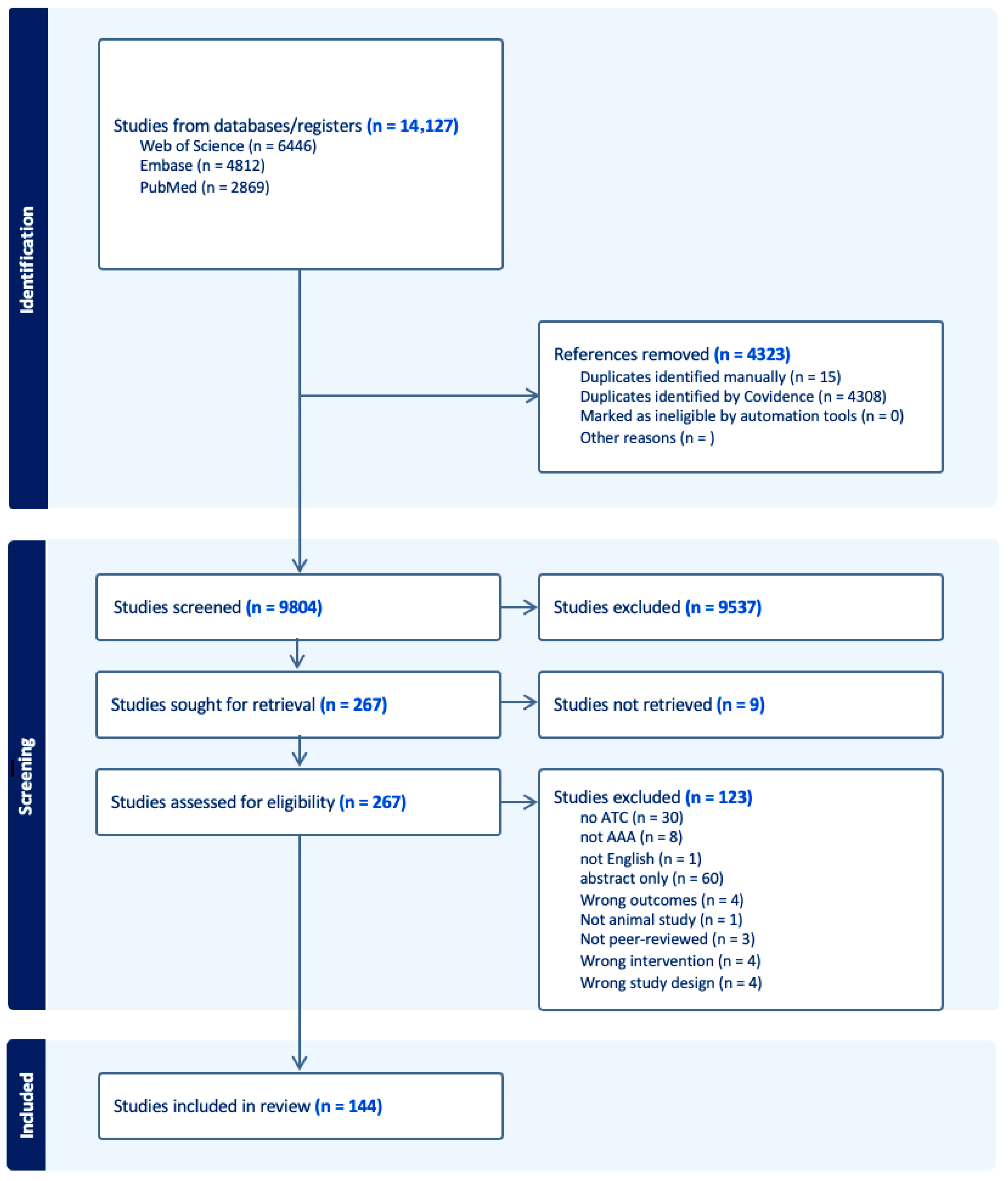
3.1. Study Selection
3.2. Overview of Included Studies
3.3. ATC Groups
3.3.1. ATC Group A–Alimentary Tract and Metabolism
3.3.2. ATC Group B–Blood and Blood Forming Organs
3.3.3. ATC Group C–Cardiovascular System
3.3.4. ATC Group D–Dermatologicals
3.3.5. ATC Group G–Genito-Urinary System and Sex Hormones
3.3.6. ATC Group H–Systemic Hormonal Preparations
3.3.7. ATC Group J–Anti-Infective for Systemic Use
3.3.8. ATC Group L–Antineoplastic and Immunomodulating Agents
3.3.9. ATC Group M–Musculoskeletal System
3.3.10. ATC Group N–Nervous System
3.3.11. ATC Group P–Antiparasitic Products
3.3.12. ATC Group R–Respiratory System
3.3.13. ATC Group S–Sensory Organs
3.3.14. Risk of Bias Assessment Results

| ATC Group | Main Category | Total | Low Risk n (%) | Medium Risk n (%) | High Risk n (%) |
|---|---|---|---|---|---|
| A | Alimentary tract and metabolism | 17 | 0 (0.0%) | 9 (52.9%) | 8 (47.1%) |
| B | Blood and blood-forming organs | 8 | 0 (0.0%) | 4 (50.0%) | 4 (50.0%) |
| C | Cardiovascular system | 50 | 3 (6.0%) | 19 (38.0%) | 28 (56.0%) |
| D | Dermatologicals | 1 | 0 (0.0%) | 1 (100.0%) | 0 (0.0%) |
| G | Genito-urinary system and sex hormones | 3 | 0 (0.0%) | 3 (100.0%) | 0 (0.0%) |
| H | Systemic hormonal preparations | 1 | 0 (0.0%) | 1 (100.0%) | 0 (0.0%) |
| J | Anti-infectives for systemic use | 13 | 0 (0.0%) | 9 (69.2%) | 4 (30.8%) |
| L | Antineoplastic and immunomodulating agents | 22 | 1 (4.5%) | 9 (40.9%) | 12 (54.5%) |
| M | Musculoskeletal system | 8 | 1 (12.5%) | 2 (25.0%) | 5 (62.5%) |
| N | Nervous system | 12 | 2 (16.7%) | 5 (41.7%) | 5 (41.7%) |
| P | Antiparasitic products | 2 | 0 (0.0%) | 1 (50.0%) | 1 (50.0%) |
| R | Respiratory system | 5 | 0 (0.0%) | 3 (60.0%) | 2 (40.0%) |
| S | Sensory organs | 1 | 0 (0.0%) | 1 (100.0%) | 0 (0.0%) |
4. Discussion
5. Conclusions
Supplementary Materials
Author Contributions
Funding
Institutional Review Board Statement
Informed Consent Statement
Data Availability Statements
Acknowledgments
Conflicts of Interest
References
- Golledge, J.; Muller, J.; Daugherty, A.; Norman, P. Abdominal aortic aneurysm: Pathogenesis and implications for management. Arterioscler. Thromb. Vasc. Biol. 2006, 26, 2605–2613. [Google Scholar] [CrossRef]
- Wanhainen, A.; Herzeele, I.V.; Goncalves, F.B.; Montoya, S.B.; Berard, X.; Boyle, J.R.; D’Oria, M.; Prendes, C.F.; Karkos, C.D.; Kazimierczak, A.; et al. Editor’s Choice—European Society for Vascular Surgery (ESVS) 2024 Clinical Practice Guidelines on the Management of Abdominal Aorto-Iliac Artery Aneurysms. Eur. J. Vasc. Endovasc. Surg. 2024, 67, 192–331. [Google Scholar] [CrossRef]
- Powell, J.T.; Sweeting, M.J.; Brown, L.C.; Gotensparre, S.M.; Fowkes, F.G.; Thompson, S.G. Systematic review and meta-analysis of growth rates of small abdominal aortic aneurysms. Br. J. Surg. 2011, 98, 609–618. [Google Scholar] [CrossRef]
- Rudarakanchana, N.; Powell, J.T. Advances in imaging and surveillance of AAA: When, how, how often? Prog. Cardiovasc. Dis. 2013, 56, 7–12. [Google Scholar] [CrossRef] [PubMed]
- Kuivaniemi, H.; Ryer, E.J.; Elmore, J.R.; Tromp, G. Understanding the pathogenesis of abdominal aortic aneurysms. Expert Rev. Cardiovasc. Ther. 2015, 13, 975–987. [Google Scholar] [CrossRef]
- Niu, W.; Shao, J.; Yu, B.; Liu, G.; Wang, R.; Dong, H.; Che, H.; Li, L. Association Between Metformin and Abdominal Aortic Aneurysm: A Meta-Analysis. Front. Cardiovasc. Med. 2022, 9, 908747. [Google Scholar] [CrossRef]
- Kristensen, J.S.S.; Krasniqi, L.; Obel, L.M.; Kavaliunaite, E.; Liisberg, M.; Lindholt, J.S. Exploring Drug Re-Purposing for Treatment of Abdominal Aortic Aneurysms: A Systematic Review and Meta-analysis. Eur. J. Vasc. Endovasc. Surg. 2023, 67, 570–582. [Google Scholar] [CrossRef] [PubMed]
- Parvizi, M.; Harmsen, M.C. Therapeutic Prospect of Adipose-Derived Stromal Cells for the Treatment of Abdominal Aortic Aneurysm. Stem Cells Dev. 2015, 24, 1493–1505. [Google Scholar] [CrossRef] [PubMed]
- Amirsardari, Z.; Khalili, A.; Behnoush, A.H.; Agahi, S.; Amirsardari, F.; Kohansal, E.; Sadeghipour, P. Bridging the gap: Navigating the impact of dietary supplements on abdominal aortic aneurysm progression—A systematic review. PLoS ONE 2024, 19, e0305265. [Google Scholar] [CrossRef]
- Pushpakom, S.; Iorio, F.; Eyers, P.A.; Escott, K.J.; Hopper, S.; Wells, A.; Doig, A.; Guilliams, T.; Latimer, J.; McNamee, C.; et al. Drug repurposing: Progress, challenges and recommendations. Nat. Rev. Drug Discov. 2019, 18, 41–58. [Google Scholar] [CrossRef]
- Animal Models Used to Explore Abdominal Aortic Aneurysms: A Systematic Review—PubMed. Available online: https://pubmed.ncbi.nlm.nih.gov/27543385/ (accessed on 9 October 2024).
- Trollope, A.; Moxon, J.V.; Moran, C.S.; Golledge, J. Animal models of abdominal aortic aneurysm and their role in furthering management of human disease. Cardiovasc. Pathol. 2011, 20, 114–123. [Google Scholar] [CrossRef] [PubMed]
- He, J.; Li, N.; Fan, Y.; Zhao, X.; Liu, C.; Hu, X. Metformin Inhibits Abdominal Aortic Aneurysm Formation through the Activation of the AMPK/mTOR Signaling Pathway. J. Vasc. Res. 2021, 58, 148–158. [Google Scholar] [CrossRef] [PubMed]
- Kunath, A.; Unosson, J.; Friederich-Persson, M.; Bjarnegård, N.; Becirovic-Agic, M.; Björck, M.; Mani, K.; Wanhainen, A.; Wågsäter, D. Inhibition of angiotensin-induced aortic aneurysm by metformin in apolipoprotein E-deficient mice. JVS-Vasc. Sci. 2021, 2, 33–42. [Google Scholar] [CrossRef]
- Wang, Z.; Guo, J.; Han, X.; Xue, M.; Wang, W.; Mi, L.; Sheng, Y.; Ma, C.; Wu, J.; Wu, X. Metformin represses the pathophysiology of AAA by suppressing the activation of PI3K/AKT/mTOR/autophagy pathway in ApoE-/- mice. Cell Biosci. 2019, 9, 68. [Google Scholar] [CrossRef]
- Xu, B.; Li, G.; Li, Y.; Deng, H.; Cabot, A.; Guo, J.; Samura, M.; Zheng, X.; Chen, T.; Zhao, S.; et al. Mechanisms and efficacy of metformin-mediated suppression of established experimental abdominal aortic aneurysms. JVS-Vasc. Sci. 2023, 4, 100102. [Google Scholar] [CrossRef]
- Golledge, J.; Cullen, B.; Rush, C.; Moran, C.S.; Secomb, E.; Wood, F.; Daugherty, A.; Campbell, J.H.; Norman, P.E. Peroxisome proliferator-activated receptor ligands reduce aortic dilatation in a mouse model of aortic aneurysm. Atherosclerosis 2010, 210, 51–56. [Google Scholar] [CrossRef]
- Wang, W.-D.; Sun, R.; Chen, Y.-X. PPARγ agonist rosiglitazone alters the temporal and spatial distribution of inflammation during abdominal aortic aneurysm formation. Mol. Med. Rep. 2018, 18, 3421–3428. [Google Scholar] [CrossRef]
- Jones, A.; Deb, R.; Torsney, E.; Howe, F.; Dunkley, M.; Gnaneswaran, Y.; Gaze, D.; Nasr, H.; Loftus, I.M.; Thompson, M.M.; et al. Rosiglitazone reduces the development and rupture of experimental aortic aneurysms. Circulation 2009, 119, 3125–3132. [Google Scholar] [CrossRef]
- Liu, H.; Wei, P.; Fu, W.; Xia, C.; Li, Y.; Tian, K.; Li, Y.; Cheng, D.; Sun, J.; Xu, Y.; et al. Dapagliflozin Ameliorates the Formation and Progression of Experimental Abdominal Aortic Aneurysms by Reducing Aortic Inflammation in Mice. Oxid. Med. Cell. Longev. 2022, 2022, 8502059. [Google Scholar] [CrossRef]
- Ortega, R.; Collado, A.; Selles, F.; Gonzalez-Navarro, H.; Sanz, M.-J.; Real, J.T.; Piqueras, L. SGLT-2 (Sodium-Glucose Cotransporter 2) Inhibition Reduces Ang II (Angiotensin II)-Induced Dissecting Abdominal Aortic Aneurysm in ApoE (Apolipoprotein E) Knockout Mice. Arterioscler. Thromb. Vasc. Biol. 2019, 39, 1614–1628. [Google Scholar] [CrossRef] [PubMed]
- Bao, W.; Morimoto, K.; Hasegawa, T.; Sasaki, N.; Yamashita, T.; Hirata, K.; Okita, Y.; Okada, K. Orally administered dipeptidyl peptidase-4 inhibitor (alogliptin) prevents abdominal aortic aneurysm formation through an antioxidant effect in rats. J. Vasc. Surg. 2014, 59, 1098–1108. [Google Scholar] [CrossRef] [PubMed]
- Lu, H.Y.; Huang, C.Y.; Shih, C.M.; Chang, W.H.; Tsai, C.S.; Lin, F.Y.; Shih, C.C. Dipeptidyl Peptidase-4 Inhibitor Decreases Abdominal Aortic Aneurysm Formation through GLP-1-Dependent Monocytic Activity in Mice. PLoS ONE 2015, 10, e0121077. [Google Scholar] [CrossRef]
- Takahara, Y.; Tokunou, T.; Ichiki, T. Suppression of Abdominal Aortic Aneurysm Formation in Mice by Teneligliptin, a Dipeptidyl Peptidase-4 Inhibitor. J. Atheroscler. Thromb. 2018, 25, 698–708. [Google Scholar] [CrossRef]
- Yu, J.; Morimoto, K.; Bao, W.; Yu, Z.; Okita, Y.; Okada, K. Glucagon-like peptide-1 prevented abdominal aortic aneurysm development in rats. Surg. Today 2016, 46, 1099–1107. [Google Scholar] [CrossRef]
- Zhao, X.; Cheng, Z.; Zhang, H.; Guo, Y.; Zhao, L.; Zhang, C.; Ye, P.; Zhang, K.; Ma, X.; Wu, Q. Glucagon-Like Peptide-1 Inhibits the Progression of Abdominal Aortic Aneurysm in Mice: The Earlier, the Better. Cardiovasc. Drugs Ther. 2024, 38, 873–884. [Google Scholar] [CrossRef]
- Kohashi, K.; Hiromura, M.; Mori, Y.; Terasaki, M.; Watanabe, T.; Kushima, H.; Shinmura, K.; Tomoyasu, M.; Nagashima, M.; Hirano, T. A Dipeptidyl Peptidase-4 Inhibitor but not Incretins Suppresses Abdominal Aortic Aneurysms in Angiotensin II-Infused Apolipoprotein E-Null Mice. J. Atheroscler. Thromb. 2016, 23, 441–454. [Google Scholar] [CrossRef]
- Jreije, A.; Medlej-Hashim, M.; Hajal, J.; Saliba, Y.; Chacar, S.; Fares, N.; Khouzami, L. Calcitriol Supplementation Protects Against Apoptosis and Alleviates the Severity of Abdominal Aortic Aneurysm Induced by Angiotensin II and Anti-TGFβ. J Cardiovasc. Transl. Res. 2022, 15, 1340–1351. [Google Scholar] [CrossRef]
- Martorell, S.; Hueso, L.; Gonzalez-Navarro, H.; Collado, A.; Sanz, M.-J.; Piqueras, L. Vitamin D Receptor Activation Reduces Angiotensin-II-Induced Dissecting Abdominal Aortic Aneurysm in Apolipoprotein E-Knockout Mice. Arterioscler. Thromb. Vasc. Biol. 2016, 36, 1587–1597. [Google Scholar] [CrossRef] [PubMed]
- Owens, A.P.; Edwards, T.L.; Antoniak, S.; Geddings, J.E.; Jahangir, E.; Wei, W.-Q.; Denny, J.C.; Boulaftali, Y.; Bergmeier, W.; Daugherty, A.; et al. Platelet Inhibitors Reduce Rupture in a Mouse Model of Established Abdominal Aortic Aneurysm. Arterioscler. Thromb. Vasc. Biol. 2015, 35, 2032–2041. [Google Scholar] [CrossRef]
- Zhang, Q.; Huang, J.-H.; Xia, R.-P.; Duan, X.-H.; Jiang, Y.-B.; Jiang, Q.; Sun, W.-J. Suppression of experimental abdominal aortic aneurysm in a rat model by the phosphodiesterase 3 inhibitor cilostazol. J. Surg. Res. 2011, 167, e385–e393. [Google Scholar] [CrossRef] [PubMed]
- Liu, O.; Jia, L.; Liu, X.; Wang, Y.; Wang, X.; Qin, Y.; Du, J.; Zhang, H. Clopidogrel, a platelet P2Y12 receptor inhibitor, reduces vascular inflammation and angiotensin II induced-abdominal aortic aneurysm progression. PLoS ONE 2012, 7, e51707. [Google Scholar] [CrossRef] [PubMed]
- Umebayashi, R.; Uchida, H.A.; Kakio, Y.; Subramanian, V.; Daugherty, A.; Wada, J. Cilostazol Attenuates Angiotensin II-Induced Abdominal Aortic Aneurysms but Not Atherosclerosis in Apolipoprotein E-Deficient Mice. Arterioscler. Thromb. Vasc. Biol. 2018, 38, 903–912. [Google Scholar] [CrossRef]
- Ding, Y.; Li, X.; Zhou, M.; Cai, L.; Tang, H.; Xie, T.; Shi, Z.; Fu, W. Factor Xa inhibitor rivaroxaban suppresses experimental abdominal aortic aneurysm progression via attenuating aortic inflammation. Vascul. Pharmacol. 2021, 136, 106818. [Google Scholar] [CrossRef]
- Moran, C.S.; Seto, S.-W.; Krishna, S.M.; Sharma, S.; Jose, R.J.; Biros, E.; Wang, Y.; Morton, S.K.; Golledge, J. Parenteral administration of factor Xa/IIa inhibitors limits experimental aortic aneurysm and atherosclerosis. Sci. Rep. 2017, 7, 43079. [Google Scholar] [CrossRef]
- Li, G.; Zhou, H.; He, Y.; Sun, S.; Wu, X.; Yuan, H. Ulinastatin Inhibits the Formation and Progression of Experimental Abdominal Aortic Aneurysms. J. Vasc. Res. 2020, 57, 58–64. [Google Scholar] [CrossRef] [PubMed]
- Huang, K.; Wu, Y.; Zhang, Y.; Youn, J.Y.; Cai, H. Combination of folic acid with nifedipine is completely effective in attenuating aortic aneurysm formation as a novel oral medication. Redox Biol. 2022, 58, 102521. [Google Scholar] [CrossRef]
- Daugherty, A.; Manning, M.W.; Cassis, L.A. Antagonism of AT2 receptors augments Angiotensin II-induced abdominal aortic aneurysms and atherosclerosis. Br. J. Pharmacol. 2001, 134, 865–870. [Google Scholar] [CrossRef]
- Fujiwara, Y.; Shiraya, S.; Miyake, T.; Yamakawa, S.; Aoki, M.; Makino, H.; Nishimura, M.; Morishita, R. Inhibition of experimental abdominal aortic aneurysm in a rat model by the angiotensin receptor blocker valsartan. Int. J. Mol. Med. 2008, 22, 703–708. [Google Scholar]
- Hall, S.; Ward, N.D.; Patel, R.; Amin-Javaheri, A.; Lanford, H.; Grespin, R.T.; Couch, C.; Xiong, Y.; Mukherjee, R.; Jones, J.A.; et al. Mechanical activation of the angiotensin II type 1 receptor contributes to abdominal aortic aneurysm formation. JVS-Vasc. Sci. 2021, 2, 194–206. [Google Scholar] [CrossRef]
- Hosokawa, Y. Effects of angiotensin receptor blocker and calcium channel blocker on experimental abdominal aortic aneurysms in a hamster model. Kurume Med. J. 2010, 57, 1–8. [Google Scholar] [CrossRef] [PubMed][Green Version]
- Inoue, N.; Muramatsu, M.; Jin, D.; Takai, S.; Hayashi, T.; Katayama, H.; Kitaura, Y.; Tamai, H.; Miyazaki, M. Involvement of vascular angiotensin II-forming enzymes in the progression of aortic abdominal aneurysms in angiotensin II-infused ApoE-deficient mice. J. Atheroscler. Thromb. 2009, 16, 164–171. [Google Scholar] [CrossRef]
- Kaschina, E.; Schrader, F.; Sommerfeld, M.; Kemnitz, U.R.; Grzesiak, A.; Krikov, M.; Unger, T. Telmisartan prevents aneurysm progression in the rat by inhibiting proteolysis, apoptosis and inflammation. J. Hypertens. 2008, 26, 2361–2373. [Google Scholar] [CrossRef] [PubMed]
- Liao, S.; Miralles, M.; Kelley, B.J.; Curci, J.A.; Borhani, M.; Thompson, R.W. Suppression of experimental abdominal aortic aneurysms in the rat by treatment with angiotensin-converting enzyme inhibitors. J. Vasc. Surg. 2001, 33, 1057–1064. [Google Scholar] [CrossRef]
- Nguyen, T.L.L.; Van Nguyen, D.; Jin, Y.; Kim, L.; Heo, K.-S. Potential effects of a human milk oligosaccharide 6′-sialyllactose on angiotensin II-induced aortic aneurysm via p90RSK/TGF-β/SMAD2 signaling pathway. Arch. Pharm. Res. 2024, 47, 854–869. [Google Scholar] [CrossRef]
- Nakahara, T.; Miyazawa, R.; Iwabuchi, Y.; Tonda, K.; Narula, N.; Strauss, H.W.; Narula, J.; Jinzaki, M. Aortic Uptake of 18F-NaF and 18F-FDG and Calcification Predict the Development of Abdominal Aortic Aneurysms and Is Attenuated by Drug Therapy. Arterioscler. Thromb. Vasc. Biol. 2024, 44, 1975–1985. [Google Scholar] [CrossRef]
- Alsiraj, Y.; Thatcher, S.E.; Liang, C.L.; Ali, H.; Ensor, M.; Cassis, L.A. Therapeutic Assessment of Combination Therapy with a Neprilysin Inhibitor and Angiotensin Type 1 Receptor Antagonist on Angiotensin II–Induced Atherosclerosis, Abdominal Aortic Aneurysms, and Hypertension. J. Pharmacol. Exp. Ther. 2021, 377, 326–335. [Google Scholar] [CrossRef] [PubMed]
- Xuan, H.; Xu, B.; Wang, W.; Tanaka, H.; Fujimura, N.; Miyata, M.; Michie, S.A.; Dalman, R.L. Inhibition or deletion of angiotensin II type 1 receptor suppresses elastase-induced experimental abdominal aortic aneurysms. J. Vasc. Surg. 2018, 67, 573–584.e2. [Google Scholar] [CrossRef]
- Karasaki, K.; Kokubo, H.; Bumdelger, B.; Kaji, N.; Sakai, C.; Ishida, M.; Yoshizumi, M. Angiotensin II Type 1 Receptor Blocker Prevents Abdominal Aortic Aneurysm Progression in Osteoprotegerin-Deficient Mice via Upregulation of Angiotensin (1–7). J. Am. Heart Assoc. 2023, 12, e027589. [Google Scholar] [CrossRef]
- Iida, Y.; Xu, B.; Schultz, G.M.; Chow, V.; White, J.J.; Sulaimon, S.; Hezi-Yamit, A.; Peterson, S.R.; Dalman, R.L. Efficacy and mechanism of angiotensin II receptor blocker treatment in experimental abdominal aortic aneurysms. PLoS ONE 2012, 7, e49642. [Google Scholar] [CrossRef]
- Alsac, J.-M.; Journe, C.; Louedec, L.; Dai, J.; Julia, P.; Fabiani, J.-N.; Michel, J.-B. Downregulation of remodelling enzymatic activity induced by an angiotensin-converting enzyme inhibitor (perindopril) reduces the degeneration of experimental abdominal aortic aneurysms in a rat model. Eur. J. Vasc. Endovasc. Surg. Off. J. Eur. Soc. Vasc. Surg. 2011, 41, 474–480. [Google Scholar] [CrossRef] [PubMed]
- Park, S.M.; Hong, M.-K.; Kim, S.H.; Jung, S.; Kim, B.K.; Choi, D. Comparison of Efficacy between Ramipril and Carvedilol on Limiting the Expansion of Abdominal Aortic Aneurysm in Mouse Model. J. Cardiovasc. Pharmacol. Ther. 2019, 24, 172–181. [Google Scholar] [CrossRef]
- Takai, S.; Jin, D.; Yamamoto, D.; Li, Z.-L.; Otsuki, Y.; Miyazaki, M. Significance of matrix metalloproteinase-9 inhibition by imidapril for prevention of abdominal aortic aneurysms in angiotensin II type 1 receptor-knockout mice. J. Pharmacol. Sci. 2013, 123, 185–194. [Google Scholar] [CrossRef] [PubMed][Green Version]
- Xiong, F.; Zhao, J.; Zeng, G.; Huang, B.; Yuan, D.; Yang, Y. Inhibition of AAA in a rat model by treatment with ACEI perindopril. J. Surg. Res. 2014, 189, 166–173. [Google Scholar] [CrossRef]
- Fu, Y.; Huang, J.; Tang, H.; Li, X.; Zhang, Q. Benazepril Inhibits the Formation of Abdominal Aortic Aneurysms in Rabbits. Life Sci. J. 2011, 8, 606–612. [Google Scholar]
- Hao, Q.; Dong, X.; Chen, X.; Yan, F.; Wang, X.; Shi, H.; Dong, B. Angiotensin-Converting Enzyme 2 Inhibits Angiotensin II-Induced Abdominal Aortic Aneurysms in Mice. Hum. Gene Ther. 2018, 29, 1387–1395. [Google Scholar] [CrossRef]
- Chen, X.; Rateri, D.L.; Howatt, D.A.; Balakrishnan, A.; Moorleghen, J.J.; Morris, A.J.; Charnigo, R.; Cassis, L.A.; Daugherty, A. Amlodipine reduces AngII-induced aortic aneurysms and atherosclerosis in hypercholesterolemic mice. PLoS ONE 2013, 8, e81743. [Google Scholar] [CrossRef] [PubMed]
- Miao, X.N.; Siu, K.L.; Cai, H. Nifedipine attenuation of abdominal aortic aneurysm in hypertensive and non-hypertensive mice: Mechanisms and implications. J. Mol. Cell. Cardiol. 2015, 87, 152–159. [Google Scholar] [CrossRef]
- Mieth, A.; Revermann, M.; Babelova, A.; Weigert, A.; Schermuly, R.T.; Brandes, R.P. L-type calcium channel inhibitor diltiazem prevents aneurysm formation by blood pressure-independent anti-inflammatory effects. Hypertension 2013, 62, 1098–1104. [Google Scholar] [CrossRef] [PubMed]
- Tomita, N.; Yamasaki, K.; Izawa, K.; Kunugiza, Y.; Osako, M.K.; Ogihara, T.; Morishita, R. Inhibition of experimental abdominal aortic aneurysm progression by nifedipine. Int. J. Mol. Med. 2008, 21, 239–244. [Google Scholar] [CrossRef]
- Yokokura, H.; Hiromatsu, S.; Akashi, H.; Kato, S.; Aoyagi, S. Effects of calcium channel blocker azelnidipine on experimental abdominal aortic aneurysms. Surg. Today 2007, 37, 468–473. [Google Scholar] [CrossRef]
- Ladd, Z.; Su, G.; Hartman, J.; Lu, G.; Hensley, S.; Upchurch, G.R.; Sharma, A.K. Pharmacologic inhibition by spironolactone attenuates experimental abdominal aortic aneurysms. Front. Cardiovasc. Med. 2023, 10, 1101389. [Google Scholar] [CrossRef] [PubMed]
- Wu, T.-C.; Chang, W.-H.; Lu, H.-Y.; Shih, C.-C. Tolvaptan reduces angiotensin II-induced experimental abdominal aortic aneurysm and dissection. Vascul. Pharmacol. 2022, 144, 106973. [Google Scholar] [CrossRef] [PubMed]
- Miyake, T.; Miyake, T.; Shimizu, H.; Morishita, R. Inhibition of Aneurysm Progression by Direct Renin Inhibition in a Rabbit Model. Hypertension 2017, 70, 1201–1209. [Google Scholar] [CrossRef]
- Seto, S.-W.; Krishna, S.M.; Moran, C.S.; Liu, D.; Golledge, J. Aliskiren limits abdominal aortic aneurysm, ventricular hypertrophy and atherosclerosis in an apolipoprotein-E-deficient mouse model. Clin. Sci. 2014, 127, 123–134. [Google Scholar] [CrossRef] [PubMed]
- Wang, Y.; Sargisson, O.; Nguyen, D.T.; Parker, K.; Pyke, S.J.R.; Alramahi, A.; Thihlum, L.; Fang, Y.; Wallace, M.E.; Berzins, S.P.; et al. Effect of Hydralazine on Angiotensin II-Induced Abdominal Aortic Aneurysm in Apolipoprotein E-Deficient Mice. Int. J. Mol. Sci. 2023, 24, 15955. [Google Scholar] [CrossRef]
- Wang, W.; Xu, B.; Xuan, H.; Ge, Y.; Wang, Y.; Wang, L.; Huang, J.; Fu, W.; Michie, S.A.; Dalman, R.L. Hypoxia-inducible factor 1 in clinical and experimental aortic aneurysm disease. J. Vasc. Surg. 2018, 68, 1538–1550.e2. [Google Scholar] [CrossRef]
- Wei, Z.; Wang, Y.; Zhang, K.; Liao, Y.; Ye, P.; Wu, J.; Wang, Y.; Li, F.; Yao, Y.; Zhou, Y.; et al. Inhibiting the Th17/IL-17A-related inflammatory responses with digoxin confers protection against experimental abdominal aortic aneurysm. Arterioscler. Thromb. Vasc. Biol. 2014, 34, 2429–2438. [Google Scholar] [CrossRef]
- Simpson, C.F.; Kling, J.M.; Palmer, R.F. Beta-aminopropionitrile-induced dissecting aneurysms of turkeys: Treatment with propranolol. Toxicol. Appl. Pharmacol. 1970, 16, 143–153. [Google Scholar] [CrossRef]
- Slaiby, J.M.; Ricci, M.A.; Gadowski, G.R.; Hendley, E.D.; Pilcher, D.B. Expansion of aortic aneurysms is reduced by propranolol in a hypertensive rat model. J. Vasc. Surg. 1994, 20, 178–183. [Google Scholar] [CrossRef]
- Ricci, M.A.; Slaiby, J.M.; Gadowski, G.R.; Hendley, E.D.; Nichols, P.; Pilcher, D.B. Effects of hypertension and propranolol upon aneurysm expansion in the Anidjar/Dobrin aneurysm model. Ann. N. Y. Acad. Sci. 1996, 800, 89–96. [Google Scholar] [CrossRef]
- Escudero, P.; Navarro, A.; Ferrando, C.; Furio, E.; Gonzalez-Navarro, H.; Juez, M.; Sanz, M.J.; Piqueras, L. Combined treatment with bexarotene and rosuvastatin reduces angiotensin-II-induced abdominal aortic aneurysm in apoE(-/-) mice and angiogenesis. Br. J. Pharmacol. 2015, 172, 2946–2960. [Google Scholar] [CrossRef]
- Golledge, J.; Cullen, B.; Moran, C.; Rush, C. Efficacy of simvastatin in reducing aortic dilatation in mouse models of abdominal aortic aneurysm. Cardiovasc. Drugs Ther. 2010, 24, 373–378. [Google Scholar] [CrossRef]
- Kalyanasundaram, A.; Elmore, J.R.; Manazer, J.R.; Golden, A.; Franklin, D.P.; Galt, S.W.; Zakhary, E.M.A.; Carey, D.J. Simvastatin suppresses experimental aortic aneurysm expansion. J. Vasc. Surg. 2006, 43, 117–124. [Google Scholar] [CrossRef]
- Kopacz, A.; Werner, E.; Grochot-Przęczek, A.; Klóska, D.; Hajduk, K.; Neumayer, C.; Józkowicz, A.; Piechota-Polanczyk, A. Simvastatin Attenuates Abdominal Aortic Aneurysm Formation Favoured by Lack of Nrf2 Transcriptional Activity. Oxid. Med. Cell. Longev. 2020, 2020, 6340190. [Google Scholar] [CrossRef]
- Mastoraki, S.T.; Toumpoulis, I.K.; Anagnostopoulos, C.E.; Tiniakos, D.; Papalois, A.; Chamogeorgakis, T.P.; Angouras, D.C.; Rokkas, C.K. Treatment with simvastatin inhibits the formation of abdominal aortic aneurysms in rabbits. Ann. Vasc. Surg. 2012, 26, 250–258. [Google Scholar] [CrossRef]
- Meng, L.; Lu, Y.; Wang, X.; Sui, W.; Ge, X.; Zhong, M.; Meng, X.; Zhang, Y. Statin therapy protects against abdominal aortic aneurysms by inducing the accumulation of regulatory T cells in ApoE-/- mice. J. Mol. Med. Berl. Ger. 2022, 100, 1057–1070. [Google Scholar] [CrossRef] [PubMed]
- Shiraya, S.; Miyake, T.; Aoki, M.; Yoshikazu, F.; Ohgi, S.; Nishimura, M.; Ogihara, T.; Morishita, R. Inhibition of development of experimental aortic abdominal aneurysm in rat model by atorvastatin through inhibition of macrophage migration. Atherosclerosis 2009, 202, 34–40. [Google Scholar] [CrossRef] [PubMed]
- Steinmetz, E.F.; Buckley, C.; Shames, M.L.; Ennis, T.L.; Vanvickle-Chavez, S.J.; Mao, D.; Goeddel, L.A.; Hawkins, C.J.; Thompson, R.W. Treatment with simvastatin suppresses the development of experimental abdominal aortic aneurysms in normal and hypercholesterolemic mice. Ann. Surg. 2005, 241, 92–101. [Google Scholar] [CrossRef] [PubMed]
- Takahashi, K.; Matsumoto, Y.; Do e, Z.; Kanazawa, M.; Satoh, K.; Shimizu, T.; Sato, A.; Fukumoto, Y.; Shimokawa, H. Combination therapy with atorvastatin and amlodipine suppresses angiotensin II-induced aortic aneurysm formation. PLoS ONE 2013, 8, e72558. [Google Scholar] [CrossRef]
- Zhang, Y.; Naggar, J.C.; Welzig, C.M.; Beasley, D.; Moulton, K.S.; Park, H.-J.; Galper, J.B. Simvastatin inhibits angiotensin II-induced abdominal aortic aneurysm formation in apolipoprotein E-knockout mice: Possible role of ERK. Arterioscler. Thromb. Vasc. Biol. 2009, 29, 1764–1771. [Google Scholar] [CrossRef]
- Ma, H.; Liang, W.-J.; Shan, M.-R.; Wang, X.-Q.; Zhou, S.-N.; Chen, Y.; Guo, T.; Li, P.; Yu, H.-Y.; Liu, C.; et al. Pravastatin activates activator protein 2 alpha to augment the angiotensin II-induced abdominal aortic aneurysms. Oncotarget 2017, 8, 14294–14305. [Google Scholar] [CrossRef]
- Li, Y.; Lu, G.; Sun, D.; Zuo, H.; Wang, D.W.; Yan, J. Inhibition of endoplasmic reticulum stress signaling pathway: A new mechanism of statins to suppress the development of abdominal aortic aneurysm. PLoS ONE 2017, 12, e0174821. [Google Scholar] [CrossRef]
- Houdek, K.; Moláček, J.; Třeška, V.; Křížková, V.; Eberlová, L.; Boudová, L.; Nedorost, L.; Tolinger, P.; Kočová, J.; Kobr, J.; et al. Focal histopathological progression of porcine experimental abdominal aortic aneurysm is mitigated by atorvastatin. Int. Angiol. J. Int. Union Angiol. 2013, 32, 291–306. [Google Scholar]
- Wang, J.; Chen, W.; Wang, Y.; Zhang, S.; Bi, H.; Hong, B.; Luo, Y.; Daugherty, A.; Xie, X. Statins exert differential effects on angiotensin II-induced atherosclerosis, but no benefit for abdominal aortic aneurysms. Atherosclerosis 2011, 217, 90–96. [Google Scholar] [CrossRef]
- Amioka, N.; Miyoshi, T.; Yonezawa, T.; Kondo, M.; Akagi, S.; Yoshida, M.; Saito, Y.; Nakamura, K.; Ito, H. Pemafibrate Prevents Rupture of Angiotensin II-Induced Abdominal Aortic Aneurysms. Front. Cardiovasc. Med. 2022, 9, 904215. [Google Scholar] [CrossRef]
- Krishna, S.M.; Seto, S.W.; Moxon, J.V.; Rush, C.; Walker, P.J.; Norman, P.E.; Golledge, J. Fenofibrate increases high-density lipoprotein and sphingosine 1 phosphate concentrations limiting abdominal aortic aneurysm progression in a mouse model. Am. J. Pathol. 2012, 181, 706–718. [Google Scholar] [CrossRef]
- Chen, C.; Wang, Y.; Cao, Y.; Wang, Q.; Anwaier, G.; Zhang, Q.; Qi, R. Mechanisms underlying the inhibitory effects of probucol on elastase-induced abdominal aortic aneurysm in mice. Br. J. Pharmacol. 2020, 177, 204–216. [Google Scholar] [CrossRef] [PubMed]
- Yang, M.; Yuan, Y.; Liu, Y.; Chen, C.; Cao, Y.; Qi, R. Probucol Nanostructured Lipid Carrier Ameliorates Elastase-induced Abdominal Aortic Aneurysm in Mice: Probucol nanostructured lipid carrier ameliorates abdominal aortic aneurysm. Iran. J. Pharm. Sci. 2019, 15, 1–16. [Google Scholar] [CrossRef]
- Horimatsu, T.; Blomkalns, A.L.; Ogbi, M.; Moses, M.; Kim, D.; Patel, S.; Gilreath, N.; Reid, L.; Benson, T.W.; Pye, J.; et al. Niacin protects against abdominal aortic aneurysm formation via GPR109A independent mechanisms: Role of NAD+/nicotinamide. Cardiovasc. Res. 2020, 116, 2226–2238. [Google Scholar] [CrossRef]
- Xiao, J.; Liu, J.; Lio, I.; Yang, C.; Chen, X.; Zhang, H.; Wang, S.; Wei, Z. All-trans retinoic acid attenuates the progression of Ang II-induced abdominal aortic aneurysms in ApoE-/-mice. J. Cardiothorac. Surg. 2020, 15, 160. [Google Scholar] [CrossRef] [PubMed]
- Davis, J.P.; Salmon, M.; Pope, N.H.; Lu, G.; Su, G.; Meher, A.; Ailawadi, G.; Upchurch, G.R. Pharmacologic Blockade and Genetic Deletion of Androgen Receptor Attenuates Aortic Aneurysm Formation. J. Vasc. Surg. 2016, 63, 1602–1612.e2. [Google Scholar] [CrossRef] [PubMed]
- Montgomery, W.G.; Spinosa, M.D.; Cullen, J.M.; Salmon, M.D.; Su, G.; Hassinger, T.; Sharma, A.K.; Lu, G.; Fashandi, A.; Ailawadi, G.; et al. Tamsulosin attenuates abdominal aortic aneurysm growth. Surgery 2018, 164, 1087–1092. [Google Scholar] [CrossRef]
- Yan, D.; Ma, H.; Shi, W.; Luo, P.; Liu, T.; Guo, J.; Zhai, M.; Tao, J.; Huo, S.; Li, C.; et al. Bazedoxifene Attenuates Abdominal Aortic Aneurysm Formation via Downregulation of Interleukin-6/Glycoprotein 130/Signal Transducer and Activator of Transcription 3 Signaling Pathway in Apolipoprotein E-Knockout Mice. Front. Pharmacol. 2020, 11, 392. [Google Scholar] [CrossRef] [PubMed]
- Wei, X.; Li, Y.; Jiang, T.; Luo, P.; Dai, Y.; Wang, Q.; Xu, M.; Yan, J.; Li, Y.; Gao, J.; et al. Terazosin attenuates abdominal aortic aneurysm formation by downregulating Peg3 expression to inhibit vascular smooth muscle cell apoptosis and senescence. Eur. J. Pharmacol. 2024, 968, 176397. [Google Scholar] [CrossRef]
- Dobrin, P.B.; Baumgartner, N.; Anidjar, S.; Chejfec, G.; Mrkvicka, R. Inflammatory aspects of experimental aneurysms. Effect of methylprednisolone and cyclosporine. Ann. N. Y. Acad. Sci. 1996, 800, 74–88. [Google Scholar] [CrossRef] [PubMed]
- Kaito, K.; Urayama, H.; Watanabe, G. Doxycycline treatment in a model of early abdominal aortic aneurysm. Surg. Today 2003, 33, 426–433. [Google Scholar] [CrossRef]
- Manning, M.W.; Cassis, L.A.; Daugherty, A. Differential effects of doxycycline, a broad-spectrum matrix metalloproteinase inhibitor, on angiotensin II-induced atherosclerosis and abdominal aortic aneurysms. Arterioscler. Thromb. Vasc. Biol. 2003, 23, 483–488. [Google Scholar] [CrossRef]
- Mata, K.M.; Tefé-Silva, C.; Floriano, E.M.; Fernandes, C.R.; Rizzi, E.; Gerlach, R.F.; Mazzuca, M.Q.; Ramos, S.G. Interference of doxycycline pretreatment in a model of abdominal aortic aneurysms. Cardiovasc. Pathol. Off. J. Soc. Cardiovasc. Pathol. 2015, 24, 110–120. [Google Scholar] [CrossRef]
- Petrinec, D.; Liao, S.; Holmes, D.R.; Reilly, J.M.; Parks, W.C.; Thompson, R.W. Doxycycline inhibition of aneurysmal degeneration in an elastase-induced rat model of abdominal aortic aneurysm: Preservation of aortic elastin associated with suppressed production of 92 kD gelatinase. J. Vasc. Surg. 1996, 23, 336–346. [Google Scholar] [CrossRef]
- Prall, A.K.; Longo, G.M.; Mayhan, W.G.; Waltke, E.A.; Fleckten, B.; Thompson, R.W.; Baxter, B.T. Doxycycline in patients with abdominal aortic aneurysms and in mice: Comparison of serum levels and effect on aneurysm growth in mice. J. Vasc. Surg. 2002, 35, 923–929. [Google Scholar] [CrossRef]
- Yu, M.; Chen, C.; Cao, Y.; Qi, R. Inhibitory effects of doxycycline on the onset and progression of abdominal aortic aneurysm and its related mechanisms. Eur. J. Pharmacol. 2017, 811, 101–109. [Google Scholar] [CrossRef]
- Sho, E.; Chu, J.; Sho, M.; Fernandes, B.; Judd, D.; Ganesan, P.; Kimura, H.; Dalman, R.L. Continuous periaortic infusion improves doxycycline efficacy in experimental aortic aneurysms. J. Vasc. Surg. 2004, 39, 1312–1321. [Google Scholar] [CrossRef]
- Curci, J.A.; Petrinec, D.; Liao, S.; Golub, L.M.; Thompson, R.W. Pharmacologic suppression of experimental abdominal aortic aneurysms: Acomparison of doxycycline and four chemically modified tetracyclines. J. Vasc. Surg. 1998, 28, 1082–1093. [Google Scholar] [CrossRef] [PubMed]
- Adams, L.C.; Brangsch, J.; Kaufmann, J.O.; Mangarova, D.B.; Moeckel, J.; Kader, A.; Buchholz, R.; Karst, U.; Botnar, R.M.; Hamm, B.; et al. Effect of Doxycycline on Survival in Abdominal Aortic Aneurysms in a Mouse Model. Contrast Media Mol. Imaging 2021, 2021, 9999847. [Google Scholar] [CrossRef]
- Xie, X.; Lu, H.; Moorleghen, J.J.; Howatt, D.A.; Rateri, D.L.; Cassis, L.A.; Daugherty, A. Doxycycline does not influence established abdominal aortic aneurysms in angiotensin II-infused mice. PLoS ONE 2012, 7, e46411. [Google Scholar] [CrossRef]
- Aoyama, N.; Suzuki, J.-I.; Ogawa, M.; Watanabe, R.; Kobayashi, N.; Hanatani, T.; Yoshida, A.; Ashigaki, N.; Izumi, Y.; Isobe, M. Clarithromycin suppresses the periodontal bacteria-accelerated abdominal aortic aneurysms in mice. J. Periodontal Res. 2012, 47, 463–469. [Google Scholar] [CrossRef] [PubMed]
- LeMaire, S.A.; Zhang, L.; Luo, W.; Ren, P.; Azares, A.R.; Wang, Y.; Zhang, C.; Coselli, J.S.; Shen, Y.H. Effect of Ciprofloxacin on Susceptibility to Aortic Dissection and Rupture in Mice. JAMA Surg. 2018, 153, e181804. [Google Scholar] [CrossRef]
- Çulpan, Y.; Keçeci, İ.; Sandıkçı, İ.; Gökçe, Ş.; Göker, H.; Özyılmaz Yay, N.; Ergelen, R.; Akakın, D.; Gülhan, R. Duration of Ciprofloxacin Use Is Important in the Development of Abdominal Aortic Aneurysm in a Rat Model. Anatol. J. Cardiol. 2022, 26, 810–817. [Google Scholar] [CrossRef]
- Busch, A.; Pauli, J.; Winski, G.; Bleichert, S.; Chernogubova, E.; Metschl, S.; Winter, H.; Trenner, M.; Wiegering, A.; Otto, C.; et al. Lenvatinib halts aortic aneurysm growth by restoring smooth muscle cell contractility. JCI Insight 2021, 6, e140364. [Google Scholar] [CrossRef]
- Ghoshal, S.; Loftin, C.D. Cyclooxygenase-2 inhibition attenuates abdominal aortic aneurysm progression in hyperlipidemic mice. PLoS ONE 2012, 7, e44369. [Google Scholar] [CrossRef]
- Lawrence, D.M.; Singh, R.S.; Franklin, D.P.; Carey, D.J.; Elmore, J.R. Rapamycin suppresses experimental aortic aneurysm growth. J. Vasc. Surg. 2004, 40, 334–338. [Google Scholar] [CrossRef]
- Li, F.-F.; Shang, X.-K.; Du, X.-L.; Chen, S. Rapamycin Treatment Attenuates Angiotensin II-induced Abdominal Aortic Aneurysm Formation via VSMC Phenotypic Modulation and Down-regulation of ERK1/2 Activity. Curr. Med. Sci. 2018, 38, 93–100. [Google Scholar] [CrossRef]
- Moran, C.S.; Jose, R.J.; Moxon, J.V.; Roomberg, A.; Norman, P.E.; Rush, C.; Körner, H.; Golledge, J. Everolimus limits aortic aneurysm in the apolipoprotein E-deficient mouse by downregulating C-C chemokine receptor 2 positive monocytes. Arterioscler. Thromb. Vasc. Biol. 2013, 33, 814–821. [Google Scholar] [CrossRef]
- Obama, T.; Tsuji, T.; Kobayashi, T.; Fukuda, Y.; Takayanagi, T.; Taro, Y.; Kawai, T.; Forrester, S.J.; Elliott, K.J.; Choi, E.; et al. Epidermal growth factor receptor inhibitor protects against abdominal aortic aneurysm in a mouse model. Clin. Sci. 2015, 128, 559–565. [Google Scholar] [CrossRef]
- Ren, H.; Li, F.; Tian, C.; Nie, H.; Wang, L.; Li, H.-H.; Zheng, Y. Inhibition of Proteasome Activity by Low-dose Bortezomib Attenuates Angiotensin II-induced Abdominal Aortic Aneurysm in Apo E(-/-) Mice. Sci. Rep. 2015, 5, 15730. [Google Scholar] [CrossRef]
- Vorkapic, E.; Dugic, E.; Vikingsson, S.; Roy, J.; Mäyränpää, M.I.; Eriksson, P.; Wågsäter, D. Imatinib treatment attenuates growth and inflammation of angiotensin II induced abdominal aortic aneurysm. Atherosclerosis 2016, 249, 101–109. [Google Scholar] [CrossRef]
- Yao, F.; Yao, Z.; Zhong, T.; Zhang, J.; Wang, T.; Zhang, B.; He, Q.; Ding, L.; Yang, B. Imatinib prevents elastase-induced abdominal aortic aneurysm progression by regulating macrophage-derived MMP9. Eur. J. Pharmacol. 2019, 860, 172559. [Google Scholar] [CrossRef]
- Johnston, W.F.; Salmon, M.; Su, G.; Lu, G.; Stone, M.L.; Zhao, Y.; Owens, G.K.; Upchurch, G.R.; Ailawadi, G. Genetic and pharmacologic disruption of interleukin-1β signaling inhibits experimental aortic aneurysm formation. Arterioscler. Thromb. Vasc. Biol. 2013, 33, 294–304. [Google Scholar] [CrossRef]
- Li, G.; Qin, L.; Wang, L.; Li, X.; Caulk, A.W.; Zhang, J.; Chen, P.-Y.; Xin, S. Inhibition of the mTOR pathway in abdominal aortic aneurysm: Implications of smooth muscle cell contractile phenotype, inflammation, and aneurysm expansion. Am. J. Physiol. Heart Circ. Physiol. 2017, 312, H1110–H1119. [Google Scholar] [CrossRef]
- Rouer, M.; Xu, B.H.; Xuan, H.J.; Tanaka, H.; Fujimura, N.; Glover, K.J.; Furusho, Y.; Gerritsen, M.; Dalman, R.L. Rapamycin Limits the Growth of Established Experimental Abdominal Aortic Aneurysms. Eur. J. Vasc. Endovasc. Surg. 2014, 47, 493–500. [Google Scholar] [CrossRef]
- Millar, J.K.; Salmon, M.; Nasser, E.; Malik, S.; Kolli, P.; Lu, G.; Pinteaux, E.; Hawkins, R.B.; Ailawadi, G. Endothelial to mesenchymal transition in the interleukin-1 pathway during aortic aneurysm formation. J. Thorac. Cardiovasc. Surg. 2024, 167, e146–e158. [Google Scholar] [CrossRef] [PubMed]
- Yong, J.; Wang, R.; Song, F.; Wang, T. The protective effects of pirfenidone in preventing abdominal aortic aneurysm formation. J. Biochem. Mol. Toxicol. 2023, 37, e23514. [Google Scholar] [CrossRef]
- Song, T.; Zhao, S.; Luo, S.; Chen, C.; Liu, X.; Wu, X.; Sun, Z.; Cao, J.; Wang, Z.; Wang, Y.; et al. SLC44A2 regulates vascular smooth muscle cell phenotypic switching and aortic aneurysm. J. Clin. Investig. 2024, 134, e173690. [Google Scholar] [CrossRef]
- Wang, X.; Kuang, J.; Li, X.-T.; Hu, X.; Liu, Y.-H.; Hu, C.-P.; Wang, M.; Wang, Q.; Zhang, Z. Dimethyl fumarate is repurposed to ameliorate aortic aneurysm and dissection in mice. Eur. J. Pharmacol. 2025, 988, 177215. [Google Scholar] [CrossRef]
- Marinkovic, G.; Hibender, S.; Hoogenboezem, M.; van Broekhoven, A.; Girigorie, A.F.; Bleeker, N.; Hamers, A.A.J.; Stap, J.; van Buul, J.D.; de Vries, C.J.M.; et al. Immunosuppressive drug azathioprine reduces aneurysm progression through inhibition of Rac1 and c-Jun-terminal-N-kinase in endothelial cells. Arterioscler. Thromb. Vasc. Biol. 2013, 33, 2380–2388. [Google Scholar] [CrossRef]
- Griepke, S.; Grupe, E.; Lindholt, J.S.; Fuglsang, E.H.; Steffensen, L.B.; Beck, H.C.; Larsen, M.D.; Bang-Møller, S.K.; Overgaard, M.; Rasmussen, L.M.; et al. Selective inhibition of soluble tumor necrosis factor signaling reduces abdominal aortic aneurysm progression. Front. Cardiovasc. Med. 2022, 9, 942342. [Google Scholar] [CrossRef]
- Grigoryants, V.; Hannawa, K.K.; Pearce, C.G.; Sinha, I.; Roelofs, K.J.; Ailawadi, G.; Deatrick, K.B.; Woodrum, D.T.; Cho, B.S.; Henke, P.K.; et al. Tamoxifen up-regulates catalase production, inhibits vessel wall neutrophil infiltration, and attenuates development of experimental abdominal aortic aneurysms. J. Vasc. Surg. 2005, 41, 108–114. [Google Scholar] [CrossRef]
- Holmes, D.R.; Petrinec, D.; Wester, W.; Thompson, R.W.; Reilly, J.M. Indomethacin prevents elastase-induced abdominal aortic aneurysms in the rat. J. Surg. Res. 1996, 63, 305–309. [Google Scholar] [CrossRef]
- Miralles, M.; Wester, W.; Sicard, G.A.; Thompson, R.; Reilly, J.M. Indomethacin inhibits expansion of experimental aortic aneurysms via inhibition of the cox2 isoform of cyclooxygenase. J. Vasc. Surg. 1999, 29, 884–892; discussion 892–893. [Google Scholar] [CrossRef]
- King, V.L.; Trivedi, D.B.; Gitlin, J.M.; Loftin, C.D. Selective cyclooxygenase-2 inhibition with celecoxib decreases angiotensin II-induced abdominal aortic aneurysm formation in mice. Arterioscler. Thromb. Vasc. Biol. 2006, 26, 1137–1143. [Google Scholar] [CrossRef] [PubMed]
- Phie, J.; Thanigaimani, S.; Huynh, P.; Anbalagan, R.; Moran, C.S.; Kinobe, R.; Moxon, J.V.; Field, M.A.; Krishna, S.M.; Golledge, J. Colchicine Does Not Reduce Abdominal Aortic Aneurysm Growth in a Mouse Model. Cardiovasc. Ther. 2022, 2022, 5299370. [Google Scholar] [CrossRef]
- Zhao, Y.; Shen, Q.-R.; Chen, Y.-X.; Shi, Y.; Wu, W.-B.; Li, Q.; Li, D.-J.; Shen, F.-M.; Fu, H. Colchicine protects against the development of experimental abdominal aortic aneurysm. Clin. Sci. 2023, 137, 1533–1545. [Google Scholar] [CrossRef]
- Hu, J.; Xu, J.; Zhao, J.; Liu, Y.; Huang, R.; Yao, D.; Xie, J.; Lei, Y. Colchicine ameliorates short-term abdominal aortic aneurysms by inhibiting the expression of NLRP3 inflammasome components in mice. Eur. J. Pharmacol. 2024, 964, 176297. [Google Scholar] [CrossRef] [PubMed]
- Chen, M.; Yang, D.; Zhou, Y.; Yang, C.; Lin, W.; Li, J.; Liu, J.; Ye, J.; Huang, W.; Ma, W.; et al. Colchicine Blocks Abdominal Aortic Aneurysm Development by Maintaining Vascular Smooth Muscle Cell Homeostasis. Int. J. Biol. Sci. 2024, 20, 2092–2110. [Google Scholar] [CrossRef]
- Tsai, S.-H.; Huang, P.-H.; Peng, Y.-J.; Chang, W.-C.; Tsai, H.-Y.; Leu, H.-B.; Chen, J.-W.; Lin, S.-J. Zoledronate attenuates angiotensin II-induced abdominal aortic aneurysm through inactivation of Rho/ROCK-dependent JNK and NF-κB pathway. Cardiovasc. Res. 2013, 100, 501–510. [Google Scholar] [CrossRef]
- Yu, Q.; Zeng, S.; Hu, R.; Li, M.; Liu, Q.; Wang, Y.; Dai, M. Dexmedetomidine Alleviates Abdominal Aortic Aneurysm by Activating Autophagy Via AMPK/mTOR Pathway. Cardiovasc. Drugs Ther. 2025, 39, 33–42. [Google Scholar] [CrossRef] [PubMed]
- Kong, J.; Zhang, Y.; Liu, S.; Li, H.; Liu, S.; Wang, J.; Qin, X.; Jiang, X.; Yang, J.; Zhang, C.; et al. Melatonin attenuates angiotensin II-induced abdominal aortic aneurysm through the down-regulation of matrix metalloproteinases. Oncotarget 2017, 8, 14283–14293. [Google Scholar] [CrossRef][Green Version]
- Tang, L.; Cong, Z.; Hao, S.; Li, P.; Huang, H.; Shen, Y.; Li, K.; Jing, H. Protective effect of melatonin on the development of abdominal aortic aneurysm in a rat model. J. Surg. Res. 2017, 209, 266–278.e1. [Google Scholar] [CrossRef]
- Tekin, G.; İsbir, S.; Şener, G.; Çevik, Ö.; Çetinel, Ş.; Dericioğlu, O.; Arsan, S.; Çobanoğlu, A. The preventive and curative effects of melatonin against abdominal aortic aneurysm in rats. J. Vasc. Surg. 2018, 67, 1546–1555. [Google Scholar] [CrossRef] [PubMed]
- Yu, Q.; Li, Q.; Yang, X.; Liu, Q.; Deng, J.; Zhao, Y.; Hu, R.; Dai, M. Dexmedetomidine suppresses the development of abdominal aortic aneurysm by downregulating the mircoRNA-21/PDCD 4 axis. Int. J. Mol. Med. 2021, 47, 90. [Google Scholar] [CrossRef]
- Chen, X.; Li, Y.; Xiao, J.; Zhang, H.; Yang, C.; Wei, Z.; Chen, W.; Du, X.; Liu, J. Modulating Neuro-Immune-Induced Macrophage Polarization With Topiramate Attenuates Experimental Abdominal Aortic Aneurysm. Front. Pharmacol. 2020, 11, 565461. [Google Scholar] [CrossRef]
- Zhu, J.-X.; Zhou, C.; Huang, L.-Z.; Guo, J.-W.; Yin, N.-P.; Yang, F.; Zhang, Y.-D.; Yang, Y. Intervention effect of regulating GABA-A receptor activity on the formation of experimental abdominal aortic aneurysm in rats. Sci. Rep. 2024, 14, 31388. [Google Scholar] [CrossRef]
- Yang, H.-Q.; Li, Z.-W.; Dong, X.-X.; Zhang, J.-X.; Shan, J.; Wang, M.-J.; Yang, J.; Li, M.-H.; Wang, J.; Zhao, H.-M. Vinpocetine alleviates the abdominal aortic aneurysm progression via VSMCs SIRT1-p21 signaling pathway. Acta Pharmacol. Sin. 2025, 46, 96–106. [Google Scholar] [CrossRef]
- Guo, J.; Shi, J.; Qin, M.; Wang, Y.; Li, Z.; Shoji, T.; Ikezoe, T.; Ge, Y.; Xu, B. Pharmacological Inhibition of Gasdermin D Suppresses Angiotensin II-Induced Experimental Abdominal Aortic Aneurysms. Biomolecules 2023, 13, 899. [Google Scholar] [CrossRef]
- Uchida, H.A.; Takatsuka, T.; Hada, Y.; Umebayashi, R.; Takeuchi, H.; Shikata, K.; Subramanian, V.; Daugherty, A.; Wada, J. Edaravone Attenuated Angiotensin II-Induced Atherosclerosis and Abdominal Aortic Aneurysms in Apolipoprotein E-Deficient Mice. Biomolecules 2022, 12, 1117. [Google Scholar] [CrossRef]
- Morimoto, K.; Hasegawa, T.; Tanaka, A.; Wulan, B.; Yu, J.; Morimoto, N.; Okita, Y.; Okada, K. Free-radical scavenger edaravone inhibits both formation and development of abdominal aortic aneurysm in rats. J. Vasc. Surg. 2012, 55, 1749–1758. [Google Scholar] [CrossRef] [PubMed]
- Liao, F.; Wang, L.; Wu, Z.; Luo, G.; Qian, Y.; He, X.; Ding, S.; Pu, J. Disulfiram protects against abdominal aortic aneurysm by ameliorating vascular smooth muscle cells pyroptosis. Cardiovasc. Drugs Ther. 2023, 37, 1–14. [Google Scholar] [CrossRef]
- Ramadan, A.; Wheatcroft, M.D.; Quan, A.; Singh, K.K.; Lovren, F.; Dhingra, N.; Teoh, H.; Al-Omran, M.; Leong-Poi, H.; Verma, S. Effects of long-term chloroquine administration on the natural history of aortic aneurysms in mice. Can. J. Physiol. Pharmacol. 2015, 93, 641–648. [Google Scholar] [CrossRef] [PubMed]
- Zhang, J.; Cao, Y.; Ren, R.; Sui, W.; Zhang, Y.; Zhang, M.; Zhang, C. Medium-Dose Formoterol Attenuated Abdominal Aortic Aneurysm Induced by EPO via β2AR/cAMP/SIRT1 Pathway. Adv. Sci. 2024, 11, e2306232. [Google Scholar] [CrossRef] [PubMed]
- Di Gennaro, A.; Araújo, A.C.; Busch, A.; Jin, H.; Wågsäter, D.; Vorkapic, E.; Caidahl, K.; Eriksson, P.; Samuelsson, B.; Maegdefessel, L.; et al. Cysteinyl leukotriene receptor 1 antagonism prevents experimental abdominal aortic aneurysm. Proc. Natl. Acad. Sci. USA 2018, 115, 1907–1912. [Google Scholar] [CrossRef]
- Kawai, Y.; Narita, Y.; Yamawaki-Ogata, A.; Usui, A.; Komori, K. Montelukast, a Cysteinyl Leukotriene Receptor 1 Antagonist, Induces M2 Macrophage Polarization and Inhibits Murine Aortic Aneurysm Formation. BioMed Res. Int. 2019, 2019, 9104680. [Google Scholar] [CrossRef]
- Huang, J.; Zhuang, J.; Wang, J.; Shan, Z. Montelukast inhibits abdominal aortic aneurysm formation in mice via activating the AMPK/mTOR signalling pathway. Langenbecks Arch. Surg. 2024, 409, 362. [Google Scholar] [CrossRef]
- Li, K.; Li, M.; Wei, P.; Tian, K.; Liu, H.; Fu, W.; Hou, H.; Chen, Y.; Xu, B.; Li, Y.; et al. Cysteine Leukotriene Receptor Antagonist-Montelukast-Treatment Improves Experimental Abdominal Aortic Aneurysms in Mice. Cardiovasc. Ther. 2024, 2024, 8826287. [Google Scholar] [CrossRef] [PubMed]
- Xie, C.; Hu, Y.; Yin, Z. Inhibiting YAP1 reduced abdominal aortic aneurysm formation by suppressing adventitial fibroblast phenotype transformation and migration. J. Cell. Mol. Med. 2024, 28, e70159. [Google Scholar] [CrossRef] [PubMed]
- Golledge, J.; Pinchbeck, J.; Tomee, S.M.; Rowbotham, S.E.; Singh, T.P.; Moxon, J.V.; Jenkins, J.S.; Lindeman, J.H.; Dalman, R.L.; McDonnell, L.; et al. Efficacy of Telmisartan to Slow Growth of Small Abdominal Aortic Aneurysms: A Randomized Clinical Trial. JAMA Cardiol. 2020, 5, 1374–1381. [Google Scholar] [CrossRef]
- Dunne, J.A.; Bailey, M.A.; Griffin, K.J.; Sohrabi, S.; Coughlin, P.A.; Scott, D.J.A. Statins: The holy grail of Abdominal Aortic Aneurysm (AAA) growth attenuation? A systematic review of the literature. Curr. Vasc. Pharmacol. 2014, 12, 168–172. [Google Scholar] [CrossRef]
- Propanolol Aneurysm Trial Investigators. Propranolol for small abdominal aortic aneurysms: Results of a randomized trial. J. Vasc. Surg. 2002, 35, 72–79. [Google Scholar] [CrossRef]
- Lindholt, J.S.; Henneberg, E.W.; Juul, S.; Fasting, H. Impaired results of a randomised double blinded clinical trial of propranolol versus placebo on the expansion rate of small abdominal aortic aneurysms. Int. Angiol. J. Int. Union Angiol. 1999, 18, 52–57. [Google Scholar]
- Bicknell, C.D.; Kiru, G.; Falaschetti, E.; Powell, J.T.; Poulter, N.R.; AARDVARK Collaborators. An evaluation of the effect of an angiotensin-converting enzyme inhibitor on the growth rate of small abdominal aortic aneurysms: A randomized placebo-controlled trial (AARDVARK). Eur. Heart J. 2016, 37, 3213–3221. [Google Scholar] [CrossRef] [PubMed]
- Sillesen, H.; Eldrup, N.; Hultgren, R.; Lindeman, J.; Bredahl, K.; Thompson, M.; Wanhainen, A.; Wingren, U.; Swedenborg, J.; Wanhainen, A.; et al. Randomized clinical trial of mast cell inhibition in patients with a medium-sized abdominal aortic aneurysm. Br. J. Surg. 2015, 102, 894–901. [Google Scholar] [CrossRef]
- Pinchbeck, J.L.; Moxon, J.V.; Rowbotham, S.E.; Bourke, M.; Lazzaroni, S.; Morton, S.K.; Matthews, E.O.; Hendy, K.; Jones, R.E.; Bourke, B.; et al. Randomized Placebo-Controlled Trial Assessing the Effect of 24-Week Fenofibrate Therapy on Circulating Markers of Abdominal Aortic Aneurysm: Outcomes From the FAME-2 Trial. J. Am. Heart Assoc. 2018, 7, e009866. [Google Scholar] [CrossRef]
- Wanhainen, A.; Mani, K.; Kullberg, J.; Svensjö, S.; Bersztel, A.; Karlsson, L.; Holst, J.; Gottsäter, A.; Linné, A.; Gillgren, P.; et al. The effect of ticagrelor on growth of small abdominal aortic aneurysms-a randomized controlled trial. Cardiovasc. Res. 2020, 116, 450–456. [Google Scholar] [CrossRef]
- Skovbo, J.S.; Obel, L.M.; Diederichsen, A.C.; Steffensen, F.H.; Frost, L.; Lambrechtsen, J.; Busk, M.; Urbonaviciene, G.; Egstrup, K.; Dahl, M.; et al. Association of Statin Treatment and Dose with the Clinical Course of Small Abdominal Aortic Aneurysms in Men: A 5-Year Prospective Cohort Study from Two Population-Based Screening Trials. Circulation 2025, 152, 384–396. [Google Scholar] [CrossRef] [PubMed]
- Tajima, Y.; Goto, H.; Ohara, M.; Hashimoto, M.; Akamatsu, D.; Shimizu, T.; Miyama, N.; Tsuchida, K.; Kawamura, K.; Umetsu, M.; et al. Oral Steroid Use and Abdominal Aortic Aneurysm Expansion—Positive Association. Circ. J. Off. J. Jpn. Circ. Soc. 2017, 81, 1774–1782. [Google Scholar] [CrossRef] [PubMed]
- Millar, J.; Nasser, E.; Ailawadi, G.; Salmon, M. IL-1 in Abdominal Aortic Aneurysms. J. Cell. Immunol. 2023, 5, 22–31. [Google Scholar] [CrossRef]
- Lindholt, J.S.; Rasmussen, L.M.; Søgaard, R.; Lambrechtsen, J.; Steffensen, F.H.; Frost, L.; Egstrup, K.; Urbonaviciene, G.; Busk, M.; Olsen, M.H.; et al. Baseline findings of the population-based, randomized, multifaceted Danish cardiovascular screening trial (DANCAVAS) of men aged 65–74 years. Br. J. Surg. 2019, 106, 862–871. [Google Scholar] [CrossRef]
- Grøndal, N.; Søgaard, R.; Henneberg, E.W.; Lindholt, J. The Viborg Vascular (VIVA) screening trial of 65–74 year old men in the central region of Denmark: Study protocol. Trials 2010, 11, 67. [Google Scholar] [CrossRef]
- Hirst, J.A.; Howick, J.; Aronson, J.K.; Roberts, N.; Perera, R.; Koshiaris, C.; Heneghan, C. The Need for Randomization in Animal Trials: An Overview of Systematic Reviews. PLoS ONE 2014, 9, e98856. [Google Scholar] [CrossRef] [PubMed]
- Sena, E.S.; van der Worp, H.B.; Bath, P.M.W.; Howells, D.W.; Macleod, M.R. Publication bias in reports of animal stroke studies leads to major overstatement of efficacy. PLoS Biol. 2010, 8, e1000344. [Google Scholar] [CrossRef]

Disclaimer/Publisher’s Note: The statements, opinions and data contained in all publications are solely those of the individual author(s) and contributor(s) and not of MDPI and/or the editor(s). MDPI and/or the editor(s) disclaim responsibility for any injury to people or property resulting from any ideas, methods, instructions or products referred to in the content. |
© 2025 by the authors. Licensee MDPI, Basel, Switzerland. This article is an open access article distributed under the terms and conditions of the Creative Commons Attribution (CC BY) license (https://creativecommons.org/licenses/by/4.0/).
Share and Cite
Kavaliunaite, E.; Sejr Skovbo Kristensen, J.; Scheurer, S.; Berg, I.; Lindholt, J.S.; Stubbe, J. Therapeutic Strategies for Abdominal Aortic Aneurysm: A Comprehensive Systematic Review. J. Cardiovasc. Dev. Dis. 2025, 12, 462. https://doi.org/10.3390/jcdd12120462
Kavaliunaite E, Sejr Skovbo Kristensen J, Scheurer S, Berg I, Lindholt JS, Stubbe J. Therapeutic Strategies for Abdominal Aortic Aneurysm: A Comprehensive Systematic Review. Journal of Cardiovascular Development and Disease. 2025; 12(12):462. https://doi.org/10.3390/jcdd12120462
Chicago/Turabian StyleKavaliunaite, Egle, Joachim Sejr Skovbo Kristensen, Sissel Scheurer, Ida Berg, Jes Sanddal Lindholt, and Jane Stubbe. 2025. "Therapeutic Strategies for Abdominal Aortic Aneurysm: A Comprehensive Systematic Review" Journal of Cardiovascular Development and Disease 12, no. 12: 462. https://doi.org/10.3390/jcdd12120462
APA StyleKavaliunaite, E., Sejr Skovbo Kristensen, J., Scheurer, S., Berg, I., Lindholt, J. S., & Stubbe, J. (2025). Therapeutic Strategies for Abdominal Aortic Aneurysm: A Comprehensive Systematic Review. Journal of Cardiovascular Development and Disease, 12(12), 462. https://doi.org/10.3390/jcdd12120462