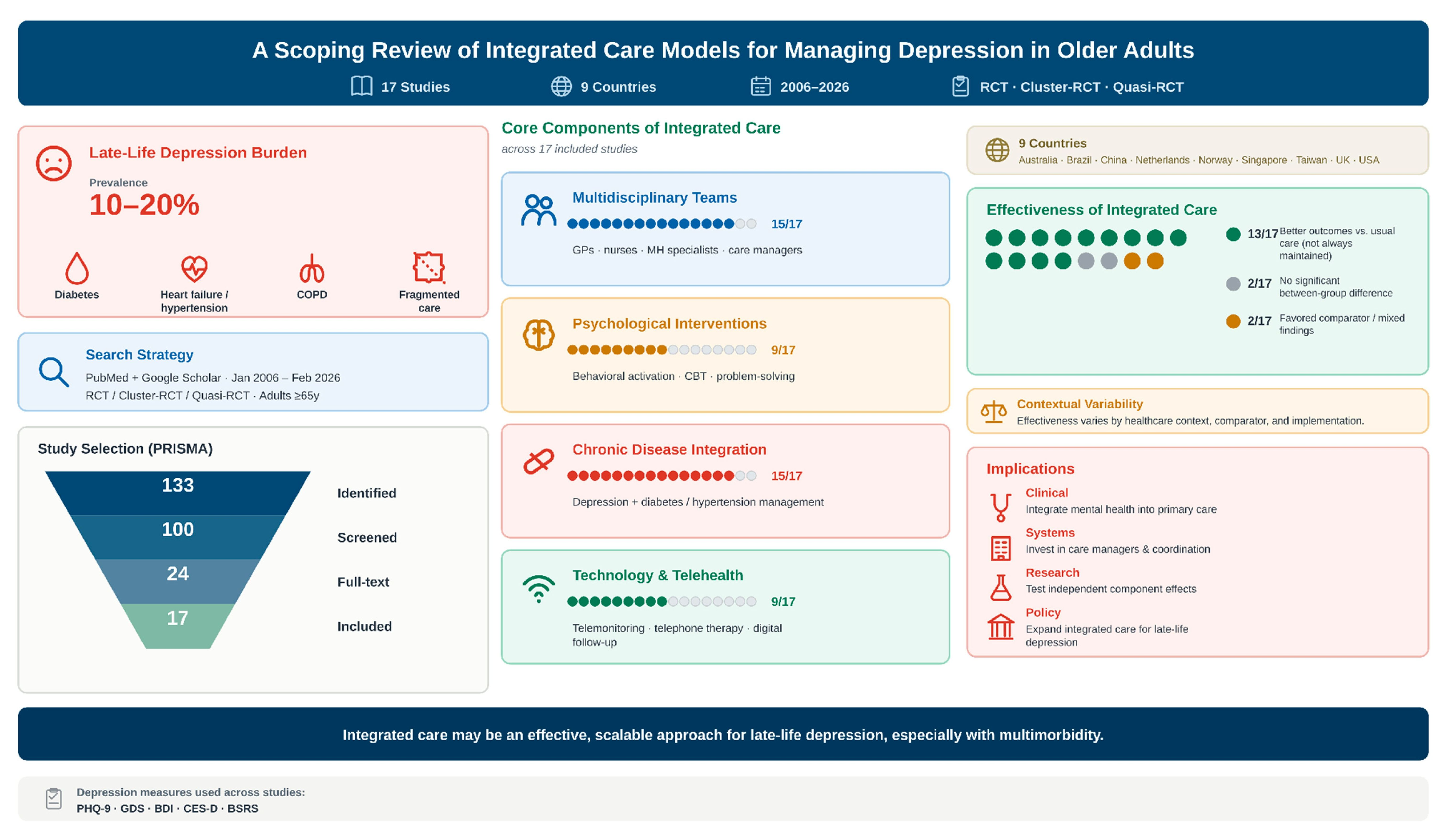

A Scoping Review of Integrated Care Models for Managing Depression in Older Adults
 ,
,
Abstract
1. Introduction/Background
2. Methods
2.1. Review Design and Reporting Framework
2.2. Inclusion and Exclusion Criteria
2.3. Information Sources and Search Strategy
2.4. Selection Process
2.5. Data Abstraction and Synthesis
2.6. Risk of Bias and Certainty Assessment
2.7. Synthesis Methods
3. Results
3.1. Study Characteristics
3.2. Operationalization of Integrated Care
3.2.1. Multidisciplinary Teams
3.2.2. Intervention Components, Provider, and Dose
3.2.3. Outcome Measures and Assessment Timing
3.3. Direction, Durability, and Magnitude of Findings
3.4. Risk of Bias and Certainty of Evidence
4. Discussion
5. Conclusions
Supplementary Materials
Author Contributions
Funding
Institutional Review Board Statement
Informed Consent Statement
Data Availability Statement
Acknowledgments
Conflicts of Interest
Abbreviations
Appendix A

| Section | Item | PRISMA-ScR Checklist Item | Reported on Page Number |
|---|---|---|---|
| TITLE | |||
| Title | 1 | Identify the report as a scoping review. | Title page |
| ABSTRACT | |||
| Structured summary | 2 | Provide a structured summary that includes (as applicable): background, objectives, eligibility criteria, sources of evidence, charting methods, results, and conclusions related to the review questions and objectives. | Abstract |
| INTRODUCTION | |||
| Rationale | 3 | Describe the rationale for the review in the context of what is already known. Explain why the review questions or objectives lend themselves to a scoping-review approach. | Introduction |
| Objectives | 4 | Provide an explicit statement of the questions and objectives being addressed with reference to their key elements (e.g., population or participants, concepts, and context) or other relevant key elements used to conceptualize the review questions and/or objectives. | Introduction, Methods. final paragraph |
| METHODS | |||
| Protocol and registration | 5 | Indicate whether a review protocol exists; state if and where it can be accessed (e.g., a Web address); and if available, provide registration information, including the registration number. | Methods |
| Eligibility criteria | 6 | Specify characteristics of the sources of evidence used as eligibility criteria (e.g., years considered, language, and publication status), and provide a rationale. | Methods—Eligibility criteria |
| Information sources | 7 | Describe all information sources in the search (e.g., databases with dates of coverage and contact with authors to identify additional sources), as well as the date the most recent search was executed. | Methods—Information sources and search strategy |
| Search | 8 | Present the full electronic search strategies for at least one database, including any limits used, so that it could be repeated. | Methods—Information sources and search strategy |
| Selection of sources of evidence | 9 | State the process for selecting sources of evidence (i.e., screening and eligibility) included in the scoping review. | Methods—Selection process |
| Data charting process | 10 | Describe the methods of charting data from the included sources of evidence (e.g., calibrated forms or forms that have been tested by the team before their use, and whether data charting was done independently or in duplicate) and any processes for obtaining and confirming data from investigators. | Methods—Data collection process and data items |
| Data items | 11 | List and define all variables for which data were sought and any assumptions or simplifications made. | Methods—Data collection process and data items |
| Critical appraisal of individual sources of evidence | 12 | If done, provide a rationale for conducting a critical appraisal of included sources of evidence; describe the methods used and how this information was used in any data synthesis (if appropriate). | Not undertaken |
| Synthesis of results | 13 | Describe the methods of handling and summarizing the data that were charted. | Methods—Synthesis methods |
| RESULTS | |||
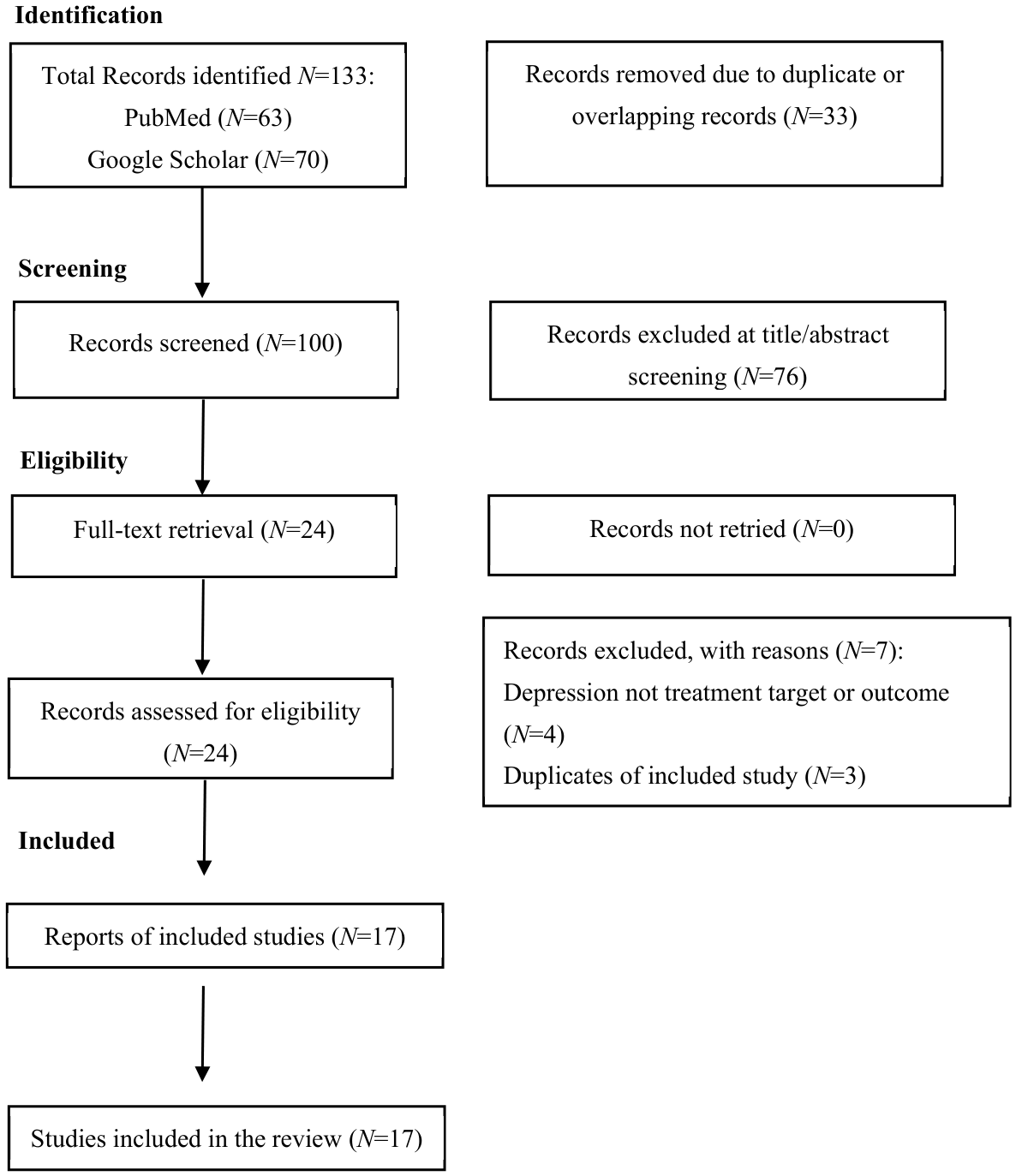
| Selection of sources of evidence | 14 | Give numbers of sources screened, assessed for eligibility, and included in the review, with reasons for exclusions at each stage, ideally using a flow diagram. | Results—Study selection; Figure 1 |
| Characteristics of sources of evidence | 15 | For each source of evidence, present characteristics for which data were charted and provide citations. | Results—Study characteristics; Table 1, Table 2 and Table 3, Supplementary Table S1 |
| Critical appraisal within sources of evidence | 16 | If done, present data on critical appraisal of included sources of evidence. | Not applicable; critical appraisal was not undertaken |
| Results of individual sources of evidence | 17 | For each included source of evidence, present the relevant data that were charted that relate to the review questions and objectives. | Table 1, Table 2 and Table 3; Supplementary Table S1 |
| Synthesis of results | 18 | Summarize and/or present the charting results as they relate to the review questions and objectives. | Results |
| DISCUSSION | |||
| Summary of evidence | 19 | Summarize the main results (including an overview of concepts, themes, and types of evidence available), link to the review questions and objectives, and consider the relevance to key groups. | Discussion—paragraphs 1–4 |
| Limitations | 20 | Discuss the limitations of the scoping review process. | Discussion—limitations paragraphs |
| Conclusions | 21 | Provide a general interpretation of the results with respect to the review questions and objectives, as well as potential implications and/or next steps. | Conclusion |
| FUNDING | |||
| Funding | 22 | Describe sources of funding for the included sources of evidence, as well as sources of funding for the scoping review. Describe the role of the funders of the scoping review. | Funding |
References
- Abdoli, N.; Salari, N.; Darvishi, N.; Jafarpour, S.; Solaymani, M.; Mohammadi, M.; Shohaimi, S. The global prevalence of major depressive disorder (MDD) among the elderly: A systematic review and meta-analysis. Neurosci. Biobehav. Rev. 2022, 132, 1067–1073. [Google Scholar] [CrossRef] [Scilit] [PubMed]
- Du, Q.; Yao, M.; Wang, W.; Wang, J.; Li, S.; Lu, K.; Li, C.; Wei, Y.; Zhang, T.; Yin, F.; et al. Association Between Multimorbidity and Depression in Older Adults: Evidence From Six Large Longitudinal Cohorts. Am. J. Geriatr. Psychiatry 2025, 33, 702–715. [Google Scholar] [CrossRef] [Scilit] [PubMed]
- Whelton, P.K.; Carey, R.M.; Aronow, W.S.; Casey, D.E., Jr.; Collins, K.J.; Dennison-Himmelfarb, C.; DePalma, S.M.; Gidding, S.; Jamerson, K.A.; Jones, D.W.; et al. 2017 ACC/AHA/AAPA/ABC/ACPM/AGS/APhA/ASH/ASPC/NMA/PCNA guideline for the prevention, detection, evaluation, and management of high blood pressure in adults: A report of the American College of Cardiovascular Guidelines Task Force. Hypertension 2018, 71, e13–e115. [Google Scholar] [CrossRef] [Scilit] [PubMed]
- World Health Organization. Integrating Mental Health into Primary Care: A Global Perspective; WHO Press: Geneva, Switzerland, 2008. Available online: https://www.who.int/publications/i/item/9789241563680 (accessed on 30 March 2026).
- Archer, J.; Bower, P.; Gilbody, S.; Lovell, K.; Richards, D.; Gask, L.; Dickens, C.; Coventry, P. Collaborative care for depression and anxiety problems. Cochrane Database Syst. Rev. 2012, 10, CD006525. [Google Scholar] [CrossRef] [Scilit] [PubMed]
- Valentijn, P.P.; Schepman, S.M.; Opheij, W.; Bruijnzeels, M.A. Understanding integrated care: A comprehensive conceptual framework based on the integrative functions of primary care. Int. J. Integr. Care 2015, 13, e010. [Google Scholar] [CrossRef] [Scilit] [PubMed]
- Goodwin, N. Understanding integrated care. Int. J. Integr. Care 2016, 16, 6. [Google Scholar] [CrossRef] [Scilit] [PubMed]
- Tops, L.; Beerten, S.G.; Vandenbulcke, M.; Vermandere, M.; Deschodt, M. Integrated care models for older adults with depression and physical comorbidity: A scoping review. Int. J. Integr. Care 2024, 24, 1. [Google Scholar] [CrossRef] [Scilit] [PubMed]
- Liu, W.; Qin, R.; Zhang, X.; Li, G.; Qiu, Y.; Huang, K.; Li, X.; Chen, L.; Xiao, J. Effectiveness of integrated care for older adults-based interventions on depressive symptoms: A systematic review and meta-analysis. J. Clin. Nurs. 2024, 33, 3737–3751. [Google Scholar] [CrossRef] [Scilit] [PubMed]
- Schillok, H.; Gensichen, J.; Panagioti, M.; Gunn, J.; Junker, L.; Lukaschek, K.; Jung-Sievers, C.; Sterner, P.; Kaupe, L.; Dreischulte, T.; et al. Effective components of collaborative care for depression in primary care: An individual participant data meta-analysis. JAMA Psychiatry 2025, 82, 868–876. [Google Scholar] [CrossRef] [Scilit] [PubMed]
- Peters, M.D.J.; Marnie, C.; Tricco, A.C.; Pollock, D.; Munn, Z.; Alexander, L.; McInerney, P.; Godfrey, C.M.; Khalil, H. Updated methodological guidance for the conduct of scoping reviews. JBI Evid. Synth. 2020, 18, 2119–2126. [Google Scholar] [CrossRef] [Scilit] [PubMed]
- Tricco, A.C.; Lillie, E.; Zarin, W.; O’Brien, K.K.; Colquhoun, H.; Levac, D.; Moher, D.; Peters, M.D.; Horsley, T.; Weeks, L.; et al. PRISMA Extension for Scoping Reviews (PRISMA-ScR): Checklist and Explanation. Ann. Intern. Med. 2018, 169, 467–473. [Google Scholar] [CrossRef] [Scilit] [PubMed]
- Bogner, H.R.; Morales, K.H.; de Vries, H.F.; Cappola, A.R. Integrated management of type 2 diabetes mellitus and depression treatment to improve medication adherence: A randomized controlled trial. Ann. Fam. Med. 2012, 10, 15–22. [Google Scholar] [CrossRef] [Scilit] [PubMed]
- Cummings, D.M.; Lutes, L.D.; Littlewood, K.; Solar, C.; Carraway, M.; Kirian, K.; Patil, S.; Adams, A.; Ciszewski, S.; Edwards, S.; et al. Randomized Trial of a Tailored Cognitive Behavioral Intervention in Type 2 Diabetes with Comorbid Depressive and/or Regimen-Related Distress Symptoms: 12-Month Outcomes from COMRADE. Diabetes Care 2019, 42, 841–848. [Google Scholar] [CrossRef] [Scilit] [PubMed]
- Ell, K.; Aranda, M.P.; Wu, S.; Oh, H.; Lee, P.J.; Guterman, J. Promotora assisted depression and self-care management among predominantly Latinos with concurrent chronic illness: Safety net care system clinical trial results. Contemp. Clin. Trials 2017, 61, 1–9. [Google Scholar] [CrossRef] [Scilit] [PubMed]
- Izquierdo, A.; Ong, M.; Pulido, E.; Wells, K.B.; Berkman, M.; Linski, B.; Sauer, V.; Miranda, J. Community Partners in Care: 6- and 12-month Outcomes of Community Engagement versus Technical Assistance to Implement Depression Collaborative Care among Depressed Older Adults. Ethn. Dis. 2018, 28, 339–348. [Google Scholar] [CrossRef] [Scilit] [PubMed]
- Wang, Y.; Guo, D.; Xia, Y.; Hu, M.; Wang, M.; Yu, Q.; Li, Z.; Zhang, X.; Ding, R.; Zhao, M.; et al. Effect of Community-Based Integrated Care for Patients with Diabetes and Depression (CIC-PDD) in China: A Pragmatic Cluster-Randomized Trial. Diabetes Care 2025, 48, 226–234. [Google Scholar] [CrossRef] [Scilit] [PubMed]
- Bosanquet, K.; Adamson, J.; Atherton, K.; Bailey, D.; Baxter, C.; Beresford-Dent, J.; Birtwistle, J.; Chew-Graham, C.; Clare, E.; Delgadillo, J.; et al. CollAborative care for Screen-Positive EldeRs with major depression (CASPER plus): A multicentred randomised controlled trial of clinical effectiveness and cost-effectiveness. Health Technol. Assess. 2017, 21, 1–252. [Google Scholar] [CrossRef] [Scilit] [PubMed]
- Janssen, N.P.; Oude Voshaar, R.C.; Wassink-Vossen, S.; Hendriks, G.J. Functional improvement by behavioural activation for depressed older adults. Eur. Psychiatry 2023, 66, e62. [Google Scholar] [CrossRef] [Scilit] [PubMed]
- Almeida, O.P.; Patel, H.; Kelly, R.; Ford, A.; Flicker, L.; Robinson, S.; Araya, R.; Gilbody, S.; Thompson, S. Preventing depression among older people living in rural areas: A randomised controlled trial of behavioural activation in collaborative care. Int. J. Geriatr. Psychiatry 2021, 36, 530–539. [Google Scholar] [CrossRef] [Scilit] [PubMed]
- Ng, T.P.; Nyunt, M.S.Z.; Feng, L.; Kumar, R.; Fones, C.S.L.; Ko, S.M. Collaborative care for primary care treatment of late-life depression in Singapore: Randomized controlled trial. Int. J. Geriatr. Psychiatry 2020, 35, 1171–1180. [Google Scholar] [CrossRef] [Scilit] [PubMed]
- Chen, S.; Conwell, Y.; Xue, J.; Li, L.; Zhao, T.; Tang, W.; Bogner, H.; Dong, H. Effectiveness of integrated care for older adults with depression and hypertension in rural China: A cluster randomized controlled trial. PLoS Med. 2022, 19, e1004019. [Google Scholar] [CrossRef] [Scilit] [PubMed]
- Krahn, D.D.; Bartels, S.J.; Coakley, E.; Oslin, D.W.; Chen, H.; McIntyre, J.; Chung, H.; Maxwell, J.; Ware, J.; Levkoff, S.E. PRISM-E: Comparison of integrated care and enhanced specialty referral models in depression outcomes. Psychiatr. Serv. 2006, 57, 946–953. [Google Scholar] [CrossRef] [PubMed]
- Kvalbein-Olsen, L.C.; Aakhus, E.; Haavet, O.R.; Mdala, I.; Werner, E.L. Joint consultations in a structured GP-patient-geriatric-psychiatrist model for late-life depression: A cluster RCT. BMC Prim. Care 2025, 26, 297. [Google Scholar] [CrossRef] [Scilit] [PubMed]
- Gellis, Z.D.; Kenaley, B.L.; Have, T.T. Integrated telehealth care for chronic illness and depression in geriatric home care patients: The Integrated Telehealth Education and Activation of Mood (I-TEAM) study. J. Am. Geriatr. Soc. 2014, 62, 889–895. [Google Scholar] [CrossRef] [Scilit] [PubMed]
- Seward, N.; Peters, T.J.; Loh, W.W.; Nakamura, C.A.; McMillan, D.; Gilbody, S.; Araya, R.; Scazufca, M. Explaining how a psychosocial intervention (PROACTIVE) based on behavioural activation improved outcomes of depression in older adults living in deprived regions of Brazil: The mediating roles of reduced loneliness and stepped care. J. Affect. Disord. 2025, 372, 191–199. [Google Scholar] [CrossRef] [Scilit] [PubMed]
- Liao, S.J.; Chao, S.M.; Fang, Y.W.; Rong, J.R.; Hsieh, C.J. The Effectiveness of the Integrated Care Model among Community-Dwelling Older Adults with Depression: A Quasi-Randomized Controlled Trial. Int. J. Environ. Res. Public Health 2022, 19, 3306. [Google Scholar] [CrossRef] [Scilit] [PubMed]
- Wang, N.; Liu, X.; Kong, X.; Sumi, Y.; Chhetri, J.K.; Hu, L.; Zhu, M.; Kang, L.; Liang, Z.; Ellis, J.W.; et al. Implementation and impact of the World Health Organization Integrated Care for Older People (ICOPE) program in China: A randomized controlled trial. Age Ageing 2024, 53, afad249. [Google Scholar] [CrossRef] [Scilit] [PubMed]
- Liu, T.; Leung, D.K.Y.; Wong, D.; Tse, S.; Wong, P.; Ng, S.M.; Chan, W.C.; Lou, V.; Tang, J.Y.; Cheng, R.; et al. Effectiveness of an integrated prevention programme (“JoyAge”) for depressive symptoms, anxiety, and loneliness in older adults in Hong Kong: A pragmatic quasi-experimental trial. J. Affect. Disord. 2026, 402, 121333. [Google Scholar] [CrossRef] [Scilit] [PubMed]
- Lutes, L.D.; Cummings, D.M.; Littlewood, K.; Solar, C.; Carraway, M.; Kirian, K.; Patil, S.; Adams, A.; Ciszewski, S.; Hambidge, B. COMRADE: A randomized trial of an individually tailored integrated care intervention for uncontrolled type 2 diabetes with depression and/or distress in the rural southeastern US. Contemp. Clin. Trials 2018, 70, 8–14. [Google Scholar] [CrossRef] [Scilit] [PubMed]
- Scazufca, M.; Nakamura, C.A.; Seward, N.; Moreno-Agostino, D.; van de Ven, P.; Hollingworth, W.; Peters, T.J.; Araya, R. A task-shared, collaborative care psychosocial intervention for improving depressive symptomatology among older adults in a socioeconomically deprived area of Brazil (PROACTIVE): A pragmatic, two-arm, parallel-group, cluster-randomised controlled trial. Lancet Healthy Longev. 2022, 3, e690–e702. [Google Scholar] [CrossRef] [Scilit] [PubMed]
- Frost, R.; Bauernfreund, Y.; Walters, K. Non-pharmacological interventions for depression/anxiety in older adults with physical comorbidities affecting functioning: Systematic review and meta-analysis. Int. Psychogeriatr. 2019, 31, 1121–1136. [Google Scholar] [CrossRef] [Scilit] [PubMed]

| Study | Model/Setting | Primary Care Staff | Care Manager/Coordinator | Mental Health Specialist | Other Personnel | Integration and Training |
|---|---|---|---|---|---|---|
| A. Primary-care collaborative or behavioral depression-care models | ||||||
| Bosanquet et al. (2017) [18] | Collaborative care (including BA); UK primary care | GPs retained medical care | NHS band 5 psychological wellbeing practitioners; trial-specific training | Specialist supervision/medication management | None reported | Case manager delivered BA and liaised with GP by face-to-face or telephone contact |
| Janssen et al. (2023) [19] | BA; primary care | GP/primary care centers | Trained mental health nurses | Mental health nurse was the direct BA provider | NR | Eight-session protocol |
| Almeida et al., (2021) [20] | Telephone-supported BA; rural community | Usual primary care/GP | No separate coordinator named | Trained psychologist; remote by telephone | None reported | Psychologist-supported self-managed BA alongside usual care |
| Ng et al., (2020) [21] | GP-led collaborative care; primary care | Trained GPs | Case management coordinator | Referral or consultation with mental health specialists | NR | Protocol-based antidepressant treatment, referral, and case management over six months |
| B. Depression care integrated with chronic-disease management | ||||||
| Bogner et al. (2012) [13] | Integrated depression–diabetes management; primary care | Primary-care physicians | Two research coordinators: one master’s-level and one bachelor’s-level; trained in diabetes pharmacotherapy | NR | None reported | Coordinators provided education and adherence/clinical monitoring and communicated with physicians; in-person plus phone |
| Cummings et al. (2019) [14] | Tailored diabetes–depression/distress care; primary care | Primary-care team/routine medical care | Nurse care manager for lower severity lifestyle coaching | Psychologist or doctoral clinical-psychology trainee for CBT/PST | Community health worker support | Severity-stratified assignment; diabetes guideline integration; face-to-face and telephone contacts |
| Wang, Y., et al. (2025) [17] | Integrated diabetes–depression care; community health centers | PCPs and diabetes specialist | Primary care case managers | Psychiatrist/psychotherapist | Student health communicators | Structured manual, interprofessional case conferences, measurement-based care, and WeChat follow-up |
| Chen et al. (2022) [22] | Depression–hypertension collaborative care; rural primary care | Village primary-care physicians | Village lay workers | Psychiatrists provided remote telephone consultation | Family involvement | Village lay workers trained in self-management, psychosocial assessment, care planning, psychoeducation, confidentiality, and ethics |
| C. Primary care with direct specialty integration or consultation | ||||||
| Krahn et al. (2006) [23] | Co-located integrated care vs. external specialty referral; primary care | Primary-care physicians | Licensed mental health/substance-use provider delivered and coordinated care | Licensed providers co-located in clinic | NR | In-clinic integration with enhanced referral |
| Kvalbein-Olsen et al. (2025) [24] | Joint primary care specialty consultation | GPs | No separate care manager | Geriatric psychiatrist attended two joint consultations | Municipal and social services as needed | Shared individualized plan followed by GP-led consultations; specialist access was direct but time-limited |
| D. Community, aged-care, or home-based integrated care models | ||||||
| Ell et al. (2017) [15] | Promotora-assisted integrated care; safety-net primary care | Patient-centered primary-care team | Three trained bilingual promotoras (lay community health workers) | NR | Community resource links | Promotoras were trained and supervised to deliver psychoeducation/problem solving, chronic-disease self-management, and patient activation |
| Izquierdo et al. (2018) [16] | Community coalition implementation; multisector programs | Health-sector programs within coalition | Coalition/program leads; individual care manager role varied | Mental health staff available across participating programs | Community, social service, faith, and other sector staff | Coalition planning and technical support were used to implement collaborative care; personnel were heterogeneous |
| Gellis et al. (2014) [25] | Home-health telehealth; Hospital-affiliated home healthcare setting | Home-health services and PCP; PCP prescribed antidepressants | Telehealth nurse | NR | NR | Nurse delivered daily monitoring and PST and communicated with PCP. |
| Seward et al., (2025) [26] | Task-shared stepped collaborative care; primary care and home | Primary care clinics | Community health workers | Specialist training and supervision | Community health workers | Non-mental health workers delivered home sessions with tablet support within a stepped-care model. |
| Liao et al. (2022) [27] | Nurse-led multidomain geriatric care; community | Medical services accessed as required | Trained registered nurses delivered the integrated care model | NR | Social welfare and safety services | Nurse assessment linked to health, function, spiritual wellbeing, welfare, and elder-abuse prevention actions |
| Wang, N., et al. (2024) [28] | WHO ICOPE; community primary care | Community primary-care team | Integrated care managers | Referral based on assessed psychological needs | Health and social service links | Screening was linked to comprehensive assessment, individualized planning, referral, and proactive follow-up |
| Liu et al. (2026) [29] | Stepped aged-care/mental-health collaboration; community | Aged-care and mental health service units | Trained social workers | Specialist mental health referral for severe cases | Trained peer supporters | Social workers delivered psychosocial care; peers supported maintenance and relapse prevention |
| Study | Depression-Specific Treatment | Provider | Planned Dose/Contact | Physical Health or Lifestyle Content | Social and Functional Support | Monitoring, Technology, or Supervision |
|---|---|---|---|---|---|---|
| Bogner et al. (2012) [13] | Education, adherence support, and antidepressant treatment coordination | Research coordinators with physicians | 3 × 30 min in-person sessions plus 2 × 15 min telephone contacts over 12 weeks | Diabetes medication adherence and clinical monitoring | NR | Medication/adherence monitoring and physician communication |
| Cummings et al. (2019) [14] | CBT/PST for higher symptoms; lifestyle counseling for lower symptoms | Psychologist/doctoral trainee or nurse care manager | 16 sessions over 12 months; in-person and telephone | Diabetes self-care, diet/activity and guideline-based medical care | Community health worker support | Severity-tailored allocation and ongoing monitoring |
| Ell et al. (2017) [15] | Psychoeducation and problem-solving strategies | Trained promotoras | 6 weekly sessions plus 3 monthly telephone boosters | Chronic disease self-management | Patient activation, provider communication, and community resources | In-person or telephone sessions with booster contact and supervision |
| Izquierdo et al. (2018) [16] | Collaborative depression care; patient-level therapy content varied | Health and community program staff | Coalition-level implementation; no details on patient-level dose | Varied by participating program | Community engagement and multisector resources | Community engagement/planning vs. individual technical assistance |
| Wang, Y., et al. (2025) [17] | BA and measurement-based depression care; specialist treatment as indicated | Case managers and psychiatrist/psychotherapist | Up to 18 sessions over 12 months | Diabetes self-management and clinical monitoring | Health communication support | WeChat follow-up, symptom/HbA1c monitoring, case conferences, and stepped treatment |
| Krahn et al. (2006) [23] | Assessment, counseling, case management, psychotherapy, and pharmacological treatment | Licensed co-located mental health/substance-use provider | NR | Coordination with primary medical care | NR | Communication about the evaluation and treatment plan between clinicians and the primary care providers; appointment with mental health or substance abuse provider after the primary care provider visit |
| Chen et al. (2022) [22] | Psychoeducation and algorithm-guided depression management | Village physician and lay worker with psychiatrist consultation | Contacts over 12 months | Hypertension self-management, adherence, and control | Family and contextual support | Structured symptom/clinical monitoring; remote psychiatric consultation |
| Kvalbein-Olsen et al. (2025) [24] | Individualized depression plan; medication adjustment possible | GP and geriatric psychiatrist | 2 joint consultations followed by GP-led consultations | Medical review and service coordination as needed | Municipal/social services as needed | Shared care plan |
| Bosanquet et al. (2017) [18] | BA plus collaborative medication management/GP liaison | Psychological wellbeing practitioner case manager | Average of 6 sessions over 7–8 weeks; up to 8–10 offered | NR | NR | Face-to-face or telephone follow-up; specialist-supervision framework |
| Gellis et al. (2014) [25] | Telephone PST plus antidepressant management | Telehealth nurse and PCP | 8 weekly 35 min PST sessions over 3 months plus daily monitoring | Daily physiological, symptom, weight, and medication monitoring | NR | Home telemonitoring and nurse–PCP communication |
| Janssen et al. (2023) [19] | BA | Trained mental health nurses | 8 weekly 30 min sessions | Activity engagement and functioning | NR | NR |
| Seward et al., (2025) [26] | Psychoeducation and BA | Community health workers with specialist supervision | 17-week home program | Activity scheduling | Social activation and loneliness-related mechanisms | Tablet-supported task sharing and stepped care |
| Liao et al. (2022) [27] | Mental-wellbeing support, such as dementia and delirium management | Trained nurses | 12-week intervention; outcomes through 18 weeks | Health-problem management and activities of daily living | Spiritual wellbeing, social welfare services, and elder abuse prevention | Multidomain assessment linked to individualized actions and referrals |
| Wang, N., et al. (2024) [28] | No stand-alone psychotherapy; psychological needs addressed within ICOPE plan | Integrated care manager/team | 6-month program | Mobility, nutrition, cognition, sensory and other health needs | Social care and caregiver support | ICOPE screening, comprehensive assessment, individualized plan, referral and follow-up; online/offline support |
| Almeida et al., (2021) [20] | Self-managed BA | Trained psychologist | Telephone support over 8 weeks | Activity engagement; no disease-specific management reported | NR | Telephone delivery |
| Ng et al., (2020) [21] | Antidepressant treatment, referral and case management | Trained GPs | 6-month collaborative-care period | Routine medical care | NR | Protocol follow-up and specialist referral |
| Liu et al. (2026) [29] | Evidence-based psychosocial strategies with stepped referral | Trained social workers; peers for maintenance | Intensity varied by symptom severity; follow-up of 2–12 months | NR | Peer support, loneliness/social support, and aged-care services | Stepped care; specialist referral for severe cases |
| Study | Design | Depression Measure | Assessment Timing | Direction and Durability | Key Magnitude | Moderators or Mediators |
|---|---|---|---|---|---|---|
| Bogner et al. (2012) [13] | Individual RCT | PHQ-9 | 6 and 12 weeks | Favorable at 12 weeks | Remission (PHQ-9 <5): 58.7% vs. 30.7% at 12 weeks | NR |
| Cummings et al. (2019) [14] | Individual RCT | PHQ-9 | 12 months | Favorable at 12 months | PHQ-9 change of −3.39 vs. −0.90, p = 0.01 | No clear race or gender differences in glycemic response |
| Ell et al. (2017) [15] | Individual RCT | PHQ-9 | 6 and 12 months | No significant between-group difference | Both groups improved; between-group difference not significant | NR |
| Izquierdo et al. (2018) [16] | Cluster RCT; community programs | PHQ-8, mental health-related quality of life, and mental wellness | 6 and 12 months | Favorable at 6 months, but early benefit not maintained at 12 months | At 6 months: 9.2% lower poor mental health quality of life and 12.8% more mental wellness improvement; no significant 12-month difference | Older-adult subgroup; patient-level intervention exposure varied across programs |
| Wang, Y., et al. (2025) [17] | Cluster RCT; community health centers | SCL-20; SF-12 mental component | 6 and 12 months | Favorable at longest follow-up | ≥50% SCL-20 reduction: 62.1% vs. 31.0%; risk difference of 31.03% (95% CI 21.85–40.21) | Rural participants showed greater improvement in self-health management |
| Krahn et al. (2006) [23] | Individual RCT | CES-D, MCS of SF-36, and MINI | 3 and 6 months | Comparator favored for symptom severity | Enhanced specialty referral mean symptom difference of 2.8 (95% CI of 1.0–4.5), p = 0.003, for major depression; remission and functional change were comparable | Combination of talk therapy and pharmacotherapy worked better in the enhanced-specialty referral model than in the integrated care model among patients with major depression |
| Chen et al. (2022) [22] | Cluster RCT; villages | HDRS clinician-rated; PHQ-9 screening | 12 months | Favorable at 12 months | Standardized between-group HDRS difference of −1.43 (95% CI −1.71 to −1.15), p < 0.001 | NR |
| Kvalbein-Olsen et al. (2025) [24] | Cluster RCT; GP practices | PHQ-9 | 6, 12, and 18 months | Both groups showed significant mean PHQ-9 score reductions at 18 months but no significant between-group difference | PHQ-9 reductions of 3.4 vs. 4.0 at 18 months; group differences not significant | NR |
| Bosanquet et al. (2017) [18] | Individual pragmatic RCT | PHQ-9 and depression severity | 4, 12, and 18 months | Favorable at 4 months but early benefit not maintained at 12 and 18 months | Mean difference of 1.92 points at 4 months; not significant at 12 or 18 months | Receipt of ≥6 sessions was explored; larger effect was not statistically definitive |
| Gellis et al. (2014) [25] | Individual RCT | PHQ-9 and HAM-D clinician-rated | 3 and 6 months | Favorable at 6 months | At 6 months: PHQ-9 7.9 vs. 14.1, p = 0.05; HAM-D 10.4 vs. 17.4, p = 0.05 | NR |
| Janssen et al. (2023) [19] | Cluster RCT; primary care centers | PHQ-9; WHODAS functioning | End of treatment and 12 months | Favorable at the end of treatment, but benefit was not sustained | WHODAS difference of −3.62 at end of treatment, p = 0.01; not significant at 12 months | A significant moderating effect of MoCA on functioning, indicating that the differences were driven by those with no cognitive impairment |
| Seward et al., (2025) [26] | Cluster RCT; primary care clinics | PHQ-9; recovery defined as <10 | 8 and 12 months | Favorable at 8 months | Recovery of 62.5% vs. 44.0% at 8 months; OR of 2.33 at 12 months, p < 0.001 | Reduced loneliness and stepped care might serve as a mediator |
| Liao et al. (2022) [27] | Quasi-randomized trial | CES-D, BSRS-5 and related outcomes | 12 and 18 weeks | Favorable at 18 weeks | Interaction effect: CES-D −4.76 (95% CI −7.39 to −2.14), p < 0.001 at 18 weeks | NR |
| Wang, N., et al. (2024) [28] | Individual RCT | GDS-5 | 6 months | Favorable at 6 months | Adjusted difference in GDS-5 of 0.09 (95% CI 0.03–0.14), p < 0.05 | NR |
| Almeida et al., (2021) [20] | Individual RCT | PHQ-9 and GAD-7 | 26 and 52 weeks | Favorable at 52 weeks | PHQ-9 mean difference of 1.0 at 52 weeks, p = 0.048 | NR |
| Ng et al., (2020) [21] | Individual RCT | HDRS-17 clinician-rated; GDS and BDI self-report | 3, 6, and 12 months | Favorable at 3, 6, and 12 months | 1.5-point greater HDRS-17 change at 6 months; benefit also observed at 3 and 12 months | NR |
| Liu et al. (2026) [29] | Pragmatic quasi-experimental allocation by service area | PHQ-9; anxiety and loneliness scales | 2–12 months | Favorable at 12 months | Adjusted PHQ-9 mean difference of −1.65, p < 0.001 | Treatment effect was stronger among people with moderate to moderately severe symptoms and those with risk factors |
Disclaimer/Publisher’s Note: The statements, opinions and data contained in all publications are solely those of the individual author(s) and contributor(s) and not of MDPI and/or the editor(s). MDPI and/or the editor(s) disclaim responsibility for any injury to people or property resulting from any ideas, methods, instructions or products referred to in the content. |
© 2026 by the authors. Licensee MDPI, Basel, Switzerland. This article is an open access article distributed under the terms and conditions of the Creative Commons Attribution (CC BY) license.
Share and Cite
Haddad, M.; Panyasarawut, J.; Srisoem, C.; Miezah, D.; Shi, L. A Scoping Review of Integrated Care Models for Managing Depression in Older Adults. Geriatrics 2026, 11, 126. https://doi.org/10.3390/geriatrics11050126
Haddad M, Panyasarawut J, Srisoem C, Miezah D, Shi L. A Scoping Review of Integrated Care Models for Managing Depression in Older Adults. Geriatrics. 2026; 11(5):126. https://doi.org/10.3390/geriatrics11050126
Chicago/Turabian StyleHaddad, Mia, Jittima Panyasarawut, Chaowalit Srisoem, Dennis Miezah, and Ling Shi. 2026. "A Scoping Review of Integrated Care Models for Managing Depression in Older Adults" Geriatrics 11, no. 5: 126. https://doi.org/10.3390/geriatrics11050126
APA StyleHaddad, M., Panyasarawut, J., Srisoem, C., Miezah, D., & Shi, L. (2026). A Scoping Review of Integrated Care Models for Managing Depression in Older Adults. Geriatrics, 11(5), 126. https://doi.org/10.3390/geriatrics11050126