
Effects of Intraoperative Prone Versus Supine Positioning on Postoperative Delirium
 ,
,  ,
,
Abstract
1. Introduction
2. Materials and Methods
2.1. Study Population
2.2. Study Design
2.3. Outcome Variables
2.4. Statistical Analyses
3. Results
3.1. Patients
3.2. Comparison of Patients After Surgery in Prone and Supine Position
3.3. Comparison of Patients with and Without Postoperative Delirium
4. Discussion
5. Conclusions
Author Contributions
Funding
Institutional Review Board Statement
Informed Consent Statement
Data Availability Statement
Conflicts of Interest
Abbreviations
| ASA | American Society of Anesthesiologists |
| BMI | Body Mass Index |
| CAM-ICU | Confusion Assessment Method for Intensive Care Unit |
| ESA | European Society of Anesthesiology |
| ICU | Intensive Care Unit |
| IQR | Interquartile Range |
| LOS | Length of Hospital Stay |
| MoCA | Montreal Cognitive Assessment |
| NIRS | Near-Infrared Oxygen Saturation |
| NYHA | New York Heart Association |
| POD | Postoperative Delirium |
| PROPDESC score | Pre-Operative Prediction of Postoperative Delirium by Appropriate Screening Score |
| PROPDESC-VAL-Study | Pre-Operative Prediction of Postoperative Delirium by Appropriate Screening Score |
| 3D-CAM | 3 min Diagnostic Interview for Confusion Assessment Method-Defined Delirium |
References
- Inouye, S.K. A Predictive Model for Delirium in Hospitalized Elderly Medical Patients Based on Admission Characteristics. Ann. Intern. Med. 1993, 119, 474. [Google Scholar] [CrossRef] [Scilit]
- American Psychiatric Association. Diagnostic and Statistical Manual of Mental Disorders (DSM 5), 5th ed.; American Psychiatric Publishing: Washington, DC, USA, 2013. [Google Scholar]
- van den Boogaard, M.; Schoonhoven, L.; van der Hoeven, J.G.; van Achterberg, T.; Pickkers, P. Incidence and short-term consequences of delirium in critically ill patients: A prospective observational cohort study. Int. J. Nurs. Stud. 2012, 49, 775–783. [Google Scholar] [CrossRef] [Scilit] [PubMed]
- Choi, J.-Y.; Kim, K.; Kang, M.; Lee, Y.-K.; Koo, K.-H.; Oh, J.H.; Park, Y.H.; Suh, J.; Kim, N.-H.; Yoo, H.-J.; et al. Impact of a delirium prevention project among older hospitalized patients who underwent orthopedic surgery: A retrospective cohort study. BMC Geriatr. 2019, 19, 289. [Google Scholar] [CrossRef] [Scilit]
- Yan, E.; Veitch, M.; Saripella, A.; Alhamdah, Y.; Butris, N.; Tang-Wai, D.F.; Tartaglia, M.C.; Nagappa, M.; Englesakis, M.; He, D.; et al. Association between postoperative delirium and adverse outcomes in older surgical patients: A systematic review and meta-analysis. J. Clin. Anesth. 2023, 90, 111221. [Google Scholar] [CrossRef] [Scilit] [PubMed]
- Marcantonio, E.R. Delirium in Hospitalized Older Adults. N. Engl. J. Med. 2017, 377, 1456–1466. [Google Scholar] [CrossRef] [Scilit] [PubMed]
- Wang, C.; Qin, Y.; Wan, X.; Song, L.; Li, Z.; Li, H. Incidence and risk factors of postoperative delirium in the elderly patients with hip fracture. J. Orthop. Surg. Res. 2018, 13, 186. [Google Scholar] [CrossRef] [Scilit]
- Inouye, S.K.; Westendorp, R.G.; Saczynski, J.S. Delirium in elderly people. Lancet 2014, 383, 911–922. [Google Scholar] [CrossRef] [Scilit]
- Menzenbach, J.; Guttenthaler, V.; Kirfel, A.; Ricchiuto, A.; Neumann, C.; Adler, L.; Kieback, M.; Velten, L.; Fimmers, R.; Mayr, A.; et al. Estimating patients’ risk for postoperative delirium from preoperative routine data—Trial design of the PRe-Operative prediction of postoperative DElirium by appropriate SCreening (PROPDESC) study—A monocentre prospective observational trial. Contemp. Clin. Trials Commun. 2020, 17, 100501. [Google Scholar] [CrossRef] [Scilit]
- Kunz, J.V.; Spies, C.D.; Bichmann, A.; Sieg, M.; Mueller, A. Postoperative anaemia might be a risk factor for postoperative delirium and prolonged hospital stay: A secondary analysis of a prospective cohort study. PLoS ONE 2020, 15, e0229325. [Google Scholar] [CrossRef] [Scilit]
- Radtke, F.M.; Franck, M.; Lendner, J.; Krüger, S.; Wernecke, K.D.; Spies, C.D. Monitoring depth of anaesthesia in a randomized trial decreases the rate of postoperative delirium but not postoperative cognitive dysfunction. Br. J. Anaesth. 2013, 110, i98–i105. [Google Scholar] [CrossRef] [Scilit]
- Zhang, H.J.; Ma, X.H.; Ye, J.B.; Liu, C.Z.; Zhou, Z.Y. Systematic review and meta-analysis of risk factor for postoperative delirium following spinal surgery. J. Orthop. Surg. Res. 2020, 15, 509. [Google Scholar] [CrossRef] [Scilit]
- Biais, M.; Bernard, O.; Ha, J.C.; Degryse, C.; Sztark, F. Abilities of pulse pressure variations and stroke volume variations to predict fluid responsiveness in prone position during scoliosis surgery. Br. J. Anaesth. 2010, 104, 407–413. [Google Scholar] [CrossRef] [Scilit] [PubMed]
- Bombardieri, A.M.; Beckman, J.; Urban, M.; Go, G.; De Gaudio, A.R.; Girardi, F.P.; Ma, Y.; Memtsoudis, S.G. An Observational Study of Cerebral Blood Flow Velocity Evaluation in the Prone Position During Posterior Lumbar Surgery. Anesth. Analg. 2019, 129, 487–492. [Google Scholar] [CrossRef] [Scilit]
- Edgcombe, H.; Carter, K.; Yarrow, S. Anaesthesia in the prone position. Br. J. Anaesth. 2008, 100, 165–183. [Google Scholar] [CrossRef] [Scilit] [PubMed]
- Højlund, J.; Sandmand, M.; Sonne, M.; Mantoni, T.; Jørgensen, H.L.; Belhage, B.; Van Lieshout, J.J.; Pott, F.C. Effect of Head Rotation on Cerebral Blood Velocity in the Prone Position. Anesthesiol. Res. Pract. 2012, 2012, 647258. [Google Scholar] [CrossRef] [Scilit]
- Deiner, S.; Chu, I.; Mahanian, M.; Lin, H.-M.; Hecht, A.C.; Silverstein, J.H. Prone position is associated with mild cerebral oxygen desaturation in elderly surgical patients. PLoS ONE 2014, 9, e106387. [Google Scholar] [CrossRef] [Scilit]
- Gatica-Moris, S.R.; Welch, T.L.; Abcejo, A.S.; Carr, C.M.; Pasternak, J.J. Anesthesia During Positive-pressure Myelogram: A New Role for Cerebral Oximetry. J. Neurosurg. Anesthesiol. 2021, 33, 263–267. [Google Scholar] [CrossRef] [Scilit] [PubMed]
- Closhen, D.; Engelhard, K.; Dette, F.; Werner, C.; Schramm, P. Changes in cerebral oxygen saturation following prone positioning for orthopaedic surgery under general anaesthesia: A prospective observational study. Eur. J. Anaesthesiol. 2015, 32, 381–386. [Google Scholar] [CrossRef] [Scilit]
- Babakhani, B.; Heroabadi, A.; Hosseinitabatabaei, N.; Schott, M.; Yekaninejad, S.; Jantzen, J.-P.; Baumert, J.-H. Cerebral Oxygenation Under General Anesthesia Can Be Safely Preserved in Patients in Prone Position: A Prospective Observational Study. J. Neurosurg. Anesthesiol. 2017, 29, 291–297. [Google Scholar] [CrossRef] [Scilit]
- Wang, J.; Zhu, L.; Li, Y.; Yin, C.; Hou, Z.; Wang, Q. The Potential Role of Lung-Protective Ventilation in Preventing Postoperative Delirium in Elderly Patients Undergoing Prone Spinal Surgery: A Preliminary Study. Med. Sci. Monit. 2020, 26, e926526. [Google Scholar] [CrossRef] [Scilit]
- Kim, J.; Shim, J.-K.; Song, J.W.; Kim, E.; Kwak, Y.L. Postoperative Cognitive Dysfunction and the Change of Regional Cerebral Oxygen Saturation in Elderly Patients Undergoing Spinal Surgery. Anesth. Analg. 2016, 123, 436–444. [Google Scholar] [CrossRef] [Scilit]
- Guttenthaler, V.; Kunsorg, A.; Mayr, A.; Hering, T.; Menzenbach, J.; Wittmann, M. PROPDESC-Score-Validierung (PROPDESC-Val). Anaesthesiologie 2024, 73, 56–59. [Google Scholar] [CrossRef] [Scilit]
- Donati, A.; Ruzzi, M.; Adrario, E.; Pelaia, P.; Coluzzi, F.; Gabbanelli, V.; Pietropaoli, P. A new and feasible model for predicting operative risk. Br. J. Anaesth. 2004, 93, 393–399. [Google Scholar] [CrossRef] [Scilit]
- Pasternak, R.L. Preanesthesia Evaluation of the Surgical Patient. ASA Refresh Courses Anesthesiol. 1996, 24, 205–219. [Google Scholar] [CrossRef] [Scilit]
- Nasreddine, Z.S.; Phillips, N.A.; Bédirian, V.; Charbonneau, S.; Whitehead, V.; Collin, I.; Cummings, J.L.; Chertkow, H. The Montreal Cognitive Assessment, MoCA: A Brief Screening Tool for Mild Cognitive Impairment. J. Am. Geriatr. Soc. 2005, 53, 695–699. [Google Scholar] [CrossRef] [Scilit]
- Rabin, R.; Charro, F. de EQ-5D: A measure of health status from the EuroQol Group. Ann. Med. 2001, 33, 337–343. [Google Scholar] [CrossRef] [Scilit] [PubMed]
- Kuczmarska, A.; Ngo, L.H.; Guess, J.; O’Connor, M.A.; Branford-White, L.; Palihnich, K.; Gallagher, J.; Marcantonio, E.R. Detection of Delirium in Hospitalized Older General Medicine Patients: A Comparison of the 3D-CAM and CAM-ICU. J. Gen. Intern. Med. 2016, 31, 297–303. [Google Scholar] [CrossRef] [Scilit] [PubMed]
- Guenther, U.; Popp, J.; Koecher, L.; Muders, T.; Wrigge, H.; Ely, E.W.; Putensen, C. Validity and Reliability of the CAM-ICU Flowsheet to diagnose delirium in surgical ICU patients. J. Crit. Care 2010, 25, 144–151. [Google Scholar] [CrossRef] [Scilit] [PubMed]
- Inouye, S.K. Clarifying Confusion: The Confusion Assessment Method: A New Method for Detection of Delirium. Ann. Intern. Med. 1990, 113, 941. [Google Scholar] [CrossRef] [Scilit]
- Soper, D.S. A-Priori Sample Size Calculator for Multiple Regression. 2025. Available online: https://www.danielsoper.com/statcalc (accessed on 9 January 2025).
- Iamaroon, A.; Wongviriyawong, T.; Sura-Arunsumrit, P.; Wiwatnodom, N.; Rewuri, N.; Chaiwat, O. Incidence of and risk factors for postoperative delirium in older adult patients undergoing noncardiac surgery: A prospective study. BMC Geriatr. 2020, 20, 40. [Google Scholar] [CrossRef] [Scilit]
- Pan, Y.; Yan, J.; Jiang, Z.; Luo, J.; Zhang, J.; Yang, K. Incidence, risk factors, and cumulative risk of delirium among ICU patients: A case-control study. Int. J. Nurs. Sci. 2019, 6, 247–251. [Google Scholar] [CrossRef] [Scilit]
- Villalpando-Berumen, J.M.; Pineda-Colorado, A.M.; Palacios, P.; Reyes-Guerrero, J.; Villa, A.R.; Gutiérrez-Robledo, L.M. Incidence of Delirium, Risk Factors, and Long-Term Survival of Elderly Patients Hospitalized in a Medical Specialty Teaching Hospital in Mexico City. Int. Psychogeriatr. 2003, 15, 325–336. [Google Scholar] [CrossRef] [Scilit]
- Karageorgos, V.; Mevorach, L.; Silvetti, M.; Bilotta, F. Preoperative Risk Factors Associated with Increased Incidence of Postoperative Delirium: Systematic Review of Qualified Clinical Studies. Geriatrics 2023, 8, 24. [Google Scholar] [CrossRef] [Scilit]
- Franco, J.G.; Valencia, C.; Bernal, C.; Ocampo, M.V.; Trzepacz, P.T.; Pablo, J.D.; Mejía, M.A. Relationship Between Cognitive Status at Admission and Incident Delirium in Older Medical Inpatients. J. Neuropsychiatry Clin. Neurosci. 2010, 22, 329–337. [Google Scholar] [CrossRef] [PubMed]
- Jankowski, C.J.; Trenerry, M.R.; Cook, D.J.; Buenvenida, S.L.; Stevens, S.R.; Schroeder, D.R.; Warner, D.O. Cognitive and Functional Predictors and Sequelae of Postoperative Delirium in Elderly Patients Undergoing Elective Joint Arthroplasty. Anesth. Analg. 2011, 112, 1186–1193. [Google Scholar] [CrossRef] [Scilit] [PubMed]
- Kim, M.Y.; Park, U.J.; Kim, H.T.; Cho, W.H. DELirium Prediction Based on Hospital Information (Delphi) in General Surgery Patients. Medicine 2016, 95, e3072. [Google Scholar] [CrossRef] [Scilit] [PubMed]
- Pei, W. Risk factors for postoperative delirium in adult patients undergoing cardiopulmonary bypass in cardiac surgery. Am. J. Transl. Res. 2024, 16, 4751–4760. [Google Scholar] [CrossRef] [Scilit]
- Mazzola, P.; Ward, L.; Zazzetta, S.; Broggini, V.; Anzuini, A.; Valcarcel, B.; Brathwaite, J.S.; Pasinetti, G.M.; Bellelli, G.; Annoni, G. Association Between Preoperative Malnutrition and Postoperative Delirium After Hip Fracture Surgery in Older Adults. J. Am. Geriatr. Soc. 2017, 65, 1222–1228. [Google Scholar] [CrossRef] [Scilit]
- Dong, B.; Wang, J.; Li, P.; Li, J.; Liu, M.; Zhang, H. The impact of preoperative malnutrition on postoperative delirium: A systematic review and meta-analysis. Perioper. Med. 2023, 12, 55. [Google Scholar] [CrossRef] [Scilit]
- Zhang, G.; Wang, Z.; Wang, D.; Jia, Q.; Zeng, Y. A systematic review and meta-analysis of the correlation between operation time and postoperative delirium in total hip arthroplasty. Ann. Palliat. Med. 2021, 10, 10459–10466. [Google Scholar] [CrossRef] [Scilit]
- Susano, M.J.; Grasfield, R.H.; Friese, M.; Rosner, B.; Crosby, G.; Bader, A.M.; Kang, J.D.; Smith, T.R.; Lu, Y.; Groff, M.W.; et al. Brief Preoperative Screening for Frailty and Cognitive Impairment Predicts Delirium after Spine Surgery. Anesthesiology 2020, 133, 1184–1191. [Google Scholar] [CrossRef] [Scilit]
- Lee, Y.-S.; Kim, Y.-B.; Lee, S.-H.; Park, Y.-S.; Park, S.-W. The Prevalence of Undiagnosed Presurgical Cognitive Impairment and Its Postsurgical Clinical Impact in Older Patients Undergoing Lumbar Spine Surgery. J. Korean Neurosurg. Soc. 2016, 59, 287. [Google Scholar] [CrossRef] [Scilit]
- Maheshwari, K.; Ahuja, S.; Khanna, A.K.; Mao, G.; Perez-Protto, S.; Farag, E.; Turan, A.; Kurz, A.; Sessler, D.I. Association Between Perioperative Hypotension and Delirium in Postoperative Critically Ill Patients: A Retrospective Cohort Analysis. Anesth. Analg. 2020, 130, 636–643. [Google Scholar] [CrossRef] [Scilit]


| All Patients (n = 760) | Patients Undergoing Surgery in Supine Position (n = 549) | Patients Undergoing Surgery in Prone Position (n = 211) | p-Value | |
|---|---|---|---|---|
| Patient age (years; median (IQR)) | 73.0 (67.0–80.0) | 73.0 (67.0–81.0) | 72.0 (67.5–77.5) | 0.54 |
| Gender (male/female) | 397/363 (52.2%/47.8%) | 291/258 (53.0%/47.0%) | 106/105 (50.2%/49.8%) | 0.52 |
| ASA | I: 40 (5.3%) II: 312 (41.1%) III: 395 (52.0%) IV: 13 (1.7%) | I: 29 (5.3%) II: 210 (38.3%) III: 301 (54.8%) IV: 9 (1.6%) | I: 11 (5.2%) II: 102 (48.3%) III: 94 (44.6%) IV: 4 (1.9%) | 0.07 |
| NYHA | I: 464 (61.1%) II: 226 (29.7%) III: 64 (8.4%) IV: 6 (0.8%) | I: 324 (59.0%) II: 174 (31.7%) III: 46 (8.4%) IV: 5 (0.9%) | I: 140 (66.4%) II: 52 (24.6%) III: 18 (8.5%) IV: 1 (0.5%) | 0.23 |
| Body mass index (kg/m2; median (IQR)) | 27.0 (24.0–30.5) | 27.0 (23.7–30.4) | 28.0 (25.0–31.3) | 0.16 |
| Modified MoCA: - 0 points - 1 point - 2 points - 3 points - 4 points - 5 points | 11 (1.4%) 23 (3.0%) 53 (7.0%) 117 (15.4%) 216 (28.4%) 340 (44.7%) | 8 (1.5%) 17 (3.1%) 41 (7.5%) 86 (15.7%) 152 (27.7%) 245 (44.6%) | 3 (1.4%) 6 (2.8%) 12 (5.7%) 31 (14.7%) 64 (30.3%) 95 (45.0%) | 0.94 |
| Self-care: - No problems - Few problems - Moderate problems - Many problems - Not possible | 490 (64.5%) 125 (16.4%) 107 (14.1%) 35 (4.6%) 3 (0.4%) | 357 (65.0%) 88 (16.0%) 76 (13.8%) 27 (4.9%) 1 (0.2%) | 133 (63.0%) 37 (17.5%) 31 (14.7%) 8 (3.8%) 2 (0.9%) | 0.55 |
| Surgical specialty: - Spine - Orthopedic/joint - Head/neck - Vascular - Hepato-biliary - Upper GIT - Lower GIT - Gynecology - Urology/kidney - Other | 218 (28.7%) 225 (29.6%) 6 (0.8%) 123 (16.2%) 13 (1.7%) 6 (0.8%) 30 (3.9%) 17 (2.2%) 87 (11.4%) 35 (4.6%) | 14 (2.6%) 219 (39.9%) 6 (1.1%) 123 (22.4%) 13 (2.4%) 6 (1.1%) 30 (5.5%) 17 (3.1%) 86 (15.7%) 35 (6.4%) | 204 (96.7%) 6 (2.8%) 0 (0.0%) 0 (0.0%) 0 (0.0%) 0 (0.0%) 0 (0.0%) 0 (0.0%) 1 (0.5%) 0 (0.0%) | n.a. |
| Surgical risk - Low - Intermediate - High | 203 (26.7%) 511 (67.2%) 46 (6.1%) | 191 (34.8%) 312 (56.8%) 46 (8.4%) | 12 (5.7%) 199 (94.3%) 0 (0%) | <0.001 |
| Incision-to-suture-time (minutes; median (IQR)) | 90.0 (60.0–133.0) | 80.0 (54.0–119.0) | 120.0 (73.0–180.0) | <0.001 |
| All Patients (n = 760) | Patients Undergoing Surgery in Supine Position (n = 549) | Patients Undergoing Surgery in Prone Position (n = 211) | p-Value | |
|---|---|---|---|---|
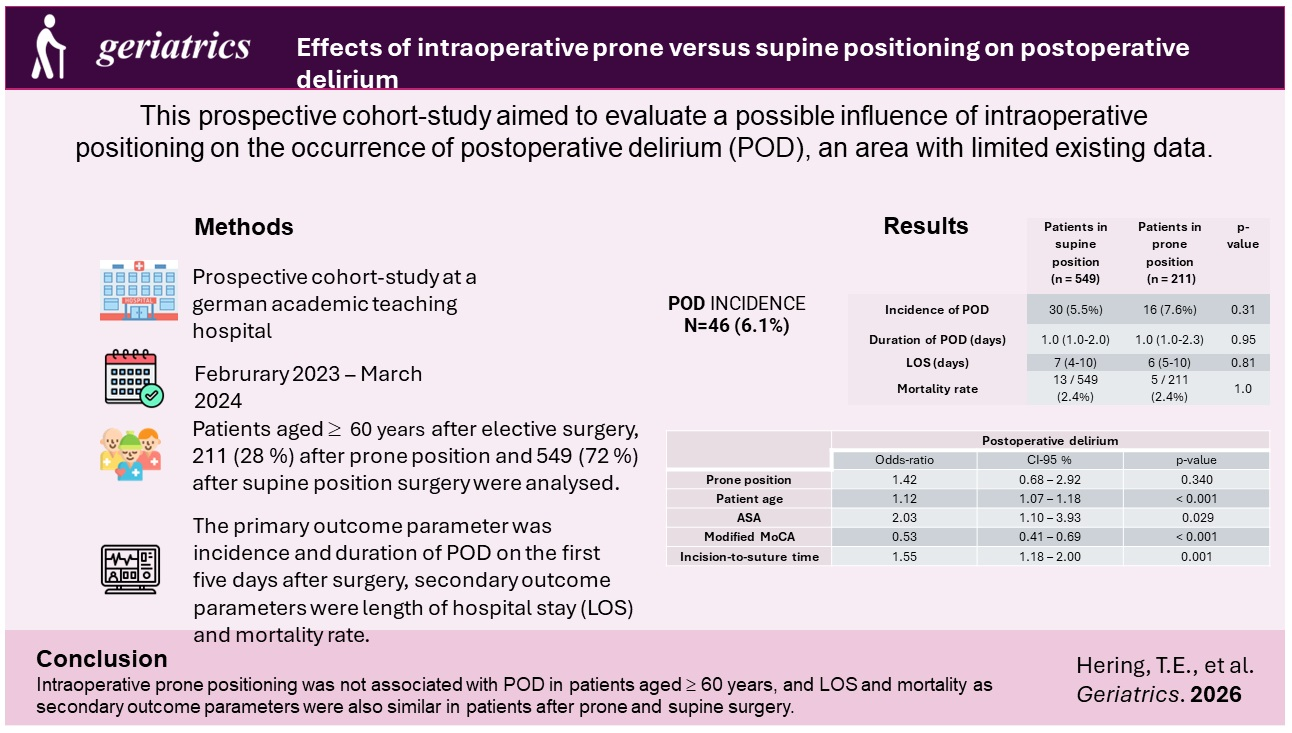
| Incidence of POD | 46 (6.1%) | 30 (5.5%) | 16 (7.6%) | 0.31 |
| Duration of POD (days; median (IQR)) | 1.0 (1.0–2.0) | 1.0 (1.0–2.0) | 1.0 (1.0–2.3) | 0.95 |
| LOS (days; median (IQR)) | 7 (4–10) | 7 (4–10) | 6 (5–10) | 0.81 |
| Mortality rate | 18/760 (2.4%) | 13/549 (2.4%) | 5/211 (2.4%) | 1.0 |
| Postoperative Delirium | |||
|---|---|---|---|
| Odds Ratio | CI-95% | p-Value | |
| Prone position | 1.42 | 0.68–2.92 | 0.340 |
| Patient age | 1.12 | 1.07–1.18 | <0.001 |
| ASA | 2.03 | 1.10–3.93 | 0.029 |
| Modified MoCA | 0.53 | 0.41–0.69 | <0.001 |
| Incision-to-suture time | 1.55 | 1.18–2.00 | 0.001 |
| All Patients (n = 760) | Patients with POD (n = 46) | Patients Without POD (n = 714) | p-Value | |
|---|---|---|---|---|
| Patient age (years; median (IQR)) | 73.0 (67.0–80.0) | 81.5 (76.2–84.8) | 72.0 (67–79) | <0.001 |
| Gender: - Male - Female | 397 (52.2%) 363 (47.8%) | 26 (56.5%) 20 (43.5%) | 371 (52.0%) 343 (48.0%) | 0.65 |
| BMI (kg/m2; median (IQR)) | 27.0 (24.0–30.5) | 26.0 (22.9–28.3) | 27.0 (24.1–30.7) | 0.04 |
| ASA | I: 40 (5.3%) II: 312 (41.1%) III: 395 (52.0%) IV: 13 (1.7%) | I: 0 (0.0%) II: 8 (17.4%) III: 35 (76.1%) IV: 3 (6.5%) | I: 40 (5.6%) II: 304 (42.6%) III: 360 (50.0%) IV: 10 (1.4%) | <0.001 |
| NYHA | I: 464 (61.1%) II: 226 (29.7%) III: 64 (8.4%) IV: 6 (0.8%) | I: 12 (26.1%) II: 23 (50.0%) III: 11 (23.9%) IV: 0 (0.0%) | I: 452 (63.3%) II: 203 (28.4%) III: 53 (7.4%) IV: 6 (0.8%) | <0.001 |
| Modified MoCA: - 0 points - 1 points - 2 points - 3 points - 4 points - 5 points | 11 (1.4%) 23 (3.0%) 53 (7.0%) 117 (15.4%) 216 (28.4%) 340 (44.7%) | 3 (6.5%) 9 (19.6%) 4 (8.7%) 10 (21.7%) 12 (26.1%) 8 (17.4%) | 8 (1.1%) 14 (2.0%) 49 (6.9%) 107 (15.0%) 204 (28.6%) 332 (46.5%) | <0.001 |
| Self-care: - No problems - Few problems - Moderate problems - Many problems - Not possible | 490 (64.5%) 125 (16.4%) 107 (14.1%) 35 (4.6%) 3 (0.4%) | 14 (30.4%) 11 (23.9%) 16 (34.8%) 4 (8.7%) 1 (2.2%) | 476 (66.7%) 114 (16.0%) 91 (12.7%) 31 (4.3%) 2 (0.3%) | <0.001 |
| Incision-to-suture-time (minutes; median (IQR)) | 90.0 (60.0–133.0) | 107.0 (76.0–173.0) | 85.0 (60.0–130.0) | 0.01 |
| All Patients | Patients with POD | Patients Without POD | p-Value | |
|---|---|---|---|---|
| LOS (days; median (IQR)): - All patients - Supine patients - Prone patients | - 7.0 (4.0–10.0) - 7.0 (4.0–10.0) - 6.0 (5.0–10.0) | 14.5 (9.0–27.0) - 13.0 (9.0–29.0) - 15.5 (10.0–21.0) | 7.0 (4.0–9.0) - 7.0 (4.0–10.0) - 6.0 (5.0–9.0) | <0.001 <0.001 <0.001 |
| Mortality rate - all patients - supine patients - prone patients | - 18/760 (2.4%) - 13/549 (2.4%) - 5/211 (2.4%) | - 6/46 (13.0%) - 4/30 (13.3%) - 2/16 (12.5%) | - 12/714 (1.7%) - 9/519 (1.7%) - 3/195 (1.5%) | <0.001 <0.001 <0.001 |
Disclaimer/Publisher’s Note: The statements, opinions and data contained in all publications are solely those of the individual author(s) and contributor(s) and not of MDPI and/or the editor(s). MDPI and/or the editor(s) disclaim responsibility for any injury to people or property resulting from any ideas, methods, instructions or products referred to in the content. |
© 2026 by the authors. Licensee MDPI, Basel, Switzerland. This article is an open access article distributed under the terms and conditions of the Creative Commons Attribution (CC BY) license.
Share and Cite
Hering, T.E.; Wittmann, M.; Guttenthaler, V.; Pflugmacher, R.; Hering, R. Effects of Intraoperative Prone Versus Supine Positioning on Postoperative Delirium. Geriatrics 2026, 11, 48. https://doi.org/10.3390/geriatrics11020048
Hering TE, Wittmann M, Guttenthaler V, Pflugmacher R, Hering R. Effects of Intraoperative Prone Versus Supine Positioning on Postoperative Delirium. Geriatrics. 2026; 11(2):48. https://doi.org/10.3390/geriatrics11020048
Chicago/Turabian StyleHering, Theresa E., Maria Wittmann, Vera Guttenthaler, Robert Pflugmacher, and Rudolf Hering. 2026. "Effects of Intraoperative Prone Versus Supine Positioning on Postoperative Delirium" Geriatrics 11, no. 2: 48. https://doi.org/10.3390/geriatrics11020048
APA StyleHering, T. E., Wittmann, M., Guttenthaler, V., Pflugmacher, R., & Hering, R. (2026). Effects of Intraoperative Prone Versus Supine Positioning on Postoperative Delirium. Geriatrics, 11(2), 48. https://doi.org/10.3390/geriatrics11020048