


Aging Redefined: Cognitive and Physical Improvement with Positive Age Beliefs


Abstract
1. Introduction
2. Materials and Methods
2.1. Sample
2.2. Measures
2.2.1. Predictor: Positive Age Beliefs
2.2.2. Outcome: Improvement in Health
Cognitive Improvement
Physical Improvement
2.2.3. Covariates
2.3. Statistical Analysis
3. Results
3.1. Hypothesis 1: Cognitive and Physical Improvement
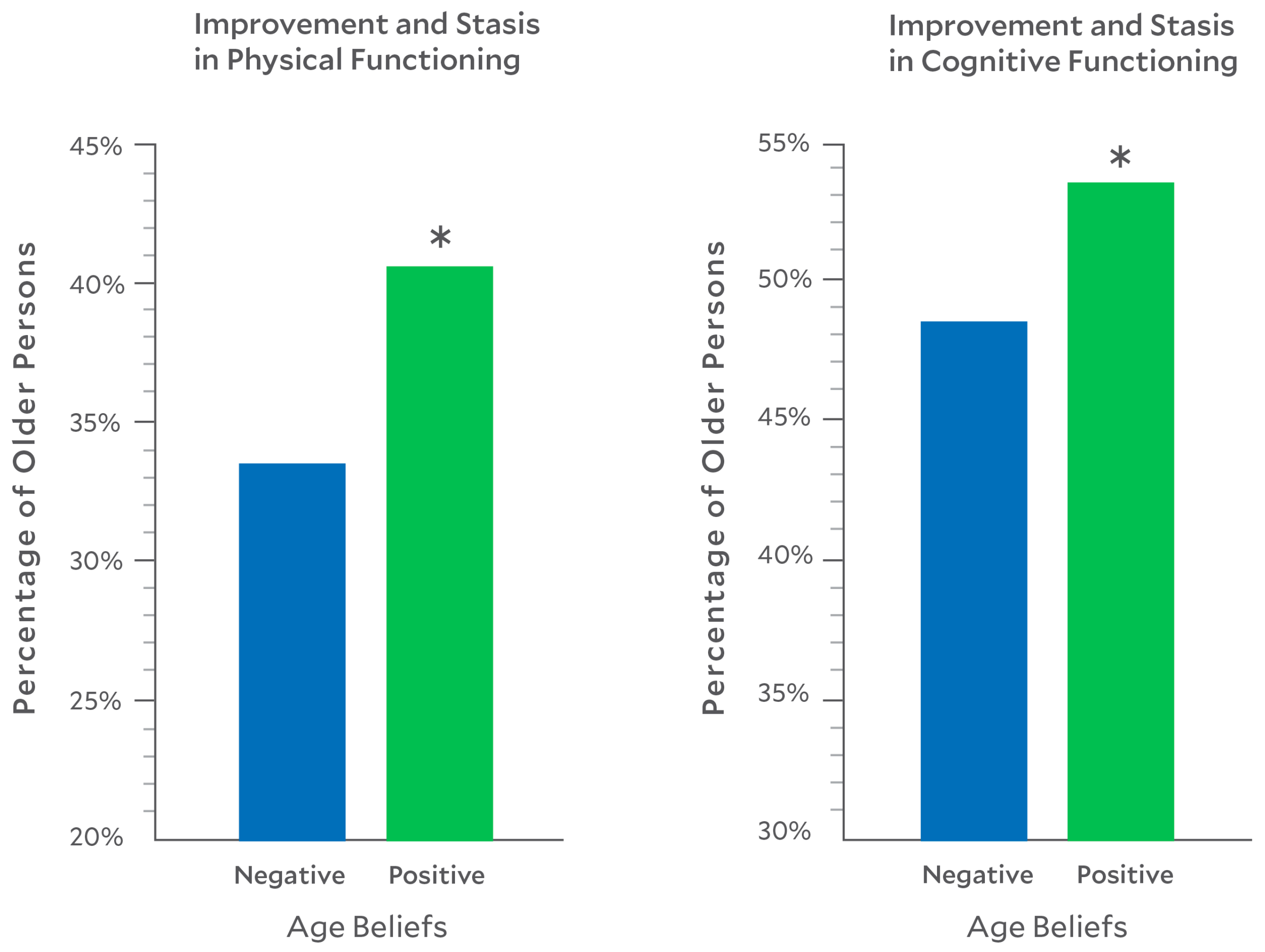
3.2. Hypothesis 2: Health Improvement Predicted by Positive Age Beliefs
4. Discussion
Author Contributions
Funding
Institutional Review Board Statement
Informed Consent Statement
Data Availability Statement
Acknowledgments
Conflicts of Interest
Correction Statement
References
- Lemoine, M. Defining aging. Biol. Philos. 2020, 35, 45. [Google Scholar] [CrossRef]
- Alzheimer’s Disease International. World Alzheimer’s Report 2024; Alzheimer’s Disease International: London, UK, 2024. [Google Scholar]
- Levy, B.R. Breaking the Age Code: How Your Age Beliefs Determine How Long and Well You Live; HarperCollins: New York, NY, USA, 2022. [Google Scholar]
- Mehegan, L. Brain Healthy Behaviors and Worry About Cognitive Decline: Adults 40 and Older; AARP Research: Washington, DC, USA, 2025. [Google Scholar]
- World Health Organization. Integrated Care for Older People (ICOPE): Guidance for Person-Assessment and Pathways in Primary Care; World Health Organization: Geneva, Switzerland, 2024. [Google Scholar]
- Lu, F.; Li, J.; Liu, X.; Liu, S.; Sun, X.; Wang, X. Diagnostic performance analysis of the Integrated Care for Older People (ICOPE) screening tool for identifying decline in intrinsic capacity. BMC Geriatr. 2023, 23, 509. [Google Scholar] [CrossRef]
- Rowe, J.W.; Kahn, R.L. Successful aging 2.0: Conceptual expansions for the 21st century. J. Gerontol. B Psychol. Sci. Soc. Sci. 2015, 70, 593–596. [Google Scholar] [CrossRef]
- Kunda, Z.; Oleson, K.C. Maintaining stereotypes in the face of disconfirmation: Constructing grounds for subtyping deviants. J. Personal. Soc. Psychol. 1995, 68, 565–579. [Google Scholar] [CrossRef]
- Levy, B. Stereotype embodiment: A psychosocial approach to aging. Curr. Dir. Psychol. Sci. 2009, 18, 332–336. [Google Scholar] [CrossRef]
- Levy, B.R.; Pilver, C.; Chung, P.H.; Slade, M.D. Subliminal strengthening: Improving older individuals’ physical function over time with an implicit-age-stereotype intervention. Psychol. Sci. 2014, 25, 2127–2135. [Google Scholar] [CrossRef]
- Meisner, B.A. A meta-analysis of positive and negative age stereotype priming effects on behavior among older adults. J. Gerontol. B Psychol. Sci. Soc. Sci. 2012, 67, 13–17. [Google Scholar] [CrossRef] [PubMed]
- Westerhof, G.J.; Nehrkorn-Bailey, A.M.; Tseng, H.Y.; Brothers, A.; Siebert, J.S.; Wurm, S.; Wahl, H.-W.; Diehl, M. Longitudinal effects of subjective aging on health and longevity: An updated meta-analysis. Psychol. Aging 2023, 38, 147–166. [Google Scholar] [CrossRef]
- Levy, B.R.; Slade, M.D.; Kasl, S.V. Longitudinal benefit of positive self-perceptions of aging on functional health. J. Gerontol. B Psychol. Sci. Soc. Sci. 2022, 57, 409–417. [Google Scholar] [CrossRef]
- Stephan, Y.; Sutin, A.R.; Terracciano, A. “Feeling younger, walking faster”: Subjective age and walking speed in older adults. Age 2015, 37, 86. [Google Scholar] [CrossRef] [PubMed]
- Levy, B.; Zonderman, A.; Slade, M.; Ferrucci, L. Memory shaped by age stereotypes over time. Psychol. Aging 2012, 67, 432–436. [Google Scholar] [CrossRef]
- Levy, B.R.; Slade, M.D.; Murphy, T.E.; Gill, T.M. Association between positive age stereotypes and recovery from disability in older persons. JAMA 2012, 308, 1972–1973. [Google Scholar] [CrossRef] [PubMed]
- Levy, B.R.; Slade, M.D. Role of positive age beliefs in recovery from mild cognitive impairment among older persons. JAMA Netw. Open 2023, 6, e237707. [Google Scholar] [CrossRef] [PubMed]
- Levy, B. Improving memory in old age through implicit self-stereotyping. J. Personal. Soc. Psychol. 1996, 71, 1092–1107. [Google Scholar] [CrossRef]
- National Institute on Aging. Growing Older in America: The Health and Retirement Study; National Institutes of Health: Washington, DC, USA, 2007. [Google Scholar]
- Fisher, G.G.; Hassan, H.; Faul, J.D.; Rogers, W.L.; Weir, D.R. Health and Retirement Study. Imputation of Cognitive Measures: 1992–2014; Institute for Social Research, University of Michigan: Ann Arbor, MI, USA, 2017. [Google Scholar]
- Crimmins, E.M.; Kim, J.K.; Langa, K.M.; Weir, D.R. Assessment of cognition using surveys and neuropsychological assessment: The Health and Retirement Study and the Aging, Demographics, and Memory Study. J. Gerontol. B Psychol. Sci. Soc. Sci. 2011, 66, 162–171. [Google Scholar] [CrossRef] [PubMed]
- Smith, J.; Fisher, G.; Ryan, L.; Clarke, P.; House, J.; Weir, D. Psychosocial and Lifestyle Questionnaire 2006–2010; Institute for Social Research, University of Michigan: Ann Arbor, MI, USA, 2013. [Google Scholar]
- Crimmins, E.; Guyer, H.; Langa, K.; Ofstedal, M.; Wallace, R.; Weir, D. Documentation of Physical Measures, Anthropometrics and Blood Pressure in the Health and Retirement Study; Institute for Social Research, University of Michigan: Ann Arbor, MI, USA, 2008. [Google Scholar]
- Liang, J.; Bollen, K.A. The structure of the Philadelphia Geriatric Center Morale scale: A reinterpretation. J. Gerontol. 1983, 38, 181–189. [Google Scholar] [CrossRef]
- Lawton, M.P. The Philadelphia Geriatric Center Morale Scale: A revision. J. Gerontol. 1975, 30, 85–89. [Google Scholar] [CrossRef]
- Levy, B.; Slade, M.D.; Kunkel, S.R.; Kasl, S.V. Increased longevity by positive self-perceptions of aging. J. Personal. Soc. Psychol. 2002, 83, 261–270. [Google Scholar] [CrossRef]
- Langa, K.M.; Larson, E.B.; Crimmins, E.M.; Faul, J.D.; Levine, D.A.; Kabeto, M.U.; Weir, D.R. A comparison of the prevalence of dementia in the United States in 2000 and 2012. JAMA Intern. Med. 2017, 177, 51–58. [Google Scholar] [CrossRef]
- McCammon, R.J.; Fisher, G.G.; Hassan, H.; Faul, J.; Rodgers, W.L.; Weir, D. Health and Retirement Study Imputation of Cognitive Functioning Measures: 1992–2018; Institute for Social Research, University of Michigan: Ann Arbor, MI, USA, 2022. [Google Scholar]
- Fong, T.G.; Fearing, M.A.; Jones, R.N.; Shi, P.; Marcantonio, E.R.; Rudolph, J.L.; Yang, F.M.; Kiely, D.K.; Inouye, S.K. Telephone Interview for Cognitive Status: Creating a crosswalk with the Mini-Mental State Examination. Alzheimer's Dement. 2009, 5, 492–497. [Google Scholar] [CrossRef]
- Middleton, A.; Fritz, S.L.; Lusardi, M. Walking speed: The functional vital sign. J. Aging Phys. Act. 2015, 23, 314–322. [Google Scholar] [CrossRef]
- McGrath, B.M.; Johnson, P.J.; McGrath, R.; Cawthon, P.M.; Klawitter, L.; Choi, B.A. matched cohort analysis for examining the association between slow gait speed and shortened longevity in older Americans. J. Appl. Gerontol. 2022, 41, 1905–1913. [Google Scholar] [CrossRef]
- Radloff, L.S. The CES-D Scale: A self-report depression scale for research in the general population. Appl. Psychol. Meas. 1977, 1, 385–401. [Google Scholar] [CrossRef]
- Soh, Y.; Tiemeier, H.; Kawachi, I.; Berkman, L.F.; Kubzansky, L.D. Eight-year depressive symptom trajectories and incident stroke: A 10-year follow-up of the HRS (Health and Retirement Study). Stroke 2022, 53, 2569–2576. [Google Scholar] [CrossRef] [PubMed]
- Jenkins, C.D.; Stanton, B.A.; Niemcryk, S.J.; Rose, R.M. A scale for the estimation of sleep problems in clinical research. J. Clin. Epidemiol. 1988, 41, 313–321. [Google Scholar] [CrossRef] [PubMed]
- Office of Disease Prevention and Health Promotion, U.S. Department of Health and Human Services. Healthy People 2030; U.S. Department of Health and Human Services: Washington, DC, USA, 2025. [Google Scholar]
- Cohen, R.A.; Alexander, G.E. Using the Telephone Interview for Cognitive Status and Telephone Montreal Cognitive Assessment for evaluating vascular cognitive impairment: Promising call or put on hold? Stroke 2017, 48, 2919–2921. [Google Scholar] [CrossRef]
- Guralnik, J.; Bandeen-Roche, K.; Bhasin, S.A.; Eremenco, S.; Landi, F.; Muscedere, J.; Perera, S.; Reginster, J.-Y.; Woodhouse, L.; Vellas, B. Clinically meaningful change for physical performance: Perspectives of the ICFSR Task Force. J. Frailty Aging 2020, 9, 9–13. [Google Scholar] [CrossRef] [PubMed]
- Langa, K.M.; Larson, E.B.; Karlawish, J.H.; Cutler, D.M.; Kabeto, M.U.; Kim, S.Y.; Rosen, A.B. Trends in the prevalence and mortality of cognitive impairment in the United States: Is there evidence of a compression of cognitive morbidity? Alzheimer’s Dement. 2008, 4, 134–144. [Google Scholar] [CrossRef]
- Boulifard, D.A.; Ayers, E.; Verghese, J. Home-based gait speed assessment: Normative data and racial/ethnic correlates among older adults. J. Am. Med. Dir. Assoc. 2019, 30, 1224–1229. [Google Scholar] [CrossRef]
- Levy, B.R.; Ferrucci, L.; Zonderman, A.B.; Slade, M.D.; Troncoso, J.; Resnick, S.M. A culture–brain link: Negative age stereotypes predict Alzheimer’s disease biomarkers. Psychol. Aging 2016, 31, 82–88. [Google Scholar] [CrossRef]
- Inouye, S.K. Creating an anti-ageist healthcare system to improve care for our current and future selves. Nat. Aging 2021, 1, 150–152. [Google Scholar] [CrossRef]

| Cohort | Variable | Level | Frequency | Mean (SD) or % |
|---|---|---|---|---|
| Cognitive Improvement Sample | Age (years) | 11,314 | 68.12 (9.92) | |
| Sleep problems (Jenkins Scale) | 11,314 | 2.40 (0.60) | ||
| Feel isolated | 11,314 | 1.39 (0.61) | ||
| TICS score | 11,314 | 15.70 (4.14) | ||
| Years in study | 11,314 | 8.04 (3.27) | ||
| Sex | Female | 6683 | 59.07 | |
| Male | 4631 | 40.93 | ||
| Married | Yes | 7125 | 62.98 | |
| No | 4189 | 37.03 | ||
| Race | Black | 1541 | 13.62 | |
| White | 9165 | 81.01 | ||
| Other Ethnic Minority Groups | 608 | 5.38 | ||
| High school or greater education | Yes | 9446 | 83.49 | |
| No | 1868 | 16.51 | ||
| Depressive symptoms | Yes | 1447 | 12.79 | |
| No | 9867 | 87.21 | ||
| Diabetes, heart disease, or hypertension | Yes | 7850 | 69.38 | |
| No | 3464 | 30.61 | ||
| Physical Improvement Sample | Age (years) | 4638 | 74.03 (6.07) | |
| Sleep problems (Jenkins Scale) | 4638 | 2.46 (0.58) | ||
| Feel isolated | 4638 | 1.31 (0.54) | ||
| Walking speed | 4638 | 84.57 (23.86) | ||
| Years in study | 4638 | 8.54 (2.86) | ||
| Sex | Female | 2708 | 58.39 | |
| Male | 1930 | 41.61 | ||
| Married | Yes | 2941 | 63.41 | |
| No | 1697 | 36.59 | ||
| Race | Black | 433 | 9.34 | |
| White | 4074 | 87.84 | ||
| Other Ethnic Minority Groups | 131 | 2.82 | ||
| High school or greater education | Yes | 3911 | 84.33 | |
| No | 727 | 15.67 | ||
| Depressive symptoms | Yes | 408 | 8.80 | |
| No | 4230 | 91.20 | ||
| Diabetes, heart disease, or hypertension | Yes | 3465 | 74.71 | |
| No | 1173 | 25.29 |
Disclaimer/Publisher’s Note: The statements, opinions and data contained in all publications are solely those of the individual author(s) and contributor(s) and not of MDPI and/or the editor(s). MDPI and/or the editor(s) disclaim responsibility for any injury to people or property resulting from any ideas, methods, instructions or products referred to in the content. |
© 2026 by the authors. Licensee MDPI, Basel, Switzerland. This article is an open access article distributed under the terms and conditions of the Creative Commons Attribution (CC BY) license.
Share and Cite
Levy, B.R.; Slade, M.D. Aging Redefined: Cognitive and Physical Improvement with Positive Age Beliefs. Geriatrics 2026, 11, 28. https://doi.org/10.3390/geriatrics11020028
Levy BR, Slade MD. Aging Redefined: Cognitive and Physical Improvement with Positive Age Beliefs. Geriatrics. 2026; 11(2):28. https://doi.org/10.3390/geriatrics11020028
Chicago/Turabian StyleLevy, Becca R., and Martin D. Slade. 2026. "Aging Redefined: Cognitive and Physical Improvement with Positive Age Beliefs" Geriatrics 11, no. 2: 28. https://doi.org/10.3390/geriatrics11020028
APA StyleLevy, B. R., & Slade, M. D. (2026). Aging Redefined: Cognitive and Physical Improvement with Positive Age Beliefs. Geriatrics, 11(2), 28. https://doi.org/10.3390/geriatrics11020028

