
Move to Remember: The Role of Physical Activity and Exercise in Preserving and Enhancing Cognitive Function in Aging—A Narrative Review

 ,
,  ,
,  ,
,  and
and
Abstract
1. Introduction
1.1. Methods
1.1.1. Design
1.1.2. Search Strategy
1.1.3. Eligibility Criteria
- Original, peer-reviewed journal articles published in English between January 2015 and May 2025.
- Human studies involving participants aged ≥60 years or animal models relevant to cognitive aging.
- Investigation of at least one of the following: cognitive outcomes of exercise interventions; molecular mediators of neuroplasticity; exercise-induced brain structural or functional changes; or interactions between physical activity and cognitive risk factors.
1.1.4. Data Extraction and Synthesis
1.1.5. Figure Design and Source Attribution
2. Cognitive Aging as a Global Health Challenge
3. Exercise-Induced Neuroplasticity: Molecular Foundations
4. The Muscle–Brain Axis: Myokines as Cognitive Mediators
4.1. Skeletal Muscle as an Endocrine Organ
4.2. Key Exercise-Induced Myokines and Their Cognitive Roles
- Brain-Derived Neurotrophic Factor (BDNF): While BDNF is also synthesized within the brain, peripheral BDNF levels increase with exercise and correlate with improvements in memory and executive function. BDNF supports hippocampal neurogenesis, synaptic plasticity, and the maintenance of dendritic complexity—processes that are compromised in aging and Alzheimer’s disease [65].
- Irisin: This myokine is produced by the cleavage of the transmembrane protein FNDC5 in response to endurance training. Irisin crosses the blood–brain barrier and has been shown to elevate BDNF expression in the hippocampus, enhance synaptic strength, and improve learning and memory in rodent models [66,67].
- Cathepsin B: Identified in both human and animal studies, this lysosomal protease is released during aerobic activity and appears to contribute to hippocampal neurogenesis and spatial memory improvements. It may also play a role in the degradation of amyloid-beta aggregates [68].
- Interleukin-6 (IL-6): Although chronically elevated IL-6 is associated with neuroinflammation, acute increases during exercise serve an anti-inflammatory role, reducing the production of TNF-α and other pro-inflammatory cytokines. This shift contributes to a neuroprotective environment, especially important in the context of “inflammaging.” [69].
- Meteorin-like (METRNL): Recently discovered as a myokine upregulated by both cold exposure and exercise, METRNL exerts anti-inflammatory and neurotrophic effects by promoting M2 macrophage polarization and indirectly stimulating BDNF production in the brain. Its modulation of immune–brain crosstalk suggests relevance in neurodegenerative conditions [70].
- Fibroblast Growth Factor 21 (FGF21): Although primarily produced in the liver, skeletal muscle contraction can enhance FGF21 expression. This hormone-like factor crosses the BBB and may promote cognitive resilience by improving mitochondrial function, reducing oxidative stress, and upregulating autophagy pathways in neurons [71].

| Myokine | Key Findings | Study (Author, Year) | Model |
|---|---|---|---|
| BDNF | 1. Peripheral BDNF increases after aerobic training and correlates with memory improvement in older adults. 2. 12-month aerobic intervention increased BDNF and delayed cognitive decline in older adults. | 1. Erickson et al., 2011 [72] | 1. Humans (older adults) 2. Humans (older adults) |
| Irisin | 1. Irisin crosses BBB; enhances hippocampal BDNF expression and improves cognition in mice after exercise. 2. Forced treadmill running in mice increased FNDC5 expression and elevated hippocampal BDNF. | 1. Wrann et al., 2013 [73] 2. Lourenco et al., 2019 [74] | 1. Rodent models (mice) 2. Rodent models (mice) |
| Cathepsin B | 1. Exercise-induced Cathepsin B correlates with spatial memory and neurogenesis in humans and mice. 2. Voluntary wheel running elevated cathepsin B and improved performance in object location memory task. | 1. Moon et al., 2016 [68] 2. Trejo et al., 2008 [75] | 1. Humans and mice 2. Rodent models (mice) |
| IL-6 | 1. Prolonged exercise-induced IL-6 reduces TNF-α levels and supports anti-inflammatory environment in CNS. 2. IL-6 knockout mice failed to exhibit exercise-induced neurogenesis, indicating its essential role. | 1. Starkie et al., 2001 [76] 2. Tsuchida et al., 2022 [77] | 1. Humans 2. Rodent models (mice) |
| Meteorin-like (METRNL) | 1. Exercise elevates METRNL, promoting M2 macrophage polarization and BDNF-related neurotrophic effects. 2. METRNL deficiency impaired exercise-induced hippocampal neuroplasticity in animal models. | 1. Rao et al., 2014 [78] 2. Hong et al., 2022 [79] | 1. Mice 2. Rodent models (mice) |
| FGF21 | 1. Exercise increases FGF21 expression; improves neuronal mitochondrial function and cognitive outcomes in aged mice. 2. FGF21 administration improved synaptic plasticity and reduced tau pathology in aged mice. | 1. Yang et al., 2021 [80] 2. Flippo et al., 2020 [81] | 1. Mice 2. Rodent models (mice) |
4.3. Mechanisms of Action and Blood–Brain Barrier Interaction
4.4. Implications for Cognitive Aging and Intervention
5. Stimulation of the Glymphatic System Through Physical Activity
5.1. The Glymphatic System: An Overview
5.2. Physical Activity as a Glymphatic Enhancer
5.3. Molecular Mediators and Circadian Considerations
5.4. Implications for Neurodegenerative Disease and Healthy Aging
6. Impact of Exercise on Functional Brain Network Connectivity in Older Adults
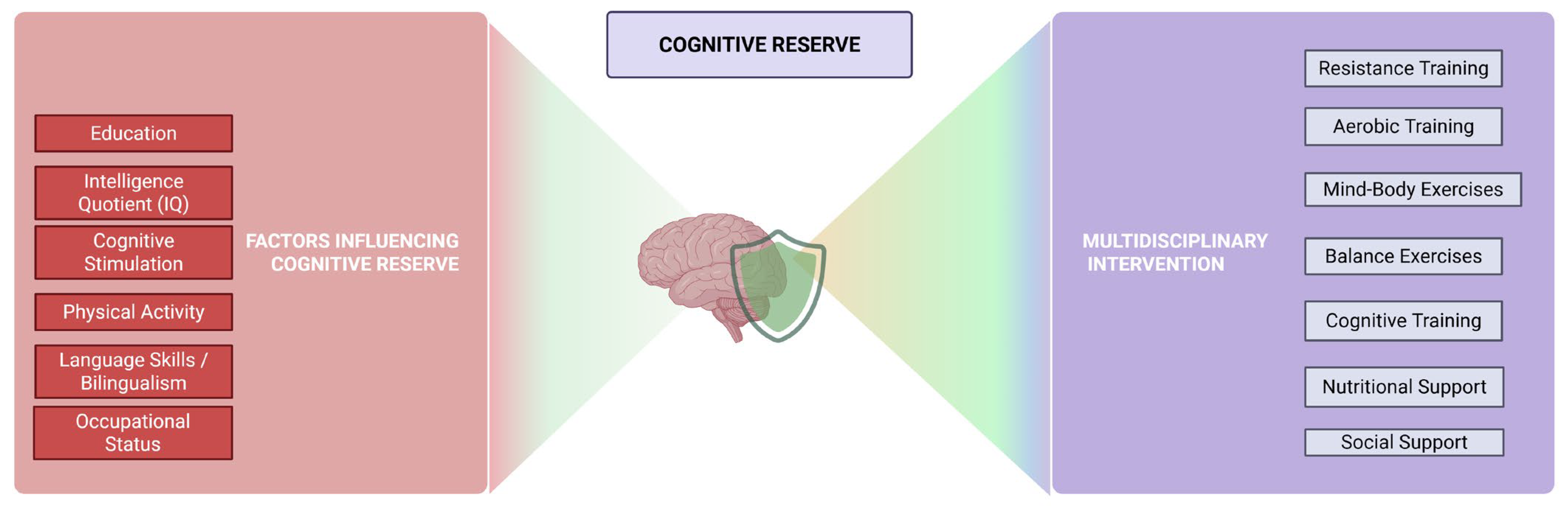
7. Multicomponent Training and Cognitive Reserve: Toward Personalized Interventions
8. Interaction Between Physical Activity and Circadian Rhythms in Cognitive Performance
9. Exercise Effects in Genetically At-Risk Populations (e.g., APOE ε4 Carriers)
9.1. Background: APOE ε4 and Alzheimer’s Disease Pathogenesis
9.2. Genotype-Exercise Interactions: Epidemiological and Cognitive Evidence
9.3. Brain Imaging and Functional Connectivity: Evidence from Human Trials
9.4. Neurobiological Mechanisms: BDNF, Inflammation, Amyloid Clearance
9.5. Epigenetics and Genetic Regulation: Exercise as a Modulator in APOE ε4 Carriers
9.6. Clinical Trials and Personalized Interventions
9.7. Sex Differences and Hormonal Interactions in APOE ε4 Responses
9.8. Precision Prevention: Toward Genotype-Guided Cognitive Health Strategies
10. Physical Activity and the Prevention of Mild Cognitive Impairment (MCI) Progression
10.1. Neurocognitive Outcomes of Exercise in MCI Populations
10.2. Brain Imaging Biomarkers: Structural and Functional Preservation
10.3. Molecular and Cellular Effects: Neuroinflammation, Insulin Resistance, and Mitochondrial Function
10.4. Psychosocial and Functional Impacts
10.5. Multimodal and Personalized Approaches in MCI Prevention
10.6. Early Identification and Public Health Implications
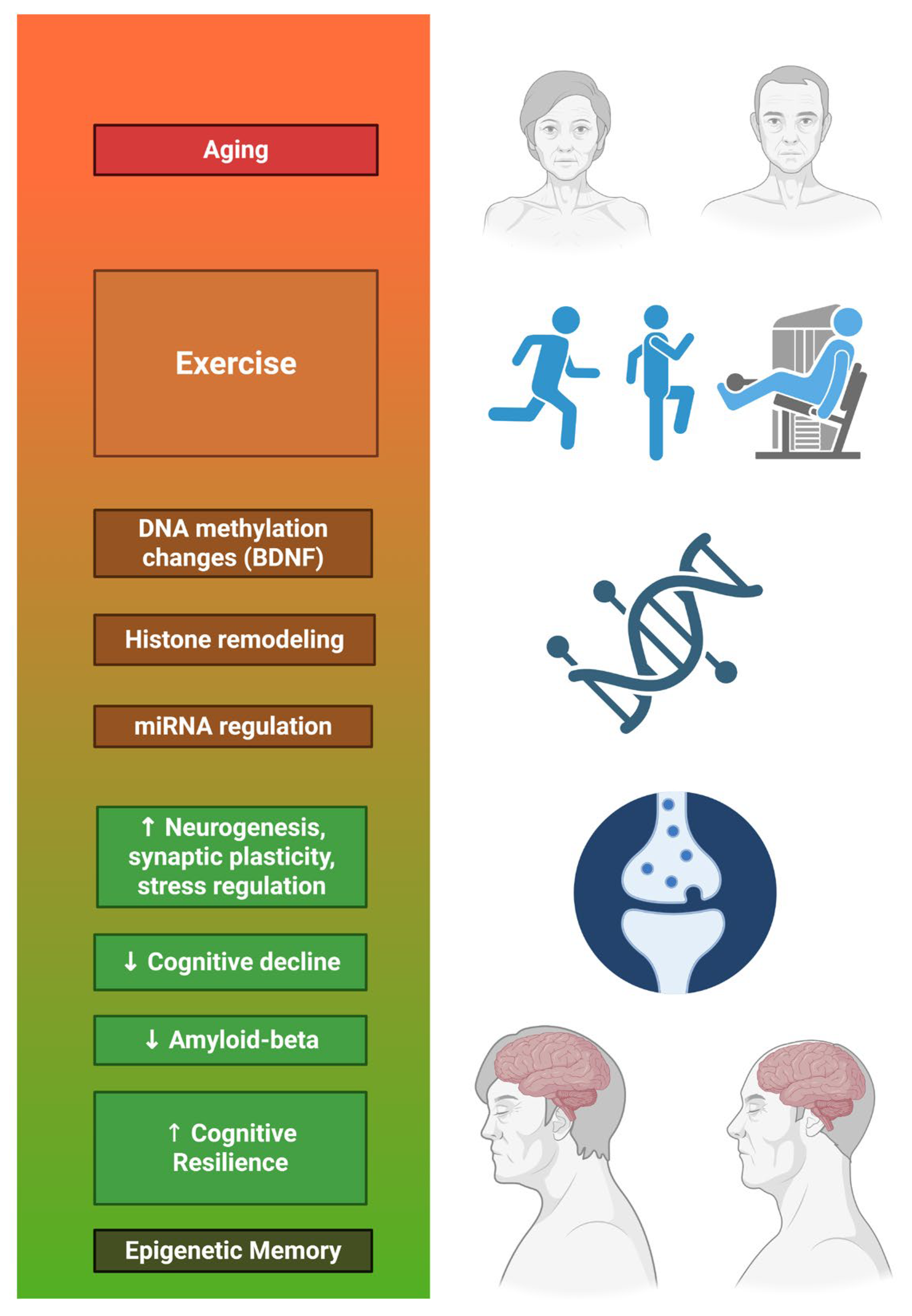
11. Exercise as an Epigenetic Modulator in Brain Aging
12. Emerging Technologies: Tele-Exercise, Virtual Reality, and Cognitive-Motor Gamification
12.1. Tele-Exercise and Remote Monitoring: Accessibility, Adherence, and Cognitive Outcomes
12.2. Virtual Reality-Based Physical and Cognitive Training: Neuroplasticity in Immersive Environments
12.3. Cognitive-Motor Gamification: Enhancing Dual-Task Performance and Cognitive Reserve
13. Sex Differences in Neurocognitive Response to Exercise in Older Adults
14. Limitations and Future Applications
15. Practical Applications
- Clinical practice: Exercise prescriptions should be incorporated into routine geriatric care, with aerobic and multicomponent programs tailored to cognitive and physical baselines.
- Public health: Community-based physical activity programs can reduce dementia incidence and promote healthy aging at the population level.
- Personalized interventions: Programs should consider individual variability—such as APOE ε4 status, sex, and chronotype—to maximize cognitive benefits.
- Technology integration: Tele-exercise, virtual reality, and gamified training offer innovative ways to increase adherence, especially in remote or mobility-limited populations.
- Multidomain strategies: Combining physical activity with cognitive training, nutrition, and social engagement enhances outcomes and may build cognitive reserve.
- Policy implications: Governments and institutions should support infrastructures and guidelines promoting active aging environments and lifelong physical activity habits.
- Training load: Exercise prescriptions should also define intensity and volume. Current recommendations suggest aerobic training at 60–75% of VO2max (or HRmax), with higher intensities (85–95% HRpeak) applied intermittently when feasible. For resistance training, loads of 70–80% of one-repetition maximum (1RM) are advised. Balancing intensity and safety is particularly important in older adults [250].
16. Conclusions
Author Contributions
Funding
Data Availability Statement
Acknowledgments
Conflicts of Interest
References
- WHO’s Work on the UN Decade of Healthy Ageing (2021–2030). Available online: https://www.who.int/initiatives/decade-of-healthy-ageing (accessed on 14 July 2025).
- Livingston, G.; Huntley, J.; Sommerlad, A.; Ames, D.; Ballard, C.; Banerjee, S.; Brayne, C.; Burns, A.; Cohen-Mansfield, J.; Cooper, C.; et al. Dementia Prevention, Intervention, and Care: 2020 Report of the Lancet Commission. Lancet 2020, 396, 413–446. [Google Scholar] [CrossRef] [PubMed]
- Wimo, A.; Guerchet, M.; Ali, G.C.; Wu, Y.T.; Prina, A.M.; Winblad, B.; Jönsson, L.; Liu, Z.; Prince, M. The Worldwide Costs of Dementia 2015 and Comparisons with 2010. Alzheimer’s Dement. 2017, 13, 1–7. [Google Scholar] [CrossRef]
- Harada, C.N.; Natelson Love, M.C.; Triebel, K.L. Normal Cognitive Aging. Clin. Geriatr. Med. 2013, 29, 737–752. [Google Scholar] [CrossRef]
- Kim, T.W.; Sung, Y.H. Regular Exercise Promotes Memory Function and Enhances Hippocampal Neuroplasticity in Experimental Autoimmune Encephalomyelitis Mice. Neuroscience 2017, 346, 173–181. [Google Scholar] [CrossRef] [PubMed]
- Blondell, S.J.; Hammersley-Mather, R.; Veerman, J.L. Does Physical Activity Prevent Cognitive Decline and Dementia?: A Systematic Review and Meta-Analysis of Longitudinal Studies. BMC Public. Health 2014, 14, 510. [Google Scholar] [CrossRef]
- Falck, R.S.; Davis, J.C.; Liu-Ambrose, T. What Is the Association between Sedentary Behaviour and Cognitive Function? A Systematic Review. Br. J. Sports Med. 2017, 51, 800–811. [Google Scholar] [CrossRef] [PubMed]
- Northey, J.M.; Cherbuin, N.; Pumpa, K.L.; Smee, D.J.; Rattray, B. Exercise Interventions for Cognitive Function in Adults Older than 50: A Systematic Review with Meta-Analysis. Br. J. Sports Med. 2018, 52, 154–160. [Google Scholar] [CrossRef]
- Gavelin, H.M.; Dong, C.; Minkov, R.; Bahar-Fuchs, A.; Ellis, K.A.; Lautenschlager, N.T.; Mellow, M.L.; Wade, A.T.; Smith, A.E.; Finke, C.; et al. Combined Physical and Cognitive Training for Older Adults with and without Cognitive Impairment: A Systematic Review and Network Meta-Analysis of Randomized Controlled Trials. Ageing Res. Rev. 2021, 66, 101232. [Google Scholar] [CrossRef]
- Salame, S.; Garcia, P.C.; Real, C.C.; Borborema, J.; Mota-Ortiz, S.R.; Britto, L.R.G.; Pires, R.S. Distinct Neuroplasticity Processes Are Induced by Different Periods of Acrobatic Exercise Training. Behav. Brain Res. 2016, 308, 64–74. [Google Scholar] [CrossRef]
- Voss, M.W.; Weng, T.B.; Burzynska, A.Z.; Wong, C.N.; Cooke, G.E.; Clark, R.; Fanning, J.; Awick, E.; Gothe, N.P.; Olson, E.A.; et al. Fitness, but Not Physical Activity, Is Related to Functional Integrity of Brain Networks Associated with Aging. Neuroimage 2016, 131, 113–125. [Google Scholar] [CrossRef]
- Cotman, C.W.; Berchtold, N.C.; Christie, L.A. Exercise Builds Brain Health: Key Roles of Growth Factor Cascades and Inflammation. Trends Neurosci. 2007, 30, 464–472. [Google Scholar] [CrossRef]
- Stillman, C.M.; Cohen, J.; Lehman, M.E.; Erickson, K.I. Mediators of Physical Activity on Neurocognitive Function: A Review at Multiple Levels of Analysis. Front. Hum. Neurosci. 2016, 10, 626. [Google Scholar] [CrossRef]
- Dose, J.; Huebbe, P.; Nebel, A.; Rimbach, G. APOE Genotype and Stress Response—A Mini Review. Lipids Health Dis. 2016, 15, 121. [Google Scholar] [CrossRef]
- Huh, J.Y. The Role of Exercise-Induced Myokines in Regulating Metabolism. Arch. Pharm. Res. 2018, 41, 14–29. [Google Scholar] [CrossRef]
- Coria-Lucero, C.D.; Golini, R.S.; Ponce, I.T.; Deyurka, N.; Anzulovich, A.C.; Delgado, S.M.; Navigatore-Fonzo, L.S. Rhythmic Bdnf and TrkB Expression Patterns in the Prefrontal Cortex Are Lost in Aged Rats. Brain Res. 2016, 1653, 51–58. [Google Scholar] [CrossRef] [PubMed]
- Clemente-Suárez, V.J.; Redondo-Flórez, L.; Rubio-Zarapuz, A.; Martín-Rodríguez, A.; Tornero-Aguilera, J.F. Microbiota Implications in Endocrine-Related Diseases: From Development to Novel Therapeutic Approaches. Biomedicines 2024, 12, 221. [Google Scholar] [CrossRef] [PubMed]
- Clemente-Suárez, V.J.; Bustamante-Sanchez, A.; Rubio-Zarapuz, A.; Martín-Rodríguez, A.; Tornero-Aguilera, J.F.; Beltrán-Velasco, A.I. Biomimetic Strategies for Nutraceutical Delivery: Advances in Bionanomedicine for Enhanced Nutritional Health. Biomimetics 2025, 10, 426. [Google Scholar] [CrossRef] [PubMed]
- Merino del Portillo, M.; Clemente-Suárez, V.J.; Ruisoto, P.; Jimenez, M.; Ramos-Campo, D.J.; Beltran-Velasco, A.I.; Martínez-Guardado, I.; Rubio-Zarapuz, A.; Navarro-Jiménez, E.; Tornero-Aguilera, J.F. Nutritional Modulation of the Gut–Brain Axis: A Comprehensive Review of Dietary Interventions in Depression and Anxiety Management. Metabolites 2024, 14, 549. [Google Scholar] [CrossRef]
- Petrovic, S.M.; Barbinta-Patrascu, M.E. Organic and Biogenic Nanocarriers as Bio-Friendly Systems for Bioactive Compounds’ Delivery: State-of-the-Art and Challenges. Materials. 2023, 16, 7550. [Google Scholar] [CrossRef]
- World Health Organization. Life Expectancy at Birth (Years) [Indicator: A21CFC2/90E2E48]—WHO Data [Internet]. 2025. Available online: https://data.who.int/indicators/i/A21CFC2/90E2E48 (accessed on 5 June 2025).
- Instituto Nacional de Estadística (INE). 4.1 Esperanza de vida [Internet]. INE: Madrid, Spain, 2025. Available online: https://www.ine.es/ss/Satellite?L=es_ES&c=INESeccion_C&cid=1259926380048&p=1254735110672&pagename=ProductosYServicios%2FPYSLayout¶m1=PYSDetalle¶m3=1259924822888&utm_source=chatgpt.com (accessed on 5 June 2025).
- COVID-19 Eliminated a Decade of Progress in Global Level of Life Expectancy. Available online: https://www.who.int/news/item/24-05-2024-covid-19-eliminated-a-decade-of-progress-in-global-level-of-life-expectancy (accessed on 3 July 2025).
- Life Expectancy and Healthy Life Expectancy. Available online: https://www.who.int/data/gho/data/themes/mortality-and-global-health-estimates/ghe-life-expectancy-and-healthy-life-expectancy (accessed on 3 July 2025).
- Nicholls, L.A.B.; Amanzio, M.; Güntekin, B.; Keage, H. Editorial: The Cognitive Ageing Collection. Sci. Rep. 2024, 14, 1–3. [Google Scholar] [CrossRef]
- United Nations Global Issues. Population. 2024. Available online: https://www.un.org/en/global-issues/population (accessed on 5 June 2025).
- Ageing and Health. Available online: https://www.who.int/news-room/fact-sheets/detail/ageing-and-health (accessed on 3 July 2025).
- Gianfredi, V.; Nucci, D.; Pennisi, F.; Maggi, S.; Veronese, N.; Soysal, P. Aging, Longevity, and Healthy Aging: The Public Health Approach. Aging Clin. Exp. Res. 2025, 37, 125. [Google Scholar] [CrossRef] [PubMed]
- Salvador-Cruz Profesor de, J.; García-Anacleto, A.; Camilo Morantes-Gomez, G.; Salvador-Cruz, J. Estimulación Cognitiva Mediante Tele Neuropsicología En Adultos Mayores En Riesgo de Deterioro Cognitivo Leve. Cuad. Neuropsicol. 2024, 18, 45–61. [Google Scholar]
- Corley, J.; Conte, F.; Harris, S.E.; Taylor, A.M.; Redmond, P.; Russ, T.C.; Deary, I.J.; Cox, S.R. Predictors of Longitudinal Cognitive Ageing from Age 70 to 82 Including APOE E4 Status, Early-Life and Lifestyle Factors: The Lothian Birth Cohort 1936. Mol. Psychiatry 2023, 28, 1256–1271. [Google Scholar] [CrossRef] [PubMed]
- Wisdom, N.M.; Mignogna, J.; Collins, R.L. Variability in Wechsler Adult Intelligence Scale-IV Subtest Performance Across Age. Arch. Clin. Neuropsychol. 2012, 27, 389–397. [Google Scholar] [CrossRef]
- Snow, W.G.; Weinstock, J. Sex Differences among Non-Brain-Damaged Adults on the Wechsler Adult Intelligence Scales: A Review of the Literature. J Clin Exp Neuropsychol 1990, 12, 873–886. [Google Scholar] [CrossRef] [PubMed]
- Boyle, P.A.; Yang, J.; Yu, L.; Leurgans, S.E.; Capuano, A.W.; Schneider, J.A.; Wilson, R.S.; Bennett, D.A. Varied Effects of Age-Related Neuropathologies on the Trajectory of Late Life Cognitive Decline. Brain 2017, 140, 804. [Google Scholar] [CrossRef]
- Scott, A.J.; Ellison, M.; Sinclair, D.A. The Economic Value of Targeting Aging. Nat. Aging 2021, 1, 616–623. [Google Scholar] [CrossRef]
- Luo, Y.; Pan, X.; Zhang, Z. Productive Activities and Cognitive Decline among Older Adults in China: Evidence from the China Health and Retirement Longitudinal Study. Soc. Sci. Med. 2019, 229, 96–105. [Google Scholar] [CrossRef]
- Ismail, F.Y.; Fatemi, A.; Johnston, M.V. Cerebral Plasticity: Windows of Opportunity in the Developing Brain. Eur. J. Paediatr. Neurol. 2017, 21, 23–48. [Google Scholar] [CrossRef]
- Marzola, P.; Melzer, T.; Pavesi, E.; Gil-Mohapel, J.; Brocardo, P.S. Exploring the Role of Neuroplasticity in Development, Aging, and Neurodegeneration. Brain Sci. 2023, 13, 1610. [Google Scholar] [CrossRef]
- Hua, Z.; Sun, J. Investigating Morphological Changes of the Hippocampus After Prolonged Aerobic Exercise in Mice: Neural Function and Learning Capabilities Investigación de Los Cambios Morfológicos Del Hipocampo Después De Un Ejercicio Aeróbico Prolongado En Ratones: Función Neuronal y Capacidades de Aprendizaje. Int. J. Morphol. 2024, 42, 614–622. [Google Scholar]
- Bartra, C.; Jager, L.A.; Alcarraz, A.; Meza-Ramos, A.; Sangüesa, G.; Corpas, R.; Guasch, E.; Batlle, M.; Sanfeliu, C. Antioxidant Molecular Brain Changes Parallel Adaptive Cardiovascular Response to Forced Running in Mice. Antioxidants 2022, 11, 1891. [Google Scholar] [CrossRef]
- Hüttenrauch, M.; Salinas, G.; Wirths, O. Effects of Long-Term Environmental Enrichment on Anxiety, Memory, Hippocampal Plasticity and Overall Brain Gene Expression in C57BL6 Mice. Front. Mol. Neurosci. 2016, 9, 62. [Google Scholar] [CrossRef]
- García-Mesa, Y.; Pareja-Galeano, H.; Bonet-Costa, V.; Revilla, S.; Gómez-Cabrera, M.C.; Gambini, J.; Giménez-Llort, L.; Cristòfol, R.; Viña, J.; Sanfeliu, C. Physical Exercise Neuroprotects Ovariectomized 3xTg-AD Mice through BDNF Mechanisms. Psychoneuroendocrinology 2014, 45, 154–166. [Google Scholar] [CrossRef]
- Mattson, M.P.; Arumugam, T.V. Hallmarks of Brain Aging: Adaptive and Pathological Modification by Metabolic States. Cell Metab. 2018, 27, 1176–1199. [Google Scholar] [CrossRef]
- Müller, P.; Duderstadt, Y.; Lessmann, V.; Müller, N.G. Lactate and BDNF: Key Mediators of Exercise Induced Neuroplasticity? J. Clin. Med. 2020, 9, 1136. [Google Scholar] [CrossRef]
- Voss, M.W.; Vivar, C.; Kramer, A.F.; van Praag, H. Bridging Animal and Human Models of Exercise-Induced Brain Plasticity. Trends Cogn. Sci. 2013, 17, 525. [Google Scholar] [CrossRef] [PubMed]
- Lee, T.H.Y.; Formolo, D.A.; Kong, T.; Lau, S.W.Y.; Ho, C.S.L.; Leung, R.Y.H.; Hung, F.H.Y.; Yau, S.Y. Potential Exerkines for Physical Exercise-Elicited pro-Cognitive Effects: Insight from Clinical and Animal Research. Int. Rev. Neurobiol. 2019, 147, 361–395. [Google Scholar] [CrossRef] [PubMed]
- Marston, K.J.; Brown, B.M.; Rainey-Smith, S.R.; Peiffer, J.J. Resistance Exercise-Induced Responses in Physiological Factors Linked with Cognitive Health. J. Alzheimers Dis. 2019, 68, 39–64. [Google Scholar] [CrossRef]
- Raichlen, D.A.; Alexander, G.E. Adaptive Capacity: An Evolutionary Neuroscience Model Linking Exercise, Cognition, and Brain Health. Trends Neurosci. 2017, 40, 408–421. [Google Scholar] [CrossRef] [PubMed]
- Castells-Sánchez, A.; Roig-Coll, F.; Lamonja-Vicente, N.; Altés-Magret, M.; Torán-Monserrat, P.; Via, M.; García-Molina, A.; Tormos, J.M.; Heras, A.; Alzamora, M.T.; et al. Effects and Mechanisms of Cognitive, Aerobic Exercise, and Combined Training on Cognition, Health, and Brain Outcomes in Physically Inactive Older Adults: The Projecte Moviment Protocol. Front. Aging Neurosci. 2019, 11, 216. [Google Scholar] [CrossRef]
- Stimpson, N.J.; Davison, G.; Javadi, A.H. Joggin’ the Noggin: Towards a Physiological Understanding of Exercise-Induced Cognitive Benefits. Neurosci. Biobehav. Rev. 2018, 88, 177–186. [Google Scholar] [CrossRef] [PubMed]
- Livingston-Thomas, J.; Nelson, P.; Karthikeyan, S.; Antonescu, S.; Jeffers, M.S.; Marzolini, S.; Corbett, D. Exercise and Environmental Enrichment as Enablers of Task-Specific Neuroplasticity and Stroke Recovery. Neurotherapeutics 2016, 13, 395–402. [Google Scholar] [CrossRef]
- Gómez, N.J.N.; Morey, R.J.R.; Machado, V.R.N.; León, M.G.; Pérez, A.M. La Neuroplasticidad En La Enfermedad de Alzheimer: Una Alternativa Terapéutica a Nivel Molecular. Medisur 2020, 18, 675–684. [Google Scholar]
- Sepúlveda-Lara, A.; Sepúlveda, P.; Marzuca-Nassr, G.N. Resistance Exercise Training as a New Trend in Alzheimer’s Disease Research: From Molecular Mechanisms to Prevention. Int. J. Mol. Sci. 2024, 25, 7084. [Google Scholar] [CrossRef]
- Abdulghani, A.; Poghosyan, M.; Mehren, A.; Philipsen, A.; Anderzhanova, E. Neuroplasticity to Autophagy Cross-Talk in a Therapeutic Effect of Physical Exercises and Irisin in ADHD. Front. Mol. Neurosci. 2023, 15, 997054. [Google Scholar] [CrossRef]
- Fernández-Rodríguez, R.; Álvarez-Bueno, C.; Martínez-Ortega, I.A.; Martínez-Vizcaíno, V.; Mesas, A.E.; Notario-Pacheco, B. Immediate Effect of High-Intensity Exercise on Brain-Derived Neurotrophic Factor in Healthy Young Adults: A Systematic Review and Meta-Analysis. J. Sport. Health Sci. 2022, 11, 367–375. [Google Scholar] [CrossRef]
- Nicolini, C.; Fahnestock, M.; Gibala, M.J.; Nelson, A.J. Understanding the Neurophysiological and Molecular Mechanisms of Exercise-Induced Neuroplasticity in Cortical and Descending Motor Pathways: Where Do We Stand? Neuroscience 2021, 457, 259–282. [Google Scholar] [CrossRef]
- Hortobágyi, T.; Vetrovsky, T.; Balbim, G.M.; Sorte Silva, N.C.B.; Manca, A.; Deriu, F.; Kolmos, M.; Kruuse, C.; Liu-Ambrose, T.; Radák, Z.; et al. The Impact of Aerobic and Resistance Training Intensity on Markers of Neuroplasticity in Health and Disease. Ageing Res. Rev. 2022, 80, 101698. [Google Scholar] [CrossRef] [PubMed]
- Li, C.; Liu, T.; Li, R.; Zhou, C. Effects of Exercise on Proactive Interference in Memory: Potential Neuroplasticity and Neurochemical Mechanisms. Psychopharmacology 2020, 237, 1917–1929. [Google Scholar] [CrossRef] [PubMed]
- Li, F.; Geng, X.; Yun, H.J.; Haddad, Y.; Chen, Y.; Ding, Y. Neuroplastic Effect of Exercise Through Astrocytes Activation and Cellular Crosstalk. Aging Dis. 2021, 12, 1644. [Google Scholar] [CrossRef]
- Hoffmann, C.; Weigert, C. Skeletal Muscle as an Endocrine Organ: The Role of Myokines in Exercise Adaptations. Cold Spring Harb. Perspect. Med. 2017, 7, a029793. [Google Scholar] [CrossRef]
- Pedersen, B.K.; Febbraio, M.A. Muscle as an Endocrine Organ: Focus on Muscle-Derived Interleukin-6. Physiol. Rev. 2008, 88, 1379–1406. [Google Scholar] [CrossRef] [PubMed]
- Rusch, J.A.; Layden, B.T.; Dugas, L.R. Signalling Cognition: The Gut Microbiota and Hypothalamic-Pituitary-Adrenal Axis. Front. Endocrinol. 2023, 14, 1130689. [Google Scholar] [CrossRef] [PubMed]
- Sebastián, D.; Palacín, M.; Zorzano, A. Mitochondrial Dynamics: Coupling Mitochondrial Fitness with Healthy Aging. Trends Mol. Med. 2017, 23, 201–215. [Google Scholar] [CrossRef] [PubMed]
- Clemente-Suárez, V.J.; Rubio-Zarapuz, A.; Belinchón-deMiguel, P.; Beltrán-Velasco, A.I.; Martín-Rodríguez, A.; Tornero-Aguilera, J.F. Impact of Physical Activity on Cellular Metabolism Across Both Neurodegenerative and General Neurological Conditions: A Narrative Review. Cells 2024, 13, 1940. [Google Scholar] [CrossRef]
- Gomez-Pinilla, F.; Hillman, C. The Influence of Exercise on Cognitive Abilities. Compr. Physiol. 2013, 3, 403. [Google Scholar] [CrossRef]
- Adlard, P.A.; Perreau, V.M.; Cotman, C.W. The Exercise-Induced Expression of BDNF within the Hippocampus Varies across Life-Span. Neurobiol. Aging 2005, 26, 511–520. [Google Scholar] [CrossRef]
- Jodeiri Farshbaf, M.; Alviña, K. Multiple Roles in Neuroprotection for the Exercise Derived Myokine Irisin. Front. Aging Neurosci. 2021, 13, 649929. [Google Scholar] [CrossRef]
- Minuti, A.; Raffaele, I.; Scuruchi, M.; Lui, M.; Muscarà, C.; Calabrò, M. Role and Functions of Irisin: A Perspective on Recent Developments and Neurodegenerative Diseases. Antioxidants 2025, 14, 554. [Google Scholar] [CrossRef]
- Fuss, J.; Ben Abdallah, N.M.B.; Vogt, M.A.; Touma, C.; Pacifici, P.G.; Palme, R.; Witzemann, V.; Hellweg, R.; Gass, P. Voluntary Exercise Induces Anxiety-like Behavior in Adult C57BL/6J Mice Correlating with Hippocampal Neurogenesis. Hippocampus 2010, 20, 364–376. [Google Scholar] [CrossRef]
- Nash, D.; Hughes, M.G.; Butcher, L.; Aicheler, R.; Smith, P.; Cullen, T.; Webb, R. IL-6 Signaling in Acute Exercise and Chronic Training: Potential Consequences for Health and Athletic Performance. Scand. J. Med. Sci. Sports 2022, 33, 4. [Google Scholar] [CrossRef]
- Li, Z.; Gao, Z.; Sun, T.; Zhang, S.; Yang, S.; Zheng, M.; Shen, H. Meteorin-like/Metrnl, a Novel Secreted Protein Implicated in Inflammation, Immunology, and Metabolism: A Comprehensive Review of Preclinical and Clinical Studies. Front. Immunol. 2023, 14, 1098570. [Google Scholar] [CrossRef] [PubMed]
- Larson, K.R.; Jayakrishnan, D.; Sauza, K.A.S.; Goodson, M.L.; Chaffin, A.T.; Davidyan, A.; Pathak, S.; Fang, Y.; Magaña, D.G.; Miller, B.F.; et al. FGF21 Induces Skeletal Muscle Atrophy and Increases Amino Acids in Female Mice: A Potential Role for Glucocorticoids. Endocrinology 2024, 165, bqae004. [Google Scholar] [CrossRef] [PubMed]
- Erickson, K.I.; Voss, M.W.; Prakash, R.S.; Basak, C.; Szabo, A.; Chaddock, L.; Kim, J.S.; Heo, S.; Alves, H.; White, S.M.; et al. Exercise Training Increases Size of Hippocampus and Improves Memory. Proc. Natl. Acad. Sci. USA 2011, 108, 3017–3022. [Google Scholar] [CrossRef]
- Wrann, C.D.; White, J.P.; Salogiannnis, J.; Laznik-Bogoslavski, D.; Wu, J.; Ma, D.; Lin, J.D.; Greenberg, M.E.; Spiegelman, B.M. Exercise Induces Hippocampal BDNF through a PGC-1α/FNDC5 Pathway. Cell Metab. 2013, 18, 649–659. [Google Scholar] [CrossRef] [PubMed]
- Lourenco, M.V.; Frozza, R.L.; de Freitas, G.B.; Zhang, H.; Kincheski, G.C.; Ribeiro, F.C.; Gonçalves, R.A.; Clarke, J.R.; Beckman, D.; Staniszewski, A.; et al. Exercise-Linked FNDC5/Irisin Rescues Synaptic Plasticity and Memory Defects in Alzheimer’s Models. Nat. Med. 2019, 25, 165–175. [Google Scholar] [CrossRef]
- Trejo, J.L.; Carro, E.; Torres-Alemán, I. Circulating Insulin-Like Growth Factor I Mediates Exercise-Induced Increases in the Number of New Neurons in the Adult Hippocampus. J. Neurosci. 2001, 21, 1628–1634. [Google Scholar] [CrossRef]
- Starkie, R.L.; Rolland, J.; Angus, D.J.; Anderson, M.J.; Febbraio, M.A. Circulating Monocytes Are Not the Source of Elevations in Plasma IL-6 and TNF-α Levels after Prolonged Running. Am. J. Physiol. Cell Physiol. 2001, 280, C769–C774. [Google Scholar] [CrossRef]
- Tsuchida, R.; Yamaguchi, T.; Funabashi, D.; Koumi, Y.; Kita, I.; Nishijima, T. Exercise Type Influences the Effect of an Acute Bout of Exercise on Hippocampal Neuronal Activation in Mice. Neurosci. Lett. 2022, 783, 136707. [Google Scholar] [CrossRef]
- Rao, R.R.; Long, J.Z.; White, J.P.; Svensson, K.J.; Lou, J.; Lokurkar, I.; Jedrychowski, M.P.; Ruas, J.L.; Wrann, C.D.; Lo, J.C.; et al. Meteorin-like Is a Hormone That Regulates Immune-Adipose Interactions to Increase Beige Fat Thermogenesis. Cell 2014, 157, 1279–1291. [Google Scholar] [CrossRef] [PubMed]
- Hong, C.; Wang, Z.; Zheng, S.L.; Hu, W.J.; Wang, S.N.; Zhao, Y.; Miao, C.Y. Metrnl Regulates Cognitive Dysfunction and Hippocampal BDNF Levels in D-Galactose-Induced Aging Mice. Acta Pharmacol. Sin. 2022, 44, 741. [Google Scholar] [CrossRef]
- Yang, C.; Wang, W.; Deng, P.; Li, C.; Zhao, L.; Gao, H. Fibroblast Growth Factor 21 Modulates Microglial Polarization That Attenuates Neurodegeneration in Mice and Cellular Models of Parkinson’s Disease. Front. Aging Neurosci. 2021, 13, 778527. [Google Scholar] [CrossRef] [PubMed]
- Li, S.; Chen, J.; Wei, P.; Zou, T.; You, J. Fibroblast Growth Factor 21: A Fascinating Perspective on the Regulation of Muscle Metabolism. Int. J. Mol. Sci. 2023, 24, 16951. [Google Scholar] [CrossRef]
- Rai, M.; Demontis, F. Muscle-to-Brain Signaling Via Myokines and Myometabolites. Brain Plasticity 2022, 8, 43. [Google Scholar] [CrossRef]
- Fagundo, A.B.; Jiménez-Murcia, S.; Giner-Bartolomé, C.; Agüera, Z.; Sauchelli, S.; Pardo, M.; Crujeiras, A.B.; Granero, R.; Baños, R.; Botella, C.; et al. Modulation of Irisin and Physical Activity on Executive Functions in Obesity and Morbid Obesity. Sci. Rep. 2016, 6, 30820. [Google Scholar] [CrossRef]
- Wrann, C.D. FNDC5/Irisin—Their Role in the Nervous System and as a Mediator for Beneficial Effects of Exercise on the Brain. Brain Plasticity 2016, 1, 55–61. [Google Scholar] [CrossRef]
- Moon, H.Y.; Becke, A.; Berron, D.; Becker, B.; Sah, N.; Benoni, G.; Janke, E.; Lubejko, S.T.; Greig, N.H.; Mattison, J.A.; et al. Running-Induced Systemic Cathepsin B Secretion Is Associated with Memory Function. Cell Metab. 2016, 24, 332–340. [Google Scholar] [CrossRef]
- Bettio, L.; Thacker, J.S.; Hutton, C.; Christie, B.R. Modulation of Synaptic Plasticity by Exercise. Int. Rev. Neurobiol. 2019, 147, 295–322. [Google Scholar] [CrossRef]
- Clemente-Suárez, V.J.; Martín-Rodríguez, A.; Curiel-Regueros, A.; Rubio-Zarapuz, A.; Tornero-Aguilera, J.F. Neuro-Nutrition and Exercise Synergy: Exploring the Bioengineering of Cognitive Enhancement and Mental Health Optimization. Bioengineering 2025, 12, 208. [Google Scholar] [CrossRef] [PubMed]
- Lee, B.; Shin, M.; Park, Y.; Won, S.Y.; Cho, K.S. Physical Exercise-Induced Myokines in Neurodegenerative Diseases. Int. J. Mol. Sci. 2021, 22, 5795. [Google Scholar] [CrossRef]
- Bae, J.Y. Aerobic Exercise Increases Meteorin-Like Protein in Muscle and Adipose Tissue of Chronic High-Fat Diet-Induced Obese Mice. Biomed. Res. Int. 2018, 2018, 6283932. [Google Scholar] [CrossRef] [PubMed]
- Lu, B.; Nagappan, G.; Guan, X.; Nathan, P.J.; Wren, P. BDNF-Based Synaptic Repair as a Disease-Modifying Strategy for Neurodegenerative Diseases. Nat. Rev. Neurosci. 2013, 14, 401–416. [Google Scholar] [CrossRef]
- Barros, M.H.; McStay, G.P. Modular Biogenesis of Mitochondrial Respiratory Complexes. Mitochondrion 2020, 50, 94–114. [Google Scholar] [CrossRef]
- Plaza-Diaz, J.; Izquierdo, D.; Torres-Martos, Á.; Baig, A.T.; Aguilera, C.M.; Ruiz-Ojeda, F.J. Impact of Physical Activity and Exercise on the Epigenome in Skeletal Muscle and Effects on Systemic Metabolism. Biomedicines 2022, 10, 126. [Google Scholar] [CrossRef] [PubMed]
- Zheng, X.; Liu, X.; Guo, Y.; Lv, Y.; Lin, C.; Wang, D.; Wang, S.; Liu, Y.; Hu, X. Physical Exercise and Epigenetic Modifications in Skeletal Muscle, Brain, and Heart. Epigenetics Chromatin 2025, 18, 12. [Google Scholar] [CrossRef]
- Tenchov, R.; Sasso, J.M.; Wang, X.; Zhou, Q.A. Aging Hallmarks and Progression and Age-Related Diseases: A Landscape View of Research Advancement. ACS Chem. Neurosci. 2024, 15, 1–30. [Google Scholar] [CrossRef]
- Kong, J.; Xie, Y.; Fan, R.; Wang, Q.; Luo, Y.; Dong, P. Exercise Orchestrates Systemic Metabolic and Neuroimmune Homeostasis via the Brain–Muscle–Liver Axis to Slow down Aging and Neurodegeneration: A Narrative Review. Eur. J. Med. Res. 2025, 30, 475. [Google Scholar] [CrossRef]
- Leger, C.; Quirié, A.; Méloux, A.; Fontanier, E.; Chaney, R.; Basset, C.; Lemaire, S.; Garnier, P.; Prigent-Tessier, A. Impact of Exercise Intensity on Cerebral BDNF Levels: Role of FNDC5/Irisin. Int. J. Mol. Sci. 2024, 25, 1213. [Google Scholar] [CrossRef] [PubMed]
- Maass, A.; Düzel, S.; Goerke, M.; Becke, A.; Sobieray, U.; Neumann, K.; Lövden, M.; Lindenberger, U.; Bäckman, L.; Braun-Dullaeus, R.; et al. Vascular Hippocampal Plasticity after Aerobic Exercise in Older Adults. Mol. Psychiatry 2015, 20, 585–593. [Google Scholar] [CrossRef]
- Liu, S.Z.; Marcinek, D.J. Skeletal Muscle Bioenergetics in Aging and Heart Failure. Heart Fail. Rev. 2017, 22, 167–178. [Google Scholar] [CrossRef]
- Wong, M.Y.C.; Leung, K.M.; Thøgersen-Ntoumani, C.; Ou, K.; Chung, P.K. Effectiveness of a Supervised Group-Based Walking Program on Physical, Psychological and Social Outcomes among Older Adults: A Randomised Controlled Trial Protocol. BMJ Open 2024, 14, e088315. [Google Scholar] [CrossRef]
- Fridberg, H.; Wiklund, M.; Snellman, F.; Rosendahl, E.; Hedlund, M.; Boraxbekk, C.J.; Lindelöf, N. Negotiating a Physically Active Life in Tune with Ageing: A Grounded Theory Study of Older Persons’ Experiences of Participating in High-Intensity Interval Training. BMC Geriatr. 2025, 25, 11. [Google Scholar] [CrossRef] [PubMed]
- Femminella, G.D.; de Lucia, C.; Iacotucci, P.; Formisano, R.; Petraglia, L.; Allocca, E.; Ratto, E.; D’Amico, L.; Rengo, C.; Pagano, G.; et al. Neuro-Hormonal Effects of Physical Activity in the Elderly. Front. Physiol. 2013, 4DEC, 71689. [Google Scholar] [CrossRef] [PubMed]
- Lian, X.; Liu, Z.; Gan, Z.; Yan, Q.; Tong, L.; Qiu, L.; Liu, Y.; Chen, J.; Li, Z. Targeting the Glymphatic System to Promote α-Synuclein Clearance: A Novel Therapeutic Strategy for Parkinson’s Disease. Neural Regen. Res. 2025, 21, 233. [Google Scholar] [CrossRef] [PubMed]
- Cai, Y.; Zhang, Y.; Leng, S.; Ma, Y.; Jiang, Q.; Wen, Q.; Ju, S.; Hu, J. The Relationship between Inflammation, Impaired Glymphatic System, and Neurodegenerative Disorders: A Vicious Cycle. Neurobiol. Dis. 2024, 192, 106426. [Google Scholar] [CrossRef]
- Iliff, J.J.; Wang, M.; Liao, Y.; Plogg, B.A.; Peng, W.; Gundersen, G.A.; Benveniste, H.; Vates, G.E.; Deane, R.; Goldman, S.A.; et al. A Paravascular Pathway Facilitates CSF Flow through the Brain Parenchyma and the Clearance of Interstitial Solutes, Including Amyloid β. Sci. Transl. Med. 2012, 4, 147ra111. [Google Scholar] [CrossRef]
- von Holstein-Rathlou, S.; Petersen, N.C.; Nedergaard, M. Voluntary running enhances glymphatic influx in awake, behaving, young mice. Neurosci. Lett. 2018, 662, 253–258. [Google Scholar] [CrossRef]
- Mestre, H.; Tithof, J.; Du, T.; Song, W.; Peng, W.; Sweeney, A.M.; Olveda, G.; Thomas, J.H.; Nedergaard, M.; Kelley, D.H. Flow of Cerebrospinal Fluid Is Driven by Arterial Pulsations and Is Reduced in Hypertension. Nat. Commun. 2018, 9, 4878. [Google Scholar] [CrossRef]
- Smith, A.J.; Yao, X.; Dix, J.A.; Jin, B.J.; Verkman, A.S. Test of the ’glymphatic’ Hypothesis Demonstrates Diffusive and Aquaporin-4-Independent Solute Transport in Rodent Brain Parenchyma. eLife 2017, 6, e27679. [Google Scholar] [CrossRef]
- Li, M.; Xu, J.; Li, L.; Zhang, L.; Zuo, Z.; Feng, Y.; He, X.; Hu, X. Voluntary Wheel Exercise Improves Glymphatic Clearance and Ameliorates Colitis-Associated Cognitive Impairment in Aged Mice by Inhibiting TRPV4-Induced Astrocytic Calcium Activity. Exp. Neurol. 2024, 376, 114770. [Google Scholar] [CrossRef]
- Feng, S.; Wu, C.; Zou, P.; Deng, Q.; Chen, Z.; Li, M.; Zhu, L.; Li, F.; Liu, T.C.Y.; Duan, R.; et al. High-Intensity Interval Training Ameliorates Alzheimer’s Disease-like Pathology by Regulating Astrocyte Phenotype-Associated AQP4 Polarization. Theranostics 2023, 13, 3434–3450. [Google Scholar] [CrossRef]
- Liao, J.; An, Z.; Cheng, Q.; Liu, Y.; Chen, Y.; Su, Z.; Usman, A.M.; Tang, Z.; Xiao, G. The Glymphatic System: A New Insight into the Understanding of Neurological Diseases. Brain-X 2024, 2, e70011. [Google Scholar] [CrossRef]
- Shentu, W.; Kong, Q.; Zhang, Y.; Li, W.; Chen, Q.; Yan, S.; Wang, J.; Lai, Q.; Xu, Q.; Qiao, S. Functional Abnormalities of the Glymphatic System in Cognitive Disorders. Neural Regen. Res. 2025, 20, 3430. [Google Scholar] [CrossRef]
- Zhang, R. Aerobic Exercise Training Reduces Central Arterial Stiffness and Improves Cerebral Blood Flow in Older Adults. Veins Lymphat. 2022, 11. [Google Scholar] [CrossRef]
- Akazawa, N.; Tanahashi, K.; Kosaki, K.; Ra, S.G.; Matsubara, T.; Choi, Y.; Zempo-Miyaki, A.; Maeda, S. Aerobic Exercise Training Enhances Cerebrovascular Pulsatility Response to Acute Aerobic Exercise in Older Adults. Physiol. Rep. 2018, 6, e13681. [Google Scholar] [CrossRef]
- Liu, H.L.; Zhao, G.; Zhang, H.; Shi, L. de Long-Term Treadmill Exercise Inhibits the Progression of Alzheimer’s Disease-like Neuropathology in the Hippocampus of APP/PS1 Transgenic Mice. Behav. Brain Res. 2013, 256, 261–272. [Google Scholar] [CrossRef]
- Reed, K.S.; Frescoln, A.M.; Keleher, Q.; Brellenthin, A.G.; Kohut, M.L.; Lefferts, W.K. Effects of Aerobic Exercise Training on Cerebral Pulsatile Hemodynamics in Middle-Aged Adults with Elevated Blood Pressure/Stage 1 Hypertension. J. Appl. Physiol. 2024, 136, 1376–1387. [Google Scholar] [CrossRef] [PubMed]
- Maugeri, G.; D’agata, V.; Magrì, B.; Roggio, F.; Castorina, A.; Ravalli, S.; Di Rosa, M.; Musumeci, G. Neuroprotective Effects of Physical Activity via the Adaptation of Astrocytes. Cells 2021, 10, 1542. [Google Scholar] [CrossRef] [PubMed]
- Wörheide, M.A.; Krumsiek, J.; Kastenmüller, G.; Arnold, M. Multi-Omics Integration in Biomedical Research—A Metabolomics-Centric Review. Anal. Chim. Acta 2021, 1141, 144–162. [Google Scholar] [CrossRef] [PubMed]
- Hablitz, L.M.; Plá, V.; Giannetto, M.; Vinitsky, H.S.; Stæger, F.F.; Metcalfe, T.; Nguyen, R.; Benrais, A.; Nedergaard, M. Circadian Control of Brain Glymphatic and Lymphatic Fluid Flow. Nat. Commun. 2020, 11, 4411. [Google Scholar] [CrossRef] [PubMed]
- Wilson, A.C.; Pountney, D.L.; Khoo, T.K. Therapeutic Mechanisms of Exercise in Parkinson’s Disease. Int. J. Mol. Sci. 2025, 26, 4860. [Google Scholar] [CrossRef] [PubMed]
- Yang, G.; Chen, L.; Grant, G.R.; Paschos, G.; Song, W.L.; Musiek, E.S.; Lee, V.; McLoughlin, S.C.; Grosser, T.; Cotsarelis, G.; et al. Timing of Expression of the Core Clock Gene Bmal1 Influences Its Effects on Aging and Survival. Sci. Transl. Med. 2016, 8, 324ra16. [Google Scholar] [CrossRef] [PubMed]
- Thomas, J.M.; Kern, P.A.; Bush, H.M.; McQuerry, K.J.; Black, W.S.; Clasey, J.L.; Pendergast, J.S. Circadian Rhythm Phase Shifts Caused by Timed Exercise Vary with Chronotype. JCI Insight 2020, 5, e134270. [Google Scholar] [CrossRef]
- Wu, W.; Zhao, Y.; Cheng, X.; Xie, X.; Zeng, Y.; Tao, Q.; Yang, Y.; Xiao, C.; Zhang, Z.; Pang, J.; et al. Modulation of Glymphatic System by Visual Circuit Activation Alleviates Memory Impairment and Apathy in a Mouse Model of Alzheimer’s Disease. Nat. Commun. 2025, 16, 63. [Google Scholar] [CrossRef]
- Liang, S.; Liu, H.; Wang, X.; Lin, H.; Zheng, L.; Zhang, Y.; Peng, L.; Huang, S.; Chen, L. Aerobic Exercise Improves Clearance of Amyloid-β via the Glymphatic System in a Mouse Model of Alzheimer’s Disease. Brain Res. Bull. 2025, 222, 111263. [Google Scholar] [CrossRef]
- Yoo, R.E.; Kim, J.H.; Moon, H.Y.; Park, J.Y.; Cheon, S.; Shin, H.S.; Han, D.; Kim, Y.; Park, S.H.; Choi, S.H. Long-Term Physical Exercise Facilitates Putative Glymphatic and Meningeal Lymphatic Vessel Flow in Humans. Nat. Commun. 2025, 16, 3360. [Google Scholar] [CrossRef]
- He, X.F.; Liu, D.X.; Zhang, Q.; Liang, F.Y.; Dai, G.Y.; Zeng, J.S.; Pei, Z.; Xu, G.Q.; Lan, Y. Voluntary Exercise Promotes Glymphatic Clearance of Amyloid Beta and Reduces the Activation of Astrocytes and Microglia in Aged Mice. Front. Mol. Neurosci. 2017, 10, 259843. [Google Scholar] [CrossRef]
- Festa, F.; Medori, S.; Macrì, M. Move Your Body, Boost Your Brain: The Positive Impact of Physical Activity on Cognition across All Age Groups. Biomedicines 2023, 11, 1765. [Google Scholar] [CrossRef]
- Mattson, M.P. Evolutionary Aspects of Human Exercise—Born to Run Purposefully. Ageing Res. Rev. 2012, 11, 347. [Google Scholar] [CrossRef]
- Boraxbekk, C.J.; Salami, A.; Wåhlin, A.; Nyberg, L. Physical Activity over a Decade Modifies Age-Related Decline in Perfusion, Gray Matter Volume, and Functional Connectivity of the Posterior Default-Mode Network-A Multimodal Approach. Neuroimage 2016, 131, 133–141. [Google Scholar] [CrossRef]
- Azarias, F.R.; Almeida, G.H.D.R.; de Melo, L.F.; Rici, R.E.G.; Maria, D.A. The Journey of the Default Mode Network: Development, Function, and Impact on Mental Health. Biology 2025, 14, 395. [Google Scholar] [CrossRef]
- Vidal-Piñeiro, D.; Valls-Pedret, C.; Fernández-Cabello, S.; Arenaza-Urquijo, E.M.; Sala-Llonch, R.; Solana, E.; Bargalló, N.; Junqué, C.; Ros, E.; Bartrés-Faz, D. Decreased Default Mode Network Connectivity Correlates with Age-Associated Structural and Cognitive Changes. Front. Aging Neurosci. 2014, 6, 256. [Google Scholar] [CrossRef] [PubMed]
- Won, J.; Nielson, K.A.; Smith, J.C. Large-Scale Network Connectivity and Cognitive Function Changes after Exercise Training in Older Adults with Intact Cognition and Mild Cognitive Impairment. J. Alzheimers Dis. Rep. 2023, 7, 399–413. [Google Scholar] [CrossRef] [PubMed]
- Kommula, Y.; Callow, D.D.; Purcell, J.J.; Smith, J.C. Acute Exercise Improves Large-Scale Brain Network Segregation in Healthy Older Adults. Brain Connect. 2024, 14, 369–381. [Google Scholar] [CrossRef]
- Dorsman, K.A.; Weiner-Light, S.; Staffaroni, A.M.; Brown, J.A.; Wolf, A.; Cobigo, Y.; Walters, S.; Kramer, J.H.; Casaletto, K.B. Get Moving! Increases in Physical Activity Are Associated With Increasing Functional Connectivity Trajectories in Typically Aging Adults. Front. Aging Neurosci. 2020, 12, 104. [Google Scholar] [CrossRef]
- Liu, H.; Sun, Z.; Zeng, H.; Han, J.; Hu, M.; Mao, D.; Tian, X.; Li, R. Meta-Analysis of the Effects of Multi-Component Exercise on Cognitive Function in Older Adults with Cognitive Impairment. Front. Aging Neurosci. 2025, 17, 1551877. [Google Scholar] [CrossRef]
- De Sousa Fernandes, M.S.; Ordônio, T.F.; Santos, G.C.J.; Santos, L.E.R.; Calazans, C.T.; Gomes, D.A.; Santos, T.M. Effects of Physical Exercise on Neuroplasticity and Brain Function: A Systematic Review in Human and Animal Studies. Neural Plast. 2020, 2020, 8856621. [Google Scholar] [CrossRef] [PubMed]
- Zhang, M.; Jia, J.; Yang, Y.; Zhang, L.; Wang, X. Effects of Exercise Interventions on Cognitive Functions in Healthy Populations: A Systematic Review and Meta-Analysis. Ageing Res. Rev. 2023, 92, 102116. [Google Scholar] [CrossRef]
- Basso, J.C.; Suzuki, W.A. The Effects of Acute Exercise on Mood, Cognition, Neurophysiology, and Neurochemical Pathways: A Review. Brain Plasticity 2017, 2, 127. [Google Scholar] [CrossRef]
- Macpherson, H.; Teo, W.P.; Schneider, L.A.; Smith, A.E. A Life-Long Approach to Physical Activity for Brain Health. Front. Aging Neurosci. 2017, 9, 147. [Google Scholar] [CrossRef]
- Pettigrew, C.; Soldan, A. Defining Cognitive Reserve and Implications for Cognitive Aging. Curr. Neurol. Neurosci. Rep. 2019, 19, 1. [Google Scholar] [CrossRef]
- Alfaro, C.; Mesa-Gresa, P.; Redolat, R. ¿Qué Factores Deberían Incluirse En Una Intervención Multicomponente Dirigida al Mantenimiento de La Salud Cerebral? Calidad de Vida y Salud 2017, 10, 23–40. [Google Scholar]
- Cheng, S.T. Cognitive Reserve and the Prevention of Dementia: The Role of Physical and Cognitive Activities. Curr. Psychiatry Rep. 2016, 18, 85. [Google Scholar] [CrossRef] [PubMed]
- Maltais, M.; Boisvert-Vigneault, K.; Rolland, Y.; Vellas, B.; de Souto Barreto, P. Longitudinal Associations of Physical Activity Levels with Morphological and Functional Changes Related with Aging: The MAPT Study. Exp Gerontol 2019, 128, 110758. [Google Scholar] [CrossRef]
- Imaoka, M.; Nakao, H.; Nakamura, M.; Tazaki, F.; Maebuchi, M.; Ibuki, M.; Takeda, M. Effect of Multicomponent Exercise and Nutrition Support on the Cognitive Function of Older Adults: A Randomized Controlled Trial. Clin. Interv. Aging 2019, 14, 2145–2153. [Google Scholar] [CrossRef]
- Jeong, M.K.; Park, K.W.; Ryu, J.K.; Kim, G.M.; Jung, H.H.; Park, H. Multi-Component Intervention Program on Habitual Physical Activity Parameters and Cognitive Function in Patients with Mild Cognitive Impairment: A Randomized Controlled Trial. Int. J. Environ. Res. Public. Health 2021, 18, 6240. [Google Scholar] [CrossRef]
- Sánchez-Sánchez, J.L.; Udina, C.; Medina-Rincón, A.; Esbrí-Victor, M.; Bartolomé-Martín, I.; Moral-Cuesta, D.; Marín-Epelde, I.; Ramon-Espinoza, F.; Latorre, M.S.; Idoate, F.; et al. Effect of a Multicomponent Exercise Program and Cognitive Stimulation (VIVIFRAIL-COGN) on Falls in Frail Community Older Persons with High Risk of Falls: Study Protocol for a Randomized Multicenter Control Trial. BMC Geriatr. 2022, 22, 612. [Google Scholar] [CrossRef]
- Znazen, H.; Slimani, M.; Hadadi, A.; Alzahrani, T.; Tod, D.; Bragazzi, N.L.; Souissi, N. Acute Effects of Moderate versus High-Intensity Strength Exercise on Attention and Mood States in Female Physical Education Students. Life 2021, 11, 931. [Google Scholar] [CrossRef] [PubMed]
- Buschert, V.; Prochazka, D.; Bartl, H.; Diemer, J.; Malchow, B.; Zwanzger, P.; Brunnauer, A. Effects of Physical Activity on Cognitive Performance: A Controlled Clinical Study in Depressive Patients. Eur. Arch. Psychiatry Clin. Neurosci. 2019, 269, 555–563. [Google Scholar] [CrossRef]
- Potter, D.; Keeling, D. Effects of Moderate Exercise and Circadian Rhythms on Human Memory. J. Sport. Exerc. Psychol. 2005, 27, 117–125. [Google Scholar] [CrossRef]
- Bloomberg, M.; Brocklebank, L.; Hamer, M.; Steptoe, A. Joint Associations of Physical Activity and Sleep Duration with Cognitive Ageing: Longitudinal Analysis of an English Cohort Study. Lancet Healthy Longev. 2023, 4, e345–e353. [Google Scholar] [CrossRef]
- Rabinowitz, J.A.; An, Y.; He, L.; Alfini, A.J.; Zipunnikov, V.; Wu, M.N.; Wanigatunga, S.K.; Schrack, J.A.; Jackson, C.L.; Ferrucci, L.; et al. Associations of Circadian Rest/Activity Rhythms with Cognition in Middle-Aged and Older Adults: Demographic and Genetic Interactions. Front. Neurosci. 2022, 16, 952204. [Google Scholar] [CrossRef] [PubMed]
- Marchesano, M.; Carboni, A.; Tassino, B.; Silva, A. Circadian Rhythms, Regular Exercise, and Cognitive Performance in Morning-Trained Dancers. Clocks Sleep 2025, 7, 7. [Google Scholar] [CrossRef] [PubMed]
- Augsburger, G.R.; Sobolewski, E.J.; Escalante, G.; Graybeal, A.J. Circadian Regulation for Optimizing Sport and Exercise Performance. Clocks Sleep 2025, 7, 18. [Google Scholar] [CrossRef] [PubMed]
- Díaz-Morales, J.F.; Escribano, C. Predicting School Achievement: The Role of Inductive Reasoning, Sleep Length and Morningness–Eveningness. Pers. Individ. Dif. 2013, 55, 106–111. [Google Scholar] [CrossRef]
- Xu, S.; Akioma, M.; Yuan, Z. Relationship between Circadian Rhythm and Brain Cognitive Functions. Front. Optoelectron. 2021, 14, 278–287. [Google Scholar] [CrossRef]
- Leahy, S.; Xiao, Q.; Yeung, C.H.C.; Figueiro, M.G. Associations between Circadian Alignment and Cognitive Functioning in a Nationally Representative Sample of Older Adults. Sci. Rep. 2024, 14, 13509. [Google Scholar] [CrossRef]
- Easton, D.; Gupta, C.; Vincent, G.; Vandelanotte, C.; Duncan, M.; Tucker, P.; Di Milia, L.; Ferguson, S.A. The Relationship between Circadian Type and Physical Activity as Predictors of Cognitive Performance during Simulated Nightshifts: A Randomised Controlled Trial. Chronobiol. Int. 2025, 42, 736–754. [Google Scholar] [CrossRef]
- Corder, E.H.; Saunders, A.M.; Strittmatter, W.J.; Schmechel, D.E.; Gaskell, P.C.; Small, G.W.; Roses, A.D.; Haines, J.L.; Pericak-Vance, M.A. Gene Dose of Apolipoprotein E Type 4 Allele and the Risk of Alzheimer’s Disease in Late Onset Families. Science 1993, 261, 921–923. [Google Scholar] [CrossRef]
- Zlokovic, B.V. Neurovascular Pathways to Neurodegeneration in Alzheimer’s Disease and Other Disorders. Nat. Rev. Neurosci. 2011, 12, 723–738. [Google Scholar] [CrossRef] [PubMed]
- Liu, C.C.; Kanekiyo, T.; Xu, H.; Bu, G. Apolipoprotein e and Alzheimer Disease: Risk, Mechanisms and Therapy. Nat. Rev. Neurol. 2013, 9, 106–118. [Google Scholar] [CrossRef] [PubMed]
- Larson, E.B.; Wang, L.; Bowen, J.D.; McCormick, W.C.; Teri, L.; Crane, P.; Kukull, W. Exercise Is Associated with Reduced Risk for Incident Dementia among Persons 65 Years of Age and Older. Ann. Intern. Med. 2006, 144, 73–81. [Google Scholar] [CrossRef]
- Smith, J.C.; Nielson, K.A.; Woodard, J.L.; Seidenberg, M.; Durgerian, S.; Hazlett, K.E.; Figueroa, C.M.; Kandah, C.C.; Kay, C.D.; Matthews, M.A.; et al. Physical Activity Reduces Hippocampal Atrophy in Elders at Genetic Risk for Alzheimer’s Disease. Front. Aging Neurosci. 2014, 6, 61. [Google Scholar] [CrossRef]
- Schultz, S.A.; Boots, E.A.; Almeida, R.P.; Oh, J.M.; Einerson, J.; Korcarz, C.E.; Edwards, D.F.; Koscik, R.L.; Dowling, M.N.; Gallagher, C.L.; et al. Cardiorespiratory Fitness Attenuates the Influence of Amyloid on Cognition. J. Int. Neuropsychol. Soc. 2015, 21, 841–850. [Google Scholar] [CrossRef]
- Lloyd, K.M.; Morris, T.P.; Anteraper, S.; Voss, M.; Nieto-Castanon, A.; Whitfield-Gabrieli, S.; Fanning, J.; Gothe, N.; Salerno, E.A.; Erickson, K.I.; et al. Data-Driven MRI Analysis Reveals Fitness-Related Functional Change in Default Mode Network and Cognition Following an Exercise Intervention. Psychophysiology 2023, 61, e14469. [Google Scholar] [CrossRef]
- Ten Brinke, L.F.; Bolandzadeh, N.; Nagamatsu, L.S.; Hsu, C.L.; Davis, J.C.; Miran-Khan, K.; Liu-Ambrose, T. Aerobic Exercise Increases Hippocampal Volume in Older Women with Probable Mild Cognitive Impairment: A 6-Month Randomised Controlled Trial. Br. J. Sports Med. 2015, 49, 248–254. [Google Scholar] [CrossRef]
- Honea, R.A.; Thomas, G.P.; Harsha, A.; Anderson, H.S.; Donnelly, J.E.; Brooks, W.M.; Burns, J.M. Cardiorespiratory Fitness and Preserved Medial Temporal Lobe Volume in Alzheimer Disease. Alzheimer Dis. Assoc. Disord. 2009, 23, 188–197. [Google Scholar] [CrossRef]
- Leckie, R.L.; Oberlin, L.E.; Voss, M.W.; Prakash, R.S.; Szabo-Reed, A.; Chaddock-Heyman, L.; Phillips, S.M.; Gothe, N.P.; Mailey, E.; Vieira-Potter, V.J.; et al. BDNF Mediates Improvements in Executive Function Following a 1-Year Exercise Intervention. Front. Hum. Neurosci. 2014, 8, 985. [Google Scholar] [CrossRef]
- Cox, S.R.; del Carmen Valdés Hernández, M.; Kim, J.; Royle, N.A.; MacPherson, S.E.; Ferguson, K.J.; Muñoz Maniega, S.; Anblagan, D.; Aribisala, B.S.; Bastin, M.E.; et al. Associations between Hippocampal Morphology, Diffusion Characteristics, and Salivary Cortisol in Older Men. Psychoneuroendocrinology 2017, 78, 151–158. [Google Scholar] [CrossRef] [PubMed]
- Cotman, C.W.; Berchtold, N.C. Exercise: A Behavioral Intervention to Enhance Brain Health and Plasticity. Trends Neurosci. 2002, 25, 295–301. [Google Scholar] [CrossRef] [PubMed]
- Nichol, K.E.; Poon, W.W.; Parachikova, A.I.; Cribbs, D.H.; Glabe, C.G.; Cotman, C.W. Exercise Alters the Immune Profile in Tg2576 Alzheimer Mice toward a Response Coincident with Improved Cognitive Performance and Decreased Amyloid. J. Neuroinflamm. 2008, 5, 13. [Google Scholar] [CrossRef]
- Gómez-Pinilla, F.; Ying, Z.; Roy, R.R.; Molteni, R.; Reggie Edgerton, V. Voluntary Exercise Induces a BDNF-Mediated Mechanism That Promotes Neuroplasticity. J. Neurophysiol. 2002, 88, 2187–2195. [Google Scholar] [CrossRef]
- Radak, Z.; Hart, N.; Sarga, L.; Koltai, E.; Atalay, M.; Ohno, H.; Boldogh, I. Exercise Plays a Preventive Role against Alzheimer’s Disease. J. Alzheimer’s Dis. 2010, 20, 777–783. [Google Scholar] [CrossRef] [PubMed]
- Fernandes, J.; Arida, R.M.; Gomez-Pinilla, F. Physical Exercise as an Epigenetic Modulator of Brain Plasticity and Cognition. Neurosci. Biobehav. Rev. 2017, 80, 443–456. [Google Scholar] [CrossRef]
- Brown, B.M.; Peiffer, J.J.; Sohrabi, H.R.; Mondal, A.; Gupta, V.B.; Rainey-Smith, S.R.; Taddei, K.; Burnham, S.; Ellis, K.A.; Szoeke, C.; et al. Intense Physical Activity Is Associated with Cognitive Performance in the Elderly. Transl. Psychiatry 2012, 2, e191. [Google Scholar] [CrossRef]
- Ngandu, T.; Lehtisalo, J.; Solomon, A.; Levälahti, E.; Ahtiluoto, S.; Antikainen, R.; Bäckman, L.; Hänninen, T.; Jula, A.; Laatikainen, T.; et al. A 2 Year Multidomain Intervention of Diet, Exercise, Cognitive Training, and Vascular Risk Monitoring versus Control to Prevent Cognitive Decline in at-Risk Elderly People (FINGER): A Randomised Controlled Trial. Lancet 2015, 385, 2255–2263. [Google Scholar] [CrossRef]
- Altmann, A.; Tian, L.; Henderson, V.W.; Greicius, M.D. Sex Modifies the APOE-Related Risk of Developing Alzheimer Disease. Ann. Neurol. 2014, 75, 563–573. [Google Scholar] [CrossRef]
- Sampedro, F.; Vilaplana, E.; de Leon, M.J.; Alcolea, D.; Pegueroles, J.; Montal, V.; Carmona-Iragui, M.; Sala, I.; Sánchez-Saudinos, M.B.; Antón-Aguirre, S.; et al. APOE-by-Sex Interactions on Brain Structure and Metabolism in Healthy Elderly Controls. Oncotarget 2015, 6, 26663–26674. [Google Scholar] [CrossRef] [PubMed]
- Zhao, L.; Woody, S.K.; Chhibber, A. Estrogen Receptor β in Alzheimer’s Disease: From Mechanisms to Therapeutics. Ageing Res. Rev. 2015, 24, 178–190. [Google Scholar] [CrossRef]
- Arafah, A.; Khatoon, S.; Rasool, I.; Khan, A.; Rather, M.A.; Abujabal, K.A.; Faqih, Y.A.H.; Rashid, H.; Rashid, S.M.; Bilal Ahmad, S.; et al. The Future of Precision Medicine in the Cure of Alzheimer’s Disease. Biomedicines 2023, 11, 335. [Google Scholar] [CrossRef]
- Berryman, N.; Bherer, L.; Nadeau, S.; Lauzière, S.; Lehr, L.; Bobeuf, F.; Kergoat, M.J.; Vu, T.T.M.; Bosquet, L. Executive Functions, Physical Fitness and Mobility in Well-Functioning Older Adults. Exp. Gerontol. 2013, 48, 1402–1409. [Google Scholar] [CrossRef] [PubMed]
- Patel, S.M.; Duchowny, K.A.; Kiel, D.P.; Correa-de-Araujo, R.; Fielding, R.A.; Travison, T.; Magaziner, J.; Manini, T.; Xue, Q.L.; Newman, A.B.; et al. Sarcopenia Definition & Outcomes Consortium Defined Low Grip Strength in Two Cross-Sectional, Population-Based Cohorts. J. Am. Geriatr. Soc. 2020, 68, 1438–1444. [Google Scholar] [CrossRef]
- Sink, K.M.; Espeland, M.A.; Castro, C.M.; Church, T.; Cohen, R.; Dodson, J.A.; Guralnik, J.; Hendrie, H.C.; Jennings, J.; Katula, J.; et al. Effect of a 24-Month Physical Activity Intervention vs Health Education on Cognitive Outcomes in Sedentary Older Adults: The LIFE Randomized Trial. JAMA—J. Am. Med. Assoc. 2015, 314, 781–790. [Google Scholar] [CrossRef]
- Roberts, R.; Knopman, D.S. Classification and Epidemiology of MCI. Clin. Geriatr. Med. 2013, 29, 753–772. [Google Scholar] [CrossRef]
- Maillot, P.; Perrot, A.; Hartley, A. Effects of Interactive Physical-Activity Video-Game Training on Physical and Cognitive Function in Older Adults. Psychol. Aging 2012, 27, 589–600. [Google Scholar] [CrossRef]
- Anderson-Hanley, C.; Arciero, P.J.; Brickman, A.M.; Nimon, J.P.; Okuma, N.; Westen, S.C.; Merz, M.E.; Pence, B.D.; Woods, J.A.; Kramer, A.F.; et al. Exergaming and Older Adult Cognition: A Cluster Randomized Clinical Trial. Am. J. Prev. Med. 2012, 42, 109–119. [Google Scholar] [CrossRef]
- Han, Q.; Kim, S.M. Research Progress and Trends in Exercise Interventions for Mild Cognitive Impairment: A Bibliometric Visualization Analysis Using CiteSpace. J. Multidiscip. Healthc. 2025, 18, 505. [Google Scholar] [CrossRef] [PubMed]
- Erickson, K.I.; Prakash, R.S.; Voss, M.W.; Chaddock, L.; Hu, L.; Morris, K.S.; White, S.M.; Wójcicki, T.R.; McAuley, E.; Kramer, A.F. Aerobic Fitness Is Associated with Hippocampal Volume in Elderly Humans. Hippocampus 2009, 19, 1030–1039. [Google Scholar] [CrossRef] [PubMed]
- Zhu, X.; Yin, S.; Lang, M.; He, R.; Li, J. The More the Better? A Meta-Analysis on Effects of Combined Cognitive and Physical Intervention on Cognition in Healthy Older Adults. Ageing Res. Rev. 2016, 31, 67–79. [Google Scholar] [CrossRef]
- Kim, O.; Pang, Y.; Kim, J.H. The Effectiveness of Virtual Reality for People with Mild Cognitive Impairment or Dementia: A Meta-Analysis. BMC Psychiatry 2019, 19, 219. [Google Scholar] [CrossRef]
- Fan, M.; Li, Q.; Yang, T.; Yang, Y.; Chen, Z.; Xuan, G.; Ruan, Y.; Sun, S.; Wang, M.; Chen, X.; et al. Effect of Multimodal Intervention in Individuals with Mild Cognitive Impairment: A Randomized Clinical Trial in Shanghai. J. Alzheimer’s Dis. 2024, 101, 235. [Google Scholar] [CrossRef] [PubMed]
- Jackson, P.A.; Pialoux, V.; Corbett, D.; Drogos, L.; Erickson, K.I.; Eskes, G.A.; Poulin, M.J. Promoting Brain Health through Exercise and Diet in Older Adults: A Physiological Perspective. J. Physiol. 2016, 594, 4485. [Google Scholar] [CrossRef] [PubMed]
- Clemente-Suárez, V.J.; Redondo-Flórez, L.; Beltrán-Velasco, A.I.; Ramos-Campo, D.J.; Belinchón-deMiguel, P.; Martinez-Guardado, I.; Dalamitros, A.A.; Yáñez-Sepúlveda, R.; Martín-Rodríguez, A.; Tornero-Aguilera, J.F. Mitochondria and Brain Disease: A Comprehensive Review of Pathological Mechanisms and Therapeutic Opportunities. Biomedicines 2023, 11, 2488. [Google Scholar] [CrossRef]
- Manera, V.; Petit, P.D.; Derreumaux, A.; Orvieto, I.; Romagnoli, M.; Lyttle, G.; David, R.; Robert, P. “Kitchen and Cooking”, a Serious Game for Mild Cognitive Impairment and Alzheimer’s Disease: A Pilot Study. Front. Aging Neurosci. 2015, 7, 134267. [Google Scholar] [CrossRef]
- Stavrou, V.T.; Vavougios, G.D.; Hadjigeorgiou, G.M.; Bargiotas, P. The Effect of Physical Exercise on Patients With Mild Cognitive Impairment: A Scoping Review. Cureus 2024, 16, e73265. [Google Scholar] [CrossRef]
- Tan, E.Y.L.; Köhler, S.; Hamel, R.E.G.; Muñoz-Sánchez, J.L.; Verhey, F.R.J.; Ramakers, I.H.G.B. Depressive Symptoms in Mild Cognitive Impairment and the Risk of Dementia: A Systematic Review and Comparative Meta-Analysis of Clinical and Community-Based Studies. J. Alzheimer’s Dis. 2019, 67, 1319–1329. [Google Scholar] [CrossRef]
- Deckers, K.; Zwan, M.D.; Soons, L.M.; Waterink, L.; Beers, S.; van Houdt, S.; Stiensma, B.; Kwant, J.Z.; Wimmers, S.C.P.M.; Heutz, R.A.M.; et al. A Multidomain Lifestyle Intervention to Maintain Optimal Cognitive Functioning in Dutch Older Adults—Study Design and Baseline Characteristics of the FINGER-NL Randomized Controlled Trial. Alzheimer’s Res. Ther. 2024, 16, 126. [Google Scholar] [CrossRef]
- De Souto Barreto, P.; Rolland, Y.; Cesari, M.; Dupuy, C.; Andrieu, S.; Vellas, B. Effects of Multidomain Lifestyle Intervention, Omega-3 Supplementation or Their Combination on Physical Activity Levels in Older Adults: Secondary Analysis of the Multidomain Alzheimer Preventive Trial (MAPT) Randomised Controlled Trial. Age Ageing 2018, 47, 281–288. [Google Scholar] [CrossRef]
- Abernethy, A.; Adams, L.; Barrett, M.; Bechtel, C.; Brennan, P.; Butte, A.; Faulkner, J.; Fontaine, E.; Friedhoff, S.; Halamka, J.; et al. The Promise of Digital Health: Then, Now, and the Future. NAM Perspect. 2022, 2022, 10–31478. [Google Scholar] [CrossRef] [PubMed]
- Forbes, S.C.; Forbes, D.; Forbes, S.; Blake, C.M.; Chong, L.Y.; Thiessen, E.J.; Little, J.P.; Rutjes, A.W.S. Exercise Interventions for Preventing Dementia or Delaying Cognitive Decline in People with Mild Cognitive Impairment. Cochrane Database Syst. Rev. 2019, 2019, CD011706. [Google Scholar] [CrossRef]
- Livingston, G.; Huntley, J.; Liu, K.Y.; Costafreda, S.G.; Selbaek, G.; Alladi, S.; Ames, D.; Banerjee, S.; Burns, A.; Brayne, C.; et al. Dementia Prevention, Intervention, and Care: 2024 Report of the Lancet Standing Commission. Lancet 2024, 404, 572–628. [Google Scholar] [CrossRef]
- 2024 Lancet Commission Underscores the Potential for Dementia Risk Reduction, Identifying 14 Modifiable Risk Factors Across the Life Course. Available online: https://www.alzheimer-europe.org/news/2024-lancet-commission-underscores-potential-dementia-risk-reduction-identifying-14-modifiable?language_content_entity=en (accessed on 20 June 2025).
- Cognitive Benefits of Physical Activity for Older Adults. Available online: https://acsm.org/cognitive-benefits-physical-activity-older-adults/ (accessed on 3 July 2025).
- Erickson, K.I.; Hillman, C.H.; Kramer, A.F. Physical Activity, Brain, and Cognition. Curr. Opin. Behav. Sci. 2015, 4, 27–32. [Google Scholar] [CrossRef]
- Azam, S.; Haque, M.E.; Balakrishnan, R.; Kim, I.S.; Choi, D.K. The Ageing Brain: Molecular and Cellular Basis of Neurodegeneration. Front. Cell Dev. Biol. 2021, 9, 683459. [Google Scholar] [CrossRef]
- Guo, T.; Zhang, D.; Zeng, Y.; Huang, T.Y.; Xu, H.; Zhao, Y. Molecular and Cellular Mechanisms Underlying the Pathogenesis of Alzheimer’s Disease. Mol. Neurodegener. 2020, 15, 40. [Google Scholar] [CrossRef] [PubMed]
- Wang, K.; Liu, H.; Hu, Q.; Wang, L.; Liu, J.; Zheng, Z.; Zhang, W.; Ren, J.; Zhu, F.; Liu, G.H. Epigenetic Regulation of Aging: Implications for Interventions of Aging and Diseases. Signal Transduct. Target. Ther. 2022, 7, 374. [Google Scholar] [CrossRef]
- Elsner, V.R.; Lovatel, G.A.; Bertoldi, K.; Vanzella, C.; Santos, F.M.; Spindler, C.; de Almeida, E.F.; Nardin, P.; Siqueira, I.R. Effect of Different Exercise Protocols on Histone Acetyltransferases and Histone Deacetylases Activities in Rat Hippocampus. Neuroscience 2011, 192, 580–587. [Google Scholar] [CrossRef]
- Sherazi, S.; Abbasi, A.; Jamil, A.; Uzair, M.; Ikram, A.; Qamar, S.; Olamide, A.; Arshad, M.; Fried, P.; Ljubisavljevic, M.; et al. Molecular Hallmarks of Long Non-Coding RNAs in Aging and Its Significant Effect on Aging-Associated Diseases. Neural Regen. Res. 2023, 18, 959–968. [Google Scholar] [CrossRef]
- Dhahbi, W.; Briki, W.; Heissel, A.; Schega, L.; Dergaa, I.; Guelmami, N.; Omri, A.E.L.; Chaabene, H. Physical Activity to Counter Age-Related Cognitive Decline: Benefits of Aerobic, Resistance, and Combined Training—A Narrative Review. Sports Med. Open 2025, 11, 56. [Google Scholar] [CrossRef] [PubMed]
- Sailani, M.R.; Halling, J.F.; Møller, H.D.; Lee, H.; Plomgaard, P.; Pilegaard, H.; Snyder, M.P.; Regenberg, B. Lifelong physical activity is associated with promoter hypomethylation of genes involved in metabolism, myogenesis, contractile properties and oxidative stress resistance in aged human skeletal muscle. Sci. Rep. 2019, 9, 3272. [Google Scholar] [CrossRef]
- Caporossi, D.; Dimauro, I. Exercise-Induced Redox Modulation as a Mediator of DNA Methylation in Health Maintenance and Disease Prevention. Free Radic. Biol. Med. 2024, 213, 113–122. [Google Scholar] [CrossRef] [PubMed]
- Gomez-Pinilla, F.; Thapak, P. Exercise Epigenetics Is Fueled by Cell Bioenergetics: Supporting Role on Brain Plasticity and Cognition. Free Radic. Biol. Med. 2024, 220, 43–55. [Google Scholar] [CrossRef]
- Malin, S.K.; Stewart, N.R.; Ude, A.A.; Alderman, B.L. Brain Insulin Resistance and Cognitive Function: Influence of Exercise. J. Appl. Physiol. 2022, 133, 1368. [Google Scholar] [CrossRef]
- de Meireles, L.C.F.; Bertoldi, K.; Cechinel, L.R.; Schallenberger, B.L.; da Silva, V.K.; Schröder, N.; Siqueira, I.R. Treadmill Exercise Induces Selective Changes in Hippocampal Histone Acetylation during the Aging Process in Rats. Neurosci. Lett. 2016, 634, 19–24. [Google Scholar] [CrossRef]
- Plano, L.M.; Calabrese, G.; Rizzo, M.G.; Oddo, S.; Caccamo, A. The Role of the Transcription Factor Nrf2 in Alzheimer’s Disease: Therapeutic Opportunities. Biomolecules 2023, 13, 549. [Google Scholar] [CrossRef]
- Chew, K.; Zhao, L. Interactions of Mitochondrial Transcription Factor A with DNA Damage: Mechanistic Insights and Functional Implications. Genes 2021, 12, 1246. [Google Scholar] [CrossRef]
- Virbasius, J.V.; Scarpulla, R.C. Activation of the Human Mitochondrial Transcription Factor A Gene by Nuclear Respiratory Factors: A Potential Regulatory Link between Nuclear and Mitochondrial Gene Expression in Organelle Biogenesis. Proc. Natl. Acad. Sci. USA 1994, 91, 1309–1313. [Google Scholar] [CrossRef] [PubMed]
- Kukla-Bartoszek, M.; Głombik, K. Train and Reprogram Your Brain: Effects of Physical Exercise at Different Stages of Life on Brain Functions Saved in Epigenetic Modifications. Int. J. Mol. Sci. 2024, 25, 12043. [Google Scholar] [CrossRef]
- Zhang, J.; Gu, F.; Thirupathi, A. Effect of Exercise on Regulating MiRNA Expression in Brain Health and Diseases. Biology 2025, 14, 729. [Google Scholar] [CrossRef] [PubMed]
- Ibrahim Fouad, G. Combination of Omega 3 and Coenzyme Q10 Exerts Neuroprotective Potential Against Hypercholesterolemia-Induced Alzheimer’s-Like Disease in Rats. Neurochem. Res. 2020, 45, 1142–1155. [Google Scholar] [CrossRef]
- Lu, Y.; Bu, F.Q.; Wang, F.; Liu, L.; Zhang, S.; Wang, G.; Hu, X.Y. Recent Advances on the Molecular Mechanisms of Exercise-Induced Improvements of Cognitive Dysfunction. Transl. Neurodegener. 2023, 12, 9. [Google Scholar] [CrossRef]
- Wang, L.T.; Wang, Y.W. Effects of a 12-Week Semi-Immersive Virtual Reality-Based Exercise Program on the Quality of Life of Older Adults Across Different Age Groups: A Randomized Controlled Trial. Appl. Sci. 2025, 15, 902. [Google Scholar] [CrossRef]
- Fabbrizio, A.; Fucarino, A.; Cantoia, M.; De Giorgio, A.; Garrido, N.D.; Iuliano, E.; Reis, V.M.; Sausa, M.; Vilaça-Alves, J.; Zimatore, G.; et al. Smart Devices for Health and Wellness Applied to Tele-Exercise: An Overview of New Trends and Technologies Such as IoT and AI. Healthcare 2023, 11, 1805. [Google Scholar] [CrossRef]
- Zheng, P.; Phillips, S.A.; Duffecy, J.; DeJonge, S.R.; DuBose, N.G.; Motl, R.W. Remotely-Delivered Exercise Training Program for Improving Physical and Cognitive Functions among Older Adults with Multiple Sclerosis: Protocol for an NIH Stage-I Randomized Controlled Trial. Contemp. Clin. Trials 2024, 144, 107636. [Google Scholar] [CrossRef] [PubMed]
- Ling, S.; Bi, L.; Drigas, A.; Sideraki, A. Brain Neuroplasticity Leveraging Virtual Reality and Brain–Computer Interface Technologies. Sensors 2024, 24, 5725. [Google Scholar] [CrossRef]
- Aderinto, N.; Olatunji, G.; Abdulbasit, M.O.; Edun, M.; Aboderin, G.; Egbunu, E. Exploring the Efficacy of Virtual Reality-Based Rehabilitation in Stroke: A Narrative Review of Current Evidence. Ann. Med. 2023, 55, 2285907. [Google Scholar] [CrossRef] [PubMed]
- Tao, X.; Sun, R.; Han, C.; Gong, W. Cognitive-Motor Dual Task: An Effective Rehabilitation Method in Aging-Related Cognitive Impairment. Front. Aging Neurosci. 2022, 14, 1051056. [Google Scholar] [CrossRef] [PubMed]
- Doniger, G.M.; Beeri, M.S.; Bahar-Fuchs, A.; Gottlieb, A.; Tkachov, A.; Kenan, H.; Livny, A.; Bahat, Y.; Sharon, H.; Ben-Gal, O.; et al. Virtual Reality-Based Cognitive-Motor Training for Middle-Aged Adults at High Alzheimer’s Disease Risk: A Randomized Controlled Trial. Alzheimer’s Dementia Transl. Res. Clin. Interv. 2018, 4, 118. [Google Scholar] [CrossRef]
- Sturnieks, D.L.; Hicks, C.; Smith, N.; Ratanapongleka, M.; Menant, J.; Turner, J.; Lo, J.; Chaplin, C.; Garcia, J.; Valenzuela, M.J.; et al. Exergame and Cognitive Training for Preventing Falls in Community-Dwelling Older People: A Randomized Controlled Trial. Nat. Med. 2024, 30, 98–105. [Google Scholar] [CrossRef]
- Nacimiento-García, E.; González-González, C.S.; Colombo-Ruano, L.; Gutiérrez-Vela, F.L. Gamification and Immersive Experiences: A Gamified Approach for Promoting Active Aging. Appl. Sci. 2024, 14, 10880. [Google Scholar] [CrossRef]
- White, B.K.; Martin, A.; White, J. Gamification and Older Adults: Opportunities for Gamification to Support Health Promotion Initiatives for Older Adults in the Context of COVID-19. Lancet Reg. Health West. Pac. 2022, 35, 100528. [Google Scholar] [CrossRef]
- Chau, P.H.; Cheung, D.S.T.; Kwok, J.Y.Y.; Chan, W.C.; Yu, D.S.F. Online Group-Based Dual-Task Training to Improve Cognitive Function of Community-Dwelling Older Adults: Randomized Controlled Feasibility Study. JMIR Aging 2025, 8, e67267. [Google Scholar] [CrossRef]
- Ribarič, S. Physical Exercise, a Potential Non-Pharmacological Intervention for Attenuating Neuroinflammation and Cognitive Decline in Alzheimer’s Disease Patients. Int. J. Mol. Sci. 2022, 23, 3245. [Google Scholar] [CrossRef]
- Phillips, M. Impact of Gender on Acute Aerobic Exercise Induced Brainderived Neurotrophic Factor And Cognitive Function in Older Adults. Master’s Thesis, Cleveland State University, Cleveland, OH, USA, 2019. [Google Scholar]
- Barha, C.K.; Hsu, C.L.; ten Brinke, L.; Liu-Ambrose, T. Biological Sex: A Potential Moderator of Physical Activity Efficacy on Brain Health. Front. Aging Neurosci. 2019, 11, 329. [Google Scholar] [CrossRef]
- Ahmadi, S.; Quirion, I.; Faivre, P.; Registe, P.P.W.; O’Brien, M.W.; Bray, N.W.; Dupuy, O.; Sénéchal, M.; Bélanger, M.; Mekari, S. Association between Physical Fitness and Executive Functions in Cognitively Healthy Female Older Adults: A Cross-Sectional Study. Geroscience 2024, 46, 5701–5710. [Google Scholar] [CrossRef]
- Contreras-Osorio, F.; Ramirez-Campillo, R.; Cerda-Vega, E.; Campos-Jara, R.; Martínez-Salazar, C.; Araneda, R.; Ebner-Karestinos, D.; Arellano-Roco, C.; Campos-Jara, C. Effects of Sport-Based Exercise Interventions on Executive Function in Older Adults: A Systematic Review and Meta-Analysis. Int. J. Environ. Res. Public. Health 2022, 19, 12573. [Google Scholar] [CrossRef]
- Li, R. Why Women See Differently from the Way Men See? A Review of Sex Differences in Cognition and Sports. J. Sport. Health Sci. 2014, 3, 155–162. [Google Scholar] [CrossRef] [PubMed]
- Barha, C.K.; Davis, J.C.; Falck, R.S.; Nagamatsu, L.S.; Liu-Ambrose, T. Sex Differences in Exercise Efficacy to Improve Cognition: A Systematic Review and Meta-Analysis of Randomized Controlled Trials in Older Humans. Front. Neuroendocrinol. 2017, 46, 71–85. [Google Scholar] [CrossRef] [PubMed]
- Krumpolt, M.; Rahil, D.; Schumacher, A.; Sannemann, L.; Witte, K. Gender-Specific Improvements in Cognitive Resources: Impact of a Multidimensional Exercise Program on Healthy Physically Inactive Older Adults. Z. Gerontol. Geriatr. 2025, 58, 504–510. [Google Scholar] [CrossRef] [PubMed]
- Barha, C.K.; Liu-Ambrose, T. Exercise and the Aging Brain: Considerations for Sex Differences. Brain Plast. 2018, 4, 53–63. [Google Scholar] [CrossRef]
- Bettio, L.E.B.; Thacker, J.S.; Rodgers, S.P.; Brocardo, P.S.; Christie, B.R.; Gil-Mohapel, J. Interplay between Hormones and Exercise on Hippocampal Plasticity across the Lifespan. Biochim. Biophys. Acta Mol. Basis Dis. 2020, 1866, 165821. [Google Scholar] [CrossRef]
- Hara, Y.; Waters, E.M.; McEwen, B.S.; Morrison, J.H. Estrogen Effects on Cognitive and Synaptic Health over the Lifecourse. Physiol. Rev. 2015, 95, 785–807. [Google Scholar] [CrossRef] [PubMed]
- Marosi, K.; Felszeghy, K.; Mehra, R.D.; Radák, Z.; Nyakas, C. Are the Neuroprotective Effects of Estradiol and Physical Exercise Comparable during Ageing in Female Rats? Biogerontology 2012, 13, 413–427. [Google Scholar] [CrossRef]
- Yamada, K.; Mizuno, M.; Nabeshima, T. Role for Brain-Derived Neurotrophic Factor in Learning and Memory. Life Sci. 2002, 70, 735–744. [Google Scholar] [CrossRef] [PubMed]
- Colcombe, S.J.; Erickson, K.I.; Scalf, P.E.; Kim, J.S.; Prakash, R.; McAuley, E.; Elavsky, S.; Marquez, D.X.; Hu, L.; Kramer, A.F. Aerobic Exercise Training Increases Brain Volume in Aging Humans. J. Gerontol.—Ser. A Biol. Sci. Med. Sci. 2006, 61, 1166–1170. [Google Scholar] [CrossRef]
- Kerr, E.M.; Ailshire, J.A.; Crimmins, E.; Walsemann, K.M. Sex Variation in the Relationship between APOE Ε4, Cognitive Decline, and Dementia. Alzheimer’s Dement. Diagn. Assess. Dis. Monit. 2025, 17, e70053. [Google Scholar] [CrossRef] [PubMed]
- Casaletto, K.B.; Lindbergh, C.; Memel, M.; Staffaroni, A.; Elahi, F.; Weiner-Light, S.; You, M.; Fonseca, C.; Karydas, A.; Jacobs, E.; et al. Sexual Dimorphism of Physical Activity on Cognitive Aging: Role of Immune Functioning. Brain Behav. Immun. 2020, 88, 699–710. [Google Scholar] [CrossRef]
- Qi, Y.; Zhang, Z.; Fu, X.; Han, P.; Xu, W.; Cao, L.; Guo, Q. Adherence to a Healthy Lifestyle and Its Association with Cognitive Impairment in Community-Dwelling Older Adults in Shanghai. Front. Public. Health 2023, 11, 1291458. [Google Scholar] [CrossRef]
- Pereira, T.; Cipriano, I.; Costa, T.; Saraiva, M.; Martins, A. Exercise, Ageing and Cognitive Function—Effects of a Personalized Physical Exercise Program in the Cognitive Function of Older Adults. Physiol. Behav. 2019, 202, 8–13. [Google Scholar] [CrossRef]
- Izquierdo, M.; Merchant, R.; Morley, J.; Anker, S.; Aprahamian, I.; Arai, H.; Aubertin-Leheudre, M.; Bernabei, R.; Cadore, E.; Cesari, M.; et al. International Exercise Recommendations in Older Adults (ICFSR): Expert Consensus Guidelines. J. Nutr. Health Aging 2021, 25, 824–853. [Google Scholar] [CrossRef]


Disclaimer/Publisher’s Note: The statements, opinions and data contained in all publications are solely those of the individual author(s) and contributor(s) and not of MDPI and/or the editor(s). MDPI and/or the editor(s) disclaim responsibility for any injury to people or property resulting from any ideas, methods, instructions or products referred to in the content. |
© 2025 by the authors. Licensee MDPI, Basel, Switzerland. This article is an open access article distributed under the terms and conditions of the Creative Commons Attribution (CC BY) license (https://creativecommons.org/licenses/by/4.0/).
Share and Cite
Martín-Rodríguez, A.; Dalamitros, A.A.; Madrigal-Cerezo, R.; Sánchez-Conde, P.; Clemente Suárez, V.J.; Tornero Aguilera, J.F. Move to Remember: The Role of Physical Activity and Exercise in Preserving and Enhancing Cognitive Function in Aging—A Narrative Review. Geriatrics 2025, 10, 143. https://doi.org/10.3390/geriatrics10060143
Martín-Rodríguez A, Dalamitros AA, Madrigal-Cerezo R, Sánchez-Conde P, Clemente Suárez VJ, Tornero Aguilera JF. Move to Remember: The Role of Physical Activity and Exercise in Preserving and Enhancing Cognitive Function in Aging—A Narrative Review. Geriatrics. 2025; 10(6):143. https://doi.org/10.3390/geriatrics10060143
Chicago/Turabian StyleMartín-Rodríguez, Alexandra, Athanasios A. Dalamitros, Rubén Madrigal-Cerezo, Paula Sánchez-Conde, Vicente Javier Clemente Suárez, and José Francisco Tornero Aguilera. 2025. "Move to Remember: The Role of Physical Activity and Exercise in Preserving and Enhancing Cognitive Function in Aging—A Narrative Review" Geriatrics 10, no. 6: 143. https://doi.org/10.3390/geriatrics10060143
APA StyleMartín-Rodríguez, A., Dalamitros, A. A., Madrigal-Cerezo, R., Sánchez-Conde, P., Clemente Suárez, V. J., & Tornero Aguilera, J. F. (2025). Move to Remember: The Role of Physical Activity and Exercise in Preserving and Enhancing Cognitive Function in Aging—A Narrative Review. Geriatrics, 10(6), 143. https://doi.org/10.3390/geriatrics10060143