
Clinical Efficacy of SPARC-Modified Mesenchymal Stem Cells for the Treatment of Dog Skin Wounds

 ,
, 
Simple Summary
Abstract
1. Introduction
2. Materials and Methods
2.1. Animal and Skin Wound Modeling
2.2. Cell Isolation and Culture
2.3. Exosome Extraction
2.4. Giemsa Staining
2.5. Establishment of Skin Wound Model in Mice
2.6. Establishment of Skin Wound Model in Dogs
2.7. Histopathology Examination
2.8. Immunohistochemical Staining
2.9. Immunofluorescence Staining
2.10. HUVEC and HaCaT Culture
2.11. Cell Scratching Experiment
2.12. CCK-8 Cell Proliferation Assay
2.13. Angiogenesis Experiment
2.14. Sequencing Analysis
2.15. Statistical Analysis
3. Results
3.1. Overexpression of SPARC Improves the Resistance of Mesenchymal Stem Cells, Endothelial, and Keratinocytes to Injury
3.2. SPARC-ADSCs Proteomic Sequencing
3.3. SPARC-ADSCs Promote Healing of Skin Wound
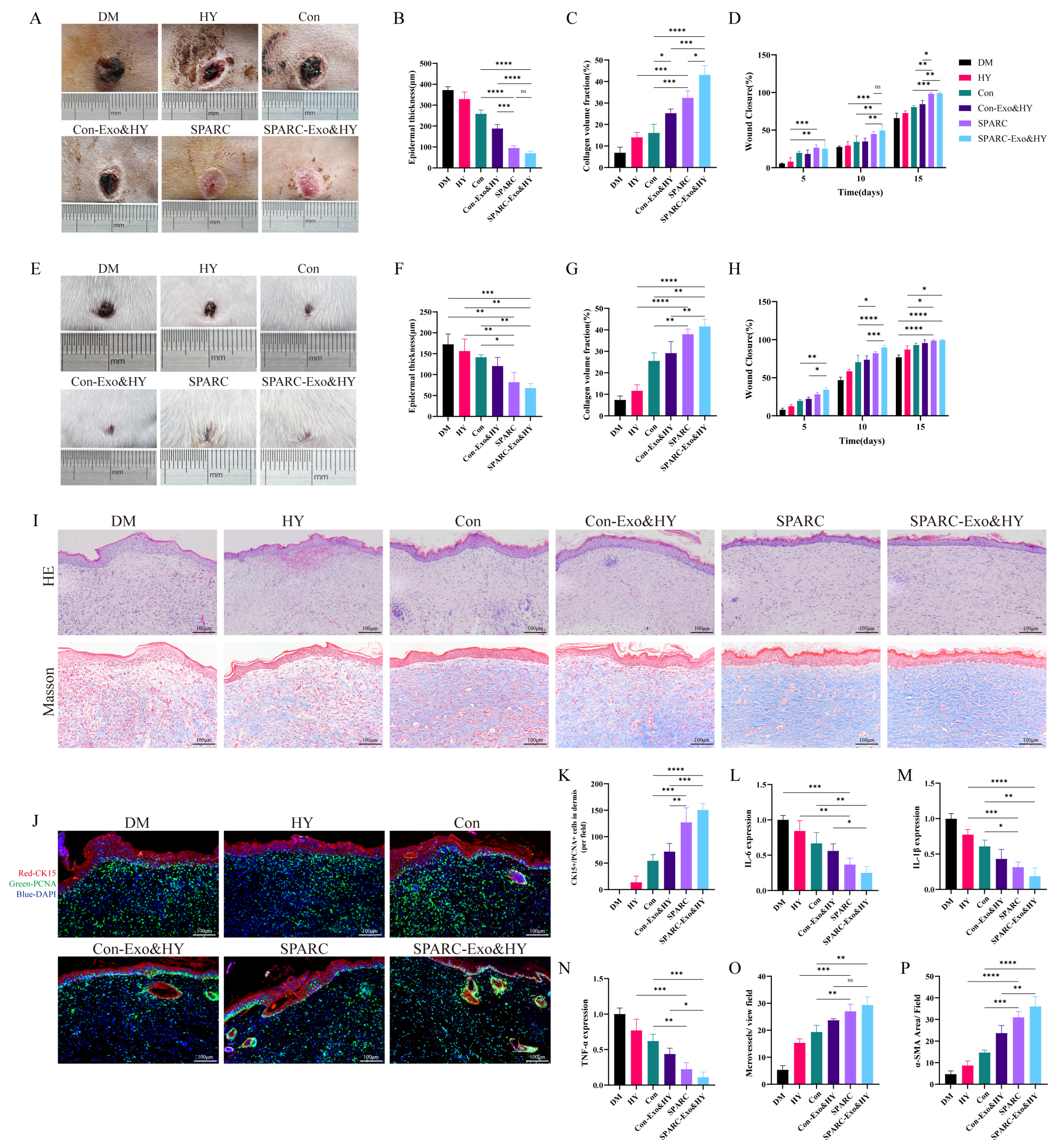
3.4. SPARC-ADSCs Promote Healing of Diabetic Skin Wound
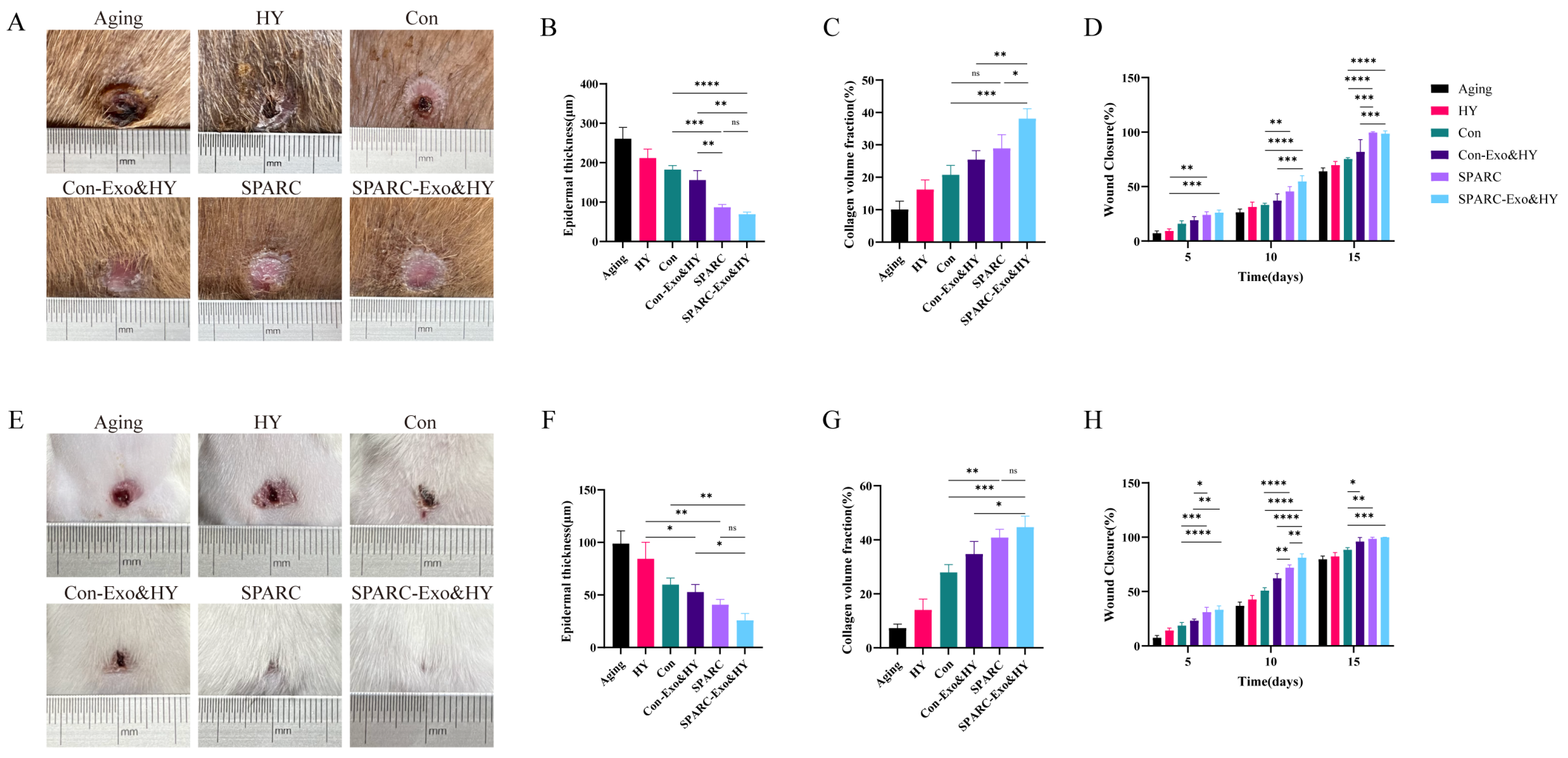
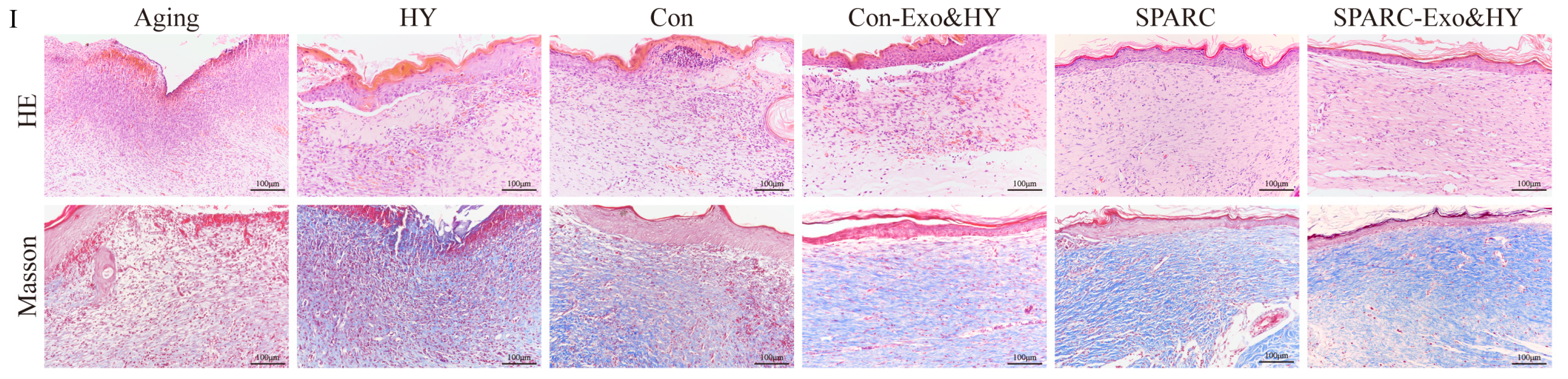
3.5. SPARC-ADSCs Promote Healing of Aging Skin Wound
4. Discussion
- (1)
- Validating these findings in larger animal models or human-relevant ex vivo systems;
- (2)
- Conducting long-term safety and efficacy studies, including assessments of potential tumorigenicity or off-target effects;
- (3)
- Elucidating the downstream signaling networks and extracellular vesicle cargo alterations driven by SPARC overexpression; and
- (4)
- Integrating recent advances in biomaterial-based delivery systems [46] to enhance localized retention and controlled release.
Supplementary Materials
Author Contributions
Funding
Institutional Review Board Statement
Informed Consent Statement
Data Availability Statement
Acknowledgments
Conflicts of Interest
References
- Zhong, S.P.; Zhang, Y.Z.; Lim, C.T. Tissue scaffolds for skin wound healing and dermal reconstruction. Wiley Interdiscip. Rev. Nanomed. Nanobiotechnol. 2010, 2, 510–525. [Google Scholar] [CrossRef] [PubMed]
- Blair, M.J.; Jones, J.D.; Woessner, A.E.; Quinn, K.P. Skin Structure-Function Relationships and the Wound Healing Response to Intrinsic Aging. Adv. Wound Care 2020, 9, 127–143. [Google Scholar] [CrossRef] [PubMed]
- Wong, R.; Geyer, S.; Weninger, W.; Guimberteau, J.C.; Wong, J.K. The dynamic anatomy and patterning of skin. Exp. Dermatol. 2016, 25, 92–98. [Google Scholar] [CrossRef] [PubMed]
- Bouwstra, J.A.; Honeywell-Nguyen, P.L. Skin structure and mode of action of vesicles. Adv. Drug Deliv. Rev. 2002, 54, S41–S55. [Google Scholar] [CrossRef]
- Murphree, R.W. Impairments in Skin Integrity. Nurs. Clin. N. Am. 2017, 52, 405–417. [Google Scholar] [CrossRef]
- Velnar, T.; Bailey, T.; Smrkolj, V. The wound healing process: An overview of the cellular and molecular mechanisms. J. Int. Med. Res. 2009, 37, 1528–1542. [Google Scholar] [CrossRef]
- Han, G.; Ceilley, R. Chronic Wound Healing: A Review of Current Management and Treatments. Adv. Ther. 2017, 34, 599–610. [Google Scholar] [CrossRef]
- Tam, J.; Wang, Y.; Farinelli, W.A.; Jiménez-Lozano, J.; Franco, W.; Sakamoto, F.H.; Cheung, E.J.; Purschke, M.; Doukas, A.G.; Anderson, R.R. Fractional Skin Harvesting: Autologous Skin Grafting without Donor-site Morbidity. Plast. Reconstr. Surg. Glob. Open 2013, 1, e47. [Google Scholar] [CrossRef]
- Heyboer, M., 3rd; Sharma, D.; Santiago, W.; McCulloch, N. Hyperbaric Oxygen Therapy: Side Effects Defined and Quantified. Adv. Wound Care 2017, 6, 210–224. [Google Scholar] [CrossRef]
- Ding, D.C.; Shyu, W.C.; Lin, S.Z. Mesenchymal stem cells. Cell Transplant. 2011, 20, 5–14. [Google Scholar] [CrossRef]
- Uccelli, A.; Moretta, L.; Pistoia, V. Mesenchymal stem cells in health and disease. Nat. Rev. Immunol. 2008, 8, 726–736. [Google Scholar] [CrossRef] [PubMed]
- Kou, Z.; Li, B.; Aierken, A.; Tan, N.; Li, C.; Han, M.; Jing, Y.; Li, N.; Zhang, S.; Peng, S.; et al. Mesenchymal Stem Cells Pretreated with Collagen Promote Skin Wound-Healing. Int. J. Mol. Sci. 2023, 24, 8688. [Google Scholar] [CrossRef] [PubMed]
- Rosset, E.M.; Bradshaw, A.D. SPARC/osteonectin in mineralized tissue. Matrix Biol. 2016, 52–54, 78–87. [Google Scholar] [CrossRef] [PubMed]
- Ghanemi, A.; Yoshioka, M.; St-Amand, J. Secreted Protein Acidic and Rich in Cysteine as A Regeneration Factor: Beyond the Tissue Repair. Life 2021, 11, 38. [Google Scholar] [CrossRef]
- Bradshaw, A.D. The role of SPARC in extracellular matrix assembly. J. Cell Commun. Signal. 2009, 3, 239–246. [Google Scholar] [CrossRef]
- Rentz, T.J.; Poobalarahi, F.; Bornstein, P.; Sage, E.H.; Bradshaw, A.D. SPARC regulates processing of procollagen I and collagen fibrillogenesis in dermal fibroblasts. J. Biol. Chem. 2007, 282, 22062–22071. [Google Scholar] [CrossRef]
- Murphy-Ullrich, J.E.; Sage, E.H. Revisiting the matricellular concept. Matrix Biol. 2014, 37, 1–14. [Google Scholar] [CrossRef]
- MacArthur Clark, J.A.; Sun, D. Guidelines for the ethical review of laboratory animal welfare People’s Republic of China National Standard GB/T 35892-2018 [Issued 6 February 2018 Effective from 1 September 2018]. Anim. Model. Exp. Med. 2020, 3, 103–113. [Google Scholar] [CrossRef]
- Li, C.; Li, B.; Han, M.; Tian, H.; Gao, J.; Han, D.; Ling, Z.; Jing, Y.; Li, N.; Hua, J. SPARC overexpression in allogeneic adipose-derived mesenchymal stem cells in dog dry eye model induced by benzalkonium chloride. Stem Cell Res. Ther. 2024, 15, 195. [Google Scholar] [CrossRef]
- Jin, X.; Dai, Y.; Xin, L.; Ye, Z.; Chen, J.; He, Q.; Chen, X.; Xu, X.; Song, G.; Yu, X.; et al. ADSC-derived exosomes-coupled decellularized matrix for endometrial regeneration and fertility restoration. Mater. Today Bio 2023, 23, 100857. [Google Scholar] [CrossRef]
- Zhao, X.; Li, X.; Wang, Y.; Guo, Y.; Huang, Y.; Lv, D.; Lei, M.; Yu, S.; Luo, G.; Zhan, R. Stability and biosafety of human epidermal stem cell for wound repair: Preclinical evaluation. Stem Cell Res. Ther. 2023, 14, 4. [Google Scholar] [CrossRef] [PubMed]
- He, W.; Qin, D.; Li, B.; Zhang, H.; Cheng, X.; Sun, J.; Hua, J.; Peng, S. Immortalized canine adipose-derived mesenchymal stem cells alleviate gentamicin-induced acute kidney injury by inhibiting endoplasmic reticulum stress in mice and dogs. Res. Vet. Sci. 2021, 136, 39–50. [Google Scholar] [CrossRef] [PubMed]
- Aierken, A.; Li, B.; Liu, P.; Cheng, X.; Kou, Z.; Tan, N.; Zhang, M.; Yu, S.; Shen, Q.; Du, X.; et al. Melatonin treatment improves human umbilical cord mesenchymal stem cell therapy in a mouse model of type II diabetes mellitus via the PI3K/AKT signaling pathway. Stem Cell Res. Ther. 2022, 13, 164. [Google Scholar] [CrossRef] [PubMed]
- Zaqout, S.; Becker, L.L.; Kaindl, A.M. Immunofluorescence Staining of Paraffin Sections Step by Step. Front. Neuroanat. 2020, 14, 582218. [Google Scholar] [CrossRef]
- Gong, L.; Lei, Y.; Liu, Y.; Tan, F.; Li, S.; Wang, X.; Xu, M.; Cai, W.; Du, B.; Xu, F.; et al. Vaccarin prevents ox-LDL-induced HUVEC EndMT, inflammation and apoptosis by suppressing ROS/p38 MAPK signaling. Am. J. Transl. Res. 2019, 11, 2140–2154. [Google Scholar]
- Zhang, M.F.; Wan, S.C.; Chen, W.B.; Yang, D.H.; Liu, W.Q.; Li, B.L.; Aierken, A.; Du, X.M.; Li, Y.X.; Wu, W.P.; et al. Transcription factor Dmrt1 triggers the SPRY1-NF-κB pathway to maintain testicular immune homeostasis and male fertility. Zool Res. 2023, 44, 505–521. [Google Scholar] [CrossRef]
- Jiang, B.W.; Zhang, W.J.; Wang, Y.; Tan, L.P.; Bao, Y.L.; Song, Z.B.; Yu, C.L.; Wang, S.Y.; Liu, L.; Li, Y.X. Convallatoxin induces HaCaT cell necroptosis and ameliorates skin lesions in psoriasis-like mouse models. Biomed. Pharmacother. 2020, 121, 109615. [Google Scholar] [CrossRef]
- Yang, D.; Wei, Y.; Lu, Q.; Qin, D.; Zhang, M.; Du, X.; Xu, W.; Yu, X.; He, C.; Li, N.; et al. Melatonin alleviates LPS-induced endoplasmic reticulum stress and inflammation in spermatogonial stem cells. J. Cell. Physiol. 2021, 236, 3536–3551. [Google Scholar] [CrossRef]
- Vernon, R.B.; Gooden, M.D.; Chan, C.K.; Workman, G.; Obika, M.; Wight, T.N. Autocrine Hyaluronan Influences Sprouting and Lumen Formation During HUVEC Tubulogenesis In Vitro. J. Histochem. Cytochem. 2021, 69, 415–428. [Google Scholar] [CrossRef]
- Bonifant, H.; Holloway, S. A review of the effects of ageing on skin integrity and wound healing. Br. J. Community Nurs. 2019, 24, S28–S33. [Google Scholar] [CrossRef]
- Havran, W.L.; Jameson, J.M. Epidermal T cells and wound healing. J. Immunol. 2010, 184, 5423–5428. [Google Scholar] [CrossRef] [PubMed]
- Su, Y.; Richmond, A. Chemokine Regulation of Neutrophil Infiltration of Skin Wounds. Adv. Wound Care 2015, 4, 631–640. [Google Scholar] [CrossRef] [PubMed]
- Sindrilaru, A.; Scharffetter-Kochanek, K. Disclosure of the Culprits: Macrophages-Versatile Regulators of Wound Healing. Adv. Wound Care 2013, 2, 357–368. [Google Scholar] [CrossRef] [PubMed]
- Brancato, S.K.; Albina, J.E. Wound macrophages as key regulators of repair: Origin, phenotype, and function. Am. J. Pathol. 2011, 178, 19–25. [Google Scholar] [CrossRef]
- Volk, S.W.; Bohling, M.W. Comparative wound healing—Are the small animal veterinarian’s clinical patients an improved translational model for human wound healing research? Wound Repair Regen. 2013, 21, 372–381. [Google Scholar] [CrossRef]
- Rittié, L. Cellular mechanisms of skin repair in humans and other mammals. J. Cell Commun. Signal. 2016, 10, 103–120. [Google Scholar] [CrossRef]
- Chance, T.C.; Rathbone, C.R.; Kamucheka, R.M.; Peltier, G.C.; Cap, A.P.; Bynum, J.A. The effects of cell type and culture condition on the procoagulant activity of human mesenchymal stromal cell-derived extracellular vesicles. J. Trauma Acute Care Surg. 2019, 87, S74–S82. [Google Scholar] [CrossRef]
- Ohtaki, H.; Ylostalo, J.H.; Foraker, J.E.; Robinson, A.P.; Reger, R.L.; Shioda, S.; Prockop, D.J. Stem/progenitor cells from bone marrow decrease neuronal death in global ischemia by modulation of inflammatory/immune responses. Proc. Natl. Acad. Sci. USA 2008, 105, 14638–14643. [Google Scholar] [CrossRef]
- Zhang, Q.Z.; Su, W.R.; Shi, S.H.; Wilder-Smith, P.; Xiang, A.P.; Wong, A.; Nguyen, A.L.; Kwon, C.W.; Le, A.D. Human gingiva-derived mesenchymal stem cells elicit polarization of m2 macrophages and enhance cutaneous wound healing. Stem Cells 2010, 28, 1856–1868. [Google Scholar] [CrossRef]
- Yates, C.C.; Rodrigues, M.; Nuschke, A.; Johnson, Z.I.; Whaley, D.; Stolz, D.; Newsome, J.; Wells, A. Multipotent stromal cells/mesenchymal stem cells and fibroblasts combine to minimize skin hypertrophic scarring. Stem Cell Res. Ther. 2017, 8, 193. [Google Scholar] [CrossRef]
- Li, Y.; Zhang, J.; Shi, J.; Liu, K.; Wang, X.; Jia, Y.; He, T.; Shen, K.; Wang, Y.; Liu, J.; et al. Exosomes derived from human adipose mesenchymal stem cells attenuate hypertrophic scar fibrosis by miR-192-5p/IL-17RA/Smad axis. Stem Cell Res. Ther. 2021, 12, 221. [Google Scholar] [CrossRef]
- Zhang, W.; Bai, X.; Zhao, B.; Li, Y.; Zhang, Y.; Li, Z.; Wang, X.; Luo, L.; Han, F.; Zhang, J.; et al. Cell-free therapy based on adipose tissue stem cell-derived exosomes promotes wound healing via the PI3K/Akt signaling pathway. Exp. Cell Res. 2018, 370, 333–342. [Google Scholar] [CrossRef]
- Liu, X.B.; Wang, J.A.; Ogle, M.E.; Wei, L. Prolyl hydroxylase inhibitor dimethyloxalylglycine enhances mesenchymal stem cell survival. J. Cell. Biochem. 2009, 106, 903–911. [Google Scholar] [CrossRef]
- Martinek, N.; Shahab, J.; Sodek, J.; Ringuette, M. Is SPARC an evolutionarily conserved collagen chaperone? J. Dent. Res. 2007, 86, 296–305. [Google Scholar] [CrossRef]
- Rivera, L.B.; Bradshaw, A.D.; Brekken, R.A. The regulatory function of SPARC in vascular biology. Cell. Mol. Life Sci. 2011, 68, 3165–3173. [Google Scholar] [CrossRef]
- Yu, H.; Zhang, J.; Yang, L.; Tian, Y.; Milne, C.; Jin, P.; Li, Q.; Song, R.; Wang, W. MSC-derived exosomes injectable hyaluronic acid hydrogel for enhanced chronic wound healing. J. Control. Release 2025, 385, 113985. [Google Scholar] [CrossRef]


Disclaimer/Publisher’s Note: The statements, opinions and data contained in all publications are solely those of the individual author(s) and contributor(s) and not of MDPI and/or the editor(s). MDPI and/or the editor(s) disclaim responsibility for any injury to people or property resulting from any ideas, methods, instructions or products referred to in the content. |
© 2026 by the authors. Licensee MDPI, Basel, Switzerland. This article is an open access article distributed under the terms and conditions of the Creative Commons Attribution (CC BY) license.
Share and Cite
Tian, H.-K.; Li, B.-L.; Gao, J.-Q.; Han, D.-Y.; Merzlikin, N.; Li, C.-C.; Ling, Z.-X.; Zhang, Z.-Y.; Zhu, W.-L.; Dai, J.-Q.; et al. Clinical Efficacy of SPARC-Modified Mesenchymal Stem Cells for the Treatment of Dog Skin Wounds. Vet. Sci. 2026, 13, 222. https://doi.org/10.3390/vetsci13030222
Tian H-K, Li B-L, Gao J-Q, Han D-Y, Merzlikin N, Li C-C, Ling Z-X, Zhang Z-Y, Zhu W-L, Dai J-Q, et al. Clinical Efficacy of SPARC-Modified Mesenchymal Stem Cells for the Treatment of Dog Skin Wounds. Veterinary Sciences. 2026; 13(3):222. https://doi.org/10.3390/vetsci13030222
Chicago/Turabian StyleTian, Hong-Kai, Ba-Lun Li, Jia-Qi Gao, Dong-Yao Han, Nikita Merzlikin, Chen-Chen Li, Zi-Xi Ling, Zeng-Yu Zhang, Wen-Long Zhu, Jian-Qi Dai, and et al. 2026. "Clinical Efficacy of SPARC-Modified Mesenchymal Stem Cells for the Treatment of Dog Skin Wounds" Veterinary Sciences 13, no. 3: 222. https://doi.org/10.3390/vetsci13030222
APA StyleTian, H.-K., Li, B.-L., Gao, J.-Q., Han, D.-Y., Merzlikin, N., Li, C.-C., Ling, Z.-X., Zhang, Z.-Y., Zhu, W.-L., Dai, J.-Q., Gerunova, L., Gao, L.-X., Li, N., & Hua, J.-L. (2026). Clinical Efficacy of SPARC-Modified Mesenchymal Stem Cells for the Treatment of Dog Skin Wounds. Veterinary Sciences, 13(3), 222. https://doi.org/10.3390/vetsci13030222