
Gene Expression Analysis and Whole Genome Sequencing Reveal the Potential Mechanism of Ciprofloxacin Resistance in a Salmonella Dublin Isolate
 ,
, 
Simple Summary
Abstract
1. Introduction
2. Materials and Methods
2.1. Selection of Isolates and Bacterial Culture
2.2. Antimicrobial Susceptibility Testing
2.3. Bacteria Challenge with Ciprofloxacin
2.4. RNA Extraction and Gene Expression Analyses Targeting Efflux Transporter Genes and Regulators
2.5. Whole Genome Sequencing of CIP-Resistant and CIP-Susceptible Salmonella Isolates
2.6. Plasmid, Antimicrobial Resistance, and Mutation Analysis
2.7. Protein Modelling
3. Results
3.1. Antimicrobial Susceptibility Testing of Isolates Against Ciprofloxacin
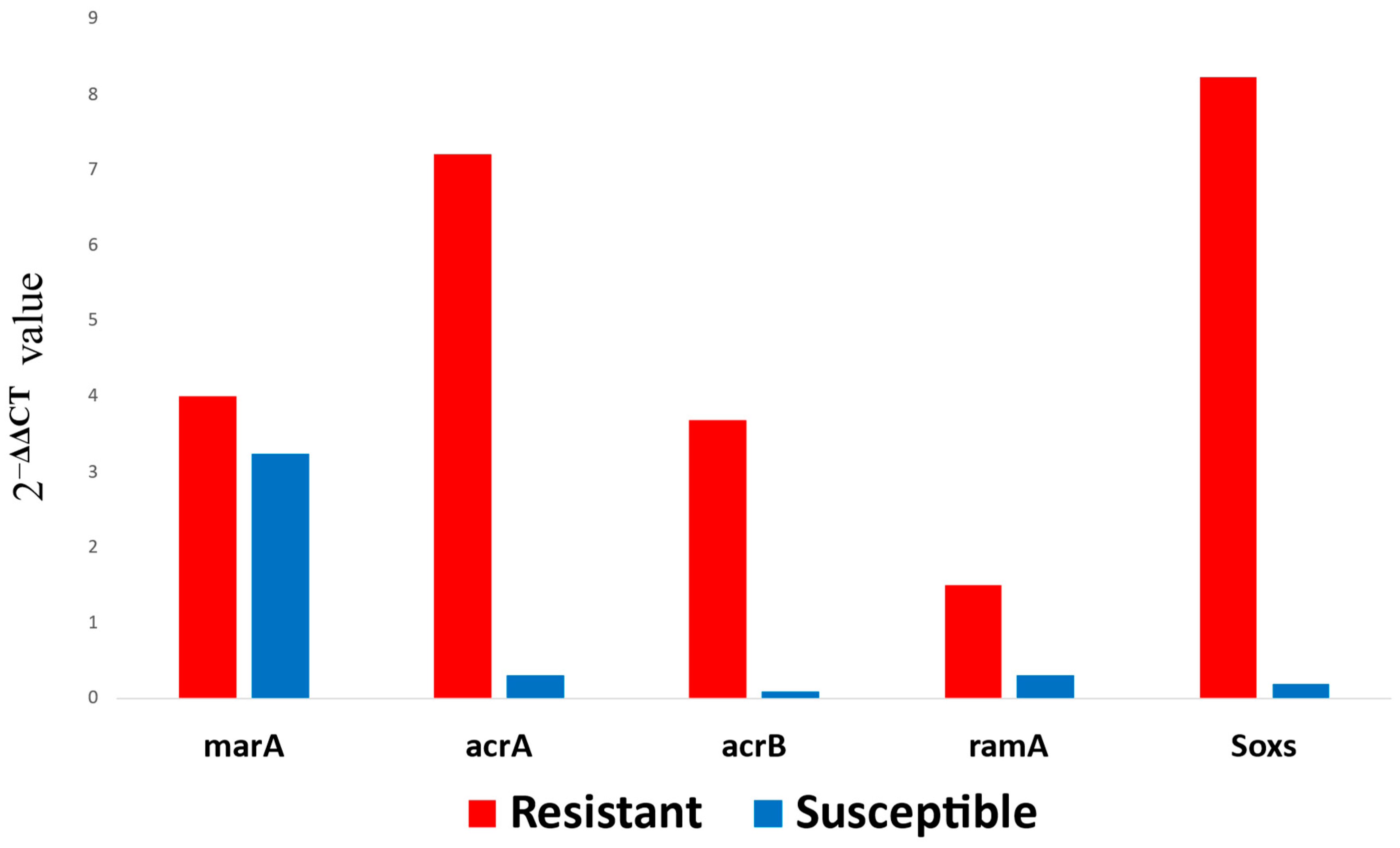
3.2. Gene Expression Analysis for the CIP-Resistant and CIP-Susceptible Salmonella Dublin Isolates
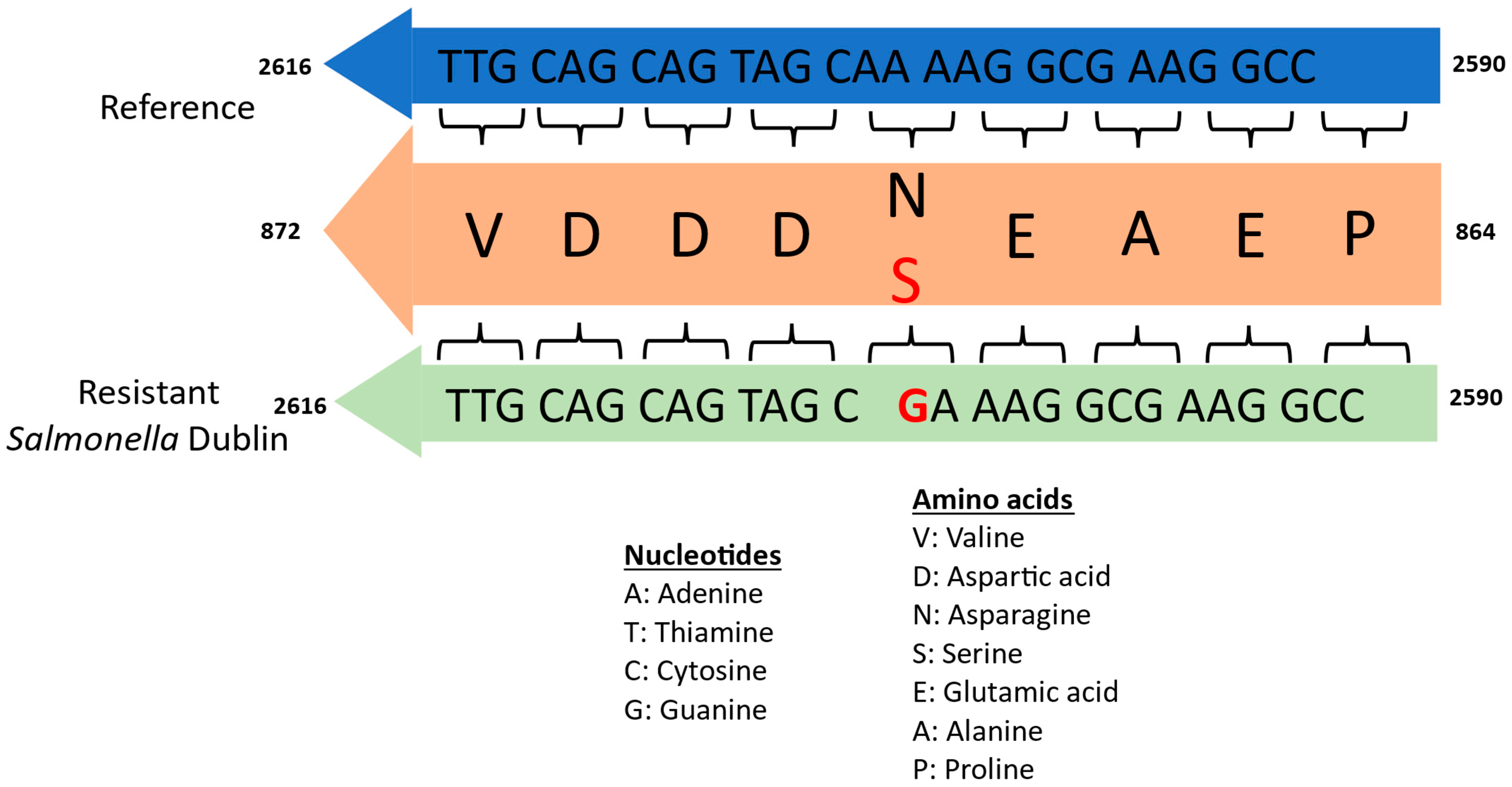
3.3. Chromosomal Mutations Identified in the Isolates
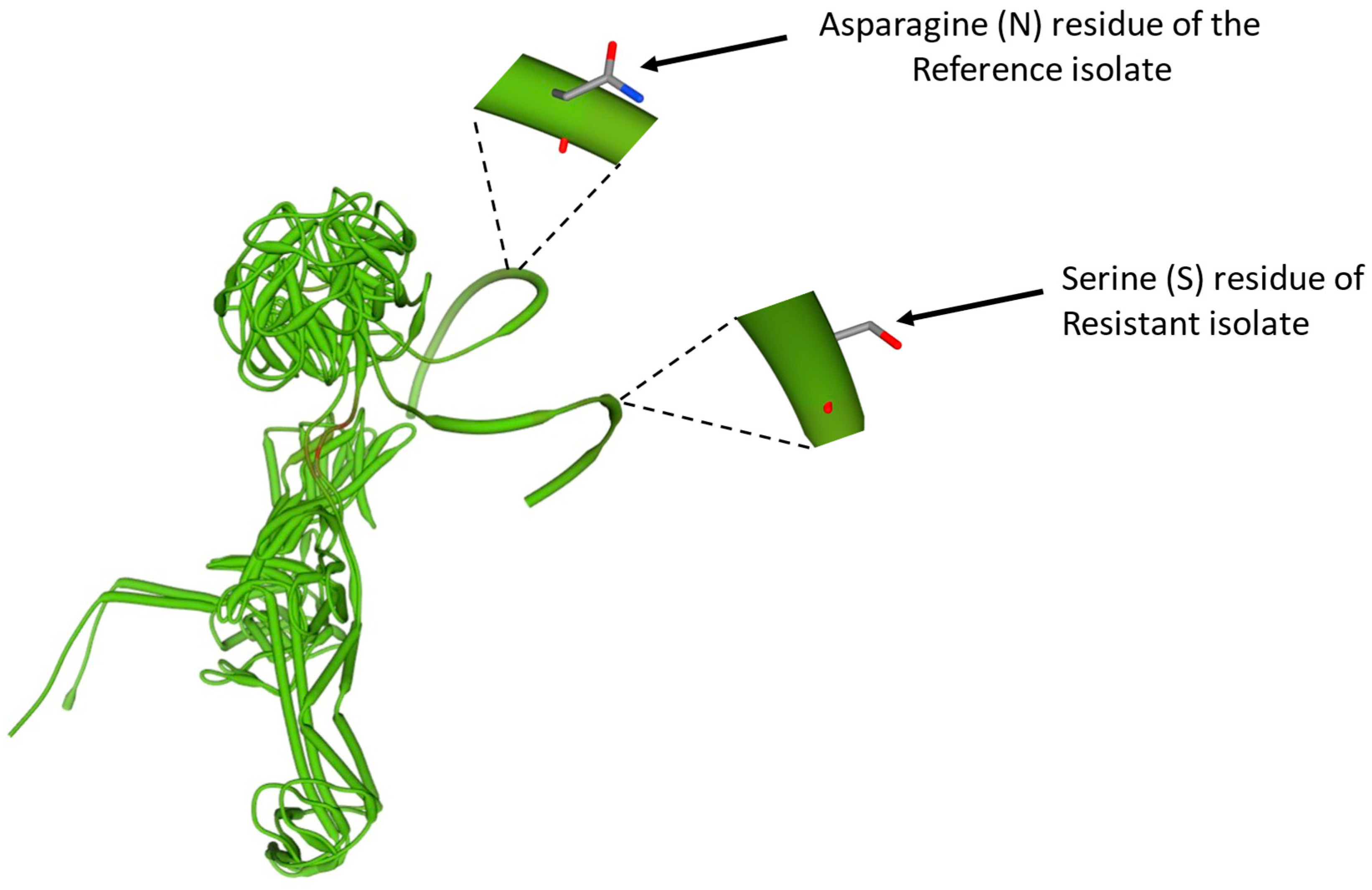
3.4. Protein Modeling
3.5. Plasmid and Antimicrobial Resistance Genes
4. Discussion
Supplementary Materials
Author Contributions
Funding
Institutional Review Board Statement
Informed Consent Statement
Data Availability Statement
Conflicts of Interest
References
- Rusu, A.; Lungu, I.A.; Moldovan, O.L.; Tanase, C.; Hancu, G. Structural Characterization of the Millennial Antibacterial (Fluoro) Quinolones—Shaping the Fifth Generation. Pharmaceutics 2021, 13, 1289. [Google Scholar] [CrossRef] [PubMed]
- Strahilevitz, J.; Jacoby, G.A.; Hooper, D.C.; Robicsek, A. Plasmid-Mediated Quinolone Resistance: A Multifaceted Threat. Clin. Microbiol. Rev. 2009, 22, 664–689. [Google Scholar] [CrossRef] [PubMed]
- Mahapatra, A.; Patro, A.R.K.; Khajuria, A.; Dhal, S.; Praharaj, A.K. Ciprofloxacin-Resistant Gram-Negative Isolates from a Tertiary Care Hospital in Eastern India with Novel GyrA and ParC Gene Mutations. Med. J. Armed Forces India 2022, 78, 24–31. [Google Scholar] [CrossRef] [PubMed]
- Cuypers, W.L.; Jacobs, J.; Wong, V.; Klemm, E.J.; Deborggraeve, S.; van Puyvelde, S. Fluoroquinolone Resistance in Salmonella: Insights by Whole-genome Sequencing. Microb. Genom. 2018, 4, e000195. [Google Scholar] [CrossRef]
- Das, T.; Nath, C.; Das, P.; Ghosh, K.; Logno, T.A.; Debnath, P.; Dash, S.; Devnath, H.S.; Das, S.; Islam, M.Z. High Prevalence of Ciprofloxacin Resistance in Escherichia coli Isolated from Chickens, Humans, and the Environment: An Emerging One Health Issue. PLoS ONE 2023, 18, e0294043. [Google Scholar] [CrossRef]
- Chen, K.; Dong, N.; Chan, E.W.C.; Chen, S. Transmission of Ciprofloxacin Resistance in Salmonella Mediated by a Novel Type of Conjugative Helper Plasmids. Emerg. Microbes Infect. 2019, 8, 857–865. [Google Scholar] [CrossRef]
- Hopkins, K.L.; Davies, R.H.; Threlfall, E.J. Mechanisms of Quinolone Resistance in Escherichia coli and Salmonella: Recent Developments. Int. J. Antimicrob. Agents 2005, 25, 358–373. [Google Scholar] [CrossRef]
- Gu, Y.; Huang, L.; Wu, C.; Huang, J.; Hao, H.; Yuan, Z.; Cheng, G. The Evolution of Fluoroquinolone Resistance in Salmonella under Exposure to Sub-Inhibitory Concentration of Enrofloxacin. Int. J. Mol. Sci. 2021, 22, 12218. [Google Scholar] [CrossRef]
- Manyi-Loh, C.; Mamphweli, S.; Meyer, E.; Okoh, A. Antibiotic Use in Agriculture and Its Consequential Resistance in Environmental Sources: Potential Public Health Implications. Molecules 2018, 23, 795. [Google Scholar] [CrossRef]
- Piddock, L.J.V. Fluoroquinolone Resistance in Salmonella Serovars Isolated from Humans and Food Animals. FEMS Microbiol. Rev. 2002, 26, 3–16. [Google Scholar] [CrossRef]
- Medalla, F.; Sjölund-Karlsson, M.; Shin, S.; Harvey, E.; Joyce, K.; Theobald, L.; Nygren, B.L.; Pecic, G.; Gay, K.; Austin, J.; et al. Ciprofloxacin-Resistant Salmonella enterica Serotype Typhi, United States, 1999–2008. Emerg. Infect. Dis. 2011, 17, 1095–1098. [Google Scholar] [CrossRef] [PubMed]
- Chang, M.X.; Zhang, J.F.; Sun, Y.H.; Li, R.S.; Lin, X.L.; Yang, L.; Webber, M.A.; Jiang, H.X. Contribution of Different Mechanisms to Ciprofloxacin Resistance in Salmonella spp. Front. Microbiol. 2021, 12, 663731. [Google Scholar] [CrossRef]
- Giraud, E.; Baucheron, S.; Cloeckaert, A. Resistance to Fluoroquinolones in Salmonella: Emerging Mechanisms and Resistance Prevention Strategies. Microbes Infect. 2006, 8, 1937–1944. [Google Scholar] [CrossRef] [PubMed]
- Shaheen, A.; Tariq, A.; Iqbal, M.; Mirza, O.; Haque, A.; Walz, T.; Rahman, M. Mutational Diversity in the Quinolone Resistance-Determining Regions of Type-II Topoisomerases of Salmonella Serovars. Antibiotics 2021, 10, 1455. [Google Scholar] [CrossRef]
- Sia, C.M.; Ambrose, R.L.; Valcanis, M.; Andersson, P.; Ballard, S.A.; Howden, B.P.; Williamson, D.A.; Pearson, J.S.; Ingle, D.J. Distinct Adaptation and Epidemiological Success of Different Genotypes within Salmonella enterica Serovar Dublin. eLife 2025, 13, RP102253. [Google Scholar] [CrossRef]
- García-Soto, S.; Tomaso, H.; Linde, J.; Methner, U. Epidemiological Analysis of Salmonella enterica Subsp. Enterica Serovar Dublin in German Cattle Herds Using Whole-Genome Sequencing. Microbiol. Spectr. 2021, 9, e00332-21. [Google Scholar] [CrossRef]
- Akiba, M.; Nakaoka, Y.; Kida, M.; Ishioka, Y.; Sameshima, T.; Yoshii, N.; Nakazawa, M.; Uchida, I.; Terakado, N. Changes in Antimicrobial Susceptibility in a Population of Salmonella enterica Serovar Dublin Isolated from Cattle in Japan from 1976 to 2005. J. Antimicrob. Chemother. 2007, 60, 1235–1242. [Google Scholar] [CrossRef]
- An, K.; Wu, Z.; Zhong, C.; Li, S. Case Report: Uncommon Presentation of Salmonella Dublin Infection as a Large Paravertebral Abscess. Front. Med. 2023, 10, 1276360. [Google Scholar] [CrossRef]
- CLSI. M100 Performance Standards for Antimicrobial Susceptibility Testing: A CLSI Supplement for Global Application; CLSI: Wayne, PA, USA, 2020. [Google Scholar]
- Livak, K.J.; Schmittgen, T.D. Analysis of Relative Gene Expression Data Using Real-Time Quantitative PCR and the 2−ΔΔCT Method. Methods 2001, 25, 402–408. [Google Scholar] [CrossRef]
- Baucheron, S.; Nishino, K.; Monchaux, I.; Canepa, S.; Maurel, M.C.; Coste, F.; Roussel, A.; Cloeckaert, A.; Giraud, E. Bile-Mediated Activation of the acrAB and tolC Multidrug Efflux Genes Occurs Mainly Through Transcriptional Derepression of RamA in Salmonella enterica Serovar Typhimurium. J. Antimicrob. Chemother. 2014, 69, 2400–2406. [Google Scholar] [CrossRef]
- Ferrari, R.G.; Galiana, A.; Cremades, R.; Rodríguez, J.C.; Magnani, M.; Tognim, M.C.B.; Oliveira, T.C.R.M.; Royo, G. Expression of the marA, soxS, acrB and ramA Genes Related to the AcrAB/TolC Efflux Pump in Salmonella enterica Strains with and Without Quinolone Resistance-Determining Regions gyrA Gene Mutations. Braz. J. Infect. Dis. 2013, 17, 125–130. [Google Scholar] [CrossRef] [PubMed]
- Fey, A.; Eichler, S.; Flavier, S.; Christen, R.; Höfle, M.G.; Guzmán, C.A. Establishment of a Real-Time PCR-Based Approach for Accurate Quantification of Bacterial RNA Targets in Water, Using Salmonella as a Model Organism. Appl. Environ. Microbiol. 2004, 70, 3618–3623. [Google Scholar] [CrossRef] [PubMed]
- Fritz, H.M.; Pereira, R.V.; Toohey-Kurth, K.; Marshall, E.; Tucker, J.; Clothier, K.A. Salmonella enterica Serovar Dublin from Cattle in California from 1993–2019: Antimicrobial Resistance Trends of Clinical Relevance. Antibiotics 2022, 11, 1110. [Google Scholar] [CrossRef] [PubMed]
- Eaves, D.J.; Randall, L.; Gray, D.T.; Buckley, A.; Woodward, M.J.; White, A.P.; Piddock, L.J.V. Prevalence of Mutations within the Quinolone Resistance-Determining Region of gyrA, gyrB, parC, and parE and Association with Antibiotic Resistance in Quinolone-Resistant Salmonella enterica. Antimicrob. Agents Chemother. 2004, 48, 4012–4015. [Google Scholar] [CrossRef]
- Wang, Y.P.; Li, L.; Shen, J.Z.; Yang, F.J.; Wu, Y.N. Quinolone-Resistance in Salmonella Is Associated with Decreased MRNA Expression of Virulence Genes invA and avrA, Growth and Intracellular Invasion and Survival. Vet. Microbiol. 2009, 133, 328–334. [Google Scholar] [CrossRef]
- Adhikari, P.; Maharjan, R.; Paudel, S.; Malla, B.; Shah, P.K.; Bastola, A.; Shrestha, U.T. gyrA ser83 Mutation Among Fluoroquinolone-Resistant Salmonella enterica Serovars from Enteric Fever Patients in Tertiary Care Hospital, Kathmandu. BMC Microbiol. 2022, 22, 51. [Google Scholar] [CrossRef]
- Cebrian, L.; Sirvent, E.; Rodríguez Díaz, J.C.; Ruiz, M.; Royo, G. Characterisation of Salmonella Spp. Mutants Produced by Exposure to Various Fluoroquinolones. Int. J. Antimicrob. Agents 2003, 22, 134–139. [Google Scholar] [CrossRef]
- Giraud, E.; Cloeckaert, A.; Kerboeuf, D.; Chaslus-Dancla, E. Evidence for Active Efflux as the Primary Mechanism of Resistance to Ciprofloxacin in Salmonella enterica Serovar Typhimurium. Antimicrob. Agents Chemother. 2000, 44, 1223–1228. [Google Scholar] [CrossRef]
- Holden, E.R.; Webber, M.A. MarA, RamA, and SoxS as Mediators of the Stress Response: Survival at a Cost. Front. Microbiol. 2020, 11, 828. [Google Scholar] [CrossRef]
- Paulsen, I.T. Multidrug Efflux Pumps and Resistance: Regulation and Evolution. Curr. Opin. Microbiol. 2003, 6, 446–451. [Google Scholar] [CrossRef]
- Swick, M.C.; Morgan-Linnell, S.K.; Carlson, K.M.; Zechiedrich, L. Expression of Multidrug Efflux Pump Genes acrAB-tolC, mdfA, and norE in Escherichia coli Clinical Isolates as a Function of Fluoroquinolone and Multidrug Resistance. Antimicrob. Agents Chemother. 2011, 55, 921–924. [Google Scholar] [CrossRef]
- Zhang, C.Z.; Chen, P.X.; Yang, L.; Li, W.; Chang, M.X.; Jiang, H.X. Coordinated Expression of acrAB-tolC and Eight Other Functional Efflux Pumps Through Activating ramA and marA in Salmonella enterica Serovar Typhimurium. Microb. Drug Resist. 2018, 24, 120–125. [Google Scholar] [CrossRef]
- Ricci, V.; Busby, S.J.W.; Piddock, L.J.V. Regulation of RamA by RamR in Salmonella enterica Serovar Typhimurium: Isolation of a RamR Superrepressor. Antimicrob. Agents Chemother. 2012, 56, 6037–6040. [Google Scholar] [CrossRef]
- Becerra, M.C.; Eraso, A.J.; Albesa, I. Comparison of Oxidative Stress Induced by Ciprofloxacin and Pyoverdin in Bacteria and in Leukocytes to Evaluate Toxicity. Luminescence 2003, 18, 334–340. [Google Scholar] [CrossRef]
- Sani, G.S.; Ghane, M.; Babaeekhou, L. Fluoroquinolone-Resistance Mechanisms and Molecular Epidemiology of Ciprofloxacin-Resistant Klebsiella pneumoniae Isolates in Iran. Folia Microbiol. 2023, 68, 633–644. [Google Scholar] [CrossRef]
- Acheampong, G.; Owusu, M.; Owusu-Ofori, A.; Osei, I.; Sarpong, N.; Sylverken, A.; Kung, H.J.; Cho, S.T.; Kuo, C.H.; Park, S.E.; et al. Chromosomal and Plasmid-Mediated Fluoroquinolone Resistance in Human Salmonella enterica Infection in Ghana. BMC Infect. Dis. 2019, 19, 898. [Google Scholar] [CrossRef]



| Number | Accession | Organism | Species | Source | Date Obtained |
|---|---|---|---|---|---|
| 1 | 85-1235 | Salmonella Dublin | n/a | n/a | 1985 |
| 2 | 02-742 | Salmonella Typhimurium | n/a | n/a | 2002 |
| 3 | 09-10043 | Salmonella Enteritidis | Equine | n/a | 2009 |
| 4 | 13-427 | Salmonella Typhimurium | n/a | n/a | 2013 |
| 5 | 15-3130 | Salmonella Typhimurium | n/a | n/a | 2015 |
| 6 | 20-04335 | Salmonella Typhimurium | Equine | n/a | 2020 |
| 7 | 21-02381 | Salmonella Typhimurium | Avian | n/a | 2021 |
| 8 | 21-02399-B | Salmonella Typhimurium | Avian | n/a | 2021 |
| 9 | 15V01330 | Salmonella Enteritidis | Avian | n/a | 2015 |
| 10 | C202670019 | Salmonella Typhimurium | Equine | Feces | 2020 |
| 11 | C210050040 | Salmonella Typhimurium | Avian (Pine siskin) | Liver/Small Intestine | 2021 |
| 12 | C210080050A | Salmonella Typhimurium | Bovine | Large intestine contents | 2021 |
| 13 | C210460048-1 | Salmonella Typhimurium | Canine (domestic) | Draining tract | 2021 |
| 14 | C220050014 | Salmonella Typhimurium | Bovine | Feces | 2022 |
| 15 | C2301000070-2 | Salmonella Typhimurium | Caprine | Uterus swab | 2023 |
| 16 | C230200031 | Salmonella Typhimurium | Bovine | Liver | 2023 |
| 17 | C230310056 | Salmonella Dublin | Bovine | Fetal Stomach Content | 2023 |
| Gene | Primer Name | Sequence | Product Size | Reference |
|---|---|---|---|---|
| marA | marA-F | 5′-TAGGCCAATACATCCGCAGC-3′ | 193 | This study |
| marA-R | 5′-TACCGTGATTCGCCATGC-3′ | |||
| ramA | ramA-F | 5′-CGCTCAGGTTATCGACAC-3′ | 179 | This study |
| ramA-R | 5′-CCGCCAGTTTTAGCTTCC-3′ | |||
| acrA | acrA-F | 5′-ACGACAAACAGGACCAGC-3′ | 161 | This study |
| acrB-R | 5′-ACGCTTCAGGATAATGCC-3′ | |||
| acrB | acrB-F | 5′-TCGTGTTCCTGGTGATGTACCT-3′ | 69 | [21] |
| acrB-R | 5′-AACCGCAATAGTCGGAATCAA-3′ | |||
| soxS | soxS-F | 5′-CGGAATACACGCGAGAAGGT-3′ | 72 | [22] |
| soxS-R | 5′-GAGCGCCCGATTTTTGATATC-3′ | |||
| 16S rRNA | 16S-F 16S-R | 5′-CGGGGAGGAAGGTGTTGTG-3′ 5′-GAGCCCGGGGATTTCACATC-3′ | 178 | [23] |
| Number | Serovar | Accession | MIC (μg/mL) Disk Diffusion (μg/mL) | Interpretation | Selected for Gene Expression | MIC (μg/mL) Broth Dilution (μg/mL) |
|---|---|---|---|---|---|---|
| 1 | Salmonella Dublin | 85-1235 | <0.125 | Susceptible | Yes | 0.03 |
| 2 | Salmonella Typhimurium | 02-742 | <0.125 | Susceptible | No | - |
| 3 | Salmonella Enteritidis | 09-10043 | <0.125 | Susceptible | No | - |
| 4 | Salmonella Typhimurium | 13-427 | <0.125 | Susceptible | No | - |
| 5 | Salmonella Typhimurium | 15-3130 | <0.125 | Susceptible | No | - |
| 6 | Salmonella Typhimurium | 20-04335 | <0.125 | Susceptible | No | - |
| 7 | Salmonella Typhimurium | 21-02381 | <0.125 | Susceptible | No | - |
| 8 | Salmonella Typhimurium | 21-02399-B | <0.125 | Susceptible | No | - |
| 9 | Salmonella Enteritidis | 15V01330 | <0.125 | Susceptible | No | - |
| 10 | Salmonella Typhimurium | C202670019 | <0.125 | Susceptible | No | - |
| 11 | Salmonella Typhimurium | C210050040 | <0.125 | Susceptible | No | - |
| 12 | Salmonella Typhimurium | C210080050A | <0.125 | Susceptible | No | - |
| 13 | Salmonella Typhimurium | C210460048-1 | <0.125 | Susceptible | No | - |
| 14 | Salmonella Typhimurium | C220050014 | <0.125 | Susceptible | No | - |
| 15 | Salmonella Typhimurium | C2301000070-2 | <0.125 | Susceptible | No | - |
| 16 | Salmonella Typhimurium | C230200031 | <0.125 | Susceptible | No | - |
| 17 | Salmonella Dublin | C230310056 | 1.500 | Resistant | Yes | 1.95 |
Disclaimer/Publisher’s Note: The statements, opinions and data contained in all publications are solely those of the individual author(s) and contributor(s) and not of MDPI and/or the editor(s). MDPI and/or the editor(s) disclaim responsibility for any injury to people or property resulting from any ideas, methods, instructions or products referred to in the content. |
© 2026 by the authors. Licensee MDPI, Basel, Switzerland. This article is an open access article distributed under the terms and conditions of the Creative Commons Attribution (CC BY) license.
Share and Cite
Bentum, K.E.; Leestemaker-Palmer, A.; Nuss, S.; Ballard, S.; Montgomery, A.; Abebe, W.; Samuel, T.; Pokoo-Aikins, A.; Bemudez, L.E. Gene Expression Analysis and Whole Genome Sequencing Reveal the Potential Mechanism of Ciprofloxacin Resistance in a Salmonella Dublin Isolate. Vet. Sci. 2026, 13, 177. https://doi.org/10.3390/vetsci13020177
Bentum KE, Leestemaker-Palmer A, Nuss S, Ballard S, Montgomery A, Abebe W, Samuel T, Pokoo-Aikins A, Bemudez LE. Gene Expression Analysis and Whole Genome Sequencing Reveal the Potential Mechanism of Ciprofloxacin Resistance in a Salmonella Dublin Isolate. Veterinary Sciences. 2026; 13(2):177. https://doi.org/10.3390/vetsci13020177
Chicago/Turabian StyleBentum, Kingsley E., Amy Leestemaker-Palmer, Stephanie Nuss, Sophia Ballard, Alexandra Montgomery, Woubit Abebe, Temesgen Samuel, Anthony Pokoo-Aikins, and Luiz E. Bemudez. 2026. "Gene Expression Analysis and Whole Genome Sequencing Reveal the Potential Mechanism of Ciprofloxacin Resistance in a Salmonella Dublin Isolate" Veterinary Sciences 13, no. 2: 177. https://doi.org/10.3390/vetsci13020177
APA StyleBentum, K. E., Leestemaker-Palmer, A., Nuss, S., Ballard, S., Montgomery, A., Abebe, W., Samuel, T., Pokoo-Aikins, A., & Bemudez, L. E. (2026). Gene Expression Analysis and Whole Genome Sequencing Reveal the Potential Mechanism of Ciprofloxacin Resistance in a Salmonella Dublin Isolate. Veterinary Sciences, 13(2), 177. https://doi.org/10.3390/vetsci13020177