


A Comprehensive Review: Molecular Diagnostics and Multi-Omics Approaches to Understanding Bovine Respiratory Disease



Simple Summary
Abstract
1. Introduction
2. Materials and Methods
3. Laboratory and Molecular Diagnostics for BRD
3.1. Application of PCR Methodologies in the Diagnosis of BRD
3.2. NGS Technologies for BRD Diagnosis
4. Host Transcriptomics in BRD
5. Characterization of the Bovine Respiratory Microbiome in BRD Infections
5.1. Advances in BRD Diagnostics: Insights from 16S rRNA Gene Sequencing
5.2. Third-Generation Sequencing Techniques in BRD Microbiome Characterisation
6. Metagenomic Approaches to BRD Virome Characterization
7. Insights into BRD Pathogenesis
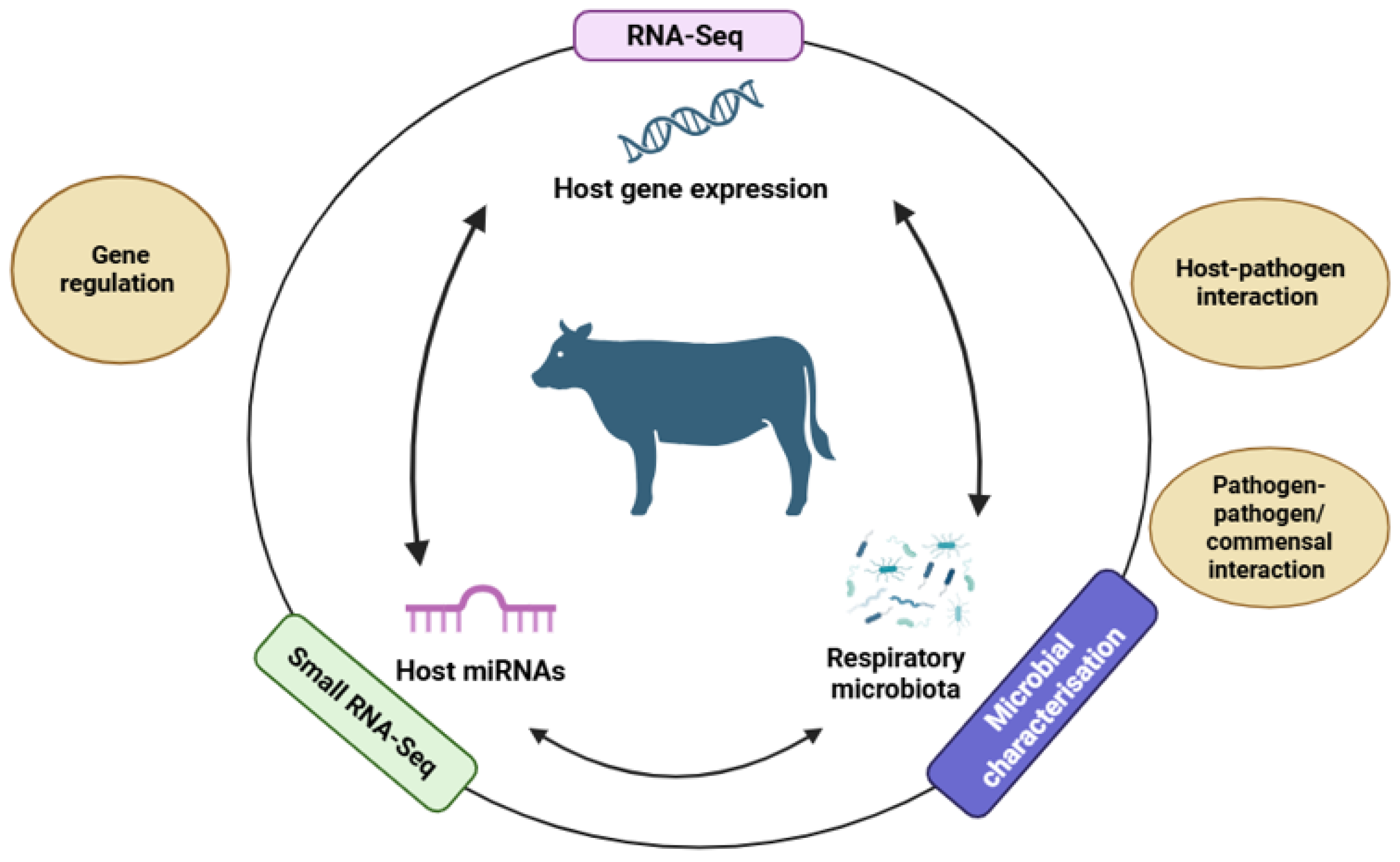
Integrating Multi-Omics Approaches to Elucidate BRD Pathogenesis
8. Limitations in Current Omics Approaches for BRD Research
9. Conclusions
10. Future Directions and Research Priorities
- Standardization of Protocols:
- 2.
- Multi-Omics Data Integration:
- 3.
- Translational Applications:
Author Contributions
Funding
Institutional Review Board Statement
Informed Consent Statement
Data Availability Statement
Conflicts of Interest
Abbreviations
| BCoV | Bovine coronavirus |
| BoHV-1 | Bovine herpesvirus 1 |
| BPI3V | Bovine parainfluenza 3 |
| BRAV1 | Bovine rhinitis A virus 1 |
| BRAV2 | Bovine rhinitis A virus 2 |
| BRD | Bovine respiratory disease |
| BRSV | Bovine respiratory syncytial virus |
| BVDV | Bovine viral diarrhoea virus |
| cDNA | Complementary DNA) |
| LAMP | Loop-mediated isothermal amplification |
| LASL | Linker Amplified Shotgun Library |
| LRT | Lower respiratory tract |
| MDA | Multiple Displacement Amplification |
| MLN | Mediastinal lymph node |
| MiRNA | MicroRNA |
| MLV | Modified live vaccine |
| mRNA | Messenger RNA |
| NCBI | National Center for Biotechnology Information |
| OTUs | Operational Taxonomic Units |
| RNA | Ribonucleic acid |
| RNA-Seq | RNA-Sequencing |
| SISPA | Sequence-Independent Single-Primer Amplification |
| URT | Upper respiratory tract |
| US | United States |
References
- Pardon, B.; Buczinski, S. Bovine respiratory disease diagnosis: What progress has been made in infectious diagnosis? Vet. Clin. North Am. Food Anim. Pract. 2020, 36, 425–444. [Google Scholar] [CrossRef] [PubMed]
- Kamel, M.S.; Davidson, J.L.; Verma, M.S. Strategies for bovine respiratory disease (BRD) diagnosis and prognosis: A comprehensive overview. Animals 2024, 14, 627. [Google Scholar] [CrossRef] [PubMed]
- O’Donoghue, S.; Waters, S.M.; Morris, D.W.; Earley, B. A comprehensive review: Bovine respiratory disease, current insights into epidemiology, diagnostic challenges, and vaccination. Vet. Sci. 2025, 12, 778. [Google Scholar] [CrossRef] [PubMed]
- Thonur, L.; Maley, M.; Gilray, J.; Crook, T.; Laming, E.; Turnbull, D.; Nath, M.; Willoughby, K. One-step multiplex real-time RT-PCR for the detection of bovine respiratory syncytial virus, bovine herpesvirus 1, and bovine parainfluenza virus 3. BMC Vet. Res. 2012, 8, 37. [Google Scholar] [CrossRef] [PubMed]
- Hao, F.; Tao, C.; Xiao, R.; Huang, Y.; Yuan, W.; Wang, Z.; Jia, H. Development of a Multiplex Real-Time PCR Assay for the detection of eight pathogens associated with bovine respiratory disease complex from clinical samples. Microorganisms 2025, 13, 1629. [Google Scholar] [CrossRef]
- Sun, H.Z.; Srithayakumar, V.; Jiminez, J.; Jin, W.; Hosseini, A.; Raszek, M.; Orsel, K.; Guan, L.L.; Plastow, G. Longitudinal blood transcriptomic analysis to identify molecular regulatory patterns of bovine respiratory disease in beef cattle. Genomics 2020, 112, 3968–3977. [Google Scholar] [CrossRef]
- Scott, M.A.; Woolums, A.R.; Swiderski, C.E.; Finley, A.; Perkins, A.D.; Nanduri, B.; Karisch, B.B. Hematological and gene co-expression network analyses of high-risk beef cattle defines immunological mechanisms and biological complexes involved in bovine respiratory disease and weight gain. PLoS ONE 2022, 17, e0277033. [Google Scholar] [CrossRef]
- Jiminez, J.; Timsit, E.; Orsel, K.; van der Meer, F.; Guan, L.L.; Plastow, G. Whole-blood transcriptome analysis of feedlot cattle with and without bovine respiratory disease. Front. Genet. 2021, 12, 257. [Google Scholar] [CrossRef]
- Tizioto, P.C.; Kim, J.; Seabury, C.M.; Schnabel, R.D.; Gershwin, L.J.; Van Eenennaam, A.L.; Toaff-Rosenstein, R.; Neibergs, H.L.; Team, B.R.D.C.C.A.P.R.; Taylor, J.F. Immunological response to single pathogen challenge with agents of the bovine respiratory disease complex: An RNA-sequence analysis of the bronchial lymph node transcriptome. PLoS ONE 2015, 10, e0131459. [Google Scholar] [CrossRef]
- Johnston, D.; Earley, B.; McCabe, M.S.; Lemon, K.; Duffy, C.; McMenamy, M.; Cosby, S.L.; Kim, J.; Blackshields, G.; Taylor, J.F. Experimental challenge with bovine respiratory syncytial virus in dairy calves: Bronchial lymph node transcriptome response. Sci. Rep. 2019, 9, 14736. [Google Scholar] [CrossRef]
- O’Donoghue, S.; Earley, B.; Johnston, D.; McCabe, M.S.; Kim, J.W.; Taylor, J.F.; Duffy, C.; Lemon, K.; McMenamy, M.; Cosby, S.L.; et al. Whole blood transcriptome analysis in dairy calves experimentally challenged with bovine herpesvirus 1 (BoHV-1) and comparison to a bovine respiratory syncytial virus (BRSV) Challenge. Front. Genet. 2023, 14, 1092877. [Google Scholar] [CrossRef]
- Murray, G.M.; O’Neill, R.G.; More, S.J.; McElroy, M.C.; Earley, B.; Cassidy, J.P. Evolving views on bovine respiratory disease: An appraisal of selected key pathogens–Part 1. Vet. J. 2016, 217, 95–102. [Google Scholar] [CrossRef]
- Ambrose, R.K.; Blakebrough-Hall, C.; Gravel, J.L.; Gonzalez, L.A.; Mahony, T.J. Characterisation of the upper respiratory tract virome of feedlot cattle and its association with bovine respiratory disease. Viruses 2023, 15, 455. [Google Scholar] [CrossRef]
- Johnston, D.; Earley, B.; Cormican, P.; Murray, G.; Kenny, D.A.; Waters, S.M.; McGee, M.; Kelly, A.K.; McCabe, M.S. Illumina MiSeq 16S Amplicon sequence analysis of bovine respiratory disease associated bacteria in lung and mediastinal lymph node tissue. BMC Vet. Res. 2017, 13, 118. [Google Scholar] [CrossRef]
- Timsit, E.; Workentine, M.; Schryvers, A.B.; Holman, D.B.; van der Meer, F.; Alexander, T.W. Evolution of the nasopharyngeal microbiota of beef cattle from weaning to 40 days after arrival at a feedlot. Vet. Microbiol. 2016, 187, 75–81. [Google Scholar] [CrossRef]
- Mitra, N.; Cernicchiaro, N.; Torres, S.; Li, F.; Hause, B.M. Metagenomic Characterization of the virome associated with bovine respiratory disease in feedlot cattle identified novel viruses and suggests an etiologic role for influenza D virus. J. Gen. Virol. 2016, 97, 1771–1784. [Google Scholar] [CrossRef] [PubMed]
- Zhang, M.; Hill, J.E.; Alexander, T.W.; Huang, Y. The nasal viromes of cattle on arrival at western Canadian feedlots and their relationship to development of bovine respiratory disease. Transbound. Emerg. Dis. 2021, 68, 2209–2218. [Google Scholar] [CrossRef] [PubMed]
- Ng, T.F.F.; Kondov, N.O.; Deng, X.; Van Eenennaam, A.; Neibergs, H.L.; Delwart, E. A Metagenomics and case-control study to identify viruses associated with bovine respiratory disease. J. Virol. 2015, 89, 5340–5349. [Google Scholar] [CrossRef] [PubMed]
- Esnault, G.; Earley, B.; Cormican, P.; Waters, S.M.; Lemon, K.; Cosby, S.L.; Lagan, P.; Barry, T.; Reddington, K.; McCabe, M.S. Assessment of Rapid MinION nanopore DNA virus metagenomics using calves experimentally infected with bovine herpes virus-1. Viruses 2022, 14, 1859. [Google Scholar] [CrossRef]
- Ní Dhufaigh, K.; McCabe, M.; Cormican, P.; Cuevas-Gomez, I.; McGee, M.; McDaneld, T.; Earley, B. Genome sequence of bovine coronavirus variants from the nasal virome of Irish beef suckler and pre-weaned dairy calves clinically diagnosed with bovine respiratory disease. Microbiol. Resour. Announc. 2022, 11, e00821-22. [Google Scholar] [CrossRef]
- Brito, B.P.; Frost, M.J.; Anantanawat, K.; Jaya, F.; Batterham, T.; Djordjevic, S.P.; Chang, W.S.; Holmes, E.C.; Darling, A.E.; Kirkland, P.D. Expanding the range of the respiratory infectome in australian feedlot cattle with and without respiratory disease using metatranscriptomics. Microbiome 2023, 11, 158. [Google Scholar] [CrossRef] [PubMed] [PubMed Central]
- Gershwin, L.J.; Van Eenennaam, A.L.; Anderson, M.L.; McEligot, H.A.; Shao, M.X.; Toaff-Rosenstein, R.; Taylor, J.F.; Neibergs, H.L.; Womack, J.; Bovine Respiratory Disease Complex Coordinated Agricultural Project Research Team. Single pathogen challenge with agents of the bovine respiratory disease complex. PLoS ONE 2015, 10, e0142479. [Google Scholar] [CrossRef]
- Poonsuk, K.; Kordik, C.; Hille, M.; Cheng, T.-Y.; Crosby, W.B.; Woolums, A.R.; Clawson, M.L.; Chitko-McKown, C.; Brodersen, B.; Loy, J.D. Detection of Mannheimia haemolytica-specific IgG, IgM and IgA in sera and their relationship to respiratory disease in cattle. Animals 2023, 13, 1531. [Google Scholar] [CrossRef]
- Werid, G.M.; Miller, D.; Hemmatzadeh, F.; Messele, Y.E.; Petrovski, K. An overview of the detection of bovine respiratory disease complex pathogens using immunohistochemistry: Emerging trends and opportunities. J. Vet. Diagn. Investig. 2023, 36, 12–23. [Google Scholar] [CrossRef] [PubMed]
- Singh, S.; Singh, R.; Singh, K.P.; Singh, V.; Malik, Y.P.S.; Kamdi, B.; Singh, R.; Kashyap, G. Immunohistochemical and molecular detection of natural cases of bovine rotavirus and coronavirus infection causing enteritis in dairy calves. Microb. Pathog. 2020, 138, 103814. [Google Scholar] [CrossRef] [PubMed]
- Fulton, R.W.; Confer, A.W. Laboratory test descriptions for bovine respiratory disease diagnosis and their strengths and weaknesses: Gold standards for diagnosis, do they exist? Can. Vet. J. 2012, 53, 754–761. [Google Scholar] [PubMed]
- Loy, J.D. Development and application of molecular diagnostics and proteomics to bovine respiratory disease (BRD). Anim. Health Res. Rev. 2020, 21, 164–167. [Google Scholar] [CrossRef]
- Kishimoto, M.; Tsuchiaka, S.; Rahpaya, S.S.; Hasebe, A.; Otsu, K.; Sugimura, S.; Kobayashi, S.; Komatsu, N.; Nagai, M.; Omatsu, T.; et al. Development of a One-Run Real-Time PCR detection system for pathogens associated with bovine respiratory disease complex. J. Vet. Med. Sci. 2017, 79, 517–523. [Google Scholar] [CrossRef]
- Wisselink, H.J.; Cornelissen, J.B.; van der Wal, F.J.; Kooi, E.A.; Koene, M.G.; Bossers, A.; Smid, B.; de Bree, F.M.; Antonis, A.F. Evaluation of a Multiplex Real-Time PCR for detection of four bacterial agents commonly associated with bovine respiratory disease in bronchoalveolar lavage fluid. BMC Vet. Res. 2017, 13, 221. [Google Scholar] [CrossRef]
- Goto, Y.; Yaegashi, G.; Fukunari, K.; Suzuki, T. Design of a Multiplex Quantitative Reverse Transcription-PCR system to simultaneously detect 16 pathogens associated with bovine respiratory and enteric diseases. J. Appl. Microbiol. 2020, 129, 832–847. [Google Scholar] [CrossRef]
- Zhang, J.; Wang, W.; Yang, M.; Lin, J.; Xue, F.; Zhu, Y.; Yin, X. Development of a one-step multiplex real-time PCR assay for the detection of viral pathogens associated with the bovine respiratory disease complex. Front. Vet. Sci. 2022, 9, 825257. [Google Scholar] [CrossRef]
- Pascual-Garrigos, A.; Maruthamuthu, M.K.; Ault, A.; Davidson, J.L.; Rudakov, G.; Pillai, D.; Koziol, J.; Schoonmaker, J.P.; Johnson, T.; Verma, M.S. On-farm colorimetric detection of Pasteurella multocida, Mannheimia haemolytica, and Histophilus somni in Crude Bovine Nasal Samples. Vet. Res. 2021, 52, 126. [Google Scholar] [CrossRef]
- Mohan, S.; Pascual-Garrigos, A.; Brouwer, H.; Pillai, D.; Koziol, J.; Ault, A.; Schoonmaker, J.; Johnson, T.; Verma, M.S. Loop-Mediated Isothermal Amplification for the detection of Pasteurella multocida, Mannheimia haemolytica, and Histophilus somni in Bovine Nasal Samples. ACS Agric. Sci. Technol. 2021, 1, 100–108. [Google Scholar] [CrossRef]
- Petrini, S.; Iscaro, C.; Righi, C. Antibody responses to bovine alphaherpesvirus 1 (BoHV-1) in passively immunized calves. Viruses 2019, 11, 1. [Google Scholar] [CrossRef] [PubMed]
- Zhang, M.; Huang, Y.; Godson, D.L.; Fernando, C.; Alexander, T.W.; Hill, J.E. Assessment of metagenomic sequencing and qPCR for detection of influenza D virus in bovine respiratory tract samples. Viruses 2020, 12, 814. [Google Scholar] [CrossRef] [PubMed]
- Pinto, A.J.; Raskin, L. PCR biases distort bacterial and archaeal community structure in pyrosequencing datasets. PLoS ONE 2012, 7, e43093. [Google Scholar] [CrossRef]
- Silverman, J.D.; Bloom, R.J.; Jiang, S.; Durand, H.K.; Dallow, E.; Mukherjee, S.; David, L.A. Measuring and mitigating PCR bias in microbiota datasets. PLoS Comput. Biol. 2021, 17, e1009113. [Google Scholar] [CrossRef]
- Kralik, P.; Ricchi, M. A Basic Guide to Real-Time PCR in Microbial Diagnostics: Definitions, parameters, and everything. Front. Microbiol. 2017, 8, 108. [Google Scholar] [CrossRef]
- Behjati, S.; Tarpey, P.S. What is next generation sequencing? Arch. Dis. Child. Educ. Pract. Ed. 2013, 98, 236–238. [Google Scholar] [CrossRef]
- Iqbal, N.; Kumar, P. Integrated COVID-19 Predictor: Differential expression analysis to reveal potential biomarkers and prediction of Coronavirus Using RNA-Seq Profile Data. Comput. Biol. Med. 2022, 147, 105684. [Google Scholar] [CrossRef]
- Wei, I.H.; Shi, Y.; Jiang, H.; Kumar-Sinha, C.; Chinnaiyan, A.M. RNA-Seq accurately identifies cancer biomarker signatures to distinguish tissue of origin. Neoplasia 2014, 16, 918–927. [Google Scholar] [CrossRef] [PubMed]
- Li, J.; Wang, H.; Mao, L.; Yu, H.; Yu, X.; Sun, Z.; Qian, X.; Cheng, S.; Chen, S.; Chen, J.; et al. Rapid genomic characterization of SARS-CoV-2 viruses from clinical specimens using nanopore sequencing. Sci. Rep. 2020, 10, 17492. [Google Scholar] [CrossRef] [PubMed]
- Behura, S.K.; Tizioto, P.C.; Kim, J.; Grupioni, N.V.; Seabury, C.M.; Schnabel, R.D.; Gershwin, L.J.; Van Eenennaam, A.L.; Toaff-Rosenstein, R.; Neibergs, H.L.; et al. Tissue tropism in host transcriptional response to members of the bovine respiratory disease complex. Sci. Rep. 2017, 7, 17938. [Google Scholar] [CrossRef] [PubMed]
- Scott, M.A.; Woolums, A.R.; Swiderski, C.E.; Perkins, A.D.; Nanduri, B.; Smith, D.R.; Karisch, B.B.; Epperson, W.B.; Blanton, J.R., Jr. Whole blood transcriptomic analysis of beef cattle at arrival identifies potential predictive molecules and mechanisms that indicate animals that naturally resist bovine respiratory disease. PLoS ONE 2020, 15, e0227507. [Google Scholar] [CrossRef]
- Scott, M.A.; Woolums, A.R.; Swiderski, C.E.; Perkins, A.D.; Nanduri, B.; Smith, D.R.; Karisch, B.B.; Epperson, W.B.; Blanton, J.R. Comprehensive at-arrival transcriptomic analysis of post-weaned beef cattle uncovers type I interferon and antiviral mechanisms associated with bovine respiratory disease mortality. PLoS ONE 2021, 16, e0250758. [Google Scholar] [CrossRef]
- Johnston, D.; Earley, B.; McCabe, M.S.; Kim, J.; Taylor, J.F.; Lemon, K.; Duffy, C.; McMenamy, M.; Cosby, S.L.; Waters, S.M. Messenger RNA biomarkers of bovine respiratory syncytial virus infection in the whole blood of dairy calves. Sci. Rep. 2021, 11, 9392. [Google Scholar] [CrossRef]
- Li, Z.; Li, X.; Jin, M.; Liu, Y.; He, Y.; Jia, N.; Cui, X.; Liu, Y.; Hu, G.; Yu, Q. Identification of potential biomarkers for early diagnosis of schizophrenia through RNA sequencing analysis. J. Psychiatr. Res. 2022, 147, 39–49. [Google Scholar] [CrossRef]
- Green, M.M.; Woolums, A.R.; Karisch, B.B.; Harvey, K.M.; Capik, S.F.; Scott, M.A. Influence of the at-arrival host transcriptome on bovine respiratory disease incidence during backgrounding. Vet. Sci. 2023, 10, 211. [Google Scholar] [CrossRef]
- Glazov, E.A.; Kongsuwan, K.; Assavalapsakul, W.; Horwood, P.F.; Mitter, N.; Mahony, T.J. Repertoire of bovine mirna and mirna-like small regulatory rnas expressed upon viral infection. PLoS ONE 2009, 4, e6349. [Google Scholar] [CrossRef]
- Tam, S.; Tsao, M.-S.; McPherson, J.D. Optimization of miRNA-seq data preprocessing. Brief. Bioinform. 2015, 16, 950–963. [Google Scholar] [CrossRef]
- Wang, J.; Chen, J.; Sen, S. MicroRNA as biomarkers and diagnostics. J. Cell. Physiol. 2016, 231, 25–30. [Google Scholar] [CrossRef] [PubMed]
- Huang, W. MicroRNAs: Biomarkers, Diagnostics, and Therapeutics. In Bioinformatics in MicroRNA Research; Springer: New York, NY, USA, 2017; pp. 57–67. [Google Scholar]
- Miretti, S.; Lecchi, C.; Ceciliani, F.; Baratta, M. MicroRNAs as Biomarkers for animal health and welfare in livestock. Front. Vet. Sci. 2020, 7, 578193. [Google Scholar] [CrossRef] [PubMed]
- Dong, H.; Gao, Q.; Peng, X.; Sun, Y.; Han, T.; Zhao, B.; Liu, Y.; Wang, C.; Song, X.; Wu, J. Circulating MicroRNAs as potential biomarkers for veterinary infectious diseases. Front. Vet. Sci. 2017, 4, 186. [Google Scholar] [CrossRef] [PubMed]
- Casas, E.; Cai, G.; Kuehn, L.A.; Register, K.B.; McDaneld, T.G.; Neill, J.D. Association of MicroRNAs with antibody response to Mycoplasma bovis in beef cattle. PLoS ONE 2016, 11, e0161651. [Google Scholar] [CrossRef]
- Johnston, D.; Earley, B.; McCabe, M.S.; Kim, J.; Taylor, J.F.; Lemon, K.; McMenamy, M.; Duffy, C.; Cosby, S.L.; Waters, S.M. Elucidation of the host bronchial lymph node miRNA transcriptome response to bovine respiratory syncytial virus. Front. Genet. 2021, 12, 526. [Google Scholar] [CrossRef]
- Hou, P.; Zhao, M.; He, W.; He, H.; Wang, H. Cellular MicroRNA bta-miR-2361 Inhibits Bovine Herpesvirus 1 replication by directly targeting EGR1 Gene. Vet. Microbiol. 2019, 233, 174–183. [Google Scholar] [CrossRef]
- Lederberg, J.; McCray, A.T. Ome Sweet Omics—A genealogical treasury of words. Scientist 2001, 15, 8. [Google Scholar]
- Zeineldin, M.; Lowe, J.; Aldridge, B. Contribution of the mucosal microbiota to bovine respiratory health. Trends Microbiol. 2019, 27, 753–770. [Google Scholar] [CrossRef]
- Fouhy, F.; Clooney, A.G.; Stanton, C.; Claesson, M.J.; Cotter, P.D. 16S rRNA Gene Sequencing of mock microbial populations—Impact of DNA extraction method, primer choice and sequencing platform. BMC Microbiol. 2016, 16, 123. [Google Scholar] [CrossRef]
- Liu, L.; Li, Y.; Li, S.; Hu, N.; He, Y.; Pong, R.; Lin, D.; Lu, L.; Law, M. Comparison of next-generation sequencing systems. Biomed. Res. Int. 2012, 2012, 251364. [Google Scholar] [CrossRef]
- Klindworth, A.; Pruesse, E.; Schweer, T.; Peplies, J.; Quast, C.; Horn, M.; Glöckner, F.O. Evaluation of general 16S ribosomal RNA Gene PCR primers for classical and next-generation sequencing-based diversity studies. Nucleic Acids Res. 2013, 41, e1. [Google Scholar] [CrossRef] [PubMed]
- Lima, S.F.; Teixeira, A.G.; Higgins, C.H.; Lima, F.S.; Bicalho, R.C. The Upper Respiratory tract microbiome and its potential role in bovine respiratory disease and otitis media. Sci. Rep. 2016, 6, 29050. [Google Scholar] [CrossRef]
- Zeineldin, M.; Lowe, J.; de Godoy, M.; Maradiaga, N.; Ramirez, C.; Ghanem, M.; Abd El-Raof, Y.; Aldridge, B. Disparity in the nasopharyngeal microbiota between healthy cattle on feed, at entry processing, and with respiratory disease. Vet. Microbiol. 2017, 208, 30–37. [Google Scholar] [CrossRef] [PubMed]
- McMullen, C.; Orsel, K.; Alexander, T.W.; van der Meer, F.; Plastow, G.; Timsit, E. Evolution of the nasopharyngeal bacterial microbiota of beef calves from spring processing to 40 days after feedlot arrival. Vet. Microbiol. 2018, 225, 139–148. [Google Scholar] [CrossRef]
- McMullen, C.; Orsel, K.; Alexander, T.W.; van der Meer, F.; Plastow, G.; Timsit, E. Comparison of the nasopharyngeal bacterial microbiota of beef calves raised without the use of antimicrobials between healthy calves and those diagnosed with bovine respiratory disease. Vet. Microbiol. 2019, 231, 56–62. [Google Scholar] [CrossRef]
- Centeno-Delphia, R.E.; Glidden, N.; Long, E.; Ellis, A.; Hoffman, S.; Mosier, K.; Ulloa, N.; Cheng, J.J.; Davidson, J.L.; Mohan, S. Nasal pathobiont abundance is a moderate feedlot-dependent indicator of bovine respiratory disease in beef cattle. Anim. Microbiome 2025, 7, 27. [Google Scholar] [CrossRef] [PubMed] [PubMed Central]
- McDaneld, T.G.; Workman, A.M.; Chitko-McKown, C.G.; Kuehn, L.A.; Dickey, A.; Bennett, G.L. Detection of Mycoplasma bovirhinis and Bovine Coronavirus in an outbreak of bovine respiratory disease in nursing beef calves. Front. Microbiomes 2022, 1, 1051241. [Google Scholar] [CrossRef]
- McAtee, T.B.; Pinnell, L.J.; Powledge, S.A.; Wolfe, C.A.; Morley, P.S.; Richeson, J.T. Effects of respiratory virus vaccination and bovine respiratory disease on the respiratory microbiome of feedlot cattle. Front. Microbiol. 2023, 14, 1203498. [Google Scholar] [CrossRef]
- Sabry, I.; Zeineldin, M.; Kamal, M.; Hefnawy, A.; El-Attar, H.; Abdelraof, Y.; Ghanem, M. Comparative evaluation of lower respiratory tract microbiota in healthy and BRD-affected calves in Egypt. Trop. Anim. Health Prod. 2025, 57, 78. [Google Scholar] [CrossRef]
- Nicola, I.; Cerutti, F.; Grego, E.; Bertone, I.; Gianella, P.; D’Angelo, A.; Peletto, S. Characterization of the upper and lower respiratory tract microbiota in piedmontese Calves. Microbiome 2017, 5, 152. [Google Scholar] [CrossRef]
- McMullen, C.; Alexander, T.W.; Léguillette, R.; Workentine, M.; Timsit, E. Topography of the Respiratory Tract Bacterial Microbiota in Cattle. Microbiome 2020, 8, 91. [Google Scholar] [CrossRef] [PubMed]
- McMullen, C.; Alexander, T.W.; Orsel, K.; Timsit, E. Progression of Nasopharyngeal and tracheal bacterial microbiotas of feedlot cattle during development of bovine respiratory disease. Vet. Microbiol. 2020, 248, 108826. [Google Scholar] [CrossRef] [PubMed]
- Li, C.; Zaheer, R.; Kinnear, A.; Jelinski, M.; McAllister, T.A. Comparative microbiomes of the respiratory tract and joints of feedlot cattle mortalities. Microorganisms 2022, 10, 134. [Google Scholar] [CrossRef] [PubMed]
- Goodwin, S.; McPherson, J.D.; McCombie, W.R. Coming of Age: Ten Years of Next-Generation Sequencing Technologies. Nat. Rev. Genet. 2016, 17, 333–351. [Google Scholar] [CrossRef]
- Xiao, T.; Zhou, W. The third generation sequencing: The advanced approach to genetic diseases. Transl. Pediatr. 2020, 9, 163–173. [Google Scholar] [CrossRef]
- Kono, N.; Arakawa, K. Nanopore Sequencing: Review of potential applications in functional genomics. Dev. Growth Differ. 2019, 61, 316–326. [Google Scholar] [CrossRef]
- Walter, M.C.; Zwirglmaier, K.; Vette, P.; Holowachuk, S.A.; Stoecker, K.; Genzel, G.H.; Antwerpen, M.H. MinION as part of a biomedical rapidly deployable laboratory. J. Biotechnol. 2017, 250, 16–22. [Google Scholar] [CrossRef]
- Okamura, S.; Fukuda, A.; Usui, M. Rapid detection of causative bacteria including multiple infections of bovine respiratory disease using 16S rRNA amplicon-based nanopore sequencing. Vet. Res. Commun. 2024, 48, 3873–3881. [Google Scholar] [CrossRef]
- O’Donoghue, S.; Earley, B.; McCabe, M.S.; Johnston, D.; Cosby, S.L.; Lemon, K.; Kim, J.; Taylor, J.F.; Morris, D.; Waters, S. Characterisation of the bacterial microbiota of nasal swab and pharyngeal tonsil samples from dairy calves following experimental challenge with bovine herpesvirus 1 (BoHV-1). Anim.–Sci. Proc. 2025, 16, 64–66. [Google Scholar] [CrossRef]
- Zhang, M.; Hill, J.E.; Fernando, C.; Alexander, T.W.; Timsit, E.; van der Meer, F.; Huang, Y. Respiratory viruses identified in western Canadian beef cattle by metagenomic sequencing and their association with bovine respiratory disease. Transbound. Emerg. Dis. 2019, 66, 1379–1386. [Google Scholar] [CrossRef]
- Zhang, M.; Hill, J.E.; Godson, D.L.; Ngeleka, M.; Fernando, C.; Huang, Y. The pulmonary virome, bacteriological and histopathological findings in bovine respiratory disease from western Canada. Transbound. Emerg. Dis. 2020, 67, 924–934. [Google Scholar] [CrossRef]
- Costa-Silva, J.; Domingues, D.; Lopes, F.M. RNA-Seq Differential Expression Analysis: An Extended Review and a Software Tool. PLoS ONE 2017, 12, e0190152. [Google Scholar] [CrossRef]
- Deshpande, D.; Chhugani, K.; Chang, Y.; Karlsberg, A.; Loeffler, C.; Zhang, J.; Muszyńska, A.; Munteanu, V.; Yang, H.; Rotman, J.; et al. RNA-seq Data science: From raw data to effective interpretation. Front. Genet. 2023, 14, 997383. [Google Scholar] [CrossRef]
- Medina, J.E.; Castañeda, S.; Camargo, M.; García-Corredor, D.J.; Muñoz, M.; Ramírez, J.D. Exploring viral diversity and metagenomics in livestock: Insights into disease emergence and spillover risks in cattle. Vet. Res. Commun. 2024, 48, 2029–2049. [Google Scholar] [CrossRef] [PubMed]
- Sonkoly, E.; Ståhle, M.; Pivarcsi, A. MicroRNAs and immunity: Novel players in the regulation of normal immune function and inflammation. Semin. Cancer Biol. 2008, 18, 131–140. [Google Scholar] [CrossRef] [PubMed]
- Holman, D.B.; McAllister, T.A.; Topp, E.; Wright, A.-D.G.; Alexander, T.W. The Nasopharyngeal microbiota of feedlot cattle that develop bovine respiratory disease. Vet. Microbiol. 2015, 180, 90–95. [Google Scholar] [CrossRef] [PubMed]
- McDaneld, T.G.; Kuehn, L.A.; Keele, J.W. Evaluating the Microbiome of Two Sampling Locations in the Nasal Cavity of Cattle with Bovine Respiratory Disease Complex (BRDC)1. J. Anim. Sci. 2018, 96, 1281–1287. [Google Scholar] [CrossRef]
- Klima, C.L.; Holman, D.B.; Ralston, B.J.; Stanford, K.; Zaheer, R.; Alexander, T.W.; McAllister, T.A. Lower respiratory tract microbiome and resistome of bovine respiratory disease mortalities. Microb. Ecol. 2019, 78, 446–456. [Google Scholar] [CrossRef]
- Qi, J.; Huang, F.; Gan, L.; Zhou, X.; Gou, L.; Xie, Y.; Guo, H.; Fang, J.; Zuo, Z. Multi-omics investigation into long-distance road transportation effects on respiratory health and immunometabolic responses in calves. Microbiome 2024, 12, 242. [Google Scholar] [CrossRef]

| Diagnostic Tool | Principle | Strengths | Weaknesses |
|---|---|---|---|
| Culture | Growth of pathogens on selective media | Gold standard for bacterial identification; inexpensive | Time-consuming; low sensitivity; cannot detect unculturable organisms |
| ELISA | Antigen–antibody interaction | High specificity; useful for herd-level screening | Requires trained personnel; limited multiplexing; cannot detect novel pathogens |
| PCR (qPCR, multiplex) | Amplification of target DNA/RNA | High sensitivity; rapid; multiplexing possible | Requires prior sequence knowledge; cannot detect unknown pathogens |
| NGS (Illumina) | High-throughput sequencing | Comprehensive pathogen profiling; detects novel species; high resolution | Expensive; requires bioinformatics expertise; longer turnaround |
| Nanopore (MinION) | Long-read sequencing via nanopores | Portable; real-time analysis; species-level resolution | Higher error rate than short-read; requires optimization for accuracy |
| Animal Breed and Sample Size | Pathogen Challenge or Natural Infection | Tissue Investigated | Country | Key Findings | Reference |
|---|---|---|---|---|---|
| Angus Hereford; Challenged (n = 4), control (n = 2) | Pathogen challenge with one of the following (BRSV, BVDV, IBR, M. haemolytica, P. multocida or M. bovis) | Bronchial lymph node | USA | One hundred and forty-two differentially expressed genes were located in previously described quantitative trait locus regions associated with risk of BRD. DEGs were primarily involved in innate immunity pathways. | [9] |
| Angus Hereford; Challenged (n = 4), control (n = 2) | Pathogen challenge with one of the following (BRSV, BVDV, IBR, M. haemolytica, P. multocida or M. bovis) | Healthy and lesioned lung, bronchial lymph node, retropharyngeal lymph node, nasopharyngeal lymph node and pharyngeal tonsil | USA | Identified tissue specific transcriptional responses to the viral and bacterial pathogens. Identified gene networks involved in host innate immunity. | [43] |
| Holstein-Friesian bull calves; BRSV (n = 12), control (n = 6) | BRSV | Bronchial lymph node | Ireland | 934 DEGs between BRSV and control calves. Enriched biological processes included interferon signalling, granzyme B signalling and pathogen pattern recognition receptors. | [10] |
| Mixed breed Beef cattle (n = 24) | Natural BRD infection | Blood | Canada | Gene expression profiles differed across Entry, Pulled and close out stages in each animal. The IFI6, IFIT3, ISG15, MX1 and OAS2 were identified as biomarkers to predict and recognize sick cattle. | [6] |
| Beef cattle; BRD (n = 6), healthy controls (n = 5) | Natural BRD infection | Blood | USA | 132 DEGs identified between BRD and healthy cattle. Pathways related to microbial killing upregulated in cattle that contracted BRD. | [44] |
| Mixed breed beef heifers; BRD (n = 25), Control (n = 18) | Natural BRD infection | Blood | Canada | Identified a clear distinction in gene expression profiles between BRD and non-BRD cattle. Found similarities in DEGs with other studies such as CATH2, LRG1, CFB, ALOX15 and GZMB. | [8] |
| Beef cattle; BRD (n = 119), healthy (n = 115). | Natural BRD infection | Blood | USA | Cattle diagnosed with BRD showed increase expression of genes associated with type I interferon production, alternative complement and granulocyte adhesion. Healthy cattle had increased expression of anti-inflammatory, antimicrobial and lymphatic maturation genes. | [7] |
| Crossbred beef cattle; BRD mortality (n = 3), BRD survived (n = 3) | Natural BRD infection | Blood | USA | Increase in expression of genes associated with pro-inflammation and immune response in cattle at arrival. Cattle that died from BRD show increased expression of type I interferon and antiviral genes at arrival. | [45] |
| Holstein-Friesian bull calves; BRSV (n = 12), control (n = 6) | BRSV challenge | Blood | Ireland | 281 DEGs between BRSV and control calves. Enriched KEGG pathways were associated with viral infection including Influenza A, defense response to virus and innate immune response. | [46] |
| Multi-breed beef cattle; BRD (n = 80), non-BRD (n = 63) | Natural BRD infection | Blood | Canada | 101 DEGs identified between BRD and non-BRD animals. IL3RA and HBB most significant upregulated and downregulated genes respectively. | [47] |
| Cross-bred beef steers; (n = 43) | Natural BRD infection | Blood | USA | Cattle that remained healthy had increased gene expression patterns relating to collagen formation and platelet activity compared to those that developed BRD. | [48] |
| Holstein-Friesian bull calves, BoHV1 (n = 12), control (n = 6). | BoHV-1 experimental challenge | Blood | Ireland | [11] |
| Anatomical Sampling Site(s) | Study Population | Geographical Location | Summary of the Key Findings | Reference |
|---|---|---|---|---|
| URT | ||||
| Deep Nasopharyngeal swabs | Holstein heifer calves (n = 174) in total. 37 diagnosed with pneumonia, 62 with otitis and 11 with pneumonia-otitis combined. 64 were healthy | USA | The relative abundance of Mannheimia, Moraxella and Mycoplasma were significantly higher in diseased versus healthy animals. Total bacterial load of newborn calves at day 3, was higher for animals that developed pneumonia compared to those that remained healthy. | [63] |
| Deep Nasopharyngeal swabs | BRD (n = 22) and pen matched healthy controls (n = 10). | USA | The overall composition of the BRD calves was different from that of the healthy controls. Predominant genera were Moraxella, Mycoplasma and Acinetobacter Nasopharyngeal microbiota differed in feedlot calves at entry and in BRD calves, compared to healthy controls. | [64] |
| Nasopharyngeal swabs | Crossbred beef steer calves (n = 120). Three groups; Spring processing, at arrival and 40 days after arrival (n = 40 calves per group) | Canada | Mycoplasma was the most abundant genus and M. dispar the most abundant species across all groups. Difference in the composition of the microbiota over time for all calf groups. | [65] |
| Nasopharyngeal swabs | Feedlot cattle with (n = 82) and without BRD (n = 82) | Canada | Species richness was lower in BRD cattle compared to controls. Health status and days on feed were sources of variation for microbiota composition. M. bovis was more frequently identified in cattle with BRD. | [66] |
| Nasal cavity | Holstein steers (6–7 months old) (n = 75 healthy; n = 58 BRD) | USA | BRD cattle had lower alpha diversity compared to controls. Trueperella pyogenes, Bibersteinia and Mycoplasma spp. were increased in relative abundance in the BRD group, while Mycoplasma bovirhinis and Clostridium sensu stricto were increased in the healthy group. The prevalence of H. somni and P. multocida were high regardless of clinical status. M. haemolytica and M. bovis were more prevalent in the BRD group. | [67] |
| Nasal swabs | Feedlot calves (n = 51) | USA | Neither bovine coronavirus nor Mycoplasma sp. were present at high abundance at the earlier timepoint of initial vaccination. Alpha diversity was significantly greater at initial vaccination compared to the BRD outbreak (p-value < 0.001). At the time of the BRD outbreak, all calves were nasally shedding bovine coronavirus and a large percentage had a coinfection with Mycoplasma sp., with Mycoplasma bovirhinis being the predominant species. | [68] |
| Nasopharynx (nasal swabs) | Crossbred beef-bull and steer calves. Two treatment groups (vaccines) INT (n = 175) and INJ (n = 175). Control group (n = 175) | USA | The microbiome in healthy animals on d 28 had increased Proteobacteria (largely Moraxella spp.) and decreased Firmicutes (comprising almost exclusively of Mycoplasma spp.) compared to animals that were treated for or died from BRD (p < 0.05). A greater RA of Mycoplasma spp. was observed in cattle that died of BRD on d0. All animals displayed an increased diversity on d 28. | [69] |
| LRT | ||||
| Lung and mediastinal lymph node | Cranial lung lobe from beef (n= 32) and dairy (n = 6) calves. Mediastinal lymph node from beef calves (n = 32) | Ireland | Leptotrichiaceae, Mycoplasma, Pasteurellaceae, and Fusobacterium were the most abundant OTUs identified in the lungs and lymph nodes of the calves which died from BRD. Certain bacterial genera had greater relative abundance in the post-mortem lung samples collected from dairy calves that died from BRD compared to healthy controls with no lesions present. Leptotrichiaceae OTUs were sequenced and found not to be identical to any known bacterial genus, suggesting the identification of a novel bacterial species associated with BRD. | [14] |
| Cranial lung lobe | Feedlot calves with BRD (n = 6) and clinically healthy controls (n = 6) | Egypt | Statistically significant variations in abundance at the family and genus levels. Statistically significant differences in chao1 and Shannon diversity observed between the two groups. Beta diversity analysis displayed a clear difference (p = 0.044) between the microbiota of healthy versus BRD calves. A core microbiota of 188 OTUs was found to be shared between the two groups. | [70] |
| URT– LRT | ||||
| Nasal swabs and trans-tracheal aspirations (TTA) | Piedmontese calves with (n = 8) and without (n = 11) clinical signs of respiratory disease | Italy | Twenty-nine phyla and 305 genera were identified. Mycoplasma was the most abundant genus in the nasal and TTA samples. Pasteurella multocida and Psychrobacter sanguinis were the most abundant species in the nasal and TTA samples, respectively. No significant difference was observed between the nasal and TTA samples based on clinical signs. NS differed by farm origin when compared using unweighted UniFrac metric (p = 0.05). | [71] |
| Nasal cavity and Bronchoalveolar lavage | Charolais calves (n = 8) | USA | [64] | |
| Nasopharyngeal swabs and tracheal washes | Recently weaned crossbred beef-breed heifer calves (n = 24) | Canada | No common pattern of change observed in nasopharyngeal or tracheal microbiotas. Variation among animals and time affected microbiota more than health status. Moraxella and Mycoplasma suggested to play a role in respiratory health. | [72] |
| Nostrils, nasopharynx, oropharynx, hard palate, floor of mouth, palatine tonsils, trachea, bronchus, bronchi | Crossbred beef-breed feedlot steer calves (n = 18) | Canada | Bacterial communities varied dependent on anatomical location. Nasopharyngeal flora was most similar to that of the lung bacterial microbiome. | [73] |
| Nasopharynx, trachea, lung and joint | Feedlot cattle that died from BRD (n = 32) and those that died of other causes (control) (n = 8) | Canada | Lower bacterial diversity in the nasopharynx, trachea and lungs of cattle that died from BRD compared to other causes. In cattle that died of BRD, alpha-diversity was lower in the lungs and joints compared to the nasopharynx. The relative abundance of Mycoplasma spp. in the lung, Pasteurella spp. in the trachea and lung, and Histophilus spp. in the lung, trachea and nasopharynx of cases were higher (p < 0.001) than controls. Cattle that died of BRD had less diverse respiratory microbiomes with a higher abundance of respiratory pathogens. | [74] |
| Nasal swabs | Holstein and Jersey calves and cows. BRD (n = 50) and healthy (n = 50) | USA | The genera Acinetobacter, Moraxella, Psychrobacter, Histophilus, Mannheimia, Mycoplasma, and Pasteurella were prevalent in the bovine nasal microbiome regardless of farm or disease status. H. somni was most prevalent whilst M. bovis was least prevalent. At one farm location (CA), the abundance of a pathobiont differed according to disease status, where M. haemolytica was significantly more abundant in the BRD-affected animals than apparently healthy animals. | [67] |
Disclaimer/Publisher’s Note: The statements, opinions and data contained in all publications are solely those of the individual author(s) and contributor(s) and not of MDPI and/or the editor(s). MDPI and/or the editor(s) disclaim responsibility for any injury to people or property resulting from any ideas, methods, instructions or products referred to in the content. |
© 2025 by the authors. Licensee MDPI, Basel, Switzerland. This article is an open access article distributed under the terms and conditions of the Creative Commons Attribution (CC BY) license (https://creativecommons.org/licenses/by/4.0/).
Share and Cite
O’Donoghue, S.; Waters, S.M.; Morris, D.W.; Earley, B. A Comprehensive Review: Molecular Diagnostics and Multi-Omics Approaches to Understanding Bovine Respiratory Disease. Vet. Sci. 2025, 12, 1095. https://doi.org/10.3390/vetsci12111095
O’Donoghue S, Waters SM, Morris DW, Earley B. A Comprehensive Review: Molecular Diagnostics and Multi-Omics Approaches to Understanding Bovine Respiratory Disease. Veterinary Sciences. 2025; 12(11):1095. https://doi.org/10.3390/vetsci12111095
Chicago/Turabian StyleO’Donoghue, Stephanie, Sinéad M. Waters, Derek W. Morris, and Bernadette Earley. 2025. "A Comprehensive Review: Molecular Diagnostics and Multi-Omics Approaches to Understanding Bovine Respiratory Disease" Veterinary Sciences 12, no. 11: 1095. https://doi.org/10.3390/vetsci12111095
APA StyleO’Donoghue, S., Waters, S. M., Morris, D. W., & Earley, B. (2025). A Comprehensive Review: Molecular Diagnostics and Multi-Omics Approaches to Understanding Bovine Respiratory Disease. Veterinary Sciences, 12(11), 1095. https://doi.org/10.3390/vetsci12111095

