

SIT-PET: Long-Term Multimodal Traffic Trajectory Data with PET-Based Interaction Events at a Signalized Intersection


Abstract
1. Summary
2. Data Description
2.1. Overview of the Dataset
- Tracks: Time-resolved trajectories of individual road users detected by the MOT system;
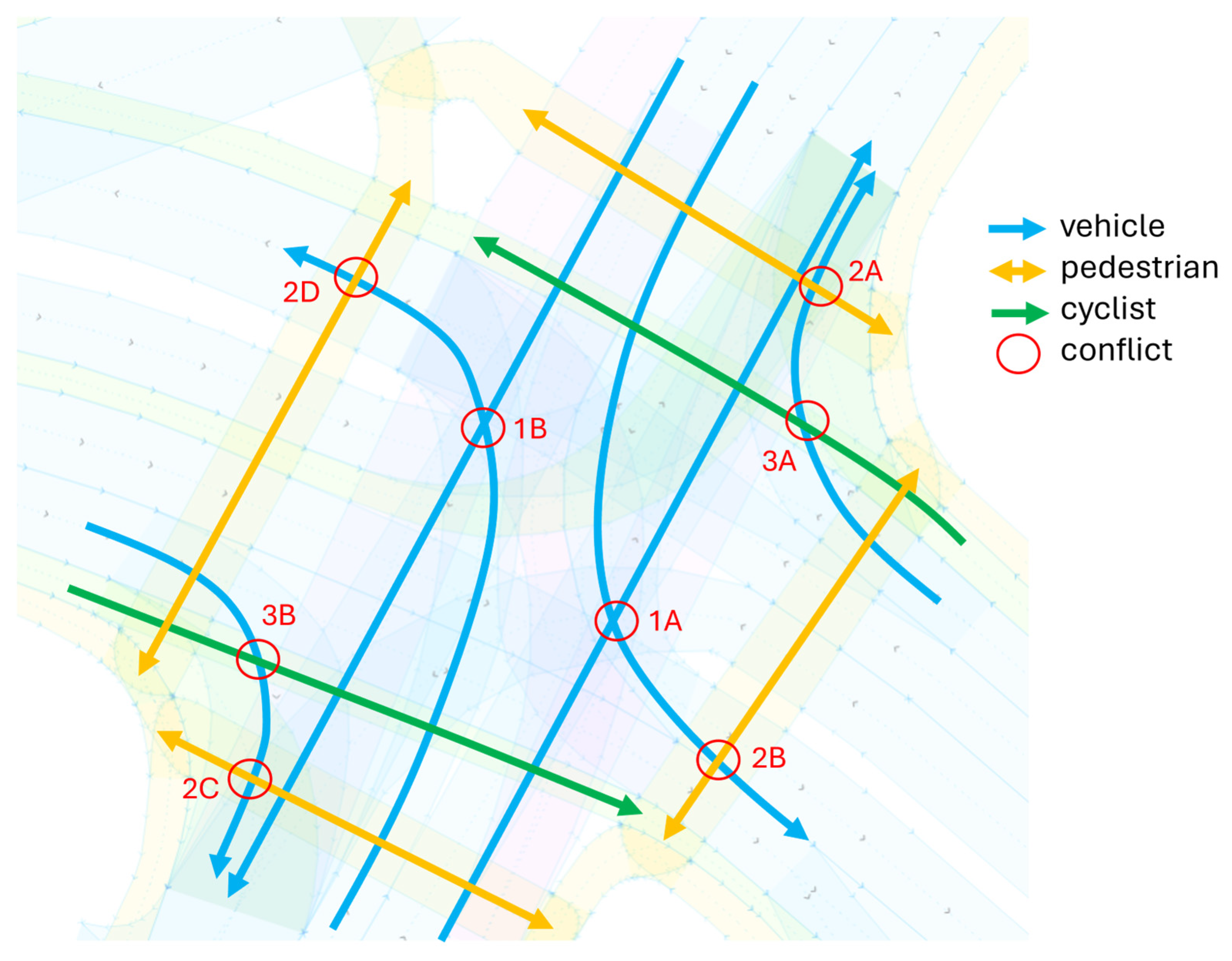
- Scenarios: Pre-defined interaction scenarios for which PET is calculated;
- Objects: Post-processed object-level attributes and movement relations of scenario-relevant objects;
- PET events: All computed PET values for predefined conflict scenarios;
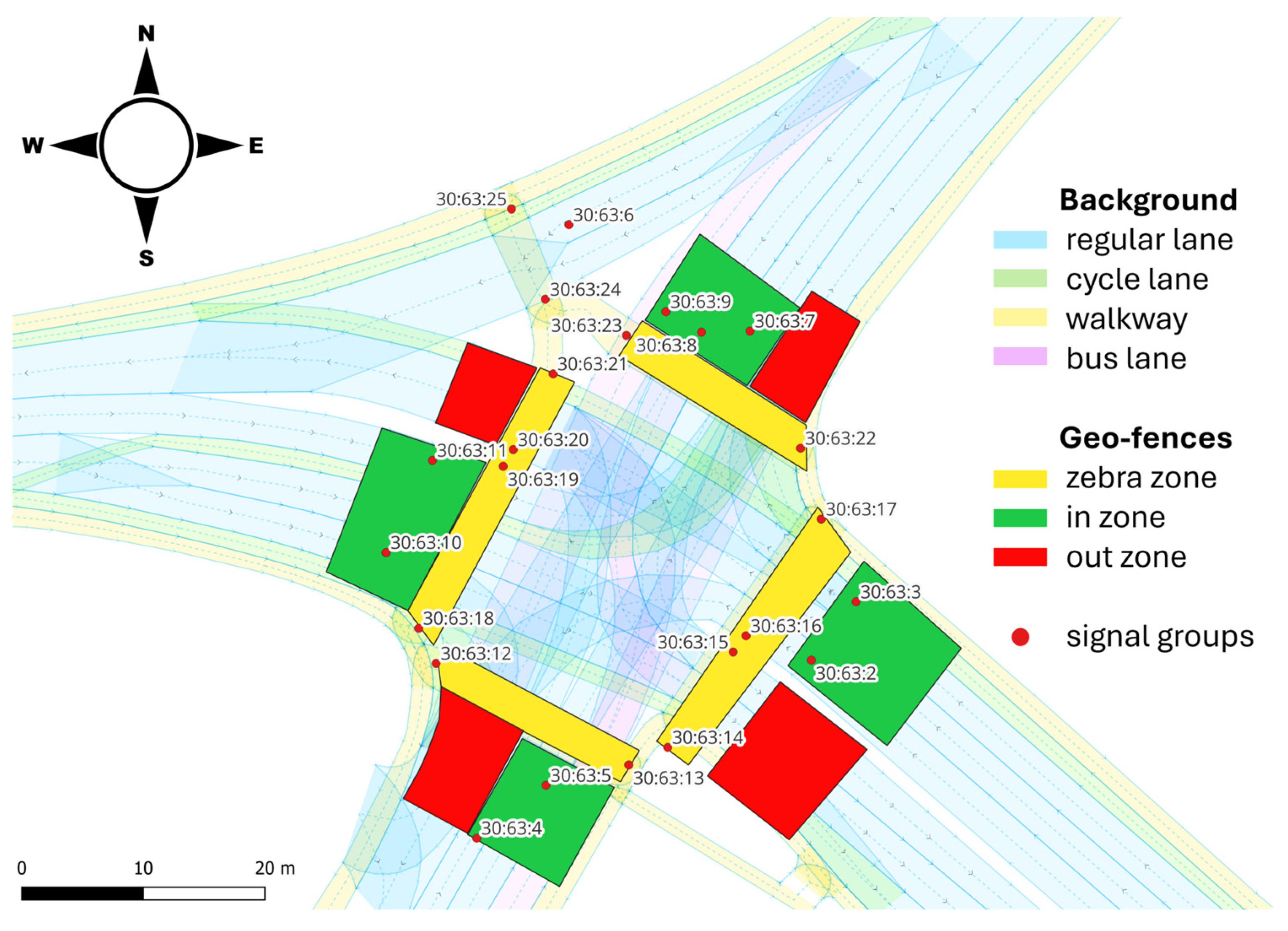
- Signal states: Traffic light signal states at the intersection.
2.2. Tracks
- A unique object identifier;
- A timestamp;
- Spatial coordinates in WGS84;
- Object class, dimensions, orientation, and speed;
- Detection quality indicators.
- The column description of the tracks table is provided in Table 1.
2.3. Scenarios
2.4. Objects
2.5. PET Events
- Identifiers of the encroaching and priority objects;
- Entry and exit times of both objects into the conflict area;
- The resulting PET value;
- The spatial location of the conflict point;
- The associated conflict scenario.
2.6. Signal Data
2.7. Auxiliary Files
2.8. Entity Relationships
- Trajectory records in tracks are associated with individual road users via object_id.
- Static object attributes in objects reference the same road users via object_id:
- ○
- tracks.object_id → objects.object_id
- PET-based interaction events in pet_events reference two road users:
- ○
- pet_events.encroaching_object_id → objects.object_id
- ○
- pet_events.priority_object_id → objects.object_id
- Each PET event is associated with exactly one predefined interaction scenario:
- ○
- pet_events.scenario_id → scenarios.scenario_id
- Scenario definitions in scenarios describe combinations of object-level movement attributes that determine whether PET is computed for a given pair of road users.
- Objects are therefore indirectly related to scenarios through their movement attributes and their participation in PET events.
- A convenience mapping between scenarios and traffic signal groups is provided:
- ○
- scenario_signal_mapping.scenario_id → scenarios.scenario_id
- ○
- scenario_signal_mapping.encroaching_signal_group_id → signal_states.signal_group_id
- ○
- scenario_signal_mapping.priority_signal_group_id → signal_states.signal_group_id
- The scenario_signal_mapping table enables straightforward temporal association of PET events with traffic signal states based on the scenario context.
- For scenarios involving pedestrians, multiple signal groups may correspond to priority movements; the mapping table provides a representative signal group with aligned phase timing.
- pet_events can be temporally linked to signal_states using timestamps.
3. Methods
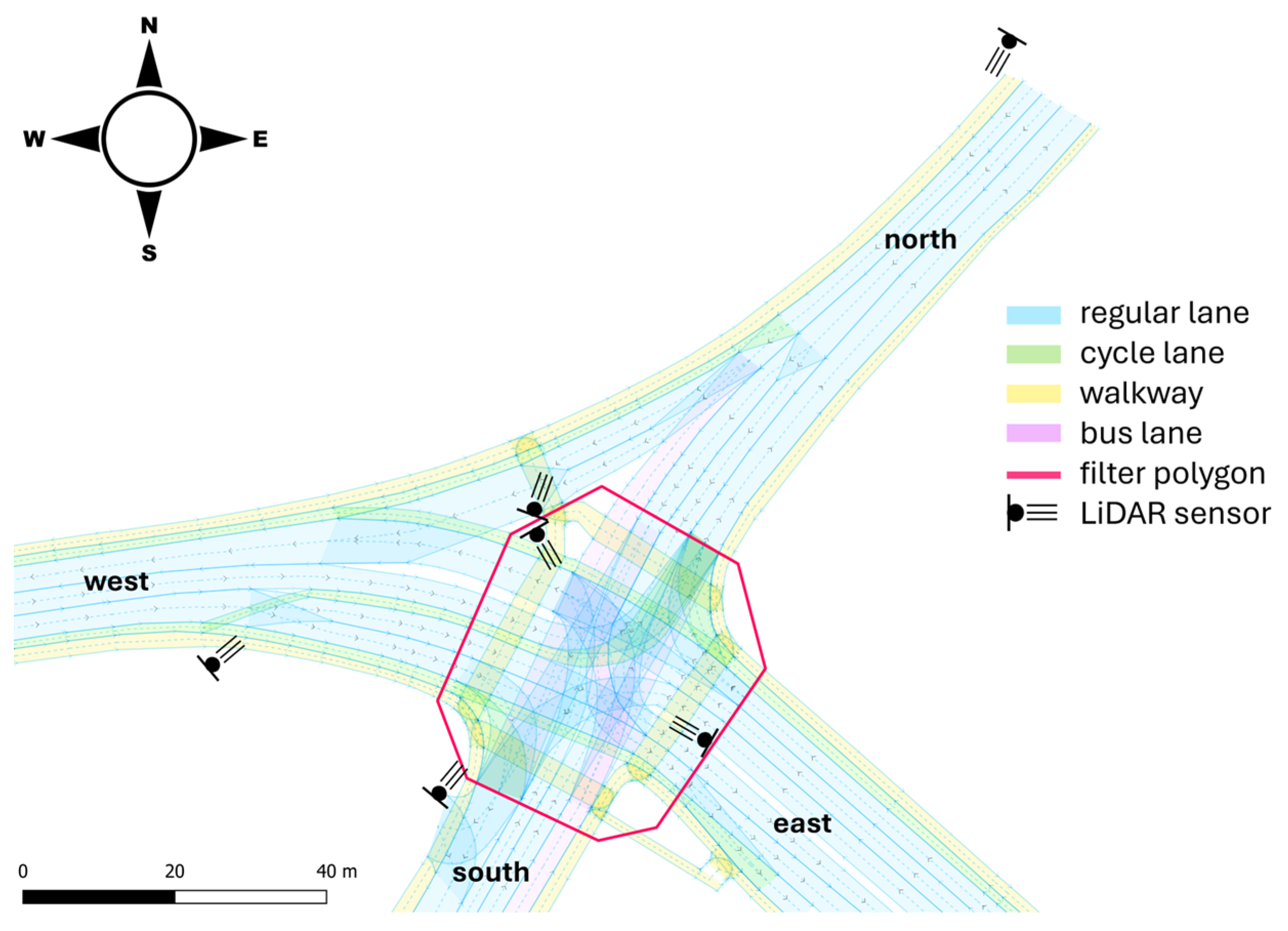
3.1. MOT System
3.2. Preparation of Tracks Data and Quality Notes
3.3. Preparation of Objects Data and Notes on Movement Relations
3.4. Notes on Scenario Selection
3.5. PET Calculation and Quality Notes
- encroaching max. timestamp + 5 s ≥ priority min. timestamp;
- encroaching min. timestamp ≤ priority max. timestamp.
- The 5 s tolerance ensures that all PETs up to 5 s can be calculated from the pairs considered.
- Determine the positions where the paths of both objects intersect as conflict points. If there are no conflict points, there is no PET for the pair.
- Determine a conflict area per conflict point:
- ○
- For both objects, find the record with the nearest position to the conflict point;
- ○
- For both objects, create a rectangle around the conflict point based on the object’s heading, length, and width from the nearest record;
- ○
- The intersecting area of these two rectangles defines the conflict area.
- For each record of both objects, reconstruct the 2D bounding box of the objects based on their position, heading, length, and width resulting in a trajectory of rectangles.
- For both objects and every conflict area, determine the timestamps corresponding to the first and last bounding box that intersect the conflict area and calculate the PET and the encroachment duration.
- Multiple PET events can exist for the same pair of objects. These might be artifacts requiring special attention.
- One object can encroach multiple priority objects in the data. Depending on the scenario, it might be adequate to only consider the first event per encroaching object. One vehicle can encroach multiple pedestrians on the crosswalk. Arguably, one left-turning vehicle cannot encroach multiple opposing vehicles on a single lane but rather only the first of them.
- One priority object can be encroached by multiple objects. Arguably, this is meaningful in every defined scenario.
3.6. Preparation of Signal State Data and Quality Notes
- Signal state duration and signal state end timestamp are derived from the timestamp of the next record (=changed state) within a signal group.
- The collecting system occasionally receives an unknown state. Sometimes, known states and unknown states alternate with high frequency in the raw data. Therefore, we removed any unknown states that lasted for not more than two seconds.
- Consecutive records of the same state (now possible due to the filter in the previous step) are fused into a single record of that state.
- 1 August 2023 to 2 August 2023;
- 31 August 2023 to 4 September 2023;
- 18 January 2024;
- 21 January 2024;
- 30 January 2024;
- 1 February 2024;
- 23 February 2024 to 25 February 2024;
- 17 March 2024;
- 16 June 2024;
- 13 July 2024;
- 22 August 2024 to 31 August 2024;
- 5 June 2025 to 11 June 2025;
- 17 July 2025;
- 16 August 2025 to 17 August 2025;
- 28 August 2025 to 31 August 2025.
- Other days might be partially affected.
4. User Notes
Author Contributions
Funding
Institutional Review Board Statement
Informed Consent Statement
Data Availability Statement
Acknowledgments
Conflicts of Interest
Abbreviations
| MOT | Multi-object tracking |
| PET | Post-encroachment time |
| SSM | Surrogate safety measure |
References
- Abdel-Aty, M.; Wang, Z.; Zheng, O.; Abdelraouf, A. Advances and Applications of Computer Vision Techniques in Vehicle Trajectory Generation and Surrogate Traffic Safety Indicators. Accid. Anal. Prev. 2023, 191, 107191. [Google Scholar] [CrossRef] [Scilit] [PubMed]
- Allen, B.L.; Shin, B.T.; Cooper, P.J. Analysis of Traffic Conflicts and Collisions. In Transportation Research Record; Transportation Research Board: Washington, DC, USA, 1978. [Google Scholar]
- Johnsson, C.; Laureshyn, A.; De Ceunynck, T. In Search of Surrogate Safety Indicators for Vulnerable Road Users: A Review of Surrogate Safety Indicators. Transp. Rev. 2018, 38, 765–785. [Google Scholar] [CrossRef] [Scilit]
- Steinmaßl, M.; Beeking, M. Salzburg Intersection Trajectory Dataset 2023. Available online: https://osf.io/rdzxp/ (accessed on 17 March 2026).
- Steinmaßl, M.; Rehrl, K. Evaluating Traffic Trajectories from Stationary Multiple Object Tracking Systems. J. Locat. Based Serv. 2025, 19, 257–286. [Google Scholar] [CrossRef] [Scilit]
- Steinmaßl, M.; Beeking, M.; Troth, N.; Rehrl, K. A Framework for Reliable Traffic Surrogate Safety Assessment Based on Multi-Object Tracking Data. Traffic Saf. Res. 2025, 9, e000123. [Google Scholar] [CrossRef] [Scilit]
- TS 102 894-2; Intelligent Transport Systems (ITS); Users and Applications Requirements; Part 2: Applications and Facilities Layer Common Data Dictionary. European Telecommunications Standards Institute (ETSI): Sophia Antipolis, France, 2025.



| Column | Type | Description |
|---|---|---|
| object_id | int | Identifier of the tracked object |
| timestamp_ms | int | Timestamp in milliseconds since Unix epoch (UTC) |
| det_points_count | int | Number of LiDAR points associated with the object (detection quality indicator) |
| lon_deg | float | Object position—Longitude (WGS84, degrees) |
| lat_deg | float | Object position—Latitude (WGS84, degrees) |
| heading_deg | float | Object heading (degrees clockwise from North) |
| speed_ms | float | Object speed (meters per second) |
| length_m | float | Object length (meters) |
| width_m | float | Object width (meters) |
| height_m | float | Object height (meters) |
| tracking_status | string | Object tracking status reported by the MOT system: |
| VALIDATING = Checking validity in the early stage of tracking; | ||
| INVALIDATING = Short term prediction when tracking is lost in VALIDATING status; | ||
| TRACKING = Stable tracking (recommended value to use for tracking, ignore the rest); | ||
| DRIFTING = Short term prediction when tracking is lost in TRACKING status | ||
| object_class | string | Object class as reported by the MOT system (vehicle, two-wheeler, pedestrian, misc) |
| Column | Type | Description |
|---|---|---|
| scenario_id | string | Unique identifier of the PET scenario |
| encroaching_movement_category | string | Movement category of the encroaching road user |
| encroaching_conflict_leg | string | Logical intersection leg associated with the encroaching movement |
| encroaching_turning_movement | string | Turning movement of the encroaching road user (empty if not applicable) |
| priority_movement_category | string | Movement category of the priority road user |
| priority_conflict_leg | string | Logical intersection leg associated with the priority movement |
| priority_turning_movement | string | Turning movement of the priority road user (empty if not applicable) |
| description | string | Human-readable description of the scenario |
| Column | Type | Description |
|---|---|---|
| object_id | int | Object identifier (references tracks.object_id) |
| object_day | string | Calendar day on which the object was first observed, expressed as an ISO 8601 date (YYYY-MM-DD, UTC) |
| object_class_static | string | Stabilized object class |
| length_m_static | float | Static object length (meters) |
| width_m_static | float | Static object width (meters) |
| height_m_static | float | Static object height (meters) |
| movement_category | string | High-level category describing the type of movement performed by the road user at the intersection |
| conflict_leg | string | Logical intersection leg associated with the movement, defined according to the intersection layout |
| turning_movement | string | Turning movement performed by the road user at the intersection (empty if not applicable) |
| Column | Type | Description |
|---|---|---|
| event_id | int | Unique event identifier |
| scenario_id | string | Interaction scenario identifier |
| encroaching_object_id | int | Object of the encroaching movement relation |
| priority_object_id | int | Object of the priority movement relation |
| ts_enter_encroaching_ms | int | Entry time of encroaching object (ms since epoch) |
| ts_leave_encroaching_ms | int | Exit time of encroaching object (ms since epoch) |
| ts_enter_priority_ms | int | Entry time of priority object (ms since epoch) |
| ts_leave_priority_ms | int | Exit time of priority object (ms since epoch) |
| encroachment_duration_s | float | Duration of encroachment (seconds) |
| pet_s | float | Post-Encroachment Time (seconds) |
| conflict_lon_deg | float | Conflict point longitude (WGS84, degrees) |
| conflict_lat_deg | float | Conflict point latitude (WGS84, degrees) |
| Column | Type | Description |
|---|---|---|
| signal_group_id | string | Identifier of the signal group |
| start_timestamp_ms | int | Start time of the signal state (ms since epoch) |
| end_timestamp_ms | int | End time of the signal state (ms since epoch) |
| signal_state | string | Human-readable signal state (green, yellow, red, red-yellow) |
Disclaimer/Publisher’s Note: The statements, opinions and data contained in all publications are solely those of the individual author(s) and contributor(s) and not of MDPI and/or the editor(s). MDPI and/or the editor(s) disclaim responsibility for any injury to people or property resulting from any ideas, methods, instructions or products referred to in the content. |
© 2026 by the authors. Licensee MDPI, Basel, Switzerland. This article is an open access article distributed under the terms and conditions of the Creative Commons Attribution (CC BY) license.
Share and Cite
Steinmaßl, M.; Rehrl, K.; Vornberger, T. SIT-PET: Long-Term Multimodal Traffic Trajectory Data with PET-Based Interaction Events at a Signalized Intersection. Data 2026, 11, 68. https://doi.org/10.3390/data11040068
Steinmaßl M, Rehrl K, Vornberger T. SIT-PET: Long-Term Multimodal Traffic Trajectory Data with PET-Based Interaction Events at a Signalized Intersection. Data. 2026; 11(4):68. https://doi.org/10.3390/data11040068
Chicago/Turabian StyleSteinmaßl, Markus, Karl Rehrl, and Timo Vornberger. 2026. "SIT-PET: Long-Term Multimodal Traffic Trajectory Data with PET-Based Interaction Events at a Signalized Intersection" Data 11, no. 4: 68. https://doi.org/10.3390/data11040068
APA StyleSteinmaßl, M., Rehrl, K., & Vornberger, T. (2026). SIT-PET: Long-Term Multimodal Traffic Trajectory Data with PET-Based Interaction Events at a Signalized Intersection. Data, 11(4), 68. https://doi.org/10.3390/data11040068