

Perspectives on Research and Personalized Healthcare in the Context of Federated FAIR Data Based on an Exploratory Study by Medical Researchers

 , ,
, ,  ,
,  , ,
, ,
Abstract
1. Introduction
2. Materials and Methods
2.1. Data Collection
2.2. Data Description
2.3. Data Analysis
- “The awareness of the existence of data repositories within the institution”—either present or absent.
- “The level of interaction with health-related data”—a score based on the responses to the related question, as follows: none (score 0), data collection (+1), access (+1), analysis (+1), and storage (+1).
- “The experience with a diversity of types of data from repositories”—a score based on the responses to the related question, as follows: none (score 0), health status (+1), lifestyle (+1), environment (+1), family history (+1), clinical examination (+1), imagistic investigations (+1), laboratory tests (+1), omics (+1), and other data (+1).
- “The number of categories of data considered useful if stored in repositories”—a score based on the responses to the related question, as follows: none (score 0), health status (+1), lifestyle (+1), environment (+1), family history (+1), clinical examination (+1), imagistic investigations (+1), laboratory tests (+1), omics (+1), and other data (+1).
- “The agreement to share the data collected during professional activity in a data repository”—either present or absent.
- Data repositories within respondents’ institution—respondents could choose to answer with “Yes”, “No”, or “I do not know”.
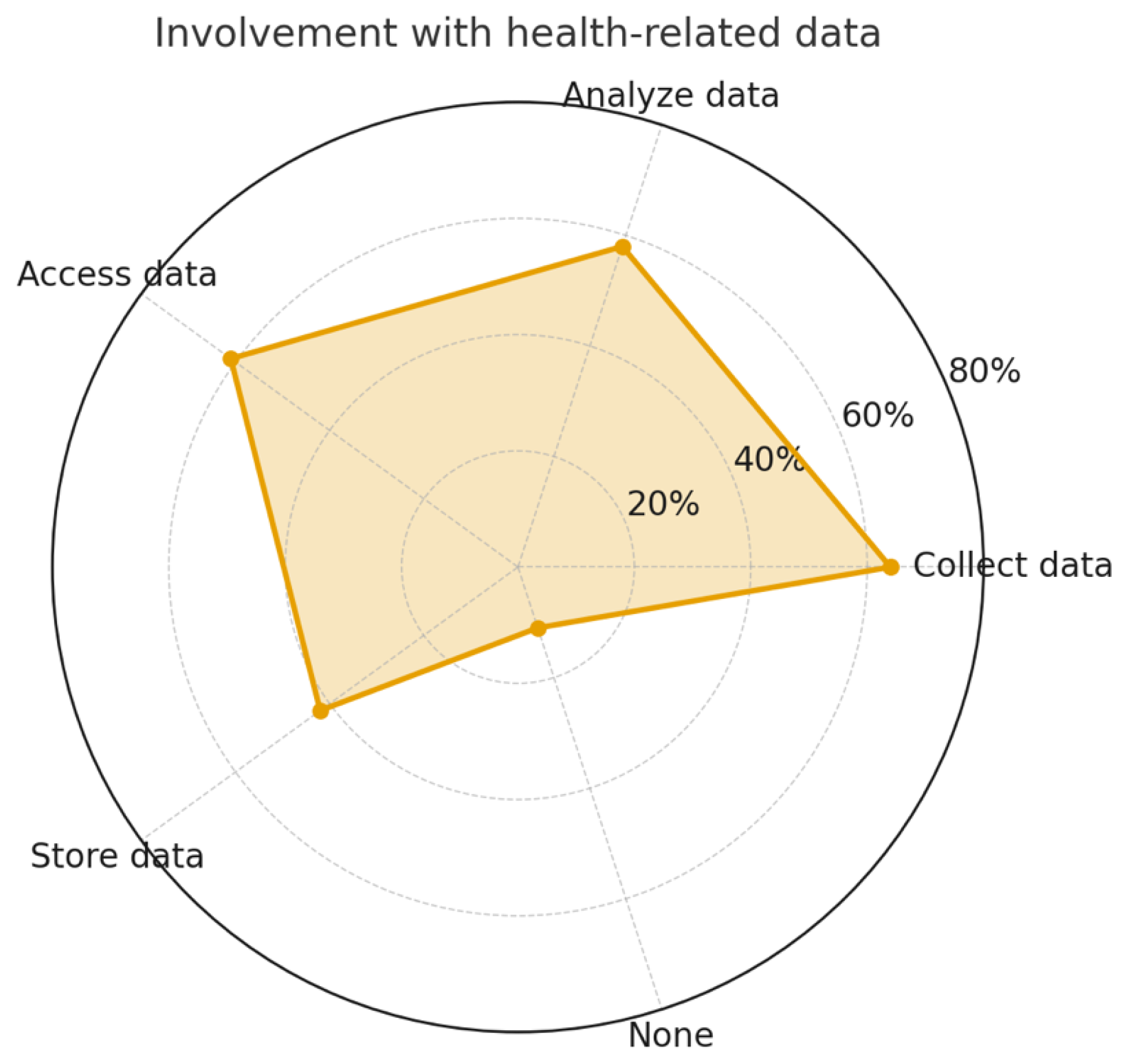
- Involvement with health-related data—the respondents were asked to respond if they collect, analyze, store, or access health-related data in their professional activity (multiple choice question).
- Use of data from repositories—the respondents were asked if they had previously used data from repositories. If the answer was yes, they could choose from the following categories (multiple choice question): health status, lifestyle, environment, family history, clinical examination, medical imaging, omics data, laboratory investigations, or other data.
- Storing health-related data in repositories—the respondents were asked to choose which types of health-related data should be stored in a data repository (multiple choice question): health status, lifestyle, environment, family history, clinical examination, imagistic investigations, laboratory tests, omics, or other data.
- Agreement to store data in a repository—the respondents were asked to mention if they would agree to store the data collected in their professional activity in a data repository by choosing one of the following answers: “Yes”, “I do not know”, or “No”.
2.4. Organisational Readiness Score (ORS)
- “Purpose of the activities” as the reasons behind the use of data by the respondents.
- “Reasons for using federated data” as the reasons behind the potential use of federated data by the respondents.
- “Already used types of data from repositories” as the categories of data used by the respondents (health status, imagistic investigations, laboratory tests, omics, etc.).
- “Reasons for the lack of use of data stored in repositories” was the justification provided by the respondents when the data was not used.
- “Useful types of data when stored in a repository” as the categories of data considered beneficial by the respondents when stored in repositories (health status, imagistic investigations, laboratory tests, omics, etc.).
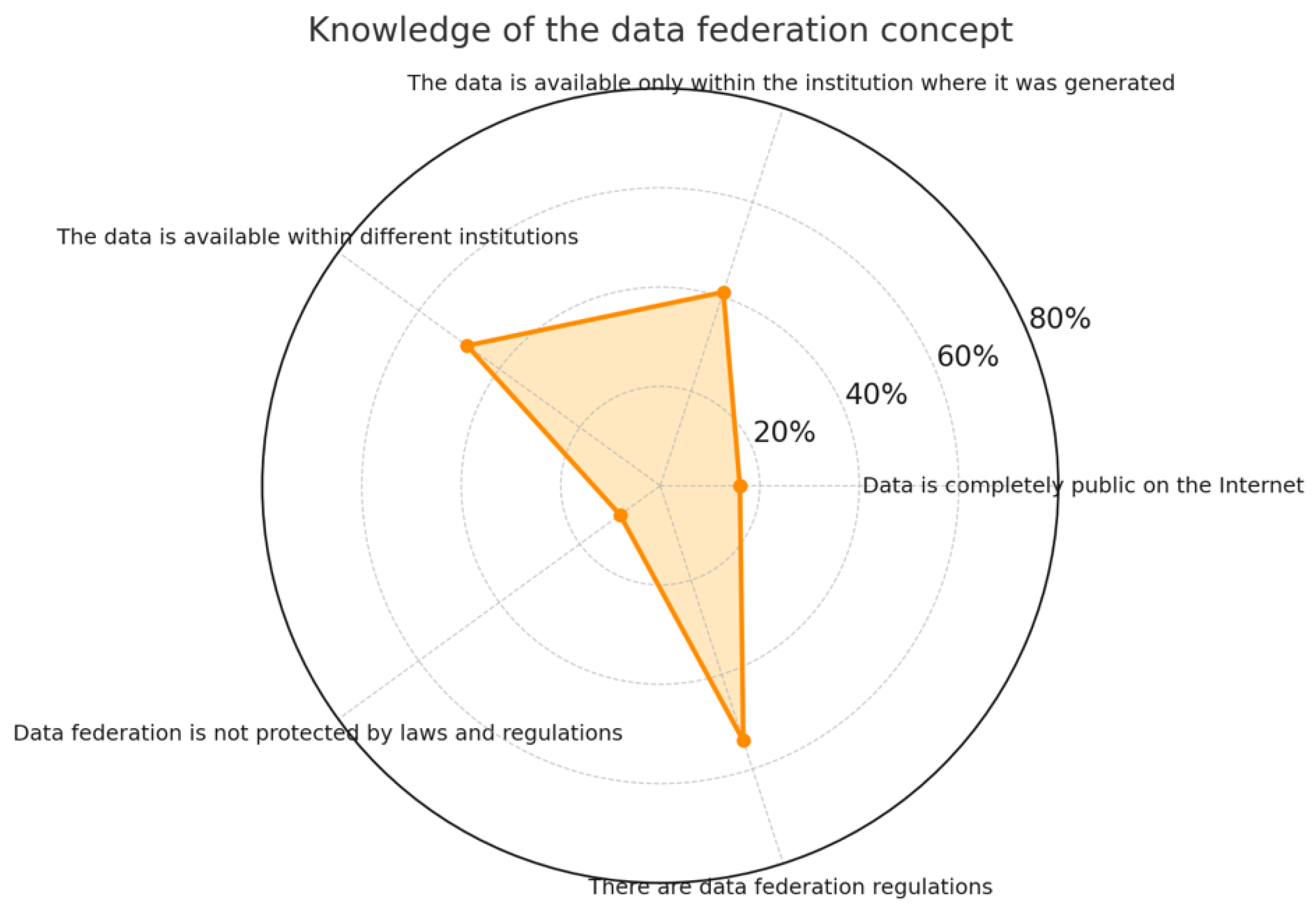
- “Knowledge of the concept of data federation” as the statements regarding data federation considered true by the respondents.
- “Data federation challenges” as the potential challenges for data federation reported by the respondents.
- “Data federation usefulness” as the benefits of data federation from respondents’ perspectives.
- “Interest in related and additional concepts” as the topics mentioned by the respondents as being of interest.
- “Potential limitations to data federation implementation” as the factors that influence the decision of the respondents to share data.
3. Results
3.1. Self-Reported Involvement with Data in Respondents’ Professional Activity
3.2. Opinions and Perceptions on Shared Data
3.3. Potential Trends Within the Group of Respondents
4. Discussion
5. Conclusions
Supplementary Materials
Author Contributions
Funding
Institutional Review Board Statement
Informed Consent Statement
Data Availability Statement
Acknowledgments
Conflicts of Interest
Abbreviations
| API | Application programming interfaces |
| EGA | European Genome-Phenome Archive |
| FAIR | Findable, Accessible, Interoperable, Reusable |
| GA4GH | Global Alliance for Genomics and Health |
| GDPR | General Data Protection Regulation |
| ORS | Organisational Readiness Score |
References
- Mathur, S.; Sutton, J. Personalized medicine could transform healthcare. Biomed. Rep. 2017, 7, 3–5. [Google Scholar] [CrossRef]
- Jakka, S.; Rossbach, M. An economic perspective on personalized medicine. HUGO J. 2013, 7, 1. [Google Scholar] [CrossRef]
- Badr, Y.; Abdul Kader, L.; Shamayleh, A. The Use of Big Data in Personalized Healthcare to Reduce Inventory Waste and Optimize Patient Treatment. J. Pers. Med. 2024, 14, 383. [Google Scholar] [CrossRef]
- Athieniti, E.; Spyrou, G.M. A guide to multi-omics data collection and integration for translational medicine. Comput. Struct. Biotechnol. J. 2022, 21, 134–149. [Google Scholar] [CrossRef]
- Wade, T.D. Traits and types of health data repositories. Health Inf. Sci. Syst. 2014, 2, 4. [Google Scholar] [CrossRef] [PubMed][Green Version]
- Holub, P.; Kohlmayer, F.; Prasser, F.; Mayrhofer, M.T.; Schlünder, I.; Martin, G.M.; Casati, S.; Koumakis, L.; Wutte, A.; Kozera, Ł.; et al. Enhancing Reuse of Data and Biological Material in Medical Research: From FAIR to FAIR-Health. Biopreserv. Biobank. 2018, 16, 97–105. [Google Scholar] [CrossRef]
- Lin, D.; McAuliffe, M.; Pruitt, K.D.; Gururaj, A.; Melchior, C.; Schmitt, C.; Wright, S.N. Biomedical Data Repository Concepts and Management Principles. Sci. Data 2024, 11, 622. [Google Scholar] [CrossRef]
- Niehues, A.; de Visser, C.; Hagenbeek, F.A.; Kulkarni, P.; Pool, R.; Karu, N.; Kindt, A.S.D.; Singh, G.; Vermeiren, R.R.J.M.; Boomsma, D.I.; et al. A multi-omics data analysis workflow packaged as a FAIR Digital Object. Gigascience 2024, 13, giad115. [Google Scholar] [CrossRef] [PubMed]
- Mohr, A.E.; Ortega-Santos, C.P.; Whisner, C.M.; Klein-Seetharaman, J.; Jasbi, P. Navigating Challenges and Opportunities in Multi-Omics Integration for Personalized Healthcare. Biomedicines 2024, 12, 1496. [Google Scholar] [CrossRef] [PubMed]
- Rujano, M.A.; Boiten, J.W.; Ohmann, C.; Canham, S.; Contrino, S.; David, R.; Ewbank, J.; Filippone, C.; Connellan, C.; Custers, I.; et al. Sharing sensitive data in life sciences: An overview of centralized and federated approaches. Brief. Bioinform. 2024, 25, bbae262. [Google Scholar] [CrossRef]
- Wilkinson, M.D.; Dumontier, M.; Aalbersberg, I.J.; Appleton, G.; Axton, M.; Baak, A.; Blomberg, N.; Boiten, J.W.; da Silva Santos, L.B.; Bourne, P.E.; et al. The FAIR Guiding Principles for scientific data management and stewardship. Sci. Data 2016, 3, 160018. [Google Scholar] [CrossRef]
- Hunger, M.; Bardenheuer, K.; Passey, A.; Schade, R.; Sharma, R.; Hague, C. The Value of Federated Data Networks in Oncology: What Research Questions Do They Answer? Outcomes From a Systematic Literature Review. Value Health 2022, 25, 855–868. [Google Scholar] [CrossRef]
- Sheth, A.P.; Larson, A.J. Federated database systems for managing distributed, heterogeneous, and autonomous databases. ACM Comput. Surv. 1990, 22, 183–236. [Google Scholar] [CrossRef]
- Haas, L.M.; Lin, E.T.; Roth, M.A. Data integration through database federation. IBM Syst. J. 2002, 41, 578–596. [Google Scholar] [CrossRef]
- Gu, Z.; Corcoglioniti, F.; Davide, L.; Mosca, A.; Xiao, G.; Xiong, J.; Calvanese, D. A systematic overview of data federation systems. Semant. Web 2024, 15, 107–165. [Google Scholar] [CrossRef]
- Thorogood, A.; Rehm, H.L.; Goodhand, P.; Page, A.J.H.; Joly, Y.; Baudis, M.; Rambla, J.; Navarro, A.; Nyronen, T.H.; Linden, M.; et al. International federation of genomic medicine databases using GA4GH standards. Cell Genom. 2021, 1, 100032. [Google Scholar] [CrossRef]
- Mullins, I.M.; Siadaty, M.S.; Lyman, J.; Scully, K.; Garrett, C.T.; Miller, W.G.; Muller, R.; Robson, B.; Apte, C.; Weiss, S.; et al. Data mining and clinical data repositories: Insights from a 667,000 patient data set. Comput. Biol. Med. 2006, 36, 1351–1377. [Google Scholar] [CrossRef]
- De Maria Marchiano, R.; Di Sante, G.; Piro, G.; Carbone, C.; Tortora, G.; Boldrini, L.; Pietragalla, A.; Daniele, G.; Tredicine, M.; Cesario, A.; et al. Translational Research in the Era of Precision Medicine: Where We Are and Where We Will Go. J. Pers. Med. 2021, 11, 216. [Google Scholar] [CrossRef]
- Winker, M.A.; Bloom, T.; Onie, S.; Tumwine, J. Equity, transparency, and accountability: Open science for the 21st century. Lancet 2023, 402, 1206–1209. [Google Scholar] [CrossRef]
- The Lancet. Making sense of our digital medicine Babel. Lancet 2018, 392, 1487. [Google Scholar] [CrossRef]
- Vesteghem, C.; Brøndum, R.F.; Sønderkær, M.; Sommer, M.; Schmitz, A.; Bødker, J.S.; Dybkær, K.; El-Galaly, T.C.; Bøgsted, M. Implementing the FAIR Data Principles in precision oncology: Review of supporting initiatives. Brief. Bioinform. 2020, 21, 936–945. [Google Scholar] [CrossRef] [PubMed]
- Kayaalp, M. Patient Privacy in the Era of Big Data. Balkan Med. J. 2018, 35, 8–17. [Google Scholar] [CrossRef] [PubMed]
- Dwork, C.; Roth, A. The Algorithmic Foundations of Differential Privacy. Found. Trends Theor. Comput. Sci. 2014, 9, 211–407. [Google Scholar] [CrossRef]
- Murthy, S.; Abu Bakar, A.; Rahim, F.A.; Ramli, R. A Comparative Study of Data Anonymization Techniques. In Proceedings of the IEEE 5th Intl Conference on Big Data Security on Cloud (BigDataSecurity), IEEE Intl Conference on High Performance and Smart Computing, (HPSC) and IEEE Intl Conference on Intelligent Data and Security (IDS), Washington, DC, USA, 27–29 May 2019. [Google Scholar] [CrossRef]
- Attieh, H.A.; Haber, A.; Wirth, F.N.; Buchner, B.; Prasser, F. Enabling Open Science in Medicine Through Data Sharing: An Overview and Assessment of Common Approaches from the European Perspective. J. Open Access Law 2023, 11. [Google Scholar] [CrossRef]
- Lehne, M.; Sass, J.; Essenwanger, A.; Schepers, J.; Thun, S. Why digital medicine depends on interoperability. npj Digit. Med. 2019, 2, 79. [Google Scholar] [CrossRef] [PubMed]
- Mandel, J.C.; Kreda, D.A.; Mandl, K.D.; Kohane, I.S.; Ramoni, R.B. SMART on FHIR: A standards-based, interoperable apps platform for electronic health records. J. Am. Med. Inform. Assoc. 2016, 23, 899–908. [Google Scholar] [CrossRef]
- Benson, T.; Grieve, G. Principles of Health Interoperability: SNOMED CT, HL7 and FHIR, 3rd ed.; Springer: London, UK, 2016. [Google Scholar]
- McDonald, C.J.; Huff, S.M.; Suico, J.G.; Hill, G.; Leavelle, D.; Aller, R.; Forrey, A.; Mercer, K.; DeMoor, G.; Hook, J.; et al. LOINC, a universal standard for identifying laboratory observations: A 5-year update. Clin. Chem. 2003, 49, 624–633. [Google Scholar] [CrossRef]
- Glicksberg, B.S.; Johnson, K.W.; Dudley, J.T. The next generation of precision medicine: Observational studies, electronic health records, biobanks and continuous monitoring. Hum. Mol. Genet. 2018, 27, R56–R62. [Google Scholar] [CrossRef]
- Raab, R.; Kuderle, A.; Zakreuskaya, A.; Stern, A.D.; Klucken, J.; Kaissis, G.; Rueckert, D.; Boll, S.; Eils, R.; Wagener, H.; et al. Federated electronic health records for the European Health Data Space. Lancet Digit. Health 2023, 5, E840–E847. [Google Scholar] [CrossRef]
- Bernier, A.; Molnár-Gábor, F.; Knoppers, B.M. The international data governance landscape. J. Law Biosci. 2022, 9, lsac005. [Google Scholar] [CrossRef]
- Hoffmann, K.; Pelz, A.; Karg, E.; Gottschalk, A.; Zerjatke, T.; Schuster, S.; Böhme, H.; Glauche, I.; Roeder, I. Data integration between clinical research and patient care: A framework for context-depending data sharing and in silico predictions. PLoS Digit. Health 2023, 2, e0000140. [Google Scholar] [CrossRef] [PubMed]
- Inau, E.T.; Sack, J.; Waltemath, D.; Zeleke, A.A. Initiatives, Concepts, and Implementation Practices of the Findable, Accessible, Interoperable, and Reusable Data Principles in Health Data Stewardship: Scoping Review. J. Med. Internet Res. 2023, 25, e45013. [Google Scholar] [CrossRef]
- Molla, G.; Bitew, M. Revolutionizing Personalized Medicine: Synergy with Multi-Omics Data Generation, Main Hurdles, and Future Perspectives. Biomedicines 2024, 12, 2750. [Google Scholar] [CrossRef] [PubMed]
- Blobel, B.; Lopez, D.M.; Gonzalez, C. Patient privacy and security concerns on big data for personalized medicine. Health Technol. 2016, 6, 75–81. [Google Scholar] [CrossRef]
- Williamson, S.M.; Prybutok, V. Balancing Privacy and Progress: A Review of Privacy Challenges, Systemic Oversight, and Patient Perceptions in AI-Driven Healthcare. Appl. Sci. 2024, 14, 675. [Google Scholar] [CrossRef]
- World Economic Forum. Available online: https://www3.weforum.org/docs/WEF_Federated_Data_Systems_2019.pdf (accessed on 29 November 2024).
- Bahcall, O.G. Partnerships to enable the responsible sharing of biomedical data. Cell Genom. 2021, 1, 100037. [Google Scholar] [CrossRef]
- Rehm, H.L.; Page, A.J.H.; Smith, L.; Adams, J.B.; Alterovitz, G.; Babb, L.J.; Barkley, M.P.; Baudis, M.; Beauvais, M.J.S.; Beck, T.; et al. International policies and standards for data sharing across genomic research and healthcare. Cell Genom. 2021, 1, 100029. [Google Scholar] [CrossRef] [PubMed]
- Dyke, S.O.M. Genomic data access policy models. In Responsible Genomic Data Sharing—Challenges and Approaches; Jiang, X., Tang, H., Eds.; Academic Press: Amsterdam, The Netherlands, 2020; pp. 19–32. [Google Scholar] [CrossRef]
- Scheibner, J.; Raisaro, J.L.; Troncoso-Pastoriza, J.R.; Ienca, M.; Fellay, J.; Vayena, E.; Hubaux, J.P. Revolutionizing Medical Data Sharing Using Advanced Privacy-Enhancing Technologies: Technical, Legal, and Ethical Synthesis. J. Med. Internet Res. 2021, 23, e25120. [Google Scholar] [CrossRef]
- González-García, J.; Estupiñán-Romero, F.; Tellería-Orriols, C.; González-Galindo, J.; Palmieri, L.; Faragalli, A.; Pristās, I.; Vuković, J.; Misinš, J.; Zile, I.; et al. InfAct Joint Action consortium. Coping with interoperability in the development of a federated research infrastructure: Achievements, challenges and recommendations from the JA-InfAct. Arch. Public Health 2021, 79, 221, Erratum in Arch. Public Health 2022, 80, 116. https://doi.org/10.1186/s13690-022-00877-4. [Google Scholar] [CrossRef]
- Jacobsen, A.; de Miranda Azevedo, R.; Juty, N.; Batista, D.; Coles, S.; Cornet, R.; Courtot, M.; Crosas, M.; Dumontier, M.; Evelo, C.T.; et al. FAIR Principles: Interpretations and Implementation Considerations. Data Intell. 2020, 2, 10–29. [Google Scholar] [CrossRef]
- European Genome-Phenome Archive. Available online: https://ega-archive.org/about/projects-and-funders/federated-ega/ (accessed on 12 November 2024).
- Sima, C.; Iordache, P.; Poenaru, E.; Manolescu, A.; Poenaru, C.; Jinga, V. Genome-wide association study of nephrolithiasis in an Eastern European population. Int. Urol. Nephrol. 2021, 53, 309–313. [Google Scholar] [CrossRef] [PubMed]
- Poenaru, E.; Chirică, V.I.; Poenaru, C.; Curcă, G.C.; Poenaru, A.; Jinga, V.; Vinereanu, D.; Sima, C.; Iacob, D.; Iordache, P.; et al. Considerations on the results evaluation of the genetic epidemiology training of AppGenEdu project. Rom. J. Leg. Med. 2021, 29, 147–156. [Google Scholar] [CrossRef]
- Balan, A.; Dugaesescu, M.; Bejan, I.; Brinduse, O.; Bonciu, S.; Ferdoschi, C.; Iacob, D.; Poenaru, E. Lung Cancer Variants in Romanian Population—A Genome-Wide Association Study. In Proceedings of the 2021 International Conference on e-Health and Bioengineering (EHB), Iasi, Romania, 18–19 November 2021. [Google Scholar] [CrossRef]
- Mateescu, L.A.; Savu, A.P.; Mutu, C.C.; Vaida, C.D.; Șerban, E.D.; Bucur, Ș.; Poenaru, E.; Nicolescu, A.C.; Constantin, M.M. The Intersection of Psoriasis and Neoplasia: Risk Factors, Therapeutic Approaches, and Management Strategies. Cancers 2024, 16, 4224. [Google Scholar] [CrossRef] [PubMed]
- Sandru, F.; Poenaru, E.; Stoleru, S.; Radu, A.-M.; Roman, A.-M.; Ionescu, C.; Zugravu, A.; Nader, J.M.; Baicoianu-Nitescu, L.-C. Microbial Colonization and Antibiotic Resistance Profiles in Chronic Wounds: A Comparative Study of Hidradenitis Suppurativa and Venous Ulcers. Antibiotics 2025, 14, 53. [Google Scholar] [CrossRef] [PubMed]
- Matei, A.; Poenaru, E.; Dimitriu, M.C.T.; Zaharia, C.; Ionescu, C.A.; Navolan, D.; Furau, C.G. Obstetrical Soft Tissue Trauma during Spontaneous Vaginal Birth in the Romanian Adolescent Population—Multicentric Comparative Study with Adult Population. Int. J. Environ. Res. Public Health 2021, 18, 11491. [Google Scholar] [CrossRef]
- Cascini, F. Secondary Use of Electronic Health Data: Public Health Perspectives, Use Cases and Challenges; Springer Nature: Cham, Switzerland, 2025; ISBN 978-3-031-88496-2. [Google Scholar] [CrossRef]
- Aitken, M.; de St. Jorre, J.; Pagliari, C.; Jepson, R.; Cunningham-Burley, S. Public Responses to the Sharing and Linkage of Health Data for Research Purposes: A Systematic Review and Thematic Synthesis of Qualitative Studies. BMC Med. Ethics 2016, 17, 73. [Google Scholar] [CrossRef]
- Gagnon, M.P.; Attieh, R.; Ghandour, E.K.; Légaré, F.; Ouimet, M.; Estabrooks, C.A.; Grimshaw, J. A Systematic Review of Instruments to Assess Organizational Readiness for Knowledge Translation in Health Care. PLoS ONE 2014, 9, e114338. [Google Scholar] [CrossRef]



| The Relevance of Federated Data in Medicine | % of Respondents |
|---|---|
| Accelerating discoveries in medicine | 88% |
| Identifying personalized therapies | 62% |
| Developing new therapeutic molecules | 43% |
| Understanding disease mechanisms | 58% |
| Assessing environmental and lifestyle impacts on health | 58% |
| Establishing the clinical significance of rare genetic variants | 49% |
| Understanding the role of genetic factors in pathology | 47% |
| Determining causes of rare diseases | 19% |
| Challenges Related to Data Federation in Medicine | % of Respondents |
|---|---|
| Data collection—obtaining consent from participants | 44% |
| Required infrastructure (communication, storage, access speed, etc.) | 73% |
| Data storage security | 72% |
| Guaranteeing data confidentiality | 65% |
| Facilitating data access | 50% |
| Lack of digitalized data | 53% |
| Standardizing data formats | 48% |
| Quality and accuracy of data | 44% |
| The need for collaboration between professionals and institutions | 49% |
| Achieving interoperability | 20% |
| Experience | % of Respondents |
|---|---|
| Performed data-related activities | 47% |
| Defined purpose of the activities | 42% |
| Reported reasons for using federated data | 24% |
| Used types of data from repositories | 39% |
| Reported reasons for the lack of use of data stored in repositories | 7% |
| Awareness | % of Respondents |
|---|---|
| Useful types of data when stored in a repository | 84% |
| Knowledge of the concept of data federation | 23% |
| Data federation challenges | 68% |
| Data federation usefulness | 59% |
| Interest in related and additional concepts | 67% |
| Identified potential limitations to implementing data federation | 79% |
Disclaimer/Publisher’s Note: The statements, opinions and data contained in all publications are solely those of the individual author(s) and contributor(s) and not of MDPI and/or the editor(s). MDPI and/or the editor(s) disclaim responsibility for any injury to people or property resulting from any ideas, methods, instructions or products referred to in the content. |
© 2025 by the authors. Licensee MDPI, Basel, Switzerland. This article is an open access article distributed under the terms and conditions of the Creative Commons Attribution (CC BY) license (https://creativecommons.org/licenses/by/4.0/).
Share and Cite
Poenaru, E.; Dugăeşescu, M.; Poenaru, C.; Andrei-Bitere, I.; Băicoianu-Niţescu, L.-C.; Constantin, T.-V.; Zugravu, A.; Bitel, B.; Constantin, M.M.; Stoleru, S. Perspectives on Research and Personalized Healthcare in the Context of Federated FAIR Data Based on an Exploratory Study by Medical Researchers. Data 2025, 10, 187. https://doi.org/10.3390/data10110187
Poenaru E, Dugăeşescu M, Poenaru C, Andrei-Bitere I, Băicoianu-Niţescu L-C, Constantin T-V, Zugravu A, Bitel B, Constantin MM, Stoleru S. Perspectives on Research and Personalized Healthcare in the Context of Federated FAIR Data Based on an Exploratory Study by Medical Researchers. Data. 2025; 10(11):187. https://doi.org/10.3390/data10110187
Chicago/Turabian StylePoenaru, Elena, Monica Dugăeşescu, Călin Poenaru, Iulia Andrei-Bitere, Livia-Cristiana Băicoianu-Niţescu, Traian-Vasile Constantin, Aurelian Zugravu, Brandusa Bitel, Maria Magdalena Constantin, and Smaranda Stoleru. 2025. "Perspectives on Research and Personalized Healthcare in the Context of Federated FAIR Data Based on an Exploratory Study by Medical Researchers" Data 10, no. 11: 187. https://doi.org/10.3390/data10110187
APA StylePoenaru, E., Dugăeşescu, M., Poenaru, C., Andrei-Bitere, I., Băicoianu-Niţescu, L.-C., Constantin, T.-V., Zugravu, A., Bitel, B., Constantin, M. M., & Stoleru, S. (2025). Perspectives on Research and Personalized Healthcare in the Context of Federated FAIR Data Based on an Exploratory Study by Medical Researchers. Data, 10(11), 187. https://doi.org/10.3390/data10110187