

OpenSim–Umberger-Based Metabolic Power Stratification During the Sit-to-Walk Transition Using Interpretable Ensemble Learning



Abstract
1. Introduction
2. Materials and Methods
2.1. Participants and Experimental Procedures
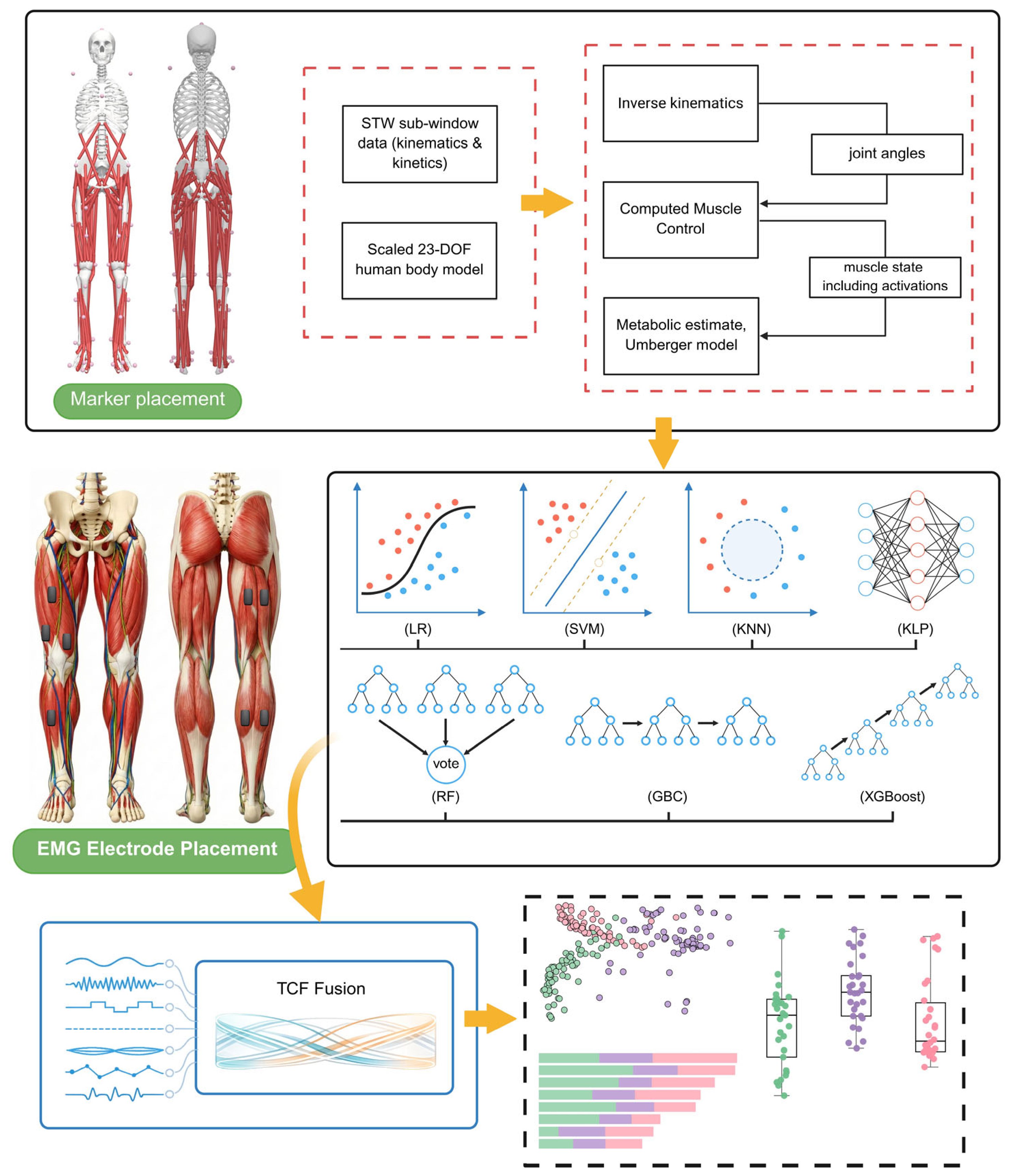
2.2. OpenSim–Umberger-Based Metabolic Cost Modeling
2.3. Candidate Variable Construction and Feature Selection
2.4. Predictive Modeling and TOPSIS-Weighted Fusion
2.5. Model Interpretation
2.6. Statistical Analysis
3. Results
3.1. Participant Characteristics and Metabolic Power Stratification
3.2. Validation of Data-Tracking Simulation Results
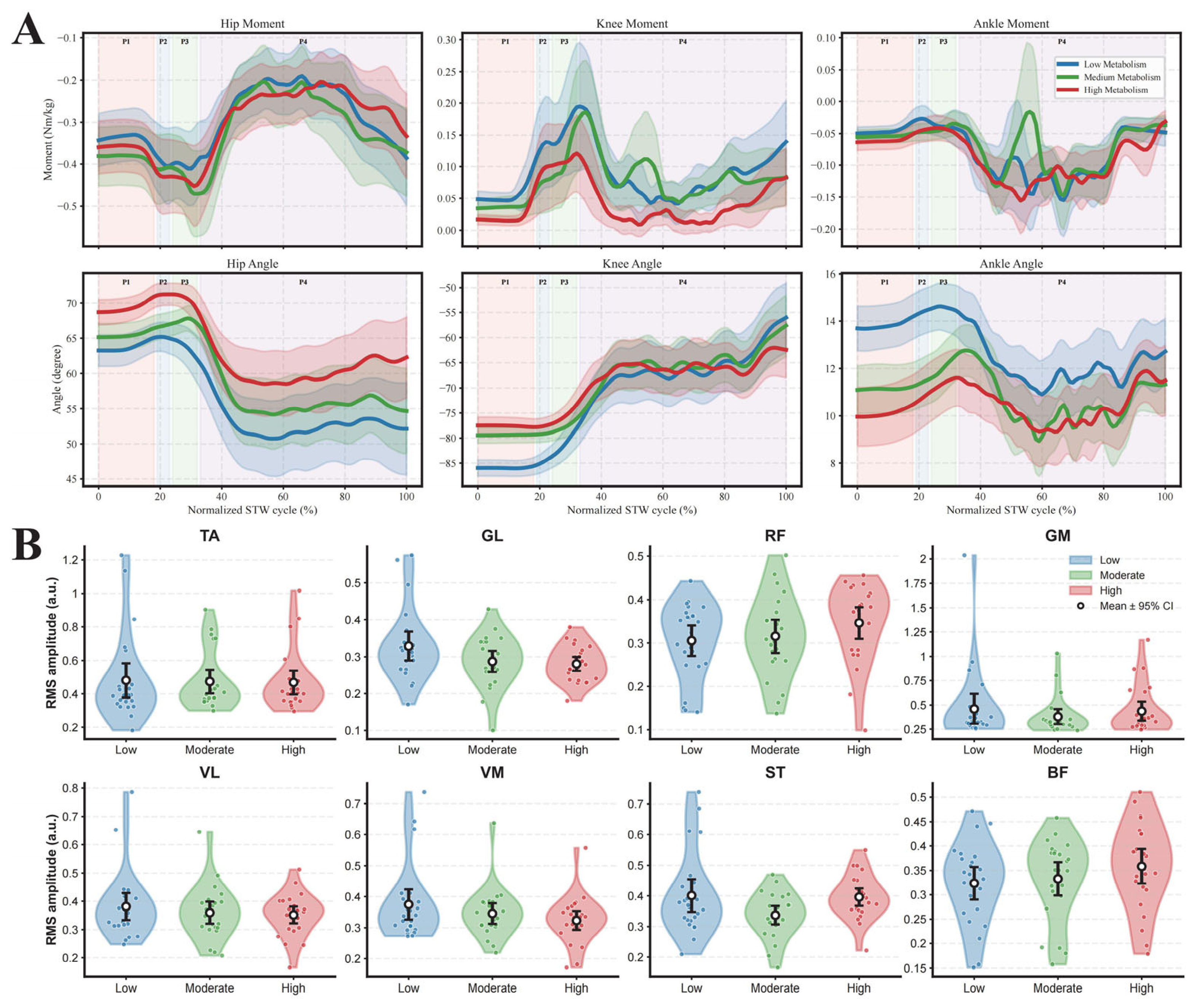
3.3. Baseline Kinematic, Kinetic, and sEMG Features Across Metabolic-Cost Groups
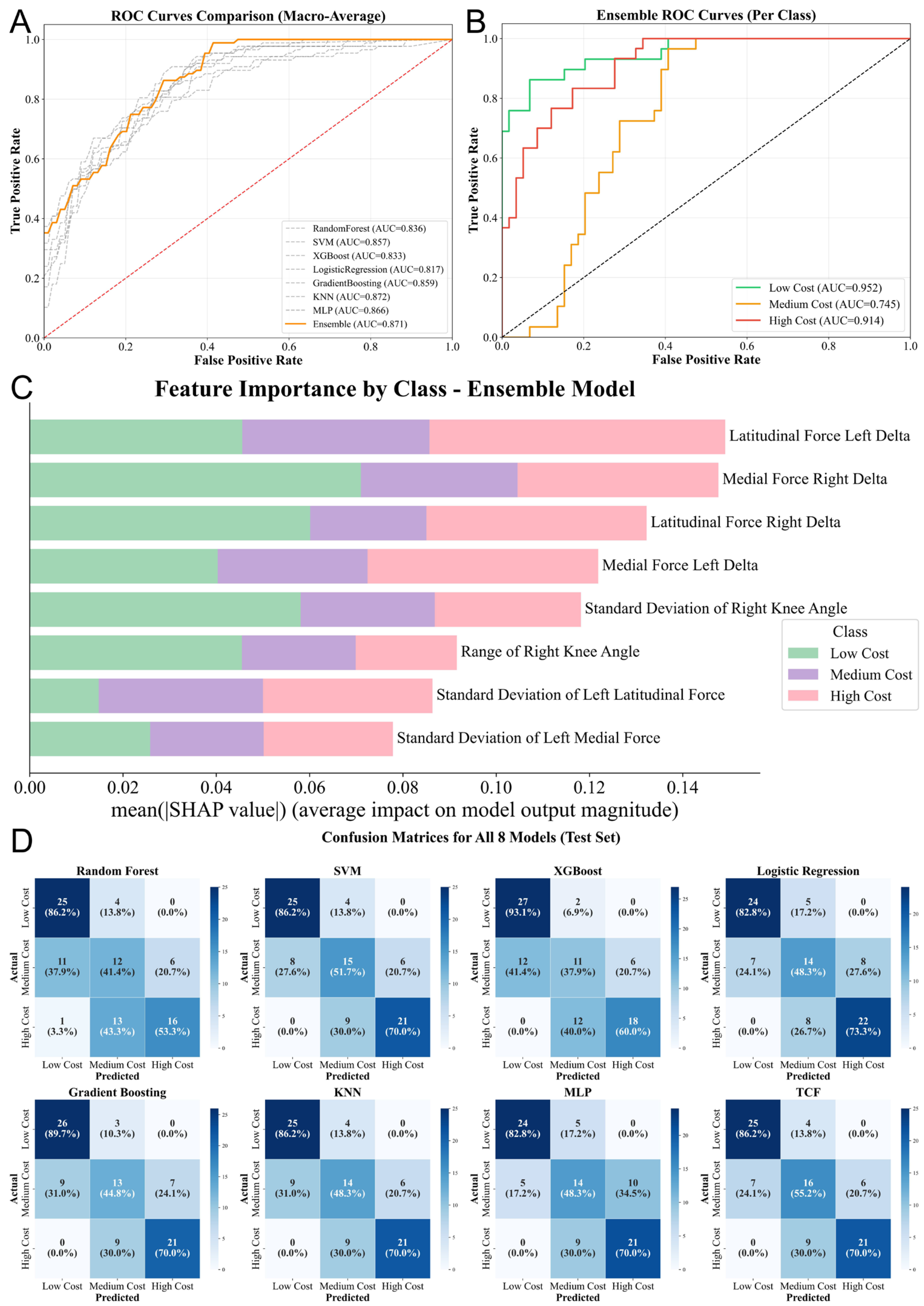
3.4. Three-Class Model Performance and Ensemble Model Results
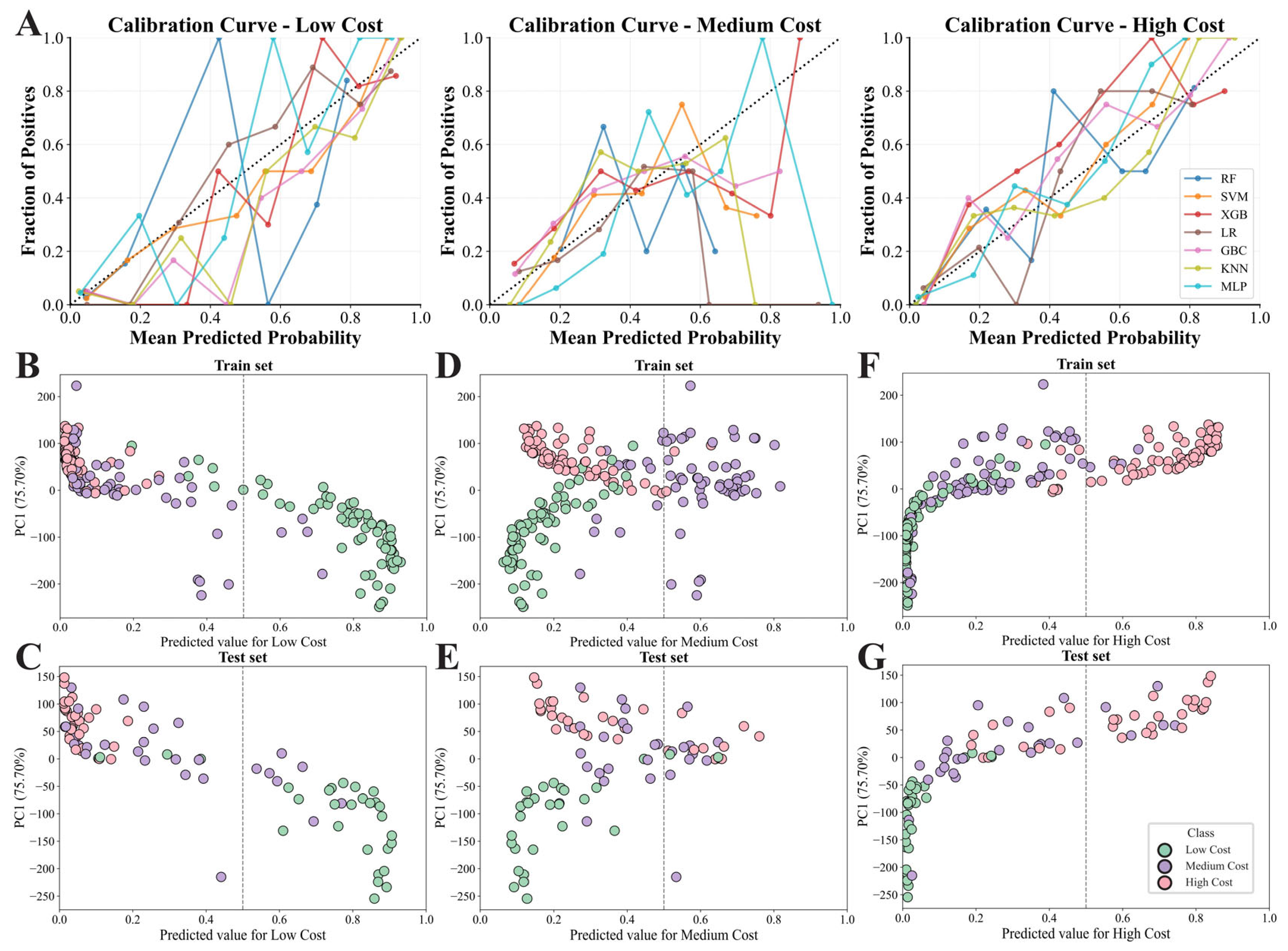
3.5. Class-Specific Discrimination Performance
3.6. Feature Contributions and Interpretability
3.7. Classification Error Patterns
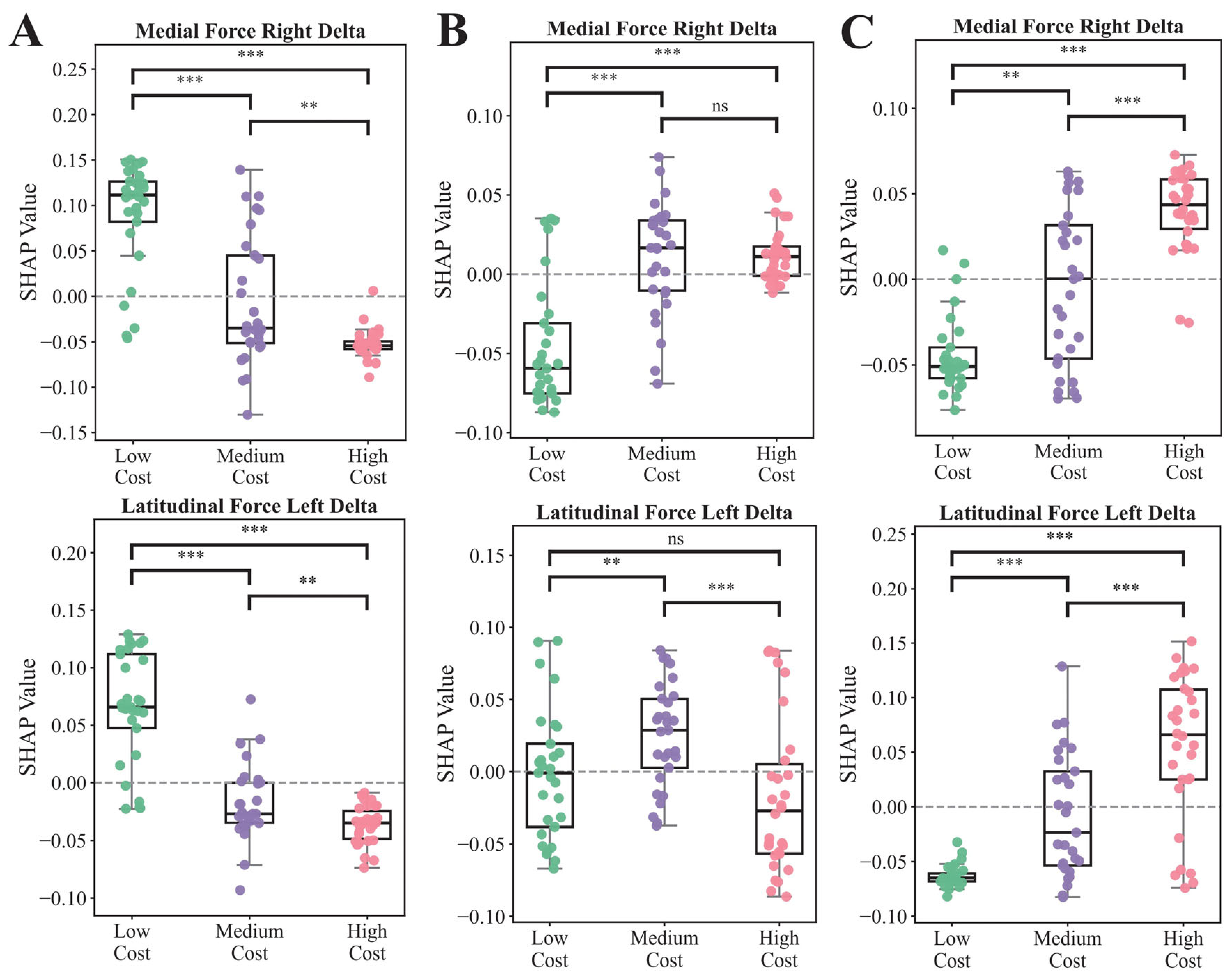
3.8. Class-Specific SHAP Value Distributions
4. Discussion
4.1. Main Findings
4.2. From STW Performance to Model-Derived Metabolic Cost
4.3. Ensemble Fusion for Multisource Biomechanical Classification
4.4. Prediction-Relevant Biomechanical Feature Attribution
4.5. Limitations and Future Directions
5. Conclusions
Supplementary Materials
Author Contributions
Funding
Institutional Review Board Statement
Informed Consent Statement
Data Availability Statement
Acknowledgments
Conflicts of Interest
Abbreviations
| iTUG | Instrumented Timed Up and Go |
| sEMG | Surface Electromyography |
| OpenSim | Musculoskeletal Model |
| SHAP | Shapley Additive Explanations |
| RF | Random Forest |
| SVM | Support Vector Machine |
| XGBoost | XGBoost |
| LR | Logistic Regression |
| GBC | Gradient Boosting Classifier |
| KNN | K-Nearest Neighbors |
| MLP | Multilayer Perceptron |
| TOPSIS-based TCF | Top Ranked and Ranked Weighted Classification Fusion |
| ROM | Range of Motion |
| SD | Standard Deviation |
| Δ | Change (difference between adjacent time points) |
References
- Grant, P.M.; Dall, P.M.; Kerr, A. Daily and hourly frequency of the sit to stand movement in older adults: A comparison of day hospital, rehabilitation ward and community living groups. Aging Clin. Exp. Res. 2011, 23, 437–444. [Google Scholar] [CrossRef] [PubMed]
- Dall, P.M.; Kerr, A. Frequency of the sit to stand task: An observational study of free-living adults. Appl. Ergon. 2010, 41, 58–61. [Google Scholar] [CrossRef] [PubMed]
- Kerr, A.; Durward, B.; Kerr, K.M. Defining phases for the sit-to-walk movement. Clin. Biomech. 2004, 19, 385–390. [Google Scholar]
- Miller, M.F.; van der Kruk, E.; Silverman, A.K. Age and initial position affect movement biomechanics in sit to walk transitions: Lower limb muscle activity and joint moments. J. Biomech. 2024, 177, 112367. [Google Scholar] [CrossRef] [PubMed]
- Kerr, A.; Rafferty, D.; Kerr, K.M.; Durward, B. Timing phases of the sit-to-walk movement: Validity of a clinical test. Gait Posture 2007, 26, 11–16. [Google Scholar] [PubMed]
- Lu, C.; Amundsen Huffmaster, S.L.; Harvey, J.C.; MacKinnon, C.D. Anticipatory postural adjustment patterns during gait initiation across the adult lifespan. Gait Posture 2017, 57, 182–187. [Google Scholar] [CrossRef] [PubMed]
- Osada, Y.; Yamamoto, S.; Fuchi, M.; Ibayashi, S. Sit-to-walk Task in Hemiplegic Stroke Patients: Relationship between Movement Fluidity and the Motor Strategy in Initial Contact. J. Jpn. Phys. Ther. Assoc. 2015, 18, 7–14. [Google Scholar] [PubMed]
- Podsiadlo, D.; Richardson, S. The timed “Up & Go”: A test of basic functional mobility for frail elderly persons. J. Am. Geriatr. Soc. 1991, 39, 142–148. [Google Scholar] [CrossRef] [PubMed]
- Picardi, M.; Redaelli, V.; Antoniotti, P.; Pintavalle, G.; Aristidou, E.; Sterpi, I.; Meloni, M.; Corbo, M.; Caronni, A. Turning and sit-to-walk measures from the instrumented Timed Up and Go test return valid and responsive measures of dynamic balance in Parkinson’s disease. Clin. Biomech. 2020, 80, 105177. [Google Scholar]
- Ortega-Bastidas, P.; Gómez, B.; Aqueveque, P.; Luarte-Martínez, S.; Cano-de-la-Cuerda, R. Instrumented Timed Up and Go Test (iTUG)-More than Assessing Time to Predict Falls: A Systematic Review. Sensors 2023, 23, 3426. [Google Scholar] [PubMed]
- Zhou, J.; Yao, Q.; Han, R.; De Bock, P.; Vassard-Yu, G.; Hallemans, A.; Van Laer, L. Reliability and Validity of Instrumented Timed Up and Go Test in Typical Adults and Elderly: A Systematic Review. Arch. Phys. Med. Rehabil. 2025, 106, 1092–1107. [Google Scholar] [CrossRef] [PubMed]
- Zampieri, C.; Salarian, A.; Carlson-Kuhta, P.; Aminian, K.; Nutt, J.G.; Horak, F.B. The instrumented timed up and go test: Potential outcome measure for disease modifying therapies in Parkinson’s disease. J. Neurol. Neurosurg. Psychiatry 2010, 81, 171–176. [Google Scholar] [PubMed]
- van der Kruk, E.; Strutton, P.; Koizia, L.J.; Fertleman, M.; Reilly, P.; Bull, A.M.J. Why do older adults stand-up differently to young adults?: Investigation of compensatory movement strategies in sit-to-walk. npj Aging 2022, 8, 13. [Google Scholar] [CrossRef] [PubMed]
- Robergs, R.A.; Dwyer, D.; Astorino, T. Recommendations for improved data processing from expired gas analysis indirect calorimetry. Sports Med. 2010, 40, 95–111. [Google Scholar] [CrossRef] [PubMed]
- Delp, S.L.; Anderson, F.C.; Arnold, A.S.; Loan, P.; Habib, A.; John, C.T.; Guendelman, E. Thelen DG: OpenSim: Open-source software to create and analyze dynamic simulations of movement. IEEE Trans. Biomed. Eng. 2007, 54, 1940–1950. [Google Scholar] [PubMed]
- Bhargava, L.J.; Pandy, M.G.; Anderson, F.C. A phenomenological model for estimating metabolic energy consumption in muscle contraction. J. Biomech. 2004, 37, 81–88. [Google Scholar] [CrossRef] [PubMed]
- Halilaj, E.; Rajagopal, A.; Fiterau, M.; Hicks, J.L.; Hastie, T.J.; Delp, S.L. Machine learning in human movement biomechanics: Best practices, common pitfalls, and new opportunities. J. Biomech. 2018, 81, 1–11. [Google Scholar] [CrossRef] [PubMed]
- Dibbern, K.N.; Krzak, M.G.; Olivas, A.; Albert, M.V.; Krzak, J.J.; Kruger, K.M. Scoping Review of Machine Learning Techniques in Marker-Based Clinical Gait Analysis. Bioengineering 2025, 12, 591. [Google Scholar] [CrossRef] [PubMed]
- Krishnan, N.M.A.; Kodamana, H.; Bhattoo, R. Interpretable Machine Learning. In Machine Intelligence for Materials Science; Springer: Berlin/Heidelberg, Germany, 2024; pp. 159–171. [Google Scholar]
- Xiang, L.; Gao, Z.; Yu, P.; Fernandez, J.; Gu, Y.; Wang, R.; Gutierrez-Farewik, E.M. Explainable artificial intelligence for gait analysis: Advances, pitfalls, and challenges—A systematic review. Front. Bioeng. Biotechnol. 2025, 13, 1671344. [Google Scholar] [PubMed]
- Perera, C.K.; Hussain, Z.; Khant, M.; Gopalai, A.A.; Gouwanda, D.; Ahmad, S.A. A Motion Capture Dataset on Human Sitting to Walking Transitions. Sci. Data 2024, 11, 878. [Google Scholar] [CrossRef] [PubMed]
- Stegeman, D.; Hermens, H. Standards for suface electromyography: The European project Surface EMG for non-invasive assessment of muscles (SENIAM). Enschede Roessingh Res. Dev. 2007, 10, 108–112. [Google Scholar]
- Seth, A.; Hicks, J.L.; Uchida, T.K.; Habib, A.; Dembia, C.L.; Dunne, J.J.; Ong, C.F.; DeMers, M.S.; Rajagopal, A.; Millard, M. OpenSim: Simulating musculoskeletal dynamics and neuromuscular control to study human and animal movement. PLoS Comput. Biol. 2018, 14, e1006223. [Google Scholar] [CrossRef] [PubMed]
- Delp, S.L.; Loan, J.P.; Hoy, M.G.; Zajac, F.E.; Topp, E.L.; Rosen, J.M. An interactive graphics-based model of the lower extremity to study orthopaedic surgical procedures. IEEE Trans. Biomed. Eng. 1990, 37, 757–767. [Google Scholar] [CrossRef] [PubMed]
- Harrington, M.E.; Zavatsky, A.B.; Lawson, S.E.; Yuan, Z.; Theologis, T.N. Prediction of the hip joint centre in adults, children, and patients with cerebral palsy based on magnetic resonance imaging. J. Biomech. 2007, 40, 595–602. [Google Scholar] [CrossRef] [PubMed]
- Kainz, H.; Carty, C.P.; Modenese, L.; Boyd, R.N.; Lloyd, D.G. Estimation of the hip joint centre in human motion analysis: A systematic review. Clin. Biomech. 2015, 30, 319–329. [Google Scholar] [CrossRef]
- Thelen, D.G.; Anderson, F.C.; Delp, S.L. Generating dynamic simulations of movement using computed muscle control. J. Biomech. 2003, 36, 321–328. [Google Scholar] [CrossRef] [PubMed]
- Umberger, B.R.; Gerritsen, K.G.; Martin, P.E. A model of human muscle energy expenditure. Comput. Methods Biomech. Biomed. Eng. 2003, 6, 99–111. [Google Scholar] [CrossRef]
- Uchida, T.K.; Hicks, J.L.; Dembia, C.L.; Delp, S.L. Stretching Your Energetic Budget: How Tendon Compliance Affects the Metabolic Cost of Running. PLoS ONE 2016, 11, e0150378. [Google Scholar] [CrossRef] [PubMed]
- Varma, S.; Simon, R. Bias in error estimation when using cross-validation for model selection. BMC Bioinform. 2006, 7, 91. [Google Scholar] [CrossRef]
- Krstajic, D.; Buturovic, L.J.; Leahy, D.E.; Thomas, S. Cross-validation pitfalls when selecting and assessing regression and classification models. J. Cheminform. 2014, 6, 10. [Google Scholar] [CrossRef] [PubMed]
- Pudjihartono, N.; Fadason, T.; Kempa-Liehr, A.W.; O’Sullivan, J.M. A Review of Feature Selection Methods for Machine Learning-Based Disease Risk Prediction. Front. Bioinform. 2022, 2, 927312. [Google Scholar] [CrossRef] [PubMed]
- Wang, S.; Liu, X.; Yuan, S.; Bian, Y.; Wu, H.; Ye, Q. Artificial intelligence based multispecialty mortality prediction models for septic shock in a multicenter retrospective study. npj Digit. Med. 2025, 8, 228. [Google Scholar] [CrossRef] [PubMed]
- Lilliefors, H. On the Kolmogorov-Smirnov Test for Normality with Mean and Variance Unknown. J. Am. Stat. Assoc. 1967, 62, 399–402. [Google Scholar] [CrossRef]
- Dunn, O.J. Multiple Comparisons among Means. Publ. Am. Stat. Assoc. 1961, 56, 52–64. [Google Scholar] [CrossRef]
- dos Santos, A.C.A.; Matheus, D.M.; Battistella, L.R. Reference values for instrumented Timed Up and Go—Outcomes of vertical accelerations and angular velocities in healthy subjects. J. Int. Soc. Phys. Rehabil. Med. 2025, 8, 1–5. [Google Scholar] [CrossRef]
- Salarian, A.; Horak, F.B.; Zampieri, C.; Carlson-Kuhta, P.; Nutt, J.G. Aminian K: iTUG, a sensitive and reliable measure of mobility. IEEE Trans. Neural Syst. Rehabil. Eng. 2010, 18, 303–310. [Google Scholar] [PubMed]
- Weiss, A.; Herman, T.; Plotnik, M.; Brozgol, M.; Maidan, I.; Giladi, N.; Gurevich, T.; Hausdorff, J.M. Can an accelerometer enhance the utility of the Timed Up & Go Test when evaluating patients with Parkinson’s disease? Med. Eng. Phys. 2010, 32, 119–125. [Google Scholar] [PubMed]
- Koelewijn, A.D.; Heinrich, D.; van den Bogert, A.J. Metabolic cost calculations of gait using musculoskeletal energy models, a comparison study. PLoS ONE 2019, 14, e0222037. [Google Scholar] [CrossRef] [PubMed]
- Wezenberg, D.; de Haan, A.; van Bennekom, C.A.; Houdijk, H. Mind your step: Metabolic energy cost while walking an enforced gait pattern. Gait Posture 2011, 33, 544–549. [Google Scholar] [CrossRef] [PubMed]
- Sagi, O.; Rokach, L. Ensemble learning: A survey. Wiley Interdiscip. Rev. Data Min. Knowl. Discov. 2018, 8, e1249. [Google Scholar] [CrossRef]
- Lee, J.; Kim, E. Muscle synergy-driven ensemble learning framework for individualized stroke gait rehabilitation. Sci. Rep. 2025, 15, 44025. [Google Scholar] [CrossRef] [PubMed]
- Phinyomark, A.; Phukpattaranont, P.; Limsakul, C. Feature Reduction and Selection for EMG Signal Classification. Expert Syst. Appl. 2012, 39, 7420–7431. [Google Scholar] [CrossRef]
- Buckley, T.; Pitsikoulis, C.; Barthelemy, E.; Hass, C. Age impairs sit-to-walk motor performance. J. Biomech. 2009, 42, 2318–2322. [Google Scholar] [PubMed]
- Donelan, J.M.; Shipman, D.W.; Kram, R.; Kuo, A.D. Mechanical and metabolic requirements for active lateral stabilization in human walking. J. Biomech. 2004, 37, 827–835. [Google Scholar] [CrossRef] [PubMed]
- O’Connor, S.M.; Xu, H.Z.; Kuo, A.D. Energetic cost of walking with increased step variability. Gait Posture 2012, 36, 102–107. [Google Scholar] [CrossRef] [PubMed]



| Variables | Low Cost | Medium Cost | High Cost |
|---|---|---|---|
| Age (Years) | 34.97 ± 15.23 | 40.14 ± 18.4 | 43.55 ± 18.98 |
| Weight (kg) | 72.95 ± 12.8 | 65.38 ± 14.8 | 56.98 ± 9.69 |
| Height (m) | 1.7 ± 0.06 | 1.63 ± 0.1 | 1.58 ± 0.07 |
| BMI (kg/m2) | 25.22 ± 4.13 | 24.35 ± 3.76 | 22.68 ± 3.12 |
| Metabolic Power Index (Medium Cost = 100) | 99.76 ± 4.16 | 100.00 ± 3.87 | 103.62 ± 4.15 |
| Model | AUC | F1-Score | ACC | PRE | SEN | SPE | PPV | NPV |
|---|---|---|---|---|---|---|---|---|
| RandomForest | 0.8356 ± 0.0301 | 0.5956 ± 0.0182 | 0.6023 ± 0.0493 | 0.6056 ± 0.0164 | 0.6031 ± 0.0480 | 0.8017 ± 0.0279 | 0.6056 ± 0.0164 | 0.8071 ± 0.0164 |
| SVM | 0.8566 ± 0.0302 | 0.6899 ± 0.0485 | 0.6932 ± 0.0498 | 0.6904 ± 0.0488 | 0.6931 ± 0.0478 | 0.8469 ± 0.0256 | 0.6904 ± 0.0488 | 0.8488 ± 0.0256 |
| XGBoost | 0.8326 ± 0.0323 | 0.6227 ± 0.0500 | 0.6364 ± 0.0527 | 0.6274 ± 0.0522 | 0.6368 ± 0.0462 | 0.8186 ± 0.0268 | 0.6274 ± 0.0522 | 0.8287 ± 0.0266 |
| LogisticRegression | 0.8174 ± 0.0326 | 0.6778 ± 0.0483 | 0.6818 ± 0.0499 | 0.6753 ± 0.0496 | 0.6812 ± 0.0474 | 0.8410 ± 0.0258 | 0.6753 ± 0.0496 | 0.8428 ± 0.0258 |
| GradientBoosting | 0.8592 ± 0.0295 | 0.6727 ± 0.0494 | 0.6818 ± 0.0509 | 0.6710 ± 0.0514 | 0.6816 ± 0.0469 | 0.8411 ± 0.0261 | 0.6710 ± 0.0514 | 0.8465 ± 0.0258 |
| KNN | 0.8725 ± 0.0292 | 0.6768 ± 0.0492 | 0.6818 ± 0.0505 | 0.6772 ± 0.0502 | 0.6816 ± 0.0481 | 0.8412 ± 0.0259 | 0.6772 ± 0.0502 | 0.8442 ± 0.0259 |
| MLP | 0.8658 ± 0.0301 | 0.6691 ± 0.0492 | 0.6705 ± 0.0518 | 0.6683 ± 0.0500 | 0.6701 ± 0.0494 | 0.8352 ± 0.0274 | 0.6683 ± 0.0500 | 0.8358 ± 0.0275 |
| Ensemble | 0.8705 ± 0.0372 | 0.7027 ± 0.0182 | 0.7045 ± 0.0493 | 0.7036 ± 0.0164 | 0.7046 ± 0.0450 | 0.8525 ± 0.0214 | 0.7036 ± 0.0164 | 0.8536 ± 0.0164 |
Disclaimer/Publisher’s Note: The statements, opinions and data contained in all publications are solely those of the individual author(s) and contributor(s) and not of MDPI and/or the editor(s). MDPI and/or the editor(s) disclaim responsibility for any injury to people or property resulting from any ideas, methods, instructions or products referred to in the content. |
© 2026 by the authors. Licensee MDPI, Basel, Switzerland. This article is an open access article distributed under the terms and conditions of the Creative Commons Attribution (CC BY) license.
Share and Cite
Zang, W.; Wu, J.; Wu, J.; Zhang, Z.; Wang, S.; Zhang, Q. OpenSim–Umberger-Based Metabolic Power Stratification During the Sit-to-Walk Transition Using Interpretable Ensemble Learning. Bioengineering 2026, 13, 774. https://doi.org/10.3390/bioengineering13070774
Zang W, Wu J, Wu J, Zhang Z, Wang S, Zhang Q. OpenSim–Umberger-Based Metabolic Power Stratification During the Sit-to-Walk Transition Using Interpretable Ensemble Learning. Bioengineering. 2026; 13(7):774. https://doi.org/10.3390/bioengineering13070774
Chicago/Turabian StyleZang, Wanli, Jiarong Wu, Jun Wu, Zhengqiu Zhang, Su Wang, and Qiuxia Zhang. 2026. "OpenSim–Umberger-Based Metabolic Power Stratification During the Sit-to-Walk Transition Using Interpretable Ensemble Learning" Bioengineering 13, no. 7: 774. https://doi.org/10.3390/bioengineering13070774
APA StyleZang, W., Wu, J., Wu, J., Zhang, Z., Wang, S., & Zhang, Q. (2026). OpenSim–Umberger-Based Metabolic Power Stratification During the Sit-to-Walk Transition Using Interpretable Ensemble Learning. Bioengineering, 13(7), 774. https://doi.org/10.3390/bioengineering13070774