
Comparison of Trunk and Lower Limb Muscle Activation Between Non-Motorized Treadmill and Flat Ground Walking at Varying Intensities in Patients with Stroke

Abstract
1. Introduction
2. Materials and Methods
2.1. Participants
2.2. Study Procedure
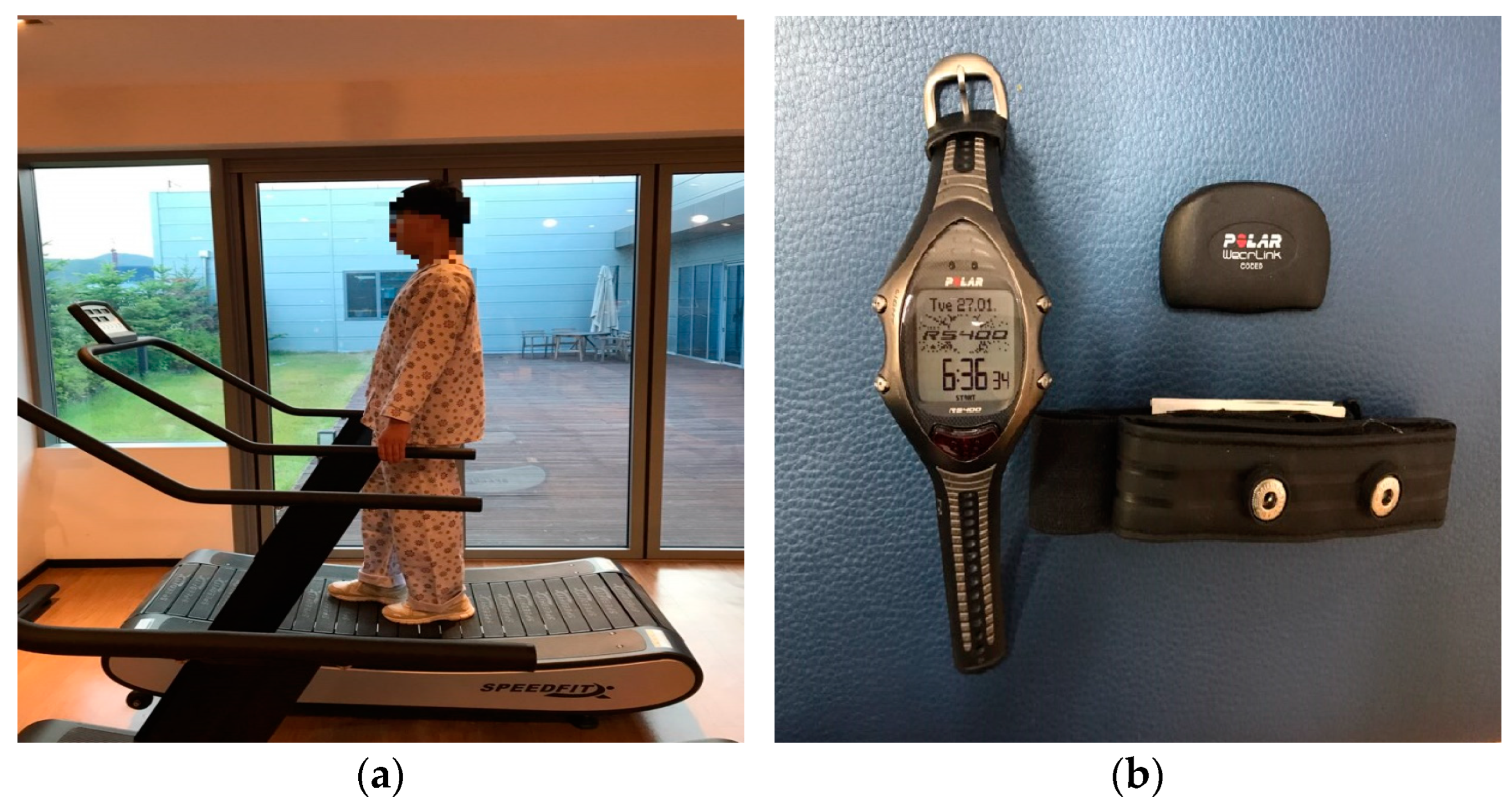
2.3. Non-Motorized Treadmill and Target Heart Rate
2.4. Surface Electromyography
2.5. Statistics Analysis
3. Results
4. Discussion
5. Conclusions
Author Contributions
Funding
Institutional Review Board Statement
Informed Consent Statement
Data Availability Statement
Conflicts of Interest
Appendix A

| Muscle | Muscle Activation (%MVIC) | |||
|---|---|---|---|---|
| 60% HRR | 40% HRR | 20% HRR | ||
| ES | NMT | 37.43 ± 14.04 b,c | 32.79 ± 13.97 | 28.8 ± 11.78 |
| FG | 34.64 ± 10.74 b,c | 29.87 ± 9.65 b | 29.38 ± 9.50 | |
| GMed | NMT | 33.36 ± 16.68 b,c | 27.65 ± 16.31 b | 23.44 ± 13.34 |
| FG | 31.13 ± 14.35 b,c | 27.00 ± 13.98 b | 24.10 ± 11.71 | |
| GMax | NMT | 28.70 ± 11.36 b,c | 25.07 ± 12.04 a,b | 21.80 ± 10.49 a |
| FG | 21.99 ± 8.04 b,c | 17.84 ± 7.90 b | 16.20 ± 7.29 | |
| BF | NMT | 33.69 ± 20.00 b,c | 27.46 ± 18.19 a | 23.00 ± 13.40 |
| FG | 25.49 ± 10.17 b,c | 19.33 ± 7.98 b | 18.31 ± 6.45 | |
| IO | NMT | 22.77 ± 11.26 b,c | 23.82 ± 9.44 a,b | 20.68 ± 8.68 a |
| FG | 22.08 ± 8.97 b,c | 18.23 ± 8.05 b | 16.44 ± 6.68 | |
| VMO | NMT | 39.43 ± 20.12 b,c | 32.08 ± 16.47 a,b | 26.14 ± 14.05 a |
| FG | 30.45 ± 11.56 b,c | 25.77 ± 11.55 b | 22.05 ± 9.93 | |
| LG | NMT | 46.21 ± 20.49 b,c | 42.81 ± 18.60 b | 37.24 ± 17.89 |
| FG | 42.64 ± 17.64 b,c | 35.53 ± 13.91 b | 31.03 ± 11.32 | |
| Muscle | Factor | df | F | p | ηp2 |
|---|---|---|---|---|---|
| ES | Intensity (%HRR) | (2, 34) | 3.27 | 0.042 | 0.161 |
| Method (NMT vs. FG) | (1, 17) | 0.57 | 0.451 | 0.033 | |
| Interaction (%HRR × Method) | (2, 34) | 0.26 | 0.774 | 0.015 | |
| GMed | Intensity (%HRR) | (2, 34) | 3.10 | 0.049 | 0.154 |
| Method (NMT vs. FG) | (1, 17) | 0.07 | 0.791 | 0.004 | |
| Interaction (%HRR × Method) | (2, 34) | 0.09 | 0.914 | 0.005 | |
| GMax | Intensity (%HRR) | (2, 34) | 3.92 | 0.023 | 0.187 |
| Method (NMT vs. FG) | (1, 17) | 12.22 | 0.001 | 0.418 | |
| Interaction (%HRR × Method) | (2, 34) | 0.07 | 0.933 | 0.004 | |
| BF | Intensity (%HRR) | (2, 34) | 4.04 | 0.020 | 0.192 |
| Method (NMT vs. FG) | (1, 17) | 7.11 | 0.009 | 0.295 | |
| Interaction (%HRR × Method) | (2, 34) | 0.19 | 0.891 | 0.011 | |
| IO | Intensity (%HRR) | (2, 34) | 4.62 | 0.012 | 0.214 |
| Method (NMT vs. FG) | (1, 17) | 9.02 | 0.003 | 0.347 | |
| Interaction (%HRR × Method) | (2, 34) | 0.074 | 0.929 | 0.004 | |
| VMO | Intensity (%HRR) | (2, 34) | 5.15 | 0.007 | 0.232 |
| Method (NMT vs. FG) | (1, 17) | 5.45 | 0.021 | 0.243 | |
| Interaction (%HRR × Method) | (2, 34) | 0.26 | 0.771 | 0.015 | |
| LG | Intensity (%HRR) | (2, 34) | 3.33 | 0.040 | 0.164 |
| Method (NMT vs. FG) | (1, 17) | 3.05 | 0.084 | 0.152 | |
| Interaction (%HRR × Method) | (2, 34) | 0.18 | 0.832 | 0.011 |
References
- Prange, G.B.; Jannink, M.J.; Groothuis-Oudshoorn, C.G.; Hermens, H.J.; Ijzerman, M.J. Systematic review of the effect of robot-aided therapy on recovery of the hemiparetic arm after stroke. J. Rehabil. Res. Dev. 2006, 43, 171–184. [Google Scholar] [CrossRef] [PubMed]
- Jeong, T.; Chung, Y. The effects of visual information deprivation and feedback balance training on balance in patients with stroke. NeuroRehabilitation 2024, 54, 435–448. [Google Scholar] [CrossRef] [PubMed]
- Schmidt, H.; Volkmar, M.; Werner, C.; Helmich, I.; Piorko, F.; Kruger, J.; Hesse, S. Muscle activation patterns of healthy subjects during floor walking and stair climbing on an end-effector-based gait rehabilitation robot. In Proceedings of the 2007 IEEE 10th International Conference on Rehabilitation Robotics, Noordwijk, The Netherlands, 13–15 June 2007; pp. 1077–1084. [Google Scholar]
- Pandy, M.G.; Lin, Y.C.; Kim, H.J. Muscle coordination of mediolateral balance in normal walking. J. Biomech. 2010, 43, 2055–2064. [Google Scholar] [CrossRef] [PubMed]
- Patten, C.; Lexell, J.; Brown, H.E. Weakness and strength training in persons with poststroke hemiplegia: Rationale, method, and efficacy. J. Rehabil. Res. Dev. 2004, 41, 293–312. [Google Scholar] [CrossRef] [PubMed]
- Bohannon, R.W. Muscle strength and muscle training after stroke. J. Rehabil. Med. 2007, 39, 14–20. [Google Scholar] [CrossRef] [PubMed]
- Watanabe, M.; Suzuki, M.; Sugimura, Y.; Kawaguchi, T.; Watanabe, A.; Shibata, K.; Fukuda, M. The relationship between bilateral knee muscle strength and gait performance after stroke: The predictive value for gait performance. J. Phys. Ther. Sci. 2015, 27, 3227–3232. [Google Scholar] [CrossRef] [PubMed]
- Kim, C.M.; Eng, J.J. Magnitude and pattern of 3D kinematic and kinetic gait profiles in persons with stroke: Relationship to walking speed. Gait Posture 2004, 20, 140–146. [Google Scholar] [CrossRef] [PubMed]
- Sullivan, K.; Klassen, T.; Mulroy, S. Combined task-specific training and strengthening effects on locomotor recovery post-stroke: A case study. J. Neurol. Phys. Ther. 2006, 30, 130–141. [Google Scholar] [CrossRef] [PubMed]
- Jonkers, I.; Stewart, C.; Spaepen, A. The complementary role of the plantarflexors, hamstrings and gluteus maximus in the control of stance limb stability during gait. Gait Posture 2003, 17, 264–272. [Google Scholar] [CrossRef] [PubMed]
- Flansbjer, U.B.; Downham, D.; Lexell, J. Knee muscle strength, gait performance, and perceived participation after stroke. Arch. Phys. Med. Rehabil. 2006, 87, 974–980. [Google Scholar] [CrossRef] [PubMed]
- Hodges, P.W.; van den Hoorn, W.; Wrigley, T.V.; Hinman, R.S.; Bowles, K.A.; Cicuttini, F.; Wang, Y.; Bennell, K. Increased duration of co-contraction of medial knee muscles is associated with greater progression of knee osteoarthritis. Man. Ther. 2016, 21, 151–158. [Google Scholar] [CrossRef] [PubMed]
- Ada, L.; Dean, C.M.; Hall, J.M.; Bampton, J.; Crompton, S. A treadmill and overground walking program improves walking in persons residing in the community after stroke: A placebo-controlled, randomized trial. Arch. Phys. Med. Rehabil. 2003, 84, 1486–1491. [Google Scholar] [CrossRef] [PubMed]
- Hesse, S.; Konrad, M.; Uhlenbrock, D. Treadmill walking with partial body weight support versus floor walking in hemiparetic subjects. Arch. Phys. Med. Rehabil. 1999, 80, 421–427. [Google Scholar] [CrossRef] [PubMed]
- Kautz, S.A.; Bowden, M.G.; Clark, D.J.; Neptune, R.R. Comparison of motor control deficits during treadmill and overground walking poststroke. Neurorehabilit. Neural Repair 2011, 25, 756–765. [Google Scholar] [CrossRef] [PubMed]
- Hesse, S.; Werner, C.; Bardeleben, A.; Barbeau, H. Body weight-supported treadmill training after stroke. Curr. Atheroscler. Rep. 2001, 3, 287–294. [Google Scholar] [CrossRef] [PubMed]
- Mohammadi, R.; Phadke, C.P. Effects of treadmill incline and speed on peroneus longus muscle activity in persons with chronic stroke and healthy subjects. Gait Posture 2017, 54, 221–228. [Google Scholar] [CrossRef] [PubMed]
- Tung, F.L.; Yang, Y.R.; Lee, C.C.; Wang, R.Y. Balance outcomes after additional sit-to-stand training in subjects with stroke: A randomized controlled trial. Clin. Rehabil. 2010, 24, 533–542. [Google Scholar] [CrossRef] [PubMed]
- Franks, K.A.; Brown, L.E.; Coburn, J.W.; Kersey, R.D.; Bottaro, M. Effects of Motorized vs Non-Motorized Treadmill Training on Hamstring/Quadriceps Strength Ratios. J. Sports Sci. Med. 2012, 11, 71–76. [Google Scholar] [PubMed]
- Montgomery, G.; Abt, G.; Dobson, C.; Smith, T.; Ditroilo, M. Tibial impacts and muscle activation during walking, jogging and running when performed overground, and on motorised and non-motorised treadmills. Gait Posture 2016, 49, 120–126. [Google Scholar] [CrossRef] [PubMed]
- Janaudis-Ferreira, T.; Sundelin, G.; Wadell, K. Comparison of the 6-minute walk distance test performed on a non-motorised treadmill and in a corridor in healthy elderly subjects. Physiotherapy 2010, 96, 234–239. [Google Scholar] [CrossRef] [PubMed]
- Olney, S.J.; Richards, C. Hemiparetic gait following stroke. Part I: Characteristics. Gait Posture 1996, 4, 136–148. [Google Scholar] [CrossRef]
- Weightman, M.M. Motor unit behavior following cerebrovascular accident. Neurol. Rep. 1994, 18, 26–28. [Google Scholar] [CrossRef]
- Rowland, J.T.; Basic, D.; Storey, J.E.; Conforti, D.A. The Rowland Universal Dementia Assessment Scale (RUDAS) and the Folstein MMSE in a multicultural cohort of elderly persons. Int. Psychogeriatr. 2006, 18, 111–120. [Google Scholar] [CrossRef] [PubMed]
- Marigold, D.S.; Eng, J.J. Altered timing of postural reflexes contributes to falling in persons with chronic stroke. Exp. Brain Res. 2006, 171, 459–468. [Google Scholar] [CrossRef] [PubMed]
- Kendall, F.P.; McCreary, E.K.; Provance, P.G.; Rodgers, M.M.; Romani, W.A. Muscles: Testing and Function with Posture and Pain, 5th ed.; Lippincott Williams & Wilkins: Baltimore, MD, USA, 2005. [Google Scholar]
- Harris-Love, M.L.; Macko, R.F.; Whitall, J.; Forrester, L.W. Improved hemiparetic muscle activation in treadmill versus overground walking. Neurorehabilit. Neural Repair 2004, 18, 154–160. [Google Scholar] [CrossRef] [PubMed]
- Pang, M.Y.; Charlesworth, S.A.; Lau, R.W.; Chung, R.C. Using aerobic exercise to improve health outcomes and quality of life in stroke: Evidence-based exercise prescription recommendations. Cerebrovasc. Dis. 2013, 35, 7–22. [Google Scholar] [CrossRef] [PubMed]
- Criswell, E. Cram’s Introduction to Surface Electromyography, 2nd ed.; Jones & Bartlett Learning: Sudbury, MA, USA, 2010. [Google Scholar]
- Smoliga, J.M.; Hegedus, E.J.; Ford, K.R. Increased physiologic intensity during walking and running on a non-motorized, curved treadmill. Phys. Ther. Sport 2015, 16, 262–267. [Google Scholar] [CrossRef]
- Wang, J.C.; Sung, W.H.; Chang, Y.L.; Wu, S.H.; Chuang, T.Y. Speed and temporal-distance adaptations during non-motorized treadmill walking in stroke and non-disabled individuals. Eur. J. Phys. Rehabil. Med. 2017, 53, 863–869. [Google Scholar] [CrossRef] [PubMed]
- Jung, K.S.; Cho, H.Y.; In, T.S. Trunk exercises performed on an unstable surface improve trunk muscle activation, postural control, and gait speed in patients with stroke. J. Phys. Ther. Sci. 2016, 28, 940–944. [Google Scholar] [CrossRef] [PubMed]
- Snyder, A.C.; Myatt, C.; Weiland, N.; Bednarek, J. Energy expenditure while walking on a non-motorized treadmill. J. Strength Cond. Res. 2011, 25, S109. [Google Scholar] [CrossRef][Green Version]
- Dragert, K.; Zehr, E.P. High-intensity unilateral dorsiflexor resistance training results in bilateral neuromuscular plasticity after stroke. Exp. Brain Res. 2013, 225, 93–104. [Google Scholar] [CrossRef] [PubMed]
- Burnfield, J.M.; Buster, T.W.; Goldman, A.J.; Corbridge, L.M.; Harper-Hanigan, K. Partial body weight support treadmill training speed influences paretic and non-paretic leg muscle activation, stride characteristics, and ratings of perceived exertion during acute stroke rehabilitation. Hum. Mov. Sci. 2016, 47, 16–28. [Google Scholar] [CrossRef] [PubMed]
- Higginson, J.S.; Zajac, F.E.; Neptune, R.R.; Kautz, S.A.; Delp, S.L. Muscle contributions to support during gait in an individual with post-stroke hemiparesis. J. Biomech. 2006, 39, 1769–1777. [Google Scholar] [CrossRef] [PubMed]
- Liu, M.Q.; Anderson, F.C.; Schwartz, M.H.; Delp, S.L. Muscle contributions to support and progression over a range of walking speeds. J. Biomech. 2008, 41, 3243–3252. [Google Scholar] [CrossRef] [PubMed]
- Turns, L.J.; Neptune, R.R.; Kautz, S.A. Relationships between muscle activity and anteroposterior ground reaction forces in hemiparetic walking. Arch. Phys. Med. Rehabil. 2007, 88, 1127–1135. [Google Scholar] [CrossRef] [PubMed]

| Variable | Number of Subjects/Value |
|---|---|
| Gender | |
| Male | 11 |
| Female | 7 |
| Age (years) | 53.69 ± 10.59 |
| Height (cm) | 165.5 ± 8.42 |
| Weight (kg) | 65.17 ± 8.75 |
| Stroke type | |
| Ischemia | 10 |
| Hemorrhage | 8 |
| Paralyzed area | |
| Right | 9 |
| Left | 9 |
| Onset (months) | 21.39 ± 15.53 |
| MMSE-K (points) | 24.55 ± 2.64 |
| MAS (points) | 0.69 ± 0.82 |
Disclaimer/Publisher’s Note: The statements, opinions and data contained in all publications are solely those of the individual author(s) and contributor(s) and not of MDPI and/or the editor(s). MDPI and/or the editor(s) disclaim responsibility for any injury to people or property resulting from any ideas, methods, instructions or products referred to in the content. |
© 2026 by the authors. Licensee MDPI, Basel, Switzerland. This article is an open access article distributed under the terms and conditions of the Creative Commons Attribution (CC BY) license.
Share and Cite
Cho, M.; Jeong, T.; Chung, Y. Comparison of Trunk and Lower Limb Muscle Activation Between Non-Motorized Treadmill and Flat Ground Walking at Varying Intensities in Patients with Stroke. Bioengineering 2026, 13, 735. https://doi.org/10.3390/bioengineering13070735
Cho M, Jeong T, Chung Y. Comparison of Trunk and Lower Limb Muscle Activation Between Non-Motorized Treadmill and Flat Ground Walking at Varying Intensities in Patients with Stroke. Bioengineering. 2026; 13(7):735. https://doi.org/10.3390/bioengineering13070735
Chicago/Turabian StyleCho, Minkwon, Taewoong Jeong, and Yijung Chung. 2026. "Comparison of Trunk and Lower Limb Muscle Activation Between Non-Motorized Treadmill and Flat Ground Walking at Varying Intensities in Patients with Stroke" Bioengineering 13, no. 7: 735. https://doi.org/10.3390/bioengineering13070735
APA StyleCho, M., Jeong, T., & Chung, Y. (2026). Comparison of Trunk and Lower Limb Muscle Activation Between Non-Motorized Treadmill and Flat Ground Walking at Varying Intensities in Patients with Stroke. Bioengineering, 13(7), 735. https://doi.org/10.3390/bioengineering13070735