Article

Influence of Solvent Challenge on the Hardness and Toughness of Viscosity-Modified Composites

by
Abdulrahman Alshabib
1,*,
Hamad Algamaiah
1,
Silvia Rojas-Rueda
2,
Carlos A. Jurado
2,
Abdullah Almansour
3 and
Saad AlOtaibi
1,*
1
Department of Restorative Dental Science, College of Dentistry, King Saud University, Riyadh 11545, Saudi Arabia
2
School of Dental Medicine, Ponce Health Sciences University, Ponce, PR 00732, USA
3
College of Dentistry, Prince Sattam Bin Abdulaziz University, Al-Kharj 16245, Saudi Arabia
*
Authors to whom correspondence should be addressed.
Bioengineering 2026, 13(7), 726; https://doi.org/10.3390/bioengineering13070726
Submission received: 25 May 2026 / Revised: 21 June 2026 / Accepted: 22 June 2026 / Published: 24 June 2026
(This article belongs to the Special Issue Application of Bioengineering to Restorative Dentistry)

Abstract

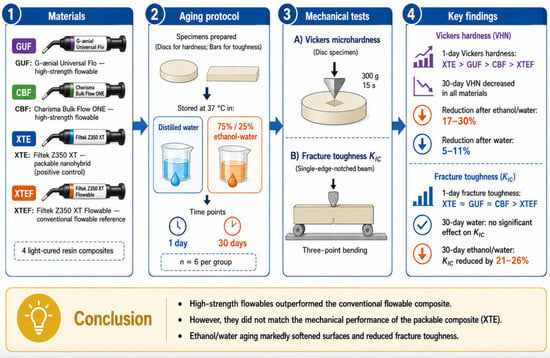
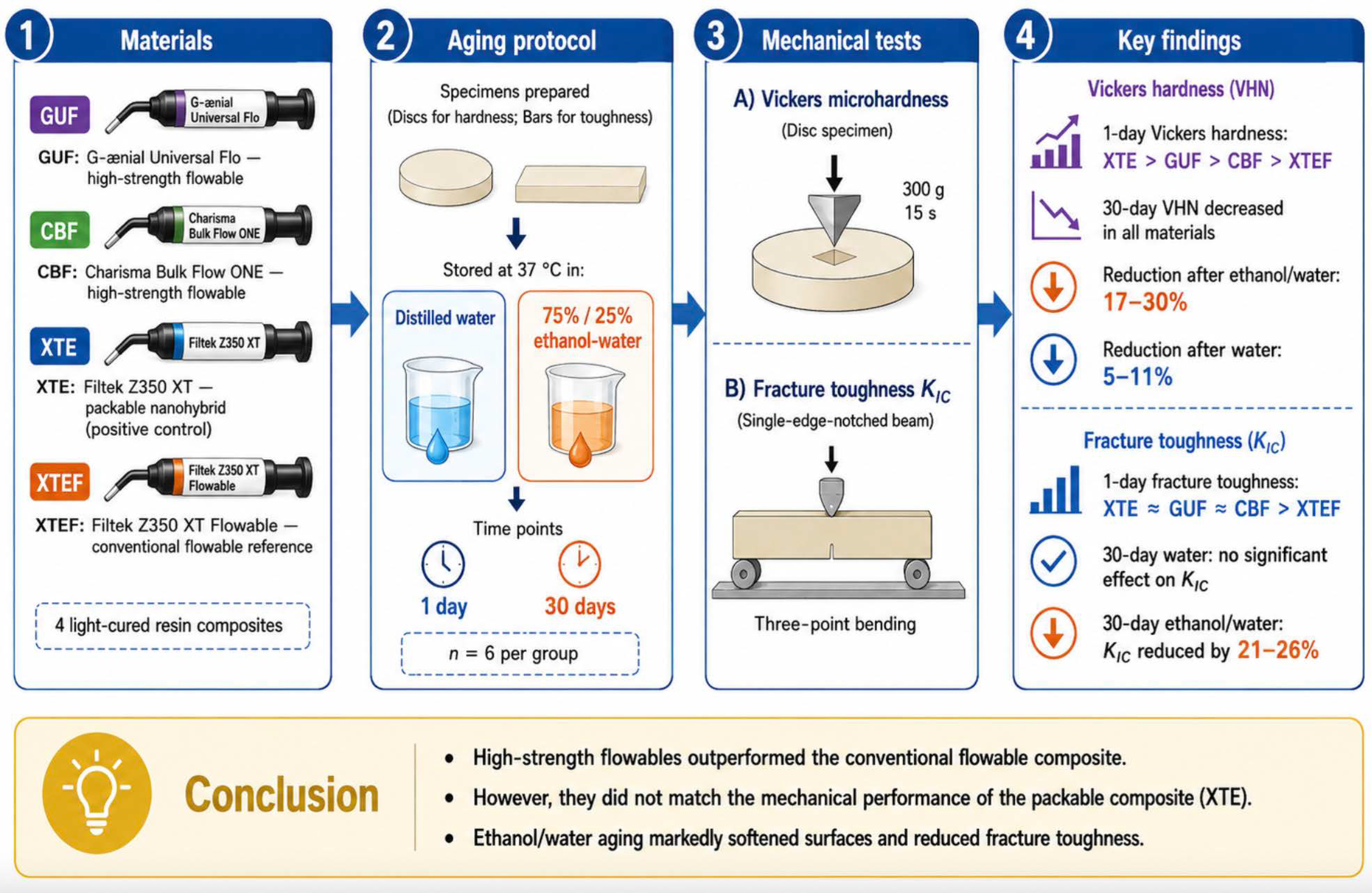
Background: This study assessed the effect of solvent aging on Vickers microhardness (VHN) and fracture toughness (KIC) of four resin composites: two high-strength flowable materials indicated for all cavity classes (GUF and CBF), a packable nanohybrid composite (XTE), and its flowable counterpart (XTEF). Methods: Disk specimens (n = 6 per group) were photocured and stored at 37 °C in distilled water or in a 75%/25% ethanol/water solution for 1 or 30 days. Vickers microhardness was recorded with a 300 g load applied for 15 s. Single-edge-notched beam (SENB) specimens (32 × 6 × 3 mm; n = 6 per group) were loaded in three-point bending for KIC determination after 1 and 30 days of storage in water or ethanol/water. Data were analyzed by three-way ANOVA followed by Tukey’s post hoc test (α = 0.05). Results: At 1 day, the four composites separated into distinct VHN groups in the order XTE > GUF > CBF > XTEF (p ≤ 0.05). After 30 d, VHN decreased in all materials, with larger reductions in ethanol/water (17–30% relative to the 1 d water value) than in water alone (5–11%). At 1 day, KIC values for XTE, GUF and CBF formed a single statistical group, all significantly higher than XTEF (p ≤ 0.05). Thirty-day water storage did not affect KIC for any material (p > 0.05), whereas ethanol/water storage reduced KIC by 21–26% in all four composites and produced four distinct material groups (p ≤ 0.05). Conclusions: The high-strength flowable composites showed greater hardness and toughness than a conventional flowable composite but did not match the mechanical performance of the highly filled packable composite. Ethanol/water aging markedly softened the composite surfaces and reduced fracture toughness, whereas prolonged water storage had a smaller effect on hardness and no measurable effect on KIC.

Graphical Abstract

1. Introduction

Flowable resin composites were introduced as low-viscosity restoratives to improve cavity-wall adaptation and simplify placement. Relative to conventional packable composites, traditional flowables contain approximately 20 wt.% less filler, a compositional trade-off that improves handling but reduces surface hardness, elastic modulus, wear resistance, and fracture resistance [1]. Their clinical use has therefore been restricted to low-stress indications such as liners, small restorations, and areas in which enhanced marginal adaptation is desired. More recent formulations, variously marketed as “high-strength” or “universal” flowables, aim to preserve the handling advantages of flowable materials while raising filler loading and modifying the matrix chemistry to approach the mechanical behavior of packable composites, including reduced polymerization shrinkage stress, improved wear resistance, and higher flexural strength [2,3,4,5,6,7,8].
Published data suggest that some high-strength flowables now approach the flexural strength of conventional packable composites [3,9]. A 36-month randomized clinical trial of a highly filled flowable in posterior restorations reported clinical performance comparable to a conventional paste composite [10]. These findings raise the question of whether the performance gap between flowable and packable composites has genuinely narrowed or whether it re-opens under conditions that stress the resin matrix.
Two mechanical descriptors are central to answering this question. Surface hardness reflects resistance to plastic deformation and correlates with wear behavior and resistance to abrasion. In resin composites, hardness is governed by the degree of conversion and by filler content, size, and coupling chemistry; highly filled, well-polymerized composites exhibit the highest Vickers values [1,11]. Flowable composites, with their larger resin fraction, typically show lower hardness than densely filled packable materials [11,12]. Fracture toughness (KIC) describes resistance to unstable crack propagation and is the most relevant single parameter for predicting mechanical survival in load-bearing restorations [13,14]. Conventional hybrid composites have KIC values in the range of 1–2 MPa·m0.5, with flowables typically at the lower end of this interval [1]. Attempts to raise KIC in flowable materials have focused on filler architecture (nanoclusters, prepolymerized fillers, short glass fibers) and on modifications to the monomer system [1,15,16].
Aging plays a decisive role in how these mechanical indices evolve in service. In the oral cavity, resin composites are continuously exposed to saliva, to food-simulating liquids, and, intermittently, to organic solvents such as the ethanol present in alcoholic beverages and mouthrinses. Water sorption plasticizes the polymer network, promotes hydrolytic cleavage of ester bonds in the dimethacrylate matrix, and attacks the silane layer at the filler–matrix interface [17,18]. Ethanol penetrates the network more rapidly than water; swelling the matrix relaxes internal stresses at the interphase, accelerates leaching of unreacted monomer, and provides the kinetic conditions for filler debonding and micro-crack initiation [17,19]. The 75% ethanol/water mixture specified as a food-simulating liquid in ISO 10993-12 is a widely accepted accelerated-aging medium in dental materials research [17,20,21]. Hardness losses of approximately 20% after short-term ethanol storage are commonly reported, whereas pure water produces milder changes over comparable periods [1,17,19]. KIC appears less sensitive to short-term water storage [1,22], but sustained exposure to more aggressive media can compromise crack resistance by degrading both the matrix and the filler–matrix interphase [17,18,22].
Recent in vitro studies report that injectable and high viscosity bulk-fill flowables can approach conventional packable composites in flexural strength and core build-up performance, yet their behavior under prolonged solvent challenge has not been systematically benchmarked against a packable control [23,24]. Information on how the current generation of “all-class” flowable composites compares with conventional materials under prolonged solvent aging remains limited. Addressing this gap is clinically meaningful because it directly relates to the anticipated longevity of restorations placed with these materials. Although the general influence of filler loading and solvent exposure on composite mechanics is well established, these newly introduced high-strength flowables are being marketed for load-bearing posterior use and have not previously been characterized under standardized solvent aging against a packable benchmark; the present study addresses that specific gap and, in doing so, tests whether bulk filler content or the resin matrix/interface governs solvent-aged crack resistance. The aim of the present study was therefore to quantify the effect of solvent aging on the surface hardness and fracture toughness of two high-strength flowable resin composites (GUF and CBF) and to benchmark their performance against a highly filled nanohybrid packable composite (XTE) and its flowable counterpart (XTEF). The null hypotheses tested were that (i) the four composites do not differ in hardness or fracture toughness, and (ii) neither storage medium nor storage time modifies these properties.

2. Materials and Methods

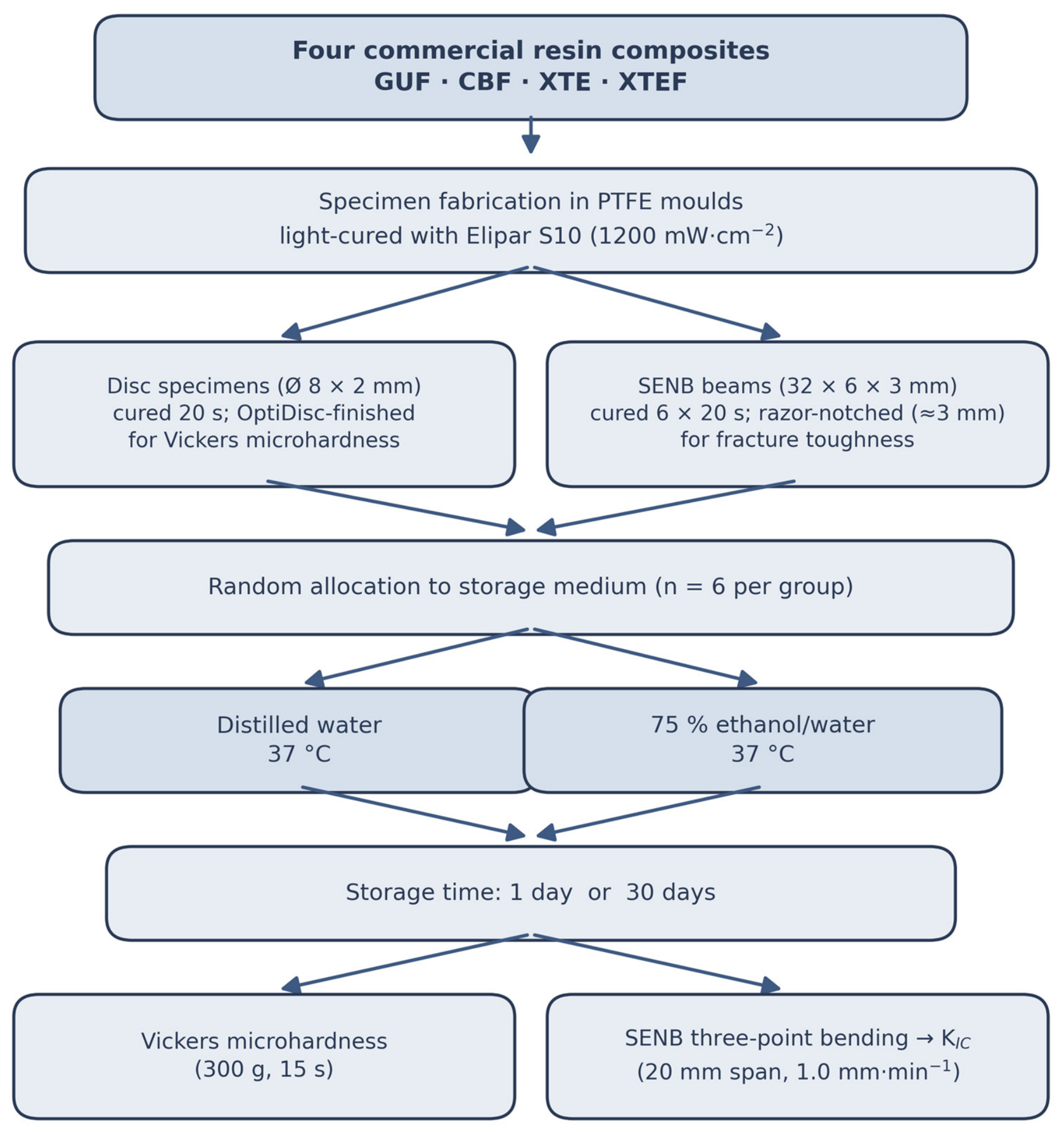
Four light-cured resin composites were evaluated (Table 1): G-ænial Universal Flo (GUF), a nanohybrid “universal” flowable composite (GC Corp., Tokyo, Japan); Charisma Bulk Flow ONE (CBF), a bulk-fill one-shade flowable composite (Kulzer GmbH, Hanau, Germany); Filtek Z350 XT (XTE), a nanohybrid packable composite (3M ESPE, St. Paul, MN, USA), used here as the positive control; and Filtek Z350 XT Flowable (XTEF), the flowable counterpart of XTE, used as a reference for conventional flowable behavior. All materials were used in shade A2 (or the single universal shade, for CBF) (Table 1). The overall study design and experimental workflow are summarized in Figure A1 (Appendix A).

2.1. Surface Hardness

Disk specimens (8 mm diameter × 2 mm thickness) were prepared in PTFE molds. A Mylar strip lined the base of the mold; after the mold was filled, a second Mylar strip and two 1 mm glass slides were applied and clamped to extrude excess material and ensure uniform thickness. Photo-polymerization was carried out through the upper slide for 20 s with an LED curing unit (Elipar S10, 3M ESPE, Seefeld, Germany) delivering an irradiance of 1200 mW·cm−2, verified before each cycle with a MARC™ Resin Calibrator (Blue Light Analytics, Halifax, NS, Canada).
After demolding, both surfaces of each specimen were finished with an OptiDisc abrasive set (coarse→medium→fine; Kerr Hawe SA, Bioggio, Switzerland) mounted in a contra-angle handpiece operated at a rotational speed of 15,000 rpm to remove flash and standardize surface roughness.
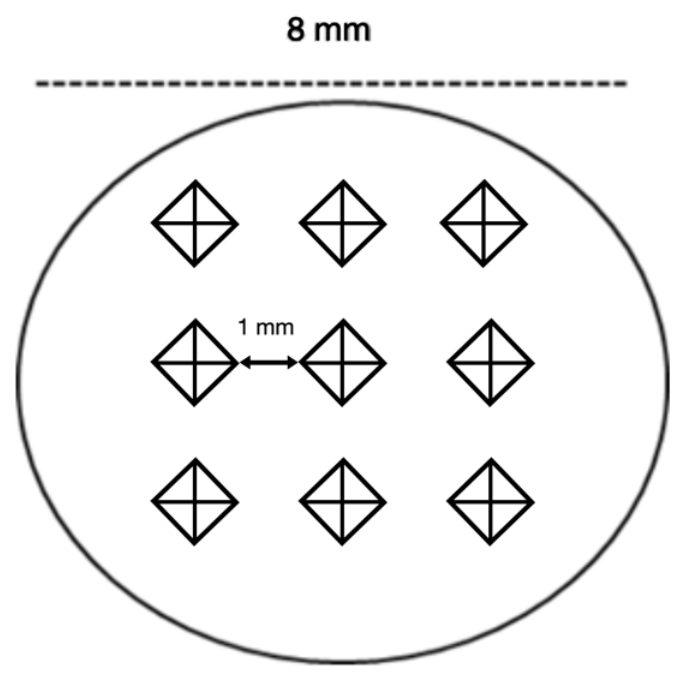
For each composite, specimens were allocated randomly to one of two storage media (n = 6 per group): distilled water or a 75 vol.% ethanol/water solution. Vickers microhardness (VHN) was recorded after 1 d and 30 d of storage at 37 ± 1 °C in the dark. Indentations were produced with a microindenter (Nova 130/240 series, INNOVATEST Europe BV, Borgharenweg, The Netherlands) under a 300 g load applied for 15 s at 23 ± 1 °C. Nine indents were placed on each specimen in a 3 × 3 pattern, each separated by at least 1 mm and positioned ≥1 mm from the specimen edge (Figure 1); the mean of the nine indents was taken as the VHN of that specimen, in accordance with ASTM E384 [25].

2.2. Fracture Toughness

Twelve Single-edge-notched beam (SENB) specimens (32 × 6 × 3 mm; n = 6 per group) were prepared in PTFE-lined brass molds. Uncured composite was packed into the mold, overfilled, and covered with Mylar film and glass slides. Photo-polymerization was performed using the curing unit described in Section 2.1 for a cumulative 120 s, delivered as six overlapping 20 s exposures to ensure uniform conversion along the beam length. A sharpened razor blade was used to introduce a ≈ 3 mm notch at mid-span.
Residual flash was removed with 320-grit silicon carbide paper, after which the beams were stored in distilled water at 37 °C for 24 h. Initial notch length (a0) was measured with a stereomicroscope (EMZ 5, Meiji Techno, Saitama, Japan) at 1.5× magnification and recorded to 0.1 mm. Specimen depth (B) and width (W) were measured at three equidistant locations with a digital caliper (resolution ± 0.01 mm).
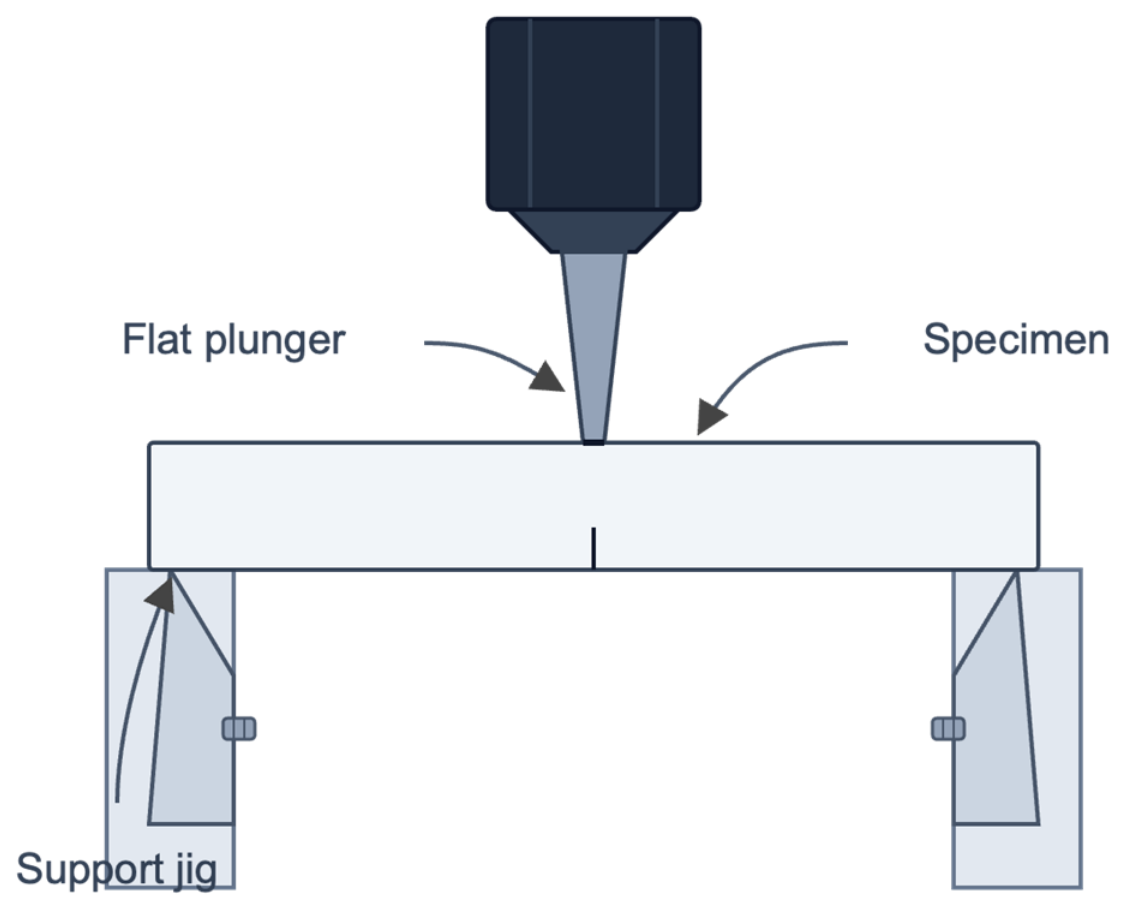
Fracture toughness (KIC) was determined by three-point bending on a universal testing machine (Instron model 5965, Instron Corp., Canton, OH, USA) with a 20 mm support span (Figure 2). Tests were run at 23 ± 1 °C and at a crosshead speed of 1.0 mm·min−1 until catastrophic failure. The critical load (Pc) was used to calculate KIC according to the linear elastic fracture mechanics expression for SENB specimens, as specified in ASTM D5045 and ISO 13586 for polymeric materials [26,27]:
K I C = [ P L B W 1.5 ] Y
P = Load at fractureB = thickness of the specimen
L = distance between the supportsY = calibration function for given geometry
W = width of the specimena = notch length
Y = [2.9 (a/w)1/2 − 4.6 (a/w)3/2 + 21.8 (a/w)5/2 − 37.6 (a/w)7/2 + 38.7 (a/w)9/2]
Equation (1): Fracture toughness equation

2.3. Statistical Analysis

Data were analyzed in SPSS 27.0 (IBM Corp., Armonk, NY, USA). Homogeneity of variance was verified with Levene’s test and the assumption of equal variance was satisfied. A three-way ANOVA (factors: material, storage medium, storage time) followed by Tukey’s HSD post hoc test was used to examine the main effects and the two- and three-way interactions on Vickers microhardness and on fracture toughness. The significance level was set at α = 0.05; effects with p ≤ 0.05 are reported as significant together with the associated F statistic and degrees of freedom.

3. Results

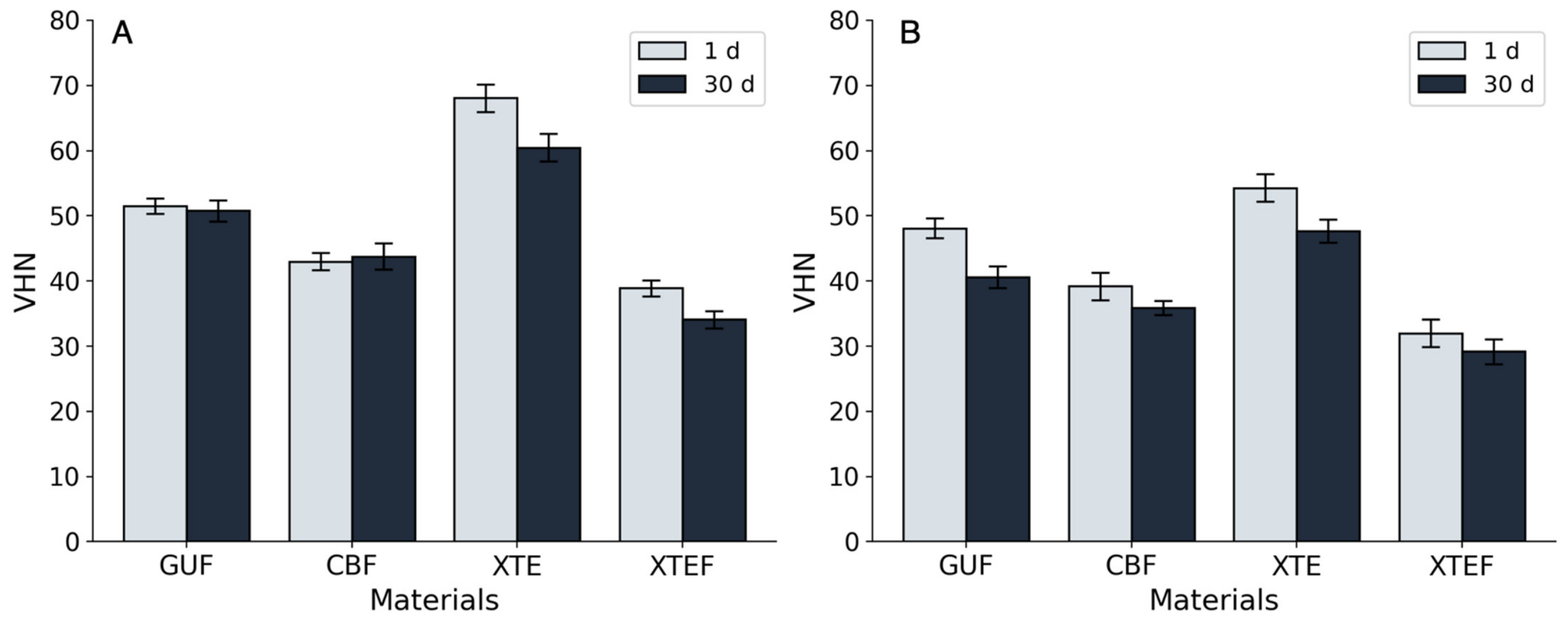
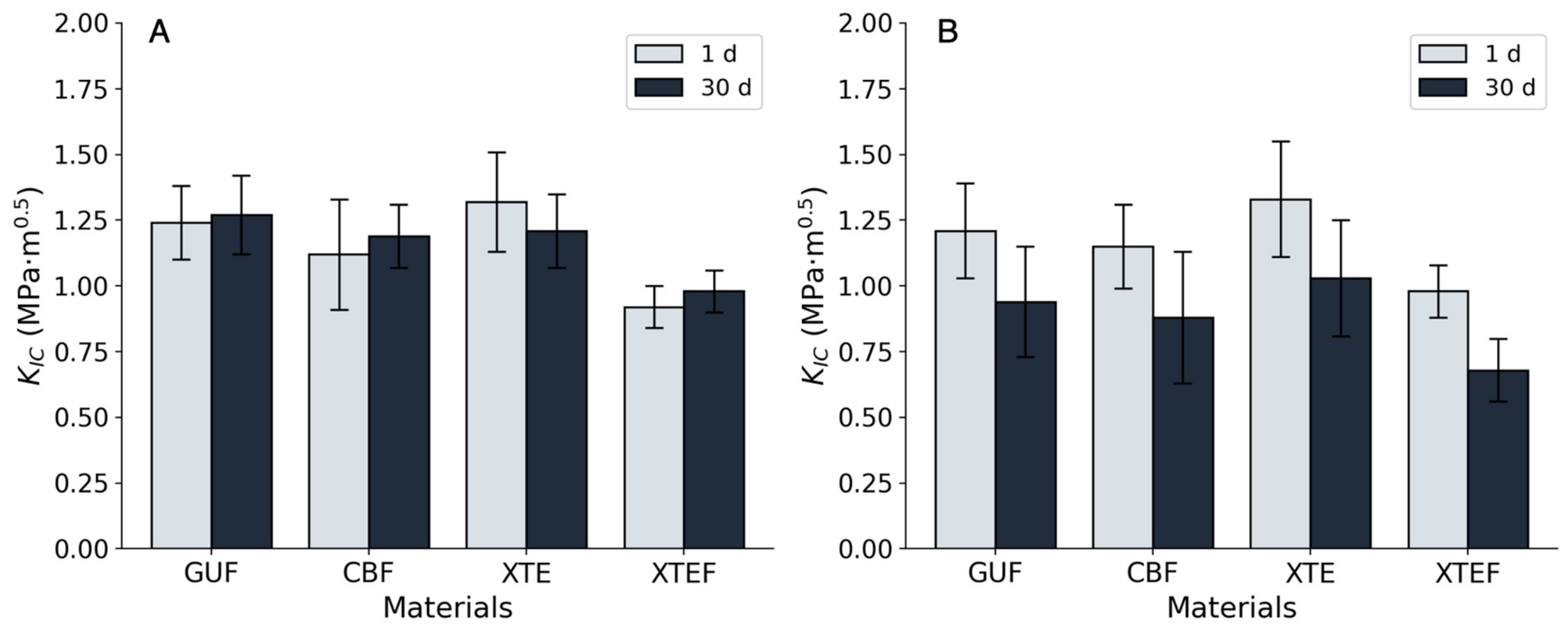
Descriptive statistics for Vickers microhardness and fracture toughness are given in Table 2 and Table 3, and the corresponding treatment-level comparisons are illustrated in Figure 3 and Figure 4. The three-way ANOVA on VHN identified significant main effects of material (F(3,80) = 858.7, p ≤ 0.05), storage medium (F(1,80) = 497.0, p ≤ 0.05), and storage time (F(1,80) = 127.0, p ≤ 0.05), together with significant material × medium (F(3,80) = 26.5, p ≤ 0.05), material × time (F(3,80) = 11.6, p ≤ 0.05), medium × time (F(1,80) = 9.0, p ≤ 0.05) and three-way material × medium × time (F(3,80) = 8.0, p ≤ 0.05) interactions. The corresponding analysis on KIC returned significant main effects of material (F(3,80) = 17.8, p ≤ 0.05), medium (F(1,80) = 14.5, p ≤ 0.05) and time (F(1,80) = 15.7, p ≤ 0.05) and a significant medium × time interaction (F(1,80) = 18.7, p ≤ 0.05), whereas the interactions involving material (A × B, A × C, and A × B × C; F ≤ 0.5) did not reach significance, indicating that the four composites responded similarly to the combined effect of solvent exposure and time. Under every condition, the packable nanohybrid composite XTE showed the highest mean VHN and KIC, and the conventional flowable XTEF showed the lowest; the two new-generation flowables GUF and CBF occupied an intermediate position. Ethanol/water storage produced larger reductions in both properties than distilled water storage, with the effect being most pronounced after 30 days and most clearly expressed in VHN.

3.1. Vickers Microhardness

At 1 d, Filtek Z350 XT (XTE) exhibited the highest mean VHN in both media (distilled water: 68.1 ± 2.1; 75% ethanol/water: 54.3 ± 2.1). G-ænial Universal Flo (GUF) and Charisma Bulk Flow ONE (CBF) showed intermediate values (51.5 ± 1.2 and 43.0 ± 1.3 respectively in water) that were significantly higher than the conventional flowable XTEF (38.3 ± 1.2) but lower than XTE (Tukey, p ≤ 0.05) (Figure 3A).
After 30 d of aging, every material showed a decrease in VHN. Softening was medium-dependent: distilled water induced a 5–11% reduction relative to the 1 d water value, whereas 75% ethanol/water induced a 17–30% reduction relative to the same reference (Figure 3B). The hierarchy XTE > GUF > CBF > XTEF was preserved at every sampling point (p ≤ 0.05). The largest absolute loss was recorded for XTE (−20.4 VHN units from 1 d water to 30 d ethanol/water), while XTEF showed the largest relative drop (−23.8%).

3.2. Fracture Toughness (KIC)

The KIC ranking paralleled the hardness ranking. At 1 d, XTE, GUF and CBF formed a single statistical group with mean toughness of 1.32 ± 0.19, 1.24 ± 0.14 and 1.12 ± 0.21 MPa·m0.5 respectively, all significantly higher than XTEF (0.92 ± 0.08 MPa·m0.5; Tukey, p ≤ 0.05) (Figure 4A). Although XTE showed the highest mean value, the difference relative to GUF and CBF did not reach significance at this time point.
Thirty-day storage in distilled water did not alter KIC in any composite (p > 0.05; Figure 4A). Thirty-day storage in 75% ethanol/water, in contrast, reduced KIC in every group by 21–26% relative to the 1 d water value (Figure 4B). The reductions were 24% for GUF (1.24→0.94), 21% for CBF (1.12→0.88), 22% for XTE (1.32→1.03), and 26% for XTEF (0.92→0.68). After 30 d of ethanol/water exposure the four materials separated into four distinct statistical groups, with XTE showing the highest residual KIC (1.03 ± 0.22 MPa·m0.5) and XTEF the lowest (0.68 ± 0.12 MPa·m0.5; p ≤ 0.05). The non-significant material × medium and material × time interactions indicate that the four composites lost a statistically indistinguishable fraction of their initial KIC, but the absolute hierarchy was preserved across all conditions.

4. Discussion

The present study examined how solvent aging modifies the surface hardness and fracture toughness of four resin composites, representing the contemporary spectrum from conventional flowables to high-strength flowables to a highly filled packable. Three observations stand out. First, the nanohybrid packable XTE showed the highest VHN and KIC under every condition, while the conventional flowable XTEF showed the lowest, with the two high-strength flowables GUF and CBF occupying a clearly intermediate position. Second, 30-day immersion in 75% ethanol/water produced substantially greater reductions in both properties than 30-day immersion in distilled water. Third, water storage for 30 days did not measurably alter KIC for any material, whereas ethanol storage reduced KIC by a comparable percentage (21–26%) in all four composites, indicating that the matrix-dominated fracture mechanism is similarly vulnerable across these formulations. Both null hypotheses are therefore rejected.
The greater impact of ethanol/water relative to water is consistent with the well-documented pattern of solvent-induced degradation in dental polymers [1,17,19]. Ethanol is a more effective swelling agent for dimethacrylate networks than water because its solubility parameter is closer to that of the matrix; it penetrates the crosslinked network more rapidly, relaxes internal stresses at the filler–matrix interphase, and facilitates leaching of unreacted monomer and low-molecular-weight degradation products [17,18]. Ferracane and Berge reported that aging experimental composites in 75% ethanol for 6 months produced KIC reductions of 30–56% with concurrent microhardness loss, the largest losses occurring in materials of lower filler loading or degree of conversion [19]; our 30-day exposure produced reductions toward the lower end of that range in all four materials, consistent with the shorter aging interval and the relatively high filler loading of three of the tested materials. Comparably, the review by Wlodarczyk et al. similarly identified ethanol-based protocols as the most challenging short-term aging condition for methacrylate composites [3].
The milder water-induced response agrees with prior reports that short-term aqueous storage produces only modest changes in KIC [1,22,28]. Water sorption is nonetheless mechanistically active. It hydrolyzes ester linkages in the dimethacrylate backbone, diffuses along the filler–matrix interface, and—in radiopaque barium- or strontium-containing glasses—can attack the silica network through ion leaching, producing siloxane bond cleavage and a self-propagating surface degradation [17,18,29]. Early-stage water uptake may also exert a small plasticizing effect that blunts crack-tip stress concentrations and partially offsets degradation [17], likely contributing to the stability of KIC observed here after 30 d in water. Over clinically relevant timescales, however, this transient toughening is displaced by the progressive loss of interfacial integrity and a measurable drop in VHN and KIC [18,28,30,31,32].
Differences in composition explain the consistent mechanical hierarchy observed across conditions. XTE is a densely packed nanohybrid (~63 vol.% filler) with silica/zirconia nanoclusters and a resin matrix combining Bis-GMA, Bis-EMA, UDMA and TEGDMA. The combination of a dense, well-coupled filler network and a matrix with a lower Bis-GMA fraction is consistent with higher baseline mechanical performance and with better resistance to solvent uptake, because Bis-EMA and UDMA are less hydrophilic than Bis-GMA [17,18,32,33]. The superior VHN of XTE is in line with published values for nanohybrid packable composites [11,12], and its KIC (≈1.3 MPa·m0.5) falls within the range typically reported for highly filled hybrid composites [1,13]. GUF and CBF narrow but do not close the gap with XTE: both carry filler loadings around 50 vol.%, an increment over XTEF (~42 vol.%) that is clearly reflected in their higher 1-day VHN and KIC. The relative ranking GUF > CBF for VHN may be related to the smaller, more densely packed nanofiller reported for G-ænial Universal Flo [2], while the bulk-fill formulation of CBF trades some filler density for depth-of-cure performance.
Viewed together, the VHN and KIC data suggest that the new-generation flowables have succeeded in narrowing the mechanical gap at baseline without eliminating the filler-driven ceiling on fracture resistance. The response to ethanol aging is informative in a different way: the relative KIC loss is essentially the same for all four materials (21–26%) and the material-level ANOVA interactions did not reach significance, implying that under aggressive solvent exposure the matrix phase and the filler–matrix interphase govern crack resistance more strongly than total filler content. This cross-material equivalence of relative solvent susceptibility, despite an almost three-fold range in baseline performance, is a non-obvious outcome that is not predictable from filler content alone and constitutes the principal mechanistic contribution of this work. This observation is consistent with the view of Lohbauer et al. that matrix plasticization and silane-layer hydrolysis, rather than bulk filler loading, are the rate-controlling steps in the mechanical fatigue and slow crack growth of dimethacrylate composites [34]. It points toward resin chemistry—monomer selection, degree of conversion, and silane coupling stability—as the most promising target for further improvement [35], and also reinforces the long-standing argument that flexural and fracture data on unaged specimens can overstate the clinical durability of a composite and should be complemented by solvent-aged measurements when the material is intended for stress-bearing posterior use [17,18,36].
Several limitations should be noted. The 30-day observation window is short relative to the expected service life of a posterior restoration, and the accelerated-aging medium, although standard, does not reproduce the full chemical and mechanical complexity of the oral environment, including thermal and masticatory cycling, enzymatic attack by salivary esterases [30], and biofilm-driven acidification. In particular, no thermal cycling was applied; thermo-mechanical cycling is a common simulation of the oral environment and should be incorporated in future work to better reproduce in-service thermal and masticatory stresses. The SENB configuration, while consistent with ASTM D5045 and ISO 13586, does not capture the full loading spectrum of a clinical restoration. Finally, no direct measurement of degree of conversion was made; differences in cure between materials cannot be completely excluded and could partially modulate the aging response [32,37]. Post-test fracture surfaces were not examined by scanning electron microscopy; SEM fractography of solvent-aged specimens is recommended in future work to directly visualize the filler–matrix degradation inferred here, as documented for resin composites [38,39].

5. Conclusions

Within the limitations of this in vitro study, the packable nanohybrid composite XTE showed the highest Vickers microhardness and fracture toughness under all conditions, whereas the conventional flowable XTEF showed the lowest; the new-generation flowable composites GUF and CBF occupied an intermediate position, narrowing but not eliminating the gap with the packable benchmark. Thirty-day storage in 75% ethanol/water produced a significantly greater reduction in both hardness and fracture toughness than 30-day storage in distilled water, which did not measurably alter KIC. Thus, although the high-strength flowables represent a clear mechanical advance over conventional flowables, their resistance to solvent-induced degradation remains inferior to that of the highly filled packable composite.

Author Contributions

Conceptualization, A.A. (Abdulrahman Alshabib), H.A. and S.A.; methodology, A.A. (Abdulrahman Alshabib), C.A.J. and S.R.-R.; software, A.A. (Abdulrahman Alshabib) and S.A.; validation, A.A. (Abdulrahman Alshabib), H.A. and S.A.; formal analysis, A.A. (Abdulrahman Alshabib) and A.A. (Abdullah Almansour); investigation, S.R.-R. and A.A. (Abdulrahman Alshabib); resources, C.A.J.; data curation, H.A. and S.A.; writing—original draft preparation, A.A. (Abdulrahman Alshabib), A.A. (Abdullah Almansour), H.A. and S.A.; writing—review and editing, S.R.-R., A.A. (Abdullah Almansour) and C.A.J.; visualization, A.A. (Abdullah Almansour); supervision, A.A. (Abdulrahman Alshabib), H.A. and S.A.; project administration, S.R.-R. and C.A.J.; funding acquisition, A.A. (Abdulrahman Alshabib). All authors have read and agreed to the published version of the manuscript.

Funding

This research was funded by the Ongoing Research Funding Program (ORF-2026-1419) at King Saud University in Riyadh.

Institutional Review Board Statement

Not applicable.

Data Availability Statement

Data presented in this study are available on request from the corresponding authors.

Conflicts of Interest

The authors declare no conflicts of interest.

Appendix A

Figure A1. Schematic of the study design and experimental workflow, from the four commercial resin composites through specimen fabrication, random allocation to storage medium, solvent aging, mechanical testing, and statistical analysis.
Bioengineering 13 00726 g0a1

References

  1. Alshabib, A.; Silikas, N.; Watts, D.C. Hardness and fracture toughness of resin-composite materials with and without fibers. Dent. Mater. 2019, 35, 1194–1203. [Google Scholar] [CrossRef] [Scilit] [PubMed]
  2. Ferracane, J.L. Resin composite—State of the art. Dent. Mater. 2011, 27, 29–38. [Google Scholar] [CrossRef] [Scilit] [PubMed]
  3. Szczesio-Wlodarczyk, A.; Sokolowski, J.; Kleczewska, J.; Bociong, K. Ageing of dental composites based on methacrylate resins—A critical review of the causes and method of assessment. Polymers 2020, 12, 882. [Google Scholar] [CrossRef] [Scilit] [PubMed]
  4. Ilie, N.; Hickel, R. Investigations on mechanical behaviour of dental composites. Clin. Oral Investig. 2009, 13, 427–438. [Google Scholar] [CrossRef] [Scilit] [PubMed]
  5. Sartawi, S.Y.; AbuSidu, Z.; El-Qawasmi, Y.; Salim, N.A. In vitro analysis of flowable and high-viscosity bulk-fill composite versus conventional composite in core build-up of endodontically treated teeth. Sci. Rep. 2024, 14, 28013. [Google Scholar] [CrossRef] [Scilit] [PubMed]
  6. Ilie, N.; Bucuta, S.; Draenert, M. Bulk-fill resin-based composites: An in vitro assessment of their mechanical performance. Oper. Dent. 2013, 38, 618–625. [Google Scholar] [PubMed]
  7. Yue, H.-L.; Liu, Z.-C.; Yan, Z.-Y.; Liu, G.-Q.; Chen, L.-W.; Zhu, J.-H.; Han, J.-M. Bioinspired cell membrane-like hybrid coating for enhanced bioactivity and corrosion resistance of magnesium-based implants. Rare Met. 2025, 44, 4898–4912. [Google Scholar] [CrossRef] [Scilit]
  8. Fang, J.; Han, Y.; Wang, L.; Ai, J.-L.; Zhai, J.-X.; Ge, Z.-G.; Wang, Z.-G.; Ning, C.-Y. The development of electroactive materials for metal implant surface antimicrobial treatment and antibacterial adhesion. Rare Met. 2025, 44, 6986–7010. [Google Scholar] [CrossRef]
  9. Leprince, J.G.; Palin, W.M.; Hadis, M.A.; Devaux, J.; Leloup, G. Progress in dimethacrylate-based dental composite technology and curing efficiency. Dent. Mater. 2013, 29, 139–156. [Google Scholar] [CrossRef] [Scilit] [PubMed]
  10. Kitasako, Y.; Sadr, A.; Burrow, M.F.; Tagami, J. Thirty-six month clinical evaluation of a highly filled flowable composite for direct posterior restorations. Aust. Dent. J. 2016, 61, 366–373. [Google Scholar] [CrossRef] [Scilit] [PubMed]
  11. Alrahlah, A.; Khan, R.; Alotaibi, K.; Almutawa, Z.; Fouad, H.; Elsharawy, M.; Silikas, N. Simultaneous evaluation of creep deformation and recovery of bulk-fill dental composites immersed in food-simulating liquids. Materials 2018, 11, 1180. [Google Scholar] [CrossRef] [Scilit] [PubMed]
  12. Basheer, R.R.; Hasanain, F.A.; Abuelenain, D.A. Evaluating flexure properties, hardness, roughness and microleakage of high-strength injectable dental composite: An in vitro study. BMC Oral Health 2024, 24, 546. [Google Scholar] [CrossRef] [Scilit] [PubMed]
  13. Soderholm, K.-J. Review of the fracture toughness approach. Dent. Mater. 2010, 26, e63–e77. [Google Scholar] [CrossRef] [Scilit] [PubMed]
  14. Pilliar, R.M.; Smith, D.C.; Maric, B. Fracture toughness of dental composites determined using the short-rod fracture toughness test. J. Dent. Res. 1986, 65, 1308–1314. [Google Scholar] [CrossRef] [Scilit] [PubMed]
  15. Lassila, L.; Garoushi, S.; Vallittu, P.K.; Säilynoja, E. Mechanical properties of fiber reinforced restorative composite with two distinguished fiber length distribution. J. Mech. Behav. Biomed. Mater. 2016, 60, 331–338. [Google Scholar] [CrossRef] [Scilit] [PubMed]
  16. Baroudi, K.; Rodrigues, J.C. Flowable resin composites: A systematic review and clinical considerations. J. Clin. Diagn. Res. 2015, 9, ZE18–ZE24. [Google Scholar] [CrossRef] [Scilit] [PubMed]
  17. Ferracane, J.L. Hygroscopic and hydrolytic effects in dental polymer networks. Dent. Mater. 2006, 22, 211–222. [Google Scholar] [CrossRef] [Scilit] [PubMed]
  18. Drummond, J.L. Degradation, fatigue, and failure of resin dental composite materials. J. Dent. Res. 2008, 87, 710–719. [Google Scholar] [CrossRef] [Scilit] [PubMed]
  19. Ferracane, J.L.; Berge, H.X. Fracture toughness of experimental dental composites aged in ethanol. J. Dent. Res. 1995, 74, 1418–1423. [Google Scholar] [CrossRef] [Scilit] [PubMed]
  20. Sideridou, I.; Tserki, V.; Papanastasiou, G. Study of water sorption, solubility and modulus of elasticity of light-cured dimethacrylate-based dental resins. Biomaterials 2003, 24, 655–665. [Google Scholar] [CrossRef] [Scilit] [PubMed]
  21. ISO 10993-12:2021; Biological Evaluation of Medical Devices—Part 12: Sample Preparation and Reference Materials. International Organization for Standardization: Geneva, Switzerland, 2021.
  22. Pilliar, R.M.; Vowles, R.; Williams, D.F. The effect of environmental aging on the fracture toughness of dental composites. J. Dent. Res. 1987, 66, 722–726. [Google Scholar] [CrossRef] [Scilit] [PubMed]
  23. Tzimas, K.; Pappa, E.; Fostiropoulou, M.; Papazoglou, E.; Rahiotis, C. Highly filled flowable composite resins as sole restorative materials: A systematic review. Materials 2025, 18, 3370. [Google Scholar] [CrossRef] [Scilit] [PubMed]
  24. Abtahi, S.; Omidian, S.; Sherafatmand, Y.; Tayebi, G.; Ranjbar Hassani, A. Comprehensive evaluation of six flowable composite resins in the market: A comparative study. Front. Dent. 2025, 22, 28. [Google Scholar] [CrossRef] [Scilit] [PubMed]
  25. ASTM E384-22; Standard Test Method for Microindentation Hardness of Materials. ASTM International: West Conshohocken, PA, USA, 2022.
  26. ASTM D5045-14(2022); Standard Test Methods for Plane-Strain Fracture Toughness and Strain Energy Release Rate of Plastic Materials. ASTM International: West Conshohocken, PA, USA, 2022.
  27. ISO 13586:2018; Plastics—Determination of Fracture Toughness (GIC and KIC)—Linear Elastic Fracture Mechanics (LEFM) Approach. ISO: Geneva, Switzerland, 2018.
  28. Alshabib, A.; Algamaiah, H.; Silikas, N.; Watts, D.C. Material behavior of resin composites with and without fibers after extended water storage. Dent. Mater. J. 2021, 40, 557–565. [Google Scholar] [CrossRef] [Scilit] [PubMed]
  29. Kim, S.-H.; Watts, D.C. Effect of glass-fiber reinforcement and water storage on fracture toughness (KIC) of polymer-based provisional crown and FPD materials. Int. J. Prosthodont. 2004, 17, 318–322. [Google Scholar] [PubMed]
  30. Finer, Y.; Santerre, J.P. Salivary esterase activity and its association with the biodegradation of dental composites. J. Dent. Res. 2004, 83, 22–26. [Google Scholar] [CrossRef] [Scilit] [PubMed]
  31. Alshali, R.Z.; Salim, N.A.; Satterthwaite, J.D.; Silikas, N. Long-term sorption and solubility of bulk-fill and conventional resin-composites in water and artificial saliva. J. Dent. 2015, 43, 1511–1518. [Google Scholar] [CrossRef] [Scilit] [PubMed]
  32. Ferracane, J.L. Elution of leachable components from composites. J. Oral Rehabil. 1994, 21, 441–452. [Google Scholar] [CrossRef] [Scilit] [PubMed]
  33. Alrahlah, A.; Al-Odayni, A.B.; Al-Mutairi, H.F.; Almousa, B.M.; Alsubaie, F.S.; Khan, R.; Saeed, W.S. A low-viscosity BisGMA derivative for resin composites: Synthesis, characterization, and evaluation of its rheological properties. Materials 2021, 14, 338. [Google Scholar] [CrossRef] [Scilit] [PubMed]
  34. Lohbauer, U.; Belli, R.; Ferracane, J.L. Factors involved in mechanical fatigue degradation of dental resin composites. J. Dent. Res. 2013, 92, 584–591. [Google Scholar] [CrossRef] [Scilit] [PubMed]
  35. Musanje, L.; Darvell, B.W. Aspects of water sorption from the air, water and artificial saliva in resin composite restorative materials. Dent. Mater. 2003, 19, 414–422. [Google Scholar] [CrossRef] [Scilit] [PubMed]
  36. Martos, J.; Osinaga, P.W.R.; Oliveira, E.D.; Castro, L.A.S. Hydrolytic degradation of composite resins: Effects on the microhardness. Mater. Res. 2003, 6, 599–604. [Google Scholar] [CrossRef] [Scilit]
  37. Eweis, A.H.; Yap, A.U.J.; Yahya, N.A. Dynamic analysis of bulk-fill composites: Effect of food-simulating liquids. J. Mech. Behav. Biomed. Mater. 2017, 74, 183–188. [Google Scholar] [CrossRef] [Scilit] [PubMed]
  38. Thomaidis, S.; Kakaboura, A.; Mueller, W.D.; Zinelis, S. Mechanical properties of contemporary composite resins and their interrelations. Dent. Mater. 2013, 29, e132–e141. [Google Scholar] [CrossRef] [Scilit] [PubMed]
  39. Abdulhameed, N.; Angus, B.; Wanamaker, J.; Mecholsky, J.J. Quantitative fractography as a novel approach to measure fracture toughness of direct resin composites. J. Mech. Behav. Biomed. Mater. 2020, 109, 103857. [Google Scholar] [CrossRef] [Scilit] [PubMed]
Figure 1. Schematic illustration of the 3 × 3 Vickers indentation pattern, showing the nine indentations per specimen separated by approximately 1 mm.
Bioengineering 13 00726 g001
Figure 2. Schematic illustration of the SENB specimen mounted on the three-point bending jig of the Instron universal testing machine (flat plunger: 8 mm length × 1.2 mm width).
Bioengineering 13 00726 g002
Figure 3. Vickers microhardness (VHN) of the four resin composites after 1 d and 30 d of storage at 37 °C. (A) Distilled water; (B) 75% ethanol/water. Error bars represent one standard deviation (n = 6 per group).
Bioengineering 13 00726 g003
Figure 4. Fracture toughness (KIC) of the four resin composites after 1 d and 30 d of storage at 37 °C. (A) Distilled water; (B) 75% ethanol/water. Error bars represent one standard deviation (n = 6 per group).
Bioengineering 13 00726 g004
Table 1. Resin composites evaluated in the study.
Material CodeComposite Name (Type)ManufacturerFiller Content (Wt.%)Shade
GUFG-ænial™ Universal Flo (nano-hybrid “universal” flowable)GC Corp., Japan69% (≈50% vol)A2
CBFCharisma® Bulk Flow ONE (bulk-fill flowable)Kulzer GmbH, Germany70% (≈46% vol)(One-shade)
XTEFiltek™ Z350 XT (nano-hybrid packable)3M ESPE, USA78% (≈63% vol)A2
XTEFFiltek™ Z350 XT Flowable (nano-hybrid flowable)3M ESPE, USA65% (≈42% vol)A2
Table 2. Vickers hardness VHN (standard deviation) of resin composites after 1 d, 30 d storage in two solvents at 37 °C.
MaterialsDistilled Water75% Ethanol/Water
1 d30 d1 d30 d
GUF51.5 (1.2) a,150.8 (1.6) a,148.1 (1.5) a,140.6 (1.7) b,1
CBF43.0 (1.3) a,243.8 (2.0) a,239.2 (2.1) a,235.9 (1.1) b,2
XTE68.1 (2.1) a,360.5 (2.1) b,354.3 (2.1) b,347.7 (1.8) c,3
XTEF38.9 (1.2) a,234.1 (1.3) b,432.0 (2.1) b,429.2 (1.9) b,4
For each solvent, identical letter superscripts indicate no significant difference between different time points (p > 0.05). Each solvent is analyzed independently. At each time point, identical number superscripts indicate no significant difference between materials (p > 0.05).
Table 3. Fracture toughness (standard deviation) of resin composites after 1 d, 30 d storage in two solvents at 37 °C.
MaterialsFracture Toughness KIC (M·Pa·m0.5)
Distilled Water75% Ethanol/Water
1 d30 d1 d30 d
GUF1.24 (0.14) a,11.27 (0.15) a,11.21 (0.18) a,10.94 (0.21) b,1
CBF1.12 (0.21) a,11.19 (0.12) a,11.15 (0.16) a,10.88 (0.25) b,2
XTE1.32 (0.19) a,11.21 (0.14) a,11.33 (0.22) a,11.03 (0.22) b,3
XTEF0.92 (0.08) a,20.98 (0.08) a,20.98 (0.1) a,20.68 (0.12) b,4
For each solvent, identical letter superscripts indicate no significant difference over time (p > 0.05). At each time point, identical number superscripts indicate no significant difference between materials (p > 0.05).
Disclaimer/Publisher’s Note: The statements, opinions and data contained in all publications are solely those of the individual author(s) and contributor(s) and not of MDPI and/or the editor(s). MDPI and/or the editor(s) disclaim responsibility for any injury to people or property resulting from any ideas, methods, instructions or products referred to in the content.