3.2. Feature Extraction Module
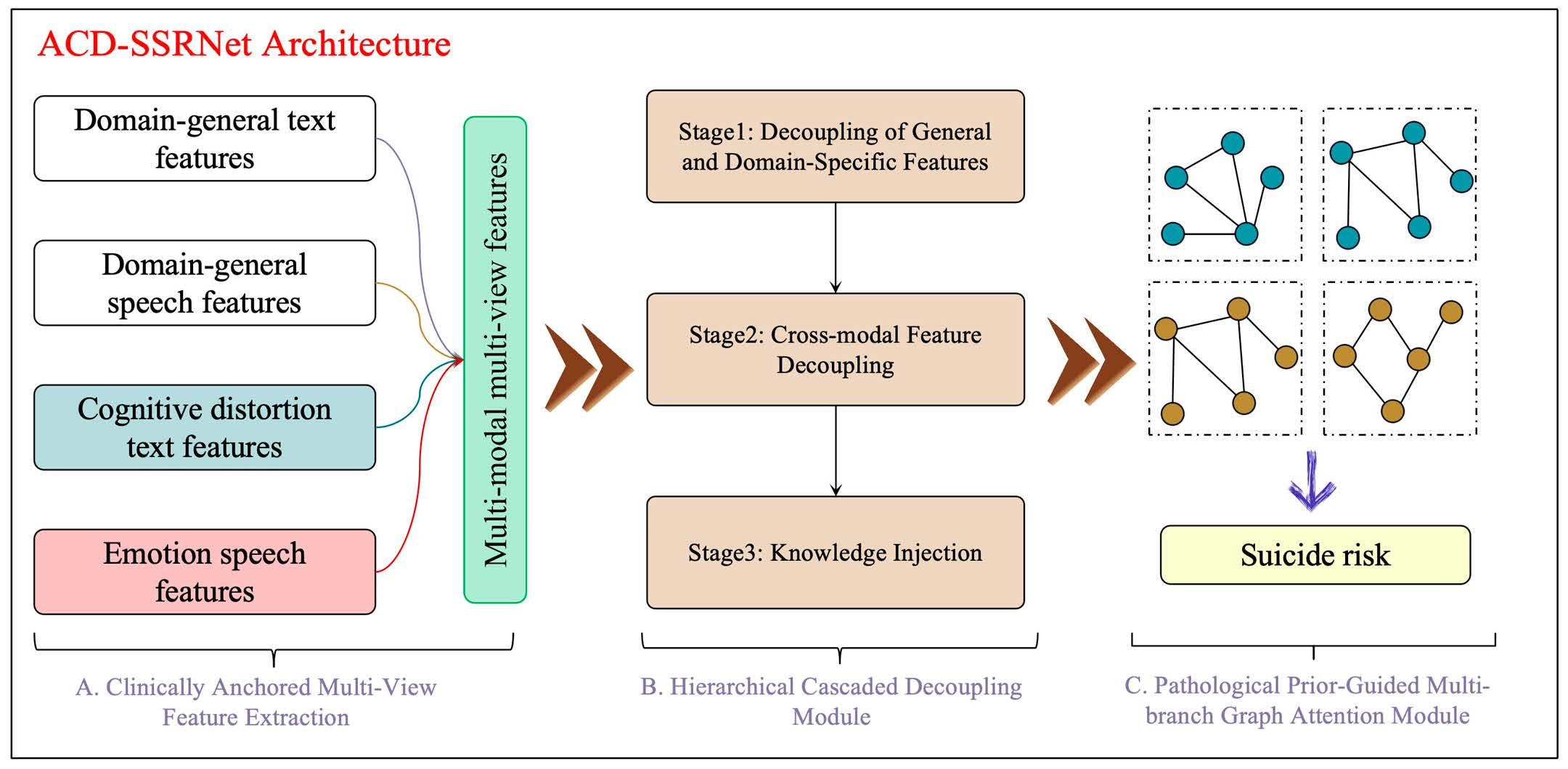
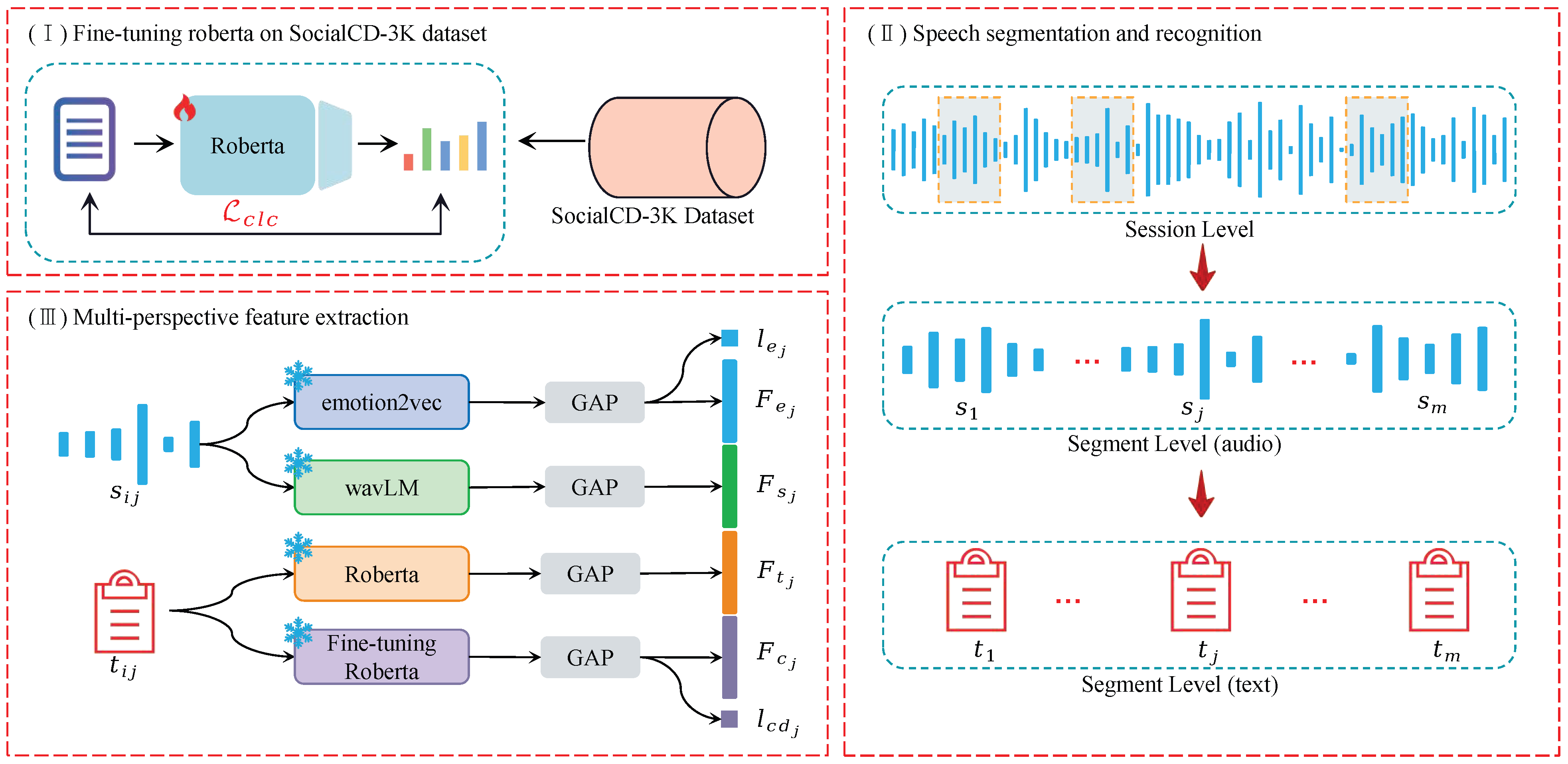
The feature extraction module is designed to capture multi-dimensional and complementary feature representations from speech and text modalities, laying a solid foundation for subsequent suicide risk prediction. As shown in
Figure 2, feature extraction consists of three key steps.
Given the close association between cognitive distortions and suicide risk [
27], we treat cognitive distortion as an important source of prior knowledge. We therefore fine-tune RoBERTa [
28] on the SocialCD-3K [
29] dataset to build CD-RoBERTa, which is used to identify distortion-related expressions and extract corresponding features. As the first Chinese multi-label classification dataset for cognitive distortion detection, SocialCD-3K comprises 3,407 Chinese social media posts, annotated with 12 types of cognitive distortions, including “All-or-nothing thinking” and “Over-generalization”.
For each long-form speech sample from psychological hotline scenarios, we first perform speaker segmentation using the speaker-diarization-community-1 (
https://huggingface.co/pyannote/speaker-diarization-community-1 (accessed on 14 January 2026) [
30,
31,
32] tool to separate the speech signals of the caller and the counselor. To focus on the emotional expression and psychological state of the caller, which are closely related to suicide risk assessment, only the caller’s speech segments are retained after segmentation. Subsequently, the retained caller’s speech segments are converted into corresponding text content using the SenseVoice (
https://github.com/FunAudioLLM/SenseVoice (accessed on 14 January 2026)) tool. This speech-to-text conversion process ensures that we can obtain accurate text data corresponding to the caller’s speech, providing a basis for text-related feature extraction.
Based on the caller’s processed speech and text, we extract four distinct feature representations. Domain-general text features are obtained using the original RoBERTa model, where global average pooling (GAP) over the final Transformer layer output yields segment-level features
, and concatenation across all segments forms the sample-level feature
with
as the feature dimension. Cognitive distortion text features are extracted by CD-RoBERTa fine-tuned on SocialCD-3K, producing segment-level features
and sample-level features
along with cognitive distortion labels
through the same pooling operation. Domain-general speech features are extracted via WavLM [
33], generating segment-level features
from the final Transformer layer output and sample-level features
after concatenation, where
denotes the speech feature dimension. Emotion speech features are derived from Emotion2Vec, with global average pooling on the model output producing segment-level features
and integrated sample-level features
together with emotion labels
. In this study, the suicide-risk gold standard is the psychiatrist-confirmed 12-month follow-up outcome at the call level. By contrast, the cognitive distortion labels extracted by CD-RoBERTa are used as auxiliary clinically motivated prior cues for representation learning and graph construction, rather than as independent gold-standard supervisory labels for the hotline corpus.
3.3. Hierarchical Cascaded Decoupling Module
A key motivation for this hierarchical design is to avoid direct all-to-all pairwise decoupling across all feature types. Let V denote the total number of feature types. In a peer-to-peer decoupling paradigm, the number of direct pairwise cross-feature relations grows as . In the current setting, (general speech, general text, affective prior, and cognitive-distortion prior), which would already correspond to six pairwise relations if all feature types were treated symmetrically. By contrast, the proposed HCDM decomposes the problem into two stages. The first stage only performs local prior-general decoupling for matched pairs, i.e., affective–speech and cognitive-distortion–text. The second stage then applies shared-private decoupling only to the two general modalities rather than to all four feature types jointly. More generally, if r additional clinical prior feature types are introduced on top of the two general modalities, a peer-to-peer formulation grows quadratically, whereas the proposed staged formulation only adds one local first-layer relation per new prior feature while keeping the second-layer structure unchanged. This is the sense in which the proposed design avoids constraint combinatorial explosion.
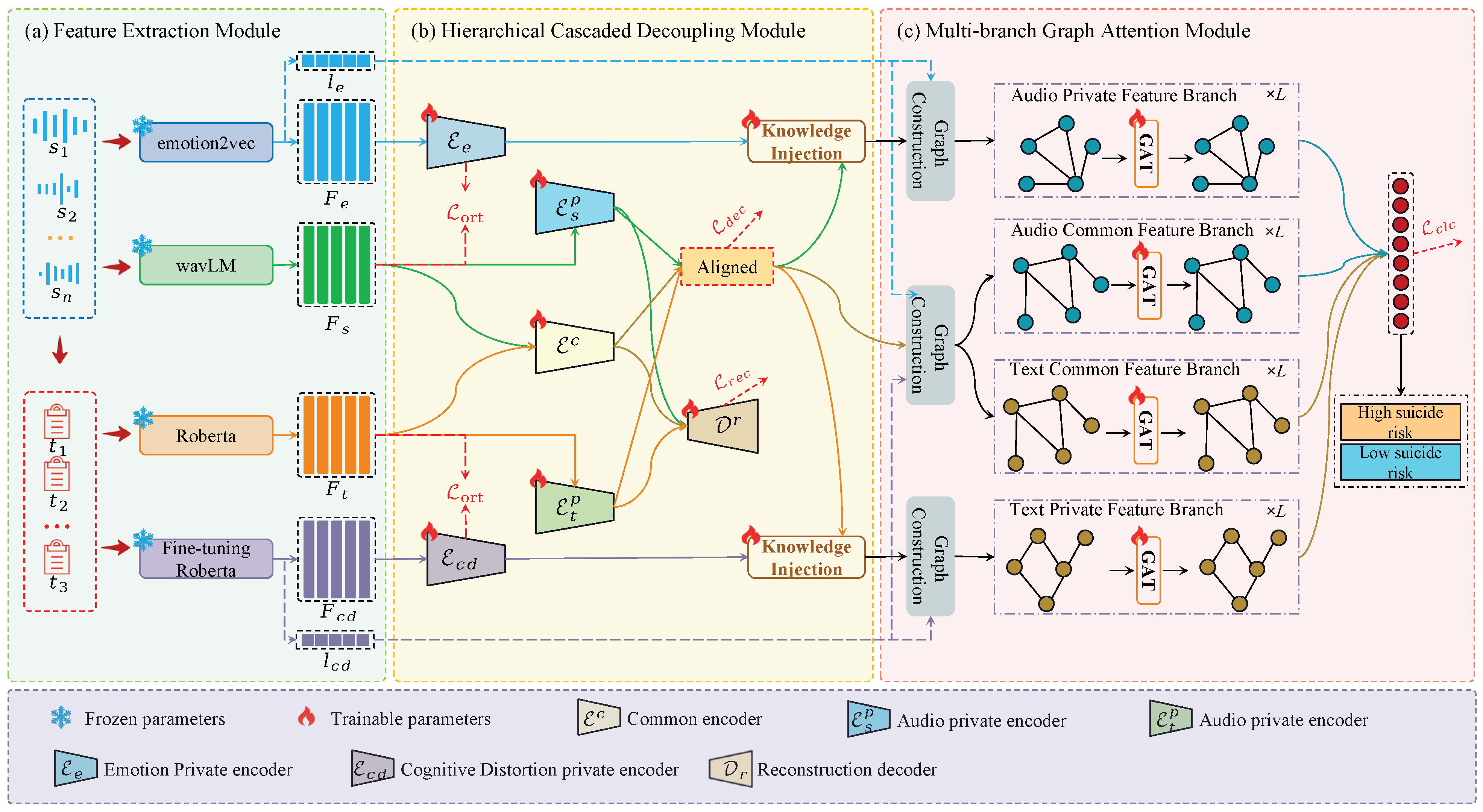
To address the redundant entanglement among multi-modal and multi-type features extracted in the previous module and enhance the discriminative power of features for suicide risk prediction, a Hierarchical Cascaded Decoupling Module is proposed. This module adopts a two-layer cascaded structure to sequentially realize the decoupling between domain-specific and domain-general features, as well as the decoupling between cross-modal general features, while integrating a knowledge injection mechanism to enhance feature representation.
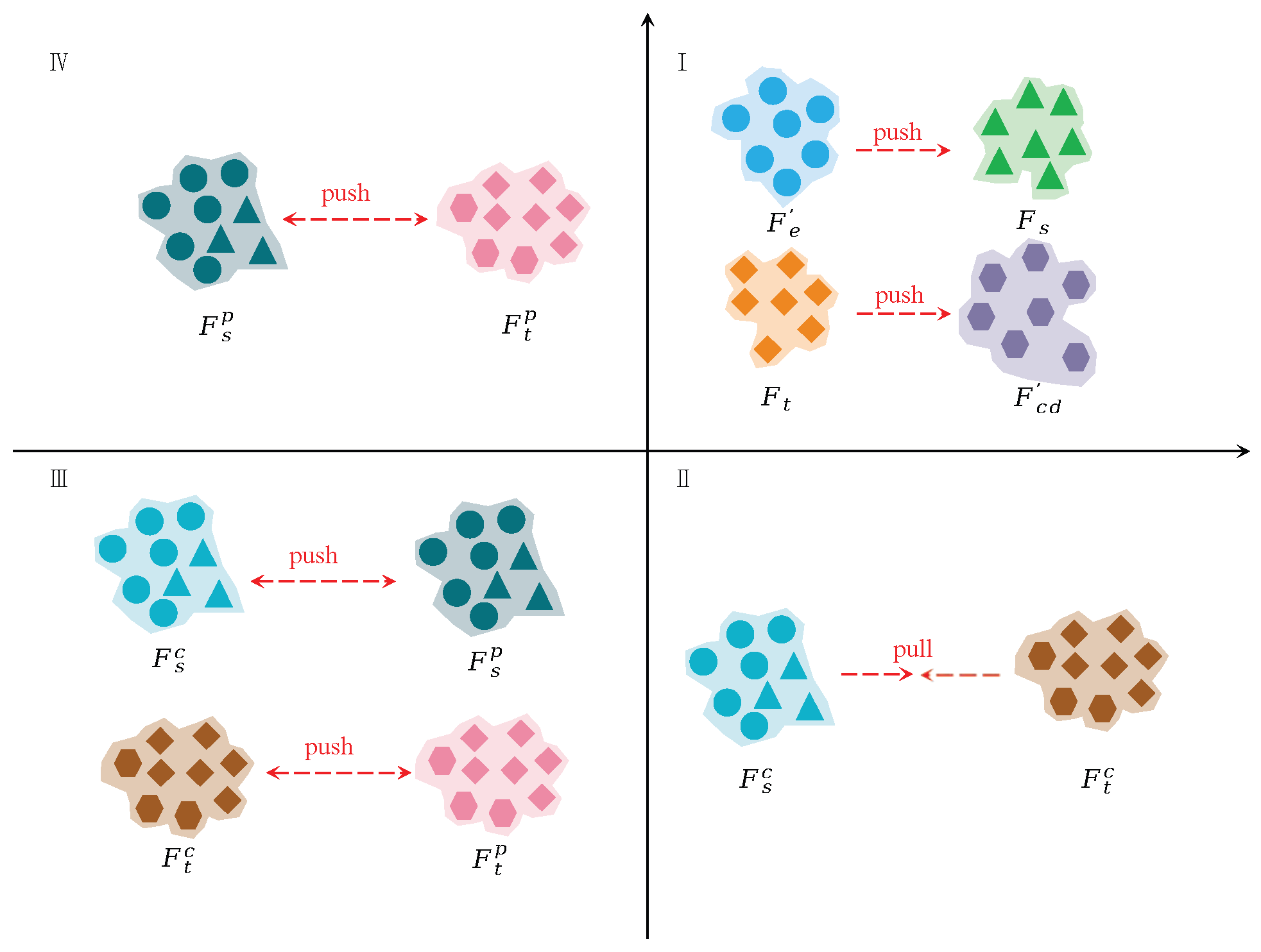
For clarity,
Figure 3 should be interpreted as a schematic summary of the constraint relationships used in the module, rather than as a left-to-right forward computation graph. The top-right panel belongs to the first decoupling layer and describes the separation between domain-specific prior features and their corresponding domain-general features. The remaining three panels correspond to the second-layer shared-private decoupling: the lower-right panel aligns the shared speech-text representations, the top-left panel separates the cross-modal private representations, and the lower-left panel separates the shared and private representations within each modality. The knowledge injection mechanism is presented separately in
Figure 4.
3.3.1. Decoupling of General and Domain-Specific Features
The first layer of the module focuses on decoupling domain-specific features from their corresponding domain-general features and enhancing general features through knowledge injection. Specifically, two lightweight fully connected layers are adopted as encoders to extract refined domain-specific feature representations: the emotion encoder
for emotion features and the cognitive distortion encoder
for cognitive distortion features. The emotion feature
and cognitive distortion feature
are encoded by
and
to generate refined domain-specific features
and
, respectively, which are defined as
where
and
denote the trainable parameters of
and
, respectively;
is the refined emotion feature after encoding, and
is the refined cognitive distortion feature after encoding, with
m representing the number of segment units,
the speech feature dimension, and
the text feature dimension.
To eliminate redundant entanglement between domain-specific and domain-general features, orthogonal loss is introduced for feature decoupling. As illustrated in the top-right section of
Figure 3, the refined emotion feature
is decoupled from the domain-general speech feature
, and the refined cognitive distortion feature
is decoupled from the domain-general text feature
. The orthogonal loss function minimizes the inner product between the two groups of features, thereby suppressing feature redundancy, which is defined as
where
denotes the Frobenius and ⊙ denotes the Hadamard product.
3.3.2. Cross-Modal Feature Decoupling
The second layer of the module focuses on decoupling the enhanced cross-modal general features
and
, adopting a traditional feature decoupling method based on a shared-private encoder structure to separate shared and private information between text and speech modalities. All encoders in this layer are implemented as lightweight, fully connected layers to ensure efficiency and compatibility with feature decoupling objectives. Specifically, three encoders are designed: a shared encoder
to extract cross-modal shared information, and two private encoders
(for speech) and
(for text) to extract modality-specific private information. The shared information reflects the common characteristics of text and speech related to suicide risk, while the private information retains the unique discriminative information of each modality. The encoding processes are defined as
where
,
, and
denote the trainable parameters of
,
and
, respectively;
and
are the shared features of speech and text modalities;
and
are the private features of speech and text modalities.
To ensure thorough and hierarchical feature decoupling, the total decoupling loss for the second layer is defined as the sum of three complementary constraint terms:
where
denotes shared feature consistency loss,
denotes cross-modal private feature orthogonal loss, and
denotes intra-modal shared–private orthogonal loss. Together, these losses enforce effective separation between shared and private features as well as between cross-modal private features. More specifically,
constrains the shared speech and text representations to encode common suicide-risk-related information,
encourages the two private branches to retain complementary modality-specific cues, and
prevents the shared and private features within the same modality from collapsing into each other.
As depicted in the lower-right panel of
Figure 3, the shared feature consistency loss is formulated to align cross-modal semantic representations in the latent feature space. Specifically, this loss enforces semantic consistency between the speech-derived shared features
and text-derived shared features
by maximizing their cosine similarity, which prioritizes the alignment of semantic orientation rather than absolute feature magnitude, thereby ensuring task-relevant information is consistently encoded across both modalities. This loss is formally defined as
where
denotes the cosine similarity operator between two feature vectors, formally defined as
for arbitrary feature vectors
a and
b, and
represents the L2 norm.
As illustrated in the top-left corner of
Figure 3, the private feature orthogonal loss eliminates redundant entanglement between modality-specific private features, encouraging
and
to capture unique and complementary information. It is defined as
Furthermore, the intra-modal orthogonal loss is introduced to strengthen decoupling within each individual modality. As illustrated in the lower-left corner of
Figure 3, it penalizes redundancy between shared and private features of the same modality, preserving their independence and distinctiveness. This loss is given by
where
denotes the Frobenius norm and ⊙ denotes the Hadamard product.
To further ensure the integrity of the encoded features and avoid the loss of task-relevant discriminative information, a reconstruction decoder
is introduced in the second layer, along with a reconstruction loss. The reconstruction decoder implemented with fully connected layers
takes the concatenated shared and private features of each modality as input and reconstructs the original general features
and
, thereby constraining the encoder to learn feature representations that can fully retain the original information. The reconstruction process is defined as:
where
denotes the trainable parameters of the reconstruction decoder
;
and
are the reconstructed enhanced speech and text general features, respectively;
represents the feature concatenation operation. The reconstruction loss is formulated to guarantee that the reconstructed features faithfully recover the semantic information of the original enhanced features for both speech and text modalities. To this end, we adopt cosine similarity as the alignment metric, and this loss is computed as
3.3.3. Knowledge Injection
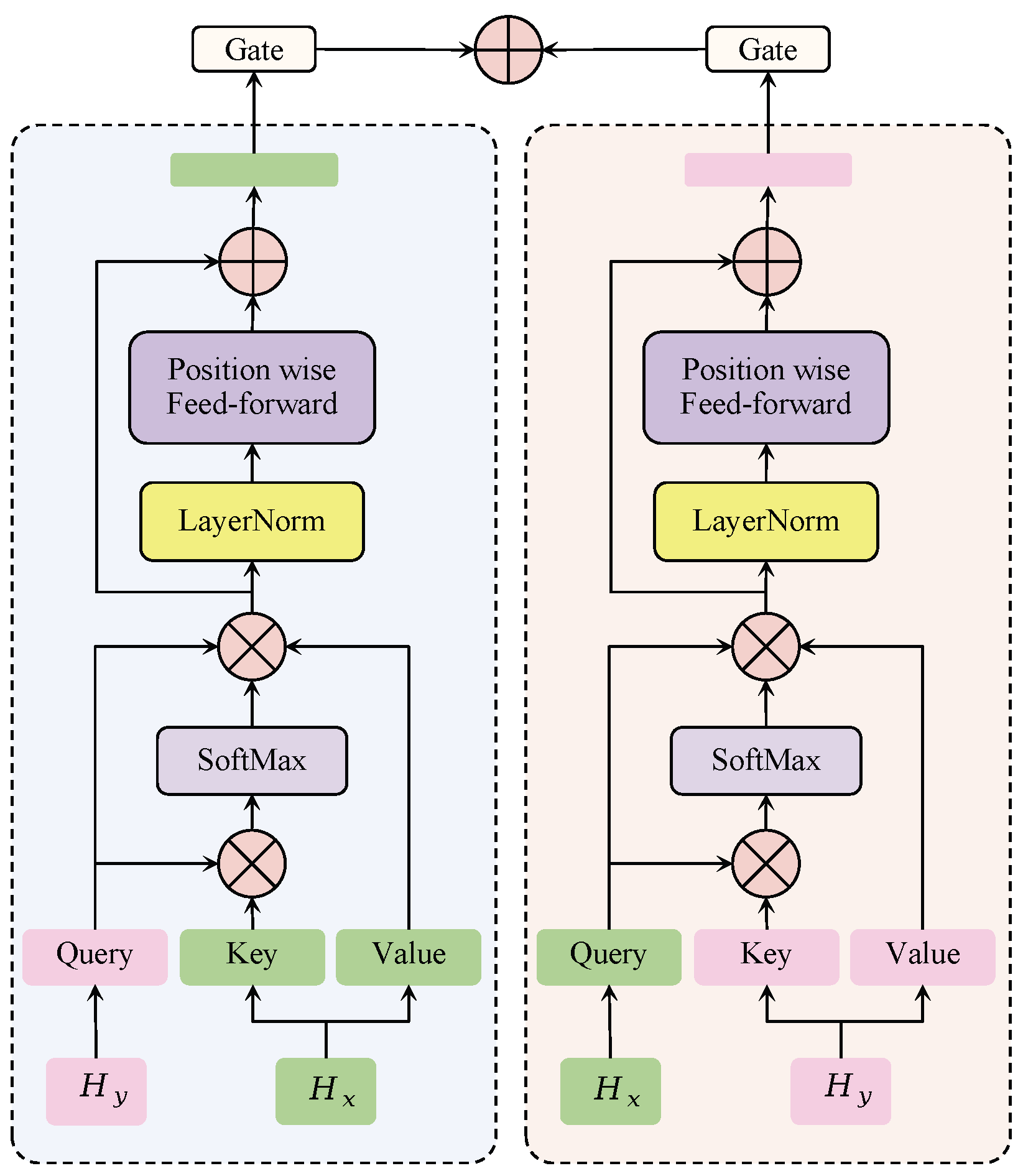
As shown in
Figure 4, following intra-modal orthogonal decoupling, we employ bidirectional cross-attention to achieve mutual information fusion between the refined affective features
and general speech features
, as well as between refined cognitive distortion features
and general text features
. Adaptive gate mechanisms are then applied to the two cross-attention outputs to balance the contributions of prior and general information. The knowledge injection process is formulated as
where
denotes the cross-attention module,
are segment-level adaptive gate weights, and ⊙ denotes the Hadamard product.
Intuitively, the knowledge injection module is introduced after the first decoupling stage because the refined prior features and the modality-specific general features contain complementary information. The refined affective and cognitive-distortion features emphasize clinically relevant prior cues, whereas the modality-specific general features retain acoustic and semantic details that may not be fully represented by the priors alone. Bidirectional cross-attention enables each source to query the other from both directions so that clinically salient prior cues can highlight relevant modality-specific segments, while general features can preserve contextual details and reduce over-reliance on a single prior source. The adaptive gates further control the relative contribution of the two directions, preventing noisy or incomplete prior information from dominating the fused representation. In this way, feature interaction is guided and selective rather than simple concatenation.
3.4. Multi-Branch Graph Attention Module
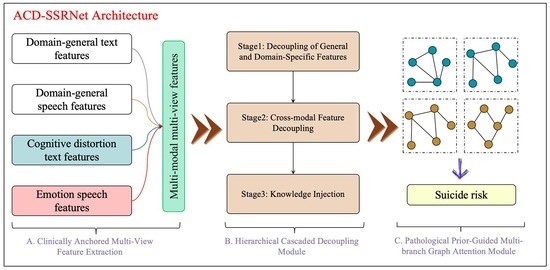
To fully exploit the contextual dependencies and discriminative information among the decoupled features , , , and from the Hierarchical Cascaded Decoupling Module, a Multi-branch Graph Attention Module is proposed. This module constructs distinct graph topological structures for each of the four features, respectively, to model the intrinsic associations between segment-level features, and then employs graph attention mechanisms to adaptively learn the importance of each node, ultimately fusing the features for suicide risk detection.
The core of this module lies in the construction of graph topological structures, where each feature corresponds to an independent graph branch, and the adjacency matrix of each graph is constructed based on the task-specific domain knowledge (emotion and cognitive distortion labels) extracted in the feature extraction stage. Specifically, the four graph branches are denoted as , , , and , corresponding to features , , , and , respectively. The node of each graph corresponds to the segment-level feature of the corresponding feature matrix (i.e., , , , for the j-th node), and the edge construction rules of each graph are detailed as follows.
Clinically, suicide risk in hotline conversations is rarely expressed through a single isolated utterance; rather, it is reflected in the recurrence, persistence, and temporal evolution of affective disturbance and maladaptive cognition across different parts of the call. For this reason, we do not construct graph edges solely based on generic feature similarity. Instead, we use emotion labels and cognitive distortion labels as clinically motivated anchors: recurrent emotion patterns indicate sustained affective states, recurrent cognitive distortion labels indicate repeated maladaptive thinking patterns, and their co-occurrence captures clinically meaningful pathological coupling. Temporal adjacency is further introduced to preserve the local sequential continuity that is also important in real-world clinical assessment.
The rationale for constructing four graph branches instead of a single unified graph is that the four decoupled feature groups have different semantics after HCDM and therefore require different edge definitions. The speech-private branch focuses on affective continuity in acoustic expression, the text-private branch focuses on distortion-related textual risk cues, and the two shared branches capture clinically meaningful cross-modal common contexts. In the shared branches, we connect both low-risk supportive states (positive emotion without cognitive distortion) and high-risk pathological states (negative emotion with cognitive distortion), while temporal adjacency preserves local conversational evolution. This design allows the model to separately learn modality-specific and modality-shared relational patterns before late fusion, rather than forcing heterogeneous relations into a single graph with one uniform adjacency rule.
For the graph
corresponding to the speech private feature
, the topological structure is constructed based on the emotion labels output by the Emotion2Vec model and the temporal adjacency of segments. Let
denote the emotion label of the
j-th segment, where
represents positive emotion,
represents neutral emotion, and
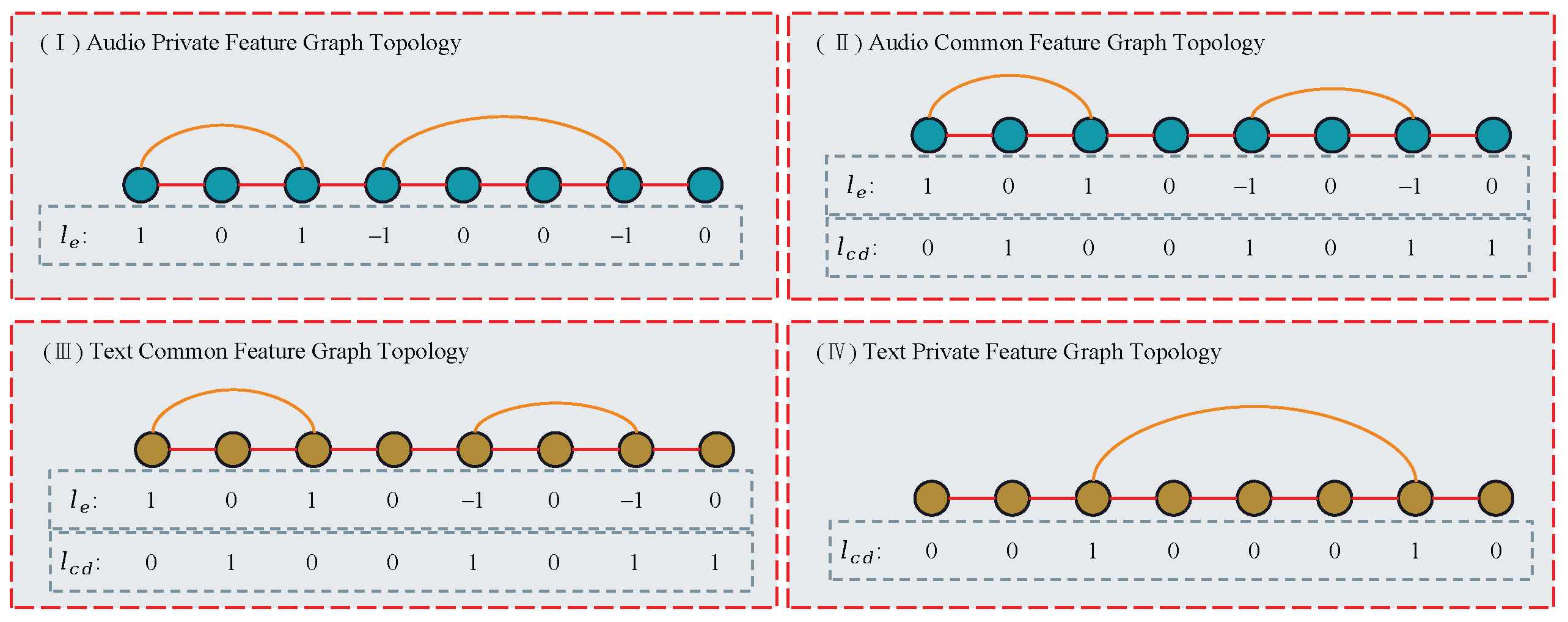
represents negative emotion. As illustrated in Part (I) of
Figure 5, nodes are connected in two scenarios: one is nodes with the same emotion label, and the other is nodes that are adjacent in time sequence (i.e., consecutive segments), which ensures that the graph can capture both the contextual correlation of the same emotional tendency and the temporal dependency of speech private features. The adjacency matrix
of
is defined as
where
denotes the edge weight between the
i-th and
j-th nodes;
i and
j represent the index of segment-level nodes, and
m is the total number of segment units. This rule is clinically motivated because affective disturbance in callers at suicide risk is often expressed intermittently rather than continuously. Two temporally separated segments with the same emotion label may therefore reflect the same underlying affective state. Connecting same-emotion segments enables the graph to aggregate distributed affective evidence, while temporal edges preserve short-range conversational continuity.
For the graph
corresponding to the text private feature
, the topological structure is constructed based on the cognitive distortion labels output by the CD-RoBERTa model and the temporal adjacency of segments. Let
denote the cognitive distortion label of the
j-th segment, where
indicates the presence of cognitive distortion and
indicates the absence of cognitive distortion. As illustrated in Part (IV) of
Figure 5, nodes are connected in two scenarios: one is nodes with cognitive distortion (i.e.,
), and the other is nodes that are adjacent in time sequence, to focus on both the contextual correlation of cognitive distortion-related information and the temporal dependency in text private features. The adjacency matrix
of
is defined as:
This rule is clinically motivated because cognitive distortions, such as over-generalization or all-or-nothing thinking, may recur across nonadjacent utterances within the same call. Linking distortion-positive segments allows the model to integrate dispersed evidence of maladaptive cognition that is highly relevant to suicide risk, while temporal edges preserve the local narrative progression of the caller’s thinking.
For the graphs
and
corresponding to the speech shared feature
and text shared feature
, respectively, the topological structures are constructed based on the combination of emotion labels, cognitive distortion labels, and the temporal adjacency of segments, aiming to capture the common contextual correlation and temporal dependency of speech and text shared features related to suicide risk. As illustrated in Part (II) and Part (III) of
Figure 5, nodes are connected in three scenarios: one is nodes with positive emotion and no cognitive distortion (i.e.,
and
), the second is nodes with negative emotion and cognitive distortion (i.e.,
and
), and the third is nodes that are adjacent in time sequence. The adjacency matrices
and
of
and
are uniformly defined as:
The shared branches are intended to model modality-invariant common context related to suicide risk. From a clinical perspective, the co-occurrence of negative emotion and cognitive distortion represents a more direct high-risk pattern because it reflects simultaneous affective distress and maladaptive cognition. By contrast, positive emotion without cognitive distortion corresponds to a comparatively non-pathological or lower-risk state. Connecting both patterns allows the shared branches to preserve clinically meaningful polarity structure and contrastive context within the conversation, while temporal adjacency models transitions between these states over time.
After constructing the topological structures of the four graphs, a graph attention layer [
34] is adopted for each graph branch to adaptively learn the attention weight of each node, capturing the importance of different segment-level features in suicide risk prediction. All four graph branches adopt an identical two-layer stacked graph attention layer architecture, with the hidden layer dimension uniformly fixed at 256. For each graph branch, the enhanced node feature matrix is obtained after the graph attention operation, and then global average pooling is performed on the node feature matrix to obtain the global feature representation of each graph branch, denoted as
,
,
, and
, respectively, where
is the dimension of the graph global feature.
The global features of the four graph branches are concatenated to form the final fused feature representation
, which integrates the discriminative information of multi-modal, multi-type, and contextual correlated features. The concatenation process is defined as
where
denotes the feature concatenation operation. The fused feature
is input into a fully connected layer to complete the suicide risk classification task (binary classification: suicide risk or no suicide risk). The cross-entropy loss function is adopted as the classification loss to optimize the entire model, which is defined as:
where
N is the total number of training samples;
is the true suicide risk label of the
i-th sample (1 for suicide risk, 0 for no suicide risk);
is the predicted probability that the
i-th sample has suicide risk, output by the fully connected layer.
To achieve the end-to-end joint optimization of feature decoupling, information integrity preservation, and suicide risk discriminative ability, we construct a multi-task constrained total loss function by integrating the classification loss from the graph attention module, the decoupling constraint loss, and the feature reconstruction loss from the hierarchical cascaded decoupling module. The total loss function is defined as the weighted linear combination of the three aforementioned loss terms:
where
,
, and
are tunable weight hyperparameters that regulate the contribution of the classification loss, decoupling loss and reconstruction loss, to the total optimization objective, respectively. The values of
,
, and
are determined via grid search.




 ,
,