1. Introduction
Cardiovascular disease (CVD) has become a major global health burden, with its onset age steadily decreasing, particularly among younger populations aged 20 to 29. Reports from the World Health Organization indicate that metabolic conditions such as obesity, hypertension, hyperlipidemia, and diabetes are increasingly prevalent in younger age groups, thereby accelerating the early onset of CVD [
1]. Furthermore, previous studies have shown that obesity-related indicators, including body mass index and waist circumference, are significantly associated with the incidence of atrial fibrillation and ischemic stroke, highlighting the critical importance of early cardiovascular risk assessment in preventive medicine [
2].
In clinical practice, the Cardiac Index (CI) is a key indicator reflecting cardiac output normalized to body surface area and is widely used for cardiovascular function assessment and disease stratification. However, conventional CI measurement relies heavily on specialized hemodynamic analyzers such as PhysioFlow, which require controlled clinical environments and expert operation. These constraints hinder the clinical application of CI monitoring in routine screening, long-term surveillance, and home-based healthcare scenarios. Therefore, developing an accurate and stable CI prediction method using minimal, non-invasive parameters remains a paramount research challenge. With the rapid advancement of the Internet of Things (IoT) and Internet of Medical Things (IoMT) technologies, non-invasive sensing devices are increasingly capable of continuously acquiring multiple physiological signals in real time, while leveraging cloud and edge computing architectures for efficient data integration and analysis [
3,
4]. When combined with machine learning techniques, these systems enable automated decision-making and significantly enhance the efficiency of early disease detection and health management [
5,
6,
7,
8,
9,
10].
Among various approaches, Artificial Neural Networks (ANNs) have demonstrated strong capabilities in modeling complex nonlinear physiological relationships and have consistently outperformed traditional statistical methods in cardiovascular prediction tasks [
11,
12,
13,
14,
15,
16]. Recent studies have further explored the integration of IoT sensing and artificial intelligence for cardiovascular risk monitoring and multi-disease prediction. For instance, IoT-based AI frameworks have been proposed for monitoring cardiovascular risk in young obese populations [
17], while data-driven predictive architectures and deep auto-optimized collaborative learning (DACL) approaches have shown superior performance in multi-disease prognosis [
18,
19]. In addition, ANN-based methods have successfully estimated critical hemodynamic parameters, such as cardiac output, directly from physiological signals, demonstrating the feasibility of non-invasive prediction [
20]. Furthermore, IoT-enabled smart healthcare systems have been widely applied in the reliable diagnosis of metabolic diseases, such as diabetes [
21]. However, most existing studies rely on high-dimensional input features or comprehensive clinical datasets, which limits their applicability in real-world scenarios. When applied to practical environments with limited and non-invasive inputs, these methods often suffer from reduced prediction accuracy and decreased model stability. Moreover, traditional multiple linear regression approaches fail to capture nonlinear physiological interactions, resulting in predictions biased toward mean values. In addition, insufficient data preprocessing further degrades overall model reliability.
Motivated by these limitations, this study focuses on developing a non-invasive CI prediction method that is both accurate and practically deployable under limited physiological input conditions. We propose a framework that integrates IoT-based sensing with an optimized Feedforward Neural Network (FFNN), incorporating systematic data preprocessing and Mixup-based data augmentation to enhance nonlinear feature learning and generalization capability. Compared with existing approaches, the proposed method maintains high predictive performance while reducing the number of required input parameters, thereby improving its practicality and efficiency for real-world applications. Furthermore, a dual-task evaluation framework is adopted to explicitly distinguish between binary CI classification (CI ≥ 3 vs. CI < 3) [
22,
23] and continuous CI regression prediction, avoiding ambiguity in performance interpretation and enhancing result interpretability. To validate the stability and reliability of the proposed method, an independent test set consisting of original clinical samples was reserved, and cross-validation was employed for comprehensive evaluation. Experimental results demonstrate that, even under limited sample conditions, the proposed model achieves consistent and robust predictive performance. In particular, the model exhibits high accuracy in classification tasks, indicating strong potential for real-world deployment in non-invasive cardiovascular monitoring and intelligent healthcare systems.
2. Methodology
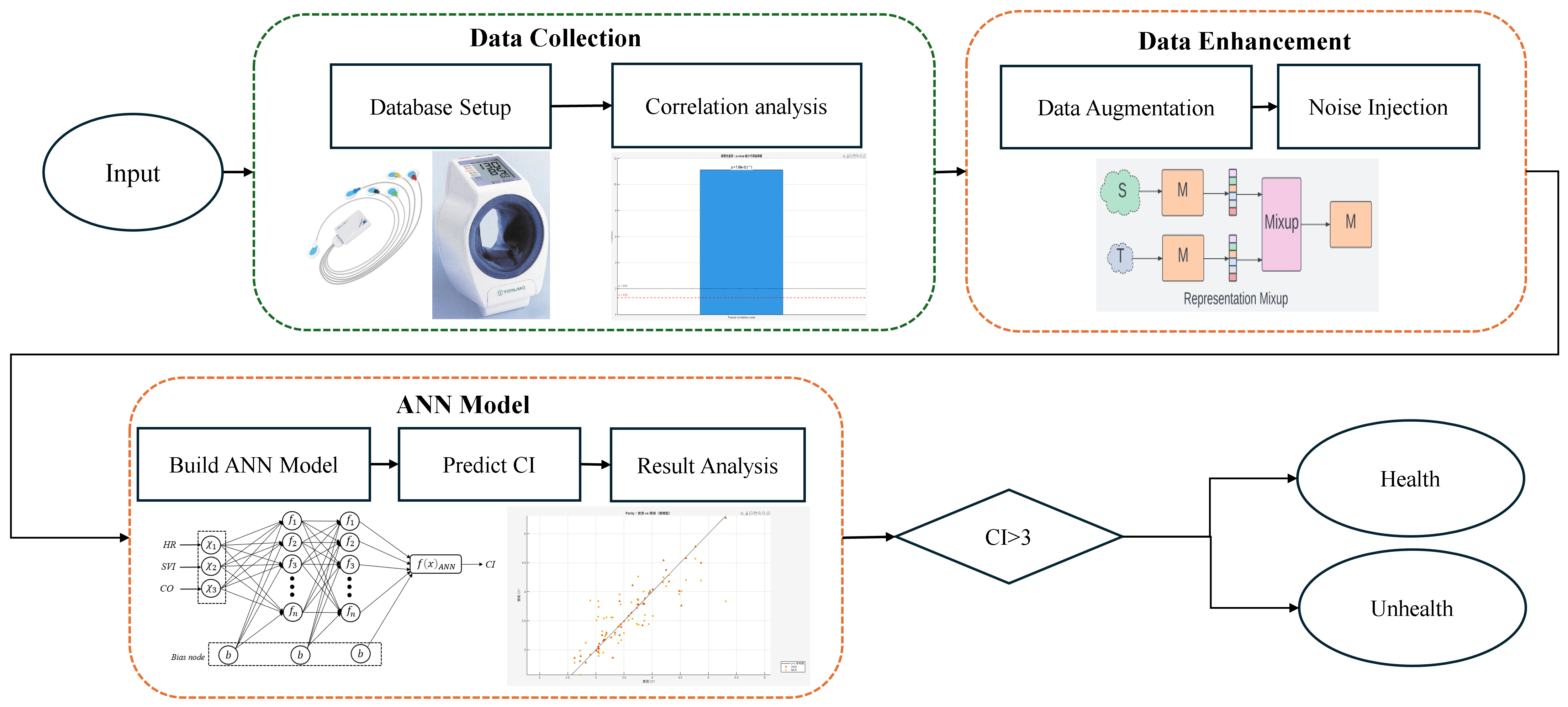
This study integrates IoT and IoMT sensing technologies with machine learning techniques to monitor cardiovascular function and predict CI in young adults with obesity. The research process is divided into several stages, as illustrated in
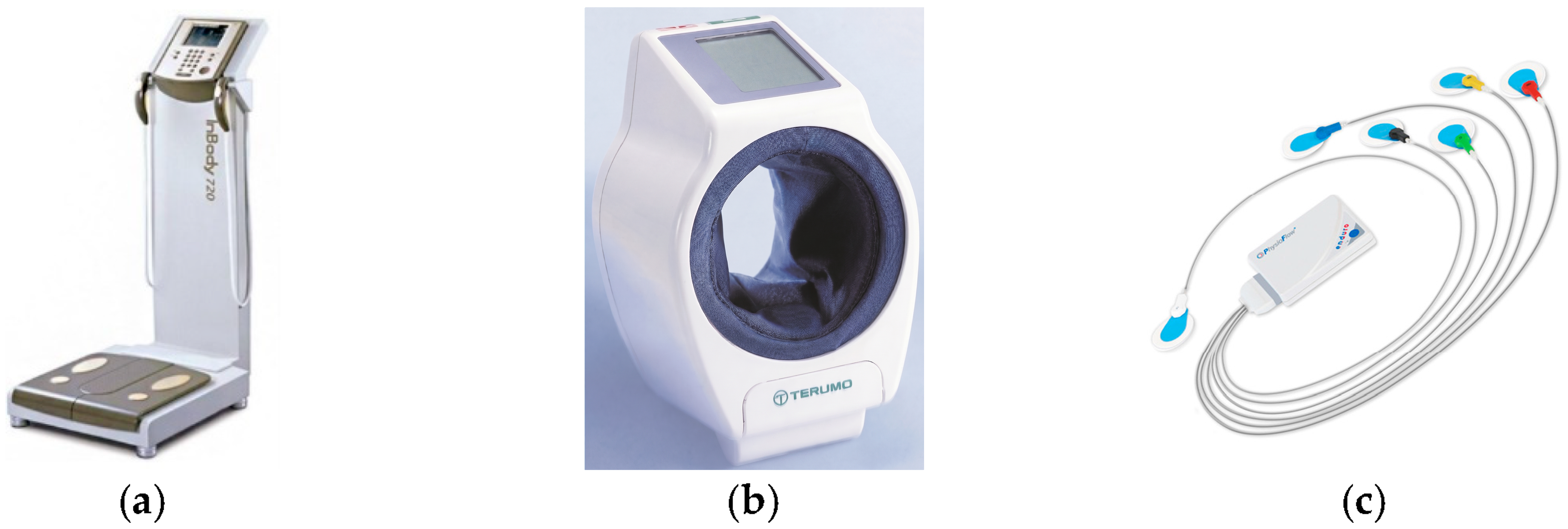
Figure 1. First, physiological data were acquired using advanced non-invasive sensing devices, including TERUMO ES-P2000 (Terumo Corp., Tokyo, Japan), InBody 720,(InBody Co., Ltd., Seoul, South Korea), and PhysioFlow (Manatec Biomedical, Poissy, France), to establish the input features for subsequent analysis. Next, the collected health indicators are standardized to eliminate the effects of differing units on the model. Subsequently, data augmentation is applied to diversify the training dataset and enhance the model’s generalization capability. Finally, an ANN model is developed and evaluated to predict CI.
2.1. Data Collection
This study enrolled 54 obese individuals who were between 20 and 29 years old and had a body mass index (BMI) exceeding 27 kg/m
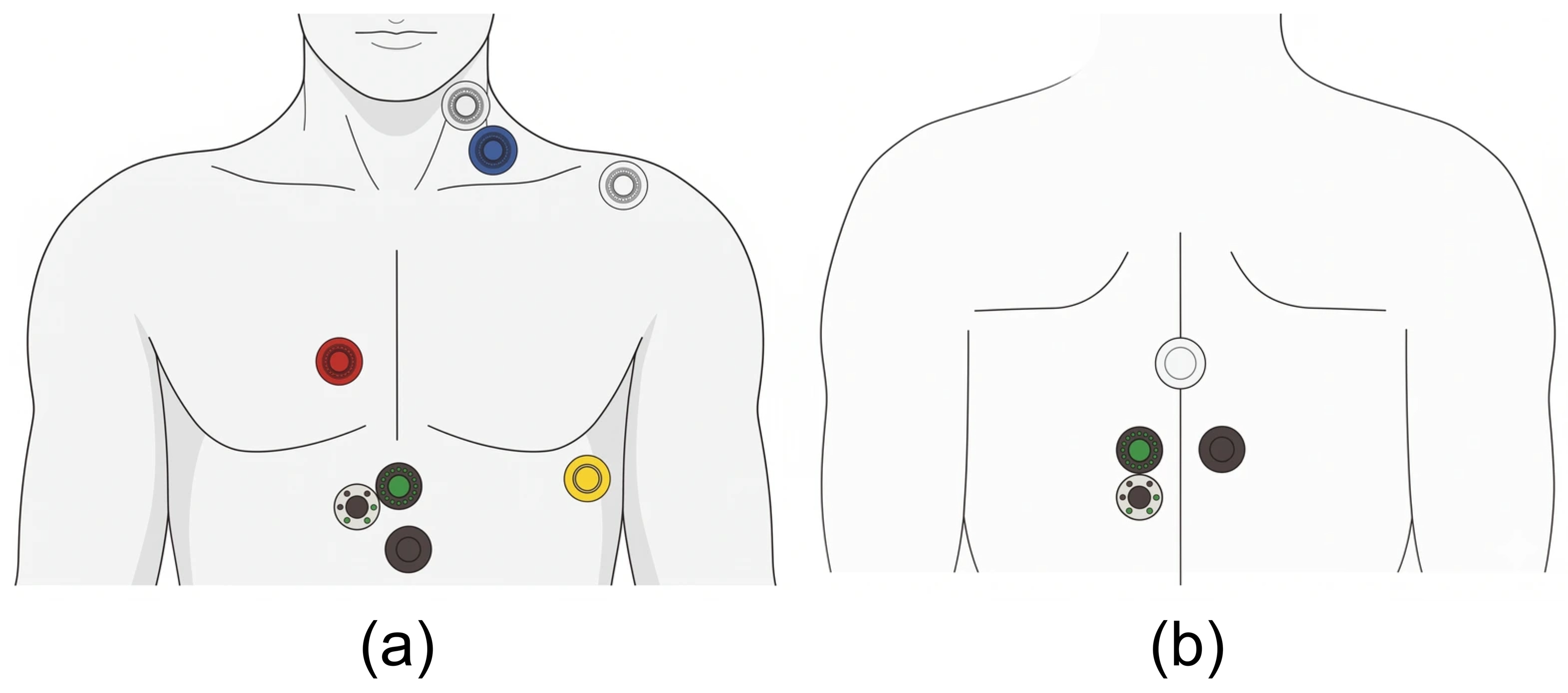
2. All participants were free of diagnosed cardiovascular disease and the Taiwan Ministry of Health and Welfare body composition guidelines served as the basis for obesity determination. Data collection was performed using three specialized non-invasive instruments. Hemodynamic parameters, including blood pressure (SBP, DBP, PP, MAP) and heart rate (HR), were recorded using the TERUMO ES-P2000. Cardiac function, specifically stroke volume (SV), was assessed via the PhysioFlow analyzer, while the InBody 720 was employed to determine body composition, including BMI and fat distribution. Blood flow and cardiac hemodynamic measurements were conducted after sensor placement and monitoring procedures, which are depicted in
Figure 2 and
Figure 3.
The experimental protocol was conducted in sequential stages. Initially, participants rested in a seated position for 10 min to ensure physiological stabilization, followed by a 3 min blood pressure assessment. Subsequently, electrodes were attached for a 10 min recording of cardiac physiological signals, after which a further 5 min rest period was observed. The protocol concluded with a 20 min assessment of cardiac hemodynamic parameters. The complete sequence and temporal allocation are summarized in
Table 1.
In this study, sample labeling for cardiovascular status was based on a clinically established cardiac index (CI) threshold. This threshold is well supported by authoritative cardiovascular physiology literature and was further validated through expert consensus involving three clinicians with more than three years of clinical experience, and a physiology specialist. Specifically, CI ≥ 3 L/min/m
2 was defined as normal, while CI < 3 L/min/m
2 was categorized as abnormal [
22,
23]. All labels were objectively determined from CI values directly measured using the PhysioFlow hemodynamic analyzer, ensuring consistency, reproducibility, and minimizing subjective bias.
2.2. Data Analysis
This study employed statistical analyses to examine associations among obesity-related measures and cardiac-function parameters. The study employed descriptive statistics to present demographic information and health data of 54 participants while analyzing essential cardiovascular measurements, including body weight, BMI, blood pressure, and HR. The initial summary of subject health status helped establish basic data that would support further detailed investigations. The Pearson product-moment correlation analysis [
24] tested how body weight related to cardiac hemodynamic parameters including SVI, CO, and EF to establish whether body weight impacts cardiac function. The analysis used SPSS version 24.0 with statistical significance determined by
p < 0.05 for drawing reliable conclusions. The research investigated how different physiological indicators connect with CI along with body weight correlations to SV and HR while stressing early cardiovascular risk assessment in individuals with obesity.
2.3. Data Enhancement
This study aims to improve predictive accuracy for the cardiac index (CI). Traditional CI assessment has primarily relied on physiological indicators such as HR and SVI; however, these indicators have limitations in accurately reflecting cardiac function. To address these limitations, systematic data preprocessing and augmentation strategies were integrated to enhance model robustness and predictive performance. The dataset consisted of measurements collected from 54 subjects, resulting in a total of 270 samples. These samples were divided into training and testing sets in an 8:2 ratio, yielding 216 training samples and 54 testing samples. In addition, 30% of the training set was further reserved as a validation set for model tuning and early stopping.
To improve the model’s generalization ability and robustness, the training data were augmented sixfold using Mixup [
25] and Noise Injection [
26]. Mixup was applied by randomly combining two training samples through a linear combination to generate new synthetic samples, as illustrated in Equations (1) and (2). To further enhance generalization and increase training data diversity, zero-mean Gaussian noise with standard deviation σ was added to each feature vector after Mixup, introducing slight random perturbations around the original feature space, as described in Equation (3). Consequently, the training set expanded from 216 samples to 1296 samples after augmentation.
It is important to note that the augmented data included both original and synthetic samples and did not represent independent subjects. The test set remained completely independent and was not subjected to any augmentation or model training processes.
To evaluate the impact of different variable combinations on predictive performance, multiple prediction models were developed, including simplified models based on HR, cardiac output (CO), and SVI, as well as multivariate models incorporating multiple physiological parameters. This comparative approach helps identify the most efficient set of input features without compromising prediction accuracy, thereby simplifying the measurement process and improving clinical applicability.
2.4. ANN Model
An Artificial Neural Network (ANN) was utilized as the primary predictive architecture for this study. Leveraging their capacity for high-dimensional nonlinear modeling, ANNs are particularly effective at capturing the complex, interdependent relationships between physiological variables and cardiac output—tasks where traditional linear regressions often fall short [
27]. In the medical domain, ANNs are highly suitable for physiological parameter prediction and health risk assessment, as they can learn and represent complex physiological variations through multilayer neural structures [
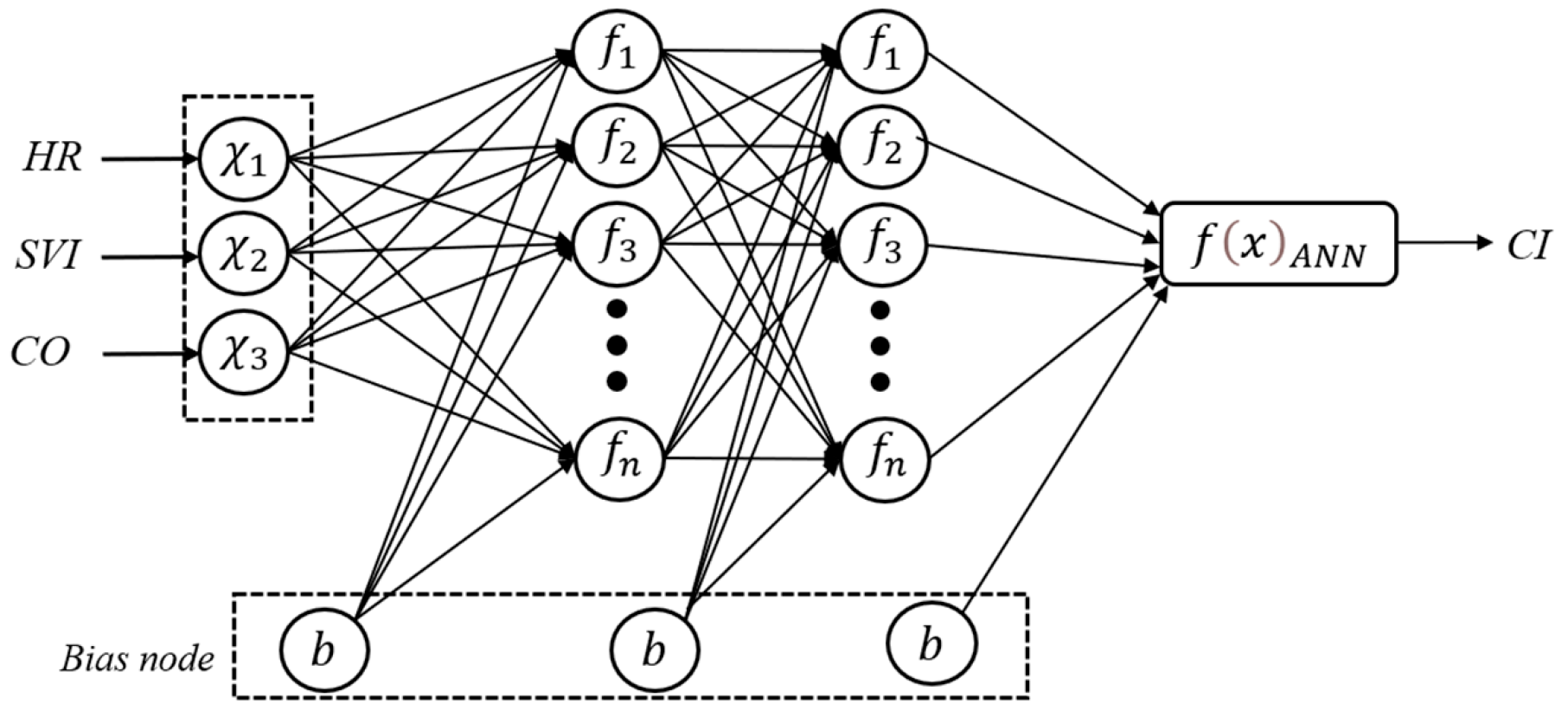
28]. The ANN architecture comprises an input layer for physiological features (e.g., HR, CO), hidden layers for nonlinear feature transformation, and an output layer for CI prediction. Weighted summations and activation functions within the hidden layers enable the model to learn complex relationships between inputs. The overall ANN architecture is illustrated in
Figure 4.
A Feedforward Neural Network (FFNN) was utilized as the core predictive model, implementing a backpropagation learning rule to minimize residual errors and ensure robust performance. The hidden layers employ the Rectified Linear Unit (ReLU) activation function to improve nonlinear feature learning, while the output layer uses a linear activation function to accommodate the regression-based prediction of CI. The proposed FFNN architecture comprises three hidden layers with 32, 16, and 8 neurons, respectively, with each layer fully connected. The input features are transformed through weight and bias adjustments and passed through the ReLU activation function for nonlinear computation, as defined in Equation (4), while the linear combination for the output layer is represented in Equation (5). To prevent overfitting, a 30% dropout rate was applied after the first and second hidden layers [
29], randomly deactivating a subset of neurons during training to encourage the model to learn more generalizable feature representations. After multiple training iterations, the FFNN automatically adjusted the connection weights and biases to achieve optimal predictive performance. The final model demonstrated high stability and precision in CI prediction under various physiological conditions, exhibiting strong generalization capability and significant potential for clinical application in cardiovascular health monitoring.
To comprehensively evaluate model performance, this study adopted a dual-task evaluation framework that explicitly distinguished between classification and regression tasks. For the classification task (CI ≥ 3 vs. CI < 3), the model performance was evaluated using standard classification metrics, including Accuracy, Recall (Sensitivity), Specificity, Precision, and F1-score. These metrics provide a comprehensive assessment of the model’s ability to correctly identify normal and abnormal cardiac function. For the regression task (continuous CI prediction), model performance is evaluated using both statistical error metrics and confidence-based accuracy. Specifically, the proportion of predictions falling within the 95% confidence interval of the actual values is defined as Accuracy, reflecting the degree to which model predictions align with the uncertainty range of the true data. Furthermore, the Coefficient of Determination (R
2), Root Mean Square Error (RMSE), Mean Absolute Error (MAE), and Mean Absolute Percentage Error (MAPE) are employed, as defined in Equations (6)–(9). R
2 measures the proportion of variance in the target variable that can be explained by the model, with values approaching 1 indicating a better fit. RMSE quantifies the standard deviation of prediction errors and is particularly sensitive to large deviations, reflecting overall prediction stability. MAE represents the average absolute difference between predicted and actual values, providing a direct measure of prediction error magnitude. MAPE further normalizes prediction error in percentage form, enabling intuitive interpretation in clinical contexts. This dual-task evaluation framework ensures a clear separation between classification accuracy and regression accuracy, thereby avoiding ambiguity and providing a more rigorous and interpretable assessment of model performance.
2.5. Model Configuration and Implementation Details
The ANN model was configured using the hyperparameters listed in
Table 2. The dataset was divided into a training set (80%, 216 samples) and an independent testing set (20%, 54 samples). Within the training partition, the samples were further subdivided: 70% were used as the training subset for weight optimization, whereas 30% were allocated as the validation subset for early stopping and hyperparameter tuning. The testing set was reserved exclusively for final performance evaluation. Input features were normalized using z-score normalization, and the model was trained using the Levenberg–Marquardt optimization algorithm. Training was implemented via the MATLAB trainlm function, utilizing full-batch optimization (batch size
n = 216). Rather than a fixed learning rate, the Levenberg–Marquardt algorithm employs an adaptive damping factor (
μ) to ensure convergence, with an initial
μ of 0.001 and adjustment factors of 0.1 (decrease) and 10 (increase). All experiments were conducted on the hardware and software platform summarized in
Table 3. The training process was performed on a workstation equipped with an Intel Core Ultra 7 265K CPU (Intel Corp., Santa Clara, CA, USA), 32 GB RAM, and an NVIDIA GeForce RTX 4080 GPU (NVIDIA Corp., Santa Clara, CA, USA), running on Windows 11 with MATLAB R2025b.
3. Result
This study aims to integrate IoT and IoMT technologies to collect multiple physiological parameters from subjects in real-time using non-invasive sensors. To enhance the model’s adaptability to data diversity and mitigate the limitation of insufficient data volume, data augmentation techniques were applied to improve model generalization and stability. The collected and augmented data were then used to train an FFNN model, establishing a highly accurate and interpretable CI prediction system. This approach effectively enhanced the precision and robustness of CI prediction, thereby enhancing the model’s clinical applicability. Furthermore, the proposed system demonstrates the broad potential of combining IoT technologies with advanced machine learning methods to enable intelligent cardiovascular health monitoring and risk prediction. Future work may further integrate multimodal physiological data and extend toward long-term dynamic monitoring to strengthen personalized cardiovascular health management.
The findings of this study are presented in two major components. The first part analyzes physiological parameters using statistical methods to examine the relationships between various physiological indicators and cardiac functional indices, thereby identifying key factors that influence cardiac performance. The second part evaluates the performance of ANN models by comparing different network architectures and parameter scales on the same dataset, assessing their accuracy and multiple performance metrics in predicting CI. Through this two-level analysis, the study not only provides a comprehensive understanding of the associations between physiological characteristics and cardiac health but also verifies the feasibility and robustness of the FFNN model in predicting cardiac function and overall physiological status. These results offer valuable insights for future clinical applications and the early management of cardiovascular disease risk.
3.1. Results of Statistical Analysis of Physiological Parameters
Table 4 presents the physical relationships among physiological parameters, while
Table 5 illustrates the statistically significant correlations among cardiac hemodynamic parameters. The results indicate that body weight has a notable impact on cardiac function. As one of the key indicators of cardiac performance, CI shows a strong positive correlation with both the SVI (
r = 0.521,
p < 0.01) and CO (
r = 0.914,
p < 0.01), suggesting that higher CI values are typically associated with greater cardiac pumping efficiency. In contrast, CI exhibits a significant negative correlation with End-Systolic Volume (ESV) (
r = −0.445,
p < 0.01), implying that enhanced myocardial contractility results in a smaller residual blood volume within the ventricle at the end of systole, thereby reflecting improved ventricular contraction performance.
Overall, these findings highlight the importance of CI as a critical indicator for assessing cardiac function and demonstrate its clinical applicability in evaluating cardiovascular health. Furthermore, the results emphasize the importance of continuous monitoring of cardiovascular parameters, particularly in cases where increased body weight contributes to a higher risk of hypertension and heart disease. Such monitoring supports effective clinical management and early prevention of cardiovascular complications.
3.2. FFNN Model Training
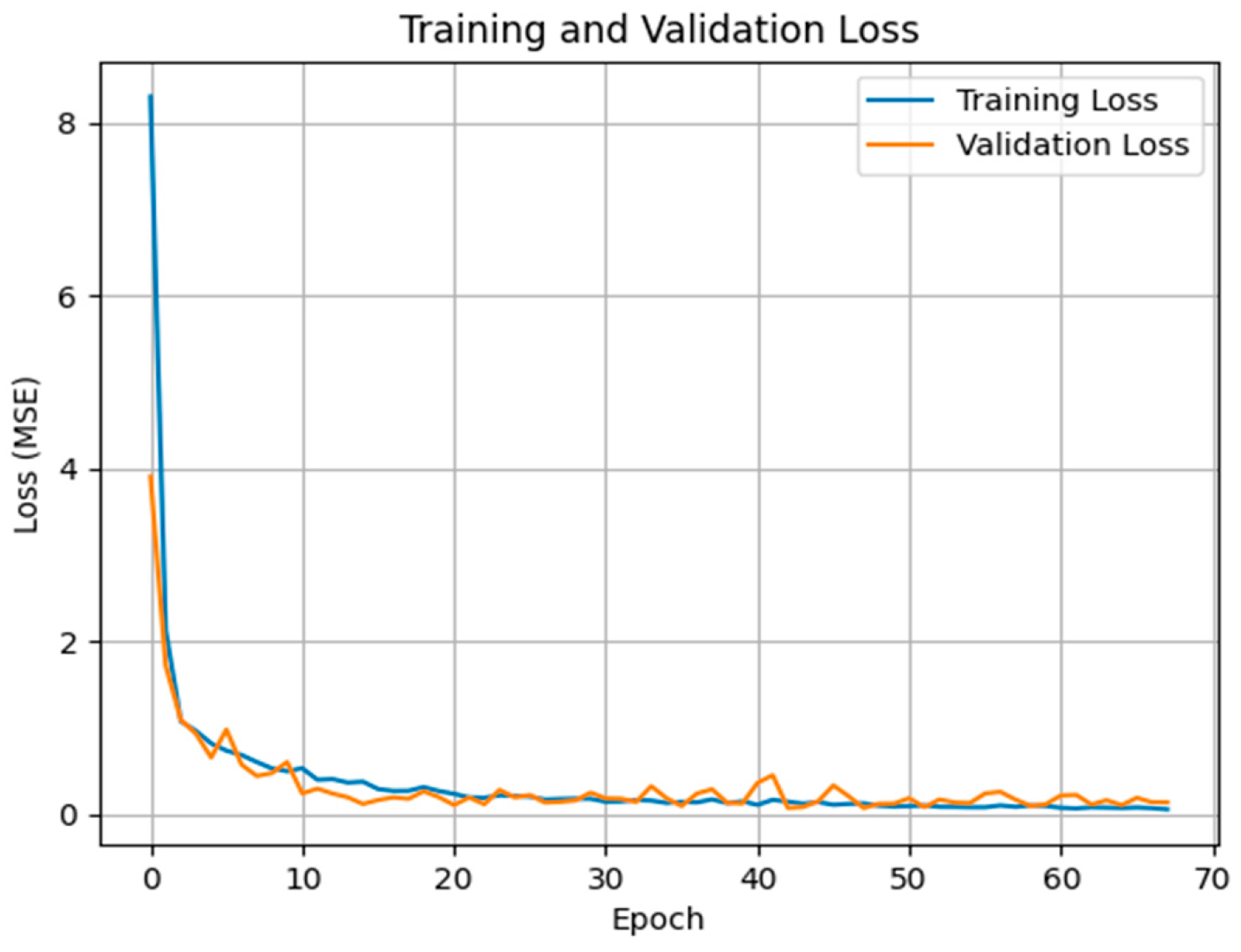
Data were partitioned into training and validation sets to refine the FFNN’s predictive accuracy. This approach allowed for continuous monitoring of model performance, ensuring high generalizability and preventing overfitting. As illustrated in
Figure 5, the training process incorporated an Early Stopping mechanism to monitor both training and validation losses [
30], thereby evaluating the model’s learning behavior and generalization capability. The training loss exhibited a sharp decline at the beginning, decreasing from approximately 8.3 to nearly 0.1, indicating that the model effectively captured key features and continuously optimized its parameters. The validation loss also showed a significant initial decrease and remained stable around 0.15 throughout the training, demonstrating the absence of overfitting and consistent generalization performance. Both training and validation loss curves flattened between epochs 40 and 50, signaling convergence. Training automatically terminated at epoch 68 according to the predefined Early Stopping criterion, which halted the process after the validation loss failed to improve for 20 consecutive epochs. This approach ensured that the optimal weight configuration was selected for maximum generalization and stable predictive performance.
The overall loss trajectory indicates that the FFNN achieved efficient and stable learning, effectively minimizing prediction errors. This outcome establishes a reliable foundation for accurate CI prediction and related physiological parameter estimation.
3.3. FFNN Model Results
To avoid ambiguity arising from combining classification and regression metrics under a single “Accuracy” definition, this study reports model performance using two distinct evaluation frameworks, as described in
Section 2.4.
- (a)
Classification Performance
Table 6 presents the classification performance of the proposed FFNN and three representative machine learning models—Support Vector Machine (SVM), Support Vector Regression (SVR), and K-Nearest Neighbors (KNN)—evaluated on a held-out test set consisting of 54 original clinical samples. The FFNN achieved high classification performance, with an accuracy of 97.78% on the test set, correctly identifying the majority of samples with only minimal misclassification. This result indicates that the model is highly effective in distinguishing between normal (CI ≥ 3) and abnormal (CI < 3) cardiac function. In comparison, SVR and SVM also demonstrated strong classification performance, both achieving an accuracy of 95.82%, while KNN achieved 93.87%. Although these conventional machine learning models exhibit competitive performance, the FFNN consistently outperformed them in terms of accuracy and stability, highlighting its superior capability in modeling nonlinear physiological relationships.
Furthermore, to evaluate the stability and generalization capability of the proposed model, a 5-fold cross-validation (5-fold CV) was conducted. As shown in
Table 7, the FFNN exhibited consistent and stable performance across different data partitions, with only minor variations observed among folds. This indicates that the proposed model is not sensitive to specific data splits and is capable of maintaining reliable learning performance across different training subsets. These results further suggest that the superior classification performance of the FFNN is not attributed to overfitting or favorable data partitioning, but rather stems from its effective ability to capture the underlying nonlinear relationships among physiological parameters.
- (b)
Regression Performance
Table 8 presents the regression performance for continuous CI prediction, evaluated using the proportion of predictions falling within the 95% confidence interval of the actual CI values, alongside R
2, RMSE, MAE, and MAPE. The FFNN achieved an R
2 of 0.929, RMSE of 0.1670, MAE of 0.1236, and MAPE of 3.12%, outperforming all comparison models including SVR, Random Forest, KNN, and MLR. These results indicate that the predicted CI closely approximates the measured CI, confirming the clinical viability of the proposed non-invasive approach. It is important to note that the “Accuracy” in this table refers specifically to the proportion of predictions within the 95% confidence interval of the actual values, and is therefore not directly comparable to the classification accuracy reported in
Table 6.
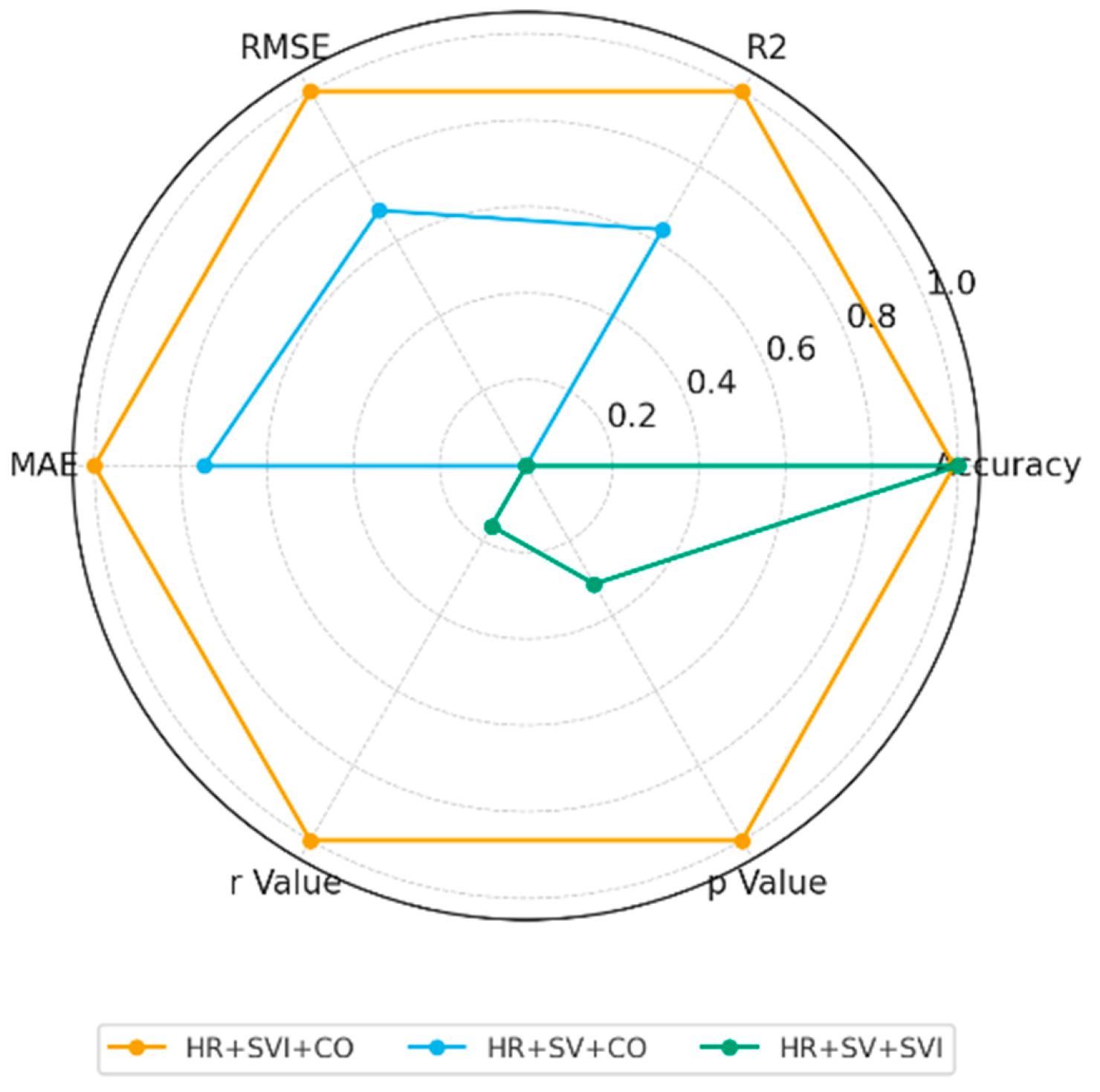
Building upon these findings, the study further examined how different combinations of cardiovascular indicators influence CI prediction performance to evaluate the model’s robustness under varying input conditions. As shown in
Table 9 and
Figure 6, the combination of SVI, HR, and CO yielded the best overall performance, achieving an MAE of 0.1236, an R
2 of 0.929, and attaining high classification performance on the held-out test set. It should be noted that this classification accuracy specifically refers to the binary classification task (CI ≥ 3 vs. CI < 3) and should not be confused with the regression-based accuracy defined under the 95% confidence interval. These results demonstrate that the three-to-one configuration (HR + SVI + CO) most effectively captures cardiac functional variations and provides stable, high-accuracy predictions.
Furthermore, to assess the model’s scalability when fewer physiological indicators are available, the study evaluated several two-to-one input combinations (HR + SV, HR + SVI), with results summarized in
Table 10. Despite reduced data dimensionality, the model maintained stable predictive performance. Among the evaluated combinations, HR + SVI achieved the best balance (MAE = 0.350, R
2 = 0.442), indicating that the model can still effectively capture cardiac hemodynamic patterns even with limited inputs.
Overall, the ANN architecture demonstrated strong flexibility and generalization capability. The three-input configuration achieved the best predictive performance and clinical relevance, while the two-input configurations showed promising potential for maintaining reliable predictions when fewer physiological inputs are available.
These findings suggest that the model’s ability to integrate varying physiological inputs provides a robust and adaptable solution for real-world applications. By maintaining predictive stability even in reduced-input scenarios, the proposed framework offers a practical approach to simplifying data acquisition while preserving accuracy, thereby enhancing its applicability for real-time, non-invasive CI prediction.
4. Discussion
This study successfully integrated IoT and IoMT technologies to collect multiple physiological parameters through non-invasive sensing and employed data augmentation and AI algorithms to enhance the accuracy and stability of CI prediction. The proposed FFNN demonstrated outstanding predictive performance, achieving a classification accuracy of 97.78%, a coefficient of determination of 0.929, and a mean absolute error of 0.1236. Compared with conventional multiple linear regression models that achieved only 53.33% accuracy, the proposed network exhibited superior nonlinear learning and adaptive optimization capabilities, effectively capturing the complex hemodynamic relationships within physiological data. These results confirm the high reliability and clinical applicability of the proposed model.
The analysis of different input feature combinations revealed that the model performed best when HR, SVI, and CO were used as input variables. Even when the input dimension was reduced to two features, such as HR with CO or SVI, the network maintained strong predictive stability and regression performance. This demonstrates that the neural architecture remains robust and generalizable even when fewer sensing parameters are available, highlighting its potential for practical deployment in clinical or portable healthcare environments where sensor availability may be limited.
The results further indicate that the model can effectively predict CI variations across diverse subjects, including extreme values, even when using a limited number of physiological indicators. This capability suggests that the proposed approach is not only suitable for general cardiovascular monitoring but also for early-stage assessment in high-risk or abnormal cases. Building upon these promising outcomes, future work will focus on optimizing the model to maintain high classification accuracy while improving the precision of CI estimation using a minimal set of input features, thereby expanding the versatility and applicability of the system.
Nevertheless, several limitations should be acknowledged. First, the study is based on a relatively small sample size, which may limit the generalizability of the findings. Second, although data augmentation techniques were employed to enhance model robustness, augmented data do not represent independent subjects. Therefore, future work will focus on validating the proposed framework using larger and more diverse populations to further improve its generalization capability and clinical reliability.
5. Conclusions
In conclusion, this study demonstrated that integrating IoT- and IoMT-based sensing technologies with an FFNN significantly improves the accuracy, robustness, and clinical value of non-invasive CI prediction. The proposed model achieved 97.78% accuracy, a coefficient of determination of 0.929, and a mean absolute error of 0.1236, outperforming traditional regression methods. The ability to maintain strong predictive performance using only a small number of physiological features highlights its scalability, adaptability, and suitability for real-world clinical environments.
Future work will aim to refine the network to achieve accurate prediction across all subjects, including outlier cases, using minimal sensing parameters. This improvement will broaden the system’s applicability and facilitate its integration into intelligent, low-cost, and real-time cardiovascular health monitoring platforms. Expanding the dataset to include more diverse populations and incorporating multimodal signals with temporal deep learning models such as LSTM and GRU will further enhance the capability for dynamic cardiac trend analysis and personalized healthcare.
Author Contributions
Conceptualization, S.-L.C. and T.-Y.C.; data curation, C.-H.C. and P.-L.H.; formal analysis, T.-Y.C., T.-R.G. and C.-H.C.; funding acquisition, J.-C.W., I.E.C. and K.-C.L.; methodology, C.-H.C., M.-L.C. and L.-H.W.; resources, I.E.C. and L.-H.W.; software, T.-R.G., M.-L.C. and T.-K.C.; validation, P.-L.H., C.-H.C. and Y.-H.F.; visualization, Y.-H.F., T.-K.C. and P.A.R.A.; writing—original draft, P.-L.H. and C.-H.C.; writing—review and editing, J.-C.W., S.-L.C., K.-C.L. and P.A.R.A. All authors have read and agreed to the published version of the manuscript.
Funding
This work was supported by the Ministry of Science and Technology (MOST), Taiwan, under grant numbers NSTC 112-2221-E-033-049, 113-2622-E-033-001 and 114-2221-E-035-032.
Institutional Review Board Statement
This study was reviewed and approved by the Institutional Review Board (IRB) of the Chang Gung Medical Foundation, IRB No.: 202501987B0. The approval was granted on 7 January 2026, under an expedited review process for retrospective studies involving clinical records obtained from routine diagnosis or treatment, excluding HIV-positive cases. The approved study period is from 7 January 2026, to 6 January 2027, and is conducted at Chiayi Chang Gung Memorial Hospital. The study protocol complies with Good Clinical Practice (GCP) guidelines and all applicable regulations.
Informed Consent Statement
The IRB approves the waiver of the participants’ consent.
Data Availability Statement
The data that support the findings of this study are not publicly available due to confidentiality agreements, ethical restrictions, and institutional review board (IRB) regulations. These restrictions are implemented to protect participant privacy and ensure compliance with institutional policies and applicable legal requirements. The dataset contains sensitive personal information, and the study participants did not provide consent for public data sharing. Therefore, the data cannot be publicly disclosed.
Acknowledgments
We thank the physicians at Chiayi Chang Gung Memorial Hospital for their collaboration and the National Science and Technology Council (NSTC) for funding this research.
Conflicts of Interest
The authors declare no conflicts of interest.
References
- Prakash, N.; Mahesh, M.; Gouthaman, P. Cardiovascular Disease Risk Assessment using Machine Learning. In 2023 International Conference on Inventive Computation Technologies (ICICT); IEEE: New York, NY, USA, 2023; pp. 249–256. [Google Scholar] [CrossRef]
- Ahn, H.-J.; Lee, S.-R.; Choi, E.-K.; Han, K.-D.; Rhee, T.-M.; Kwon, S.; Kim, S.; Oh, S.; Lip, G.Y.H. Associations between obesity parameters and the risk of incident atrial fibrillation and ischaemic stroke in the different age groups. Front. Cardiovasc. Med. 2022, 9, 906844. [Google Scholar] [CrossRef]
- Kam, W.; Mohammed, W.S.; O’Keeffe, S.; Lewis, E. Portable 3-D Printed Plastic Optical Fibre Motion Sensor for Monitoring of Breathing Pattern and Respiratory Rate. In 2019 IEEE 5th World Forum on Internet of Things (WF-IoT); IEEE: New York, NY, USA, 2019; pp. 144–148. [Google Scholar] [CrossRef]
- Nwaneri, S.; Nnamdi, N. A systematic approach to the development of an iot-enabled cardiovascular monitoring device: A systematic approach to the development of an iot-enabled cardiovascular monitoring device. LAUTECH J. Eng. Technol. 2025, 19, 56–66. [Google Scholar] [CrossRef]
- Locharoenrat, K. IoMT–Fog–Cloud-based AI frameworks for chronic disease diagnosis: Updated comparative analysis with recent AI-IoMT models (2020–2025). Front. Med. Technol. 2026, 8, 1748964. [Google Scholar] [CrossRef] [PubMed]
- Wu, F.; Rüdiger, C.; Redouté, J.-M.; Yuce, M.R. WE-Safe: A wearable IoT sensor node for safety applications via LoRa. In 2018 IEEE 4th World Forum on Internet of Things (WF-IoT); IEEE: New York, NY, USA, 2018; pp. 144–148. [Google Scholar] [CrossRef]
- Laabab, I.; Ezzouhairi, A.; El Madhoun, N.; Khan, M.H. Blockchain and Biometric Systems Integration for IoMT Security. In 2024 8th Cyber Security in Networking Conference (CSNet); IEEE: New York, NY, USA, 2024; pp. 259–262. [Google Scholar] [CrossRef]
- Adewole, K.S.; Akintola, A.G.; Jimoh, R.G.; Mabayoje, M.A.; Jimoh, M.K.; Usman-Hamza, F.E.; Balogun, A.O.; Sangaiah, A.K.; Ameen, A.O. Cloud-based IoMT framework for cardiovascular disease prediction and diagnosis in personalized E-health care. In Intelligent IoT Systems in Personalized Health Care; Academic Press: Cambridge, MA, USA, 2021; pp. 105–145. [Google Scholar] [CrossRef]
- Islam, M.N.; Raiyan, K.R.; Mitra, S.; Mannan, M.M.R.; Tasnim, T.; Putul, A.O. Predictis: An IoT and machine learning-based system to predict risk level of cardio-vascular diseases. BMC Health Serv. Res. 2023, 23, 171. [Google Scholar] [CrossRef]
- Sun, L.; Yu, Q.; Peng, D.; Subramani, S.; Wang, X. FogMed: A Fog-Based Framework for Disease Prognosis Based Medical Sensor Data Streams. CMC-Comput. Mat. Contin. 2021, 66, 603–619. [Google Scholar] [CrossRef]
- Alghareeb, E.; Aljehani, N. AI in Health Care Service Quality: Systematic Review. JMIR AI 2025, 4, e69209. [Google Scholar] [CrossRef]
- Liu, T.; Krentz, A.J.; Huo, Z.; Ćurčin, V. Opportunities and Challenges of Cardiovascular Disease Risk Prediction for Primary Prevention Using Machine Learning and Electronic Health Records: A Systematic Review. Rev. Cardiovasc. Med. 2025, 26, 37443. [Google Scholar] [CrossRef]
- Yildirim, O.; Talo, M.; Ciaccio, E.J.; Tan, R.S.; Acharya, U.R. Accurate deep neural network model to detect cardiac arrhythmia on more than 10,000 individual subject ECG records. Comput. Methods Programs Biomed. 2020, 197, 105740. [Google Scholar] [CrossRef] [PubMed]
- Yildirim, O.; Baloglu, U.B.; Tan, R.-S.; Ciaccio, E.J.; Acharya, U.R. A new approach for arrhythmia classification using deep coded features and LSTM networks. Comput. Methods Programs Biomed. 2019, 176, 121–133. [Google Scholar] [CrossRef]
- Deo, R.C. Artificial Intelligence and Machine Learning in Cardiology. Circulation 2024, 149, 1235–1237. [Google Scholar] [CrossRef]
- Cai, Y.Q.; Gong, D.X.; Tang, L.Y.; Cai, Y.; Li, H.J.; Jing, T.C.; Gong, M.; Hu, W.; Zhang, Z.W.; Zhang, X.; et al. Pitfalls in Developing Machine Learning Models for Predicting Cardiovascular Diseases: Challenge and Solutions. J. Med. Internet Res. 2024, 26, e47645. [Google Scholar] [CrossRef]
- Chan, M.; Yu, Y.; Chang, P.; Chen, T.-Y.; Wong, H.-L.; Huang, J.-H.; Zhang, W.; Chen, S.-L. Optimizing Cardiovascular Health Monitoring with IoT-Enabled Sensors and AI: A Focus on Obesity-Induced Cardiovascular Risks in Young Adults. Electronics 2025, 14, 121. [Google Scholar] [CrossRef]
- Krishnamurthy, H.; P S, A.; Kumar, M.; T K, C. IoT-Enabled Predictive Analytics for Early Detection of CAHD—A Data Driven Framework Section A—Research paper IoT-Enabled Predictive Analytics for Early Detection of CAHD—A Data Driven Framework. European Chemical Bulletin, November 2024.
- Nandagopal, M.; Seerangan, K.; Govindaraju, T.; Abi, N.E.; Balusamy, B.; Selvarajan, S. A Deep Auto-Optimized Collaborative Learning (DACL) model for disease prognosis using AI-IoMT systems. Sci. Rep. 2024, 14, 10280. [Google Scholar] [CrossRef] [PubMed]
- Bikia, V.; Rovas, G.; Stergiopulos, N. Cardiac output estimated from an uncalibrated radial blood pressure waveform: Validation in an in-silico-generated population. Front. Bioeng. Biotechnol. 2023, 11, 1199726. [Google Scholar] [CrossRef] [PubMed]
- Pati, A.; Parhi, M.; Pattanayak, B.K.; Singh, D.; Samanta, D.; Banerjee, A.; Biring, S.; Dalapati, G.K. Diagnose Diabetic Mellitus Illness Based on IoT Smart Architecture. Wirel. Commun. Mob. Comput. 2022, 2022, 7268571. [Google Scholar] [CrossRef]
- Patel, N.; Durland, J.; Awosika, A.O.; Makaryus, A.N. Physiology, Cardiac Index. In StatPearls; StatPearls Publishing: Orlando, FL, USA, 2026. Available online: http://www.ncbi.nlm.nih.gov/books/NBK539905/ (accessed on 1 April 2026).
- Ngan, C.; Zeng, X.; Lia, T.; Yin, W.; Kang, Y. Cardiac index and heart rate as prognostic indicators for mortality in septic shock: A retrospective cohort study from the MIMIC-IV database. Heliyon 2024, 10, e28956. [Google Scholar] [CrossRef]
- Puth, M.-T.; Neuhäuser, M.; Ruxton, G.D. Effective use of Pearson’s product–moment correlation coefficient. Anim. Behav. 2014, 93, 183–189. [Google Scholar] [CrossRef]
- Darabi, S.; Fazeli, S.; Pazoki, S.; Sankararaman, S.; Sarrafzadeh, M. Contrastive Mixup: Self- and Semi-Supervised learning for Tabular Domain. arXiv 2021, arXiv:2108.12296. [Google Scholar] [CrossRef]
- Kim, G.I.; Chung, K. Extraction of Features for Time Series Classification Using Noise Injection. Sensors 2024, 24, 6402. [Google Scholar] [CrossRef]
- Aishwarya, D.C.; Babu, C.N. Prediction of Time Series Data Using GA-BPNN Based Hybrid ANN Model. In 2017 IEEE 7th International Advance Computing Conference (IACC); IEEE: New York, NY, USA, 2017; pp. 848–853. [Google Scholar] [CrossRef]
- Rao, Z.; Guo, B.; Zu, J.; Zheng, W.; Xu, Y.; Yang, Y. Construction of an ECL-DPV Dual Model Biosensor for Dopamine Detection Based on PSO-ANN Algorithm. IEEE Sens. J. 2024, 24, 7463–7472. [Google Scholar] [CrossRef]
- Kakarla, S.; Mahany, D. Implementation of Artificial Neural Networks and Machine Learning Algorithms to Evaluate and Predict Educational Student Dropout Metrics. In 2024 6th International Workshop on Artificial Intelligence and Education (WAIE); IEEE: New York, NY, USA, 2024; pp. 102–106. [Google Scholar] [CrossRef]
- Ganaie, M.A.; Tanveer, M.; Beheshti, I. Brain Age Prediction With Improved Least Squares Twin SVR. IEEE J. Biomed. Health Inform. 2023, 27, 1661–1669. [Google Scholar] [CrossRef] [PubMed]
- Sun, P.; Liu, X.; Lin, M.; Wang, J.; Jiang, T.; Wang, Y. Transmission Line Fault Diagnosis Method Based on Improved Multiple SVM Model. IEEE Access 2023, 11, 133825–133834. [Google Scholar] [CrossRef]
- Dai, Z.; Qian, X.; Kang, C.; Wang, L.; Guan, S.; Zhao, Y. A k-Nearest Neighbor Wind Turbine Fault Detection Method Based on Deep Metric Learning and Domain Feature Discrimination. IEEE Access 2024, 12, 181666–181678. [Google Scholar] [CrossRef]
- Huang, Z.; Li, X.; Du, H.; Zou, W.; Zhou, G.; Mao, F. An Algorithm of Forest Age Estimation Based on the Forest Disturbance and Recovery Detection. IEEE Trans. Geosci. Remote Sens. 2023, 61, 4409018. [Google Scholar] [CrossRef]
| Disclaimer/Publisher’s Note: The statements, opinions and data contained in all publications are solely those of the individual author(s) and contributor(s) and not of MDPI and/or the editor(s). MDPI and/or the editor(s) disclaim responsibility for any injury to people or property resulting from any ideas, methods, instructions or products referred to in the content. |




 ,
,