Article

HIV-Associated Microstructural Abnormalities in Default Mode, Executive Control, and Salience Networks: Insights from Tensor-Valued Diffusion Encoding


1
Department of Neurology, University of Rochester, Rochester, NY 14642, USA
2
Department of Biomedical Engineering, University of Rochester, Rochester, NY 14627, USA
3
Department of Electrical and Computer Engineering, University of Rochester, Rochester, NY 14627, USA
4
Department of Radiology, University of Manitoba, Winnipeg, MB R3A 1R9, Canada
5
Department of Biostatistics and Computational Biology, University of Rochester, Rochester, NY 14642, USA
6
Department of Imaging Sciences, University of Rochester, Rochester, NY 14642, USA
*
Author to whom correspondence should be addressed.
Bioengineering 2026, 13(4), 413; https://doi.org/10.3390/bioengineering13040413

Submission received: 18 February 2026 / Revised: 25 March 2026 / Accepted: 28 March 2026 / Published: 1 April 2026
(This article belongs to the Special Issue Neuroimaging Techniques and Applications in Neuroscience)

Abstract

Cognitive impairment persists in people with HIV (PWH) despite effective combination antiretroviral therapy, possibly as a result of persistent alterations in white matter microstructural abnormalities in the brain. Noninvasive tensor-valued diffusion MRI (dMRI) is sensitive to microstructural integrity; thus, it may contribute to the understanding of HIV-associated cognitive impairment. In this exploratory cross-sectional study, 31 healthy controls (HCs) and 24 PWH underwent 3T MRI and neurocognitive assessment. Tensor-valued dMRI metrics, including microscopic fractional anisotropy (µFA) and isotropic, anisotropic, and total mean kurtosis (MKi, MKa, MKt), and conventional DTI and DKI metrics (FA, MD, and MK) were evaluated across six functionally defined brain networks. Compared with HCs, PWH exhibited reduced FA, µFA, and MKa in the dorsal default mode and anterior salience networks, along with increased MKi in the salience network and decreased MKi in the executive control network, with moderate effect sizes. Compared with HCs, PWH performed significantly worse on measures of learning, memory, and language, but showed no differences in executive function, attention, or processing speed. Additionally, significant associations and interactions between dMRI metrics and HIV status were observed, particularly for MKi and attention, executive function, and processing speed across the default mode, salience, and executive control networks. These preliminary findings underscore tensor-valued dMRI as a sensitive biomarker of network-specific neurocognitive vulnerability in HIV.

1. Introduction

Although combination antiretroviral therapy (cART) has substantially improved clinical outcomes, people with HIV (PWH) continue to show a risk of cognitive impairment, with nearly 50% exhibiting subtle changes in executive function, information processing speed, attention, and motor skills, even with effective viral suppression [1,2,3]. Although combination antiretroviral therapy (cART) has substantially improved clinical outcomes, PWH continue to show a risk of cognitive impairments. These impairments are thought to arise from a combination of factors, including past uncontrolled viral replication, persistent immune activation, and cART-associated neurotoxicity [3]. Chronic mild neuroinflammation is considered a primary driver in HIV-associated cognitive impairment, and the aging population on cART faces additional risks from comorbidities and certain neurotoxic antiretroviral regimens [4,5,6]. Advanced, noninvasive, sensitive, and reproducible neuroimaging methods may help to understand mechanisms of neurocognitive dysfunction in HIV by better characterizing HIV-associated microstructural injury.
Diffusion magnetic resonance imaging (dMRI) provides a quantitative assessment of tissue microstructure noninvasively by sensitizing the MR signal to the stochastic displacement of water molecules [7,8,9,10,11]. In conventional diffusion tensor imaging (DTI), scalar indices such as mean diffusivity (MD) and fractional anisotropy (FA) are estimated to characterize average diffusivity and diffusion anisotropy within a voxel, respectively. However, the diffusion tensor model is constrained by a Gaussian diffusion assumption and a single-compartment representation, which limits its specificity in regions with complex fiber architecture, heterogeneous cellular environments, or increased extracellular water content [12,13,14]. Therefore, differences in microstructural characteristics, such as axonal density, fiber orientation dispersion, and partial-volume effects, may be confounded by DTI-derived metrics. Advanced dMRI models have been developed to better characterize pathological tissue and overcome these constraints. Diffusion kurtosis imaging (DKI), for example, offers enhanced sensitivity to microstructural heterogeneity and captures non-Gaussian diffusion behavior [15,16]. Previous works on HIV have shown that PWH have lower FA and mean kurtosis (MK) than HCs, which suggests that DKI may be able to identify subtle microstructural abnormalities [17]. However, because MK reflects several microstructural characteristics, including anisotropy, compartmental heterogeneity, and microscopic restrictions, which are combined into a single MK metric in standard DKI, limiting biological specificity, the biological interpretation of MK is still difficult.
By using multidimensional b-tensor encoding schemes, such as linear and spherical tensor encodings (LTE and STE), which more accurately capture the intricate microstructure of brain tissue, tensor-valued dMRI overcomes the aforementioned limitations [18]. The total mean kurtosis (MKt) can be decomposed into anisotropic (MKa) and isotropic (MKi) components using this framework. MKa predominantly reflects variance in diffusion arising from orientation-dependent microstructural anisotropy, such as axonal alignment and dispersion, whereas MKi quantifies orientation-invariant diffusion heterogeneity related to variability in compartmental size, cellular packing, and changes in intracellular volume fraction. In addition, unlike FA, which is strongly confounded by fiber orientation dispersion and crossing fibers [10], tensor-valued diffusion encoding decouples microscopic fractional anisotropy (µFA) from macroscopic orientation effects [19,20,21]. That is, tensor-valued dMRI provides more specific and biologically meaningful measures of tissue microstructural integrity. Several previous studies have documented that tensor-valued dMRI metrics have demonstrated increased sensitivity for detecting microstructural abnormalities in both gray and white matter in HIV and other neurological disorders, offering improved interpretability and performance compared with conventional DTI- and DKI-based measures [20,22,23].
It is well established that HIV is associated with white matter abnormalities that can lead to cognitive impairment [24,25,26]. However, the pathways through which HIV-related brain changes translate into deficits across cognitive domains remain incompletely characterized, and prior dMRI studies have reported inconsistent findings [27,28]. In addition, most prior MRI studies, particularly those using dMRI, have relied on anatomically defined regions of interest (ROIs) to extract imaging metrics and relate them to cognitive performance. However, cognitive functions are mediated by distributed, network-level circuits rather than strictly defined anatomical regions. Functionally defined atlases [29,30,31] provide a more biologically meaningful framework by grouping voxels with similar functional connectivity or microstructural roles, thereby reducing within-ROI heterogeneity and partial-volume effects. This approach enhances sensitivity and specificity when linking microstructural abnormalities to cognitive outcomes, especially in conditions characterized by subtle, diffuse, or network-specific damage.
In this pilot study, we investigated conventional DTI and DKI, and tensor-valued dMRI metrics across functionally defined white matter brain networks and evaluated their associations with cognitive performance in PWH and HCs. We hypothesized that tensor-valued dMRI would reveal network-specific microstructural alterations in PWH and demonstrate stronger and more specific relationships with cognition than conventional DTI and DKI measures.

2. Materials and Methods

Study Participants: A prior study reported quantitative dMRI analysis in gray and white matter using an anatomically defined atlas and examined their associations with cognition and blood markers [32]. The present work analyzed the same dMRI dataset from the same cohort using functionally defined brain networks to assess relationships with cognitive performance. This work was conducted as a sub-study of a project approved by the Institutional Research Subjects Review Board (RSRB) at the University of Rochester. Twenty-four PWH (mean age 55 ± 10 years; 7 female) and 31 age- and sex-matched HC participants (mean age 55 ± 15 years; 7 female) were recruited from Rochester, NY, and surrounding areas. Written informed consent was obtained from each participant prior to their participation in the study. Participants then underwent a series of clinical, laboratory, neurocognitive, and brain MRI evaluations, all conducted in accordance with approved ethical and regulatory frameworks. A brief overview of cohort demographics and clinical characteristics is presented in Table 1. It is noteworthy that the study participants had several major comorbidities, including hypertension, hyperlipidemia, high cholesterol, anxiety, depression, and neuropathy.
Detailed inclusion and exclusion criteria have been reported previously [33]. Briefly, PWH were ≥18 years old, on stable cART for at least three months before screening, and HIV-1 seropositive with documented infection, and had viral load ≤200 copies/mL. Exclusion criteria included symptomatic cardiovascular disease, uncontrolled vascular risk factors, severe psychiatric disorders, non-HIV-related brain infections, space-occupying lesions, dementia, and MRI contraindications. The control group differed (p < 0.05) from the PWH group by HIV status, education level, and race.
Neuropsychological assessments: All participants completed a comprehensive neuropsychological battery assessing seven cognitive domains. Information processing speed was evaluated with the Symbol Digit Modalities Test, the Stroop Color and Word Test (Color Naming), and the Trailmaking Test A. Executive function was evaluated using the Stroop Color and Word Test (Interference) and the Trailmaking Test B, attention and working memory were evaluated via the Letter Number Sequencing subtest of the Wechsler Adult Intelligence Scale and the California Computerized Assessment Package (CalCAP), learning was evaluated with the Immediate recall trials of the Rey Auditory Verbal Learning Test and the Rey Complex Figure Test, memory was evaluated with the delayed recall portions of both tests, language was evaluated with the Controlled Oral Word Association Test, and motor function was evaluated with the Grooved Pegboard test.
All tests were scored and administered by trained psychometrists under the supervision of a licensed clinical neuropsychologist. For each individual test, raw scores were converted to standardized z-scores using published, manualized norms that account for age and education. Composite domain scores were then computed by averaging the z-scores of the constituent tests within each of the seven domains. A total cognitive z-score was also calculated by summing the seven domain-specific z-scores.
MRI data acquisition: MRI data were acquired on a 3T whole-body scanner (MAGNETOM Prisma Fit, Siemens Healthineers, Erlangen, Germany; software version VE11c) equipped with a 64-channel head coil. The system provides a maximum gradient strength of 80 mT/m and a slew rate of 200 mT/m/s.
Anatomical MRI: High-resolution anatomical images were obtained using a three-dimensional T1-weighted (T1w) magnetization-prepared rapid acquisition gradient-echo (MPRAGE) sequence. Imaging parameters included inversion time (TI) = 926 ms, repetition time (TR) = 1840 ms, echo time (TE) = 2.45 ms, GeneRalized Autocalibrating Partial Parallel Acquisition (GRAPPA) acceleration factor = 2, and flip angle = 8°, sagittal orientation, field of view (FOV) = 256 × 256 × 192 mm3, total number of slices = 192, resolution = 1.0 × 1.0 × 1.0 mm3, and total scan time = 4 min 26 s.
Tensor-valued diffusion encoding: Diffusion-weighted imaging (DWI) was performed using a prototype free-waveform (FWF) encoding single-shot spin-echo sequence with concomitant gradient compensation (v1.13s) [34]. The sequence implementation is publicly available (https://github.com/filip-szczepankiewicz/fwf_seq_resources, accessed on 5 September 2023). Eighty DWI volumes were acquired, consisting of 43 volumes with linear tensor encoding (LTE) and 37 volumes with spherical tensor encoding (STE). Data were sampled at multiple diffusion weightings (b = 0, 100, 700, 1400, and 2000 s/mm2). Sequence parameters included TR = 4100 ms, TE = 91 ms, FOV = 224 × 224 × 30 mm3, echo spacing = 0.6 ms, GRAPPA acceleration factor = 2, partial Fourier acquisition = 6/8, axial orientation, number of slices = 30, and resolution = 2.0 × 2.0 × 4.0 mm3. Phase encoding was applied in the anterior–posterior direction, and total scan time was 5 min 53 s.
Image Analysis: Image analyses were performed using MATLAB (version 2023b), FMRIB Software Library (FSL https://fsl.fmrib.ox.ac.uk/fsl/fslwiki/, accessed on 5 September 2023) [35], and Advanced Normalization Tools (ANTs http://stnava.github.io/ANTs/, accessed on 5 September 2023) [36].
All images were visually checked to identify major artifacts, such as subject bulk motion, geometric distortion, or signal loss. T1w anatomical images were then processed using FSL’s fsl_anat pipeline [37], which included image reorientation, correction of intensity nonuniformity, skull stripping using Brain Extraction Tool (BET) [38], tissue segmentation with FMRIB’s Automated Segmentation Tool (FAST), subcortical segmentation via FMRIB’s Integrated Registration and Segmentation Tool (FIRST), and both linear and nonlinear registration to the MNI 2 mm template using FMRIB’s Linear Image Registration Tool (FLIRT) and FMRIB’s Nonlinear Image Registration Tool (FNIRT).
The dMRI metrics (b-tensor encoded, DTI, and DKI) were quantified using a multidimensional dMRI (MD-dMRI) framework [39] (https://github.com/markus-nilsson/md-dmri, accessed on 5 September 2023). Major image processing steps: (1) raw DWI images were corrected for eddy-current-induced distortions and inter-volume subject motion using an extrapolation-based registration implemented in ElastiX (version 5.0.0) [40,41], which is particularly suited for datasets acquired at high diffusion weightings; (2) the images were spatially smoothed using a 3D Gaussian filter with a standard deviation of 0.4 voxels; (3) voxel-wise dMRI metrics were estimated by fitting the log-transformed signal using linear least-squares regression with heteroscedasticity correction via the dtd_covariance method [19,21,39]. This procedure yielded measures of anisotropic, isotropic, and total diffusional variance (MKa, MKi, MKt) and µFA. Conventional DTI metrics, including FA and MD, as well as DKI metrics such as MK, were also computed from the same tensor-valued dMRI dataset using the same processing framework [42].
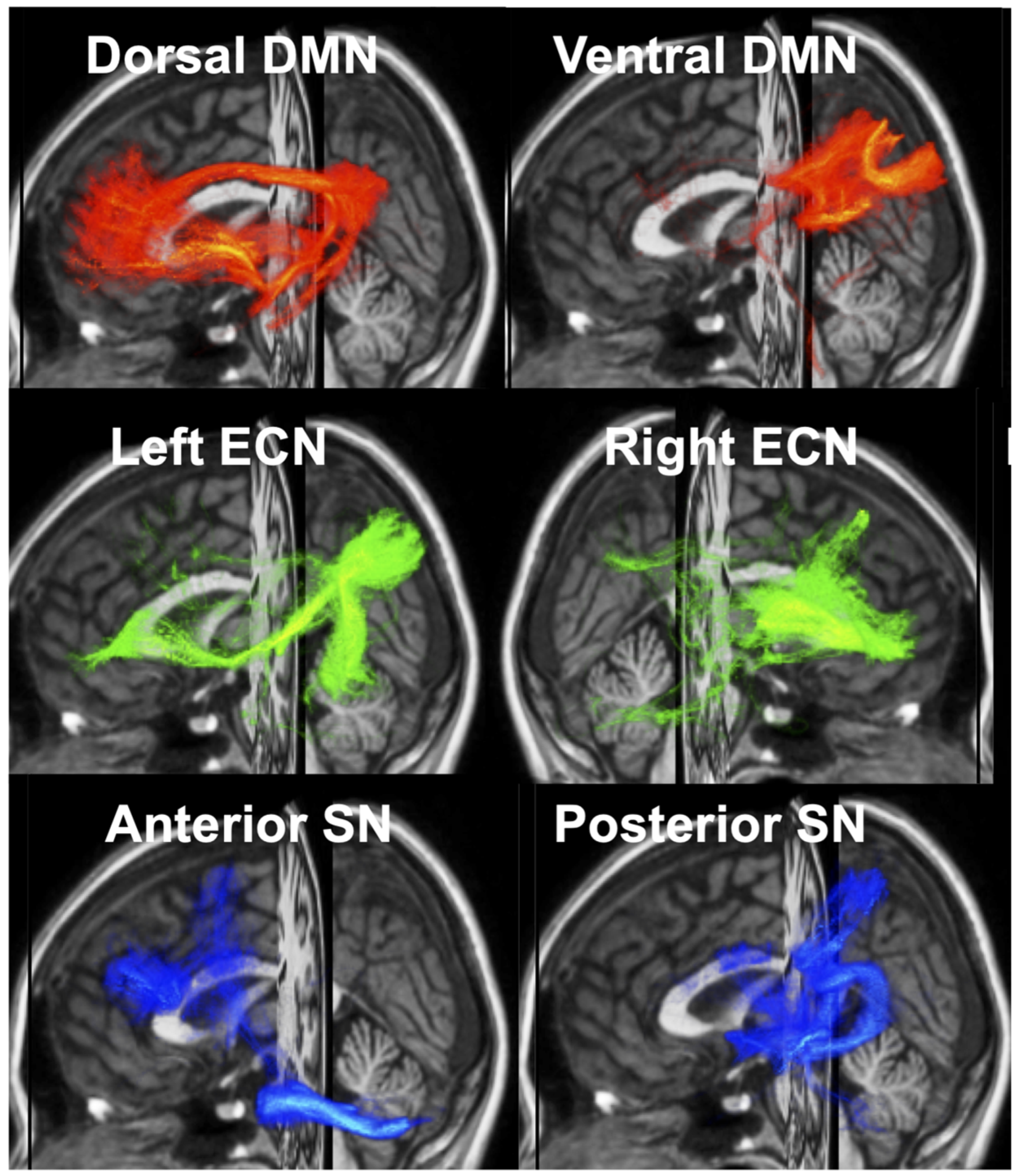
ROI analysis: The UManitoba–JHU functionally defined human white matter atlases [29,30] and b-tensor derived maps were nonlinearly registered to native DWI space using ANTs [43]. ROI mean values were then extracted from white matter pathways corresponding to 6 previously defined intrinsic functional brain networks [31], including the dorsal and ventral Default Mode Network (DMN_D, DMN_V), left and right Executive Control Network (ECN_L, ECN_R), and anterior and posterior Salience Network (SN_A, SN_P). Although the atlas defines 12 functional networks, we focused our analyses on these 6 networks due to their established involvement in HIV-associated cognitive impairment [44,45]. Figure 1 illustrates the 6 functionally defined brain networks.
Statistical Analyses: All statistical analyses were performed using Python (version 3.7.4). with NumPy (version 1.26.3) and SciPy (version 1.11.4), and data visualization was conducted using Seaborn (version 0.11.2). Group differences in dMRI metrics within functionally defined ROIs were evaluated using two-sample t-tests. Associations between dMRI metrics and cognitive performance were assessed using Spearman correlation analyses with age and sex included as covariates to control for their potential confounding effects.
To examine the combined effects of HIV status and dMRI metrics on cognitive performance, an ordinary least squares (OLS) linear regression model was constructed with cognitive performance modeled as a function of dMRI metrics, HIV status, and their interaction (i.e., Cognitive score = dMRI metrics + HIV status + dMRI metrics × HIV status). Statistical significance was defined as p < 0.05 for single comparisons.
Effect sizes were calculated to quantify the magnitude of observed associations and group differences. For group comparisons, Cohen’s d was computed from group means and standard deviations using the pooled standard deviation. For correlation analyses, effect sizes were derived from Spearman correlation coefficients (r) using the transformation ( d = 2 r 1 r 2 ). For OLS linear regression models comparing two groups with interactions, Cohen’s d was estimated from the t-statistic using ( d = t 1 n 1 + 1 n 2 , where n1 and n2 represent the sample sizes of the two groups. Effect sizes were interpreted using conventional benchmarks (small ≈ 0.2, medium ≈ 0.5, large ≥ 0.8).

3. Results

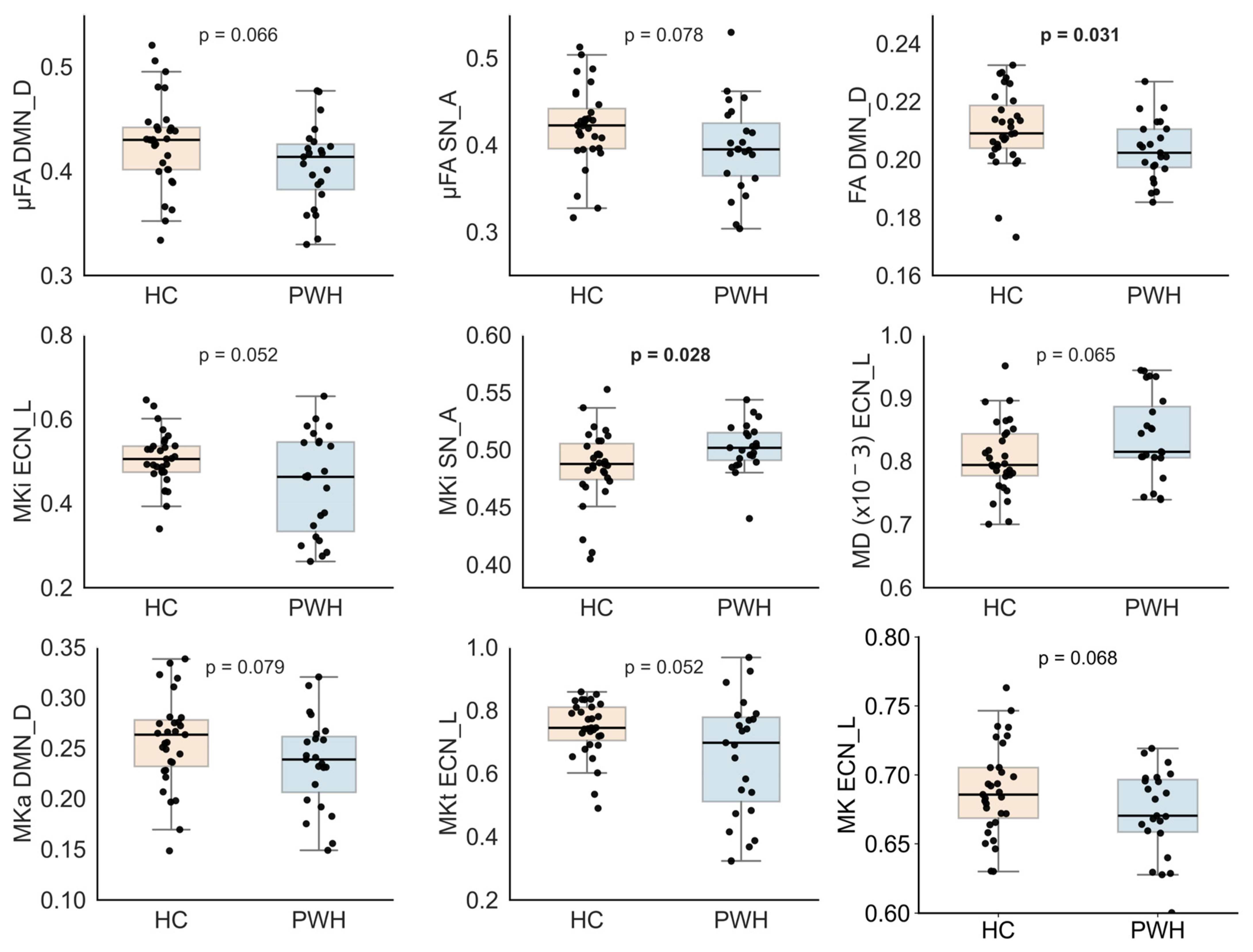
Figure 2 illustrates group comparisons of dMRI metrics across functionally defined brain networks, including only regions showing effects at p < 0.1. We found that PWH demonstrated evidence of altered tissue microstructure relative to HCs, particularly within core cognitive networks. As expected, both µFA and conventional FA, as well as MKa, were reduced in the DMN_D and the SN_A in PWH compared with HCs. A statistically significant reduction was observed for FA in DMN_D (p = 0.031), while reductions in µFA and MKa in DMN_D and SN_A reached marginal significance (p > 0.05 but <0.1).
In contrast, PWH revealed significantly increased MKi in SN_A (p = 0.028), whereas MKi was reduced in the ECN_L (p = 0.052) compared with HCs. Additionally, MKa was marginally decreased in DMN_D (p = 0.079), MKt was reduced in DMN_V (p = 0.074) and ECN_L (p = 0.052), and MK was reduced in ECN_L (p = 0.068) in PWH relative to HCs.
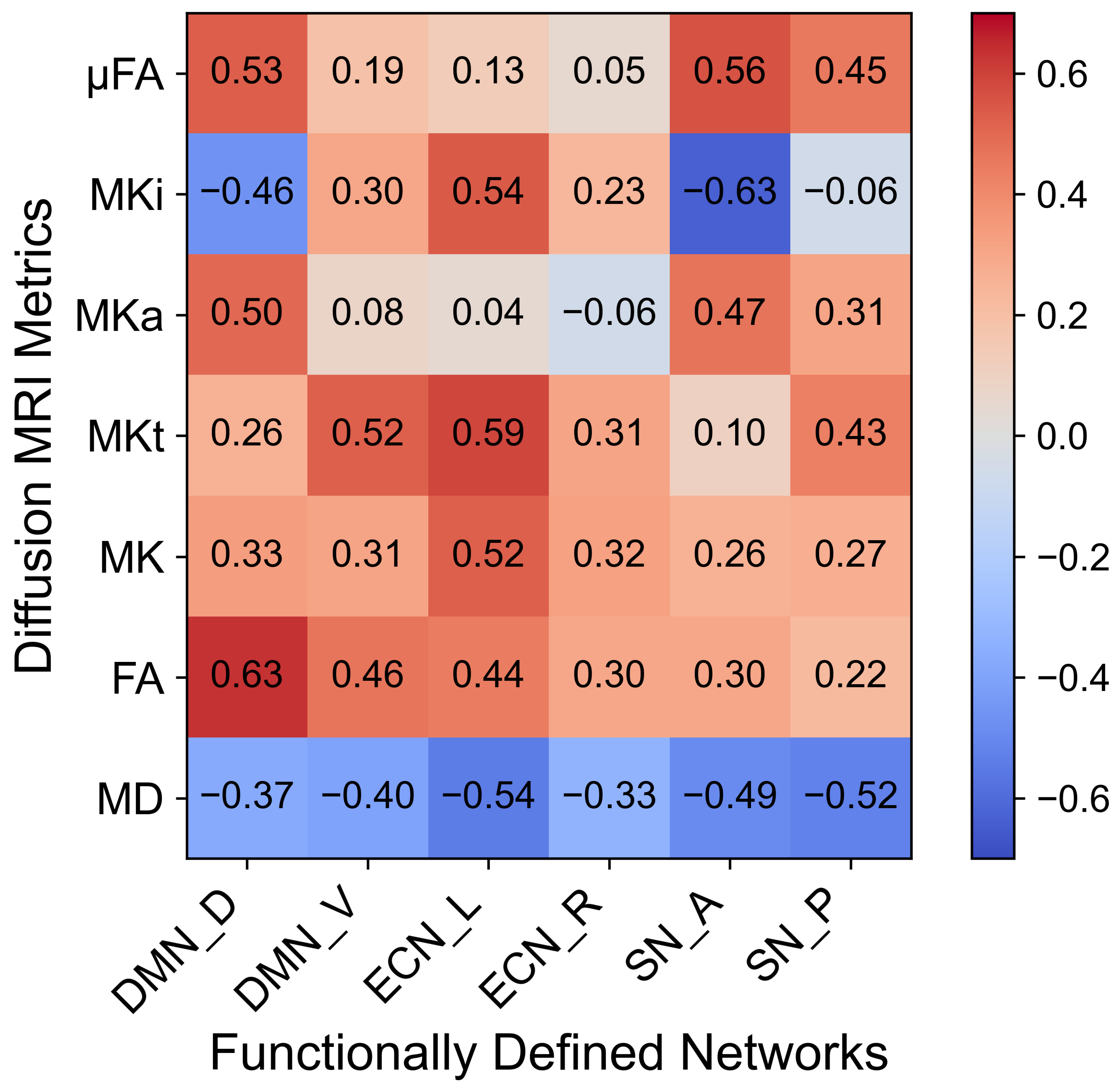
Further, the effect size analysis revealed small to moderate group differences across dMRI metrics and functional networks (Figure 3). FA had the strongest positive effects in the DMN_D (d = 0.63) and MKt in the ECN_L (d = 0.59), while MD had consistently negative effects across networks (d ≈ −0.33 to −0.54). MKi in SN_A had a significant negative effect (d = −0.63), suggesting network-specific microstructural differences between HCs and PWH.
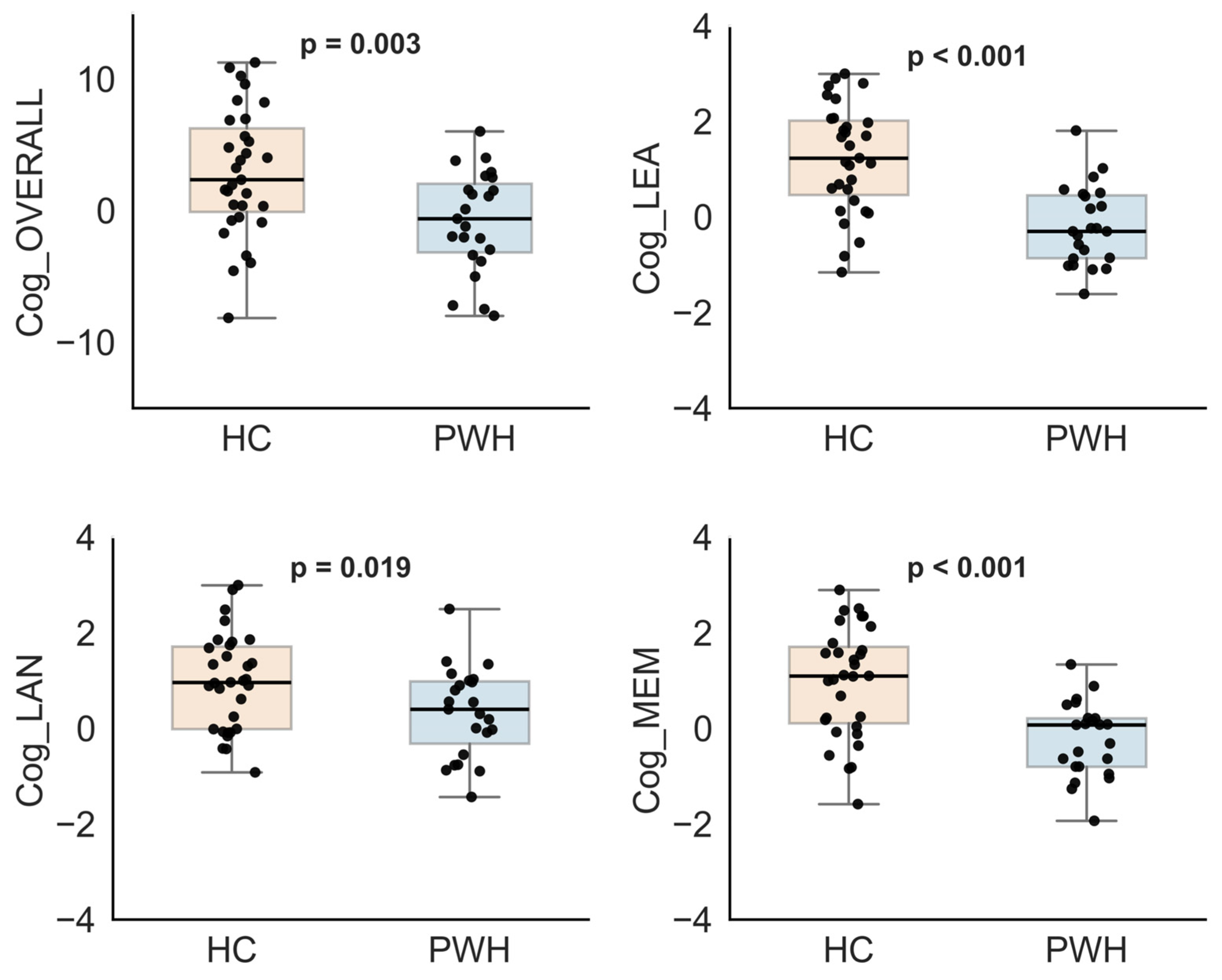
Figure 4 presents comparisons of cognitive domain scores between PWH and HCs. PWH had significantly lower overall cognitive scores than HCs. Follow-up analyses revealed that these differences were specific to the learning, language, and memory domains (p < 0.05). In contrast, no significant group differences were observed for executive function, attention, motor skills, or processing speed. In addition, effect size analysis indicated large group differences in learning (d = 1.43) and memory (d = 1.22), as well as moderate to large effects in overall cognition (d = 0.84) and language (d = 0.66). Executive function, attention, and processing speed domains, on the other hand, showed only small effects.
We next examined associations between cognitive scores and tensor-valued dMRI metrics across six functionally defined brain networks. Spearman correlation coefficients and effect sizes between dMRI metrics and cognitive domains are summarized in Table 2. In PWH, most significant correlations (|r| ≈ 0.5, p < 0.05) involved executive function (EXE), which was associated with µFA and MKa (positive) and MKi and MD (negative) in DMN_D, DMN_V, ECN_R, and SN_A, with large effect sizes (|d| ≈ 0.9–1.35). Processing speed (SPE) also showed significant associations with MKi across multiple networks, including DMN_D, DMN_V, and SN_A (|r| ≈ 0.6, p < 0.05, |d| up to 1.58). In contrast, among HCs, significant correlations were predominantly observed between attention (ATT) and µFA, MKa, MKt, and MD within several networks, including DMN_D, DMN_V, ECN_R, and SN_A (p < 0.05), with large effect sizes (|d| ≈ 0.9–1.28).
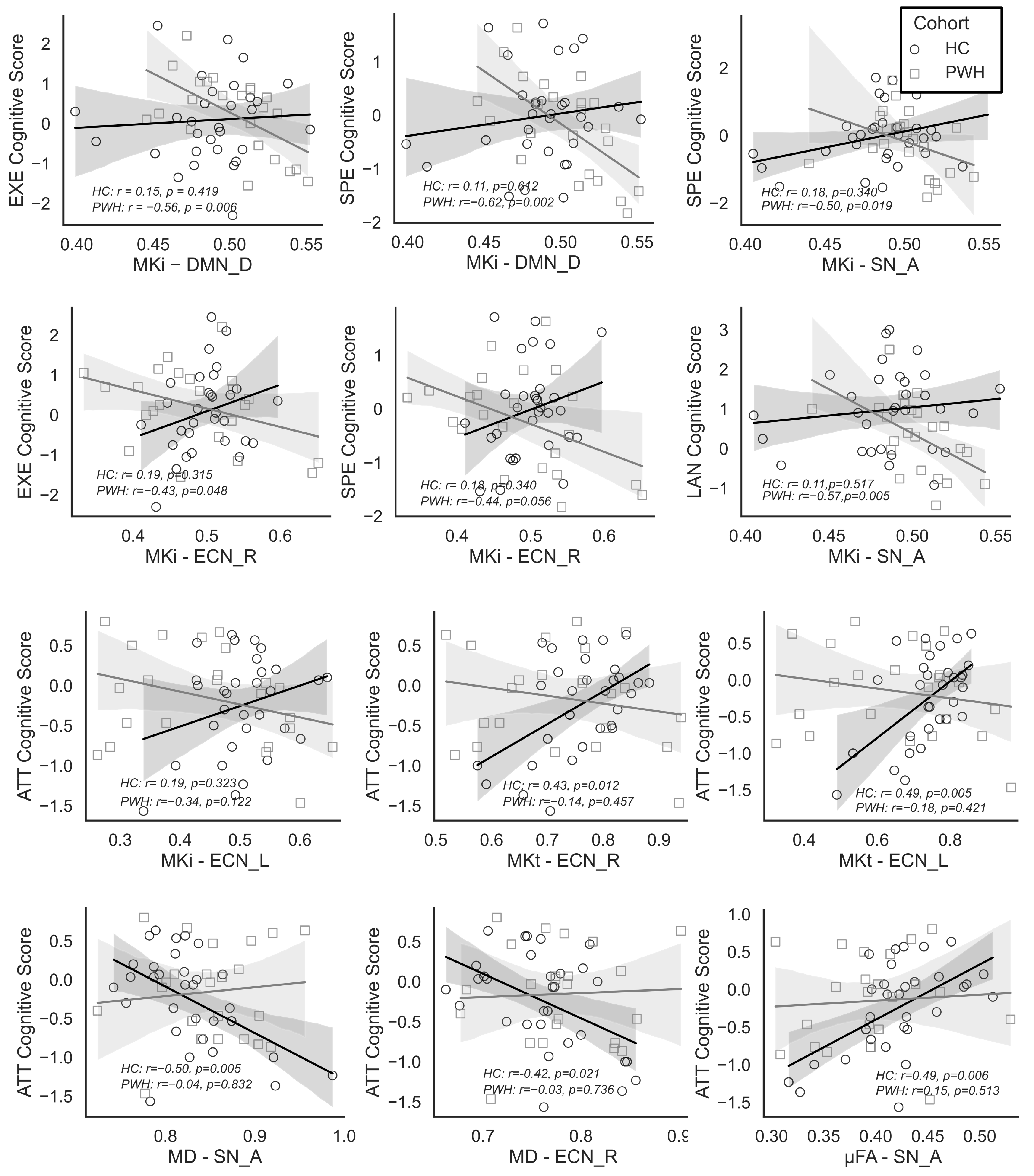
We used an ordinary least squares (OLS) linear regression model to further investigate associations between cognitive domain scores and dMRI metrics, assessing the main effects of HIV status and dMRI metrics, as well as their interaction, across six functionally defined ROIs. Consistent with our two-group analyses, HIV status exhibited significant main effects on cognitive scores across all reported models. While dMRI metrics did not show significant main effects, their interactions with HIV status were significant across multiple networks, strongly suggesting that there are HIV-specific associations between dMRI measures and cognition. Figure 5 depicts the plots of cognitive scores versus dMRI measures, whereas Table 3 summarizes representative results, reporting only statistically significant interactions.
In DMN_D, executive function (EXE) interacted significantly with MKi (d = −0.65, p = 0.018), and HIV status had a significant main effect (d = 0.67, p = 0.016). EXE also showed a significant interaction (d = −0.59, p = 0.031) and a main effect of HIV status (d = 0.60, p = 0.029) in the ECN_R.
For attention (ATT), MKi in the ECN_L had a significant interaction with HIV status (d = −0.57, p = 0.037). MKt had stronger effects in both ECN_L (d = −0.94, p = 0.001) and ECN_R (d = −0.82, p = 0.004) and showed significant interactions with HIV status. In addition, MD in the ECN_R (d = 0.54, p = 0.047) and MD in the SN_A (d = 0.65, p = 0.019) had significant interaction effects. Significant interactions with medium effect sizes were also found for µFA (d = −0.55, p = 0.044) and FA (d = −0.63, p = 0.021) in the SN_A.
HIV status significantly influenced processing speed (SPE) across several networks (d = 0.59–0.82, p < 0.05). MKi showed significant interaction effects in the DMN_D (d = −0.83, p = 0.003), ECN_R (d = −0.62, p = 0.024), and SN_A (d = −0.70, p = 0.012). Furthermore, a significant interaction between MKi and language (LAN) was found in SN_A (d = −0.65, p = 0.018).

4. Discussion

In this pilot study, we used dMRI to investigate the effects of HIV infection on white matter microstructure across functionally defined brain networks and how these microstructural changes relate to domain-specific cognitive performance. Our findings show that tensor-valued dMRI metrics are more sensitive to microstructural alterations in functionally defined networks than conventional DTI and DKI metrics, as evidenced by group differences in PWH and HCs. In addition, PWH exhibit significant associations and interactions between dMRI metrics, with tensor-valued metrics having a higher sensitivity to HIV status, which influences cognitive outcomes compared to HCs. These results demonstrate that tensor-valued dMRI metrics outperform conventional dMRI metrics in quantifying subtle neuroaxonal damage and the impact of HIV on cognition. It should be noted that the primary goal of this study is hypothesis generation in an exploratory pilot context; we present unadjusted p-values and effect sizes for each analysis.
We observed reductions in FA, µFA, and MKa in key functionally defined brain networks, including the DMN_D and SN_A, supporting prior evidence that HIV infection causes widespread white matter microstructural changes [46,47,48,49]. The significant reduction in FA in DMN_D and marginal reductions in related metrics are consistent with previous studies reporting lower FA and higher MD in white matter tracts of PWH, indicating compromised microstructural integrity of white matter tracts that support cognition [17,50]. According to recent meta-analyses, PWH consistently show lower FA and higher MD than HCs, suggesting diffuse white matter injury even in those receiving cART [51,52].
However, we found a significant increase in MKi in SN_A and a decrease in MKi in ECN_L. These diverse patterns of isotropic kurtosis indicate complex microstructural changes that vary across functionally defined brain networks and may result from a combination of processes, such as compensatory reorganization, axonal degeneration, and neuroinflammation. Multi-shell dMRI studies in PWH also show widespread involvement of white matter pathways involved in attention and memory domains, supporting the idea that advanced dMRI metrics can reveal subtler alterations than conventional DTI alone [17]. PWH had significantly lower cognitive function than HCs, especially on measures of learning, memory, and language. This is consistent with extensive neuropsychological evidence demonstrating that HIV infection is frequently associated with cognitive declines, particularly in episodic memory and complex cognitive processing, even during the cART era [53].
In contrast to previous studies [54,55,56], we found no significant group differences in executive function, attention, or processing speed. Our correlation analyses, however, revealed a significant association of tensor-valued dMRI metrics with cognitive domain scores, specifically executive function, and processing speed in PWH, as well as attention, for most of the b-tensor encoding metrics and MD. Effect size estimates revealed moderate-to-large correlations (|d| ≈ 0.8–1.6), indicating that microstructural alterations in functional brain networks, especially within the DMN, ECN, and SN, may influence variations in executive function, attention, and processing speed in PWH.
Furthermore, our interaction analyses revealed that HIV status significantly influences the relationship between microstructural integrity, primarily as measured by b-tensor encoding, and cognitive performance across several subdomains. Although interactions for overall cognitive scores did not reach statistical significance, these results suggest that tensor-valued dMRI metrics are sensitive to microstructural changes within brain networks that influence specific cognitive domains, particularly executive function, attention, and processing speed.
Executive function showed significant interactions with MKi in both the DMN_D and ECN_R, suggesting that microstructural changes in these networks disproportionately affect executive outcomes in PWH. These findings are consistent with functional connectivity studies that have shown that disruptions in the DMN and its coupling with executive networks are associated with declines in higher-order cognition in HIV-associated neurocognitive impairment [45,57].
The attention domain was highly sensitive to microstructural interactions across multiple networks, including significant effects of MKi, µFA, FA, and MD in ECN_R, ECN_L, and SN_A. This suggests that attention performance in PWH is highly dependent on the integrity of both executive control and salience networks, and that this may also be true in other situations. Prior research has shown that the salience and executive control networks play an important role in attentional control and cognitive resource allocation, and that disruptions in these networks are associated with attentional deficits in PWH [45,58]. The prominence of attention in the interaction results suggests that it is especially vulnerable to early network compromise.
Processing speed also showed significant interactions with MKi in DMN_D, ECN_R, and SN_A, indicating that the microstructural complexity of these networks modulates cognitive processing speed differently in PWH. Processing speed is frequently affected in HIV-associated cognitive impairment, and it is regarded as one of the sensitive cognitive domains to be influenced by microstructural brain changes [59,60]. Advanced dMRI studies have linked variations in white matter integrity to slower information processing across clinical populations [61,62,63], implying that tensor-valued dMRI metrics capture microstructural features that support efficient neural communication and cognitive function.
Furthermore, domain-specific interactions were observed for learning in DMN_D and for language in SN_A, suggesting that microstructural integrity within memory and language networks influences these cognitive processes in PWH. These network-dependent effects highlight the benefit of looking at dMRI metrics within functionally defined brain regions rather than the entire brain, as this approach may reveal more specific structure-function relationships related to HIV-associated neurocognitive impairment [45]. Notably, DKI-derived MK and DTI-derived FA were insensitive markers for distinguishing PWH from HCs in this study, whereas MD and b-tensor encoding metrics were more sensitive to HIV-related microstructural changes.
There are several limitations that should be acknowledged. First, this study is an exploratory cross-sectional pilot investigation with a limited sample size, which constrains statistical power and heightens the likelihood of both type I and type II errors. We present unadjusted p-values alongside effect sizes, and the findings should be regarded as hypothesis-generating rather than confirmatory.
Second, while the cognitive scores were norm-adjusted for age and education, the imaging metrics were not explicitly adjusted for these variables, potentially introducing residual demographic influences on the dMRI metrics. Furthermore, the observed cognitive differences between PWH and HCs cannot be attributed solely to HIV-driven factors, as other factors such as demographic variability, comorbidities, or lifestyle-related factors may influence cognitive performance.
Third, despite being age-matched, the PWH and HC groups differed in the proportions of male and female participants (roughly 25% in each group are female) and in the proportions of participants from different races, which could lead to residual confounding. Additional factors, such as substance use, cardiovascular risk, or other comorbidities, may have an impact on both dMRI and cognitive performance.
Fourth, while tensor-valued dMRI offers improved sensitivity to microstructural characteristics compared to standard DTI and MKI metrics, the biological specificity of these measures remains constrained, and the differences observed may reflect multiple underlying processes, including microstructural organization, extracellular free water content, or inflammatory changes.
Finally, the pattern of cognitive differences observed in this cohort (e.g., memory, learning, and fluency) does not fully align with the cognitive domains most commonly affected in HIV-associated neurocognitive impairment, which typically involves executive function, processing speed, and visuospatial abilities [64,65,66,67]. Therefore, within a specific clinical cohort (i.e., PWH), these factors may limit the generalizability of the findings. Larger and more diverse studies will be required to confirm these preliminary findings and better understand the role of tensor-valued dMRI metrics in characterizing brain changes and their cognitive correlates.

5. Conclusions

This study shows that tensor-valued dMRI is highly sensitive in detecting microstructural changes in major brain networks in cART-treated PWH. Reductions in µFA and MKa, and conventional FA and MK, indicate that white matter injury persists even after the cART treatment. PWH demonstrated deficits in learning, language, memory, and overall cognition, but attention and executive function appeared to be relatively intact. Notably, significant interactions between dMRI metrics and HIV status, particularly those involving MKi and attention, indicate altered relationships between tissue microstructure and cognition in PWH, possibly reflecting compensatory mechanisms or increased heterogeneity in cognitive performance across networks. These preliminary findings demonstrate the utility of tensor-valued dMRI as a sensitive biomarker of neurocognitive vulnerability in PWH. Future longitudinal multimodal studies with a larger sample size, incorporating tensor-valued dMRI, are required to characterize the progression of microstructural abnormalities and inform early intervention strategies for HIV-associated cognitive decline.

Author Contributions

M.N.U.: Conceptualization, image processing, data analysis and interpretation, manuscript writing, and funding acquisition; A.F.: Image processing and manuscript review for intellectual content; C.R.F.: developed the functionally defined atlas and manuscript review for intellectual content; X.Q.: Statistical analysis and interpretation, and manuscript review for intellectual content; M.T.W.: Cognitive data collection and manuscript review for intellectual content; G.S.: Funding acquisition, manuscript review for intellectual content. All authors have read and agreed to the published version of the manuscript.

Funding

This research was funded by the National Institutes of Health (Grant number: R01AG054328 and R01MH118020), and UR CABIN Pilot.

Institutional Review Board Statement

All protocols were reviewed and approved by the Research Subjects Review Board (RSRB) at the University of Rochester Medical Center (RSRB#67634/1289, 13 December 2021). All participants signed a written consent form.

Informed Consent Statement

All participants signed a written consent form.

Data Availability Statement

Anonymized data will be made available upon reasonable request, pending approval from the appropriate institutional review board.

Acknowledgments

We are deeply grateful to the patients and healthy volunteers who participated in this study.

Conflicts of Interest

None of the authors has any competing financial or non-financial interests in relation to the work described in this manuscript.

Abbreviations

The following abbreviations are used in this manuscript:
PWHPeople with HIV
cARTCombination antiretroviral therapy
ARVApproved antiretroviral
NRTINucleoside/Nucleotide Reverse Transcriptase Inhibitor
NNRTINon-Nucleoside Reverse Transcriptase Inhibitor
PIProtease inhibitor
SDStandard deviation
dMRIDiffusion magnetic resonance imaging
DTIDiffusion tensor imaging
FAFractional anisotropy
MDMean diffusivity
DKIDiffusion kurtosis imaging
MKMean Kurtosis
MKaAnisotropic mean kurtosis
MKiIsotropic mean kurtosis
MKtTotal mean kurtosis
µFAmicroscopic fractional anisotropy
ROIRegion of interest
RSRBInstitutional Research Subjects Review Board
CalCAPCalifornia Computerized Assessment Package
T1wT1-weighted
MPRAGEMagnetization-prepared rapid acquisition gradient-echo
TIInversion time
TEEcho time
TRRepetition time
GRAPPAGeneRalized Autocalibrating Partial Parallel Acquisition
FOVField of view
DWIDiffusion weighted imaging
FWFFree waveform
STESpherical tensor encoding
LTELinear tensor encoding
FSLFMRIB Software Library
ANTsAdvanced Normalization Tools
BETBrain extraction tool
FASTFMRIB’s Automated Segmentation Tool
FIRSTFMRIB’s Integrated Registration and Segmentation Tool
FLIRTFMRIB’s Linear Image Registration Tool
FNIRTFMRIB’s Nonlinear Image Registration Tool
DMN_DDorsal Default Mode Network
DMN_VVentral Default Mode Network
ECN_LLeft Executive Control Network
ECN_RRight Executive Control Network
SN_AAnterior Salience Network
SN_PPosterior Salience Network
CogCognitive score
OLSOrdinary least square
OVERALLTotal cognitive score
LEALearning
LANLanguage
MEMMemory
EXEExecutive function
SPEProcessing speed
MOTMotor control

References

  1. Woods, S.P.; Moore, D.J.; Weber, E.; Grant, I. Cognitive neuropsychology of HIV-associated neurocognitive disorders. Neuropsychol. Rev. 2009, 19, 152–168. [Google Scholar] [CrossRef]
  2. Antinori, A.; Arendt, G.; Becker, J.; Brew, B.; Byrd, D.; Cherner, M.; Clifford, D.; Cinque, P.; Epstein, L.; Goodkin, K. Updated research nosology for HIV-associated neurocognitive disorders. Neurology 2007, 69, 1789–1799. [Google Scholar] [CrossRef]
  3. Heaton, R.; Clifford, D.; Franklin, D.; Woods, S.; Ake, C.; Vaida, F.; Ellis, R.; Letendre, S.; Marcotte, T.; Atkinson, J. HIV-associated neurocognitive disorders persist in the era of potent antiretroviral therapy: CHARTER Study. Neurology 2010, 75, 2087–2096. [Google Scholar]
  4. Saylor, D.; Dickens, A.M.; Sacktor, N.; Haughey, N.; Slusher, B.; Pletnikov, M.; Mankowski, J.L.; Brown, A.; Volsky, D.J.; McArthur, J.C. HIV-associated neurocognitive disorder—Pathogenesis and prospects for treatment. Nat. Rev. Neurol. 2016, 12, 234–248. [Google Scholar]
  5. Hong, S.; Banks, W.A. Role of the immune system in HIV-associated neuroinflammation and neurocognitive implications. Brain Behav. Immun. 2015, 45, 1–12. [Google Scholar]
  6. Underwood, J.; Robertson, K.R.; Winston, A. Could antiretroviral neurotoxicity play a role in the pathogenesis of cognitive impairment in treated HIV disease? AIDS 2015, 29, 253–261. [Google Scholar]
  7. Chenevert, T.L.; Stegman, L.D.; Taylor, J.M.; Robertson, P.L.; Greenberg, H.S.; Rehemtulla, A.; Ross, B.D. Diffusion magnetic resonance imaging: An early surrogate marker of therapeutic efficacy in brain tumors. JNCI J. Natl. Cancer Inst. 2000, 92, 2029–2036. [Google Scholar] [CrossRef]
  8. Horsfield, M.A.; Jones, D.K. Applications of diffusion-weighted and diffusion tensor MRI to white matter diseases—A review. NMR Biomed. Int. J. Devoted Dev. Appl. Magn. Reson. In Vivo 2002, 15, 570–577. [Google Scholar]
  9. Lebel, C.; Walker, L.; Leemans, A.; Phillips, L.; Beaulieu, C. Microstructural maturation of the human brain from childhood to adulthood. NeuroImage 2008, 40, 1044–1055. [Google Scholar]
  10. Figley, C.R.; Uddin, M.N.; Wong, K.; Kornelsen, J.; Puig, J.; Figley, T.D. Potential pitfalls of using fractional anisotropy, axial diffusivity, and radial diffusivity as biomarkers of cerebral white matter microstructure. Front. Neurosci. 2022, 15, 799576. [Google Scholar] [CrossRef]
  11. Assaf, Y.; Johansen-Berg, H.; Thiebaut de Schotten, M. The role of diffusion MRI in neuroscience. NMR Biomed. 2019, 32, e3762. [Google Scholar] [CrossRef]
  12. Basser, P.J.; Pierpaoli, C. Microstructural and physiological features of tissues elucidated by quantitative-diffusion-tensor MRI. J. Magn. Reson. 2011, 213, 560–570. [Google Scholar] [CrossRef]
  13. Beaulieu, C. The basis of anisotropic water diffusion in the nervous system–a technical review. NMR Biomed. Int. J. Devoted Dev. Appl. Magn. Reson. In Vivo 2002, 15, 435–455. [Google Scholar]
  14. Uddin, M.N.; Faiyaz, A.; Wang, L.; Zhuang, Y.; Murray, K.D.; Descoteaux, M.; Tivarus, M.E.; Weber, M.T.; Zhong, J.; Qiu, X. A longitudinal analysis of brain extracellular free water in HIV infected individuals. Sci. Rep. 2021, 11, 1–12. [Google Scholar] [CrossRef]
  15. Jensen, J.H.; Helpern, J.A.; Ramani, A.; Lu, H.; Kaczynski, K. Diffusional kurtosis imaging: The quantification of non-gaussian water diffusion by means of magnetic resonance imaging. Magn. Reson. Med. Off. J. Int. Soc. Magn. Reson. Med. 2005, 53, 1432–1440. [Google Scholar] [CrossRef]
  16. Jensen, J.H.; Helpern, J.A. MRI quantification of non-Gaussian water diffusion by kurtosis analysis. NMR Biomed. 2010, 23, 698–710. [Google Scholar] [CrossRef]
  17. Minosse, S.; Picchi, E.; Conti, A.; di Giuliano, F.; di Ciò, F.; Sarmati, L.; Teti, E.; De Santis, S.; Andreoni, M.; Floris, R. Multishell diffusion MRI reveals whole-brain white matter changes in HIV. Hum. Brain Mapp. 2023, 44, 5113–5124. [Google Scholar] [CrossRef]
  18. Lampinen, B.; Szczepankiewicz, F.; Lätt, J.; Knutsson, L.; Mårtensson, J.; Björkman-Burtscher, I.M.; van Westen, D.; Sundgren, P.C.; Ståhlberg, F.; Nilsson, M. Probing brain tissue microstructure with MRI: Principles, challenges, and the role of multidimensional diffusion-relaxation encoding. NeuroImage 2023, 282, 120338. [Google Scholar] [CrossRef]
  19. Szczepankiewicz, F.; Sjölund, J.; Ståhlberg, F.; Lätt, J.; Nilsson, M. Tensor-valued diffusion encoding for diffusional variance decomposition (DIVIDE): Technical feasibility in clinical MRI systems. PLoS ONE 2019, 14, e0214238. [Google Scholar] [CrossRef]
  20. Nilsson, M.; Szczepankiewicz, F.; Brabec, J.; Taylor, M.; Westin, C.-F.; Golby, A.; van Westen, D.; Sundgren, P.C. Tensor-valued diffusion MRI in under 3 minutes: An initial survey of microscopic anisotropy and tissue heterogeneity in intracranial tumors. Magn. Reson. Med. 2020, 83, 608–620. [Google Scholar] [CrossRef]
  21. Szczepankiewicz, F.; Hoge, S.; Westin, C.-F. Linear, planar and spherical tensor-valued diffusion MRI data by free waveform encoding in healthy brain, water, oil and liquid crystals. Data Brief 2019, 25, 104208. [Google Scholar] [CrossRef]
  22. Nery, F.; Szczepankiewicz, F.; Kerkelä, L.; Hall, M.G.; Kaden, E.; Gordon, I.; Thomas, D.L.; Clark, C.A. In vivo demonstration of microscopic anisotropy in the human kidney using multidimensional diffusion MRI. Magn. Reson. Med. 2019, 82, 2160–2168. [Google Scholar] [CrossRef]
  23. Lasič, S.; Szczepankiewicz, F.; Dall’Armellina, E.; Das, A.; Kelly, C.; Plein, S.; Schneider, J.E.; Nilsson, M.; Teh, I. Motion-compensated b-tensor encoding for in vivo cardiac diffusion-weighted imaging. NMR Biomed. 2020, 33, e4213. [Google Scholar] [CrossRef]
  24. Gongvatana, A.; Schweinsburg, B.C.; Taylor, M.J.; Theilmann, R.J.; Letendre, S.L.; Alhassoon, O.M.; Jacobus, J.; Woods, S.P.; Jernigan, T.L.; Ellis, R.J. White matter tract injury and cognitive impairment in human immunodeficiency virusinfected individuals. J. Neurovirology 2009, 15, 187–195. [Google Scholar] [CrossRef]
  25. Cysique, L.A.; Soares, J.R.; Geng, G.; Scarpetta, M.; Moffat, K.; Green, M.; Brew, B.J.; Henry, R.G.; Rae, C. White matter measures are near normal in controlled HIV infection except in those with cognitive impairment and longer HIV duration. J. Neurovirology 2017, 23, 539–547. [Google Scholar] [CrossRef]
  26. Watson, C.; Busovaca, E.; Foley, J.M.; Allen, I.E.; Schwarz, C.G.; Jahanshad, N.; Nir, T.M.; Esmaeili-Firidouni, P.; Milanini, B.; Rosen, H. White matter hyperintensities correlate to cognition and fiber tract integrity in older adults with HIV. J. Neurovirology 2017, 23, 422–429. [Google Scholar] [CrossRef]
  27. Underwood, J.; Cole, J.H.; Caan, M.; De Francesco, D.; Leech, R.; Van Zoest, R.A.; Su, T.; Geurtsen, G.J.; Schmand, B.A.; Portegies, P. Gray and white matter abnormalities in treated human immunodeficiency virus disease and their relationship to cognitive function. Clin. Infect. Dis. 2017, 65, 422–432. [Google Scholar] [CrossRef]
  28. Su, T.; Caan, M.W.; Wit, F.W.; Schouten, J.; Geurtsen, G.J.; Cole, J.H.; Sharp, D.J.; Vos, F.M.; Prins, M.; Portegies, P. White matter structure alterations in HIV-1-infected men with sustained suppression of viraemia on treatment. AIDS 2016, 30, 311–322. [Google Scholar] [CrossRef]
  29. Figley, T.D.; Bhullar, N.; Courtney, S.M.; Figley, C.R. Probabilistic atlases of default mode, executive control and salience network white matter tracts: An fMRI-guided diffusion tensor imaging and tractography study. Front. Hum. Neurosci. 2015, 9, 585. [Google Scholar] [CrossRef]
  30. Figley, T.D.; Mortazavi Moghadam, B.; Bhullar, N.; Kornelsen, J.; Courtney, S.M.; Figley, C.R. Probabilistic white matter atlases of human auditory, basal ganglia, language, precuneus, sensorimotor, visual and visuospatial networks. Front. Hum. Neurosci. 2017, 11, 306. [Google Scholar] [CrossRef]
  31. Shirer, W.R.; Ryali, S.; Rykhlevskaia, E.; Menon, V.; Greicius, M.D. Decoding subject-driven cognitive states with whole-brain connectivity patterns. Cereb. Cortex 2012, 22, 158–165. [Google Scholar] [CrossRef]
  32. Uddin, M.N.; Singh, M.V.; Faiyaz, A.; Szczepankiewicz, F.; Nilsson, M.; Boodoo, Z.D.; Sutton, K.R.; Tivarus, M.E.; Zhong, J.; Wang, L. Tensor-valued diffusion MRI detects brain microstructural abnormalities in HIV infected individuals with cognitive impairment. Sci. Rep. 2024, 14, 28839. [Google Scholar] [CrossRef]
  33. Murray, K.D.; Singh, M.V.; Zhuang, Y.; Uddin, M.N.; Qiu, X.; Weber, M.T.; Tivarus, M.E.; Wang, H.Z.; Sahin, B.; Zhong, J.; et al. Pathomechanisms of HIV-Associated Cerebral Small Vessel Disease: A Comprehensive Clinical and Neuroimaging Protocol and Analysis Pipeline. Front. Neurol. 2020, 11, 595463. [Google Scholar] [CrossRef]
  34. Szczepankiewicz, F.; Westin, C.-F.; Nilsson, M. Gradient waveform design for tensor-valued encoding in diffusion MRI. J. Neurosci. Methods 2021, 348, 109007. [Google Scholar] [CrossRef]
  35. Jenkinson, M.; Beckmann, C.F.; Behrens, T.E.; Woolrich, M.W.; Smith, S.M. Fsl. NeuroImage 2012, 62, 782–790. [Google Scholar]
  36. Avants, B.B.; Tustison, N.; Song, G. Advanced normalization tools (ANTS). Insight J. 2009, 2, 1–35. [Google Scholar]
  37. Smith, S.M.; Jenkinson, M.; Woolrich, M.W.; Beckmann, C.F.; Behrens, T.E.; Johansen-Berg, H.; Bannister, P.R.; De Luca, M.; Drobnjak, I.; Flitney, D.E. Advances in functional and structural MR image analysis and implementation as FSL. NeuroImage 2004, 23, S208–S219. [Google Scholar] [CrossRef]
  38. Smith, S.M. Fast robust automated brain extraction. Hum. Brain Mapp. 2002, 17, 143–155. [Google Scholar] [CrossRef]
  39. Nilsson, M.; Szczepankiewicz, F.; Lampinen, B.; Ahlgren, A.; De Almeida Martins, J.P.; Lasic, S.; Westin, C.-F.; Topgaard, D. An open-source framework for analysis of multidimensional diffusion MRI data implemented in MATLAB. Proc. Intl. Soc. Mag. Reson. Med. 2018, 26, 5355. [Google Scholar]
  40. Nilsson, M.; Szczepankiewicz, F.; van Westen, D.; Hansson, O. Extrapolation-based references improve motion and eddy-current correction of high b-value DWI data: Application in Parkinson’s disease dementia. PLoS ONE 2015, 10, e0141825. [Google Scholar] [CrossRef]
  41. Klein, S.; Staring, M.; Murphy, K.; Viergever, M.A.; Pluim, J.P. Elastix: A toolbox for intensity-based medical image registration. IEEE Trans. Med. Imaging 2009, 29, 196–205. [Google Scholar]
  42. Westin, C.-F.; Knutsson, H.; Pasternak, O.; Szczepankiewicz, F.; Özarslan, E.; van Westen, D.; Mattisson, C.; Bogren, M.; O’Donnell, L.J.; Kubicki, M. Q-space trajectory imaging for multidimensional diffusion MRI of the human brain. NeuroImage 2016, 135, 345–362. [Google Scholar] [CrossRef]
  43. Avants, B.B.; Tustison, N.J.; Song, G.; Cook, P.A.; Klein, A.; Gee, J.C. A reproducible evaluation of ANTs similarity metric performance in brain image registration. NeuroImage 2011, 54, 2033–2044. [Google Scholar]
  44. Thomas, J.B.; Brier, M.R.; Snyder, A.Z.; Vaida, F.F.; Ances, B.M. Pathways to neurodegeneration: Effects of HIV and aging on resting-state functional connectivity. Neurology 2013, 80, 1186–1193. [Google Scholar]
  45. Zhou, Z.; Wang, W.; Li, H.; Shi, Y.; Zhao, L.; Lu, Y.; Wei, X.; Li, H. Decoding HIV-associated neurocognitive disorders: A new perspective from multimodal connectomics. Front. Neurol. 2025, 16, 1467175. [Google Scholar] [CrossRef]
  46. Andersen, K.W.; Lasič, S.; Lundell, H.; Nilsson, M.; Topgaard, D.; Sellebjerg, F.; Szczepankiewicz, F.; Siebner, H.R.; Blinkenberg, M.; Dyrby, T.B. Disentangling white-matter damage from physiological fibre orientation dispersion in multiple sclerosis. Brain Commun. 2020, 2, fcaa077. [Google Scholar] [CrossRef]
  47. Boito, D.; Eklund, A.; Tisell, A.; Levi, R.; Özarslan, E.; Blystad, I. MRI with generalized diffusion encoding reveals damaged white matter in patients previously hospitalized for COVID-19 and with persisting symptoms at follow-up. Brain Commun. 2023, 5, fcad284. [Google Scholar] [CrossRef]
  48. Li, X.; Sawamura, D.; Hamaguchi, H.; Urushibata, Y.; Feiweier, T.; Ogawa, K.; Tha, K.K. Microscopic fractional anisotropy detects cognitive training-induced microstructural brain changes. Tomography 2022, 8, 33–44. [Google Scholar] [CrossRef]
  49. Kamiya, K.; Kamagata, K.; Ogaki, K.; Hatano, T.; Ogawa, T.; Takeshige-Amano, H.; Murata, S.; Andica, C.; Murata, K.; Feiweier, T. Brain white-matter degeneration due to aging and Parkinson disease as revealed by double diffusion encoding. Front. Neurosci. 2020, 14, 584510. [Google Scholar] [CrossRef]
  50. Wang, H.; Jiu, X.; Wang, Z.; Zhang, Y. Neuroimaging advances in neurocognitive disorders among HIV-infected individuals. Front. Neurol. 2025, 16, 1479183. [Google Scholar] [CrossRef]
  51. O’Connor, E.E.; Jaillard, A.; Renard, F.; Zeffiro, T.A. Reliability of white matter microstructural changes in HIV infection: Meta-analysis and confirmation. Am. J. Neuroradiol. 2017, 38, 1510–1519. [Google Scholar] [CrossRef]
  52. Ma, J.; Yang, X.; Xu, F.; Li, H. Application of diffusion tensor imaging (DTI) in the diagnosis of HIV-associated neurocognitive disorder (HAND): A meta-analysis and a system review. Front. Neurol. 2022, 13, 898191. [Google Scholar] [CrossRef]
  53. Sui, J.; Li, X.; Bell, R.P.; Towe, S.L.; Gadde, S.; Chen, N.-K.; Meade, C.S. Structural and functional brain abnormalities in human immunodeficiency virus disease revealed by multimodal magnetic resonance imaging fusion: Association with cognitive function. Clin. Infect. Dis. 2021, 73, e2287–e2293. [Google Scholar] [CrossRef]
  54. Kanmogne, G.; Fonsah, J.; Tang, B.; Doh, R.; Kengne, A.; Umlauf, A. Effects of HIV on executive function and verbal fluency in Cameroon. Sci. Rep. 2018, 8, 17794. [Google Scholar] [CrossRef]
  55. Chen, C.; Song, F.; Peng, C.; Shi, Y.; Cai, D.-C. Attention or memory deficits? An HIV study in Shanghai using local and norm-based controls. Front. Neurol. 2025, 16, 1555378. [Google Scholar] [CrossRef]
  56. Walker, K.A.; Brown, G.G. HIV-associated executive dysfunction in the era of modern antiretroviral therapy: A systematic review and meta-analysis. J. Clin. Exp. Neuropsychol. 2018, 40, 357–376. [Google Scholar] [CrossRef]
  57. Abidin, A.Z.; DSouza, A.M.; Nagarajan, M.B.; Wang, L.; Qiu, X.; Schifitto, G.; Wismüller, A. Alteration of brain network topology in HIV-associated neurocognitive disorder: A novel functional connectivity perspective. NeuroImage Clin. 2018, 17, 768–777. [Google Scholar] [CrossRef]
  58. Chaganti, J.; Heinecke, A.; Gates, T.; Moffat, K.; Brew, B. Functional connectivity in virally suppressed patients with HIV-associated neurocognitive disorder: A resting-state analysis. Am. J. Neuroradiol. 2017, 38, 1623–1629. [Google Scholar] [CrossRef]
  59. Diaz, M.M.; Harris, M.G.; Koble, J.M.; Copperthite, K.; Jimenez, J.; Dayan, E. Association between processing speed and segregation/integration of large-scale functional networks in middle-aged and older people living with HIV. BMC Neurol. 2026, 26, 207. [Google Scholar] [CrossRef]
  60. Kanmogne, G.D.; Fonsah, J.Y.; Umlauf, A.; Moul, J.; Doh, R.F.; Kengne, A.M.; Tang, B.; Tagny, C.T.; Nchindap, E.; Kenmogne, L. Effects of HIV infection, antiretroviral therapy, and immune status on the speed of information processing and complex motor functions in adult Cameroonians. Sci. Rep. 2020, 10, 14016. [Google Scholar] [CrossRef]
  61. Chen, J.; Wang, Z.; Shi, M.; Shi, Z.; Shi, W. Large-scale functional network connectivity mediate the associations of white matter lesions with executive functions and information processing speed in asymptomatic cerebral small vessels diseases. NeuroImage Clin. 2025, 46, 103773. [Google Scholar] [CrossRef] [PubMed]
  62. Savini, G.; Pardini, M.; Castellazzi, G.; Lascialfari, A.; Chard, D.; D’Angelo, E.; Gandini Wheeler-Kingshott, C.A. Default mode network structural integrity and cerebellar connectivity predict information processing speed deficit in multiple sclerosis. Front. Cell. Neurosci. 2019, 13, 21. [Google Scholar] [CrossRef] [PubMed]
  63. Mazerolle, E.L.; Wojtowicz, M.A.; Omisade, A.; Fisk, J.D. Intra-individual variability in information processing speed reflects white matter microstructure in multiple sclerosis. NeuroImage Clin. 2013, 2, 894–902. [Google Scholar] [CrossRef]
  64. Devlin, K.N.; Giovannetti, T. Heterogeneity of neuropsychological impairment in HIV infection: Contributions from mild cognitive impairment. Neuropsychol. Rev. 2017, 27, 101–123. [Google Scholar] [CrossRef]
  65. Cysique, L.A.; Maruff, P.; Brew, B.J. Prevalence and pattern of neuropsychological impairment in human immunodeficiency virus-infected/acquired immunodeficiency syndrome (HIV/AIDS) patients across pre-and post-highly active antiretroviral therapy eras: A combined study of two cohorts. J. Neurovirology 2004, 10, 350–357. [Google Scholar] [CrossRef]
  66. Nightingale, S.; Ances, B.; Cinque, P.; Dravid, A.; Dreyer, A.J.; Gisslén, M.; Joska, J.A.; Kwasa, J.; Meyer, A.-C.; Mpongo, N. Cognitive impairment in people living with HIV: Consensus recommendations for a new approach. Nat. Rev. Neurol. 2023, 19, 424–433. [Google Scholar] [CrossRef]
  67. Cysique, L.A.; Brew, B.J.; Bruning, J.; Byrd, D.; Costello, J.; Daken, K.; Ellis, R.J.; Fazeli, P.L.; Goodkin, K.; Gouse, H. Cognitive criteria in HIV: Greater consensus is needed. Nat. Rev. Neurol. 2024, 20, 127–128. [Google Scholar] [CrossRef] [PubMed]
Figure 1. 3D depictions of the six functionally defined human white matter networks investigated in the current study overlaid on the T1-weighted MNI152 template: Dorsal and ventral Default Mode Network (DMN_D, DMN_V), left and right Executive Control Network (ECN_L, ECN_R), anterior and posterior Salience Network (SN_A, SN_P).
Bioengineering 13 00413 g001
Figure 2. Comparison of diffusion MRI (dMRI) metrics across functionally defined brain networks (p < 0.1). Statistically significant uncorrected results (p < 0.05) are shown in bold; tensor-valued dMRI metrics include microscopic fractional anisotropy (μFA), isotropic mean kurtosis (MKi), anisotropic mean kurtosis (MKa), and total mean kurtosis (MKt). DTI metrics include fractional anisotropy (FA) and mean diffusivity (MD), and DKI-derived mean kurtosis (MK). Brain networks include the dorsal default mode network (DMN_D), anterior salience network (SN_A), and left executive control network (ECN_L). PWH denotes people with HIV, and HC denotes healthy controls.
Bioengineering 13 00413 g002
Figure 3. Heatmap of effect sizes (Cohen’s d) for diffusion MRI metrics across six functional brain networks. Positive values indicate higher values in HCs relative to PWH, while negative values indicate higher values in PWH.
Bioengineering 13 00413 g003
Figure 4. Comparison of cognitive scores between healthy controls (HCs) and people with HIV (PWH) (p < 0.05). Both overall and domain-specific cognitive scores are consistently higher in HCs than in PWH. Significant group differences were observed for the total cognitive score (Cog_OVERALL), learning (Cog_LEA), language (Cog_LAN), and memory (Cog_MEM) domain scores.
Bioengineering 13 00413 g004
Figure 5. Relationships between cognitive domain scores and diffusion MRI (dMRI) metrics (b-tensor encoding and DTI) within functionally defined brain networks showing significant interactions with HIV status (p < 0.05). Cognitive domains include executive function (EXE), information processing speed (SPE), language (LAN), and attention/working memory (ATT). Diffusion metrics include isotropic mean kurtosis (MKi), total mean kurtosis (MKt), fractional anisotropy (FA), microscopic fractional anisotropy (uFA), and mean diffusivity (MD). PWH denotes people with HIV, and HC denotes healthy controls.
Bioengineering 13 00413 g005
Table 1. Subject Demographics and Clinical Characteristics.
Characteristics PWH (n = 24)HC (n = 31)p-Value
Age, mean ± SD 55 ± 1055 ± 150.947
Sex, n   0.443
 Female77
 Male1724
Ethnicity, n   0.847
Hispanic or Latino02
Not Hispanic or Latino2329
Other10 
Race, n   <0.001
 Caucasian1627
 Black African American64
 Other10
 Missing10
Education, n   <0.001
 ≤12 Years41
 >12 Years2030
Time since HIV diagnosis   
CD4+ T-cell count, cell/mm3, mean ± SD728 ± 288NANA
Viral load copies/mL, mean ± SD7 ± 13NANA
ARV drug class   
 NRTI4NANA
 NNRTI3NANA
 PI16NANA
Note: Significant p-values are shown in bold. n: number of subjects, SD: standard deviation, ARV: Approved antiretroviral, NRTI: Nucleoside/Nucleotide Reverse Transcriptase Inhibitor, NNRTI: Non-Nucleoside Reverse Transcriptase Inhibitor, PI: Protease inhibitor, NA: Not applicable.
Table 2. Spearman correlations between MRI metrics in functionally defined ROIs and cognitive domain scores.
NetworkCohortµFA vs. EXEMKi vs. EXEMKa vs. EXEMD vs. EXEµFA vs. ATTMKi vs. ATTMKa vs. ATTMD vs. ATTMKi vs. SPE
DMN_DHCr (p)0.25 (0.185)0.15 (0.419)0.30 (0.113)−0.21 (0.267)0.49 (0.006)−0.07 (0.698)0.51 (0.004)−0.48 (0.005)0.11 (0.612)
d0.520.300.63−0.431.12−0.141.19−1.090.22
PWHr (p)0.51 (0.016)−0.56 (0.006)0.52 (0.014)−0.54 (0.016)0.23 (0.298)−0.53 (0.012)0.34 (0.119)−0.09 (0.738)−0.62 (0.002)
d1.19−1.351.22−1.280.47−1.250.72−0.18−1.58
DMN_VHCr (p)0.18 (0.348)0.21 (0.266)0.19 (0.314)−0.07 (0.911)0.44 (0.016)−0.12 (0.528)0.40 (0.029)−0.34 (0.051)0.12 (0.528)
d0.370.430.39−0.140.98−0.240.87−0.720.24
PWHr (p)0.49 (0.020)−0.33 (0.129)0.43 (0.048)−0.25 (0.260)0.21 (0.353)−0.28 (0.210)0.34 (0.119)−0.10 (0.629)−0.62 (0.002)
d1.12−0.70.95−0.520.43−0.580.72−0.20−1.58
ECN_LHCr (p)0.16 (0.391)0.23 (0.222)0.25 (0.181)−0.03 (0.884)0.37 (0.046)0.19 (0.323)0.46 (0.011)−0.34 (0.066)0.05 (0.867)
d0.320.470.52−0.060.800.391.04−0.720.1
PWHr (p)0.49 (0.022)−0.31 (0.161)0.32 (0.152)−0.33 (0.094)0.22 (0.331)−0.34 (0.122)0.24 (0.287)−0.11 (0.611)−0.37 (0.088)
d1.12−0.650.68−0.700.45−0.720.49−0.22−0.8
ECN_RHCr (p)0.21 (0.273)0.19 (0.315)0.19 (0.315)−0.20 (0.290)0.52 (0.003)0.06 (0.769)0.50 (0.005)−0.42 (0.021)0.18 (0.340)
d0.430.390.39−0.411.220.121.15−0.930.37
PWHr (p)0.48 (0.023)−0.43 (0.048)0.43 (0.043)−0.49 (0.019)0.26 (0.245)−0.39 (0.078)0.30 (0.178)−0.03 (0.736)−0.44 (0.056)
d1.09−0.950.95−1.120.54−0.850.63−0.06−0.98
SN_AHCr (p)0.17 (0.373)0.19 (0.304)0.09 (0.620)−0.16 (0.465)0.49 (0.006)−0.00 (0.993)0.46 (0.010)−0.50 (0.005)0.18 (0.340)
d0.350.390.18−0.321.120.001.04−1.150.37
PWHr (p)0.43 (0.046)−0.44 (0.038)0.48 (0.023)−0.48 (0.016)0.15 (0.513)−0.39 (0.074)0.29 (0.187)−0.04 (0.832)−0.50 (0.019)
 d0.95−0.981.09−1.090.30−0.850.61−0.08−1.15
SN_PHCr (p)0.12 (0.511)0.23 (0.2170)0.12 (0.540)−0.16 (0.400)0.42 (0.022)0.00 (0.984)0.43 (0.018)−0.44 (0.015)−0.01 (0.977)
d0.240.470.24−0.320.930.000.95−0.98−0.02
PWHr (p)0.26 (0.236)−0.23 (0.310)0.23 (0.301)−0.29 (0.191)0.15 (0.513)0.00 (0.987)0.12 (0.606)−0.26 (0.097)−0.32 (0.140)
d0.54−0.470.47−0.610.300.000.24−0.54−0.68
Note: EXE: executive function; ATT: Attention; SPE: Processing speed. Only the MRI metrics and cognitive domain that exhibit most significant associations are shown.
Table 3. An ordinary least squares linear regression model to measure the effects of dMRI metrics in functionally defined brain networks, HIV status, and their interactions on cognitive scores.
CognitionEffectEstimateStd. Errort ValueCohen’s dPr (>|t|)
EXEMKi DMN_D2.25.60.390.100.696
HIV Status10.994.42.50.670.016
HIV × MKi DMN_D−21.658.84−2.45−0.650.018
EXEECN_R6.664.401.510.400.136
HIV Status5.722.542.250.600.029
HIV × MKi ECN_R−11.295.09−2.22−0.590.031
ATTECN_L2.551.651.550.410.128
HIV Status2.100.972.180.580.034
HIV × MKi ECN_L−4.171.95−2.14−0.570.037
ATTECN_L2.551.651.550.410.128
HIV Status2.100.972.180.580.034
HIV × MKi ECN_L−4.171.95−2.14−0.570.037
ATTECN_L3.861.133.430.920.001
HIV Status3.390.943.600.960.001
HIV × MKt ECN_L−4.531.29−3.51−0.940.001
ATTECN_R4.071.363.000.80.004
HIV Status3.891.253.120.830.003
HIV × MKt ECN_R−5.051.65−3.06−0.820.004
ATTECN_R−5.562.05−2.71−0.720.009
HIV Status−4.532.30−1.97−0.530.055
HIV × MD ECN_R6.062.982.030.540.047
ATTSN_A−5.981.96−3.06−0.820.004
HIV Status−5.822.47−2.36−0.630.022
HIV × MD SN_A7.132.932.430.650.019
ATTSN_A7.342.213.320.890.002
HIV Status2.871.312.200.590.033
HIV × μFA SN_A−6.553.17−2.07−0.550.044
ATTSN_A26.018.942.910.780.005
HIV Status5.772.372.440.650.019
HIV × FA SN_A−28.8112.09−2.38−0.630.021
SPEDMN_D4.184.850.860.230.393
HIV Status11.693.813.070.820.003
HIV × MKi DMN_D−23.777.67−3.10−0.830.003
SPEECN_R5.243.871.350.360.182
HIV Status4.932.232.210.590.032
HIV × MKi ECN_R−10.404.48−2.32−0.620.024
SPESN_A9.524.821.980.530.054
HIV_Status12.524.892.560.680.013
HIV × MKi SN_A−25.629.80−2.62−0.70.012
LANSN_A4.155.320.780.210.439
HIV_Status12.615.402.340.630.024
HIV × MKi SN_A−26.5410.82−2.45−0.650.018
Note: EXE: executive function, ATT: Attention, LAN: Language, SPE: Processing speed.
Disclaimer/Publisher’s Note: The statements, opinions and data contained in all publications are solely those of the individual author(s) and contributor(s) and not of MDPI and/or the editor(s). MDPI and/or the editor(s) disclaim responsibility for any injury to people or property resulting from any ideas, methods, instructions or products referred to in the content.