Treatment of Severe Atrophy with Juxta-Osseous Implants: A Systematic Review and Case Report

 ,
,
Abstract
1. Introduction
2. Materials and Methods
2.1. Systematic Review
2.2. Eligibility Criteria
2.3. Search Strategy
2.4. Data Selection Process
2.5. Data Extraction
2.6. Qualitative Assessment and Evaluation of Reporting Quality
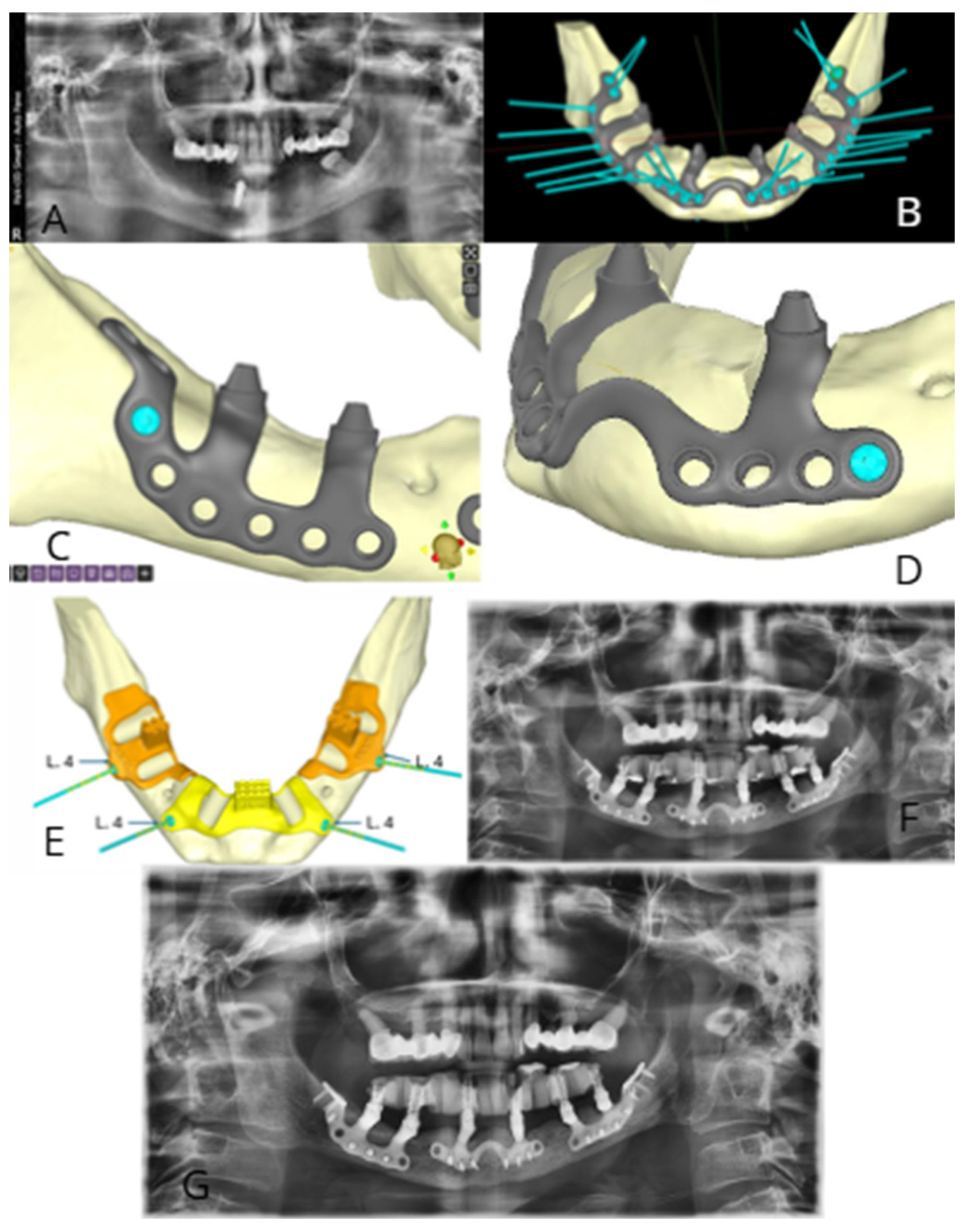
2.7. Illustrative Case
3. Results
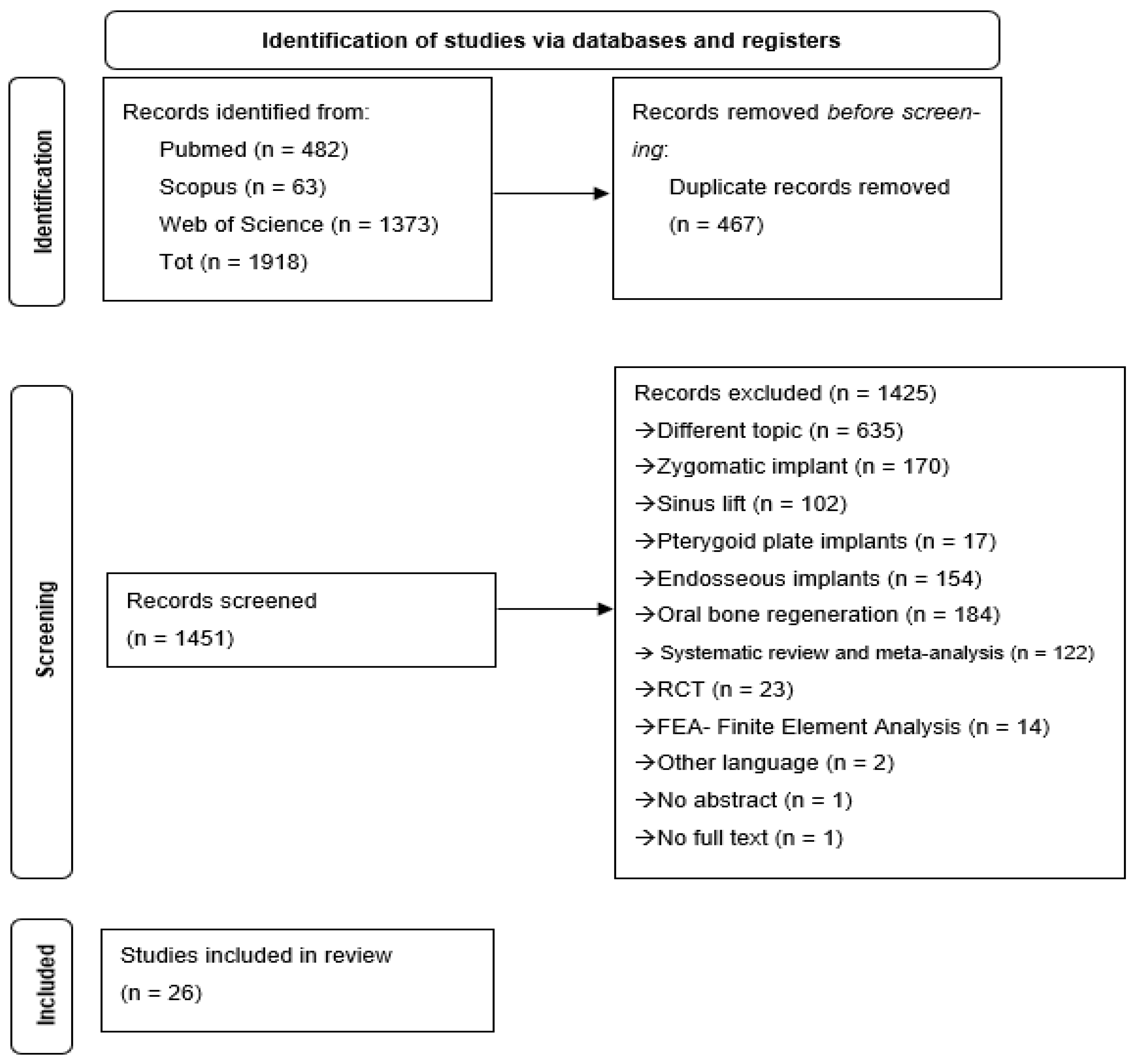
3.1. Study Selection
3.2. Results of the Study
3.3. Age and Gender Distribution of the Patients
3.4. Clinical Features: Systemic Diseases and Medical History
3.5. Atrophy Classification
3.6. Treatment
3.7. Follow-Up
3.8. Evaluation of Reporting Quality
4. Discussion
4.1. Technical Considerations and Digital Workflow
4.2. Clinical Implications and Patient Outcomes
4.3. Limitations of the Study
5. Conclusions
Author Contributions
Funding
Institutional Review Board Statement
Informed Consent Statement
Data Availability Statement
Acknowledgments
Conflicts of Interest
References
- Mahardawi, B.; Jiaranuchart, S.; Arunjaroensuk, S.; Dhanesuan, K.; Mattheos, N.; Pimkhaokham, A. The clinical benefit of alveolar ridge preservation in the posterior maxilla: A systematic review and meta-analysis. Sci. Rep. 2025, 15, 23019. [Google Scholar] [CrossRef] [PubMed] [PubMed Central]
- Elboraey, M.O.; Alqutaibi, A.Y.; Aboalrejal, A.N.; Borzangy, S.; Zafar, M.S.; Al-Gabri, R.; Alghauli, M.A.; Ramalingam, S. Regenerative approaches in alveolar bone augmentation for dental implant placement: Techniques, biomaterials, and clinical decision-making: A comprehensive review. J. Dent. 2025, 154, 105612. [Google Scholar] [CrossRef] [PubMed]
- Di Carlo, S.; Ciolfi, A.; Grasso, E.; Pranno, N.; De Angelis, F.; Di Gioia, C.; Jedliński, M.; Tornese, A.; Lomelo, P.; Brauner, E. A Retrospective Analysis of Treatment Outcomes Following Guided Bone Regeneration at Sites Exhibiting Severe Alveolar Ridge Atrophy. J. Craniofacial Surg. 2021, 32, e572–e578. [Google Scholar] [CrossRef] [PubMed]
- Sudhir, M.V.S.; Prasad, R.B.; Krothapalli, N.; Kumar, P. Graftless Solutions for Rehabilitation of Atrophied Maxilla—Zygomatic Versus Subperiosteal Implants—A Systematic Review. J. Pharm. Bioallied Sci. 2025, 17, S207–S210. [Google Scholar] [CrossRef] [PubMed] [PubMed Central]
- Zielinski, R.; Okulski, J.; Piechaczek, M.; Łoś, J.; Sowiński, J.; Sadowska-Sowińska, M.; Kołkowska, A.; Simka, W.; Kozakiewicz, M. Five-Year Comparative Study of Zygomatic and Subperiosteal Implants: Clinical Outcomes, Complications, and Treatment Strategies for Severe Maxillary Atrophy. J. Clin. Med. 2025, 14, 661. [Google Scholar] [CrossRef] [PubMed] [PubMed Central]
- Anitua, E.; Eguia, A.; Staudigl, C.; Alkhraisat, M.H. Clinical performance of additively manufactured subperiosteal implants: A systematic review. Int. J. Implant. Dent. 2024, 10, 4. [Google Scholar] [CrossRef] [PubMed] [PubMed Central]
- Arshad, M.; Khoramshahi, N.; Shirani, G. Additively custom-made 3D-printed subperiosteal implants for the rehabilitation of the severely atrophic maxilla (a case report). Clin. Case Rep. 2023, 11, e8135. [Google Scholar] [CrossRef] [PubMed] [PubMed Central]
- Dahl, G. Om möjlighten ör inplantation I käken av metallskelett som bas eller retention ör fasta eller avtagbara protester. Odontol. Tidskr. 1943, 51, 440–449. [Google Scholar]
- Linkow, L.I. The blade vent—A new dimension in endosseous implantology. Dent. Concepts 1968, 11, 3–12. [Google Scholar] [PubMed]
- Goh, R.; Vaquette, C.; Breik, O.; Ivanovski, S.; Batstone, M. Subperiosteal Implants: A Lost Art Worth Revisiting? Clin. Implant. Dent. Relat. Res. 2025, 27, e70025. [Google Scholar] [CrossRef] [PubMed] [PubMed Central]
- Young, L., Jr.; Michel, J.D.; Moore, D.J. A twenty-year evaluation of subperiosteal implants. J. Prosthet. Dent. 1983, 49, 690–694. [Google Scholar] [CrossRef] [PubMed]
- Vatteroni, E.; Covani, U.; Menchini Fabris, G.B. The New Generation of Subperiosteal Implants for Patient-Specific Treatment of Atrophic Dental Arches: Literature Review and Two Case Reports. Int. J. Periodontics Restor. Dent. 2023, 43, 735–741. [Google Scholar] [CrossRef] [PubMed]
- Marziani, L. L’implant sous-périosté: Sa base théorique, sa technique, ses résultats cliniques. Inform. Dent. 1954, 36, 1419–1430. [Google Scholar]
- Darwish, S.A.; El-Mohandes, W.A.; Abd Rabbo, B.E. Clinical and Radiographic Assessment of Milled Versus 3D-Printed Patient-Specific Subperiosteal Implants for Atrophic Mandibular Ridges: A Randomized Clinical Trial. Cureus 2025, 17, e80326. [Google Scholar] [CrossRef] [PubMed] [PubMed Central]
- Al-Nawas, B.; Bär, A.K. Virtual surgical planning and customized subperiosteal implants: A systematic review. Int. J. Oral Maxillofac. Surg. 2025, 54, 979–994. [Google Scholar] [CrossRef] [PubMed]
- Cerea, M.; Dolcini, G.A. Custom-Made Direct Metal Laser Sintering Titanium Subperiosteal Implants: A Retrospective Clinical Study on 70 Patients. Biomed Res. Int. 2018, 2018, 5420391. [Google Scholar] [CrossRef] [PubMed] [PubMed Central]
- Ângelo, D.F.; Vieira Ferreira, J.R. The Role of Custom-made Subperiosteal Implants for Rehabilitation of Atrophic Jaws—A Case Report. Ann. Maxillofac. Surg. 2020, 10, 507–511. [Google Scholar] [CrossRef] [PubMed] [PubMed Central]
- Mommaerts, M.Y. Evolutionary steps in the design and biofunctionalization of the additively manufactured sub-periosteal jaw implant ‘AMSJI’ for the maxilla. Int. J. Oral Maxillofac. Surg. 2019, 48, 108–114. [Google Scholar] [CrossRef] [PubMed]
- Gellrich, N.-C.; Zimmerer, R.M.; Spalthoff, S.; Jehn, P.; Pott, P.-C.; Rana, M.; Rahlf, B. A customised digitally engineered solution for fixed dental rehabilitation in severe bone deficiency: A new innovative line extension in implant dentistry. J. Cranio-Maxillofac. Surg. 2017, 45, 1632–1638. [Google Scholar] [CrossRef]
- Nemtoi, A.; Covrig, V.; Nemtoi, A.; Stoica, G.; Vatavu, R.; Haba, D.; Zetu, I. Custom-Made Direct Metal Laser Sintering Titanium Subperiosteal Implants in Oral and Maxillofacial Surgery for Severe Bone-Deficient Patients—A Pilot Study. Diagnostics 2022, 12, 2531. [Google Scholar] [CrossRef] [PubMed] [PubMed Central]
- Chrcanovic, B.R.; Pedrosa, A.R.; Neto Custódio, A.L. Zygomatic implants: A critical review of the surgical techniques. Oral Maxillofac. Surg. 2013, 17, 1–9. [Google Scholar] [CrossRef] [PubMed]
- Chaware, S.H.; Thakare, V.; Chaudhary, R.; Jankar, A.; Thakkar, S.; Borse, S. The rehabilitation of posterior atrophic maxilla by using the graftless option of short implant versus conventional long implant with sinus graft: A systematic review and meta-analysis of randomized controlled clinical trial. J. Indian Prosthodont. Soc. 2021, 21, 28–44. [Google Scholar] [CrossRef] [PubMed] [PubMed Central]
- Page, M.J.; McKenzie, J.E.; Bossuyt, P.M.; Boutron, I.; Hoffmann, T.C.; Mulrow, C.D.; Shamseer, L.; Tetzlaff, J.M.; Akl, E.A.; Brennan, S.E.; et al. The PRISMA 2020 statement: An updated guideline for reporting systematic reviews. BMJ 2021, 372, n71. [Google Scholar] [CrossRef]
- Porritt, K.; Gomersall, J.; Lockwood, C. JBI’s System-atic Reviews: Study selection and critical appraisal. Am. J. Nurs. 2014, 114, 47–52. [Google Scholar] [CrossRef] [PubMed]
- Mounir, M.; Atef, M.; Abou-Elfetouh, A.; Hakam, M.M. Titanium and polyether ether ketone (PEEK) patient-specific sub-periosteal implants: Two novel approaches for rehabilitation of the severely atrophic anterior maxillary ridge. Int. J. Oral Maxillofac. Surg. 2018, 47, 658–664. [Google Scholar] [CrossRef] [PubMed]
- Vatteroni, E.; Toti, P.; Covani, U.; Crespi, R.; Cosola, S.; Menchini-Fabris, G.B. A Retrospective Radiologic and Clinical Survey of Full-Arch Immediate Fixed Prostheses Supported by Custom-Made 3D-Printed Subperiosteal Titanium Implants in Patients with Severely Atrophic Jaws: Implant Success Code. Int. J. Oral Maxillofac. Implant. 2025, 40, 703–714. [Google Scholar] [CrossRef] [PubMed]
- Santiago, P.H.; Tavares, M.G.; Grillo, R. Personalized Rehabilitation of Atrophic Customized Subperiosteal Implants. J. Craniofacial Surg. 2025, 36, e20–e22. [Google Scholar] [CrossRef] [PubMed]
- Cardoso, F.R.G.R.; Grillo, R. Maxillary rehabilitation after zygomatic implant sequelae using custom subperiosteal implants: A case study. J. Stomatol. Oral Maxillofac. Surg. 2025, 126, 102154. [Google Scholar] [CrossRef] [PubMed]
- Diss, A.; Lerebours, A.; Grébonval, C.; Birault, L. Pterygoid Anchorage of Subperiosteal Implants: An Overview and Case Report. Cureus 2025, 17, e85175. [Google Scholar] [CrossRef] [PubMed] [PubMed Central]
- Khachatryan, L.; Khachatryan, G.; Karapetyan, E.; Sahakyan, V. Prosthetic Rehabilitation of a Resorbed Maxilla with an Individual Titanium Implant Using Selective Laser Melting (slm) Technologies. Case Report. Bull. Stomatol. Maxillofac. Surg. 2023, 19, 63–70. [Google Scholar] [CrossRef]
- Le Chêne, T.; Duffort, S.; Oillic, A. Custom-made subperiosteal implants for atrophic maxilla rehabilitation: A digital approach. J. Oral Med. Oral Surg. 2025, 31, 21. [Google Scholar] [CrossRef]
- El-Sawy, M.A.; ELgamal, M.E.; Ahmed, W.M.; El-Daker, M.A.; Hegazy, S.A. Polyetheretherketone subperiosteal implant retaining a maxillary fixed prosthesis: A case series. J. Prosthet. Dent. 2024, 132, 562–569. [Google Scholar] [CrossRef] [PubMed]
- Salmi, M.; Tuomi, J.; Paloheimo, K.S.; Björkstrand, R.; Paloheimo, M.; Salo, J.; Kontio, R.; Meslmäki, K.; Mäkitie, A. Patient-Specific Reconstruction with 3D Modelling and DMLS Additive Manufacturing. Rapid Prototyp. J. 2012, 18, 209–214. [Google Scholar] [CrossRef]
- Kusek, E.R. The use of laser technology (Er;Cr:YSGG) and stereolithography to aid in the placement of a subperiosteal implant: Case study. J. Oral Implantol. 2009, 35, 5–11. [Google Scholar] [CrossRef] [PubMed]
- Zwerger, S.; Abu-Id, M.H.; Kreusch, T. Langzeitergebnisse nach der Insertation von subperiostalen Gerüstimplantaten: Bericht über zwölf Patientenfälle [Long-term results of fittig subperiosteal implants: Report of twelve patient cases]. Mund-, Kiefer- Und Gesichtschirurgie 2007, 11, 359–362. (In German) [Google Scholar] [CrossRef] [PubMed]
- Lew, D.; Hinkle, R.M.; Collins, S.F. Use of subperiosteal implants with distal filling ports in the correction of the atrophic alveolar ridge. Int. J. Oral Maxillofac. Surg. 1991, 20, 15–17. [Google Scholar] [CrossRef] [PubMed]
- Costin, S.; Micu, C.; Cristea, S. Bridging and Repairing Patient Specific Acetabular Defects with a New Custom Acetabular Cage. Key Eng. Mater. 2013, 587, 412–415. [Google Scholar] [CrossRef]
- Ayhan, M.; Yey Özkeskin, S.Z. Rehabilitation of Severely Atrophic Maxilla with Le Fort I Advancement Surgery and Subperiosteal Implant in a Patient With Ectodermal Dysplasia. J. Craniofacial Surg. 2024, 35, e484–e486. [Google Scholar] [CrossRef] [PubMed]
- De Riu, G.; Biglio, A.; Baj, A.; Maniaci, A.; Lechien, J.R.; Vaira, L.A. Primary reconstruction of total maxillectomy defect with additively manufactured subperiosteal implant and fibula free flap: A case report. Oral Maxillofac. Surg. 2025, 29, 86. [Google Scholar] [CrossRef] [PubMed] [PubMed Central]
- Rico, Á.; Fernández, A.; Martínez, E.; López, A.; Valadés, R.; Plaza, A. Prosthetic restoration with virtual planned subperiosteal implant in adult patient with cleft lip and palate with severe sequelae. Ann. 3D Print. Med. 2022, 9, 100095. [Google Scholar] [CrossRef]
- Ow, A.; Tan, W.; Pienkowski, L. Mandibular Reconstruction Using a Custom-Made Titanium Prosthesis: A Case Report on the Use of Virtual Surgical Planning and Computer-Aided Design/Computer-Aided Manufacturing. Craniomaxillofac. Trauma Reconstr. 2016, 9, 246–250. [Google Scholar] [CrossRef] [PubMed] [PubMed Central]
- Al-Ahmari, A.; Abouel Nasr, E.; Moiduddin, K.; Alkindi, M.; Kamrani, A. Patient specific mandibular implant for maxillofacial surgery using additive manufacturing. In Proceedings of the IEOM 2015—5th International Conference on Industrial Engineering and Operations Management, Dubai, United Arab Emirates, 3–5 March 2015. [Google Scholar] [CrossRef]
- Ayhan, M.; Ozturk Muhtar, M.; Kundakcioglu, A.; Kucukcakir, O.; Cansiz, E. Evaluation of Clinical Success of the 3D-Printed Custom-Made Subperiosteal Implants. J. Craniofacial Surg. 2024, 35, 1146–1151. [Google Scholar] [CrossRef] [PubMed]
- Hatamleh, M.M.; Bhamrah, G.; Ryba, F.; Mack, G.; Huppa, C. Simultaneous Computer-Aided Design/Computer-Aided Manufacture Bimaxillary Orthognathic Surgery and Mandibular Reconstruction Using Selective-Laser Sintered Titanium Implant. J. Craniofacial Surg. 2016, 27, 1810–1814. [Google Scholar] [CrossRef] [PubMed]
- Igelbrink, S.; Zanettini, L.M.S.; Bohner, L.; Kleinheinz, J.; Jung, S. Three-Dimensional Planning of the Mandibular Margin in Hemifacial Microsomia Using a Printed Patient-Specific Implant. J. Craniofacial Surg. 2020, 31, 2297–2301. [Google Scholar] [CrossRef] [PubMed]
- van Kootwijk, A.; Moosabeiki, V.; Saldivar, M.C.; Pahlavani, H.; Leeflang, M.A.; Kazemivand Niar, S.; Pellikaan, P.; Jonker, B.P.; Ahmadi, S.M.; Wolvius, E.B.; et al. Semi-automated digital workflow to design and evaluate patient-specific mandibular reconstruction implants. J. Mech. Behav. Biomed. Mater. 2022, 132, 105291. [Google Scholar] [CrossRef] [PubMed]
- Chernohorskyi, D.M.; Chepurnyi, Y.V.; Kanyura, O.A.; Kopchak, A.V. Total Mandibular Defect Reconstruction By Total Titanium Patient-Specific Implant: Clinical Efficacy and Long Term Follow up. Clinical Case. Wiad. Lek. 2021, 74, 1037–1041. [Google Scholar] [CrossRef] [PubMed]
- Olate, S.; Unibazo, A.; Ravelo, V.; Rivas, C.; López, P.; Valdivia, J. Avoiding Unwanted Exposure of Subperiosteal Implants in the Atrophic Maxilla: Technical Note. J. Craniofacial Surg. 2025, 36, 1318–1319. [Google Scholar] [CrossRef] [PubMed]
- Systermans, S.; Cobraiville, E.; Camby, S.; Meyer, C.; Louvrier, A.; Lie, S.A.; Schouman, T.; Siciliano, S.; Beckers, O.; Poulet, V.; et al. An innovative 3D hydroxyapatite patient-specific implant for maxillofacial bone reconstruction: A case series of 13 patients. J. Craniomaxillofac. Surg. 2024, 52, 420–431. [Google Scholar] [CrossRef] [PubMed]
- Mangano, C.; Bianchi, A.; Mangano, F.G.; Dana, J.; Colombo, M.; Solop, I.; Admakin, O. Custom-made 3D printed subperiosteal titanium implants for the prosthetic restoration of the atrophic posterior mandible of elderly patients: A case series. 3D Print. Med. 2020, 6, 1. [Google Scholar] [CrossRef] [PubMed] [PubMed Central]
- Łoginoff, J.; Majos, A.; Elgalal, M. The Evolution of Custom Subperiosteal Implants for Treatment of Partial or Complete Edentulism in Patients with Severe Alveolar Ridge Atrophy. J. Clin. Med. 2024, 13, 3582. [Google Scholar] [CrossRef] [PubMed] [PubMed Central]
- El-Sawy, M.A.; Hegazy, S.A. Subperiosteal implants constructed with digital technology: A systematic review. Oral Maxillofac. Surg. 2024, 28, 1063–1075. [Google Scholar] [CrossRef] [PubMed]
- Mikulás, K.; Qian, X.; Tajti, P.; Agócs, G.; Gallucci, G.O.; Pedrinaci, I.; Hermann, P. Accuracy of Digital Impression Methods for Capturing the Peri-Implant Emergence Profile: A Systematic Review. Clin. Oral Implant. Res. 2025, 36, 930–943. [Google Scholar] [CrossRef] [PubMed] [PubMed Central]
- Valedsaravi, N.; Semnani, A.; Moghadam, M.; Semnani, F. Effect of submucosal dexamethasone injection on pain and swelling after immediate implant placement: A randomized clinical trial. Gen. Dent. 2025, 73, 62–67. [Google Scholar] [PubMed]



| Checklist |
|---|
| 1. Were the Patient’s Demographic Characteristics Clearly Described? Yes/No/Unclear/Not Applicable |
| 2. Was the Patient’s History Clearly Described and Presented as a Timeline? Yes/No/Unclear/Not Applicable |
| 3. Was the Current Clinical Condition of the Patient on Presentation Clearly Described? Yes/No/Unclear/Not Applicable |
| 4. Were Diagnostic Tests or Assessment Methods and the Results Clearly Described? Yes/No/Unclear/Not Applicable |
| 5. Was the Intervention(s) or Treatment Procedure(s) Clearly Described? Yes/No/Unclear/Not Applicable |
| 6. Was the Post-Intervention Clinical Condition Clearly Described? Yes/No/Unclear/Not Applicable |
| 7. Were Adverse Events (Harms) or Unanticipated Events Identified and Described? Yes/No/Unclear/Not Applicable |
| 8. Does the Case Report Provide Takeaway Lessons? Yes/No/Unclear/Not Applicable |
| ID | Author/Year | Cases | Patients | Medical History | Atrophy Class. | Treatment | Follow-Up |
|---|---|---|---|---|---|---|---|
| 1 | Arshad/2023 [7] | 1 | 25 y male | Aggressive periodontitis; failed full-arch prosthesis after 5 years. | Severe alveolar atrophy; extraoral bone grafting declined. | 3D-printed subperiosteal implant (Ti6AL4V-ELI); single stage. | 3 years: satisfied with function/aesthetics. |
| 2 | Mounir 2018 [25] | 10 | Adult | Severe atrophic anterior maxillary ridges; no systemic diseases. | Severe anterior maxillary atrophy. | Virtual planning; CAD/CAM titanium and PEEK implants. | 12 months: stability and patient satisfaction. |
| 3 | Vatteroni 2025 [26] | 18 | 61.9 ± 6.7 y | Severe maxillary/mandibular atrophy; systemic diseases excluded. | Severe jaw atrophy. | Custom 3D-printed titanium implants; SIO success criteria. | 2 years: implant survival and success assessed. |
| 4 | Santiago 2025 [27] | 3 | 68 f, 50 m | Dissatisfied with removable prostheses; impaired masticatory function. | Severe maxillary atrophy. | Sintered titanium implants; immediate provisional rehabilitation. | 3–12 months: documented prosthetic function. |
| 5 | Cardoso 2025 [28] | 1 | 62 f (smoker) | History of failed zygomatic implants; chronic inflammation. | Severe maxillary atrophy. | Removal of zygomatic implants; custom titanium subperiosteal implant. | 18 months: stable after managing partial exposure. |
| 6 | Diss 2025 [29] | 1 | 71 f | Completely edentulous; seeking fixed rehabilitation. | Cawood/Howell Class VI. | Two implants in Ti-6Al-4V via metal laser sintering. | Postoperative stability; no complications. |
| 7 | Khachatryan 2023 [30] | 1 | 52 f | Atrophic maxilla with significant edentulism. | Significantly atrophic edentulous maxilla. | Selective Laser Melting titanium implant; passive fit. | 1 year: restoration remained functional. |
| 8 | Le Chêne 2025 [31] | 1 | 74 f | Peri-implantitis on 6 maxillary/5 mandibular implants. | Cawood Class VI. | Customized subperiosteal implants; Bichat fat pad for isolation | 1 year: no dehiscence or loosening detected. |
| 9 | El-Sawy 2024 [32] | 4 | 65–75 y | Completely edentulous; no systemic diseases. | Cawood/Howell IV and V. | PEEK implants via CAD-CAM; 10 screws fixation. | 12–24 months: functionally stable. |
| 10 | Salmi 2012 [33] | 1 | 67 m | Orbital volume displacement after severe accident. | Increased orbital volume with ragged wall. | DMLS titanium orbital reconstruction implant. | 3 weeks: eyeball displacement diminished. |
| 11 | Kusek 2009 [34] | 1 | 80 f | Mandibular denture instability; non-contributory history. | Severe mandibular atrophy. | SLA model used for digital workflow; laser incision. | 1 year: successful stability and soft tissue. |
| 12 | Zwerger 2007 [35] | 12 | Mean 62 y | Chronic edentulism; failed conventional rehabilitation. | Extreme jaw atrophy. | Traditional laboratory casting or CT-derived models. | Mean 7.2 years: 75% cumulative success rate. |
| 13 | Lew D. 1991 [36] | 15 | 43–71 y | Long-term edentulism; severe ridge resorption. | Severe atrophic alveolar ridges. | Hydroxyapatite-coated implants with filling ports. | 6–24 months: improved prosthetic retention. |
| 14 | Costin 2013 [37] | 1 | 59 f | Failed hip arthroplasties; acetabular bone defect. | Paprosky Type IIIb defect. | Custom acetabular cage in Ti6Al4V. | 24 months: improved mobility/quality of life. |
| 15 | Ayhan 2024 [38] | 1 | 20 m | Hypohidrotic ectodermal dysplasia; anodontia. | Severe atrophy; Class III skeletal relationship. | Le Fort I advancement + custom titanium implant. | 1 year: stable skeletal correction. |
| 16 | De Riu 2025 [39] | 1 | Adult | Malignant tumor requiring total maxillectomy. | Total maxillectomy defect. | Fibula free flap + additively manufactured implant. | Successful reconstruction; improved recovery. |
| 17 | Rico 2022 [40] | 1 | 48 f | Congenital cleft lip/palate; multiple failed grafts. | Severe atrophy from cleft palate sequelae. | 100% digital workflow; custom titanium implant. | 1 year: excellent stability and phonetics. |
| 18 | Ow 2016 [41] | 1 | 39 m | High-energy trauma (gunshot wound). | Severe acquired bone defect (mandible). | Custom PSI in Ti6Al4V; osteosynthesis screws. | 12 months: improved masticatory function. |
| 19 | Al-Ahmari 2015 [42] | 1 | 22 m | Large Ameloblastoma requiring mandibular resection. | Segmental mandibular defect. | EBM technology; CT data processing for fit. | Accurate fit restored facial symmetry. |
| 20 | Ayhan 2024 [43] | 17 | Mean 55.4 y | Severe atrophy where bone grafting was not feasible. | Severe maxillary and mandibular atrophy. | 3D-printed titanium implants via CAD/CAM. | Mean 18.2 months: 90.4% success rate. |
| 21 | Hatamleh 2016 [44] | 1 | 25 f | Severe facial deformity after ameloblastoma resection. | Segmental mandibular defect. | Single-stage orthognathic surgery + SLS implant. | 12 months: stable skeletal correction. |
| 22 | Igelbrink 2020 [45] | 1 | 19 m | Hemifacial microsomia (Pruzansky IIb). | Congenital mandibular hypoplasia. | PSI manufactured from medical-grade titanium. | Restoration of facial symmetry achieved. |
| 23 | Van Kootwijk 2022 [46] | 1 | 50 m | History of carcinoma; failed fibula free flap. | Segmental mandibular defect. | ”Digital Twin” approach with FEA analysis. | Technical validation of biomechanical reliability. |
| 24 | Chernohorskyi 2021 [47] | 1 | 43 m | Total loss of function after gunshot wound. | Total mandibular defect. | Total titanium PSI via virtual 3D planning. | 3 years: excellent stability and swallowing. |
| 25 | Olate 2025 [48] | 2 | 64 f, 68 f | Failed conventional prosthetic rehabilitation. | Severe maxillary atrophy. | Palatal-shifted incision to avoid exposure. | 6 months: healthy periimplant mucosa. |
| 26 | Systermans 2024 [49] | 13 | 8–78 y | Oncological resections or congenital anomalies. | Complex maxillofacial bone defects. | Bioactive ceramic HA implants; scaffold-based. | Median 12 months: successful integration. |
| St. No | First Authors Name/Year of Publication [Reference Number] | 1. Were the Patient’s Demographic Characteristics Clearly Described | 2. Was the Patient’s History Clearly Described and Presented as a Timeline? | 3. Was the Current Clinical Condition of the Patient on Presentation Clearly Described? | 4. Were Diagnostic Tests or Assessment Methods and the Results Clearly Described | 5. Was the Intervention(s) or Treatment Procedure(s) Clearly Described? | 6. Was the PostIntervention Clinical Condition Clearly Described? | 7. Were Adverse Events (Harms) or Unanticipated Events Identified and Described? | 8. Does the Case Report Provide Takeaway Lessons? | The Overall Risk of Bias |
|---|---|---|---|---|---|---|---|---|---|---|
| 1 | Arshad/2023 [7] | Yes | Yes | Yes | Yes | Yes | Yes | Yes | Yes | L |
| 2 | Mounir 2018 [25] | Yes | Some concern | Yes | Yes | Yes | Yes | Yes | Yes | L |
| 3 | Vatteroni 2025 [26] | Yes | No | Yes | Yes | Yes | Yes | No | Yes | L |
| 4 | Santiago 2025 [27] | Yes | Yes | Yes | Yes | Yes | Yes | Yes | Yes | L |
| 5 | Cardoso 2025 [28] | Yes | Yes | Yes | Yes | Yes | Yes | Yes | Yes | L |
| 6 | Diss 2025 [29] | Yes | Yes | Yes | Yes | Yes | Yes | No | Yes | L |
| 7 | Khachatryan 2023 [30] | Yes | Yes | Yes | Yes | Yes | Yes | No | Yes | L |
| 8 | Le Chêne 2025 [31] | Yes | Yes | Yes | Yes | Yes | Yes | Yes | Yes | L |
| 9 | El-Sawy 2024 [32] | Yes | Yes | Yes | Yes | Yes | Yes | Yes | Yes | L |
| 10 | Salmi 2012 [33] | Yes | Yes | Yes | Yes | Yes | Yes | Yes | Yes | L |
| 11 | Kusek 2009 [34] | Yes | Yes | Yes | Yes | Yes | Yes | Yes | Yes | L |
| 12 | Zwerger 2007 [35] | Yes | Unclear | Yes | Yes | Yes | Yes | Yes | Yes | L |
| 13 | Lew D. 1991 [36] | Yes | Unclear | Yes | Yes | Yes | Yes | Yes | Yes | L |
| 14 | Costin 2013 [37] | Yes | Yes | Yes | Yes | Yes | Yes | Yes | Yes | L |
| 15 | Ayhan 2024 [38] | Yes | Yes | Yes | Yes | Yes | Yes | Yes | Yes | L |
| 16 | De Riu 2025 [39] | Yes | Yes | Yes | Yes | Yes | Yes | Yes | Yes | L |
| 17 | Rico 2022 [40] | Yes | Yes | Yes | Yes | Yes | Yes | Yes | Yes | L |
| 18 | Ow 2016 [41] | Yes | Yes | Yes | Yes | Yes | Yes | Yes | Yes | L |
| 19 | Al-Ahmari 2015 [42] | Yes | Yes | Yes | Yes | Yes | Yes | Yes | Yes | L |
| 20 | Ayhan 2024 [43] | Yes | Yes | Yes | Yes | Yes | Yes | Yes | Yes | L |
| 21 | Hatamleh 2016 [44] | Yes | Yes | Yes | Yes | Yes | Yes | Yes | Yes | L |
| 22 | Igelbrink 2020 [45] | Yes | Yes | Yes | Yes | Yes | Yes | Yes | Yes | L |
| 23 | Van Kootwijk 2022 [46] | Yes | Yes | Yes | Yes | Yes | Yes | Yes | Yes | L |
| 24 | Chernohorskyi 2021 [47] | Yes | Yes | Yes | Yes | Yes | Yes | Yes | Yes | L |
| 25 | Olate 2025 [48] | Yes | Yes | Yes | Yes | Yes | Yes | Yes | Yes | L |
| 26 | Systermans 2024 [49] | Yes | Yes | Yes | Yes | Yes | Yes | Yes | Yes | L |
Disclaimer/Publisher’s Note: The statements, opinions and data contained in all publications are solely those of the individual author(s) and contributor(s) and not of MDPI and/or the editor(s). MDPI and/or the editor(s) disclaim responsibility for any injury to people or property resulting from any ideas, methods, instructions or products referred to in the content. |
© 2026 by the authors. Licensee MDPI, Basel, Switzerland. This article is an open access article distributed under the terms and conditions of the Creative Commons Attribution (CC BY) license.
Share and Cite
Gasbarri, A.; Giovannetti, F.; Caporro, G.; D’Amario, M.; Sperati, R.; Jahjah, A.; Lupi, E.; Capogreco, M. Treatment of Severe Atrophy with Juxta-Osseous Implants: A Systematic Review and Case Report. Bioengineering 2026, 13, 386. https://doi.org/10.3390/bioengineering13040386
Gasbarri A, Giovannetti F, Caporro G, D’Amario M, Sperati R, Jahjah A, Lupi E, Capogreco M. Treatment of Severe Atrophy with Juxta-Osseous Implants: A Systematic Review and Case Report. Bioengineering. 2026; 13(4):386. https://doi.org/10.3390/bioengineering13040386
Chicago/Turabian StyleGasbarri, Alberto, Filippo Giovannetti, Giulia Caporro, Maurizio D’Amario, Renato Sperati, Ali Jahjah, Ettore Lupi, and Mario Capogreco. 2026. "Treatment of Severe Atrophy with Juxta-Osseous Implants: A Systematic Review and Case Report" Bioengineering 13, no. 4: 386. https://doi.org/10.3390/bioengineering13040386
APA StyleGasbarri, A., Giovannetti, F., Caporro, G., D’Amario, M., Sperati, R., Jahjah, A., Lupi, E., & Capogreco, M. (2026). Treatment of Severe Atrophy with Juxta-Osseous Implants: A Systematic Review and Case Report. Bioengineering, 13(4), 386. https://doi.org/10.3390/bioengineering13040386