
Predicting Intrapartum Acidemia: A Review of Approaches Based on Fetal Heart Rate

 , ,
, ,  , ,
, ,  and
and
Abstract
1. Background
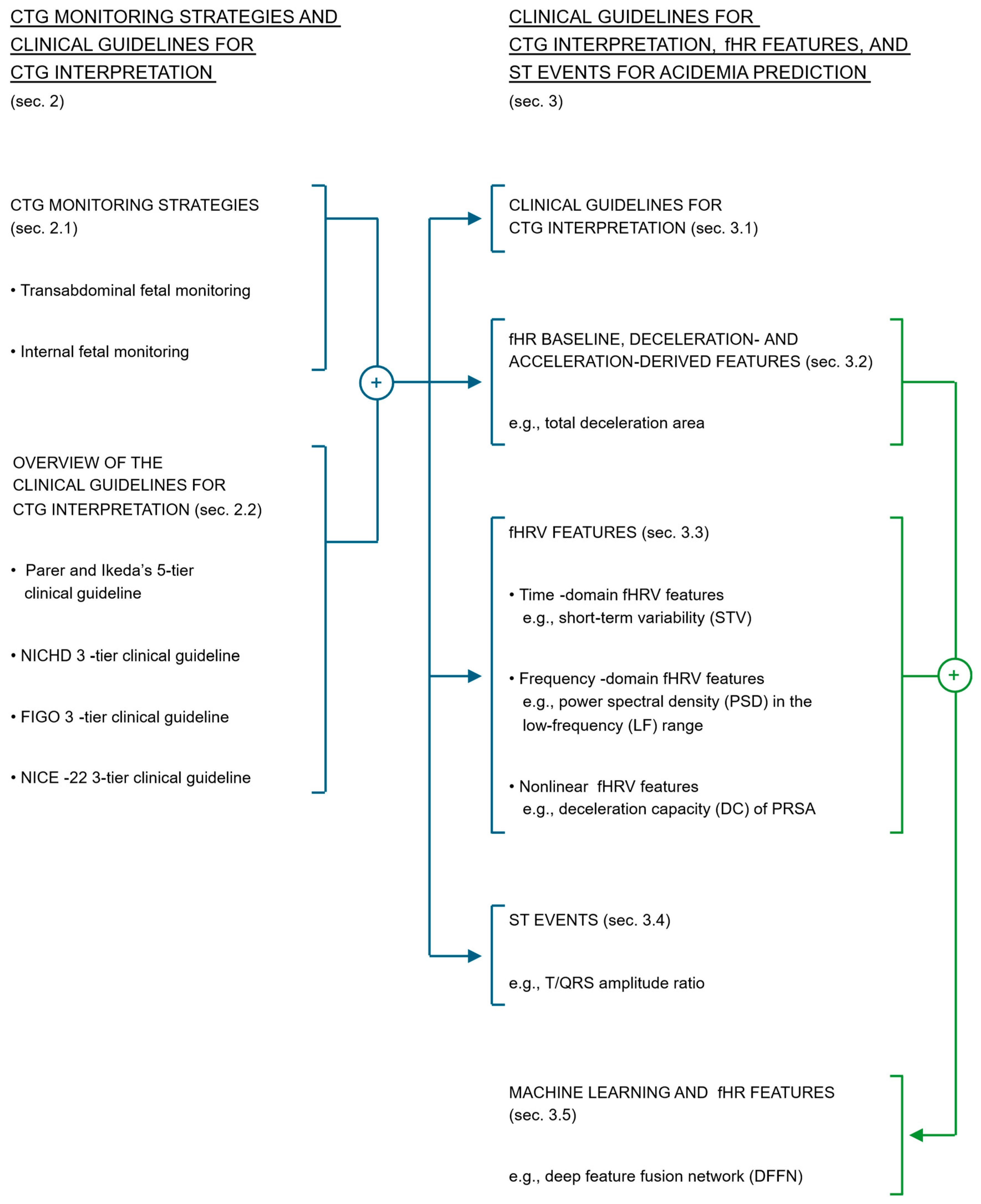
2. CTG Monitoring Strategies and Clinical Guidelines for CTG Interpretation
2.1. CTG Monitoring Strategies
2.2. Overview of the Clinical Guidelines for CTG Interpretation

| Parer and Ikeda’s 5-tier clinical guideline (2007) [16] | Green | Blue | Yellow | Orange | Red |
| Risk for acidemia | Absent | Absent | Absent | Borderline/acceptably low | Unacceptably high |
| Risk for evolution | Very low | Low | Moderate | High | Very high |
| Action | None | Adopt conservative techniques | Adopt conservative techniques; increase surveillance | Adopt conservative techniques; prepare for urgent delivery | Expedite delivery |
| Additional considerations | Baseline fHR, fHRV, and different types of fHR decelerations were defined according to the NICHD nomenclature (1997) [22] | ||||
| NICHD 3-tier clinical guideline (2008) [17,21] | Category I | Category II | Category III | ||
| Risk for acidemia | Absent | Absent/acceptably low | High | ||
| Risk for evolution | Very low | Low/high | High | ||
| Action | None | Perform evaluation; continue surveillance; and perform re-evaluation | Perform prompt evaluation; expedite delivery | ||
| Additional considerations | Baseline fHR, fHRV, different types of fHR decelerations, fHR accelerations, and uterine contractions were defined according to Macones et al. (2008) [21] | ||||
| FIGO 3-tier clinical guideline (2015) [10] | Normal | Suspicious | Pathological | ||
| Risk for acidemia | Absent | Low | High | ||
| Risk for evolution | Very low | Low/high | High | ||
| Action | None | Correct reversible causes if identified; perform close monitoring; use additional methods to evaluate fetal oxygenation | Adopt immediate action to correct reversible causes; adopt additional methods to evaluate fetal oxygenation; expedite delivery | ||
| Additional considerations | Baseline fHR, fHRV, different types of fHR decelerations, fHR accelerations, and uterine contractions were defined according to Ayres-de-Campos et al. (2015) [10] | ||||
| NICE-22 3-tier clinical guideline (2022) [64] | Normal | Suspicious | Pathological | ||
| Risk for acidemia | Absent | Moderate | High | ||
| Risk for evolution | Very low | Low/high | High | ||
| Action | None | Perform evaluation (considering whether fHR accelerations are identified); perform full risk assessment; expedite delivery | Perform full risk assessment; expedite delivery | ||
| Additional considerations | Baseline fHR, fHRV, different types of fHR decelerations, fHR accelerations, and uterine contractions were defined according to the NICE nomenclature (2022) [65] | ||||
3. Clinical Guidelines for CTG Interpretation, fHR Features, and ST Events for Acidemia Prediction
3.1. Clinical Guidelines for CTG Interpretation
| Study | Population and CTG Tracings | Methods | Key Results | Distinct Limitations |
|---|---|---|---|---|
| Elliott et al. (2010) [75] | • 2472 total fetuses (GA > 35.0 weeks) including the following: - 60 with acidemia and developing neonatal encephalopathy (UA BD > 12 mmol/L) - 280 with acidemia without neurologic complications (UA BD > 12 mmol/L) - 2132 controls • Use of CTG tracings from the last 3 h before delivery | • Use of a dedicated software to annotate CTG tracings from three groups of fetuses according to Parer and Ikeda’s 5-tier clinical guideline • This software uses proprietary signal processing techniques and pattern recognition algorithms • Use of metrics (e.g., ROC curves and AUROC values) | • Only 8.3% of the fetuses developing acidemia and neonatal encephalopathy ever reached the red annotation in the last 3 h preceding the delivery, and this happened on average only for 5.2 min • An AUROC value equal to 0.77 was found when investigating the minimum time spent above a specific color-coded category, using yellow as the threshold, to discriminate between fetuses developing neonatal encephalopathy and controls | • Clinicians had access to the included CTG tracings and might have influenced clinical management |
| Clark et al. (2017) [78] | • 240 total fetuses including the following: - 120 with acidemia (mean GA = 39.9 weeks, UA BD > 12 mmol/L) - 120 matched controls (mean GA = 39.9 weeks, UA BD < 8 mmol/L) • Use of 30-min noncritical category II CTG tracings followed by delivery within 30 min | • Compared a tree-based algorithm for fetal management followed by a decision from healthcare professionals with standardized decisions adopted in clinical practice consisting of the use of the NICHD 3-tier clinical guideline • Use of statistical tests (e.g., chi-squared and Fisher’s exact test) | • The use of a tree-based algorithm followed by a decision from healthcare professionals led to a higher number of operative intervention decisions for fetuses developing acidemia compared to standardized clinical performance (55 vs. 36) and enabled earlier recognition of fHR patterns associated with metabolic acidemia | • The analysis was restricted to a specific set of fetuses, characterized by a 30 min noncritical category II CTG tracings followed by delivery within 30 min |
| Bruno et al. (2020) [79] | • 4274 total fetuses including the following: - 42 with acidemia (mean GA = 39.2 weeks, UA pH ≤ 7.1) - 4232 controls (mean GA = 38.9 weeks) • Use of CTG tracings from the last 60 min before delivery | • Verify whether assigning Category I of the NICHD 3-tier clinical guideline to CTG tracings from the 60 min preceding delivery guarantees absence of acidemia. • Use of statistical tests and metrics (e.g., sensitivity and specificity) | • A considerable number of cases (i.e., 13 fetuses, or 31%) had category I assigned to CTG tracings from the 30 min preceding the delivery | • Limited number of included CTG tracings |
| Coletta et al. (2012) [74] | • 48 total fetuses including the following: - 24 with acidemia (mean GA = 38.7 weeks, UA pH < 7.0) - 24 matched controls (mean GA = 38.8 weeks) • Use of CTG tracings from the last 30 to 60 min before delivery | • Comparison between Parer and Ikeda’s 5-tier and NICHD 3-tier clinical guidelines for the task of predicting acidemia • Use of statistical tests and metrics (sensitivity and specificity) | • Parer and Ikeda’s 5-tier clinical guideline showed higher sensitivity and the same specificity compared to the NICHD 3-tier clinical guideline while predicting acidemia (i.e., SE = 79.2%, found with orange or red tracings, vs. 12.5%, found with category III, SP = 100% vs. 100%) | • Limited number of included CTG tracings • A single reviewer was responsible for performing annotations considering both clinical guidelines |
| Kling et al. (2024) [20] | • 573 total fetuses including the following: - 38 with acidemia (GA = 34–36.6 weeks, UA pH < 7.1) - 535 controls (GA = 34–36.6 weeks, UA pH ≥ 7.1) • Use of CTG tracings from the last 1 h before birth | • Comparison of FIGO-15 3-tier, SWE-09 4-tier, SWE-15 3-tier, NICE-17 3-tier, and NICE-22 3-tier clinical guidelines in their ability to predict the onset of acidemia • Use of statistical tests and metrics (sensitivity and specificity) | • The highest sensitivity for pathological tracings was found for NICE-22 3-tier and SWE-09 4-tier clinical guidelines (both 92%; 95% CI 79–98%) • The highest specificity for pathological tracings was found for SWE-17 3-tier (91%; 88–93%) and FIGO-15 3-tier clinical guidelines (90%; 88–93%) | • Limited number of included CTG tracings |
| Pruksanusak et al. (2017) [80] | • 715 total fetuses including the following: - 36 with acidemia (mean GA = 38.8 weeks, UA pH < 7.1 or BD ≥ 12 mmol/L within 60 min of birth or other strategies) - 679 controls (mean GA = 39.0 weeks) • Use of CTG tracings from the last 2 h before delivery | • Comparison of the predictive power for acidemia of the different clinical guidelines for CTG interpretation • Investigation as to whether this predictive power can be improved using additional maternal- associated risk factors • Use of statistical tests and prediction models (e.g., Pearson’s chi-squared and logistic regression) | • Category II and suspicious tracings can be characterized by higher sensitivity and lower specificity in predicting acidemia compared to yellow and orange tracings (SE = 67.0% vs. 61.0% vs. 36.0% vs. 8.0%, SP = 65.0% vs. 47.0% vs. 85.0% vs. 99.0%) • The inclusion of maternal risk factors slightly increased the performance of Parer and Ikeda’s 5-tier clinical guideline, which outperformed both the NICHD 3-tier and FIGO 3-tier clinical guideline as shown by the increased AUROC value (0.72 vs. 0.68 vs. 0.63) | • Very limited number of included fetuses developing acidemia • Metrics derived from the use of prediction models combining clinical guidelines for CTG interpretation, and additional risk factors were not computed |
3.2. fHR Baseline, Deceleration-, and Acceleration-Derived Features
| Study | Population and CTG tracings | Methods | Key results | Distinct limitations |
|---|---|---|---|---|
| Cahill et al. (2012) [24] | • 5388 total fetuses including the following: - 57 with acidemia (mean GA = 39.0 weeks, UA pH < 7.1) - 5331 controls (mean GA = 39.0 weeks) • Use of CTG tracings from the last 30 min before delivery | • Comparison of fHR features derived from the NICHD 3-tier clinical guideline and fHR deceleration-derived features, including total deceleration area based on their power to predict acidemia • Use of statistical tests, metrics, and prediction models (e.g., Student’s t-test and backward stepwise logistic regression) | • Tachycardia held a significant association with acidemia and performed better than other fHR features derived from the NICHD 3-tier clinical guideline (SP = 95.7%, SE = 14%, PRE = 3.4%) • Bradycardia occurred rarely in the controls and did not occur at all in fetuses developing acidemia • Total deceleration area was significantly associated with acidemia after adjusting for labor and delivery conditions | • The included population was characterized by a severe imbalance |
| Gracia-Perez-Bonfils et al. (2021) [23] | • 484 total CTG tracings (GA range = 37.0–42.0 weeks) including the following: - 3 with UA pH ≤ 7.0 - 18 with 7.0 < UA pH ≤ 7.1 - 73 with 7.1 < UA pH ≤ 7.2 - other CTG tracings split based on UV pH or considered as controls • Use of CTG tracings lasting ≥ 30 min during labor | • Investigation of the incidence of the saltatory patterns and their correlation with perinatal outcomes, including acidemia • Use of a statistical test (i.e., chi-squared test with odds ratios) | • Short saltatory patterns lasting ≥ 1 min and ≥ 2 min were significantly more likely to be observed in fetuses with 7.0 < UA pH ≤ 7.1 and 7.1 < UA pH ≤ 7.2 compared to controls | • Only a limited number of fetuses with UA pH ≤ 7.0 was included |
| Gamboa et al. (2017) [77] | • 204 total fetuses including the following: - 102 with acidemia (mean GA = 279.5 days, UA pH ≤ 7.1 and BD > 8 mmol/L) - 102 controls (mean GA = 278.6 days) • Use of CTG tracings from the last 30 min before delivery | • Comparison of fHR features derived from the NICHD 3-tier clinical guideline and total deceleration area based on their power to predict acidemia • Use of statistical tests, metrics and prediction models (e.g., paired Student’s t-test and backward stepwise logistic regression) | • Bradycardia was hardly observed • Total deceleration area, number of severe decelerations with a nadir ≤ 60 bpm, number of decelerations > 60 s were significantly higher in fetuses developing acidemia | • Only a limited number of fetuses was included • Total deceleration area was calculated manually |
| Tarvonen et al. (2021) [84] | • 4988 total fetuses including the following: - 160 with severe complications (mean GA = 40.5 weeks, UA pH < 7.10 and/or BE < −12.0 mEq/L and/or other strategies) - 1208 with moderate complications (mean GA = 40.2 weeks) - 3620 controls (mean GA = 40.2 weeks) • Use of CTG tracings from the last 2 h before delivery | • Investigation of possible associations between fHR baseline, deceleration-, and acceleration- derived features, including short saltatory patterns and acidemia • Use of statistical tests and prediction models (e.g., independent samples t-test and logistic regression) | • Short saltatory patterns lasting > 2 min were significantly associated with acidemia and severe complications • In fetuses with severe complications, the frequency of short saltatory patterns decreased continuously in the 2 h before delivery, whereas late decelerations increased up to 1 h before birth and then decreased again | • CTG tracings were recorded using a scalp electrode for 91.4% of fetuses |
| Furukawa et al. (2019) [86] | • 1630 total fetuses including the following: - 132 with acidemia (mean GA = 40.0 weeks, UA BD > 12 mmol/L) - 1498 controls (mean GA = 39.6 weeks) • Use of CTG tracings from the last 5 h before delivery | • Investigation of the predictive power of fHR deceleration- derived features from hours close to delivery for acidemia • Use of statistical tests and metrics (e.g., ROC curves and AUROC values) | • Total deceleration area and counts of variable decelerations showed significantly higher values in fetuses developing acidemia only in the last 2 h • Total deceleration area showed the highest discrimination power based on its AUROC value equal to 0.70 compared to other fHR deceleration-derived features | • No further analysis of metrics following the computation of AUROC values was performed |
| Costa et al. (2021) [96] | • 246 total CTG tracings from the CTU-UHB dataset including the following: - 39 with acidemia (mean GA = 40.0 weeks, UA pH < 7.15) - 207 controls (mean GA = 39.0 weeks) • Use of CTG tracings from the last 4 h before delivery | • Introduction of different fHR fragmentation features • Investigation of their predictive power for acidemia and comparison with traditional fHR features derived from the FIGO 3-tier clinical guideline • Use of statistical tests (e.g., Mann–Whitney U-test and Cliff’s delta) | • PIP, IALS, and PSS values were significantly lower in fetuses developing acidemia • Lower prediction power was identified when using fHR fragmentation features computed using CTG tracings downsampled to 2 Hz | • The sampling frequency of the CTG tracings affects results obtained with all fHR fragmentation features • Only a limited number of fetuses developing acidemia was included |
3.3. fHRV Features
3.3.1. Time-Domain fHRV Features
| Study | Population and CTG Tracings | Methods | Key Results | Distinct Limitations |
|---|---|---|---|---|
| Lu et al. (2018) [103] | • 1070 total fetuses (median GA = 40.0 weeks + 3.0 days) which received 2134 fetal scalp blood sampling (FBS). This resulted in the inclusion of different groups of CTG tracings including up to: - 114 with acidemia (4.8 mmol/L < FBS ≤ 6.6 mmol/L) - 1011 controls (FBS < 4.2 mmol/L) • Use of CTG tracings from the last 120 min before FBS | • Investigation of the contribution of short-term variability (STV) in predicting the onset of acidemia in the 120 min preceding FBS • Separation of CTG tracings into 30-min periods • Use of statistical tests and metrics (e.g., Mann–Whitney U-test and Spearman’s Rank test) | • Significantly higher mean and median STV values were found in the acidemic group in each 30 min periods • Weak growing trends for the STV were found over time, progressing towards FBS for acidemic fetuses compared to control | • A population of high-risk fetuses, all of whom presented CTG changes indicating FBS, was included • STV was calculated using a novel modified algorithm, which had only been validated in another study from the same group of authors |
| Gatellier et al. (2021) [102] | 439 total CTG tracings from the CTU-UHB dataset including the following: - 43 with acidemia (mean GA = 39.9 weeks, UA pH ≤ 7.10) - 396 controls (mean GA = 40.0 weeks) • Use of CTG tracings from the last 90 min before delivery | • Investigation of the contribution of different time-domain fHRV features, including the STV, long-term variability (LTV) and Fetal Stress Index (FSI) in the prediction of acidemia • Use of statistical tests and metrics (e.g., Student’s t-test) | • Higher values for different fHRV features, including the STV, were found in fetuses developing acidemia in 5 min intrapartum periods characterized by maximum Fetal Stress Index value (FSImax) • Statistical significance was only found when considering the latter period | • A visual selection was performed to include the 5 min periods characterized by stable fHR • Such long stable periods, characterized by the absence of accelerations and decelerations, cannot always be found using intrapartum CTG tracings |
| Butruille et al. (2017) [105] | • 299 total CTG tracings (GA = 36.0–42.0 weeks) including the following: - 12 with acidemia (UA pH < threshold according to the different GA) - 287 controls • Use of CTG tracings from the last 30 min before delivery | • Investigation of the contribution of the FSI and derived statistics in the prediction of acidemia • Use of statistical tests (e.g., Mann–Whitney U-test and chi-squared test) | • Significantly lower values for the FSImin and FSImean were found in fetuses developing acidemia, indicating mitigation of the whole response of the ANS caused by a prolonged hypoxic condition | • Only a limited number of CTG tracings leading to acidemia was included |
| Van Laar et al. (2008) [26] | • 458 total fetuses (GA ≥ 20.0 weeks) from six studies • Use of different definitions for acidemia (e.g., UA pH < 7.05 or UA pH < 7.2) • Use of both antepartum and intrapartum CTG tracings | • Systematic review aiming at verifying whether a correlation exists between frequency-domain fHRV features and acidemia while considering different stages of pregnancy | • Most studies investigating intrapartum CTG tracings reported a general decrease in the PSD in the LF range in fetuses developing acidemia • One study that used the highest threshold to discriminate acidemic fetuses from controls (i.e., UA pH < 7.2) reported a decrease in the PSD in the LF range in fetuses developing acidemia • One study reported an initial increase in PSD in the LF range and in the LF/HF ratio followed by a decrease closer to birth only for the former fHRV features in acidemic fetuses | • Use of different definitions of acidemia, options to separate the spectral bands, and use of CTG tracings derived using Doppler ultrasound or a scalp electrode |
| Van Laar et al. (2010) [71] | • 20 total fetuses including the following: - 10 with acidemia (GA = 283 days, UA pH < 7.05) - 10 controls (GA = 278 days) • Use of CTG tracings from the last 3 h before delivery | • Investigation of the correlation between frequency-domain fHRV features computed using both absolute and relative values with acidemia • Use of statistical tests (e.g., Student’s t-test and ANOVA) | • PSD in the LF and HF ranges using relative values were found to be statistically significant and useful to discriminate fetuses developing acidemia from controls only when considering the last 30 min before delivery • Higher values for the relative LF were found in fetuses developing acidemia whereas higher values for the relative HF were found in controls | • Only a limited number of fetuses was included |
| Castro et al. (2021) [28] | • 246 total CTG tracings (median GA = 40.0 weeks) from the CTU-UHB dataset leading or not to acidemia based on the different thresholds (i.e., UA pH ranging from 7.05 to 7.2) • Use of CTG tracings from the last 35 min included in the CTU-UHB dataset | • Systematic review focused on collecting frequency bands and relative ranges which were used in previous studies to perform intrapartum fHR spectral analysis • Evaluation of their performance when these were used to discriminate CTG tracings leading to acidemia from controls • Use of statistical tests and metrics (e.g., ROC curves and AUROC values) | • The highest AUROC values were found when the UA pH threshold was set equal to 7.05, causing the highest imbalance, and used in combination with different options for the LF range • High AUROC values were also found with a UA pH threshold equal to 7.1 always in combination with the LF range (e.g., an AUROC value equal to 0.73 was found using a 0.04–0.15 Hz LF range) | • Only a limited number of CTG tracings leading to acidemia was included when lower thresholds for acidemia were considered |
| Georgieva et al. (2014) [27] | • 7568 total fetuses (mean GA = 39.8 weeks) including the following: - 319 with acidemia (UA pH ≤ 7.05) - 7249 controls • Use of CTG tracings from the active second stage of delivery | • Investigation of the predictive power for acidemia associated with deceleration capacity (DC) and acceleration capacity (AC), fHRV features derived from the PRSA • Use of statistical tests and metrics (e.g., ROC curves and AUROC values) | • AC and DC performed similarly and showed a high correlation • AUROC values found using DC were shown to be superior to the one obtained with STV (mean AUROC value = 0.67 vs. 0.61) | • Only a comparison between individual fHRV features, resulting in relatively low mean AUROC values, and no multivariate model was considered |
| Rivolta et al. (2020) [29] | • 465 total CTG tracings (GA ≥ 37.0 weeks) from the CTU-UHB dataset including the following: - 24 with acidemia (UA pH ≤ 7.05) - 441 controls • Use of CTG tracings from the last 1 h before the onset of delivery stage II | • Introduction of the deceleration reserve (DR), a fHRV feature derived from the PRSA • Investigation of their predictive power for acidemia associated to DR, DC, and AC • Use of statistical tests and metrics (e.g., ROC curves and AUROC values) | DR, introduced to estimate possible asymmetric increasing or decreasing fHR trends, returned a higher mean AUROC, equal to 0.65, compared to AC and DC | • Only a limited number of CTG tracings leading to acidemia was included • Only a comparison between individual fHRV features, resulting in relatively low mean AUROC values, and no multivariate model was considered |
3.3.2. Frequency-Domain fHRV Features
3.3.3. Non-Linear fHRV Features
3.3.4. Summary
3.4. ST Events
3.5. Machine Learning and fHR Features
| Study | Population and CTG Tracings | Methods | Key Results | Distinct Limitations |
|---|---|---|---|---|
| Cahill et al. (2018) [44] | • 8580 total fetuses including the following: - 149 with acidemia (mean GA = 39.0 weeks, UA pH < 7.10) - 8431 controls (mean GA = 39.0 weeks) • Use of CTG tracings from the last 120 min before delivery | • Investigation of the association between CTG tracings and fHR features, including total deceleration area, alone or in combination, with acidemia and neonatal morbidity • Use of statistical tests and prediction model (e.g., log-binomial regression) | • The use of total deceleration area used in combination with labor and delivery conditions returned the highest AUROC value and values for most metrics (AUROC = 0.76, SE = 73.5%, SP = 67.2%, PRE = 4.0%, NPV = 99.3%) • Tachycardia, best fHR feature derived from the NICHD 3-tier clinical guideline, provided little additional value to the prediction model (AUROC = 0.77, SE = 66.0%, SP = 76.2%, PRE = 5.0%, NPV = 99.2%) | • The included population was characterized by a severe imbalance • A very low precision value was returned by the prediction model |
| Ekengård et al. (2023) [46] | 1095 total fetuses (GA ≥ 34.0 weeks) including the following: - 364 with acidemia (UA or UV pH < 7.05 at vaginal birth or pH < 7.10 at birth after first-stage cesarean delivery) - 731 controls • Use of CTG tracings from the last 30–60 min before delivery for acidemic fetuses, from the last 30–60 min before the first or second stage of labor (to provide a match) for controls | • Investigation of possible associations between sporadic and periodic fHR accelerations and acidemia • Use of a prediction model (i.e., logistic regression) | • The presence of ≥2 sporadic accelerations significantly predicted the absence of acidemia in the first two stages of labor • Periodic accelerations only showed a weak association with acidemia during the second stage of labor | • The healthcare professional that annotated accelerations was not blinded to the fetus group • Fixed threshold used to discriminate between the counts of sporadic and periodic accelerations |
| Xiao et al. (2022) [15] | • 552 total CTG tracings (mean GA = 40.0 weeks) from the CTU-UHB dataset including the following: - 113 with acidemia (UA pH < 7.15) - 439 controls • 784 total CTG tracings (mean GA = 39.0 weeks) from a second private dataset • Use of CTG tracings from the last 20 min before delivery | • Prediction of acidemia using time-domain and non-linear fHRV features as well as features directly derived from CTG tracings using convolutional kernels • Use of prediction models and metrics (e.g., deep feature fusion network (DFFN)) • Comparison with the results achieved with previous prediction models | • DFFN outperformed other prediction models considered by the authors as well as prediction models from previous authors who worked with the CTU-UHB • Values for different metrics were found to be superior both while considering the CTU-UHB dataset (SE = 0.62, SP = 0.74, quality index (QI) = 0.67) and the second private dataset (SE = 0.44, SP = 0.66, QI = 0.54) | • The lower values for the metrics achieved with the second private dataset indicate a poor transfer of the learned knowledge • Different choices performed by the authors reduced values for the metrics compared to the ones found in the original studies |
| Francis et al. (2024) [14] | • 9923 total fetuses from 36 studies • Use of different definitions for acidemia (e.g., UA pH ≤ 7.05) • Use of intrapartum CTG tracings | • Scoping review investigating how machine learning has been used to analyze CTG tracings and predict acidemia • Investigation of the used datasets, machine learning algorithms, and fHR features • Systematic search and screening performed based on eligibility criteria to ensure an unbiased selection of studies | • The use of different definitions for acidemia, datasets, and fHR features prevented a direct comparison of the results achieved in different studies | • Inclusion only of studies investigating the intrapartum period, published in English, after the year 2000, and in journals |
| Ben M’Barek et al. (2025) [128] | 27,662 total fetuses (GA ≥ 37.0 weeks) from five different datasets, Including the following: • 464 with severe acidemia (UA pH ≤ 7.05) • 3457 with moderate acidemia (7.05 < UA pH ≤ 7.05) | • Prediction of acidemia using a CNN, pretrained to estimate relevant FHR features, and then trained on four datasets and tested on the other (leave-one-group-out cross-validation) | • The prediction model returned moderate performance scores with some variations among datasets and level of acidemia. • The best performance (AUROC = 0.81) was achieved on the “Robert Debrè” private dataset, while predicting severe acidemia, • The worst performance (AUROC = 0.70) was achieved on the CTU-UHB dataset, while predicting moderate and severe acidemia | • Lower performances compared to other studies |
4. Discussion
5. Future Directions
Author Contributions
Funding
Institutional Review Board Statement
Informed Consent Statement
Data Availability Statement
Acknowledgments
Conflicts of Interest
Abbreviations
| Abs | Absolute values (for the power spectral density computed in a spectral band) |
| AC | Acceleration capacity of the phase-rectified signal averaging |
| ACC | Accuracy |
| ACOG | American College of Obstetricians and Gynecologists |
| ANS | Autonomic nervous system |
| AUROC value | Area under the receiver operating characteristic curve value |
| BD | Base deficit |
| BE | Negative base excess |
| BiLSTM | Bidirectional long short-term memory network |
| CNN | Convolutional neural network |
| CTG | Cardiotocography |
| CTU-UHB dataset | Dataset collected by Czech Technical University in Prague and University Hospital in Brno |
| DC | Deceleration capacity of the phase-rectified signal averaging |
| DFFN | Deep feature fusion network |
| DR | Deceleration reserve of the phase-rectified signal averaging |
| FBS | Fetal scalp blood sampling |
| fECG | Fetal electrocardiogram |
| fHR | Fetal heart rate |
| fHRV | Fetal heart rate variability |
| FIGO | International Federation of Gynecology and Obstetrics |
| FSI | Fetal Stress Index |
| GA | Gestational age |
| HF | High-frequency range of power spectral density |
| IALS | Inverse average length of acceleration and deceleration segments |
| LF/HF ratio | Ratio between the power spectral density computed in the low-and high-frequency range |
| LF range | Low-frequency range of power spectral density |
| LTV | Long-term variability |
| LSTM | Long short-term memory networks |
| MF range | Mid- or movement frequency range of the power spectral density |
| mHR | Maternal heart rate |
| NICHD | National Institute of Child Health and Human Development |
| NPV | Negative predictive value |
| PNS | Parasympathetic nervous system |
| PIP | Percentage of inflection points |
| PRE | Precision |
| PRSA | Phase-rectified signal averaging |
| PSD | Power spectral density |
| PSS | Percentage of short accelerations or deceleration segments |
| QI | Quality index |
| Rel | Relative values (for the power spectral density computed in a spectral band) |
| RCT | Randomized controlled trials |
| ROC curve | Receiver operating characteristic curve |
| SE | Sensitivity |
| SMFM | Society for Maternal-Fetal Medicine |
| SNS | Sympathetic nervous system |
| SP | Specificity |
| STV | Short-term variability |
| SVM | Support vector machines |
| UA pH | Umbilical cord artery pH |
| UV pH | Umbilical cord vein pH |
| VLF range | Very low-frequency range of power spectral density |
Appendix A
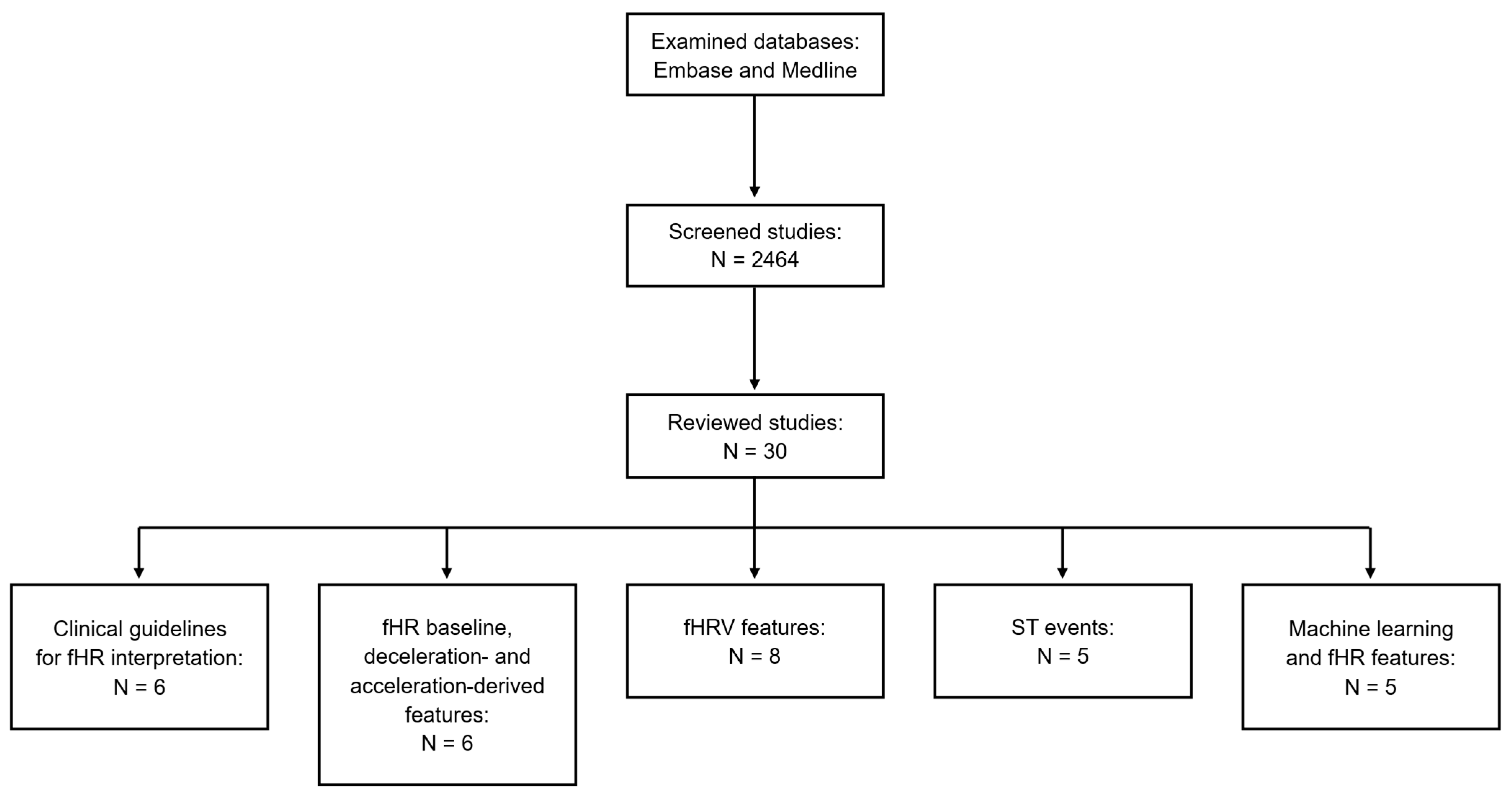
Screening Process and Inclusion Criteria

| Query Block | Query Block Description | Words or Word Combinations Searched Within the Database Indexing, Titles, Abstracts and Keywords of the Studies |
|---|---|---|
| #1 | Use of fHR and fECG | ‘fetus electrocardiography’/exp OR ‘fetus heart rate’/exp OR ‘cardiotocography’/exp OR ((‘CTG*’ OR ‘cardiotoco*’ OR ‘electronic fetal monitor*’ OR ‘EFM*’):ti,ab,kw) OR (((fet* OR foet*) NEAR/3 (‘HR*’ OR ‘HRV’ OR ‘ecg*’ OR ‘ekg*’ OR ‘elektrocardiogra*’ OR ‘electrocardiogra*’ OR ‘cardiotocogra*’ OR ‘heart rate*’ OR ‘heart rate variabilit*’))):ti,ab,kw |
| #2 | Prediction task | ‘prediction and forecasting’/exp OR ‘statistical analysis’/exp OR ‘data classification’/exp OR ‘risk’/exp OR ‘machine learning’/exp OR ‘neural network’/exp OR ‘artificial intelligence’/exp OR (‘predict*’ OR ‘prognos*’ OR ‘correlat*’ OR ‘relevan*’ OR ‘statistic*’ OR ‘analys*’ OR ‘detect*’ OR ‘classific*’ OR ‘risk*’ OR ‘machine learning’ OR ‘deep learning’ OR ‘neural network*’ OR ‘artificial intelligence’):ti,ab,kw |
| #3 | Investigation of acidemia | ‘asphyxia’/exp OR ‘suffocation’/exp OR ‘fetus hypoxia’/exp OR ‘fetal acidosis’/exp OR ‘fetus acidemia’/exp OR ‘newborn hypoxia’/exp OR ‘fetus acid base balance’/exp OR ((fet* OR foet* OR perinat* OR neonat* OR newborn* OR premature* OR preterm* OR term*) NEAR/6 (asphyx* OR suffocat* OR hypox* OR acidem* OR acidos*)):ti,ab,kw |
| #4 | Overlaps between query blocks and exclusion criteria | #1 AND #2 AND #3 NOT ([animals]/lim NOT [humans]/lim) NOT ‘conference abstract’/it |
References
- Ahearne, C.E. Short and Long Term Prognosis in Perinatal Asphyxia: An Update. World J. Clin. Pediatr. 2016, 5, 67. [Google Scholar] [CrossRef]
- Fahey, J.; King, T.L. Intrauterine Asphyxia: Clinical Implications for Providers of Intrapartum Care. J. Midwifery Women’s Health 2005, 50, 498–506. [Google Scholar] [CrossRef]
- Ayres-De-Campos, D. Introduction: Why Is Intrapartum Foetal Monitoring Necessary—Impact on Outcomes and Interventions. Best Pract. Res. Clin. Obstet. Gynaecol. 2016, 30, 3–8. [Google Scholar] [CrossRef]
- Garabedian, C.; De Jonckheere, J.; Butruille, L.; Deruelle, P.; Storme, L.; Houfflin-Debarge, V. Understanding Fetal Physiology and Second Line Monitoring during Labor. J. Gynecol. Obs. Hum. Reprod. 2017, 46, 113–117. [Google Scholar] [CrossRef]
- Mietzsch, U.; Juul, S.E. Neonatal Encephalopathy; Elsevier: Amsterdam, The Netherlands, 2023; ISBN 9780323828239. [Google Scholar]
- Bhutta, Z.A. Pediatrics in the Tropics. In Manson’s Tropical Infectious Diseases; Elsevier: Amsterdam, The Netherlands, 2013; ISBN 9780702053061. [Google Scholar]
- Antonucci, R.; Porcella, A.; Pilloni, M.D. Perinatal Asphyxia in the Term Newborn. J. Pediatr. Neonatal Individ. Med. 2014, 3, e030269. [Google Scholar] [CrossRef]
- World Health Organization Perinatal Asphyxia. Available online: https://www.who.int/teams/maternal-newborn-child-adolescent-health-and-ageing/newborn-health/perinatal-asphyxia (accessed on 1 December 2025).
- Gebregziabher, G.T.; Hadgu, F.B.; Abebe, H.T. Prevalence and Associated Factors of Perinatal Asphyxia in Neonates Admitted to Ayder Comprehensive Specialized Hospital, Northern Ethiopia: A Cross-Sectional Study. Int. J. Pediatr. 2020, 2020, 4367248. [Google Scholar] [CrossRef] [PubMed]
- Ayres-De-Campos, D.; Spong, C.Y.; Chandraharan, E. FIGO Consensus Guidelines on Intrapartum Fetal Monitoring: Cardiotocography. Int. J. Gynecol. Obstet. 2015, 131, 13–24. [Google Scholar] [CrossRef] [PubMed]
- Gilstrap, L.C.; Leveno, K.J.; Burris, J.; Williams, M.L.; Little, B.B. Diagnosis of Birth Asphyxia on the Basis of Fetal PH, Apgar Score, and Newborn Cerebral Dysfunction. Am. J. Obs. Gynecol. 1989, 161, 825–830. [Google Scholar] [CrossRef]
- Valentin, L.; Ekman, G.; Isberg, P.E.; Polberger, S.; Marsál, K. Clinical Evaluation of the Fetus and Neonate. Relation between Intra-Partum Cardiotocography, Apgar Score, Cord Blood Acid-Base Status and Neonatal Morbidity. Arch. Gynecol. Obs. 1993, 253, 103–115. [Google Scholar] [CrossRef] [PubMed]
- Olofsson, P. Umbilical Cord PH, Blood Gases, and Lactate at Birth: Normal Values, Interpretation, and Clinical Utility. Am. J. Obs. Gynecol. 2023, 228, S1222–S1240. [Google Scholar] [CrossRef]
- Francis, F.; Luz, S.; Wu, H.; Stock, S.J.; Townsend, R. Machine Learning on Cardiotocography Data to Classify Fetal Outcomes: A Scoping Review. Comput. Biol. Med. 2024, 172, 108220. [Google Scholar] [CrossRef] [PubMed]
- Xiao, Y.; Lu, Y.; Liu, M.; Zeng, R.; Bai, J. A Deep Feature Fusion Network for Fetal State Assessment. Front. Physiol. 2022, 13, 969052. [Google Scholar] [CrossRef] [PubMed]
- Parer, J.T.; Ikeda, T. A Framework for Standardized Management of Intrapartum Fetal Heart Rate Patterns. Am. J. Obs. Gynecol. 2007, 197, 26.e1–26.e6. [Google Scholar] [CrossRef] [PubMed]
- Macones, G.A. Intrapartum Fetal Heart Rate Monitoring: Nomenclature, Interpretation, and General Management Principles. Obstet. Gynecol. 2009, 114, 192–202. [Google Scholar] [CrossRef]
- Ekengård, F.; Cardell, M.; Herbst, A. Low Sensitivity of the New FIGO Classification System for Electronic Fetal Monitoring to Identify Fetal Acidosis in the Second Stage of Labor. Eur. J. Obs. Gynecol. Reprod. Biol. X 2021, 9, 100120. [Google Scholar] [CrossRef]
- Mendis, L.; Palaniswami, M.; Brownfoot, F.; Keenan, E. Computerised Cardiotocography Analysis for the Automated Detection of Fetal Compromise during Labour: A Review. Bioengineering 2023, 10, 1007. [Google Scholar] [CrossRef]
- Kling, D.; Rehnström, M.; Herbst, A. Performance of Five Cardiotocography Classification Templates in Labor: A Cohort Study. J. Matern. Fetal Neonatal Med. 2024, 37, 2394845. [Google Scholar] [CrossRef]
- Macones, G.A.; Hankins, G.D.V.; Spong, C.Y.; Hauth, J.; Moore, T. The 2008 National Institute of Child Health and Human Development Report on Fetal Heart Rate Monitoring. Update on Definitions, Interpretation, and Research Guidelines. Obstet. Gynecol. 2008, 112, 661–666. [Google Scholar] [CrossRef]
- Parer, J.T.; Quilligan, E.J.; Boehm, F.H.; Depp, R.; Depp, R.; Divon, M.Y.; Greene, K.R.; Harvey, C.J.; Hauth, J.C.; Huddleston, J.F.; et al. Electronic Fetal Heart Rate Monitoring: Research Guidelines for Interpretation. The National Institute of Child Health and Human Development Research Planning Workshop. Am. J. Obs. Gynecol. 1997, 177, 1385–1390. [Google Scholar] [CrossRef]
- Gracia-Perez-Bonfils, A.; Vigneswaran, K.; Cuadras, D.; Chandraharan, E. Does the Saltatory Pattern on Cardiotocograph (CTG) Trace Really Exist? The ZigZag Pattern as an Alternative Definition and Its Correlation with Perinatal Outcomes. J. Matern. Fetal Neonatal Med. 2021, 34, 3537–3545. [Google Scholar] [CrossRef]
- Cahill, A.G.; Roehl, K.A.; Odibo, A.O.; Macones, G.A. Association and Prediction of Neonatal Acidemia. Am. J. Obs. Gynecol. 2012, 207, 206.e1–206.e8. [Google Scholar] [CrossRef]
- Schiermeier, S.; Reinhard, J.; Hatzmann, H.; Zimmermann, R.C.; Westhof, G. Fetal Short Time Variation during Labor: A Non-Invasive Alternative to Fetal Scalp PH Measurements? J. Perinat. Med. 2009, 37, 529–533. [Google Scholar] [CrossRef]
- Van Laar, J.O.E.H.; Porath, M.M.; Peters, C.H.L.; Oei, S.G. Spectral Analysis of Fetal Heart Rate Variability for Fetal Surveillance: Review of the Literature. Acta Obs. Gynecol. Scand. 2008, 87, 300–306. [Google Scholar] [CrossRef]
- Georgieva, A.; Papageorghiou, A.T.; Payne, S.J.; Moulden, M.; Redman, C.W.G. Phase-Rectified Signal Averaging for Intrapartum Electronic Fetal Heart Rate Monitoring Is Related to Acidaemia at Birth. BJOG Int. J. Obstet. Gynaecol. 2014, 121, 889–894. [Google Scholar] [CrossRef]
- Castro, L.; Loureiro, M.; Henriques, T.S.; Nunes, I. Systematic Review of Intrapartum Fetal Heart Rate Spectral Analysis and an Application in the Detection of Fetal Acidemia. Front. Pediatr. 2021, 9, 661400. [Google Scholar] [CrossRef]
- Rivolta, M.W.; Stampalija, T.; Frasch, M.G.; Sassi, R. Theoretical Value of Deceleration Capacity Points to Deceleration Reserve of Fetal Heart Rate. IEEE Trans. Biomed. Eng. 2020, 67, 1176–1185. [Google Scholar] [CrossRef]
- Amer-Wahlin, I.; Arulkumaran, S.; Hagberg, H.; Maršál, K.; Visser, G.H.A. Fetal Electrocardiogram: ST Waveform Analysis in Intrapartum Surveillance. BJOG Int. J. Obstet. Gynaecol. 2007, 114, 1191–1193. [Google Scholar] [CrossRef]
- Amer-Wåhlin, I.; Maršál, K. ST Analysis of Fetal Electrocardiography in Labor. Semin. Fetal Neonatal Med. 2011, 16, 29–35. [Google Scholar] [CrossRef]
- Westerhuis, M.E.M.H.; Visser, G.H.A.; Moons, K.G.M.; Zuithoff, N.; Mol, B.W.J.; Kwee, A. Cardiotocography plus ST Analysis of Fetal Electrocardiogram Compared with Cardiotocography Only for Intrapartum Monitoring: A Randomized Controlled Trial. Obstet. Gynecol. 2011, 117, 406–407. [Google Scholar] [CrossRef]
- Belfort, M.A.; Saade, G.R.; Thom, E.; Blackwell, S.C.; Reddy, U.M.; Thorp, J.M.; Tita, A.T.N.; Miller, R.S.; Peaceman, A.M.; McKenna, D.S.; et al. A Randomized Trial of Intrapartum Fetal ECG ST-Segment Analysis. N. Engl. J. Med. 2015, 373, 632–641. [Google Scholar] [CrossRef]
- Hamelmann, P.; Vullings, R.; Kolen, A.F.; Bergmans, J.W.M.; Van Laar, J.O.E.H.; Tortoli, P.; Mischi, M. Doppler Ultrasound Technology for Fetal Heart Rate Monitoring: A Review. IEEE Trans. Ultrason. Ferroelectr. Freq. Control 2020, 67, 226–238. [Google Scholar] [CrossRef]
- Hulsenboom, A.D.J.; Van der Hout-van der Jagt, M.B.; van den Akker, E.S.A.; Bakker, P.C.A.M.; van Beek, E.; Drogtrop, A.P.; Kwee, A.; Westerhuis, M.E.M.H.; Rijnders, R.J.P.; Schuitemaker, N.W.E.; et al. New Possibilities for ST Analysis—A Post-Hoc Analysis on the Dutch STAN RCT. Early Hum. Dev. 2022, 166, 105537. [Google Scholar] [CrossRef]
- Hulsenboom, A.D.J.; van der Woude, D.A.A.; Porath, M.M.; Kwee, A.; Vullings, R.; Oei, S.G.; van Laar, J.O.E.H. Adapted ST Analysis during Labor: Relative versus Absolute ST Events, a Case-Control Study. J. Matern. Fetal Neonatal Med. 2022, 35, 7375–7380. [Google Scholar] [CrossRef]
- Clifford, G.D.; Silva, I.; Behar, J.; Moody, G.B. Noninvasive Fetal ECG Analysis. Physiol. Meas. 2014, 35, 1521–1536. [Google Scholar] [CrossRef]
- Kawakita, T.; Reddy, U.M.; Landy, H.J.; Iqbal, S.N.; Huang, C.C.; Grantz, K.L. Neonatal Complications Associated with Use of Fetal Scalp Electrode: A Retrospective Study. BJOG Int. J. Obstet. Gynaecol. 2016, 123, 1797–1803. [Google Scholar] [CrossRef]
- Van Laar, J.O.E.H.; Warmerdam, G.J.J.; Verdurmen, K.M.J.; Vullings, R.; Peters, C.H.L.; Houterman, S.; Wijn, P.F.F.; Andriessen, P.; Van Pul, C.; Guid Oei, S. Fetal Heart Rate Variability during Pregnancy, Obtained from Non-Invasive Electrocardiogram Recordings. Acta Obs. Gynecol. Scand. 2014, 93, 93–101. [Google Scholar] [CrossRef]
- Vullings, R.; van Laar, J.O.E.H. Non-Invasive Fetal Electrocardiography for Intrapartum Cardiotocography. Front. Pediatr. 2020, 8, 599049. [Google Scholar] [CrossRef]
- Monson, M.; Heuser, C.; Einerson, B.D.; Esplin, I.; Snow, G.; Varner, M.; Esplin, M.S. Evaluation of an External Fetal Electrocardiogram Monitoring System: A Randomized Controlled Trial. Am. J. Obs. Gynecol. 2020, 223, 244.e1–244.e12. [Google Scholar] [CrossRef]
- Luong, C.; Pham, H.; Kaur, R.; Nair, A. Evaluation of The Fetal Heart Rate Monitoring with The Non-Invasive Electrocardiography Signals. In Proceedings of the Annual International Conference of the IEEE Engineering in Medicine and Biology Society, EMBS, Sydney, Australia, 24–27 July 2023. [Google Scholar]
- Mhajna, M.; Schwartz, N.; Levit-Rosen, L.; Warsof, S.; Lipschuetz, M.; Jakobs, M.; Rychik, J.; Sohn, C.; Yagel, S. Wireless, Remote Solution for Home Fetal and Maternal Heart Rate Monitoring. Am. J. Obs. Gynecol. MFM 2020, 2, 100101. [Google Scholar] [CrossRef]
- Cahill, A.G.; Tuuli, M.G.; Stout, M.J.; López, J.D.; Macones, G.A. A Prospective Cohort Study of Fetal Heart Rate Monitoring: Deceleration Area Is Predictive of Fetal Acidemia. Am. J. Obs. Gynecol. 2018, 218, 523.e1–523.e12. [Google Scholar] [CrossRef]
- Baghel, N.; Burget, R.; Dutta, M.K. 1D-FHRNet: Automatic Diagnosis of Fetal Acidosis from Fetal Heart Rate Signals. Biomed. Signal Process Control 2022, 71, 102794. [Google Scholar] [CrossRef]
- Ekengård, F.; Cardell, M.; Herbst, A. Sporadic Accelerations during Labor Strongly Indicate Normal PH, Whereas Periodic Accelerations Do Not: A Case–Control Study. J. Matern. Fetal Neonatal Med. 2023, 36, 2157717. [Google Scholar] [CrossRef]
- Hon, E.H.; Lee, S.T. Electronic Evaluation of the Fetal Heart Rate. VIII. Patterns Preceding Fetal Death, Further Observations. Am. J. Obs. Gynecol. 1963, 87, 814–826. [Google Scholar]
- Heelan, L. Fetal Monitoring: Creating a Culture of Safety with Informed Choice. J. Perinat. Educ. 2013, 22, 156–165. [Google Scholar] [CrossRef]
- Yli, B.M.; Kessler, J.; Eikeland, T.; Hustad, B.L.; Dragnes, W.; Henriksen, T. What Is the Gold Standard for Intrapartum Fetal Monitoring? Acta Obs. Gynecol. Scand. 2012, 91, 1011–1014. [Google Scholar] [CrossRef]
- Chauhan, S.P.; Klauser, C.K.; Woodring, T.C.; Sanderson, M.; Magann, E.F.; Morrison, J.C. Intrapartum Nonreassuring Fetal Heart Rate Tracing and Prediction of Adverse Outcomes: Interobserver Variability. Am. J. Obs. Gynecol. 2008, 199, 623.e1–623.e5. [Google Scholar] [CrossRef]
- Royal College of Obstetricians and Gynaecologists. The Use of Electronic Fetal Monitoring: The Use and Interpretation of Cardiotocography in Intrapartum Fetal Surveillance; Royal College of Obstetricians and Gynaecologists: London, UK, 2001. [Google Scholar]
- Ribeiro, M.; Monteiro-Santos, J.; Castro, L.; Antunes, L.; Costa-Santos, C.; Teixeira, A.; Henriques, T.S. Non-Linear Methods Predominant in Fetal Heart Rate Analysis: A Systematic Review. Front. Med. 2021, 8, 661226. [Google Scholar] [CrossRef]
- Signorini, M.G.; Pini, N.; Malovini, A.; Bellazzi, R.; Magenes, G. Dataset on Linear and Non-Linear Indices for Discriminating Healthy and IUGR Fetuses. Data Brief 2020, 29, 105164. [Google Scholar] [CrossRef]
- Warmerdam, G.J.J.; Vullings, R.; Van Laar, J.O.E.H.; Van Der Hout-Van Der Jagt, M.B.; Bergmans, J.W.M.; Schmitt, L.; Oei, S.G. Using Uterine Activity to Improve Fetal Heart Rate Variability Analysis for Detection of Asphyxia during Labor. Physiol. Meas. 2016, 37, 387–400. [Google Scholar] [CrossRef]
- Costa, A.; Ayres-de-Campos, D.; Costa, F.; Santos, C.; Bernardes, J. Prediction of Neonatal Acidemia by Computer Analysis of Fetal Heart Rate and ST Event Signals. Am. J. Obs. Gynecol. 2009, 201, 464.e1–464.e6. [Google Scholar] [CrossRef]
- Landman, A.J.E.M.C.; Immink-Duijker, S.T.; Mulder, E.J.H.; Koster, M.P.H.; Xodo, S.; Visser, G.H.A.; Groenendaal, F.; Kwee, A. Significant Reduction in Umbilical Artery Metabolic Acidosis after Implementation of Intrapartum ST Waveform Analysis of the Fetal Electrocardiogram. Am. J. Obs. Gynecol. 2019, 221, 63.e1–63.e13. [Google Scholar] [CrossRef]
- Tarvonen, M.; Markkanen, J.; Tuppurainen, V.; Jernman, R.; Stefanovic, V.; Andersson, S. Intrapartum Cardiotocography with Simultaneous Maternal Heart Rate Registration Improves Neonatal Outcome. Am. J. Obs. Gynecol. 2024, 230, 379.e1–379.e12. [Google Scholar] [CrossRef]
- Amer-Wåhlin, I.; Ugwumadu, A.; Yli, B.M.; Kwee, A.; Timonen, S.; Cole, V.; Ayres-de-Campos, D.; Roth, G.E.; Schwarz, C.; Ramenghi, L.A.; et al. Fetal Electrocardiography ST-Segment Analysis for Intrapartum Monitoring: A Critical Appraisal of Conflicting Evidence and a Way Forward. Am. J. Obs. Gynecol. 2019, 221, 577–601.e11. [Google Scholar] [CrossRef]
- Cagninelli, G.; Dall’asta, A.; Di Pasquo, E.; Morganelli, G.; Degennaro, V.A.; Fieni, S.; Frusca, T.; Ghi, T. STAN: A Reappraisal of Its Clinical Usefulness. Minerva Obstet. Gynecol. 2021, 73, 34–44. [Google Scholar] [CrossRef]
- Tsiligkeridou, S.; Bolou, A.; Xanthos, T.; Gourounti, K. Perinatal and Neonatal Outcomes Using Cardiotocography Versus STAN and Cardiotocography: A Systematic Review. Maedica A J. Clin. Med. 2023, 18, 684–691. [Google Scholar] [CrossRef]
- Knupp, R.J.; Andrews, W.W.; Tita, A.T.N. The Future of Electronic Fetal Monitoring. Best Pract. Res. Clin. Obstet. Gynaecol. 2020, 67, 44–52. [Google Scholar] [CrossRef]
- Stout, M.J.; Cahill, A.G. Electronic Fetal Monitoring: Past, Present, and Future. Clin. Perinatol. 2011, 38, 127–142. [Google Scholar] [CrossRef]
- O’Heney, J.; McAllister, S.; Maresh, M.; Blott, M. Fetal Monitoring in Labour: Summary and Update of NICE Guidance. BMJ 2022, 379, o2854. [Google Scholar] [CrossRef]
- National Institute for Health and Care Excellence (NICE). Fetal Monitoring in Labour (NG229). 2022. Available online: https://www.nice.org.uk/guidance/ng229 (accessed on 1 December 2025).
- Chandraharan, E.; Evans, S.A.; Krueger, D.; Pereira, S.; Skivens, S.; Zaima, A. Physiological Interpretation. Intrapartum Fetal Monitoring Guideline. 2018. Available online: https://physiological-ctg.com/resources/Intrapartum%20Fetal%20Monitoring%20Guideline.pdf (accessed on 1 December 2025).
- Chandraharan, E.; Pereira, S.; Ghi, T.; Gracia Perez-Bonfils, A.; Fieni, S.; Jia, Y.J.; Griffiths, K.; Sukumaran, S.; Ingram, C.; Reeves, K.; et al. International Expert Consensus Statement on Physiological Interpretation of Cardiotocograph (CTG): First Revision (2024). Eur. J. Obstet. Gynecol. Reprod. Biol. 2024, 302, 346–355. [Google Scholar] [CrossRef]
- Hubert, S.; Brodbeck, O.; David, C.; Chrusciel, J.; Kattini, A.; Sanchez, S. Using the CAESARE Tool in Fetal Heart Rate Analysis. J. Gynecol. Obstet. Hum. Reprod. 2023, 52, 102557. [Google Scholar] [CrossRef]
- Ayres-De-Campos, D.; Sousa, P.; Costa, A.; Bernardes, J. Omniview-SisPorto® 3.5—A Central Fetal Monitoring Station with Online Alerts Based on Computerized Cardiotocogram+ST Event Analysis. J. Perinat. Med. 2008, 36, 260–264. [Google Scholar] [CrossRef]
- Ayres-de-Campos, D.; Rei, M.; Nunes, I.; Sousa, P.; Bernardes, J. SisPorto 4.0–Computer Analysis Following the 2015 FIGO Guidelines for Intrapartum Fetal Monitoring. J. Matern. Fetal Neonatal Med. 2017, 30, 62–67. [Google Scholar] [CrossRef]
- Georgieva, A.; Redman, C.W.G.; Papageorghiou, A.T. Computerized Data-Driven Interpretation of the Intrapartum Cardiotocogram: A Cohort Study. Acta Obs. Gynecol. Scand. 2017, 96, 883–891. [Google Scholar] [CrossRef]
- Van Laar, J.; Peters, C.H.L.; Vullings, R.; Houterman, S.; Bergmans, J.W.M.; Oei, S.G. Fetal Autonomic Response to Severe Acidaemia during Labour. BJOG Int. J. Obstet. Gynaecol. 2010, 117, 429–437. [Google Scholar] [CrossRef]
- The INFANT Collaborative Group. Computerised Interpretation of Fetal Heart Rate during Labour (INFANT): A Randomised Controlled Trial. Lancet 2017, 389, 1719–1729. [Google Scholar] [CrossRef]
- Pardey, J.; Moulden, M.; Redman, C.W.G. A Computer System for the Numerical Analysis of Nonstress Tests. Am. J. Obs. Gynecol. 2002, 186, 1095–1103. [Google Scholar] [CrossRef]
- Coletta, J.; Murphy, E.; Rubeo, Z.; Gyamfi-Bannerman, C. The 5-Tier System of Assessing Fetal Heart Rate Tracings Is Superior to the 3-Tier System in Identifying Fetal Acidemia. Am. J. Obs. Gynecol. 2012, 206, 226.e1–226.e5. [Google Scholar] [CrossRef]
- Elliott, C.; Warrick, P.A.; Graham, E.; Hamilton, E.F. Graded Classification of Fetal Heart Rate Tracings: Association with Neonatal Metabolic Acidosis and Neurologic Morbidity. Am. J. Obs. Gynecol. 2010, 202, 258.e1–258.e8. [Google Scholar] [CrossRef]
- Yagur, Y.; Weitzner, O.; Biron-Shental, T.; Hornik-Lurie, T.; Bookstein Peretz, S.; Tzur, Y.; Shechter Maor, G. Can We Improve Our Ability to Interpret Category II Fetal Heart Rate Tracings Using Additional Clinical Parameters? J. Perinat. Med. 2021, 49, 1089–1095. [Google Scholar] [CrossRef]
- Gamboa, S.M.; Moros, M.L.; Mancho, J.P.; Moros, C.L.; Mateo, S.C. Deceleration Area and Fetal Acidemia. J. Matern. Fetal Neonatal Med. 2017, 30, 2578–2584. [Google Scholar] [CrossRef]
- Clark, S.L.; Hamilton, E.F.; Garite, T.J.; Timmins, A.; Warrick, P.A.; Smith, S. The Limits of Electronic Fetal Heart Rate Monitoring in the Prevention of Neonatal Metabolic Acidemia. Am. J. Obs. Gynecol. 2017, 216, 163.e1–163.e6. [Google Scholar] [CrossRef]
- Bruno, A.M.; López, J.D.; Stout, M.J.; Tuuli, M.G.; Macones, G.A.; Cahill, A.G. Acidemia Can Occur despite Category I Tracing. Am. J. Perinatol. 2020, 37, 762–768. [Google Scholar] [CrossRef]
- Pruksanusak, N.; Thongphanang, P.; Suntharasaj, T.; Suwanrath, C.; Geater, A. Combined Maternal-Associated Risk Factors with Intrapartum Fetal Heart Rate Classification Systems to Predict Peripartum Asphyxia Neonates. Eur. J. Obstet. Gynecol. Reprod. Biol. 2017, 218, 85–91. [Google Scholar] [CrossRef]
- Gilstrap, L.C.; Hauth, J.C.; Hankins, G.D.V.; Beck, A.W. Second-Stage Fetal Heart Rate Abnormalities and Type of Neonatal Acidemia. Obstet. Gynecol. 1987, 70, 191–195. [Google Scholar] [CrossRef]
- Piquard, F.; Hsiung, R.; Mettauer, M.; Schaefer, A.; Haberey, P.; Dellenbach, P. The Validity of Fetal Heart Rate Monitoring during the Second Stage of Labor. Obstet. Gynecol. 1988, 72, 746–751. [Google Scholar] [CrossRef]
- Sheiner, E.; Hadar, A.; Hallak, M.; Katz, M.; Mazor, M.; Shoham-Vardi, I. Clinical Significance of Fetal Heart Rate Tracings during the Second Stage of Labor. Obstet. Gynecol. 2001, 97, 747–752. [Google Scholar]
- Tarvonen, M.; Hovi, P.; Sainio, S.; Vuorela, P.; Andersson, S.; Teramo, K. Intrapartum Zigzag Pattern of Fetal Heart Rate Is an Early Sign of Fetal Hypoxia: A Large Obstetric Retrospective Cohort Study. Acta Obs. Gynecol. Scand. 2021, 100, 252–262. [Google Scholar] [CrossRef]
- Giannubilo, S.R.; Buscicchio, G.; Gentilucci, L.; Palla, G.P.; Tranquilli, A.L. Deceleration Area of Fetal Heart Rate Trace and Fetal Acidemia at Delivery: A Case-Control Study. J. Matern. Fetal Neonatal Med. 2007, 20, 141–144. [Google Scholar] [CrossRef]
- Furukawa, A.; Neilson, D.; Hamilton, E. Cumulative Deceleration Area: A Simplified Predictor of Metabolic Acidemia. J. Matern. Fetal Neonatal Med. 2021, 34, 3104–3111. [Google Scholar] [CrossRef]
- Krebs, H.B.; Petres, R.E.; Dunn, L.J.; Smith, P.J. Intrapartum Fetal Heart Rate Monitoring. VI. Prognostic Significance of Accelerations. Am. J. Obs. Gynecol. 1982, 142, 297–305. [Google Scholar] [CrossRef]
- Agrawal, S.K.; Doucette, F.; Gratton, R.; Richardson, B.; Gagnon, R. Intrapartum Computerized Fetal Heart Rate Parameters and Metabolic Acidosis at Birth. Obstet. Gynecol. 2003, 102, 731–738. [Google Scholar] [CrossRef]
- Nunes, I.; Ayres-de-Campos, D.; Kwee, A.; Rosén, K.G. Prolonged Saltatory Fetal Heart Rate Pattern Leading to Newborn Metabolic Acidosis. Clin. Exp. Obs. Gynecol. 2014, 41, 507–511. [Google Scholar] [CrossRef]
- Murata, Y.; Martin, C.B.; Ikenoue, T.; Hashimoto, T.; Taira, S.; Sagawa, T.; Sakata, H. Fetal Heart Rate Accelerations and Late Decelerations during the Course of Intrauterine Death in Chronically Catheterized Rhesus Monkeys. Am. J. Obs. Gynecol. 1982, 144, 218–223. [Google Scholar] [CrossRef]
- van der Hout-van der Jagt, M.B.; Oei, S.G.; Bovendeerd, P.H.M. Simulation of Reflex Late Decelerations in Labor with a Mathematical Model. Early Hum. Dev. 2013, 89, 7–19. [Google Scholar] [CrossRef]
- Ball, R.H.; Parer, J.T. The Physiologic Mechanisms of Variable Decelerations. Am. J. Obs. Gynecol. 1992, 166, 1683–1689. [Google Scholar] [CrossRef]
- Van der Hout-van der Jagt, M.B.; Jongen, G.J.L.M.; Bovendeerd, P.H.M.; Oei, S.G. Insight into Variable Fetal Heart Rate Decelerations from a Mathematical Model. Early Hum. Dev. 2013, 89, 361–369. [Google Scholar] [CrossRef]
- Fogelberg, M.; Dahlbäck, C.; Ekengård, F.; Rickle, G.; Herbst, A. Association between Different Types and Characteristics of Fetal Deceleration during Labour and Neonatal Acidemia at Delivery: A Case-Control Study. Eur. J. Obstet. Gynecol. Reprod. Biol. X 2025, 26, 100389. [Google Scholar] [CrossRef]
- Costa, M.D.; Davis, R.B.; Goldberger, A.L. Heart Rate Fragmentation: A New Approach to the Analysis of Cardiac Interbeat Interval Dynamics. Front. Physiol. 2017, 8, 255. [Google Scholar] [CrossRef]
- Costa, M.; Xavier, M.; Nunes, I.; Henriques, T.S. Fetal Heart Rate Fragmentation. Front. Pediatr. 2021, 9, 662101. [Google Scholar] [CrossRef]
- Goldberger, A.L.; Amaral, L.A.; Glass, L.; Hausdorff, J.M.; Ivanov, P.C.; Mark, R.G.; Mietus, J.E.; Moody, G.B.; Peng, C.K.; Stanley, H.E. PhysioBank, PhysioToolkit, and PhysioNet: Components of a New Research Resource for Complex Physiologic Signals. Circulation 2000, 101, E215–E220. [Google Scholar] [CrossRef]
- Chudáček, V.; Spilka, J.; Burša, M.; Janků, P.; Hruban, L.; Huptych, M.; Lhotská, L. Open Access Intrapartum CTG Database. BMC Pregnancy Childbirth 2014, 14, 16. [Google Scholar] [CrossRef]
- Ponsiglione, A.M.; Cosentino, C.; Cesarelli, G.; Amato, F. A Comprehensive Review of Techniques for Processing and Analyzing Fetal Heart Rate Signals. Sensors 2021, 21, 6136. [Google Scholar] [CrossRef]
- Dawes, G.S.; Moulden, M.; Redman, C.W.G. System 8000: Computerized Antenatal FHR Analysis. J. Perinat. Med. 1991, 19, 47–51. [Google Scholar] [CrossRef]
- Steer, P.J.; Eigbe, F.; Lissauer, T.J.; Beard, R.W. Interrelationships among Abnormal Cardiotocograms in Labor, Meconium Staining of the Amniotic Fluid, Arterial Cord Blood PH, and Apgar Scores. Obstet. Gynecol. 1989, 74, 715–721. [Google Scholar] [CrossRef]
- Gatellier, M.A.; De Jonckheere, J.; Storme, L.; Houfflin-Debarge, V.; Ghesquiere, L.; Garabedian, C. Fetal Heart Rate Variability Analysis for Neonatal Acidosis Prediction. J. Clin. Monit. Comput. 2021, 35, 771–777. [Google Scholar] [CrossRef]
- Lu, K.; Holzmann, M.; Abtahi, F.; Lindecrantz, K.; Lindqvist, P.G.; Nordstrom, L. Fetal Heart Rate Short Term Variation during Labor in Relation to Scalp Blood Lactate Concentration. Acta Obs. Gynecol. Scand. 2018, 97, 1274–1280. [Google Scholar] [CrossRef]
- Mulkey, S.B.; Plessis, A. dú The Critical Role of the Central Autonomic Nervous System in Fetal-Neonatal Transition. Semin. Pediatr. Neurol. 2018, 28, 29–37. [Google Scholar] [CrossRef]
- Butruille, L.; De Jonckheere, J.; Flocteil, M.; Garabedian, C.; Houfflin-Debarge, V.; Storme, L.; Deruelle, P.; Logier, R. Parasympathetic Tone Variations According to Umbilical Cord PH at Birth: A Computerized Fetal Heart Rate Variability Analysis. J. Clin. Monit. Comput. 2017, 31, 1197–1202. [Google Scholar] [CrossRef]
- Kitlinski, M.L.; Källén, K.; Marsál, K.; Olofsson, P. Gestational Age–Dependent Reference Values for PH in Umbilical Cord Arterial Blood at Term. Obstet. Gynecol. 2003, 102, 338–345. [Google Scholar] [CrossRef]
- Signorini, M.G.; Magenes, G.; Cerutti, S.; Arduini, D. Linear and Nonlinear Parameters for the Analysis of Fetal Heart Rate Signal from Cardiotocographic Recordings. IEEE Trans. Biomed. Eng. 2003, 50, 365–374. [Google Scholar] [CrossRef]
- Siira, S.M.; Ojala, T.H.; Vahlberg, T.J.; Jalonen, J.O.; Välimäki, I.A.; Rosén, K.G.; Ekholm, E.M. Marked Fetal Acidosis and Specific Changes in Power Spectrum Analysis of Fetal Heart Rate Variability Recorded during the Last Hour of Labour. BJOG Int. J. Obstet. Gynaecol. 2005, 112, 418–423. [Google Scholar] [CrossRef]
- Salamalekis, E.; Hintipas, E.; Salloum, I.; Vasios, G.; Loghis, C.; Vitoratos, N.; Chrelias, C.; Creatsas, G. Computerized Analysis of Fetal Heart Rate Variability Using the Matching Pursuit Technique as an Indicator of Fetal Hypoxia during Labor. J. Matern. Fetal Neonatal Med. 2006, 19, 165–169. [Google Scholar] [CrossRef] [PubMed]
- van Laar, J.O.E.H.; Peters, C.H.L.; Houterman, S.; Wijn, P.F.F.; Kwee, A.; Oei, S.G. Normalized Spectral Power of Fetal Heart Rate Variability Is Associated with Fetal Scalp Blood PH. Early Hum. Dev. 2011, 87, 259–263. [Google Scholar] [CrossRef]
- Siira, S.M.; Ojala, T.H.; Vahlberg, T.J.; Rosén, K.G.; Ekholm, E.M. Do Spectral Bands of Fetal Heart Rate Variability Associate with Concomitant Fetal Scalp PH? Early Hum. Dev. 2013, 89, 739–742. [Google Scholar] [CrossRef]
- Shaffer, F.; Ginsberg, J.P. An Overview of Heart Rate Variability Metrics and Norms. Front. Public Health 2017, 5, 258. [Google Scholar] [CrossRef]
- Bauer, A.; Kantelhardt, J.W.; Bunde, A.; Barthel, P.; Schneider, R.; Malik, M.; Schmidt, G. Phase-Rectified Signal Averaging Detects Quasi-Periodicities in Non-Stationary Data. Phys. A Stat. Mech. Its Appl. 2006, 364, 423–434. [Google Scholar] [CrossRef]
- Kantelhardt, J.W.; Bauer, A.; Schumann, A.Y.; Barthel, P.; Schneider, R.; Malik, M.; Schmidt, G. Phase-Rectified Signal Averaging for the Detection of Quasi-Periodicities and the Prediction of Cardiovascular Risk and the Prediction of Cardiovascular Risk. Chaos Interdiscip. J. Nonlinear Sci. 2007, 17, 015112. [Google Scholar] [CrossRef]
- Martin, C.B.; de Haan, J.; van der Wildt, B.; Jongsma, H.W.; Dieleman, A.; Arts, T.H.M. Mechanisms of Late Decelerations in the Fetal Heart Rate. A Study with Autonomic Blocking Agents in Fetal Lambs. Eur. J. Obstet. Gynecol. Reprod. Biol. 1979, 9, 361–373. [Google Scholar] [CrossRef]
- Westgate, J.A.; Wibbens, B.; Bennet, L.; Wassink, G.; Parer, J.T.; Gunn, A.J. The Intrapartum Deceleration in Center Stage: A Physiologic Approach to the Interpretation of Fetal Heart Rate Changes in Labor. Am. J. Obs. Gynecol. 2007, 197, 236.e1–236.e11. [Google Scholar] [CrossRef]
- Lear, C.A.; Beacom, M.J.; Dhillon, S.K.; Lear, B.A.; Mills, O.J.; Gunning, M.I.; Westgate, J.A.; Bennet, L.; Gunn, A.J. Dissecting the Contributions of the Peripheral Chemoreflex and Myocardial Hypoxia to Fetal Heart Rate Decelerations in Near-Term Fetal Sheep. J. Physiol. 2023, 601, 2017–2041. [Google Scholar] [CrossRef] [PubMed]
- Bennet, L.; Westgate, J.A.; Liu, Y.C.; Wassink, G.; Gunn, A.J. Fetal Acidosis and Hypotension during Repeated Umbilical Cord Occlusions Are Associated with Enhanced Chemoreflex Responses in Near-Term Fetal Sheep. J. Appl. Physiol. 2005, 99, 1477–1482. [Google Scholar] [CrossRef]
- Giussani, D.A.; Unno, N.; Jenkins, S.L.; Wentworth, R.A.; Berks, J.B.; Collins, J.H.; Nathanielsz, P.W. Dynamics of Cardiovascular Responses to Repeated Partial Umbilical Cord Compression in Late-Gestation Sheep Fetus. Am. J. Physiol. Heart Circ. Physiol. 1997, 273, 2351–2360. [Google Scholar] [CrossRef]
- Green, L.R.; Kawagoe, Y.; Homan, J.; White, S.E.; Richardson, B.S. Adaptation of Cardiovascular Responses to Repetitive Umbilical Cord Occlusion in the Late Gestation Ovine Fetus. J. Physiol. 2001, 535, 879–888. [Google Scholar] [CrossRef]
- Ursino, M. Interaction between Carotid Baroregulation and the Pulsating Heart: A Mathematical Model. Am. J. Physiol. Heart Circ. Physiol. 1998, 275, 1733–1747. [Google Scholar] [CrossRef]
- Ojala, K.; Vääräsmäki, M.; Mäkikallio, K.; Valkama, M.; Tekay, A. A Comparison of Intrapartum Automated Fetal Electrocardiography and Conventional Cardiotocography—A Randomised Controlled Study. BJOG Int. J. Obstet. Gynaecol. 2006, 113, 419–423. [Google Scholar] [CrossRef]
- Vullings, R.; Verdurmen, K.M.J.; Hulsenboom, A.D.J.; Scheffer, S.; De Lau, H.; Kwee, A.; Wijn, P.F.F.; Amer-Wåhlin, I.; Van Laar, J.O.E.H.; Oei, S.G. The Electrical Heart Axis and ST Events in Fetal Monitoring: A Post-Hoc Analysis Following a Multicentre Randomised Controlled Trial. PLoS ONE 2017, 12, e0175823. [Google Scholar] [CrossRef] [PubMed]
- Hulsenboom, A.D.J.; Verdurmen, K.M.J.; Vullings, R.; Beatrijs van der Hout–van der Jagt, M.; Kwee, A.; van Laar, J.O.E.H.; Guid Oei, S. Relative versus Absolute Rises in T/QRS Ratio by ST Analysis of Fetal Electrocardiograms in Labour: A Case-Control Pilot Study. PLoS ONE 2019, 14, e0214357. [Google Scholar] [CrossRef]
- Georgoulas, G.; Karvelis, P.; Spilka, J.; Chudáček, V.; Stylios, C.D.; Lhotská, L. Investigating PH Based Evaluation of Fetal Heart Rate (FHR) Recordings. Health Technol. 2017, 7, 241–254. [Google Scholar] [CrossRef]
- Zhao, Z.; Deng, Y.; Zhang, Y.; Zhang, Y.; Zhang, X.; Shao, L. DeepFHR: Intelligent Prediction of Fetal Acidemia Using Fetal Heart Rate Signals Based on Convolutional Neural Network. BMC Med. Inf. Decis. Mak. 2019, 19, 286. [Google Scholar] [CrossRef]
- Aswathi Mohan, P.P.; Uma, V.; Sasirekha, R.; Hamsika, V. CTGFusionNet: Fusion of Deep Learning Models for Predicting Fetal Distress—A Multimodal Approach. Health Inf. Sci. Syst. 2025, 13, 66. [Google Scholar] [CrossRef]
- Ben M’Barek, I.; Jauvion, G.; Merrer, J.; Koskas, M.; Sibony, O.; Ceccaldi, P.F.; Le Pennec, E.; Stirnemann, J. DeepCTG® 2.0: Development and Validation of a Deep Learning Model to Detect Neonatal Acidemia from Cardiotocography during Labor. Comput. Biol. Med. 2025, 184, 109448. [Google Scholar] [CrossRef] [PubMed]
- Zhao, Z.; Zhang, Y.; Comert, Z.; Deng, Y. Computer-Aided Diagnosis System of Fetal Hypoxia Incorporating Recurrence Plot with Convolutional Neural Network. Front. Physiol. 2019, 10, 255. [Google Scholar] [CrossRef] [PubMed]
- Vullings, R. Non-Invasive Fetal Electrocardiogram: Analysis and Interpretation; Eindhoven University of Technology: Eindhoven, The Netherlands, 2010. [Google Scholar]


| Study | Population and CTG Tracings | Methods | Key Results | Distinct Limitations |
|---|---|---|---|---|
| Costa et al. (2009) [55] | • 148 total fetuses (median GA = 39.0 weeks) including the following: - 7 with acidemia (UA pH ≤ 7.05) - 141 controls • Use of CTG tracings from the last 1 h before delivery | • Use of the SisPorto to predict acidemia • Comparison of the predictive power associated with fHR features and with fHR features plus ST events • Use of metrics (e.g., sensitivity and specificity) | • ST events provided an increase in sensitivity, a similar specificity, but did not improve low precision (SE = 1.00 vs. 0.57, SP = 0.94 vs. 0.97, PRE = 0.47 vs. 0.50) | • A very low precision value was returned even when ST events were considered • Only a limited number of fetuses developing acidemia was included |
| Landman et al. (2019) [56] | • 19,664 total fetuses (GA ≥ 36.0 weeks) including the following: - 230 with acidemia (UA pH < 7.05 and BD > 12 mmol/L) (estimated value based on the reported percentages) - 19,434 controls • Use of CTG tracings after rupture of membranes | • Investigation of the effects of the introduction of the scalp electrode and ST events in clinical practice over a period of 14 years (from 2000 to 2013) • Use of statistical tests (e.g., chi-squared and ANOVA linear trend analysis) | • The rate of acidemia was significantly reduced by 84% during the investigation period • Since a preceding RCT, which only assessed a limited number of years, reported a lower reduction in the rate of acidemia, two possible reasons for the obtained improvement were identified: (1) the introduction of the scalp electrode and ST events, and (2) the intensified training of the hospital personnel | • Most of the fetuses were monitored by using the scalp electrode, but no record was kept of which were monitored • Significant changes occurred in the population of fetuses over the years which were included in the study |
| Cagninelli et al. (2021) [59] | • Fetuses from six RCTs and seven meta-analyses of RCTs • Use of different definitions for acidemia (e.g., UA pH ≤ 7.05) • Use of intrapartum CTG tracings | • Review the effects associated with the use of the scalp electrode and ST events in clinical practice with regards to the onset of acidemia, the rate of operative deliveries as well as other perinatal outcomes | • Conflicting results were presented regarding potential benefits of using ST events to reduce the occurrence of acidemia in both the RCTs and meta-analyses of RCTs • This result could be motivated by the use of different definitions for acidemia in different studies | • Inclusion only of RCTs and seven meta-analyses of RCTs |
| Hulsenboom et al. (2022) [36] | • 20 total fetuses including the following: - 10 with acidemia (mean GA = 283 days, UA pH < 7.05) - 10 matched controls (mean GA = 278 days, UA pH > 7.20) • Use of CTG tracings from the last 10 h before delivery | • Comparison of the diagnostic accuracy of absolute and relative ST events with regard to acidemia • The relevance of absolute ST events was verified by two healthcare professionals who annotated CTG tracings • Use of a statistical test and metrics (i.e., McNemar’s test) | • Relative ST events returned higher sensitivity and specificity in predicting fetuses developing acidemia compared to absolute ST event (SE = 0.90 vs. 0.70, SP = 1.00 vs. 0.70) • No statistical differences were found between relative and absolute ST events | • Only a limited number of fetuses was included • A non-complete spectrum of UA pH values was considered to include fetuses |
| Tarvonen et al. (2024) [57] | • 213,798 fetuses (GA ≥ 37 weeks) including the following: - 81,559 monitored using Doppler ultrasound transducer (358 with UA pH < 7.0) - 62,268 monitored using both a Doppler ultrasound and a mHR transducer (139 with UA pH < 7.0) - 69,971 monitored using the fetal scalp electrode (130 with UA pH < 7.0) • Use of CTG tracings recorded during labor | • Investigation of the relationship between CTG tracings recorded during labor using different strategies with different fetal and neonatal complications • Use of statistical tests (e.g., Kruskal–Wallis test and Mann–Whitney U test) | • Fetuses monitored with the Doppler ultrasound transducer had a 2.2-fold increased risk of acidemia (defined as UA pH < 7.0) compared to those monitored with the other two strategies, a difference that remained significant after adjustment for maternal, delivery, and fetal risk factors • Fetuses monitored using the combination of a Doppler ultrasound transducer and a mHR transducer had a 1.4-fold increased risk of acidemia defined by composite criteria compared to those monitored using the scalp electrode | • Features such as ST events were not investigated within this study |
Disclaimer/Publisher’s Note: The statements, opinions and data contained in all publications are solely those of the individual author(s) and contributor(s) and not of MDPI and/or the editor(s). MDPI and/or the editor(s) disclaim responsibility for any injury to people or property resulting from any ideas, methods, instructions or products referred to in the content. |
© 2026 by the authors. Licensee MDPI, Basel, Switzerland. This article is an open access article distributed under the terms and conditions of the Creative Commons Attribution (CC BY) license.
Share and Cite
Varisco, G.; Steyde, G.; Peri, E.; Hoogendoorn, I.; Signorini, M.G.; van Laar, J.O.E.H.; Mischi, M.; van der Hout-van der Jagt, M.B. Predicting Intrapartum Acidemia: A Review of Approaches Based on Fetal Heart Rate. Bioengineering 2026, 13, 146. https://doi.org/10.3390/bioengineering13020146
Varisco G, Steyde G, Peri E, Hoogendoorn I, Signorini MG, van Laar JOEH, Mischi M, van der Hout-van der Jagt MB. Predicting Intrapartum Acidemia: A Review of Approaches Based on Fetal Heart Rate. Bioengineering. 2026; 13(2):146. https://doi.org/10.3390/bioengineering13020146
Chicago/Turabian StyleVarisco, Gabriele, Giulio Steyde, Elisabetta Peri, Iris Hoogendoorn, Maria G. Signorini, Judith O. E. H. van Laar, Massimo Mischi, and Marieke B. van der Hout-van der Jagt. 2026. "Predicting Intrapartum Acidemia: A Review of Approaches Based on Fetal Heart Rate" Bioengineering 13, no. 2: 146. https://doi.org/10.3390/bioengineering13020146
APA StyleVarisco, G., Steyde, G., Peri, E., Hoogendoorn, I., Signorini, M. G., van Laar, J. O. E. H., Mischi, M., & van der Hout-van der Jagt, M. B. (2026). Predicting Intrapartum Acidemia: A Review of Approaches Based on Fetal Heart Rate. Bioengineering, 13(2), 146. https://doi.org/10.3390/bioengineering13020146