
Numerical Simulation of Karst Groundwater Systems Under Construction of Xiushan Tunnel in Pingyanggai Syncline, Chongqing, China


Abstract
1. Introduction
2. General Situation of Study Area
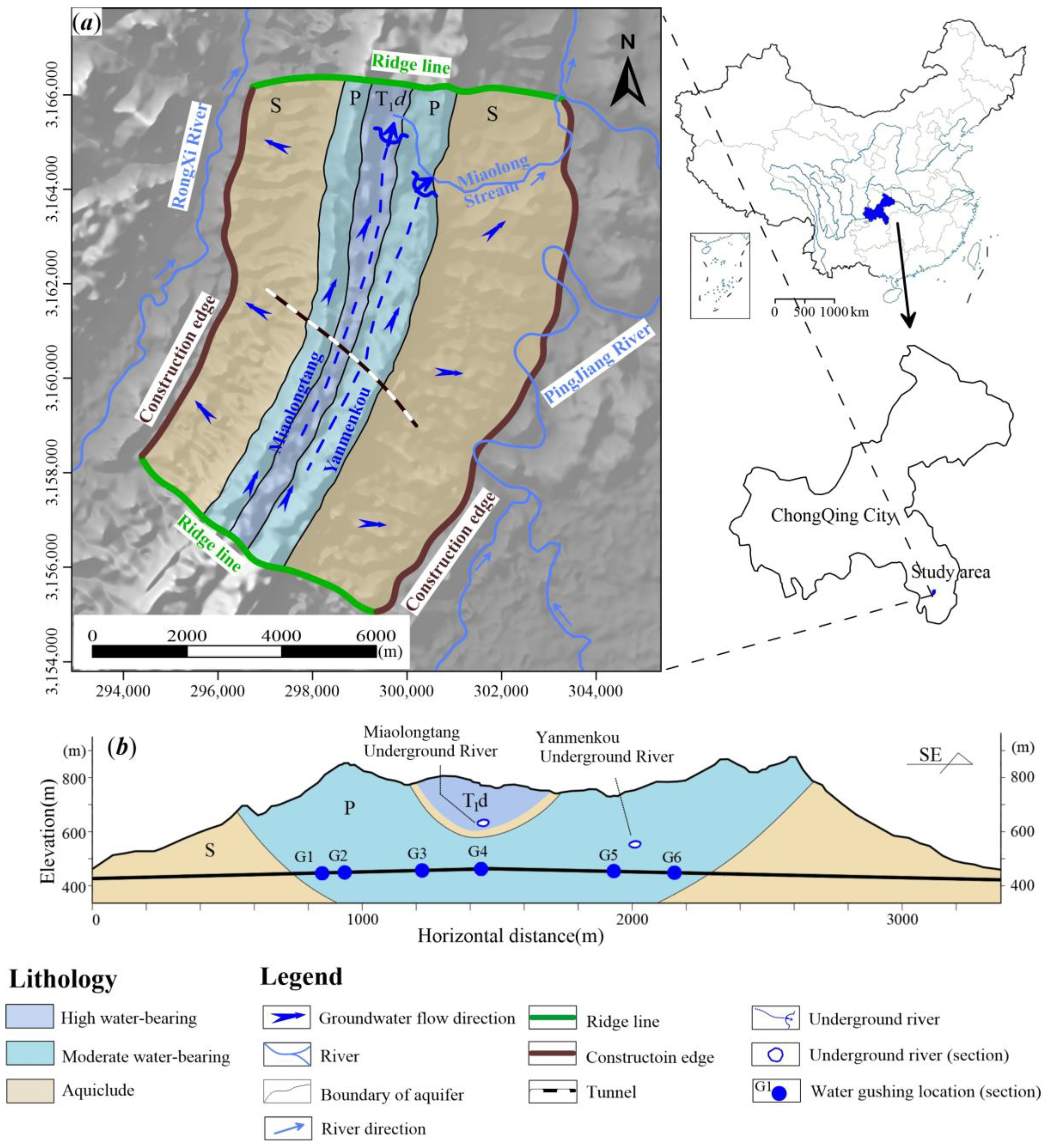
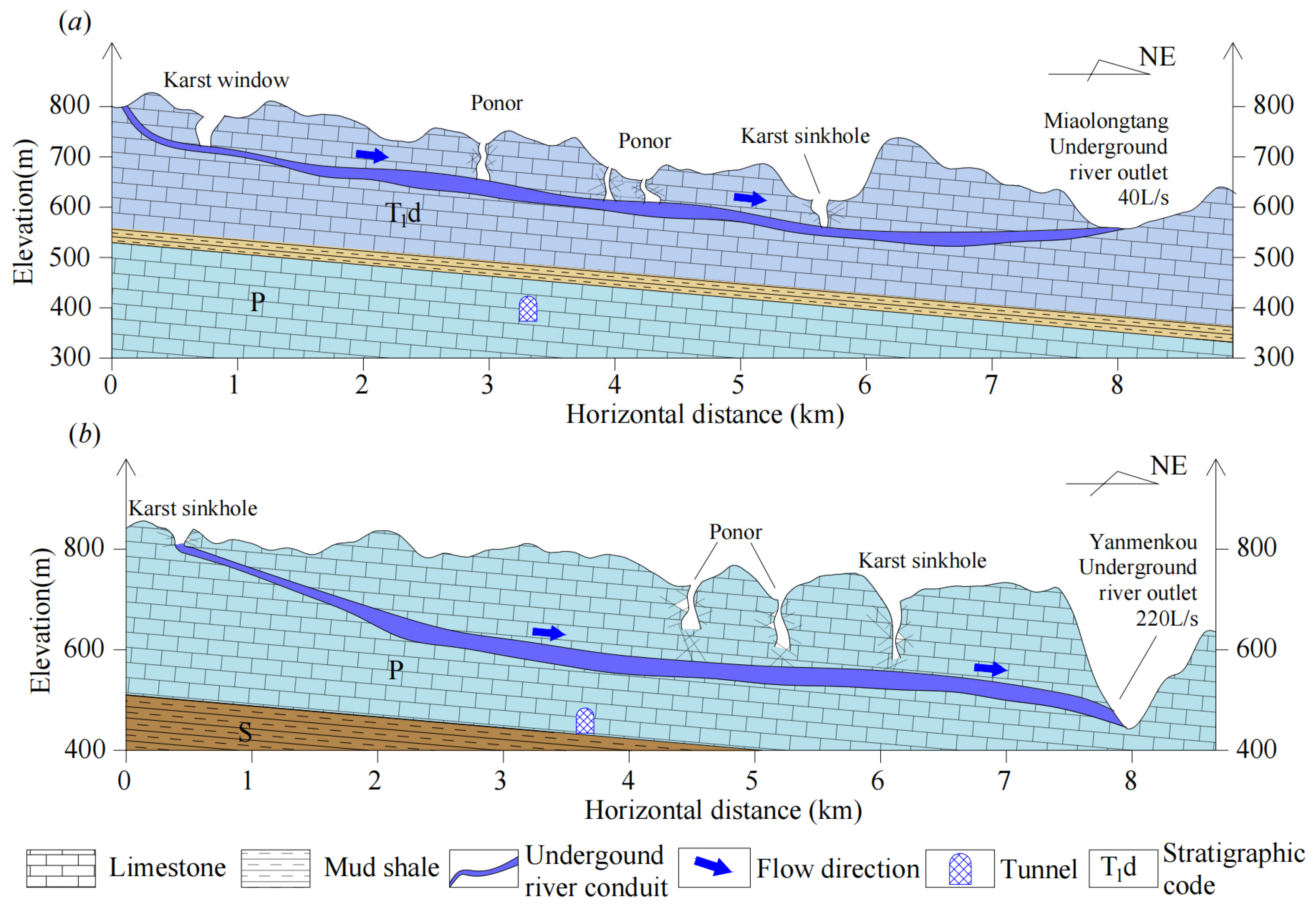
2.1. Hydrogeological Conditions
- (1)
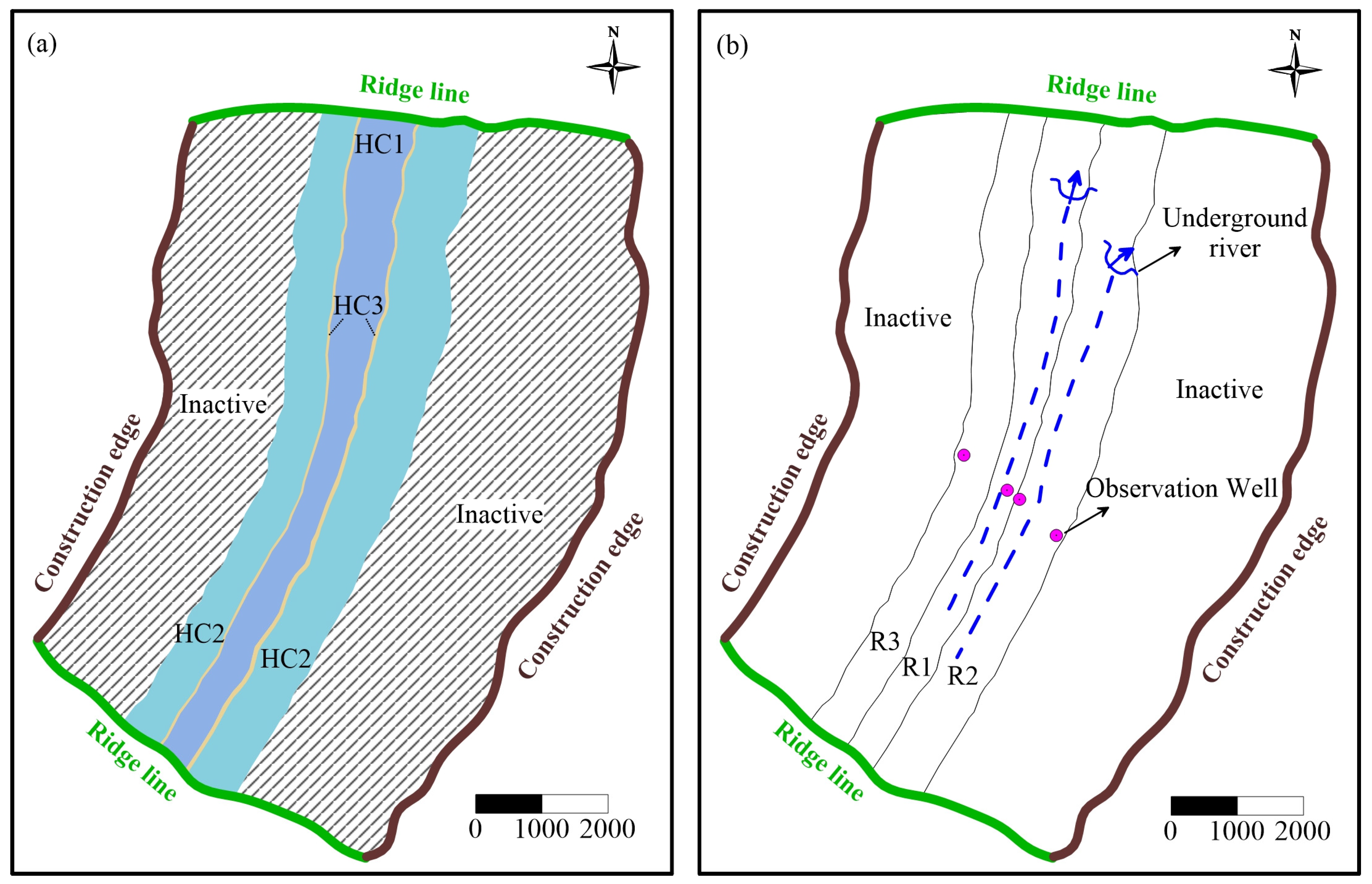
- Lateral boundaries: The lateral boundaries of the numerical model are defined by the natural boundaries within the study area. The northwestern and southeastern sides are the structural boundaries of the Pingyanggai syncline, while the northeastern and southwestern boundaries are the watersheds along the axial direction of the syncline system.
- (2)
- Bottom boundary: Since the lowest altitude of the deeply incised rivers around the syncline is 250 m, an altitude of 200 m is used as the bottom boundary of the hydrogeological model. Below this depth, karst development is poor and has little influence on the model, so it is regarded as an impermeable boundary.
- (3)
- Top boundary: The land surface interpolated at a horizontal resolution of 30 m × 30 m is used as the top boundary. The top unit of the hydrogeological system is recharged by atmospheric precipitation.
2.2. Water Inflow Situation of Xiushan Tunnel
3. Numerical Simulation Conceptualization
3.1. Conduit Flow Simulation
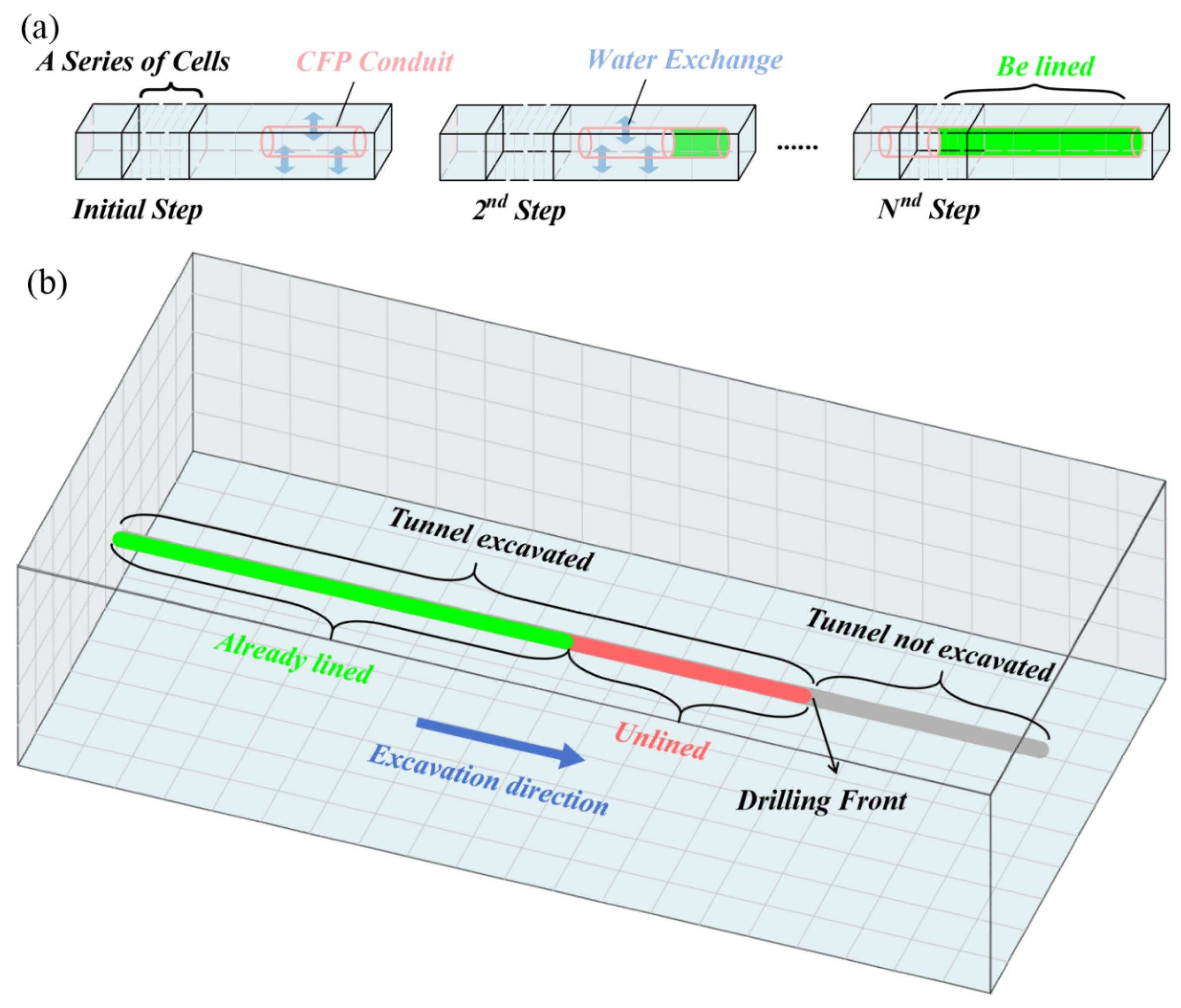
3.2. Dynamic Tunnel Excavation
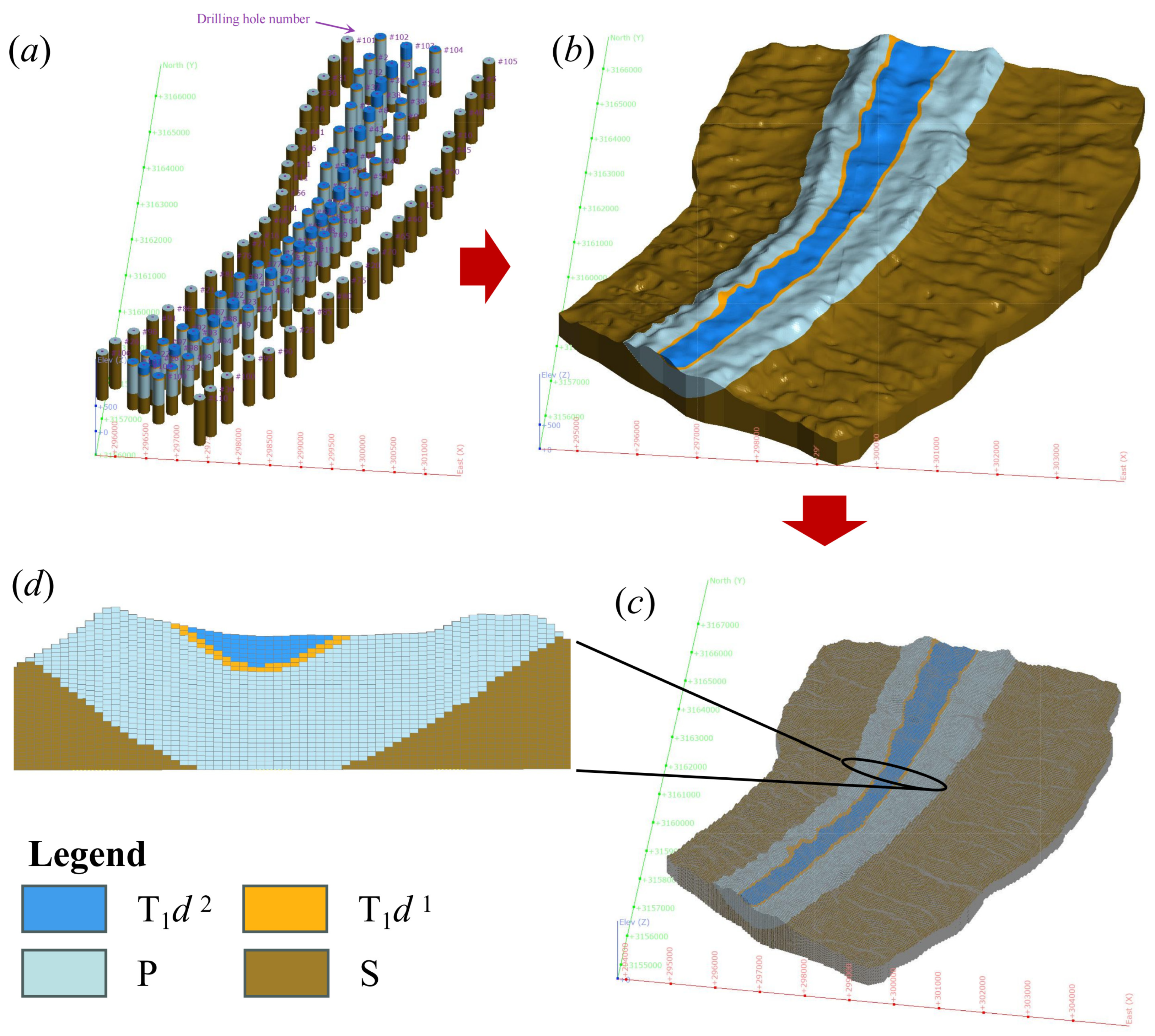
3.3. 3D Geological Model of Syncline Aquifer
4. Model Calibration and Groundwater Initial Flow Field
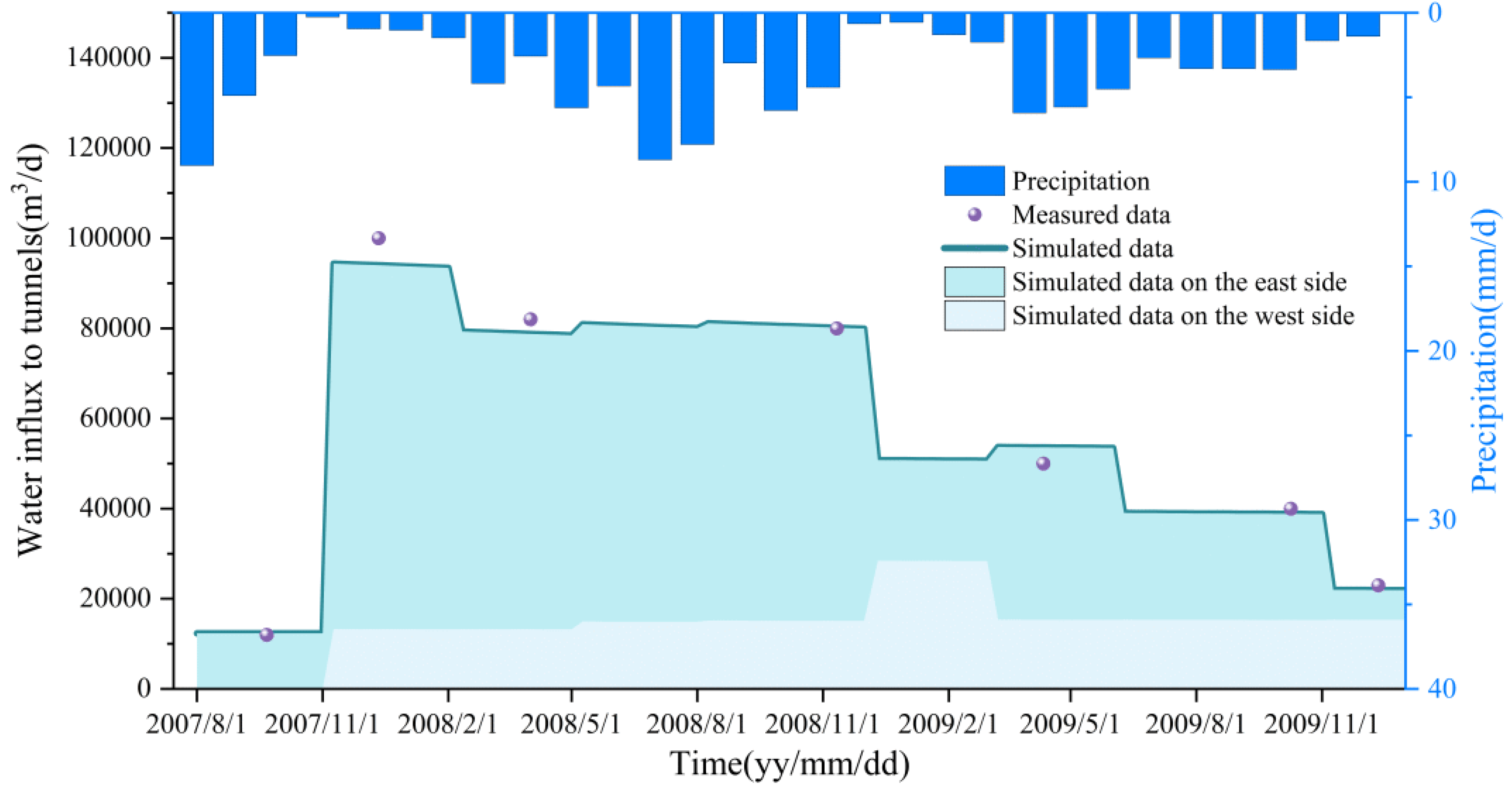
4.1. Model Calibration
4.2. Numerical Simulation of Initial Groundwater Flow
5. Numerical Simulation of Groundwater Flow During Tunnel Construction
5.1. Transient Simulation Settings
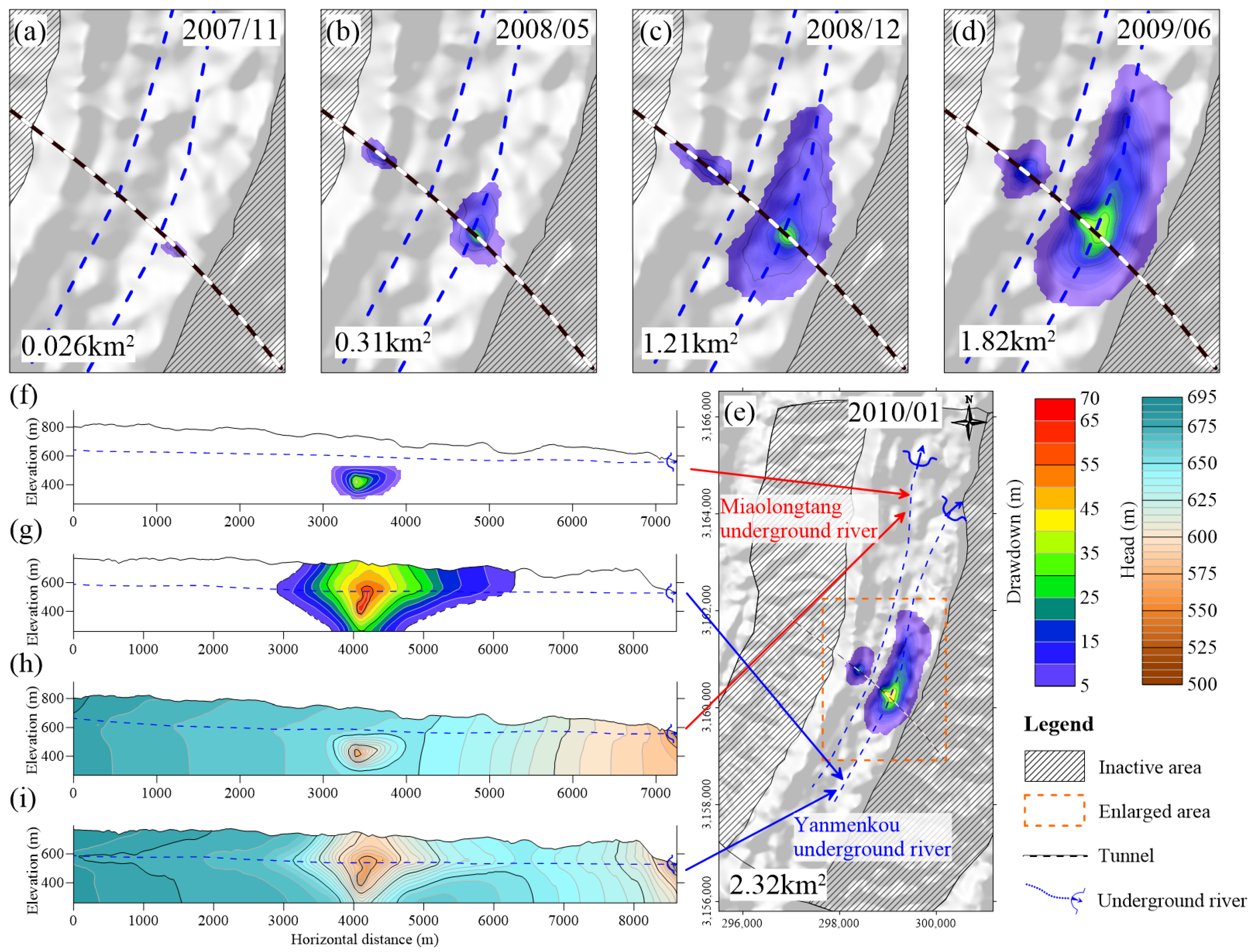
5.2. Impact of Tunnel Construction on Groundwater Levels
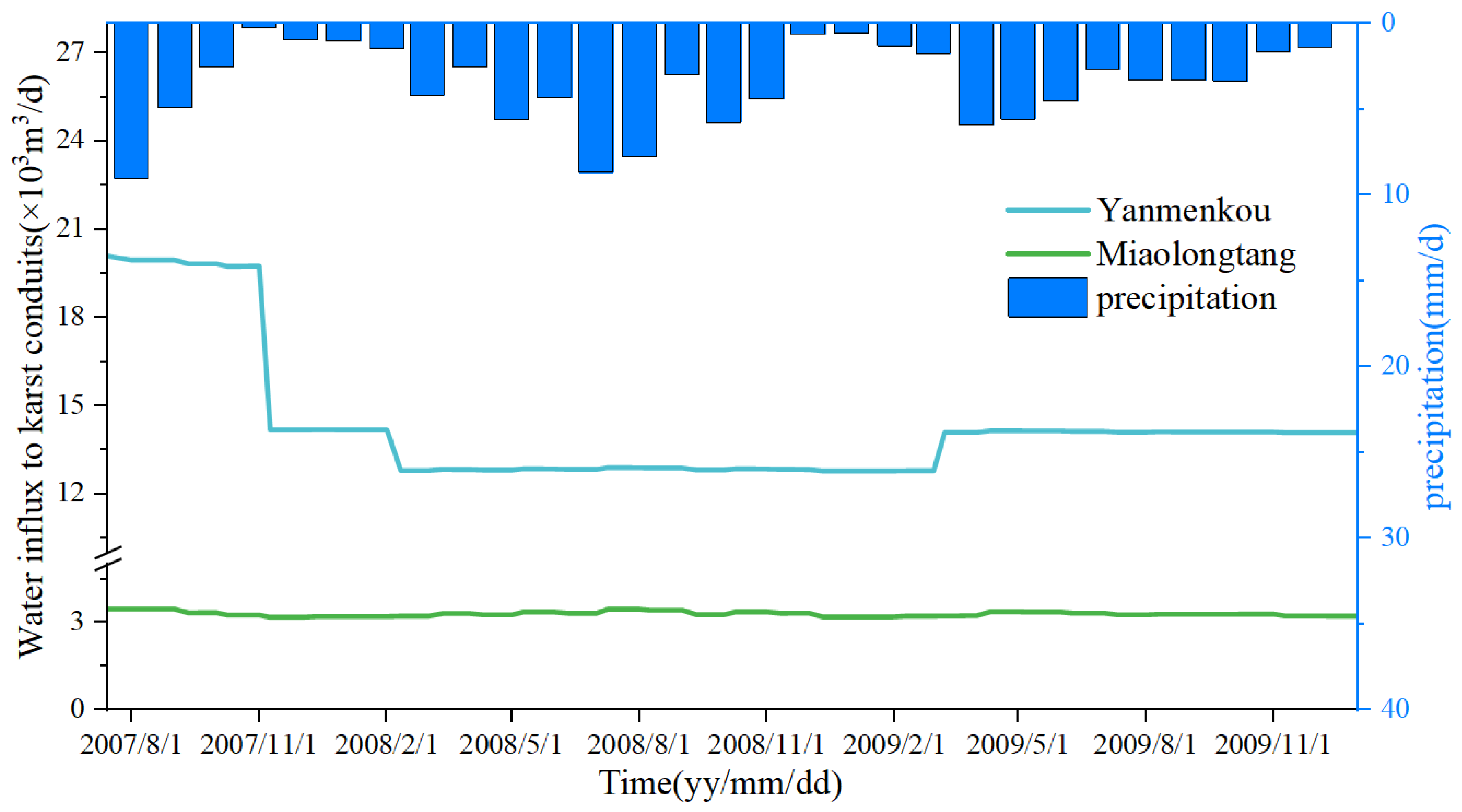
5.3. Impact on Flow in Karst Conduits
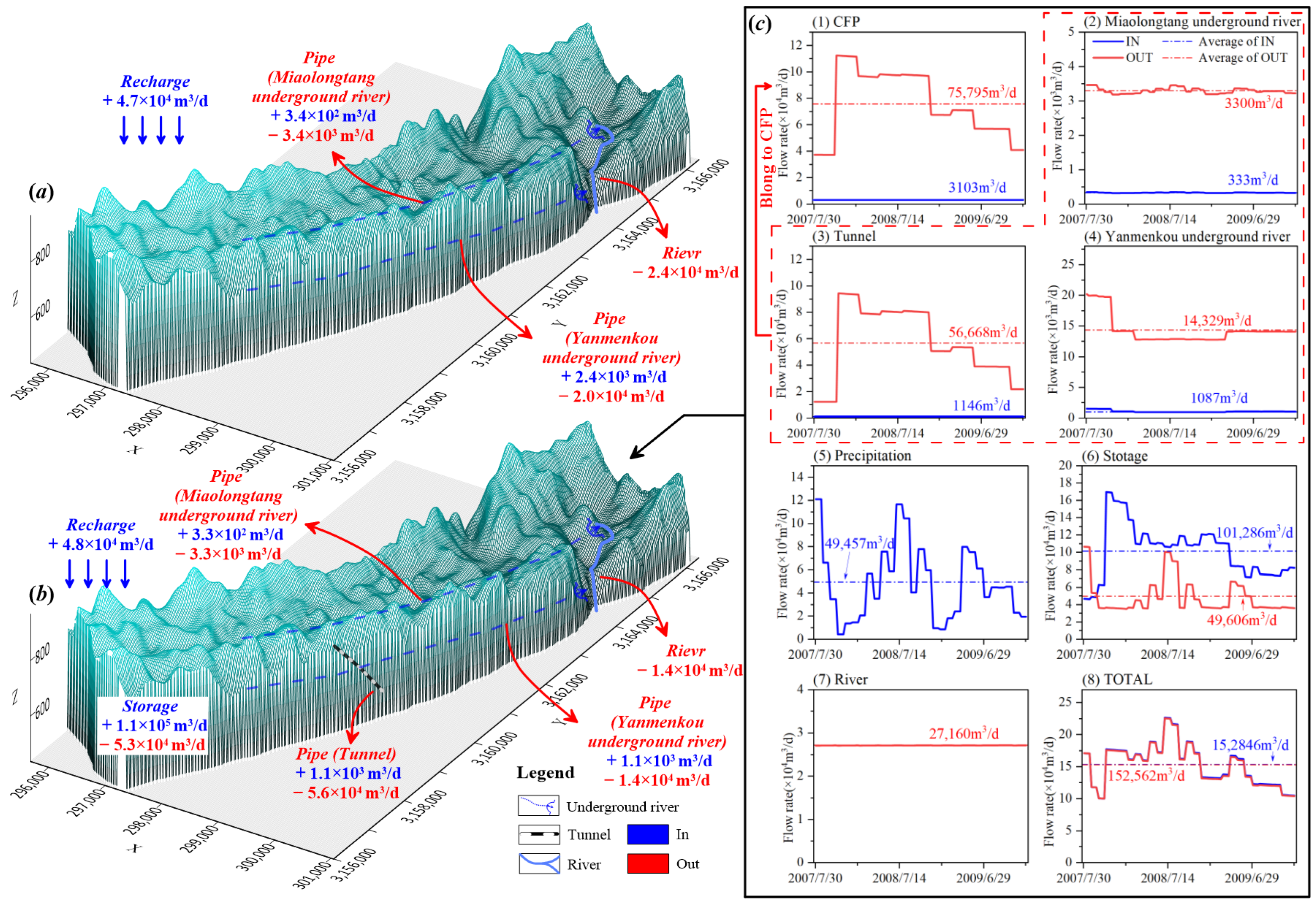
5.4. Groundwater Flow Budgets
5.5. Limitation
6. Conclusions
Author Contributions
Funding
Data Availability Statement
Conflicts of Interest
Appendix A

| Tunnel Water Inflow Point | Inflow Rate (m3/d) | Time |
|---|---|---|
| G1 | 13,400–13,200 | December 2007 |
| 3400 | January 2008 | |
| G2 | 140 | June 2008 |
| G3 | 585 | September 2008 |
| G4 | 5 × 10⁴ | 18 April 2009 |
| 4 × 10⁴ | 17 October 2009 | |
| G5 | 1 × 10⁵ | 3 January 2008 |
| 3.5 × 10⁵ | 9 November 2008 | |
| 8 × 10⁴ | 25 November 2008 | |
| G6 | 1.2 × 10⁴ | September 2007 |
References
- Chen, Z.; Auler, A.S.; Bakalowicz, M.; Drew, D.; Griger, F.; Hartmann, J.; Jiang, G.H.; Moosdorf, N.; Richts, A.; Stevanovic, Z.; et al. The World Karst Aquifer Mapping project: Concept, mapping procedure and map of Europe. Hydrogeol. J. 2017, 25, 771–785. [Google Scholar] [CrossRef]
- Goldscheider, N.; Chen, Z.; Auler, A.S.; Bakalowicz, M.; Broda, S.; Drew, D.; Hartmann, J.; Jiang, G.H.; Moosdorf, N.; Stevanovic, Z.; et al. Global distribution of carbonate rocks and karst water resources. Hydrogeol. J. 2020, 28, 1661–1677. [Google Scholar] [CrossRef]
- Cui, Q.L.; Wu, H.N.; Shen, S.L.; Xu, Y.S.; Ye, G.L. Chinese karst geology and measures to prevent geohazards during shield tunnelling in karst region with caves. Nat. Hazards 2015, 77, 129–152. [Google Scholar] [CrossRef]
- Butscher, C. Steady-state groundwater inflow into a circular tunnel. Tunn. Undergr. Space Technol. 2012, 32, 158–167. [Google Scholar] [CrossRef]
- Zhang, N.; Zheng, Q.; Elbaz, K.; Xu, Y.S. Water Inrush Hazards in the Chaoyang Tunnel, Guizhou, China: A Preliminary Investigation. Water 2020, 12, 1083. [Google Scholar] [CrossRef]
- Wu, Y.; Qiao, W.-G.; Zhu, Y.-G.; Li, S.-C.; Liu, H.-N.; Zhang, S.; Li, Y.-Z. Engineering application of new silica fume environmentally friendly cement slurry. Constr. Build. Mater. 2024, 411, 134497. [Google Scholar] [CrossRef]
- Song, J.; Chen, D.Y.; Wang, J.; Bi, Y.F.; Liu, S.; Zhong, G.Q.; Wang, C. Evolution Pattern and Matching Mode of Precursor Information about Water Inrush in a Karst Tunnel. Water 2021, 13, 1579. [Google Scholar] [CrossRef]
- Xue, Y.; Teng, T.; Zhu, L.; He, M.M.; Ren, J.; Dong, X.; Liu, F. Evaluation of the Non-Darcy Effect of Water Inrush from Karst Collapse Columns by Means of a Nonlinear Flow Model. Water 2018, 10, 1234. [Google Scholar] [CrossRef]
- Yang, W.M.; Fang, Z.D.; Yang, X.; Shi, S.S.; Wang, J.; Wang, H.; Bu, L.; Li, L.P.; Zhou, Z.Q.; Li, X.Q. Experimental Study of Influence of Karst Aquifer on the Law of Water Inrush in Tunnels. Water 2018, 10, 1211. [Google Scholar] [CrossRef]
- Abusaada, M.; Sauter, M. Studying the Flow Dynamics of a Karst Aquifer System with an Equivalent Porous Medium Model. Ground Water 2013, 51, 641–650. [Google Scholar] [CrossRef]
- Bakalowicz, M. Karst groundwater: A challenge for new resources. Hydrogeol. J. 2005, 13, 148–160. [Google Scholar] [CrossRef]
- Brkic, Z.; Kuhta, M.; Hunjak, T. Groundwater flow mechanism in the well-developed karst aquifer system in the western Croatia: Insights from spring discharge and water isotopes. Catena 2018, 161, 14–26. [Google Scholar] [CrossRef]
- Martin, J.B.; Dean, R.W. Exchange of water between conduits and matrix in the Floridan aquifer. Chem. Geol. 2001, 179, 145–165. [Google Scholar] [CrossRef]
- Olarinoye, T.; Gleeson, T.; Marx, V.; Seeger, S.; Adinehvand, R.; Allocca, V.; Andreo, B.; Apaéstegui, J.; Apolit, C.; Arfib, B.; et al. Global karst springs hydrograph dataset for research and management of the world’s fastest-flowing groundwater. Sci. Data 2020, 7, 59. [Google Scholar] [CrossRef] [PubMed]
- Worthington, S.R.H.; Ford, D.C. Self-Organized Permeability in Carbonate Aquifers. Ground Water 2009, 47, 326–336. [Google Scholar] [CrossRef]
- Li, S.C.; Zhou, Z.Q.; Li, L.P.; Xu, Z.H.; Zhang, Q.Q.; Shi, S.S. Risk assessment of water inrush in karst tunnels based on attribute synthetic evaluation system. Tunn. Undergr. Space Technol. 2013, 38, 50–58. [Google Scholar] [CrossRef]
- Kaufmann, G.; Romanov, D. Modelling long-term and short-term evolution of karst in vicinity of tunnels. J. Hydrol. 2020, 581, 124282. [Google Scholar] [CrossRef]
- Zhou, J.Q.; Liu, H.B.; Li, C.D.; He, X.L.; Tang, H.M.; Zhao, X.J. A semi-empirical model for water inflow into a tunnel in fractured-rock aquifers considering non-Darcian flow. J. Hydrol. 2021, 597, 126149. [Google Scholar] [CrossRef]
- Yin, H.C.; Zhang, G.Z.; Wu, Q.; Cui, F.P.; Yan, B.C.; Yin, S.X.; Soltanian, M.R.; Thanh, H.V.; Dai, Z.X. Unraveling Overlying Rock Fracturing Evolvement for Mining Water Inflow Channel Prediction: A Spatiotemporal Analysis Using ConvLSTM Image Reconstruction. IEEE Trans. Geosci. Remote Sens. 2024, 62, 4510417. [Google Scholar] [CrossRef]
- Hubinger, B.; Birk, S.; Hergarten, S. A New Equation Solver for Modeling Turbulent Flow in Coupled Matrix-Conduit Flow Models. Groundwater 2016, 54, 596–602. [Google Scholar] [CrossRef]
- Liu, H.; Chen, J.H.; Zhang, X.Y.; Dai, D.W.; Cui, J.; Spencer, B.F. Collaborative Imaging of Subsurface Cavities Using Ground-Pipeline Penetrating Radar. IEEE Geosci. Remote Sens. Lett. 2024, 21, 3002205. [Google Scholar] [CrossRef]
- Zhang, D.S.; Zhou, Z.Q.; Gao, C.L.; Gai, P.P.; Chen, X.C.; Chen, J.B.; Bu, F.L. A novel hybrid PD-FEM-FVM approach for simulating hydraulic fracture propagation in saturated porous media. Comput. Geotech. 2025, 177, 106821. [Google Scholar] [CrossRef]
- Doummar, J.; Sauter, M.; Geyer, T. Simulation of flow processes in a large scale karst system with an integrated catchment model (Mike She)—Identification of relevant parameters influencing spring discharge. J. Hydrol. 2012, 426, 112–123. [Google Scholar] [CrossRef]
- Mayaud, C.; Wagner, T.; Benischke, R.; Birk, S. Understanding changes in the hydrological behaviour within a karst aquifer (Lurbach system, Austria). Carbonates Evaporites 2016, 31, 357–365. [Google Scholar] [CrossRef] [PubMed]
- de Rooij, R.; Perrochet, P.; Graham, W. From rainfall to spring discharge: Coupling conduit flow, subsurface matrix flow and surface flow in karst systems using a discrete-continuum model. Adv. Water Resour. 2013, 61, 29–41. [Google Scholar] [CrossRef]
- Liedl, R.; Sauter, M.; Hückinghaus, D.; Clemens, T.; Teutsch, G. Simulation of the development of karst aquifers using a coupled continuum pipe flow model. Water Resour. Res. 2003, 39, 1057. [Google Scholar] [CrossRef]
- Robineau, T.; Tognelli, A.; Goblet, P.; Renard, F.; Schaper, L. A double medium approach to simulate groundwater level variations in a fissured karst aquifer. J. Hydrol. 2018, 565, 861–875. [Google Scholar] [CrossRef]
- Shoemaker, W.B.; Kuniansky, E.; Birk, S.; Bauer, S.; Swain, E. Documentation of a Conduit Flow Process (CFP) for MODFLOW-2005; 6-A24; U.S. Geological Survey (USGS): Reston, VA, USA, 2007.
- Gallegos, J.J.; Hu, B.X.; Davis, H. Simulating flow in karst aquifers at laboratory and sub-regional scales using MODFLOW-CFP. Hydrogeol. J. 2013, 21, 1749–1760. [Google Scholar] [CrossRef]
- Zheng, X.K.; Yang, Z.B.; Wang, S.; Chen, Y.F.; Hu, R.; Zhao, X.J.; Wu, X.L.; Yang, X.L. Evaluation of hydrogeological impact of tunnel engineering in a karst aquifer by coupled discrete-continuum numerical simulations. J. Hydrol. 2021, 597, 125765. [Google Scholar] [CrossRef]
- Maréchal, J.C.; Lanini, S.; Aunay, B.; Perrochet, P. Analytical Solution for Modeling Discharge into a Tunnel Drilled in a Heterogeneous Unconfined Aquifer. Groundwater 2014, 52, 597–605. [Google Scholar] [CrossRef]
- Perrochet, P. Confined flow into a tunnel during progressive drilling: An analytical solution. Ground Water 2005, 43, 943–946. [Google Scholar] [CrossRef] [PubMed]
- Perrochet, P.; Dematteis, A. Modeling transient discharge into a tunnel drilled in a heterogeneous formation. Ground Water 2007, 45, 786–790. [Google Scholar] [CrossRef]
- Yang, S.Y.; Yeh, H.D. A closed-form solution for a confined flow into a tunnel during progressive drilling in a multi-layer groundwater flow system. Geophys. Res. Lett. 2007, 34, L07405. [Google Scholar] [CrossRef]
- Zhu, R.; Xia, Q.; Zhang, Q.; Cao, C.; Zhang, X.Y.; Mao, B.Y. Dynamic Parameter Calibration of an Analytical Model to Predict Transient Groundwater Inflow into a Tunnel. Water 2023, 15, 2702. [Google Scholar] [CrossRef]
- Molinero, J.; Samper, J.; Juanes, R. Numerical modeling of the transient hydrogeological response produced by tunnel construction in fractured bedrocks. Eng. Geol. 2002, 64, 369–386. [Google Scholar] [CrossRef]
- Xia, Q.; Xu, M.; Zhang, H.; Zhang, Q.; Xiao, X.X. A dynamic modeling approach to simulate groundwater discharges into a tunnel from typical heterogenous geological media during continuing excavation. Ksce J. Civ. Eng. 2018, 22, 341–350. [Google Scholar] [CrossRef]
- Yoo, C.S. Interaction between tunneling and groundwater—Numerical investigation using three dimensional stress-pore pressure coupled analysis. J. Geotech. Geoenviron. Eng. 2005, 131, 240–250. [Google Scholar] [CrossRef]
- McDonald, M.; Harbaugh, A. A Modular Three-Dimensional Finite-Difference Ground-Water Flow Model; 06-A1; U.S. Geological Survey (USGS): Reston, VA, USA, 1988.
- Vennard, J.K.; Street, R.L. Elementary Fluid Mechanics; John Wiley & Sons: New York, NY, USA, 1975. [Google Scholar]
- Li, Z.X.; Xiao, J.; Wan, J.W.; Cheng, J.M.; Feng, H.B.; Zhan, H.B.; Yuan, S.; Huang, K. A dynamic modeling approach to predict water inflow during tunnel excavation in relatively uniform rock masses. Tunn. Undergr. Space Technol. 2024, 146, 105668. [Google Scholar] [CrossRef]
- Calcagno, P.; Chilès, J.P.; Courrioux, G.; Guillen, A. Geological modelling from field data and geological knowledge Part I. Modelling method coupling 3D potential-field interpolation and geological rules. Phys. Earth Planet. Inter. 2008, 171, 147–157. [Google Scholar] [CrossRef]
- Field, M.S. The QTRACER2 Program for Tracer-Breakthrough Curve Analysis for Tracer Tests in Karstic Aquifers and Other Hydrologic Systems; EPA/600/R-02/001; U.S. Environmental Protection Agency: Washington, DC, USA, 2002.
- Jeannin, P.Y. Modeling flow in phreatic and epiphreatic karst conduits in the Holloch cave (Muotatal, Switzerland). Water Resour. Res. 2001, 37, 191–200. [Google Scholar] [CrossRef]
- Bai, Y.; Wu, Z.; Huang, T.; Peng, D.P. A Dynamic Modeling Approach to Predict Water Inflow during Karst Tunnel Excavation. Water 2022, 14, 2380. [Google Scholar] [CrossRef]
- Chen, N.; Gunzburger, M.; Hu, B.; Wang, X.M.; Woodruff, C. Calibrating the exchange coefficient in the modified coupled continuum pipe-flow model for flows in karst aquifers. J. Hydrol. 2012, 414, 294–301. [Google Scholar] [CrossRef]
- Song, X.Q.; Cen, C.; Liu, K.; Zhang, C.; Zhou, A.G.; Wang, Y.; Peng, Q.; Na, J. Numerical Simulation Analysis of the Impact of Tunnel Construction on Aquifers in the Karst Regions of Southwestern China. Water 2025, 17, 619. [Google Scholar] [CrossRef]
- Zhu, Y.-G.; Wu, Y.; Han, C.-H.; Qiao, W.-G.; Jiang, F.; Dong, J.-X.; Zhang, S.; Li, Y.-Z. Fracture evolution and anchoring mechanisms in discontinuous rock masses with irregular joints: Discrete element study using a novel damage constitutive model. Comput. Geotech. 2025, 186, 107395. [Google Scholar] [CrossRef]


| Name | Length (km) | Diameter (m) | Roughness Height | K_Exchange (m2/d) |
|---|---|---|---|---|
| Miaolongtang Karst conduits | 7253 | 3 | 0.25 | 2 |
| Yanmenkou Karst conduits | 8613 | 3 | 0.25 | 1.5 |
| Tunnels | 3358 | 8 | 0.005 | 10 |
| Zone | Main Lithology | Strata | Hydraulic Conductivity K (m/d) |
|---|---|---|---|
| HC1 | Limestone | T1d2 | 0.612 |
| HC2 | Limestone and Dolomite Shale | P2c, P2w, P1m, P1qP1l | 0.483 |
| HC3 | Mud shale | T1d1 | 0.005 |
Disclaimer/Publisher’s Note: The statements, opinions and data contained in all publications are solely those of the individual author(s) and contributor(s) and not of MDPI and/or the editor(s). MDPI and/or the editor(s) disclaim responsibility for any injury to people or property resulting from any ideas, methods, instructions or products referred to in the content. |
© 2026 by the authors. Licensee MDPI, Basel, Switzerland. This article is an open access article distributed under the terms and conditions of the Creative Commons Attribution (CC BY) license.
Share and Cite
Zhu, X.; Xia, Q.; Xu, M.; Wang, Y.; Huang, Y.; Li, Y.; Ding, B. Numerical Simulation of Karst Groundwater Systems Under Construction of Xiushan Tunnel in Pingyanggai Syncline, Chongqing, China. Hydrology 2026, 13, 81. https://doi.org/10.3390/hydrology13030081
Zhu X, Xia Q, Xu M, Wang Y, Huang Y, Li Y, Ding B. Numerical Simulation of Karst Groundwater Systems Under Construction of Xiushan Tunnel in Pingyanggai Syncline, Chongqing, China. Hydrology. 2026; 13(3):81. https://doi.org/10.3390/hydrology13030081
Chicago/Turabian StyleZhu, Xingyu, Qiang Xia, Mo Xu, Yinghe Wang, Yixiong Huang, Yayi Li, and Boru Ding. 2026. "Numerical Simulation of Karst Groundwater Systems Under Construction of Xiushan Tunnel in Pingyanggai Syncline, Chongqing, China" Hydrology 13, no. 3: 81. https://doi.org/10.3390/hydrology13030081
APA StyleZhu, X., Xia, Q., Xu, M., Wang, Y., Huang, Y., Li, Y., & Ding, B. (2026). Numerical Simulation of Karst Groundwater Systems Under Construction of Xiushan Tunnel in Pingyanggai Syncline, Chongqing, China. Hydrology, 13(3), 81. https://doi.org/10.3390/hydrology13030081