Article

High-Frequency Multi-Satellite Observations of Brahmaputra River Hydrology and Floodplain Dynamics


1
Department of Water Resources Engineering, Bangladesh University of Engineering and Technology, Dhaka 1000, Bangladesh
2
LEGOS/IRD/UT, 31400 Toulouse, France
3
Institute of Water and Flood Management, Bangladesh University of Engineering and Technology, Dhaka 1000, Bangladesh
4
Bangladesh Water Development Board, Dhaka 1215, Bangladesh
*
Author to whom correspondence should be addressed.
Hydrology 2026, 13(2), 60; https://doi.org/10.3390/hydrology13020060
Submission received: 21 December 2025 / Revised: 1 February 2026 / Accepted: 3 February 2026 / Published: 4 February 2026
(This article belongs to the Section Surface Waters and Groundwaters)

Abstract

Reliable observation of water resources is a major challenge for sustainable development, particularly in the river-centric deltaic countries like Bangladesh, where the data is generally scarce. Leveraging operational satellites, this study presents a real-time capable water level (WL), discharge (Q), and floodplain monitoring framework implemented for the Brahmaputra River in Bangladesh. The multi-satellite approach presented here combined satellite altimetry, synthetic aperture radar (SAR), and optical imagery. A set of WL time series is obtained first from Jason-2/3 and Sentinel-3 altimetry, while a combination of Sentinel-1 SAR and Sentinel-2 optical images is used to extract the floodplain extent. Seasonal Rating Curve (RC) models are then developed to estimate Q from the river WL (altimetry) and width (imagery). The altimetry WL measurement is further complemented by the width-based Q utilizing an inverse RC. Furthermore, the water level is combined with a floodplain map to extract floodplain topography and its evolution. The proposed framework provides consistent and reliable observations in the Brahmaputra River, with a bias, root mean-squared errors (RMSEs), and correlation coefficient of 0.03 m, 0.68 m, and 0.96 for WL, and −168.22 m3/s, 4161.46 m3/s, and 0.97 for Q, respectively, relative to a mean discharge of approximately 30,000 m3/s. The locations of high erosion–accretion across the river reach are also well-captured in the evolving floodplain maps. By integrating multiple satellite altimetry missions with SAR and optical imagery, the multi-satellite approach reduces the effective monitoring interval for both water level and discharge from approximately 10 days (single-mission altimetry) to about 4 days, enabling improved capture of extreme events such as floods. As the operational satellites used in this study are expected to provide long-term observations, the proposed framework supports sustainable monitoring of floodplain dynamics in Bangladesh and other similar data-poor environments, towards informed water management under ongoing climatic and anthropogenic changes.

1. Introduction

The interdisciplinary field of water resources management relies on reliable and timely observation of key hydrological variables such as water level, discharge, and bathymetry [1]. These observations are essential for flood risk mitigation, erosion control, and sustainable development [2]. While traditional in situ observation is a valuable source of these key hydrological variables, many less developed regions lack sufficient resources and technical capacity to install and maintain reliable observation systems, resulting either in no data or in poor data quality [3]. One such data-poor region is Bangladesh, a deltaic country with a vast river network dominated by monsoon climate [4]. This region is also exposed to tropical cyclones and associated storm surges [5], where coincident high-riverine discharge can potentially create compound flooding events [6]. Satellite remote sensing can complement in situ networks in such areas and offers direct and indirect measurements of nearly all components of the hydrological cycle [7,8].
Among various remote sensing sensors, three types of sensors are more regularly used in hydrologic monitoring, namely altimetry, synthetic aperture radar (SAR) imagery, and optical imagery. Applications of remote sensing can be found globally in various river basins [9], but for brevity, focus has been given here on the Ganges–Brahmaputra–Meghna (GBM) river basins, particularly covering Bangladesh. Satellite altimetry, which measures the water level from space, has been well explored in Bangladesh for discharge measurement [10,11], for numerical modeling [12], and for flow forecasting [13]. Despite being developed for the open ocean, the efficiency of this technology for monitoring riverine water levels is now well recognized [10,14,15]. Optical satellite imagery, which is a passive remote sensing technique, has been extensively used in waterbody and erosion–accretion analysis in this region [16,17]. Most of these previous studies are based on either MODIS (500 m resolution) or Landsat (30 m resolution), and only employ a handful of images. Despite challenges of lower resolution images and manual image processing, these studies show the highly dynamic nature of the Brahmaputra River floodplain. However, the application of optical imagery for flood monitoring is rather limited [18,19]. This is mainly due to the cloud, which restricts the visibility of the land to the passive optical sensors. On the other hand, because radar signal penetrates the cloud, SAR images are used for flood monitoring and impact assessment [20,21]. A recent example of the use of Sentinel-1 SAR imagery in operational flood mapping is presented by [22].
Due to orbit constraints, the observation frequency of individual satellites is generally sparse (in an order of 10 days or more). A combination of observations from multiple satellites has been found to significantly expand the spatio-temporal observation frequency. For example, merging of multiple radar altimeters allowed continuous observation of monthly water level and discharges in the Ganges and Brahmaputra [10,11]. A combination of SAR and optical imagery allowed multi-sensor assessment of flood extent [18], while the combined use of flood monitoring capabilities of SAR and agricultural monitoring capabilities of optical sensors made accurate flood impact assessment on agriculture possible [23].
Another interesting application of optical or SAR imagery comes from merging water extent analysis (waterlines or bank lines) with localized water level to estimate topography [24]. This method is known as the waterline method, which can provide high-resolution topographic information over intermittently flooded areas such as coastal intertidal zones [25] or riverine floodplains [26]. Furthermore, the water extent can be used to estimate river discharge, particularly in braided rivers where river width changes significantly with discharge and, consequently, water level [27]. This method of extracting river discharge from the width derived from the river extent, however, has not yet been explored in the braided rivers of Bangladesh to the best of our knowledge.
The inland water monitoring from traditional altimetry, optical, and SAR imagery has reached a certain maturity to be considered for operational applications. This is attested by the launch of the Sentinel program [28], which aims to operate satellites equipped with these technologies for global cryosphere monitoring with a long-term operational commitment. Furthermore, Sentinel satellites are designed to be a twin-satellite constellation to extend the temporal coverage. Currently there are seven active Sentinel satellites in orbit: Sentinel-1A and Sentinel-1C providing wide-swath SAR observations, Sentinel-2A, Sentinel-2B, and Sentinel-2C providing imageries at 13 spectral bands, and Sentinel-3A and Sentinel-3B mapping the waterbodies with traditional radar altimetry. In addition, Sentinel-6 Michael Freilich continues the observation in the reference orbit of Topex-Poseidon/Jason-1-2-3, ensuring the continuity of the historic so-called reference altimetry missions.
These operational satellites, combined with various methods to observe water level, discharge, floodplain, and topography monitoring, provide an excellent opportunity to monitor these hydrological parameters at high resolution. Efficient use of different sensors in a multi-satellite constellation can significantly increase the temporal resolution. However, the high-resolution datasets coming from these satellites poses significant data processing challenges towards this monitoring goal, which requires the adoption of efficient processing algorithms. Recent advancements have enabled the routine large-scale processing of altimetry datasets, including through services such as Hydroweb (https://hydroweb.next.theia-land.fr/, accessed on 21 July 2023). On the other hand, automated processing algorithms for extracting waterlines from Sentinel-2 imagery are now available [25,29]. Despite major advancements, there are no studies yet that explore the integrated ability to monitor water level, discharge, floodplains, and their topography evolution from the ensemble of these satellite datasets and their potential in long-term sustainable monitoring for water management.
Globally, multi-satellite integration techniques for rating-curve-based discharge monitoring have experienced significant advancement, evolving from the use of altimetry-only water-level-based rating curves [30] to the integration of SAR-imagery-derived width-based discharge estimation [31], and more recently to the incorporation of all available satellite observation sensors [32]. Previous multi-satellite discharge studies in the study region [10,11,33,34] primarily focused on improving discharge estimation through the combination of satellite altimetry-derived water levels and rating-curve approaches. While these studies demonstrated the benefit of multi-mission altimetry for increasing temporal sampling, they did not explore river width observations from optical or SAR imagery to complement altimetry-based discharge estimates. In contrast, this study combines all major altimetry satellite-derived water levels, as well as the width estimates from optical and SAR sensors to develop complementary rating-curve and inverse rating-curve models, enabling more frequent (sub-weekly scale) and robust discharge monitoring in a data-scarce river system. Furthermore, waterline-based floodplain digital elevation model extraction is implemented here as an integral component of the monitoring framework. The waterline method is globally recognized for integrating satellite- or in situ-derived water level information with water extent obtained from satellite image sensors, both in coastal environments [35] and inland river settings [36]. In the study region, similar waterline extraction approaches have previously been demonstrated for deriving intertidal bathymetry [25]. More recently, ref. [37] applied the waterline method to derive river floodplain DEMs by integrating in situ water level data with satellite imagery using Google Earth Engine. In contrast, the present study evaluates the applicability of this approach for large inland river floodplains and, for the first time in the Jamuna River context, integrates a fully remote-sensing-based floodplain evolution monitoring scheme with concurrent water level and discharge observations.
Overall, this study addresses the key gaps in the current monitoring system and explores the capabilities of a multi-satellite framework with an emphasis on the Brahmaputra River in Bangladesh. The primary monitoring facilities in the river consist of manual in situ observational gauges, which, while providing valuable information, are often criticized for data quality and vertical referencing [38]. Additionally, systematic surveys for monitoring the dynamic floodplains, particularly regarding erosion and accretion, are lacking, with intermittent cross-sectional surveys at a few locations being the only source of data [37]. Therefore, the novelty of this study lies in the integrated and operational use of multiple Earth observation sensors to jointly monitor hydrological (water level, discharge), and floodplain dynamics at high temporal resolution, overcoming these observational data gaps in the Brahmaputra River and its floodplains. The key scientific questions addressed are: (i) how can multi-satellite observations be combined to improve the frequency and accuracy of river water level and discharge estimates, and (ii) how can satellite-derived waterlines and altimetry be used to characterize floodplain dynamics and bathymetry in a data-scarce, highly dynamic river system.

2. Materials and Methods

2.1. Study Area

The study area is focused on the lower part of the Brahmaputra River, locally known as Jamuna, in central Bangladesh between 23.5° N and 25.5° N (Figure 1, red box) [39]. The Brahmaputra is among the world’s most dynamic rivers, subject to frequent flooding and extreme riverbank erosion that severely affect floodplain and char (riverine island) communities [40]. The hydrology of the Jamuna River is predominantly governed by monsoonal rainfall, as well as the snow and glacier melting and flow contributions from the upper regions [4]. Indeed, the region is often identified as one of the climate change hotspots with drastic changes in the future flows [41,42].
Bangladesh’s tropical monsoon climate features a hot, humid summer (March–May), a monsoon season (June–October), and a dry winter (November–February) [43]. The monsoon season is dominant, contributing to approximately 70–80% of the total annual rainfall, which ranges from 140 to 390 cm depending on the region [43]. Temperature variations, with average highs reaching 35 °C in the summer and lows of 10 °C in winter, also affect local agricultural practices and water management strategies. Heavy monsoon precipitation in the upstream basin swells the Brahmaputra, causing seasonal floods, affecting not only the chars but also the surrounding floodplains. Peak monsoon discharge can exceed 100,000 m3/s, transporting ~1.1 billion tons of sediment annually [44], shaping floodplains while accelerating erosion [45]. The banks of this stretch of river have engineering protection measures in many places, having a strong impact on the erosion–accretion pattern [26]. Occasionally, the seasonal flows are driven by tributaries and local rainfall. In addition, anthropogenic factors such as the upstream damming and water management now play an important role in altering the discharge and sediment regimes [46].
The Jamuna River is about 205 km long within Bangladesh, with widths of 9 to 16 km in high-flow periods [47]. Its sandy, silty bed goes through rapid channel migration, forming and eroding chars [45]. These chars are transient, flood-prone islands that emerge from deposited sediment and are often submerged during the monsoon. They are home to some of the most marginalized communities in Bangladesh, many living in extreme poverty with insecure land tenure and limited access to healthcare, education, and sanitation [48]. Residents within these deprived lands depend heavily on agriculture, fishing, and livestock while adapting to seasonal displacement and rebuilding homes from lightweight materials after floods. Frequent floods and erosion (averaging 2000 ha of land loss per year) force repeated migration and threaten both livelihoods and infrastructure in this region [49].

2.2. Data

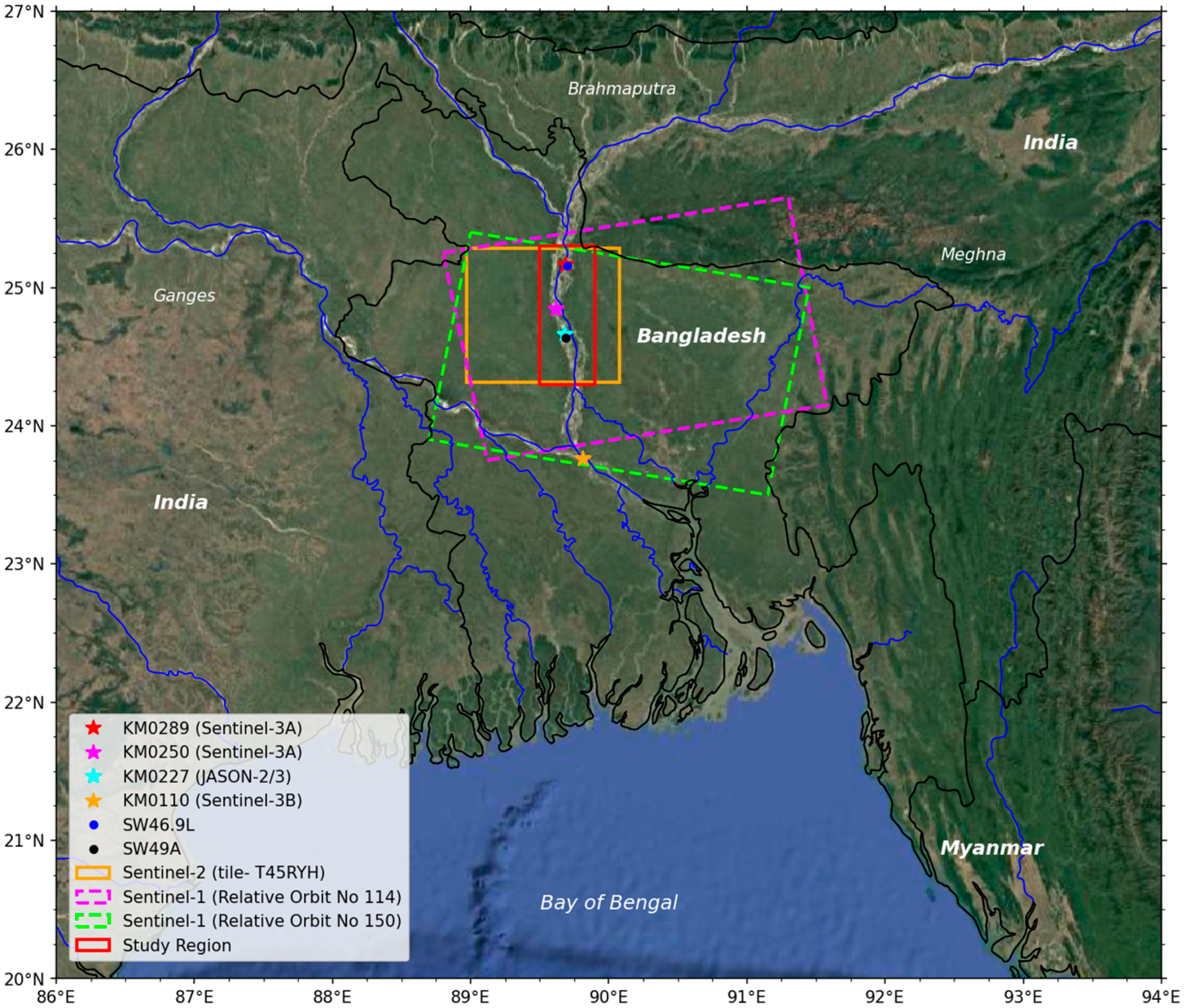
Within the focus region of the current study (Figure 1, red box), there are four virtual stations from traditional altimetry missions, including Sentinel-3, as well as coverage of Sentinel-2 optical and Sentinel-1 SAR imagery. The altimetry virtual stations are shown with stars. Rectangular patches in Figure 1 indicate the SAR (Sentinel-1) and multi-spectral imagery (Sentinel-2) extents. Circles show in situ water level and discharge stations along the river reach, namely Bahadurabad (SW46.9L, blue) and Kazipur (SW49A, black). Further details of these datasets are provided in the following subsections.

2.2.1. Satellite Altimetry

Four altimetry stations, shown in Figure 1, were used: KM0289 as a red star (Sentinel-3A; 2016–2022), KM0250 as a pink star (Sentinel-3A; 2016–2022), KM0227 as a cyan star (Jason-2/3; 2008–2022) and KM0110 as an orange star (Sentinel-3B; 2018–2022). Instead of processing these datasets from the original geophysical data records, the preprocessed water level datasets were downloaded from the Hydroweb platform (https://hydroweb.next.theia-land.fr/, accessed on 21 July 2023). Hydroweb provides access to pre-processed altimetry data from virtual stations at rivers [50] and lakes [51] for operational and research applications. Among these virtual stations, KM0289 is located in the vicinity of the in situ water level station at Bahadurabad (SW46.9L, blue circle). Another virtual station, KM0227, is in the vicinity of the BWDB station at Kazipur (SW49A, black circle). Sentinel-3 derived virtual stations are sampled at 27 days. Notably, KM0289 and KM0250 are sampled practically at the same time. On the other hand, KM0227 is derived from the JASON-2-3/Sentinel-6 orbiting on the reference orbit with a sampling period of about 10 days (9.9 days). Combined together, these multiple virtual stations can provide a relatively high sampling of the water level over the Jamuna River reach.

2.2.2. Sentinel-2 Optical Imagery

The Sentinel-2 constellation consists of two polar-orbiting, sun-synchronous satellites (Sentinel-2A launched in 2015 and Sentinel-2B in 2017) with a 290 km swath width and revisit time of 10 days at the equator, reduced to 5 days with both satellites and 2–3 days at mid-latitudes [52]. This mission provides imagery across 13 spectral bands, including four (blue, green, red, and near-infrared) at 10 m resolution and six (including SWIR) at 20 m resolution [53]. In this study, Copernicus Sentinel-2 data at the L2A processing level were downloaded [54,55] through the Theia Land Data Center (https://theia.cnes.fr, accessed on 21 July 2023, now migrated to https://geodes-portal.cnes.fr/) for the time period of 2016 to 2022. For our study, one Sentinel-2 tile, T45RYH, shown in Figure 1 (orange rectangle), was sufficient. At L2A processing levels, all individual tiles were corrected for atmospheric and adjacency effects, with cloud and shadow detection performed using the MAJA processing chain [56]. A 30% cloud cover limit was applied, resulting in a total of 85 images that predominantly cover low-flow periods.

2.2.3. Sentinel-1 SAR Imagery

The Sentinel-1 constellation comprises two C-band Synthetic Aperture Radar (SAR) satellites (Sentinel-1A and Sentinel-1B) operating in the same orbital plane, providing all-weather, day–night imaging every six days [57] at a ground range resolution of approximately 10 m. As of writing, Sentinel-1C was launched (5 December 2025), while Sentinel-1B was decommissioned due to a power supply failure. The analysis here only consists of SAR acquisitions from Sentinel-1A and Sentinel-1B. Around 400 Sentinel-1 GRD (Ground Range Detected) image granules [58] from the Copernicus Open Access Hub (https://scihub.copernicus.eu/dhus, accessed on 21 July 2023, now migrated to https://dataspace.copernicus.eu) were downloaded for 2016–2022 via the Sentinelsat Python API (v1.2.1). The data provided in relative orbit numbers 114 (purple box in Figure 1) and 150 (green box in Figure 1) were found to intersect with the study region. After sensitivity analysis, VV polarization mode was chosen for its effectiveness in flood and waterline monitoring [59]. During processing, some faulty acquisitions were excluded to ensure data reliability, as explained later.

2.2.4. In Situ Observations

In situ water level data used in this study comes from the Bangladesh Water Development Board (BWDB), spanning from 2008 to 2022, at two key stations: Bahadurabad (SW46.9L) and Kazipur (SW49A), shown in Figure 1. The data is generally at sub-daily time steps (3 h). In addition, an intermittently collected (2008–2022) discharge dataset at Bahadurabad is also collected to develop the stage-discharge relationship. These observed datasets were pre-processed to remove inconsistencies and clearly erroneous values. The observed water level dataset is aggregated into a daily water level through averaging.

2.2.5. Topography Dataset

To compare floodplain topography, FABDEM (Forest and Buildings removed Copernicus DEM) is used. FABDEM is a global 30 m resolution DEM derived from the Copernicus GLO-30 dataset, with vegetation canopy and building heights removed to more accurately represent bare-earth terrain [60]. It is widely used for hydrological, geomorphological, and flood modeling applications due to its improved accuracy over earlier global DEMs.

2.3. Methodology

2.3.1. Altimetry Data Analysis

The first step of the altimetry data analysis is focused on the quality assessment of the measurements compared to the in situ observations. The datums of the datasets are not the same. Altimetry data is provided in relation to a Geoid, whereas the in situ data is referenced to a regional mean sea level datum. The exact relationship between these two is not known; therefore, for comparison, the mean was removed from both time series. This made it possible to assess the quality of the data in terms of variability and error. The altimetry data and in situ water level measurements were evaluated by comparing the KM0289 and KM0227 altimetry time series with their respective in situ data from Bahadurabad and Kazipur stations using the mean error and standard deviation.
In the second step, correlation equations were established between each of the four altimetry stations and the BWDB stations (Bahadurabad and Kazipur) to translate altimetric measurements into corresponding in situ station measurements using Equation (1).
B = Slope × A + Intercept
Here,
B = Predicted Water Level at the corresponding in situ BWDB station
A = Water Level Measurement at the corresponding Altimetry Station
Four individual predicted water level time series from KM0289, KM0250, KM0227, and KM0110 were derived, which can then be merged to obtain a combined altimetry-derived water level time series for both Bahadurabad and Kazipur stations.

2.3.2. Image Processing

Both Sentinel-1 and Sentinel-2 datasets were processed to derive two variables, namely water extent (waterline position) and river width at selected cross sections. This requires the separation of land and water pixels in each image.
For Sentinel-2 optical imagery, waterline detection was performed using the pyIntertidalDEM algorithm [25] (https://github.com/jamal919/pyIntertidalDEM, accessed on 21 July 2023), a method originally developed and validated for the coastal regions. This study represents the first application and validation of pyIntertidalDEM for upstream rivers. No further modification to the original parameterizations was necessary for this application, indicating the robustness of the methodology. Sentinel-2 images were cropped to the study region extent shown by the red box in Figure 1, covering the altimetry and in situ water level stations, thereby reducing computational requirements and improving processing efficiency.
For Sentinel-1, the GRD products were preprocessed in the ESA SNAP toolbox using batch processing functionality. The orbit was applied, thermal and border noise were removed, speckle filtering and range-Doppler terrain correction were performed, the data were converted to dB units, and radiometric calibration was finally applied. After preprocessing, images were cropped to match the Sentinel-2 extent, faulty acquisitions, i.e., distorted and incomplete images were excluded, and, when the river was split across multiple acquisitions on the same date, the scenes were merged to produce a single image. The Otsu algorithm was then applied to derive the threshold for separating land and water [61,62]. The Otsu method selects the optimal threshold by maximizing inter-class variance; however, it does not work well if the classes are not of similar sizes (number of samples). However, for the riverine cases, most of the pixels are land. Hence, an adaptive approach was taken by first selecting a small area as a fixed polygon containing roughly equal numbers of flooded and non-flooded pixels. This strategy is expected not only to ensure that the Otsu algorithm works well, but also brings computational efficiency in applying this costly algorithm. This threshold is derived image-by-image and subsequently applied to the entire image to generate the land–water classifications. For this application, the fixed small area was chosen manually, which can potentially be automated for any region of interest based on known water masks.
After completing the land–water separation procedure, waterlines were extracted from both Sentinel-1 and Sentinel-2 images. These waterlines were refined using the edge detection algorithms implemented in pyIntertidalDEM, followed by morphological filtering to remove small isolated land (5000 pixels) and waterbody (10,000 pixels) features. The waterlines from both datasets were then merged to create a combined waterline time series for the study area. Finally, this waterline time series was used for river floodplain and associated topography monitoring in Section 2.3.4.
In addition to the shoreline, the river width at two specific locations along the study reach was also extracted from the segmented land–water image. Due to the braided nature of the Jamuna River, these selected cross-sections often overpass the char-lands. These land areas were removed from the width computation. This river width time series was then used for rating-curve development to compute the associated discharge to a river width in Section 2.3.3.

2.3.3. Discharge Rating Curves (RC) Development

In this study, discharge rating curves were developed at the Bahadurabad station with altimetry-derived water level and imagery-derived river width. Rating curve (RC) is a functional relationship between discharge (Q) and river geometry (L) written typically as a power law [63], as in Equation (2):
Q   = a L b  
The constants a and b can be derived through regression between paired observations of Q and L. River geometry (L) can be one of water level (in situ or satellite altimetry) or river width (optical and SAR imagery).
As the observed discharge data for 2008–2022 are intermittently collected, a continuous in situ rated discharge time series was generated first by establishing a water level-discharge relationship from observed gauge data. This in situ series served as the reference for evaluating satellite-derived discharge estimates.
For altimetry-based water level rating curves, separate relationships were developed for each of the seasons, i.e., summer (March–May), monsoon (June–October) and winter (November–February) by correlating the combined observed water level timeseries obtained from Section 2.3.1 with the in situ rated discharge at Bahadurabad. The daily discharge estimates from these season-specific individual curves were then combined to generate a long-term altimetry-derived discharge timeseries for Bahadurabad station.
Similarly, using the river widths computed from the optical (Sentinel-2) and SAR (Sentinel-1) imagery, three season-specific width–discharge relationships were developed and later merged to obtain continuous combined width-based discharge estimates for Bahadurabad. The corresponding river discharge was sampled from the in situ river discharge at a daily timestep.
Additionally, the discharge estimated from the width–discharge rating curve was used to estimate the associated water level from the inverse water level-discharge rating curve. This method was applied to estimate the water level at Bahadurabad station.
To evaluate the performance of satellite-derived water level and discharge time-series, several metrics are used consistently throughout the manuscript. Bias represents the mean difference between the satellite-derived and reference (in situ or rated) observations and indicates systematic error. Standard deviation (SD) quantifies the variability of the differences, while root-mean-squared error (RMSE) provides a combined measure of both bias and variance. Average percent error (APE) expresses the relative magnitude of errors compared to observed values. The correlation coefficient (R) assesses the strength of the linear relationship between satellite-derived and reference data. These metrics are applied to all comparisons to provide a comprehensive assessment of accuracy and reliability.

2.3.4. Waterline-Derived Floodplain Topography Monitoring

This study utilized the altimetry-derived water level timeseries and SAR and optical imagery-derived waterlines to create a floodplain bathymetry for the Jamuna River using the waterline method [24,64]. Waterlines (shorelines) were extracted independently from each SAR and optical image, providing the spatial extent of inundation across the floodplain for each acquisition date. Each extracted waterline was vertically referenced by linking it to the corresponding river water level on the same date. The altimetry-derived WL time series was temporally interpolated to the exact satellite image acquisition time using linear interpolation. Daily temporal accuracy was considered sufficient, as the Jamuna River water level typically does not exhibit abrupt variations within a single day. By assigning the interpolated water level value to every point along the corresponding waterline, elevation information was obtained along that inundation boundary. Because the Jamuna River exhibits a gradual longitudinal water surface slope, a slope correction was applied to the vertically referenced waterlines. The known geographic coordinates (latitude and longitude) of the virtual stations (KM0289 to KM0227) and gauge locations were used to estimate the longitudinal gradient, which was then applied to adjust the vertical referencing of each waterline along the river reach. The vertically corrected waterlines from all available dates were subsequently combined to construct a floodplain Digital Elevation Model (DEM), enabling the analysis of floodplain topography and its temporal evolution.
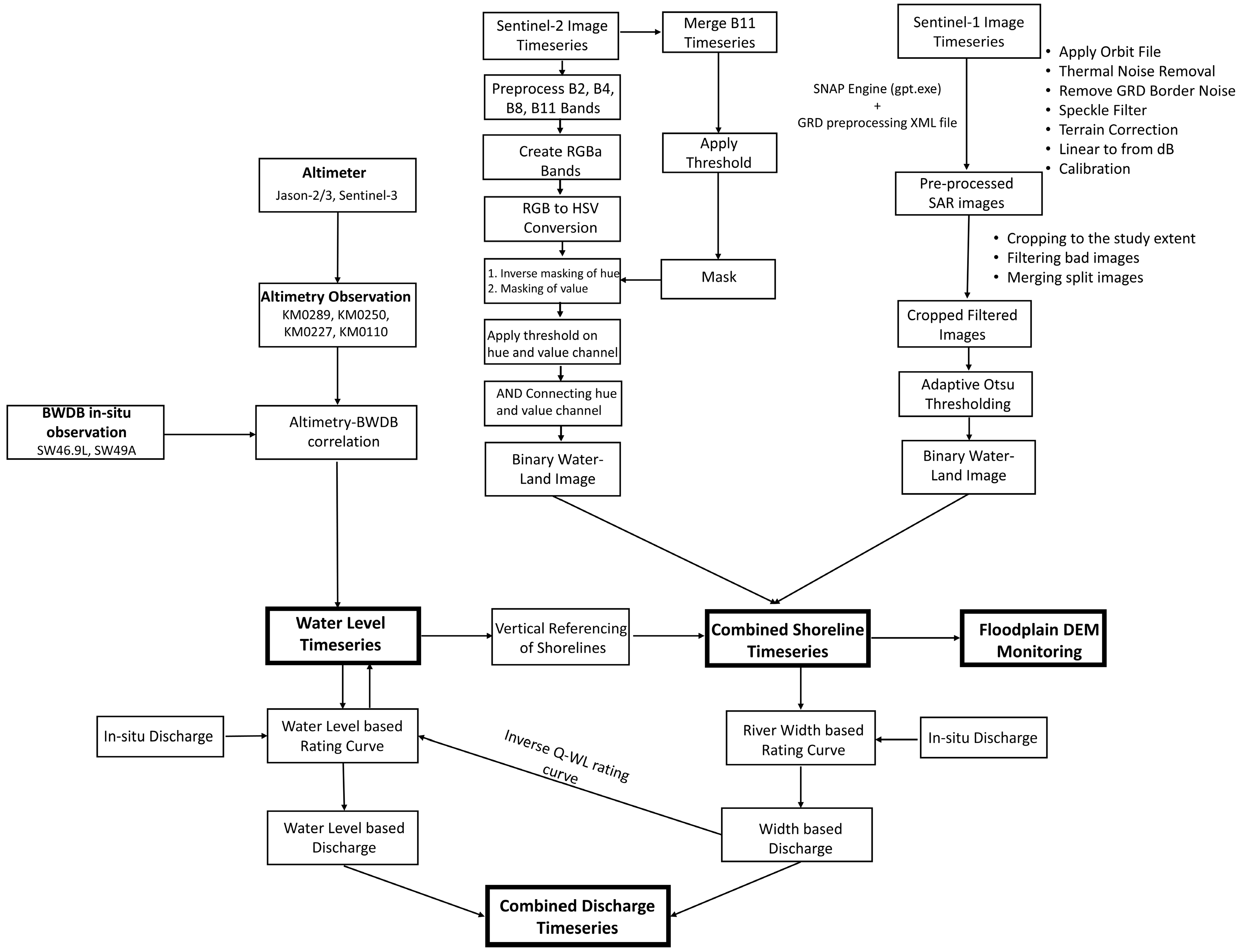
Figure 2 illustrates the overall methodological flowchart of the study, which schematically shows how altimeter, optical, and SAR observations are combined to obtain observations of water level, discharge, and floodplain topography.

3. Results and Discussions

3.1. Water Level Measurements from Altimetry

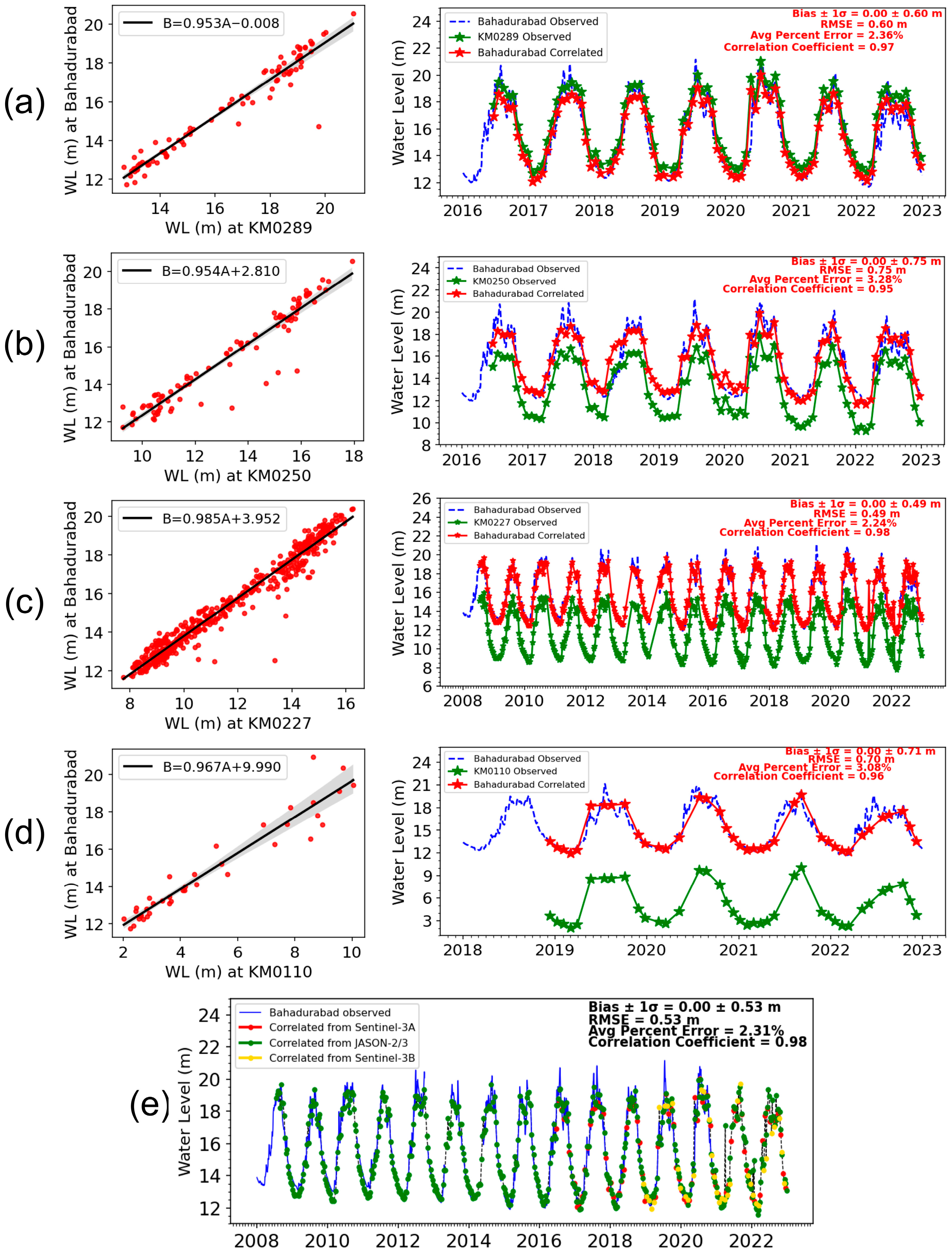
Figure 3a–d shows the station-wise correlations and the time series of in situ observed (blue-dashed line), altimetry observed (green line with stars), and the water level at the in situ station derived by the correlation equation (red line with stars). The station-wise predicted water levels (red) closely follow the observed Bahadurabad time series (blue) with zero bias when derived from the corresponding altimetry observations (green). Among them, KM0227 (from Jason) yielded the strongest correlation, with the lowest RMSE and SD (0.49 m), average percent error (2.24%), and the highest correlation coefficient (0.98).
Merging the station-wise predictions produced a combined altimetry-derived time series for Bahadurabad (2008–2022), as shown in Figure 3e. This combined series closely matched the observed records, with an RMSE and SD of 0.53 m, and average percent error of 2.31%. The correlation coefficient of 0.98 confirmed an excellent agreement, indicating that the combined predictions effectively captured both the temporal dynamics and magnitude of observed water levels. Combining multiple altimetric missions improved the observation frequency from 9.91 days (2008–2016) to 7.06 days (2017–2022).
The altimetry data show a clear longitudinal water surface gradient from the north (KM0289) to the south along the Jamuna River. The mean gradient was estimated between the upstream location KM0289 and the downstream location KM0227 using the difference in mean water levels divided by their spatial distance. The resulting longitudinal water surface gradient is approximately 9 cm km−1, which is consistent with reported slopes for large lowland alluvial rivers [65]. This estimated gradient is subsequently used to properly assign the longitudinal slope in the floodplain topography analysis described in Section 3.5.

3.2. Waterline/Bankline Extraction

Waterlines were extracted from Sentinel-2 multispectral and Sentinel-1 SAR images to create a combined waterline time series (2016–2022) for the Jamuna River reach. See Figure S3 for an example of extracted shorelines for the period from April 2016 to March 2017.
For Sentinel-2 optical imagery, the pyIntertidalDEM method [25] has been utilized, which was initially developed for the coastal zone. Their method transforms the original B2, B4, B8, and B11 bands of Sentinel-2 to synthetic hue and value bands and relies on two different thresholds that are computed automatically from a window size parameter (nhue and nvalue). For this application in the upstream rivers, the method worked without any further modification. The same nhue (0.5) and nvalue (3.0) have been used as reported in [25]. This application indicates its robustness across the land–ocean continuum as proposed in the original paper. However, optical sensors cannot penetrate clouds, making most of the acquisitions during the monsoon season unusable for waterline extraction.
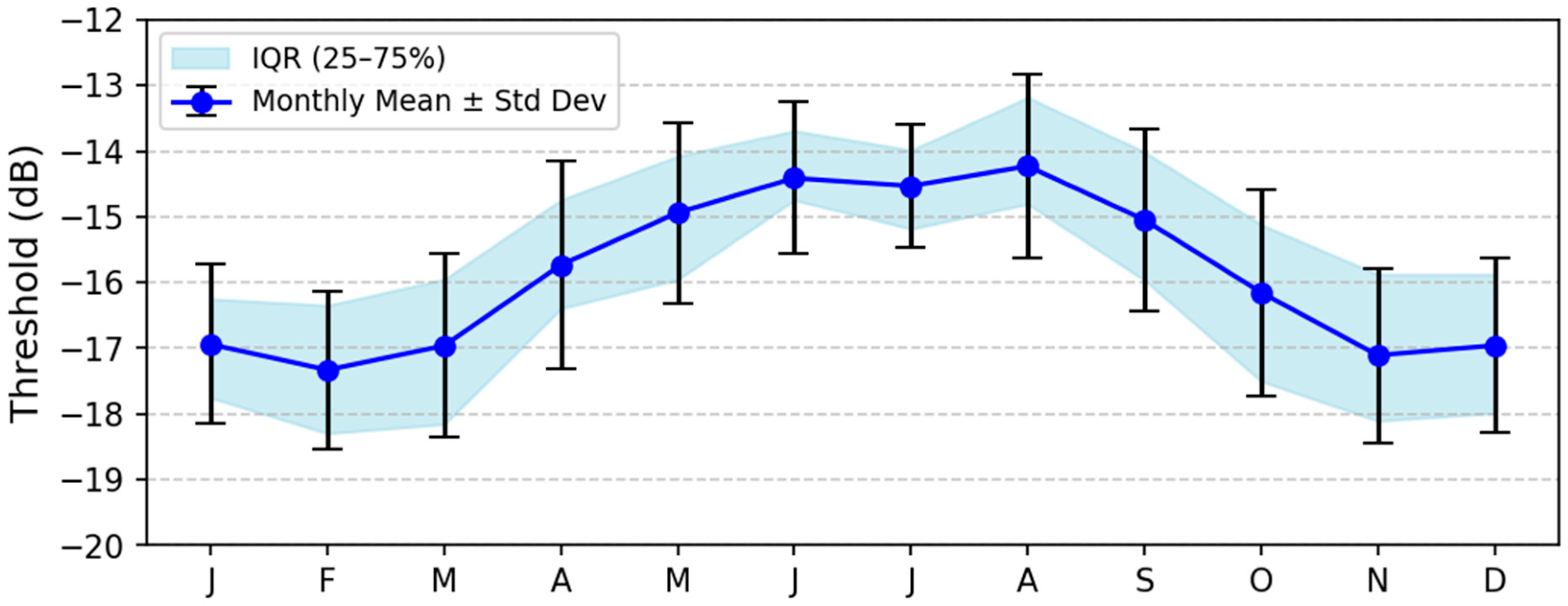
To separate land and water from Sentinel-1 SAR data, previous studies in this region, such as [22], used a fixed backscatter threshold. However, after experimentation, an adaptive Otsu thresholding method had to be employed, which dynamically adjusts the threshold for each image (See Methods, Section 2.3.2). This is because the analysis of this study shows that the appropriate threshold separating land and water pixels in a Sentinel-1 image evolves seasonally. The seasonal variation in threshold values as monthly means and standard deviations (blue line and error bar) from 2016 to 2022, and the interquartile range (IQR) in blue shade, is shown in Figure 4. This analysis reveals a significant increase in threshold from −17 dB during the winter months to −14.5 dB during the monsoon months, indicating that the fixed threshold method is not sufficient. The result from this figure may be used in future land–water separation applications.

3.3. River Discharge

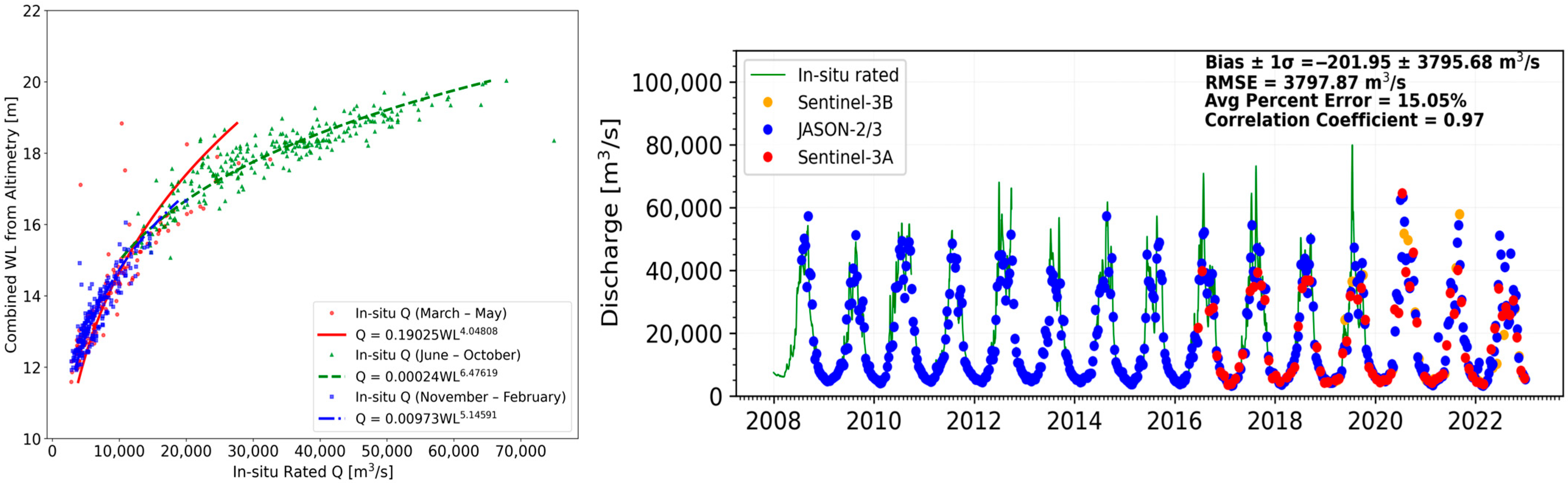
The stage–discharge relationship (rating curve) for Bahadurabad was developed utilizing the combined altimetry-derived water level time series from Figure 3 and in situ rated discharge. Bahadurabad is chosen here as the reference in situ station. Temporally, the water level at the in situ observation was linearly interpolated. Then, the rating curve between altimetry water level and in situ rated discharge was computed for each of the three seasons and later a combined discharge time series was generated for the 2008 to 2022 time period by merging these seasonal RCs, as shown in Figure 5. This combined discharge estimate, on average, demonstrates a bias of −201.95 m3/s and an error of 15.05% compared to the in situ discharge rating curve, indicating good accuracy. Although the RMSE (3797.87 m3/s) seems high, it is only 12.66% of the mean discharge (30,000 m3/s).
As an alternative, two more approaches of the application of rating curves were tested without considering the seasonality. First, a single rating curve between combined altimetry-derived water level and in situ rated discharge were established. Second, individual rating curves were generated for each of the four altimetry water level stations and then the station-wise generated discharges were merged to prepare a combined altimetry-derived discharge time series. When compared with the in situ rated discharge time series, the season-specific rating curve approach was found to be superior to the other two approaches. The seasonal approach reduces estimation errors and improves the overall fit, particularly during high-flow monsoon and low-flow dry conditions. Corresponding results from the alternative rating curve methods are shown in the Supplementary Materials (Figures S1 and S2).
Although in situ rated discharge data are available until 2022, only data up to 2019 are displayed in the direct comparison with satellite-derived discharge in Figure 5 to simulate a data-gap scenario. Satellite-derived discharge estimates are shown beyond 2019 to demonstrate the effectiveness of satellite observations as an alternative, reliable, and open source of discharge measurements. However, the comparison also reveals that the altimetry-derived discharge series missed several peak flows (e.g., 2019) due to temporal sampling (peak discharge is between two passes). To address these gaps and enhance temporal resolution, an additional width-based rating curve was developed (Section 2.3.3).
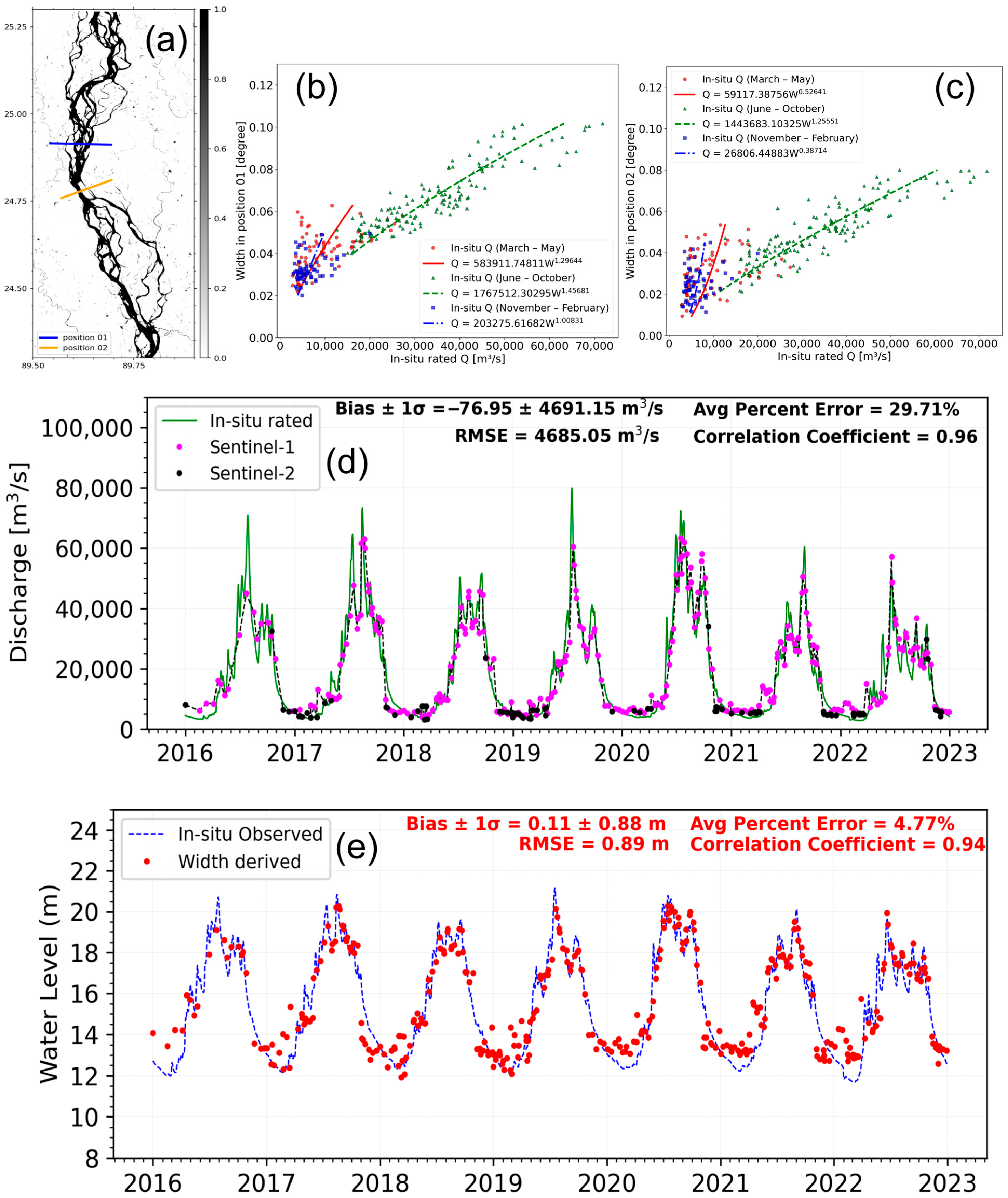
Figure 6a shows the locations along the Jamuna River within the study area where river widths were calculated from Sentinel-1 and Sentinel-2 derived land-water segmentation. These locations were chosen based on their proximity to the Bahadurabad in situ station, bank stability, and representation of different river morphologies. The guiding assumption was that width–discharge rating curves would be less accurate in narrow or constrained sections, and more accurate in wide, flat cross-sections. Separate rating curves were estimated in the corresponding locations for each of the three seasons between satellite imagery derived width and Bahadurabad in situ rated discharge timeseries. Position 01 yielded the best discharge estimates (Figure 6b). However, for some Sentinel-2 images, the image was out of the swath; hence, Position 02 was used as a secondary cross-section (Figure 6c). The final discharge time series, shown in Figure 6d, was generated by combining results from both positions.
Some unusual width, hence discharge values were observed in the width-based discharge during the dry season derived from Sentinel-1, particularly Sentinel-1A. It was found that Sentinel-1 images acquired during nighttime tend to produce inconsistent results throughout the time series. To minimize these spurious values, only daytime imagery was used for width-based discharge calculations.
While the rating curve seems to be well-fitted, it was observed that the width during the low-flow periods is noisy, and can potentially produce spurious discharge estimates (Figure 6b,c). The widths from optical (Sentinel-2) are more consistent than SAR (Sentinel-1). However, as expected, few optical observations were available during the monsoon season with high flow.
Compared to the in situ rated discharge, the estimated discharge from the width shows very good correlation (0.96), capturing very well the seasonal signal. Comparison shows a bias and RMSE of −76.95 m3/s and 4685.05 m3/s, which are 0.25% and 15% of the mean flow (30,000 m3/s), respectively. The average percentage error seems relatively higher, 29.71%, which is due to the noisier low-flow estimates. However, it is notable that, using this approach, the peak flow measurements were correctly made and a few of the peak flow events were captured (e.g., 2017, 2019, 2020), which complements the altimetry-derived measurements.
It is to be noted that the in situ discharge used in this study is not directly measured but is derived from a stage–discharge rating curve. As a result, this reference discharge contains uncertainties, particularly during high-flow conditions and periods of channel change. These uncertainties may partly influence the comparison with satellite-derived discharge estimates, meaning that some of the observed differences may originate from the reference data rather than from satellite retrieval errors alone. Nevertheless, rated discharge represents the only continuous long-term discharge information available for this region and is therefore commonly used for discharge evaluation in data-scarce river basins.
Additionally, the above-derived river width-based discharge was converted to water level using the in situ water level–discharge rating curve for Bahadurabad shown in Figure 6e. These satellite image-derived water levels were then integrated into the altimetry-derived water level time series, resulting in a combined satellite-based water level series for Bahadurabad (Figure 7b).

3.4. Multi-Satellite Water Level and Discharge

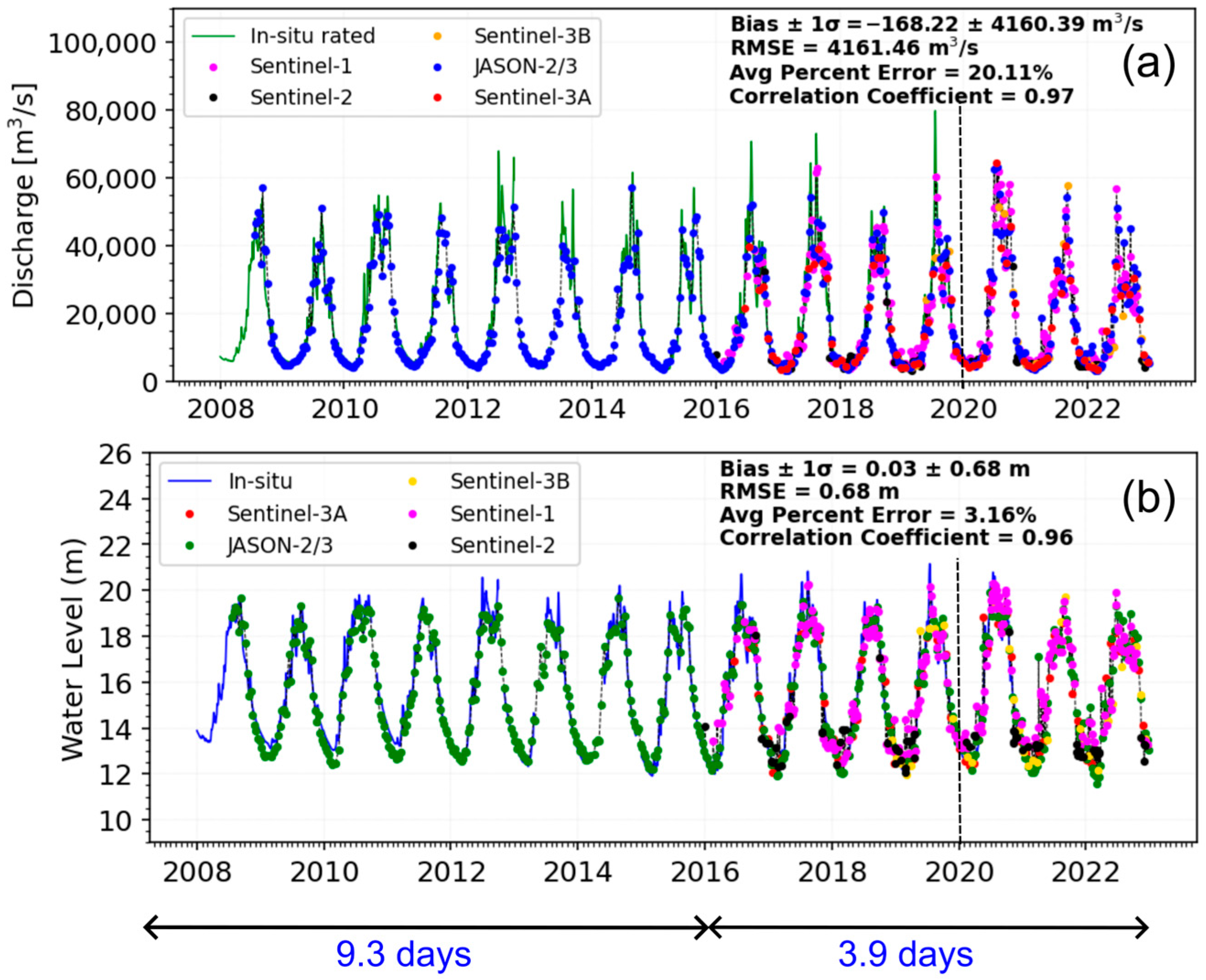
The combined discharge time series for Bahadurabad was generated by merging all discharge estimates from altimetry-derived water levels, and Sentinel-1/Sentinel-2-derived river widths are shown in Figure 7a.
When compared with the in situ rated discharge time series for 2008–2022, the combined discharge series achieved a bias of −168.22 m3/s, RMSE of 4161.46 m3/s, average percent error of 20.11%, and a correlation coefficient of 0.97. The combined water level series yielded a bias of 0.03 m, RMSE of 0.68 m, average percent error of 3.16%, and the correlation coefficient of 0.96. Both time series reflect strong agreement with observations.
A key outcome of the multi-satellite approach is the significant improvement in monitoring frequency. For 2016–2022, it achieved an average revisit interval of 3.90 days, compared to 7.06 days for altimetry alone and 7.34 days for Sentinel-1 and Sentinel-2 combined. Over the longer period (2008–2022), the multi-satellite approach reduced the interval to 5.71 days versus 8.37 days for altimetry alone. This more than doubles the observation frequency, enabling better detection of peak flows, rapid changes, and seasonal patterns. This higher observation frequency is particularly valuable for the Jamuna River, where in situ measurements are often sparse or disrupted during extreme flood events when in situ systems fail. By integrating diverse satellite datasets, the multi-satellite approach not only overcomes individual limitations but also enhances data quality, fills historical gaps, and provides a continuous, reliable, and openly accessible data record that can significantly strengthen the monitoring and management of the Brahmaputra River.

3.5. Floodplain Topography

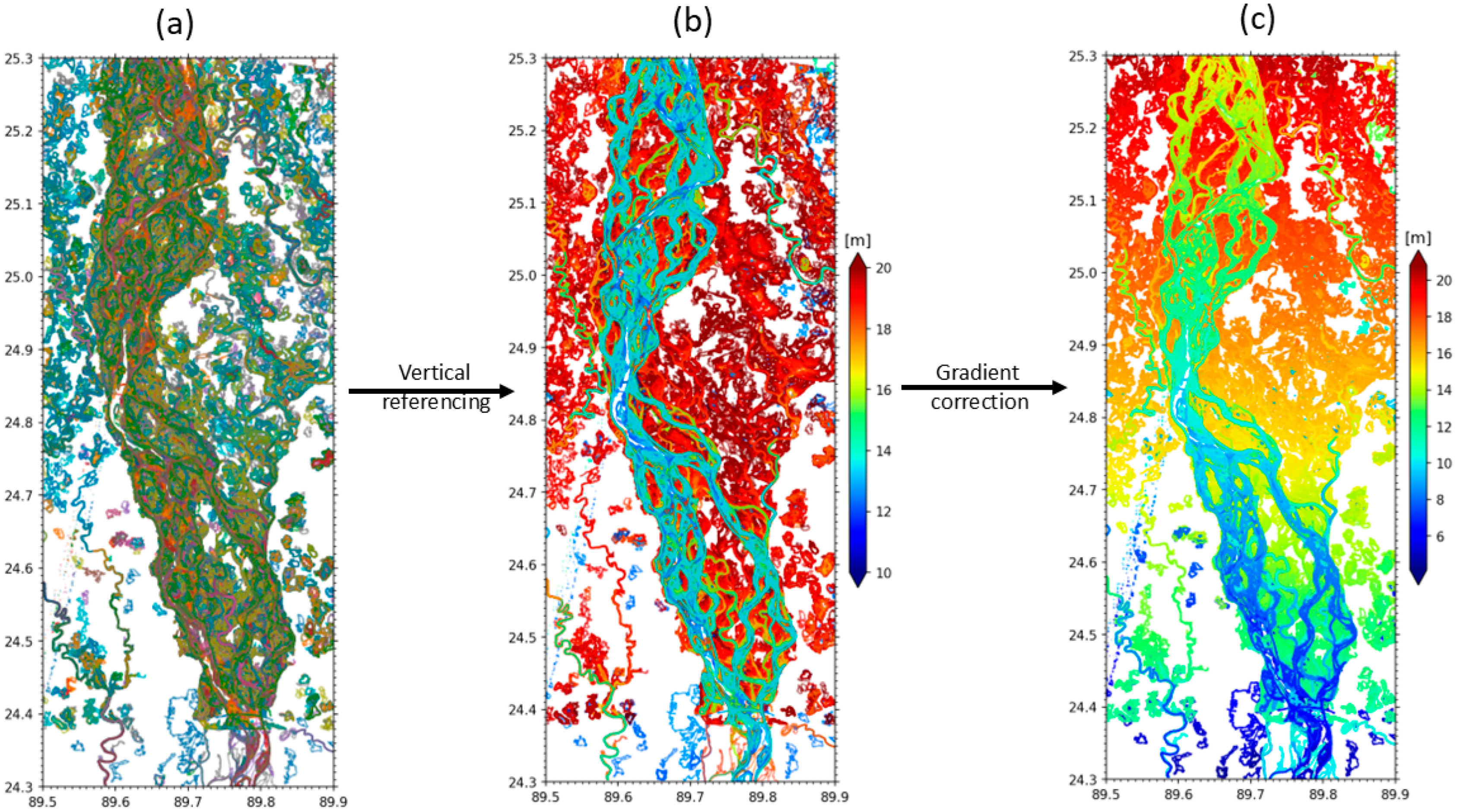
The combined waterline time series derived from Sentinel-1 and Sentinel-2 images (Figure 8a) was linked to altimetry-derived water level values to perform vertical referencing of the spatial extents, i.e., waterlines, along the Jamuna River. To do this, the combined water level at the Bahadurabad station location has been used, where the combined observation frequency reaches about 4 days (Figure 7b). The corresponding shorelines referenced to the Bahadurabad water level are shown in Figure 8b.
As previously discussed, there is a strong south-north gradient of the water level (Figure 3). This gradient was calculated with respect to the location of the Bahadurabad in situ gauge using the mean water levels and positions of the altimetry stations, KM0289 and KM0227. The topography, after correcting for the water level gradient, referenced to the datum of the Bahadurabad in situ gauge station is shown in Figure 8c.
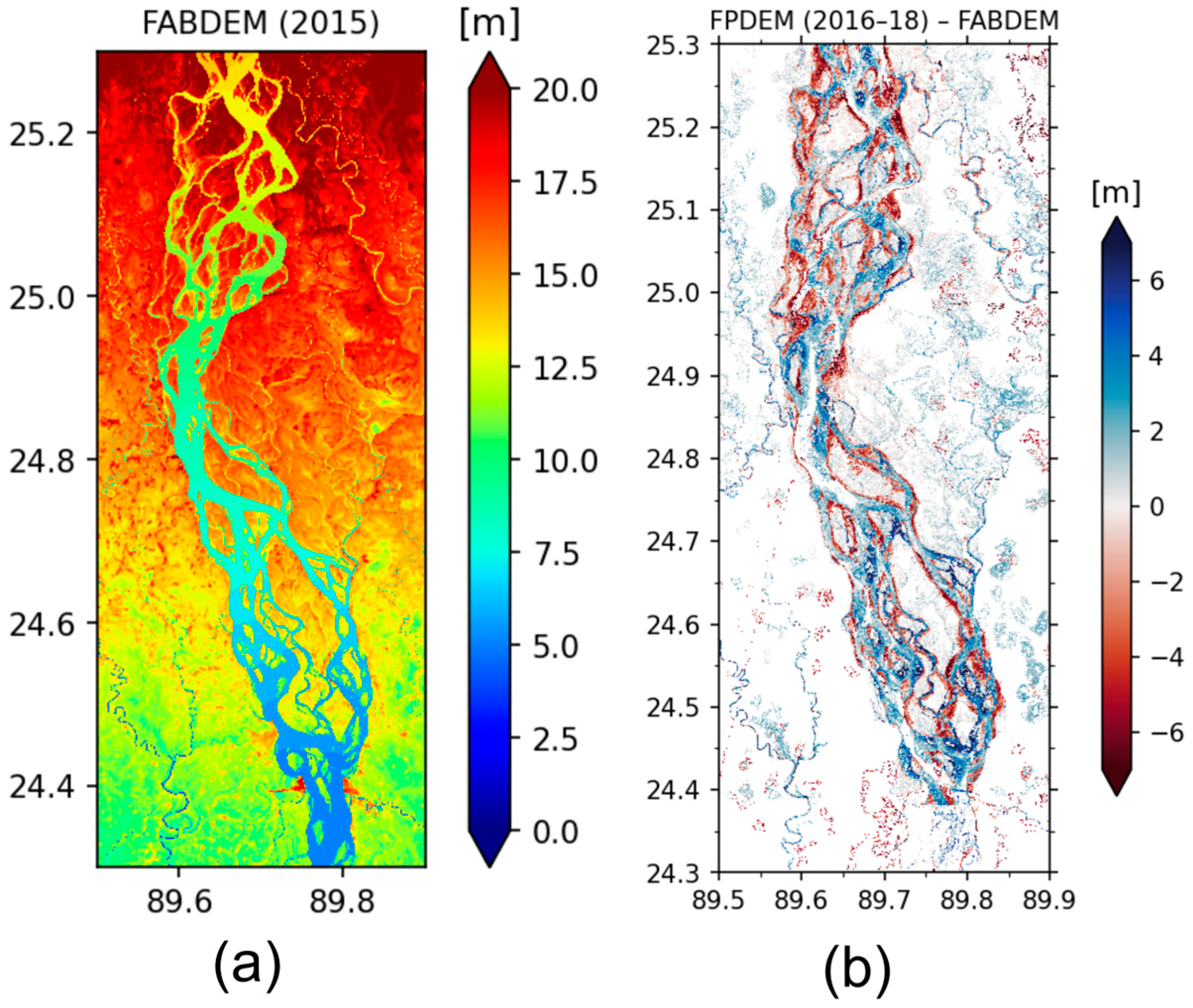
The generated floodplain DEM (FPDEM) was compared with the FABDEM. FABDEM is a Digital Elevation Model derived from the Copernicus DEM after removing the vegetation and buildings and distributed at 1 arc-sec resolution, which amounts to about 30 m at the equator. The underlying acquisitions for Copernicus DEM, and subsequently FABDEM, are made from TanDEM-X, a German space mission to map the global topography launched in 2010. The bathymetry reflects the morphological state of the acquisitions made during 2011–2015. For large-scale applications, this dataset is found to be one of the best DEMs in a deltaic environment [66]. For a direct comparison, the 10 m FPDEM was resampled to FABDEM’s 30 m resolution by averaging the elevations of all FPDEM pixels within each FABDEM pixel footprint. The resulting dataset was then compared with FABDEM pixel by pixel.
As expected, FPDEM built from the waterlines aggregated over 2016–2018, which captures the closest recent state of the river floodplain morphology, shows large-scale differences compared to the FABDEM (2011–2015) due to the rapid morphological evolution of the Brahmaputra floodplain. Figure 9b shows the elevation differences for FPDEM (2016–2018) compared to FABDEM, where red areas indicate erosion (FPDEM < FABDEM) and blue areas represent deposition (FPDEM > FABDEM). Both DEMs show strong agreement in capturing key topographic features, including the braided channels, char lands, and low-lying flood-prone areas. FPDEM clearly offers an updated spatial detail, especially in dynamically changing regions where erosion, deposition, and subtle channel form changes occur. The annually constructed FPDEM (2016–2022) provides a dynamic, current view of the floodplain topography (see Figure S4). At the same time, due to the dynamic nature of the topography in this floodplain, this analysis reveals that in situ validation will require dedicated field campaigns, which are out of the scope of this study. However, the waterline method is expected to provide reliable topography in this region, as demonstrated by [37]. As the morphology is changing rapidly, the analysis of erosion and accretion in this region will be expanded using the waterline method in the following section.

3.6. Morphodynamics

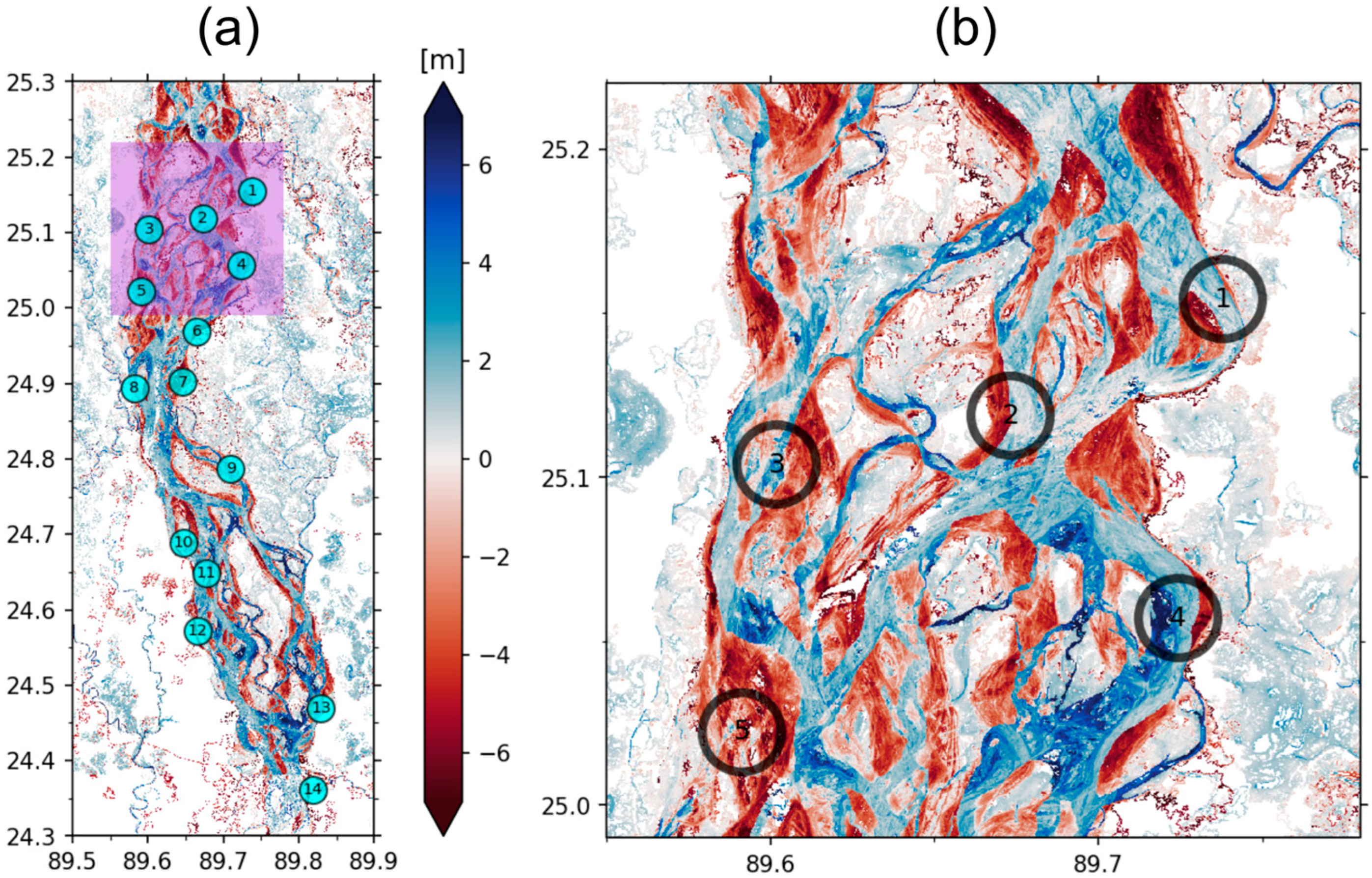
To analyze the morphological changes, the difference between the FPDEM derived from waterlines (2016–2022) and the FABDEM was first examined. This difference is shown in Figure 10. As before, blue indicates accretion and red indicates erosion (Figure 10b).
To address the lack of data, secondary sources were used, identifying several major erosion hotspots along the Jamuna River from local newspaper reports spanning 2016 to 2022 (Table S1). The location of these hotspots is shown in Figure 10a with numbered circles. A spreadsheet containing the location and details of the newspaper sources is provided in the Supplementary Materials. The changes are clearly greater in the upper part of our analysis domain, above 24.9° N. Figure 10b offers a close-up view of this particularly erosion-prone area, with circles marking the sites reported in the news. It was found that all the reported erosion zones are well captured by the computed change map (Figure 10b). In addition, the method demonstrated in this study could capture even more areas with detailed spatial scales that remained unmapped before.
Overall, the spatial distribution of erosion and deposition demonstrates the complex interplay between sediment transport, river flow dynamics, and floodplain morphology characteristic of braided rivers like the Jamuna. Some riverbank sections show persistent erosion over multiple years, where stronger water flow forces prevail, while deposition zones tend to be more dispersed across the floodplain, highlighting the continuous cycle of erosion and sediment accumulation shaping the river’s dynamic landscape.
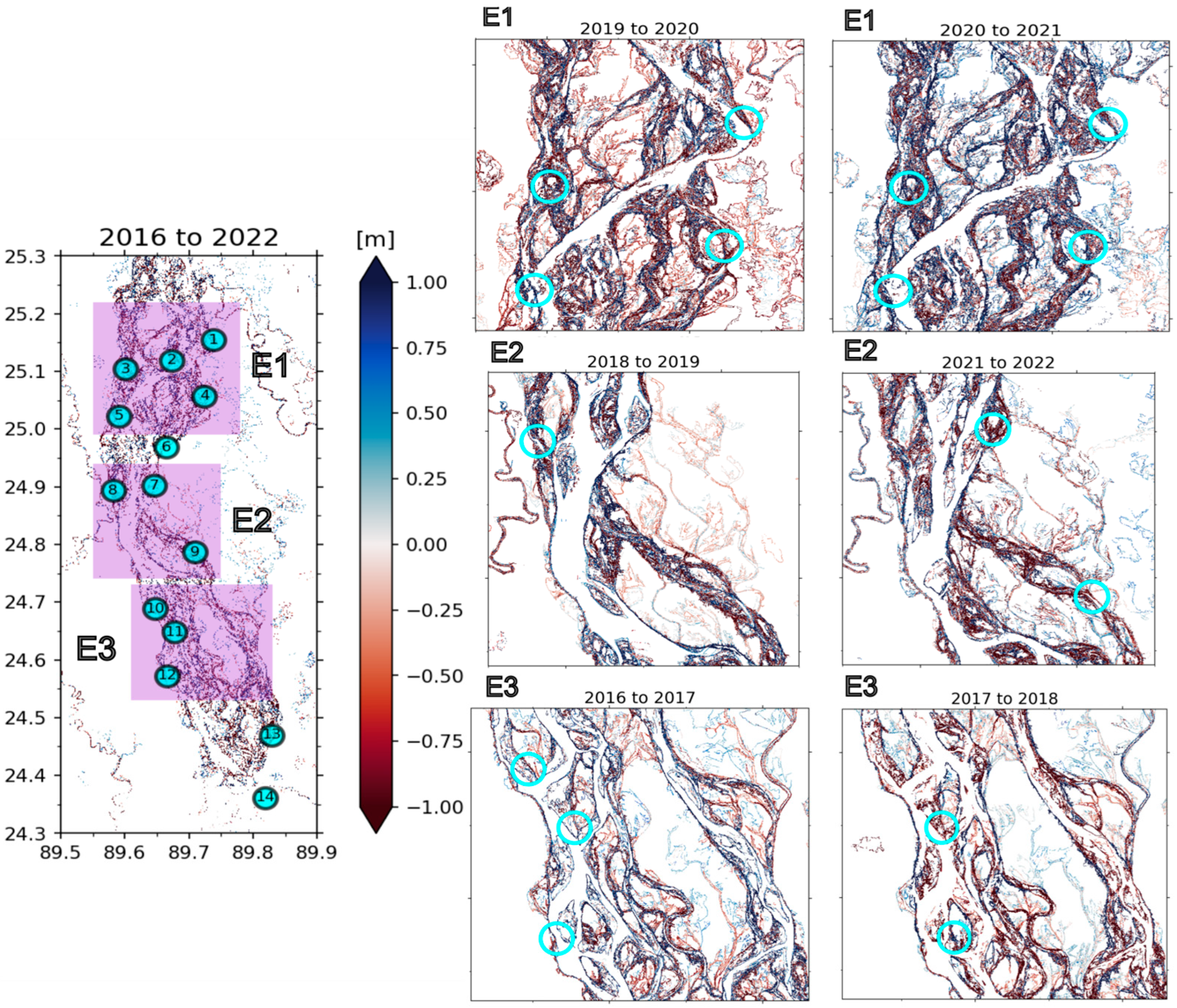
By accumulating the shorelines over a given period (a year, a season), FPDEM can be used to monitor floodplain dynamics over a specified time. This approach can be used to gain a deeper insight into the yearly erosion and accretion patterns along the study reach shown in Figure 11. The three key regions, marked as E1, E2, and E3 in Figure 11 (left panel), were selected based on the newspaper survey. For each region, the year-over-year change has been computed. In these different maps, negative values (red) represent erosion, while positive values (blue) indicate accretion compared to the previous year.
For all of the presented yearly changes, the erosion locations reported in the newspaper were well captured (cyan circles). As before, our methodology could capture these large-scale erosion–accretion spatial patterns, which were not represented in the news.
In region E1, the changes in 2020 compared to 2019 (E1 2019–2020) and the changes in 2021 compared to 2020 (E1 2020–2021) are shown. It has been observed that, in 2020, a lot of small char channels appear compared to 2019 (red, Figure 11, E1 2019–2020), which again get filled up by 2021 (Figure 11, E1 2020–2021).
For E2, the changes in 2019 compared to 2018 (E2 2018–2019) and the changes in 2022 compared to 2021 (E2 2021–2022) have been presented. The year-to-year transitions show noisy changes, indicating very rapid dynamics. The two maps, E2 2021–2022 and E2 2018–2019, side-by-side show much more prominent changes that occurred to the river plan form. Notably, a number of small islands appear throughout the zoomed area, and large-scale shifting of the islands is prominently visible.
For E3, the year-to-year changes from 2016 to 2017 (E3 2016–2017) and from 2017 to 2018 (E3 2017–2018) are more clearly visible. Many of the areas that were accreted in E3 2016–2017 observed an erosion in E3 2017–2018, and vice versa.
Overall, the six year-to-year difference plots reveal the shifting spatial distribution of erosion and accretion areas, which correspond closely with erosion events reported in local newspapers, thus indicating the potential usefulness of the waterline method in capturing seasonal and yearly morphological changes. Despite such rapid morphological changes in this underdeveloped yet relatively densely populated and vulnerable region, currently, there is no system in place for continuous monitoring. Our experience with surveying the newspaper articles indicates that only a handful of events are reported in the mainstream media, leaving the vulnerability of thousands of char residents unknown.
Such year-to-year monitoring was possible, as our image processing approach is automatic, for both optical and SAR imagery, allowing mass analysis of high-resolution imagery. Like the water level and discharge monitoring, this waterline method can also be operationalized for regular monitoring of the evolution of the char land. The results from our analysis can also be useful for future numerical modeling by ensuring more accurate topography and bathymetry compared to the global bathymetric dataset.

3.7. Added Values and Perspectives

The study successfully used remote sensing to monitor river hydrology and morphodynamics in areas inhabited by a significant number of vulnerable populations. The continuous discharge estimation and high-resolution mapping obtained here enable robust assessments of flooding and erosion impacts on communities through interdisciplinary research [67,68]. The derived dataset also supports the identification of areas most susceptible to erosion hazards, facilitating more effective allocation of resources for disaster response and recovery.
The automated processing framework developed in this study overcomes key limitations of existing approaches that rely on a single satellite data source [16,69] and single-event-centric flood monitoring [19,22], where the potential of multi-satellite integration and long-term flood analysis remains underexplored. Again, most existing studies rely on manual on-screen digitization for shoreline extraction and overlook the role of floodplain topography in braided river morphodynamics. This study addresses these limitations by presenting an integrated semi-automated satellite-based framework and also improving the accuracy and frequency of water level and discharge estimates significantly compared to the previous approaches.
Although this study primarily utilized operational satellites (e.g., Sentinel missions), data from recent state-of-the-art satellite missions such as the Surface Water and Ocean Topography (SWOT) mission [70,71] could be further leveraged to enhance spatial coverage and improve understanding of regional water dynamics. Such datasets could also help with monitoring seasonal topographic changes [72]. Additionally, the waterline- and altimetry-based floodplain topography monitoring can be expanded to other optical and SAR satellites, including the Landsat series, to better characterize erosion–accretion patterns across this dynamic river region.
The derived dataset is openly available and can be readily extended with future acquisitions. The extended dataset of water level, discharge, and floodplain topography provides a valuable resource for hydrological modeling. It can be used to validate and refine models, extend coverage to other river sections, and integrate into real-time flood monitoring systems. This dataset lays a foundation for continued exploration of the Jamuna River’s dynamics and offers a practical tool for impact assessments and forecasting. The discharge dataset is also highly valuable for coastal and ocean modeling in this region [73], especially for storm surge and compound flooding studies [74,75]. Moreover, the methodology presented here is transferable and can be applied to other river basins in Bangladesh and beyond.

4. Conclusions

This study successfully developed and applied a multi-satellite approach to monitor water level, discharge, and floodplain evolution in a highly dynamic reach of the Brahmaputra River in Bangladesh. By integrating altimetry, SAR, and optical imagery, the proposed framework increases the temporal frequency of water level and discharge observations, addressing key limitations associated with sparse in situ data in data-scarce regions. The integrated methodology enabled more frequent and comprehensive monitoring than single-sensor approaches and provided continuous water level and discharge time series with good accuracy, high reliability, and faster availability. In addition, the demonstrated annual monitoring of river floodplain morphodynamics allowed regular large-scale assessment of erosion, accretion, and floodplain changes in areas inhabited by vulnerable riverine populations. The satellite-derived dataset presented here is open and extendable, offering a valuable resource for future applications such as hydrological and hydrodynamic model calibration and validation. The proposed framework can also serve as a foundation for operational flood monitoring systems. Overall, this transferable framework demonstrates a practical and scalable multi-satellite application for monitoring hydro-morphodynamics towards informed riverine impact assessment and sustainable river basin management in Bangladesh and other data-poor large river systems globally.

Supplementary Materials

The following supporting information can be downloaded at: https://www.mdpi.com/article/10.3390/hydrology13020060/s1, Figure S1: Established Rating Curve (without considering seasonality) between combined altimetric water level and Bahadurabad (SW46.9L) and respective correlated water level time series; Figure S2: Established individual Rating Curve (without considering seasonality) between altimetric water level stations and Bahadurabad (SW46.9L) and respective correlated water level time series for altimetry stations—(a) KM0289, (b) KM0250, (c) KM0227, and (d) KM0110; Figure S3: (a) Waterlines extracted from Sentinel-1 and Sentinel-2 imagery covering the period from April 2016 to March 2017, with the purple box highlighting a section of the Jamuna River that is particularly dynamic; (b) waterlines for the same reach between April 2021 and March 2022; Figure S4: Year-wise differences between the floodplain DEM and FABDEM from 2016 to 2022; Table S1: Location of the erosion hotspots along the study reach according to the published reports in the local newspapers.

Author Contributions

Conceptualization, J.K., F.A. and N.J.; methodology, F.A., J.K. and N.J.; software, F.A. and J.K.; validation, F.A.; formal analysis, F.A.; investigation, F.A.; resources, N.J. and J.K.; data curation, F.A.; writing—original draft preparation, F.A.; writing—review and editing, F.A., N.J., J.K., A.S.I. and S.H.; visualization, F.A.; supervision, N.J., J.K. and A.S.I. All authors have read and agreed to the published version of the manuscript.

Funding

This research received funding from the Bangladesh University of Engineering and Technology (BUET) for data collection.

Data Availability Statement

The original data presented in the study are openly available in zenodo at https://doi.org/10.5281/zenodo.18005582. The raw satellite and other auxiliary datasets are available at their respective online sources. The raw data supporting the conclusions of this article will be made available by the authors on reasonable request.

Acknowledgments

The authors acknowledge satellite data pre-processing by Hydroweb and Copernicus and the use of computing facilities at the Department of Water Resources Engineering, BUET.

Conflicts of Interest

The authors declare no conflicts of interest.

Abbreviations

The following abbreviations are used in this manuscript:
BWDBBangladesh Water Development Board
ESAEuropean Space Agency
FABDEMForest and Buildings removed Digital Elevation Model
GBMGanges–Brahmaputra–Meghna
GRDGround Range Detected
MAJAMACCS–ATCOR Joint Algorithm
MODISModerate Resolution Imaging Spectroradiometer
RMSERoot Mean Square Error
SARSynthetic Aperture Radar
SNAPSentinel Application Platform

References

  1. Serinaldi, F.; Kilsby, C.G. A Blueprint for Full Collective Flood Risk Estimation: Demonstration for European River Flooding. Risk Anal. 2017, 37, 1958–1976. [Google Scholar] [CrossRef]
  2. Wheater, H.; Evans, E. Land Use, Water Management and Future Flood Risk. Land Use Policy 2009, 26, S251–S264. [Google Scholar] [CrossRef]
  3. Sheffield, J.; Wood, E.F.; Pan, M.; Beck, H.; Coccia, G.; Serrat-Capdevila, A.; Verbist, K. Satellite Remote Sensing for Water Resources Management: Potential for Supporting Sustainable Development in Data-Poor Regions. Water Resour. Res. 2018, 54, 9724–9758. [Google Scholar] [CrossRef]
  4. Chen, X.; Long, D.; Hong, Y.; Zeng, C.; Yan, D. Improved Modeling of Snow and Glacier Melting by a Progressive Two-stage Calibration Strategy with GRACE and Multisource Data: How Snow and Glacier Meltwater Contributes to the Runoff of the Upper Brahmaputra River Basin? Water Resour. Res. 2017, 53, 2431–2466. [Google Scholar] [CrossRef]
  5. Khan, M.J.U.; Durand, F.; Emanuel, K.; Krien, Y.; Testut, L.; Islam, A.K.M.S. Storm Surge Hazard over Bengal Delta: A Probabilistic–Deterministic Modelling Approach. Nat. Hazards Earth Syst. Sci. 2022, 22, 2359–2379. [Google Scholar] [CrossRef]
  6. Becker, M.; Seeger, K.; Paszkowski, A.; Marcos, M.; Papa, F.; Almar, R.; Bates, P.; France-Lanord, C.; Hossain, M.S.; Khan, M.J.U.; et al. Coastal Flooding in Asian Megadeltas: Recent Advances, Persistent Challenges, and Call for Actions Amidst Local and Global Changes. Rev. Geophys. 2024, 62, e2024RG000846. [Google Scholar] [CrossRef]
  7. Lettenmaier, D.P.; Alsdorf, D.; Dozier, J.; Huffman, G.J.; Pan, M.; Wood, E.F. Inroads of Remote Sensing into Hydrologic Science during the WRR Era. Water Resour. Res. 2015, 51, 7309–7342. [Google Scholar] [CrossRef]
  8. McCabe, M.F.; Rodell, M.; Alsdorf, D.E.; Miralles, D.G.; Uijlenhoet, R.; Wagner, W.; Lucieer, A.; Houborg, R.; Verhoest, N.E.C.; Franz, T.E.; et al. The Future of Earth Observation in Hydrology. Hydrol. Earth Syst. Sci. 2017, 21, 3879–3914. [Google Scholar] [CrossRef] [PubMed]
  9. Abdalla, S.; Abdeh Kolahchi, A.; Ablain, M.; Adusumilli, S.; Aich Bhowmick, S.; Alou-Font, E.; Amarouche, L.; Andersen, O.B.; Antich, H.; Aouf, L.; et al. Altimetry for the Future: Building on 25 Years of Progress. Adv. Space Res. 2021, 68, 319–363. [Google Scholar] [CrossRef]
  10. Papa, F.; Durand, F.; Rossow, W.B.; Rahman, A.; Bala, S.K. Satellite Altimeter-derived Monthly Discharge of the Ganga-Brahmaputra River and Its Seasonal to Interannual Variations from 1993 to 2008. J. Geophys. Res. 2010, 115, 2009JC006075. [Google Scholar] [CrossRef]
  11. Papa, F.; Bala, S.K.; Pandey, R.K.; Durand, F.; Gopalakrishna, V.V.; Rahman, A.; Rossow, W.B. Ganga-Brahmaputra River Discharge from Jason-2 Radar Altimetry: An Update to the Long-term Satellite-derived Estimates of Continental Freshwater Forcing Flux into the Bay of Bengal. J. Geophys. Res. 2012, 117, 2012JC008158. [Google Scholar] [CrossRef]
  12. Hossain, F.; Maswood, M.; Siddique-E-Akbor, A.H.; Yigzaw, W.; Mazumdar, L.C.; Ahmed, T.; Hossain, M.; Shah-Newaz, S.M.; Limaye, A.; Lee, H.; et al. A Promising Radar Altimetry Satellite System for Operational Flood Forecasting in Flood-Prone Bangladesh. IEEE Geosci. Remote Sens. Mag. 2014, 2, 27–36. [Google Scholar] [CrossRef]
  13. Maswood, M.; Hossain, F. Advancing River Modelling in Ungauged Basins Using Satellite Remote Sensing: The Case of the Ganges–Brahmaputra–Meghna Basin. Int. J. River Basin Manag. 2016, 14, 103–117. [Google Scholar] [CrossRef]
  14. Frappart, F.; Papa, F.; Marieu, V.; Malbeteau, Y.; Jordy, F.; Calmant, S.; Durand, F.; Bala, S. Preliminary Assessment of SARAL/AltiKa Observations over the Ganges-Brahmaputra and Irrawaddy Rivers. Mar. Geod. 2015, 38, 568–580. [Google Scholar] [CrossRef]
  15. Villadsen, H.; Andersen, O.B.; Stenseng, L.; Nielsen, K.; Knudsen, P. CryoSat-2 Altimetry for River Level Monitoring—Evaluation in the Ganges–Brahmaputra River Basin. Remote Sens. Environ. 2015, 168, 80–89. [Google Scholar] [CrossRef]
  16. Bhuiyan, M.A.H.; Kumamoto, T.; Suzuki, S. Application of Remote Sensing and GIS for Evaluation of the Recent Morphological Characteristics of the Lower Brahmaputra-Jamuna River, Bangladesh. Earth Sci. Inf. 2015, 8, 551–568. [Google Scholar] [CrossRef]
  17. Deb, M.; Ferreira, C. Planform Channel Dynamics and Bank Migration Hazard Assessment of a Highly Sinuous River in the North-Eastern Zone of Bangladesh. Environ. Earth Sci. 2015, 73, 6613–6623. [Google Scholar] [CrossRef]
  18. Billah, M.; Islam, A.K.M.S.; Mamoon, W.B.; Rahman, M.R. Random Forest Classifications for Landuse Mapping to Assess Rapid Flood Damage Using Sentinel-1 and Sentinel-2 Data. Remote Sens. Appl. Soc. Environ. 2023, 30, 100947. [Google Scholar] [CrossRef]
  19. Islam, A.S.; Bala, S.K.; Haque, M.A. Flood Inundation Map of Bangladesh Using MODIS Time-series Images. J. Flood Risk Manag. 2010, 3, 210–222. [Google Scholar] [CrossRef]
  20. Islam, M.M.; Ahamed, T. Development of a Near-Infrared Band Derived Water Indices Algorithm for Rapid Flash Flood Inundation Mapping from Sentinel-2 Remote Sensing Datasets. Asia-Pac. J. Reg. Sci. 2023, 7, 615–640. [Google Scholar] [CrossRef]
  21. Singha, M.; Dong, J.; Sarmah, S.; You, N.; Zhou, Y.; Zhang, G.; Doughty, R.; Xiao, X. Identifying Floods and Flood-Affected Paddy Rice Fields in Bangladesh Based on Sentinel-1 Imagery and Google Earth Engine. ISPRS J. Photogramm. Remote Sens. 2020, 166, 278–293. [Google Scholar] [CrossRef]
  22. Uddin, K.; Matin, M.A.; Meyer, F.J. Operational Flood Mapping Using Multi-Temporal Sentinel-1 SAR Images: A Case Study from Bangladesh. Remote Sens. 2019, 11, 1581. [Google Scholar] [CrossRef]
  23. Chowdhury, E.H.; Hassan, Q.K. Use of Remote Sensing Data in Comprehending an Extremely Unusual Flooding Event over Southwest Bangladesh. Nat. Hazards 2017, 88, 1805–1823. [Google Scholar] [CrossRef]
  24. Mason, D.C.; Davenport, I.J.; Robinson, G.J.; Flather, R.A.; McCartney, B.S. Construction of an Inter-tidal Digital Elevation Model by the ‘Water-Line’ Method. Geophys. Res. Lett. 1995, 22, 3187–3190. [Google Scholar] [CrossRef]
  25. Khan, M.J.U.; Ansary, M.N.; Durand, F.; Testut, L.; Ishaque, M.; Calmant, S.; Krien, Y.; Islam, A.K.M.S.; Papa, F. High-Resolution Intertidal Topography from Sentinel-2 Multi-Spectral Imagery: Synergy between Remote Sensing and Numerical Modeling. Remote Sens. 2019, 11, 2888. [Google Scholar] [CrossRef]
  26. Valsangkar, N.; Nelson, A.; Hasan, M.F. Combining Earth Observations with Ground Data to Assess River Topography and Morphologic Change: Case Study of the Lower Jamuna River. Int. J. Appl. Earth Obs. Geoinf. 2024, 134, 104146. [Google Scholar] [CrossRef]
  27. Mengen, D.; Ottinger, M.; Leinenkugel, P.; Ribbe, L. Modeling River Discharge Using Automated River Width Measurements Derived from Sentinel-1 Time Series. Remote Sens. 2020, 12, 3236. [Google Scholar] [CrossRef]
  28. Berger, M.; Moreno, J.; Johannessen, J.A.; Levelt, P.F.; Hanssen, R.F. ESA’s Sentinel Missions in Support of Earth System Science. Remote Sens. Environ. 2012, 120, 84–90. [Google Scholar] [CrossRef]
  29. Salameh, E.; Frappart, F.; Turki, I.; Laignel, B. Intertidal Topography Mapping Using the Waterline Method from Sentinel-1 & -2 Images: The Examples of Arcachon and Veys Bays in France. ISPRS J. Photogramm. Remote Sens. 2020, 163, 98–120. [Google Scholar] [CrossRef]
  30. Tourian, M.J.; Tarpanelli, A.; Elmi, O.; Qin, T.; Brocca, L.; Moramarco, T.; Sneeuw, N. Spatiotemporal Densification of River Water Level Time Series by Multimission Satellite Altimetry. Water Resour. Res. 2016, 52, 1140–1159. [Google Scholar] [CrossRef]
  31. Sichangi, A.W.; Wang, L.; Yang, K.; Chen, D.; Wang, Z.; Li, X.; Zhou, J.; Liu, W.; Kuria, D. Estimating Continental River Basin Discharges Using Multiple Remote Sensing Data Sets. Remote Sens. Environ. 2016, 179, 36–53. [Google Scholar] [CrossRef]
  32. Liu, Q.; Chen, Y.; Brêda, J.P.L.F.; Cui, H.; Duan, H.; Huang, C. Higher-Density River Discharge Observation through Integration of Multiple Satellite Data: Midstream Yellow River, China. Int. J. Appl. Earth Obs. Geoinf. 2025, 137, 104433. [Google Scholar] [CrossRef]
  33. Dubey, A.K.; Gupta, P.K.; Dutta, S.; Singh, R.P. An Improved Methodology to Estimate River Stage and Discharge Using Jason-2 Satellite Data. J. Hydrol. 2015, 529, 1776–1787. [Google Scholar] [CrossRef]
  34. Rai, A.K.; Beg, Z.; Singh, A.; Gaurav, K. Estimating Discharge of the Ganga River from Satellite Altimeter Data. J. Hydrol. 2021, 603, 126860. [Google Scholar] [CrossRef]
  35. Pool, L.; Mascagni, M.L.; Klein, A.H.F.; Carvalho, J.L.B.; Lima, L.G.; Costa, W.L.L.; Gonçalves, R.Q.; Fiorini, L.P. Revealing Intertidal Topography with Public Satellite Imagery: Adaptations of the Waterline Method. Environ. Model. Softw. 2025, 193, 106600. [Google Scholar] [CrossRef]
  36. Tan, J.; Chen, M.; Xie, X.; Zhang, C.; Mao, B.; Lei, G.; Wang, B.; Meng, X.; Guan, X.; Zhang, Y. Riparian Zone DEM Generation from Time-Series Sentinel-1 and Corresponding Water Level: A Novel Waterline Method. IEEE Trans. Geosci. Remote Sens. 2022, 60, 4207110. [Google Scholar] [CrossRef]
  37. Valsangkar, N.; Nelson, A.; Simpalean, A.; Islam, M.N. Morphologic Adjustment of the Jamuna River to Large-Scale Riverbank Protection. Int. J. River Basin Manag. 2025, 1–19. [Google Scholar] [CrossRef]
  38. Philip, S.; Sparrow, S.; Kew, S.F.; van der Wiel, K.; Wanders, N.; Singh, R.; Hassan, A.; Mohammed, K.; Javid, H.; Haustein, K.; et al. Attributing the 2017 Bangladesh Floods from Meteorological and Hydrological Perspectives. Hydrol. Earth Syst. Sci. 2019, 23, 1409–1429. [Google Scholar] [CrossRef]
  39. Ferdous, M.R.; Wesselink, A.; Brandimarte, L.; Slager, K.; Zwarteveen, M.; Di Baldassarre, G. The Costs of Living with Floods in the Jamuna Floodplain in Bangladesh. Water 2019, 11, 1238. [Google Scholar] [CrossRef]
  40. Hossain, S.; Cloke, H.L.; Ficchì, A.; Turner, A.G.; Stephens, E.M. Hydrometeorological Drivers of Flood Characteristics in the Brahmaputra River Basin in Bangladesh 2021. Hydrol. Earth Syst. Sci. 2021. preprint. [Google Scholar] [CrossRef]
  41. Mohammed, K.; Islam, A.K.M.S.; Tarekul Islam, G.M.; Alfieri, L.; Bala, S.K.; Khan, M.J.U. Impact of High-End Climate Change on Floods and Low Flows of the Brahmaputra River. J. Hydrol. Eng. 2017, 22, 04017041. [Google Scholar] [CrossRef]
  42. Khan, J.U.; Islam, A.K.M.S.; Das, M.K.; Mohammed, K.; Bala, S.K.; Islam, G.M.T. Future Changes in Meteorological Drought Characteristics over Bangladesh Projected by the CMIP5 Multi-Model Ensemble. Clim. Change 2020, 162, 667–685. [Google Scholar] [CrossRef]
  43. Rashid, M.B.; Habib, M.A. Channel Bar Development, Braiding and Bankline Migration of the Brahmaputra-Jamuna River, Bangladesh through RS and GIS Techniques. Int. J. River Basin Manag. 2024, 22, 203–215. [Google Scholar] [CrossRef]
  44. Raff, J.L.; Goodbred, S.L.; Pickering, J.L.; Sincavage, R.S.; Ayers, J.C.; Hossain, M.S.; Wilson, C.A.; Paola, C.; Steckler, M.S.; Mondal, D.R.; et al. Sediment Delivery to Sustain the Ganges-Brahmaputra Delta under Climate Change and Anthropogenic Impacts. Nat. Commun. 2023, 14, 2429. [Google Scholar] [CrossRef]
  45. Paszkowski, A.; Goodbred, S.; Borgomeo, E.; Khan, M.S.A.; Hall, J.W. Geomorphic Change in the Ganges–Brahmaputra–Meghna Delta. Nat. Rev. Earth Environ. 2021, 2, 763–780. [Google Scholar] [CrossRef]
  46. Bakker, M.H.N. Transboundary River Floods: Examining Countries, International River Basins and Continents. Water Policy 2009, 11, 269–288. [Google Scholar] [CrossRef]
  47. Bandyopadhyay, S.; Das, S.; Kar, N.S. Avulsion of the Brahmaputra in Bangladesh during the 18th–19th Century: A Review Based on Cartographic and Literary Evidence. Geomorphology 2021, 384, 107696. [Google Scholar] [CrossRef]
  48. Conroy, K.; Goodman, A.; Kenward, S. Lessons from the Chars Livelihoods Program, Bangladesh (2004–2010). In Proceedings of the Ten Years of War Against Poverty, Manchester, UK, 8–10 September 2010; pp. 8–10. [Google Scholar]
  49. Joarder, M.A.M.; Miller, P.W. Factors Affecting Whether Environmental Migration Is Temporary or Permanent: Evidence from Bangladesh. Glob. Environ. Change 2013, 23, 1511–1524. [Google Scholar] [CrossRef]
  50. Santos Da Silva, J.; Calmant, S.; Seyler, F.; Rotunno Filho, O.C.; Cochonneau, G.; Mansur, W.J. Water Levels in the Amazon Basin Derived from the ERS 2 and ENVISAT Radar Altimetry Missions. Remote Sens. Environ. 2010, 114, 2160–2181. [Google Scholar] [CrossRef]
  51. Crétaux, J.-F.; Arsen, A.; Calmant, S.; Kouraev, A.; Vuglinski, V.; Bergé-Nguyen, M.; Gennero, M.-C.; Nino, F.; Abarca Del Rio, R.; Cazenave, A.; et al. SOLS: A Lake Database to Monitor in the Near Real Time Water Level and Storage Variations from Remote Sensing Data. Adv. Space Res. 2011, 47, 1497–1507. [Google Scholar] [CrossRef]
  52. Yan, L.; Roy, D.; Zhang, H.; Li, J.; Huang, H. An Automated Approach for Sub-Pixel Registration of Landsat-8 Operational Land Imager (OLI) and Sentinel-2 Multi Spectral Instrument (MSI) Imagery. Remote Sens. 2016, 8, 520. [Google Scholar] [CrossRef]
  53. Chastain, R.; Housman, I.; Goldstein, J.; Finco, M.; Tenneson, K. Empirical Cross Sensor Comparison of Sentinel-2A and 2B MSI, Landsat-8 OLI, and Landsat-7 ETM+ Top of Atmosphere Spectral Characteristics over the Conterminous United States. Remote Sens. Environ. 2019, 221, 274–285. [Google Scholar] [CrossRef]
  54. Fletcher, K. Sentinel-1: ESA’s Radar Observatory Mission for GMES Operational Services 2012; European Space Agency: Paris, France, 2012. [Google Scholar]
  55. Drusch, M.; Del Bello, U.; Carlier, S.; Colin, O.; Fernandez, V.; Gascon, F.; Hoersch, B.; Isola, C.; Laberinti, P.; Martimort, P.; et al. Sentinel-2: ESA’s Optical High-Resolution Mission for GMES Operational Services. Remote Sens. Environ. 2012, 120, 25–36. [Google Scholar] [CrossRef]
  56. Petrucci, B.; Huc, M.; Feuvrier, T.; Ruffel, C.; Hagolle, O.; Lonjou, V.; Desjardins, C. MACCS: Multi-Mission Atmospheric Correction and Cloud Screening Tool for High-Frequency Revisit Data Processing. In Proceedings of the 2015 SPIE Remote Sensing, Toulouse, France, 21–24 September 2015; Bruzzone, L., Ed.; Society of Photo-Optical Instrumentation Engineers: Bellingham, WA, USA, 2015. [Google Scholar]
  57. Zhang, Y.; Zhang, G.; Zhu, T. Seasonal Cycles of Lakes on the Tibetan Plateau Detected by Sentinel-1 SAR Data. Sci. Total Environ. 2020, 703, 135563. [Google Scholar] [CrossRef]
  58. Filipponi, F. Sentinel-1 GRD Preprocessing Workflow. Proceedings 2019, 18, 11. [Google Scholar] [CrossRef]
  59. Clement, M.A.; Kilsby, C.G.; Moore, P. Multi-temporal Synthetic Aperture Radar Flood Mapping Using Change Detection. J. Flood Risk Manag. 2018, 11, 152–168. [Google Scholar] [CrossRef]
  60. Hawker, L.; Uhe, P.; Paulo, L.; Sosa, J.; Savage, J.; Sampson, C.; Neal, J. A 30 m Global Map of Elevation with Forests and Buildings Removed. Environ. Res. Lett. 2022, 17, 024016. [Google Scholar] [CrossRef]
  61. Otsu, N. A Threshold Selection Method from Gray-Level Histograms. IEEE Trans. Syst. Man Cybern. 1979, 9, 62–66. [Google Scholar] [CrossRef]
  62. Tan, J.; Tang, Y.; Liu, B.; Zhao, G.; Mu, Y.; Sun, M.; Wang, B. A Self-Adaptive Thresholding Approach for Automatic Water Extraction Using Sentinel-1 SAR Imagery Based on OTSU Algorithm and Distance Block. Remote Sens. 2023, 15, 2690. [Google Scholar] [CrossRef]
  63. Leopold, L.B.; Maddock, T. The Hydraulic Geometry of Stream Channels and Some Physiographic Implications; US Government Printing Office: Washington, DC, USA, 1953; Volume 252. [Google Scholar]
  64. Mason, D.; Hill, D.; Davenport, I.; Flather, R.; Robinson, G. Improving Inter-Tidal Digital Elevation Models Constructed by the Waterline Technique. In Proceedings of the Space at the Service of Our Environment, Florence, Italy, 17–21 March 1997; ESA Publications Division: Noordwijk, The Netherlands, 1997; pp. 1079–1082. [Google Scholar]
  65. Latrubesse, E.M. Patterns of Anabranching Channels: The Ultimate End-Member Adjustment of Mega Rivers. Geomorphology 2008, 101, 130–145. [Google Scholar] [CrossRef]
  66. Seeger, K.; Minderhoud, P.S.J.; Peffeköver, A.; Vogel, A.; Brückner, H.; Kraas, F.; Oo, N.W.; Brill, D. Assessing Land Elevation in the Ayeyarwady Delta (Myanmar) and Its Relevance for Studying Sea Level Rise and Delta Flooding. Hydrol. Earth Syst. Sci. 2023, 27, 2257–2281. [Google Scholar] [CrossRef]
  67. Islam, M.S.; Mitra, J.R. Quantification of Historical Riverbank Erosion and Population Displacement Using Satellite Earth Observations and Gridded Population Data. Earth Syst. Environ. 2025, 9, 375–388. [Google Scholar] [CrossRef]
  68. Omar, P.J.; Rai, S.P.; Tiwari, H. Study of Morphological Changes and Socio-Economic Impact Assessment: A Case Study of Koshi River. Arab. J. Geosci. 2022, 15, 1426. [Google Scholar] [CrossRef]
  69. Islam, M.N.; Biswas, R.N.; Shanta, S.R.; Islam, R.; Jakariya, M. Morphological Dynamics of the Jamuna River in Kazipur Subdistrict. Earth Syst. Environ. 2019, 3, 73–81. [Google Scholar] [CrossRef]
  70. Larnier, K.; Garambois, P.; Emery, C.; Pujol, L.; Monnier, J.; Gal, L.; Paris, A.; Yesou, H.; Ledauphin, T.; Calmant, S. Estimating Channel Parameters and Discharge at River Network Scale Using Hydrological-Hydraulic Models, SWOT and Multi-Satellite Data. Water Resour. Res. 2025, 61, e2024WR038455. [Google Scholar] [CrossRef]
  71. Yao, J.; Xu, N.; Wang, M.; Liu, T.; Lu, H.; Cao, Y.; Tang, X.; Mo, F.; Chang, H.; Gong, H.; et al. SWOT Satellite for Global Hydrological Applications: Accuracy Assessment and Insights into Surface Water Dynamics. Int. J. Digit. Earth 2025, 18, 2472924. [Google Scholar] [CrossRef]
  72. Salameh, E.; Desroches, D.; Deloffre, J.; Fjørtoft, R.; Mendoza, E.T.; Turki, I.; Froideval, L.; Levaillant, R.; Déchamps, S.; Picot, N.; et al. Evaluating SWOT’s Interferometric Capabilities for Mapping Intertidal Topography. Remote Sens. Environ. 2024, 314, 114401. [Google Scholar] [CrossRef]
  73. Khan, M.J.U.; Durand, F.; Testut, L.; Krien, Y.; Islam, A.K.M.S. Sea Level Rise Inducing Tidal Modulation along the Coasts of Bengal Delta. Cont. Shelf Res. 2020, 211, 104289. [Google Scholar] [CrossRef]
  74. Khan, M.J.U.; Durand, F.; Bertin, X.; Testut, L.; Krien, Y.; Islam, A.K.M.S.; Pezerat, M.; Hossain, S. Towards an Efficient Storm Surge and Inundation Forecasting System over the Bengal Delta: Chasing the Supercyclone Amphan. Nat. Hazards Earth Syst. Sci. 2021, 21, 2523–2541. [Google Scholar] [CrossRef]
  75. Khan, M.J.U.; Durand, F.; Afroosa, M.; Coulet, P.; Bertin, X.; Mueller, V.; Krien, Y.; Wainwright, C. Tropical Cyclone Induced Compound Flooding in Madagascar: A Coupled Modeling Approach. Nat. Hazards 2025, 121, 11013–11050. [Google Scholar] [CrossRef]
Figure 1. Study region with locations of satellite and in situ data acquisition stations.
Hydrology 13 00060 g001
Figure 2. Overall methodological workflow of the study. The boxes with thicker borders indicate the final outputs.
Hydrology 13 00060 g002
Figure 3. Established correlation between altimetric water level and Bahadurabad (SW46.9L) and respective correlated water level time series for altimetry stations—(a) KM0289, (b) KM0250, (c) KM0227, and (d) KM0110. (e) Combined predicted observation time series at Bahadurabad from the virtual observations at altimetry stations.
Hydrology 13 00060 g003
Figure 4. Seasonal variation (2016–2022) of the optimal threshold for separating land and water from Sentinel-1 with its monthly standard deviation presented in error bar and the interquartile range (IQR) shown in blue-shaded region.
Hydrology 13 00060 g004
Figure 5. Established season-specific water level–discharge rating curves using combined altimetry water level time series (left) and comparison between altimetry-rated combined discharge time series and Bahadurabad in situ rated discharge time series (right).
Hydrology 13 00060 g005
Figure 6. (a) Positions of the locations along the study reach of the Jamuna River where width was calculated; (b) established width–discharge rating curve at position 01; (c) established width–discharge rating curve at position 02; (d) comparison of combined predicted discharge time series (2016–2022) from Sentinel-1 (magenta) and Sentinel-2 (black) with Bahadurabad in situ rated discharge (green) and (e) water level time series derived from width.
Hydrology 13 00060 g006
Figure 7. Combined time series of satellite-predicted (a) discharge and (b) water levels for Bahadurabad, where different colors correspond to the contribution of different satellites. The black vertical dashed line indicates the end of in situ data used for visualization.
Hydrology 13 00060 g007
Figure 8. (a) Combined waterlines where an arbitrary color is assigned to individual waterline for visual separation; (b) vertically referenced waterline using altimetry water level; and (c) generated floodplain DEM (FPDEM) after gradient correction.
Hydrology 13 00060 g008
Figure 9. (a) FABDEM; (b) difference between FPDEM (2016–2018) and FABDEM.
Hydrology 13 00060 g009
Figure 10. (a) Difference between floodplain DEM (2016–2022) and FABDEM with field locations; and (b) zoomed extent. Here, red indicates erosion and blue indicates accretion. Numbered circles indicate the location of major erosion hotspots identified from the local newspaper reports.
Hydrology 13 00060 g010
Figure 11. Yearly evolution of the floodplain DEM (2016–2022) and corresponding erosion-prone field locations collected from the newspaper shown in numbered circles (left panel). Highlighted regions labeled as E1 through E3 are shown in the zoomed panels on the right illustrating the elevation changes over a year for different epoch (indicated in the subplot titles). Red represents erosion, and blue represents accretion.
Hydrology 13 00060 g011
Disclaimer/Publisher’s Note: The statements, opinions and data contained in all publications are solely those of the individual author(s) and contributor(s) and not of MDPI and/or the editor(s). MDPI and/or the editor(s) disclaim responsibility for any injury to people or property resulting from any ideas, methods, instructions or products referred to in the content.