
Article

Hydrogeologic and Agricultural Drivers of Groundwater Salinity, Boron, Selenium, and Nitrate in Wister Unit, Eastern Salton Sea, California


Hydrogeology Laboratory, College of Natural and Social Sciences, California State University, Los Angeles, CA 90032, USA
*
Author to whom correspondence should be addressed.
Hydrology 2026, 13(2), 58; https://doi.org/10.3390/hydrology13020058
Submission received: 5 December 2025 / Revised: 13 January 2026 / Accepted: 22 January 2026 / Published: 3 February 2026

Abstract

Selenium contamination in arid agricultural basins remains a key ecological concern, yet the Wister Unit of the Imperial Wildlife Area has received comparatively little hydrochemical study. This investigation provides the most integrated assessment to date of selenium, salinity, nitrate, stable water isotopes (δ2H and δ18O), and selected redox-sensitive trace elements within the Wister Unit and its contributing open agricultural drains, with the goal of identifying controls on selenium concentrations and mobility. Water samples from open agricultural drains, shallow groundwater tile drains, canal project water, and tailwater return flow were analyzed for Total Dissolved Solids (TDS), major ions, nutrients, selenium, and stable water isotopes. A subset of samples was anlayzed for iron, manganese, and vanadium. Overall, 71% of open drain and tile drain samples collected in this study exceeded the U.S. Environmental Protection Agency aquatic-life criterion of 5 µg/L, indicating persistent ecological risk. All waters plotted along an evaporation trajectory originating from imported Colorado River irrigation water; however, isotopic enrichment did not scale directly with salinity. Pure evaporation models predicted much lower TDS values than observed, and the most evaporated samples were not the most saline or selenium-rich. These results demonstrate that simple soil water evaporation alone cannot explain the data. Instead, the broad isotopic range at similar salinities reflects a secondary process in which salts that accumulated in soils during dry or average years are later mobilized and flushed during periods of surplus water and heavy irrigation. Low dissolved iron, manganese, and vanadium concentrations in a subset of water samples indicate predominantly oxidizing conditions, under which selenium behaves conservatively during salt leaching, producing a strong correlation with TDS. Selenium levels measured in Wister Unit are generally lower than those reported in nearby areas during the 1990s–2000s, implying changes in salt accumulation, hydrologic routing, or agricultural practices. These results refine the conceptual model for the Wister Unit and motivate future work on selenium speciation, nitrate isotope tracing, time series monitoring, and soil-salt interactions.

1. Introduction

Concerns regarding selenium mobilization in irrigated arid landscapes were brought to national attention following the discovery of severe avian deformities and reproductive failure at Kesterson Reservoir during the early 1980s [1,2]. The Kesterson case demonstrated that irrigation drainage interacting with marine-derived sedimentary sources can yield selenium concentrations capable of causing widespread ecological damage. In response, federal agencies initiated a series of irrigation–drainage investigations across the western United States to evaluate whether similar conditions existed in other agricultural basins underlain by comparable geologic materials [2,3].
Within the Salton Sea drainage basin, comprehensive early investigations were conducted by [3,4,5,6,7], focusing primarily on the Imperial and Coachella Valleys south and northwest of the Wister Unit (Figure 1). These studies demonstrated that selenium in open agricultural drains originates largely from Colorado River irrigation water and becomes progressively enriched through evapotranspiration, shallow groundwater circulation, and solute concentration in clay-rich soils. By integrating major ions, nutrients, dissolved solids, and stable water isotopes, this body of work established a robust conceptual framework linking salinity patterns to selenium accumulation across the region. More recent syntheses, including [8], expanded the record to several decades of water, sediment, and biological measurements and reaffirmed that open agricultural drains are the dominant selenium source to the Salton Sea, while also noting the influence of redox processes in shallow groundwater, drains, wetlands, and biogeochemical uptake.
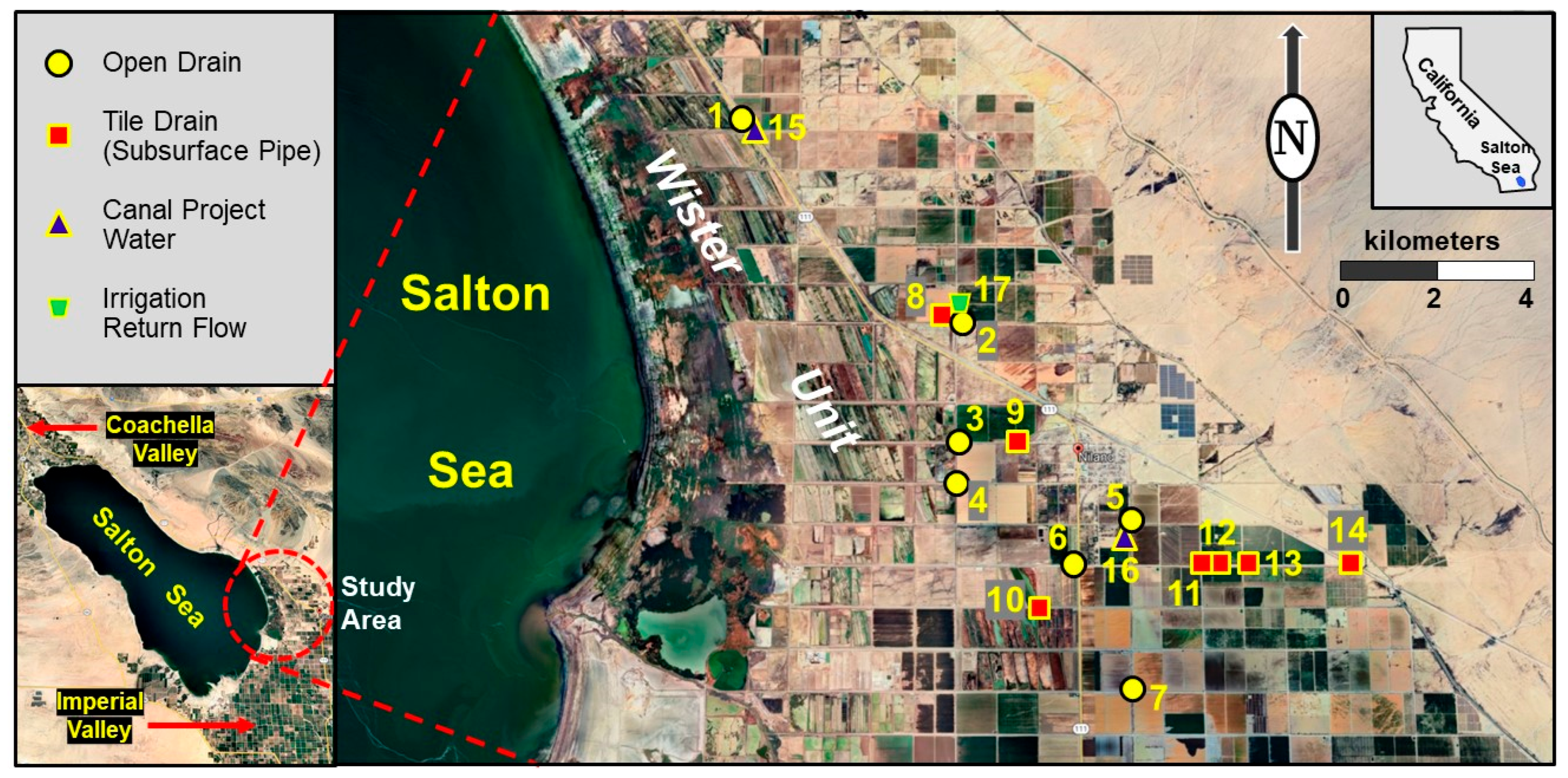
Figure 1. Study area location map showing stations numbers for samples collected from open agricultural drains, groundwater discharge points from subsurface groundwater tile drains, canal project water, and tailwater return flow feeding into Wister Unit. Inset map shows location of Coachella and Imperial Valleys. The numbers correspond to sample numbers in Table 1 and Table 2.
Hydrology 13 00058 g001
Table 1. Water chemistry and flow measurement data collected in this study showing open drain, tile drain, canal project water, and tailwater return flow. Map index in Figure 1 can be used to find sample locations.
Map
Index
Sample
Location
Sample
Type
Date
Sampled
Flow
(Liters/
Minute)
Temp.
°C
Spec. Cond (µS)TDS
(mg/L)
SO4
(mg/L)
Cl
(mg/L)
B
(mg/L)
1Setmire at 111 Road DrainOpen Drain
Water
23 June 20233831.812,0018041290029782.9
2English Rd Above 111 Road DrainOpen Drain
Water
25 March 2025253629.2240916145103480.3
3Beal and English DrainOpen Drain Water19 January 20251115.749193296164010280.5
4Noffsinger and English DrainOpen Drain Water25 March 202593431.2162410883002720.1
5Gillespie Drain Above Moving Mud SpringOpen Drain Water6 July 20238336.1393126348808260.9
6Pound and 111 Road DrainOpen Drain Water19 January 202560614.8385425828807270.5
7Schrimpf Above 111 Highway at Tracks DrainOpen Drain Water25 March 202568129.8400126819404850.3
8Pipe at Drain at English Road Above 111 RoadTile Drain Water25 March 202511423.52913195210502540.3
9Beal T Drain PipeTile Drain Water21 July 20233428.8418228025806990.5
10Hazard PipeTile Drain Water6 July
2023
7627.637,21924,937520013,7003.7
11Pound and Blair-Big PipeTile Drain Water21 July 20235728.171514791205012841.2
12Pound and Blair-Small PipeTile Drain Water21 July 20239529.05500368516809320.9
13Pound and Burke PipeTile Drain Water21 July 202311428.9343423017805120.3
14Noffsinger and Pound-PipeTile Drain Water21 July 202322728.29410630542005590.5
15Setmire at 111 Rd Project WaterCanal
Project
Water
23 June 2023163231.111857942701440.1
16Alcott and Tracks Project WaterCanal Project Water19 January 2025Flowing canal
>11,500 L/min
14.713108783901620.1
17English Above 111 Highway Tailwater Return FlowTail Water Return Flow25 March 202526.532.1195113079405910.5
Table 2. Water chemistry and stable water isotopes data collected in this study showing open drain, tile drain, canal project water, and tailwater return flow. Map index in Figure 1 can be used to find sample locations.
Map
Index
Sample
Location
Sample
Type
Date
Sampled
NO3-N
(mg/L)
NH3-N
(mg/L)
HPO4
(mg/L)
Se
(µg/L)
δ18O
Per Mil
δ2H
Per Mil
1Setmire at 111 Road DrainOpen Drain
Water
23 June 20231.20.048<0.1541.0−5.7−69.5
2English Rd Above 111 Road DrainOpen Drain
Water
25 March 20251.90.0970.1766.7−11.7−95.7
3Beal and English DrainOpen Drain Water19 January 20254.80.059<0.1512.0−11.6−96.0
4Noffsinger and English DrainOpen Drain Water25 March 20251.90.070<0.152.0−12.2−98.0
5Gillespie Drain Above Moving Mud SpringOpen Drain Water6 July 20230.20.035<0.150.9−7.4−76.9
6Pound and 111 Road DrainOpen Drain Water19 January 20253.50.033<0.1510.0−11.9−96.7
7Schrimpf Above 111 Highway at Tracks DrainOpen Drain Water25 March 20259.8<0.015<0.156.1−11.4−94.0
8Pipe at Drain at English Road Above 111 RoadTile Drain Water25 March 20252.6<0.015<0.153.5−12.2−97.9
9Beal T Drain PipeTile Drain Water21 July 20232.5<0.015<0.1516.0−10.0−90.3
10Hazard PipeTile Drain Water6 July
2023
2.3<0.0150.15150.0−8.7−83.8
11Pound and Blair-Big PipeTile Drain Water21 July 20232.0<0.015<0.1518.0−11.8−96.6
12Pound and Blair-Small PipeTile Drain Water21 July 20233.90.023<0.1517.0−11.4−94.6
13Pound and Burke PipeTile Drain Water21 July 20230.9<0.015<0.1563.0−11.1−93.8
14Noffsinger and Pound-PipeTile Drain Water21 July 20235.1<0.015<0.153.8−10.1−87.6
15Setmire at 111 Rd Project WaterCanal
Project
Water
23 June 20230.30.026<0.151.6−11.0−93.0
16Alcott and Tracks Project WaterCanal Project Water19 January 20250.30.022<0.151.4−12.6−99.4
17English Above 111 Highway Tailwater Return FlowTail Water Return Flow25 March 20250.80.0960.181.9−10.1−90
Previous studies report that several open drain and tile drain samples exceed the EPA aquatic life criterion of 5 µg/L selenium [9], yet the relative roles of evaporative concentration, soil leaching, nutrient-driven oxidation, and groundwater surface water mixing remain uncertain. Ref. [8] notes that EPA guidance for selenium emphasizes site-specific processes controlling transfer from water to the food web, rather than reliance on a single water column threshold. Waterborne selenium concentrations alone are poor predictors of ecological risk because toxicity depends on dietary exposure and trophic transfer and can be influenced by interactions with other constituents in agricultural drainage. Ref. [8] also notes that although the Salton Sea is hypersaline, drain water and most shallow groundwater feeding the Sea, including in the Wister Unit, are only slightly saline (typically 1000 to 3000 mg/L TDS). For tributary inflows to the Salton Sea, a chronic selenium objective of 5 µg/L as a 4-day average has been identified as a screening benchmark by [8]. Clarifying selenium source processes is therefore essential for assessing ecological exposure and guiding monitoring and mitigation strategies as hydrologic conditions continue to change.
Despite this extensive regional understanding, the Wister Unit of the Imperial Wildlife Area has remained comparatively under-studied (Figure 1 and Figure 2). Earlier irrigation drainage monitoring programs did not systematically include the Wister complex, resulting in sparse historical measurements of selenium and related analytes in both open agricultural drains and groundwater-fed tile drains (e.g., sampling locations shown in [3,8]). Although [8] compiled a substantial selenium dataset from Wister Unit sediments and biota, selenium data for agricultural drainwater and groundwater inputs to the wetlands remain extremely limited. Previous investigations included only zero to two selenium measurements within the Wister Unit per study [3,4,5], and selenium was not routinely analyzed in groundwater or agricultural drain samples. Ref. [8] further emphasizes that selenium data in Imperial Valley groundwater remain sparse and that targeted sampling is needed to identify potential hotspots and evaluate trends. In contrast, this study presents a focused dataset of selenium concentrations measured directly in groundwater-fed tile drains and open drains discharging to the Wister Unit wetlands, establishing the first Wister Unit specific baseline for interpreting selenium sources, controls, and future change.

1.1. Study Area, Physiography, and Climate

The study area includes the Wister Unit and adjacent agricultural lands along the eastern Salton Sea. The Wister Unit, part of the Imperial Wildlife Area managed by California Department of Fish and Wildlife (CDFW), consists of seasonally flooded wetlands near Niland, California (Figure 1 and Figure 2). Levees subdivide the complex into managed ponds supplied with Colorado River water from the Coachella Branch Canal and supplemented by agricultural drain flow. These wetlands provide key habitat for migratory waterfowl and support hunting and birdwatching [10]. Water is generally delivered in fall and winter, with some ponds filled earlier for early-arriving species.
Retreat of the Salton Sea shoreline has exposed extensive playa, increasing dust emissions and prompting wetland restoration along the lake margin [11,12]. Surrounding agricultural lands form part of one of the nation’s most productive irrigated regions, supported by imported Colorado River water conveyed through the Coachella Branch of the All-American Canal. A wide range of crops—alfalfa, cotton, wheat, lettuce, sugar beets, melons, and expanding plantings of olives and grapes—are grown on alluvial and lake-plain soils using engineered irrigation and groundwater tile drain systems that enable intensive production in this arid setting.
The project area occupies the northeastern Imperial Valley within the Salton Trough, a structural and topographic depression forming part of the Basin and Range Province of inland southern California and northern Mexico. The trough includes the Imperial Valley to the south and Coachella Valley to the northwest, and it is bounded by the Coyote and Jacumba Mountains to the west, the Chocolate and Orocopia Mountains to the northeast, and the Sand Hills and Cargo Muchacho Mountains to the southeast [13]. The elevated eastern valley margin adjacent to the study area is known as the East Mesa.
Major water delivery features include the Coachella Canal, the East Highline Canal, and numerous laterals serving both agriculture and the Wister Unit (Figure 2). The Coachella Canal once lost substantial flow to seepage [14]. Canal lining began in 1979, and by 2007, the remaining reach, including that besides the study area, was fully lined, markedly reducing recharge to the alluvial aquifer [8,14,15]. Figure 2 shows the post-2007 lined configuration.
The region has a hot desert climate, with mean monthly temperatures of 12.7 °C in December to 33.1 °C in August [13]. Mean annual precipitation near Niland is about 73 mm, increasing to 100 to 150 mm yr−1 in the Chocolate Mountains because of orographic effects [13,16]. Potential evapotranspiration is very high, ranging from 2000 to 2500 mm yr−1 in the Wister Unit to 2500 to 2800 mm yr−1 in nearby uplands [13,17].

1.2. Project Water Application, Key Terms, and Management of Salinity

The Imperial Irrigation District (IID) delivers Colorado River water to approximately 190,000 hectares of irrigated farmland through an extensive conveyance system consisting of about 2600 km of canals and laterals, of which the Wister Unit is a part of [8,18]. These facilities distribute imported project water throughout the Wister Unit for agricultural use.
The irrigation cycle begins with the application of Colorado River Project water to agricultural fields (hereafter called canal project water). Water that exceeds crop consumptive use and evaporation constitutes excess irrigation water and is partitioned into subsurface drainwater, tailwater return flow, operational losses, and canal seepage [18]. Subsurface drainwater consists of irrigation water that infiltrates through the soil profile, recharges shallow groundwater, and is intercepted by groundwater tile drains (hereafter called tile drains). Tile drains are perforated underground pipes typically installed at depths of approximately 1.8 to 3.5 m below land surface [18]. Groundwater flow into tile drains occurs only under conditions of positive hydraulic pressure. Groundwater conditions in the Wister Unit range from locally perched to predominantly semi-perched, with groundwater generally remaining continuously saturated and hydraulically connected to deeper aquifers. Semi-perched conditions occur due to the presence of clay layers and high infiltration rates associated with irrigation.
Tile drains convey groundwater containing elevated concentrations of dissolved salts, which are concentrated by evapotranspiration, to a few sumps and a large number of gravity tile outlets located at the downgradient ends of fields [18]. Sumps are typically 2.4 m diameter cisterns that collect subsurface drainflow and pump the water to open agricultural drains (hereafter called open drains) where tile elevations are above the water level in the open drain. Gravity-fed tile drains discharge subsurface drainwater directly to open drains without pumping.
Tailwater return flow consists of irrigation water that exceeds crop requirements and flows from the lower (tail) end of fields to open drains. Operational losses represent the additional water required to convey requested deliveries to fields through the canal system [18]. Together, tailwater return flow and operational losses account for a portion of excess irrigation water in the Wister Unit. Crop evapotranspiration during summer months may exceed 8.5 mm per day, leading to heavy salt accumulation in soils [19,20]. Consequently, excess irrigation water is routinely applied, when available, to meet crop water demands and to manage soil salinity [20].
Irrigation return flow is the portion of applied irrigation water that is not consumed by evapotranspiration and returns to the hydrologic system after leaching salts and solutes from soils. It includes tailwater return flow, tile drain flow, and water collected in open drains that receive these combined return flows. Open drains usually include direct contributions of seeping shallow groundwater. These combined flows, along with some direct canal project water diversions, are the main source flows into the Wister Unit wetlands.
During drought conditions or dry years, water supplies are often insufficient to fully optimize leaching for salinity management [20]. In such periods, some growers apply deficit irrigation, defined as applying less water than potential crop evapotranspiration, in order to maintain crop viability. When combined with reduced winter precipitation, deficit irrigation usually results in increased salinity in the crop root zone [20]. During wet and average years, precipitation can contribute to leaching; however, growers commonly apply excess irrigation water to remove accumulated salts from the soil profile and maintain soil productivity.
These irrigation and leaching practices transport dissolved salts, including boron, selenium, and other soluble constituents, to the shallow groundwater system [18]. Shallow groundwater is subsequently collected by tile drains and discharged to open drains, which convey drainage water through the Wister Unit. Shallow groundwater discharges directly to open drains where drainage canals intersect the water table and allow direct groundwater seepage [18].

1.3. Geology and Hydrogeology

The Salton Trough is an active pull-apart basin undergoing crustal thinning and subsidence along the Pacific North American plate boundary, forming the inland continuation of the Gulf of California rift system [21,22,23]. Right-lateral fault systems, including the San Andreas and Imperial faults, accommodate regional strain, influence groundwater flow, and maintain a structural depression containing more than 4000 m of relief and thick Cenozoic sedimentary fill [13,24].
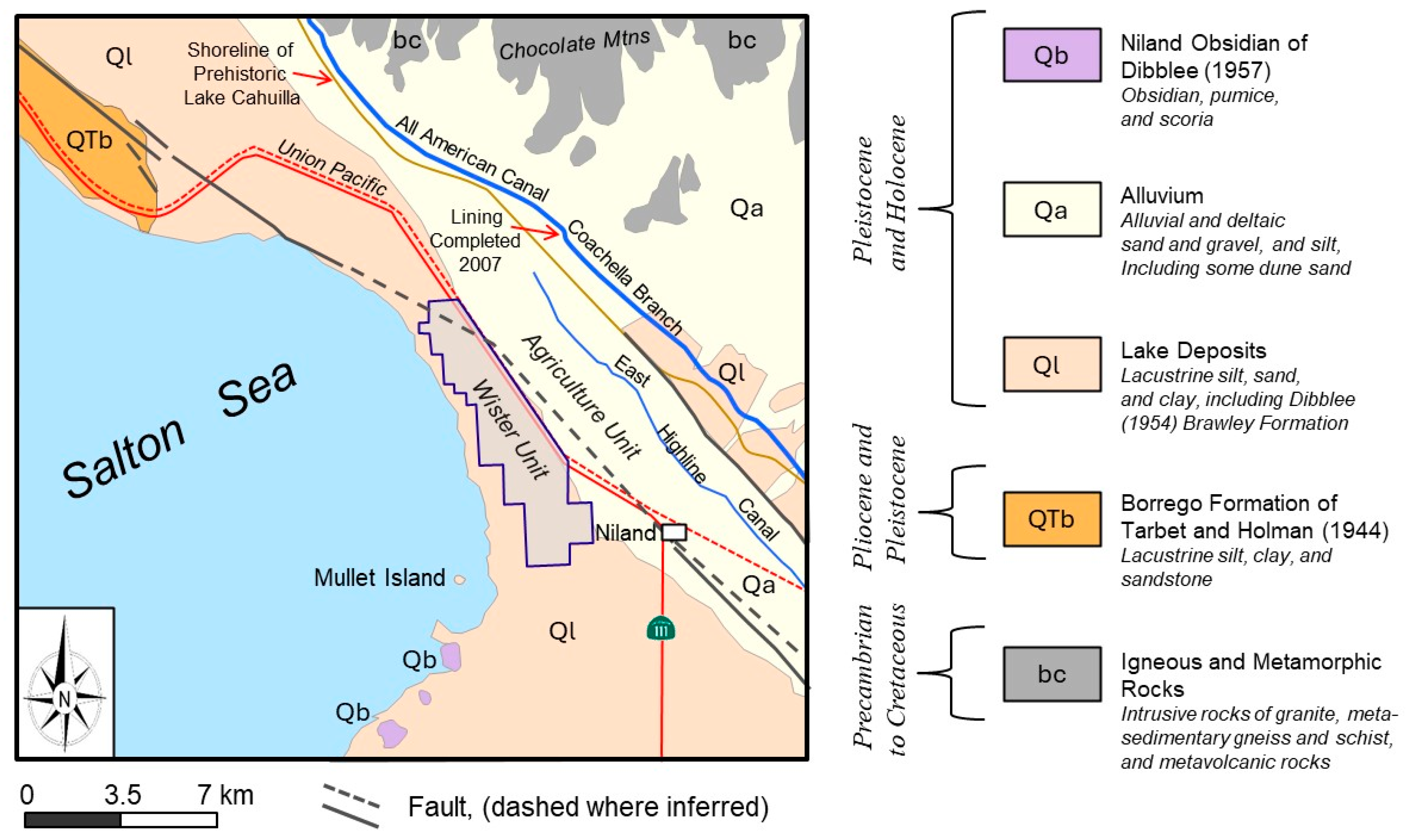
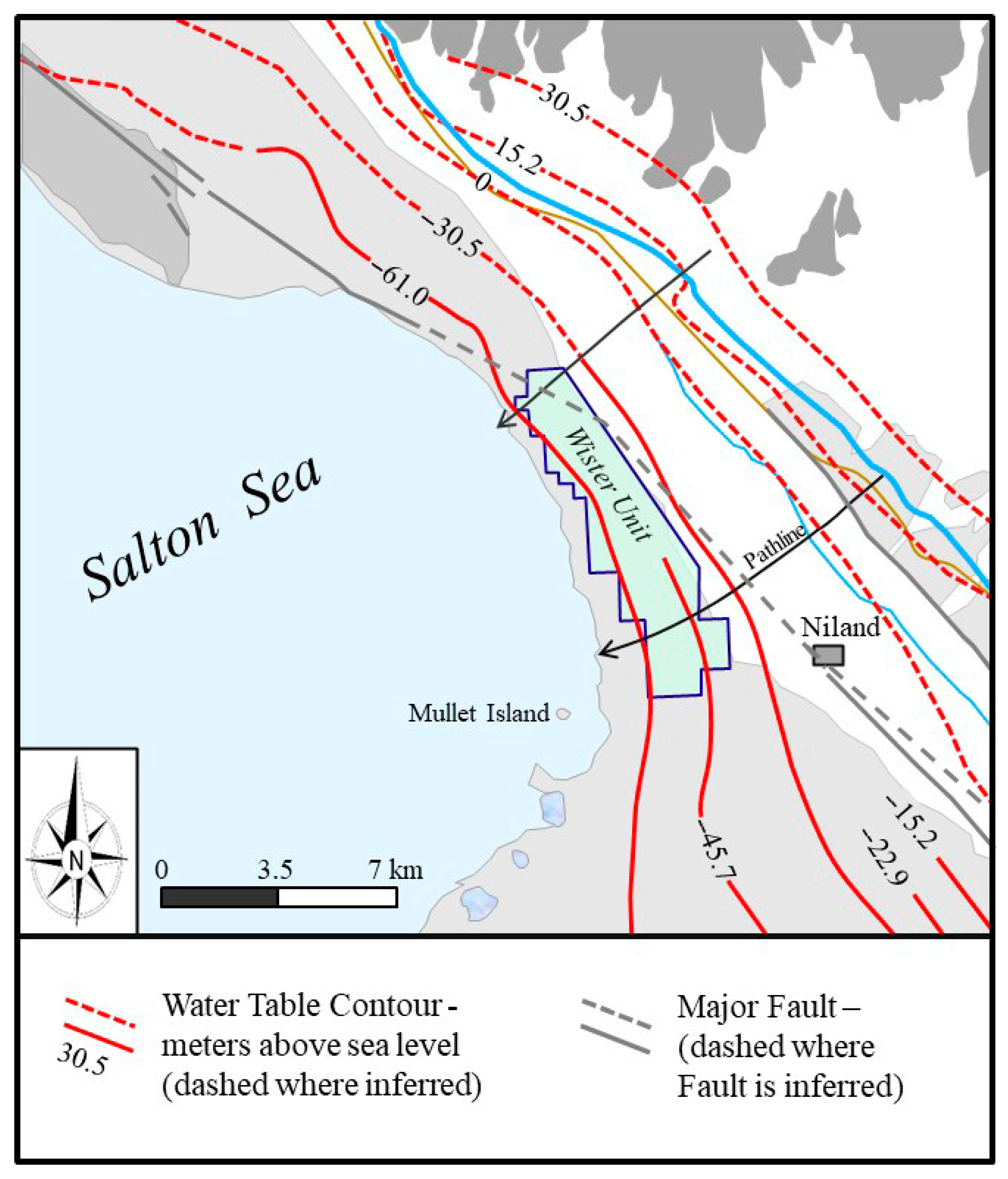
Figure 2. Geologic map of the study area on the northeastern margin of the Salton Trough, showing the limits of the Wister Unit. The map displays Quaternary alluvium (Qa), Lake Cahuilla deposits (Ql), Borrego Formation (QTb), recent volcanic rocks (Qb), and older granitic, metamorphic, and carbonate basement rocks (bc). These units reflect the interplay of repeated lacustrine, volcanic, and alluvial processes that shaped the modern landscape (modfied from [24]).
Hydrology 13 00058 g002
The subsurface consists of Precambrian crystalline basement with Mesozoic and Tertiary intrusions [25,26], overlain by as much as 6100 m of Tertiary–Quaternary deposits [27,28]. The Imperial Formation includes marine silts, sands, and fanglomerates [27,29], overlain by the Palm Springs Formation of lacustrine and alluvial strata [30]. Younger basin fills include sediments from ancient Lake Borrego and Lake Brawley and extensive late Pleistocene to Holocene Lake Cahuilla deposits, which form prominent paleoshorelines [31,32]. Additional short lived lake episodes occurred in 1849, 1861, and 1891 prior to formation of the modern Salton Sea after the 1905 to 1907 Colorado River avulsion [27,33].
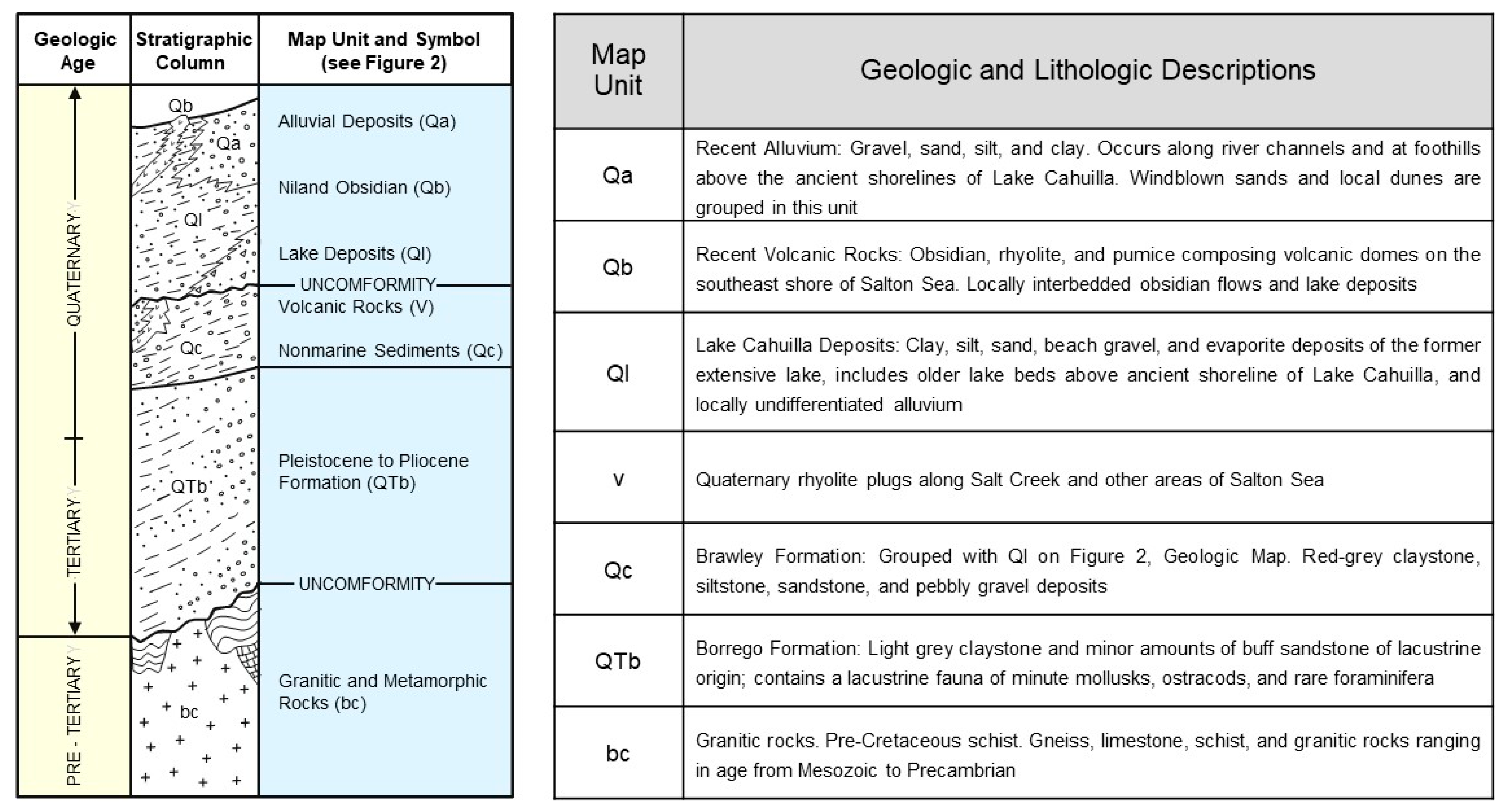
Surficial units include recent alluvium (Qa), Lake Cahuilla deposits (Ql), mixed deltaic and lacustrine sediments of the Brawley Formation (Qc), and localized Quaternary volcanic features (Qb; v). Older lacustrine deposits such as the Borrego Formation (QTb) contain claystones and fine sands. East of the study area, the Chocolate Mountains expose Tertiary volcanic and older metamorphic rocks whose alluvial fans interfinger with lacustrine units near the Salton Sea [13,24] (Figure 2 and Figure 3).
The Salton Trough is one of the most geothermally active regions in North America, with high heat flow from shallow magmatic intrusions [34]. Resulting geothermal alteration affects basin sediments [35] and drives hydrothermal features—mud pots, mud volcanoes, fumaroles, and CO2 vents—that align along structural lineaments, particularly near the southeastern Salton Sea [36,37,38].
Hydrogeologically, the area spans the boundary between the East Salton Sea and Imperial Valley groundwater basins, with State Route 111 approximating the divide [13,39]. Both basins contain thick alluvial and lacustrine sequences, with coarser alluvial fans eastward and increasing fine-grained deposits toward the Salton Sea. Eastern aquifers are mostly unconfined and influenced by irrigation return flows, while greater confinement occurs nearer the lake, though shallow zones remain unconfined or semi-perched [40].
Recharge historically occurred through ephemeral washes draining the Chocolate Mountains and through seepage from unlined reaches of the Coachella Branch Canal prior to its lining [41,42]. Canal seepage supplied ~1.5 million m3/yr before 1979 [14,43], but lining after 2007 greatly reduced recharge except from unlined laterals. Natural recharge now occurs mainly during infrequent high intensity storms [8,24]. Discharges occur through tile drains, seepage toward the Salton Sea, evapotranspiration in wetlands, and limited pumping. Salinity increases toward the shoreline, with nearby landfill monitoring wells near Niland reporting TDS > 20,000 to 35,000 mg/L [39], although shallow groundwater sampled for this study is considerably less saline.
Figure 3. Generalized stratigraphic column of the mapped geologic units in the study area and geologic descriptions of units. The column shows the vertical succession from the oldest basement rocks (bc) through Borrego (QTb) and Brawley (Qc) Formations to Lake Cahuilla deposits (Ql), recent volcanic rocks (Qb, v), and surficial alluvium (Qa). This sequence highlights the transition from older lacustrine and deltaic strata to the younger volcanic and alluvial deposits exposed today (modified for study area rocks only, from [44]).
Hydrology 13 00058 g003
Groundwater elevations are highest beneath the East Mesa and decline toward the Salton Sea [25]. The former groundwater mound associated with canal seepage has diminished since canal lining, and declining water levels reflect reduced recharge [13,24]. These gradients have shifted in conjunction with long-term regression of the Salton Sea but still slope across Wister Unit directly toward Salton Sea (Figure 4).
Extensive irrigated agriculture surrounds the Wister Unit, and agricultural drainage strongly influences its hydrology. Tailwater return flow, surplus irrigation water, leached salts, and shallow groundwater are routed through a network of tile drains and open drains that flow west and southwest toward the Wister Unit. These waters mix with managed inflows of Colorado River water supplied to select drains through the Coachella Branch Canal, producing a blended surface-water and drainage supply that affects salinity, water quality, and wetland management.

2. Methods and Materials

2.1. Study Approach

Although selenium processes in the Imperial and Coachella Valleys have been widely studied northwest and south of the Wister Unit [3,4,5,6,7,8,45,46,47,48], far less work has been done within the Wister wetlands and adjacent agricultural drainage areas. This study provides the first integrated dataset designed to identify major controls on selenium source and mobility in the Wister Unit and surrounding agricultural lands. Analytes include total dissolved solids, major anions, selenium, boron, nitrate, ammonium, orthophosphate, select trace elements, and stable water isotopes (δ18O and δ2H). Dissolved solids, boron, selenium, nitrate, and stable water isotopes serve as the primary interpretive tools. Testable hypothesis include the following:
(1)
Selenium increases proportionally with dissolved solids under simple evaporative concentration of Colorado River irrigation water.
(2)
Nitrate-rich recharge oxidizes reduced selenium in soils and aquifers, producing mobile selenate independent of dissolved-solids patterns, consistent with simil ararid-basin [49,50,51,52,53,54]. Distinguishing these mechanisms is central to establishing the first conceptual geochemical model for selenium in the Wister Unit and determining whether selenium and associated salts and ions behave similarly to other parts of the Imperial Valley [3,4,8].
Ref. [8] documents that groundwater selenium data in the greater Imperial Valley to the south of Wister Unit (Figure 1) are limited, noting that improved spatial coverage, expanded analytical suites, and sustained multi-year monitoring would be necessary to identify localized areas of elevated selenium and to evaluate temporal trends in zones where groundwater discharges to surface waters. Synthesis of the available publications shows that these limitations are more severe in the Wister Unit, where direct measurements of selenium in groundwater are extremely scarce, amounting to 1 or 2 drains in each study [3,4,5,8]. Consequently, the magnitude and variability of selenium loading from shallow groundwater and tile drain discharge to the Wister Unit wetlands are substantially less constrained than in other parts of the Imperial Valley.
The number of drain samples collected (n = 7 open drains and n = 7 tile drains) reflects current hydrologic and land use conditions within the Wister Unit rather than an arbitrary sampling limitation. At the time of sampling, these sites represented most drains with sustained flow. A few historical drains no longer discharge because the Salton Sea water level has declined by approximately 4.3 m since 2003, lowering the shallow water table below portions of the original drainage network. The Salton Sea water level exerts partial controls on local groundwater levels in open drains and tile drains. In addition, rotational fallowing associated with the export of Colorado River water from the Imperial Valley has reduced irrigation and drainage flows, further limiting the number of active flowing drains. Sampling locations were selected to span the dominant hydrochemical settings, including both open drains and tile drain discharges, and to capture variability associated with groundwater inflow and irrigation recycling. Mixed source drains receiving project water and groundwater between Stations 1 and 8 (Figure 1) were excluded because the focus was on Wister Unit groundwater. Although limited in number, the samples define key relationships among salinity parameters, boron, selenium, nutrients, and stable water isotopes and are considered representative of the dominant processes controlling modern drain-water chemistry in the Wister Unit.

2.2. Field Methods

Water samples were collected from canal project water, open drains, tile drains, and tailwater return flow (Figure 1). The objective was to compare dissolved solids, nutrients, selenium, and isotopes in groundwater and to identify water origins and evaluate whether selenium, TDS, and nitrate reflect evapotranspiration effects. Sampling of tile drains was conducted primarily during summer 2023, whereas open drains were sampled mainly during winter 2025 to preferentially characterize groundwater chemistry. Winter (light irrigation season) sampling was intentionally selected for open drains because, during the heavy irrigation season, drains commonly receive substantial inputs of tailwater return flow, excess project water, and direct irrigation runoff, which dilute groundwater signals and bias drain chemistry toward Colorado River project water. In contrast, winter drain flows are dominated by groundwater baseflow and therefore provide a more representative proxy for shallow groundwater composition. This seasonal sampling bias in agricultural drain chemistry has been explicitly documented by [55], who showed that irrigation-season open drain samples may shift toward a project-water signature, whereas light or non-irrigation samples more effectively isolate groundwater contributions and underlying salinity sources. Tile drains were sampled directly, while open drains were sampled either as grab samples or using width- and depth-integrated methods.
Specific conductance and temperature were measured with portable meters. Surface-water discharge was measured using Marsh-McBirney Model 2000 flowmeters following USGS procedures [56,57], or estimated by width–depth–velocity measurements where necessary. Tile drains were measured using timed bucket or bin methods.
Samples were collected in new HDPE bottles, triple-rinsed with deionized water and then with sample water. Bottles were labeled with sample ID, date, and preservation requirements. Samples collected for minor and trace elements and major anion analyses were filtered through 0.45 µm membrane filters. Stable water isotope samples were collected in 60 mL vials and filled completely to eliminate headspace.

2.3. Laboratory Methods

Isotopic analyses were conducted at the University of Arizona Isotope Geochemistry Laboratory using a Finnigan Delta S IRMS. δ2H was measured after reacting water with chromium at 750 °C; δ18O was measured after CO2 equilibration at 15 °C. All results were calibrated to VSMOW and SLAP [58] (Coplen, 1994) with analytical precisions of ~0.9‰ for δ2H and 0.08‰ for δ18O [59] (Eastoe and Dettman, 2016).
Selected ions were sampled and analyzed in the California State University, Los Angels Hydrogeology Laboratory, including sulfate, chloride, boron, nitrate-N, ammonia-N, and orthophosphate. These were analyzed spectrophotometrically at the California State University Hydrogeology Laboratory using a HACH DR6000. Methods followed USEPA procedures: sulfate (Method 375.4; [60]), chloride (Method 9251; [61]), boron [62]), nitrate-N (Method 353.2; [63]), ammonia-N (Method 350.1; [64]), and orthophosphate (Method 365.1; [65]). Selenium, iron, manganese, and vFigure 12anadium were analyzed using ICP-MS per EPA Method 200.7 with digestion following Method 200.2 [66,67]. Full details on data quality analytics are provided in Supplementary Meterials.
Because a full set of general minerals analysis was not available in this study, TDS was estimated with a proxy method. TDS was estimated using the equation TDS = 0.67 × specific conductance, based on a regional regression in the Salton Sea area developed by [68], and is considered accurate to roughly ±6.5%.

2.4. Data Processing and Interpretation

Data were screened for transcription accuracy, range validity, and internal consistency. Values reported below analytical quantification limits were replaced with one-half the reporting limit to allow plotting, correlation analysis, and regression-based statistical evaluation [69]. Hydrochemical data were interpreted to evaluate selenium mobility, salinity evolution, redox conditions, and the relative roles of evaporation and secondary salt dissolution.
Relationships among dissolved constituents were evaluated using a Pearson correlation matrix and regression-based coefficient of determination (R2) and p value analysis, with selenium treated as the dependent variable. These analyses were used to identify the primary controls on selenium variability and to guide selection of parameters emphasized in subsequent graphical analyses. Statistical results were complemented by bivariate plots to visually present data distribution, coherence, and departures from linear trends across individual samples.
Redox conditions were assessed using nitrate–nitrogen and ammonium systematics and concentrations of iron, manganese, and vanadium, which serve as indicators of oxidizing versus reducing conditions. These data provide context for interpreting selenium behavior as either conservatively enriched or redox-mobilized.
Stable water isotope ratios (δ2H and δ18O) were evaluated relative to the Global Meteoric Water Line [70,71] and interpreted jointly with salinity and major ion chemistry. Isotope solute relationships were used to evaluate evaporation trends, differentiate imported irrigation water from evolved groundwater, and assess whether selenium enrichment reflects simple evaporation or secondary flushing of salts accumulated in soils and shallow aquifers.

3. Results

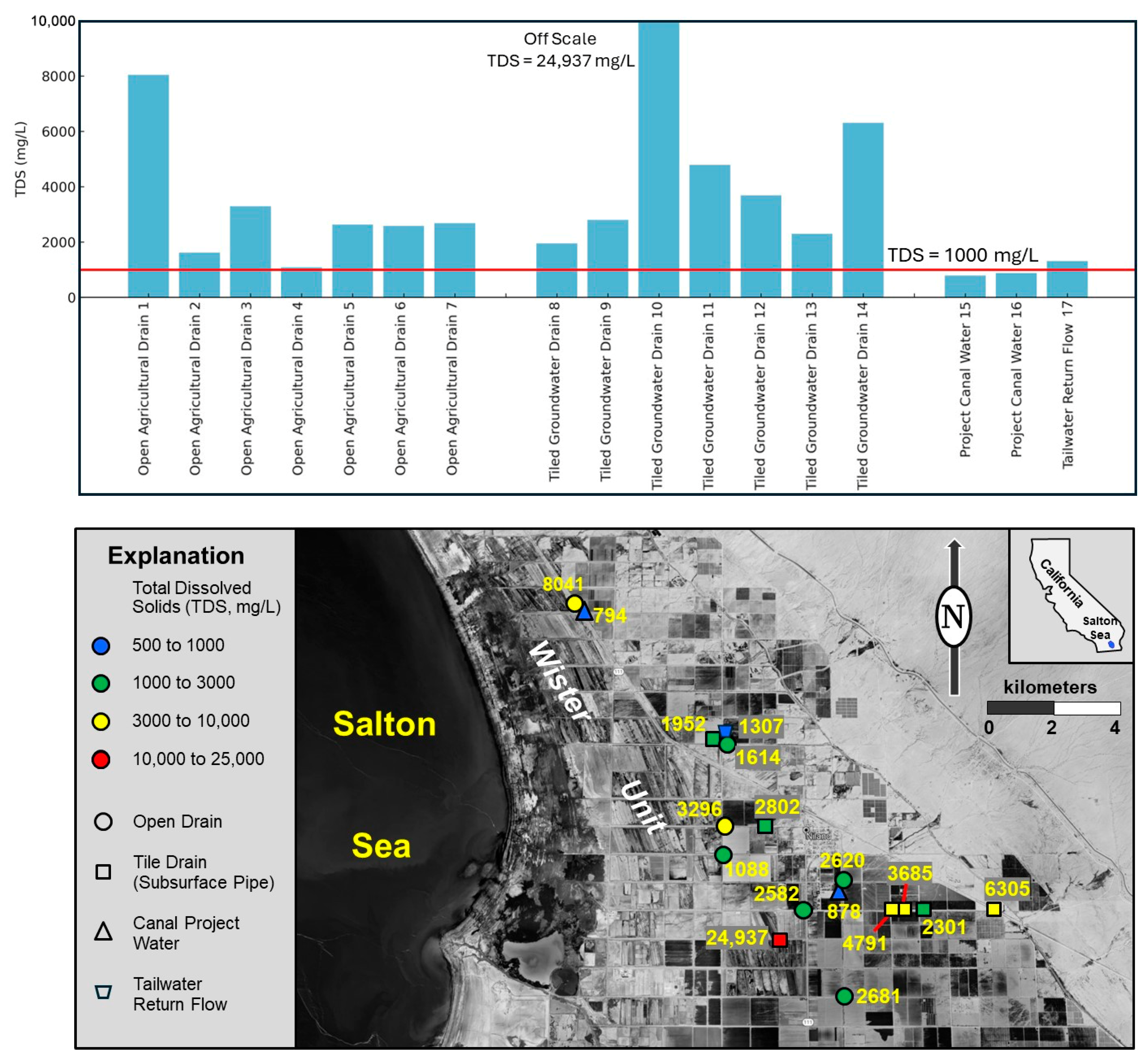
Canal project water contained the lowest total dissolved solids, ranging from 794 to 878 mg/L (Table 1 and Table 2; Figure 5), defining the low-salinity end member among all sampled waters. Open drain water exhibited a wider range of total dissolved solids, from 1088 to 8041 mg/L, spanning moderately to highly saline conditions. Tile drain water showed both the greatest range and the highest values, from 1952 to 24,937 mg/L, and consistently occupied the upper end of the salinity distribution. Tailwater return flow had a total dissolved solids concentration of 1307 mg/L, higher than canal project water but lower than most open drain and tile drain samples, placing it intermediate among the sampled water types.
Sulfate concentrations varied systematically among water types and generally increased with increasing salinity. Canal project water contained the lowest sulfate concentrations, ranging from 270 to 390 mg/L (Table 1), consistent with its role as the least mineralized water source. Open drain water exhibited a broader range of sulfate concentrations, from 300 to 2900 mg/L, spanning moderately to highly saline conditions. Tile drain water contained the highest sulfate concentrations overall, ranging from 580 to 5200 mg/L, and consistently defined the upper end of the sulfate distribution. Tailwater return flow had a sulfate concentration of 940 mg/L, higher than canal project water and within the range of both open and tile drain samples, placing it intermediate among the sampled water types. Chloride concentrations showed a similar progression across water types. Canal project water contained the lowest chloride concentrations, ranging from 144 to 162 µg/L (Table 1). Open drain water ranged from 272 to 2978 µg/L, reflecting increasing solute enrichment relative to canal water. Tile drain water exhibited the highest chloride concentrations, ranging from 254 to 13,700 µg/L, including the most elevated values observed in the dataset. Tailwater return flow contained 591 µg/L chloride, higher than canal project water but within the lower portion of the open- and tile-drain concentration ranges.
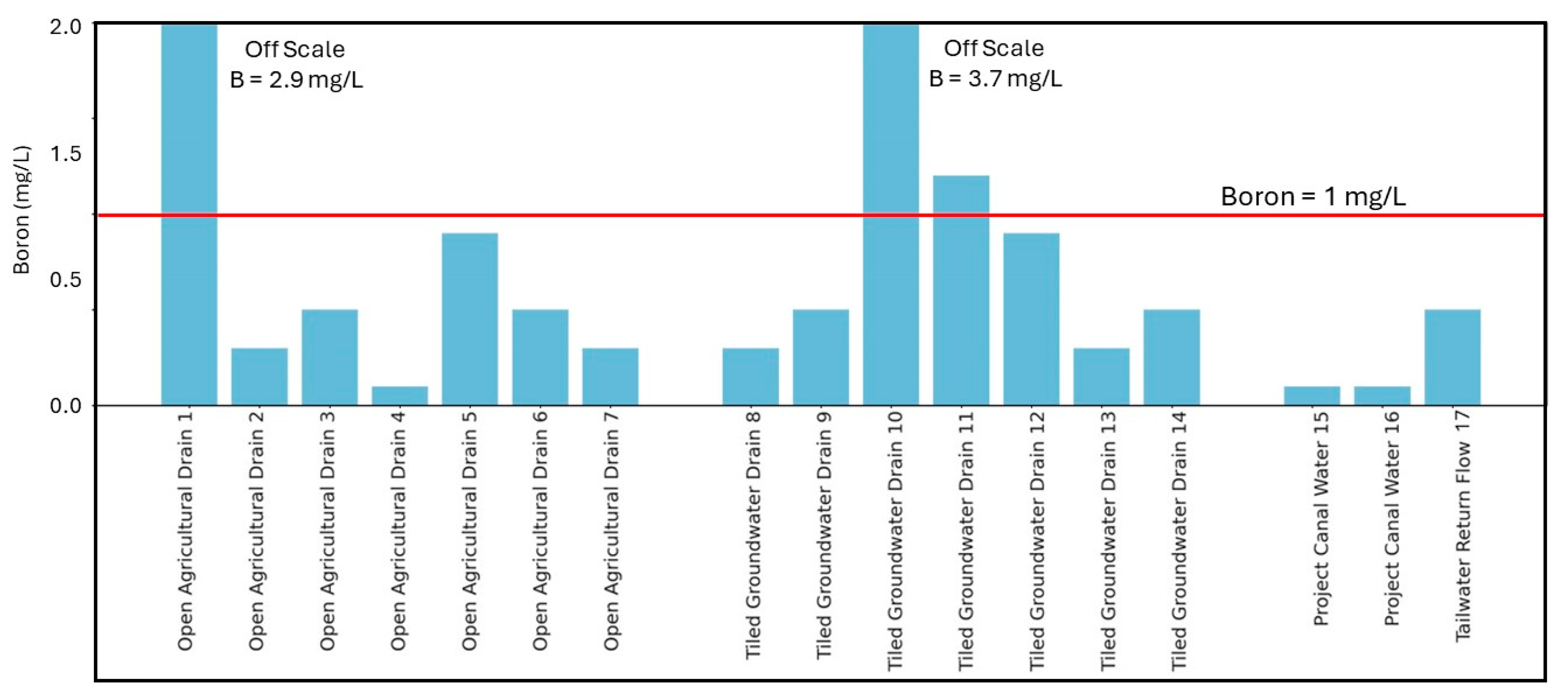
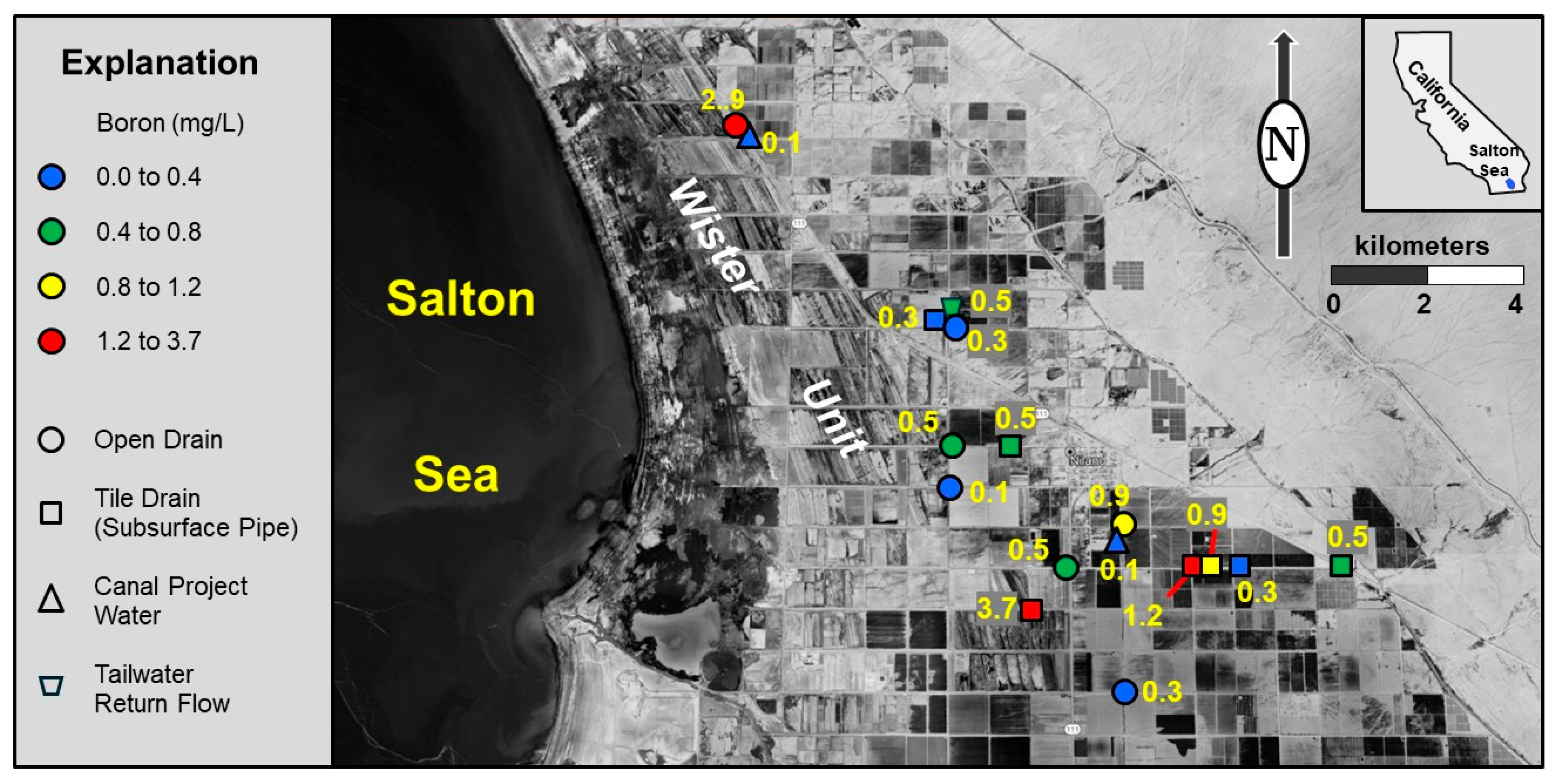
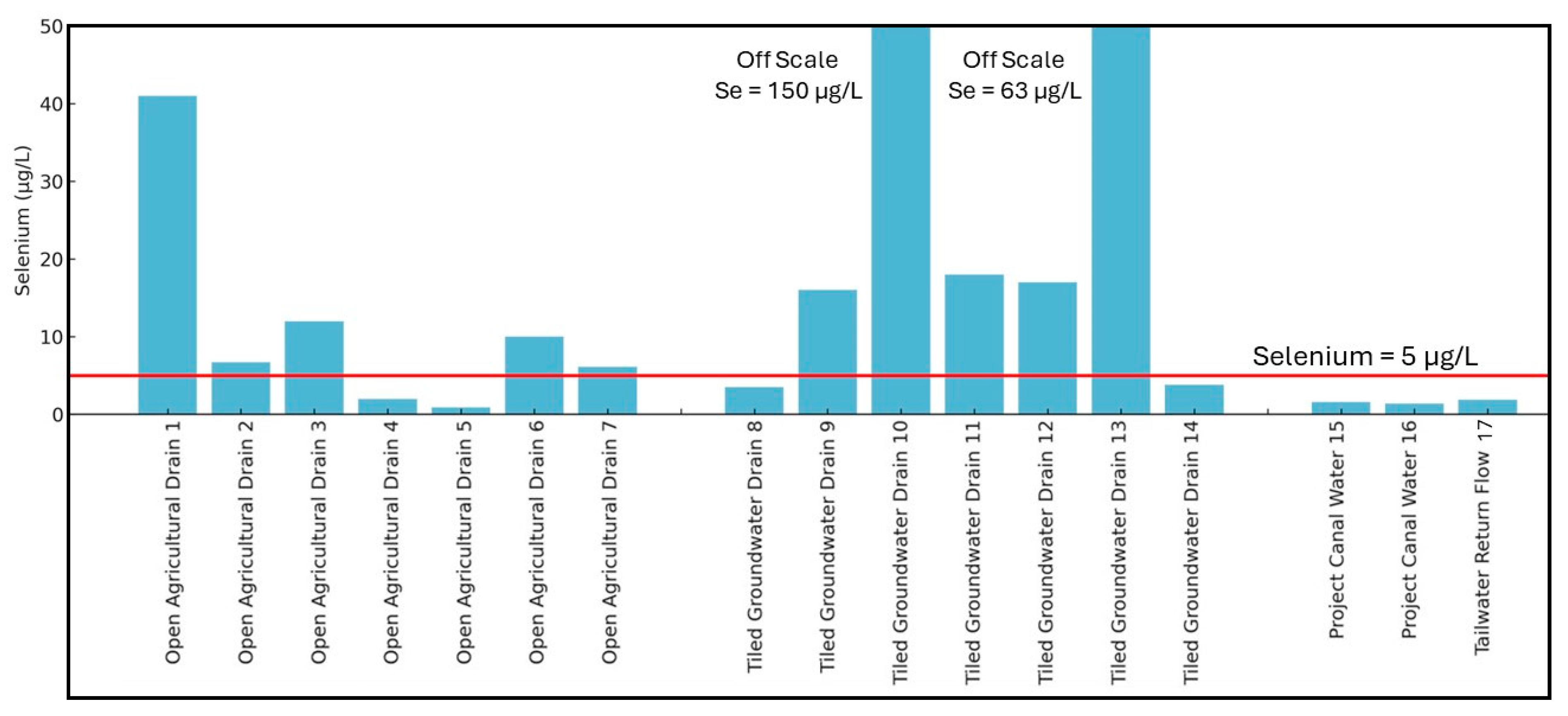
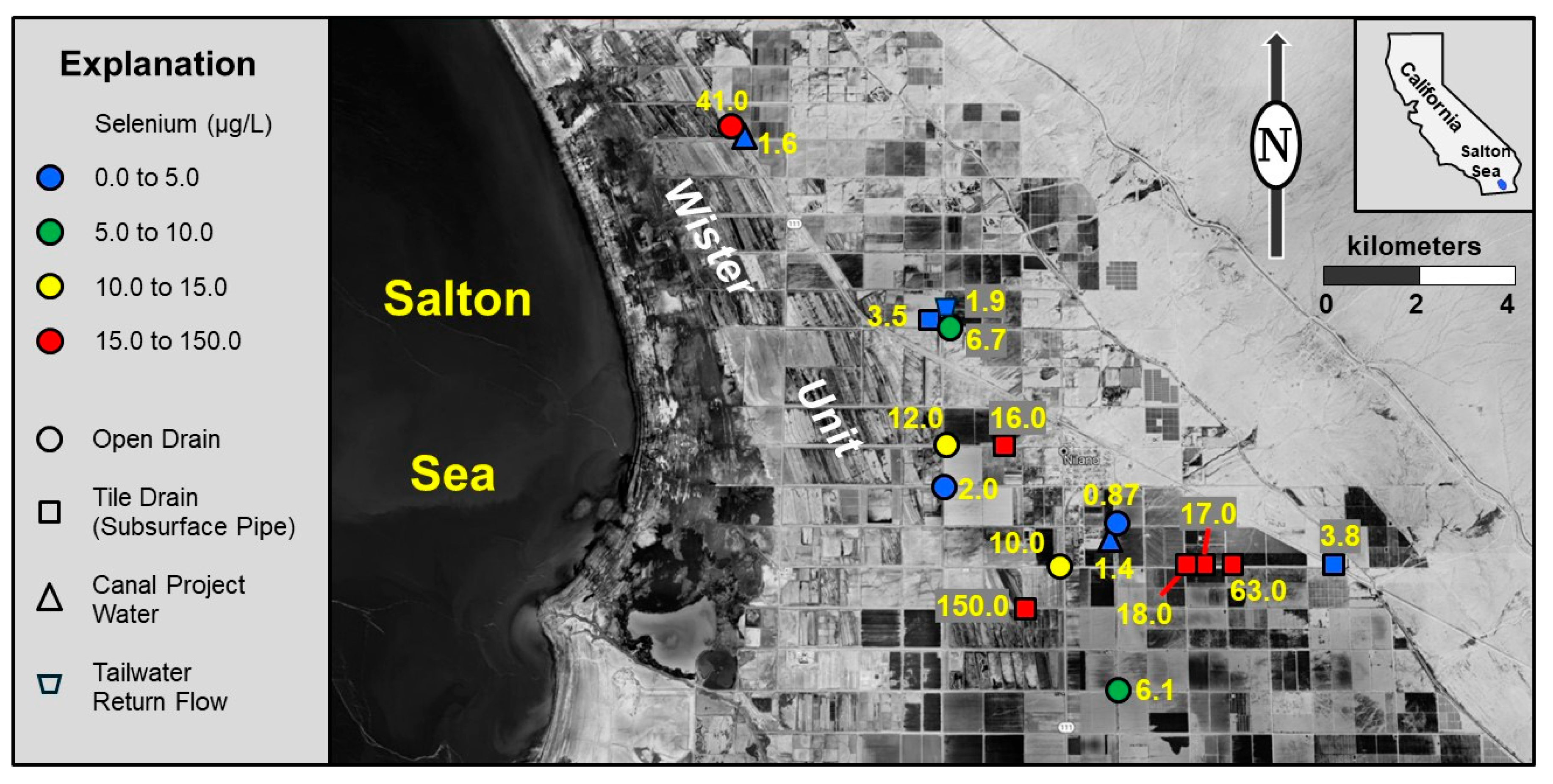
Boron concentrations in canal project water were uniformly low, approximately 0.1 mg/L (Table 1; Figure 6). Open drain water ranged from 0.1 to 2.9 mg/L boron, spanning more than an order of magnitude. Tile drain water ranged from 0.3 to 3.7 mg/L and included the highest boron concentrations observed in the dataset. Tailwater return flow contained 0.5 mg/L boron, falling within the lower portion of the open- and tile-drain ranges. Selenium concentrations in canal project water were consistently low, ranging from 1.4 to 1.6 µg/L (Table 2; Figure 7). Open drain water showed a broad range of selenium concentrations, from 0.9 to 41.0 µg/L. Tile drain water exhibited the highest selenium concentrations overall, ranging from 3.5 to 150.0 µg/L and defining the upper extreme of the dataset. Tailwater return flow contained 1.9 µg/L selenium, comparable to canal project water and well below most drain samples.
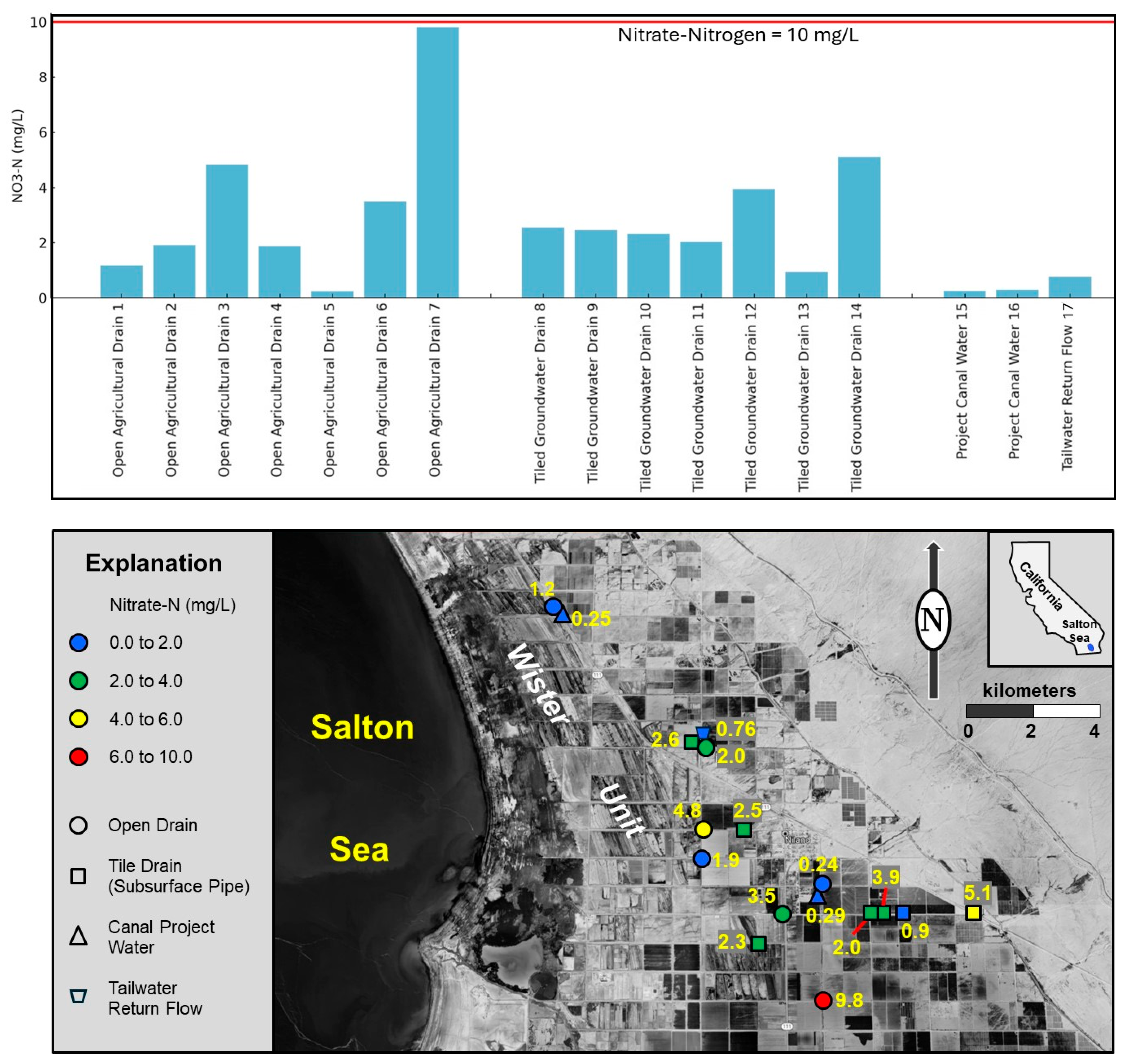
With respect to nutrients commonly associated with fertilizer applications, nitrate–nitrogen concentrations in canal project water were low and uniform, at approximately 0.3 mg/L NO3-N (Table 2; Figure 8). Open drain water ranged from 0.2 to 9.8 mg/L NO3-N and exhibited the widest spread in concentrations. Tile drain water ranged from 0.9 to 5.1 mg/L NO3-N and generally occupied an intermediate range relative to open drains. Tailwater return flow contained 0.8 mg/L NO3-N, lower than most open drain samples and comparable to the lower end of tile drain values. Ammonium (NH3-N) concentrations in canal project water ranged from 0.022 to 0.026 mg/L (Table 2). Open drain water ranged from less than 0.015 to 0.097 mg/L NH3-N, with most values clustering between approximately 0.03 and 0.07 mg/L. Tile drain water was predominantly below the reporting limit of 0.015 mg/L, with one measured value of 0.023 mg/L. Tailwater return flow contained 0.096 mg/L NH3-N, representing the highest ammonium concentration measured among the sampled waters. Orthophosphate concentrations in canal project water were below the reporting limit of 0.15 mg/L (Table 2). Open drain water was generally below 0.15 mg/L, with one sample containing 0.176 mg/L. Tile drain water was below the reporting limit in all samples except one, which contained 0.15 mg/L at the reporting limit. Tailwater return flow contained 0.18 mg/L orthophosphate, the highest value measured in the dataset.
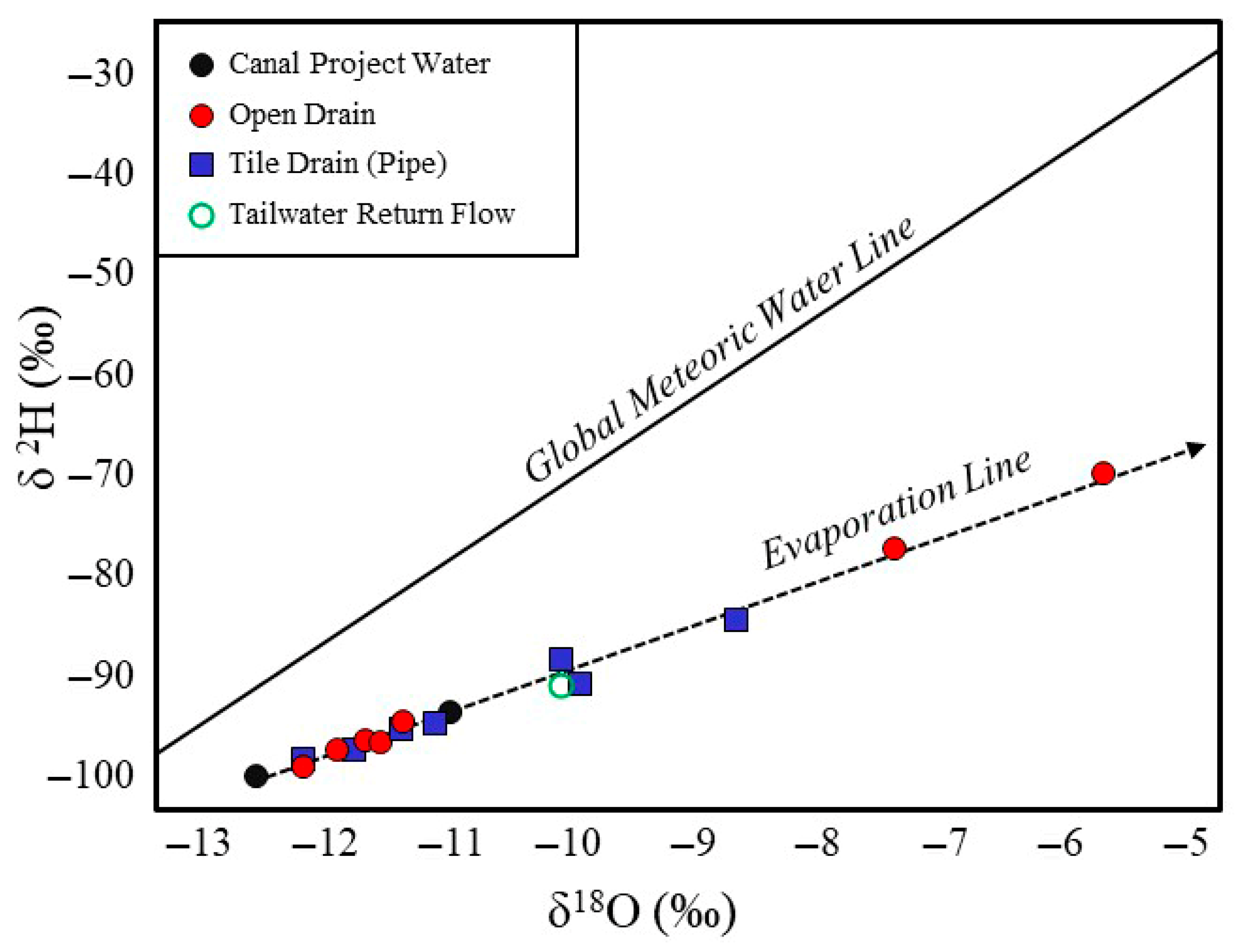
Stable water isotope compositions for canal project water ranged from −12.6‰ to −11.0‰ for δ18O and from −99.4‰ to −93.0‰ for δ2H (Table 2; Figure 9), defining the least enriched isotopic compositions measured. Open drain water exhibited a broader isotopic range, with δ18O values from −12.2‰ to −5.7‰ and δ2H values from −98.0‰ to −69.5‰, including the most isotopically enriched samples. Tile drain water ranged from −12.2‰ to −8.7‰ for δ18O and from −97.9‰ to −83.8‰ for δ2H and generally overlapped the open-drain isotopic field. Tailwater return flow had δ18O of −10.1‰ and δ2H of −90.0‰, plotting between canal project water and the more enriched drain samples. The Global Meteoric Water Line (Craig, 1961a, 1961b) is shown in Figure 9 for reference.

4. Discussion and Data Interpretation

4.1. Testable Hypotheses

Groundwater and managed flows from the Coachella Canal are the principal sources of inflow within the Wister Unit during dry-weather periods. Based on salinity, groundwater discharging into open drains is a very important portion of the water budget in Wister Unit. Understanding the chemical composition of drain water is essential for evaluating potential ecological risks. Of particular concern are selenium and nitrate-nitrogen, two constituents that commonly occur together in oxidizing groundwater systems. Selenium and nitrate-nitrogen have been measured in multiple sources across the Wister Unit, including drain waters, shallow groundwater, canal project water, or tailwater return flow inputs, and the relationship between these constituents needs to be assessed. The current dataset provides an opportunity to evaluate whether nitrate–nitrogen may be contributing to selenium mobility in the subsurface.
Selenium occurs in natural waters in four primary oxidation states, and its mobility is strongly controlled by redox conditions. The most oxidized form, selenate (Se [VI]), is highly soluble and mobile and typically dominates in well-oxygenated or nitrate-rich environments, where strong oxidants maintain selenium in its highest valence state. Under suboxic conditions, selenium is converted to selenite (Se [IV]), which is less soluble and sorbs to iron and aluminum oxyhydroxides, clay minerals, and organic material, reducing its mobility. Continued reduction leads to elemental selenium (Se [0]), a solid phase commonly formed by microbial processes under organic-rich conditions. Under the most strongly reducing, sulfidic environments, selenium is converted into selenide, the (Se [-II]) species, that forms highly insoluble metal selenide minerals. Thus, selenium solubility and transport potential decrease systematically with reduction from selenate to selenite to elemental selenium and finally selenide [51,52,72,73,74]. Redox kinetics and transformations of selenium are known to be responsive to redox conditions, and the reverse trend from reduction to oxidation is fully transferrable [75].
Selenium in sedimentary environments commonly occurs in reduced mineral forms, including selenium bearing pyrite and organic bound selenium. These reduced phases remain largely immobile unless exposed to oxidizing conditions capable of transforming selenium into dissolved oxyanions. Dissolved oxygen can initiate this transformation, but oxygen availability is often limited in groundwater moving through organic rich sediments or fine-grained alluvial deposits such as the loamy alluvial deposits in the agricultural lands above the Wister Unit. In such settings, nitrate–nitrogen that often can be traced to fertilizer may act as an additional oxidant with the capacity to maintain selenium mobility where dissolved oxygen alone would be insufficient. Because nitrate–nitrogen is often derived from agricultural inputs, its presence in the Wister Unit may influence selenium transport more strongly than natural background processes. Oxidation of reduced selenium phases by dissolved oxygen can be represented by the generalized reaction:
2FeSe2 (solid) + 7O2 + 2H2O → 4SeO42− + 2Fe2+ + 4H+
until dissolved oxygen is depleted.
Once oxygen reaches depletion, nitrate–nitrogen can act as a secondary oxidizing agent, sustaining selenium transformation to mobile forms through the reactions:
5FeSe2 (solid) + 14NO3 + 4H+ → 10SeO42− + 5Fe2+ + 7N2 + 2H2O
If both dissolved oxygen and nitrate are present, each can contribute to the oxidation of selenium because they exhibit similar Gibbs free energies for selenium oxidation [49]. Because nitrate is far more soluble than dissolved oxygen, it has the potential to persist longer in the subsurface and therefore may sustain oxidizing conditions even after dissolved oxygen is depleted. Both reactions 1 and 2 illustrate how selenium mobility may be enhanced in subsurface environments. Whether these processes are occurring within the Wister Unit, and to what degree they influence selenium concentrations in groundwater discharging to surface channels and managed wetlands, is a central question for evaluation in this study.
Primary field data from the Wister Unit include selenium, nitrate–nitrogen, TDS, and stable water isotopes (δ18O and δ2H) across a range of water types. These values reflect contributions from shallow and potentially deep groundwater, tile drains, and canal project water or tailwater return flows that interact within the managed hydrologic system. Because open and tile drain return flows contributes substantially to surface flows in many parts of the Wister Unit, the chemistry of these groundwater sources will influence water quality downstream. The dataset provides the basis for evaluating whether elevated selenium concentrations coincide with elevated nitrate–nitrogen, whether trends differ between groundwater and drain waters, and whether there are spatial patterns suggesting particular source areas or lithologic controls.
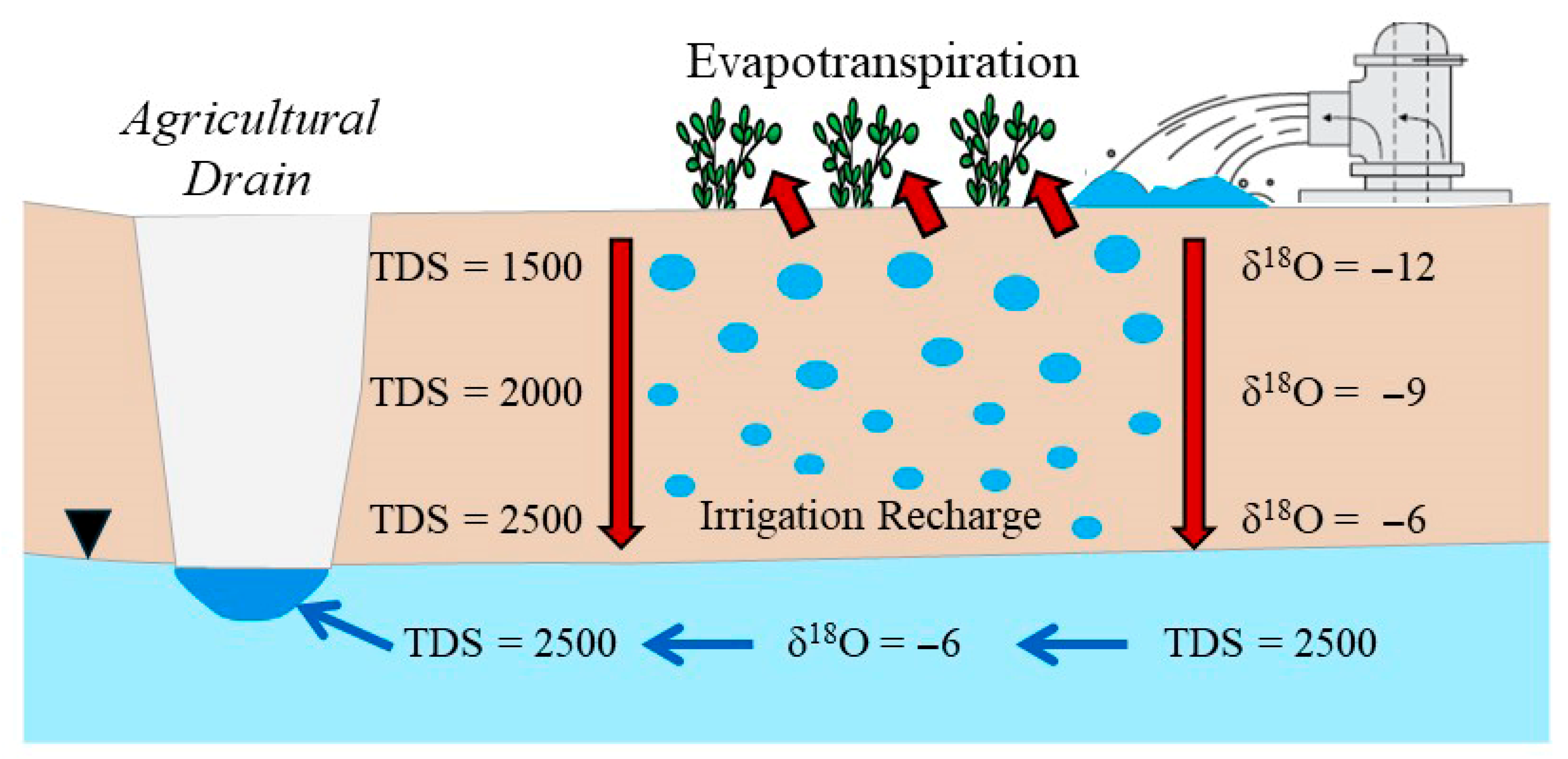
Another hypothesis to be evaluated in the Wister Unit concerns the role of evaporative concentration in producing elevated selenium levels in groundwater and drain flows. In arid agricultural basins, shallow groundwater often experiences substantial evaporation and evapotranspiration, which selectively removes water while leaving dissolved solids behind. As dissolved solids accumulate, many conservative ions, including sulfate and chloride, become progressively enriched, and selenium present in oxidized forms can also increase through the same evaporative concentration process (Figure 10). This mechanism is well documented in irrigation systems in arid basins, most notably at Kesterson [2,76,77] and Imperial Valley [3,4,8], where progressive salt accumulation in shallow groundwater and surface impoundments led to elevated selenium despite relatively modest source concentrations. A similar process may occur in the Wister Unit, where shallow groundwater, tile drains, and irrigated fields are subject to strong evaporative demand.
If oxidizing conditions are maintained within the soil profile, selenium remains in its mobile oxyanion forms, primarily selenate, which behave conservatively during evaporation. Under these circumstances, enrichment of total dissolved solids (TDS) should correlate with enrichment of selenium because concentration of salts through evaporation simultaneously concentrates selenium already present in solution. The collected dataset, including measurements of selenium, TDS, stable water isotopes, and water chemistry across groundwater, drains, and canal sources, will allow evaluation of whether selenium increases systematically with dissolved solids. If evaporation is an important control, samples with higher TDS should exhibit proportionally higher selenium, reflecting a conservative enrichment pathway similar to that documented historically in salt-affected systems such as Kesterson. Testing this hypothesis will be essential for distinguishing between concentration-driven enrichment and nitrate-mediated oxidation as competing explanations for selenium behavior in the Wister Unit.

4.2. Correlation Analysis of Hydrochemistry Parameters

Both a Pearson correlation matrix and an R2-based selenium correlation analysis are presented in Table 3 and Table 4, respectively, to evaluate relationships among dissolved constituents and to identify the primary controls on selenium variability. The Pearson correlation matrix provides a system-wide assessment of linear covariance among all measured parameters, while the R2 analysis treats selenium explicitly as the dependent variable and quantifies the explanatory strength of individual parameters. Together, these statistical results guide the selection of key parameters emphasized in the subsequent graphical analysis, which focuses on TDS, boron, nitrate, and selenium.
The Pearson correlation matrix reveals a clear and internally consistent structure in the relationships among dissolved constituents. Selenium exhibits very strong positive correlations with chloride (r = 0.92) and total dissolved solids (r = 0.90), indicating that selenium concentrations increase systematically with overall salinity. The strong correlation between TDS and chloride (r = 0.98) further supports chloride as a robust tracer of salinity and groundwater evolution within the system. These relationships suggest that selenium behaves conservatively during processes that increase dissolved solute concentrations, such as evaporative enrichment or mixing with more saline groundwater.
A strong positive correlation is also observed between selenium and boron (r = 0.80). Boron is commonly enriched in evolved groundwater and concentrated waters, and its close association with selenium indicates shared geochemical controls related to groundwater residence time, water–rock interaction, or solute accumulation. This pattern is consistent with a dominant geologic control on selenium rather than surface-derived inputs. Selenium shows a moderate correlation with sulfate (r = 0.67), suggesting partial coupling between these constituents; however, the weaker relationship relative to chloride and TDS indicates that sulfate concentrations are influenced by additional processes, such as gypsum dissolution or precipitation, that partially decouple sulfate behavior from selenium.
In contrast, nitrate (NO3–N) exhibits no meaningful correlation with selenium (r = −0.09) and shows weak or negligible correlations with other major dissolved constituents. This lack of association indicates that nitrate-related processes, including shallow oxic recharge and surface-derived nutrient inputs, do not exert a significant control on selenium concentrations in the study area.
The R2 analysis reinforces these patterns by explicitly quantifying the degree to which individual parameters explain selenium variability. Selenium shows very strong and statistically significant relationships with chloride (R2 = 0.85) and TDS (R2 = 0.82), indicating that more than 80% of the observed variation in selenium can be explained by salinity-related parameters. A strong relationship is also observed between selenium and boron (R2 = 0.64), supporting shared geochemical controls associated with groundwater evolution. Selenium exhibits a moderate relationship with sulfate (R2 = 0.45), while nitrate shows no explanatory power (R2 = 0.0078; p = 0.736).
Taken together, the Pearson and R2 analyses demonstrate that selenium variability is best explained by salinity and groundwater evolution indicators, particularly chloride, TDS, and boron, whereas nitrate plays no meaningful role. This clear statistical separation provides the basis for the graphical analysis that follows, which focuses on TDS, boron, nitrate, and selenium to illustrate the dominant geochemical and hydrologic processes controlling selenium behavior in the system.
The Pearson correlation coefficients and R2 values with associated p-values presented in Table 3 and Table 4 establish the strength and statistical significance of relationships among dissolved constituents, but they do not convey the visual distribution and spread of these relationships across individual samples. To provide focused visualization of the dominant patterns identified statistically, a graphical analysis is presented as a direct follow-up to the correlation results. This analysis emphasizes total dissolved solids (TDS), boron, nitrate, and selenium, which define the primary hydrochemical gradients in the dataset and form the core parameters evaluated in this study. Chloride and sulfate are major contributors to total dissolved solids and exhibit strong, statistically significant correlations with TDS and with selenium (Table 3 and Table 4). Chloride shows an almost one-to-one relationship with TDS (r = 0.98), indicating that it functions as a direct tracer of salinity, while sulfate also displays a strong positive correlation with TDS (r = 0.86). Because TDS integrates the combined effects of chloride, sulfate, and other major ions, it provides a more comprehensive representation of salinity and groundwater evolution than the individual anions. Accordingly, the graphical analysis focuses on TDS alone rather than plotting chloride and sulfate separately, avoiding redundancy while capturing the dominant salinity control identified statistically.
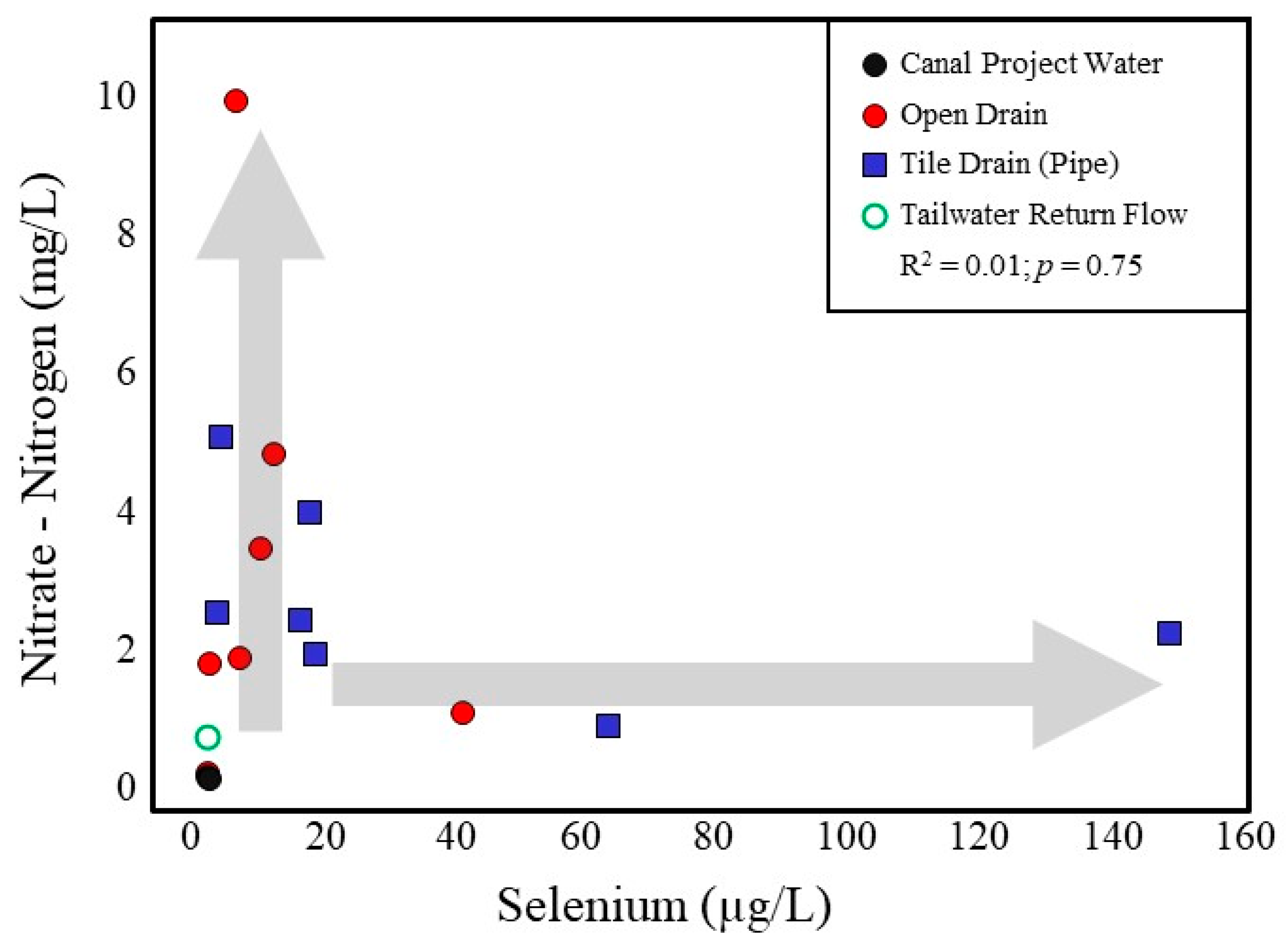
Selenium concentrations in the dataset range from 0.9 to 150.0 µg/L, spanning more than two orders of magnitude (Table 2). Total dissolved solids range from 794 to 24,937 mg/L, while nitrate (NO3–N) varies from <0.015 to 9.8 mg/L, with most samples below 3.0 mg/L (Table 2). Comparison across parameters shows no observable relationship between selenium and nitrate (Table 3 and Table 4). Samples with elevated selenium commonly contain very low nitrate, while samples with higher nitrate display selenium concentrations that span the full observed range (Figure 11). This absence of association is confirmed by a very weak coefficient of determination (r2 = 0.01), indicating that nitrate-related processes do not control selenium enrichment in the study area (Table 3 and Table 4).
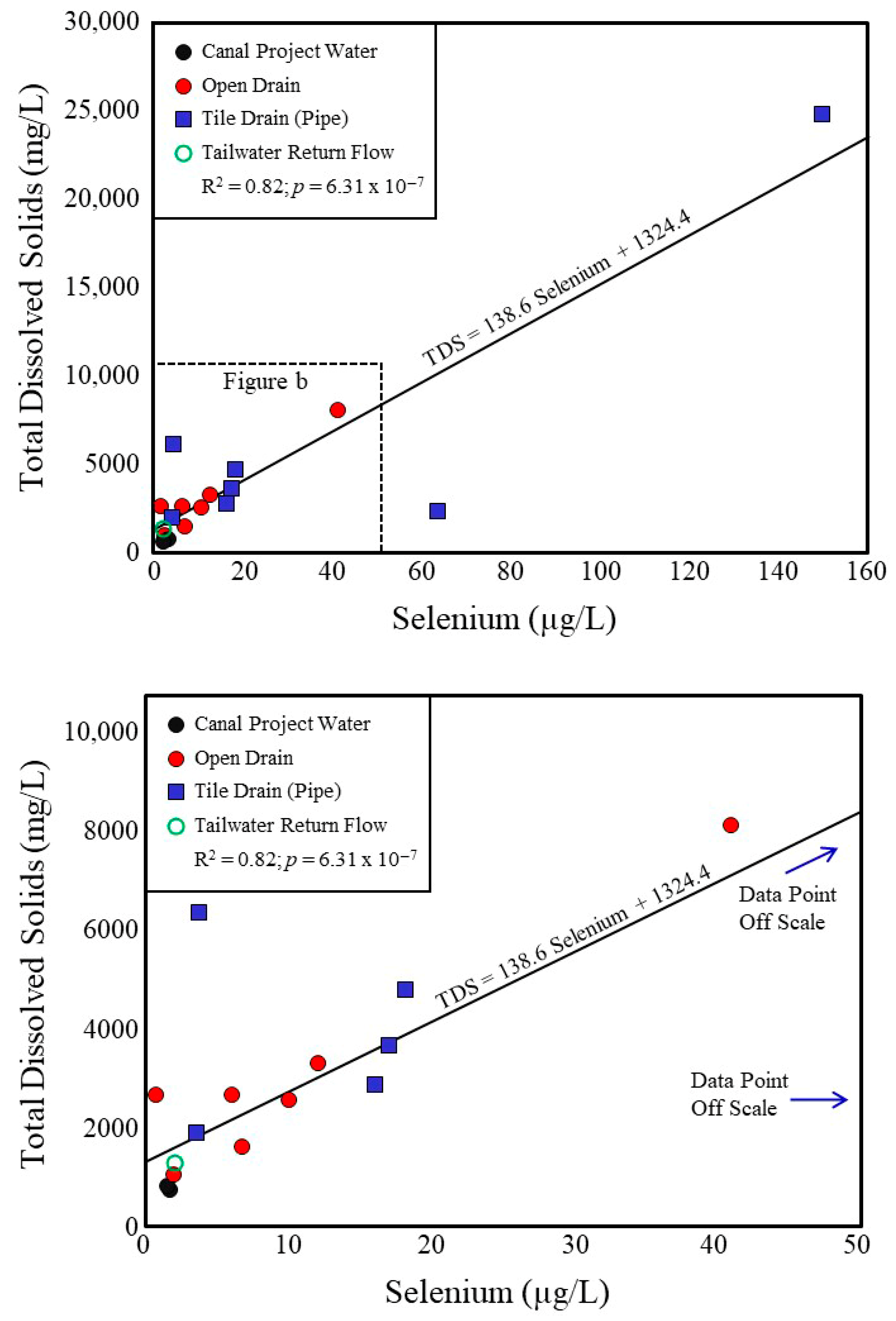
In contrast, selenium exhibits a strong and consistent positive relationship with total dissolved solids (r2 ≈ 0.82) (Figure 12). Samples with the highest TDS contain the highest selenium concentrations, including the most saline groundwater sample (~25,000 mg/L TDS) paired with the maximum observed selenium concentration of 150.0 µg/L. Conversely, samples with lower TDS values generally contain <10.0 µg/L selenium. This pattern visually reinforces the statistical finding that selenium concentrations are tightly coupled to dissolved-solids enrichment rather than to nutrient inputs.
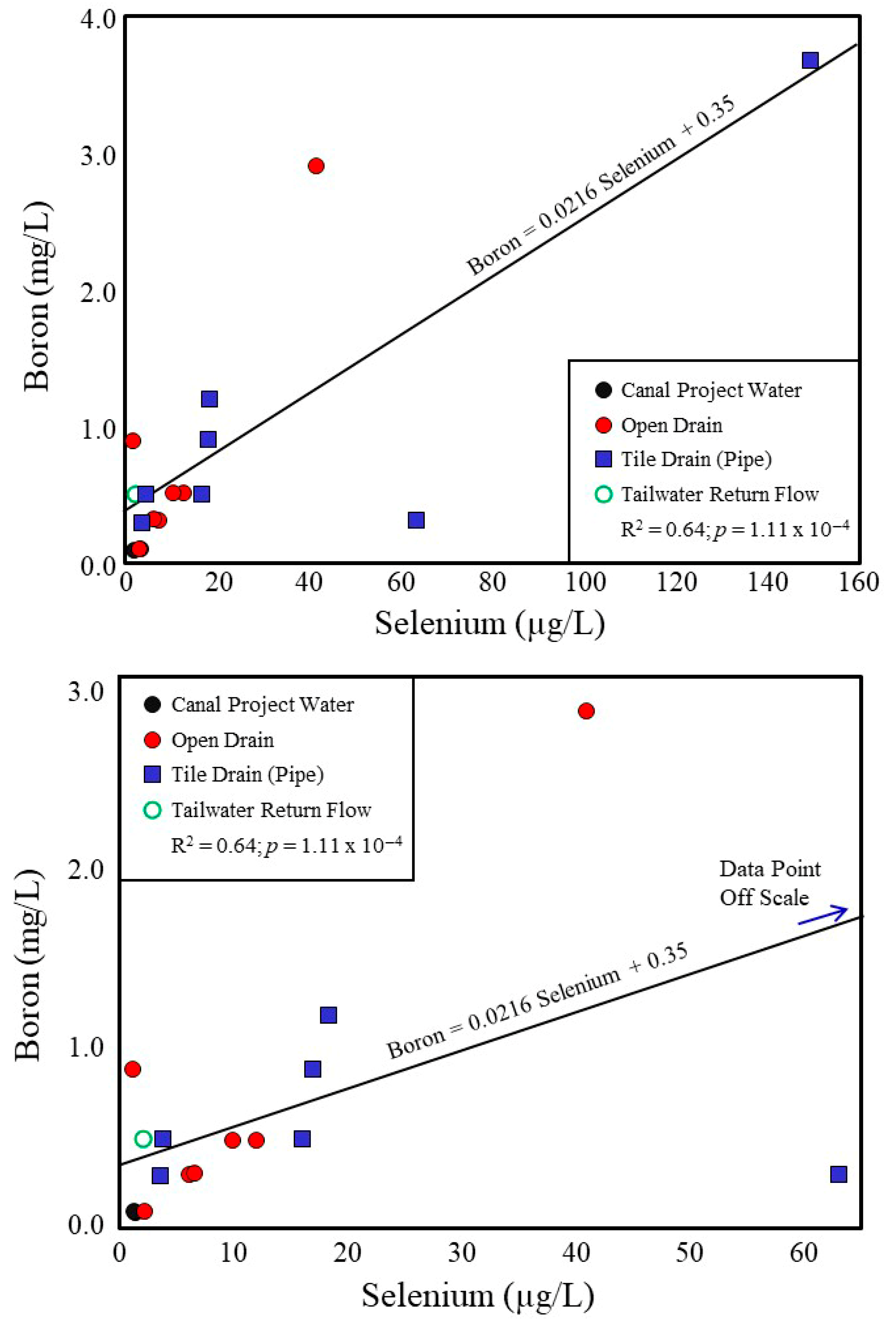
Boron shows a similarly strong association with salinity. Although not plotted against all parameters, boron concentrations increase systematically with TDS across all sampled water types (Table 1). Linear regression of boron concentration versus TDS yields a strong and statistically significant relationship (R2 = 0.79; p = 1.7 × 10⁻⁶), indicating that boron behaves conservatively with increasing salinity. This behavior is consistent across open drains, tile drains, canal project water, and tailwater return flows, supporting interpretation of boron as a tracer of evaporative concentration and irrigation recycling within the Wister Unit rather than redox-dependent mobilization.
Linear regression of boron concentration versus selenium also shows a statistically significant positive relationship (R2 = 0.64; p = 1.1 × 10⁻⁴) (Figure 13). Although this correlation is weaker than those observed between selenium and TDS and between boron and TDS, it demonstrates that selenium and boron covary across sample types and salinity conditions. This pattern is consistent with joint enrichment through evaporative concentration and irrigation recycling rather than selenium mobilization driven by nitrate-mediated oxidation or redox reactions.
Collectively, the graphical relationships among TDS, boron, nitrate, and selenium provide visual confirmation of the statistically significant correlations identified in Table 3 and Table 4 and illustrate the distribution and coherence of these relationships across the dataset. Together, the statistical and graphical analyses demonstrate that selenium enrichment in the Wister Unit is primarily governed by evaporative salt concentration processes under generally oxidizing conditions, with little to no influence from nitrate-related inputs.

4.3. Stable Water Isotopes as Constraints on Salinity and Selenium Enrichment

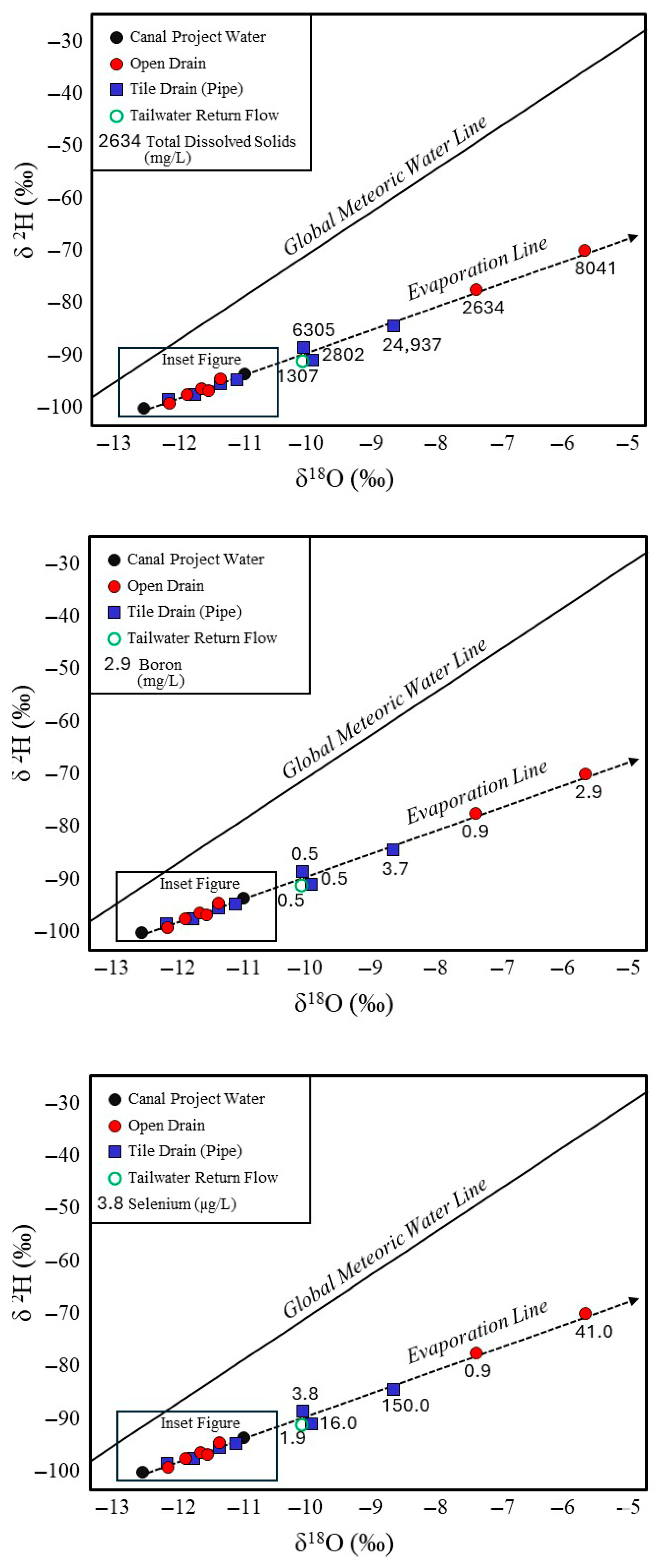
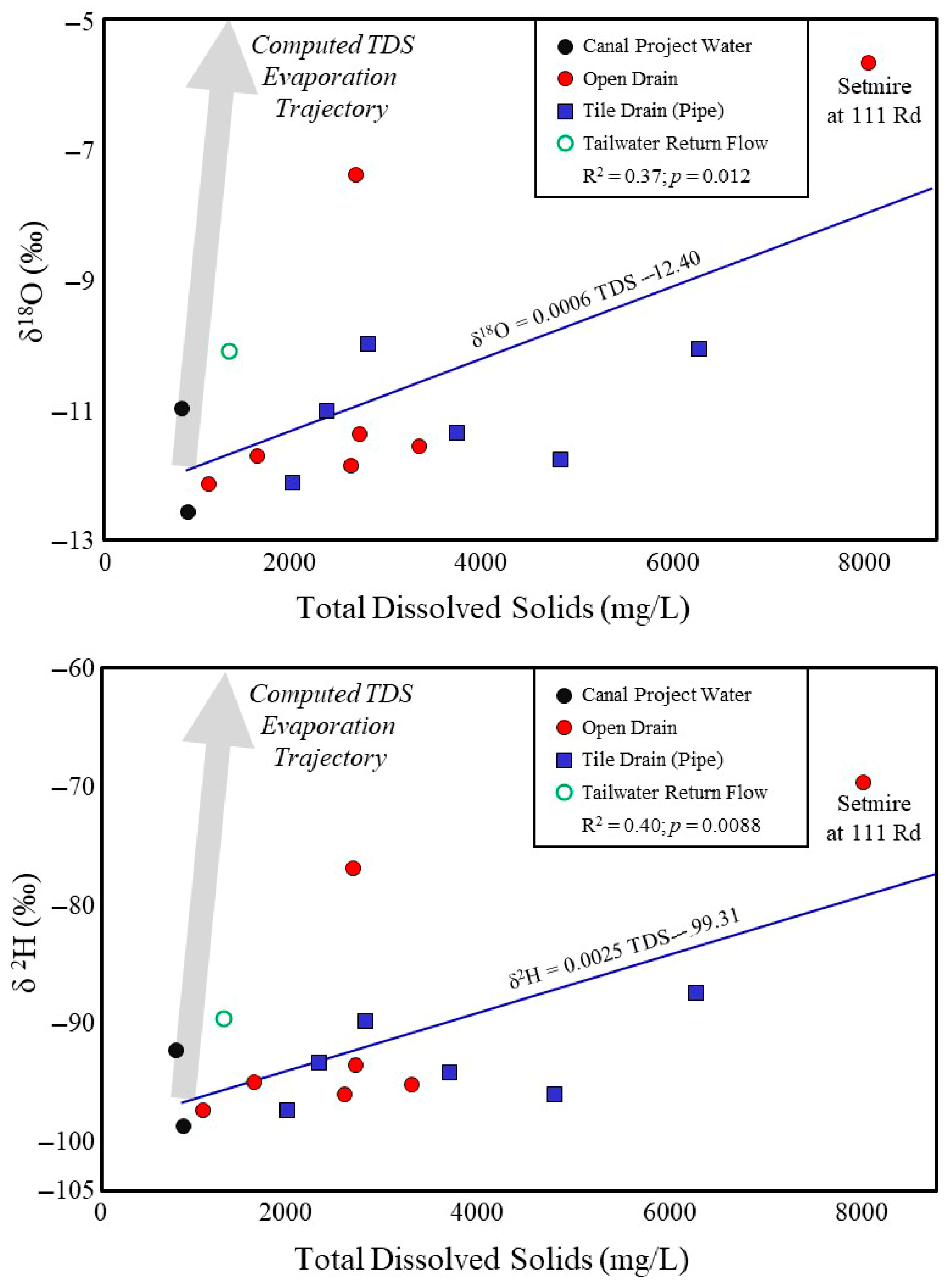
Stable water isotopic data (δ2H and δ18O) provide additional context for evaluating hydrologic sources and evaporative processes. A pronounced isotopic shift in canal project water between sampling dates reflects changing reservoir conditions during summer 2023, when Lake Mead and other Lower Colorado River Basin reservoirs reached extremely low levels (Figure 9). These shifts align with documented reservoir mixing dynamics and variable snowmelt inputs. Conditions improved following wetter winters and increased Upper Basin snowpack after 2023. Across all sample types, tile drains, open drains, canal project water, and tailwater return flow, the δ2H and δ18O compositions plot along an evaporative trend derived from imported Colorado River water (Figure 9). No samples fall along a local meteoric water line. These patterns confirm that the hydrologic system is dominated by irrigation water from the Colorado River Project rather than locally recharged or geothermal sources.
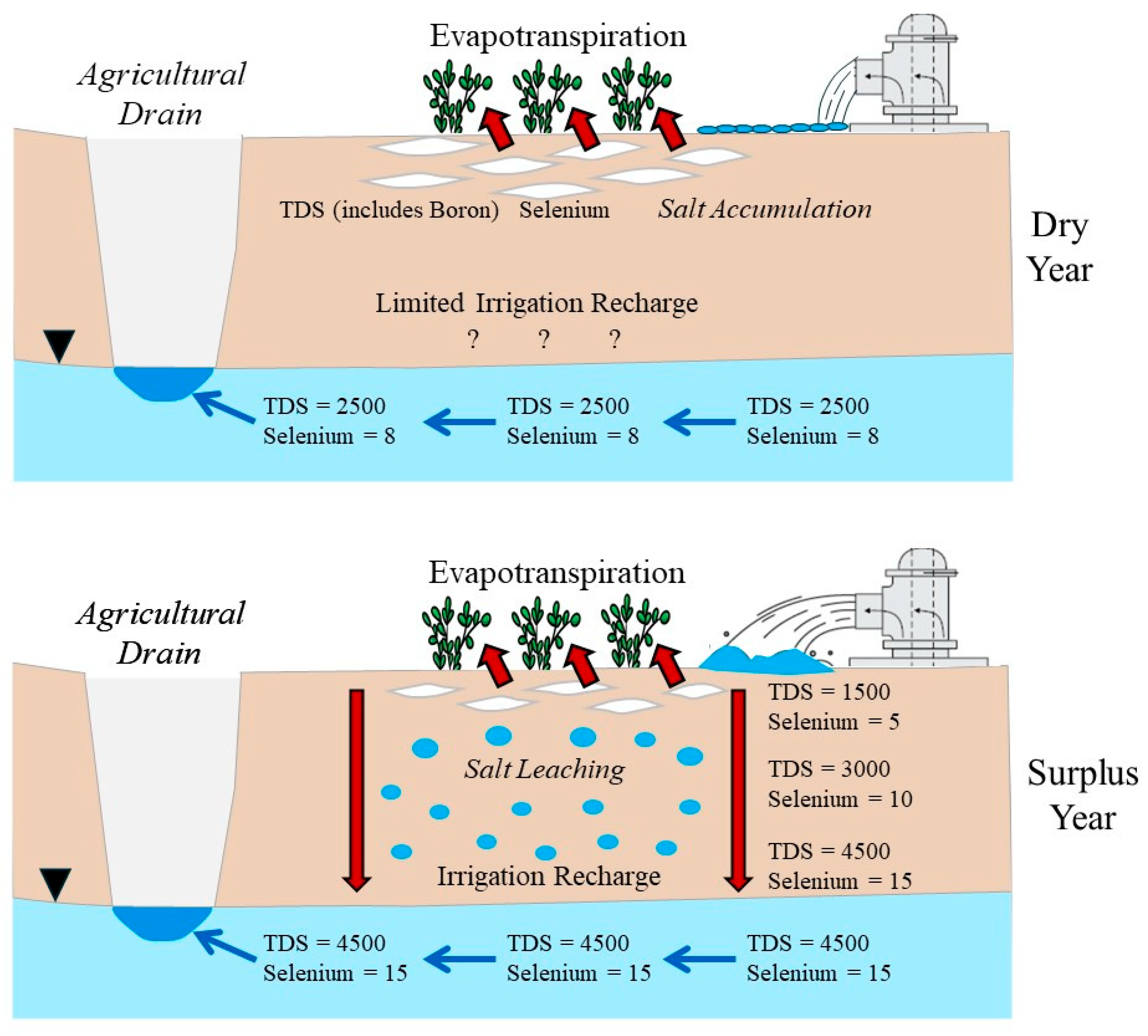
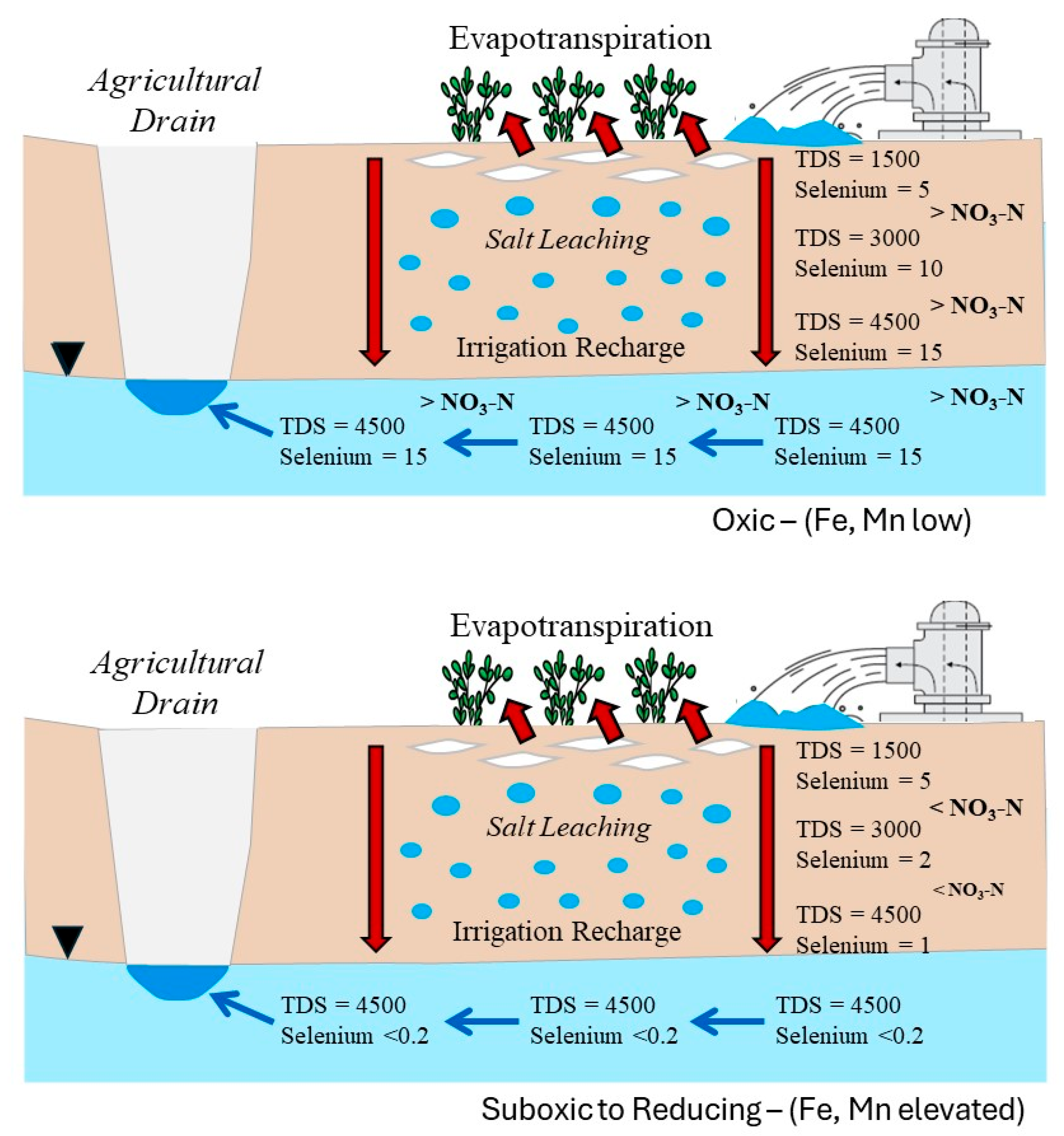
Most drain and groundwater samples display δ2H and δ18O values similar to the project-water baseline, with only slight evaporative enrichment. A subset of sites, including Setmire at 111 Rd Drain, Gillespie Drain, and Hazard Pipe, are more isotopically evaporated. However, these samples do not exhibit a consistent linear relationship between isotopic enrichment and either TDS or selenium (Figure 14). Several highly evaporated samples contain only moderate TDS and selenium, while some of the most saline, selenium-rich samples show little isotopic enrichment. These findings contradict the conceptual model in Figure 10, which assumes that salinity enrichment is driven primarily by partial and continuous evaporation with depth during percolation of irrigation water through arid soils.
Stable water isotope—TDS comparisons reinforce this interpretation; samples with the highest TDS do not show correspondingly enriched δ18O or δ2H values, and isotopic compositions remain relatively uniform across widely varying dissolved-solids concentrations (Figure 14). Likewise, selenium concentrations show no systematic relation to stable water isotopes. High-selenium groundwater (e.g., 150 µg/L) has isotopic values well within the same range as low selenium groundwater, drain water, and canal project water (Figure 14). Low-selenium drain samples often plot isotopically close to higher-selenium groundwater, and canal project water are isotopically indistinguishable from many mineralized samples.
Because all waters originate as Colorado River imports with typical TDS of 750 to 850 mg/L and ~1.5 µg/L dissolved selenium, the observed salinity increases cannot be explained by evaporation alone. Instead, the dataset indicates that salinity enrichment primarily reflects dissolution of precipitated salts accumulated in irrigated soils (Figure 15). During dry or normal years, salts precipitate widely in arid agricultural soils; during wet or surplus years, heavy irrigation is applied to leach these salts from the soil profile. Mobile solutes such as the oxidized form of selenium (selenate) is leached along with dissolved salts, producing the strong selenium-TDS correlation observed (Figure 12). This mechanism is consistent with common irrigation drainage management practices throughout arid basins. These practices also generate variable soluble salt concentrations that do not follow stable water isotope evaporation trajectories in a linear manner, producing variable salinities and evaporated parcels of water as shown in Figure 14.
Figure 15 and other conceptual schematics synthesize the dominant chemical evolution pathways inferred from the dataset, rather than direct representations of individual sample concentrations. The diagrams integrate observed trends across groundwater, tile drains, open drains, tailwater return flows, and project water, and are semi-quantitative, referenced to a reasonable initial condition derived from measured field values. The observed behaviors of total dissolved solids, boron, nitrate–nitrogen, selenium, and stable water isotopes provide the empirical basis for the enrichment, mixing, and transport processes depicted conceptually.

4.4. Testing of Proposed Conceptual Model for Elevated Dissolved Solids and Selenium

Further interpretation of the model shown in Figure 15 is performed by using a mathematical model using the most evaporated sample, with the Setmire at 111 Rd Drain and initial canal project water as an example (Table 1 and Table 2). Prior studies in arid zones have quantified the relationship between δ2H enrichment and salinity using evaporation–salinity enrichment coefficients [78]. Ref. [79] reported that δ2H increases by 0.65‰ for each 1% water loss by evaporation, while [80] reported 0.78‰. Using an average enrichment rate of 0.70‰ δ2H per 1% evaporative water loss, the δ2H difference between the Setmire at 111 Rd Drain sample (−69.5‰) and canal project water (−93.0‰ and −99.4‰) averages 26.7‰. This implies approximately 38.1% evaporative water loss between recharge and discharge at the Setmire 111 Rd Drain site (Table 5).
Assuming an initial salinity of 830 mg/L TDS, physical evaporation alone would yield a concentration of 1342 mg/L TDS, far lower than the measured 8041 mg/L TDS at the Setmire 111 Rd site (Table 1 and Table 2). For comparison, Sample 5 from the Gillespie Drain, which evaporated at almost two-thirds as the amount of the Setmire 111 Rd water (Table 1 and Table 2), contains only 2634 mg/L TDS, versus 8041 mg/L at the Setmire location, despite both receiving similar initial feed-in project water of ~750 to 800 mg/L TDS.
Table 5 and Figure 16 show the theoretical evaporation driven salinity enrichment data and the data fitted with trend lines, which demonstrates very poor correlation to the actual data. These calculations and data collectively show that dissolution of evaporite minerals and near surface salts variably in the vadose zone is the dominant mechanism enriching groundwater dissolved solids, anions, and selenium. Partial evaporation of soil water during percolation alone cannot account for the observed salinity increases; instead, interaction with evaporite minerals and near-surface salts mobilized during surplus irrigation years appears to be the more significant source of groundwater salinity, as depicted in Figure 15.

4.5. Selenium Behavior in the Wister Unit: Oxidizing Conditions and Evaporative Control on Selenium Enrichment

Selenium behavior in the Wister Unit is controlled primarily by hydrologic concentration processes rather than by redox driven release from reduced sedimentary phases. In irrigated arid and semi-arid environments, the redox state of shallow groundwater and agricultural drain water governs whether selenium persists in oxidized, mobile forms such as selenate or is reduced and immobilized in sediments. Where conditions remain oxidizing, selenium behaves conservatively and becomes enriched through evaporative concentration and irrigation recycling in a manner analogous to other dissolved salts. Evaluation of selenium occurrence in the Wister Unit therefore requires assessment of redox conditions together with evaporative enrichment mechanisms.
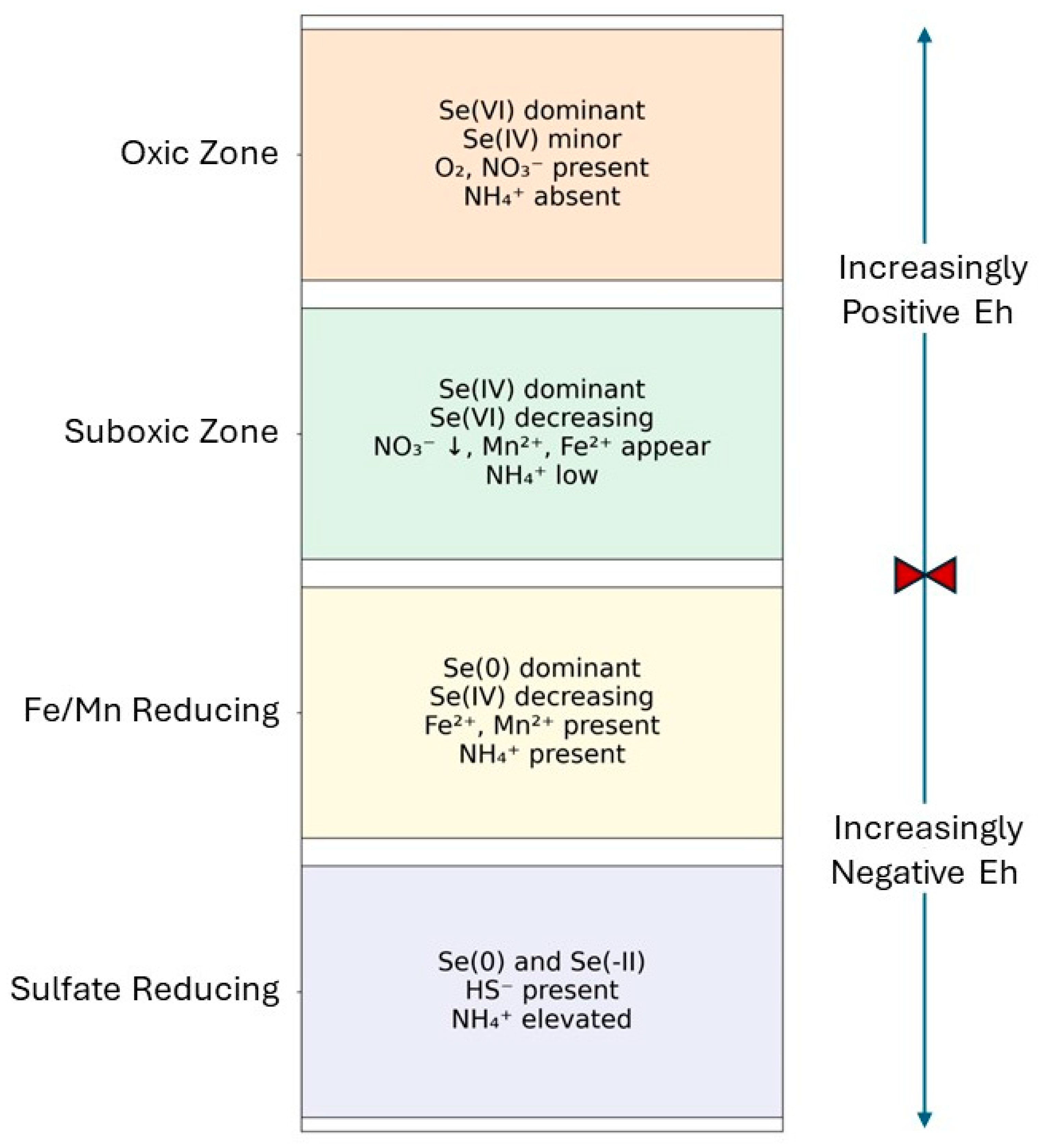
Redox conditions exert a primary control on the mobility of redox sensitive constituents such as iron, manganese, selenium, and nitrogen in groundwater and agricultural drainage systems (Figure 17). As redox potential decreases, natural waters progress through a well-established sequence of terminal electron accepting processes in which oxygen and nitrate reduction occurs first, followed by manganese reduction, iron reduction, sulfate reduction, and ultimately methanogenesis under strongly reducing conditions [81,82,83,84]. Because manganese oxides are reduced at higher redox potentials than iron oxides, dissolved manganese typically appears before dissolved iron, making manganese a sensitive early indicator of the onset of reducing conditions [83,84] (Figure 17). Dissolved oxygen measurements are not considered reliable indicators of subsurface redox conditions in tile-drain systems because groundwater discharging to drains through open tile drains, which are only partly wetted and contain a large air filled chamber, may be exposed to the atmosphere for several minutes prior to sampling, allowing partial re-oxygenation that obscures in situ redox conditions.
Redox systematics translate this conceptual framework into practical concentration-based indicators widely used in groundwater investigations. Groundwater with dissolved manganese concentrations below approximately 20 to 50 µg/L and iron concentrations below about 50 to 75 µg/L is generally considered oxic, reflecting the stability of Mn(IV) and Fe(III) oxide phases as well as the absence of reductive dissolution [82,85]. Dissolved manganese concentrations in the range of about 50 to 300 µg/L, in the absence of elevated iron, are commonly interpreted as suboxic or weakly reducing conditions, whereas iron concentrations exceeding about 300 µg/L, typically accompanied by elevated manganese, are characteristic of iron reducing environments [83,85] (Figure 17).
Direct evidence from a partial data set of the same sample collected within the Wister Unit indicates that redox conditions are dominantly oxidizing, with most samples classified as oxic and only one sample indicating weakly suboxic conditions (Table 6). Across open drain, tile drain, and tailwater return flow samples, dissolved iron concentrations are uniformly low and remain below detection (<20 µg/L), indicating that iron reduction is not occurring to any appreciable extent in the shallow groundwater system feeding the drains. Dissolved manganese concentrations are similarly low in nearly all samples and are commonly at or near detection limits, consistent with oxidizing conditions and the stability of manganese oxide phases. One tile drain sample exhibits slightly elevated dissolved manganese (140 µg/L) in the absence of corresponding iron enrichment, indicating a marginally suboxic condition that reflects the onset of manganese reduction but does not approach iron-reducing or more strongly reducing environments (Table 6). Low vanadium concentrations, all under 13 µg/L, further support this model of predominantly oxidizing conditions. The overall uniformity of low iron and manganese concentrations across virtually the entire sample set indicates that redox conditions are spatially consistent across the Wister Unit set of samples and remain predominantly oxidizing.
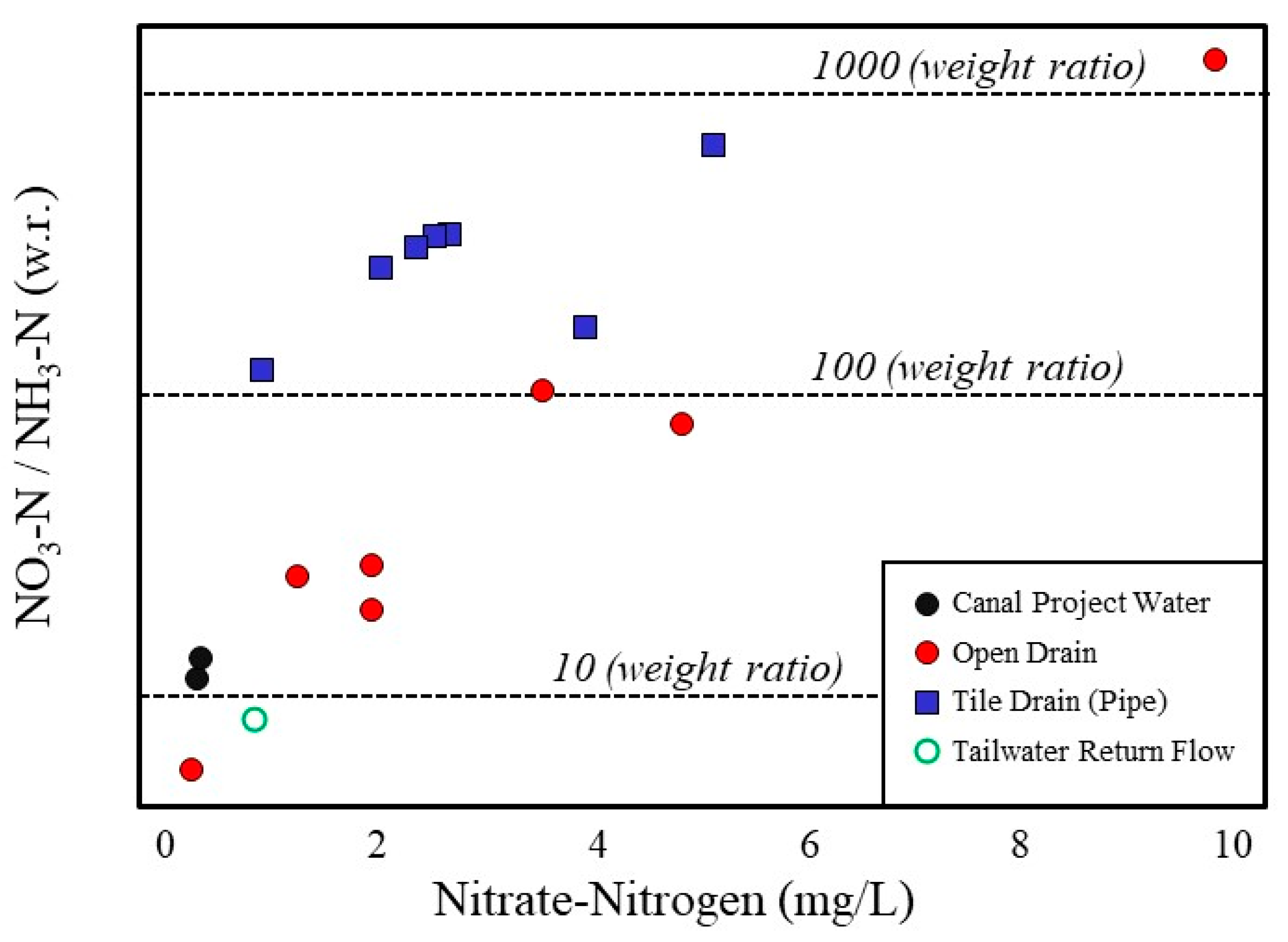
This redox framework is internally consistent with the nitrogen systematics observed in the same samples. Nitrate is present in all drain waters, while ammonium concentrations are uniformly low or below detection (Figure 18). Under oxidizing conditions, fertilizer ammonia is rapidly converted to nitrate through nitrification, resulting in high nitrate-to-ammonium ratios, whereas under decreasing redox potential, nitrate is consumed through denitrification or dissimilatory nitrate reduction prior to the onset of manganese or iron reduction. Ammonia may become the dominant dissolved inorganic nitrogen species if nitrate undergoes dissimilatory nitrate reduction rather than nitrogen gas-forming denitrification [81,83,85]. The persistence of nitrate and suppression of ammonium in Wister Unit drain waters therefore provide independent evidence of oxic to weakly suboxic conditions, consistent with the iron, manganese, selenium, and vanadium data (Figure 18).
Selenium concentrations increase broadly with total dissolved solids across the dataset, particularly in the most saline samples, indicating conservative behavior and enrichment through evaporation and irrigation recycling rather than redox-controlled release. The absence of reductive dissolution of Fe–Mn oxide phases indicates that hydrologic conditions are predominantly oxidizing. Therefore, selenium persists in oxidized, soluble forms under oxic conditions and is concentrated through hydrologic processes that increase salinity.
Altogether, the iron–manganese systematics, nitrate–ammonium relationships, and salinity–selenium trends provide a consistent and internally coherent picture of redox conditions in the Wister Unit (Figure 17). The available evidence indicates that the shallow groundwater (tile drains) and drain waters are dominantly oxidizing, with only isolated, marginally suboxic conditions that do not progress to iron reducing or anoxic environments. Under these conditions, selenium enrichment reflects evaporative concentration and irrigation recycling rather than oxidation of reduced selenium bearing phases in aquifer sediments. Instead, oxidizing conditions are critical because selenium remains predominantly in its most oxidized and mobile form as selenate (Se6+), consistent with the observed geochemical patterns in the Wister Unit (Figure 19).
Historical drain data provide important context for the higher selenium concentrations reported in earlier studies relative to those measured in the Wister Unit and the broader Imperial Valley. Although the Wister system resembles nearby agricultural drainages, selenium concentrations measured in this study are generally lower than those reported in the late 1980s through early 2000s [3,4,46] (Setmire et al., 1990, 1993; Schroeder et al., 2002). Setmire et al. (1993) [3] reported drain-water selenium concentrations ranging from 25 to 250 µg/L at sites approximately 4 to 35 km south of the Wister Unit, as well as a single Wister Unit value of 110 µg/L, all substantially higher than concentrations measured at Wister Unit (Table 2) [46]. Although the absence of continuous long-term monitoring limits formal trend analysis, evidence summarized by [8] Rosen et al. (2023) indicates that these elevated selenium concentrations in older data reflect conditions associated with earlier stages of irrigation development. Subsequent declines in selenium are consistent with long-term depletion of readily leachable selenium in agricultural soils, improved irrigation efficiency, and changes in drainage management that reduce evaporative concentration [8] (Rosen et al., 2023). A worked calculation provided in the Supplementary Materials quantitatively demonstrates the relationship between selenium enrichment and increasing salinity under present conditions.

4.6. Broader Applicability and Management Implications

The mechanisms identified—irrigation-driven salinity recycling, evaporative concentration, shallow groundwater discharge to drains, and the mobility of salinity, boron, selenium, nutrients, and other trace elements under predominantly oxidizing conditions—are not unique to Wister Unit. Similar processes operate in many drought-irrigated agricultural regions worldwide where imported surface water is applied to arid soils under artificial drainage. The results indicate that elevated salinity, boron, selenium, nutrients, and other trace elements in agricultural return flows commonly reflect long-term irrigation recycling and soil flushing histories. These findings provide a transferable framework for evaluating agricultural drainage water quality and trace element risk in other arid irrigated basins experiencing drought, water reallocation, or land use change.
A key distinction of the Wister Unit is that agricultural return flows discharge directly into ecologically active and managed wetlands rather than primarily into rivers or streams. In this setting, elevated salinity, boron, selenium, nutrients, and other trace elements represent not only agricultural water quality concerns but also direct ecological and policy issues, given the sensitivity of wetland habitats and food webs. In contrast, many irrigated regions route return flows to rivers and streams, where similar salinity and nutrient impairments are widely documented. The mechanisms identified here are therefore broadly applicable, while underscoring the need for targeted monitoring and management where agricultural drainage directly sustains wetland ecosystems.

5. Conclusions

This study provides the first hydrochemical and isotopic assessment of selenium, salinity, and nitrate dynamics in the Wister Unit, addressing a long-standing data gap in an area largely overlooked in earlier Imperial Valley drainage investigations. Results show that selenium enrichment in groundwater and tile drain is driven mainly by dissolved-solids accumulation and subsequent leaching, rather than nitrate induced oxidation of reduced selenium on mineral surfaces or organic matter. Selenium correlates strongly with TDS (r2 ≈ 0.82), with the highest values occurring in the most saline tile drains. Nitrate concentrations, while sufficient to maintain oxidizing conditions, have no relationship with selenium (r2 ≈ 0.01), indicating nitrate primarily sustains selenium in its oxidized form rather than releasing it from sediments.
Stable water isotope data support this interpretation. All waters plot along a canal project water-derived evaporation line, confirming dominance of imported irrigation water. However, isotopic enrichment does not increase with TDS or selenium, demonstrating that pure evaporation cannot explain the extreme salinities in groundwater. Instead, salts accumulate in soils during dry and normal irrigation years and are flushed downward during wet or surplus years, transporting both dissolved solids and oxidized selenium to shallow groundwater and tile drains. This mechanism is consistent with arid zone irrigation systems and explains the strong selenium TDS relationship and weak salinity isotope correspondence. Thus, selenium in the Wister Unit reflects evaporative salt enrichment and leaching rather than nitrate mediated oxidation of reduced selenium bearing minerals.
Several priorities for future work remain. Time-series sampling of drains and shallow groundwater is needed to capture seasonal and interannual variability. Selenium speciation will clarify the distribution of selenate, selenite, elemental Se, and organically bound forms and better define redox controls. Nitrate isotope data (δ15N and δ18O of NO3) will help identify nitrogen sources and assess whether denitrification occurs in reducing microsites. Soil coring and leaching tests beneath agricultural fields and control areas, along with long term monitoring of water levels and chemistry, will improve understanding of salt and selenium storage and mobilization. These next steps will refine the conceptual model and support more effective wetland and agricultural water management in the eastern Salton Sea region.
The data indicate that evaporative concentration and irrigation recycling dominate salinity and trace-element behavior in the Wister Unit; however, evaluation of periodic leaching and surplus-year flushing will require a targeted, long-term monitoring design. Future work should focus on a limited number of representative tile drains and selected open drains that intercept shallow groundwater, with sampling conducted at least quarterly, and preferably monthly, during active leaching periods, winter precipitation, and high project-water deliveries. Monitoring should span multiple irrigation cycles and both wet and dry years, with a duration of approximately 5–10 years to distinguish short-term concentration effects from sustained flushing responses. Core analytes should include TDS, major ions (Cl, SO4), boron, bromide, selenium, nutrients, iron, manganese, and stable water isotopes.
Selenium concentrations measured in drains should be interpreted in the context of downstream mixing, dilution, and variable hydrologic routing within the Wister Unit wetland cells. This study documents selenium and salinity in modern shallow groundwater entering the drainage network through tile drains and direct seepage, addressing limited existing data for groundwater and agricultural drains in the Wister Unit and upstream areas. Open drains represent the initial hydraulic connection between irrigated fields and wetlands and therefore provide an appropriate basis for characterizing constituent inputs. As drain waters enter wetland cells, mixing with project water, tailwater return flow, groundwater seepage, and precipitation produces spatially and temporally variable concentrations; evaluation of selenium behavior within wetlands will therefore require in situ monitoring within wetland cells

Supplementary Materials

The following supporting information can be downloaded at: https://www.mdpi.com/article/10.3390/hydrology13020058/s1, Section S1: laboratory analytical methods; Section S2: supplementary quantitative evaluation of selenium co-enrichment with salinity. Figures S1–S3: Additional stable isotope (δ2H and δ18O) plots comparing isotopic enrichment with TDS, boron, and selenium concentrations, respectively. Table S1: Measured and calculated selenium concentrations for project water, tailwater return flow, open drains, and tile drains in the Wister Unit, evaluated using a salinity-based regression relating selenium enrichment to total dissolved solids (Equations (S1) and (S2)). Grey shaded entries indicate low salinity feed waters for which the regression is not applicable, whereas white shaded entries show reasonable agreement between measured and calculated selenium at TDS > ~1500 mg/L, consistent with evaporative concentration under oxidizing conditions. Blue shaded entries highlight samples that deviate from the regression, reflecting localized hydrochemical variability or mixing rather than distinct selenium sources

Author Contributions

Conceptualization, B.J.H.; methodology, B.J.H. and M.S.; validation, B.J.H., M.S., A.S. and J.M.; formal analysis, B.J.H., M.S., A.S. and J.M; investigation, B.J.H., M.S., A.S. and J.M.; resources, B.J.H.; data curation, B.J.H. and M.S.; writing—original draft preparation, B.J.H.; writing—review and editing, B.J.H., M.S., A.S. and J.M; visualization, B.J.H. and M.S.; supervision, B.J.H.; project administration, B.J.H.; funding acquisition, B.J.H. All authors have read and agreed to the published version of the manuscript.

Funding

This research was supported by the United States Department of Agriculture (USDA)—National Institute of Food and Agriculture (NIFA) through the NLGCA Award No. 2024-70001-43062. Additional support for undergraduate student research stipends was provided by the National Science Foundation (NSF) under NSF REU Site Award No. 1852506. Any opinions, findings, conclusions, or recommendations expressed in this material are those of the author and do not necessarily reflect the views of the USDA-NIFA, or the NSF.

Data Availability Statement

The original contributions presented in this study are included in the tables in this article.

Acknowledgments

The authors acknowledge Barrett Gibbs and Heath Milton for their field assistance. The authors also extends thanks to three anonymous reviewers for their constructive and insightful suggestions.

Conflicts of Interest

The authors declare no conflicts of interest.

References

  1. Ohlendorf, H.M.; Hoffman, D.J.; Saiki, M.K.; Aldrich, T.W. Embryonic mortality and abnormalities of aquatic birds: Apparent impacts of selenium from irrigation drainwater. Sci. Total Environ. 1986, 52, 49–63. [Google Scholar] [CrossRef]
  2. Presser, T.S.; Barnes, I. Dissolved Constituents Including Selenium in Waters in the Vicinity of Kesterson National Wildlife Refuge and West Grassland, Fresno and Merced Counties, California; Water-Resources Investigations Report 85-4220; U.S. Geological Survey: Reston, VA, USA, 1985; 73p.
  3. Setmire, J.G.; Schroeder, R.A.; Densmore, J.N.; Goodbred, S.O.; Audet, D.J.; Radke, W.R. Detailed Study of Water Quality, Bottom Sediment, and Biota in the Salton Sea Area, 1988–90; USGS Water-Resources Investigations Report 93-4014; USGS: Washington, DC, USA, 1993.
  4. Setmire, J.G.; Wolfe, J.C.; Stroud, R.K. Reconnaissance Investigation of Water Quality, Bottom Sediment, and Biota in the Salton Sea Area, 1986–87; USGS Water-Resources Investigations Report 89-4102; USGS: Washington, DC, USA, 1990.
  5. Setmire, J.G.; Schroeder, R.A. Selenium and salinity concerns in the Salton Sea area of California. In Environmental Chemistry of Selenium; Frankenberger, W.T., Engberg, R.A., Eds.; Dekker: New York, NY, USA, 1998; pp. 205–221. [Google Scholar]
  6. Crepeau, K.L.; Kuivila, K.M.; Bergamaschi, B.A. Dissolved pesticides in the Alamo River and the Salton Sea, California, 1996–97; Open-File Report 2002–232; U.S. Geological Survey: Reston, VA, USA, 2002; pp. 1–7.
  7. May, T.W.; Walther, M.J.; Saiki, M.K.; Brumbaugh, W.G. Total Selenium and Selenium Species in Irrigation-Drain Inflows to the Salton Sea; USGS Open-File Report 2009-1123; USGS: Reston, VA, USA, 2009.
  8. Rosen, M.R.; De La Cruz, S.E.W.; Groover, K.D.; Woo, I.; Roberts, S.A.; Davis, M.J.; Antonino, C.Y. Selenium Hazards in the Salton Sea environment; USGS Scientific Investigations Report 2023-5042; USGS: Washington, DC, USA, 2023.
  9. U.S. Environmental Protection Agency. Final Aquatic Life and Aquatic-Dependent Wildlife Selenium Water Quality Criterion for Freshwaters of California; EPA-822-R-24-014; Office of Water and Region 9: Washington, DC, USA, 2024.
  10. California Waterfowl Association. Construction Has Started with the Removal of Salt Cedar and Water Control Structures at the Imperial Wildlife Area Wister Unit 312 A–C. News, 27 March 2024. Available online: https://calwaterfowl.org/news/construction-has-started-with-the-removal-of-salt-cedar-and-water-control-structures-at-the-imperial-wildlife-area-wister-unit-312-a-c (accessed on 8 November 2024).
  11. Johnston, R.; Razafy, M.; Lugo, H.; Olmedo, L.; Farzan, S.F. The disappearing Salton Sea—A critical reflection on the emerging environmental threat. Sci. Total Environ. 2019, 663, 804–817. [Google Scholar] [CrossRef]
  12. Bradley, T.J.; Ajami, H.; Porter, W.C. Ecological transitions at the Salton Sea—Past, present and future. Calif. Agric. 2022, 76, 1. [Google Scholar] [CrossRef]
  13. Stantec. Wister Solar Energy Facility Project Report; Stantec Consulting Ltd.: El Centro, CA, USA, 2020. [Google Scholar]
  14. Tetra Tech. Final Report: Seepage and Subsurface Inflows to the Salton Sea; Report to the Salton Sea Authority; Tetra Tech: Pasadena, CA, USA, 1999. [Google Scholar]
  15. Case, H.L., III; Boles, J.; Delgado, A.; Nguyen, T.; Osugi, D.; Barnum, D.A.; Decker, D.; Steinberg, S.; Steinberg, S.; Keene, C.; et al. Salton Sea Ecosystem Monitoring and Assessment Plan; U.S. Geological Survey Open-File Report 2013–1133, prepared for the California Department of Water Resources, Salton Sea Ecosystem Restoration Program; U.S. Geological Survey: Reston, VA, USA, 2013.
  16. PRISM Climate Group. PRISM Climate Data; Oregon State University: Corvallis, OR, USA, 2020. [Google Scholar]
  17. ESRI. Average Annual Potential Evapotranspiration (mm/Year); University of Montana Numerical Terradynamic Simulation Group: Missoula, MT, USA, 2015. [Google Scholar]
  18. U.S. Bureau of Reclamation. Imperial Valley Drainwater Reclamation and Reuse Study; Southern California Area Office: Temecula, CA, USA, 1998.
  19. Hely, A.G.; Hughes, G.H.; Irelan, B. Hydrologic Regimen of the Salton Sea, California; USGS Professional Paper 486-C; USGS: Washington, DC, USA, 1966; 32p.
  20. Cahn, M.D.; Bali, K.M. Managing Salts by Leaching—Leaching for Salt Management; ANR Publication 8550; University of California Agriculture and Natural Resources: Davis, CA, USA, 2015; 8p. [Google Scholar]
  21. Oakeshott, G.B. California’s Changing Landscapes; McGraw-Hill: New York, NY, USA, 1971; pp. 343–351. [Google Scholar]
  22. Herzig, C.T.; Jacobs, K. Cenozoic volcanism and two-stage extension in the Salton Trough. Geology 1994, 22, 991–994. [Google Scholar] [CrossRef]
  23. Aragón-Arreola, M.; Martín-Barajas, A. Westward migration of extension in the northern Gulf of California, Mexico. Geology 2007, 35, 571–574. [Google Scholar] [CrossRef]
  24. Loeltz, O.J.; Irelan, B.; Robison, J.H.; Olmsted, F.H. Geohydrologic Reconnaissance of the Imperial Valley, California; U.S. Geological Survey Professional Paper 486-K; U.S. Geological Survey: Washington, DC, USA, 1975.
  25. Jennings, C.W. Geologic Map of California, Salton Sea Sheet; California Division of Mines and Geology: Sacramento, CA, USA, 1967.
  26. Crowell, J.C. Geologic sketch of the Orocopia Mountains, southeastern California. In San Andreas Fault in Southern California; Special Report 118; California Division of Mines and Geology: Sacramento, CA, USA, 1975; pp. 99–110. [Google Scholar]
  27. Proctor, R.J. Geology of the Desert Hot Springs–Upper Coachella Valley Area, California: With a Selected Bibliography of the Coachella Valley, Salton Sea, and Vicinity; California Division of Mines and Geology: San Francisco, CA, USA, 1968; Bulletin No. 94; pp. 1–50.
  28. Planert, M.; Williams, J.S. Groundwater Atlas of the United States—Segment 1; USGS Hydrologic Investigations Atlas 730-B; USGS: Washington, DC, USA, 1995.
  29. Babcock, E.A. Geology of the northeast margin of the Salton Trough, Salton Sea, California. Geol. Soc. Am. Bull. 1974, 85, 321–332. [Google Scholar] [CrossRef]
  30. Van de Kamp, P. Holocene continental sedimentation in the Salton Basin. Geol. Soc. Am. Bull. 1973, 84, 827–848. [Google Scholar] [CrossRef]
  31. Philibosian, B.; Fumal, T.; Weldon, R. San Andreas fault earthquake chronology and Lake Cahuilla history. Bull. Seismol. Soc. Am. 2011, 101, 13–38. [Google Scholar] [CrossRef]
  32. Rockwell, T.K.; Meltzner, A.J.; Haaker, E.C.; Madugo, D. The late Holocene history of Lake Cahuilla. Quat. Sci. Rev. 2022, 282, 107456. [Google Scholar] [CrossRef]
  33. Tompson, A. Born from a flood—The Salton Sea and its story of survival. J. Earth Sci. 2016, 27, 89–97. [Google Scholar] [CrossRef]
  34. Lynch, D.K.; Hudnut, K.W. The Wister Mud Pot lineament: Southeastward extension or abandoned strand of the San Andreas fault? Bull. Seismol. Soc. Am. 2008, 98, 1720–1729. [Google Scholar] [CrossRef]
  35. Sturz, A. Low-temperature hydrothermal alteration in near-surface sediments, Salton Sea. J. Geophys. Res. 1989, 94, 4015–4024. [Google Scholar] [CrossRef]
  36. Sturz, A.; Itoh, M.; Earley, P.; Otero, W. Mud volcanoes and mud pots, Salton Sea geothermal area. In South Coast Geological Society Field Trip Guidebook 25; SCGS: Los Angeles, CA, USA, 1997; pp. 300–323. [Google Scholar]
  37. Svensen, H.; Karlson, D.; Stün, A.; Backer, K.; Banks, D.A.; Planke, S. Processes controlling water and hydrocarbon composition in seeps. Geology 2007, 35, 85–88. [Google Scholar] [CrossRef]
  38. Hibbs, B.; Bautista, C.; Alwood, L.; Drummond, M. Hydrogeologic and hydrochemical inputs to emerging wetlands on the shores of the receding Salton Sea, California. J. Am. Water Resour. Assoc. 2024, 60, e13220. [Google Scholar] [CrossRef]
  39. California Regional Water Quality Control Board (Colorado River Basin Region). Waste Discharge Requirements for the County of Imperial—Niland Class III Municipal Solid Waste Management Facility; Order R7-2009-0002; CRWQCB: Palm Desert, CA, USA, 2009.
  40. Hibbs, B.J. Driving processes of the Niland Moving Mud Spring: A conceptual model of a unique geohazard in California’s eastern Salton Sea region. GeoHazards 2025, 6, 59. [Google Scholar] [CrossRef]
  41. Hunter, J. An investigation of the Hot Mineral Spa geothermal area, Riverside and Imperial Counties, California. Geotherm. Resour. Counc. Trans. 1992, 16, 175–182. [Google Scholar]
  42. Mingjie, C.; Andrew, F.B.; Tompson, R.J.M.; Osman, A. Efficient optimization of well placement under uncertainty. Appl. Energy 2015, 137, 352–363. [Google Scholar]
  43. Leroy Crandall & Associates. Phase 1 Hydrogeologic Investigation: Feasibility of Recovering Groundwater in the East Mesa Area; Leroy Crandall & Associates: Imperial County, CA, USA, 1983.
  44. California Department of Water Resources. Geothermal Wastes and the Water Resources of the Salton Sea Area; Bulletin 143-7; CDWR: Sacramento, CA, USA, 1970. [Google Scholar]
  45. Setmire, J.G. Water Quality in the New River from Calexico to the Salton Sea; USGS Water-Supply Paper 2212; USGS: Washington, DC, USA, 1984.
  46. Schroeder, R.A.; Orem, W.H.; Kharaka, Y.K. Chemical evolution of the Salton Sea: Nutrient and selenium dynamics. Hydrobiologia 2002, 473, 23–45. [Google Scholar] [CrossRef]
  47. Byron, E.R.; Ohlendorf, H.M. Diffusive flux of selenium between lake sediment and overlying water: Assessing restoration alternatives for the Salton Sea. Lake Reserv. Manag. 2007, 23, 73–83. [Google Scholar] [CrossRef]
  48. Saiki, M.K.; Martin, B.A.; May, T.W. Selenium in aquatic biota inhabiting agricultural drains in the Salton Sea Basin. Environ. Monit. Assess. 2012, 184, 5623–5640. [Google Scholar] [CrossRef]
  49. Wright, W.G. Oxidation and mobilization of selenium by nitrate in irrigation drainage. J. Environ. Qual. 1999, 28, 1182–1187. [Google Scholar] [CrossRef]
  50. Bailey, R.T.; Hunter, W.J.; Gates, T.K. The influence of nitrate on selenium in irrigated agricultural groundwater systems. J. Environ. Qual. 2012, 41, 783–793. [Google Scholar] [CrossRef]
  51. Bailey, R.T.; Gates, T.K.; Halvorson, A.D. Simulating variably-saturated reactive transport of selenium and nitrogen in agricultural groundwater systems. J. Contam. Hydrol. 2013, 149, 27–45. [Google Scholar] [CrossRef]
  52. Mast, M.A.; Mills, T.J.; Paschke, S.S.; Keith, G.; Linard, J.I. Mobilization of selenium from Mancos Shale in the lower Uncompahgre River Basin, Colorado. Appl. Geochem. 2014, 48, 16–27. [Google Scholar] [CrossRef]
  53. Mills, C.T.; Mast, M.A.; Thomas, J.; Keith, G. Controls on selenium distribution and mobilization in irrigated shallow groundwater underlain by Mancos Shale, Colorado. Sci. Total Environ. 2016, 566–567, 1621–1631. [Google Scholar] [CrossRef] [PubMed]
  54. Gebreeyessus, G.D.; Zewge, F. A review on environmental selenium issues. SN Appl. Sci. 2019, 1, 55. [Google Scholar] [CrossRef]
  55. Hibbs, B.J.; Eastoe, C.J.; Merino, M. Issues of bias in groundwater quality data sets in an irrigated floodplain aquifer of variable salinity. Geosciences 2024, 14, 66. [Google Scholar] [CrossRef]
  56. Buchanan, T.J.; Somers, W.P. Discharge Measurements at Gaging Stations; U.S. Geological Survey Techniques of Water-Resources Investigations, Book 3, Chapter A8; USGS: Washington, DC, USA, 1969; 65p.
  57. Turnipseed, D.P.; Sauer, V.B. Discharge Measurements at Gaging Stations; USGS Techniques and Methods 3-A8; USGS: Reston, VA, USA, 2010.
  58. Coplen, T.B. Reporting of stable hydrogen, carbon, and oxygen isotopic abundances. Pure Appl. Chem. 1994, 66, 273–276. [Google Scholar] [CrossRef]
  59. Eastoe, C.J.; Dettman, D.L. Isotope amount effects in hydrologic and climate reconstructions of monsoon climates: Implications of some long-term data sets for precipitation. Chem. Geol. 2016, 430, 78–89. [Google Scholar] [CrossRef]
  60. U.S. Environmental Protection Agency. Method 375.4: Sulfate, turbidimetric. In Methods for Chemical Analysis of Water and Wastes; EPA-600/4-79-020; U.S. Environmental Protection Agency: Cincinnati, OH, USA, 1979. [Google Scholar]
  61. U.S. Environmental Protection Agency. Method 9251: Chloride (Colorimetric). In Test Methods for Evaluating Solid Waste (SW-846); EPA: Washington, DC, USA, 1986. [Google Scholar]
  62. Mohammed, A.S.; Garba, K.; Umar, S. Analytical determination of boron in irrigation water using Azomethine-H. IOSR J. Appl. Chem. 2014, 7, 47–51. [Google Scholar]
  63. U.S. Environmental Protection Agency. Method 353.2: Determination of nitrate–nitrite nitrogen by automated colorimetry. In Methods for the Determination of Inorganic Substances in Environmental Samples; EPA-600/4-79-020; U.S. Environmental Protection Agency: Cincinnati, OH, USA, 1993. [Google Scholar]
  64. U.S. Environmental Protection Agency. Method 350.1: Determination of ammonia nitrogen. In Methods for Chemical Analysis of Water and Wastes; EPA-600/4-79-020; U.S. Environmental Protection Agency: Cincinnati, OH, USA, 1978. [Google Scholar]
  65. U.S. Environmental Protection Agency. Method 365.1: Determination of phosphorus. In Methods for Chemical Analysis of Water and Wastes; EPA-600/4-79-020; U.S. Environmental Protection Agency: Cincinnati, OH, USA, 1978. [Google Scholar]
  66. U.S. Environmental Protection Agency. Method 200.7: Determination of metals and trace elements in water and wastes by ICP-AES. In Methods for the Determination of Metals in Environmental Samples, Supplement I; EPA/600/R-94/111; U.S. Environmental Protection Agency: Cincinnati, OH, USA, 1994. [Google Scholar]
  67. U.S. Environmental Protection Agency. Method 200.2: Sample preparation procedure for spectrochemical determination of total recoverable elements. In Methods for the Determination of Metals in Environmental Samples, Supplement I; EPA/600/R-94/111; U.S. Environmental Protection Agency: Cincinnati, OH, USA, 1994. [Google Scholar]
  68. Kelliher, F. Sources and Evolution of Waters at Dos Palmas Preserve and Vicinity, Salton Sea, California. Master’s Thesis, California State University, Los Angeles, CA, USA, 2006. [Google Scholar]
  69. Oblinger-Childress, C.J.; Foreman, W.T.; Connor, B.F.; Maloney, T.J. New Reporting Procedures Based on Long-Term Method Detection Levels and Some Considerations for Interpretations of Water-Quality Data Provided by the U.S. Geological Survey National Water Quality Laboratory; Open-File Report 99–193; U.S. Geological Survey: Reston, VA, USA, 1999.
  70. Craig, H. Isotopic variations in meteoric waters. Science 1961, 133, 1702–1703. [Google Scholar] [CrossRef] [PubMed]
  71. Craig, H. Standard for reporting concentrations of deuterium and oxygen-18 in natural waters. Science 1961, 133, 1833–1834. [Google Scholar] [CrossRef]
  72. McNeal, J.M.; Balistrieri, L.S. Geochemistry and occurrence of selenium: An overview. In Selenium in Agriculture and the Environment; Jacobs, L.W., Ed.; SSSA Special Publication No. 23; Soil Science Society of America: Madison, WI, USA, 1989; pp. 1–13. [Google Scholar]
  73. Frankenberger, W.T.; Benson, S. Selenium in soils and plants: An overview. In Selenium in the Environment; Dekker: New York, NY, USA, 1994; pp. 1–20. [Google Scholar]
  74. Oremland, R.S.; Hollibaugh, J.T.; Maest, A.S.; Presser, T.S.; Miller, L.G.; Culbertson, C.W. Selenate reduction to elemental selenium by anaerobic bacteria in sediments and culture; biogeochemical significance of a novel, sulfate-independent respiration. Appl. Environ. Microbiol. 1989, 55, 2333–2343. [Google Scholar] [CrossRef]
  75. Zhang, Y.; Moore, J.N. Selenium fractionation and speciation in a wetland system. Environ. Sci. Technol. 1996, 30, 2613–2619. [Google Scholar] [CrossRef]
  76. White, A.F.; Benson, S.M.; Yee, A.W.; Wollenberg, H.A., Jr.; Flexser, S. Groundwater contamination at the Kesterson Reservoir, California: 1. Hydrogeologic setting and conservative solute transport. Water Resour. Res. 1991, 27, 1071–1084. [Google Scholar] [CrossRef]
  77. White, A.F.; Benson, S.M.; Yee, A.W.; Wollenberg, H.A., Jr.; Flexser, S. Groundwater contamination at the Kesterson Reservoir, California: 2. Geochemical parameters influencing selenium mobility. Water Resour. Res. 1991, 27, 1085–1098. [Google Scholar] [CrossRef]
  78. Huang, T.; Pang, Z. The role of deuterium excess in determining water salinisation mechanisms: Tarim River Basin, NW China. Appl. Geochem. 2012, 27, 2382–2388. [Google Scholar] [CrossRef]
  79. Simpson, H.J.; Hamza, M.S.; White, J.W.C.; Nada, A.; Awad, M.A. Evaporative enrichment of deuterium and 18O in arid zone irrigation. In Isotope Techniques in Water Resources Development, Proceedings of a Symposium, Vienna, Austria, 30 March–3 April 1987; International Atomic Energy Agency (IAEA): Vienna, Austria, 1988; IAEA-SM-299/125; pp. 241–256. [Google Scholar]
  80. Fontes, J.C.; Gonfiantini, R. Isotopic behavior during evaporation of two Saharan basins. Earth Planet. Sci. Lett. 1967, 3, 258–266. [Google Scholar] [CrossRef]
  81. Stumm, W.; Morgan, J.J. Aquatic Chemistry: Chemical Equilibria and Rates in Natural Waters, 3rd ed.; John Wiley & Sons: New York, NY, USA, 1995. [Google Scholar]
  82. Hem, J.D. Study and Interpretation of the Chemical Characteristics of Natural Water, 3rd ed.; U.S. Geological Survey Water-Supply Paper 2254; USGS: Washington, DC, USA, 1985.
  83. Chapelle, F.H. Ground-Water Microbiology and Geochemistry, 2nd ed.; John Wiley & Sons: New York, NY, USA, 2000. [Google Scholar]
  84. Appelo, C.A.J.; Postma, D. Geochemistry, Groundwater and Pollution, 2nd ed.; A.A. Balkema Publishers: Rotterdam, The Netherlands, 2005. [Google Scholar]
  85. McMahon, P.B.; Chapelle, F.H. Redox Processes and Water Quality of Selected Principal Aquifer Systems. Groundwater 2007, 46, 259–271. [Google Scholar] [CrossRef]
Figure 4. Composite 1993 hydraulic head map showing groundwater elevations in the study area. Contours reflect topography, local faulting, and variations in the transmissivity of strata, broadly aligning with the Salton Sea shoreline regression and the Moving Mud Spring’s migration trajectory. Contours are dashed where inferred and water table mapping uses variable contour interval (map adapted from [44]; water table contours adapted from [14]).
Hydrology 13 00058 g004
Figure 5. These two diagrams show total dissolved solids concentrations, estimated by specific conductance, across open agricultural drains, tile groundwater drains, canal project water, and tailwater return flow. Open drains exhibited moderate to high salinity, while tile drains showed markedly higher values, including one extremely saline sample near 25,000 mg/L. Canal project water remained the least saline source, underscoring its role as the low-TDS end member relative to agricultural drainage. The freshwater limit of 1000 mg/L TDS is plotted in the upper diagram for reference to sample values). Values of Total Dissolved Solids are shown next to the data points.
Hydrology 13 00058 g005
Figure 6. These figures present boron concentrations among all sampled water types, highlighting frequent exceedances in both open drains and tile drains. Most exceedances occurred in the two drain types, with tile drains displaying the highest values and canal project derived waters remaining well below the aquatic life criterion. These results indicate that selenium loading is largely associated with. Values of Boron are shown next to the data points.
Hydrology 13 00058 g006aHydrology 13 00058 g006b
Figure 7. These figures present selenium concentrations among all sampled water types, highlighting frequent exceedances in both open drains and tile drains. Most exceedances occurred in the two drain types, with tile drains displaying the highest values and canal project-derived waters remaining well below the aquatic life criterion. These results indicate that selenium loading is largely associated with agricultural drainage pathways rather than canal project water. 77. Values of selenium are shown next to the data points.
Hydrology 13 00058 g007aHydrology 13 00058 g007b
Figure 8. These figures show nitrate–nitrogen concentrations for open drains, tile drains, canal project water, and tailwater return flow. Open drains generally contained the highest nitrate levels, including several samples above 5 mg/L, whereas tile drains showed moderate and variable concentrations. Canal project water and tailwater return flow exhibited very low nitrate–nitrogen, reflecting minimal upstream nitrogen inputs compared to the agricultural drainage system. The U.S. Environmental Protection Agency drinking water standard of 10.0 mg/L Nitrate-N is plotted in the upper diagram for reference to sample values. Values of Nitrate-N are shown next to the data points.
Hydrology 13 00058 g008
Figure 9. This figure shows δ2H and δ18O values for open drains, tile drains, canal project water, and tailwater return flow, all of which fall along a common evaporation trend. The isotopic range reflects progressive evaporation and reuse of irrigation water, with canal water plotting at the least-evaporated end of the spectrum. No samples exhibit local meteoric signatures.
Hydrology 13 00058 g009
Figure 10. Elevated selenium concentrations in Wister Unit groundwater may partly reflect evaporative concentration in shallow, arid-zone aquifers. As evaporation and evapotranspiration remove water, dissolved solids such as sulfate, chloride, and oxidized selenium species become progressively enriched in the vadose zone before wetting fronts reach the water table. This process is common in irrigated agricultural basins with irrigated agriculture. The agricultural units in the study area use gravity irrigation from imported Colorado River water. The groundwater pump can be thought of a pump that pulls imported water out of irrigation canals.
Hydrology 13 00058 g010
Figure 11. Scatterplot showing selenium concentrations versus nitrate-nitrogen (NO3-N) for all sampled water types. Selenium spans more than two orders of magnitude (0.87–150 µg/L), while nitrate ranges from <0.015 to 9.81 mg/L. The wide vertical spread of selenium values at any given nitrate concentration, combined with the very weak correlation (r2 = 0.01), demonstrates that nitrate is not a controlling factor on selenium enrichment in the Wister Unit. The two arrows show uncorrelated trends between nitrate and selenium in the data set.
Hydrology 13 00058 g011
Figure 12. Scatterplot showing selenium concentrations versus total dissolved solids (TDS) across all sampled water sources. Selenium displays a strong positive correlation with TDS 00 0.82), indicating that dissolved solids enrichment is the primary driver of elevated selenium in the study area.
Hydrology 13 00058 g012
Figure 13. Scatterplot showing selenium concentrations versus boron concentrations across all sampled water sources. Selenium displays a moderate correlation with boron (r2 ≈ 0.64), indicating that salt enrichment is the primary driver of elevated selenium in the study area.
Hydrology 13 00058 g013
Figure 14. δ2H and δ18O values for tile drains, open drains, canal project water, and tailwater return flow plot along a common evaporation trend derived from canal project water (imported Colorado River source), confirming a shared hydrologic source. Despite this evaporative alignment, the range of isotopic enrichment does not correspond systematically with either TDS, boron, or selenium concentrations. Several samples with highly evaporated isotopic signatures display only moderate dissolved solids, boron, and selenium levels, while the most saline, boron, and selenium-rich samples show little isotopic enrichment. This pattern demonstrates that salinity and selenium increases are not governed by evaporative fractionation alone and contradicts the evaporation-driven conceptual model presented in Figure 10. Inset figures with numbers for total dissolved solids, boron, and selenium are included with Supplementary Materials.
Hydrology 13 00058 g014
Figure 15. Comparisons among δ2H, δ18O, and TDS show that the most saline groundwater and drain samples do not exhibit the isotopic enrichment expected from substantial evaporative concentration (Figure 9). Instead, isotopic compositions remain relatively uniform across widely varying salinity levels, indicating that pure evaporative processes cannot account for the observed increases in TDS and selenium. The data support a mechanism in which salts precipitated in soils during dry periods are subsequently dissolved and flushed into groundwater during surplus irrigation years. This salt leaching process produces variable salinity and selenium concentrations that do not follow linear isotope evaporation trajectories, consistent with irrigation drainage dynamics typical of arid agricultural basins.
Hydrology 13 00058 g015
Figure 16. This figure compares a theoretically derived evaporation–salinity enrichment line, based on published δ2H evaporation coefficients, with observed TDS values from Wister area groundwater and drain samples. The isotopic enrichment corresponds to roughly 38% evaporative water loss, which would raise the initial canal water salinity of ~830 mg/L to only about 1342 mg/L, an increase of 61.7%. In contrast, measured TDS values exceed this theoretical limit by several hundred percent, reaching almost 800% higher in Setmire at 111 Rd Drain. This large divergence demonstrates that evaporation alone cannot account for the observed salinity; instead, dissolution of accumulated soil salts during periods of heavy irrigation is the primary driver of dissolved-solids and selenium enrichment in the system.
Hydrology 13 00058 g016
Figure 17. Conceptual redox zonation and selenium behavior in shallow groundwater and agricultural drain systems. Colored fields illustrate oxidizing, suboxic, Fe/Mn-reducing, and sulfate-reducing conditions based on established redox systematics, with associated selenium speciation and nitrogen indicators. Under the oxidizing to weakly suboxic conditions characteristic of the Wister Unit, selenium remains predominantly as soluble selenate and is enriched through evaporative concentration and irrigation recycling rather than redox-driven mobilization.
Hydrology 13 00058 g017
Figure 18. Nitrate–nitrogen versus NO3–N/NH3–N weight ratios (w.r.) for canal project water, open drains, tile drains, and tailwater return flows in the Wister Unit. Dashed lines show reference ratios of 10, 100, and 1000; elevated ratios, particularly in tile drains, indicate dominantly oxidizing conditions.
Hydrology 13 00058 g018
Figure 19. This conceptual diagram illustrates how evaporative concentration of irrigation water in arid soils leads to the accumulation of dissolved salts and associated oxidized selenium (primarily selenate) in the shallow subsurface. During periods of increased water availability, these accumulated salts, and the selenium incorporated within them, are leached from the soil profile and transported to shallow groundwater and open and tile drains. The figure also indicates that nitrate does not oxidize or mobilize selenium from soils; rather, nitrate primarily helps maintain oxidizing conditions that allow selenium already present in solution to remain in the dissolved phase (upper panel). Management practices that limit nitrate inputs may therefore help reduce dissolved selenium concentrations in shallow groundwater and drainage waters by reducing the persistence of oxidizing conditions (lower panel).
Hydrology 13 00058 g019
Table 3. Pearson (r) correlation matrix for total dissolved solids (TDS), sulfate (SO4), chloride (Cl), boron (B), nitrate–nitrogen (NO3–N), and selenium (Se). Correlation coefficients (r) range from −1 to +1, where values closer to 1 indicate strong linear relationships. Dark blue shading denotes very strong positive correlations (r ≥ 0.90), including TDS–Cl (r = 0.98), Cl–Se (r = 0.92), and TDS–Se (r = 0.90). Light blue shading indicates strong positive correlations (approximately r = 0.75–0.89), such as TDS–SO4 (r = 0.86), TDS–B (r = 0.89), Cl–B (r = 0.86), SO4–Cl (r = 0.75), SO4–B (r = 0.78), and B–Se (r = 0.80). Light orange shading represents weak positive correlations (approximately r = 0.05–0.20), including TDS–NO3–N (r = 0.05) and SO4–NO3–N (r = 0.20). Dark orange shading highlights weak negative correlations, including relationships between NO3–N and Cl (r = −0.04), B (r = −0.10), and Se (r = −0.09). Diagonal values of 1.00 represent self-correlation.
TDSSO4ClBNO3–NSe
TDS1.000.870.980.890.050.90
SO4 1.000.750.780.190.67
Cl 1.000.87−0.040.92
B 1.00−0.100.80
NO3–N 1.00−0.09
Se 1.00
Table 4. Coefficient of determination (R2) and statistical significance (p-value) for linear relationships between selenium (D.V. dependent variable) and selected water-quality parameters (I.V. independent variables).
Selenium (Dependent Variable—D.V.)TDS—I.V.
(mg/L)
Cl—I.V.
(mg/L)
SO4—I.V.
(mg/L)
B—I.V.
(mg/L)
NO3-N—I.V.
(mg/L)
R20.820.850.450.640.0078
p-value6.31 × 10−71.3 × 10−70.00311.11 × 10−40.736
SummaryVery Strongly CorrelatedVery Strongly CorrelatedModerately CorrelatedStrongly CorrelatedNo Correlation
Table 5. Comparison of theoretical evaporation driven salinity enrichment illustrating poor correlation with measured groundwater data. The combined calculations indicate that dissolution of evaporite minerals and near-surface salts in the vadose zone is the dominant source of increased dissolved solids, anions, and selenium. Partial evaporation of percolating soil water alone cannot explain the observed salinity; mobilization of surficial salts during surplus-irrigation years provides a more significant contribution.
Canal Project Water Evolution to Setmire at 111 Rd Drain: Isotope Evolution-Calculated TDS Enrichmentδ2H
Calculated TDS (mg/L)
Initial unevaporated δ2H ‰ and TDS−96.2-Initial830-Initial
10 percent evaporation−89.2922
20 percent evaporation−82.21038
30 percent evaporation−75.21186
38.1 percent evaporation, final calculated δ2H ‰ and TDS (mg/L)−69.5-Final1342-Final
Canal Project Water Evolution to Setmire at 111 Rd Drain -Actual TDS Dataδ2H
Actual TDS (mg/L)
Actual δ2H ‰ and TDS (mg/L)−69.58041
Table 6. Redox-sensitive constituents measured in three open drains, five tile drains, and one tailwater return flow from our samples set in Wister Unit, showing salinity, nitrate, ammonium, selenium, iron, manganese, and vanadium concentrations used to infer oxidizing conditions and one marginally suboxic condition in Wister Unit.
Map
Index
Sample
Location
Sample
Type
Date
Sampled
TDS
(mg/L)
NO3-N
(mg/L)
NH3-N
(mg/L)
Se
(µg/L)
Fe
(µg/L)
Mn
(µg/L)
V
(µg/L)
2English Rd Above 111 Road DrainOpen Drain
Water
25 March 202516141.90.0976.7<20124.5
4Noffsinger and English DrainOpen Drain Water25 March 202510881.90.0702.0<202.72.6
7Schrimpf Above 111 Highway at Tracks DrainOpen Drain Water25 March 202526819.8<0.0156.1<201.11.8
8Pipe at Drain at English Road Above 111 RoadTile Drain Water25 March 202529132.6<0.0153.5<20<1.02.9
10Hazard PipeTile Drain Water6 July
2023
24,9372.3<0.015150.0<20<1.06.3
11Pound and Blair-Big PipeTile Drain Water21 July 202347912.0<0.01518.0<202.71.2
12Pound and Blair-Small PipeTile Drain Water21 July 202336853.90.02317.0<20251.1
13Pound and Burke PipeTile Drain Water21 July 202323010.9<0.01563.0<201402.0
17English Above 111 Highway Tailwater Return FlowTail Water Return Flow25 March 202513070.80.0961.9<202.113
SHADING KEY
Oxidizing Conditions
Suboxic Conditions
Disclaimer/Publisher’s Note: The statements, opinions and data contained in all publications are solely those of the individual author(s) and contributor(s) and not of MDPI and/or the editor(s). MDPI and/or the editor(s) disclaim responsibility for any injury to people or property resulting from any ideas, methods, instructions or products referred to in the content.