

Formation of Films on a Metal Surface by Inhibitors with Assessment of Their Protective Properties


Abstract
1. Introduction
2. Methodology of the Experiment
3. Results and Discussion
4. Conclusions
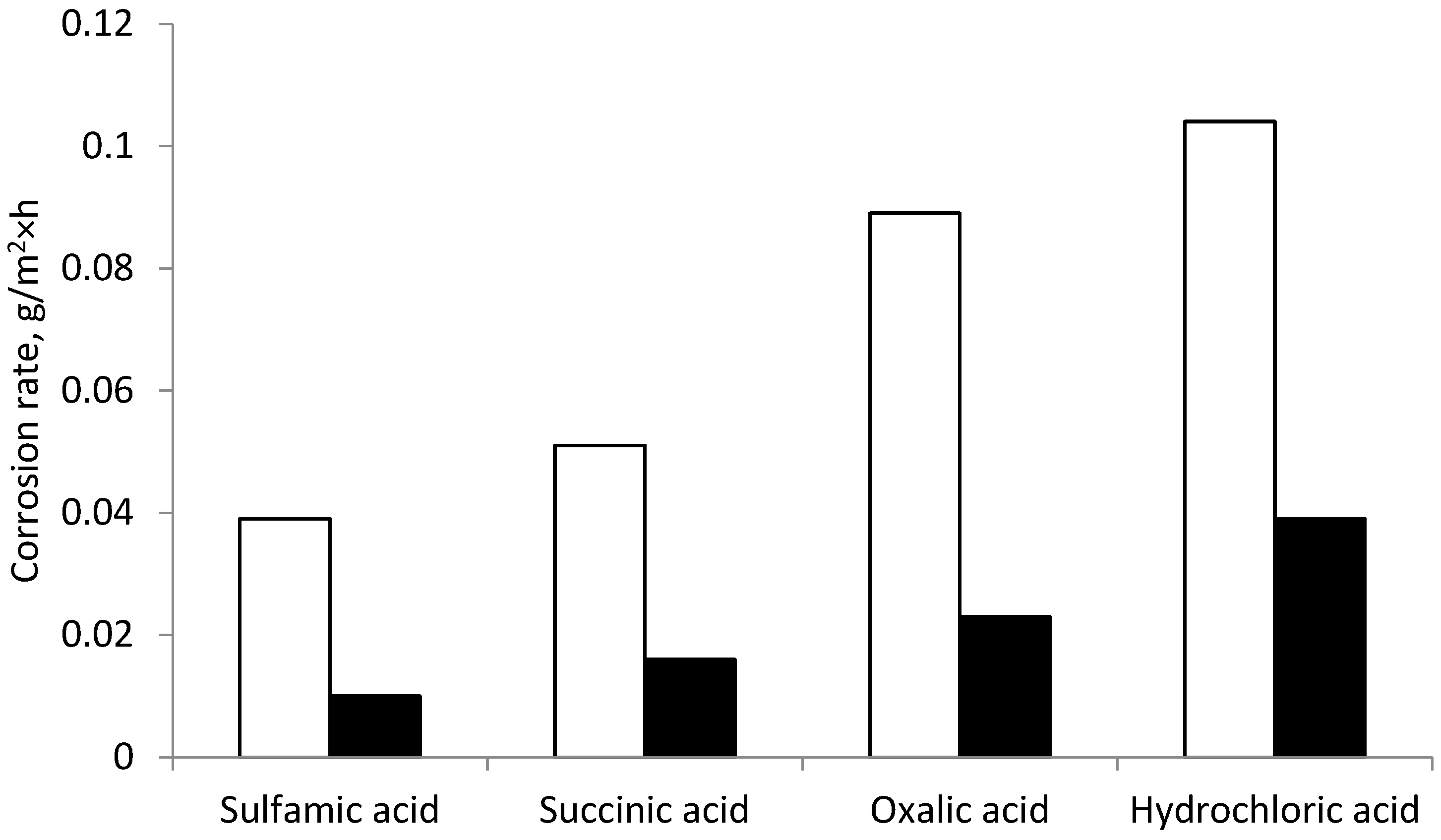
- The highest corrosion rate and corrosion losses were obtained if the surface is activated with hydrochloric acid (corrosion rate = 0.104 g/m2 × h and corrosion losses = 0.13).
- The mixed inhibitor of sodium silicate with tripolyphosphate is more effective than the mono inhibitor of sodium silicate.
- The sodium silicate modulus for the formation of a protective film with the highest quality indicators on the surface of a steel sample is m = 3.
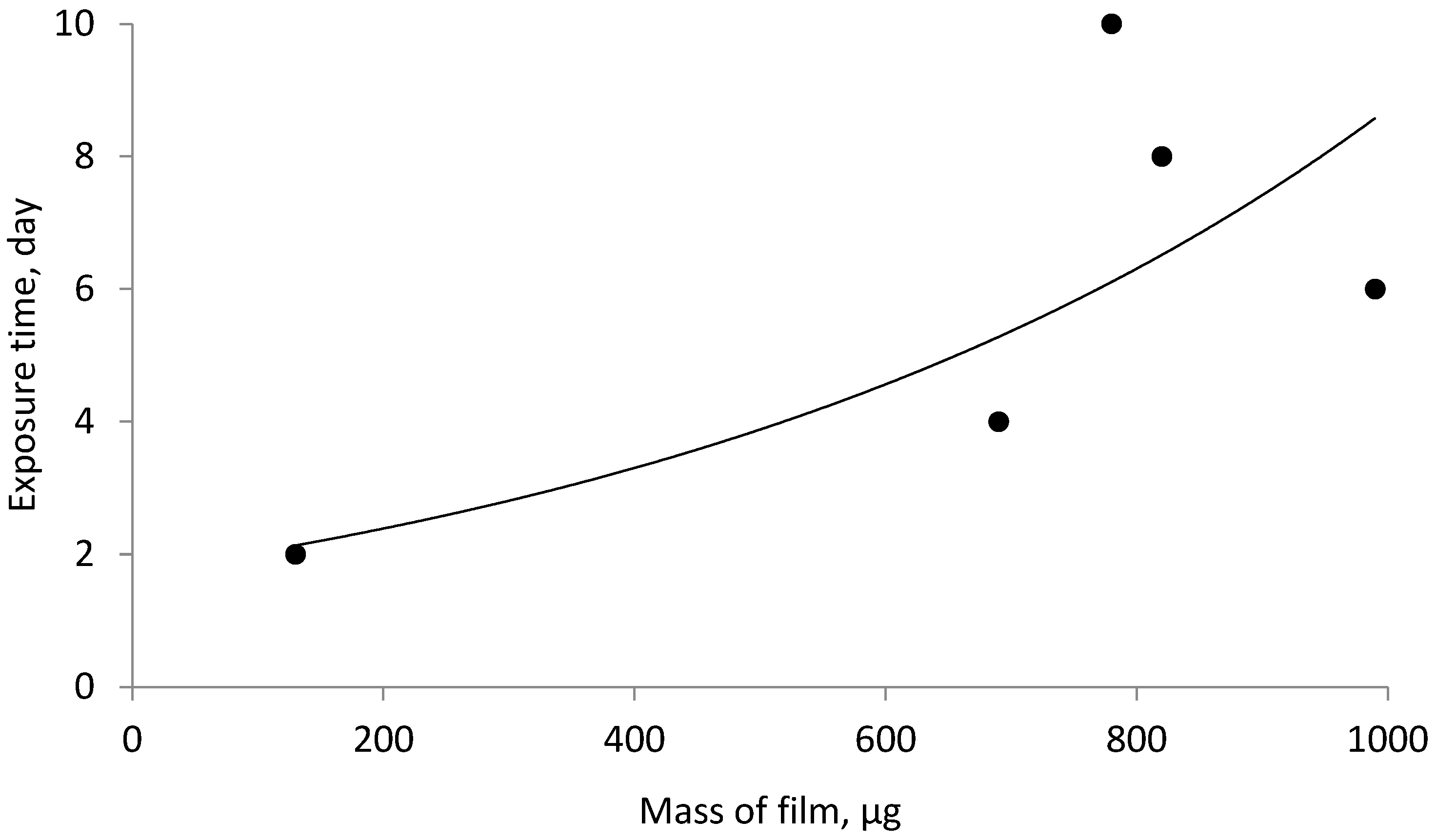
- The effective time for the formation of a protective film on the surface of a steel sample from a mixture of inhibitors is 6 days.
Author Contributions
Funding
Data Availability Statement
Conflicts of Interest
References
- Zhuk, N.P. Course in the Theory of Corrosion and Protection of Metals; Alliance: Moscow, Russia, 2016; 472p. [Google Scholar]
- Kozlova, L.S.; Sibileva, S.V.; Chesnokov, D.V.; Kutyrev, A.E. Corrosion inhibitors (Overview). Aviat. Mater. Technol. 2015, 2, 67–75. [Google Scholar] [CrossRef]
- Kuznetsov, Y.I.; Avdeev, Y.G.; Zel, O.O. Inhibitor of Acid Corrosion of Metals. Patent RF 2539129, 1 October 2015. [Google Scholar]
- Avdeev, Y.G.; Kuznetsov, Y.I. Organic inhibitors of metal corrosion in acid solutions. Features of the mechanism of protective action. J. Phys. Chem. 2023, 97, 305–321. [Google Scholar] [CrossRef]
- Reyzin, B.L.; Strizhevsky, I.V.; Shevelev, F.A. Corrosion and Protection of Municipal Water Pipelines; Stroyizdat: Moscow, Russia, 1979; 398p. [Google Scholar]
- Zhuk, N.P. Corrosion and Protection of Metals: Calculations; Alliance: Moscow, Russia, 2015; 332p. [Google Scholar]
- Sabanov, S.V.; Nikulin, S.A.; Karnavsky, E.L. Determination of the priority of withdrawal to repair of equipment of anti-corrosive protection on the section of the gas pipeline in the conditions of restriction of financing. Pract. Anti-Corros. Prot. 2020, 25, 7–17. [Google Scholar] [CrossRef]
- Aliyeva, L.I.; Afandiyeva, L.M.; Abbasov, V.M.; Rustamly, G.Y.; Akhmedbekova, S.F. The complexes of synthetic and petroleum acids n-derivatives as steel acidic corrosion inhibitors. Pract. Anti-Corros. Prot. 2020, 25, 19–25. [Google Scholar] [CrossRef]
- Teryusheva, S.A. Organic inhibitors of steel corrosion (analytical review of publications). Pract. Anti-Corros. Prot. 2020, 25, 60–65. [Google Scholar] [CrossRef]
- Vigdorovich, V.I.; Tsygaekova, L.E. Inhibition of Hydrogen Sulfide and Carbon Dioxide Corrosion of Metals. Universality of Inhibitors: Monograph; KARTEK: Moscow, Russia, 2011; 244p. [Google Scholar]
- Silin, M.A.; Magadova, L.A.; Davletshina, L.F.; Pakhomov, M.D.; Timerbulatova, Y.M.; Samsonenko, E.A. Research of current corrosion inhibitors action in acid systems. Pract. Anti-Corros. Prot. 2016, 4, 22–30. [Google Scholar]
- Shaker, N.O.; Badr, E.E.; Kandell, E.M. Adsorption and inhibitive properties of fatty imidazoline surfactants on mild steel. Chem. Sin. 2011, 2, 26–35. [Google Scholar]
- Gurbanov, G.R.; Adygezalova, M.B.; Pashaeva, S.M. Study of universal combined inhibitor for oil and gas industry. Izv. Vyssh. Uchebn. Zaved. Khim. Khim. Tekhnol. [Russ. J. Chem. Chem. Tech.] 2020, 63, 78–89. [Google Scholar] [CrossRef]
- Rozenfeld, I.L. Corrosion Inhibitors; McGraw Hill Inc.: New York, NY, USA, 1982; 327p. [Google Scholar]
- Fomenkov, O.A. Study of the Polyfunctionality of a Number of Inhibitors of Hydrogen Sulfide and Carbon Dioxide Corrosion. Ph.D Thesis, Tambov State Technical University, Tambov, Russia, 15 October 2009. [Google Scholar]
- Tsygankova, L.E.; Fomenkov, O.A.; Esina, M.N. Protective properties of inhibitors of hydrogen sulfide and carbon dioxide corrosion. Chem. Chem. Technol. 2009, 52, 66–69. [Google Scholar]
- Ostroukhova, O.I.; Prokin, E.V.; Bezmaternykh, M.A.; Mokrushin, V.S.; Ivanov, M.G. Synthesis and application of polyfluorinated corrosion inhibitors. In Proceedings of the XIV Youth Conference on Organic Chemistry, May 10-14, Ekaterinburg, Russia, 10–14 May 2011; Federal State Autonomous Educational Institution of Higher Professional Education “Ural Federal University Named After the First President of Russia B.N. Yeltsin”: Ekaterinburg, Russia, 2011; pp. 443–445. [Google Scholar]
- Rajabov, Y.N.; Eshmamatova, N.B.; Akbarov, H.I. Defense mechanisms and gravimetric estimation of the effectiveness of inhibitors on the base amino compounds. Univ. Chem. Biol. 2020, 12. Available online: https://7universum.com/ru/nature/archive/item/10939 (accessed on 8 May 2025).
- Kabylbekova, B.; Vysotskaya, N.; Anarbaev, A.; Spabekova, R.; Kurbanbekov, K.; Khussanov, Z.; Kaldybekova, G. Role of Heat Carrier Components in the Formation of Corrosion and Scale Deposits in the Pipes of Heat Supply Systems. Math. Model. Eng. Probl. 2024, 11, 2731–2739. [Google Scholar] [CrossRef]
- Kabylbekova, B.N.; Vysotskaya, N.; Anarbaev, A.; Spabekova, R.; Kurbanbekov, K.; Kaldybekova, G.; Anarbaev, N. The role of inhibitors in the process of forming a protective anti-corrosion film on the steel surface of equipment in heat supply systems. RASĀYAN J. Chem. 2025, 18, 77–85. [Google Scholar] [CrossRef]
- Kholikov, A.Z. Steel Corrosion Inhibitors Based on Phosphorus-Containing Compounds and Polyelectrolytes. Ph.D. Thesis, National Universityn of Uzbekistan, Tashkent, Uzbekistan, 2010. [Google Scholar]
- Atakulova, N.A.; Kholikov, A.Z.; Akbarov, H.I. Anti-corrosion properties of water-soluble two-component inhibitors. Eurasian Union Sci. Chem. Sci. 2014, 10, 81–83. [Google Scholar]
- Kabylbekova, B.N.; Vysotskaya, N.A.; Anarbaev, A.A.; Spabekova, R.S.; Kurbanbekov, K.T.; Kaldybekova, G.M.; Nurman, E. Method of Protection Against Corrosion of the Inner Surface of Metal Pipes in Heat Supply Systems. Patent 9384 RK, 2 April 2024. [Google Scholar]



| C, % | Si, % | Mn, % | P, % | S, % | Cr, % | Ni, % | Cu, % |
|---|---|---|---|---|---|---|---|
| 0.14–0.22 | 0.15–0.30 | 0.40–0.65 | <0.04 | <0.05 | <0.3 | <0.3 | <0.3 |
| Na, mg/L | K, mg/L | Mg, mg/L | Al, mg/L | Ca, mg/L | Mn, mg/L | Fe, mg/L | Zn, mg/L |
|---|---|---|---|---|---|---|---|
| 6.3 | 2.3 | 31.0 | 0.6 | 139.0 | 0.1 | 3.0 | 0.1 |
| Inhibitor, Module Indicator | Inhibitor Concentration, mg/L | Mass of Deposited Film, μg | Standard Deviation of Mass, μg | Visual Indicator of Film Surface on Steel Sample |
|---|---|---|---|---|
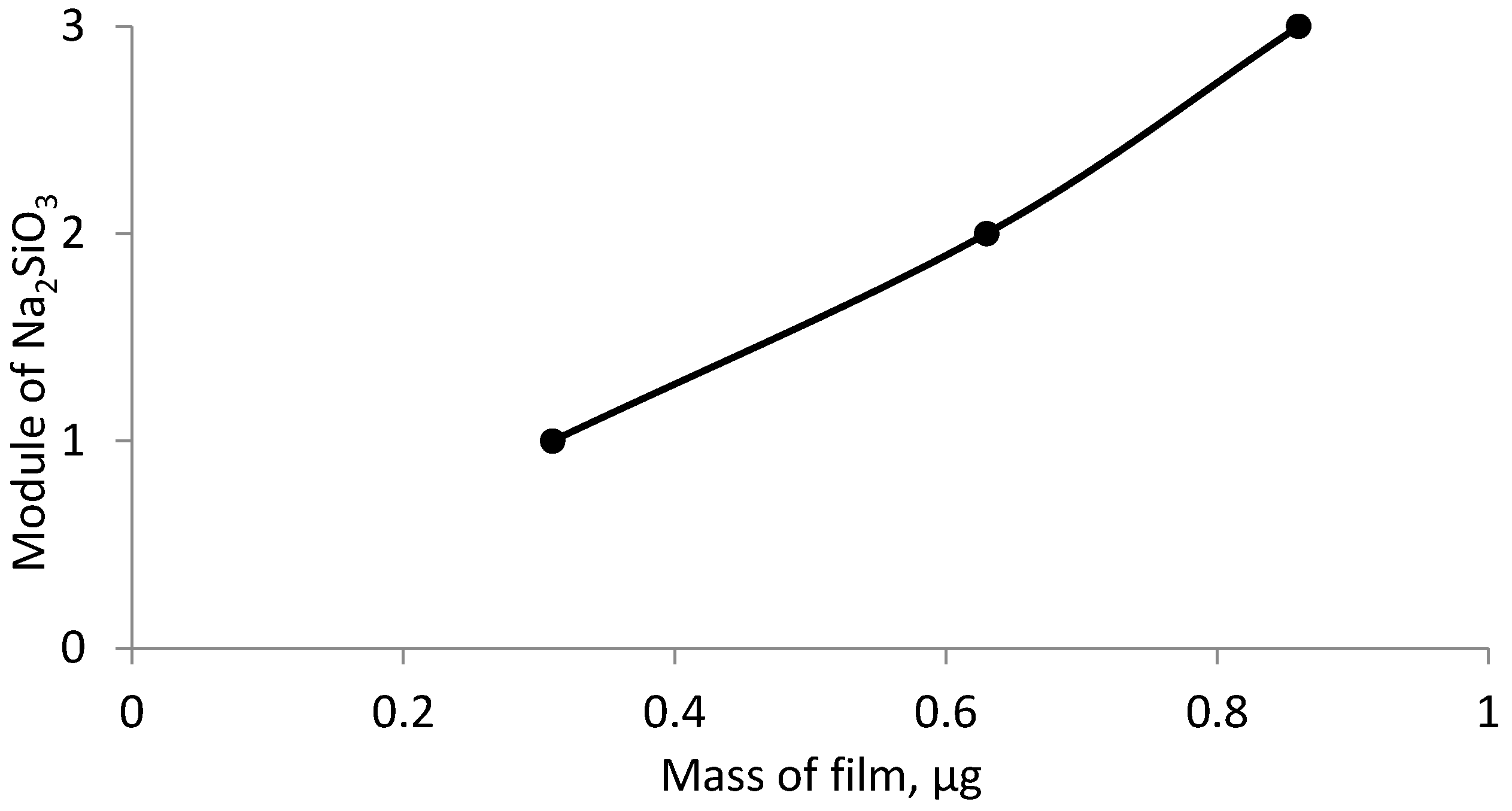
| Na2SiO3 m = 1 | 500 | 0.31 | 0.11 | The surface is dark and covered with dots. |
| Na2SiO3 m = 2 | 500 | 0.63 | 0.14 | The surface is dark, slightly friable. |
| Na2SiO3 m = 3 | 500 | 0.86 | 0.12 | The surface is grey, friable. |
| Inhibitor, Modulus Indicator | Inhibitor Concentration, mg/L | Mass of Deposited Film, μg | Standard Deviation of Mass, μg | Visual Indicator of Film Surface on Steel Sample |
|---|---|---|---|---|
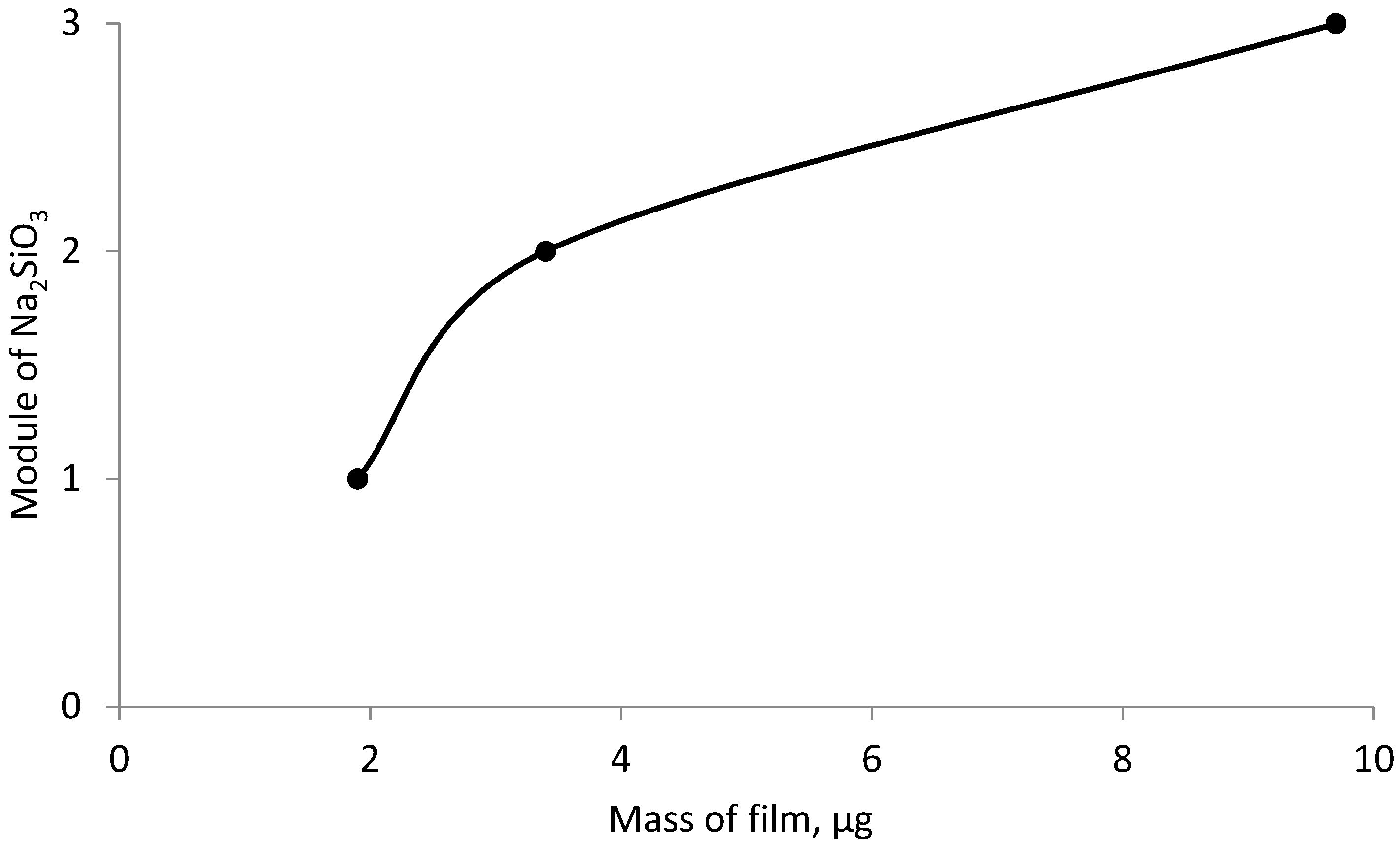
| Na2SiO3 m = 1 | 500 | 1.9 | 0.12 | The surface is dark grey, with ulcers. |
| Na2SiO3 m = 2 | 500 | 3.4 | 0.17 | The surface is grey, with stripes. |
| Na2SiO3 m = 3 | 500 | 9.7 | 0.30 | The surface is gray with dots. |
| Sodium Silicate Modulus Index | Tripolyphosphate Concentration, mg/L | Sodium Silicate Concentration, mg/L | Film Weight, μg | Standard Deviation of Film Weight, μg | Visual Indicator of Film Surface on Steel Sample |
|---|---|---|---|---|---|
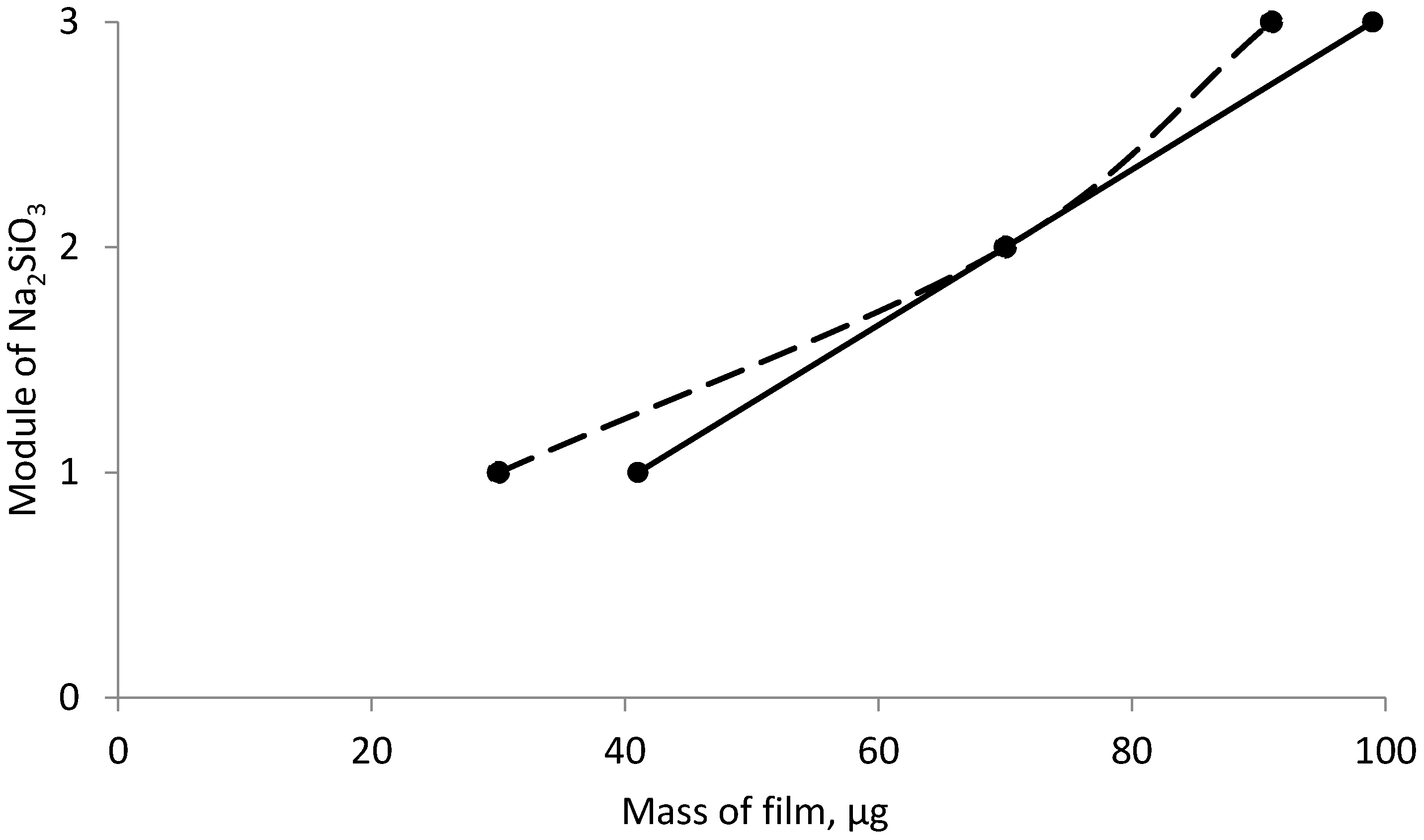
| Na2SiO3 m = 1 | 50 | 100 | 30 | 1.6 | Surface is dark gray |
| Na2SiO3 m = 2 | 50 | 100 | 70 | 3.0 | Surface is gray with roughness |
| Na2SiO3 m = 3 | 50 | 100 | 91 | 3.9 | Surface is light, smooth |
| Sodium Silicate Modulus Index | Tripolyphosphate Concentration, mg/L | Sodium Silicate Concentration, mg/L | Film Weight, μg | Standard Deviation of Film Weight, μg | Visual Indicator of Film Surface on Steel Sample |
|---|---|---|---|---|---|
| Na2SiO3 m = 1 | 50 | 100 | 41 | 2.4 | Surface is dark with dots |
| Na2SiO3 m = 2 | 50 | 100 | 70 | 3.1 | Surface is loose |
| Na2SiO3 m = 3 | 50 | 100 | 99 | 4.1 | Surface is gray with stripes |
| Acid Solutions for Surface Activation | Mass of Iron Removed from the Surface of a Steel Tube, g | Corrosion Rate, g/m2·h | Standard Deviation of Corrosion Rate, g/m2·h | Corrosion Losses, mm/year |
|---|---|---|---|---|
| Sulfamic acid | 0.100 | 0.039 | 0.002 | 0.5·10−3 |
| Succinic acid | 0.126 | 0.051 | 0.003 | 0.7·10−3 |
| Oxalic acid | 0.227 | 0.089 | 0.005 | 0.81·10−3 |
| Hydrochloric acid | 0.252 | 0.104 | 0.004 | 0.13·10−2 |
| Acid Solutions for Surface Activation | Mass of Iron Removed from the Surface of a Steel Tube, g | Corrosion Rate, g/m2·h | Standard Deviation of Corrosion Rate, g/m2·h | Corrosion Losses, mm/year |
|---|---|---|---|---|
| Sulfamic acid | 0.026 | 0.010 | 0.0006 | 0.022·10−3 |
| Succinic acid | 0.041 | 0.016 | 0.0007 | 0.037·10−3 |
| Oxalic acid | 0.058 | 0.023 | 0.0011 | 0.042·10−3 |
| Hydrochloric acid | 0.082 | 0.039 | 0.0019 | 0.058·10−3 |
| Exposure Time, Days | Sodium Tripolyphosphate Concentration, mg/L | Sodium Silicate Concentration, mg/L | Film Weight, μg | Standard Deviation of Film Weight, μg | Visual Indicator of Film Surface on Steel Sample |
|---|---|---|---|---|---|
| 2 | 50 | 100 | 130 | 6.9 | Surface is light |
| 4 | 50 | 100 | 690 | 31.1 | Surface is light |
| 6 | 50 | 100 | 990 | 49.2 | Surface is light |
| 8 | 50 | 100 | 820 | 42.0 | Surface is light |
| 10 | 50 | 100 | 780 | 40.5 | Surface is light |
Disclaimer/Publisher’s Note: The statements, opinions and data contained in all publications are solely those of the individual author(s) and contributor(s) and not of MDPI and/or the editor(s). MDPI and/or the editor(s) disclaim responsibility for any injury to people or property resulting from any ideas, methods, instructions or products referred to in the content. |
© 2025 by the authors. Licensee MDPI, Basel, Switzerland. This article is an open access article distributed under the terms and conditions of the Creative Commons Attribution (CC BY) license (https://creativecommons.org/licenses/by/4.0/).
Share and Cite
Kabylbekova, B.; Vysotskaya, N.; Anarbaev, A.; Spabekova, R.; Kurbanbekov, K.; Kaldybekova, G.; Khussanov, Z. Formation of Films on a Metal Surface by Inhibitors with Assessment of Their Protective Properties. ChemEngineering 2025, 9, 133. https://doi.org/10.3390/chemengineering9060133
Kabylbekova B, Vysotskaya N, Anarbaev A, Spabekova R, Kurbanbekov K, Kaldybekova G, Khussanov Z. Formation of Films on a Metal Surface by Inhibitors with Assessment of Their Protective Properties. ChemEngineering. 2025; 9(6):133. https://doi.org/10.3390/chemengineering9060133
Chicago/Turabian StyleKabylbekova, Balzhan, Nadezhda Vysotskaya, Abibulla Anarbaev, Roza Spabekova, Karim Kurbanbekov, Gulnur Kaldybekova, and Zhakhongir Khussanov. 2025. "Formation of Films on a Metal Surface by Inhibitors with Assessment of Their Protective Properties" ChemEngineering 9, no. 6: 133. https://doi.org/10.3390/chemengineering9060133
APA StyleKabylbekova, B., Vysotskaya, N., Anarbaev, A., Spabekova, R., Kurbanbekov, K., Kaldybekova, G., & Khussanov, Z. (2025). Formation of Films on a Metal Surface by Inhibitors with Assessment of Their Protective Properties. ChemEngineering, 9(6), 133. https://doi.org/10.3390/chemengineering9060133