1. Introduction
The United Kingdom has more than 30.4 million houses as of 2022 [
1]. It is identified that every house will need some level of improvement to meet sustainability goals [
2]. The UK also has a considerable number of poorly energy-efficient non-residential buildings. In terms of the energy performance certificates, 56.2% of the houses in England are below the government expected EPC “C” rating [
3]. Moreover, the building stock of the UK is reported to contribute around 27% of the UK’s operational emissions [
4]. The UK government needs to achieve net zero by 2050 [
5]. The process of improving the performance of buildings can be considered as retrofit. This includes installing energy efficiency measures such as adding insulation, upgrading heating systems, or installing renewables [
6]. In order to bring houses to an EPC “C” rating, there will be a need for 260,000 new workers and 230,000 indirect workers. Another 223,000 existing workers are to be further trained [
7]. The number will increase further when non-residential buildings are considered. Skill shortage has been considered a critical problem in achieving retrofit goals [
8,
9].
PAS 2035:2023 is the current specification governing the retrofit project management in the United Kingdom for residential properties. This is basically a voluntary specification, but mandatory in government-funded projects. The overarching objective of this specification is to ensure the quality delivery of housing retrofit projects and protect the consumers [
6]. The PAS 2035 specification can be considered as a child of the Each Home Counts report in 2016, which made 27 recommendations to ensure the quality of the retrofit industry and manage the risk [
10]. The government took these initiatives due to the widespread criticism of poor housing retrofit delivery earlier, as a number of government-funded retrofit projects failed, and houses suffered from unintended consequences [
11]. PAS 2030 is a sister specification to PAS 2035 to ensure the quality of the installers [
12]. Since the focus of this study is retrofit professionals, installers are out of the scope. While the PAS 2035 is to govern the project management aspects of residential buildings, the PAS 2038 specification is to govern the non-residential projects. The process is similar, but with contextual adaptations [
13]. PAS 2038 defines the roles and sets broader specifications. This can be due to the greater diversity of non-residential buildings compared with the residential buildings.
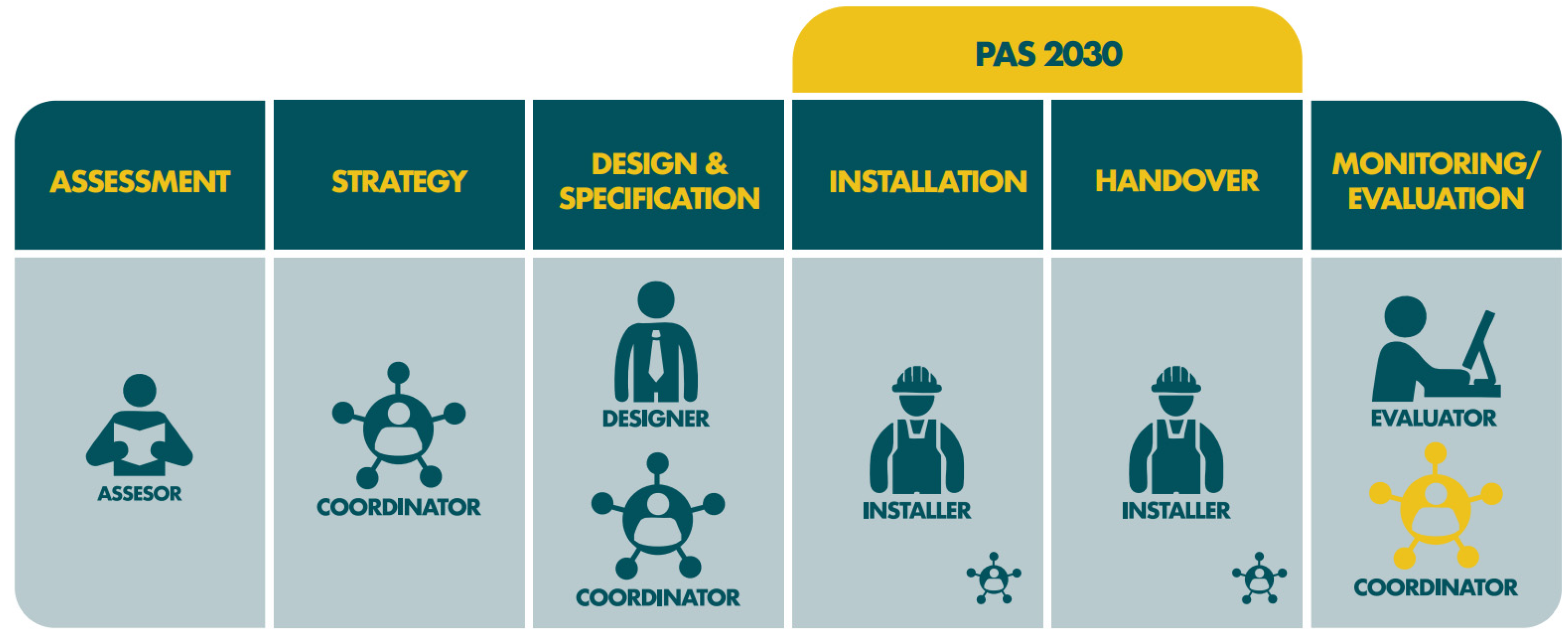
Figure 1 presents the key professional roles involved with the residential retrofit process and the retrofit project phases they are involved in. Although this figure is related to residential retrofit under PAS 2035, the process and the idea are similar for non-residential properties under PAS 2038 specification. PAS 2035:2023 identifies five roles. There was a separate retrofit advisor role in the 2021 version of PAS 2035. Still, the retrofit advisory role is an important aspect of the overall project delivery. The retrofit advisor role is to be delivered by any professional or even by an installer, according to the new version. The first one is the “retrofit assessor”. The existing domestic energy assessors are trained for this purpose. The role of assessors is to record the existing condition of the property and the occupancy. A retrofit assessor shall have the domestic energy assessor’s qualifications for this purpose [
6]. For non-commercial buildings, there should be a non-domestic energy assessor qualification [
13]. There is a new complementary British standard for retrofit assessment, namely the BS 40104 Assessment of Dwellings for Retrofit [
14]. This standard will outline the standard process of retrofit assessments.
Apart from the regular retrofit assessment role, there can be specific requirements of property assessments, such as thermography or air tightness testing. These additional tests are recommended when a usual retrofit assessment is not sufficient to make a proper assessment of the property for retrofit options [
6]. The industry will need these professionals to support the retrofit journey. Another professional role is the retrofit coordinator. To become a retrofit coordinator, a person should have a level 4 qualification related to construction or a level 3 construction-related qualification and five years of experience, in addition to the level 5 retrofit coordinator qualification. The role of the retrofit coordinator is to determine the retrofit measures, their sequences, risk management, and overall project management [
6]. The basic duty of a retrofit coordinator is to deliver the project according to the PAS 2035:2023 specification. There is no specific retrofit coordinator role for non-residential projects under the PAS 2038 specification. A lead professional role is required to be appointed according to the key priority of the project to manage the overall project. For example, if the priority is ventilation, an HVAC engineer can take the lead, or if the priority is aesthetics, an architect can take the lead in the lead professional role [
13].
Another essential role in retrofit delivery is the retrofit designer. The retrofit designer designs retrofit measures. According to PAS 2035:2023, a retrofit designer should have a professional body membership such as CIAT, RIBA, RICS, or CIOB. Furthermore, proprietary solutions can develop their own designs [
6]. There are separate retrofit designer courses also available, as the role of retrofit designer requires additional expertise due to the characteristics of the retrofit industry. The Passivhaus Institute has Passivhaus designer courses available for retrofit designers. Although not explicitly focused on retrofit, retrofit is a part of Passivhaus designs [
16]. Passivhaus is a proven and well-known certification method for houses for their energy efficiency. Their certification for housing retrofit is called “Passivhaus Enerphit” and the way of design claims a highly energy-efficient retrofit [
17]. This means the technology for retrofit is already there.
Another area of retrofit education is related to the retrofit installers. According to PAS 2035:2023, the retrofit installers should have the right qualifications or proprietary system training to install the measures. The retrofit coordinator must ensure that all the installers have relevant qualifications [
6]. It has been noted that the poor workmanship of the retrofit industry has created considerable issues in the past [
18]. The retrofit installers are required to be certified by TrustMark, which is the government-endorsed quality assurance scheme for retrofit installers [
19]. Apart from TrustMark, there can be other proprietary certification schemes recognised under PAS 2035:2023 specification. One example is the Micro Generation Certification (MCS) scheme, which covers renewable energy, heat pumps, and some other installations [
20].
The Royal Institute of Chartered Surveyors (RICS) has published a retrofit standard, and they have proposed a retrofit contract administrator [
21]. The PAS 2035:2023 is silent about retrofit procurement [
6]. Ideally, it is a call to make on whether there should be a separate retrofit contract administrator role or to include it in the scope of the retrofit coordinator. There is another role called a retrofit evaluator. This role can be performed by a retrofit assessor or coordinator, and there are no specific courses related to this now. Apart from the usual roles under the PAS 2035:2023, there are industry-wide qualifications associated with retrofitting buildings [
6]. An example of this is the level 3 qualification—the energy efficiency of older and traditional buildings is a prerequisite to work on as they are historically significant properties. Although not directly accredited under PAS 2035:2023, there are several other courses in the industry to support retrofit delivery. For example, the AECB Carbonlite retrofit coordinator [
22].
The industry has already developed several qualifications for these roles. Furthermore, different retrofit-related services have their own courses, such as Passivhaus designer certification or air tightness testing. At the university level, there are no direct retrofit bachelor’s or master’s programmes in the UK. The available courses are generic, leading to multiple career paths. The students will have to take a number of further qualifications to become retrofit professionals. This would discourage people from entering the retrofit industry. This study aims to review the existing retrofit educational programmes and make further recommendations for a university master’s programme for retrofit.
2. Materials and Methods
Considering the purpose of aligning retrofit education for university-level master’s programmes, the syllabuses of the existing retrofit-related courses were reviewed to identify the main themes. Namely, the level 3 award in domestic retrofit advice, the level 3 award in domestic energy assessment, the level 4 award in non-domestic energy assessment, the level 3 award in energy efficiency for older and traditional buildings (ABBE and NOCN), the level 3 award for retrofit assessors, the level 5 award in retrofit coordination and risk assessment/management (ABBE and NOCN), the AECB Carbonlite retrofit coordinator course [
22], and the retrofit designer course by the Retrofit Academy [
23]. The syllabuses of these courses can be found through the respective citations.
Table 1 shows the retrofit related syllabuses used for this analysis. AIM, ABBE, NOCN, and AECB are the institutions offering these qualifications. They are detailed in the abbreviations. These qualifications cover the retrofit professionals according to PAS 2035:2023 [
6] and PAS 2038:2021 [
13]. The first course is an introduction to retrofit, with a focus on enhancing the knowledge to be a retrofit advisor. A domestic energy assessor can issue energy performance certificates (EPCs) for a residential building. EPC reports are required for new builds and existing houses when they are rented or sold [
24]. Furthermore, most of the government grant programmes, such as the Warm Homes scheme or the Energy Company Obligation, measure energy efficiency through EPC reports [
25,
26]. The retrofit assessor course is a top-up programme for domestic energy assessors. There is another level 4 qualification for non-domestic energy assessors. Non-domestic energy assessors can issue energy performance reports to non-residential buildings. They are trained to be retrofit assessors for non-residential buildings [
13]. When the particular property has a historical significance, the energy assessor or retrofit assessor should have completed the level 3 award on Energy Efficiency for Older and Traditional Buildings under the standard BS 7913:2013 Guide to the Conservation of Historic Buildings [
27].
Retrofit coordinators should have the level 5 award in retrofit coordination and risk management course. Accordingly, this course is an essential part of the analysis. Furthermore, the AECB Carbonlite retrofit coordinator course syllabus was considered. This retrofit coordinator course was started separately in response to PAS 2035 [
22]. Later, it was merged with the retrofit coordinator mainstream qualification. For the role of the retrofit designer, it is only required to have a professional recognition to become a retrofit designer. However, retrofit design is a separate set of skills and knowledge. The Retrofit Academy developed a retrofit designer course to address this shortfall [
23]. Currently, it is the only qualification found in relation to retrofit design. Passivhaus certification was not considered as it covers a different scope, going beyond the academic focus. The syllabuses of these qualifications were thematically analysed to design a syllabus for the proposed retrofit master’s programme.
4. Discussion
The potential students for a retrofit master’s programme can be from mainly architectural, civil/mechanical/electrical engineering, building surveying, project management, quantity surveying, and commercial management bachelor’s educational backgrounds. As far as the retrofit industry market requirements are concerned, two pathways can be identified: one is the retrofit coordinator pathway and the other is the retrofit designer pathway. Accordingly, there shall be two specialisations: a master’s in retrofit—project management specialisation and a master’s in retrofit—and an architectural design specialisation. In this scenario, the students who will complete these courses should directly receive the accreditation from either the retrofit coordinator or the retrofit designer. For the retrofit coordinator specialisation, the course content can be validated by TrustMark [
19]. For the retrofit designer specialisation, the course content can be validated by the Chartered Institute of Architectural Technologists—CIAT [
37]—or a similar professional organisation.
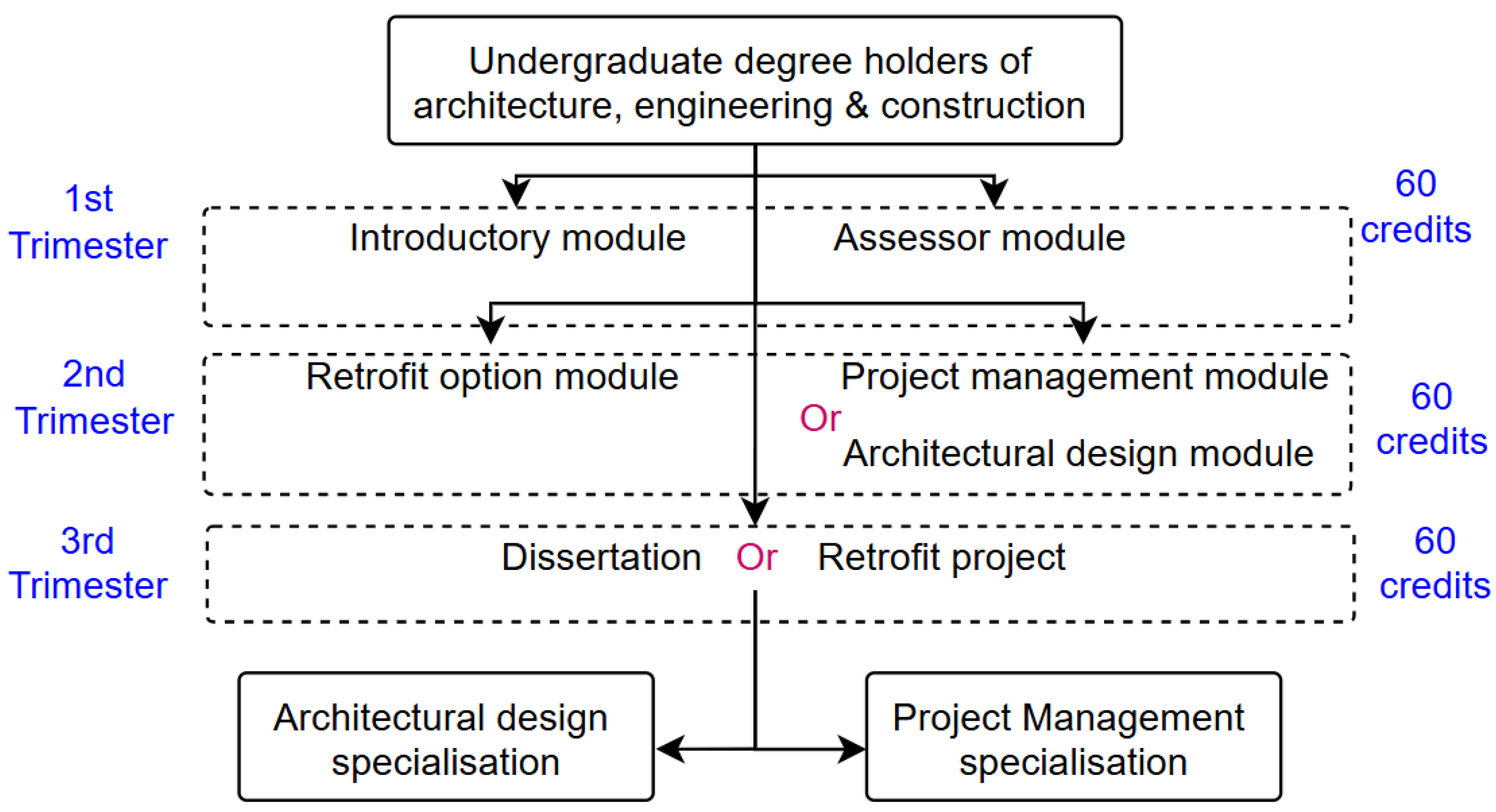
The university shall decide who can follow which specialisation. Basically, architectural and civil/mechanical/electrical engineering students can be directly considered for the architectural design specialisation, and others can be considered for project management specialisation. Considering the above review of the syllabuses of retrofit-related qualifications and the proposed modules, a structure for a university master’s programme can be recommended as follows. The recommendation is based on a three-trimester programme with a total number of 180 credits. Considering the usual model of a UK master’s programme, there will be two modules for each trimester, with 30 credits each and the final trimester is proposed to be reserved for the dissertation or a project with 60 credits.
Figure 2 presents the proposed structure of the modules for the proposed master’s programme in retrofit. The programme can be delivered full-time or part-time, depending on the requirements of the students. The part-time option can be valuable for students who are already working in the industry. The assessment of the modules is required to be developed to test the student’s competence under retrofit roles. Some of the suggestions for assessments can be given as case study reports, retrofit designs, retrofit project proposals, and target energy efficiency modelling activities. Once the selected four modules are delivered according to the specialisations, a dissertation or retrofit project is recommended for the final trimester.
The purpose of the dissertation is to enable students to undertake an academic inquiry into the problem in the context. This will be important, especially for students who wish to stay in academia or public policy. The dissertation should be related to retrofit. It will develop the research skills of the students and contribute to generating new knowledge. The students in the industry can do a final project to put all their learning to the test. Considering the nature of retrofit projects, multi-disciplinary projects may not be suitable to students with other master’s programmes in the built environment. Students in the same programme with different specialisations can jointly conduct projects. For example, architectural design specialisation students can focus on the architectural aspects of the project, while the project management specialisation students can have a project management focus. Even in the industry, both the retrofit designers and retrofit coordinators will have to work together on the same project. The possibility of sharing modules with the other master’s programmes can be evaluated at the point of course validation.
The students will first learn a module, in which they will be introduced to retrofit. The assessor module provides knowledge about the retrofit assessment, which will set the scene for understanding the concepts of retrofit. These will be the two modules for the first trimester, and they will be mandatory modules. The second trimester will have a mandatory retrofit option module. The next module will be decided according to the specialisation: project management or architectural design. The final trimester should have either a dissertation project or a retrofit project.
Apart from the academic contents, the programme must comply with the University’s equality, diversity, and inclusion considerations. Since the programme is more related to industry than academia, the programme will benefit from input from industry experts. This can include guest lectures, site visits, and demonstrations. Furthermore, the staff will also need experience and qualifications related to the retrofit industry. The university library support and IT support with the required software, such as IESVE, Designbuilder, RdSAP, PHPP or PAS Hub, will also be necessary to deliver this programme. Although the programme is more industry focused, there are no barriers to delivering the programme fully online if required. Most of the courses analysed for this study are delivered both in-person and online.