Study Protocol

A Proposal for a Retrofit Master’s Degree in University Education: Bridging the Skill Gap

School of Science, Engineering and Environment, University of Salford, 43 Crescent, Salford M5 4WT, UK
*
Author to whom correspondence should be addressed.
Standards 2026, 6(1), 3; https://doi.org/10.3390/standards6010003
Submission received: 22 September 2025 / Revised: 4 December 2025 / Accepted: 17 December 2025 / Published: 25 December 2025

Abstract

Retrofitting the UK building stock is a key priority due to the importance of achieving sustainability goals, preferably before 2050. This goal will not be achieved without reducing energy consumption and making houses more comfortable, healthier, and cheaper to heat. One of the key challenges of building retrofit is skill shortage. The retrofit industry will need a number of professionals under the roles of retrofit assessors, coordinators, and designers. However, the existing university programmes do not directly produce retrofit professionals. Most construction-related university programmes do not emphasise or introduce retrofits. To address this skill shortage, this paper proposes a master’s programme in retrofit, which is directly aimed at producing retrofit professionals. Two specialisations are recommended under the master’s programme, namely architectural design and project management, with accreditations from relevant professional bodies. The objective is to produce a market-ready graduate who can be directly employed as a retrofit assessor, coordinator, or designer. Ten syllabuses related to retrofit professional courses were analysed to design the syllabus of the proposed master’s programme. The master’s programme will help to produce industry-ready retrofit professionals through either physical or online delivery methods.

1. Introduction

The United Kingdom has more than 30.4 million houses as of 2022 [1]. It is identified that every house will need some level of improvement to meet sustainability goals [2]. The UK also has a considerable number of poorly energy-efficient non-residential buildings. In terms of the energy performance certificates, 56.2% of the houses in England are below the government expected EPC “C” rating [3]. Moreover, the building stock of the UK is reported to contribute around 27% of the UK’s operational emissions [4]. The UK government needs to achieve net zero by 2050 [5]. The process of improving the performance of buildings can be considered as retrofit. This includes installing energy efficiency measures such as adding insulation, upgrading heating systems, or installing renewables [6]. In order to bring houses to an EPC “C” rating, there will be a need for 260,000 new workers and 230,000 indirect workers. Another 223,000 existing workers are to be further trained [7]. The number will increase further when non-residential buildings are considered. Skill shortage has been considered a critical problem in achieving retrofit goals [8,9].
PAS 2035:2023 is the current specification governing the retrofit project management in the United Kingdom for residential properties. This is basically a voluntary specification, but mandatory in government-funded projects. The overarching objective of this specification is to ensure the quality delivery of housing retrofit projects and protect the consumers [6]. The PAS 2035 specification can be considered as a child of the Each Home Counts report in 2016, which made 27 recommendations to ensure the quality of the retrofit industry and manage the risk [10]. The government took these initiatives due to the widespread criticism of poor housing retrofit delivery earlier, as a number of government-funded retrofit projects failed, and houses suffered from unintended consequences [11]. PAS 2030 is a sister specification to PAS 2035 to ensure the quality of the installers [12]. Since the focus of this study is retrofit professionals, installers are out of the scope. While the PAS 2035 is to govern the project management aspects of residential buildings, the PAS 2038 specification is to govern the non-residential projects. The process is similar, but with contextual adaptations [13]. PAS 2038 defines the roles and sets broader specifications. This can be due to the greater diversity of non-residential buildings compared with the residential buildings.
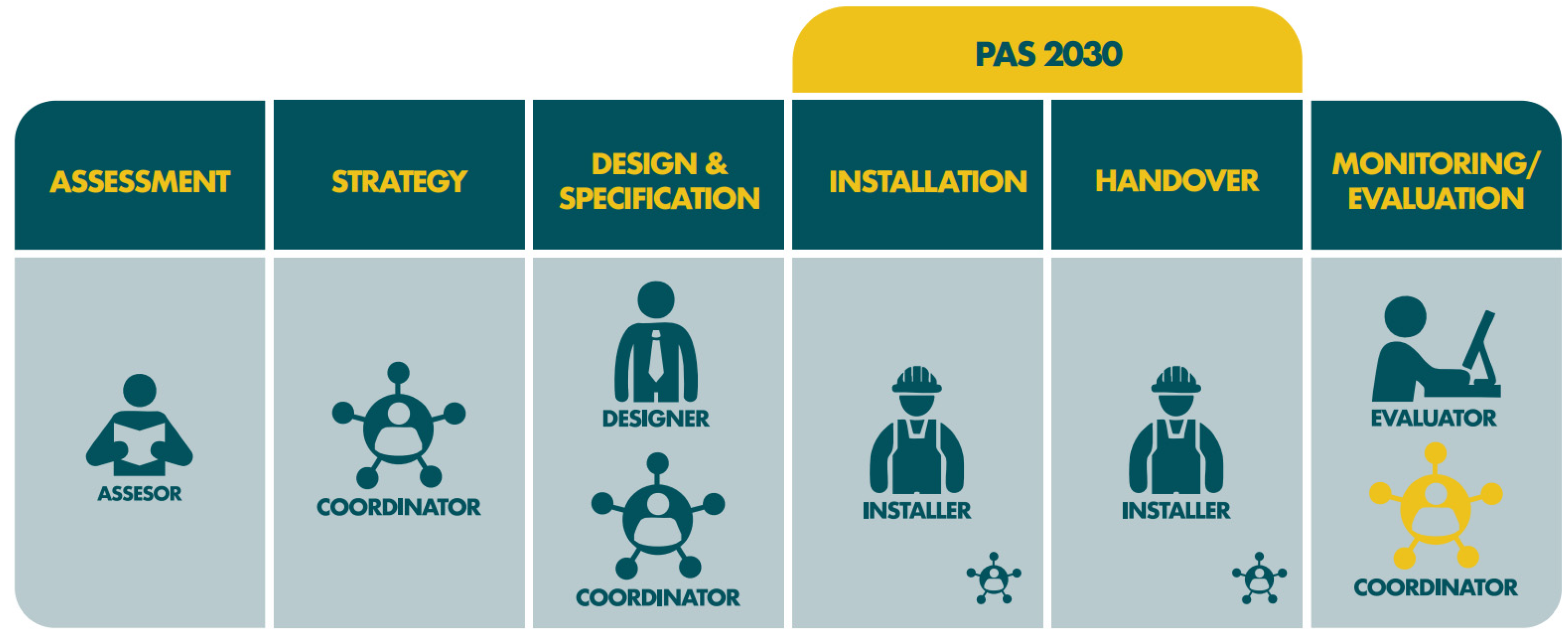
Figure 1 presents the key professional roles involved with the residential retrofit process and the retrofit project phases they are involved in. Although this figure is related to residential retrofit under PAS 2035, the process and the idea are similar for non-residential properties under PAS 2038 specification. PAS 2035:2023 identifies five roles. There was a separate retrofit advisor role in the 2021 version of PAS 2035. Still, the retrofit advisory role is an important aspect of the overall project delivery. The retrofit advisor role is to be delivered by any professional or even by an installer, according to the new version. The first one is the “retrofit assessor”. The existing domestic energy assessors are trained for this purpose. The role of assessors is to record the existing condition of the property and the occupancy. A retrofit assessor shall have the domestic energy assessor’s qualifications for this purpose [6]. For non-commercial buildings, there should be a non-domestic energy assessor qualification [13]. There is a new complementary British standard for retrofit assessment, namely the BS 40104 Assessment of Dwellings for Retrofit [14]. This standard will outline the standard process of retrofit assessments.
Apart from the regular retrofit assessment role, there can be specific requirements of property assessments, such as thermography or air tightness testing. These additional tests are recommended when a usual retrofit assessment is not sufficient to make a proper assessment of the property for retrofit options [6]. The industry will need these professionals to support the retrofit journey. Another professional role is the retrofit coordinator. To become a retrofit coordinator, a person should have a level 4 qualification related to construction or a level 3 construction-related qualification and five years of experience, in addition to the level 5 retrofit coordinator qualification. The role of the retrofit coordinator is to determine the retrofit measures, their sequences, risk management, and overall project management [6]. The basic duty of a retrofit coordinator is to deliver the project according to the PAS 2035:2023 specification. There is no specific retrofit coordinator role for non-residential projects under the PAS 2038 specification. A lead professional role is required to be appointed according to the key priority of the project to manage the overall project. For example, if the priority is ventilation, an HVAC engineer can take the lead, or if the priority is aesthetics, an architect can take the lead in the lead professional role [13].
Another essential role in retrofit delivery is the retrofit designer. The retrofit designer designs retrofit measures. According to PAS 2035:2023, a retrofit designer should have a professional body membership such as CIAT, RIBA, RICS, or CIOB. Furthermore, proprietary solutions can develop their own designs [6]. There are separate retrofit designer courses also available, as the role of retrofit designer requires additional expertise due to the characteristics of the retrofit industry. The Passivhaus Institute has Passivhaus designer courses available for retrofit designers. Although not explicitly focused on retrofit, retrofit is a part of Passivhaus designs [16]. Passivhaus is a proven and well-known certification method for houses for their energy efficiency. Their certification for housing retrofit is called “Passivhaus Enerphit” and the way of design claims a highly energy-efficient retrofit [17]. This means the technology for retrofit is already there.
Another area of retrofit education is related to the retrofit installers. According to PAS 2035:2023, the retrofit installers should have the right qualifications or proprietary system training to install the measures. The retrofit coordinator must ensure that all the installers have relevant qualifications [6]. It has been noted that the poor workmanship of the retrofit industry has created considerable issues in the past [18]. The retrofit installers are required to be certified by TrustMark, which is the government-endorsed quality assurance scheme for retrofit installers [19]. Apart from TrustMark, there can be other proprietary certification schemes recognised under PAS 2035:2023 specification. One example is the Micro Generation Certification (MCS) scheme, which covers renewable energy, heat pumps, and some other installations [20].
The Royal Institute of Chartered Surveyors (RICS) has published a retrofit standard, and they have proposed a retrofit contract administrator [21]. The PAS 2035:2023 is silent about retrofit procurement [6]. Ideally, it is a call to make on whether there should be a separate retrofit contract administrator role or to include it in the scope of the retrofit coordinator. There is another role called a retrofit evaluator. This role can be performed by a retrofit assessor or coordinator, and there are no specific courses related to this now. Apart from the usual roles under the PAS 2035:2023, there are industry-wide qualifications associated with retrofitting buildings [6]. An example of this is the level 3 qualification—the energy efficiency of older and traditional buildings is a prerequisite to work on as they are historically significant properties. Although not directly accredited under PAS 2035:2023, there are several other courses in the industry to support retrofit delivery. For example, the AECB Carbonlite retrofit coordinator [22].
The industry has already developed several qualifications for these roles. Furthermore, different retrofit-related services have their own courses, such as Passivhaus designer certification or air tightness testing. At the university level, there are no direct retrofit bachelor’s or master’s programmes in the UK. The available courses are generic, leading to multiple career paths. The students will have to take a number of further qualifications to become retrofit professionals. This would discourage people from entering the retrofit industry. This study aims to review the existing retrofit educational programmes and make further recommendations for a university master’s programme for retrofit.

2. Materials and Methods

Considering the purpose of aligning retrofit education for university-level master’s programmes, the syllabuses of the existing retrofit-related courses were reviewed to identify the main themes. Namely, the level 3 award in domestic retrofit advice, the level 3 award in domestic energy assessment, the level 4 award in non-domestic energy assessment, the level 3 award in energy efficiency for older and traditional buildings (ABBE and NOCN), the level 3 award for retrofit assessors, the level 5 award in retrofit coordination and risk assessment/management (ABBE and NOCN), the AECB Carbonlite retrofit coordinator course [22], and the retrofit designer course by the Retrofit Academy [23]. The syllabuses of these courses can be found through the respective citations.
Table 1 shows the retrofit related syllabuses used for this analysis. AIM, ABBE, NOCN, and AECB are the institutions offering these qualifications. They are detailed in the abbreviations. These qualifications cover the retrofit professionals according to PAS 2035:2023 [6] and PAS 2038:2021 [13]. The first course is an introduction to retrofit, with a focus on enhancing the knowledge to be a retrofit advisor. A domestic energy assessor can issue energy performance certificates (EPCs) for a residential building. EPC reports are required for new builds and existing houses when they are rented or sold [24]. Furthermore, most of the government grant programmes, such as the Warm Homes scheme or the Energy Company Obligation, measure energy efficiency through EPC reports [25,26]. The retrofit assessor course is a top-up programme for domestic energy assessors. There is another level 4 qualification for non-domestic energy assessors. Non-domestic energy assessors can issue energy performance reports to non-residential buildings. They are trained to be retrofit assessors for non-residential buildings [13]. When the particular property has a historical significance, the energy assessor or retrofit assessor should have completed the level 3 award on Energy Efficiency for Older and Traditional Buildings under the standard BS 7913:2013 Guide to the Conservation of Historic Buildings [27].
Retrofit coordinators should have the level 5 award in retrofit coordination and risk management course. Accordingly, this course is an essential part of the analysis. Furthermore, the AECB Carbonlite retrofit coordinator course syllabus was considered. This retrofit coordinator course was started separately in response to PAS 2035 [22]. Later, it was merged with the retrofit coordinator mainstream qualification. For the role of the retrofit designer, it is only required to have a professional recognition to become a retrofit designer. However, retrofit design is a separate set of skills and knowledge. The Retrofit Academy developed a retrofit designer course to address this shortfall [23]. Currently, it is the only qualification found in relation to retrofit design. Passivhaus certification was not considered as it covers a different scope, going beyond the academic focus. The syllabuses of these qualifications were thematically analysed to design a syllabus for the proposed retrofit master’s programme.

3. Results

3.1. Themes of Retrofit Education

By reviewing the syllabuses of these courses, twenty study areas were identified under five themes. They can be considered as the modules of the proposed master’s programme. In general, these study areas cover the scope of the professional roles of the PAS 2035:2023 specification: retrofit assessor, retrofit coordinator, retrofit designer, and retrofit evaluator. Furthermore, the scope is expected to cover the scope of BS 7913: Guide to the Conservation of Historic Buildings. This is the British standard and the best practice guidance which needs to be followed when working with buildings with historical significance [6]. The contents of the non-domestic energy assessment and project management specification for non-residential buildings, namely PAS 2038: 2021, were also considered [13].
Table 2 shows the proposed modules for the programme. Although the PAS 2038 for non-residential retrofit was referred to and introduced in the first module, there will not be any deliverables in any of the modules. The level of complexity involved with non-residential retrofit is assumed to be out of the scope for the proposed master’s programme. According to the suggested approach, a student will have to complete a non-domestic energy assessment course separately to work with non-residential retrofits. This will not be a key issue as it is unlikely for a master level student to work as a professional non-domestic energy assessor. There are three mandatory modules and two optional modules proposed. The mandatory modules will give the common competence to work in the retrofit industry, and they will help the students to become a retrofit assessor or advisor. (The overall purpose is not to produce retrofit assessors, but to give the understanding of the role of the assessors to the students. This will allow them to do professional retrofit assessments if there is a need.)
The optional modules are required to be decided according to the background of the student. There are two pathways observed: retrofit coordinator and retrofit designer. Since these two pathways have distinct differences, a student can choose to become either a retrofit coordinator or a retrofit designer. The fourth and fifth modules were designed to help the students in these specialisations. The outline of the programme is further discussed under the discussion section.

3.2. Mandatory Introductory Module

This will be the ideal first module. This module will introduce retrofit to the students. The understanding gained from this module will help the students to proceed with the other modules. There are four areas focused on under this module.
Table 3 presents an overall picture of the introductory module of the proposed retrofit master’s programme. The overall purpose of this module is to give an idea about retrofitting buildings. In this module, the need and justification for retrofit will be discussed. The regulations, standards, certifications, and other tools related to retrofit will also be introduced. Case studies are required to give an understanding of the practical situation related to retrofit. This can include a site visit if possible. The knowledge of building physics needs to be conveyed. In general, the introductory module can focus on both residential and non-residential buildings. At the end of this module, the student can be expected to become a qualified retrofit advisor who has a sound understanding of retrofit.

3.3. Mandatory Assessor Module

This will be the ideal second module for the students. While having an introductory knowledge about retrofit with the first module, they can proceed for an assessor role by delving further into the subject. Four areas of recommended study are given below. Considering the practical scope, only residential buildings will be focused on.
Table 4 presents the study areas for the second module. This module will focus on the knowledge required to do retrofit assessments. Adaptation, re-use, defects, repair, and maintenance knowledge will broaden the understanding a student has about the properties related to retrofit. Furthermore, the retrofit assessor’s role will be taught. Heritage and conservation knowledge should also be delivered. It is recommended for the retrofit assessment study area to be aligned with the standard for the PAS 2035 retrofit assessor role under BS 40104 Retrofit Assessment for Domestic Dwellings, as well as the heritage and conservation study area to be aligned with the standard for the BS 7913 Guide to the conservation of historic buildings. Accordingly, opportunities can be sought to give accreditation for the domestic energy assessor role, the retrofit assessor role, and the heritage significance assessor (BS 7913) role.

3.4. Mandatory Retrofit Options Module

The third module is to give students a thorough understanding of the retrofit options and their interdependence. There are 41 retrofit measures outlined in the PAS 2035 specification. The retrofit professionals should have a good understanding of these measures, including how they interact with each other.
Table 5 presents the outline of the third module. This is also a mandatory module for all students. Considering the importance of air tightness and ventilation in retrofit, this will be taught first. The retrofit measures are taught in the second and third study areas of the module. Finally, the design of retrofit measures under the whole-house approach will be taught. This includes the interdependence of the measures and the sequencing of measures. The outcome of this module is to give knowledge on how to do an improvement option evaluation, leading to a medium-term plan [6]. The improvement option evaluation comes under the scope of the retrofit coordinator under PAS 2035. However, having the idea of the process (and the outcome of the medium-term plan) is essential to any retrofit professional in the process. This module and the previous two modules will be mandatory modules for all students of the programme.

3.5. Optional Project Management Module

There are two specialisations proposed under this master’s programme. The first specialisation is the retrofit coordination. Students who choose this specialisation shall pick the project management module. This module outlines the retrofit coordinator’s role under PAS 2035.
Table 6 shows the content for the project management module. The project management module is only for students who wish to become retrofit coordinators (or project managers). Ideally, these students should be able to be accredited as retrofit coordinators under PAS 2035. It is important to ensure the content is aligned with the PAS 2035 retrofit coordinator role and to obtain the prior endorsement from TrustMark. Managing stakeholders and delivering work professionally are important aspects for a retrofit coordinator. Furthermore, ensuring the retrofit project is delivered under PAS 2035 will be a main requirement. The study areas of risk management, health and safety, commissioning, and evaluation are the job responsibilities of the retrofit coordinator. Another suggested accreditation is the membership of the Association for Project Management (APM) in the United Kingdom. This is the recognised professional body for project managers in the UK [36].
The retrofit coordinator qualification is a level 5 course under the qualification framework of England, Wales and Northern Ireland on a scale of zero to eight [34]. Since the master’s degree is positioned at level 7, it can be argued why someone should do a master’s degree to become a retrofit coordinator and why they cannot follow the three-month level 5 qualification at a fraction of the cost. From one point of view, the role of a retrofit coordinator is the point of entry to the retrofit industry for them. They can advance further in their career with a master’s degree compared to someone with a level 5 award. From another point of view, this is a matter of supply and demand. The UK needs people to retrofit its over 30 million housing stock within the next twenty-five years.

3.6. Optional Architectural Design Module

This is also an optional module. Students from design backgrounds can choose this module to become retrofit designers. They will learn the design-related areas for retrofit. The purpose of the module is to scale up existing designers to competent retrofit designers under PAS 2035.
Table 7 shows the contents of the architectural design module. The students who have chosen the architectural design specialisation can choose this module instead of the project management module. According to PAS 2035, a retrofit designer can be anyone with a professional membership with a designated professional body, e.g., the Chartered Institute of Architectural Technologists (CIAT). If the student does not have such a membership, they shall be given access to become a member by becoming accredited for this course with a suitable professional body.

4. Discussion

The potential students for a retrofit master’s programme can be from mainly architectural, civil/mechanical/electrical engineering, building surveying, project management, quantity surveying, and commercial management bachelor’s educational backgrounds. As far as the retrofit industry market requirements are concerned, two pathways can be identified: one is the retrofit coordinator pathway and the other is the retrofit designer pathway. Accordingly, there shall be two specialisations: a master’s in retrofit—project management specialisation and a master’s in retrofit—and an architectural design specialisation. In this scenario, the students who will complete these courses should directly receive the accreditation from either the retrofit coordinator or the retrofit designer. For the retrofit coordinator specialisation, the course content can be validated by TrustMark [19]. For the retrofit designer specialisation, the course content can be validated by the Chartered Institute of Architectural Technologists—CIAT [37]—or a similar professional organisation.
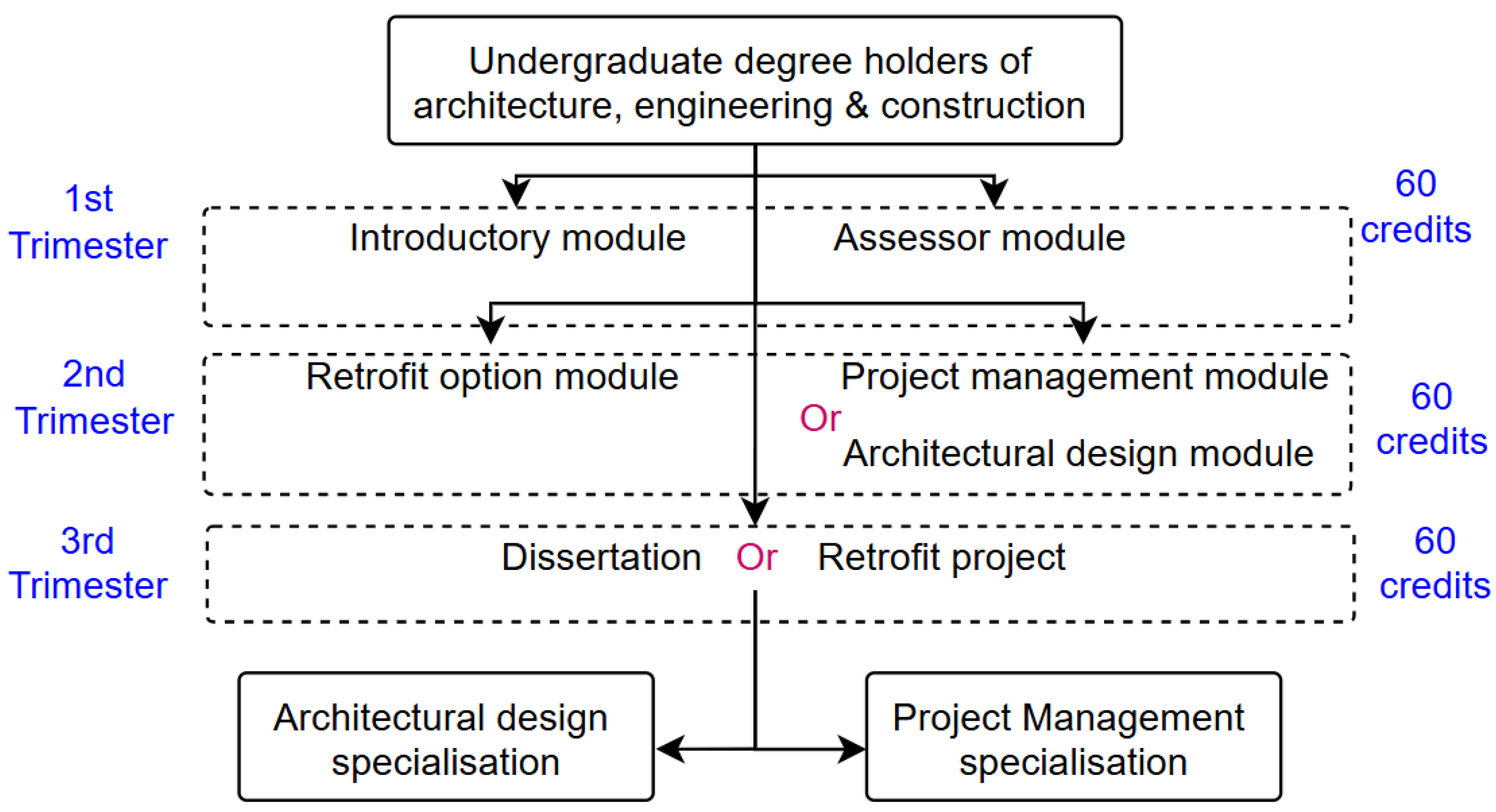
The university shall decide who can follow which specialisation. Basically, architectural and civil/mechanical/electrical engineering students can be directly considered for the architectural design specialisation, and others can be considered for project management specialisation. Considering the above review of the syllabuses of retrofit-related qualifications and the proposed modules, a structure for a university master’s programme can be recommended as follows. The recommendation is based on a three-trimester programme with a total number of 180 credits. Considering the usual model of a UK master’s programme, there will be two modules for each trimester, with 30 credits each and the final trimester is proposed to be reserved for the dissertation or a project with 60 credits.
Figure 2 presents the proposed structure of the modules for the proposed master’s programme in retrofit. The programme can be delivered full-time or part-time, depending on the requirements of the students. The part-time option can be valuable for students who are already working in the industry. The assessment of the modules is required to be developed to test the student’s competence under retrofit roles. Some of the suggestions for assessments can be given as case study reports, retrofit designs, retrofit project proposals, and target energy efficiency modelling activities. Once the selected four modules are delivered according to the specialisations, a dissertation or retrofit project is recommended for the final trimester.
The purpose of the dissertation is to enable students to undertake an academic inquiry into the problem in the context. This will be important, especially for students who wish to stay in academia or public policy. The dissertation should be related to retrofit. It will develop the research skills of the students and contribute to generating new knowledge. The students in the industry can do a final project to put all their learning to the test. Considering the nature of retrofit projects, multi-disciplinary projects may not be suitable to students with other master’s programmes in the built environment. Students in the same programme with different specialisations can jointly conduct projects. For example, architectural design specialisation students can focus on the architectural aspects of the project, while the project management specialisation students can have a project management focus. Even in the industry, both the retrofit designers and retrofit coordinators will have to work together on the same project. The possibility of sharing modules with the other master’s programmes can be evaluated at the point of course validation.
The students will first learn a module, in which they will be introduced to retrofit. The assessor module provides knowledge about the retrofit assessment, which will set the scene for understanding the concepts of retrofit. These will be the two modules for the first trimester, and they will be mandatory modules. The second trimester will have a mandatory retrofit option module. The next module will be decided according to the specialisation: project management or architectural design. The final trimester should have either a dissertation project or a retrofit project.
Apart from the academic contents, the programme must comply with the University’s equality, diversity, and inclusion considerations. Since the programme is more related to industry than academia, the programme will benefit from input from industry experts. This can include guest lectures, site visits, and demonstrations. Furthermore, the staff will also need experience and qualifications related to the retrofit industry. The university library support and IT support with the required software, such as IESVE, Designbuilder, RdSAP, PHPP or PAS Hub, will also be necessary to deliver this programme. Although the programme is more industry focused, there are no barriers to delivering the programme fully online if required. Most of the courses analysed for this study are delivered both in-person and online.


5. Conclusions

Considering the importance of retrofit education in the United Kingdom, this paper has recommended a hypothetical framework for a master’s programme in building retrofit. The objective is to create industry-ready retrofit professionals upon the successful completion of the master’s degree. Two specialisations are recommended for this master’s programme: project management and architectural design. So, the students can become either retrofit coordinators or retrofit designers without the need to take further courses (except for non-residential buildings). The study further recommended making arrangements to accredit students under the professional roles of PAS 2035. For the architectural design specialisation, the students should be able to achieve direct membership in a professional body by accrediting the course under a relevant professional body under PAS 2035. Accordingly, the programme will be able to produce industry-ready retrofit professionals, considering the current skill shortage in the retrofit industry.
A university may benefit from this programme by establishing a foundation for a retrofit centre of excellence to become an academic leader in retrofit. Due to the high percentage of historical buildings in the UK and a larger share of buildings being unsustainable, such a master’s programme will be highly relevant for the UK context. This can also drive urban regeneration for sustainability and inspire academic and industry discussion about sustainable development further. Innovation is critical in order to reach carbon targets. As such a master’s programmeme could provide a springboard for researchers and PhD students who in turn might drive innovation. One of the limitations of this paper is the absence of empirical validation. Furthermore, the proposed programme is designed considering the UK retrofit context.

Author Contributions

Conceptualization, C.P. and P.C.; methodology, C.P. and P.C.; software, C.P.; validation, P.C., C.S., M.M. and H.B.; formal analysis, C.P.; investigation, P.C., C.S., M.M. and H.B.; resources, C.P.; data curation, C.P.; writing—original draft preparation, C.P.; writing—review and editing, C.P. and H.B.; visualisation, C.S.; supervision, P.C., M.M. and C.S.; project administration, P.C.; funding acquisition, C.P. All authors have read and agreed to the published version of the manuscript.

Funding

This research received no external funding.

Institutional Review Board Statement

Not applicable.

Informed Consent Statement

Not applicable.

Data Availability Statement

The original data presented in the study are referred within the article.

Acknowledgments

We want to express our sincere gratitude to the authors and institutions responsible for developing the syllabus materials analysed in this study. Their dedication and effort in creating these resources were essential to the completion of this study.

Conflicts of Interest

The authors declare no conflicts of interest.

Abbreviations

The following abbreviations are used in this manuscript:
ABBEAwarding Body of the Built Environment
AECBAssociation for Environment Conscious Building
AIMName of an educational quality assessment institution in the UK
APMAssociation for Project Management
CIATChartered Institute of Architectural Technologists
CIOBChartered Institute of Building
CWICavity Wall Insulation
EPCEnergy Performance Certificate
EWIExternal Wall Insulation
NOCNNational Open College Network
PASPublicly Available Specification
RdSAPReduced Data Standard Assessment Procedure
SAPStandard Assessment Procedure
HVACHeating, Ventilation and Air Conditioning
IWIInternal Wall Insulation
ISEVEIntegrated Environmental Solutions Virtual Environment
PHPPPassive House Planning Package
RICSRoyal Institute of Chartered Surveyors
RIBARoyal Institute of British Architects
SBEMSimplified Building Energy Model

References

  1. ONS. Dwelling Stock: By Tenure, United Kingdom, as at 31 March 2023; Office for National Statistics: London, UK, 2025. [Google Scholar]
  2. Holms, C. Demand: Net Zero Tackling the Barriers to Increased Homeowner Demand for Retrofit Measures; Citizens Advice: London, UK, 2023. [Google Scholar]
  3. MHCLG. Live Tables on Energy Performance of Buildings Certificates; Ministry of Housing, Communities and Local Government: London, UK, 2014. Available online: https://www.gov.uk/government/statistical-data-sets/live-tables-on-energy-performance-of-buildings-certificates (accessed on 21 July 2025).
  4. LETI. LETI Climate Emergency Retrofit Guide; Low Energy Transformation Initiative: London, UK, 2021. [Google Scholar]
  5. UK Government, Climate Change Act 2008; UK Government: London, UK, 2019.
  6. BSI. PAS 2035:2023 Retrofitting Dwellings for Improved Energy Efficiency–Specification and Guidance; The British Standards Institution: London, UK, 2023. [Google Scholar]
  7. Brown, D.; Bailey, T. Cheaper Bills Warmer Homes; Cheaper Bills Warmer Homes: London, UK, 2022. [Google Scholar]
  8. Lyons, H.; Taylor, A.; Green, A. Rising to the UK’s Skills Challenges; Industrial Strategy Council: Birmingham, UK, 2020. [Google Scholar]
  9. Skidmore, C.; McWhirter, S. Mission Retrofit; United Kingdom Green Building Council: London, UK, 2023. [Google Scholar]
  10. Bonfield, P. Each Home Counts; Department for Business, Energy and Industrial Strategy (BEIS) and Department for Communities and Local Government (DCLG): London, UK, 2016. [Google Scholar]
  11. Rosenow, J.; Eyre, N. A post mortem of the Green Deal: Austerity, energy efficiency, and failure in British energy policy. Energy Res. Soc. Sci. 2016, 21, 141–144. [Google Scholar] [CrossRef]
  12. BSI. PAS 2030:2023 Energy Efficiency in Existing Dwellings; British Standards Institution: London, UK, 2023. [Google Scholar]
  13. BSI. PAS 2038:2021 Retrofitting Non-Domestic Buildings for Improved Energy Efficiency. Specification; British Standards Institution: London, UK, 2021. [Google Scholar]
  14. RISE. Supply Chain Advice Pack: BS 40104 Retrofit Assessment for Domestic Dwellings—Explainer; Retrofit Information, Support and Expertise. Available online: https://riseretrofit.org.uk/resources/toolkits/supply-chain-advice-pack-bs-40104-retrofit-assessment-for-domestic-dwellings-explainer (accessed on 2 September 2025).
  15. Retrofit Academy. The PAS 2035 Compliance Process Map; The Retrofit Academy: London, UK, 2025. [Google Scholar]
  16. Passivhaus Trust. Passivhaus Retrofit in the UK; Passivhaus Trust: London, UK, 2021. [Google Scholar]
  17. Traynor, J. EnerPHit: A Step by Step Guide to Low Energy Retrofit; RIBA Publishing: London, UK, 2019. [Google Scholar]
  18. Nanda, A.; Gibbs, L.; Wong, C.; Baker, M.; Longlands, S.; Bentley, R.; Jennings, A. Retrofitting Housing: Translating Net-Zero Commitments into Actions and Impacts; University of Manchester: Manchester, UK, 2022. [Google Scholar]
  19. TrustMark. Frequently Asked Questions. Available online: https://www.trustmark.org.uk/homeowner/faqs?chapter=About%20TrustMark&question=Who%20is%20TrustMark?&id=5658985a-e7ae-4c91-a7be-6cf2d469d95f (accessed on 2 September 2025).
  20. MCS. MCS Certified|Giving You Confidence in Home-Grown Energy; Micro Generation Certification Scheme. Available online: https://mcscertified.com/ (accessed on 2 September 2025).
  21. RICS. Residential Retrofit Standard; Royal Institute of Chartered Surveyors: London, UK, 2024. [Google Scholar]
  22. AECB. AECB CarbonLite Retrofit Coordination Course; Association for Environment Conscious Building: Llandysul, UK, 2025; Available online: https://aecb.net/aecb-retrofit-coordination-course/ (accessed on 4 September 2025).
  23. Retrofit Academy. Retrofit Designer; The Retrofit Academy: London, UK, 2025. Available online: https://retrofitacademy.org/training/courses/retrofit-designer/ (accessed on 2 September 2025).
  24. DCLG. A Guide to Energy Performance Certificates for the Marketing, Sale and Let of Dwellings Improving the Energy Efficiency of Our Buildings; Department for Communities and Local Government: London, UK, 2017. [Google Scholar]
  25. DESNZ. Warm Homes: Local Grant Policy Guidance for Local Authorities; Department for Energy Security and Net Zero: London, UK, 2025. [Google Scholar]
  26. OFGEM. ECO4 Delivery Guidance; Office of Gas and Electricity Markets: London, UK, 2024. [Google Scholar]
  27. BSI. BS 7913:2013: Guide to the Conservation of Historic Buildings; British Standards Institution: London, UK, 2013. [Google Scholar]
  28. Retrofit Academy. Retrofit Advisor Course—Level 3; Retrofit Academy: London, UK, 2025; Available online: https://retrofitacademy.org/courses/retrofit-advisor-course/ (accessed on 2 September 2025).
  29. ABBE. Level 3 Certificate in Domestic Energy Assessment; Awarding Body of the Built Environment: Birmingham, UK, 2025; Available online: https://www.abbeqa.co.uk/energy/abbe-level-3-certificate-in-domestic-energy-assessment-2/ (accessed on 2 September 2025).
  30. ABBE. Level 3 Certificate for Retrofit Assessors; Awarding Body of the Built Environment: Birmingham, UK, 2025; Available online: https://www.abbeqa.co.uk/retrofit-2/abbe-level-3-certificate-for-retrofit-assessors (accessed on 2 September 2025).
  31. ABBE. Level 3 Award in Energy Efficiency for Older and Traditional Buildings; Awarding Body of the Built Environment: Birmingham, UK, 2024; Available online: https://www.abbeqa.co.uk/retrofit-2/abbe-level-3-award-in-energy-efficiency-for-older-and-traditional-buildings/ (accessed on 2 September 2025).
  32. NOCN. Level 3 Award in Energy Efficiency Measures for Older and Traditional Buildings; National Open College Network: Sheffield, UK, 2022; Available online: https://www.nocn.org.uk/products/qualifications/610-1607-x-nocn-level-3-award-in-energy-efficiency-measures-for-older-and-traditional-buildings-2022/ (accessed on 2 September 2025).
  33. ABBE. Level 4 Diploma in Non Domestic Energy Assessment; Awarding Body of the Built Environment: Birmingham, UK, 2023; Available online: https://www.abbeqa.co.uk/energy/abbe-level-4-diploma-in-non-domestic-energy-assessment-2/ (accessed on 2 September 2025).
  34. ABBE. Level 5 Diploma in Retrofit Coordination and Risk Assessment; Awarding Body of the Built Environment: Birmingham, UK, 2024; Available online: https://www.abbeqa.co.uk/abbe-level-5-diploma-in-retrofit-coordination-and-risk-assessment/ (accessed on 2 September 2025).
  35. NOCN. Level 5 Diploma in Retrofit Coordination and Risk Management; National Open College Network: Sheffield, UK, 2022; Available online: https://www.nocn.org.uk/products/qualifications/610-0967-2-nocn-level-5-diploma-in-retrofit-coordination-and-risk-management/ (accessed on 2 September 2025).
  36. APM. Project Management Full Membership; Association for Project Management: Risborough, UK, 2025; Available online: https://www.apm.org.uk/membership/full-member/ (accessed on 2 September 2025).
  37. CIAT. Qualifying as a Chartered Architectural Technologist, MCIAT; Chartered Institute of Architectural Technologists: London, UK, 2024; Available online: https://architecturaltechnology.com/membership/qualifying-chartered-architectural-technologist.html (accessed on 2 September 2025).
Figure 1. PAS 2035 professional roles [15].
Standards 06 00003 g001
Figure 2. Proposed master’s degree structure.
Standards 06 00003 g002
Table 1. Syllabuses used for the analysis.
LevelDescriptionInstitution
13Domestic Retrofit Advisor [28]AIM
23Domestic Energy Assessor [29]ABBE
33Domestic Retrofit Assessor [30]ABBE
43Energy Efficiency for Older and Traditional Buildings [31]ABBE
53Energy Efficiency for Older and Traditional Buildings [32]NOCN
64Non-Domestic Energy Assessor [33]ABBE
75Retrofit Coordination and Risk Assessment (PAS 2035) [34]ABBE
85Retrofit Coordination and Risk Management (PAS 2035) [35]NOCN
9≈5Carbonlite Retrofit Coordinator course [22]AECB
10-Retrofit Designer [23]Retrofit Academy
Table 2. Proposed modules for the retrofit master’s programme.
ModuleObjectiveComparative RoleCompetency
1IntroductoryTo introduce the basics of the retrofit and train the students to become retrofit advisors. Retrofit advisorA student can advise a homeowner to retrofit their house.
2AssessorTo train the student to assess a property for retrofitting.Retrofit assessorA student can do a retrofit assessment under BS 40104, including a historic property (BS 7913).
3Retrofit optionsTo give a professional understanding of retrofit options. Any retrofit professionalThe student has a thorough understanding of 41 retrofit measures of PAS 2035 and develops medium-term plans.
4Project managementTo educate retrofit coordination and risk management under PAS 2035Retrofit coordinator/evaluatorA student can deliver a retrofit project from start to end under the PAS 2035 specification.
5Architectural designTo design a retrofit measure (e.g., internal wall insulation) in line with PAS 2035.Retrofit designerStudents can design one or more retrofit measures under PAS 2035 for a generic UK house archetype.
Table 3. Introductory module (mandatory).
Study AreaDescriptorObjective
1Introduction to retrofitCarbon emissions, fuel poverty, poor health and comfort, why retrofit?To introduce what retrofit is.
2Standards, regulations, and toolsPAS 2030, PAS 2035, PAS 2038, BS 7913, building regulations, planning framework, Passivhaus, RdSAP, SAP, SBEM, and other energy modelling tools. To introduce the tools used in retrofit.
3Case studiese.g., Grenfell tower, Fishwick Preston, Chimney pot park, Middlesbrough.To give practical insights about retrofit.
4Building physicsU values, thermal bridges, heat loss, primary energy, draughts, dampness, and condensation. To introduce building physics related to retrofit.
Table 4. Assessor module (Mandatory).
Study AreaDescriptorObjective
5Adaptation and re-useAdapting properties for different purposes, re-using buildings, rebuilding, and retrofitting. To outline the other areas related to retrofit, such as adaptation and re-use.
6Defects, repair, and maintenanceIdentifying defects, types of defects, repairing defects, and maintenance requirements. To give an understanding of how to address defects, repair and maintenance.
7Retrofit assessment Age, construction and elements of buildings. Assessment requirements. Energy performance certificates. To produce residential retrofit assessors.
8Heritage and conservation (BS 7913)Heritage values, listed buildings, significance assessment, and challenges. Materials. Approaches.To give technical competence under BS 7913 on historic buildings.
Table 5. Retrofit options module (mandatory).
Study AreaDescriptorObjective
9Air tightness and ventilationWhat is air tightness, and what are some air tightness testing methods, as well as ventilation assessment, and ventilation types?To understand the importance of ventilation and air tightness.
10Building fabric retrofitIWI, EWI, CWI, floor insulation, loft insulation, doors, and windows.To understand the building fabric.
11Building service retrofitHeating, hot water, plumbing, draining, electrical wiring, renewables.To understand building services.
12Option evaluationFabric first, whole-house approach, sequencing, payback calculation, cost–benefit analysis.To learn the process of improvement option evaluation.
Table 6. Project management module (optional).
Study AreaDescriptorObjective
13Stakeholders and ethicsIdentifying and managing stakeholders, technical tools, professionalism, ethics, and responsibilities.To study the professionalism in retrofit delivery.
14Risk management Avoiding unintended consequences, the Each Home Counts report, and PAS 2035, risk management principles, delivering risk-free retrofit.To learn risk management and avoid unintended consequences.
15Health and safety in the retrofit processHealth and safety of the occupants, workers, and society. Best practice, CDM regulations, and other applicable health and safety regulations. To learn how to manage the health and safety of the stakeholders during the project.
16Commissioning and evaluationPlanning, installation, testing, and handing over. Training and soft landing. Monitoring and evaluation. Feedback and lessons learned. To learn how to hand over the project, including the role of the retrofit evaluator.
Table 7. Architectural design module (optional).
Study AreaDescriptorObjective
17Understanding buildingsUnderstanding the characteristics of buildings in different archetypes, construction, heritage significance, ages, and purposes. To have a good understanding of the existing building stock.
18Sustainable designDesign techniques to minimise carbon emissions, improve health and comfort, reduce resource utilisation, and prevent overheating. Planning permissions and building control.To understand the design principles related to retrofit.
19Sustainable materialsSpecification related to sustainable building materials, components and building services, circular economy and embodied carbon. To explore the retrofit materials and components.
20Energy modellingModelling the operational energy performance to a target energy efficiency level using recommended software (IESVE, Designbuilder, RdSAP, SAP, PHPP, etc.To learn how to design retrofit measures for a given energy efficiency target.
Disclaimer/Publisher’s Note: The statements, opinions and data contained in all publications are solely those of the individual author(s) and contributor(s) and not of MDPI and/or the editor(s). MDPI and/or the editor(s) disclaim responsibility for any injury to people or property resulting from any ideas, methods, instructions or products referred to in the content.