
The Efficacy of Fixed-Dose Diclofenac and Orphenadrine for Postoperative Pain Management: A Systematic Review


Abstract
1. Introduction
2. Materials and Methods
2.1. Inclusion and Exclusion Criteria
2.2. Information Sources
2.3. Search Strategy
2.4. Study Selection Process
2.5. Data Collection Process and Data Items
2.6. Quality Assessment and Risk of Bias
2.7. Effect Measures
- Pain Intensity:
- 2.
- Opioid Sparing Effect: This was assessed by two metrics:
- Absolute Opioid Consumption: The mean mg of opioid analgesics consumed over a defined post-operative period. Mean difference is calculated as the metric.
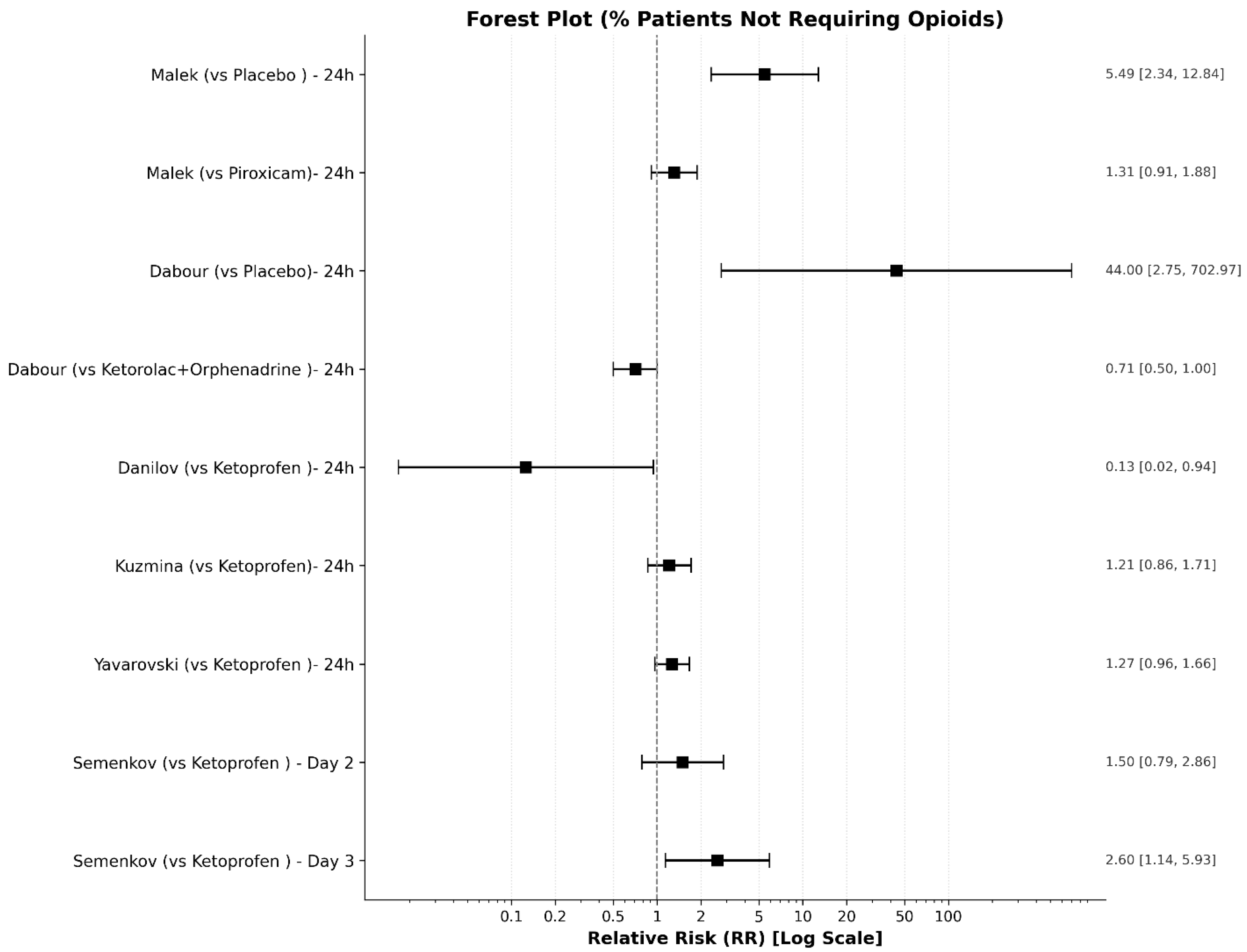
- Opioid Sparing Rate: Defined as the number or proportion of patients who required no postoperative opioid rescue analgesia, or who met a predefined clinical success threshold, measured by risk ratio (RR).
2.8. Strategy for Data Synthesis
2.9. Assessment of Certainty of Evidence
3. Results
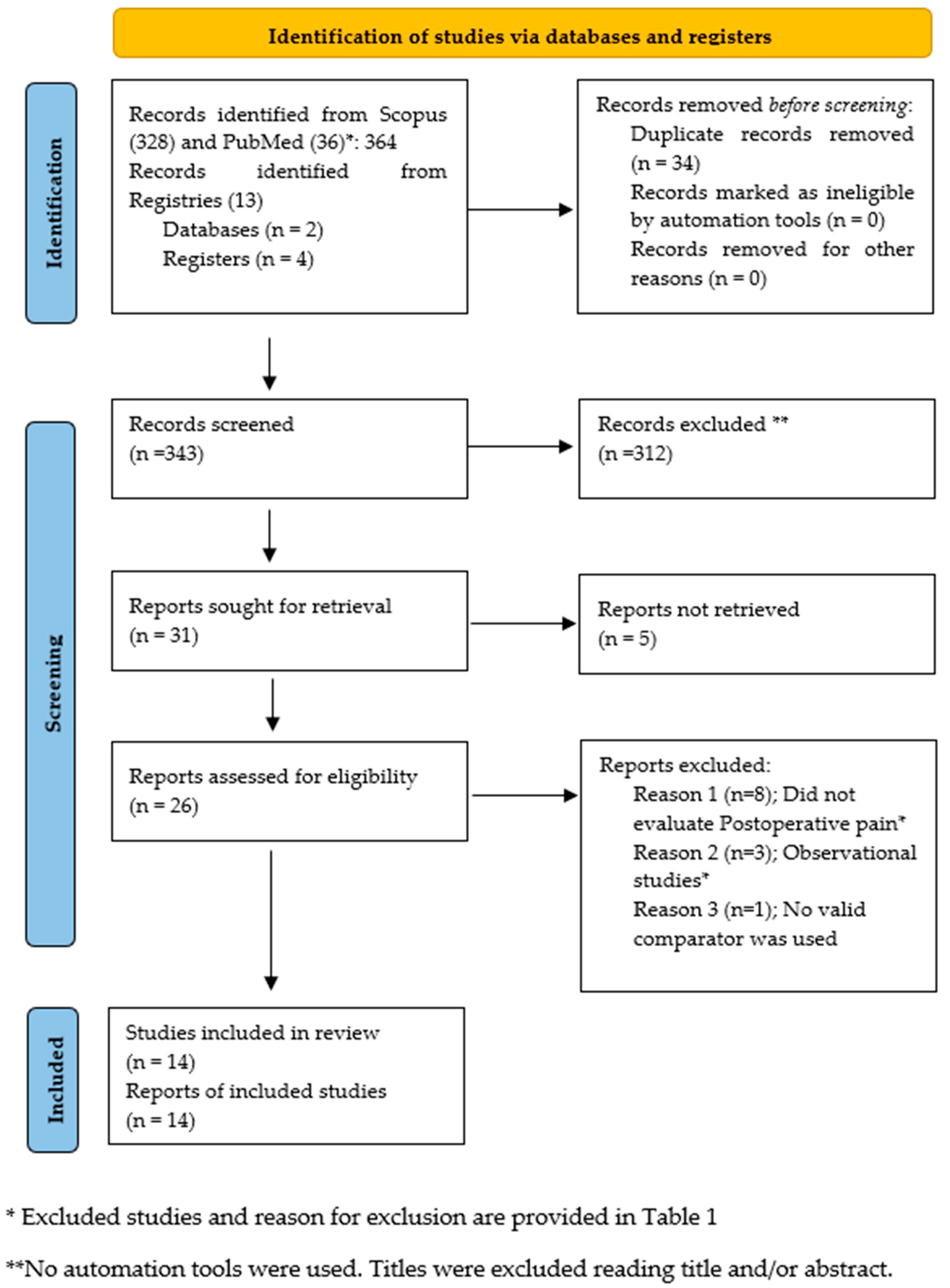
3.1. Study Selection
3.1.1. Flow of Studies
3.1.2. Excluded Studies
3.2. Characteristics of Included Studies
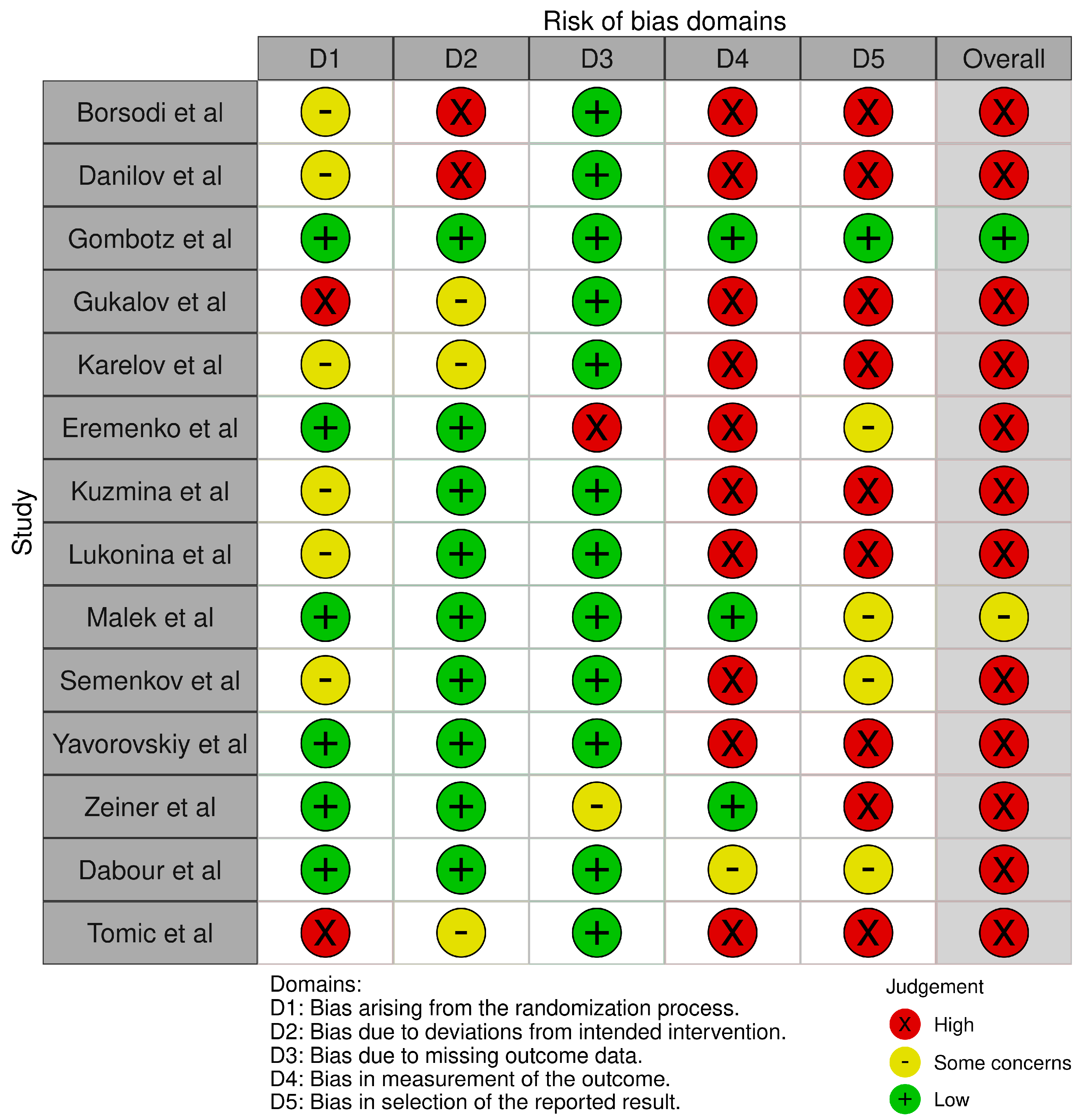
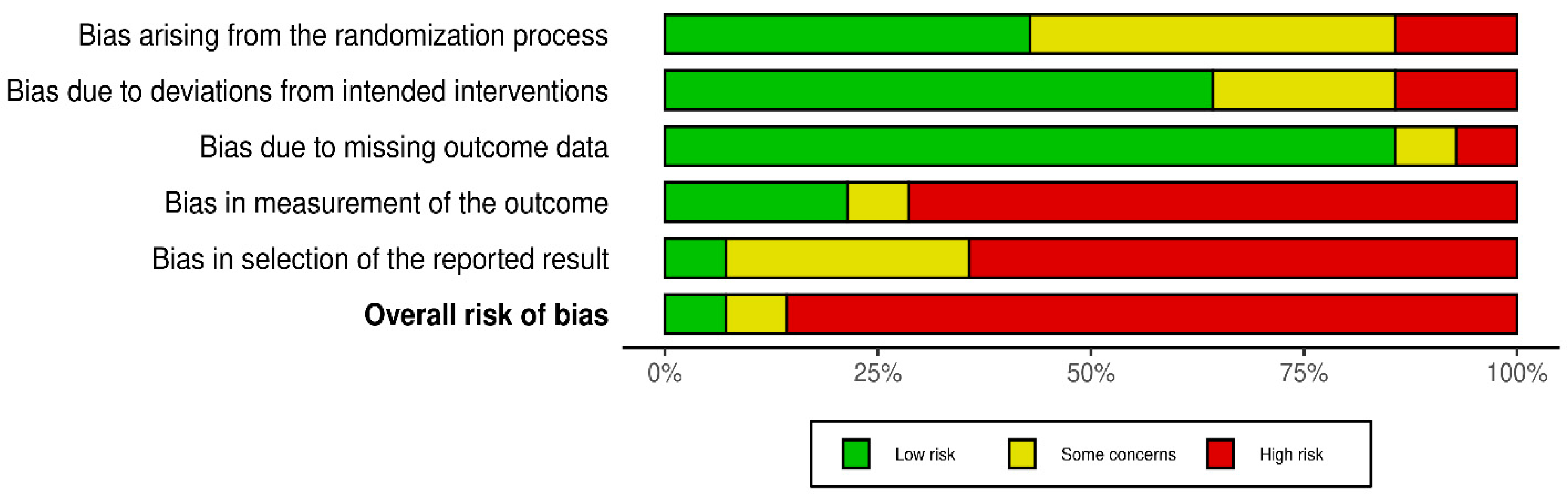
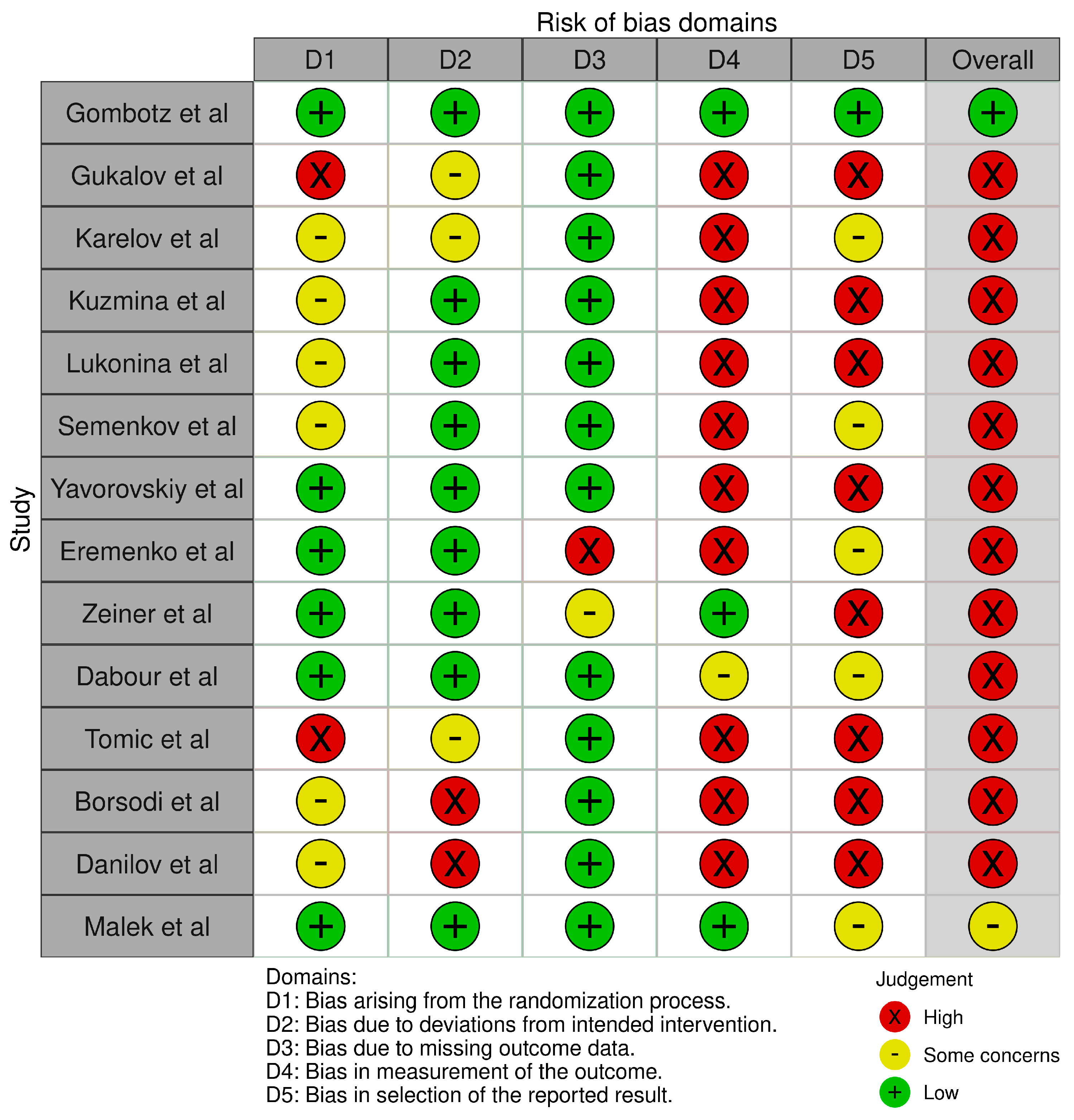
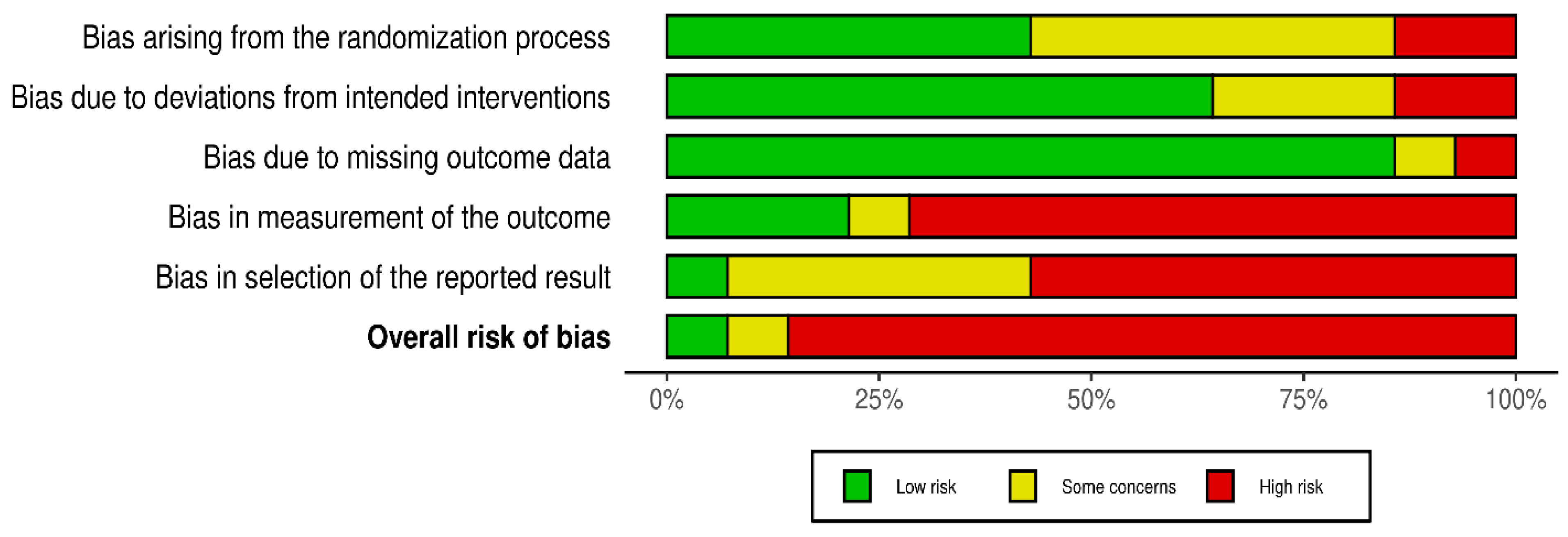
3.3. Risk of Bias in Selected Studies
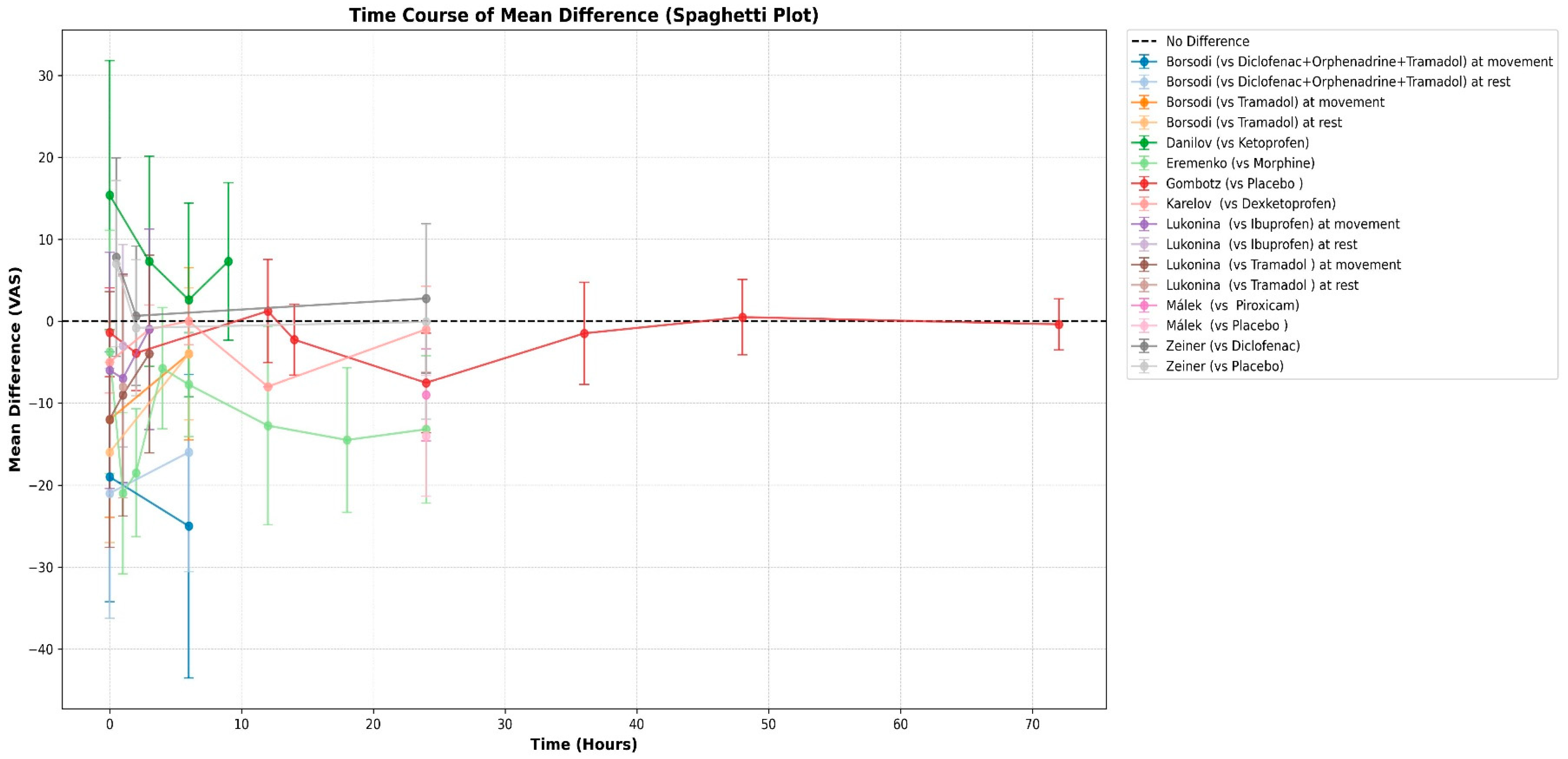
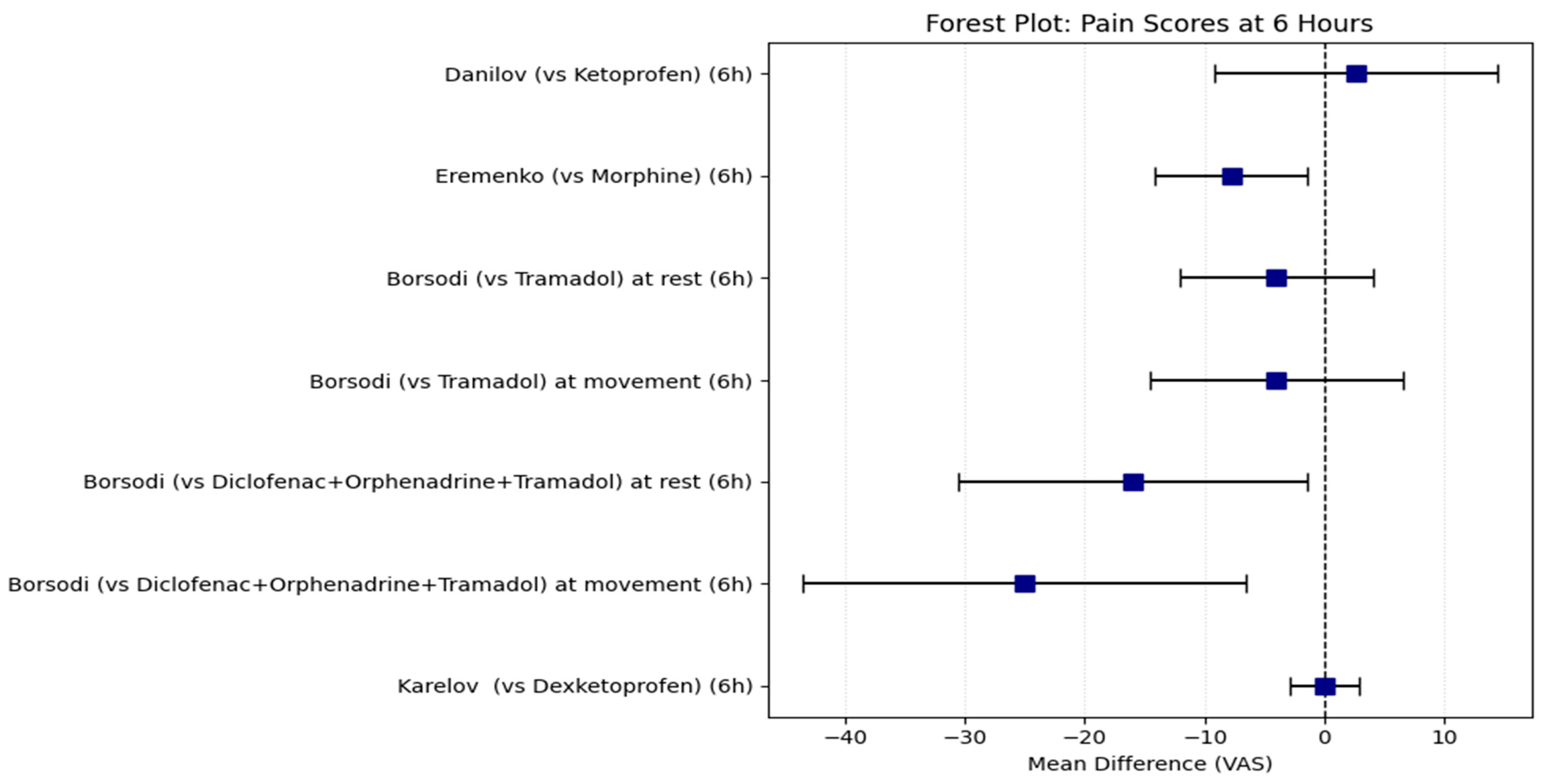
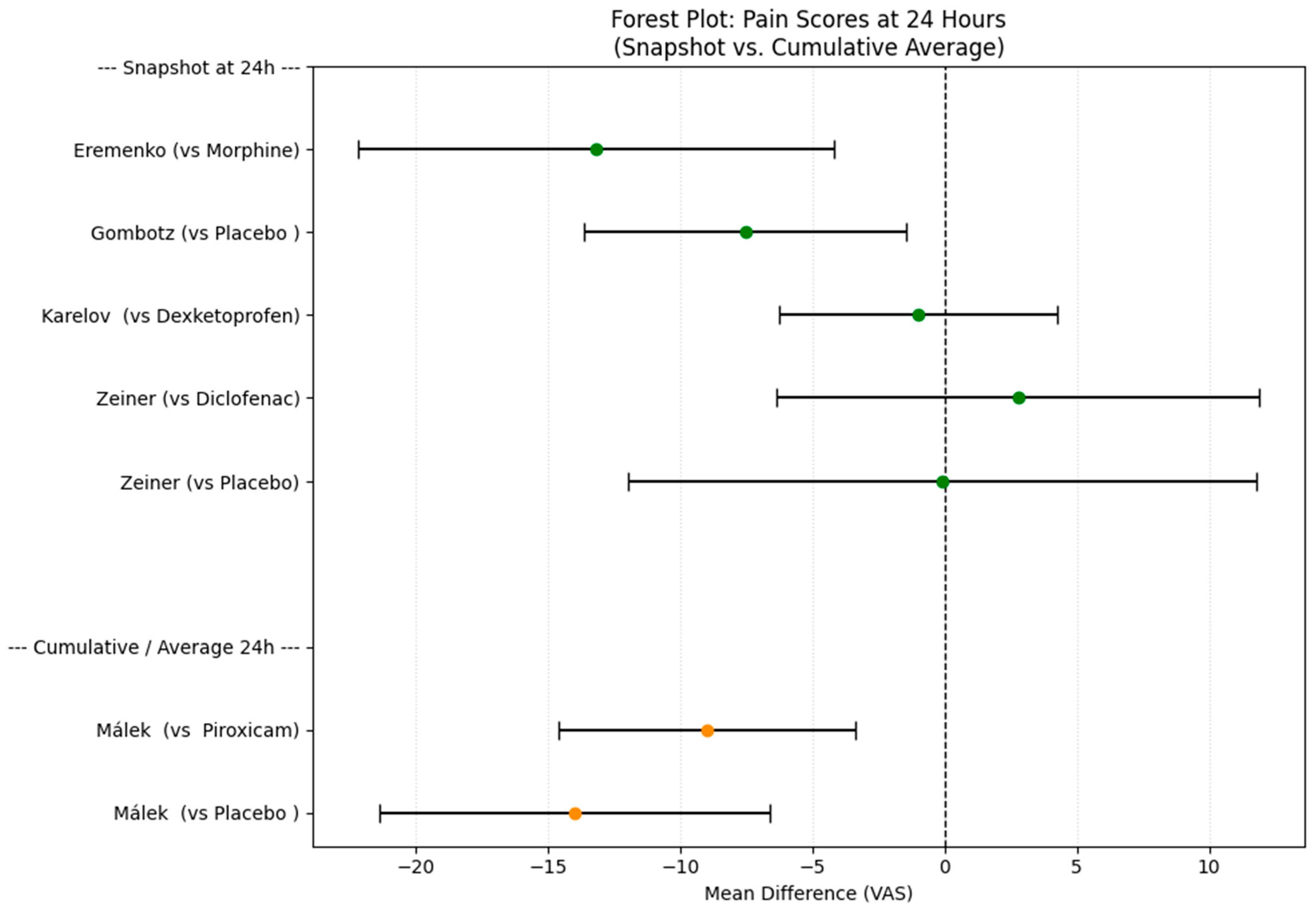
3.4. Results of Individual Studies
3.5. Results of the Synthesis
3.5.1. Pain Intensity
- For Danilov et al. [28], a likely typographical error in the comparator group’s standard deviation at the 6 h time point (reported as 2 rather than the expected range of 20) was assumed and adjusted for the analysis.
- For Lukonina et al. [40] reported both mean and median VAS values depending on the time point. We separated these data points to assess them in the respective synthesis tables.
- Synthesis of Mean VAS Scores
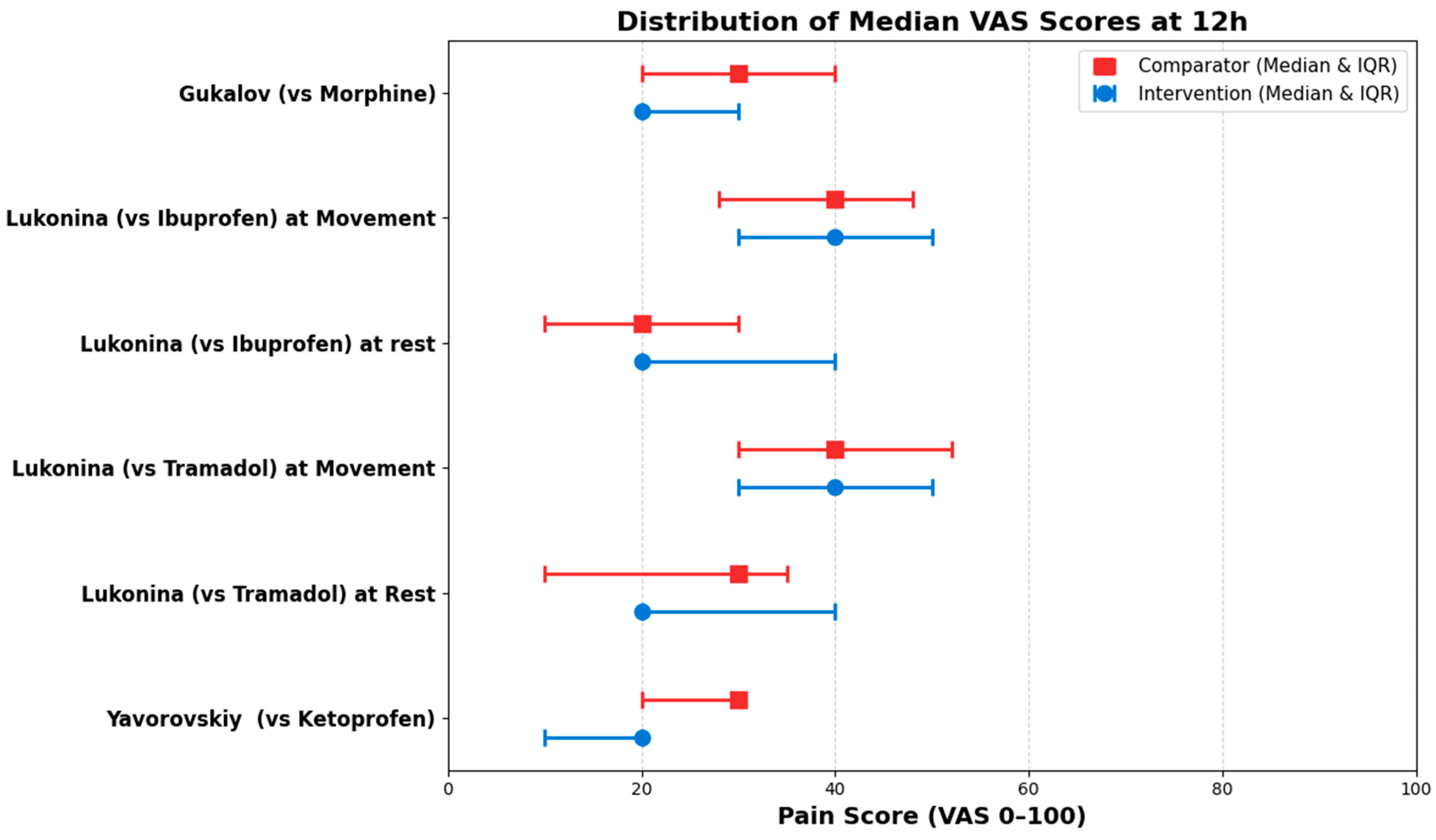
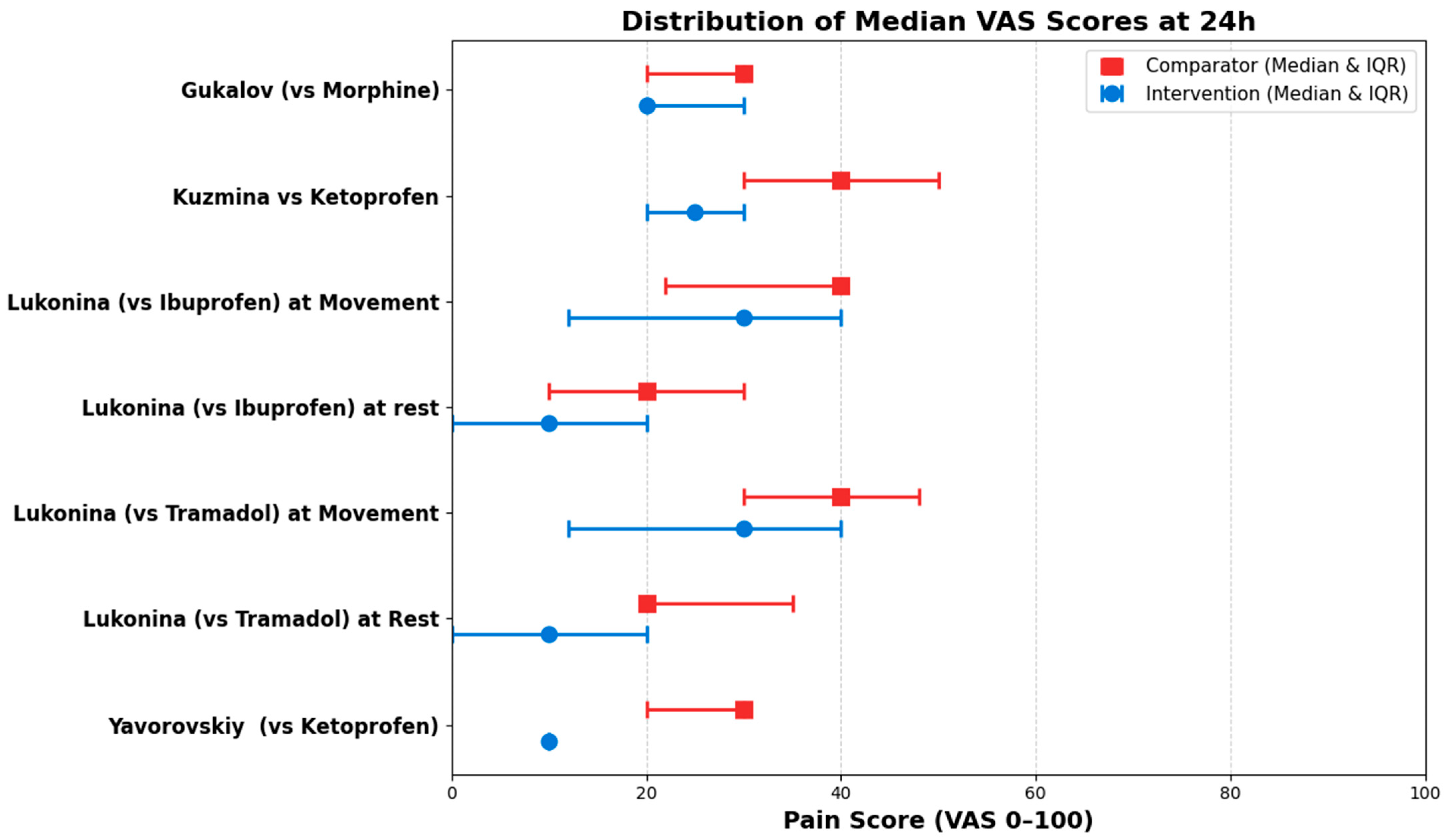
- Synthesis of Median VAS Scores
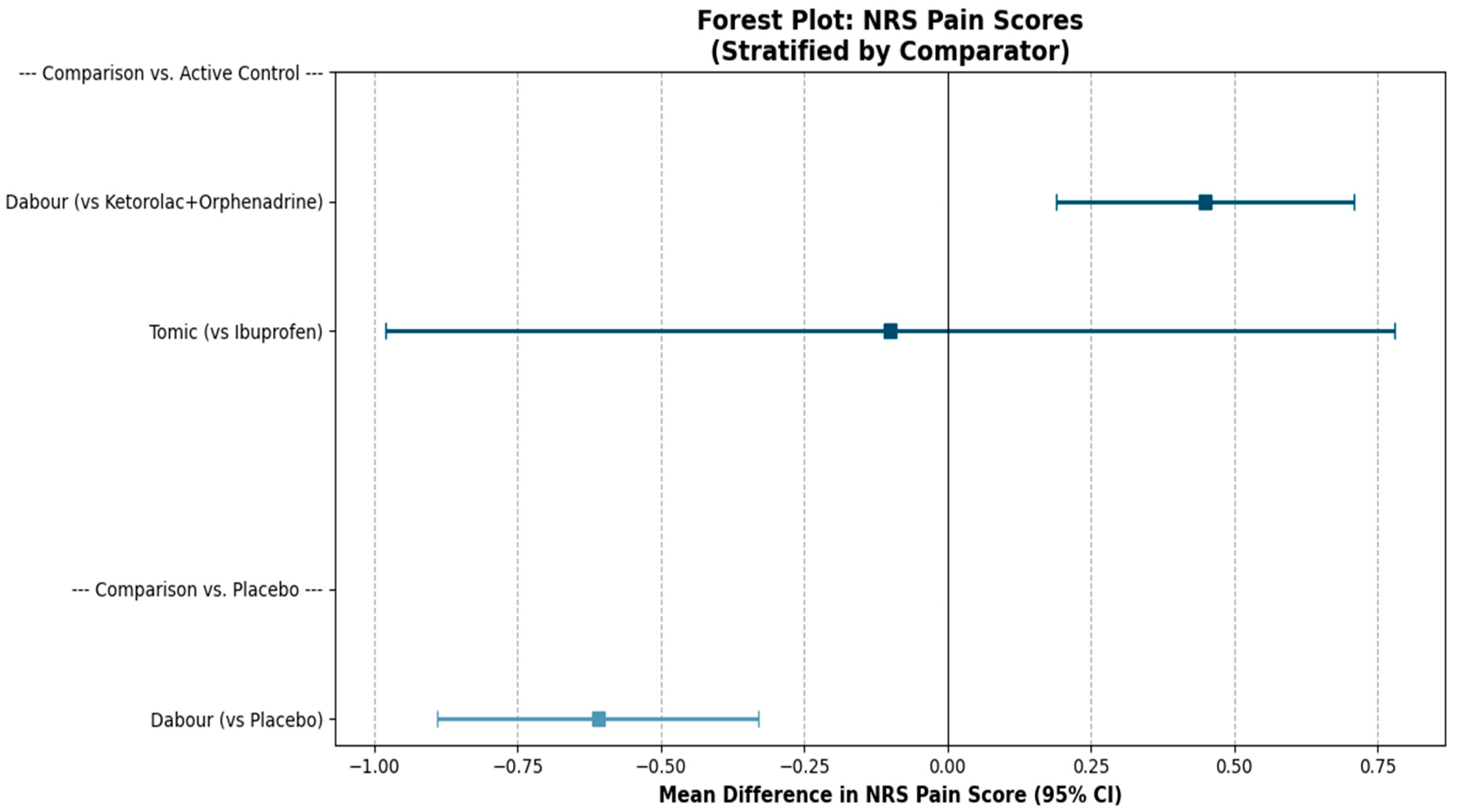
- Synthesis of NRS Scores
3.5.2. Opioid Sparing Effect
- (A)
- Morphine Equivalent Milligrams Consumed
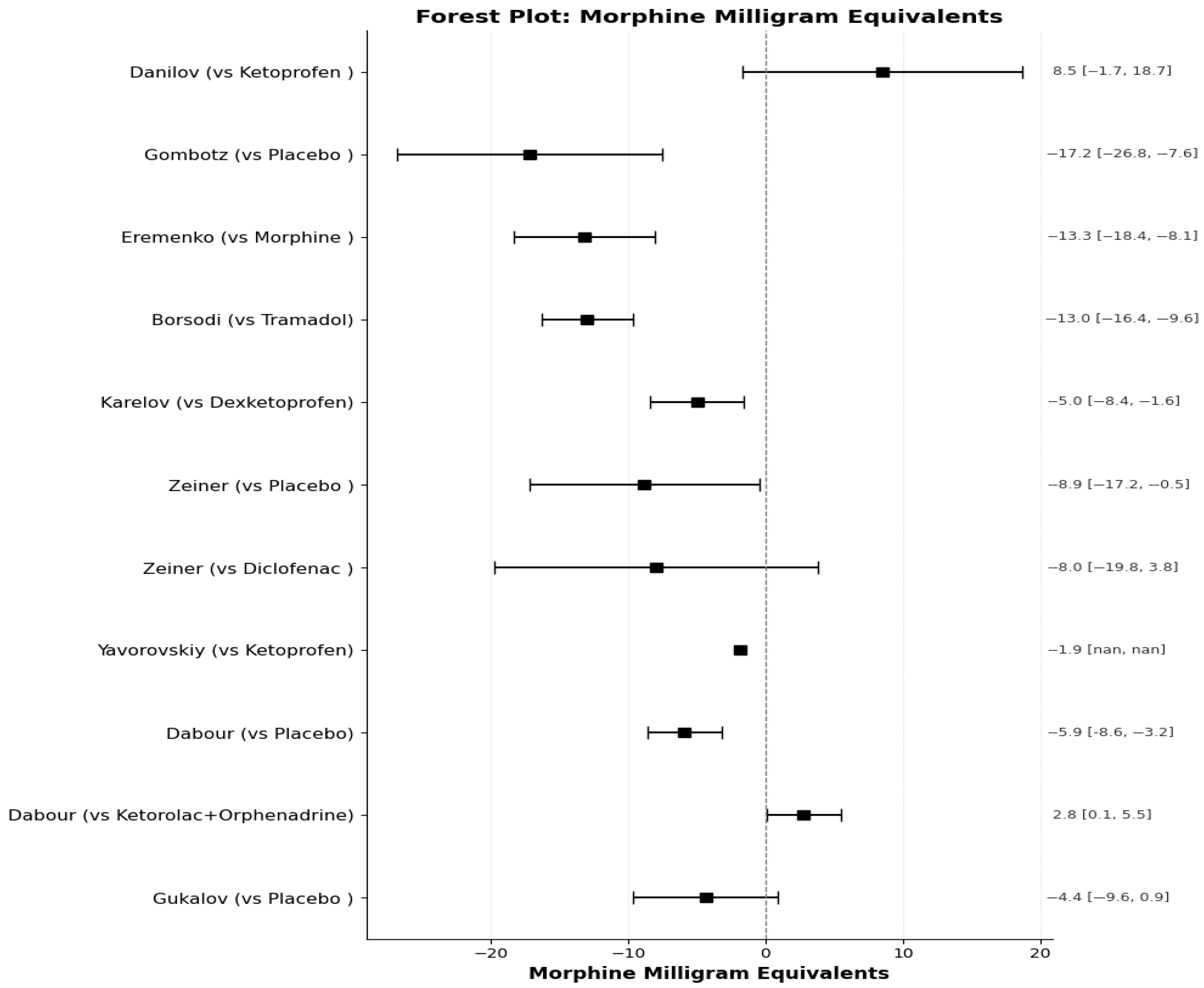
- The extracted data regarding Morphine Milligram Equivalents (MME) consumed over 24 h across the included studies, alongside the calculated mean differences, are synthesized in Table 8 and visually represented in the corresponding forest plot (Figure 12). However, several studies required specific extraction strategies to harmonize the data for this synthesis:Malek et al. [33], Lukonina et al. [40], Kuzmina et al. [39], and Semenkov et al. [34] did not report total milligrams consumed. Tomic et al. [37] reported total intake as an aggregate sum over three days without providing a mean per group or standard deviation, preventing inclusion in the pooled analysis; however, their reported results indicated similar intake levels between groups. The studies were excluded from the synthesis table of mg consumed.
- Dabour et al. presented consumption data only for the subset of patients requiring rescue analgesia. To enable an intention-to-treat comparison, we calculated the average for the whole treatment arm by combining the summary statistics of the two intervention subgroups (Diclofenac+Orphenadrine and Ketorolac+Orphenadrine) following Cochrane methods. Furthermore, a discrepancy was noted between the tabulated data for the placebo group (reporting 1.7–3.38 mg) and the text stating “significantly higher consumption.” Based on the data visualized in their Figure 2, we extrapolated that the placebo group consumed a total of 460 mg (at 5 mg per dose). We therefore calculated a corrected mean of 10.7 mg for the placebo arm (460 mg divided by 43 subjects) to accurately reflect the study’s findings.
- Borsodi et al. [27,31]: The study design included a split intervention group (FDC alone vs. FDC + Tramadol). To derive a representative value for the intervention arm, we merged the samples of the FDC and FDC+Tramadol groups. We calculated a weighted average of opioid consumption ([(19 × 0) + (11 × 61.5)]/30 = 22.55 mg Tramadol), converted this value to MME, and pooled the standard deviations using the sum of squares method.
- Gukalov et al. [38] presented opioid consumption as medians. As this was the only study in the quantitative synthesis reporting non-parametric data, we imputed the mean and standard deviation using the validated methods described by Luo et al. [54] and Wan et al. [55], respectively. A sensitivity analysis was conducted by excluding this study; the exclusion did not alter the overall direction of the effect.
- (B)
- Use of Rescue Analgesia (% of patients)
- Exclusions: Borsodi et al. [31] and Gukalov et al. [38] were excluded from this specific outcome as the comparator itself was an opioid. Karelov et al. [32], Tomic et al. [37], Lukonina et al. [40], Zeiner et al. [36], Eremenko et al. [30], and Gombots et al. [29] did not report binary data on rescue analgesia requirements.
3.5.3. Safety
3.6. Certainty of Evidence
4. Discussion
5. Conclusions
Supplementary Materials
Author Contributions
Funding
Institutional Review Board Statement
Informed Consent Statement
Data Availability Statement
Acknowledgments
Conflicts of Interest
Abbreviations
| AE | Adverse Event |
| APS | American Pain Society |
| ASA | American Society of Anesthesiologists |
| ASRA | American Society of Regional Anesthesia |
| CI | Confidence Interval |
| CNS | Central Nervous System |
| COX | Cyclooxygenase |
| CRP | C-Reactive Protein |
| CTIS | Clinical Trials Information System |
| ERAS | Enhanced Recovery After Surgery |
| EU | European Union |
| FDC | Fixed-Dose Combination |
| GRADE | Grading of Recommendations Assessment, Development and Evaluation |
| HD | Hospitalization Days |
| ICU | Intensive Care Unit |
| IMMPACT | Initiative on Methods, Measurement, and Pain Assessment in Clinical Trials |
| IMP | Investigational Medicinal Product |
| IQR | Interquartile Range |
| MD | Mean Difference |
| MeD | Median Difference |
| Miel/MILC | Maximum Inspiratory Capacity of the Lungs |
| MME | Morphine Milligram Equivalents |
| NMDA | N-methyl-D-aspartate |
| NRS | Numeric Rating Scale |
| NSAID | Non-Steroidal Anti-Inflammatory Drug |
| ORAEs | Opioid-Related Adverse Events |
| PICO | Population, Intervention, Comparator, Outcome |
| PONV | Postoperative Nausea and Vomiting |
| PRISMA | Preferred Reporting Items for Systematic Reviews and Meta-Analyses |
| PROSPECT | Procedure-Specific Pain Management |
| PRS | Physician-Rated Safety |
| PSS | Patient Satisfaction Score |
| RASP | Russian Association for the Study of Pain |
| RCT | Randomized Controlled Trial |
| RoB2 | Risk of Bias 2 |
| RR | Risk Ratio |
| RSS | Ramsey Sedation Score |
| SAP | Statistical Analysis Plan |
| SD | Standard Deviation |
| SEd | Standard Error of the Difference |
| SSS | Surgeon Satisfaction Score |
| SWiM | Synthesis Without Meta-analysis |
| VAS | Visual Analog Scale |
| VRS | Verbal Rating Scale |
| WBF | Weight-Bearing Fraction |
| WHO | World Health Organization |
References
- Gan, T.J.; Habib, A.S.; Miller, T.E.; White, W.; Apfelbaum, J.L. Incidence, Patient Satisfaction, and Perceptions of Post-Surgical Pain: Results from a US National Survey. Curr. Med. Res. Opin. 2014, 30, 149–160. [Google Scholar] [CrossRef]
- Saccò, M.; Meschi, M.; Regolisti, G.; Detrenis, S.; Bianchi, L.; Bertorelli, M.; Pioli, S.; Magnano, A.; Spagnoli, F.; Giuri, P.G.; et al. The Relationship Between Blood Pressure and Pain. J. Clin. Hypertens. 2013, 15, 600–605. [Google Scholar] [CrossRef]
- Ozgur, S. Approach to Adult Patients Admitted with Pain to the Emergency Department. GSC Biol. Pharm. Sci. 2019, 6, 68–70. [Google Scholar] [CrossRef]
- Nicholson, A.; Lowe, M.C.; Parker, J.; Lewis, S.R.; Alderson, P.; Smith, A.F. Systematic Review and Meta-Analysis of Enhanced Recovery Programmes in Surgical Patients. J. Br. Surg. 2014, 101, 172–188. Available online: https://academic.oup.com/bjs/article-abstract/101/3/172/6138111?redirectedFrom=fulltext&login=false (accessed on 27 November 2025). [CrossRef]
- Salamanna, F.; Tedesco, G.; Sartori, M.; Contartese, D.; Asunis, E.; Cini, C.; Veronesi, F.; Martikos, K.; Fini, M.; Giavaresi, G.; et al. Clinical Outcomes and Inflammatory Response to the Enhanced Recovery After Surgery (ERAS) Protocol in Adolescent Idiopathic Scoliosis Surgery: An Observational Study. Int. J. Mol. Sci. 2025, 26, 3723. [Google Scholar] [CrossRef]
- Voscopoulos, C.; Lema, M. When Does Acute Pain Become Chronic? Br. J. Anaesth. 2010, 105, i69–i85. [Google Scholar] [CrossRef]
- Fregoso, G.; Wang, A.; Tseng, K.; Wang, J. Transition from Acute to Chronic Pain: Evaluating Risk for Chronic Postsurgical Pain. Pain Physician 2019, 22, 479–488. [Google Scholar] [CrossRef]
- Chapman, C.R.; Vierck, C.J. The Transition of Acute Postoperative Pain to Chronic Pain: An Integrative Overview of Research on Mechanisms. J. Pain 2017, 18, 359.e1–359.e38. [Google Scholar] [CrossRef]
- Fuller, A.M.; Bharde, S.; Sikandar, S. The Mechanisms and Management of Persistent Postsurgical Pain. Front. Pain Res. 2023, 4, 1154597. [Google Scholar] [CrossRef]
- Hah, J.M.; Bateman, B.T.; Ratliff, J.; Curtin, C.; Sun, E. Chronic Opioid Use After Surgery: Implications for Perioperative Management in the Face of the Opioid Epidemic. Anesth. Analg. 2017, 125, 1733–1740. [Google Scholar] [CrossRef]
- Ismail, M.F. Opioid-Sparing Strategies in Perioperative Pain Management: Current Evidence, Challenges, and Future Directions. Asian J. Med. Health 2025, 23, 107–119. [Google Scholar] [CrossRef]
- Chou, R.; Gordon, D.B.; de Leon-Casasola, O.A.; Rosenberg, J.M.; Bickler, S.; Brennan, T.; Carter, T.; Cassidy, C.L.; Chittenden, E.H.; Degenhardt, E.; et al. Management of Postoperative Pain: A Clinical Practice Guideline From the American Pain Society, the American Society of Regional Anesthesia and Pain Medicine, and the American Society of Anesthesiologists’ Committee on Regional Anesthesia, Executive Committee, and Administrative Council. J. Pain 2016, 17, 131–157. [Google Scholar] [CrossRef]
- Lee, B.; Schug, S.A.; Joshi, G.P.; Kehlet, H.; Beloeil, H.; Bonnet, F.; Lavand’Homme, P.; Lirk, P.; Pogatzki-Zahn, E.; Raeder, J.; et al. Procedure-Specific Pain Management (PROSPECT)—An Update. Best Pract. Res. Clin. Anaesthesiol. 2018, 32, 101–111. [Google Scholar] [CrossRef] [PubMed]
- Gan, T.J. Diclofenac: An Update on Its Mechanism of Action and Safety Profile. Curr. Med. Res. Opin. 2010, 26, 1715–1731. [Google Scholar] [CrossRef]
- Ginzel, K.H. The Blockade of Reticular and Spinal Facilitation of Motor Function by Orphenadrine. J. Pharmacol. Exp. Ther. 1966, 154, 128–141. [Google Scholar] [CrossRef]
- Kornhuber, J.; Parsons, C.G.; Hartmann, S.; Retz, W.; Kamolz, S.; Thome, J.; Riederer, P. Orphenadrine Is an Uncompetitive N-Methyl-D-Aspartate (NMDA) Receptor Antagonist: Binding and Patch Clamp Studies. J. Neural Transm. Gen. Sect. 1995, 102, 237–246. [Google Scholar] [CrossRef]
- Gupta, A.; Kaur, K.; Sharma, S.; Goyal, S.; Arora, S.; Murthy, R.S.R. Clinical Aspects of Acute Post-Operative Pain Management & Its Assessment. J. Adv. Pharm. Technol. Res. 2010, 1, 97–108. [Google Scholar] [CrossRef] [PubMed]
- Churyukanov, M.V.; Amelin, A.V.; Akhmadeeva, L.R.; Davydov, O.S.; Kukushkin, M.L.; Shirokov, V.A. Resolution of the Extended Meeting of the Presidium and Committees of the Russian Association for the Study of Pain (RASP) “The Role of Central Muscle Relaxants in the Treatment of Non-Specific Low Back Pain”. Russ. J. Pain 2025, 23, 91. [Google Scholar] [CrossRef]
- Sorokina, L.S.; Vyzhigina, M.A.; Semenkov, M.A.; Arkhipova, O.V.; Eremenko, A.A. Fixed Combination of Diclofenac and Orphenadrine (Neodolpasse) for Postoperative Pain Relief. Review of the Results of International and Russian Studies. Russ. J. Anesthesiol. Reanimatol. 2024, 74–80. [Google Scholar] [CrossRef]
- Eremenko, A.A.; Polushin, Y.S.; Klypa, T.V.; Yavorovskiy, A.G.; Karelov, A.E.; Sorokina, L.S.; Babayants, A.V.; Ignatenko, O.V.; Sergeev, O.S. Expert Council Resolution on Efficacy and Safety of Neodolpasse in Early Postoperative Period: Summary of Observational Studies in the Russian Federation. Russ. J. Pain 2023, 21, 65. [Google Scholar] [CrossRef]
- Zhang, Q.; Chan, D.X.H.; Ho, K.-Y. Efficacy and Safety of Fixed-Dose Combinations for Pain in Older Adults. Drugs Aging 2024, 41, 873–879. [Google Scholar] [CrossRef]
- Oikonomou, I.; Akinosoglou, K. Efficacy and Safety of the Combination of Diclofenac and Thiocolchicoside in the Treatment of Low Back Pain and Other Conditions: Systematic Review of the Literature. Healthcare 2025, 13, 677. [Google Scholar] [CrossRef]
- Page, M.J.; McKenzie, J.E.; Bossuyt, P.M.; Boutron, I.; Hoffmann, T.C.; Mulrow, C.D.; Shamseer, L.; Tetzlaff, J.M.; Akl, E.A.; Brennan, S.E.; et al. The PRISMA 2020 Statement: An Updated Guideline for Reporting Systematic Reviews. BMJ 2021, 372, n71. [Google Scholar] [CrossRef]
- Higgins, J.P.T.; Thomas, J.; Chandler, J.; Cumpston, M.; Li, T.; Page, M.J.; Welch, V.A. (Eds.) Cochrane Handbook for Systematic Reviews of Interventions; Version 6.5 (Updated August 2024); Wiley: Hoboken, NJ, USA, 2024; Available online: https://www.cochrane.org/authors/handbooks-and-manuals/handbook#how-to-access (accessed on 25 September 2025).
- Sterne, J.A.C.; Savović, J.; Page, M.J.; Elbers, R.G.; Blencowe, N.S.; Boutron, I.; Cates, C.J.; Cheng, H.-Y.; Corbett, M.S.; Eldridge, S.M.; et al. RoB 2: A Revised Tool for Assessing Risk of Bias in Randomised Trials. BMJ 2019, 366, l4898. [Google Scholar] [CrossRef]
- Campbell, M.; McKenzie, J.E.; Sowden, A.; Katikireddi, S.V.; Brennan, S.E.; Ellis, S.; Hartmann-Boyce, J.; Ryan, R.; Shepperd, S.; Thomas, J.; et al. Synthesis without Meta-Analysis (SWiM) in Systematic Reviews: Reporting Guideline. BMJ 2020, 368, l6890. [Google Scholar] [CrossRef]
- Dabour, Y.S.; Elnoury, A.S.; Daoud, A.A. Twenty-Four-Hour Postoperative Orphenadrine and Ketorolac Infusion Efficiently Precedes Orphenadrine-Diclofenac Infusion as an Opioid-Sparing Analgesic Modality after Mastectomy. Egypt. J. Anaesth. 2023, 39, 706–714. [Google Scholar] [CrossRef]
- Danilov, M.S.; Simutis, I.S.; Salygina, D.S.; Polovtsev, E.G.; Syrovatskiy, A.A.; Bogatikov, A.A.; Fedorov, M.E. Advisability of NSAID Combined with Central Muscle Relaxant for Pain Syndrome after Thoracoscopic Surgery. Russ. J. Anesthesiol. Reanimatol. 2024, 5, 82–87. [Google Scholar] [CrossRef]
- Gombotz, H.; Lochner, R.; Sigl, R.; Blasl, J.; Herzer, G.; Trimmel, H. Opiate Sparing Effect of Fixed Combination of Diclophenac and Orphenadrine after Unilateral Total Hip Arthroplasty: A Double-Blind, Randomized, Placebo-Controlled, Multi-Centre Clinical Trial. Wien. Med. Wochenschr. 2010, 160, 526–534. [Google Scholar] [CrossRef]
- Eremenko, A.A.; Sorokina, L.S.; Ryabova, D.V.; Urbanov, A.V. Analgesic and Opioid-Sparing Effects of a Fixed Combination of Diclofenac and Orphenadrine in the Early Postoperative Period in Cardiac Surgery Patients. S.S. Korsakov J. Neurol. Psychiatry 2022, 122, 109. [Google Scholar] [CrossRef]
- Borsodi, M.; Nagy, E.; Darvas, K. Diclofenac/Orphenadrin as a Combined Analgetic in Post-Operative Relief of Pain. Orvosi Hetil. 2008, 149, 1847–1852. [Google Scholar] [CrossRef]
- Karelov, A.E.; Khmara, V.M.; Orozaliev, I.E.; Kellarev, M.V.; Petrosyan, T.G.; Karelov, D.A.; Zabolotskii, D.V. Comparative Assessment of Analgesic Efficacy of Diclofenac and Orfenadrine Combination in Abdominal and Vertebral Surgery. Russ. J. Anesthesiol. Reanimatol. 2023, 5, 52–57. [Google Scholar] [CrossRef]
- Málek, J.; Nedĕlová, I.; Lopourová, M.; Stefan, M.; Kostál, R. Diclofenac 75mg. and 30 mg. orfenadine (Neodolpasse) versus placebo and piroxicam in postoperative analgesia after arthroscopy. Acta Chir. Orthop. Traumatol. Cechoslov. 2004, 71, 80–83. [Google Scholar]
- Semenkov, A.V.; Skugarev, A.L.; Tulskih, D.A.; Khitrov, N.V.; Yavorovskaya, D.A.; Sergeev, O.S. Pain Relief after Abdominal Oncologic Surgery. Evaluation of the Effectiveness and Safety of a Fixed Combination of Diclofenac and Orphenadrine. Pirogov Russ. J. Surg. 2024, 9, 38–50. [Google Scholar] [CrossRef]
- Yavorovskiy, A.G.; Nogtev, P.V.; Ovechkin, A.M.; Bagdasarov, P.S.; Polukhin, N.V.; Sergeev, O.S.; Aliev, V.A.; Zolotova, E.N.; Yavorovskaya, D.A. Postoperative Analgesia with a Fixed Combination of Diclofenac and Orphenadrine in Thoracic Surgery. Russ. J. Anesthesiol. Reanimatol. 2023, 4, 81–87. [Google Scholar] [CrossRef]
- Zeiner, S.; Haider, T.; Zotti, O.; Thüringer, K.; Höbart, P.; Kimberger, O.; Knolle, E. Intravenous Diclofenac and Orphenadrine for the Treatment of Postoperative Pain after Remifentanil-Based Anesthesia: A Double-Blinded, Randomized, Placebo-Controlled Study. Wien. Klin. Wochenschr. 2023, 135, 67–74. [Google Scholar] [CrossRef]
- Tomic, J.; Wallner, J.; Mischak, I.; Sendlhofer, G.; Zemann, W.; Schanbacher, M.; Hassanzadeh, H.; Sandner-Kiesling, A.; Payer, M.; Zrnc, T.A. Intravenous Ibuprofen versus Diclofenac plus Orphenadrine in Orthognathic Surgery: A Prospective, Randomized, Double-Blind, Controlled Clinical Study. Clin. Oral. Investig. 2022, 26, 4117–4125. [Google Scholar] [CrossRef]
- Gukalov, A.A.; Klypa, T.V.; Mandel’, I.A.; Minets, A.I. The Use of a Fixed Combination of Diclofenac and Orphenadrine for Postoperative Pain Relief in Orthopedic Patients. Pirogov Russ. J. Surg. 2023, 4, 49–54. [Google Scholar] [CrossRef]
- Kuzmina, M.V.; Shlyk, I.V.; Panafidina, V.A.; Kozhevin, A.A.; Polushin, Y.S.; Krivov, V.O. The Use of a Combination of Diclofenac and Orphenadrine for Analgesia in Knee Replacement. Messenger Anesthesiol. Resusc. 2023, 20, 48–53. [Google Scholar] [CrossRef]
- Lukonina, T.D.; Денисoвнa, Л.T.; Khoronenko, V.E.; Эдуaрдoвнa, X.B.; Abuzarova, G.R.; Pафaилoвнa, A.Г.; Alekseeva, G.S.; Cepгeeвнa, A.Г.; Buharov, A.V.; Bиктopoвич, Б.A. Potential of modern nonopioid analgesics in the prevention and treatment of pain syndrome in decompressive stabilizing spine surgeries. Reg. Anesth. Acute Pain Manag. 2024, 18, 115–131. [Google Scholar] [CrossRef]
- Sedláčková, E.; Černý, D. Clinical Experience in the Use of the Infusion Fi Xed Combination Neodolpasse (Diclofenac/Orphenadrine) in the Postoperative Period in Cardiac Surgery Patients. Kardiol. Rev. Int. Med. 2020, 22, 90–92. [Google Scholar]
- Sorokina, L.S.; Ryabova, D.V.; Koshek, E.A.; Eremenko, A.A. Efficiency and Safety of a Fixed Combination of Orphenadrine and Diclofenac for Postoperative Analgesia in Cardiac Surgery Patients. S.S. Korsakov J. Neurol. Psychiatry 2022, 122, 61. [Google Scholar] [CrossRef]
- Visic, U.; Pintaric, T.S.; Albreht, T.; Blajic, I.; Lucovnik, M. Multimodal Stepwise Analgesia for Reducing Opioid Consumption after Cesarean Delivery. Clin. Exp. Obstet. Gynecol. 2021, 48, 1162. [Google Scholar] [CrossRef]
- Amelin, A.V.; Tereshchenko, N.M.; Gotovchikov, A.A. Clinical Experience with the Use of a Fixed Combination of Diclofenac and Orphenadrine in the Treatment of Acute Pain Syndrome. S.S. Korsakov J. Neurol. Psychiatry 2021, 121, 83. [Google Scholar] [CrossRef]
- Amelin, A.V.; Balyazin, V.A.; Davydov, O.S.; Zyryanov, S.K.; Kiselev, D.V.; Kurushina, O.V.; Medvedeva, L.A.; Tereshchenko, N.M.; Shirokov, V.A.; Kukushkin, M.L.; et al. Russian Multicenter Study of Fixed Combination of Diclofenac and Orphenadrine Its Efficacy and Tolerance of in Acute Non-Specific Pain and Radiculopathy Relief. Russ. J. Pain 2022, 20, 33. [Google Scholar] [CrossRef]
- Zyryanov, S.K.; Butranova, O.I.; Putsman, G.A. The Efficacy of the Combination of Diclofenac and Orphenadrine in the Treatment of Dorsalgia. S.S. Korsakov J. Neurol. Psychiatry 2021, 121, 126. [Google Scholar] [CrossRef]
- Shirokov, V.A.; Potaturko, A.V.; Terekhov, N.L.; Morozov, A.A. Fixed Combination of Orphenadrine and Diclofenac in the Treatment of Acute Spondylogenic Pain Syndromes. Russ. J. Pain 2021, 19, 19. [Google Scholar] [CrossRef]
- Schaffler, K.; Reitmeir, P.; Gschanes, A.; Eggenreich, U. Comparison of the Analgesic Effects of a Fixed-Dose Combination of Orphenadrine and Diclofenac (Neodolpasse) with Its Single Active Ingredients Diclofenac and Orphenadrine: A Placebo-Controlled Study Using Laser-Induced Somatosensory-Evoked Potentials from Capsaicin-Induced Hyperalgesic Human Skin. Drugs R D 2005, 6, 189–199. [Google Scholar] [CrossRef]
- Ghafoor, I.; Kalsoom, T.; Gohar, A.; Rasul, A. Effectiveness of NSAIDs and Physiotherapy in Acute Low Back Pain on Pain and Function in Workers of Pakistan Textile Industry. J. Liaquat Univ. Med. Health Sci. 2019, 18, 320–324. [Google Scholar] [CrossRef]
- Veerabhadrappa, S.K.; Anbananthan, T.D.; Ying, C.X.; Ramamurthy, P.H.; Yadav, S.; Zamzuri, A.T.B. Effectiveness of TENS and Home Exercises as an Adjunct to Drug Therapy in the Management of Myogenous Masticatory Pain: A Comparative Study. J. Oral. Med. Oral. Surg. 2021, 27, 40. [Google Scholar] [CrossRef]
- Uitz, E.; Aglas, F.; Wurm, A.; Rainer, F. [Diclofenac/orphenadrine infusion therapy in patients with active arthrosis]. Wien. Med. Wochenschr. 1998, 148, 179–182. [Google Scholar]
- Abuzarova, G.R.; Sarmanaeva, R.R.; Kuznetsov, S.V.; Bychkova, N.M.; Brazhnikova, Y.V. Projection into the Future: Combination of Orphenadrine and Diclofenac in Patients with Bone Metastases. Med. Counc. 2022, 9, 147–156. [Google Scholar] [CrossRef]
- Bender, K.I.; Gerasimova, O.V. Relationship between the pain-relieving action of narcotic analgesics and their effect on respiration. Farmakol. Toksikol. 1976, 39, 552–556. [Google Scholar]
- Luo, D.; Wan, X.; Liu, J.; Tong, T. Optimally Estimating the Sample Mean from the Sample Size, Median, Mid-Range, and/or Mid-Quartile Range. Stat. Methods Med. Res. 2018, 27, 1785–1805. [Google Scholar] [CrossRef]
- Wan, X.; Wang, W.; Liu, J.; Tong, T. Estimating the Sample Mean and Standard Deviation from the Sample Size, Median, Range and/or Interquartile Range. BMC Med. Res. Methodol. 2014, 14, 135. [Google Scholar] [CrossRef]
- Friedrich, J.O.; Adhikari, N.K.; Beyene, J. Inclusion of Zero Total Event Trials in Meta-Analyses Maintains Analytic Consistency and Incorporates All Available Data. BMC Med. Res. Methodol. 2007, 7, 5. [Google Scholar] [CrossRef] [PubMed]
- Bujang, M.A.; Omar, E.D.; Baharum, N.A. A Review on Sample Size Determination for Cronbach’s Alpha Test: A Simple Guide for Researchers. Malays. J. Med. Sci. 2018, 25, 85–99. [Google Scholar] [CrossRef]
- Janczura, M.; Kobus-Moryson, M.; Sip, S.; Żarowski, M.; Wareńczak, A.; Cielecka-Piontek, J. Fixed-Dose Combination of NSAIDs and Spasmolytic Agents in the Treatment of Different Types of Pain-A Practical Review. J. Clin. Med. 2021, 10, 3118. [Google Scholar] [CrossRef]
- Dai, F.; Silverman, D.G.; Chelly, J.E.; Li, J.; Belfer, I.; Qin, L. Integration of Pain Score and Morphine Consumption in Analgesic Clinical Studies. J. Pain 2013, 14, 767–777.e8. [Google Scholar] [CrossRef]
- Marret, E.; Kurdi, O.; Zufferey, P.; Bonnet, F. Effects of Nonsteroidal Antiinflammatory Drugs on Patient-Controlled Analgesia Morphine Side Effects: Meta-Analysis of Randomized Controlled Trials. Anesthesiology 2005, 102, 1249–1260. [Google Scholar] [CrossRef]
- EMA/CHMP/970057/2011; Guideline on the Clinical Development of Medicinal Products Intended for the Treatment of Pain. European Medicines Agency: Amsterdam, The Netherlands, 2016.
- Grecu, I.; Nicolau, A.; Ologoiu, D.; Cucereanu-Badica, I.; Grintescu, I. Diclophenac/Orphenadrine Decreases Tramadol Consumption and Incidence of Nausea and Vomiting (PONV) after Laparoscopic Cholecystectomy: 14AP5-11. Eur. J. Anaesthesiol. 2008, 25, 207. [Google Scholar] [CrossRef]
- Ologoiu, D.; Tiganiuc, L.; Constantinescu, A.; Grecu, I.; Grintescu, I. Diclofenac/Orphenadrine versus Tramadol Attenuates Early and Late Pain after Spine Surgery: 14AP2-10. Eur. J. Anaesthesiol. 2008, 25, 198. [Google Scholar] [CrossRef]
- Medical University of Vienna. Efficiency Study About the Effect of Acupuncture on Postoperative Pain After Total Knee Arthroplasty (APOPKA). ClinicalTrials.Gov Identifier NCT02456116. 28 May 2015. Available online: https://Clinicaltrials.Gov/Study/NCT02456116 (accessed on 18 March 2026).
- EMA/CHMP/158268/2017; Guideline on Clinical Development of Fixed Combination Medicinal Products. European Medicines Agency: Amsterdam, The Netherlands, 2017.




| PICO Component | Criteria for Inclusion |
|---|---|
| P (Population) | Adult patients (>18 years) undergoing various surgeries requiring postoperative pain relief. |
| I (Intervention) | Fixed combination of Diclofenac and Orphenadrine. |
| C (Comparator) | Placebo, Diclofenac alone, other analgesics, including opioids or NSAIDs. |
| O (Outcome) | Postoperative pain intensity (VAS/NRS scores), opioid sparing effect, and incidence of adverse effects. |
| Study | Reason for Exclusion |
|---|---|
| Sedláčková, E., & Černý, D., 2020 [41] | This study presented a case series |
| Sorokina et al. 2022 [42] | This study was a retrospective study |
| Visic et al., 2021 [43] | This study was a retrospective study |
| Amelin et al., 2021 [44] | This study presented 3 case reports with acute pain |
| Amelin et al., 2022 [45] | This was an observational study (NEODOLEX) evaluating acute non-specific pain |
| Zyryanov et al., 2021 [46] | This study presented 4 case reports with dorsalgia |
| Shirokov et al., 2021 [47] | This study evaluated patients with acute spondylogenic pain syndromes and not post-operative pain |
| Schaffler et al., 2005 [48] | This study evaluated the pain relief in capsaicin-induced pain models |
| Ghafoor et al., 2019 [49] | This was a cross-sectional study |
| Veerabhadrappa et al., 2021 [50] | This study evaluated myogenous masticatory pain and not post-operative pain |
| Uitz et al., 1998 [51] | This study evaluated patients with osteoarthritis-related chronic pain |
| Abuzarova et al., 2022 [52] | This study evaluated patients after radiotherapy, but it had an ineligible comparator (Diclofenac and Orphenadrine combination was used in both groups with different doses, thus making it a dose-controlled study, not an active-controlled one) |
| Study | Pooled Patients (N = 981) | Female vs. Men | Operation Type |
|---|---|---|---|
| Dabour, 2023 [27] | 129 women (43 per group) | All women (0% men) | Mastectomy |
| Danilov, 2024 [28] | 47 patients (25 study, 22 control) | Both sexes (comparable groups) | Planned Thoracoscopic operations |
| Eremenko, 2022 [30] | 40 patients (20 per group) | Sex distribution comparable | Cardiac surgery |
| Gukalov, 2023 [38] | 65 patients (39 study, 26 control) | Sex distribution comparable | Hip arthroplasty |
| Karelov, 2023 [32] | 48 patients (24 per group) | 24 men, 24 women (Abdominal: 15 men, 9 women; Spinal: 9 men, 15 women) | Abdominal surgeries OR Vertebral surgeries |
| Kuzmina, 2023 [39] | 40 patients (20 per group) | 7 men, 33 women (5/15 main, 2/18 comparison) | Knee arthroplasty |
| Lukonina, 2024 [40] | 52 patients (15 K/Tramadol, 18 D/D+O, 19 I/Ibuprofen) | 23 men (44.2%), 29 women (55.8%) | Spinal surgery |
| Málek, 2004 [33] | 119 patients (44 Piroxicam, 35 Neodolpasse, 40 Control/Placebo) | Not specified by count | Knee arthroscopy |
| Semenkov, 2024 [34] | 40 cancer patients (20 Neodolpasse, 20 Ketoprofen) | Not specified by count | Abdominal surgery |
| Tomic, 2022 [37] | 109 patients enrolled (53 Diclofenac+Orphenadrine, 56 Ibuprofen) | Not specified by count | Orthognathic surgery |
| Yavorovskiy, 2023 [35] | 40 patients (20 Neodolpasse, 20 Ketoprofen) | Not specified by count | Thoracic surgery |
| Zeiner, 2023 [36] | 65 patients completed (72 initially randomized) (21 Placebo, 21 Diclofenac, 23 Diclofenac+Orphenadrine) | 27.7% female, 72.3% male (Overall N = 65) | Elective cruciate ligament surgery (arthroscopic reconstruction) |
| Gombotz, 2010 [29] | 120 patients (60 Verum/D+O, 60 Placebo) | Not specified by count | Hip Arthroplasty |
| Borsodi, 2008 [31] | 60 patients (19 D+O only, 30 Tramadol only, 11 D+O + Tramadol) | 42 female, 18 male | Minor and moderate surgeries (open hernia surgery, breast surgery, hydrocele testis) |
| Dabour et al. [27] | Danilov et al. [28] | Eremenko et al. [30] | Gukalov et al. [38] | Karelov et al. [32] | Kuzmina et al. [39] | Lukonina et al. [40] | Málek et al. [33] | Semenkov et al. [34] | Tomic et al. [37] | Yavorovskiy et al. [35] | Zeiner et al. [36] | Gombotz et al. [29] | Borsodi et al. [31] | |
|---|---|---|---|---|---|---|---|---|---|---|---|---|---|---|
| VAS | √ | √ | √ | √ | √ | √ | √ | √ | √ | √ | √ | √ | ||
| NRS | √ | √ | ||||||||||||
| Opioid effect | √ | √ | √ | √ | √ | √ | √ | √ | √ | √ | √ | √ | √ | √ |
| VRS | √ | |||||||||||||
| Non-opioid rescue consumption | √ | √ | ||||||||||||
| PSS | √ | √ | √ | |||||||||||
| SSS | √ | √ | √ | |||||||||||
| Lab measurements | √ | √ | √ | √ | √ | √ | ||||||||
| PRS | √ | |||||||||||||
| MILC | √ | √ | ||||||||||||
| WBF | √ | |||||||||||||
| HD | √ | √ | √ | |||||||||||
| RSS | √ | |||||||||||||
| Safety | √ | √ | √ | √ | √ | √ | √ | √ | √ | √ | √ | √ | √ |
| Study | Comparator | Time After Surgery | Mean VAS Scores in mm (±SD) | Mean Difference (MD) | Upper, Lower 95% CI | |
|---|---|---|---|---|---|---|
| Intervention | Comparator | |||||
| Danilov et al., 2024 [28] (n = 47) | Ketoprofen (n = 22) | 0 h | 58.7 ± 29.5 | 43.3 ± 26.4 | 15.4 ± 8.15 | [−1.01, 31.81] |
| 3 h | 44 ± 24.1 | 36.7 ± 19.5 | 7.3 ± 6.37 | [−5.53, 20.13] | ||
| 6 h | 37.3 ± 20.2 | 34.7 ± 20 | 2.6 ± 5.87 | [−9.22, 14.42] | ||
| 9 h | 35.3 ± 16.0 | 28.0 ± 16.6 | 7.3 ± 4.77 | [−2.31, 16.91] | ||
| Gombotz et al., 2010 [29] 2004-002724-17 (n = 120) | Placebo (n = 60) | 0 h (Baseline/Before 1st Infusion) | 2.96 ± 15.55 | 4.335 ± 14.465 | −1.37 ± 2.74 | [−6.8, 4.05] |
| ~1.25 after 1st infusion | 3.685 ± 9.755 | 7.585 ± 15.115 | −3.9 ± 2.32 | [−8.49, 0.69] | ||
| ~12 h before 2nd infusion | 12.415 ± 19.095 | 11.185 ± 15.575 | 1.23 ± 3.18 | [−5.07, 7.53] | ||
| ~13.5 h after 2nd infusion | 4.26 ± 12.09 | 6.52 ± 11.75 | −2.26 ± 2.18 | [−6.58, 2.06] | ||
| Morning Day 2 | 8.74 ± 13.89 | 16.275 ± 19.435 | −7.535 ± 3.08 | [−13.63, −1.44] | ||
| Afternoon Day 2 | 10.535 ± 16.915 | 12.025 ± 17.565 | −1.49 ± 3.15 | [−7.73, 4.75] | ||
| Morning Day 3 | 8.85 ± 12.32 | 8.355 ± 13.045 | 0.49 ± 2.32 | [−4.1, 5.09] | ||
| Afternoon Day 3 | 3.99 ± 6.85 | 4.375 ± 10.145 | −0.385 ± 1.58 | [−3.51, 2.74] | ||
| Eremenko et al., 2022 [30] NCT05322603 (n = 40) | Morphine monotherapy (n = 20) | 0 h | 41 ± 24.27 | 44.75 ± 22.09 | −3.75 ± 7.33 | [−18.59, 11.09] |
| 1 h | 19 ± 14.74 | 40 ± 15.89 | −21 ± 4.85 | [−30.82, −11.18] | ||
| 2 h | 17 ± 11.16 | 35.5 ± 13.16 | −18.5 ± 3.86 | [−26.31, −10.69] | ||
| 4 h | 16.75 ± 9.9 | 22.5 ± 13.02 | −5.75 ± 3.66 | [−13.16, 1.66] | ||
| 6 h | 16 ± 8.3 | 23.75 ± 11.34 | −7.75 ± 3.14 | [−14.11, −1.39] | ||
| 12 h | 20.75 ± 15.99 | 33.5 ± 21.34 | −12.75 ± 5.96 | [−24.82, −0.68] | ||
| 18 h | 15.75 ± 10.03 | 30.25 ± 16.73 | −14.5 ± 4.36 | [−23.33, −5.67] | ||
| 24 h | 14.55 ± 9.5 | 27.75 ± 17.43 | −13.2 ± 4.44 | [−22.19, −4.21] | ||
| Borsodi et al., 2008 [31] (n = 60) | Tramadol (n = 30) | 0 h rest | 32 ± 17 | 48 ± 21 | −16 ± 5.47 | [−27, −5] |
| 0 h movement | 46 ± 19 | 58 ± 22 | −12 ± 5.93 | [−23.93, −0.07] | ||
| 6 h rest | 7 ± 11 | 11 ± 17 | −4 ± 4 | [−12.05, 4.05] | ||
| 6 h movement | 16 ± 17 | 20 ± 19 | −4 ± 5.22 | [−14.5, 6.5] | ||
| Diclofenac+Orphenadrine + Tramadol (n = 11) | 0 h rest | 32 ± 17 | 53 ± 21 | −21 ± 7.44 | [−36.24, −5.76] | |
| 0 h movement | 46 ± 19 | 65 ± 20 | −19 ± 7.44 | [−34.24, −3.76] | ||
| 6 h rest | 7 ± 11 | 23 ± 22 | −16 ± 7.1 | [−30.54, −1.46] | ||
| 6 h movement | 6 ± 17 | 31 ± 27 | −25 ± 9.03 | [−43.5, −6.5] | ||
| Karelov et al., 2023 [32] (n = 48) | Dexketoprofen (n = 24) | 0 h (Awakening) Note: FDC was received during surgery, while ketoprofen was administered after awakening | 30 ± 6 | 35 ± 7 | −5 ± 1.88 | [−8.78, −1.22] |
| 3 h | 39 ± 4 | 40 ± 6 | −1 ± 1.47 | [−3.96, 1.96] | ||
| 6 h | 53 ± 5 | 53 ± 5 | 0 ± 1.44 | [−2.9, 2.9] | ||
| 12 h | 41 | 49 | −8 | - | ||
| 24 h | 38 ± 10 | 39 ± 8 | −1 ± 2.61 | [−6.25, 4.25] | ||
| Zeiner, 2023 [36] NCT03493490 (n = 72) | Placebo (n = 21) | 30 min | 57.35 ± 12.97 | 50.33 ± 19.45 | 7.02 ± 5.03 | [−3.13, 17.17] |
| 2 h | 29.70 ± 13.42 | 30.52 ± 13.88 | −0.82 ± 4.12 | [−9.13, 7.49] | ||
| 24 h | 28.48 ± 16.48 | 28.57 ± 21.92 | −0.09 ± 5.89 | [−11.98, 11.8] | ||
| Diclofenac (n = 21) | 30 min | 57.35 ± 12.97 | 49.52 ± 24.59 | 7.83 ± 6.01 | [−4.3, 19.96] | |
| 2 h | 29.70 ± 13.42 | 29.05 ± 14.46 | 0.65 ± 4.22 | [−7.87, 9.17] | ||
| 24 h | 28.48 ± 16.48 | 25.71 ± 13.54 | 2.77 ± 4.53 | [−6.37, 11.91] | ||
| Lukonina et al., 2024 [40] (n = 52) | Ibuprofen (n = 19) | Transfer to ICU (movement) (IMP was given 30 min before the end of surgery) | 34 ± 19 | 40 ± 24 | −6 ± 7.1 | [−20.41, 8.41] |
| 1 h rest | 21 ± 19 | 24 ± 18 | −3 ± 6.09 | [−15.36, 9.36] | ||
| 1 h (movement) | 33 ± 19 | 40 ± 19 | −7 ± 6.25 | [−19.69, 5.69] | ||
| 3 h (movement) | 37 ± 14 | 38 ± 22 | −1 ± 6.03 | [−13.24, 11.24] | ||
| Tramadol monotherapy (n = 15) | Transfer to ICU (movement) (IMP was given 30 min before the end of surgery) | 34 ± 19 | 46 ± 24 | −12 ± 7.65 | [−27.6, 3.6] | |
| 1 h rest | 21 ± 19 | 29 ± 19 | −8 ± 6.64 | [−21.54, 5.54] | ||
| 1 h (movement) | 33 ± 19 | 42 ± 22 | −9 ± 7.23 | [−23.75, 5.75] | ||
| 3 h (movement) | 37 ± 14 | 41 ± 19 | −4 ± 5.91 | [−16.05, 8.05] | ||
| Málek et al., 2004 [33] (n = 119) | Placebo (n = 40) | Average scores during 24 h | 15 ± 15 | 29 ± 17 | −14 ± 3.7 | [−21.37, −6.63] |
| Piroxicam (n = 44) | Average scores during 24 h | 15 ± 15 | 24 ± 18 | −9 ± 2.81 | [−14.6, −3.4] | |
| Study | Comparator | Time After Surgery | Median VAS Scores in mm (Q1–Q3) | Median Difference | |
|---|---|---|---|---|---|
| Intervention Group | Comparator | ||||
| Lukonina et al., 2024 [40] (n = 52) | Ibuprofen (n = 19) | 0 h (rest) | 5 (0–30) | 10 (0–30) | −5 |
| 0 h (movement) | 30 (10–48) | 30 (20–40) | 0 | ||
| Transfer to the ICU rest | 20 (0–38) | 20 (5–40) | 0 | ||
| 3 h rest | 20 (10–30) | 20 (8–40) | 0 | ||
| 12 h rest | 20 (20–40) | 20 (10–30) | 0 | ||
| 12 h movement | 40 (30–50) | 40 (28–48) | 0 | ||
| 24 h rest | 10 (0–20) | 20 (10–30) | −10 | ||
| 24 h movement | 30 (12–40) | 40 (22–40) | −10 | ||
| Tramadol (n = 15) | 0 h (rest) | 5 (0–30) | 15 (5–30) | −10 | |
| 0 h (movement) | 30 (10–48) | 30 (18–42) | 0 | ||
| Transfer to the ICU rest | 20 (0–38) | 30 (18–40) | −10 | ||
| 3 h rest | 20 (10–30) | 20 (20–40) | 0 | ||
| 12 h rest | 20 (20–40) | 30 (10–35) | −10 | ||
| 12 h movement | 40 (30–50) | 40 (30–52) | 0 | ||
| 24 h rest | 10 (0–20) | 20 (20–35) | −10 (p = 0.025) | ||
| 24 h movement | 30 (12–40) | 40 (30–48) | −10 | ||
| Kuzmina et al. 2023 [39] (n = 40) | Ketoprofen (n = 20) | 6 h | No significant difference was reported by the authors between groups. | - | |
| 12 h | Data measured but not reported. The authors note a more favorable trend for FDC in later periods. | - | |||
| 24 h | 25 (20–30) | 40 (30–50) | −15 (p = 0.006) | ||
| 48 h | 20 (20–30) | 30 (28–40) | −10 (p = 0.021) | ||
| Gukalov et al., 2023 [38] (n = 65) | Morphine only (n = 26) | 2 h | 50 (40–60) | 50 (40–60) | 0 (ns, p = 0.813) |
| 12 h | 20 (20–30) | 30 (20–40) | −10 (ns, p = 0.071) | ||
| 24 h | 20 (20–30) | 30 (20–30) | −10 (p = 0.05) | ||
| Yavorovskiy et al., 2023 [35] (n = 40) | Ketoprofen (n = 20) | 0 h | 30 (20–40) | 40 (30–60) | −10 (p = 0.096) |
| 1 h | 20 (20–30) | 40 (30–40) | −20 (p < 0.001) | ||
| 2 h | 30 (20–30) | 35 (30–40) | −5 (p = 0.001) | ||
| 4 h | 30 (20–30) | 30 (30–40) | 0 ns, p = 0.096 | ||
| 6 h | 20 (20–30) | 30 (30–40 | −10 (p < 0.001) | ||
| 8 h | 20 (10–30) | 30 (30–40) | −10 (p < 0.001) | ||
| 10 h | 20 (20–20) | 30 (20–40) | −10 (p < 0.001) | ||
| 12 h | 20 (10–20) | 30 (20–30) | −10 (p < 0.001) | ||
| 18 h | 15 (10–20) | 20 (20–40) | −5 (p = 0.006) | ||
| 24 h | 10 (10–10) | 30 (20–30) | −20 (p < 0.001) | ||
| Study | Comparator | Time After Surgery | NRS Mean Scores | Mean Difference (95% CI Upper, 95% CI Lower) | |
|---|---|---|---|---|---|
| Intervention Group | Comparator | ||||
| Tomic, 2022 [37] (n = 109) | Ibuprofen (n = 56) | Day 0 PO (Average of 3 measurements) | 2.58 (95% CI 1.94–3.23) | 2.39 (95% CI 1.84–2.94) | 0.19 [−0.65, 1.03] |
| Day 1 PO (Average of 3 measurements) | 3.06 (95% CI 2.44–3.67) | 3.16 (95% CI 2.52–3.8) | −0.1 [−0.98, 0.78] | ||
| Day 2 PO (Average of 3 measurements) | 2.45 (95% CI 1.81–3.09) | 2.36 (95% CI 1.78–2.94) | 0.09 [−0.76, 0.94] | ||
| Day 3 PO (Average of 3 measurements) | 1.89 (95% CI 1.25–2.52) | 1.23 (95% CI 0.74–1.73) | 0.66 [−0.14, 1.46] | ||
| Dabour et al., 2023 [27] (n = 129) | Placebo (n = 43) | 0 h | 0.4 ± 0.88 | 1.33 ± 1.15 | −0.93 [−1.37, −0.49] |
| 2 h | 0.95 ± 1.34 | 2.14 ± 1.45 | −1.19 [−1.79, −0.59] | ||
| 4 h | 1.2 ± 1.57 | 2.26 ± 1.53 | −1.06 [−1.72, −0.4] | ||
| 6 h | 1.26 ± 1.36 | 2.37 ± 1.13 | −1.11 [−1.65, −0.57] | ||
| 8 h | 1.58 ± 1.28 | 2.81 ± 1.03 | −1.23 [−1.73, −0.73] | ||
| 12 h | 1.95 ± 1.05 | 2.7 ± 1.2 | −0.75 [−1.23, −0.27] | ||
| 16 h | 2.3 ± 0.9 | 2.35 ± 1.46 | −0.05 [−0.57, 0.47] | ||
| 20 h | 2.5 ± 1 | 2.37 ± 1.46 | 0.13 [−0.41, 0.67] | ||
| 24 h | 2.5 ± 1.18 | 1.81 ± 1.28 | 0.69 [0.15, 1.23] | ||
| Average | 1.65 ± 0.7 | 2.26 ± 0.55 | −0.61 [−0.89, −0.33] | ||
| Ketorolac + Orphenadrine (n = 43) | 0 h | 0.4 ± 0.88 | 0 | 0.4 [0.14, 0.66] | |
| 2 h | 0.95 ± 1.34 | 0.14 ± 0.5 | 0.81 [0.37, 1.25] | ||
| 4 h | 1.2 ± 1.57 | 0.35 ± 0.8 | 0.85 [0.31, 1.39] | ||
| 6 h | 1.26 ± 1.36 | 0.7 ± 1.1 | 0.56 [0.02, 1.1] | ||
| 8 h | 1.58 ± 1.28 | 1.12 ± 1.2 | 0.46 [−0.08, 1] | ||
| 12 h | 1.95 ± 1.05 | 1.28 ± 0.88 | 0.67 [0.25, 1.09] | ||
| 16 h | 2.3 ± 0.9 | 2.05 ± 0.87 | 0.25 [−0.13, 0.63] | ||
| 20 h | 2.5 ± 1 | 2.56 ± 0.88 | −0.06 [−0.46, 0.34] | ||
| 24 h | 2.5 ± 1.18 | 2.63 ± 0.85 | −0.13 [−0.57, 0.31] | ||
| Average | 1.65 ± 0.7 | 1.2 ± 0.5 | 0.45 [0.19, 0.71] | ||
| Study | Comparator | Mean Morphine Milligram Equivalents Consumed Intervention 24 h | Mean Morphine Milligram Equivalents Consumed Comparator 24 h | Mean Difference (95% CI Upper, 95% CI Lower) |
|---|---|---|---|---|
| Danilov et al., 2024 [28] (n = 47) | Ketoprofen (n = 22) | 37.145 ± 15.405 | 28.665 ± 18.845 | 8.48 [−1.71, 18.67] |
| Gombotz et al., 2010 [29] (n = 120) | Placebo (n = 60) | 38.7 ± 21.3 | 55.9 ± 31.1 | −17.2 [−26.84, −7.56] |
| Eremenko et al., 2022 [30] (n = 40) | Morphine monotherapy (n = 20) | 9.35 ± 4.31 | 22.6 ± 10.52 | −13.25 [−18.39, −8.11] |
| Borsodi et al., 2008 [31] (n = 60) | Tramadol (n = 30) | 4.51 ± 6.55 | 17.5 ± 6.5 | −12.99 [−16.35, −9.63] |
| Karelov et al., 2023 [32] (n = 48) | Dexketoprofen (n = 24) | 20.85 ± 5.85 | 25.85 ± 5.85 | −5 [−8.40, −1.60] |
| Zeiner, 2023 [36] (n = 72) | Placebo (n = 21) | 20.65 ± 12.85 | 29.5 ± 14.5 | −9 [−17.23, −0.47] |
| Diclofenac (n = 21) | 20.65 ± 12.85 | 28.65 ± 23.75 | −8 [−19.77, 3.77] | |
| Yavorovskiy et al., 2023 [35] (n = 40) | Ketoprofen (n = 20) | 0.95(provided total mg per group we divided with 20 to get mean) | 2.85 (provided total mg per group, we divided by 20 to get the mean) | −1.9 |
| Dabour et al., 2023 [27] (n = 129) | Placebo (n = 43) | 4.77 ± 5.45 mg | 10.7 ± 3.38 | −5.93 [−8.63–3.23] |
| Ketorolac+Orphenadrine (n = 43) | 4.77 ± 5.45 mg | 1.98 ± 3.47 mg | 2.79 [0.07, 5.51] | |
| Gukalov et al., 2023 [38] (n = 65) | Morphine only (n = 26) | 25.50 ± 10.78 (Reported median 25 [19; 33]) | 29.75 ± 10.20 (Reported median 29 [24; 37]) | −4.3625 [−9.64, 0.91] (p-value for median 0.085) |
| Study | Comparator | Time Point | %No Opioid Used Intervention | %No Opioid Used Comparator | RR (95% CI Upper, 95% CI Lower) |
|---|---|---|---|---|---|
| Dabour et al., 2023 [27] (n = 129) | Placebo (n = 43) | 24 h | 51.2% (N = 22) | 0 (N = 0.5) | 44 [2.75, 702.97] |
| Ketorolac+Orphenadrine (n = 43) | 24 h | 51.2% (N = 22) | 72.1% (N = 31) | 0.7 [0.50, 1.00] | |
| Danilov et al., 2024 [28] (n = 47) | Ketoprofen (n = 22) | 24 h | 4% (N = 1) | 31.8% (N = 7) | 0.13 [0.02, 0.94] |
| Málek et al., 2004 [33] (n = 119) | Placebo (n = 40) | 24 h | 68.6% (N = 24) | 11.7% (N = 5) | 5.48 [2.34, 12.83] |
| Piroxicam (n = 44) | 24 h | 68.6% (N = 24) | 52.3% (N = 23) | 1.31 [0.91, 1.88] | |
| Kuzmina et al., 2023 [39] (n = 40) | Ketoprofen (n = 20) | 24 h | 85% (N = 17) | 70% (N = 14) | 1.21 [0.86–1.70] |
| Yavorovskiy et al., 2023 [35] (n = 40) | Ketoprofen (n = 20) * | 24 h | 95% (N = 19) | 75% N = 15 | 1.26 [0.96, 1.66] |
| Semenkov et al., 2024 [34] (n = 40) | Ketoprofen (n = 20) | Day 2 | 60% (N = 12) | 40% (N = 8) | 1.5 [0.78, 2.86] |
| Day 3 | 65% (N = 13) | 25% (N = 5) | 2.6 [1.14, 5.93] |
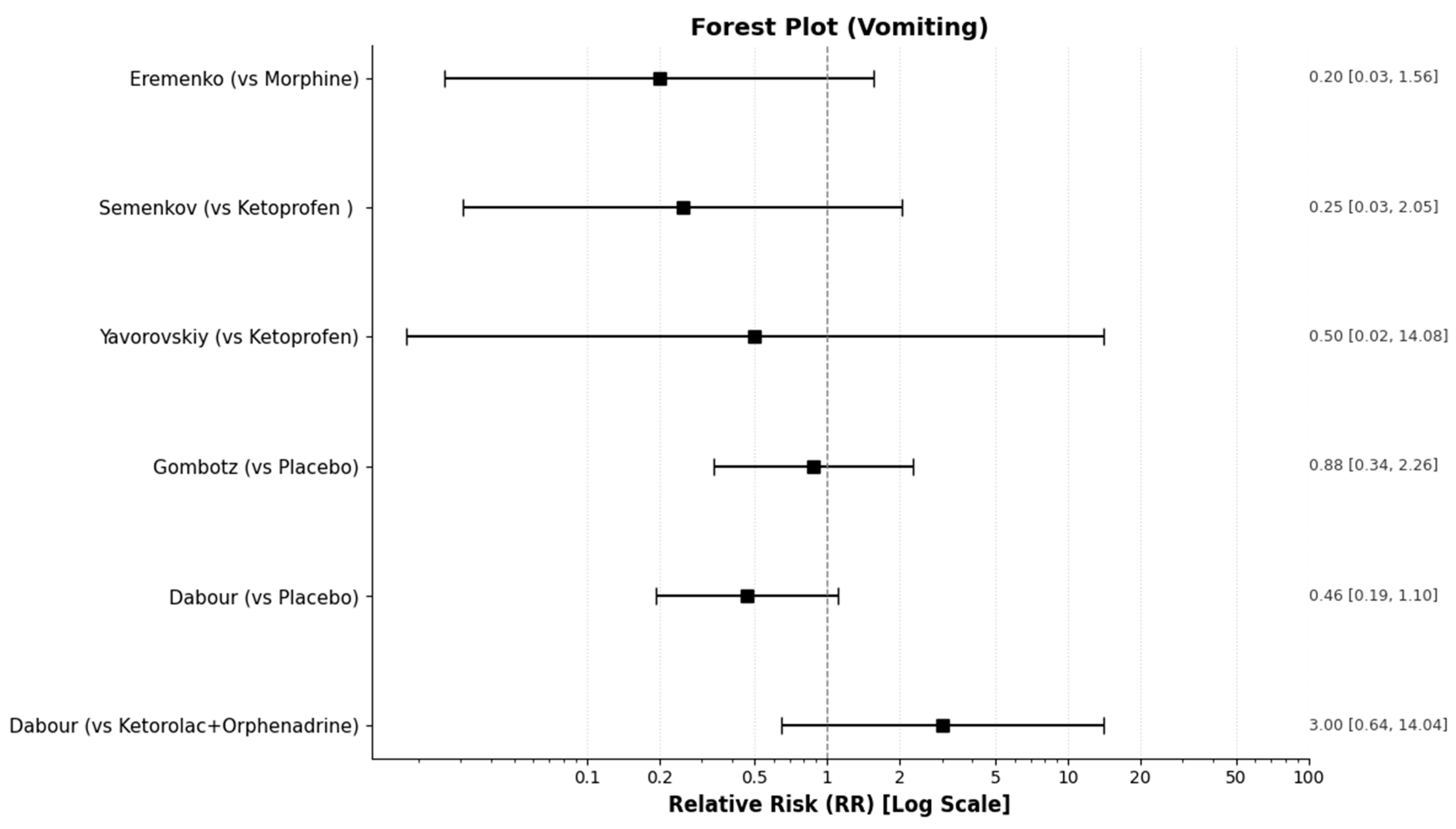
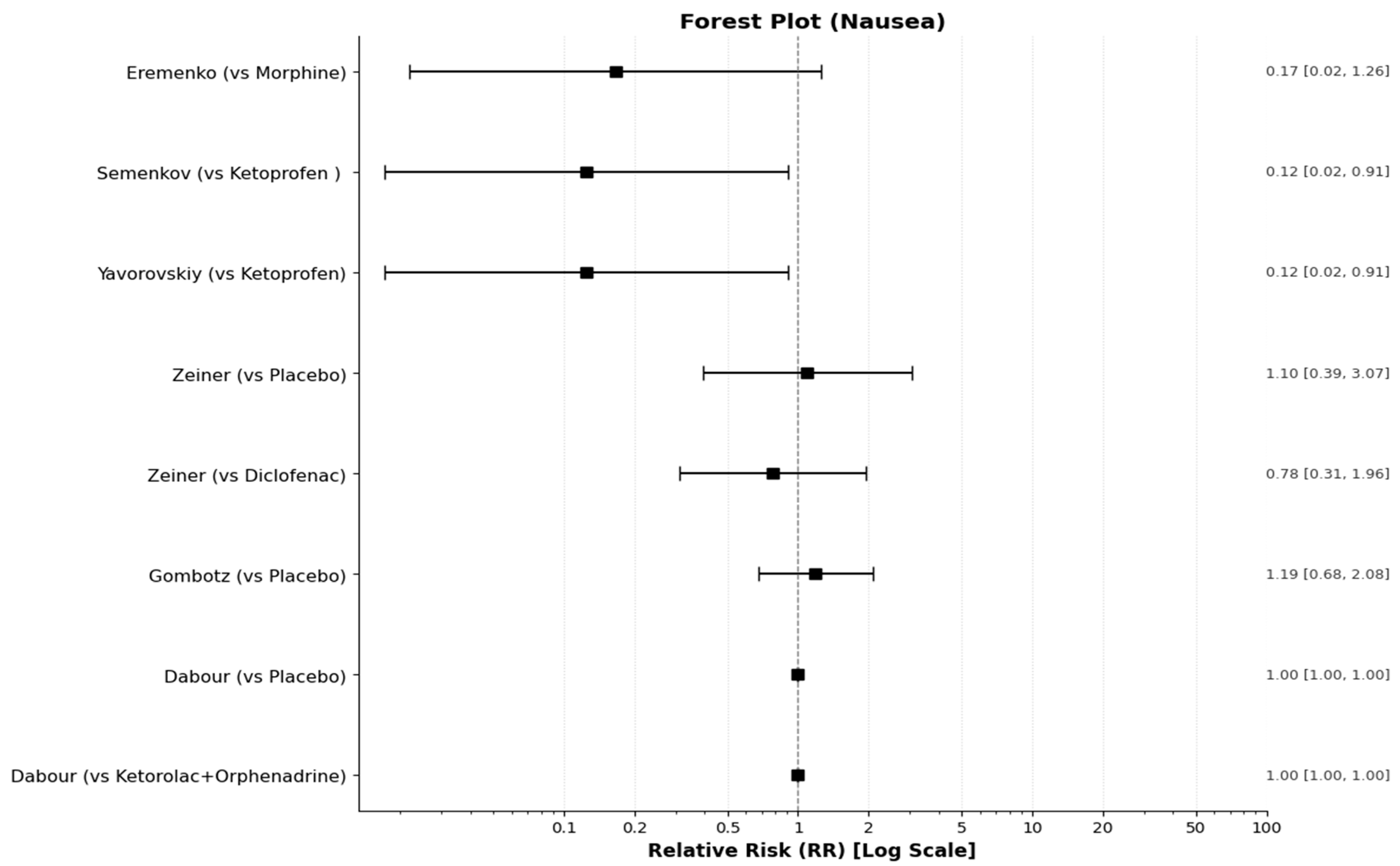
| System Organ Class/Preferred Term | Study | Comparator | Intervention Group % (N) | Comparator Group % (N) | RR (95% CI Upper, 95% CI Lower) |
|---|---|---|---|---|---|
| Gastrointestinal | |||||
| Nausea | Eremenko et al. [30] | Morphine monotherapy | 5% (N = 1) | 30% (N = 6) | 0.16 [0.02, 1.26] |
| Semenkov et al. [34] | Ketoprofen | 5% (N = 1) | 40% (N = 8) | 0.125 [0.017, 0.90] | |
| Yavorovskiy et al. [35] | Ketoprofen | 5% (N = 1) | 40% (N = 8) | 0.125 [0.017, 0.90] | |
| Zeiner et al. [36] | Placebo | 26.1% (N = 6) | 23.8% (N = 5) | 1.09 [0.39, 3.06] | |
| Diclofenac | 26.1% (N = 6) | 33.3% (N = 7) | 0.78 [0.31, 1.95] | ||
| Gombotz et al. [29] | Placebo | 31.6% (N = 19) | 26.6% (N = 16) | 1.18 [0.67, 2.08] | |
| Dabour et al. [27] | Placebo | (N = 43) | (N = 43) | 1 [1, 1] | |
| Ketorolac+Orphenadrine | (N = 43) | (N = 43) | 1 [1, 1] | ||
| Vomiting | Eremenko et al. [30] | Morphine monotherapy | 5% (N = 1) | 25% (N = 5) | 0.2 [0.02, 1.56] |
| Semenkov et al. [34] | Ketoprofen | 5% (N = 1) | 20% (N = 4) | 0.25 [0.03, 2.04] | |
| Yavorovskiy et al. [35] | Ketoprofen | 0% (N = 0.5) | 5% (N = 1) | 0.5 [0.01, 14.07] | |
| Gombotz et al. [29] | Placebo | 11.6% (N = 7) | 13.3% (N = 8) | 0.875 [0.33, 2.26] | |
| Dabour et al. [27] | Placebo | 14% (N = 6) | 30.2% (N = 13) | 0.46 [0.19, 1.10] | |
| Ketorolac+Orphenadrine | 14% (N = 6) | 4.6% (N = 2) | 3 [0.64, 14.04] | ||
| Dry mouth | Yavorovskiy et al. [35] | Ketoprofen | 30% (N = 6) | 65% (N = 13) | 0.46 [0.22, 0.96] |
| Intestinal paresis | Semenkov et al. [34] | Ketoprofen | 25% (N = 5) | 45% (N = 9) | 0.55 [0.22, 1.36] |
| Yavorovskiy et al. [35] | Ketoprofen | 5% (N = 1) | 10% (N = 2) | 0.5 [0.05, 5.08] | |
| Nervous system disorders | |||||
| Drowsiness | Semenkov et al. [34] | Ketoprofen (n = 20) | 35% (N = 7) | 60% (N = 12) | 0.58 [0.29, 1.17] |
| Yavorovskiy et al. [35] | Ketoprofen | 25% (N = 5) | 70% (N = 14) | 0.35 [0.16, 0.80] | |
| Weakness | Semenkov et al. [34] | Ketoprofen (n = 20) | 40% (N = 8) | 75(N = 15) | 0.53 [0.29, 0.96] |
| Dizziness | Semenkov et al. [34] | Ketoprofen | 10% (N = 2) | 25% (N = 5) | 0.4 [0.08, 1.82] |
| General disorders | |||||
| Headache | Semenkov et al. [34] | Ketoprofen | 15% (N = 3) | 15% (N = 3) | 1 [0.23, 4.37] |
| Decreased rate of diuresis | Semenkov et al. [34] | Ketoprofen | 5% (N = 1) | 10% (N = 2) | 0.5 [0.05, 5.08] |
| Fever | Gombotz et al. [29] | Placebo | 28% (N = 17) | 45% (N = 27) | 0.63 [0.38, 1.02] |
| Outcome | Participants (Studies) | Risk of Bias | F1 * | F2 * | F3 * | Effect Estimate Range | Certainty of Evidence (GRADE) * | Comments | |
|---|---|---|---|---|---|---|---|---|---|
| Analgesic Effect | Pain scores (VAS) at 6 h | 195 (4 RCT [28,30,31,32]) | Very Serious (−2) | −1 | 0 | −2 | MD: −25 to 2.6 | ⊕◯◯◯ Very Low | The direction of effect was negative in 3 out of 4 studies, favoring FDC. This effect must be interpreted in the context of the opioid-sparing effect found across the wider body of evidence, where studies consistently demonstrated a reduction in the use of narcotic analgesics when FDC was administered. |
| Pain scores (VAS) at 24 h | 392 (5 RCT [29,30,32,33,36]) | Serious (−1) | −1 | 0 | −2 | MD: −14 to 2.77 | ⊕◯◯◯ Very Low | The direction of effect was negative in 4 out of 6 studies, favoring FDC. This effect must be interpreted in the context of the opioid-sparing effect found across the wider body of evidence, where studies consistently demonstrated a reduction in the use of narcotic analgesics when FDC was administered. | |
| Average pain scores (NRS) at 12 h | 238 (2 RCT [27,37]) | Very Serious (−2) | −2 | 0 | −2 | MD: −0.61 to 0.45 | ⊕◯◯◯ Very Low | The direction of effect did not consistently favor the FDC since the results were extremely inconsistent. | |
| Opioid sparing effect | Morphine milligrams consumed | 554 (9 RCT [27,28,29,30,31,32,35,36,38]) | Very Serious (−2) | −1 | 0 | −2 | MD: −17.2 to 8.48 | ⊕◯◯◯ Very Low | The direction of effect was negative in 7 out of 9 studies, favoring FDC. This effect should also be interpreted alongside the consistent finding of lower pain scores reported with the FDC usage. |
| % of people without need for opioids | 415 (6 RCT [27,28,33,34,35,39]) | Very Serious (−2) | −2 | 0 | −1 | RR: 44 to 0.12 | ⊕◯◯◯ Very Low | The direction of effect was above 1 in 5 out of 6 studies favoring FDC. This effect should be interpreted alongside the consistent finding of lower pain scores reported with the FDC usage. | |
| Safety | Incidence of nausea | 434 (6 RCT [27,29,30,34,35,36]) | Very Serious (−2) | −2 | 0 | −1 | RR: 0.12 to 1.19 | ⊕◯◯◯ Very Low | The direction of effect was below 1 in 4 out of 6 studies, marginally favoring the FDC. However, these results can mask the effect of opioids used in the comparator groups, as the FDC was consistently associated with lower narcotics usage. |
| Incidence of vomiting | 369 (5 RCT [27,29,30,34,35]) | Very Serious (−2) | −2 | 0 | −2 | RR: 0.20 to 3 | ⊕◯◯◯ Very Low | The direction of effect was below 1 in 4 out of 5 studies favoring the FDC. However, these results can mask the effect of opioids used in the comparator groups, as the FDC was consistently associated with lower narcotics usage. | |
Disclaimer/Publisher’s Note: The statements, opinions and data contained in all publications are solely those of the individual author(s) and contributor(s) and not of MDPI and/or the editor(s). MDPI and/or the editor(s) disclaim responsibility for any injury to people or property resulting from any ideas, methods, instructions or products referred to in the content. |
© 2026 by the authors. Licensee MDPI, Basel, Switzerland. This article is an open access article distributed under the terms and conditions of the Creative Commons Attribution (CC BY) license.
Share and Cite
Christopoulos, N.; Akinosoglou, K. The Efficacy of Fixed-Dose Diclofenac and Orphenadrine for Postoperative Pain Management: A Systematic Review. Medicines 2026, 13, 17. https://doi.org/10.3390/medicines13020017
Christopoulos N, Akinosoglou K. The Efficacy of Fixed-Dose Diclofenac and Orphenadrine for Postoperative Pain Management: A Systematic Review. Medicines. 2026; 13(2):17. https://doi.org/10.3390/medicines13020017
Chicago/Turabian StyleChristopoulos, Nikolaos, and Karolina Akinosoglou. 2026. "The Efficacy of Fixed-Dose Diclofenac and Orphenadrine for Postoperative Pain Management: A Systematic Review" Medicines 13, no. 2: 17. https://doi.org/10.3390/medicines13020017
APA StyleChristopoulos, N., & Akinosoglou, K. (2026). The Efficacy of Fixed-Dose Diclofenac and Orphenadrine for Postoperative Pain Management: A Systematic Review. Medicines, 13(2), 17. https://doi.org/10.3390/medicines13020017