
Highly Efficient Adsorption of Pb(II) by Magnesium-Modified Zeolite: Performance and Mechanisms

 ,
,  , and
, and
Abstract
1. Introduction
2. Materials and Methods
2.1. Materials
2.2. Synthesis of Magnesium-Modified Zeolite
2.3. Characterization
2.4. Batch Adsorption Experiments
2.4.1. Adsorption Kinetics and Isotherm Experiments
2.4.2. Effect of Dose
2.4.3. Effect of pH
2.4.4. Effect of Coexisting Ion
3. Results and Discussion
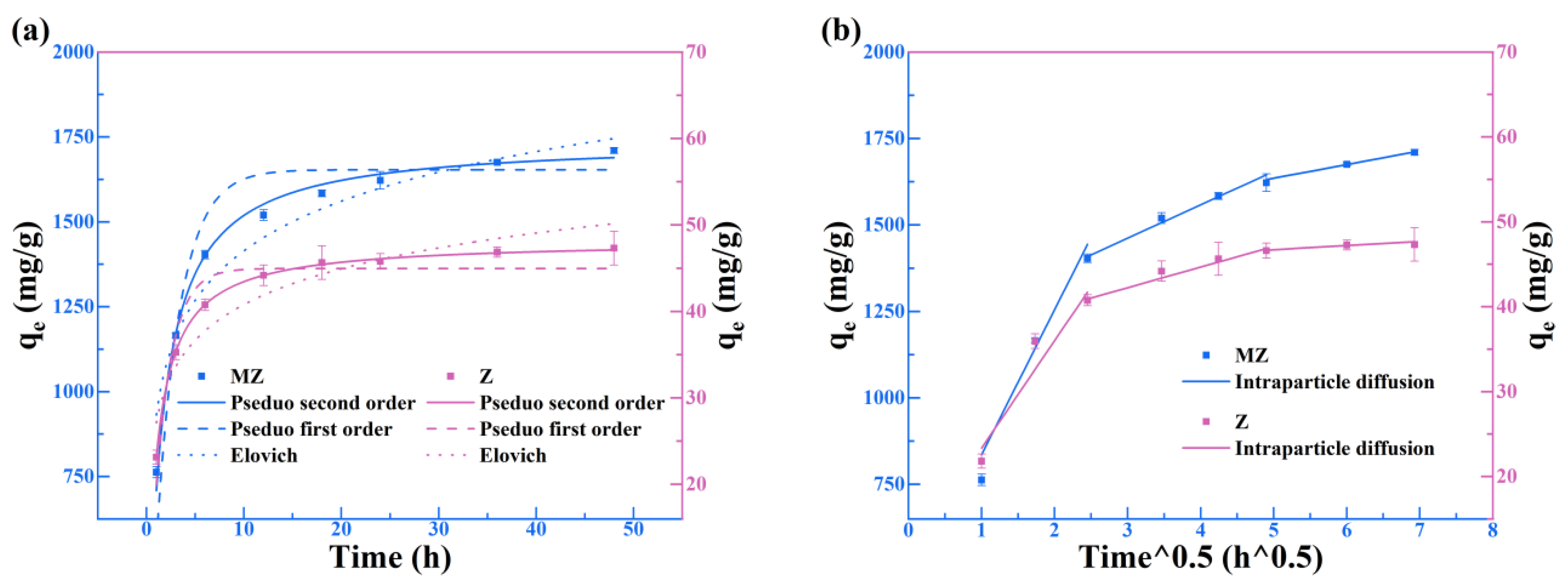
3.1. Kinetics
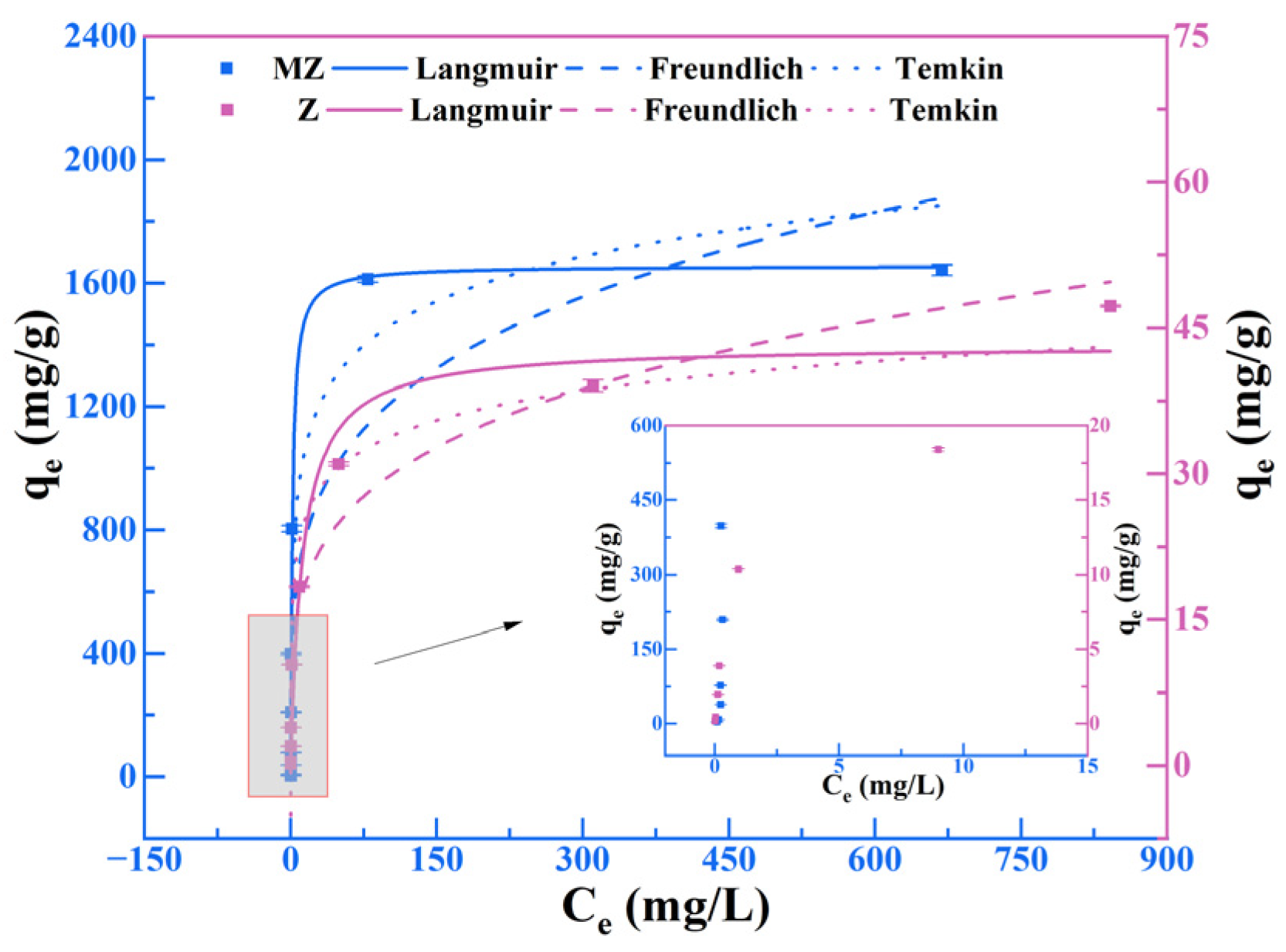
3.2. Isotherms
3.3. Effect of Dose, pH and Coexisting Ions
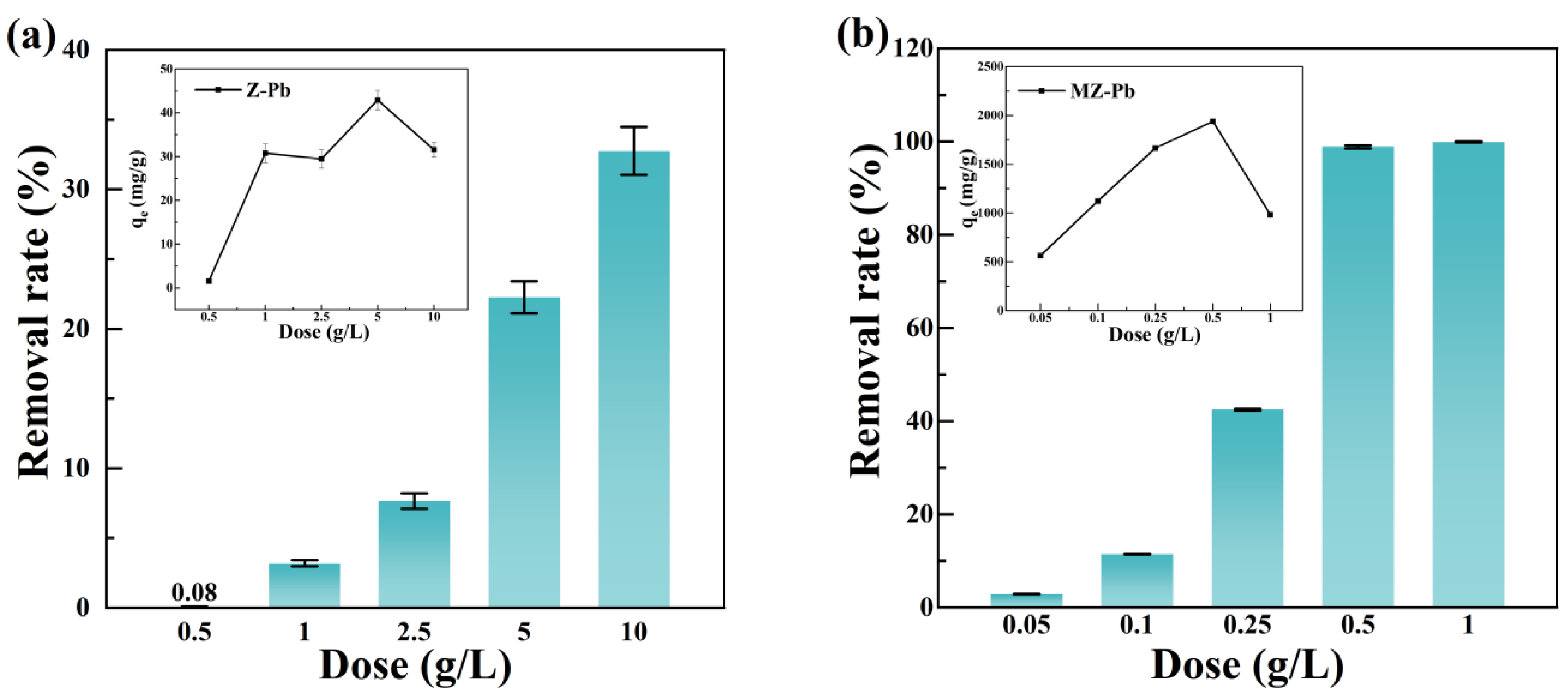
3.3.1. Results of the Effect of Dose
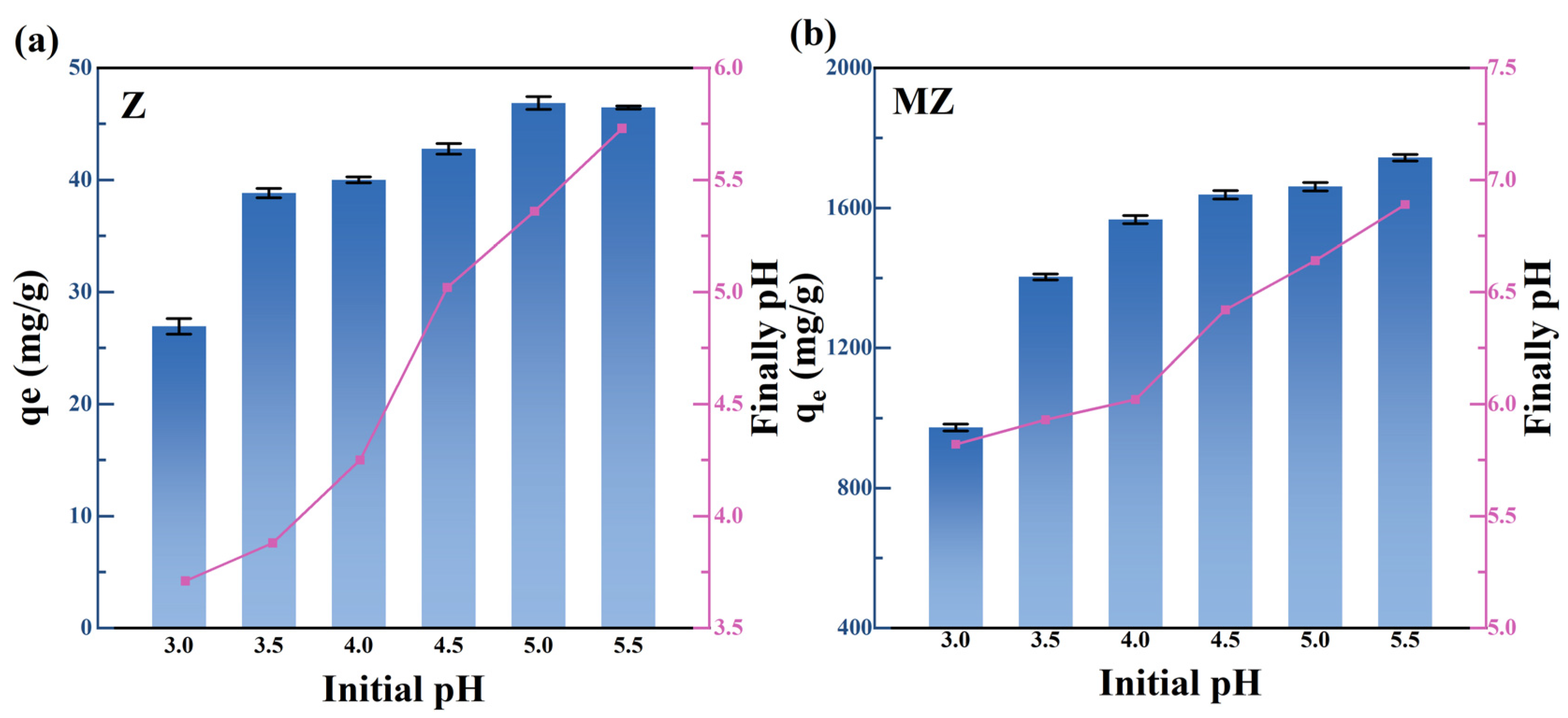
3.3.2. Results of the Effect of pH
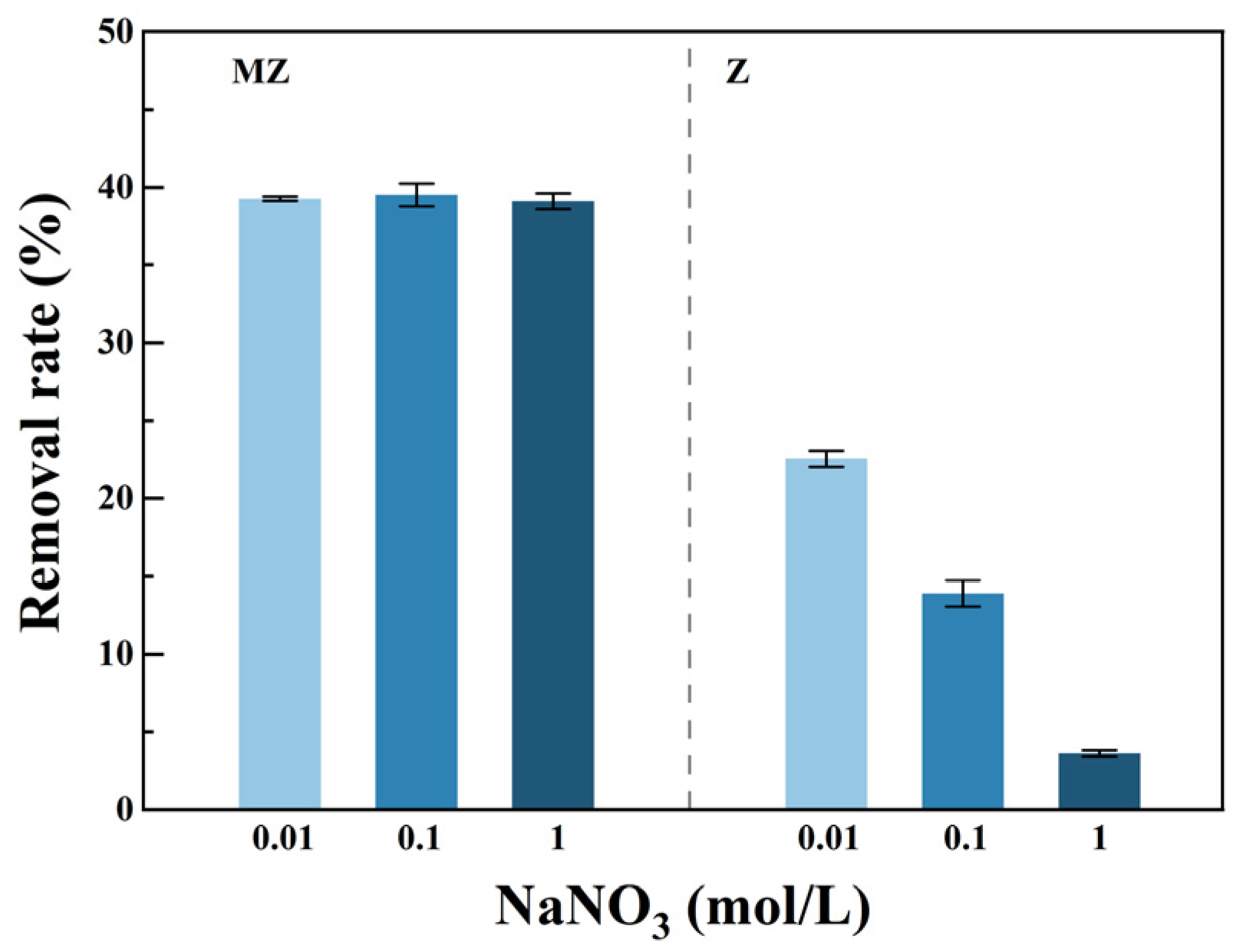
3.3.3. Effect of Coexisting Ions
3.4. Possible Adsorption Mechanism
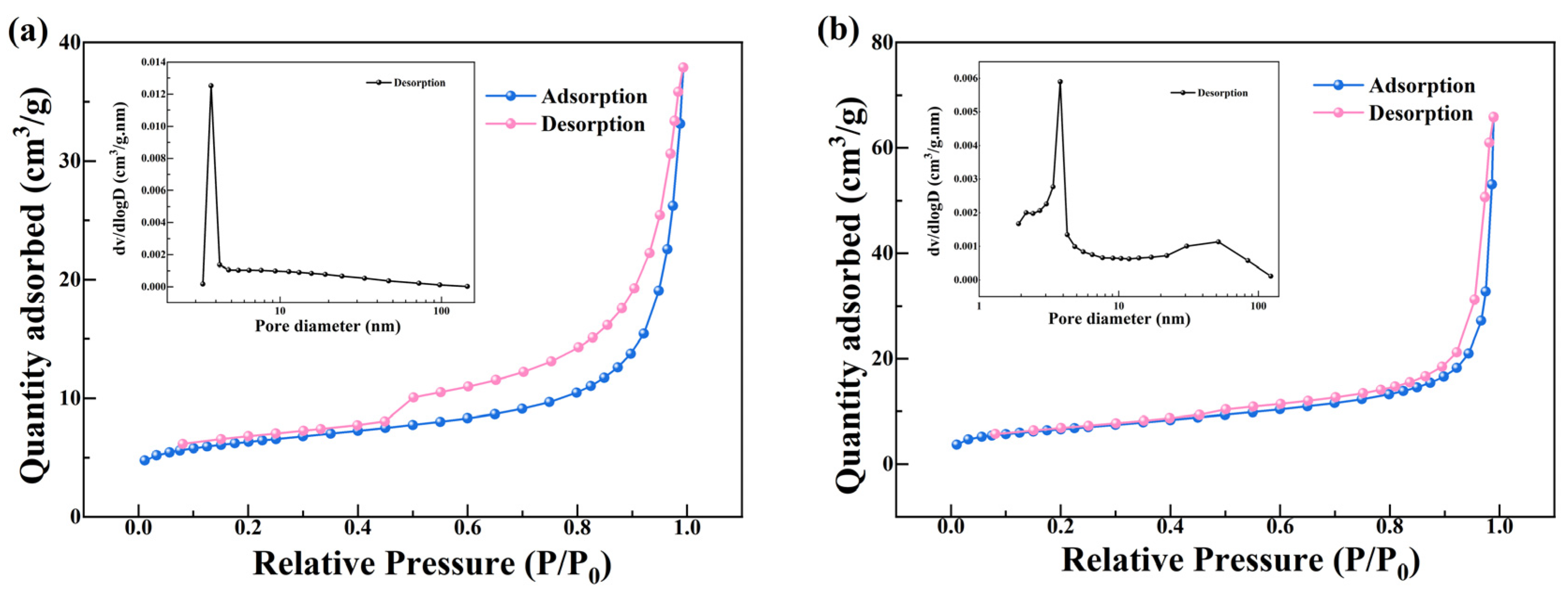
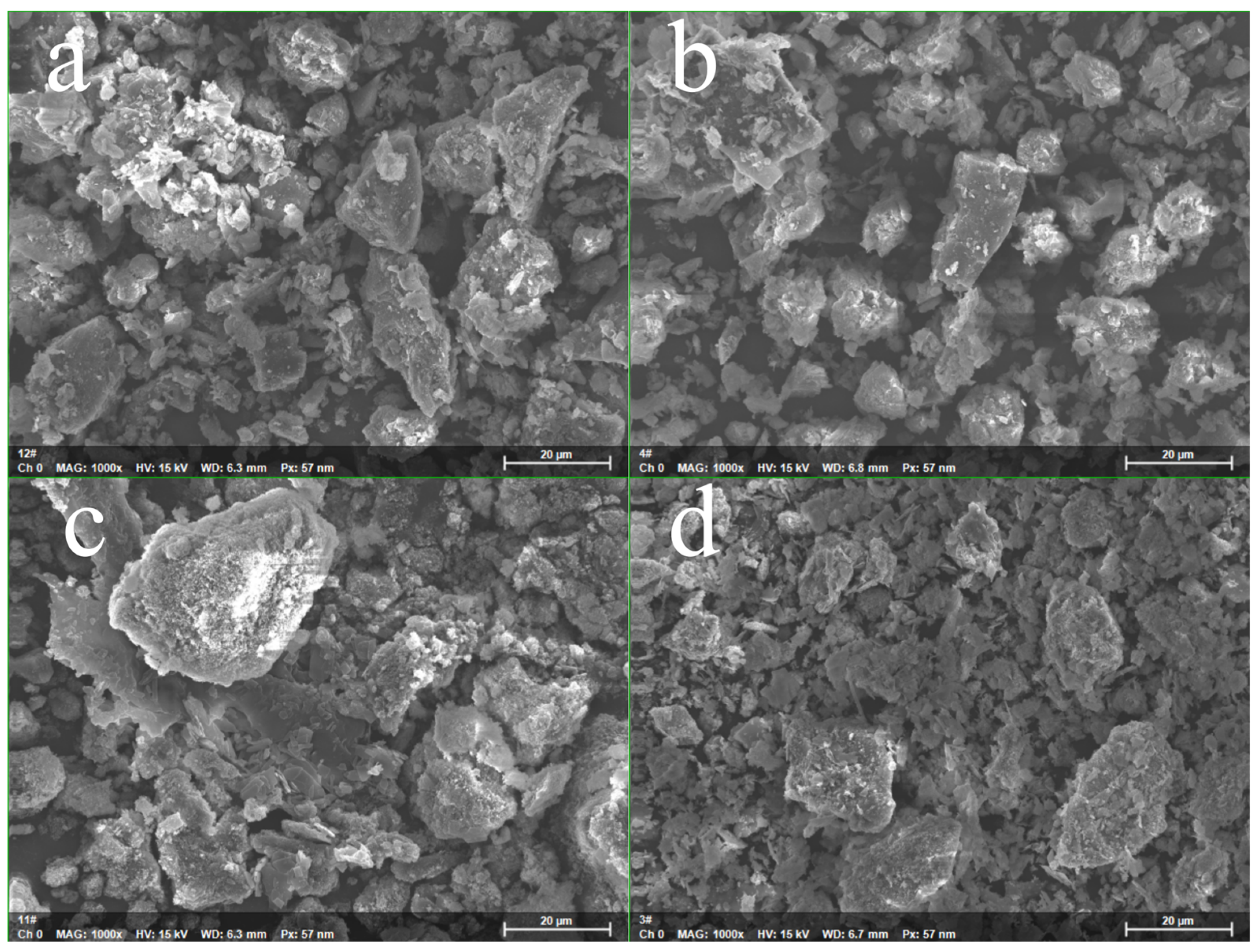
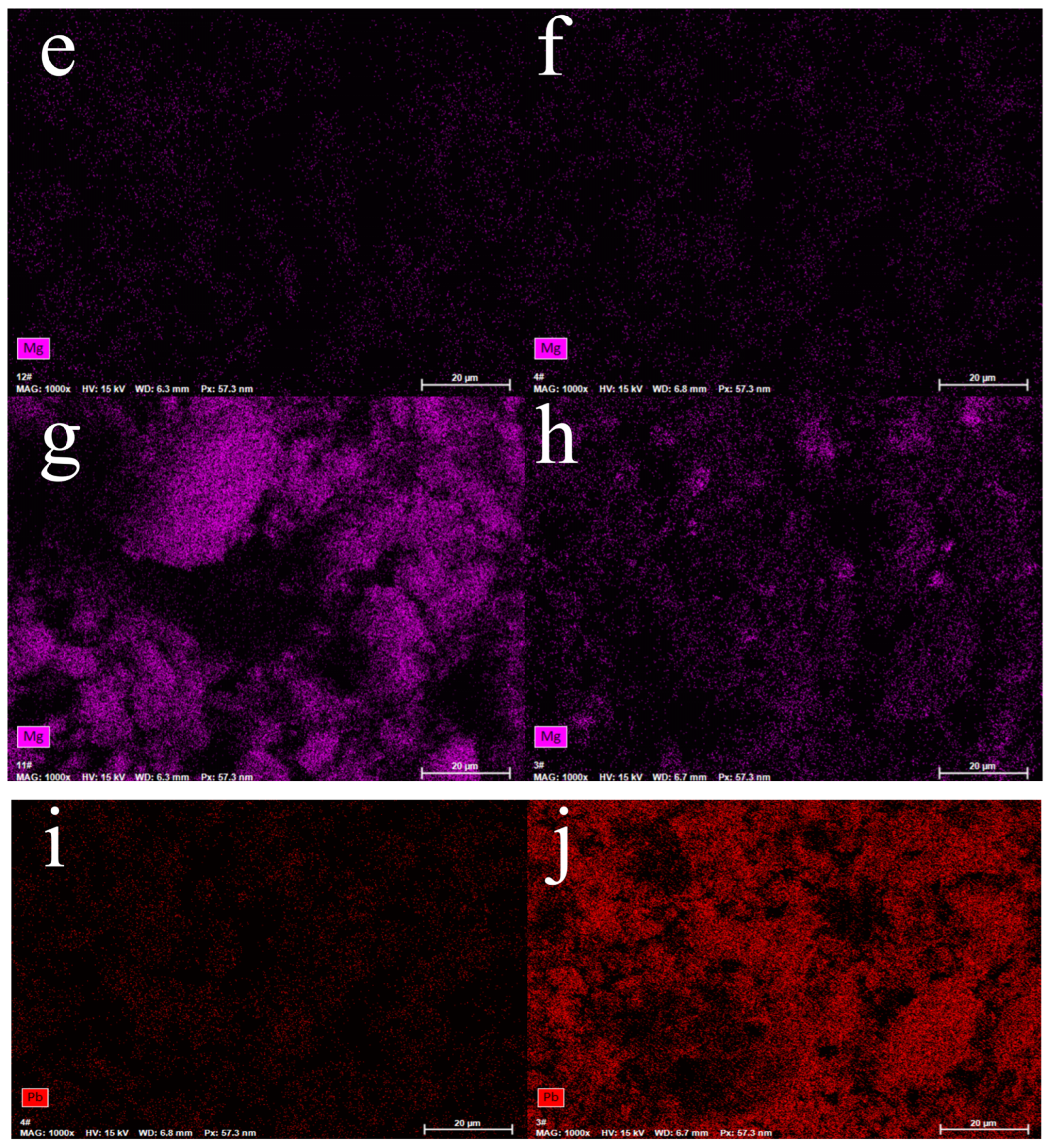
3.4.1. BET and SEM-EDX Results
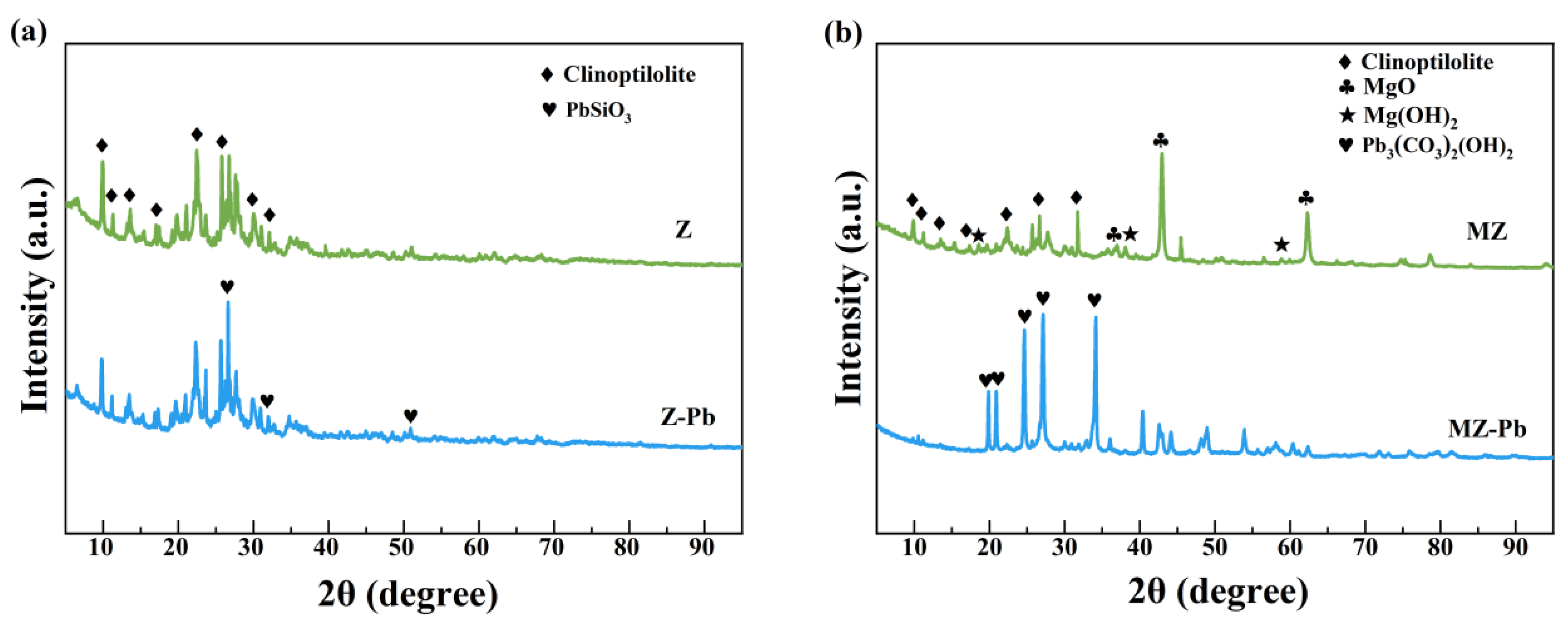
3.4.2. XRD
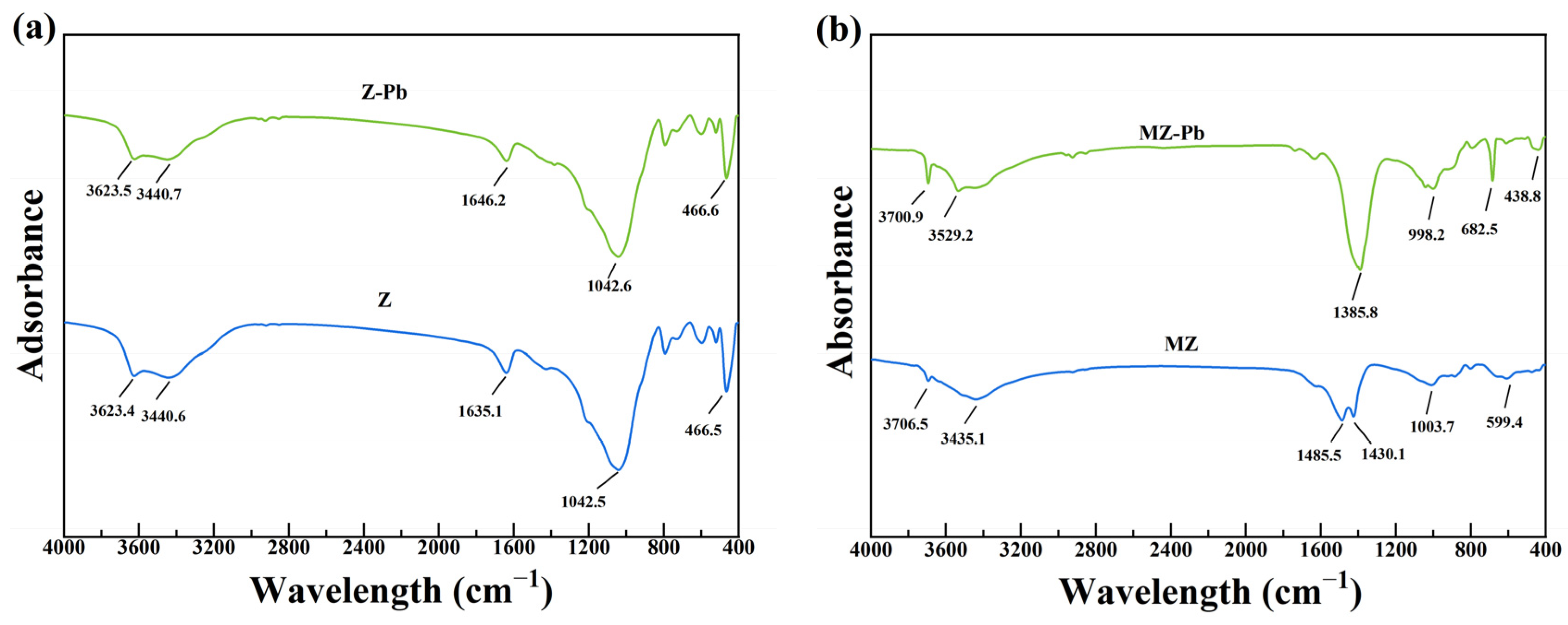
3.4.3. FTIR
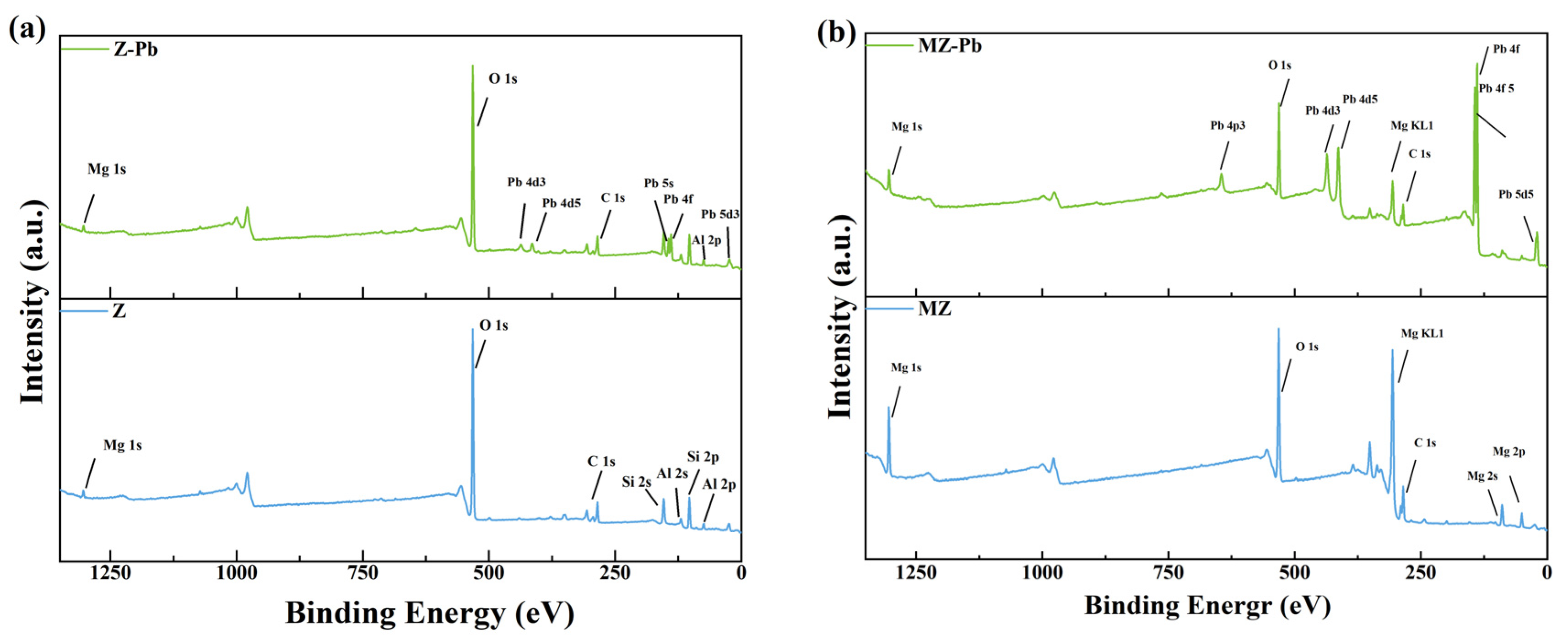
3.4.4. XPS
3.4.5. Potential Mechanisms
4. Conclusions
Supplementary Materials
Author Contributions
Funding
Institutional Review Board Statement
Informed Consent Statement
Data Availability Statement
Conflicts of Interest
References
- Buzukashvili, S.; Sommerville, R.; Hu, W.; Brooks, O.; Kökkılıç, O.; Ouzilleau, P.; Rowson, N.A.; Waters, K.E. Zeolite synthesis from coal fly ash and its application to heavy metals remediation from water contaminated with Pb, Cu, Zn and Ni ions. Miner. Eng. 2024, 209, 108619. [Google Scholar] [CrossRef]
- Xing, P.; Wang, C.; Ma, B.; Chen, Y. Removal of Pb(II) from aqueous solution using a new zeolite-type absorbent: Potassium ore leaching residue. J. Environ. Chem. Eng. 2018, 6, 7138–7143. [Google Scholar] [CrossRef]
- Jacob, J.M.; Karthik, C.; Saratale, R.G.; Kumar, S.S.; Prabakar, D.; Kadirvelu, K.; Pugazhendhi, A. Biological approaches to tackle heavy metal pollution: A survey of literature. J. Environ. Manag. 2018, 217, 56–70. [Google Scholar] [CrossRef] [PubMed]
- Feng, T.; Xu, J.; Yu, C.; Cheng, K.; Wu, Y.; Wang, Y.; Li, F. Graphene oxide wrapped melamine sponge as an efficient and recoverable adsorbent for Pb(II) removal from fly ash leachate. J. Hazard. Mater. 2019, 367, 26–34. [Google Scholar] [CrossRef]
- Li, Z.; Wang, L.; Meng, J.; Liu, X.; Xu, J.; Wang, F.; Brookes, P. Zeolite-supported nanoscale zero-valent iron: New findings on simultaneous adsorption of Cd(II), Pb(II), and As(III) in aqueous solution and soil. J. Hazard. Mater. 2018, 344, 1–11. [Google Scholar] [CrossRef]
- Pehlivan, E.; Yanık, B.H.; Ahmetli, G.; Pehlivan, M. Equilibrium isotherm studies for the uptake of cadmium and lead ions onto sugar beet pulp. Bioresour. Technol. 2008, 99, 3520–3527. [Google Scholar] [CrossRef]
- Shirzadi, H.; Nezamzadeh-Ejhieh, A. An efficient modified zeolite for simultaneous removal of Pb(II) and Hg(II) from aqueous solution. J. Mol. Liq. 2017, 230, 221–229. [Google Scholar] [CrossRef]
- Fu, F.; Wang, Q. Removal of heavy metal ions from wastewaters: A review. J. Environ. Manag. 2011, 92, 407–418. [Google Scholar] [CrossRef]
- Renault, F.; Sancey, B.; Badot, P.-M.; Crini, G. Chitosan for coagulation/flocculation processes—An eco-friendly approach. Eur. Polym. J. 2009, 45, 1337–1348. [Google Scholar] [CrossRef]
- Mihajlović, M.T.; Lazarević, S.S.; Janković-Častvan, I.M.; Kovač, J.; Jokić, B.M.; Janaćković, D.T.; Petrović, R.D. Kinetics, thermodynamics, and structural investigations on the removal of Pb2+, Cd2+, and Zn2+ from multicomponent solutions onto natural and Fe(III)-modified zeolites. Clean Technol. Technol. Policy 2015, 17, 407–419. [Google Scholar] [CrossRef]
- Qasem, N.A.A.; Mohammed, R.H.; Lawal, D.U. Removal of heavy metal ions from wastewater: A comprehensive and critical review. npj Clean Water 2021, 4, 36. [Google Scholar] [CrossRef]
- Xu, X.; Cao, X.; Zhao, L. Comparison of rice husk-and dairy manure-derived biochars for simultaneously removing heavy metals from aqueous solutions: Role of mineral components in biochars. Chemosphere 2013, 92, 955–961. [Google Scholar] [CrossRef]
- Chen, M.; Nong, S.; Zhao, Y.; Riaz, M.S.; Xiao, Y.; Molokeev, M.S.; Huang, F. Renewable P-type zeolite for superior absorption of heavy metals: Isotherms, kinetics, and mechanism. Sci. Total Environ. 2020, 726, 138535. [Google Scholar] [CrossRef] [PubMed]
- He, K.; Chen, Y.; Tang, Z.; Hu, Y. Removal of heavy metal ions from aqueous solution by zeolite synthesized from fly ash. Environ. Sci. Pollut. Res. 2016, 23, 2778–2788. [Google Scholar] [CrossRef] [PubMed]
- Kameda, T.; Kikuchi, H.; Kitagawa, F.; Kumagai, S.; Saito, Y.; Kondo, M.; Jimbo, Y.; Yoshioka, T. Ammonia adsorption by L-type zeolite and Prussian blue from aqueous and culture solutions. Colloids Surf. A Physicochem. Eng. Asp. 2021, 622, 126595. [Google Scholar] [CrossRef]
- Karnib, M.; Kabbani, A.; Holail, H.; Olama, Z. Heavy Metals Removal Using Activated Carbon, Silica and Silica Activated Carbon Composite. Energy Procedia 2014, 50, 113–120. [Google Scholar] [CrossRef]
- Sprynskyy, M.; Buszewski, B.; Terzyk, A.P.; Namiesnik, J. Study of the selection mechanism of heavy metal (Pb2+, Cu2+, Ni2+, and Cd2+) adsorption on clinoptilolite. J. Colloid Interface Sci. 2006, 304, 21–28. [Google Scholar] [CrossRef]
- Karatas, M. Removal of Pb(II) from water by natural zeolitic tuff: Kinetics and thermodynamics. J. Hazard. Mater. 2012, 199–200, 383–389. [Google Scholar] [CrossRef]
- Perić, J.; Trgo, M.; Vukojević Medvidović, N. Removal of zinc, copper and lead by natural zeolite—A comparison of adsorption isotherms. Water Res. 2004, 38, 1893–1899. [Google Scholar] [CrossRef]
- Masoud, M.S.; Zidan, A.A.; El Zokm, G.M.; Elsamra, R.M.I.; Okbah, M.A. Humic acid and nano-zeolite NaX as low cost and eco-friendly adsorbents for removal of Pb(II) and Cd(II) from water: Characterization, kinetics, isotherms and thermodynamic studies. Biomass Convers. Biorefin. 2024, 14, 3615–3632. [Google Scholar] [CrossRef]
- Wingenfelder, U.; Nowack, B.; Furrer, G.; Schulin, R. Adsorption of Pb and Cd by amine-modified zeolite. Water Res. 2005, 39, 3287–3297. [Google Scholar] [CrossRef] [PubMed]
- Han, R.; Zou, W.; Li, H.; Li, Y.; Shi, J. Copper(II) and lead(II) removal from aqueous solution in fixed-bed columns by manganese oxide coated zeolite. J. Hazard. Mater. 2006, 137, 934–942. [Google Scholar] [CrossRef]
- Praipipat, P.; Ngamsurach, P.; Roopkhan, N. Zeolite A powder and beads from sugarcane bagasse fly ash modified with iron(III) oxide-hydroxide for lead adsorption. Sci. Rep. 2023, 13, 1873. [Google Scholar] [CrossRef]
- Kuldeyev, E.; Seitzhanova, M.; Tanirbergenova, S.; Tazhu, K.; Doszhanov, E.; Mansurov, Z.; Azat, S.; Nurlybaev, R.; Berndtsson, R. Modifying Natural Zeolites to Improve Heavy Metal Adsorption. Water 2023, 15, 2215. [Google Scholar] [CrossRef]
- Yuan, M.; Xie, T.; Yan, G.; Chen, Q.; Wang, L. Effective removal of Pb2+ from aqueous solutions by magnetically modified zeolite. Powder Technol. 2018, 332, 234–241. [Google Scholar] [CrossRef]
- Choi, H.-J.; Yu, S.-W.; Kim, K.H. Efficient use of Mg-modified zeolite in the treatment of aqueous solution contaminated with heavy metal toxic ions. J. Taiwan Inst. Chem. Eng. 2016, 63, 482–489. [Google Scholar] [CrossRef]
- Lu, Z.; Zhang, K.; Liu, F.; Gao, X.; Zhai, Z.; Li, J.; Du, L. Simultaneous recovery of ammonium and phosphate from aqueous solutions using Mg/Fe modified NaY zeolite: Integration between adsorption and struvite precipitation. Sep. Purif. Technol. 2022, 299, 121713. [Google Scholar] [CrossRef]
- Shi, Q.; Zhang, H.; Shahab, A.; Zeng, H.; Zeng, H.; Bacha, A.-U.-R.; Nabi, I.; Siddique, J.; Ullah, H. Efficient performance of magnesium oxide loaded biochar for the significant removal of Pb2+ and Cd2+ from aqueous solution. Ecotoxicol. Environ. Saf. 2021, 221, 112426. [Google Scholar] [CrossRef]
- Ameur, N.B.; Allouche, N.; Hihn, J.-Y.; Sassi, W. Removal of persistent heavy metals using marine biomass and engineered biopolymer under challenging seawater conditions. Results Eng. 2025, 28, 108293. [Google Scholar] [CrossRef]
- Guo, T.; Bulin, C.; Li, C.; Xin, G.; Bao, J.; Song, J. Experimental and statistical physics illumination of Pb(II) adsorption on magnetic chitosan-graphene oxide surface. Sep. Purif. Technol. 2025, 354, 128867. [Google Scholar] [CrossRef]
- Shi, T.; Guo, M.; Gao, H.; Wang, Y.; Li, H.; Wu, M.; Cheng, D.; Han, Y.; Wang, D. Removal of tetracycline by steel slag-red mud composite pellets: Adsorption performance and mechanism. Appl. Surf. Sci. 2025, 688, 162363. [Google Scholar] [CrossRef]
- Silva, L.M.S.; Muñoz-Peña, M.J.; Domínguez-Vargas, J.R.; González, T.; Cuerda-Correa, E.M. Kinetic and equilibrium adsorption parameters estimation based on a heterogeneous intraparticle diffusion model. Surf. Interfaces 2021, 22, 100791. [Google Scholar] [CrossRef]
- Xiong, L.; Chen, C.; Chen, Q.; Ni, J. Adsorption of Pb(II) and Cd(II) from Aqueous Solutions Using Titanate Nanotubes Prepared via Hydrothermal Method. J. Hazard. Mater. 2011, 189, 741–748. [Google Scholar] [CrossRef]
- Günay, A.; Arslankaya, E.; Tosun, İ. Lead removal from aqueous solution by natural pretreated clinoptilolite: Adsorption equilibrium kinetics. J. Hazard. Mater. 2007, 146, 362–371. [Google Scholar] [CrossRef]
- Xie, K.; Xie, J.; Zhao, Z.; Meng, X.; Chen, B. Synthesis of iron-modified montmorillonite/Al2O3 composite adsorbents and their phosphorus adsorption performance study. Sci. Rep. 2025, 15, 34873. [Google Scholar] [CrossRef] [PubMed]
- Langmuir, I. The adsorption of gases on plane surfaces of glass, mica and platinum. J. Am. Chem. Soc. 1918, 40, 1361–1403. [Google Scholar] [CrossRef]
- Medykowska, M.; Wiśniewska, M.; Szewczuk-Karpisz, K.; Galaburda, M.; Oranska, O.; Panek, R. Green Synthesis and Efficient Adsorption: Na-X Zeolite vs. C/Mn/SiO2 Composite for Heavy Metals Removal. Materials 2024, 17, 954. [Google Scholar] [CrossRef]
- Panek, R.; Medykowska, M.; Wiśniewska, M.; Szewczuk-Karpisz, K.; Jędruchniewicz, K.; Franus, M. Simultaneous Removal of Pb2+ and Zn2+ Heavy Metals Using Fly Ash Na-X Zeolite and Its Carbon Na-X(C) Composite. Materials 2021, 14, 2832. [Google Scholar] [CrossRef]
- Zhang, C.; Yang, D.; Liu, W.; Dong, Y.; Zhang, L.; Lin, H. Insight into the impacts of pyrolysis time on adsorption behavior of Pb2+ and Cd2+ by Mg modified biochar: Performance and modification mechanism. Environ. Res. 2023, 239, 117215. [Google Scholar] [CrossRef] [PubMed]
- Wu, J.; Wang, T.; Wang, J.; Zhang, Y.; Pan, W.-P. A novel modified method for the efficient removal of Pb and Cd from wastewater by biochar: Enhanced the ion exchange and precipitation capacity. Sci. Total Environ. 2021, 754, 142150. [Google Scholar] [CrossRef]
- Cheng, S.; Zhao, S.; Guo, H.; Xing, B.; Liu, Y.; Zhang, C.; Ma, M. High-efficiency removal of lead/cadmium from wastewater by MgO modified biochar derived from crofton weed. Bioresour. Technol. 2022, 343, 126081. [Google Scholar] [CrossRef]
- Kim, S.A.; Kamala-Kannan, S.; Lee, K.-J.; Park, Y.-J.; Shea, P.J.; Lee, W.-H.; Kim, H.-M.; Oh, B.-T. Removal of Pb(II) from aqueous solution by a zeolite–nanoscale zero-valent iron composite. Chem. Eng. J. 2013, 217, 54–60. [Google Scholar] [CrossRef]
- Lin, H.; Yang, D.; Zhang, C.; Liu, W.; Zhang, L.; Dong, Y. Selective removal behavior of lead and cadmium from calcium-rich solution by MgO loaded soybean straw biochars and mechanism analysis. Chemosphere 2023, 319, 138010. [Google Scholar] [CrossRef] [PubMed]
- Shang, H.; Li, Y.; Liu, J.; Wan, Y.; Feng, Y.; Yu, Y. Preparation of nitrogen doped magnesium oxide modified biochar and its sorption efficiency of lead ions in aqueous solution. Bioresour. Technol. 2020, 314, 123708. [Google Scholar] [CrossRef] [PubMed]
- Abdel-Azim, S.M.; Aboul-Gheit, N.A.K.; Younis, S.A.; Ahmed, S.M. Synergistic role of pillared bentonite with single and binary Fe/Al-polyoxocations on Pb(II) adsorption recovery from hard water under competitive and non-competitive effects. Appl. Clay Sci. 2025, 267, 107716. [Google Scholar] [CrossRef]
- Zhang, X.; Yan, L.; Liu, J.; Zhang, Z.; Tan, C. Removal of Different Kinds of Heavy Metals by Novel PPG-nZVI Beads and Their Application in Simulated Stormwater Infiltration Facility. Appl. Sci. 2019, 9, 4213. [Google Scholar] [CrossRef]
- Fu, W.; Deng, Y.; Ram, R.; Etschmann, B.; Owen, N.D.; Brugger, J.; Vaughan, J. Selective removal of radioactive 210Pb(II) and nonradioactive Pb(II) isotopes from Cu(II)-rich acidic chloride solution by a new polyamine anion exchanger. Sep. Purif. Technol. 2020, 251, 117359. [Google Scholar] [CrossRef]
- Lassoued, H.; Mota, N.; Millán Ordóñez, E.; Raissi, S.; Younes, M.K.; Quilis Romero, C.; Navarro Yerga, R.M. Improved Dimethyl Ether Production from Syngas over Aerogel Sulfated Zirconia and Cu-ZnO(Al) Bifunctional Composite Catalysts. Materials 2023, 16, 7328. [Google Scholar] [CrossRef]
- Ren, K.; Liu, S.; Dong, Z.; Wang, J. Wet Catalytic Oxidation of a FeMnCe-Activated Semi-Coke Catalyst for Treating Piperazine Wastewater. ACS Omega 2023, 8, 8683–8694. [Google Scholar] [CrossRef]
- Bai, Q.; Zhang, B.; Ma, X.; Zhao, S.; Fan, J.; Fan, Y.; Tang, X. Research on the Modification of the Coal Pore Structure by Indigenous Microbial Degradation. Sustainability 2025, 17, 3337. [Google Scholar] [CrossRef]
- Tong, Y.; Ke, M. Study on the Acidic Modification of Mesoporous HZSM-5 Zeolite and Its Catalytic Cracking Performance. Catalysts 2024, 14, 713. [Google Scholar] [CrossRef]
- Kang, J.; Singh, B.K.; Um, W. Efficient radon removal using fluorine-functionalized natural zeolite. J. Environ. Radioact. 2021, 233, 106607. [Google Scholar] [CrossRef] [PubMed]
- Rahmani-Aliabadi, A.; Nezamzadeh-Ejhieh, A. A visible light FeS/Fe2S3/zeolite photocatalyst towards photodegradation of ciprofloxacin. J. Photochem. Photobiol. A Chem. 2018, 357, 1–10. [Google Scholar] [CrossRef]
- Ulfa, M.; Masykur, A.; Nofitasari, A.F.; Sholeha, N.A.; Suprapto, S.; Bahruji, H.; Prasetyoko, D. Controlling the Size and Porosity of Sodalite Nanoparticles from Indonesian Kaolin for Pb2+ Removal. Materials 2022, 15, 2745. [Google Scholar] [CrossRef]
- Zhao, J.; Qin, Y.; Liu, Y.; Shi, Y.; Lin, Q.; Cai, M.; Jia, Z.; Yu, C.; Shang, A.; Fei, Y.; et al. Cobalt/Iron Bimetallic Biochar Composites for Lead(II) Adsorption: Mechanism and Remediation Performance. Molecules 2024, 29, 1595. [Google Scholar] [CrossRef]
- Wang, H.; Wen, Y.; Ding, Y.; Yue, Z.; Xu, D.; Liu, Y.; Zhang, Y.; Xu, R.; Zeng, W. Rapid and Effective Lead Elimination Using Cow Manure Derived Biochar: Balance between Inherent Phosphorus Release and Pollutants Immobilization. Toxics 2023, 11, 1. [Google Scholar] [CrossRef] [PubMed]
- Wen, Y.; Chen, D.; Zhang, Y.; Wang, H.; Xu, R. Towards a better understanding on adsorption mechanism of various heavy metal with phosphorus rich hydrochar. Arab. J. Chem. 2024, 17, 105530. [Google Scholar] [CrossRef]
- Shang, Z.; Wang, T.; Ye, Q.; Wu, P.; Wu, J.; Sun, L.; Zhu, N. Immobilization of Pb2+ and Cd2+ on the novel calcium/magnesium silicate and their transformation in the presence of phosphate. Desalination 2023, 568, 117007. [Google Scholar] [CrossRef]
- Sahoo, S.K.; Panigrahi, G.K.; Sahu, M.K.; Arzoo, A.; Sahoo, J.K.; Sahoo, A.; Pradhan, A.K.; Dalbehera, A. Biological synthesis of GO-MgO nanomaterial using Azadirachta indica leaf extract: A potential bio-adsorbent for removing Cr(VI) ions from aqueous media. Biochem. Eng. J. 2022, 177, 108272. [Google Scholar] [CrossRef]
- Wang, C.-Y.; Wang, Q.; Zhou, H.-D.; Fang, X.; Zeng, Q.; Zhu, G. Adsorption of phosphate over a novel magnesium-loaded sludge-based biochar. PLoS ONE 2024, 19, e0301986. [Google Scholar] [CrossRef] [PubMed]
- Badjatya, P.; Akca, A.H.; Fraga Alvarez, D.V.; Chang, B.; Ma, S.; Pang, X.; Wang, E.; van Hinsberg, Q.; Esposito, D.V.; Kawashima, S. Carbon-negative cement manufacturing from seawater-derived magnesium feedstocks. Proc. Natl. Acad. Sci. USA 2022, 119, e2114680119. [Google Scholar] [CrossRef]
- Shinagawa, T.; Chigane, M.; Izaki, M. Electrochemical Growth of Mg(OH)x Layered Films Stacked Parallel to the Substrates and Their Thermal Conversion to (111)-Oriented Nanoporous MgO Films. ACS Omega 2021, 6, 2312–2317. [Google Scholar] [CrossRef]
- Li, A.Y.; Deng, H.; Jiang, Y.H.; Ye, C.H.; Yu, B.G.; Zhou, X.L.; Ma, A.Y. Superefficient Removal of Heavy Metals from Wastewater by Mg-Loaded Biochars: Adsorption Characteristics and Removal Mechanisms. Langmuir 2020, 36, 9160–9174. [Google Scholar] [CrossRef] [PubMed]
- Pérez-Rodríguez, J.L.; Robador, M.D.; Larrea, G.; Durán, A. Revealing Juan de Oviedo y de la Bandera’s Artworks: The Case of the Polychrome of a Stone-Carved Sculpture from the Madre de Dios Convent Façade in Seville. Minerals 2024, 14, 225. [Google Scholar] [CrossRef]
- Muñoz-Iglesias, V.; Fernández-Sampedro, M.; Gil-Lozano, C.; Bonales, L.J.; Ercilla Herrero, O.; Valles González, M.P.; Mateo-Martí, E.; Prieto-Ballesteros, O. Characterization of NH4-montmorillonite under conditions relevant to Ceres. Appl. Clay Sci. 2021, 209, 106137. [Google Scholar] [CrossRef]
- Alcantara, A.P.M.P.; Moura de Oliveira, M.L.; Santiago de Araújo, J.C.; dos Santos Araújo, R.; Chaves de Lima, R.K.; Bueno, A.V.; Vieira da Silva, M.E.; Costa Rocha, P.A.; Rodríguez-Castellón, E. Reduction of Typical Diesel NOx Emissions by SCR-NH3 Using Metal-Exchanged Natural Zeolite and SBA-15 Catalysts. Air 2023, 1, 159–174. [Google Scholar] [CrossRef]
- Helmi, M.; Ghaemi, A.; Sobati, M.A. Exploring behavior of Clinoptilolite@Graphene oxide compositeas a novel adsorbent for CO2 capture. Sci. Rep. 2025, 15, 30135. [Google Scholar] [CrossRef]
- de Oliveira, E.F.; Hase, Y. Infrared study and isotopic effect of magnesium hydroxide. Vib. Spectrosc. 2001, 25, 53–56. [Google Scholar] [CrossRef]
- Meuser, M.V.M.; Quattrociocchi, D.G.S.; Da Costa, L.M.; Ferreira, G.B.; de Carneiro, J.W.M. Computational study of the interaction between the [Pb(H2O)3]2+ cation and ligands containing oxygen, nitrogen and sulfur donor atoms. Polyhedron 2015, 102, 193–200. [Google Scholar] [CrossRef]
- Xu, H.; Yan, M.; Li, W.; Jiang, H.; Guo, L. Dissolved organic matter binding with Pb(II) as characterized by differential spectra and 2D UV–FTIR heterospectral correlation analysis. Water Res. 2018, 144, 435–443. [Google Scholar] [CrossRef] [PubMed]
- Wu, P.-Y.; Jiang, Y.-P.; Zhang, Q.-Y.; Jia, Y.; Peng, D.-Y.; Xu, W. Comparative study on arsenate removal mechanism of MgO and MgO/TiO2 composites: FTIR and XPS analysis. New J. Chem. 2016, 40, 2878–2885. [Google Scholar] [CrossRef]
- Kanesaka, I.; Shimizu, R. An investigation on a broad infrared band with the maximum at ∼1300 cm−1 in magnesia cement, phase 3. Spectrochim. Acta Part A Mol. Biomol. Spectrosc. 2003, 59, 569–573. [Google Scholar] [CrossRef]
- Kloprogge, J.T.; Frost, R.L. Infrared emission spectroscopic study of the dehydroxylation of synthetic Mg/Al and Mg/Zn/Al-hydrotalcites. Phys. Chem. Chem. Phys. 1999, 1, 1641–1647. [Google Scholar] [CrossRef]
- Kantia, T.; Partanen, L.; Aksela, S.; Aksela, H. High resolution KLL Auger spectra of free sodium and magnesium atoms. J. Electron Spectrosc. Relat. Phenom. 2010, 180, 58–65. [Google Scholar] [CrossRef]
- Perera, M.K.; Englehardt, J.D.; Cohn, J.L.; Dauer, E.A.; Shukla, D. Electrohydromodulation for phosphate recovery from wastewater. Sep. Purif. Technol. 2020, 247, 116909. [Google Scholar] [CrossRef]
- Ma, Y.; Liu, J.; Chen, X.; Zhao, X.; Qi, J.; She, B.; Liu, S.; Jiang, Y.; Sheng, Y.; Han, C.; et al. Enhancing hole-conductor-free, printable mesoscopic perovskite solar cells through post-fabrication treatment via electrophilic reaction. Nat. Energy 2025, 10, 1084–1094. [Google Scholar] [CrossRef]
- Chen, Y.; Tang, J.; Wang, S.; Zhang, L.; Sun, W. Bimetallic coordination polymer for highly selective removal of Pb(II): Activation energy, isosteric heat of adsorption and adsorption mechanism. Chem. Eng. J. 2021, 425, 131474. [Google Scholar] [CrossRef]
- Fu, T.; Wu, S.; Zhao, M.; Zheng, X.; Wang, Z.; Jin, Z.; Fan, C. Preparation and application of cattail residue-based magnetic cellulose composites for tetracycline antibiotics adsorption. Process Saf. Environ. Prot. 2024, 189, 598–611. [Google Scholar] [CrossRef]
- Gao, F.; Tan, C.; You, Y.; Hou, Y.; Yan, H.; Lv, X.; Dang, J. Efficient and selective adsorption of Ni(II) and Mo(VI) utilizing novel materials derived from in situ aminated Co/Zn-ZIF-Modified biochar. Sep. Purif. Technol. 2025, 359, 130669. [Google Scholar] [CrossRef]
- Haider, B.; Imran, M.; Naeem, A.; El-Beltagi, H.S.; Arshad, H.; Hussain, A.; Zulfiqar, U.; Rebouh, N.Y.; Prasad, P.V.V.; Djalovic, I. Adsorptive removal of lead from wastewater using pressmud with evaluation of kinetics and adsorption isotherms. Sci. Rep. 2025, 15, 22823. [Google Scholar] [CrossRef]
- Li, Y.-H.; Di, Z.; Ding, J.; Wu, D.; Luan, Z.; Zhu, Y. Adsorption thermodynamic, kinetic and desorption studies of Pb2+ on carbon nanotubes. Water Res. 2005, 39, 605–609. [Google Scholar] [CrossRef] [PubMed]
- Mudhoo, A. Unveiling new insights: Revised Temkin adsorption isotherm parameters from fresh curve fits in adsorption studies. Chem. Eng. Sci. 2025, 311, 121585. [Google Scholar] [CrossRef]
- Shen, M.; Song, B.; Zeng, G.; Zhang, Y.; Teng, F.; Zhou, C. Surfactant changes lead adsorption behaviors and mechanisms on microplastics. Chem. Eng. J. 2021, 405, 126989. [Google Scholar] [CrossRef]
- Singh, S.; Basavaraju, U.; Naik, T.S.K.; Behera, S.K.; Khan, N.A.; Singh, J.; Singh, L.; Ramamurthy, P.C. Graphene oxide-based novel MOF nanohybrid for synergic removal of Pb (II) ions from aqueous solutions: Simulation and adsorption studies. Environ. Res. 2023, 216, 114750. [Google Scholar] [CrossRef]
- Tseng, R.-L.; Tran, H.N.; Juang, R.-S. Revisiting temperature effect on the kinetics of liquid–phase adsorption by the Elovich equation: A simple tool for checking data reliability. J. Taiwan Inst. Chem. Eng. 2022, 136, 104403. [Google Scholar] [CrossRef]
- Wang, S.; Ariyanto, E. Competitive adsorption of malachite green and Pb ions on natural zeolite. J. Colloid Interface Sci. 2007, 314, 25–31. [Google Scholar] [CrossRef] [PubMed]
- Xiang, D.; Zhu, R.; Chen, Y.; Zhu, M.; Wang, S.; Wu, Y.; Luo, J.; Fu, L. Preparation of amidoxime modified covalent organic framework for efficient adsorption of lead ions in aqueous solution. Chem. Eng. J. 2024, 492, 152292. [Google Scholar] [CrossRef]
- Zhang, M.; Zhu, L.; He, C.; Xu, X.; Duan, Z.; Liu, S.; Song, M.; Song, S.; Shi, J.; Li, Y.; et al. Adsorption performance and mechanisms of Pb(II), Cd(II), and Mn(II) removal by a β-cyclodextrin derivative. Technol. Sci. Pollut. Res. 2019, 26, 5094–5110. [Google Scholar] [CrossRef]
- Zhang, X.; Li, Y.; Hou, Y. Preparation of magnetic polyethylenimine lignin and its adsorption of Pb(II). Int. J. Biol. Macromol. 2019, 141, 1102–1110. [Google Scholar] [CrossRef]



| Adsorption Kinetic | Parameters | Z | MZ |
|---|---|---|---|
| Pseudo-first-order kinetic | R2 | 0.9198 | 0.9396 |
| k1 (h−1) | 0.5859 ± 0.0799 | 0.4091 ± 0.0373 | |
| qe (mg/g) | 44.9679 ± 1.1427 | 1653.5168 ± 30.3926 | |
| Pseudo-second-order kinetic | R2 | 0.9997 | 0.9956 |
| K2 (g/mg h) | 0.0191 ± 0.0002 | 0.0004 ± 0.0001 | |
| qe (mg/g) | 48.1736 ± 0.0839 | 1740.2486 ± 10.3087 | |
| Elovich | R2 | 0.9060 | 0.9666 |
| α (mg/g h) | 555.7192 ± 442.3289 | 17,207.0277 ± 8293.7080 | |
| β (g/mg) | 0.1676 ± 0.0226 | 0.0047 ± 3.6678 × 10⁻⁴ |
| Intra-Particle Diffusion Steps | Parameters | Z | MZ |
|---|---|---|---|
| Step 1 | R2 | 0.9378 | 0.9561 |
| kid1 | 12.6786 ± 3.2659 | 419.6162 ± 89.9102 | |
| C1 | 10.6514 ± 6.3763 | 416.024 ± 165.0922 | |
| Step 2 | R2 | 0.9794 | 0.9883 |
| kid2 | 2.4286 ± 0.24880 | 96.5521 ± 7.4349 | |
| C2 | 34.9528 ± 0.8791 | 1172.1019 ± 27.5624 | |
| Step 3 | R2 | 0.8879 | 0.9905 |
| kid3 | 0.4928 ± 0.1751 | 39.3592 ± 3.8604 | |
| C3 | 44.2463 ± 1.0109 | 1438.4051 ± 23.9340 |
| Model | Parameters | Z | MZ |
|---|---|---|---|
| Langmuir model | R2 | 0.9591 | 0.9686 |
| qm (mg/g) | 43.2181 ± 2.8819 | 1656.0373 ± 92.4428 | |
| KL (L/mg) | 0.0809 ± 0.0294 | 0.5781 ± 0.1393 | |
| Freundlich model | R2 | 0.9642 | 0.8141 |
| 1/n | 0.2428 ± 0.0274 | 0.2334 ± 0.0536 | |
| KF (L/g) | 9.6907 ± 1.5448 | 410.9136 ± 123.8827 | |
| Temkin | R2 | 0.9636 | 0.9329 |
| A (mg/L) | 22.0043 ± 8.7963 | 11.2040 ± 4.4479 | |
| B | 4.3804 ± 0.3218 | 207.5263 ± 21.0387 |
| Adsorbent | Modifying Agent | pH | Initial Concentration (mg/L) | Solid– Liquid Ratio (g/L) | qm (mg/g) | KL (L/mg) | Kd (L/g) | References |
|---|---|---|---|---|---|---|---|---|
| CFA-Zeolite | NaCl | / | 1000 | / | 624 | 0.230 | 143.06 | [1] |
| Zeolite-NaX | NaOH | 5 | 100 | / | 322 | 0.227 | 153.59 | [37] |
| Zeolite-NZVI | FeCl3·6H2O | 6 | 100 | 0.50 | 85 | 0.490 | 41.65 | [5] |
| Zeolite-NASO | Al(NO3)3, Na2SiO3 | 5 | 1000 | 1.00 | 649 | 0.900 | 584.10 | [13] |
| Nano-Zeolite-NaX | NaOH | / | 1000 | / | 73 | 0.230 | 16.79 | [20] |
| Zeolite-NaX | NaOH | 5 | 1000 | 0.30 | 677 | 0.227 | 153.68 | [38] |
| Zeolite-NaX(C) | NaOH | 5 | 1000 | 0.30 | 322 | 1.178 | 379.32 | [38] |
| MM Zeolite | CMC, Fe3O4 | 5 | 300 | 2.00 | 84 | / | / | [25] |
| Na-Zeolite | NaCl | 5 | 300 | 2.00 | 67 | / | / | [25] |
| Zeolite-Mg | MgCl2 | / | / | / | 58 | 4.241 | 245.98 | [26] |
| Biochar-MBC | MgCl2 | 5 | 200 | 0.40 | 829 | 3.210 | 2661.09 | [28] |
| Biochar-MBC180 | MgCl2 | 5 | 300 | 5.00 | 454 | 0.470 | 213.38 | [39] |
| Biochar-MBC60 | MgCl2 | 5 | 300 | 5.00 | 436 | 0.580 | 252.88 | [39] |
| Biochar-MBC30 | MgCl2 | 5 | 300 | 5.00 | 314 | 0.670 | 210.38 | [39] |
| Biochar-MgBC | MgCl2 | 5 | 300 | 0.50 | 532 | 2.44 | 1298.08 | [40] |
| Biochar-MBCW600 | MgCl2 | 4 | 400 | 1.00 | 345 | 0.058 | 20.01 | [41] |
| Zeolite-MZ | MgCl2, NaOH | 5 | 1000 | 0.25 | 1656 | 0.578 | 957.17 | This work |
Disclaimer/Publisher’s Note: The statements, opinions and data contained in all publications are solely those of the individual author(s) and contributor(s) and not of MDPI and/or the editor(s). MDPI and/or the editor(s) disclaim responsibility for any injury to people or property resulting from any ideas, methods, instructions or products referred to in the content. |
© 2026 by the authors. Licensee MDPI, Basel, Switzerland. This article is an open access article distributed under the terms and conditions of the Creative Commons Attribution (CC BY) license.
Share and Cite
Yang, Y.; Wang, X.; Abbasi, S.S.; Zhou, B.; Huang, Q.; Zhang, S.; Xiao, X.; Li, H.; Chen, H.; Hu, Y. Highly Efficient Adsorption of Pb(II) by Magnesium-Modified Zeolite: Performance and Mechanisms. Toxics 2026, 14, 85. https://doi.org/10.3390/toxics14010085
Yang Y, Wang X, Abbasi SS, Zhou B, Huang Q, Zhang S, Xiao X, Li H, Chen H, Hu Y. Highly Efficient Adsorption of Pb(II) by Magnesium-Modified Zeolite: Performance and Mechanisms. Toxics. 2026; 14(1):85. https://doi.org/10.3390/toxics14010085
Chicago/Turabian StyleYang, Yuting, Xiong Wang, Sumra Siddique Abbasi, Bin Zhou, Qing Huang, Shujuan Zhang, Xinsheng Xiao, Hao Li, Huayi Chen, and Yueming Hu. 2026. "Highly Efficient Adsorption of Pb(II) by Magnesium-Modified Zeolite: Performance and Mechanisms" Toxics 14, no. 1: 85. https://doi.org/10.3390/toxics14010085
APA StyleYang, Y., Wang, X., Abbasi, S. S., Zhou, B., Huang, Q., Zhang, S., Xiao, X., Li, H., Chen, H., & Hu, Y. (2026). Highly Efficient Adsorption of Pb(II) by Magnesium-Modified Zeolite: Performance and Mechanisms. Toxics, 14(1), 85. https://doi.org/10.3390/toxics14010085