
Gene–Environment Interactions of Apoptosis-Related Polymorphisms and Urinary Polycyclic Aromatic Hydrocarbon (PAH) Metabolites in Relation to Sperm Cell Apoptosis Among Men Attending Infertility Clinics

 ,
,
Abstract
1. Introduction
2. Materials and Methods
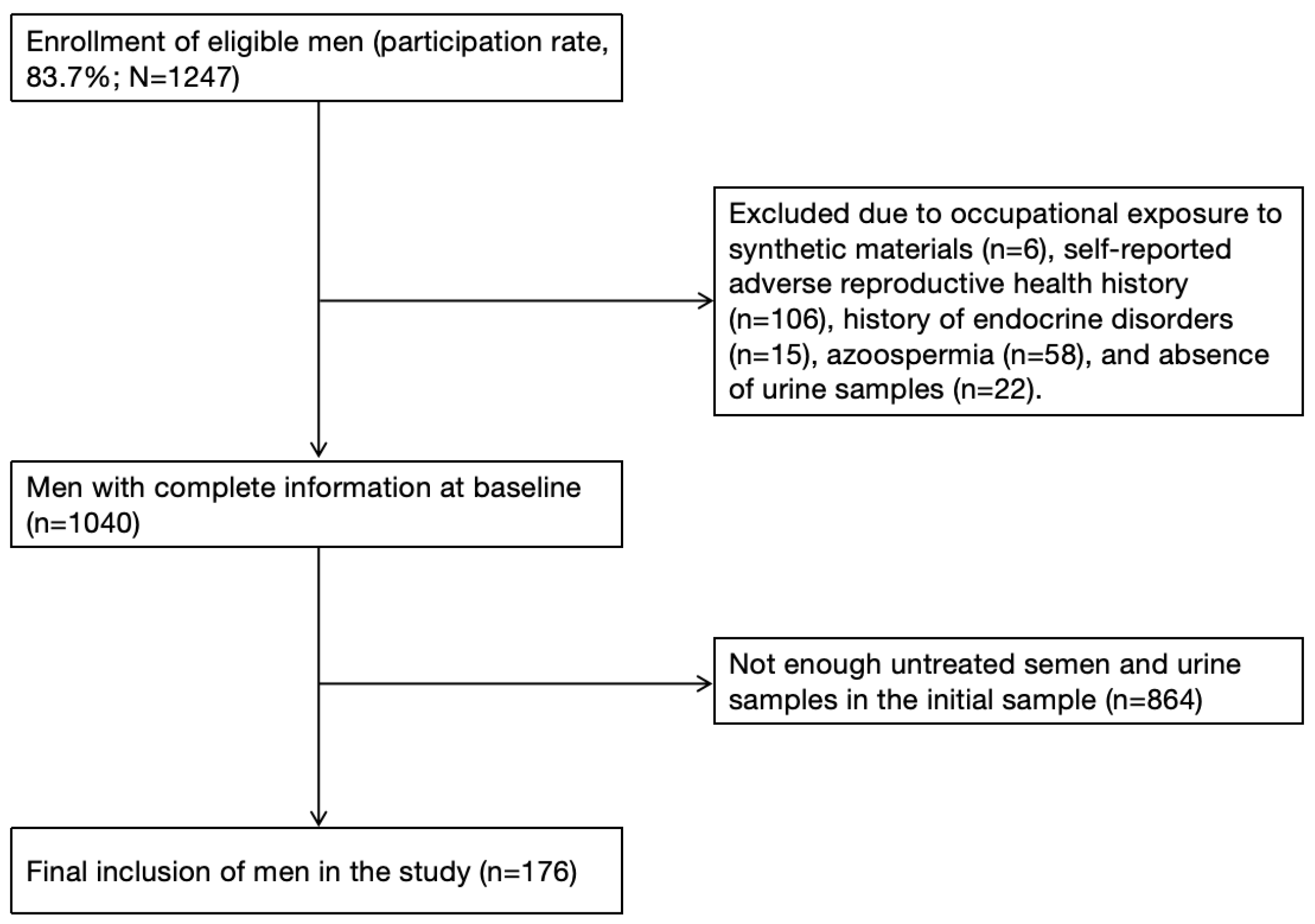
2.1. Study Subjects
2.2. Semen Collection and Annexin V/PI Assay
2.3. Urinary OH-PAH Measures
2.4. Blood DNA Extraction and Genotyping
2.5. Statistical Analysis
3. Results
3.1. The Study Population’s Characteristics
3.2. Distributions of Spermatozoa Apoptosis
3.3. Description of Polycyclic Aromatic Hydrocarbons (PAHs) Exposure
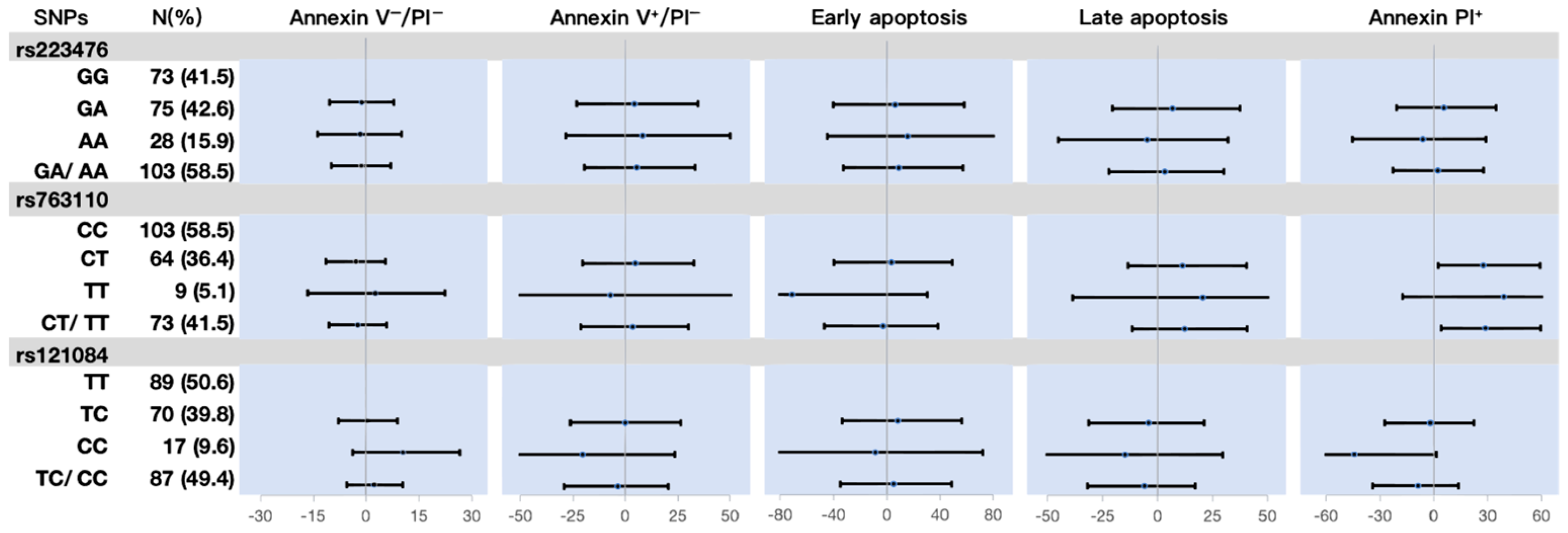
3.4. Associations Between Fas, FasL, and Caspase-3 Gene Polymorphisms and Urinary OH-PAHs Metabolites with Sperm Apoptosis
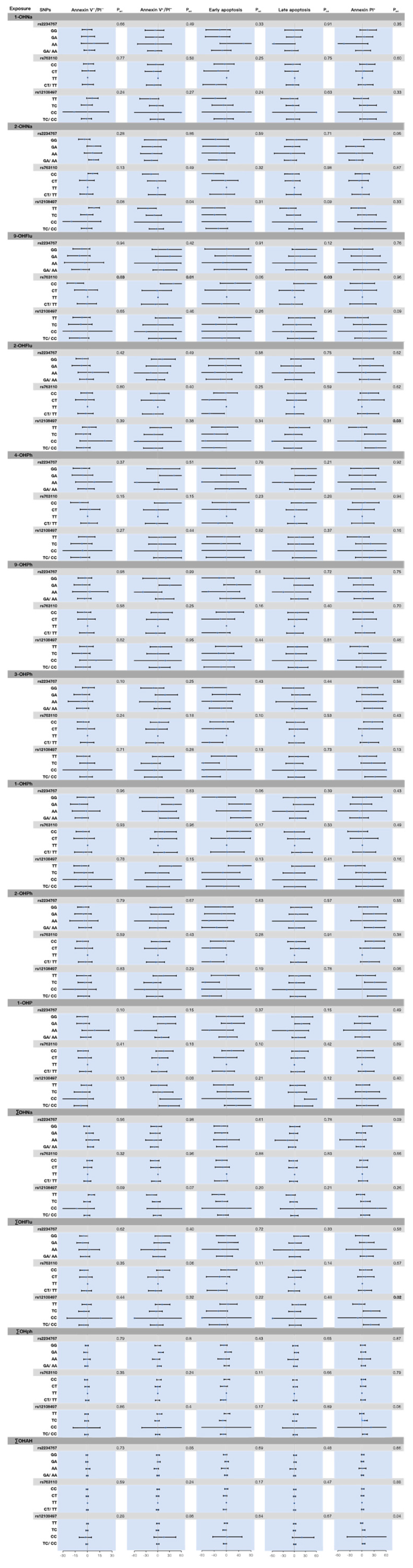
3.5. Gene-Environment Interactions: Apoptosis-Related SNPs × Urinary OH-PAHs
4. Discussion
5. Conclusions
Supplementary Materials
Author Contributions
Funding
Institutional Review Board Statement
Informed Consent Statement
Data Availability Statement
Conflicts of Interest
Abbreviations
| PAH | polymorphisms and urinary polycyclic aromatic hydrocarbon |
| SNPs | single nucleotide polymorphisms |
| EDCs | environmental endocrine disruptors |
| ICC | intraclass correlation coefficient |
| BMI | body mass index |
| GMs | geometric means |
References
- Jeng, H.A.; Sikdar, S.; Pan, C.H.; Chao, M.R.; Chang-Chien, G.P.; Lin, W.Y. Mixture analysis on associations between semen quality and sperm DNA integrity and occupational exposure to polycyclic aromatic hydrocarbons. Arch. Environ. Occup. Health 2023, 78, 14–27. [Google Scholar] [CrossRef]
- Eisenberg, M.L.; Esteves, S.C.; Lamb, D.J.; Hotaling, J.M.; Giwercman, A.; Hwang, K.; Cheng, Y.S. Male infertility. Nat. Rev. Dis. Primers 2023, 9, 49. [Google Scholar] [CrossRef]
- Mínguez-Alarcón, L.; Gaskins, A.J.; Meeker, J.D.; Braun, J.M.; Chavarro, J.E. Endocrine-disrupting chemicals and male reproductive health. Fertil. Steril. 2023, 120, 1138–1149. [Google Scholar] [CrossRef]
- Qiao, M.; Qi, W.; Liu, H.; Qu, J. Oxygenated polycyclic aromatic hydrocarbons in the surface water environment: Occurrence, ecotoxicity, and sources. Environ. Int. 2022, 163, 107232. [Google Scholar] [CrossRef] [PubMed]
- Jeong, J.; Kim, G.; Lee, J.G. A review of food contamination with nitrated and oxygenated polycyclic aromatic hydrocarbons: Toxicity, analysis, occurrence, and risk assessment. Food Sci. Biotechnol. 2024, 33, 2261–2274. [Google Scholar] [CrossRef]
- Chiang, K.C.; Chio, C.P.; Chiang, Y.H.; Liao, C.M. Assessing hazardous risks of human exposure to temple airborne polycyclic aromatic hydrocarbons. J. Hazard. Mater. 2009, 166, 676–685. [Google Scholar] [CrossRef] [PubMed]
- Hudson-Hanley, B.; Smit, E.; Branscum, A.; Hystad, P.; Kile, M.L. Trends in urinary metabolites of polycyclic aromatic hydrocarbons (PAHs) in the non-smoking U.S. population, NHANES 2001–2014. Chemosphere 2021, 276, 130211. [Google Scholar] [CrossRef] [PubMed]
- Tsang, H.L.; Wu, S.; Leung, C.K.; Tao, S.; Wong, M.H. Body burden of POPs of Hong Kong residents, based on human milk, maternal and cord serum. Environ. Int. 2011, 37, 142–151. [Google Scholar] [CrossRef]
- Gao, P.; da Silva, E.; Hou, L.; Denslow, N.D.; Xiang, P.; Ma, L.Q. Human exposure to polycyclic aromatic hydrocarbons: Metabolomics perspective. Environ. Int. 2018, 119, 466–477. [Google Scholar] [CrossRef]
- Kakavandi, B.; Rafiemanesh, H.; Giannakis, S.; Beheshtaeen, F.; Samoili, S.; Hashemi, M.; Abdi, F. Establishing the relationship between Polycyclic Aromatic Hydrocarbons (PAHs) exposure and male infertility: A systematic review. Ecotoxicol. Environ. Saf. 2023, 250, 114485. [Google Scholar] [CrossRef]
- Wallace, S.J.; de Solla, S.R.; Head, J.A.; Hodson, P.V.; Parrott, J.L.; Thomas, P.J.; Berthiaume, A.; Langlois, V.S. Polycyclic aromatic compounds (PACs) in the Canadian environment: Exposure and effects on wildlife. Environ. Pollut. 2020, 265, 114863. [Google Scholar] [CrossRef] [PubMed]
- Polli, J.R.; Rushing, B.R.; Lish, L.; Lewis, L.; Selim, M.I.; Pan, X. Quantitative analysis of PAH compounds in DWH crude oil and their effects on Caenorhabditis elegans germ cell apoptosis, associated with CYP450s upregulation. Sci. Total Environ. 2020, 745, 140639. [Google Scholar] [CrossRef]
- Jeng, H.A.; Yordt, D.; Davis, S.; Swanson, J.R. Assessment of alteration of reproductive system in vivo induced by subchronic exposure to benzo(a)pyrene via oral administration. Environ. Toxicol. 2015, 30, 1–8. [Google Scholar] [CrossRef]
- Yang, P.; Wang, Y.X.; Chen, Y.J.; Sun, L.; Li, J.; Liu, C.; Huang, Z.; Lu, W.Q.; Zeng, Q. Urinary Polycyclic Aromatic Hydrocarbon Metabolites and Human Semen Quality in China. Environ. Sci. Technol. 2017, 51, 958–967. [Google Scholar] [CrossRef]
- Yang, P.; Wang, Y.X.; Sun, L.; Chen, Y.J.; Liu, C.; Huang, L.L.; Lu, W.Q.; Zeng, Q. Urinary metabolites of polycyclic aromatic hydrocarbons, sperm DNA damage and spermatozoa apoptosis. J. Hazard. Mater. 2017, 329, 241–248. [Google Scholar] [CrossRef]
- Omolaoye, T.S.; Skosana, B.T.; Ferguson, L.M.; Ramsunder, Y.; Ayad, B.M.; Du Plessis, S.S. Implications of Exposure to Air Pollution on Male Reproduction: The Role of Oxidative Stress. Antioxidants 2024, 13, 64. [Google Scholar] [CrossRef]
- Rurale, G.; Gentile, I.; Carbonero, C.; Persani, L.; Marelli, F. Short-Term Exposure Effects of the Environmental Endocrine Disruptor Benzo(a)Pyrene on Thyroid Axis Function in Zebrafish. Int. J. Mol. Sci. 2022, 23, 5833. [Google Scholar] [CrossRef]
- Wang, M.; Su, P. The role of the Fas/FasL signaling pathway in environmental toxicant-induced testicular cell apoptosis: An update. Syst. Biol. Reprod. Med. 2018, 64, 93–102. [Google Scholar] [CrossRef] [PubMed]
- Ou, K.; Zhang, S.; Lei, X.; Liu, X.; Zhang, N.; Wang, C.; Yuan, X. Prenatal exposure to environmentally relevant levels of PAHs inhibits spermatogenesis in adult mice and the mechanism involved. Environ. Pollut. 2024, 362, 124914. [Google Scholar] [CrossRef] [PubMed]
- Shu, B.; Zhang, J.; Zeng, J.; Cui, G.; Zhong, G. Stability of selected reference genes in Sf9 cells treated with extrinsic apoptotic agents. Sci. Rep. 2019, 9, 14147. [Google Scholar] [CrossRef]
- Ashkenazi, A.; Fairbrother, W.J.; Leverson, J.D.; Souers, A.J. From basic apoptosis discoveries to advanced selective BCL-2 family inhibitors. Nat. Rev. Drug Discov. 2017, 16, 273–284. [Google Scholar] [CrossRef] [PubMed]
- Agarwal, A.; Said, T.M. Oxidative stress, DNA damage and apoptosis in male infertility: A clinical approach. BJU Int. 2005, 95, 503–507. [Google Scholar] [CrossRef] [PubMed]
- Wang, P.; Luo, C.; Li, Q.; Chen, S.; Hu, Y. Mitochondrion-mediated apoptosis is involved in reproductive damage caused by BPA in male rats. Environ. Toxicol. Pharmacol. 2014, 38, 1025–1033. [Google Scholar] [CrossRef]
- Oosterhuis, G.J.; Mulder, A.B.; Kalsbeek-Batenburg, E.; Lambalk, C.B.; Schoemaker, J.; Vermes, I. Measuring apoptosis in human spermatozoa: A biological assay for semen quality? Fertil. Steril. 2000, 74, 245–250. [Google Scholar] [CrossRef]
- Lee, J.; Richburg, J.H.; Younkin, S.C.; Boekelheide, K. The Fas system is a key regulator of germ cell apoptosis in the testis. Endocrinology 1997, 138, 2081–2088. [Google Scholar] [CrossRef]
- Ji, G.; Gu, A.; Hu, F.; Wang, S.; Liang, J.; Xia, Y.; Lu, C.; Song, L.; Fu, G.; Wang, X. Polymorphisms in cell death pathway genes are associated with altered sperm apoptosis and poor semen quality. Hum. Reprod. 2009, 24, 2439–2446. [Google Scholar] [CrossRef] [PubMed]
- Zhang, M.H.; Shi, Z.D.; Yu, J.C.; Zhang, Y.P.; Wang, L.G.; Qiu, Y. Scrotal heat stress causes sperm chromatin damage and cysteinyl aspartate-spicific proteinases 3 changes in fertile men. J. Assist. Reprod. Genet. 2015, 32, 747–755. [Google Scholar] [CrossRef]
- Shamsi-Gamchi, N.; Razi, M.; Behfar, M. Testicular torsion and reperfusion: Evidences for biochemical and molecular alterations. Cell Stress. Chaperones 2018, 23, 429–439. [Google Scholar] [CrossRef]
- Michita, R.T.; Zambra, F.M.B.; Fraga, L.R.; Sanseverino, M.T.; Schuler-Faccini, L.; Chies, J.A.B.; Vianna, P. The role of FAS, FAS-L, BAX, and BCL-2 gene polymorphisms in determining susceptibility to unexplained recurrent pregnancy loss. J. Assist. Reprod. Genet. 2019, 36, 995–1002. [Google Scholar] [CrossRef]
- Basolo, F.; Giannini, R.; Faviana, P.; Fontanini, G.; Patricelli Malizia, A.; Ugolini, C.; Elisei, R.; Miccoli, P.; Toniolo, A. Thyroid papillary carcinoma: Preliminary evidence for a germ-line single nucleotide polymorphism in the Fas gene. J. Endocrinol. 2004, 182, 479–484. [Google Scholar] [CrossRef]
- You, L.; Wang, Y.X.; Zeng, Q.; Li, M.; Huang, Y.H.; Hu, Y.; Cao, W.C.; Liu, A.L.; Lu, W.Q. Semen phthalate metabolites, spermatozoa apoptosis, and DNA damage: A cross-sectional study in China. Environ. Sci. Technol. 2015, 49, 3805–3812. [Google Scholar] [CrossRef]
- Xia, Y.; Han, Y.; Zhu, P.; Wang, S.; Gu, A.; Wang, L.; Lu, C.; Fu, G.; Song, L.; Wang, X. Relation between urinary metabolites of polycyclic aromatic hydrocarbons and human semen quality. Environ. Sci. Technol. 2009, 43, 4567–4573. [Google Scholar] [CrossRef]
- Amjadian, K.; Sacchi, E.; Rastegari Mehr, M. Heavy metals (HMs) and polycyclic aromatic hydrocarbons (PAHs) in soils of different land uses in Erbil metropolis, Kurdistan Region, Iraq. Environ. Monit. Assess. 2016, 188, 605. [Google Scholar] [CrossRef]
- Campo, L.; Rossella, F.; Fustinoni, S. Development of a gas chromatography/mass spectrometry method to quantify several urinary monohydroxy metabolites of polycyclic aromatic hydrocarbons in occupationally exposed subjects. J. Chromatogr. B Analyt Technol. Biomed. Life Sci. 2008, 875, 531–540. [Google Scholar] [CrossRef]
- Levecque, C.; Elbaz, A.; Clavel, J.; Richard, F.; Vidal, J.S.; Amouyel, P.; Tzourio, C.; Alpérovitch, A.; Chartier-Harlin, M.C. Association between Parkinson’s disease and polymorphisms in the nNOS and iNOS genes in a community-based case-control study. Hum. Mol. Genet. 2003, 12, 79–86. [Google Scholar] [CrossRef] [PubMed]
- Wang, Y.X.; You, L.; Zeng, Q.; Sun, Y.; Huang, Y.H.; Wang, C.; Wang, P.; Cao, W.C.; Yang, P.; Li, Y.F.; et al. Phthalate exposure and human semen quality: Results from an infertility clinic in China. Environ. Res. 2015, 142, 1–9. [Google Scholar] [CrossRef] [PubMed]
- Wang, Y.X.; Zeng, Q.; Sun, Y.; You, L.; Wang, P.; Li, M.; Yang, P.; Li, J.; Huang, Z.; Wang, C.; et al. Phthalate exposure in association with serum hormone levels, sperm DNA damage and spermatozoa apoptosis: A cross-sectional study in China. Environ. Res. 2016, 150, 557–565. [Google Scholar] [CrossRef] [PubMed]
- Yang, P.; Zeng, Q.; Cao, W.C.; Wang, Y.X.; Huang, Z.; Li, J.; Liu, C.; Lu, W.Q. Interactions between CYP2E1, GSTZ1 and GSTT1 polymorphisms and exposure to drinking water trihalomethanes and their association with semen quality. Environ. Res. 2016, 147, 445–452. [Google Scholar] [CrossRef]
- Greenland, S. Modeling and variable selection in epidemiologic analysis. Am. J. Public Health 1989, 79, 340–349. [Google Scholar] [CrossRef]
- Han, X.; Zhou, N.; Cui, Z.; Ma, M.; Li, L.; Cai, M.; Li, Y.; Lin, H.; Li, Y.; Ao, L.; et al. Association between urinary polycyclic aromatic hydrocarbon metabolites and sperm DNA damage: A population study in Chongqing, China. Environ. Health Perspect. 2011, 119, 652–657. [Google Scholar] [CrossRef]
- Zhang, Z.; Qiu, L.; Wang, M.; Tong, N.; Li, J.; Zhang, Z. The FAS ligand promoter polymorphism, rs763110 (-844C>T), contributes to cancer susceptibility: Evidence from 19 case-control studies. Eur. J. Hum. Genet. 2009, 17, 1294–1303. [Google Scholar] [CrossRef]
- Wu, J.; Metz, C.; Xu, X.; Abe, R.; Gibson, A.W.; Edberg, J.C.; Cooke, J.; Xie, F.; Cooper, G.S.; Kimberly, R.P. A novel polymorphic CAAT/enhancer-binding protein beta element in the FasL gene promoter alters Fas ligand expression: A candidate background gene in African American systemic lupus erythematosus patients. J. Immunol. 2003, 170, 132–138. [Google Scholar] [CrossRef]
- Asgari, R.; Mansouri, K.; Bakhtiari, M.; Bidmeshkipour, A.; Yari, K.; Shaveisi-Zadeh, F.; Vaisi-Raygani, A. Association of FAS-670A/G and FASL-844C/T polymorphisms with idiopathic azoospermia in Western Iran. Eur. J. Obstet. Gynecol. Reprod. Biol. 2017, 218, 55–59. [Google Scholar] [CrossRef] [PubMed]
- Park, J.Y.; Lee, W.K.; Jung, D.K.; Choi, J.E.; Park, T.I.; Lee, E.B.; Cho, S.; Park, J.Y.; Cha, S.I.; Kim, C.H.; et al. Polymorphisms in the FAS and FASL genes and survival of early stage non-small cell lung cancer. Clin. Cancer Res. 2009, 15, 1794–1800. [Google Scholar] [CrossRef]
- Huang, Q.R.; Morris, D.; Manolios, N. Identification and characterization of polymorphisms in the promoter region of the human Apo-1/Fas (CD95) gene. Mol. Immunol. 1997, 34, 577–582. [Google Scholar] [CrossRef]
- Bozec, A.; Amara, S.; Guarmit, B.; Selva, J.; Albert, M.; Rollet, J.; El Sirkasi, M.; Vialard, F.; Bailly, M.; Benahmed, M.; et al. Status of the executioner step of apoptosis in human with normal spermatogenesis and azoospermia. Fertil. Steril. 2008, 90, 1723–1731. [Google Scholar] [CrossRef]
- Bock, K.W.; Köhle, C. Ah receptor: Dioxin-mediated toxic responses as hints to deregulated physiologic functions. Biochem. Pharmacol. 2006, 72, 393–404. [Google Scholar] [CrossRef] [PubMed]
- Banerjee, B.; Chakraborty, S.; Ghosh, D.; Raha, S.; Sen, P.C.; Jana, K. Benzo(a)pyrene Induced p53 Mediated Male Germ Cell Apoptosis: Synergistic Protective Effects of Curcumin and Resveratrol. Front. Pharmacol. 2016, 7, 245. [Google Scholar] [CrossRef] [PubMed]
- Khazaeel, K.; Daaj, S.A.Z.; Sadeghi, A.; Tabandeh, M.R.; Basir, Z. Potential protective effect of quercetin on the male reproductive system against exposure of Wistar rats to crude oil vapor: Genetic, biochemical, and histopathological evidence. Reprod. Toxicol. 2022, 113, 10–17. [Google Scholar] [CrossRef]
- Secinaro, M.A.; Fortner, K.A.; Dienz, O.; Logan, A.; Murphy, M.P.; Anathy, V.; Boyson, J.E.; Budd, R.C. Glycolysis promotes caspase-3 activation in lipid rafts in T cells. Cell Death Dis. 2018, 9, 62. [Google Scholar] [CrossRef]
- Hashemi, M.; Moazeni-Roodi, A.; Ghavami, S. Association between CASP3 polymorphisms and overall cancer risk: A meta-analysis of case-control studies. J. Cell Biochem. 2019, 120, 7199–7210. [Google Scholar] [CrossRef] [PubMed]
- Gu, A.; Ji, G.; Zhu, P.; Zhou, Y.; Fu, G.; Xia, Y.; Song, L.; Wang, S.; Wang, X. Nucleotide excision repair polymorphisms, polycyclic aromatic hydrocarbon exposure, and their effects on sperm deoxyribonucleic acid damage and male factor infertility. Fertil. Steril. 2010, 94, 2620–2625.e5. [Google Scholar] [CrossRef] [PubMed]



| Characteristics a | Total Population (n = 176) b |
|---|---|
| Age, year | 31.0 (28.0, 36.0) |
| Body mass index, kg/m2 | 23.1 (21.1, 24.8) |
| Education | |
| Less than high school | 73 (41.5) |
| High school and above | 103 (58.5) |
| Income, yuan/month | |
| <3000 | 67 (38.0) |
| 3000–6000 | 76 (43.2) |
| >6000 | 33 (18.8) |
| Alcohol consumption | |
| Yes | 58 (33.0) |
| No | 118 (67.0) |
| Smoking status | |
| Never | 72 (40.9) |
| Former | 16 (9.1) |
| Current | 88 (50.0) |
| Abstinence duration, day | |
| ≤2 | 20 (11.4) |
| 3 | 52 (29.5) |
| 4 | 37 (21.0) |
| 5 | 25 (14.2) |
| ≥6 | 42 (23.9) |
| Fathered a biological child | |
| Yes | 69 (39.2) |
| No | 107 (60.8) |
| Spermatozoa Apoptosis | Mean | GM a | Selected Percentile | |||
|---|---|---|---|---|---|---|
| 5th | 25th | 75th | 95th | |||
| Annexin V−/PI− spermatozoa (%) | 70.17 | 73.50 | 42.9 | 60.38 | 81.48 | 89.92 |
| Annexin V+/PI− spermatozoa (%) | 16.72 | 12.25 | 3.80 | 7.80 | 22.20 | 42.96 |
| Early apoptosis | 5.36 | 2.70 | 0.40 | 1.20 | 5.43 | 20.88 |
| Late apoptosis | 11.36 | 8.95 | 2.69 | 5.80 | 13.88 | 32.27 |
| PI+ spermatozoa (%) | 13.10 | 10.75 | 2.79 | 7.00 | 17.73 | 32.48 |
| OH-PAH b | The First Urine Sample | The Second Urine Sample | ICCs d | ||
|---|---|---|---|---|---|
| % >LOD c | Median (P25, P75) | % >LOD c | Median (P25, P75) | ||
| 1-OHNa | 99.43 | 2.29 (1.31, 4.03) | 93.75 | 1.99 (0.84, 4.04) | 0.84 |
| 2-OHNa | 97.16 | 5.62 (3.19, 11.89) | 94.89 | 5.42 (2.64, 10.97) | 0.18 |
| 9-OHFlu | 100.00 | 2.52 (1.86, 3.91) | 99.43 | 2.66 (1.65, 4.29) | 0.19 |
| 2-OHFlu | 95.45 | 1.96 (1.21, 3.29) | 94.32 | 2.63 (1.50, 3.92) | 0.14 |
| 4-OHPh | 100.00 | 1.10 (0.79, 1.60) | 100.00 | 1.30 (0.82, 2.22) | 0.12 |
| 9-OHPh | 96.02 | 1.52 (0.96, 2.59) | 100.00 | 1.75 (1.13, 3.02) | 0.15 |
| 3-OHPh | 98.86 | 0.71 (0.44, 1.17) | 91.48 | 0.89 (0.42, 1.48) | 0.45 |
| 1-OHPh | 98.86 | 0.81 (0.55, 1.22) | 94.32 | 0.62 (0.38, 1.13) | 0.34 |
| 2-OHPh | 93.75 | 0.83 (0.41, 1.53) | 97.73 | 1.18 (0.62, 1.98) | 0.35 |
| 1-OHP | 92.61 | 0.65 (0.35, 1.27) | 96.59 | 1.33 (0.67, 2.22) | 0.05 |
| ∑OHNa | - | 8.28 (5.16, 16.71) | - | 7.83 (3.81, 14.90) | 0.31 |
| ∑OHFlu | - | 4.72 (3.37, 7.56) | - | 5.26 (3.82, 7.90) | 0.20 |
| ∑OHPh | - | 5.26 (3.66, 7.86) | - | 6.20 (4.16, 9.75) | 0.30 |
| ∑OHAH | - | 20.93 (14.69, 32.10) | - | 22.70 (15.88, 36.13) | 0.48 |
Disclaimer/Publisher’s Note: The statements, opinions and data contained in all publications are solely those of the individual author(s) and contributor(s) and not of MDPI and/or the editor(s). MDPI and/or the editor(s) disclaim responsibility for any injury to people or property resulting from any ideas, methods, instructions or products referred to in the content. |
© 2025 by the authors. Licensee MDPI, Basel, Switzerland. This article is an open access article distributed under the terms and conditions of the Creative Commons Attribution (CC BY) license.
Share and Cite
Yi, S.; Lin, S.; Xie, J.; Yang, Z.; You, J.; Zhong, X.; Yang, H.; Lin, H.; Wang, Q.; Gong, Y.; et al. Gene–Environment Interactions of Apoptosis-Related Polymorphisms and Urinary Polycyclic Aromatic Hydrocarbon (PAH) Metabolites in Relation to Sperm Cell Apoptosis Among Men Attending Infertility Clinics. Toxics 2026, 14, 50. https://doi.org/10.3390/toxics14010050
Yi S, Lin S, Xie J, Yang Z, You J, Zhong X, Yang H, Lin H, Wang Q, Gong Y, et al. Gene–Environment Interactions of Apoptosis-Related Polymorphisms and Urinary Polycyclic Aromatic Hydrocarbon (PAH) Metabolites in Relation to Sperm Cell Apoptosis Among Men Attending Infertility Clinics. Toxics. 2026; 14(1):50. https://doi.org/10.3390/toxics14010050
Chicago/Turabian StyleYi, Shiting, Sitong Lin, Jiabin Xie, Zhihong Yang, Junxia You, Ximei Zhong, Hui Yang, Haiqing Lin, Qian Wang, Yajie Gong, and et al. 2026. "Gene–Environment Interactions of Apoptosis-Related Polymorphisms and Urinary Polycyclic Aromatic Hydrocarbon (PAH) Metabolites in Relation to Sperm Cell Apoptosis Among Men Attending Infertility Clinics" Toxics 14, no. 1: 50. https://doi.org/10.3390/toxics14010050
APA StyleYi, S., Lin, S., Xie, J., Yang, Z., You, J., Zhong, X., Yang, H., Lin, H., Wang, Q., Gong, Y., Yang, P., Bai, Y., & Chen, Y. (2026). Gene–Environment Interactions of Apoptosis-Related Polymorphisms and Urinary Polycyclic Aromatic Hydrocarbon (PAH) Metabolites in Relation to Sperm Cell Apoptosis Among Men Attending Infertility Clinics. Toxics, 14(1), 50. https://doi.org/10.3390/toxics14010050