



Toxicological Findings of Self-Poisoning Suicidal Deaths: A Systematic Review by Countries

 ,
,  ,
,  ,
, 
Abstract
1. Introduction
2. Materials and Methods
2.1. Protocol
2.2. Data Sources and Search Strategy
2.3. Inclusion and Exclusion Criteria
- -
- The article was in English.
- -
- The article was original.
- -
- The study involved human autopsies with data regarding suicide by consuming a variety of substances that can act as poison.
- -
- The study had at least 20 patients.
2.4. Study Selection and Data Collection Process
3. Results
3.1. Characteristics of Articles Included in the Systematic Review
3.2. Analysis of Autopsies Related to Suicide by Poisoning
3.2.1. Africa
3.2.2. Asia
3.2.3. Central America
3.2.4. Central and Southern Europe
3.2.5. Northern Europe
3.2.6. The USA
4. Discussion
5. Conclusions
Author Contributions
Funding
Institutional Review Board Statement
Informed Consent Statement
Data Availability Statement
Conflicts of Interest
References
- Andriessen, K. On “intention” in the Definition of Suicide. Suicide Life Threat. Behav. 2006, 36, 533–538. [Google Scholar] [CrossRef] [PubMed]
- World Health Organization. The World Health Report2001: Mental health: New Understanding, New Hope; World Health Organization: Geneva, Switzerland, 2001; ISBN 9241562013.
- Kivistö, J.E.; Mattila, V.M.; Parkkari, J.; Kannus, P. Incidence of poisoning deaths in Finland in 1971–2005. Hum. Exp. Toxicol. 2008, 27, 567–573. [Google Scholar] [CrossRef] [PubMed]
- World Health Organization. International Programme on Chemical Safety. Available online: http://www.who.int/ipcs/poisons/en/ (accessed on 10 October 2010).
- World Health Organization. Suicide Worldwide in 2019: Global Health Estimates; World Health Organization: Geneva, Switzerland, 2021; ISBN 9789240026643.
- Centers for Disease Control and Prevention. Injury Prevention & Control. Available online: https://www.cdc.gov/injury/index.html (accessed on 9 July 2022).
- Argo, A.; Zerbo, S.; Buscemi, R.; Trignano, C.; Bertol, E.; Albano, G.D.; Vaiano, F. A Forensic Diagnostic Algorithm for Drug-Related Deaths: ACase Series. Toxics 2022, 10, 152. [Google Scholar] [CrossRef] [PubMed]
- Di Nunno, N.; Esposito, M.; Argo, A.; Salerno, M.; Sessa, F. Pharmacogenetics and Forensic Toxicology: A New Step towards a Multidisciplinary Approach. Toxics 2021, 9, 292. [Google Scholar] [CrossRef] [PubMed]
- European Monitoring Centre for Drugs and Drug Addiction. An Analysis of Post-Mortem Toxicology Practices in Drug-Related Death Cases in Europe, Technical Report; Publications Office of the European Union: Luxembourg, Luxembourg, 2019; ISBN 978-92-9497-408-2. [Google Scholar]
- Johnson, R.; Wagner, R.; Gates, M. Forensic Toxicology Subcommittee. Available online: https://www.nist.gov/osac/forensic-toxicology-subcommittee (accessed on 11 March 2022).
- Mauri, M.C.; Cerveri, G.; Volonteri, L.S.; Fiorentini, A.; Colasanti, A.; Manfré, S.; Borghini, R.; Pannacciulli, E. Parasuicide and drug self-poisoning: Analysis of the epidemiological and clinical variables of the patients admitted to the Poisoning Treatment Centre (CAV), Niguarda General Hospital, Milan. Clin. Pract. Epidemiol. Ment. Heal. 2005, 1, 5. [Google Scholar] [CrossRef][Green Version]
- Wu, K.C.C.; Chen, Y.Y.; Yip, P.S.F. Suicide Methods in Asia: Implications in Suicide Prevention. Int. J. Environ. Res. Public Health 2012, 9, 1135–1158. [Google Scholar] [CrossRef]
- Kapur, N.; Turnbull, P.; Hawton, K.; Simkin, S.; Sutton, L.; Mackway-Jones, K.; Bennewith, O.; Gunnel, D. Self-poisoning suicides in England: A multicentre study. QJM 2005, 98, 589–597. [Google Scholar] [CrossRef][Green Version]
- Spiller, H.A.; Ackerman, J.P.; Smith, G.A.; Kistamgari, S.; Funk, A.R.; McDermott, M.R.; Casavant, M.J. Suicide attempts by self-poisoning in the United States among 10–25 year olds from 2000 to 2018: Substances used, temporal changes and demographics. Clin. Toxicol. 2020, 58, 676–687. [Google Scholar] [CrossRef]
- Eddleston, M. Patterns and problems of deliberate self-poisoning in the developing world. QJM 2000, 93, 715–731. [Google Scholar] [CrossRef]
- Stewart, L.A.; Clarke, M.; Rovers, M.; Richard, D.R.; Simmonds, M.; Stewart, G.; Tierney, J.F.; Prisma-IPD Development Group. Preferred Reporting Items for Systematic Review and Meta-Analysis of individual participant data: The PRISMA-IPD Statement. JAMA 2015, 313, 1657–1665. [Google Scholar] [CrossRef]
- Armstrong, R.; Jackson, N.; Doyle, J.; Waters, E.; Howes, F. It’s in your hands: The value of handsearching in conducting systematic reviews of public health interventions. Am. J. Public Health 2005, 27, 388–391. [Google Scholar] [CrossRef] [PubMed]
- Chaudhari, V.A.; Das, S.; Sahu, S.K.; Devnath, G.P.; Chandra, A. Epidemio-toxicological profile and reasons for fatal suicidal poisoning: A record-based study in South India. J. Fam. Med. Prim. Care 2022, 11, 547–552. [Google Scholar] [CrossRef] [PubMed]
- Collados- Ros, A.; Torres-Sánchez, C.; Pérez-Cárceles, M.D.; Luna, A.; Legaz, I. Suicidal Behavior and Its Relationship with Postmortem Forensic Toxicological Findings. Toxics 2022, 10, 319. [Google Scholar] [CrossRef] [PubMed]
- Goswami, O.; Mahanta, P.; Kalita, D.; Konwar, R.; Yadav, D.S. A Three-Year Study on Acute Poisoning Cases Brought for Medico-Legal Autopsy in a North-Eastern City of India. Open Access Emerg. Med. 2021, 13, 45–50. [Google Scholar] [CrossRef] [PubMed]
- Cuchara, B.; Diaz, J. An 8-Year Retrospective Study on Suicides in Washington, DC. Am. J. Forensic. Med. Pathol. 2020, 41, 18–26. [Google Scholar] [CrossRef] [PubMed]
- Xiao, L.; Ye, Y.; Wang, Y.; Dai, X.; Fang, S.; Wei, Y.; Zheng, Y.; Wu, H.; Fu, Y.; Liao, L. A 9-year retrospective study of poisoning-related deaths in Southwest China (Sichuan). Forensic Sci. Int. 2020, 318, 110558. [Google Scholar] [CrossRef]
- Pan, M.; Wang, X.; Zhao, Y.; Liu, W.; Xiang, P. A retrospective analysis of data from forensic toxicology at the Academy of Forensic Science in 2017. Forensic Sci. Int. 2019, 298, 39–47. [Google Scholar] [CrossRef]
- Wang, L.L.; Zhang, M.; Zhang, W.; Li, B.x.; Li, R.B.; Zhu, B.L.; Wu, X.; Guan, D.W.; Zhang, G.H.; Zhao, R. A retrospective study of poisoning deaths from forensic autopsy cases in northeast China (Lianoning). J. Forensic Leg. Med. 2019, 63, 7–10. [Google Scholar] [CrossRef]
- Gharbaoui, M.; Khelil, M.B.; Harzallah, H.; Benzarti, A.; Zhioua, M.; Hamdoun, M. Pattern of suicide by self-poisoning in Northern Tunisia: An eleven-year study (2005–2015). J. Forensic Leg. Med. 2019, 61, 1–4. [Google Scholar] [CrossRef]
- Kordrostami, R.; Akhgari, M.; Ameri, M.; Ghadipasha, M.; Aghakhani, K. Forensic toxicology analysis of self-poisoning suicidal death in Tehran, Iran; trends between 2011–2015. DARU J. Pharm. Sci. 2017, 25, 15. [Google Scholar] [CrossRef]
- Jones, A.W.; Holmgren, A.; Ahlner, J. Post-mortem concentrations of drugs determined in femoral blood in single-drug fatalities compared with multi-drug poisoning deaths. Forensic Sci. Int. 2016, 267, 96–103. [Google Scholar] [CrossRef] [PubMed]
- Franchi, A.; Bagur, J.; Lemoine, P.; Maucort-Boulch, D.; Malicier, D.; Maujean, G. Autopsy of People Having Committed Suicide in 2002 and in 2012: Comparison of Epidemiological and Sociological Data. J. Forensic Sci. 2016, 6, 109–115. [Google Scholar] [CrossRef] [PubMed]
- Azmak, A.D. Suicides in Trakya Region, Turkey, from 1984 to 2004. Med. Sci. Law 2006, 46, 19–30. [Google Scholar] [CrossRef]
- Escoffery, C.T.; Shirley, S.E. Fatal Poisoning in Jamaica: A coroner’s autopsy study from the University Hospital of the West Indies. Med. Sci. Law 2004, 44, 116–120. [Google Scholar] [CrossRef] [PubMed]
- Delaveris, G.J.M.; Teige, B.; Rogde, S. Non-natural manners of death among users of illicit drugs: Substance findings. Forensic Sci. Int. 2014, 238, 16–21. [Google Scholar] [CrossRef]
- Dias, D.; Mendonça, M.C.; Corte Real, F.; Vieira, N.D.; Teixeira, H.M. Suicides in the Centre of Portugal: Seven years analysis. Forensic Sci. Int. 2014, 234, 22–28. [Google Scholar] [CrossRef] [PubMed]
- Boumba, V.A.; Georgiadis, M.; Mirescu, N.; Vougiouklakis, T. Fatal Intoxications in a Forensic Autopsy Material from Epirus, Greece, During the Period 1998–2010. J. Forensic Sci. 2013, 58, 425–431. [Google Scholar] [CrossRef]
- Frost, J.; Slørdal, L.; Vege, A.; Nordrum, I.S. Forensic autopsies in a naturalistic setting in Norway: Autopsy rates and toxicological findings. Forensic Sci. Int. 2012, 223, 353–358. [Google Scholar] [CrossRef]
- Holmgren, A.; Jones, A.W. Demographics of suicide victims in Sweden in relation to their blood-alcohol concentration and the circumstances and manner of death. Forensic Sci. Int. 2010, 198, 17–22. [Google Scholar] [CrossRef]
- Mohanty, S.; Sahu, G.; Mohanty, M.K.; Patnaik, M. Suicide in India—A four year retrospective study. J. Forensic Leg. Med. 2014, 14, 185–189. [Google Scholar] [CrossRef]
- Jönsson, A.K.; Holmgren, P.; Druid, H.; Ahlner, J. Cause of death and drug use pattern in deceased drug addicts in Sweden, 2002–2003. Forensic Sci. Int. 2007, 169, 101–107. [Google Scholar] [CrossRef] [PubMed]
- Shields, L.B.E.; Hunsaker, D.M.; Hunsaker III, J.C.; Ward, M.K. A 10-Year Retrospective Review of Kentucky Medical Examiner Cases. Am. J. Forensic Med. Pathol. 2006, 27, 106–112. [Google Scholar] [CrossRef] [PubMed]
- Jönsson, A.; Holmgren, P.; Ahlner, J. Fatal intoxications in a Swedish forensic autopsy material during 1992–2002. Forensic Sci. Int. 2004, 143, 53–59. [Google Scholar] [CrossRef] [PubMed]
- Lahti, R.A.; Vuori, E. Fatal drug poisonings: Medico-legal reports and mortality statistics. Forensic Sci. Int. 2003, 136, 35–46. [Google Scholar] [CrossRef]
- Carballo, J.J.; Llorente, C.; Kehrmann, L.; Flamarique, I.; Zuddas, A.; Purper-Ouakil, D.; Hoekstra, P.J.; Coghill, D.; Schulze, U.M.E.; Dittmann, R.W.; et al. STOP Consortium. Psychosocial risk factors for suicidality in children and adolescents. Eur. Child. Adolesc. Psychiatry 2020, 29, 759–776. [Google Scholar] [CrossRef]
- Rasheed, A.; Butt, U.S.; Farid, N.; Aziz, I.; Anwar, H.N.; Makhdoom, P.A. An autopsy Study of Cases of Death Due to Poisoning. Pak. J. Med. Health Sci. 2022, 16, 780. [Google Scholar] [CrossRef]
- Miranda-Mendizabal, A.; Castellví, P.; Parés-Badell, O.; Alayo, I.; Almenara, J.; Alonso, I.; Blasco, M.J.; Cebrià, A.; Gabilondo, A.; Gili, M.; et al. Gender differences in suicidal behavior in adolescents and young adults: Systematic review and meta-analysis of longitudinal studies. Int. J. Public Health 2019, 64, 265–283. [Google Scholar] [CrossRef]
- Ledda, C.; Cannizzaro, E.; Cinà, D.; Filetti, V.; Vitale, E.; Paravizzini, G.; Di Naso, C.; Iavicoli, I.; Rapisarda, V. Oxidative stress and DNA damage in agriculturalworkersafterexposure to pesticides. J. Occup. Med. Toxicol. 2021, 16, 1. [Google Scholar] [CrossRef]
- Cannizzaro, E.; Ramaci, T.; Cirrincione, L.; Plescia, F. Work-Related Stress, Physio-Pathological Mechanisms, and the Influence of Environmental Genetic Factors. Int. J. Environ. Res. Public Health 2019, 16, 4031. [Google Scholar] [CrossRef]
- Cannizzaro, C.; Malta, G.; Argo, A.; Brancato, A.; Roda, G.; Casagni, E.; Fumagalli, L.; Valoti, E.; Froldi, R.; Procaccianti, P.; et al. Behavioural and pharmacological characterization of a novel cannabinomimetic adamantane-derived indole, APICA, and considerations on the possible misuse as a psychotropic spice abuse, in C57bl/6J MICE. Forensic Sci. Int. 2016, 265, 6–12. [Google Scholar] [CrossRef]
- Chemical Safety and Health Unit; World Health Organization. Prevention and Management of Cases of Poisoning. Available online: https://www.who.int/teams/environment-climate-change-and-health/chemical-safety-and-health/incidents-poisonings/prevention-and-management-of-cases-of-poisoning (accessed on 11 July 2022).
- Kasemy, Z.A.; Sharif, A.F.; Amin, S.A.; Fayed, M.M.; Desouky, D.E.; Salama, A.A.; Abo Shereda, H.M.; Abdel-Aaty, N.B. Trend and epidemiology of suicide attempts by self-poisoning among Egyptians. PLoS ONE 2022, 17. [Google Scholar] [CrossRef] [PubMed]
- Lang, A.; Brieger, P.; Menzel, S.; Hamann, J. Differences between suicide note leavers and other suicides: A German psychological autopsy study. J. Psychiatr. Res. 2021, 137, 173–177. [Google Scholar] [CrossRef] [PubMed]
- Churruca, K.; Mitchell, R. Exploring coronial determination of intent for poisoning-related deaths in Australia, 2001–2013. BMC Public Health 2018, 18, 83. [Google Scholar] [CrossRef] [PubMed]
- Darke, S.; Duflou, J.; Torok, M. Toxicology and Circumstances of Completed Suicide by Means Other than Overdose. J. Forensic Sci. 2009, 54, 490–494. [Google Scholar] [CrossRef] [PubMed]
- Mereish, E.H.; Peters, J.R.; Yen, S. Minority Stress and Relational Mechanisms of Suicide among Sexual Minorities: Subgroup Differences in the Associations between Heterosexist Victimization, Shame, Rejection Sensitivity, and Suicide Risk. Suicide Life-Threat. Behav. 2019, 49, 547–560. [Google Scholar] [CrossRef]
- Ivey-Stephenson, A.Z.; Crosby, A.E.; Jack, S.P.D.; Haileyesus, T.; Kresnow-Sedacca, M.J. Suicide Trends Among and Within Urbanization Levels by Sex, Race/Ethnicity, Age Group, and Mechanism of Death—United States, 2001–2015. MMWR Surveill. Summ. 2017, 66, 1–16. [Google Scholar] [CrossRef]
- Ajdacic-Gross, V.; Weiss, M.G.; Ring, M.; Hepp, U.; Bopp, M.; Gutzwiller, F.; Rössler, W. Methods of suicide: International suicide patterns derived from the WHO mortality database. Bull. World Health Organ. 2008, 86, 726–732. [Google Scholar] [CrossRef]
- Pires, M.C.D.C.; Silva, T.D.P.S.; Passos, M.P.D.; Sougey, E.B.; Bastos Filho, O.C. Risk factors of suicide attempts by poisoning: Review. Trends Psychiatry Psychother. 2014, 36, 63–74. [Google Scholar] [CrossRef]
- Schaffer, A.; Weinstock, L.M.; Synyor, M.; Reis, C.; Goldstein, B.I.; Yatham, L.N.; Levitt, A.J. Self-poisoning suicide deaths in people with bipolar disorder: Characterizing a subgroup and identifying treatment patterns. Int. J. Bipolar. Disord. 2017, 5, 16. [Google Scholar] [CrossRef]
- Carlsten, A.; Waern, M.; Allebeck, P. Suicides by drug poisoning among the elderly in Sweden 1969–1996. Soc. Psychiatry Psichiatr. Epidemiol. 1999, 34, 609–614. [Google Scholar] [CrossRef]
- Kim, H.; Kim, Y.; Lee, G.; Choi, J.H.; Yook, V.; Shin, M.H.; Jeon, H.J. Predictive factors associated with methods of suicide: The Korean national investigations of suicide victims (the KNIGHTS study). Front. Psychiatry 2021, 12, 12–651327. [Google Scholar] [CrossRef] [PubMed]
- Anzillotti, L.; Marezza, F.; Calò, L.; Cucurachi, N.; Veronesi, L.; Cecchi, R. Toxicological findings: A retrospectiveoverview of medico-legalinvestigations in Parma (Italy). J. Forensic Leg. Med. 2019, 62, 92–96. [Google Scholar] [CrossRef] [PubMed]
- Buckley, N.A.; Fahim, M.; Raubenheimer, J.; Gawarammana, I.B.; Eddleston, M.; Roberts, M.S.; Dawson, A.H. Case fatality of agricultural pesticides after self-poisoning in Sri Lanka: A prospective cohort study. Lancet Glob. Health 2021, 9, e854–e862. [Google Scholar] [CrossRef]
- Carson, H.J. Classes of drugs and their prevalence in multiple drug intoxication in suicides and accidents. Leg. Med. 2008, 10, 92–95. [Google Scholar] [CrossRef] [PubMed]
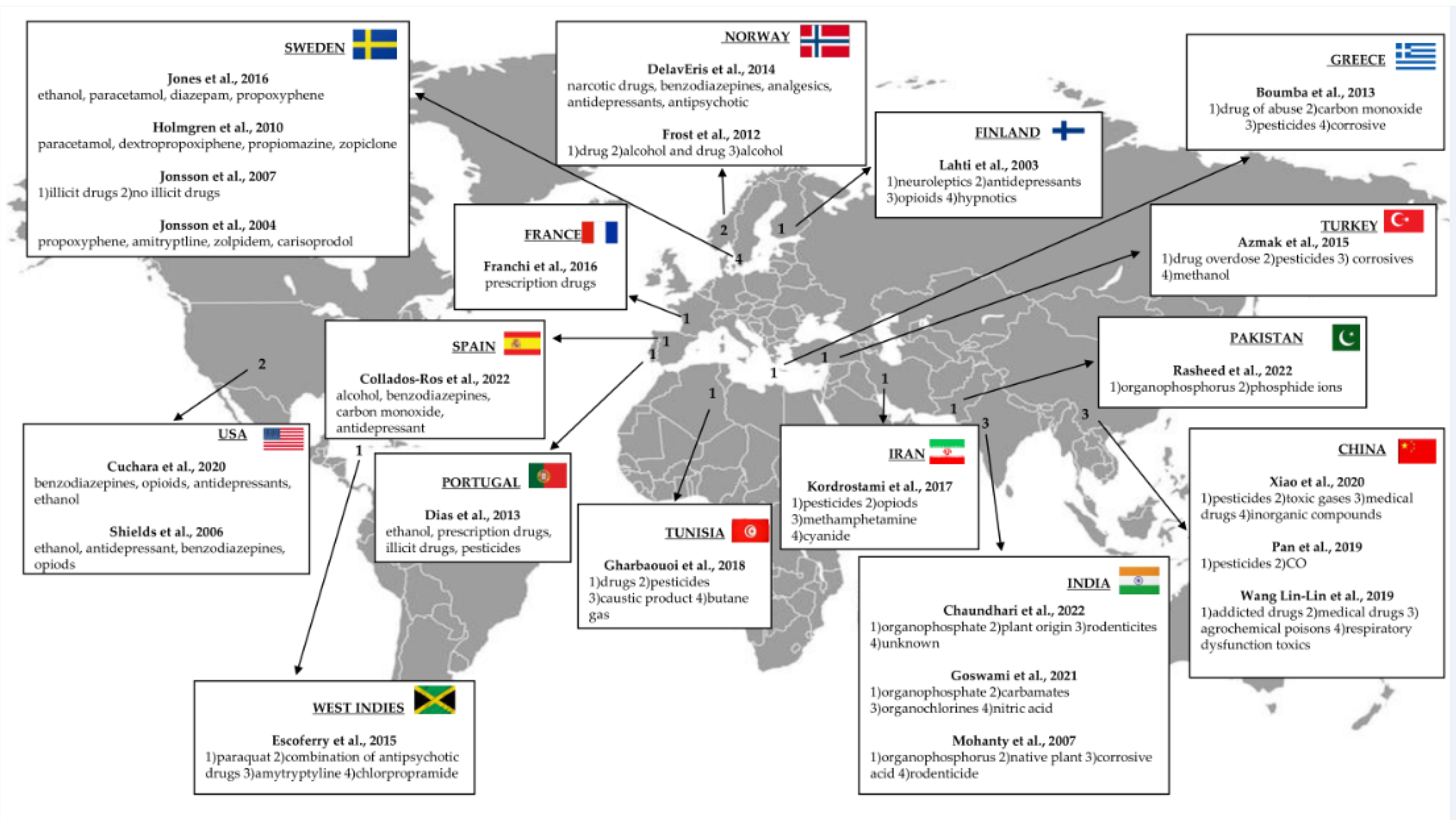

| Authors/ Year | Country | Study Design | Sample | Age/ Gender | Cause and Manner of Death | Anamnesis | Biological Matrix/ Toxicological Method (BM/TM) | Toxicological Reports |
|---|---|---|---|---|---|---|---|---|
| Rasheed A. [18] 2022 | Pakistan | Retrospective (2021) | Suicide autopsy series (n = 313) | 0–80 M 68 F32 | N° of poisoning cases 100/300 (33.33%) Suicide by consuming poison 94/100 (94%) Alleged 4/100 (4%) Accidental 2/100 (2%) | Financial problem Failure in love Ill-health Marital problem Unascertained Problem related to education Family problem Unemployment | Not specified | The most common poison encountered: Organophosphorus 55/100 (50%) Phosphide ions 33/100 (30%) |
| Chaudhari V.A. [19] 2022 | India (South India) | Retrospective (2007–2017) | Suicide by self-poisoning autopsy series (n = 595) | <19 and >60 Mean age 35.81 M 363 F 323 | Suicide by consuming poison 595/595 (100%) | Family problem 180 (30.2%) Chronic illness 168 (28.2%) Financial problem 66 (11%) Psychiatric problem 58 (9.7%) Academic failure 42 (7%) Problem in love life 15 (2.5%) Not documented 32 (5.3%) | Not specified | Poisoning agent used in 564/595 cases: Organophosphates 275 (48.8%) Plant origin 77 (12.9%) Rodenticides 76 (13.5%) Unknown 38 (6.7%) Organochlorines 32 (5.7%) Carbamates 24 (4.3%) Miscellaneous 18 (3.2%) Hair dye 9 (1.6%) Sedatives 7 (1.2%) Pyrethroids 5 (0.9%) Combination of poisons 3 (0.5%) |
| Collados-Ros A. [20] 2022 | Spain | Retrospective (2013–2018) | Suicide autopsy series (n = 355) | Not specified | Suicide by consuming poison46/355 (13%) Drug overdose 46/355 (13%) CO poisoning 2/355 (0.6%) Drowning 7/355 (2%) Firearm 26/355 (7.3%) Hanging 176/355 (49.6%) Fall from a height 76/355 (21.4%) Stabbing 8/355 (2.2%) Suffocation 4/355 (1.1%) Traffic accident 10/355 (2.8%) | Not specified | BM: Not specified TM: GC, HGC-FID, spectrometry | Suicide with positive toxicology: Drug overdose in 22.7% of the cases The most common drug classes: Alcohol Benzodiazepines Carbon monoxide Antidepressants Cyanide Benzoylecgonine Cannabinol Paracetamol Morphine |
| Goswami O. [21] 2021 | India | Retrospective (not specified) | Suspected acute poisoning cases (n = 584) | 0 to >60 M 152 F 92 | N° of poisoning cases 244/584 (41.8%) Suicide by consuming poison 210/244 (86%) Accidental poisoning 34/244 (13.9%) | Not specified | BM: Viscera and blood TM: Not specified | Organophosphate 151 (61.9%) Carbamates 45 (18.4%) Organochlorines 23 (9.4%) Nitric acid 17 (7.0%) Oxalic acid 8 (3.3%) |
| Cuchara B. [22] 2020 | USA | Retrospective (2009–2016) | Suicide autopsy series (n = 394) | <12 and >94 Mean age 44.5 M 307 F 87 | Consuming poison 71/394 (18%) Hanging 123/394 (31.2%) Firearm 80/394 (20.3%) Blunt impact 58/394 (14.7%) Suffocation 30/394 (7.6%) Sharp force 13/394 (3.3%) Thermal injury 12/394 (3%) Drowning 7/394 (1.7%) | Psychiatric disorders 181 (45.9%) | Not specified | The most common drug classes: Benzodiazepines Opioids Antidepressants Ethanol |
| Xiao L. [23] 2020 | China | Retrospective (2010–2018) | Poisoning autopsy series (n = 782) | <1 and >86 Mean age 37 M 511 F 271 | Suicide by consuming poison 300/782 (38.4%) Accidental poisoning 391/782 (50%) Homicide by poisoning 39/782 (5%) | Not specified | BM: Blood, urine, stomach content TM: GC, GC-MS, LC-MS, ICP-MS, ELISA | Pesticides 234 (78%) Toxic gases 44 (14.6%) Medical drugs10 (3.3%) Inorganic compounds 8 (2.6%) Metal and nonmetal poisons 2 (0.6%) Volatile poisons 1 (0.33%) Natural plants and naturals 1 (0.33%) |
| Pan M. [24] 2019 | China | Retrospective (2017) | Autopsy series (n = 299) | Not specified | N° of fatal poisoning cases 39/299 (13%) Self-poisoning 5/39 (12.8%) Accidental poisoning 27/39 (69.2%) Homicide by poisoning 3/39 (7.7%) Undetermined 4/39 (10.3%) | Not specified | BM: Urine, blood, hair, liver TM: GC–FID, LC-MS-MS, G-MS, GC-FID, GC-NPD, GC-ECD, ICP-MS, UV-VIS | Pesticides 3 (60%) CO2 (40%) |
| Wang Lin-Lin [25] 2019 | China | Retrospective (2008–2017) | Autopsy series (n = 1968) | <10 and >60 Mean age 35.6 M 78 F 62 | N° of poisoning cases140/1968 (7.1%) Suicide by consuming poison 39/140 (27.86%) Accidental poisoning 93/140 (66.43%) Homicide by poisoning 5/140 (3.57%) Undetermined 3/140 (2.14%) | Not specified | BM: Blood, urine, stomach content TM: GC–MS, LC–MS, SM | Drug of addiction 25 (17.8) Medical drugs 22 (15.7%) Agrochemical poisons 38 (27.1%) Respiratory dysfunction toxics 37 (26.4%) Poisoning plant/animal 9 (6.4%) Alcohol and methanol 5 (3.6%) Other chemicals 4 (2.9%) |
| Gharbaouoi M. [26] 2018 | Tunisia | Descriptive and crosssectional (2005–2015) | Self-poisoning autopsy series (n = 204) | 13–86 Mean age 34.2 M 83 F 121 | Suicide by consuming poison 204/204 (100%) | History of suicide attempts 42 (20.6%) History of suicide threats 45 (22.1%) Psychiatric disorder 80 (39.2%) | Not specified | Drugs 107/204 (52.5%) Pesticides 87/204 (42.6%) Caustic product 9/204 (4.4%) Butane gas 1 (0.5%) |
| Kordrostami R. [27] 2017 | Iran | Retrospective (2011–2015) | Suicide autopsy series (n = 1667) | Mean age 32.61 M 462 F 212 | Suicide by consuming poison 764/1667 (45.8%) | Not specified | BM: Blood, urine, bile TM: LLE | Pesticides 644 (84.2%) Opioids 52 (6.8%) Methamphetamine 21 (2.74%) Cyanide 17 (2.2%) Ethanol 10 (1.3%) Strychnine 10 (1.3%) Benzodiazepines 6 (0.8%) Tricyclic antidepressants 4 (0.5%) |
| Jones A.W. [28] 2016 | Sweden | Retrospective (1993–2010) | Poisoning autopsy series (n = 13,963) | Not specified | Suicide by consuming poison 4843/13,963 (34.68%) Accidental poisoning 4331/1396 (31%) Undetermined 4789/13,963 (34.3%) | Not specified | BM: Blood TM: EMIT, CG, N–P, GC–NP, GC–MS, LC–MS | The most common drug classes detected in poisoning cases: Ethanol Paracetamol Diazepam Propoxyphene Morphine Propiomazine Zopiclone Citalopram Flunitrazepam Alimemazine |
| Franchi A. [29] 2016 | France | Comparative and retrospective (2002 and 2012) | Suicide autopsy series (n = 486) | <14 and >85 Mean age 49.56 M 323 F 163 | Poisoning 95/486 (19.5%) Hanging 150/486 (30.86%) Firearm 55/486 (11.3%) Fall from a height 105/486 (21.6%) Other 69/486 (14.19%) | Psychiatric disorders 315 (64.8%) | BM: Blood TM: Not specified | The most common drug classes: Prescription drugs |
| Azmak A.D. [30] 2015 | Turkey | Retrospective (1984–2004) | Suicide autopsy series (n = 137) | 14–95 M 107 F 30 | Poisoning 27/137 (19.7%) Hanging55/137 (40.1%) Firearm 43/137 (31.4%) Drowning 7/137 (5%) Fall from a height4/137 (2.9%) Cutting 1/137 (0.7%) | Not specified | Not specified | Drug overdose 14 (51.8%) Pesticides 10 (37%) Corrosives 2 (7.4%) Methanol 1 (0.7%) |
| Escoferry C.T. [31] 2015 | Jamaica | Retrospective (1980–1999) | Poisoning cases series (n = 22) | 2–69 Mean age 27 M 13 F 9 | Suicide by consuming poison 14/22 (63.6%) Accidental poisoning 8/22 (36.4%) | Not specified | Not specified | Paraquat 5 (35%) Combination of antipsychotic drugs 2 (14.2%) Amitriptyline 1 (7.1%) Chlorpropamide 1 (7.1%) Alcohol, cocaine 1 (7.1%) Paracetamol, chlorpheniramine, ampicillin 1 (7.1%) Herbicide 1 (7.1%) Toilet bowl cleaner 1 (7.1%) Chlorpromazine 1 (7.1%) |
| Delaveris G.J.M. [32] 2014 | Norway | Retrospective (2000–2009) | Autopsy series (n = 1603) | 20–59 Mean age 34.9 | Suicide by consuming poison 114/1603 (7.11%) Non-intoxication suicide 119/1603 (7.42%) Accidental intoxication 1204/1603 (75.1%) Homicide 44/1603 (2.74%) Other 122/1603 (7.6%) | Psychiatric problem (not specified) | BM: Blood TM: EMIT, CG | The most common drug classes: Narcotic drugs Benzodiazepines Analgesics Antidepressants Antipsychotics |
| Dias D. [33] 2013 | Portugal | Retrospective (2003–2009) | Suicide autopsy series (n = 304) | 15 to >75 Not specified | Poisoning 97 (31.9%) Hanging 119 (39.1%) Drowning 22 (7.2%) Firearm 34 (11.2%) Fall from a height 18 (5.9%) Trucidation 11 (3.6%) Other 9 (3.1%) | Not specified | Not specified | The most common drug classes: Ethanol Prescription drugs Illicit drugs Pesticides Others |
| Vassiliki A.B. [34] 2013 | Greece | Retrospective (1998–2010) | Autopsy series (n = 1681) | 16–97 M 99/126 poisoning cases F 27/126 poisoning cases | N° of poisoning cases126/1681 (7.49%) N° of suicides 257/1681 (1.18%) Suicide by consuming poison 20/257 (16%) | Not specified | BM: Blood, urine TM: GC-MS | Drug of abuse 76 (60%) Carbon monoxide 25 (19.8%) Pesticides 12 (9.7%) Corrosives 6 (4.8%) Pharmaceuticals 6 (4.8%) Spider bite 1 (0.8%) |
| Frost J. [35] 2012 | Norway | Retrospective (2007–2009) | Autopsy series (n = 364); numberof cases subjected to toxicological analysis 361/364 (99.1%); number of poisoning cases 74/361 (20.4%) | <30 and >59 M 271 F 93 | N° of poisoning cases74/361 (20.4%) Suicide by consuming poison 9/361 (2.5%) Natural death 125/361 (34.6%) Accidental poisoning 65/361 (18%) Road traffic accident 30/361 (8.2%) Accidental fall 12/361 (3.28%) Other accident 52/365 (14.2%) Suicideby another means 59/361 (16.3%) Homicide 9/361 (2.4%) | Not specified | BM: Urine, blood TM: GC, LC-MS | Positive toxicology 8/9: Drugs 4 (50%) Alcohol and drugs 3 (37.5%) Alcohol 1 (12.5%) |
| Holmgren A. [36] 2010 | Sweden | Retrospective (1998–2007) | Suicide autopsy series (n = 11,441) | Mean age 51.3 M 8138 F 3303 | Poisoning 2462/11,441 (22%) Hanging 4471/1441 (39%) Asphyxia by gas 509 (4.4%) Drowning 803 (7%) Firearm 1307 (11.4%) Fall from a height 632 (5.5%) Sharp-force injury 363 (3.1%) Other 891 (7.8%) | Not specified | BM: Blood, urine, vitreous humor TM: Not specified | The most common drug classes: Paracetamol Dextropropoxyphene Propiomazine Zopiclone Diazepam Citalopram Zolpidem Morphine/codeine Flunitrazepam Alimemazine |
| Mohanty S. [37] 2007 | India | Retrospective (2000–2003) | Suicide autopsy series (n = 588) | 11 to60 M 294 F 294 | Poisoning 180/588 (30.6%) Hanging 192/588 (32.6%) Burns 108/588 (18.3%) Railway 100/588 (17%) Drowning 8/588 (1.3%) | Not specified | Not specified | Organophosphorus128 (71.1%) Native plants20 (11%) Corrosive acids 16 (8.8%) Rodenticides12 (6.6%) Phenyl 4 (2.2%) |
| Jonsson A. [38] 2007 | Sweden | Retrospective (2002–2003) | Autopsy series (n = 10,273) Classified as drug abusers (N° 743/10,273) | Mean age 38 | Suicide by consuming poison 97/743 (13%) Accident 293/743 (39.4%) Homicide 20/743 (2.69%) Undetermined 172/743 (23.1%) Natural death 161/743 (21.6%) | Not specified | BM: Blood, urine, vitreous TM: Not specified | No illicit drugs detected 52 (53.6%) Illicit drugs detected 44 (45.3%) No toxicology performed 1 (1.03%) |
| ShieldsL.B.E. [39] 2006 | Kentucky | Retrospective (1993–2002) | Suicide autopsy series (n = 2864) | 11–96 Mean age 42 M 2340 F 524 | Drug toxicity 283/2864 (9.8%) Firearm 1932/2864 (67.4%) Hanging 393/2864 (13.7%) Carbon monoxide intoxication 260/2864 (9%) | Non specified | BM: Blood, urine TM: Not specified | The most common drug classes: Ethanol Antidepressants Benzodiazepines Opioids Cannabinoids Cocaine or metabolites |
| Jonsson A. [40] 2004 | Sweden | Retrospective (1992–2002) | Autopsy series (n = 60,313) | 0–100 Mean age 46 M 4277 F 2689 | N° of poisoning cases6966/60,313 (11.5%) Suicide by consuming poison 3091/6966 (44.3%) Accidental poisoning 581/6966 (8.34%) Undetermined cases by poisoning 3294/6966 (47.2%) | Not specified | BM: Femoral blood TM: Not specified | The most common drug classes: Propoxyphene Amitriptyline Zolpidem Carisoprodol Alprazolam Thioridazine Methadone Ketobemidone |
| Lahti R.A. [41] 2003 | Finland | Retrospective (1997) | Poisoning autopsy series (n = 500) | 13–92 M 300 F 200 | Suicide by consuming poison 325/500 (65%) Accidental poisoning 99/500 (19.8%) Undetermined 76 (15.2%) | Not specified | Not specified | Verified principal drug in 324/325 cases of suicide by poisoning: Neuroleptics 104 (32%) Antidepressants 76 (23.4%) Opioids 44 (13.5%) Hypnotics 33 (10.1%) Cardiovascular drugs 29 (8.9%) Antidiabetics 11 (3.3%) Other drugs 10 (3%) Antiepileptics 8 (2.4%) Anxiolytics 5 (1.54%) Other analgesics 3 (0.9%) Amphetamines 1 (0.3%) |
Publisher’s Note: MDPI stays neutral with regard to jurisdictional claims in published maps and institutional affiliations. |
© 2022 by the authors. Licensee MDPI, Basel, Switzerland. This article is an open access article distributed under the terms and conditions of the Creative Commons Attribution (CC BY) license (https://creativecommons.org/licenses/by/4.0/).
Share and Cite
Albano, G.D.; Malta, G.; La Spina, C.; Rifiorito, A.; Provenzano, V.; Triolo, V.; Vaiano, F.; Bertol, E.; Zerbo, S.; Argo, A. Toxicological Findings of Self-Poisoning Suicidal Deaths: A Systematic Review by Countries. Toxics 2022, 10, 654. https://doi.org/10.3390/toxics10110654
Albano GD, Malta G, La Spina C, Rifiorito A, Provenzano V, Triolo V, Vaiano F, Bertol E, Zerbo S, Argo A. Toxicological Findings of Self-Poisoning Suicidal Deaths: A Systematic Review by Countries. Toxics. 2022; 10(11):654. https://doi.org/10.3390/toxics10110654
Chicago/Turabian StyleAlbano, Giuseppe Davide, Ginevra Malta, Corinne La Spina, Arianna Rifiorito, Valeria Provenzano, Valentina Triolo, Fabio Vaiano, Elisabetta Bertol, Stefania Zerbo, and Antonina Argo. 2022. "Toxicological Findings of Self-Poisoning Suicidal Deaths: A Systematic Review by Countries" Toxics 10, no. 11: 654. https://doi.org/10.3390/toxics10110654
APA StyleAlbano, G. D., Malta, G., La Spina, C., Rifiorito, A., Provenzano, V., Triolo, V., Vaiano, F., Bertol, E., Zerbo, S., & Argo, A. (2022). Toxicological Findings of Self-Poisoning Suicidal Deaths: A Systematic Review by Countries. Toxics, 10(11), 654. https://doi.org/10.3390/toxics10110654

