


Stock Levels and Repair Sourcing in a Periodic Review Exchangeable Item Repair System


Abstract
1. Introduction
2. Literature Review
2.1. Exchangeable-Item Inventory Systems
2.2. Performance Measures
2.3. Outsourcing Repair
3. IR Model: In-House Repair
3.1. Model Setup
3.2. Model Notation
- r: the order cycle time.
- w: the tolerable wait.
- : the arrival cycle; i.e., Jane arrived during the cycle between and .
- t: the cycle arrival time; i.e., Jane arrived t units of time after the beginning of the cycle.
- a: A boolean variable indicating if t is late in the cycle.
- S: the number of spares in the warehouse.
- : items arrive at the warehouse following a Poisson process with rate .
- : item repair times are i.i.d and their cumulative probability distribution function is , and if . We assume that has finite support; that is, there exists such that .
- .
- is the number of complete cycles in the tolerable wait; that is, .
- is customer demand (i.e., the number of nonfunctional items) between x and y and that was repaired by time .
- is customer demand between x and y and that was not repaired by time .
- is customer demand that arrived between x and y (whether it was repaired or not by time ). Note that by definition,
- For single cycle demand, we use the notation , , and .
3.3. Demand
3.4. Supply
- The spares in the warehouse, S.
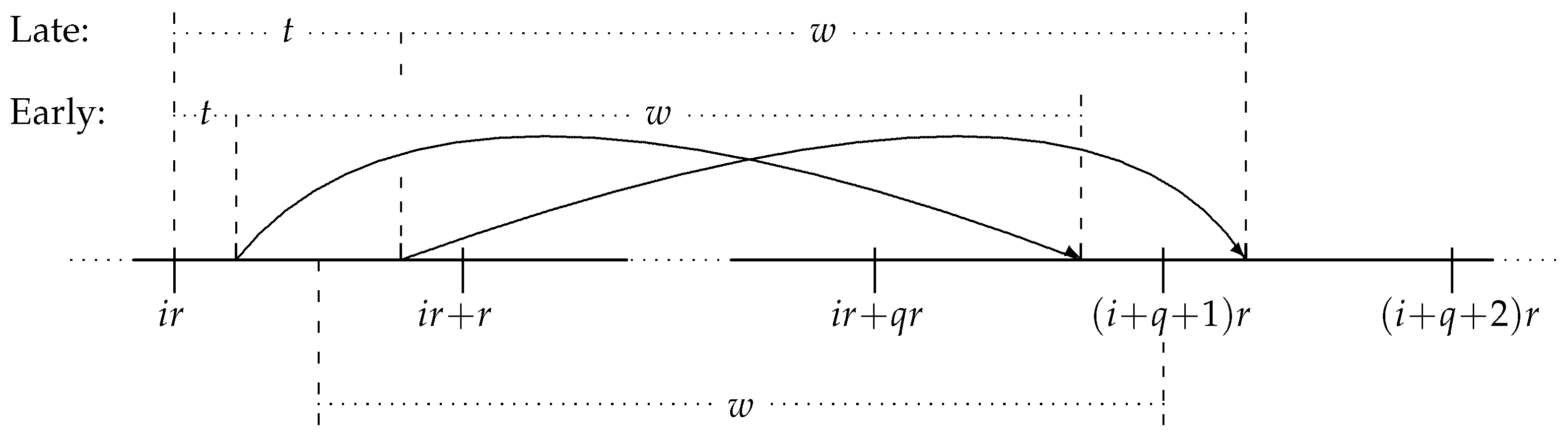
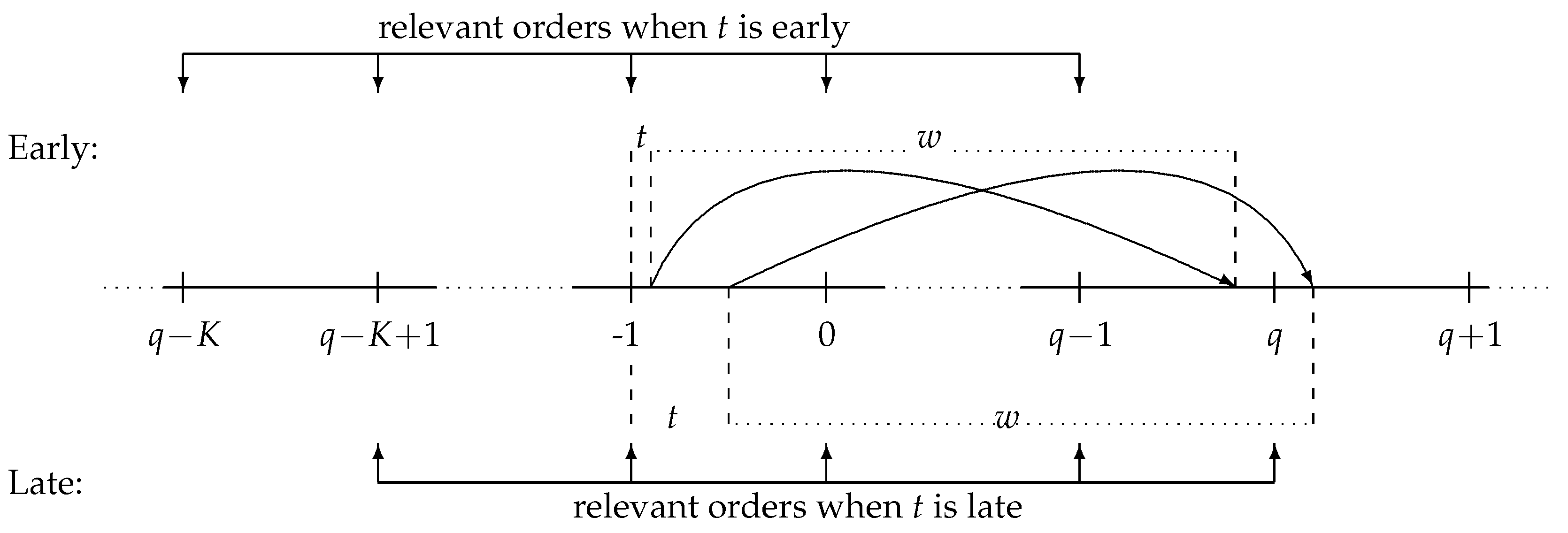
- The items brought by other customers that were repaired (and therefore returned to the warehouse’s stock) by . As can be seen in Figure 1, when Jane arrived early in the cycle, then the latest order that could be repaired on time had to be issued by . In contrast, when Jane arrived late in the cycle, then the order issued at should also be considered. Thus, this component is given by .
- The (single) item brought by Jane if it were repaired by . We denote this component by the binary random variable Z, where Z is a random variable that is equal to 1 if her item is repaired on time (i.e., by ) and zero otherwise. Thus, the distribution of Z iswhere, recall, we use the notation .
3.5. Non-Stationary Window Fill Rate
- : Each is a Poisson process with rate multiplied by the probability that the k’th order was not repaired. Thus,
- : The items arriving during the interval are part of the order issued at . Therefore, the probability for their repair on time is the probability for repair during the interval , which is . Thus,
- : The items that arrived during the interval were sent for repair at and were repaired with probability . The remaining items were sent for repair at times and their probabilities to be repaired, depending on k, are . Therefore,Note that if the parameter is nonpositive, such as when , then .
3.6. The Fill Rate
3.7. Computational Considerations
4. OR Model: Outsourced Repair
4.1. The Probability for Delivery on Time
4.2. Evaluating the Window Fill Rate
4.3. Simulation
4.3.1. Re-Indexing the Orders
4.3.2. Main Simulation Algorithm
| Algorithm 1: Simulation Algorithm |
|
4.3.3. Evaluating the Non-Stationary Window Fill Rate
| Algorithm 2: Algorithm |
|
5. The Capacity Cost of Outsourcing Repair
Managerial Implications
6. Conclusions
Funding
Data Availability Statement
Conflicts of Interest
References
- Wensing, T. Periodic Review Inventory Systems: Lecture Notes in Economics and Mathematical Systems; Springer: New York, NY, USA, 2011; Volume 651. [Google Scholar]
- Ullah, M.; Asghar, I.; Zahid, M.; Omair, M.; AlArjani, A.; Sarkar, B. Ramification of remanufacturing in a sustainable three-echelon closed-loop supply chain management for returnable products. J. Clean. Prod. 2021, 290, 125609. [Google Scholar] [CrossRef] [Scilit]
- Ullah, M.; Sarkar, B. Recovery-channel selection in a hybrid manufacturing-remanufacturing production model with RFID and product quality. Int. J. Prod. Econ. 2020, 219, 360–374. [Google Scholar] [CrossRef] [Scilit]
- Sarkar, B.; Ullah, M.; Sarkar, M. Environmental and economic sustainability through innovative green products by remanufacturing. J. Clean. Prod. 2022, 332, 129813. [Google Scholar] [CrossRef] [Scilit]
- Dreyfuss, M.; Giat, Y. Optimal spares allocation to an exchangeable-item repair system with tolerable wait. Eur. J. Oper. Res. 2017, 261, 584–594. [Google Scholar] [CrossRef] [Scilit]
- Skellam, J.G. The frequency distribution of the difference between two Poisson variates belonging to different populations. J. R. Stat. Soc. Ser. Stat. Soc. 1946, 109, 296. [Google Scholar] [CrossRef] [Scilit]
- Vasilev, J.; Milkova, T. Optimisation Models for Inventory Management with Limited Number of Stock Items. Logistics 2022, 6, 54. [Google Scholar] [CrossRef] [Scilit]
- Scarf, P.; Syntetos, A.; Teunter, R. Joint maintenance and spare-parts inventory models: A review and discussion of practical stock-keeping rules. Ima J. Manag. Math. 2024, 35, 83–109. [Google Scholar] [CrossRef] [Scilit]
- Sherbrooke, C.C. Optimal Inventory Modeling of Systems: Multi-Echelon Techniques; Kluwer: Dordrecht, The Netherlands, 2004; Volume 72. [Google Scholar]
- Muckstadt, J.A. Analysis and Algorithms for Service Parts Supply Chains; Springer Science & Business Media: New York, NY, USA, 2005. [Google Scholar]
- Van Houtum, G.J.; Kranenburg, B. Spare Parts Inventory Control under System Availability Constraints; Springer: New York, NY, USA, 2015; Volume 227. [Google Scholar]
- Basten, R.J.; Ryan, J.K. The value of maintenance delay flexibility for improved spare parts inventory management. Eur. J. Oper. Res. 2019, 278, 646–657. [Google Scholar] [CrossRef] [Scilit]
- Kouki, C.; Larsen, C. Rationing policies in a spare parts inventory system with customers differentiation. Int. J. Prod. Res. 2021, 59, 6270–6290. [Google Scholar] [CrossRef] [Scilit]
- Chen, Y.K.; Gao, Q.; Su, X.B.; Fang, S.; Guo, C.M. Research on optimization of spare parts inventory policy considering maintenance priority. Int. J. Syst. Assur. Eng. Manag. 2018, 9, 1336–1345. [Google Scholar] [CrossRef] [Scilit]
- Sherbrooke, C.C. METRIC: A multi-echelon technique for recoverable item control. Oper. Res. 1968, 16, 122–141. [Google Scholar] [CrossRef] [Scilit]
- Dreyfuss, M.; Giat, Y.; Stulman, A. An analytical approach to determine the window fill rate in a repair shop with cannibalization. Comput. Oper. Res. 2018, 98, 13–23. [Google Scholar] [CrossRef] [Scilit]
- Van Donselaar, K.; Broekmeulen, R.; de Kok, T. Heuristics for setting reorder levels in periodic review inventory systems with an aggregate service constraint. Int. J. Prod. Econ. 2021, 237, 108137. [Google Scholar] [CrossRef] [Scilit]
- Gutierrez, M.; Rivera, F.A. Undershoot and order quantity probability distributions in periodic review, reorder point, order-up-to-level inventory systems with continuous demand. Appl. Math. Model. 2021, 91, 791–814. [Google Scholar] [CrossRef] [Scilit]
- Dehghani, M.; Abbasi, B.; Oliveira, F. Proactive transshipment in the blood supply chain: A stochastic programming approach. Omega 2021, 98, 102112. [Google Scholar] [CrossRef] [Scilit]
- Poormoaied, S. Inventory decision in a periodic review inventory model with two complementary products. Ann. Oper. Res. 2022, 315, 1937–1970. [Google Scholar] [CrossRef] [Scilit]
- Yıldız, B.; Sütçü, M. A variant SDDP approach for periodic-review approximately optimal pricing of a slow-moving a item in a duopoly under price protection with end-of-life return and retail fixed markdown policy. Expert Syst. Appl. 2023, 212, 118801. [Google Scholar] [CrossRef] [Scilit]
- Rodrigues, L.R.; Yoneyama, T. A spare parts inventory control model based on Prognostics and Health monitoring data under a fill rate constraint. Comput. Ind. Eng. 2020, 148, 106724. [Google Scholar] [CrossRef] [Scilit]
- Giat, Y. Allocation of scarce resources in a network with periodic deliveries and customer tolerable wait. Comput. Ind. Eng. 2021, 159, 107462. [Google Scholar] [CrossRef] [Scilit]
- Baloch, G.; Gzara, F. Inventory planning for self-serve pharmacy kiosks: A fill rate maximization approach. Comput. Ind. Eng. 2024, 188, 109836. [Google Scholar] [CrossRef] [Scilit]
- Lamghari-Idrissi, D.; Basten, R.; van Houtum, G.J. Spare parts inventory control under a fixed-term contract with a long-down constraint. Int. J. Prod. Econ. 2020, 219, 123–137. [Google Scholar] [CrossRef] [Scilit]
- Durrande-Moreau, A. Waiting for service: Ten years of empirical research. Int. J. Serv. Ind. Manag. 1999, 10, 171–194. [Google Scholar] [CrossRef] [Scilit]
- Atkinson, M.; Ntontis, E.; Neville, F.; Reicher, S. “I’ll wait for the English one”: COVID-19 vaccine country of origin, national identity, and their effects on vaccine perceptions and uptake willingness. Soc. Personal. Psychol. Compass 2023, 17, e12837. [Google Scholar] [CrossRef] [Scilit]
- Drabicki, A.; Cats, O.; Kucharski, R.; Fonzone, A.; Szarata, A. Should I stay or should I board? Willingness to wait with real-time crowding information in urban public transport. Res. Transp. Bus. Manag. 2023, 47, 100963. [Google Scholar] [CrossRef] [Scilit]
- Feng, B.; Fan, Z.P.; Li, Y. A decision method for supplier selection in multi-service outsourcing. Int. J. Prod. Econ. 2011, 132, 240–250. [Google Scholar] [CrossRef] [Scilit]
- Hathaway, B.A.; Emadi, S.M.; Deshpande, V. Personalized priority policies in call centers using past customer interaction information. Manag. Sci. 2022, 68, 2806–2823. [Google Scholar] [CrossRef] [Scilit]
- Caggiano, K.E.; Jackson, P.L.; Muckstadt, J.A.; Rappold, J.A. Efficient computation of time-based customer service levels in a multi-item, multi-echelon supply chain: A practical approach for inventory optimization. Eur. J. Oper. Res. 2009, 199, 744–749. [Google Scholar] [CrossRef] [Scilit]
- Dreyfuss, M.; Giat, Y. Optimal allocation of spares to maximize the window fill rate in a two-echelon exchangeable-item repair system. Eur. J. Oper. Res. 2018, 270, 1053–1062. [Google Scholar] [CrossRef] [Scilit]
- Dreyfuss, M.; Giat, Y. The window fill rate with nonzero assembly times: Application to a battery swapping network. In Proceedings of the Operations Research and Enterprise Systems: 6th International Conference, ICORES 2017, Porto, Portugal, 23–25 February 2017; Revised Selected Papers 6. Springer: Berlin/Heidelberg, Germany, 2018; pp. 42–62. [Google Scholar]
- Yang, J.; Liu, W.; Ma, K.; Yue, Z.; Zhu, A.; Guo, S. An optimal battery allocation model for battery swapping station of electric vehicles. Energy 2023, 272, 127109. [Google Scholar] [CrossRef] [Scilit]
- Xu, Y.; Serel, D.A.; Bisi, A.; Dada, M. Setting fulfillment-time guarantees for accepting customer orders in a periodic-review base-stock inventory system. IISE Trans. 2023, 1–14. [Google Scholar] [CrossRef] [Scilit]
- Van der Heijden, M.C.; De Kok, A. Customer waiting times in an (R, S) inventory system with compound Poisson demand. Z. FÜR Oper. Res. 1992, 36, 315–332. [Google Scholar]
- Dreyfuss, M.; Giat, Y. Allocating spares to maximize the window fill rate in a periodic review inventory system. Int. J. Prod. Econ. 2019, 214, 151–162. [Google Scholar] [CrossRef] [Scilit]
- Giat, Y.; Dreyfuss, M. The window fill rate in a periodic review inventory system with order crossover. Int. J. Prod. Res. 2021, 59, 6791–6808. [Google Scholar] [CrossRef] [Scilit]
- Bouhnik, D.; Giat, Y. ISO 9001 as a tool for improving knowledge management in business ecosystems. Int. J. Knowl. Based Dev. 2015, 6, 261–272. [Google Scholar] [CrossRef] [Scilit]
- Öztürk, H. A deterministic economic production quantity model with partial backordering and outsourcing repair of non-conforming products. Int. J. Syst. Sci. Oper. Logist. 2022, 9, 355–383. [Google Scholar] [CrossRef] [Scilit]
- Driessen, M.; Arts, J.; van Houtum, G.J.; Rustenburg, J.W.; Huisman, B. Maintenance spare parts planning and control: A framework for control and agenda for future research. Prod. Plan. Control. 2015, 26, 407–426. [Google Scholar] [CrossRef] [Scilit]
- Basten, R.J.; van der Heijden, M.C.; Schutten, J.M. Practical extensions to a minimum cost flow model for level of repair analysis. Eur. J. Oper. Res. 2011, 211, 333–342. [Google Scholar] [CrossRef] [Scilit]
- Hallak, B.K.; Nasr, W.W.; Jaber, M.Y. Re-ordering policies for inventory systems with recyclable items and stochastic demand–Outsourcing vs. in-house recycling. Omega 2021, 105, 102514. [Google Scholar] [CrossRef] [Scilit]
- Benmoussa, O. Improving Replenishment Flows Using Simulation Results: A Case Study. Logistics 2022, 6, 34. [Google Scholar] [CrossRef] [Scilit]
- Papaleonidas, C.; Androulakis, E.; Lyridis, D.V. A Simulation-based planning tool for floating storage and regasification units. Logistics 2020, 4, 31. [Google Scholar] [CrossRef] [Scilit]
- Sarkar, A.; Guchhait, R.; Sarkar, B. Application of the artificial neural network with multithreading within an inventory model under uncertainty and inflation. Int. J. Fuzzy Syst. 2022, 24, 2318–2332. [Google Scholar] [CrossRef] [Scilit]
- Sarkar, B.; Tayyab, M.; Kim, N.; Habib, M.S. Optimal production delivery policies for supplier and manufacturer in a constrained closed-loop supply chain for returnable transport packaging through metaheuristic approach. Comput. Ind. Eng. 2019, 135, 987–1003. [Google Scholar] [CrossRef] [Scilit]
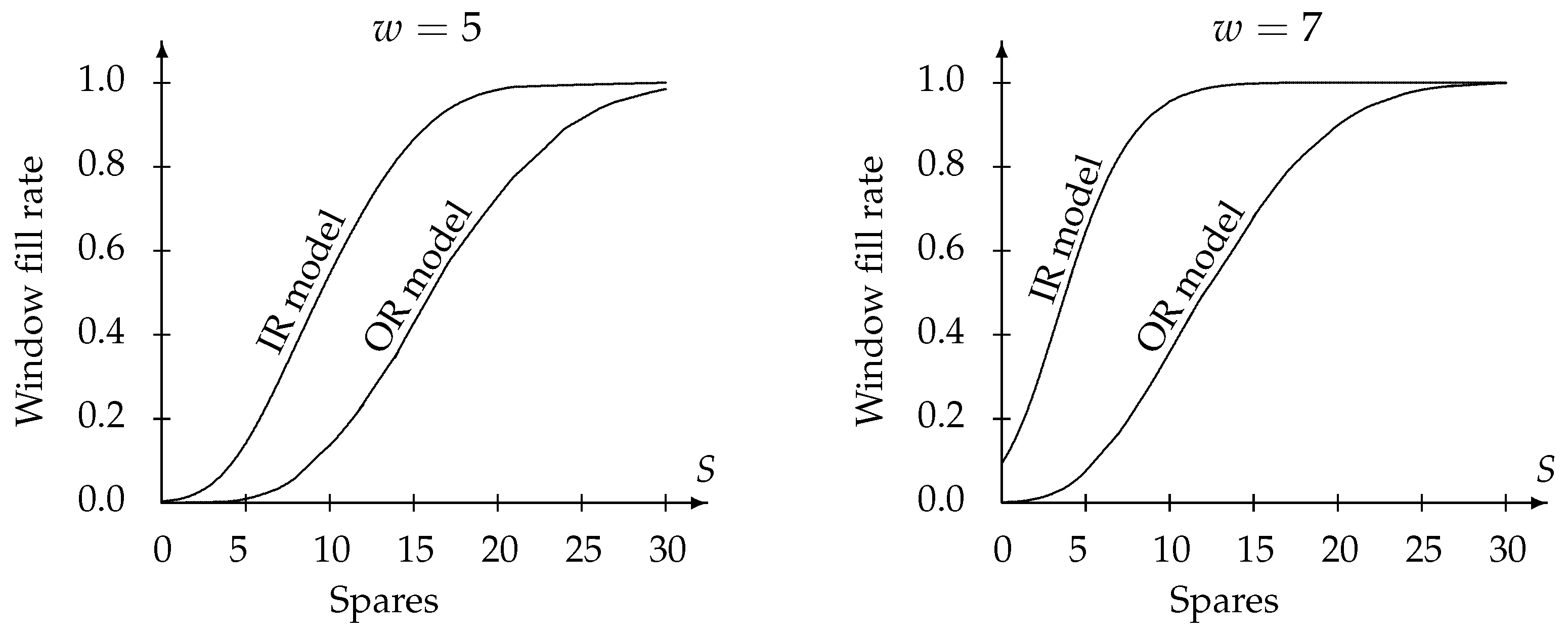

| Model | S = 0 | S = 5 | S = 10 | S = 15 | S = 20 | S = 25 | S = 30 | |
|---|---|---|---|---|---|---|---|---|
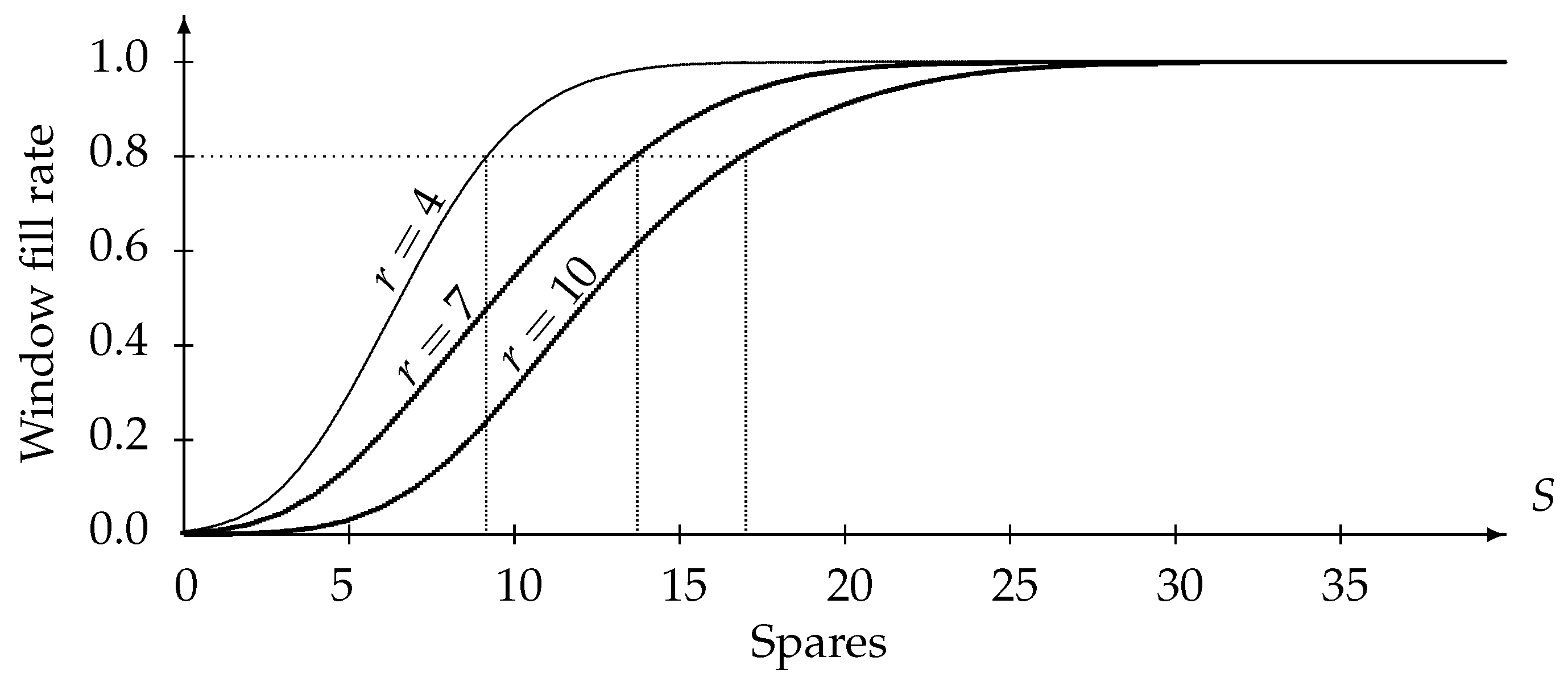
| IR | 0.3% | 14.1% | 54.4% | 86.5% | 98.3% | 99.9% | 100.0% | |
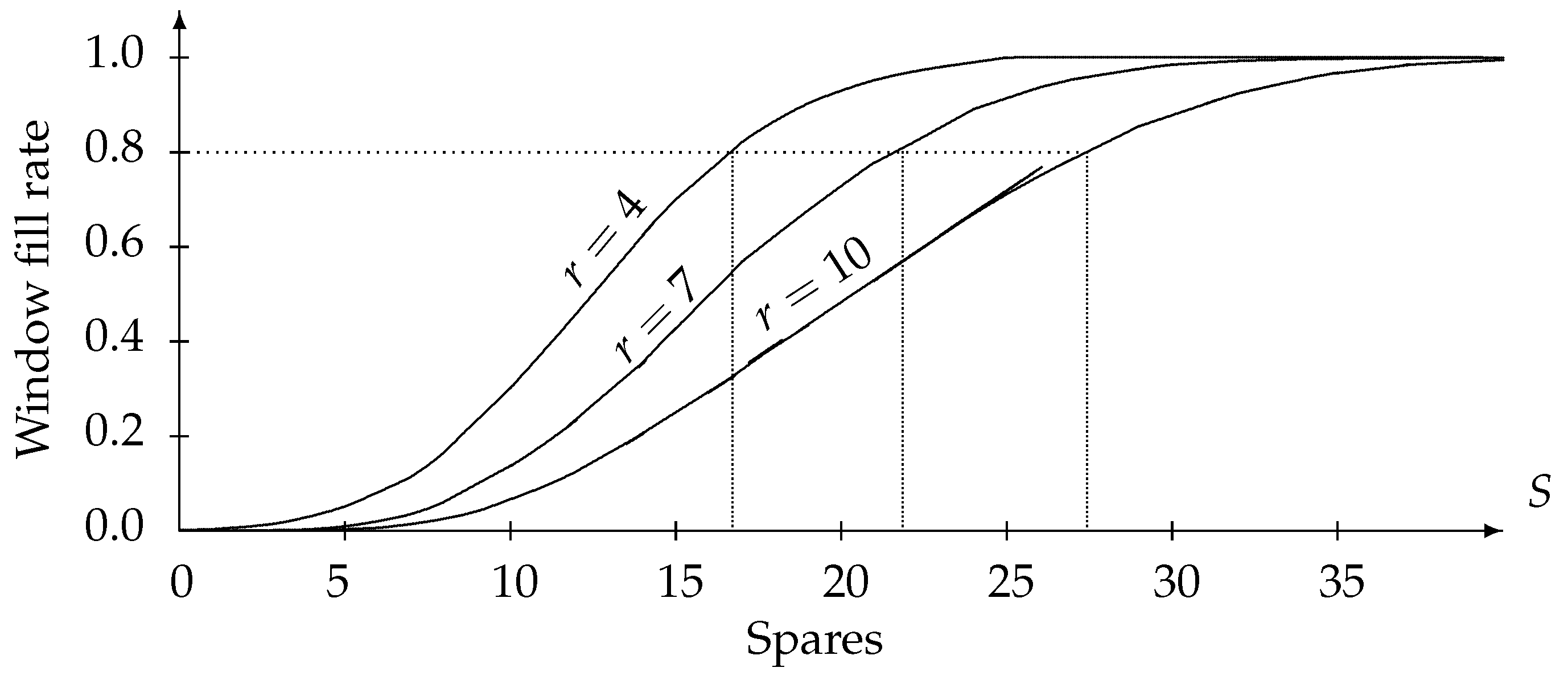
| OR | Mean | 0.0% | 1.0% | 13.4% | 42.5% | 72.2% | 91.6% | 98.4% |
| SD | 0.00% | 0.05% | 0.43% | 0.74% | 0.77% | 0.25% | 0.07% |
| Tolerable Wait | Spares | |||
|---|---|---|---|---|
| OR model | 23 | 32 | 34 | |
| IR model | 20 | 27 | 29 | |
| Cost | 3 | 5 | 5 | |
| OR model | 22 | 25 | 27 | |
| IR model | 14 | 16 | 18 | |
| Cost | 8 | 9 | 9 | |
| OR model | 16 | 18 | 21 | |
| IR model | 4 | 5 | 7 | |
| Cost | 12 | 13 | 14 |
Disclaimer/Publisher’s Note: The statements, opinions and data contained in all publications are solely those of the individual author(s) and contributor(s) and not of MDPI and/or the editor(s). MDPI and/or the editor(s) disclaim responsibility for any injury to people or property resulting from any ideas, methods, instructions or products referred to in the content. |
© 2024 by the author. Licensee MDPI, Basel, Switzerland. This article is an open access article distributed under the terms and conditions of the Creative Commons Attribution (CC BY) license (https://creativecommons.org/licenses/by/4.0/).
Share and Cite
Giat, Y. Stock Levels and Repair Sourcing in a Periodic Review Exchangeable Item Repair System. Logistics 2024, 8, 34. https://doi.org/10.3390/logistics8020034
Giat Y. Stock Levels and Repair Sourcing in a Periodic Review Exchangeable Item Repair System. Logistics. 2024; 8(2):34. https://doi.org/10.3390/logistics8020034
Chicago/Turabian StyleGiat, Yahel. 2024. "Stock Levels and Repair Sourcing in a Periodic Review Exchangeable Item Repair System" Logistics 8, no. 2: 34. https://doi.org/10.3390/logistics8020034
APA StyleGiat, Y. (2024). Stock Levels and Repair Sourcing in a Periodic Review Exchangeable Item Repair System. Logistics, 8(2), 34. https://doi.org/10.3390/logistics8020034

