
Industrial Internet of Things (IIoT) and Other Industry 4.0 Technologies in Spare Parts Warehousing in the Oil and Gas Industry: A Systematic Literature Review



Abstract
1. Introduction
2. Methodology
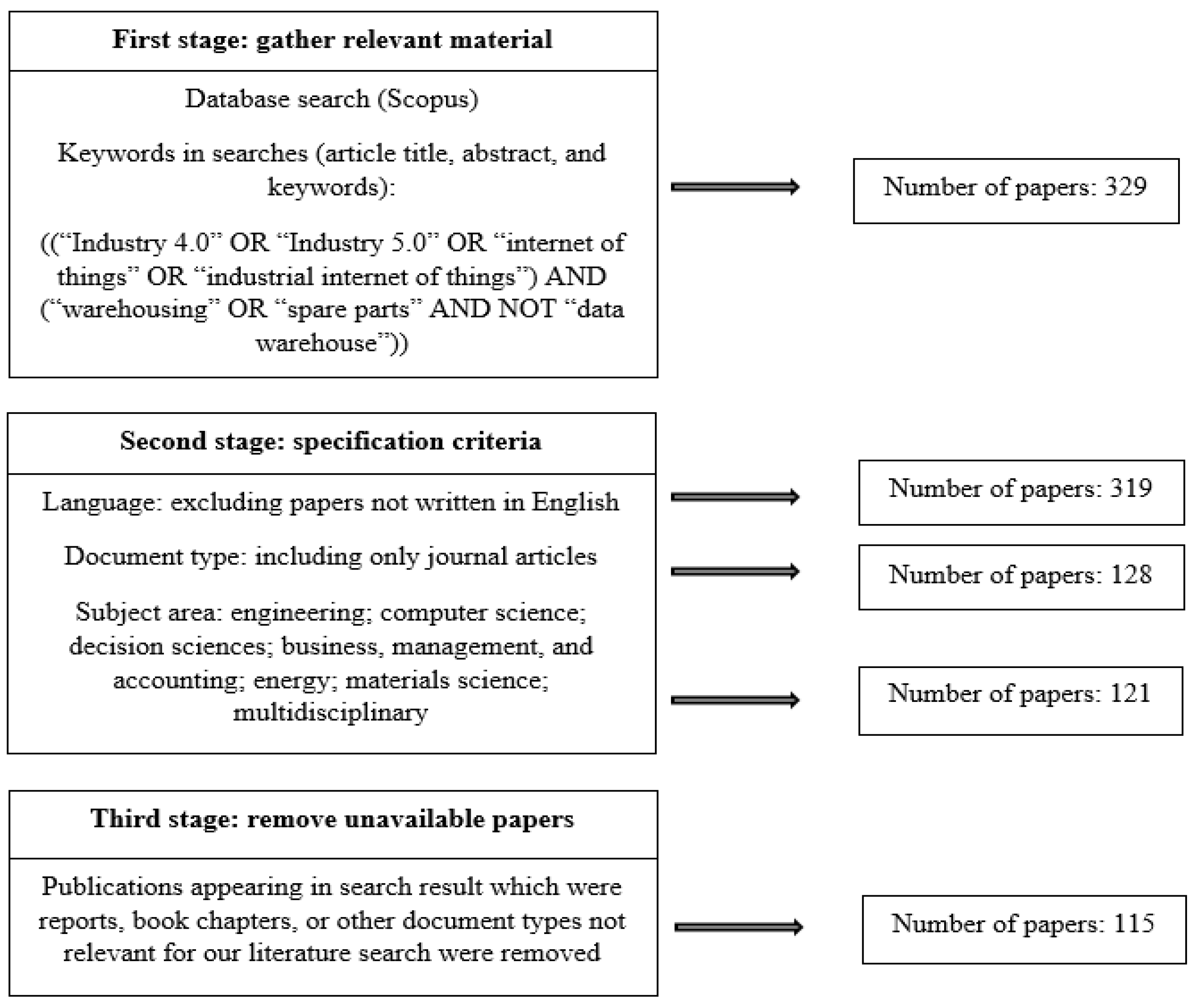
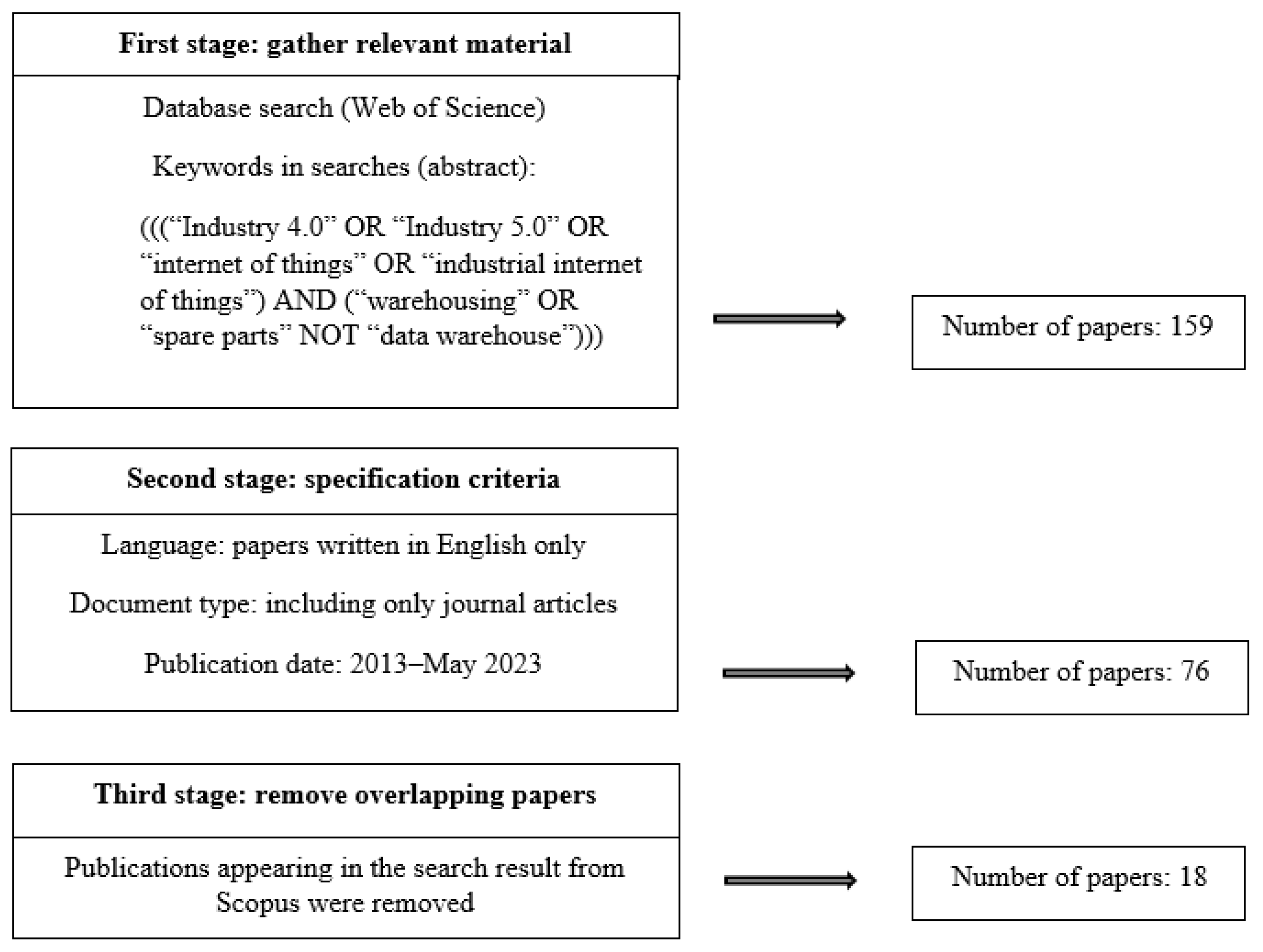
- Language of publication (English only).
- Document type of publication (peer-reviewed journal articles only).
- Publication date of publication (up to and including the date 16 May 2023).
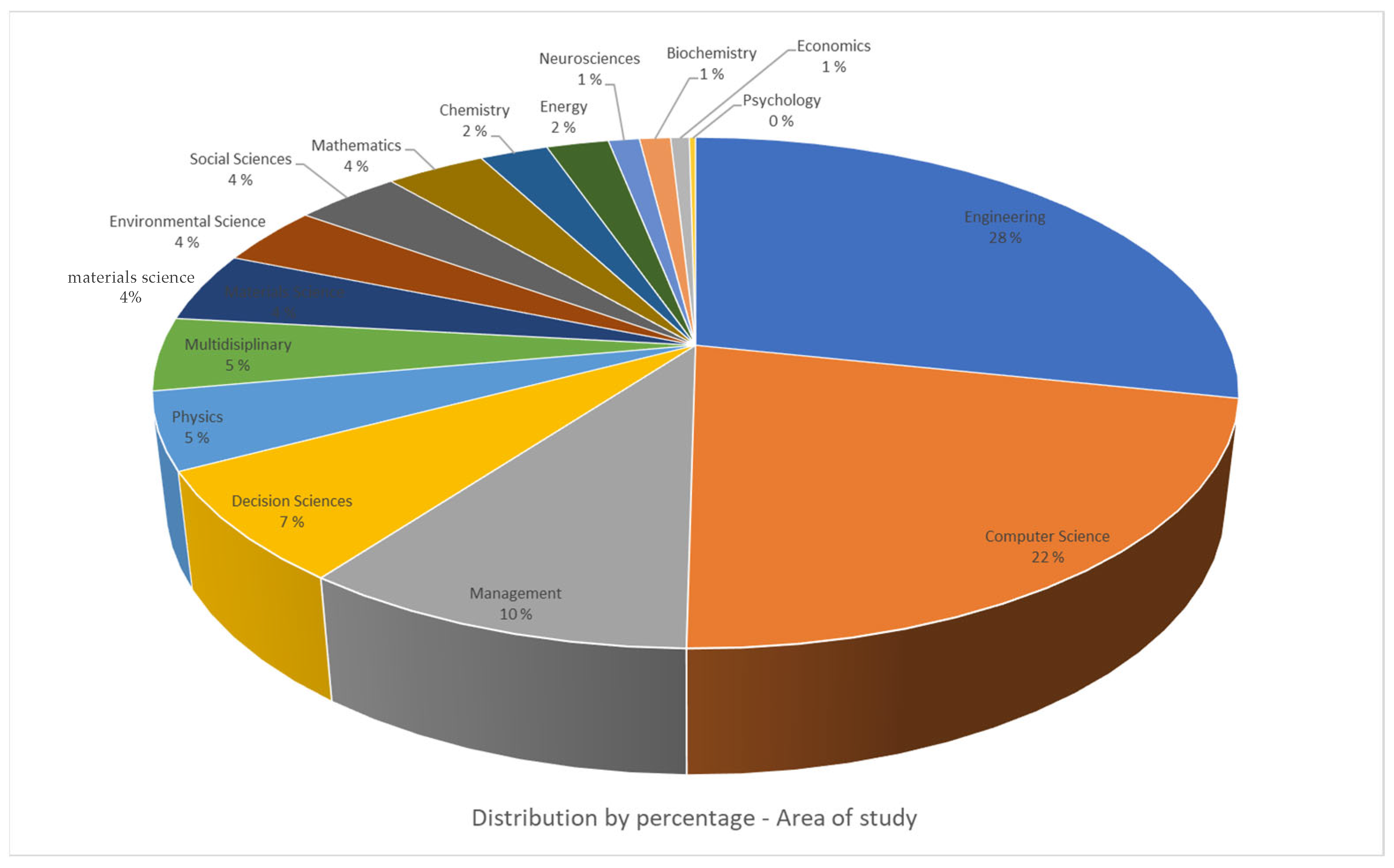
- Subject areas in Scopus: engineering; computer science; business, management, and accounting; decision sciences; mathematics; materials science; physics and astronomy; social sciences; environmental science; chemical engineering; energy; biochemistry, genetics, and molecular biology; chemistry; neuroscience; economics, econometrics, and finance; multidisciplinary; and psychology.
- Subject areas on WoS: engineering electrical electronic; management; computer science interdisciplinary applications; engineering multidisciplinary; computer science information systems; operations research management science; engineering industrial; engineering manufacturing; computer science artificial intelligence; telecommunications; instruments instrumentation; materials science multidisciplinary; physics applied; chemistry multidisciplinary; computer science software engineering; environmental sciences; automation control systems; chemistry analytical; computer science hardware architecture; energy fuels; environmental studies; green sustainable science technology; information science library science; neurosciences; robotics; business; computer science cybernetics; economics; engineering chemical; engineering mechanical; mathematics interdisciplinary applications; social sciences interdisciplinary; and transportation.
- The abstracts of each paper in the search result were read thoroughly to determine its relevance. The exclusion threshold was high. All abstracts that indicated the publication would mention, analyze, consider, or research benefits or challenges of the implementation of Industry 4.0 technologies were included: language was the strongest indicator for inclusion. One paper was excluded from the Scopus search because its content and analysis only related to the medical field.
- Publications not available online were excluded. Some titles appeared in the database searches, but the publication texts in their entirety were unavailable. Searches for these publication titles were then made in online search engines such as Google, to attempt to find the texts outside the databases. When these attempts were unsuccessful (which they were in every case the publications were unavailable directly from the database), the papers were removed from the final list of publications.
- Funding sources for the publications were not examined.
- Methodologies of the included publications were not qualifying or disqualifying for inclusion.
3. Literature Analysis
3.1. Frequency Analysis
3.2. Publisher-Wise Analysis
3.3. Study Nature Analysis
4. Content Analysis
4.1. Benefits of Implementation of IoT and IIoT and Other Industry 4.0 Technologies—A Descriptive Analysis
4.2. The Ten Most Cited Publications: Key Points and Benefits
4.3. Challenges in the Implementation of IoT, IIoT, and Other Industry 4.0 Technologies
5. Practical Implications
6. Conclusions, Limitations, and Future Work
Author Contributions
Funding
Data Availability Statement
Conflicts of Interest
References
- Ching, N.T.; Ghobakhloo, M.; Iranmanesh, M.; Maroufkhani, P.; Asadi, S. Industry 4.0 applications for sustainable manufacturing: A systematic literature review and a roadmap to sustainable development. J. Clean. Prod. 2022, 334, 130133. [Google Scholar] [CrossRef]
- Koh, L.; Orzes, G.; Jia, F. The fourth industrial revolution (Industry 4.0): Technologies disruption on operations and supply chain management. Int. J. Oper. Prod. Manag. 2019, 39, 817–828. [Google Scholar] [CrossRef]
- Ali, I.; Arslan, A.; Khan, Z.; Tarba, S.Y. The Role of Industry 4.0 Technologies in Mitigating Supply Chain Disruption: Empirical Evidence from the Australian Food Processing Industry. IEEE Trans. Eng. Manag. 2021, 1–11. [Google Scholar] [CrossRef]
- Tsolakis, N.; Goldsmith, A.T.; Aivazidou, E.; Kumar, M. Microalgae-based circular supply chain configurations using Industry 4.0 technologies for pharmaceuticals. J. Clean. Prod. 2023, 395, 136397. [Google Scholar] [CrossRef]
- Narula, S.; Puppala, H.; Kumar, A.; Luthra, S.; Dwivedy, M.; Prakash, S.; Talwar, V. Are Industry 4.0 technologies enablers of lean? Evidence from manufacturing industries. Int. J. Lean Six Sigma 2023, 14, 115–138. [Google Scholar] [CrossRef]
- Bakharev, V.; Mityashin, G.; Katrashova, Y.; Strelnikov, A.; Bugaenko, A.; Karachev, V. The Impact of Industry 4.0 Technologies on Retail Development. In Proceedings of the DTMIS ’20: Proceedings of the International Scientific Conference–Digital Transformation on Manufacturing, Infrastructure and Service, Saint Petersburg, Russia, 18–19 November 2020; pp. 1–7. [Google Scholar] [CrossRef]
- Jafari, N.; Azarian, M.; Yu, H. Moving from Industry 4.0 to Industry 5.0: What Are the Implications for Smart Logistics? Logistics 2022, 6, 26. [Google Scholar] [CrossRef]
- Youssef, A.A.; El Khoreby, M.A.; Issa, H.H.; Abdellatif, A. Brief Survey on Industry 4.0 Warehouse Management Systems. Int. Rev. Model. Simul. (IREMOS) 2022, 15, 340. [Google Scholar] [CrossRef]
- Dev, N.K.; Shankar, R.; Swami, S. Diffusion of green products in industry 4.0: Reverse logistics issues during design of inventory and production planning system. Int. J. Prod. Econ. 2020, 223, 107519. [Google Scholar] [CrossRef]
- van Geest, M.; Tekinerdogan, B.; Catal, C. Design of a reference architecture for developing smart warehouses in industry 4.0. Comput. Ind. 2021, 124, 103343. [Google Scholar] [CrossRef]
- Wan, J.; Tang, S.; Shu, Z.; Li, D.; Wang, S.; Imran, M.; Vasilakos, A.V. Software-Defined Industrial Internet of Things in the Context of Industry 4.0. IEEE Sens. J. 2016, 16, 7373–7380. [Google Scholar] [CrossRef]
- Liao, Y.; Loures, E.F.R.; Deschamps, F. Industrial Internet of Things: A Systematic Literature Review and Insights. IEEE Internet Things J. 2018, 5, 4515–4525. [Google Scholar] [CrossRef]
- Ahmad, R.W.; Salah, K.; Jayaraman, R.; Yaqoob, I.; Omar, M. Blockchain in oil and gas industry: Applications, challenges, and future trends. Technol. Soc. 2022, 68, 101941. [Google Scholar] [CrossRef]
- Lu, H.; Guo, L.; Azimi, M.; Huang, K. Oil and Gas 4.0 era: A systematic review and outlook. Comput. Ind. 2019, 111, 68–90. [Google Scholar] [CrossRef]
- Beisekenov, I.; Suleiman, Z.; Tokbergenova, A.; Shaikholla, S.; Dikhanbayeva, D.; El-Thalji, I.; Emiris, D.; Turkyilmaz, A. Maturity Assessment of Industry 4.0 Implementation in Kazakhstani and Norwegian Oil and Gas Contexts. J. Ind. Integr. Manag. 2022, 7, 455–477. [Google Scholar] [CrossRef]
- Belucio, M.; Santiago, R.; Fuinhas, J.A.; Braun, L.; Antunes, J. The Impact of Natural Gas, Oil, and Renewables Consumption on Carbon Dioxide Emissions: European Evidence. Energies 2022, 15, 5263. [Google Scholar] [CrossRef]
- Equinor’s Strategy. Available online: https://www.equinor.com/about-us/strategy (accessed on 2 April 2023).
- BP: Transformation Plans into Action. Available online: https://www.bp.com/en/global/corporate/who-we-are/our-transformation/transformation-plans-into-action.html (accessed on 2 April 2023).
- Shell: Achieving Net-Zero Emissions. Available online: https://www.shell.com/powering-progress/achieving-net-zero-emissions.html (accessed on 2 April 2023).
- Cao, L.; Hu, P.; Li, X.; Sun, H.; Zhang, J.; Zhang, C. Digital technologies for net-zero energy transition: A preliminary study. Carbon Neutrality 2023, 2, 7. [Google Scholar] [CrossRef]
- Hartanto, D.; Agustinita, A. Model of delivery consolidation of critical spare part: Case study of an oil and gas company. IOP Conf. Ser. Mater. Sci. Eng. 2018, 337, 012021. [Google Scholar] [CrossRef]
- Kandukuri, S.Y.; Moe, O.B.E. Quality Assurance Framework to Enable Additive Manufacturing Based Digital Warehousing for Oil and Gas Industry. In Proceedings of the Offshore Technology Conference, Virtual and Houston, TX, USA, 16–19 August 2021. [Google Scholar] [CrossRef]
- Jia, Z.; Wang, J.; Deng, C. IIoT-based Predictive Maintenance for Oil and Gas Industry. In Proceedings of the EITCE’22: Proceedings of the 2022 6th International Conference on Electronic Information Technology and Computer Engineering, Xiamen, China, 21–23 October 2022; pp. 432–436. [Google Scholar] [CrossRef]
- Raffik, R.; Rakesh, D.; Venkatesh, M.; Samvasan, P. Supply Chain Control and Inventory Tracking System using Industrial Automation Tools and IIoT. In Proceedings of the 2021 International Conference of Advancements in Electrical, Electronics, Communication, Computing and Automation (ICAECA), Coimbatore, India, 8–9 October 2021; pp. 1–5. [Google Scholar] [CrossRef]
- Xiao, Y.; Watson, M. Guidance on Conducting a Systematic Literature Review. J. Plan. Educ. Res. 2019, 39, 93–112. [Google Scholar] [CrossRef]
- Mei, H.; Zhang, H. Business Intelligence Architecture Based on Internet of Things. J. Theor. Appl. Inf. Technol. 2013, 50, 90–95. [Google Scholar]
- Reaidy, P.J.; Gunasekaran, A.; Spalanzani, A. Bottom-up approach based on Internet of Things for order fulfillment in a collaborative warehousing environment. Int. J. Prod. Econ. 2015, 159, 29–40. [Google Scholar] [CrossRef]
- Wei, Z.; Alam, T.; Al Sulaie, S.; Bouye, M.; Deebani, W.; Song, M. An efficient IoT-based perspective view of food traceability supply chain using optimized classifier algorithm. Inf. Process. Manag. 2023, 60, 103275. [Google Scholar] [CrossRef]
- Rojek, I.; Jasiulewicz-Kaczmarek, M.; Piechowski, M.; Mikolajewski, D. An Artificial Intelligence Approach for Improving Maintenance to Supervise Machine Failures and Support Their Repair. Appl. Sci. 2023, 13, 4971. [Google Scholar] [CrossRef]
- Chen, Q.; Li, M.; Xu, G.; Huang, G.Q. Cyber-physical spare parts intralogistics system for aviation MRO. Adv. Eng. Inform. 2023, 56, 101919. [Google Scholar] [CrossRef]
- Aziz, D.A.; Asgarnezhad, R.; Mustafa, M.S.; Saber, A.A.; Alani, S. A Developed IoT Platform-Based Data Repository for Smart Farming Applications. J. Commun. 2023, 18, 187–197. [Google Scholar] [CrossRef]
- Tannady, H.; Andry, J.F.; Suriyanti, S. The Sustainable Logistics: Big Data Analytics and Internet of Things. Int. J. Sustain. Dev. Plan. 2023, 18, 621–626. [Google Scholar] [CrossRef]
- Jarašūniene, A.; Čižiūnienė, K.; Čereška, A. Research on Impact of IoT on Warehouse Management. Sensors 2023, 23, 2213. [Google Scholar] [CrossRef]
- Chen, K.-S.; Wu, C.-F.; Tsaur, R.-C.; Huang, T.-H. Fuzzy Evaluation and Improvement Decision-Making Model for Machining Operation Performance. Appl. Sci. 2023, 13, 1430. [Google Scholar] [CrossRef]
- Preetha, A.D.; Kumar, T.S.P. Securing IoT-Based healthcare systems from counterfeit medicine penetration using Blockchain. Appl. Nanosci. 2023, 13, 1263–1275. [Google Scholar] [CrossRef]
- Shen, A. Design of internet of things service system for logistics engineering by using the blockchain technology. Int. J. Grid Util. Comput. 2023, 14, 182–190. [Google Scholar] [CrossRef]
- Talpur, S.R.; Abbas, A.F.; Khan, N.; Irum, S.; Ali, J. Improving Opportunities in Supply Chain Processes Using the Internet of Things and Blockchain Technology. Int. J. Interact. Mob. Technol. 2023, 17, 23–38. [Google Scholar] [CrossRef]
- Pasparakis, A.; de Vries, J.; de Koster, R. Assessing the impact of human-robot collaborative order picking systems on warehouse workers. Int. J. Prod. Res. 2023, 61, 7776–7790. [Google Scholar] [CrossRef]
- Feng, D.; Peng, J.; Zhuang, Y.; Guo, C.; Zhang, T.; Chu, Y.; Zhou, X.; Xia, X.-G. An Adaptive IMU/UWB Fusion Method for NLOS Indoor Positioning and Navigation. IEEE Internet Things J. 2023, 10, 11414–11428. [Google Scholar] [CrossRef]
- Grosse, E.H. Application of supportive and substitutive technologies in manual warehouse order picking: A content analysis. Int. J. Prod. Res. 2023, 62, 685–704. [Google Scholar] [CrossRef]
- Shi, J.; Rozas, H.; Yildirim, M.; Gebraeel, N. A stochastic programming model for jointly optimizing maintenance and spare parts inventory for IoT applications. IISE Trans. 2022, 55, 419–431. [Google Scholar] [CrossRef]
- De Lombaert, T.; Braekers, K.; De Koster, R.; Ramaekers, K. In pursuit of humanised order picking planning: Methodological review, literature classification and input from practice. Int. J. Prod. Res. 2023, 61, 3300–3330. [Google Scholar] [CrossRef]
- Abdul Rahman, N.S.F.; Hamid, A.A.; Lirn, T.-C.; Al Kalbani, K.; Sahin, B. The adoption of industry 4.0 practices by the logistics industry: A systematic review of the gulf region. Clean. Logist. Supply Chain. 2022, 5, 100085. [Google Scholar] [CrossRef]
- Sahara, C.R.; Aamer, A.M. Real-time data integration of an internet-of-things-based smart warehouse: A case study. Int. J. Pervasive Comput. Commun. 2021, 18, 622–644. [Google Scholar] [CrossRef]
- Lastra, R.; Pereira, A.; Diaz-Cacho, M.; Acevedo, J.; Collazo, A. Spare Parts Made by Additive Manufacturing to Improve Preventive Maintenance. Appl. Sci. 2022, 12, 10564. [Google Scholar] [CrossRef]
- Al Hanbali, A.; Saleh, H.H.; Alsawafy, O.G.; Attia, A.M.; Ghaithan, A.M.; Mohammed, A. Spare parts supply with incoming quality control and inspection errors in condition based maintenance. Comput. Ind. Eng. 2022, 172, 108534. [Google Scholar] [CrossRef]
- Elmdoost-gashti, M.; Shafiee, M.; Bozorgi-Amari, A. Enhancing resilience in marine propulsion systems by adopting machine learning technology for predicting failures and prioritising maintenance activities. J. Mar. Eng. Technol. 2023, 23, 18–32. [Google Scholar] [CrossRef]
- Barbosa, W.S.; Wanderley, R.F.F.; Gioia, M.M.; Gouvea, F.C.; Gonçalves, F.M. Additive or subtractive manufacturing: Analysis and comparison of automotive spare-parts. J. Remanuf. 2022, 12, 153–166. [Google Scholar] [CrossRef]
- Gayialis, S.P.; Kechagias, E.P.; Konstantakopoulos, G.D.; Papadopoulos, G.A. A Predictive Maintenance System for Reverse Supply Chain Operations. Logistics 2022, 6, 4. [Google Scholar] [CrossRef]
- Rupp, M.; Buck, M.; Klink, R.; Merkel, M.; Harrison, D.K. Additive manufacturing of steel for digital spare parts–A perspective on carbon emissions for decentral production. Clean. Environ. Syst. 2022, 4, 100069. [Google Scholar] [CrossRef]
- Tufano, A.; Accorsi, R.; Manzini, R. A machine learning approach for predictive warehouse design. Int. J. Adv. Manuf. Technol. 2021, 119, 2369–2392. [Google Scholar] [CrossRef]
- Ho, G.T.S.; Tang, Y.M.; Tsang, K.Y.; Tang, V.; Chau, K.Y. A blockchain-based system to enhance aircraft parts traceability and trackability for inventory management. Expert Syst. Appl. 2021, 179, 115101. [Google Scholar] [CrossRef]
- Xu, X.; Rodgers, M.D.; Guo, W. Hybrid simulation models for spare parts supply chain considering 3D printing capabilities. J. Manuf. Syst. 2021, 59, 272–282. [Google Scholar] [CrossRef]
- Tuzkaya, U.R.; Şahin, S. A Single Side Priority Based GA Approach for 3D Printing Center Integration to Spare Part Supply Chain in Automotive Industry. Tech. Gaz. 2021, 28, 836–844. [Google Scholar] [CrossRef]
- Lyu, Z.; Lin, P.; Guo, D.; Huang, G.Q. Towards Zero-Warehousing Smart Manufacturing from Zero-Inventory Just-In-Time production. Robot. Comput. Integr. Manuf. 2020, 64, 101932. [Google Scholar] [CrossRef]
- Ceruti, A.; Marzocca, P.; Liverani, A.; Bil, C. Maintenance in aeronautics in an Industry 4.0 context: The role of Augmented Reality and Additive Manufacturing. J. Comput. Des. Eng. 2019, 6, 516–526. [Google Scholar] [CrossRef]
- Pelantova, V.; Cecak, P. New Aspects of Maintenance Management and the Material of Spare Parts. MM Sci. J. 2018, 2018, 2283–2289. [Google Scholar] [CrossRef]
- Zheng, M.; Wu, K. Smart spare parts management systems in semiconductor manufacturing. Ind. Manag. Data Syst. 2017, 117, 754–763. [Google Scholar] [CrossRef]
- Hasan, N.; Chaudhary, K.; Alam, M. A novel blockchain federated safety-as-a-service scheme for industrial IoT using machine learning. Multimed. Tools Appl. 2022, 81, 36751–36780. [Google Scholar] [CrossRef]
- Wang, L.; Cao, H.; Xu, H.; Liu, H. A gated graph convolutional network with multi-sensor signals for remaining useful life prediction. Knowl.-Based Syst. 2022, 252, 109340. [Google Scholar] [CrossRef]
- Kumar, D.; Singh, R.K.; Mishra, R.; Wamba, S.F. Applications of the internet of things for optimizing warehousing and logistics operations: A systematic literature review and future research directions. Comput. Ind. Eng. 2022, 171, 108455. [Google Scholar] [CrossRef]
- Liu, C.; Ma, T. Green logistics management and supply chain system construction based on internet of things technology. Sustain. Comput. Inform. Syst. 2022, 35, 100773. [Google Scholar] [CrossRef]
- Brunetti, D.; Gena, C.; Vernero, F. Smart Interactive Technologies in the Human-Centric Factory 5.0: A Survey. Appl. Sci. 2022, 12, 7965. [Google Scholar] [CrossRef]
- Lin, Q.; Wang, H.; Pei, X.; Wang, J. Food Safety Traceability System Based on Blockchain and EPCIS. IEEE Access 2019, 7, 20698–20707. [Google Scholar] [CrossRef]
- Rejeb, A.; Keogh, J.G.; Treiblmaier, H. Leveraging the Internet of Things and blockchain technology in Supply Chain Management. Future Internet 2019, 11, 161. [Google Scholar] [CrossRef]
- Chen, C.-C.; Chen, F.-H.; Hsu, C.-L.; Chuang, W.-C.; Lee, C.-Y.; Lee, C.-H.; Ho, C.-T.; Ma, Y.; Wu, T.-L. Design of Bidirectional Security System for Intravenous Drip Infusion with Hybrid Communication. Sens. Mater. 2020, 32, 2709–2728. [Google Scholar] [CrossRef]
- Arumsari, S.S.; Aamer, A. Design and application of data analytics in an internet-of-things enabled warehouse. J. Sci. Technol. Policy Manag. 2021, 13, 485–504. [Google Scholar] [CrossRef]
- Ferrández-Pastor, F.J.; García-Chamizo, J.M.; Nieto-Hidalgo, M.; Mora-Martínez, J. Precision agriculture design method using a distributed computing architecture on internet of things context. Sensors 2018, 18, 1731. [Google Scholar] [CrossRef] [PubMed]
- Ding, Y.; Jin, M.; Li, S.; Feng, D. Smart logistics based on the internet of things technology: An overview. Int. J. Logist. Res. Appl. 2021, 24, 323–345. [Google Scholar] [CrossRef]
- He, P.; Li, K.; Kumar, P.N.R. An enhanced branch-and-price algorithm for the integrated production and transportation scheduling problem. Int. J. Prod. Res. 2022, 60, 1874–1889. [Google Scholar] [CrossRef]
- Godina, R.; Ribeiro, I.; Matos, F.; Ferreira, B.T.; Carvalho, H.; Peças, P. Impact assessment of additive manufacturing on sustainable business models in industry 4.0 context. Sustainability 2020, 12, 7066. [Google Scholar] [CrossRef]
- Klumpp, M.; Hesenius, M.; Meyer, O.; Ruiner, C.; Gruhn, V. Production logistics and human-computer interaction–state-of-the-art, challenges and requirements for the future. Int. J. Adv. Manuf. Technol. 2019, 105, 3691–3709. [Google Scholar] [CrossRef]
- Zoubek, M.; Simon, M.; Poor, P. Overall Readiness of Logistics 4.0: A Comparative Study of Automotive, Manufacturing, and Electronics Industries in the West Bohemian Region (Czech Republic). Appl. Sci. 2022, 12, 7789. [Google Scholar] [CrossRef]
- Keh, H.-C.; Chiang, R.-D.; Chang, S.-H.; Hung, W.-P. Design and implementation of pesticide residues detection system. IET Commun. 2022, 16, 1332–1343. [Google Scholar] [CrossRef]
- Trstenjak, M.; Opetuk, T.; Dukic, G.; Cajner, H. Logistics 5.0 Implementation Model Based on Decision Support Systems. Sustainability 2022, 14, 6514. [Google Scholar] [CrossRef]
- Eldem, B.; Kluczek, A.; Bagiński, J. The COVID-19 Impact on Supply Chain Operations of Automotive Industry: A Case Study of Sustainability 4.0 Based on Sense-Adapt-Transform Framework. Sustainability 2022, 14, 5855. [Google Scholar] [CrossRef]
- Akkad, M.Z.; Haidar, S.; Bányai, T. Design of Cyber-Physical Waste Management Systems Focusing on Energy Efficiency and Sustainability. Designs 2022, 6, 39. [Google Scholar] [CrossRef]
- Wu, W.; Zhao, Z.; Shen, L.; Kong, X.T.; Guo, D.; Zhong, R.Y.; Huang, G.Q. Just Trolley: Implementation of industrial IoT and digital twin-enabled spatial-temporal traceability and visibility for finished goods logistics. Adv. Eng. Inform. 2022, 52, 101571. [Google Scholar] [CrossRef]
- Affia, I.; Aamer, A. An internet of things-based smart warehouse infrastructure: Design and application. J. Sci. Technol. Policy Manag. 2022, 13, 90–109. [Google Scholar] [CrossRef]
- Zhang, Y.; Pan, F. Design and Implementation of a New Intelligent Warehouse Management System Based on MySQL Database Technology. Informatica 2022, 46, 355–364. [Google Scholar] [CrossRef]
- Perotti, S.; Santacruz, R.F.B.; Bremer, P.; Beer, J.E. Logistics 4.0 in warehousing: A conceptual framework of influencing factors, benefits, and barriers. Int. J. Logist. Manag. 2022, 33, 193–220. [Google Scholar] [CrossRef]
- Lo, C.-H.; Chen, C.-C.; Siek, P.H.L.; Yoandara, C.M. Design of Injection Molding of Side Mirror Cover. Sens. Mater. 2022, 34, 2243–2252. [Google Scholar] [CrossRef]
- Zhong, D. An ALOHA-Based Algorithm Based on Grouping of Tag Prefixes for Industrial Internet of Things. Secur. Commun. Netw. 2022, 2022, 1812670. [Google Scholar] [CrossRef]
- Zhang, R.; Zhou, X.; Jin, Y.; Li, J. Research on Intelligent Warehousing and Logistics Management System of Electronic Market Based on Machine Learning. Comput. Intell. Neurosci. 2022, 2022, 2076591. [Google Scholar] [CrossRef] [PubMed]
- Hamdy, W.; Al-Awamry, A.; Mostafa, N. Warehousing 4.0: A proposed system of using node-red for applying internet of things in warehousing. Sustain. Futures 2022, 4, 100069. [Google Scholar] [CrossRef]
- Tahir, S.; Ramish, A. Xarasoft (Pvt) Ltd.–vision 2027 to implement a digital supply chain for industry 4.0. Emerald Emerg. Mark. Case Stud. 2022, 12, 1–22. [Google Scholar] [CrossRef]
- Geng, B.; Yuan, G.; Wu, D.; Shi, E.; Zhou, Y. Implementation of Multidimensional Environmental-Economic Collaborative Management in IoT Environment. Sci. Program. 2022, 2022, 8684581. [Google Scholar] [CrossRef]
- Terelak-Tymczyna, A.; Bachtiak-Radka, E.; Jardzioch, A. Comparative Analysis of the Production Process of a Flange-Type Product by the Hybrid and Traditional Method with the Use of Simulation Methods. Adv. Sci. Technol. Res. J. 2022, 16, 231–242. [Google Scholar] [CrossRef]
- Alwakeel, A.M. An overview of fog computing and edge computing security and privacy issues. Sensors 2021, 21, 8226. [Google Scholar] [CrossRef] [PubMed]
- Liu, L.; Zhang, J.Z.; He, W.; Li, W. Mitigating information asymmetry in inventory pledge financing through the Internet of things and blockchain. J. Enterp. Inf. Manag. 2021, 34, 1429–1451. [Google Scholar] [CrossRef]
- Nantee, N.; Sureeyatanapas, P. The impact of Logistics 4.0 on corporate sustainability: A performance assessment of automated warehouse operations. Benchmarking 2021, 28, 2865–2895. [Google Scholar] [CrossRef]
- Chi, C.; Wang, Y.; Wu, S.; Zhang, J. Analysis and optimization of the robotic mobile fulfillment systems considering congestion. Appl. Sci. 2021, 11, 10446. [Google Scholar] [CrossRef]
- Dobos, P.; Cservenák, Á.; Skapinyecz, R.; Illés, B.; Tamás, P. Development of an industry 4.0-based analytical method for the value stream centered optimization of demand-driven warehousing systems. Sustainability 2021, 13, 11914. [Google Scholar] [CrossRef]
- Chen, M.-C.; Ho, P.H. Exploring technology opportunities and evolution of IoT-related logistics services with text mining. Complex Intell. Syst. 2021, 7, 2577–2595. [Google Scholar] [CrossRef]
- Rejeb, A.; Keogh, J.G.; Wamba, S.F.; Treiblmaier, H. The potentials of augmented reality in supply chain management: A state-of-the-art review. Manag. Rev. Q. 2021, 71, 819–856. [Google Scholar] [CrossRef]
- Vukićević, A.; Mladineo, M.; Banduka, N.; Mačužić, I. A smart warehouse 4.0 approach for the pallet management using machine vision and Internet of Things (IoT): A real industrial case study. Adv. Prod. Eng. Manag. 2021, 16, 297. [Google Scholar] [CrossRef]
- Zoubek, M.; Simon, M. A framework for a logistics 4.0 maturity model with a specification for internal logistics. MM Sci. J. 2021, 2021, 4264–4274. [Google Scholar] [CrossRef]
- Wang, S. Artificial Intelligence Applications in the New Model of Logistics Development Based on Wireless Communication Technology. Sci. Program. 2021, 2021, 5166993. [Google Scholar] [CrossRef]
- Du, C. Logistics and Warehousing Intelligent Management and Optimization Based on Radio Frequency Identification Technology. J. Sens. 2021, 2021, 2225465. [Google Scholar] [CrossRef]
- Darwish, L.R.; Farag, M.M.; El-Wakad, M.T. Towards Reinforcing Healthcare 4.0: A Green Real-Time IIoT Scheduling and Nesting Architecture for COVID-19 Large-Scale 3D Printing Tasks. IEEE Access 2020, 8, 213916–213927. [Google Scholar] [CrossRef]
- Maheshwari, P.; Kamble, S.; Pundir, A.; Belhadi, A.; Ndubisi, N.O.; Tiwari, S. Internet of things for perishable inventory management systems: An application and managerial insights for micro, small and medium enterprises. Ann. Oper. Res. 2021, 2021, 1–29. [Google Scholar] [CrossRef]
- Guo, D.; Chen, X.; Ma, H.; Sun, Z.; Jiang, Z. State Evaluation Method of Robot Lubricating Oil Based on Support Vector Regression. Comput. Intell. Neurosci. 2021, 2021, 9441649. [Google Scholar] [CrossRef] [PubMed]
- Khalifa, N.; Abd Elghany, M.; Abd Elghany, M. Exploratory research on digitalization transformation practices within supply chain management context in developing countries specifically Egypt in the MENA region. Cogent Bus. Manag. 2021, 8, 1965459. [Google Scholar] [CrossRef]
- Trab, S.; Bajic, E.; Zouinkhi, A.; Thomas, A.; Abdelkrim, M.N.; Chekir, H.; Ltaief, R.H. A communicating object’s approach for smart logistics and safety issues in warehouses. Concurr. Eng. Res. Appl. 2017, 25, 53–67. [Google Scholar] [CrossRef]
- Haddad, Y.; Salonitis, K.; Emmanouilidis, C. Design of redistributed manufacturing networks: A model-based decision-making framework. Int. J. Comput. Integr. Manuf. 2021, 34, 1011–1030. [Google Scholar] [CrossRef]
- Lerher, T. Warehousing 4.0 by using shuttlebased storage and retrieval systems. FME Trans. 2018, 46, 381–385. [Google Scholar] [CrossRef]
- Xu, S.; Chen, J.; Wu, M.; Zhao, C. E-Commerce supply chain process optimization based on whole-process sharing of internet of things identification technology. CMES–Comput. Model. Eng. Sci. 2021, 126, 843–854. [Google Scholar] [CrossRef]
- Wang, K.-J.; Lee, Y.-H.; Angelica, S. Digital twin design for real-time monitoring–a case study of die cutting machine. Int. J. Prod. Res. 2021, 59, 6471–6485. [Google Scholar] [CrossRef]
- Yetkin Ekren, B. A multi-objective optimisation study for the design of an AVS/RS warehouse. Int. J. Prod. Res. 2020, 59, 1107–1126. [Google Scholar] [CrossRef]
- Kattepur, A.; Purushotaman, B. RoboPlanner: A pragmatic task planning framework for autonomous robots. Cogn. Comput. Syst. 2020, 2, 12–22. [Google Scholar] [CrossRef]
- Zhao, K.; Zhu, M.; Xiao, B.; Yang, X.; Gong, C.; Wu, J. Joint RFID and UWB Technologies in Intelligent Warehousing Management System. IEEE Internet Things J. 2020, 7, 11640–11655. [Google Scholar] [CrossRef]
- Lorenc, A.; Lerher, T. Pickupsimulo–prototype of intelligent software to support warehouse managers decisions for product allocation problem. Appl. Sci. 2020, 10, 8683. [Google Scholar] [CrossRef]
- Coito, T.; Martins, M.S.; Viegas, J.L.; Firme, B.; Figueiredo, J.; Vieira, S.M.; Sousa, J.M. A Middleware Platform for Intelligent Automation: An Industrial Prototype Implementation. Comput. Ind. 2020, 123, 103329. [Google Scholar] [CrossRef]
- Gupta, S.; Godavarti, R. IoT data management using cloud computing and big data technologies. Int. J. Softw. Innov. 2020, 8, 50–58. [Google Scholar] [CrossRef]
- Kinnunen, S.-K.; Ylä-Kujala, A.; Marttonen-Arola, S.; Kärri, T.; Baglee, D. Internet of things in asset management: Insights from industrial professionals and academia. Int. J. Serv. Sci. Manag. Eng. Technol. 2018, 9, 104–119. [Google Scholar] [CrossRef]
- Borghetti, M.; Cantù, E.; Sardini, E.; Serpelloni, M. Future sensors for smart objects by printing technologies in Industry 4.0 scenario. Energies 2020, 13, 5916. [Google Scholar] [CrossRef]
- Jiang, N.; Tian, E.; Daneshmand Malayeri, F.; Balali, A. A new model for investigating the impact of urban knowledge, urban intelligent transportation systems and IT infrastructures on the success of SCM systems in the distributed organizations. Kybernetes 2020, 49, 2799–2818. [Google Scholar] [CrossRef]
- Kembro, J.H.; Danielsson, V.; Smajili, G. Network video technology: Exploring an innovative approach to improving warehouse operations. Int. J. Phys. Distrib. Logist. Manag. 2017, 47, 623–645. [Google Scholar] [CrossRef]
- Lin, Y.; Qu, T.; Zhang, K.; Huang, G.Q. Cloud-based production logistics synchronisation service infrastructure for customised production processes. IET Collab. Intell. Manuf. 2020, 2, 115–122. [Google Scholar] [CrossRef]
- Zhou, L.; Niu, X.; Zhao, S.; Zhao, X.; Cao, N.; Ding, J.; Wang, R. Research on congestion rate of classified storage narrow channel picking system for IoT security. Wirel. Netw. 2020. [Google Scholar] [CrossRef]
- Čámská, D.; Klečka, J. Cost development in logistics due to industry 4.0. Logforum 2020, 16, 219–227. [Google Scholar] [CrossRef]
- Mo, L.; Li, C. Passive UHF-RFID Localization Based on the Similarity Measurement of Virtual Reference Tags. IEEE Trans. Instrum. Meas. 2019, 68, 2926–2933. [Google Scholar] [CrossRef]
- Ellefsen, A.P.T.; Oleśków-Szłapka, J.; Pawłowski, G.; Toboła, A. Striving for excellence in ai implementation: Ai maturity model framework and preliminary research results. Logforum 2019, 15, 363–376. [Google Scholar] [CrossRef]
- Vimala, M.; Ranjan, R. Cloud computing model for agricultural applications. Int. J. Recent Technol. Eng. 2019, 8, 6349–6352. [Google Scholar] [CrossRef]
- Zhang, C.; Li, S.; Qu, J. Safety traceability system of characteristic food based on RFID and EPC internet of things. Int. J. Online Biomed. Eng. 2019, 15, 119–126. [Google Scholar] [CrossRef]
- Trab, S.; Zouinkhi, A.; Bajic, E.; Abdelkrim, M.N.; Chekir, H. IoT-based risk monitoring system for safety management in warehouses. Int. J. Inf. Commun. Technol. 2018, 13, 424–438. [Google Scholar] [CrossRef]
- Zhang, Y.; Zhao, L.; Qian, C. Modeling of an IoT-enabled supply chain for perishable food with two-echelon supply hubs. Ind. Manag. Data Syst. 2017, 117, 1890–1905. [Google Scholar] [CrossRef]
- Taş, Ş.O.; Şener, B. The Use of Additive Manufacturing in Maritime Industry. Int. J. Eng. Trends Technol. 2019, 67, 47–51. [Google Scholar] [CrossRef]
- Zhao, Z.; Zhang, M.; Yang, C.; Fang, J.; Huang, G.Q. Distributed and collaborative proactive tandem location tracking of vehicle products for warehouse operation. Comput. Ind. Eng. 2018, 125, 637–648. [Google Scholar] [CrossRef]
- Jabbar, S.; Khan, M.; Silva, B.N.; Han, K. A REST-based industrial web of things’ framework for smart warehousing. J. Supercomput. 2018, 74, 4419–4433. [Google Scholar] [CrossRef]
- Nadesh, R.K.; Srinivasa Perumal, R.; Shynu, P.G.; Sharma, G. Enhancing security for end users in cloud computing environment using hybrid encryption technique. Int. J. Eng. Technol. (UAE) 2018, 7, 152–156. [Google Scholar] [CrossRef][Green Version]
- Balamurugan, S.; Ayyasamy, A.; Joseph, K.S. Iot based supply chain traceability using enhanced naive bayes approach for scheming the food safety issues. Int. J. Sci. Technol. Res. 2020, 9, 1184–1192. Available online: https://api.semanticscholar.org/CorpusID:214774567 (accessed on 12 May 2023).
- Tuominen, V. The measurement-aided welding cell–giving sight to the blind. Int. J. Adv. Manuf. Technol. 2016, 86, 371–386. [Google Scholar] [CrossRef]


| Journal Name | Number of Articles |
|---|---|
| Applied Sciences Switzerland | 7 |
| International Journal of Production Research | 6 |
| Sustainability Switzerland, Journal of Science and Technology Policy Management, Sensors and Materials | 4 |
| Computers and Industrial Engineering, International Journal of Advanced Manufacturing Technology, Energies, IEEE Internet of Things Journal, Logforum | 3 |
| Advanced Engineering Informatics, Computational Intelligence and Neuroscience, Computers in Industry, IEEE Access, Industrial Management and Data Systems, Mm Science Journal, Scientific Programming, Sensors | 2 |
| Others | 1 |
| Industry 4.0 Technology | Benefits | Publication |
|---|---|---|
| Artificial intelligence (AI), digital twin (DT), IoT, smart manufacturing | Reduced costs; reduced negative environmental impacts of machine failure; reduced maintenance costs; reduced downtime; improved working life of assets; increased production; increased company’s profit; ensured required quality of products; improved operational safety; improved overall sustainability | Rojek et al. [29] |
| IoT, Cyber–physical system (CPS), RFID | Improved resource coordination; improved utilization; improved prediction; improved efficiency in management, execution, decision making, and system levels; improved collection of real-time spatial–temporal resource information; improved traceability and visibility of capacity and availability; improved configurability of workflows; flexible front-end operations; enhanced timeliness in cooperation among participants in business processes | Chen et al. [30] |
| Machine learning (ML) | Reduction in error of time-to-failure predictions; improved response time through data dimensionality reduction | Elmdoost-gashti et al. [47] |
| IoT | Reduced costs; increased reliability; increased prediction accuracy; improved opportunities for driving decision models for maintenance and replenishment actions | Shi et al. [41] |
| Additive manufacturing (AM), information and communication technologies (ICT) | Reduced costs; reduced manufacturing time | Lastra et al. [45] |
| Sensing and communication technologies | Enabling condition-based maintenance; reduction in maintenance activities; reduction in financial expenditure; reduced spare parts usage; reduced usage of maintenance equipment and repair tools | Al Hanbali et al. [46] |
| AM | Reduced manufacturing time; reduced costs; production-on-demand regardless of complexity and type | Barbosa et al. [48] |
| Sensors and IoT technology, cloud computing, ML and AI algorithms | Reduced maintenance costs; reduced downtime of machinery and facilities; prediction of maintenance needs; increased profits; substantial competitive advantage | Gayialis et al. [49] |
| AM | Sustainability through increased resource efficiency; extended product life; reconfiguration of value chain; opportunities for direct analysis of product failures | Rupp et al. [50] |
| Storage system technology (ST) | Prediction of optimal decisions; improved resilience; improved data overview | Tufano et al. [51] |
| Blockchain, information technology, RFID | Improved inventory control accuracy; improved visibility; improved traceability; purchase control; improved security; increased transparency; enabling of data sharing between relevant parties; effectiveness in decision making and maintenance planning; reduction in maintenance errors; establishment of accountability and disclosure between parties; elimination of labor excess and errors | Ho et al. [52] |
| AM, simulation technology | Greater customization possibilities; decentralized production; shorter supply chain lead times; improved operational flexibility | Xu et al. [53] |
| AM | Decreased lead time; improved continuity; increased profit and sustainability; low-cost manufacturing | Tuzkaya et al. [54] |
| IoT, ICT | Lower inventory costs; lower inventory levels; improved system performance; improved production efficiency; decrease in lead time | Lyu et al. [55] |
| AR, AM | Decrease in activities in the traditional logistics chain; reduced warehouse inventory; reduced number of errors; reduced spare part weight through AM; increased reliability | Ceruti et al. [56] |
| AM | Early prediction of spare part necessity; reduced electricity expenditure; reduced number of nonconformities in maintenance | Pelantova et al. [57] |
| IoT, Big Data | Increased transparency; increased flexibility; opportunity for continuous access to real-time information | Zheng et al. [58] |
| Focus of Publication | Publication | Journal | Number of Citations Listed in Scopus |
|---|---|---|---|
| Developing a prototype of a traceability system for food using blockchain and EPCIS. | Lin et al. [64] | IEEE Access | 225 |
| Enhancement of supply and value chains using blockchain technology in combination with IoT infrastructure. | Rejeb et al. [65] | Future Internet | 194 |
| Impact of augmented reality and additive manufacturing on maintenance in aviation. | Ceruti et al. [56] | Journal of Computational Design and Engineering | 171 |
| Proposal of an IoT infrastructure for collaborative warehouse order fulfillment. | Reaidy et al. [27] | International Journal of Production Economics | 164 |
| Proposal of communication architecture for farming using IoT technology. | Ferrández-Pastor et al. [68] | Sensors (Switzerland) | 132 |
| Systematically reviews recent research and applications of smart logistics based on IoT in areas like transportation, delivery, and warehousing. | Ding et al. [69] | International Journal of Logistics Research and Applications | 113 |
| Proposal of a blockchain-based system (managerial platform) for accuracy in recording spare parts traceability data in aviation. | Ho et al. [52] | Expert Systems with Applications | 73 |
| Analysis of additive manufacturing impact on sustainable business models using Industry 4.0 and its technologies. | Godina et al. [71] | Sustainability (Switzerland) | 68 |
| Presentation of a generic business process model for traditional and smart warehouses. | van Geest et al. [10] | Computers in Industry | 61 |
| Development of an HCI efficiency description in production logistics based on an interdisciplinary analysis. | Klumpp et al. [72] | International Journal of Advanced Manufacturing Technology | 61 |
| Challenge | Publication |
|---|---|
| Improper use of sensors in IoT/IIoT | Lo et al. [82] |
| Collision of RFID tags for IoT | Zhong [83] |
| Lack of programmability; lack of software definition; lack of scalability | Zhang et al. [84] |
| Security issues; integration of new technology with existing ones; return of investment on new technology | Hamdy et al. [85] |
| Integration; successful transition from manual to digital; managing suppliers and distributors in the new digital system; reducing overall process time | Tahir et al. [86] |
| Laws, regulations, and policies regarding information sharing that can negatively affect IoT usage | Geng et al. [87] |
| Limited profitability in using Industry 4.0 technology in manufacturing when producing few items | Terelak et al. [88] |
| Privacy concerns over digital access; delays in work during downtime; network bandwidth; high energy consumption; interrupted service; resource constraints | Alwakeel [89] |
| Lack of purpose and desired business outcome in a company regarding IIoT usage | Liu et al. [90] |
| Increased electricity usage; increased maintenance costs; job losses; large initial investment; cyber security concerns with shared data | Nantee et al. [91] |
| Communication delays; sensor interference; hardware faults, especially when relating to automated guided vehicles (AGVs) | Chi et al. [92] |
| Increased workload when there are few items to work with | Dobos et al. [93] |
| Outdated supply chain strategies not suitable for new business environments with IoT | Chen et al. [94] |
| Granting access to appropriate users without compromising information and cyber security | Ho et al. [52] |
| Various technical, organizational, and ergonomic challenges (especially in relation to augmented reality (AR)) | Rejeb et al. [95] |
| Complexity of IoT can result in improper usage and technical difficulties | Vukicevic et al. [96] |
| Lack of readiness for automation and digitization | Zoubek et al. [97] |
| Lack of professionals with thorough competence in information technology-enabled logistics | Wang [98] |
| Lack of an appropriate analytical framework upon which to base IoT usage | Tannady et al. [32] |
| Practical Implications | Publication |
|---|---|
| The more goods for handling, the more beneficial RFID technology is. | Du [99], Darwish et al. [100] |
| Per the perishable food industry, which has similarities with O&G, IoT has reduced inventory costs. | Maheshwari et al. [101] |
| IIoT reduces costs of spare parts in industrial robot maintenance. | Guo et al. [102] |
| O&G companies with production and activity in developing countries must consider issues related to limited connectivity before large-scale IIoT implementation. | Khalifa et al. [103], Trab et al. [104] |
| Service levels can improve in spare parts production when production is shifted to dispersed, interconnected facilities. | Haddad et al. [105], Lerher et al. [106] |
| Short-legged logistics problems can be solved with the usage of IoT and RFID technologies. | Xu et al. [107] |
| Storage of data gathered is possible both remotely for all stakeholders and locally on specific computers. | Wang et al. [108] |
| Warehouse design and purchase of appropriate technologies must be right the first time. Best to purchase correct items and implement gradually. | Yetkin Ekren [109], Kattepur et al. [110] |
| Goods sensing and location awareness are elemental contributions of correct technology implementation in the warehouse. | Zhao et al. [111] |
| Appropriate product allocation can reduce warehouse costs by 10 to 16 percent. | Lorenc et al. [112] |
| Data consistency in real-time applications is an important consequence of proper IoT implementation. | Coito et al. [113], Gupta et al. [114], Kinnunen et al. [115] |
| Responsibility of managers that all implemented technologies are compatible with each other. | Borghetti et al. [116] |
| Deeper knowledge of warehouse operations can be obtained by “observing” operations through IoT and other technologies. | Jiang et al. [117], Kembro et al. [118] |
| Increased digitalization can lead to better communication between relevant departments within logistics activities. | Lin et al. [119] |
| IoT aids in reduction of time and finances spent on order picking. | Zhou et al. [120] |
| Managers could contribute to paving the way in their industries by implementing correct technologies, as many companies in several industries have inadequate levels of development in this area. | Čámská et al. [121], Mo et al. [122], Ellefsen et al. [123] |
| The information and communication technologies chosen to work together with IIoT are significant for IIoT’s success. | Vimala et al. [124], Zhang et al. [125], Trab et al. [126], Zhang et al. [127] |
| Relationships with suppliers can and will change for the better if the right technologies are implemented in spare parts warehousing. | Taş et al. [128] |
| Appropriate technology implementation implicates decent location information of goods in the warehouse, all automated activities, a cohesive warehouse management system, workers’ safety, accident prevention, and elimination of potential theft from the warehouse. | Zhao et al. [129], Jabbar et al. [130] |
| Cyber security can be increased to a high enough level for violation through viruses and Trojan horses to be near impossible. | Nadesh et al. [131] |
| Video monitoring of warehouses may be replaced by combining augmented reality and IoT usage. | Balamurugan et al. [132] |
| Several Industry 4.0 technologies in united usage can open possibilities for producing increased amount of necessary spare parts rather than purchasing from external suppliers. | Tuominen [133] |
Disclaimer/Publisher’s Note: The statements, opinions and data contained in all publications are solely those of the individual author(s) and contributor(s) and not of MDPI and/or the editor(s). MDPI and/or the editor(s) disclaim responsibility for any injury to people or property resulting from any ideas, methods, instructions or products referred to in the content. |
© 2024 by the authors. Licensee MDPI, Basel, Switzerland. This article is an open access article distributed under the terms and conditions of the Creative Commons Attribution (CC BY) license (https://creativecommons.org/licenses/by/4.0/).
Share and Cite
Khan, N.; Solvang, W.D.; Yu, H. Industrial Internet of Things (IIoT) and Other Industry 4.0 Technologies in Spare Parts Warehousing in the Oil and Gas Industry: A Systematic Literature Review. Logistics 2024, 8, 16. https://doi.org/10.3390/logistics8010016
Khan N, Solvang WD, Yu H. Industrial Internet of Things (IIoT) and Other Industry 4.0 Technologies in Spare Parts Warehousing in the Oil and Gas Industry: A Systematic Literature Review. Logistics. 2024; 8(1):16. https://doi.org/10.3390/logistics8010016
Chicago/Turabian StyleKhan, Natalia, Wei Deng Solvang, and Hao Yu. 2024. "Industrial Internet of Things (IIoT) and Other Industry 4.0 Technologies in Spare Parts Warehousing in the Oil and Gas Industry: A Systematic Literature Review" Logistics 8, no. 1: 16. https://doi.org/10.3390/logistics8010016
APA StyleKhan, N., Solvang, W. D., & Yu, H. (2024). Industrial Internet of Things (IIoT) and Other Industry 4.0 Technologies in Spare Parts Warehousing in the Oil and Gas Industry: A Systematic Literature Review. Logistics, 8(1), 16. https://doi.org/10.3390/logistics8010016