
Factors Influencing Consumer Adoption of Smart Parcel Lockers: A Scoping Review



Abstract
1. Introduction
1.1. Research Questions
- What factors influence consumers to adopt SPLs for their parcel deliveries?
- What analytical frameworks have been applied in existing research on this topic?
- What qualitative and quantitative methods are commonly used to investigate SPL adoption?
- What opportunities exist for future research to enhance the adoption and effectiveness of SPLs?
1.2. Objectives
- To conduct a scoping review of existing literature to identify and synthesize factors influencing SPL adoption.
- To propose directions for future research and practical implications to support the effective adoption and integration of SPLs in last-mile delivery systems.
2. Methods
2.1. Design
2.2. Data Selection Process and Search Strategy
2.2.1. Inclusion Criteria
- Empirical or conceptual studies addressing SPL adoption, use, or consumer behavior were included to ensure comprehensive coverage of both theoretical and empirical contributions to the field.
- Research exploring psychological, technological, or contextual factors.
2.2.2. Exclusion Criteria
- Papers focused primarily on mathematical optimization, routing, or cost-minimization models without behavioral emphasis, as the review aimed to examine consumer adoption factors rather than operational or logistics optimization issues.
- Non-peer-reviewed studies to ensure the inclusion of high-quality and rigorously evaluated evidence.
- Studies unrelated to parcel-locker or self-collection services
2.3. Data Extraction and Synthesis
- Author(s) and year
- Theoretical framework
- Research design and methodology
- Region or country of study
- Key adoption factors
- Research gaps
3. Findings and Discussion
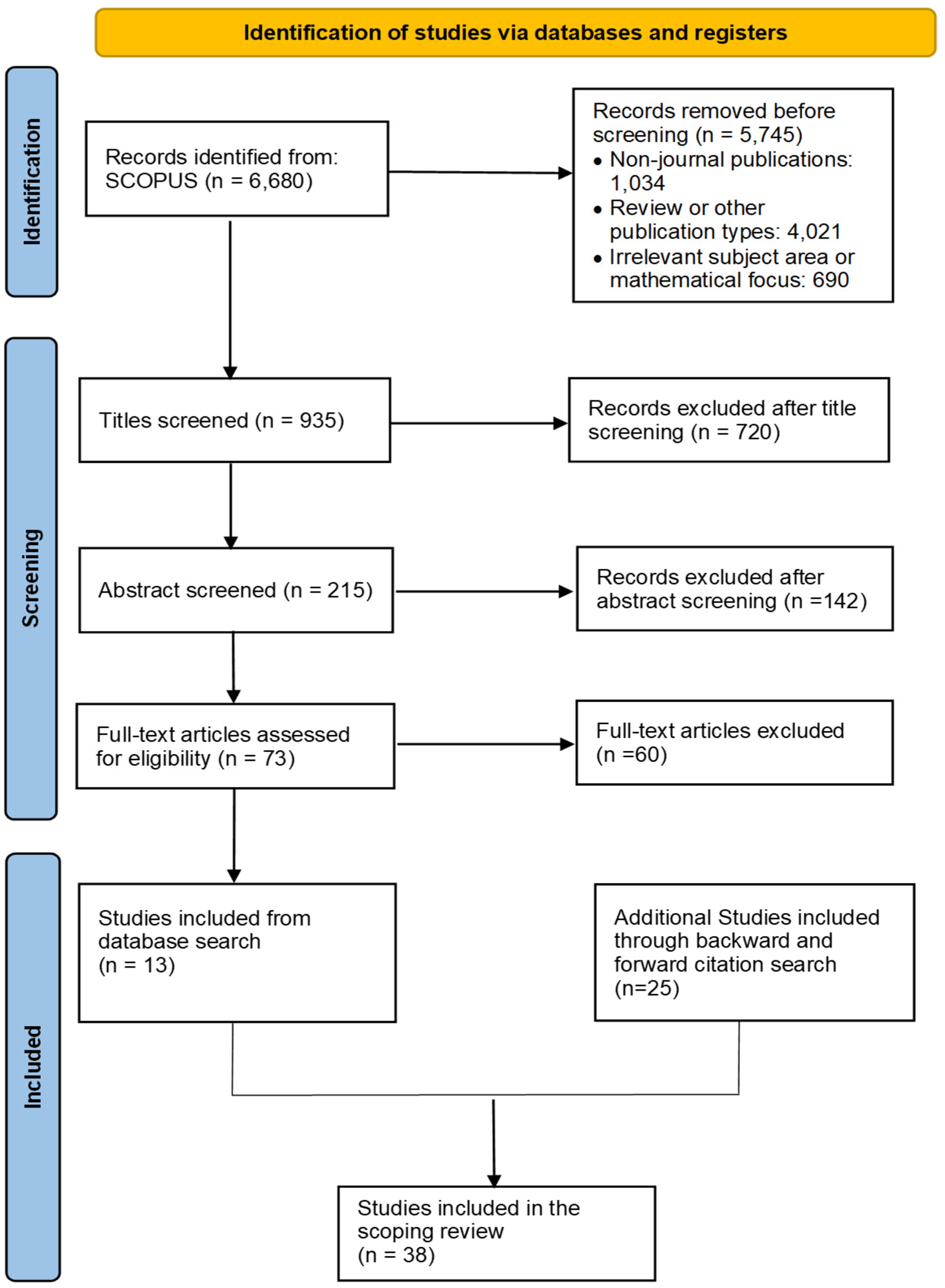
3.1. Overview of the Literature Selection Process and Outcomes
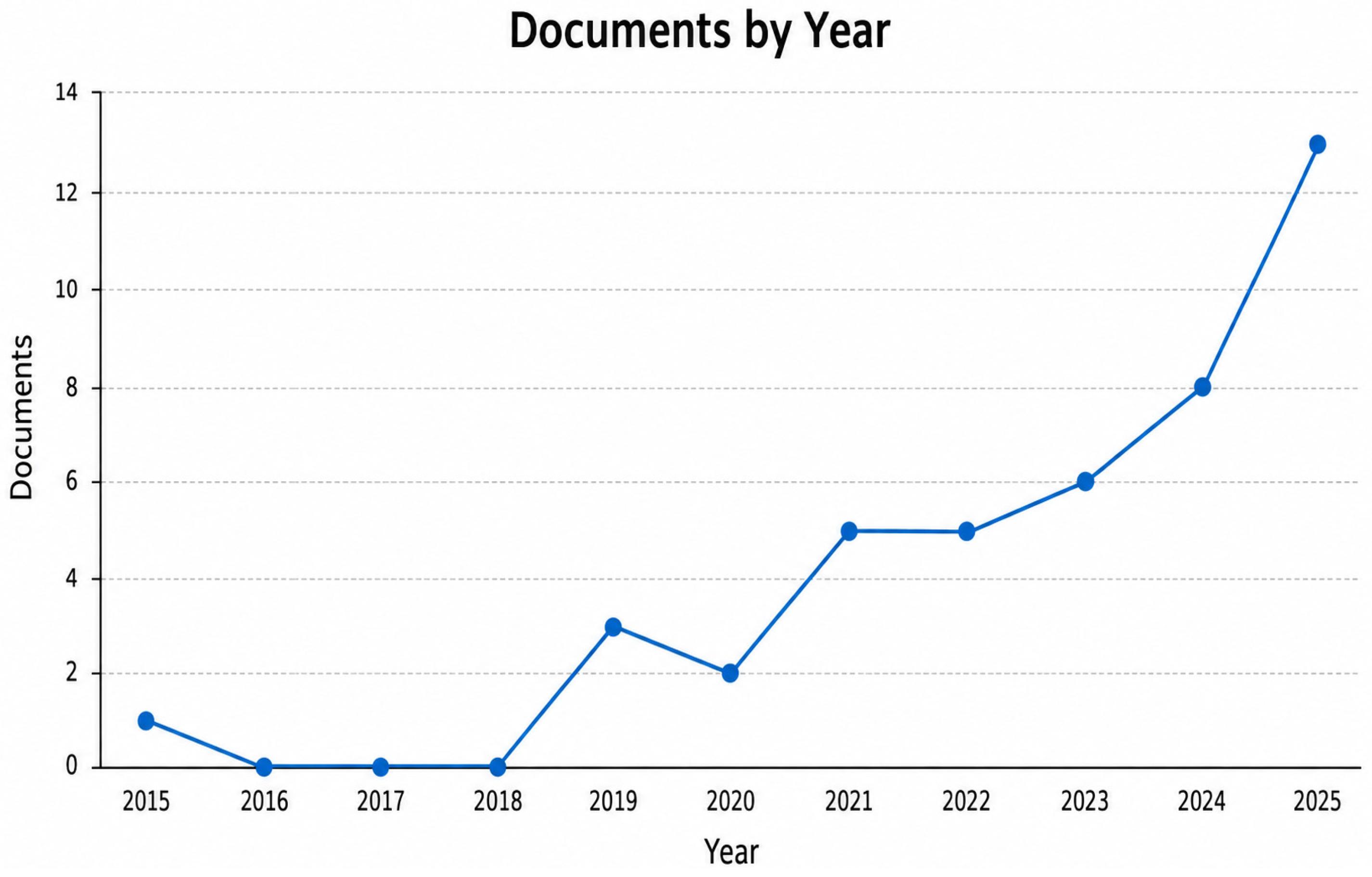
3.2. Publication Trends and Research Growth
3.3. Emerging Analytical Areas
- Key influential factors shaping SPL adoption
- Methodological approaches used in SPL adoption studies
- Dominant theoretical frameworks applied in SPL research
- Geographical context impact on SPL adoption
- Literature gaps identified from the reviewed studies
3.3.1. Key Influential Factors Shaping SPL Adoption
Service-Related Factors: Convenience, Location, and Reliability
Trust and Assurance Factors: Security, Privacy, Trust, and Risk
Value and Performance-Related Factors: Perceived Value, Usefulness, and Relative Advantage
Technology and Social Adoption Factors: Ease of Use, Readiness, and Social Influence

| Theme | Author(s) |
|---|---|
| Convenience | [3,9,23,24,25,26,27,28,32,33,37,39,47,48] |
| Security | [9,21,23,25,26,27,29,31,38,46,47,49] |
| Reliability | [9,23,26,27,28,29,30,49] |
| Perceived Value | [23,24,26,27,39,40,41] |
| Location/Distance | [3,12,26,31,39,42,47] |
| Perceived Usefulness/ Performance expectancy | [11,25,34,35,36,37] |
| Ease of Use/Effort Expectancy | [11,34,35,36,37,42] |
| Social Influence/Subjective Norms | [11,36,42,45,50] |
3.3.2. Methodological Approaches Used in SPL Adoption Studies
3.3.3. Dominant Theoretical Frameworks Applied in SPL Research
3.3.4. Geographical Contexts
3.3.5. Included Studies’ Research Gaps
Cross-Cultural Adoption Differences
Public Policy and Sustainability
Comparative Evaluation with Other Delivery Modes
Longitudinal Trends and Post-Adoption Behavior
Demographic Information
4. Conclusions
4.1. Practical Implications
4.1.1. Implications for Service Providers
4.1.2. Implications for Policymakers
4.1.3. Limitations and Future Research Avenues
Supplementary Materials
Author Contributions
Funding
Institutional Review Board Statement
Informed Consent Statement
Data Availability Statement
Conflicts of Interest
Abbreviations
| SPL | Smart Parcel Locker |
| SPLs | Smart Parcel Lockers |
| LMD | Last-Mile Delivery |
| DOI | Diffusion OF Innovation |
| TAM | Technology Acceptance Model |
| UTAUT | Unified Theory of Acceptance and Use of Technology |
| TPB | Theory of Planned Behavior |
Appendix A
| Author(s) | Theory | Methodology | Region/Country | Influential Factors of SPL Adoption |
|---|---|---|---|---|
| Vakulenko et al. [47] | - | Focus group | New Zealand | Location, Convenience, And Security of Collection Delivery Point ‘CDP’ |
| Yuen et al. [48] | Diffusion of Innovation (DOI) | Survey | Singapore | Relative Advantage, Compatibility and Trialability |
| Wang et al. [21] | Diffusion of Innovation (DOI) | Survey | Singapore | Convenience, Function, Design, security, Enjoyment, Assurance, Customization, Attitude Cognitive and Affective |
| Wang et al. [51] | Affect-Cognitive Perspectives (AFC), Service Quality (SERVQUAL) | Survey | Singapore | Compatibility, Trialability, Relative advantage, Attitude |
| Yuen et al. [23] | Resource Matching Theory (RMT), Perceived Value (PV), Transaction Cost (TC) | Survey | China | Convenience, Privacy Security, and Reliability on Customers, Mediated by Perceived Value and Transaction Costs |
| Wang et al. [22] | Service Convenience (SERVCON), Kano Model | Survey | Singapore | Operating Hours, Waiting Time, Being Enroute, Easy Retrieval, Easy Return |
| Chen et al. [24] | Technology Readiness and TAM | Survey | Taiwan/China | Perceived ability, Perceived Value, Role Identification, Service Convenience, Technology Anxiety |
| Wang et al. [41] | Value Co-Creation (VCC) | Survey | Singapore | Consumers’ Innovativeness, Consumers’ Self-Enhancement Value Orientation, Consumers’ Perceived Values, Consumers’ Green Knowledge |
| Zhou et al. [11] | Unified Theory of Acceptance and Use of Technology (UTAUT2) | Survey | China | Performance Expectancy, Effort Expectancy, Social Influence and Facilitating Conditions |
| Rai et al. [25] | - | (6) Focus groups with (49) e-shoppers divided into heavy buyers and light buyers | Belgium | Security, Perceived Usefulness, Convenience and Flexibility |
| Cai et al. [36] | Unified Theory of Acceptance and Use of Technology (UTAUT), Attitude Theory, Habit Theory | Survey | China | Habit, Performance Expectancy, Effort Expectancy, Social Influence, Facilitating Condition, Habit, Attitude |
| Wang et al. [50] | Affect-Cognitive-Social Perspectives | Survey | Singapore | Risk Appraisals, Action and Coping planning, Subjective Norms |
| Wang et al. [46] | Value Co-Creation (VCC), Fairness Heuristic | Survey | China | Perceived Service Value, Perceived Involuntariness, Perceived Fairness, Inferred Motive, Perceived Enjoyment |
| Tsai and Tiwasing [9] | Resource Matching (RMT), Diffusion of Innovation (DOI), Theory of Planned Behavior (TPB) | Survey | Thailand | Convenience, Reliability, Privacy Security, Compatibility, Relative Advantage, Complexity, Perceived Behavioral Control, And Attitude |
| Tang et al. [28] | Service Quality (SERVQUAL), E-Service Quality (ESQ), Logistics Service Quality (LSQ) | Survey | China | Service Reliability, Convenience, Fault Handling, Capability and Service Diversity |
| Wang et al. [44] | Protection Motivation Theory (PMT), Automation Acceptance Theory (AAT) | Survey | Singapore | Perceived susceptibility and severity of COVID-19, Trust, compatibility, Overall value of the service |
| Asdecker [49] | Theory of Planned Behaviours (TPB) | Interviews | Germany | Increased Flexibility: Better Reliability, Independence, Safety and Security, Privacy, Cost and Spatial Constraints |
| Lai et al. [29] | Logistics Service Quality (LSQ) | Survey | China | Tangibility, Responsiveness, security, Reliability, Timeliness |
| Merkert et al. [3] | Random utility theory and Discrete choice models | Survey | Australia | Perceived Risk, Cost, Convenience, and The Availability of Secure Locations for Delivery |
| An et al. [34] | Protection Motivation Theory (PMT) Technology Acceptance Model (TAM) | Survey | U. S | Technological Trust Perceived Usefulness and Ease of Use |
| Wang et al. [69] | Self-identity (SI) | Survey | Singapore | Prevalence of Social Distancing, Perceived Individualistic Culture, Self-Identity, Innovativeness |
| Klein and Popp [37] | Technology Acceptance Model (TAM) | Survey | Germany | Perceived Ease of Use and Perceived Usefulness |
| Vural and Akrtepe [33] | Diffusion of Innovation (DOI) | Survey, semi-structured interviews (12) service providers, and Secondary sources such as blogs, news reports, and customer complaints. | Turkey | Supply Chain-Related and Market-Related Factors Influence the Adoption: Network Structure, Service Diversity, Security and Trust, low Environmental impact, and Convenience. |
| Quan et al. [26] | Transaction Cost (TC) | Survey | Vietnam | Convenience (Locker Location), Privacy and Security, Reliability and Perceived Value |
| Olsson et al. [42] | Service-Dominant (S-D) Logic | Interviews with (9) households | Sweden | Cognitive Experience (Ease of Use, Time Saving, Security, Safe Condition) Emotional Experience (Flexibility, Location, Luxury, Frequency, Ahead of Time) Behavioral Experience (Willingness to Pay, Subscription Service, Invest, Word of Mouth, Exaltation) Sensorial Experience (Design of The Reception Box, Size of The Reception Box) Physical Experience (Order Collection) Social Experience (Human Interaction) |
| Neto and Vieira [38] | Diffusion of Innovation Theory (DOI) | Case study Survey | Brazil | Trialability, compatibility, and Relative advantage |
| Cieśla [32] | Kano model | Survey | Poland | Parcel Size, Location, Accessibility, Security, Parking Availability, High-Quality Mobile Application, Convenience and Operating Time, and 24/7 Customer Support |
| El Moussaoui et al. [31] | - | Case study; focus groups | Morocco | Location Pick-up Points Security Opening Hours Parking Availability |
| Wang et al. [43] | Risk, Attitude, Norms, Abilities, and Self-regulation (RANAS) model | Survey (500) | Singapore | Risk, Attitude, Norm, Ability and Self-regulation |
| Wu and Li [30] | - | Survey (279) | China | Time pressure, Perceived behavioral control, Self-delivery box Reliability, and socio-demographic factors. |
| Wang et al. [70] | Consumer Logistics | Survey (483) | Singapore | Willing to contribute physical effort but less interested in social interactions and attentive to informational updates. Also, socio-demographic factors and product value. |
| Chen et al. [40] | Push-Pull-Mooring (PPM) | Survey (496) | China | Push Factors: Low perceived value of home pick-up. Pull Factors: Attractiveness of smart lockers. Mooring Factors: Inertia. |
| Tsai et al. [39] | Diffusion Of Innovation Theory (DOI) | Survey (245) | Vietnam | Innovativeness And Location Convenience Through the Mediators of Perceived Value and Transaction Costs. |
| Chuong et al. [27] | Unified Theory of Acceptance and Use of Technology (UTAUT) | Survey (277) | Vietnam | Convenience, Privacy Security, Reliability, Functionality, Service Diversity, Social Influence, Facilitating Conditions, Perceived Value |
| Chen et al. [12] | Discrete choice modelling (based on random utility maximization theory) | A context-dependent stated preference survey | Nanjing, China | Access distance, socio-demographic attributes, Dwell time, Weather condition factors |
| Jang et al. [35] | Technology Acceptance Model (TAM) | Survey (459) | Seoul, Korea | Perceived Usefulness, Ease of Use, Perceived Risks (Specifically Related to Health During the Pandemic), and Trust in the Technology. |
| Li et al. [45] | Signaling Theory | Survey (612) | Singapore | Green Attributes, Green Information, Green Social Norms, and Green Participation |
References
- Global Retail E-Commerce Sales 2022–2030. Statista 2026. Available online: https://www.statista.com/statistics/379046/worldwide-retail-e-commerce-sales (accessed on 10 July 2026).
- Boysen, N.; Fedtke, S.; Schwerdfeger, S. Last-Mile Delivery Concepts: A Survey from an Operational Research Perspective. OR Spectr. 2021, 43, 1–58. [Google Scholar] [CrossRef]
- Merkert, R.; Bliemer, M.C.J.; Khan, F. Consumer Preferences for Innovative and Traditional Last-Mile Parcel Delivery. Int. J. Phys. Distrib. Logist. Manag. 2022, 52, 261–284. [Google Scholar] [CrossRef]
- Sułkowski, Ł.; Kolasińska-Morawska, K.; Brzozowska, M.; Morawski, P.; Schroeder, T. Last Mile Logistics Innovations in the Courier-Express-Parcel Sector Due to the COVID-19 Pandemic. Sustainability 2022, 14, 8207. [Google Scholar] [CrossRef]
- Suguna, M.; Shah, B.; Raj, S.K.; Suresh, M. A Study on the Influential Factors of the Last Mile Delivery Projects during COVID-19 Era. Oper. Manag. Res. 2022, 15, 399–412. [Google Scholar]
- Mangiaracina, R.; Perego, A.; Seghezzi, A.; Tumino, A. Innovative Solutions to Increase Last-Mile Delivery Efficiency in B2C e-Commerce: A Literature Review. Int. J. Phys. Distrib. Logist. Manag. 2019, 49, 901–920. [Google Scholar] [CrossRef]
- Pourmohammadreza, N.; Jokar, M.R.A.; Van Woensel, T. Last-Mile Logistics with Alternative Delivery Locations: A Systematic Literature Review. Results Eng. 2025, 25, 104085. [Google Scholar] [CrossRef]
- Seghezzi, A.; Siragusa, C.; Mangiaracina, R. Parcel Lockers vs. Home Delivery: A Model to Compare Last-Mile Delivery Cost in Urban and Rural Areas. Int. J. Phys. Distrib. Logist. Manag. 2022, 52, 213–237. [Google Scholar] [CrossRef]
- Tsai, Y.-T.; Tiwasing, P. Customers’ Intention to Adopt Smart Lockers in Last-Mile Delivery Service: A Multi-Theory Perspective. J. Retail. Consum. Serv. 2021, 61, 102514. [Google Scholar] [CrossRef]
- Orenstein, I.; Raviv, T.; Sadan, E. Flexible Parcel Delivery to Automated Parcel Lockers: Models, Solution Methods and Analysis. EURO J. Transp. Logist. 2019, 8, 683–711. [Google Scholar] [CrossRef]
- Zhou, M.; Zhao, L.; Kong, N.; Campy, K.S.; Xu, G.; Zhu, G.; Cao, X.; Wang, S. Understanding Consumers’ Behavior to Adopt Self-Service Parcel Services for Last-Mile Delivery. J. Retail. Consum. Serv. 2020, 52, 101911. [Google Scholar] [CrossRef]
- Chen, J.; Li, R.; Ma, J.; An, Q. Stationary versus Mobile Parcel Lockers: Which Self-Service Technology Moves the Consumers in the Last Mile of Urban Areas? Travel Behav. Soc. 2024, 35, 100742. [Google Scholar] [CrossRef]
- Ma, B.; Wong, Y.D.; Teo, C.-C. Parcel Self-Collection for Urban Last-Mile Deliveries: A Review and Research Agenda with a Dual Operations-Consumer Perspective. Transp. Res. Interdiscip. Perspect. 2022, 16, 100719. [Google Scholar] [CrossRef]
- Tsai, J.-F.; Ngo, H.N.; Che, Z.-H. Last-Mile Delivery during COVID-19: A Systematic Review of Parcel Locker Adoption and Consumer Experience. Acta Psychol. 2024, 249, 104462. [Google Scholar] [CrossRef] [PubMed]
- Peters, M.D.J.; Marnie, C.; Tricco, A.; Pollock, D.; Munn, Z.; Alexander, L.; McInerney, P.; Godfrey, C.M.; Khalil, H. Updated Methodological Guidance for the Conduct of Scoping Reviews. JBI Evid. Synth. 2020, 18, 2119–2126. [Google Scholar] [CrossRef] [PubMed]
- Olsson, J.; Hellström, D.; Pålsson, H. Framework of Last-Mile Logistics Research: A Systematic Review of the Literature. Sustainability 2019, 11, 7131. [Google Scholar] [CrossRef]
- Viu-Roig, M.; Alvarez-Palau, E.J. The Impact of E-Commerce-Related Last-Mile Logistics on Cities: A Systematic Literature Review. Sustainability 2020, 12, 6492. [Google Scholar] [CrossRef]
- Baas, J.; Schotten, M.; Plume, A.; Côté, G.; Karimi, R. Scopus as a Curated, High-Quality Bibliometric Data Source for Academic Research in Quantitative Science Studies. Quant. Sci. Stud. 2020, 1, 377–386. [Google Scholar] [CrossRef]
- Tricco, A.C.; Lillie, E.; Zarin, W.; O’Brien, K.K.; Colquhoun, H.; Levac, D.; Moher, D.; Peters, M.D.; Horsley, T.; Weeks, L.; et al. PRISMA extension for scoping reviews (PRISMA-ScR): Checklist and explanation. Ann. Intern. Med. 2018, 169, 467–473. [Google Scholar] [CrossRef] [PubMed]
- Wohlin, C. Guidelines for Snowballing in Systematic Literature Studies and a Replication in Software Engineering. In Proceedings of the 18th International Conference on Evaluation and Assessment in Software Engineering, London, UK, 13–14 May 2014; ACM: London, UK, 2014; pp. 1–10. [Google Scholar] [CrossRef]
- Wang, X.; Yuen, K.F.; Wong, Y.D.; Teo, C.C. An Innovation Diffusion Perspective of E-Consumers’ Initial Adoption of Self-Collection Service via Automated Parcel Station. Int. J. Logist. Manag. 2018, 29, 237–260. [Google Scholar] [CrossRef]
- Wang, X.; Wong, Y.D.; Teo, C.-C.; Yuen, K.F.; Li, K.X. Decomposing Service Conveniences in Self-Collection. Int. J. Phys. Distrib. Logist. Manag. 2019, 49, 356–375. [Google Scholar] [CrossRef]
- Yuen, K.F.; Wang, X.; Ma, F.; Wong, Y.D. The Determinants of Customers’ Intention to Use Smart Lockers for Last-Mile Deliveries. J. Retail. Consum. Serv. 2019, 49, 316–326. [Google Scholar] [CrossRef]
- Chen, C.-F.; White, C.; Hsieh, Y.-E. The Role of Consumer Participation Readiness in Automated Parcel Station Usage Intentions. J. Retail. Consum. Serv. 2020, 54, 102063. [Google Scholar] [CrossRef]
- Rai, H.B.; Verlinde, S.; Macharis, C. Unlocking the Failed Delivery Problem? Opportunities and Challenges for Smart Locks from a Consumer Perspective. Res. Transp. Econ. 2021, 87, 100753. [Google Scholar] [CrossRef]
- Quan, N.H.; Binh, N.T.; Ly, B.T. Impact of Smart Locker Use on Customer Satisfaction of Online Shoppers in Vietnam. Humanit. Soc. Sci. Commun. 2022, 9, 403. [Google Scholar] [CrossRef] [PubMed]
- Chuong, H.N.; Uyen, V.T.P.; Ngan, N.D.P.; Tram, N.T.B.; Tran, L.N.B.; Ha, N.T.T. Exploring a New Service Prospect: Customer’ Intention Determinants in Light of Utaut Theory. Cogent Bus. Manag. 2024, 11, 2291856. [Google Scholar] [CrossRef]
- Tang, Y.M.; Chau, K.Y.; Xu, D.; Liu, X. Consumer Perceptions to Support IoT Based Smart Parcel Locker Logistics in China. J. Retail. Consum. Serv. 2021, 62, 102659. [Google Scholar] [CrossRef]
- Lai, P.-L.; Jang, H.; Fang, M.; Peng, K. Determinants of Customer Satisfaction with Parcel Locker Services in Last-Mile Logistics. Asian J. Shipp. Logist. 2022, 38, 25–30. [Google Scholar] [CrossRef]
- Wu, R.; Li, P. Continuance Intention to Use Self-Delivery Boxes: An Empirical Study in Tianjin, China. J. Retail. Consum. Serv. 2023, 70, 103152. [Google Scholar] [CrossRef]
- El Moussaoui, A.E.; Benbba, B.; Jaegler, A.; El Moussaoui, T.; El Andaloussi, Z.; Chakir, L. Consumer Perceptions of Online Shopping and Willingness to Use Pick-Up Points: A Case Study of Morocco. Sustainability 2023, 15, 7405. [Google Scholar] [CrossRef]
- Cieśla, M. Perceived Importance and Quality Attributes of Automated Parcel Locker Services in Urban Areas. Smart Cities 2023, 6, 2661–2679. [Google Scholar] [CrossRef]
- Altuntaş Vural, C.; Aktepe, Ç. Why Do Some Sustainable Urban Logistics Innovations Fail? The Case of Collection and Delivery Points. Res. Transp. Bus. Manag. 2022, 45, 100690. [Google Scholar] [CrossRef]
- An, H.S.; Park, A.; Song, J.M.; Chung, C. Consumers’ Adoption of Parcel Locker Service: Protection and Technology Perspectives. Cogent Bus. Manag. 2022, 9, 2144096. [Google Scholar] [CrossRef]
- Jang, S.; Hong, D.; Lee, C. Exploring the Behavioral Adoption of Automated Parcel Locker Systems under COVID-19. Transp. Policy 2024, 151, 1–11. [Google Scholar] [CrossRef]
- Cai, L.; Yuen, K.F.; Xie, D.; Fang, M.; Wang, X. Consumer’s Usage of Logistics Technologies: Integration of Habit into the Unified Theory of Acceptance and Use of Technology. Technol. Soc. 2021, 67, 101789. [Google Scholar] [CrossRef]
- Klein, P.; Popp, B. Last-Mile Delivery Methods in E-Commerce: Does Perceived Sustainability Matter for Consumer Acceptance and Usage? Sustainability 2022, 14, 16437. [Google Scholar] [CrossRef]
- Neto, L.G.; Vieira, J.G.V. An Investigation of Consumer Intention to Use Pick-up Point Services for Last-Mile Distribution in a Developing Country. J. Retail. Consum. Serv. 2023, 74, 103425. [Google Scholar] [CrossRef]
- Tsai, J.-F.; Ngo, H.-N.; Che, Z.-H.; Lin, M.-H. Sustainable Solutions in E-Commerce: An Examination of Customer Acceptance of Automated Delivery Stations in Vietnam. Sustainability 2024, 16, 4570. [Google Scholar] [CrossRef]
- Chen, L.; Wu, P.; Dou, Y.; Wu, Y. Investigating Senders’ Switching Intention to Smart Lockers: An Extension of Push-Pull-Mooring Model. J. Retail. Consum. Serv. 2023, 74, 103414. [Google Scholar] [CrossRef]
- Wang, X.; Wong, Y.D.; Teo, C.C.; Yuen, K.F.; Feng, X. The Four Facets of Self-Collection Service for e-Commerce Delivery: Conceptualisation and Latent Class Analysis of User Segments. Electron. Commer. Res. Appl. 2020, 39, 100896. [Google Scholar] [CrossRef]
- Olsson, J.; Hellström, D.; Vakulenko, Y. Customer Experience Dimensions in Last-Mile Delivery: An Empirical Study on Unattended Home Delivery. Int. J. Phys. Distrib. Logist. Manag. 2023, 53, 184–205. [Google Scholar] [CrossRef]
- Wang, X.; Wong, Y.D.; Kim, T.Y.; Yuen, K.F. Does Consumers’ Involvement in e-Commerce Last-Mile Delivery Change after COVID-19? An Investigation on Behavioural Change, Maintenance and Habit Formation. Electron. Commer. Res. Appl. 2023, 60, 101273. [Google Scholar] [CrossRef]
- Wang, X.; Wong, Y.D.; Qi, G.; Yuen, K.F. Contactless Channel for Shopping and Delivery in the Context of Social Distancing in Response to COVID-19 Pandemic. Electron. Commer. Res. Appl. 2021, 48, 101075. [Google Scholar] [CrossRef] [PubMed]
- Li, Z.; Wu, M.; Teo, C.C.; Yuen, K.F. An Investigation of Consumer Switching Intention on the Use of Automated Courier Station from a Signaling Perspective. J. Retail. Consum. Serv. 2024, 78, 103768. [Google Scholar] [CrossRef]
- Wang, X.; Yuen, K.F.; Teo, C.-C.; Wong, Y.D. Online Consumers’ Satisfaction in Self-Collection: Value Co-Creation from the Service Fairness Perspective. Int. J. Electron. Commer. 2021, 25, 230–260. [Google Scholar] [CrossRef]
- Vakulenko, Y.; Hellström, D.; Hjort, K. What’s in the Parcel Locker? Exploring Customer Value in e-Commerce Last-Mile Delivery. J. Bus. Res. 2018, 88, 421–427. [Google Scholar] [CrossRef]
- Yuen, K.F.; Wang, X.; Ng, L.T.W.; Wong, Y.D. An Investigation of Customers’ Intention to Use Self-Collection Services for Last-Mile Delivery. Transp. Policy 2018, 66, 1–8. [Google Scholar] [CrossRef]
- Asdecker, B. Building the E-Commerce Supply Chain of the Future: What Influences Consumer Acceptance of Alternative Places of Delivery on the Last-Mile. Logistics 2021, 5, 90. [Google Scholar] [CrossRef]
- Wang, X.; Wong, Y.D.; Yuen, K.F. Does COVID-19 Promote Self-Service Usage among Modern Shoppers? An Exploration of Pandemic-Driven Behavioural Changes in Self-Collection Users. Int. J. Environ. Res. Public. Health 2021, 18, 8574. [Google Scholar] [CrossRef] [PubMed]
- Wang, X.; Yuen, K.F.; Wong, Y.D.; Teo, C.-C. Consumer Participation in Last-Mile Logistics Service: An Investigation on Cognitions and Affects. Int. J. Phys. Distrib. Logist. Manag. 2019, 49, 217–238. [Google Scholar] [CrossRef]
- Maxwell, J.A. Designing a Qualitative Study; SAGE: New York, NY, USA, 2008; pp. 214–253. [Google Scholar]
- Maher, L.; Dertadian, G. Qualitative Research. Addiction 2018, 113, 167–172. [Google Scholar] [CrossRef] [PubMed]
- Rogers, E.M.; Singhal, A.; Quinlan, M.M. Diffusion of Innovations. In An Integrated Approach to Communication Theory and Research; Stacks, D.W., Salwen, M.B., Eds.; Routledge: Oxfordshire, UK, 2014; pp. 432–448. [Google Scholar]
- Davis, F.D. Perceived Usefulness, Perceived Ease of Use, and User Acceptance of Information Technology. MIS Q. 1989, 13, 319–340. [Google Scholar] [CrossRef] [PubMed]
- Venkatesh, V.; Morris, M.G.; Davis, G.B.; Davis, F.D. User Acceptance of Information Technology: Toward A Unified View1. MIS Q. 2003, 27, 425–478. [Google Scholar] [CrossRef]
- Zeithaml, V.A. Consumer Perceptions of Price, Quality, and Value: A Means-End Model and Synthesis of Evidence. J. Mark. 1988, 52, 2–22. [Google Scholar] [CrossRef]
- Ajzen, I. The Theory of Planned Behavior. Organ. Behav. Hum. Decis. Process. 1991, 50, 179–211. [Google Scholar] [CrossRef]
- Rogers, R.W. A Protection Motivation Theory of Fear Appeals and Attitude Change. J. Psychol. 1975, 91, 93–114. [Google Scholar] [CrossRef] [PubMed]
- Parasuraman, A.; Zeithaml, V.A.; Berry, L.L. Servqual: A Multiple-Item Scale for Measuring Consumer Perceptions of Service Quality. J. Retail. 1988, 64, 12–40. [Google Scholar]
- Uzir, M.U.H.; Al Halbusi, H.; Thurasamy, R.; Hock, R.L.T.; Aljaberi, M.A.; Hasan, N.; Hamid, M. The Effects of Service Quality, Perceived Value and Trust in Home Delivery Service Personnel on Customer Satisfaction: Evidence from a Developing Country. J. Retail. Consum. Serv. 2021, 63, 102721. [Google Scholar] [CrossRef]
- Weber, L.; Mayer, K. Transaction Cost Economics and the Cognitive Perspective: Investigating the Sources and Governance of Interpretive Uncertainty. Acad. Manag. Rev. 2014, 39, 344–363. [Google Scholar] [CrossRef]
- Prahalad, C.K.; Ramaswamy, V. Co-creating Unique Value with Customers. Strategy Leadersh. 2004, 32, 4–9. [Google Scholar] [CrossRef]
- Perboli, G.; Rosano, M. Parcel Delivery in Urban Areas: Opportunities and Threats for the Mix of Traditional and Green Business Models. Transp. Res. Part C Emerg. Technol. 2019, 99, 19–36. [Google Scholar] [CrossRef]
- Luong, D.V.; Lopes de Sousa Jabbour, A.B.; Nguyen, N.M. The Nexus between Collection-and-Delivery Points and Consumers’ Adoption Intention: The Role of Country Culture. Cogent Bus. Manag. 2024, 11, 2423890. [Google Scholar] [CrossRef]
- Zhang, M.; Zhang, H. The Use of Smart Lockers in China’s Smart Villages Construction: Expanding UTAUT With Price Value and Technical Anxiety. Sage Open 2024, 14, 21582440241287593. [Google Scholar] [CrossRef]
- Zhu, X.; Cai, L.; Lai, P.L.; Wang, X.; Ma, F. Evolution, Challenges, and Opportunities of Transportation Methods in the Last-Mile Delivery Process. Systems 2023, 11, 509. [Google Scholar] [CrossRef]
- Arvianto, A.; Sopha, B.M.; Asih, A.M.S.; Imron, M.A. City Logistics Challenges and Innovative Solutions in Developed and Developing Economies: A Systematic Literature Review. Int. J. Eng. Bus. Manag. 2021, 13, 18479790211039720. [Google Scholar] [CrossRef]
- Wang, X.; Wong, Y.D.; Sun, S.; Yuen, K.F. An Investigation of Self-Service Technology Usage during the COVID-19 Pandemic: The Changing Perceptions of “Self” and Technologies. Technol. Soc. 2022, 70, 102032. [Google Scholar] [CrossRef] [PubMed]
- Wang, X.; Wong, Y.D.; Shi, W.; Yuen, K.F. An Investigation on Consumers’ Preferences for Parcel Deliveries: Applying Consumer Logistics in Omni-Channel Shopping. Int. J. Logist. Manag. 2024, 35, 557–576. [Google Scholar] [CrossRef]


| Aspect | Traditional Delivery | SPL Delivery |
|---|---|---|
| Recipient presence | Must be present in person to receive the parcel | Not required; parcel can be left even in recipient’s absence |
| Handover method | Direct handover from courier to customer | Courier leaves the package in a specified location |
| Security | Very secure, often with a signature for proof | Depending on the location’s security (risk of theft if unsecured) |
| Convenience | Requires scheduling or waiting for arrival | More flexible timing; no need to wait for courier |
| Proof of delivery | Signature or photo at the door | Photo of drop-off or locker scan (depending on the system) |
Disclaimer/Publisher’s Note: The statements, opinions and data contained in all publications are solely those of the individual author(s) and contributor(s) and not of MDPI and/or the editor(s). MDPI and/or the editor(s) disclaim responsibility for any injury to people or property resulting from any ideas, methods, instructions or products referred to in the content. |
© 2026 by the authors. Licensee MDPI, Basel, Switzerland. This article is an open access article distributed under the terms and conditions of the Creative Commons Attribution (CC BY) license.
Share and Cite
Alamoudi, L.H.; Salam, M.A. Factors Influencing Consumer Adoption of Smart Parcel Lockers: A Scoping Review. Logistics 2026, 10, 180. https://doi.org/10.3390/logistics10080180
Alamoudi LH, Salam MA. Factors Influencing Consumer Adoption of Smart Parcel Lockers: A Scoping Review. Logistics. 2026; 10(8):180. https://doi.org/10.3390/logistics10080180
Chicago/Turabian StyleAlamoudi, Lujain Hussein, and Mohammad Asif Salam. 2026. "Factors Influencing Consumer Adoption of Smart Parcel Lockers: A Scoping Review" Logistics 10, no. 8: 180. https://doi.org/10.3390/logistics10080180
APA StyleAlamoudi, L. H., & Salam, M. A. (2026). Factors Influencing Consumer Adoption of Smart Parcel Lockers: A Scoping Review. Logistics, 10(8), 180. https://doi.org/10.3390/logistics10080180