
Optimal Reordering Strategy for Three-Echelon Spare-Parts Inventory Systems Under Disruption-Dependent Lead-Time Uncertainty: Application to Wind Energy Systems

Abstract
1. Introduction
2. The Three-Echelon Problem
Assumptions
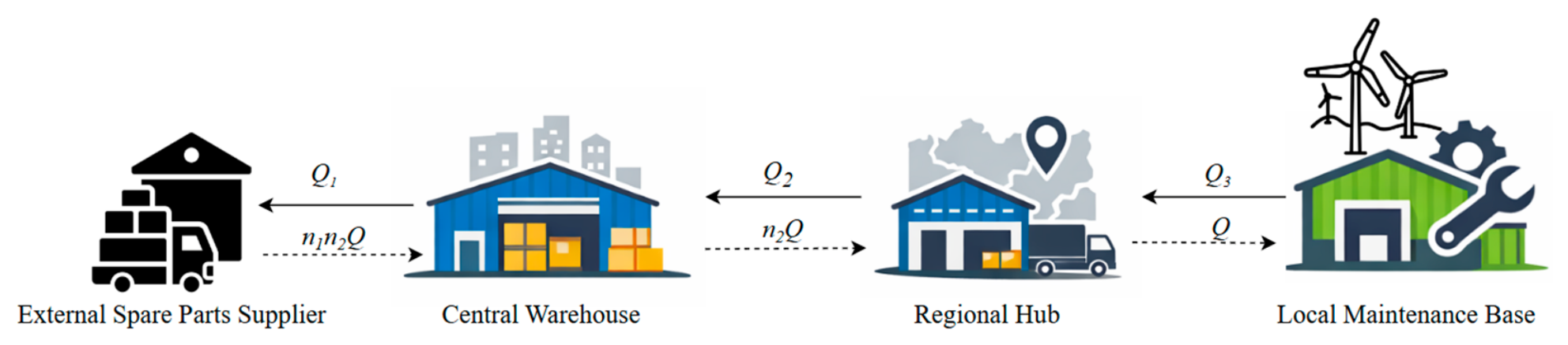
- Three-Echelon Serial Structure: The supply system is strictly hierarchical, consisting of one central warehouse (echelon 1), one regional hub (echelon 2), and one local maintenance base (echelon 3), with no lateral transshipments or parallel supply paths.
- Single-Item System: Only one critical spare part is considered, and interactions with other inventory items are excluded. This assumption is supported by the spare-parts classification literature, which emphasizes that inventory policies should be differentiated based on item criticality [51]. In wind energy systems, spare-parts availability is directly linked to downtime cost [35]; therefore, cost-optimal spare-parts planning must balance inventory holding cost against turbine unavailability cost. The single-item setting allows the study to focus on the disruption-dependent lead-time structure and three-echelon reorder policy for a high-criticality component.
- Demand Characteristics: External spare-parts demand is assumed to occur only at the local maintenance base and is represented by a constant long-run average rate units per unit time. This assumption approximates aggregate spare-parts consumption over the planning horizon and is used to isolate the effect of disruption-dependent stochastic lead times on multi-echelon replenishment decisions.
- Replenishment Flow: The regional hub replenishes the local base, and the central warehouse replenishes the regional hub. No direct shipments occur between non-adjacent echelons.
- Continuous-Review Policy: Inventory levels at all echelons are continuously monitored, and replenishment decisions are triggered immediately when inventory positions reach predefined thresholds.
- Back-ordering of Shortages: Shortages are allowed at all echelons and are completely backlogged, meaning all unmet demand is fulfilled later without loss of demand.
- Operational Impact at Local Echelon: Shortages at the local maintenance base result in turbine downtime, introducing an implicit penalty or cost associated with unmet demand.
- Stochastic Lead Times: Replenishment lead times between echelons are random variables and follow general (non-specified) probability distributions rather than fixed or simplified forms.
- Integrated Uncertainty Representation: Lead-time randomness inherently captures multiple sources of uncertainty, including transportation delays, supply chain disruptions, weather conditions, and routing variability, without modeling these factors separately.
- Stationary Environment: System parameters, such as demand rate and lead-time distributions, are assumed to be time-invariant over the planning horizon.
- Instantaneous Order Placement: Orders are placed without delay once inventory policies trigger replenishment decisions.
3. Model Formulation
3.1. Notation
- (a)
- Parameters
- (b)
- Decision Variables
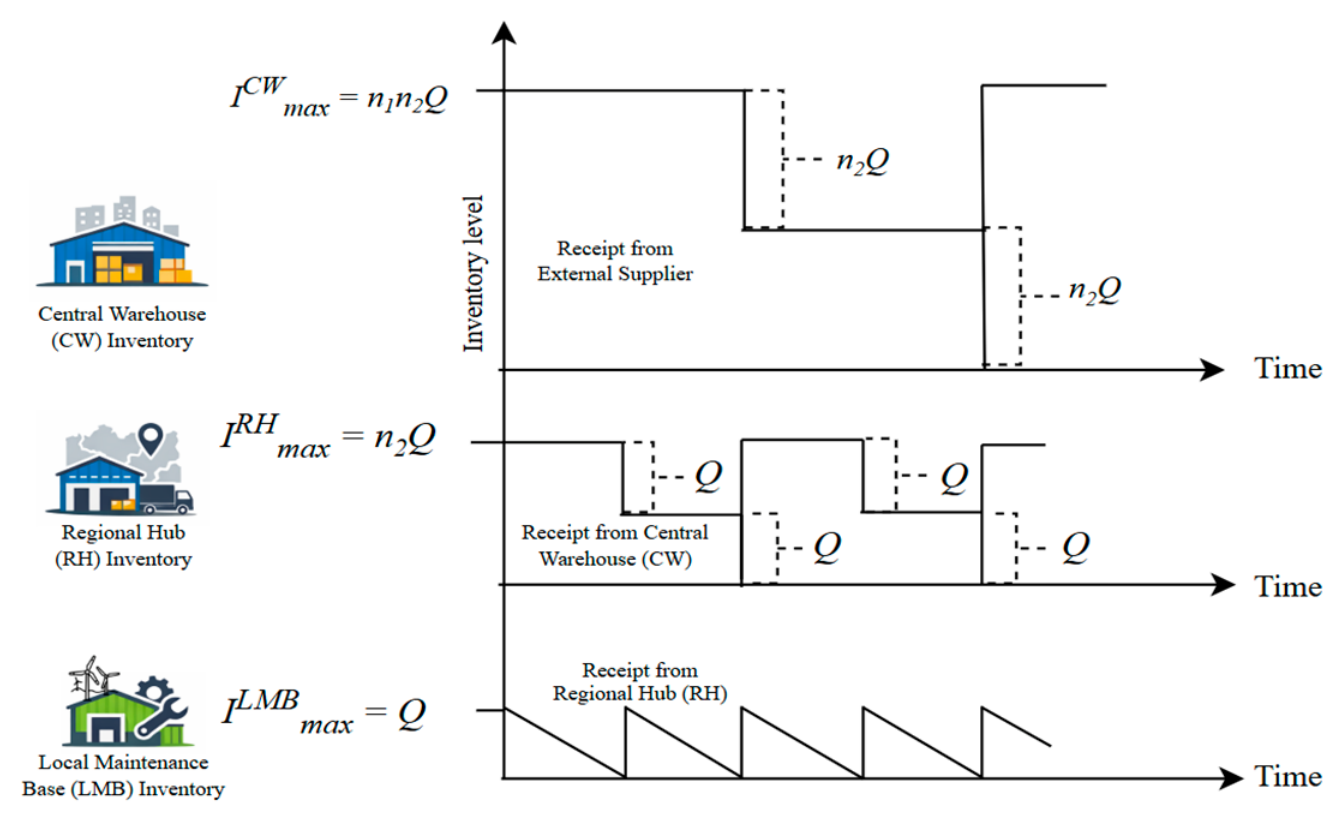
3.2. Nested Replenishment Policy and Three-Echelon Spare-Parts System
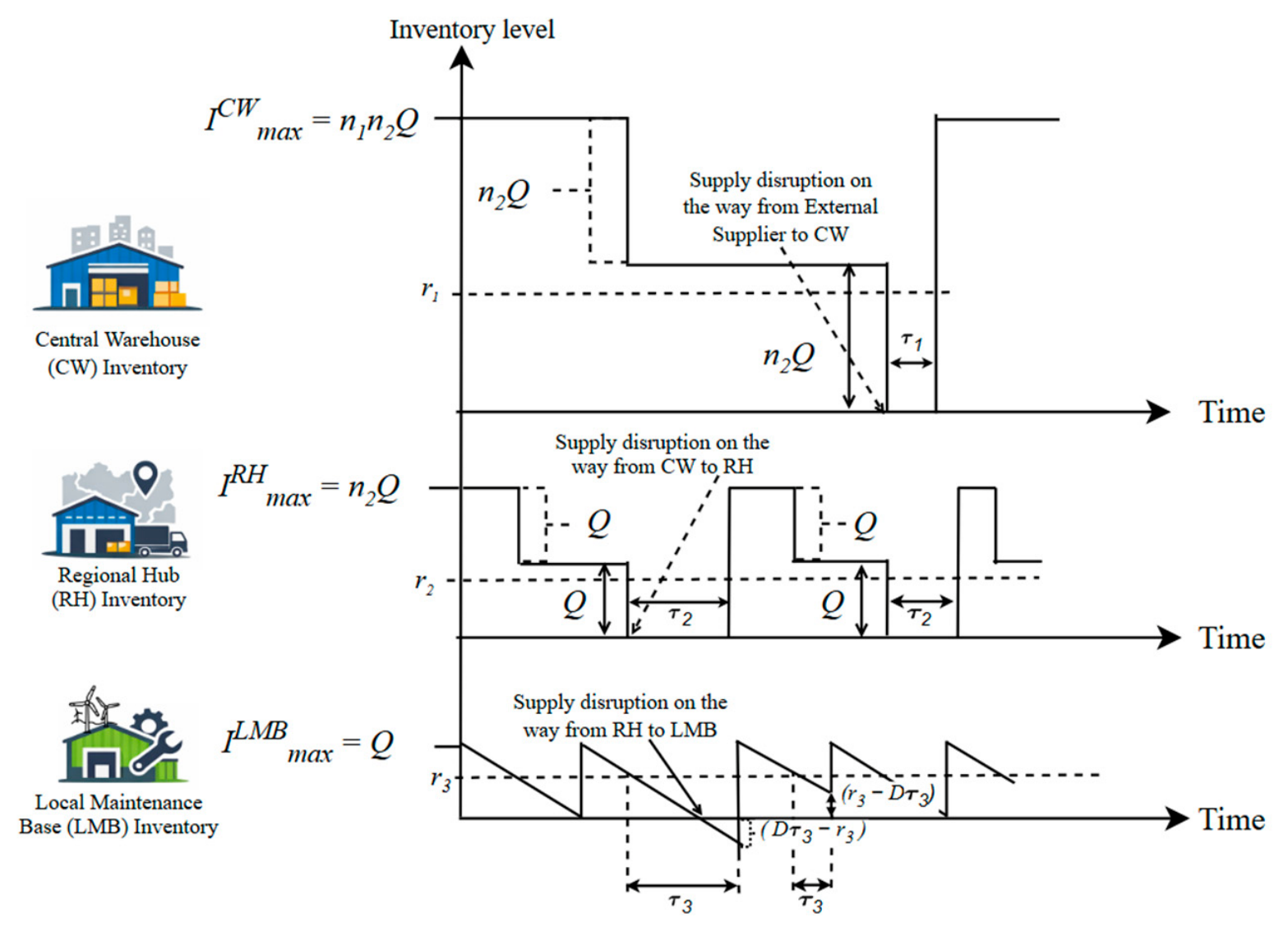
3.3. Supply Disruption and Lead-Time Variability
3.4. Expected Excess Stock and Expected Shortages Under General Lead Times
3.5. Cost Components and the Total Cost Formulation
4. Solution Methodology and Algorithm Development
| Algorithm 1. Nested Enumeration–Bisection Algorithm (NEBA) for Minimizing TAC |
| Input: Model parameters and lead-time distributions; integer bounds for and , respectively; tolerance . Step 0. Start Step 1. Set . Step 2. For Step 3. For Step 4. Compute using Equation (17) Step 5. Select initial interval such that Equation (14) evaluated at and has opposite signs Step 6. While do Step 7. Step 8. If signs of Equation (14) at , differ: Step 9. Else Step 10. End While Step 11. Step 12. Compute using Equation (6) Step 13. If Step 14. Step 15. Step 16. Go to Step 3 Step 17. Else Step 18. End For Step 19. If Step 20. Step 21. Step 22. Go to Step 2 Step 23. Else Step 24. End For Step 25. End. Output: Optimal solution |
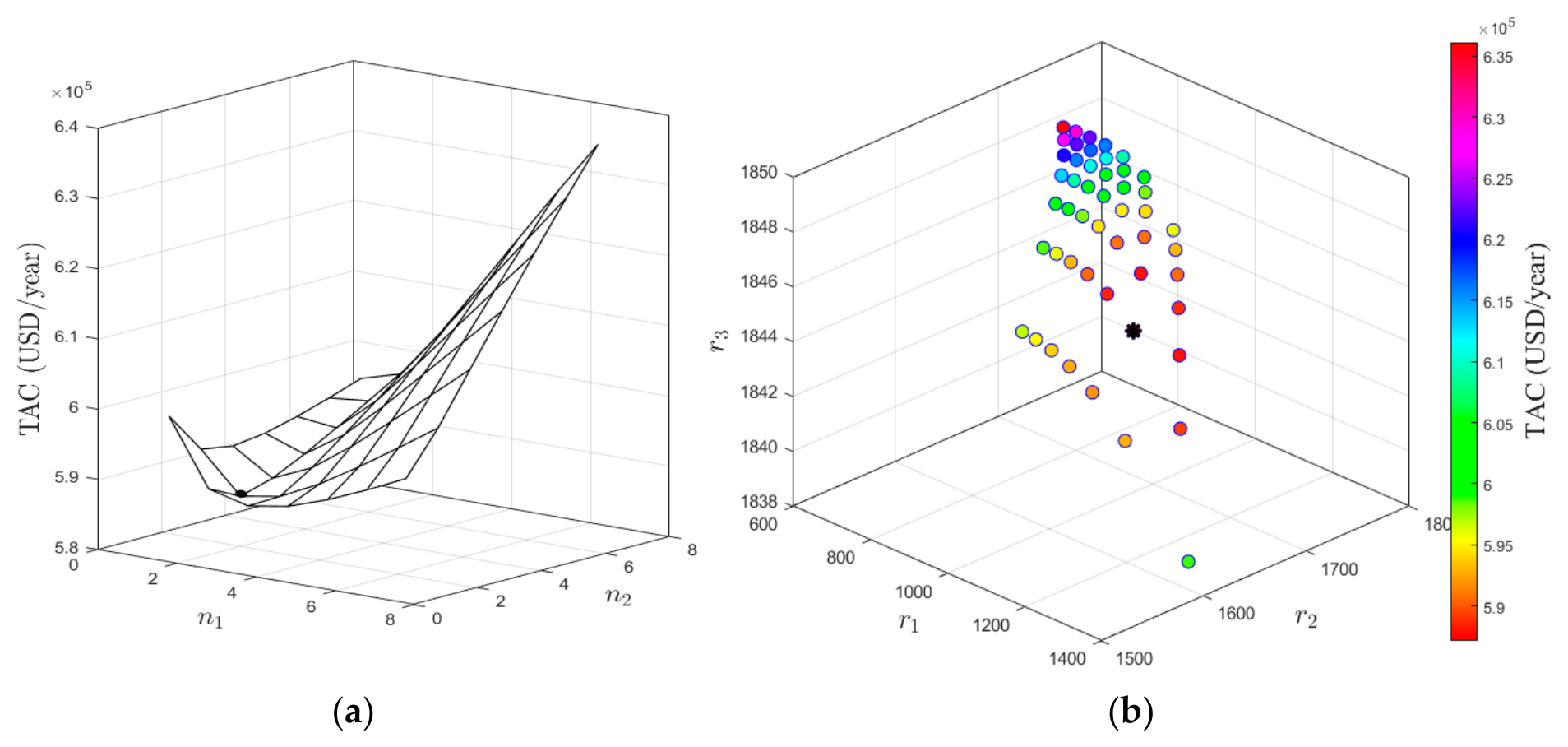
5. Numerical Analysis
5.1. Case 1 (Lead-Time Pairs with Uniform and Exponential Distribution)
- Step 0. Start.
- Step 1. Set .
- Step 2. .
- Step 3. .
- Step 4. Compute from Equation (17).
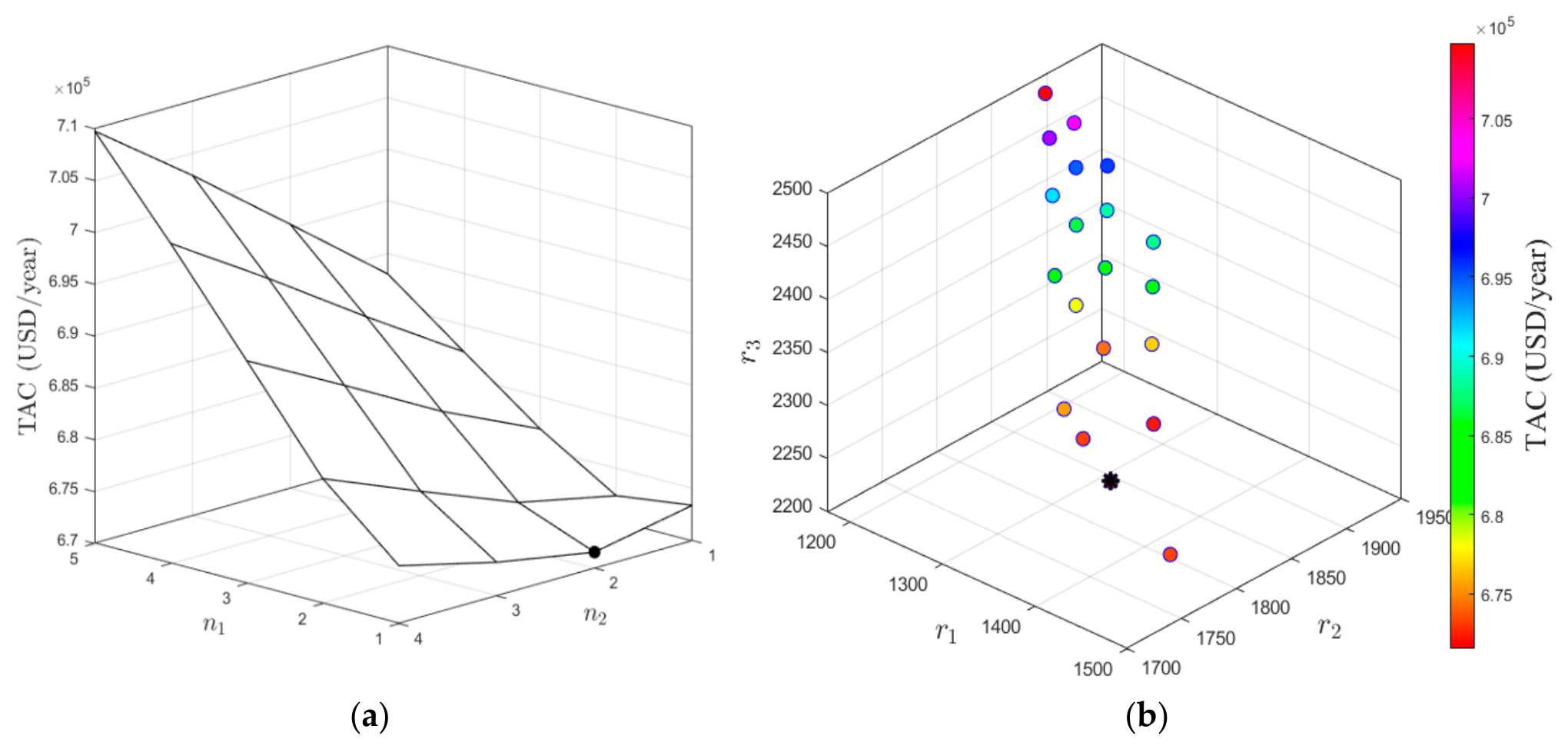
- Step 5. Accordingly, define with , so . This same initial interval is used for all three reorder points in this candidate.
- Step 6–11. Bisection loop.
- Step 4. Update using those reorder points, where .
- Step 12. Compute the TAC for this candidate: .
- Step 13–17. Candidate update, since ,
5.2. Case 2 (Lead-Time Pairs with Normal and Weibull Distribution)
6. Impact of Variable Lead Time on the Proposed Inventory System
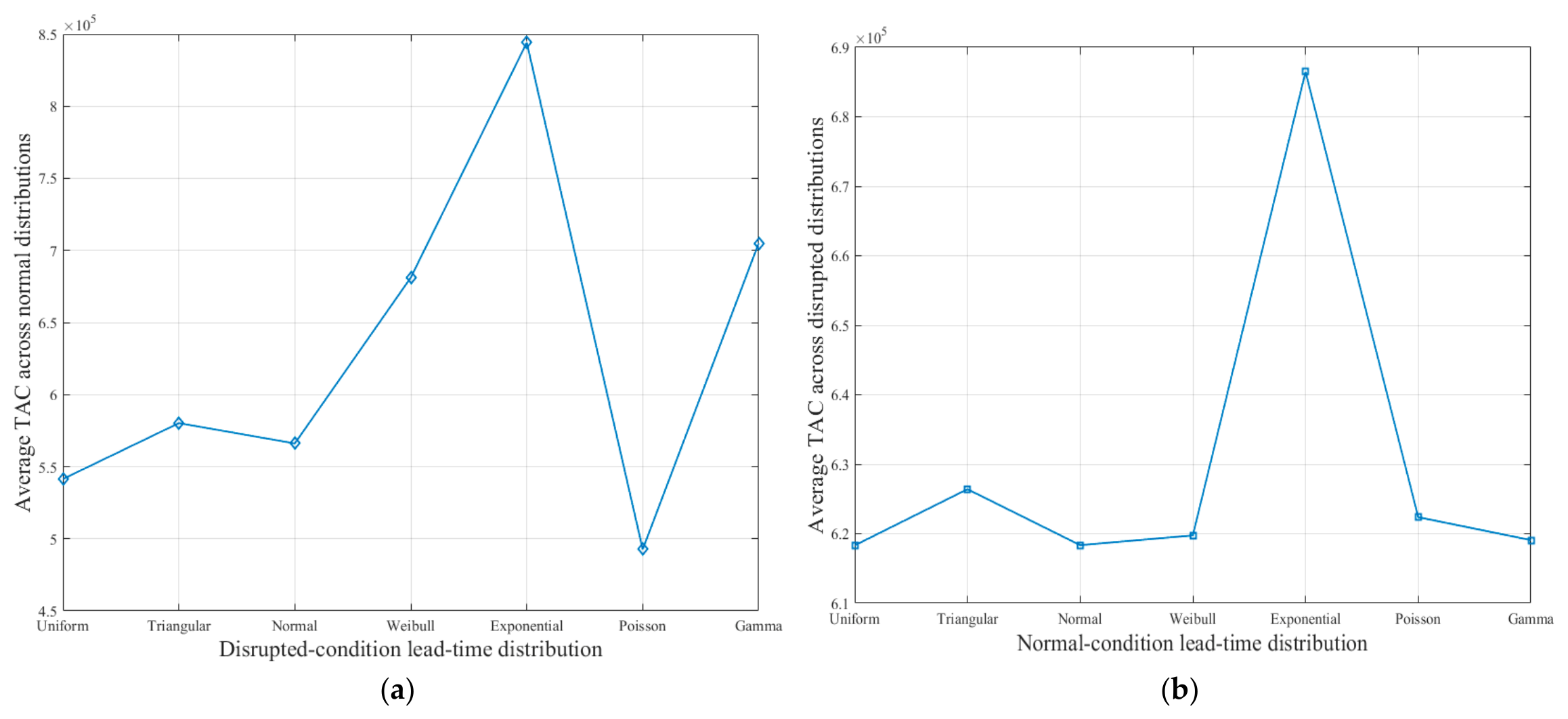
6.1. Marginal Impact of Lead-Time Distribution Types on
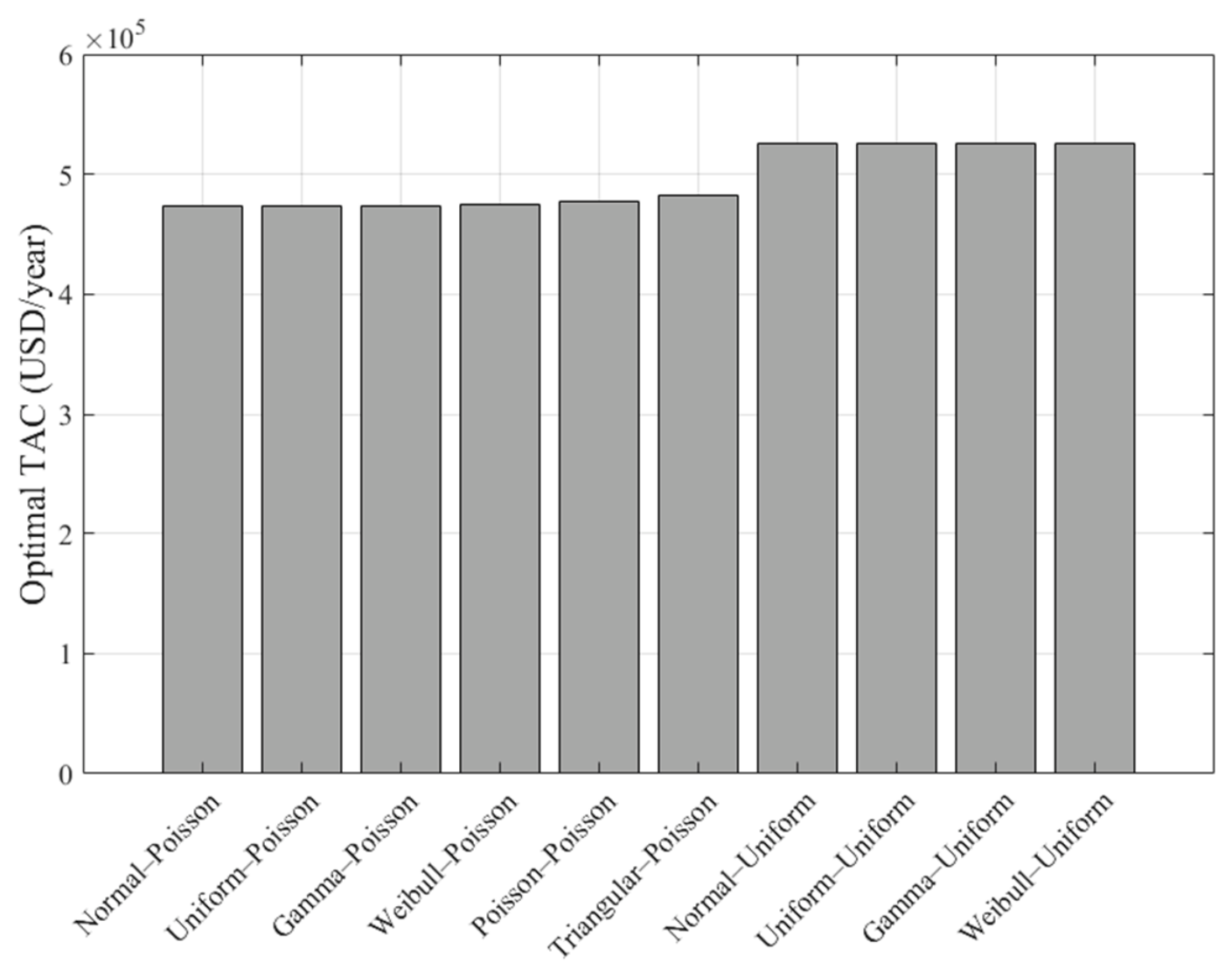
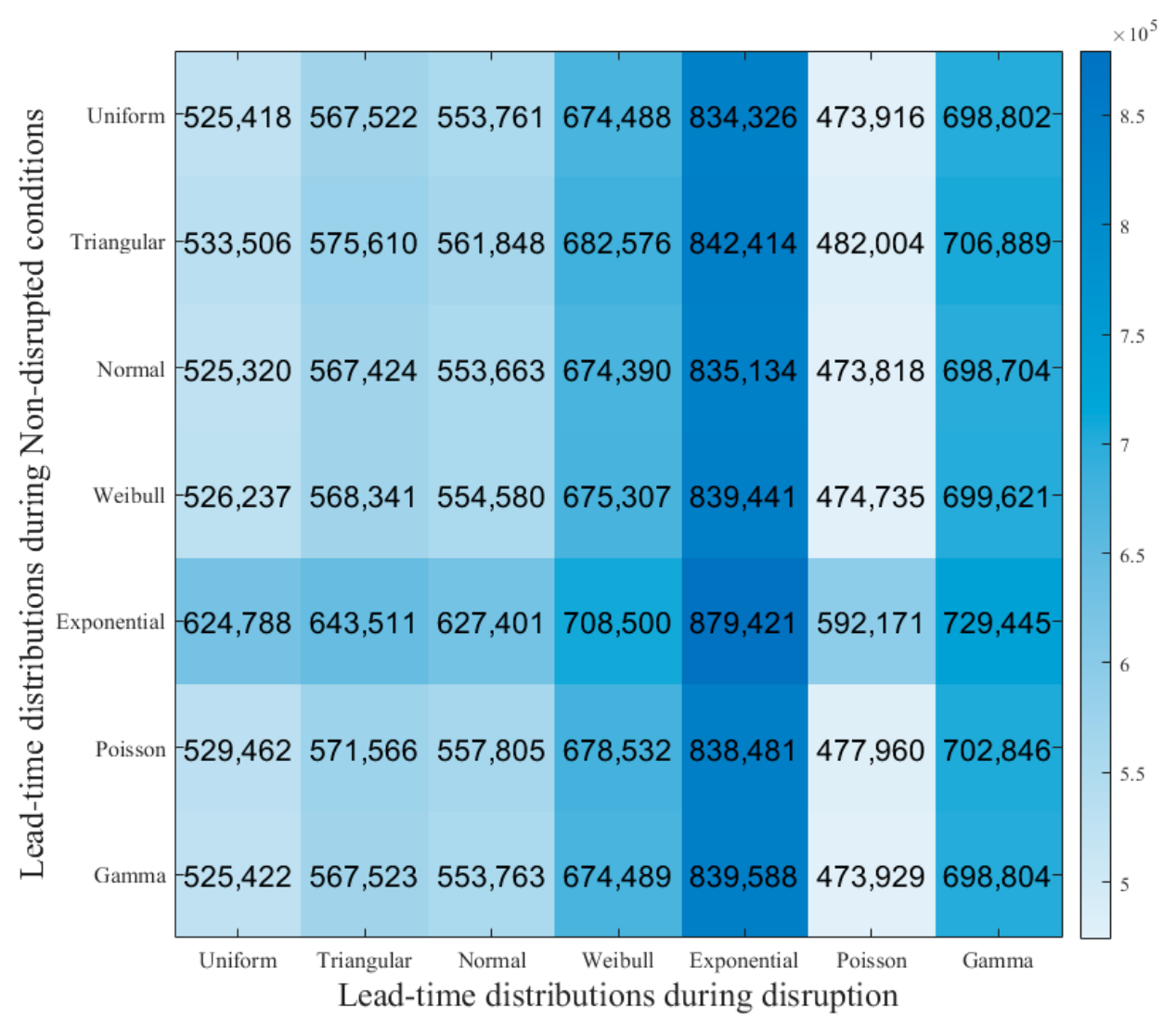
6.2. Results and Discussion
7. Conclusions
Author Contributions
Funding
Institutional Review Board Statement
Informed Consent Statement
Data Availability Statement
Acknowledgments
Conflicts of Interest
Appendix A
Appendix B
Appendix C

| Lead-Time State | Distribution | Distribution Parameters | Interpretation |
|---|---|---|---|
| Non-disrupted | Uniform | days | Shorter bounded lead-time variation |
| Non-disrupted | Triangular | days | Shorter lead time with most likely value at 22 days |
| Non-disrupted | Normal | 8 days | Moderate routine variation |
| Non-disrupted | Weibull | 2.2, 28 days | Routine asymmetric variation |
| Non-disrupted | Exponential | 22 days | More variable routine delay |
| Non-disrupted | Poisson | 24 days | Discrete lead-time approximation |
| Non-disrupted | Gamma | 5 5 days | Mean (=25) days |
| Disrupted | Uniform | days | Longer bounded disruption delay |
| Disrupted | Triangular | days | Longer delay with most likely value at 85 days |
| Disrupted | Normal | 90, 20 days | High disrupted-state variability |
| Disrupted | Weibull | days | Skewed disrupted delay |
| Disrupted | Exponential | 80 days | Heavy-tailed disruption delay |
| Disrupted | Poisson | 95 days | Discrete disrupted lead-time approximation |
| Disrupted | Gamma | 9, days | Mean (=90) days |
Appendix D
| Normal | Disrupted | ($) | ||||||
|---|---|---|---|---|---|---|---|---|
| Uniform | Uniform | 1 | 2 | 189 | 1449 | 1575 | 1601 | 525,418 |
| Uniform | Triangular | 1 | 2 | 236 | 1384 | 1665 | 1806 | 567,522 |
| Uniform | Normal | 1 | 1 | 361 | 1367 | 1528 | 1818 | 553,761 |
| Uniform | Weibull | 2 | 1 | 273 | 1418 | 1720 | 2301 | 674,488 |
| Uniform | Exponential | 4 | 2 | 204 | 452 | 1972 | 3059 | 834,326 |
| Uniform | Poisson | 1 | 1 | 290 | 1311 | 1389 | 1537 | 473,916 |
| Uniform | Gamma | 2 | 1 | 319 | 1327 | 1673 | 2495 | 698,802 |
| Triangular | Uniform | 1 | 2 | 189 | 1449 | 1575 | 1601 | 533,506 |
| Triangular | Triangular | 1 | 2 | 236 | 1384 | 1665 | 1806 | 575,610 |
| Triangular | Normal | 1 | 1 | 361 | 1367 | 1528 | 1818 | 561,848 |
| Triangular | Weibull | 2 | 1 | 273 | 1418 | 1720 | 2301 | 682,576 |
| Triangular | Exponential | 4 | 2 | 204 | 452 | 1972 | 3059 | 842,414 |
| Triangular | Poisson | 1 | 1 | 290 | 1311 | 1389 | 1537 | 482,004 |
| Triangular | Gamma | 2 | 1 | 319 | 1327 | 1673 | 2495 | 706,889 |
| Normal | Uniform | 1 | 2 | 189 | 1449 | 1575 | 1601 | 525,320 |
| Normal | Triangular | 1 | 2 | 236 | 1384 | 1665 | 1806 | 567,424 |
| Normal | Normal | 1 | 1 | 361 | 1367 | 1528 | 1818 | 553,663 |
| Normal | Weibull | 2 | 1 | 273 | 1418 | 1720 | 2301 | 674,390 |
| Normal | Exponential | 4 | 2 | 192 | 562 | 2008 | 3061 | 835,134 |
| Normal | Poisson | 1 | 1 | 290 | 1311 | 1389 | 1537 | 473,818 |
| Normal | Gamma | 2 | 1 | 319 | 1327 | 1673 | 2495 | 698,704 |
| Weibull | Uniform | 1 | 2 | 189 | 1449 | 1575 | 1601 | 526,237 |
| Weibull | Triangular | 1 | 2 | 236 | 1384 | 1665 | 1806 | 568,341 |
| Weibull | Normal | 1 | 1 | 361 | 1367 | 1528 | 1818 | 554,580 |
| Weibull | Weibull | 2 | 1 | 273 | 1418 | 1720 | 2301 | 675,307 |
| Weibull | Exponential | 4 | 1 | 309 | 752 | 1681 | 3048 | 839,441 |
| Weibull | Poisson | 1 | 1 | 290 | 1311 | 1389 | 1537 | 474,735 |
| Weibull | Gamma | 2 | 1 | 319 | 1327 | 1673 | 2495 | 699,621 |
| Exponential | Uniform | 1 | 1 | 407 | 1476 | 1566 | 2033 | 624,788 |
| Exponential | Triangular | 1 | 1 | 454 | 1449 | 1630 | 2004 | 643,511 |
| Exponential | Normal | 1 | 1 | 471 | 1380 | 1545 | 2008 | 627,401 |
| Exponential | Weibull | 1 | 1 | 497 | 1502 | 1770 | 2276 | 708,500 |
| Exponential | Exponential | 4 | 1 | 261 | 1154 | 1839 | 3053 | 879,421 |
| Exponential | Poisson | 1 | 1 | 464 | 1312 | 1409 | 1998 | 592,171 |
| Exponential | Gamma | 1 | 1 | 562 | 1436 | 1741 | 2421 | 729,445 |
| Poisson | Uniform | 1 | 2 | 189 | 1449 | 1575 | 1601 | 529,462 |
| Poisson | Triangular | 1 | 2 | 236 | 1384 | 1665 | 1806 | 571,566 |
| Poisson | Normal | 1 | 1 | 361 | 1367 | 1528 | 1818 | 557,805 |
| Poisson | Weibull | 2 | 1 | 273 | 1418 | 1720 | 2301 | 678,532 |
| Poisson | Exponential | 4 | 2 | 200 | 486 | 1983 | 3060 | 838,481 |
| Poisson | Poisson | 1 | 1 | 290 | 1311 | 1389 | 1537 | 477,960 |
| Poisson | Gamma | 2 | 1 | 319 | 1327 | 1673 | 2495 | 702,846 |
| Gamma | Uniform | 1 | 2 | 189 | 1449 | 1575 | 1601 | 525,422 |
| Gamma | Triangular | 1 | 2 | 236 | 1384 | 1665 | 1806 | 567,523 |
| Gamma | Normal | 1 | 1 | 361 | 1367 | 1528 | 1818 | 553,763 |
| Gamma | Weibull | 2 | 1 | 273 | 1418 | 1720 | 2301 | 674,489 |
| Gamma | Exponential | 4 | 1 | 305 | 781 | 1691 | 3048 | 839,588 |
| Gamma | Poisson | 1 | 1 | 290 | 1311 | 1389 | 1537 | 473,929 |
| Gamma | Gamma | 2 | 1 | 319 | 1327 | 1673 | 2495 | 698,804 |
References
- Ben-Daya, M.; Hariga, M. Integrated single vendor single buyer model with stochastic demand and variable lead time. Int. J. Prod. Econ. 2004, 92, 75–80. [Google Scholar] [CrossRef]
- Ouyang, L.-Y.; Chang, H.-C. A minimax distribution free procedure for mixed inventory models involving variable lead time with fuzzy lost sales. Int. J. Prod. Econ. 2002, 76, 1–12. [Google Scholar] [CrossRef]
- Chang, H.-C.; Ouyang, L.-Y.; Wu, K.-S.; Ho, C.-H. Integrated vendor–buyer cooperative inventory models with controllable lead time and ordering cost reduction. Eur. J. Oper. Res. 2006, 170, 481–495. [Google Scholar] [CrossRef]
- Glock, C.H. Coordination of a production network with a single buyer and multiple vendors. Int. J. Prod. Econ. 2012, 135, 771–780. [Google Scholar] [CrossRef]
- Lin, H.-J. Investing in lead-time variability reduction in a collaborative vendor–buyer supply chain model with stochastic lead time. Comput. Oper. Res. 2016, 72, 43–49. [Google Scholar] [CrossRef]
- Sarkar, S.; Giri, B.C. Safety stock management in a supply chain model with waiting time and price discount dependent backlogging rate in stochastic environment. Oper. Res. Int. J. 2022, 22, 917–946. [Google Scholar] [CrossRef]
- Sarkar, S.; Tiwari, S.; Giri, B.C. Impact of uncertain demand and lead-time reduction on two-echelon supply chain. Ann. Oper. Res. 2022, 315, 2027–2055. [Google Scholar] [CrossRef]
- Chen, Z.X.; Sarker, B.R. Multi-vendor integrated procurement-production system under shared transportation and just-in-time delivery system. J. Oper. Res. Soc. 2010, 61, 1654–1666. [Google Scholar] [CrossRef]
- Tsai, D.-M. An optimal production and shipment policy for a single-vendor single-buyer integrated system with both learning effect and deteriorating items. Int. J. Prod. Res. 2011, 49, 903–922. [Google Scholar] [CrossRef]
- Liu, Y.; Li, Q.; Yang, Z. A new production and shipment policy for a coordinated single-vendor single-buyer system with deteriorating items. Comput. Ind. Eng. 2019, 128, 492–501. [Google Scholar] [CrossRef]
- Hossain, M.S.J.; Ohaiba, M.M.; Sarker, B.R. An optimal vendor-buyer cooperative policy under generalized lead-time distribution with penalty cost for delivery lateness. Int. J. Prod. Econ. 2017, 188, 50–62. [Google Scholar] [CrossRef]
- Das Roy, M.; Sarker, B.R. Optimizing a supply chain problem with nonlinear penalty costs for early and late delivery under generalized lead time distribution. Comput. Ind. Eng. 2021, 160, 107536. [Google Scholar] [CrossRef]
- Venegas, B.B.; Ventura, J.A. A two-stage supply chain coordination mechanism considering price sensitive demand and quantity discounts. Eur. J. Oper. Res. 2018, 264, 524–533. [Google Scholar] [CrossRef]
- Zhao, Y.; Wang, S.; Cheng, T.C.E.; Yang, X.; Huang, Z. Coordination of supply chains by option contracts: A cooperative game theory approach. Eur. J. Oper. Res. 2010, 207, 668–675. [Google Scholar] [CrossRef]
- Zhu, S.X. Integration of capacity, pricing, and lead-time decisions in a decentralized supply chain. Int. J. Prod. Econ. 2015, 164, 14–23. [Google Scholar] [CrossRef]
- Jia, T.; Liu, Y.; Wang, N.; Lin, F. Optimal production-delivery policy for a vendor-buyers integrated system considering postponed simultaneous delivery. Comput. Ind. Eng. 2016, 99, 1–15. [Google Scholar] [CrossRef]
- Bushuev, M.A. Delivery performance improvement in two-stage supply chain. Int. J. Prod. Econ. 2018, 195, 66–73. [Google Scholar] [CrossRef]
- Dash, A.; Giri, B.C.; Sarkar, A.K. Coordination of a single-manufacturer multi-retailer supply chain with price and green sensitive demand under stochastic lead time. Decis. Mak. Appl. Manag. Eng. 2023, 6, 679–715. [Google Scholar] [CrossRef]
- Debnath, A.; Sarkar, B. Supply chain model having stochastic lead time demand with variable production rate and demand dependent on price and advertisement. RAIRO-Oper. Res. 2024, 58, 2645–2667. [Google Scholar] [CrossRef]
- Utama, D.M.; Kusuma, I.R.; Amallynda, I.; Baroto, T.; Jauhari, W.A. A single-vendor multi-buyer inventory model with multiple raw material and quality degradation: A case study on agri-food industry. Results Control. Optim. 2024, 14, 100353. [Google Scholar] [CrossRef]
- Alessandria, G.; Khan, S.Y.; Khederlarian, A.; Mix, C.; Ruhl, K.J. The aggregate effects of global and local supply chain disruptions: 2020–2022. J. Int. Econ. 2023, 146, 103788. [Google Scholar] [CrossRef]
- Jin, H.; Li, H.; Bi, J.; Li, M. Joint optimization of spare parts inventory and maintenance for wind turbine systems. Expert Syst. Appl. 2025, 292, 128588. [Google Scholar] [CrossRef]
- Benbouzid, M.; Berghout, T.; Sarma, N.; Djurović, S.; Wu, Y.; Ma, X. Intelligent Condition Monitoring of Wind Power Systems: State of the Art Review. Energies 2021, 14, 5967. [Google Scholar] [CrossRef]
- Cuesta, J.; Leturiondo, U.; Vidal, Y.; Pozo, F. Challenges on prognostics and health management for wind turbine components. J. Phys. Conf. Ser. 2024, 2745, 012003. [Google Scholar] [CrossRef]
- Li, M.; Xu, Z.; Li, S.; Kikuchi, Y.; Dong, Y.; Gryllias, K.C.; Baraldi, P.; Zio, E.; Carroll, J. Health prognostics and maintenance decision-making for wind energy: A comprehensive overview. Renew. Sustain. Energy Rev. 2026, 226, 116269. [Google Scholar] [CrossRef]
- Tchakoua, P.; Wamkeue, R.; Ouhrouche, M.; Slaoui-Hasnaoui, F.; Tameghe, T.; Ekemb, G. Wind Turbine Condition Monitoring: State-of-the-Art Review, New Trends, and Future Challenges. Energies 2014, 7, 2595–2630. [Google Scholar] [CrossRef]
- Carroll, J.; Koukoura, S.; McDonald, A.; Charalambous, A.; Weiss, S.; McArthur, S. Wind turbine gearbox failure and remaining useful life prediction using machine learning techniques. Wind Energy 2019, 22, 360–375. [Google Scholar] [CrossRef]
- Turnbull, A.; Carroll, J.; Koukoura, S.; McDonald, A. Prediction of wind turbine generator bearing failure through analysis of high-frequency vibration data and the application of support vector machine algorithms. J. Eng. 2019, 2019, 4965–4969. [Google Scholar] [CrossRef]
- Pandit, R.K.; Astolfi, D.; Durazo Cardenas, I. A Review of Predictive Techniques Used to Support Decision Making for Maintenance Operations of Wind Turbines. Energies 2023, 16, 1654. [Google Scholar] [CrossRef]
- Elasha, F.; Shanbr, S.; Li, X.; Mba, D. Prognosis of a Wind Turbine Gearbox Bearing Using Supervised Machine Learning. Sensors 2019, 19, 3092. [Google Scholar] [CrossRef]
- Yan, T.; Lei, Y.; Wang, B.; Han, T.; Si, X.; Li, N. Joint maintenance and spare parts inventory optimization for multi-unit systems considering imperfect maintenance actions. Reliab. Eng. Syst. Saf. 2020, 202, 106994. [Google Scholar] [CrossRef]
- Wang, X.; Chen, Q.; Fu, L.; Yang, Q. Optimization on Management Strategies for Spare Parts Inventories of Wind Turbine Components. In 2018 IEEE 8th Annual International Conference on CYBER Technology in Automation, Control, and Intelligent Systems (CYBER); IEEE: Piscataway, NJ, USA, 2018; pp. 1472–1477. [Google Scholar] [CrossRef]
- Abderrahmane, F.; Bouslikhane, S.; Hajej, Z.; Dellagi, S.; Trabelsi, W. An improved integrated maintenance/spare parts management for wind turbine systems with adopting switching concept. Energy Rep. 2022, 8, 936–955. [Google Scholar] [CrossRef]
- Yan, B.; Ma, Y.; Zhou, Y. Research on spare parts inventory optimization in wind power industry. In 2020 Global Reliability and Prognostics and Health Management (PHM-Shanghai); IEEE: Piscataway, NJ, USA, 2020; pp. 1–5. [Google Scholar] [CrossRef]
- Schuh, P.; Schneider, D.; Funke, L.; Tracht, K. Cost-optimal spare parts inventory planning for wind energy systems. Logist. Res. 2015, 8, 4. [Google Scholar] [CrossRef]
- Zhang, X.; Liao, H.; Zeng, J.; Shi, G.; Zhao, B. Optimal Condition-based Opportunistic Maintenance and Spare Parts Provisioning for a Two-unit System using a State Space Partitioning Approach. Reliab. Eng. Syst. Saf. 2021, 209, 107451. [Google Scholar] [CrossRef]
- Fan, J.; Hu, L.; Peng, R.; Li, J. Reliability-driven inventory policy optimization for spare parts in k -out-of- n redundant systems under extreme shocks. Comput. Ind. Eng. 2026, 212, 111686. [Google Scholar] [CrossRef]
- Yan, B.; Zhou, Y.; Zhang, M.; Li, Z. Reliability-Driven Multiechelon Inventory Optimization With Applications to Service Spare Parts for Wind Turbines. IEEE Trans. Reliab. 2023, 72, 748–758. [Google Scholar] [CrossRef]
- Daryanto, Y.; Wee, H.M.; Astanti, R.D. Three-echelon supply chain model considering carbon emission and item deterioration. Transp. Res. Part E Logist. Transp. Rev. 2019, 122, 368–383. [Google Scholar] [CrossRef]
- Gumus, A.T.; Guneri, A.F. A multi-echelon inventory management framework for stochastic and fuzzy supply chains. Expert Syst. Appl. 2009, 36, 5565–5575. [Google Scholar] [CrossRef]
- Hajiaghaei-Keshteli, M.; Sajadifar, S.M.; Haji, R. Determination of the economical policy of a three-echelon inventory system with (R, Q) ordering policy and information sharing. Int. J. Adv. Manuf. Technol. 2011, 55, 831–841. [Google Scholar] [CrossRef]
- Sebatjane, M.; Adetunji, O. Three-echelon supply chain inventory model for growing items. J. Model. Manag. 2019, 15, 567–587. [Google Scholar] [CrossRef]
- Geevers, K.; Van Hezewijk, L.; Mes, M.R.K. Multi-echelon inventory optimization using deep reinforcement learning. Cent. Eur. J. Oper. Res. 2024, 32, 653–683. [Google Scholar] [CrossRef]
- Kurian, D.S.; Pillai, V.M.; Raut, A.; Gautham, J. Deep reinforcement learning-based ordering mechanism for performance optimization in multi-echelon supply chains. Appl. Stoch. Models Bus. Ind. 2024, 40, 1433–1454. [Google Scholar] [CrossRef]
- Liu, X.; Hu, M.; Peng, Y.; Yang, Y. Multi-Agent Deep Reinforcement Learning for Multi-Echelon Inventory Management. Prod. Oper. Manag. 2025, 34, 1836–1856. [Google Scholar] [CrossRef] [PubMed]
- Lu, X.; Wang, H.; Peng, Z.; Liao, C.; Liu, C. Dynamic Optimization of Multi-Echelon Supply Chain Inventory Policies Under Disruptive Scenarios: A Deep Reinforcement Learning Approach. Symmetry 2025, 17, 2078. [Google Scholar] [CrossRef]
- Mutyala, P.K.; Kaur, A. Inventory Optimization of Multi-Echelon Supply Chain Under Market Uncertainties. In 2024 First International Conference on Pioneering Developments in Computer Science & Digital Technologies (IC2SDT); IEEE: Piscataway, NJ, USA, 2024; pp. 257–262. [Google Scholar] [CrossRef]
- Qu, T.; Huang, T.; Nie, D.; Fu, Y.; Ma, L.; Huang, G.Q. Joint Decisions of Inventory Optimization and Order Allocation for Omni-Channel Multi-Echelon Distribution Network. Sustainability 2022, 14, 5903. [Google Scholar] [CrossRef]
- Santos, J.A.M.; Sousa, J.M.C.; Vieira, S.M.; Ferreira, A.F. Many-objective optimization of a three-echelon supply chain: A case study in the pharmaceutical industry. Comput. Ind. Eng. 2022, 173, 108729. [Google Scholar] [CrossRef]
- Zhang, Y.; Chai, Y.; Ma, L. Research on Multi-Echelon Inventory Optimization for Fresh Products in Supply Chains. Sustainability 2021, 13, 6309. [Google Scholar] [CrossRef]
- Molenaers, A.; Baets, H.; Pintelon, L.; Waeyenbergh, G. Criticality classification of spare parts: A case study. Int. J. Prod. Econ. 2012, 140, 570–578. [Google Scholar] [CrossRef]
- Snyder, L.V.; Atan, Z.; Peng, P.; Rong, Y.; Schmitt, A.J.; Sinsoysal, B. OR/MS models for supply chain disruptions: A review. IIE Trans. 2016, 48, 89–109. [Google Scholar] [CrossRef]
- Gürler, Ü.; Parlar, M. An Inventory Problem with Two Randomly Available Suppliers. Oper. Res. 1997, 45, 904–918. [Google Scholar] [CrossRef]
- Mohebbi, E.; Hao, D. An inventory model with non-resuming randomly interruptible lead time. Int. J. Prod. Econ. 2008, 114, 755–768. [Google Scholar] [CrossRef]
- Qi, L.; Shen, Z.M.; Snyder, L.V. A Continuous-Review Inventory Model with Disruptions at Both Supplier and Retailer. Prod. Oper. Manag. 2009, 18, 516–532. [Google Scholar] [CrossRef]
- Shafiee, M. Maintenance logistics organization for offshore wind energy: Current progress and future perspectives. Renew. Energy 2015, 77, 182–193. [Google Scholar] [CrossRef]
- Tusar, M.I.H.; Sarker, B.R. Spare parts control strategies for offshore wind farms: A critical review and comparative study. Wind. Eng. 2022, 46, 1629–1656. [Google Scholar] [CrossRef]
- Cevasco, D.; Koukoura, S.; Kolios, A.J. Reliability, availability, maintainability data review for the identification of trends in offshore wind energy applications. Renew. Sustain. Energy Rev. 2021, 136, 110414. [Google Scholar] [CrossRef]
- Santos, F.; Teixeira, Â.P.; Soares, C.G. Modelling and simulation of the operation and maintenance of offshore wind turbines. Proc. Inst. Mech. Eng. Part O J. Risk Reliab. 2015, 229, 385–393. [Google Scholar] [CrossRef]
- Zhang, D.; Qian, L.; Mao, B.; Huang, C.; Huang, B.; Si, Y. A Data-Driven Design for Fault Detection of Wind Turbines Using Random Forests and XGboost. IEEE Access 2018, 6, 21020–21031. [Google Scholar] [CrossRef]
- Poulsen, T.; Lema, R. Is the supply chain ready for the green transformation? The case of offshore wind logistics. Renew. Sustain. Energy Rev. 2017, 73, 758–771. [Google Scholar] [CrossRef]
- Paquette, J.; Williams, M.; Clarke, R.; Devin, M.; Sheng, S.; Constant, C.; Clark, C.; Fields, J.; Gevorgian, V.; Hall, M.; et al. An Operations and Maintenance Roadmap for U.S. Offshore Wind: Enabling a Cost-Effective and Sustainable U.S. Offshore Wind Energy Industry Through Innovative Operations and Maintenance; NREL/TP–5000-87371, 2361054, MainId:88146; National Renewable Energy Laboratory (NREL): Golden, CO, USA; Sandia National Laboratories (SNL-NM): Albuquerque, NM, USA, 2024. [CrossRef]
- Tyworth, J.E. The Gamma Distribution and Inventory Control: Disruptive Lead Times Under Conventional and Nonclassical Conditions. Logistics 2025, 9, 67. [Google Scholar] [CrossRef]




| Study | Three-Echelon Structure | System-Cost Minimization | Uncertain Lead Time | Disruption-Dependent Lead Time | Reorder Point | Shortage Cost | Downtime or Service-Failure Penalty |
|---|---|---|---|---|---|---|---|
| Daryanto et al. [39] | Supplier–3PL–buyer | ✓ | |||||
| Gumus and Guneri [40] | Three-echelon tree structure | ✓ | ✓ | ✓ | ✓ | ||
| Hajiaghaei-Keshteli et al. [41] | Warehouse I–warehouse II–retailer | ✓ | Partly | ✓ | ✓ | ||
| Sebatjane and Adetunji [42] | Farmer–processor–retailer | ✓ | |||||
| Proposed model | Central warehouse–regional hub–local maintenance base | ✓ | ✓ | ✓ | ✓ | ✓ | ✓ |
| Loop | (Bolts) | (Bolts) | (Bolts) | (Bolts) | (Bolts) | (Bolts) | ($) | ||
|---|---|---|---|---|---|---|---|---|---|
| 1 | 1 | 1 | 418 | 418 | 418 | 1281 | 1630 | 1838 | 598,760 |
| 2 | 2 | 1 | 612 | 306 | 306 | 1120 | 1682 | 1841 | 589,410 |
| 3 | 3 | 1 | 732 | 244 | 244 | 1036 | 1713 | 1843 | 587,941 |
| 4 | 4 | 1 | 820 | 205 | 205 | 980 | 1733 | 1844 | 588,862 |
| 5 | 5 | 1 | 895 | 179 | 179 | 939 | 1747 | 1844 | 590,773 |
| 6 | 6 | 1 | 954 | 159 | 159 | 906 | 1758 | 1845 | 593,157 |
| 7 | 7 | 1 | 1008 | 144 | 144 | 878 | 1766 | 1845 | 595,783 |
| 8 | 1 | 2 | 498 | 498 | 249 | 1210 | 1595 | 1843 | 592,843 |
| 9 | 2 * | 2 * | 704 * | 352 * | 176 * | 1056 * | 1661 * | 1845 * | 587,143 * |
| 10 | 3 | 2 | 828 | 276 | 138 | 977 | 1697 | 1846 | 588,083 |
| 11 | 4 | 2 | 920 | 230 | 115 | 925 | 1720 | 1846 | 590,843 |
| 12 | 5 | 2 | 990 | 198 | 99 | 885 | 1736 | 1847 | 594,272 |
| 13 | 6 | 2 | 1056 | 176 | 88 | 852 | 1748 | 1847 | 597,970 |
| 14 | 7 | 2 | 1106 | 158 | 79 | 825 | 1758 | 1847 | 601,770 |
| 15 | 1 | 3 | 540 | 540 | 180 | 1174 | 1576 | 1844 | 592,074 |
| 16 | 2 | 3 | 756 | 378 | 126 | 1021 | 1648 | 1846 | 588,484 |
| Loop | (Bolts) | (Bolts) | (Bolts) | (Bolts) | (Bolts) | (Bolts) | ($) | ||
|---|---|---|---|---|---|---|---|---|---|
| 1 | 1 | 1 | 461 | 461 | 461 | 1474 | 1761 | 2244 | 673,389 |
| 2 | 2 | 1 | 644 | 322 | 322 | 1374 | 1830 | 2288 | 672,383 |
| 3 | 3 | 1 | 756 | 252 | 252 | 1319 | 1875 | 2316 | 676,900 |
| 4 | 4 | 1 | 840 | 210 | 210 | 1282 | 1907 | 2338 | 682,387 |
| 5 | 5 | 1 | 905 | 181 | 181 | 1253 | 1931 | 2354 | 687,966 |
| 6 | 1 * | 2 * | 520 * | 520 * | 260 * | 439 * | 1737 * | 2313 * | 671,545 * |
| 7 | 2 | 2 | 708 | 354 | 177 | 1341 | 1812 | 2357 | 674,402 |
| 8 | 3 | 2 | 828 | 276 | 138 | 1288 | 1859 | 2385 | 681,246 |
| 9 | 4 | 2 | 912 | 228 | 114 | 1250 | 1892 | 2405 | 688,456 |
Disclaimer/Publisher’s Note: The statements, opinions and data contained in all publications are solely those of the individual author(s) and contributor(s) and not of MDPI and/or the editor(s). MDPI and/or the editor(s) disclaim responsibility for any injury to people or property resulting from any ideas, methods, instructions or products referred to in the content. |
© 2026 by the authors. Licensee MDPI, Basel, Switzerland. This article is an open access article distributed under the terms and conditions of the Creative Commons Attribution (CC BY) license.
Share and Cite
Mazumder, A.; Sarker, B.R. Optimal Reordering Strategy for Three-Echelon Spare-Parts Inventory Systems Under Disruption-Dependent Lead-Time Uncertainty: Application to Wind Energy Systems. Logistics 2026, 10, 131. https://doi.org/10.3390/logistics10060131
Mazumder A, Sarker BR. Optimal Reordering Strategy for Three-Echelon Spare-Parts Inventory Systems Under Disruption-Dependent Lead-Time Uncertainty: Application to Wind Energy Systems. Logistics. 2026; 10(6):131. https://doi.org/10.3390/logistics10060131
Chicago/Turabian StyleMazumder, Anik, and Bhaba R. Sarker. 2026. "Optimal Reordering Strategy for Three-Echelon Spare-Parts Inventory Systems Under Disruption-Dependent Lead-Time Uncertainty: Application to Wind Energy Systems" Logistics 10, no. 6: 131. https://doi.org/10.3390/logistics10060131
APA StyleMazumder, A., & Sarker, B. R. (2026). Optimal Reordering Strategy for Three-Echelon Spare-Parts Inventory Systems Under Disruption-Dependent Lead-Time Uncertainty: Application to Wind Energy Systems. Logistics, 10(6), 131. https://doi.org/10.3390/logistics10060131