
Article

Optimal Reordering Strategy for Three-Echelon Spare-Parts Inventory Systems Under Disruption-Dependent Lead-Time Uncertainty: Application to Wind Energy Systems

Department of Mechanical and Industrial Engineering, Louisiana State University, Baton Rouge, LA 70803, USA
*
Author to whom correspondence should be addressed.
Logistics 2026, 10(6), 131; https://doi.org/10.3390/logistics10060131 (registering DOI)
Submission received: 5 April 2026 / Revised: 23 May 2026 / Accepted: 5 June 2026 / Published: 9 June 2026

Abstract

Background: The rapid expansion of wind energy systems has increased the need for reliable and cost-effective maintenance logistics, where the availability of critical spare parts is essential for sustaining turbine performance and reducing downtime. From this background, this study develops a three-echelon spare-parts inventory optimization model for wind-energy maintenance systems under disruption-dependent lead-time uncertainty. The model considers a hierarchical supply structure, consisting of a central warehouse, regional hub, and local maintenance base, where replenishment lead times are represented as a mixture of normal operating conditions and disruption-induced delays. Method: A total average cost function is formulated by incorporating ordering, holding, shortage, disruption penalty, and downtime costs, and a hybrid Nested Enumeration–Bisection Algorithm is developed as a method to determine the optimal order quantity, reorder points, and shipment multipliers. Results: Numerical experiments based on wind-turbine maintenance scenarios show that disrupted-condition lead-time distributions substantially affect total system cost. More variable disruption distributions increase total average cost, whereas more stable distributions produce lower-cost and more balanced inventory policies. Conclusions: The findings indicate that explicitly modeling disruption-sensitive lead times can improve spare-parts planning and provide decision support for enhancing cost efficiency and reliability in multi-echelon wind-energy maintenance logistics.

1. Introduction

The rapid expansion of wind energy has increased the importance of reliable and cost-efficient operation and maintenance strategies. In wind turbine systems, the availability of critical spare parts directly affects maintenance responsiveness, turbine downtime, and overall system performance. However, wind farms are often geographically dispersed and exposed to harsh operating conditions, which make component failures difficult to predict and replenishment logistics highly uncertain. Spare-parts supply networks are commonly organized through multiple echelons, such as central warehouses, regional hubs, and local maintenance bases, where decisions at one level influence inventory availability and service performance throughout the system. A major challenge in this setting is disruption-driven lead-time uncertainty caused by weather interruptions, transportation delays, supplier constraints, and site-access limitations. When combined with high-cost, low-demand spare parts, such uncertainty complicates reorder-point selection and increases the risk of either excessive inventory investment or prolonged turbine downtime. These issues highlight the need for advanced optimization models that jointly consider multi-echelon inventory decisions and stochastic lead-time behavior to improve the reliability and efficiency of wind-turbine spare-parts management.
Several studies have examined stochastic lead times, coordinated ordering policies, and lead-time control in integrated inventory systems. Ben-Daya and Hariga developed an optimal ordering policy under stochastic demand and lot size–dependent lead times, showing that explicitly modeling lead-time variability can reduce total cost compared with deterministic approaches [1]. Ouyang and Chang [2] considered a continuous-review inventory system with variable lead times and partial backordering, while Chang et al. [3] extended cooperative inventory modeling by treating both ordering-cost reduction and lead-time reduction as endogenous decisions. Glock further demonstrated that vendor investment in lead-time reduction can improve safety-stock performance and reduce the system-wide inventory cost [4]. Similarly, Lin examined stochastic lead times in unequal batch deliveries and showed that lead-time investment can reduce variability and improve supply chain performance [5]. Sarkar and Giri proposed a lead-time function linked to batch size and setup time, incorporating joint investment decisions and backorder price discounts [6].
In another stream of research, Sarkar et al. [7] studied a two-echelon vendor–buyer system with uncertain demand and controllable lead-time reduction, confirming that lead-time investment can decrease the safety stock and total system cost. Chen and Sarker developed an integrated vendor–buyer model for imperfect-quality items under just-in-time delivery and showed that coordinated decisions reduce system cost compared with separate optimization [8]. Learning effects and deteriorating items can also be incorporated into an integrated production–shipment policy [9], while Liu et al. [10] considered transportation time and in-transit deterioration in a coordinated vendor–buyer system. This area has also been extended by integrating controllable lead times and shipment scheduling in a vendor–buyer cooperative system with late and early penalties [11,12]. Other studies have introduced game-theoretic and contract-based coordination mechanisms, including quantity discounts, option contracts, Stackelberg games, and franchise contracts with contingent rebates, to align decisions between supply chain partners [13,14,15]. Jia et al. [16] proposed a coordinated delivery-scheduling model using shortest-processing-time sequencing, and Bushuev [17] examined delivery-window optimization under early and late delivery penalties. More recent studies have expanded integrated inventory models to include price-sensitive demand, green-sensitive demand, variable production rates, stochastic lead-time demand, multiple raw materials, and quality degradation [18,19,20].
Although these contributions provide valuable modeling frameworks, they do not fully address the inventory-control problem, where the main challenge is not the operational modeling of wind turbines but the reliable provisioning of critical spare parts under disruption-sensitive replenishment lead times. In such systems, disruptions arising from weather events, transportation delays, supplier-side interruptions, site-access restrictions, or geopolitical instability may alter the distributional behavior of lead time and increase the risk of shortage at downstream maintenance locations [21,22]. Therefore, there remains a need for a multi-echelon reordering framework that explicitly represents stochastic lead time as a disruption-dependent process and determines cost-effective inventory policies for important spare parts under such uncertainty.
However, the wind energy industry has increasingly shifted from traditional maintenance approaches toward sophisticated condition monitoring and Prognostics and Health Management (PHM) for various turbine components [23,24,25,26]. Central to these intelligent condition-monitoring systems is the analysis of diverse operational data, such as high-frequency vibration measurements and Supervisory Control and Data Acquisition (SCADA) records, which are frequently used to monitor crucial drivetrain subassemblies like gearboxes and bearings [27,28]. In recent years, machine learning techniques have become instrumental in translating these data into actionable predictive insights [29]. For example, supervised machine learning models, including multi-layer artificial neural networks and regression algorithms, have been applied successfully to predict the remaining useful life (RUL) of wind-turbine gearbox bearings by extracting specific features from operational vibration data [30]. Similarly, Support Vector Machine (SVM) algorithms have demonstrated the capability to analyze high-frequency vibrations and successfully predict generator bearing failures up to 1–2 months before their occurrence.
Spare-parts availability has been directly linked to wind-turbine maintenance performance, downtime reduction, and service cost control. In wind-power service systems, inventory level affects spare-parts costs, transportation costs, maintenance response times, and service levels, while insufficient inventory can reduce customer satisfaction and increase power-generation losses [31]. Similarly, stockout of wind turbine–component spare parts can extend downtime and generate substantial penalty costs, motivating continuous-review inventory models that include holding, ordering, and stockout-related costs [32]. Recent studies have, therefore, moved toward integrated maintenance and spare-parts planning, where spare-parts demand is linked to degradation, inspection, preventive replacement, imperfect maintenance, emergency ordering, and operational downtime. Abderrahmane et al. [33] jointly optimize maintenance strategy and spare-parts management for wind turbines by considering production-dependent degradation and switching between perfect and imperfect preventive maintenance, while Yan et al. [34] develop a finite-horizon stochastic dynamic programming model for joint maintenance and spare-parts inventory optimization under imperfect maintenance. Schuh et al. [35] demonstrate that cost-optimal spare-parts inventory decisions can be improved through a Weibull-based proportional-hazards framework that incorporates condition-monitoring data to balance stockholding and downtime costs. Zhang et al. [36] further integrate condition-based opportunistic maintenance with spare-parts provisioning by considering both system deterioration states and inventory states. More recent wind-turbine studies extend this stream by incorporating component correlation, spare-parts supply delay, reliability-driven inventory control, and downtime penalty cost [22,37]. Multi-echelon inventory structures have also been examined for wind turbine–service spare parts, where supply chain reliability, inventory costs, emergency ordering, transshipments, and downtime costs are evaluated across central and local warehouses [38].
Several studies related to three-echelon inventories have also addressed important issues, such as coordinated replenishment, information sharing, deterioration, carbon emissions, maintenance–inventory integration, reliability-driven policies, component-level stockout penalties, and multi-echelon reliability under specific lead-time assumptions [39,40,41,42]. However, limited attention has been given to a coordinated three-echelon spare-parts inventory model in which replenishment lead time is explicitly represented as a disruption-dependent stochastic process with separate disrupted and non-disrupted logistics states. This gap is important because climate-related events, transportation interruptions, site-access limitations, supplier delays, and geopolitical uncertainty may change replenishment reliability and increase the downstream shortage risk. The proposed model addresses this gap by developing a three-echelon spare-parts inventory framework that incorporates disruption-dependent stochastic lead times and jointly minimizes ordering, holding, shortage, disruption/lateness, and downtime-related costs (Table 1).
This gap motivates the present study, which develops a three-echelon serial inventory optimization framework that jointly determines order quantity, shipment multipliers, and reorder points under mixture-distributed stochastic lead times, while incorporating holding, shortage, disruption-exposure, and downtime costs. Therefore, the study aims to develop a three-echelon spare-parts inventory planning framework for wind turbine systems that optimizes inventory policies under supply chain disruption uncertainty. Specifically, the objective is to determine optimal ordering quantities by formulating a three-echelon inventory model with stochastic lead times induced by such disruptions.
This paper is organized into seven sections. Section 2 highlights the overall problem in detail, along with all the essential notations and definitions necessary to understand the subsequent developments. Section 3 is devoted to the formulation and development of the mathematical model. In Section 4, the approaches are explained to develop the solution methodology. Section 5 presents some illustrative examples with a comprehensive sensitivity analysis and discusses the results, highlighting the implications for decision-making under uncertainty. Section 6 provides a significant sensitivity analysis of the proposed model and discussion of the obtained results, and Section 7 concludes the main findings and suggests avenues for future research.

2. The Three-Echelon Problem

Multi-echelon inventory systems are commonly used to coordinate replenishment decisions across multiple stocking levels rather than optimizing each location independently. Geevers et al. define multi-echelon inventory optimization as a system in which products move through more than one stock point before reaching the final demand location, and they emphasize that such systems are more complex than single-echelon inventory because decisions at one level affect the performance of the entire network [43]. A linear multi-echelon supply chain has also been described in which demand information flows upstream, while inventory replenishment flows downstream, making ordering decisions sensitive to holding costs, shortage costs, demand uncertainty, and lead-time effects [44]. Similarly, Liu et al. show that serial multi-echelon systems involve interdependent actors whose ordering decisions influence the system-wide cost and may amplify demand variability through the bullwhip effect [45]. Recent multi-echelon studies also show that inventory decisions must account for disruption, uncertainty, transportation, and service-risk effects. Lu et al. emphasize that disruption-aware multi-echelon inventory models should capture how disruptions affect replenishment flows, logistics capacity, and inventory decisions under different disruption regimes [46]. It has been highlighted that uncertain demand, unpredictable lead times, and market uncertainty require inventory models that can balance costs, risk, and product availability across echelons [47]. Qu et al. demonstrate that multi-echelon distribution networks require joint consideration of replenishment, holding, delivery, transshipment, and stockout-related costs, although their focus includes lateral transfers and order allocation [48]. Santos et al. formulate a three-echelon supply chain with ordering, holding, transportation, shortage, and overflow-related cost components, showing that stock balancing across echelons is central to operational reliability [49]. Zhang et al. also show that a three-level inventory system requires total-cost control across ordering, transportation, purchasing, holding, and shortage costs, with downstream demand triggering upstream replenishment decisions [50]. These studies support the structure of the current study, where a central warehouse, regional hub, and local maintenance base form a three-echelon serial spare-parts system. In this setting, the central warehouse provides upstream support, the regional hub buffers intermediate replenishment, and the local base directly supports wind-turbine maintenance demand.
The problem addressed in this research arises from the need to ensure reliable and cost-efficient availability of critical spare parts in wind energy systems, wherein maintenance delays can directly translate into turbine downtime and significant economic losses (Figure 1). Wind turbines operate in geographically dispersed and often remote locations, making the supply of essential components, such as gearboxes, converters, and control units, highly dependent on a multi-layered logistics network. This network typically consists of a central warehouse, regional hubs, and local maintenance bases, forming a multi-echelon inventory structure where decisions at one level propagate downstream and influence system-wide performance. A key challenge in this system is that replenishment lead times are highly uncertain and dynamically influenced by external factors, particularly weather conditions and infrastructure disruptions. Unlike traditional inventory models that assume deterministic or fixed stochastic lead times, the transportation of spare parts in wind energy systems is subject to probabilistic disruptions, such as storms, road closures, port delays, and limited site accessibility. These disruptions do not merely shift lead times by a constant value; instead, they fundamentally alter the distribution of replenishment times, creating variability that must be explicitly incorporated into the inventory decision process.
This proposed three-echelon supply system must manage stochastic transportation delays, which arise even under normal operating conditions due to variability in logistics, traffic, handling times, and coordination between supply chain entities. When combined with disruption effects, these delays produce a compound uncertainty in lead time, making it difficult to determine appropriate reorder points and order quantities using conventional models. Failure to properly account for this uncertainty can result in either excessive inventory holding costs or severe shortages that delay turbine repair operations. Another critical aspect of the problem is the multi-echelon interaction of inventory decisions. The local maintenance base depends on the regional hub, which, in turn, depends on the central warehouse. Any delay or shortage at an upstream echelon propagates downstream, amplifying the risk of stockouts at the wind-farm level. Therefore, the system cannot be optimized in isolation at each echelon; instead, a coordinated policy must be developed that jointly determines order quantities and reorder points across all levels while accounting for the hierarchical dependency structure.
Furthermore, shortages at the local maintenance base have nonlinear economic consequences as they lead not only to backordering costs but also to turbine downtime penalties, which can be significantly higher than traditional shortage costs. This introduces an additional layer of complexity, as the model must balance holding costs against both shortage penalties and operational losses due to delayed maintenance. Given these challenges, the main problem is to develop an integrated multi-echelon inventory model that explicitly incorporates probabilistic supply chain disruptions and stochastic transportation delays through generalized lead-time distributions, and to determine optimal replenishment policies that minimize the total expected cost. This total cost includes ordering costs, holding costs, shortage costs, disruption-related penalties, and downtime losses, all evaluated within a unified analytical framework. The proposed model captures the dynamic and uncertain nature of lead times while preserving the structural characteristics of classical inventory theory, enabling both theoretical analysis and practical application in wind-energy maintenance systems. Before formulating this problem structure, there are some assumptions that need to be addressed to reflect the modeling scenarios.

Assumptions

The following assumptions define the operational scope of the proposed generic three-echelon inventory model. They specify the supply chain structure, demand representation, replenishment flow, shortage treatment, and lead-time uncertainty framework used to analyze disruption-sensitive reordering decisions in a tractable multi-echelon setting.
  • Three-Echelon Serial Structure: The supply system is strictly hierarchical, consisting of one central warehouse (echelon 1), one regional hub (echelon 2), and one local maintenance base (echelon 3), with no lateral transshipments or parallel supply paths.
  • Single-Item System: Only one critical spare part is considered, and interactions with other inventory items are excluded. This assumption is supported by the spare-parts classification literature, which emphasizes that inventory policies should be differentiated based on item criticality [51]. In wind energy systems, spare-parts availability is directly linked to downtime cost [35]; therefore, cost-optimal spare-parts planning must balance inventory holding cost against turbine unavailability cost. The single-item setting allows the study to focus on the disruption-dependent lead-time structure and three-echelon reorder policy for a high-criticality component.
  • Demand Characteristics: External spare-parts demand is assumed to occur only at the local maintenance base and is represented by a constant long-run average rate D units per unit time. This assumption approximates aggregate spare-parts consumption over the planning horizon and is used to isolate the effect of disruption-dependent stochastic lead times on multi-echelon replenishment decisions.
  • Replenishment Flow: The regional hub replenishes the local base, and the central warehouse replenishes the regional hub. No direct shipments occur between non-adjacent echelons.
  • Continuous-Review Policy: Inventory levels at all echelons are continuously monitored, and replenishment decisions are triggered immediately when inventory positions reach predefined thresholds.
  • Back-ordering of Shortages: Shortages are allowed at all echelons and are completely backlogged, meaning all unmet demand is fulfilled later without loss of demand.
  • Operational Impact at Local Echelon: Shortages at the local maintenance base result in turbine downtime, introducing an implicit penalty or cost associated with unmet demand.
  • Stochastic Lead Times: Replenishment lead times between echelons are random variables and follow general (non-specified) probability distributions rather than fixed or simplified forms.
  • Integrated Uncertainty Representation: Lead-time randomness inherently captures multiple sources of uncertainty, including transportation delays, supply chain disruptions, weather conditions, and routing variability, without modeling these factors separately.
  • Stationary Environment: System parameters, such as demand rate and lead-time distributions, are assumed to be time-invariant over the planning horizon.
  • Instantaneous Order Placement: Orders are placed without delay once inventory policies trigger replenishment decisions.
The deterministic demand and serial replenishment assumptions are used to establish a tractable baseline model for evaluating disruption-dependent lead-time effects in a three-echelon spare-parts system. The demand rate D represents the long-run average spare-parts consumption at the local maintenance base, while the upstream echelons experience induced demand through downstream replenishment needs. This stylized structure allows the analysis to focus on reorder points, shipment coordination, and disruption-sensitive lead-time behavior.

3. Model Formulation

According to the proposition, this research considers a three-echelon serial inventory system designed to ensure the availability of a critical spare part in wind-energy maintenance operations. The system consists of a central warehouse, a regional service hub, and a local wind-farm maintenance base, where demand originates at a constant rate. Inventory replenishment follows a hierarchical structure, with upstream echelons supplying downstream facilities under a continuous-review policy. A defining feature of this system is the explicit treatment of uncertainty in replenishment lead times, which are modeled as random variables, capturing transportation delays, supply chain disruptions, weather-related interruptions, and routing variability. Shortages are permitted and fully backlogged across all echelons, with additional operational consequences at the local level in the form of turbine downtime.

3.1. Notation

Wind-turbine spare-parts logistics involves a strong trade-off between inventory investment and service reliability. Critical components must be available when failures occur, but excessive stocking increases capital and storage costs because many wind-turbine spare parts are expensive and intermittently required. At the same time, delayed replenishment can extend turbine downtime and increase maintenance-related losses. These operational characteristics make the inventory decision sensitive not only to demand and ordering costs, but also to replenishment lead-time variability, disruption exposure, shortage consequences, and downtime penalties. Therefore, the model formulation is developed to represent these cost-driving mechanisms within a unified inventory optimization framework. To formulate the discussed three-echelon spare-parts inventory system, the following notations will be used throughout the paper.
(a)
Parameters
D = Average demand rate of spare parts at the wind-farm maintenance base (units/time);
A 1 = Ordering cost at the central warehouse ($/order);
A 2 = Ordering cost at the regional hub ($/order);
A 3 = Ordering cost at the local base ($/order);
h 1 = Inventory holding cost at the central warehouse ($/unit/time);
h 2 = Inventory holding cost at the regional hub ($/unit/time);
h 3 = Inventory holding cost at the local base ($/unit/time);
m 1 = Inventory shortage cost at the central warehouse ($/unit);
m 2 = Inventory shortage cost at the regional hub ($/unit);
m 3 = Inventory shortage cost at the local base ($/unit);
g = Downtime penalty or operational cost associated with turbine unavailability when repair is delayed due to local spare-parts shortage at the local base ($/unit);
c 1 = Disruption/lateness penalty coefficient for supplier-to-central replenishment;
c 2 = Disruption/lateness penalty coefficient for central-to-regional replenishment;
c 3 = Disruption/lateness penalty coefficient for regional-to-local replenishment;
η 1 = Managerial tolerance factor of lead time for echelon 1 (central warehouse), 0 < η 1 1 ;
η 2 = Managerial tolerance factor of lead time for echelon 2 (regional hub), 0 < η 2 1 ;
η 3 = Managerial tolerance factor of lead time for echelon 3 (local maintenance base), 0 < η 3 1 ;
a i = Minimum possible/planning-relevant replenishment lead time for echelon i ; lower support limit of the lead-time random variable τ i ( i = 1 , 2 , 3 ) (year);
b i = Maximum possible/planning-relevant replenishment lead time for echelon i ; lower support limit of the lead-time random variable τ i ( i = 1 , 2 , 3 ) (year);
τ 1 = Lead time from outside supplier to central warehouse (year);
τ 2 = Lead time from central warehouse to regional hub (year);
τ 3 = Lead time from regional hub to local base (year);
p i = Probability that the replenishment link of echelon i is disrupted;
ϕ i ( t ) = Lead-time density under normal operating conditions for echelon i ( i = 1 , 2 , 3 ) ;
ψ i ( t ) = Lead-time density under disrupted conditions for echelon i   ( i = 1 , 2 , 3 ) .
(b)
Decision Variables
Q 1 = Shipment size from external supplier to central warehouse (CW);
Q 2 = Shipment size from central warehouse to regional hub (RH);
Q 3 = Shipment size from regional hub to local maintenance base (LMB);
Q = Order size of spare parts from the local maintenance base (LMB);
n 1 = Number of RH replenishments supplied by one replenishment of the CW;
n 2 = Number of LMB shipments supplied by one replenishment of the RH;
r 1 = Reorder point at the central warehouse (CW);
r 2 = Reorder point at the regional hub (RH);
r 3 = Reorder point at the local maintenance base (LMB).
The notation provides a consistent basis for formulating the proposed three-echelon spare-parts inventory model. It defines the key cost-components, demand, disruption, and lead-time parameters, along with the shipment sizes and reorder-point decisions required to optimize replenishment across the central warehouse, regional hub, and local maintenance base. Values of parameters such as D , A i , h i , m i , g , and c i are selected as illustrative but reasonable inputs for a wind-turbine spare-parts system, with sensitivity analysis performed to examine how changes in lead-time uncertainty affect the optimal decisions and total cost.

3.2. Nested Replenishment Policy and Three-Echelon Spare-Parts System

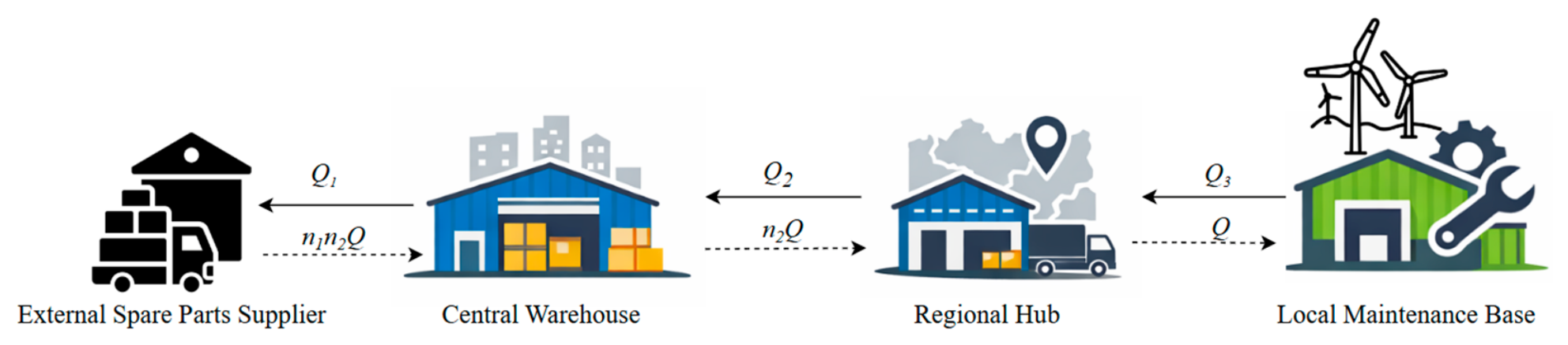
Figure 1 represents the structure of a nested replenishment policy in the multi-echelon system. Assume that the local maintenance base orders a fixed quantity Q of spare parts to meet failure-driven demand. In response, the regional hub dispatches a shipment of size Q to the local maintenance base. Therefore, according to the proposition, Q 3 = Q . As a result, the regional hub, instead of replenishing after every local order, aggregates demand over multiple local cycles and places an order of size Q 2 = n 2 Q 3 = n 2 Q , where n 2 denotes the number of local replenishment cycles covered by a single regional replenishment. Similarly, the central warehouse aggregates multiple regional orders and places a larger order of size Q 1 = n 1 n 2 Q , where n 1 represents the number of regional replenishment cycles covered by a single upstream order.
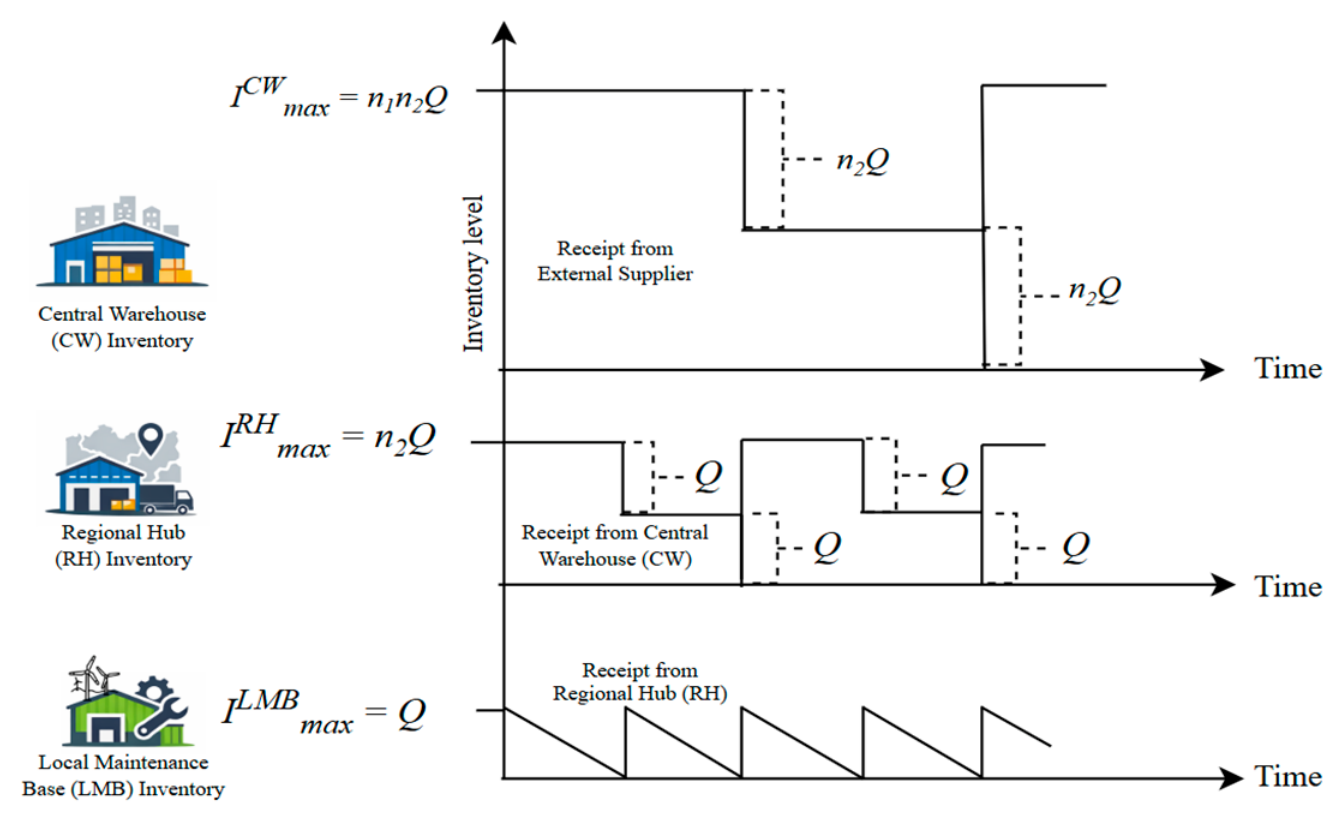
Figure 2 represents a deterministic three-echelon spare-parts inventory system, consisting of a central warehouse (CW), a regional hub (RH), and a local maintenance base (LMB), operating under a continuous-review replenishment policy without supply disruption. Demand occurs only at the local maintenance base, where inventory depletes continuously over time and is replenished in fixed lot size Q from the regional hub, resulting in a classic sawtooth inventory pattern. The regional hub, in turn, follows a similar replenishment structure, receiving shipments of size Q from the central warehouse to satisfy downstream demand, leading to a stepwise inventory profile. At the upstream level, the central warehouse aggregates demand from the regional hub and replenishes in larger batch quantities, typically multiples of Q , from an external supplier. The inventory levels at each echelon are synchronized through these batch transfers, where upstream ordering policies are scaled versions of downstream requirements, ensuring a stable and coordinated flow of spare parts across the system in the absence of lead-time uncertainty or disruption.

3.3. Supply Disruption and Lead-Time Variability

Supply chain disruption is commonly treated as a distinct source of uncertainty rather than ordinary supply variability [52]. This idea is reflected in inventory models where suppliers or replenishment links alternate between available and unavailable states due to disruptions such as breakdowns, strikes, or embargoes [53]. Similar ON/OFF supply state structures have also been used in continuous-review inventory systems with stochastic lead times and disruptions occurring at different supply chain locations [54,55]. Supply disruptions in wind-turbine spare-parts inventories, experienced as stockouts or prolonged waiting times that delay repair activities, arise from a structural mismatch between highly uncertain, condition-driven demand and tightly constrained maintenance supply chains [56,57]. Wind turbines operate in harsh and highly variable environments, where component failures occur stochastically, making repair needs difficult to predict; for offshore systems in particular, the availability of reliability and maintainability data remains limited, which further reduces the accuracy of forecasting what type of spare part will be required and when [58,59]. Even when replenishment is initiated in a timely manner, the effective lead time remains highly uncertain because the final stage of delivery is constrained by accessibility factors such as sea conditions, wind limits, and seasonal restrictions, along with the limited availability of maintenance vessels and specialized transportation resources; these factors significantly influence waiting times and overall system performance [59]. These operational and logistical uncertainties introduce a fundamental economic trade-off between holding costly and infrequently demanded spare parts and accepting the risk of turbine downtime, which often leads to intentionally reduced safety-stock levels; however, restricted accessibility increases both the importance of prepositioned inventory and the cost of stockout events when demand occurs [35]. Mitigation of such disruptions is increasingly modeled as a coordination problem that integrates maintenance planning with inventory control through multi-echelon structures and reorder policies such as the ( s , S ) policy, where s represents a reorder threshold and S denotes an order up to a level; under this policy, when the inventory position falls to or below s , a replenishment order is placed to raise the inventory level up to S , thereby balancing ordering frequency and holding costs while buffering against demand and lead-time uncertainty [25,60]. Finally, disruption risk is further intensified by system-level supply chain limitations and investment constraints, as offshore wind logistics has been identified as a critical bottleneck, where insufficient infrastructure, transportation capacity, and skilled workforce directly affect spare-parts availability and lead-time reliability [61]. Therefore, according to the proposed assumption, each lead-time τ i is a non-negative random variable in the current study with the probability density function f i ( τ ) , where a i τ b i ;   i = 1 , 2 , 3 and the cumulative distribution function F i ( τ ) = a i τ f i ( x ) d x . This is the generalized lead-time representation where these bounds a i , b i specify the feasible or planning-relevant range within which the lead-time density is assessed; they do not serve as shape parameters of the distribution. This treatment is consistent with generalized lead-time inventory models, where the lead time is stochastic but is analyzed over a specified support interval. For example, Hossain et al. [11] model the delivery lead time as a probabilistic variable following f ( τ ) within a range ( a , b ) , where a and b represent the lower and upper limits of lead time. Das Roy and Sarker [12] similarly define l and L as the minimum and maximum lengths of delivery lead time after order placement. Therefore, in the present three-echelon system, a i represents the minimum physically achievable replenishment time on link i , including unavoidable order processing, handling, loading, and transportation times, whereas b i represents the maximum planning-relevant replenishment time considered for that link under the modeled logistics conditions.
In the proposed model, replenishment lead time at echelon i is represented as a state-conditioned random variable. Let S i denote the operating state of replenishment link i , where S i = 0 corresponds to a normal logistics state, and S i = 1 corresponds to a disrupted logistics state. Under the normal state, lead-time variability arises from routine transportation, handling, scheduling, and coordination uncertainty. The conditional density of lead time in this state is denoted by ϕ i ( τ ) = f i ( τ S i = 0 ) , where ϕ i ( τ ) 0 and a i b i ϕ i ( τ ) d τ = 1 . Under the disrupted state, the replenishment process is affected by a materially different logistics condition, such as supplier-side interruption, road or port restriction, site-access limitation, carrier-capacity shortage, vessel or crane unavailability, severe weather–related access constraints, or emergency rescheduling. These conditions may alter the lead time–generating mechanism by increasing the mean delay, dispersion, skewness, or right-tail behavior of the lead-time distribution. The corresponding conditional density is denoted by ψ i ( τ ) = f i ( τ S i = 1 ) , where ψ i ( τ ) 0 and a i b i ψ i ( τ ) d τ = 1 . Let p i = P ( S i = 1 ) represent the probability that replenishment link i operates under the disrupted state during a replenishment cycle. Hence, P ( S i = 0 ) = 1 p i . Using the law of total probability, the unconditional lead-time density for echelon i is obtained as f i ( τ ) = P ( S i = 0 ) f i ( τ S i = 0 ) + P ( S i = 1 ) f i ( τ S i = 1 ) , which gives
f i ( τ ) = ( 1 p i ) ϕ i ( τ ) + p i ψ i ( τ ) ;                 i = 1 , 2 , 3
This state-conditioned representation separates routine lead-time variability from disruption-induced lead-time behavior by preserving disruption likelihood p i and conditional disruption severity ψ i ( τ ) , which would be combined in a single unconditional density. This distinction is important because reducing p i requires preventive actions, such as supplier reliability improvement, route redundancy, and access planning, whereas reducing the tail behavior of ψ i ( τ ) requires recovery actions, such as emergency sourcing, expedited transportation, or prepositioned inventory. In wind-energy spare-parts logistics, this two-state structure is meaningful because routine delivery from a regional hub to a maintenance base may be governed by normal transportation and handling variability, while site-access restrictions, vessel or crane unavailability, supplier delays, or route disruptions may shift the replenishment process into a more uncertain logistics state with longer delays. Offshore wind farm O&M studies also identify weather windows, vessel availability, spare-parts lead times, and logistics coordination as major drivers of maintenance execution, downtime, and costs [56,62]. The disruption probability p i is treated as an exogenous input for each replenishment link and may be estimated from historical records as p i = N i D / N i , where N i is the number of observed replenishment cycles and N i D is the number classified as disrupted; when data are limited, it may be obtained from expert judgment, supplier reliability reports, transportation logs, weather-access records, or scenario-based sensitivity analysis. Since each link has its own p i , the model captures different exposure levels across echelons and reduces to the conventional stochastic lead-time case when p i = 0 or ψ i ( τ ) = ϕ i ( τ ) . This mixture structure is consistent with the disruption and unreliable supply inventory literature, where supply uncertainty is often modeled through state-dependent normal/available and disrupted/unavailable operating conditions [52].
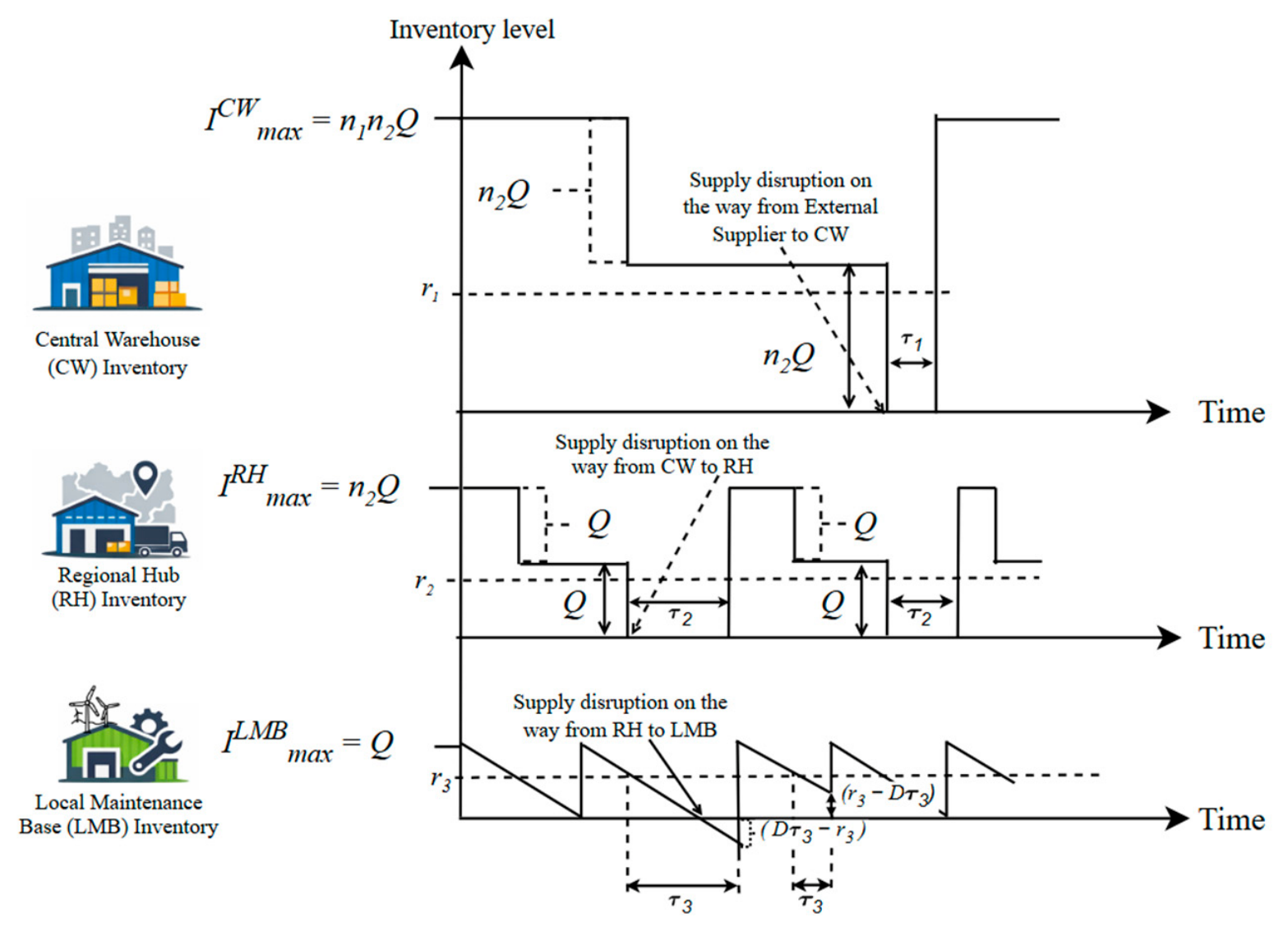
For each echelon, i = 1 , 2 , 3 , the reorder-time equivalents are defined as u 1 = r 1 / D , u 2 = r 2 / D , u 3 = r 3 / D . These are the times needed to consume the corresponding reorder points under demand rate D . The inventory level during the lead-time interval is r i D τ i , where τ i 0 and i = 1 , 2 , 3 . Due to the stochastic nature of τ i , the system may experience either positive inventory or shortage at the moment of replenishment. Figure 3 illustrates a synchronized three-echelon supply system in which replenishment processes are governed by stochastic and disruption-sensitive lead times rather than fixed delays. At each echelon, CW, RH, and LMB, inventory follows a depletion–replenishment pattern driven by a constant demand rate D , but the timing of replenishment arrivals varies across cycles due to uncertainty in the transportation and supply conditions. In the classical setting, lead-time τ i is assumed to be constant, resulting in identical and repetitive inventory cycles; however, in this system, lead-time τ i is a random variable characterized by a general distribution f i ( τ ) , which incorporates both stochastic transportation delays and probabilistic supply disruptions. As a result, the interval between the placement of an order at the reorder point r i and the actual receipt of replenishment is not fixed, causing cycle lengths to vary and leading to non-uniform inventory trajectories over time.
At the regional and local echelons, the diagram explicitly shows that supply disruptions on the links from CW to RH and from RH to LMB induce variability in the realized lead times. When τ i < r i / D , replenishment arrives before inventory is depleted, resulting in positive residual stock at the time of arrival. Conversely, when τ i r i / D , inventory reaches zero prior to replenishment, and shortages accumulate until the order is received [11]. This behavior implies that each replenishment cycle may exhibit a different combination of surplus inventory and backorders, depending on the realized value of τ i . Consequently, the inventory system cannot be represented by a single deterministic cycle; instead, it must be analyzed as a stochastic process in which each cycle corresponds to a different realization of lead time. Furthermore, since the system is multi-echelon, delays at upstream levels propagate downstream, amplifying variability in inventory levels and increasing the likelihood and magnitude of shortages at the local maintenance base, where such shortages directly translate into turbine downtime.

3.4. Expected Excess Stock and Expected Shortages Under General Lead Times

The expected inventory of wind-turbine spare parts, carried during the lead-time period, is determined by the positive part of the inventory trajectory: I i + ( τ ) = m a x { r i D τ , 0 } . Thus, the expected residual inventory at replenishment arrival is R i ( r i ) = E [ I i + ( τ ) ] = a i u i ( r i D τ ) f i ( τ ) d τ , where u i = r i / D . This term represents the expected inventory level that remains unconsumed at the time of replenishment arrival, which is basically remaining stock before stockout. If τ i > r i / D , the system enters a shortage state before replenishment arrives. The shortage during lead-time τ is I i ( t ) = m a x { D τ r i , 0 } . Hence, the expected backorder at the moment of replenishment is B i ( r i ) = E [ I i ( τ ) ] = u i b i ( D τ r i ) f i ( τ ) d τ for i = 1 , 2 , 3 . To capture disruption-sensitive lead-time exposure before inventory depletion, a tolerance threshold is defined as a fraction of the depletion time: θ i = η i u i = η i r i / D ,   0 < η i 1 , where u i = r i / D is the depletion time; θ i represents the maximum tolerated portion of this depletion time that may be consumed by the replenishment lead time before the system enters a high-risk exposure state; and parameter η i is an exogenous managerial tolerance factor that reflects the strictness of the delivery-time requirement at echelon i —a smaller value of η i imposes a stricter tolerance threshold, whereas a value close to one allows the lead time to approach the depletion time before exposure cost is incurred. Therefore, τ i > θ i is not interpreted as actual stockout; rather, it indicates that replenishment has exceeded the tolerated lead-time buffer. Actual shortage occurs only when τ i > u i , and this is captured separately by B i ( r i ) . The corresponding tolerance-exceedance magnitude is l i ( τ ) = m a x { τ θ i , 0 } ; hence, the expected lateness is L i ( r i ) = E [ l i ( τ ) ] = θ i b i ( τ η i r i / D ) f i ( τ ) d τ for i = 1 , 2 , 3 . This term measures the expected amount by which the realized lead time exceeds the tolerated fraction of the depletion time. It is used as a disruption-exposure measure rather than as a stockout measure.

3.5. Cost Components and the Total Cost Formulation

At the local maintenance base, two distinct cost consequences arise when the required spare part is unavailable. The parameter m i ($/unit) denotes the shortage or backorder cost associated with the inventory system itself for each echelon. These costs reflect logistics-related consequences of unmet demand, such as backorder processing, emergency coordination, additional administrative handling, and service-delay management for every echelon. In contrast, g ($/unit) denotes the downtime penalty associated with the wind-turbine operation at the local maintenance base (LMB). This cost reflects the economic loss caused by delayed repair, such as lost power generation, turbine unavailability, and availability-related penalty. Since the demand at the local echelon is D , the replenishment frequencies are D Q 1 = D n 1 n 2 Q , D Q 2 = D n 2 Q , D Q 3 = D Q . Therefore, the total ordering cost is as follows,
O C ( Q , n 1 , n 2 ) = D A 1 n 1 n 2 Q + D A 2 n 2 Q + D A 3 Q
For a continuous-review reorder-point system, the average on-hand inventory at echelon i = 1 , 2 , 3 is the cycle stock with the expected positive residual stock during lead time; hence, the holding costs for all three echelons are outlined below,
H C ( Q , r 1 , r 2 , r 3 , n 1 , n 2 ) = h 1 ( n 1 n 2 Q 2 + R 1 ( r 1 ) ) + h 2 ( n 2 Q 2 + R 2 ( r 2 ) ) + h 3 ( Q 2 + R 3 ( r 3 ) )
Similarly, the total backorder cost for these three echelons is
B C ( Q , r 1 , r 2 , r 3 , n 1 , n 2 ) = D n 1 n 2 Q m 1 B 1 ( r 1 ) + D n 2 Q m 2 B 2 ( r 2 ) + D Q m 3 B 3 ( r 3 )
On the other hand, unmet spare-parts demand at the local base delays turbine repair, and a downtime penalty is incurred, which is modeled as L D C ( Q , r 3 ) = D Q g B 3 ( r 3 ) . Along with that, a disruption-based penalty will be applied on all three echelons, known as the disruption penalty cost,
D P C ( Q , r 1 , r 2 , r 3 , n 1 , n 2 ) = D n 1 n 2 Q c 1 L 1 ( r 1 ) + D n 2 Q c 2 L 2 ( r 2 ) + D Q c 3 L 3 ( r 3 )
Therefore, the total average cost per unit time for the proposed three-echelon spare-parts inventory system is:
T A C ( Q , r 0 , r 1 , r 2 , n 0 , n 1 ) = O C + H C + B C + L D C + D P C = D A 1 n 1 n 2 Q + D A 2 n 2 Q + D A 3 Q + h 1 ( n 1 n 2 Q 2 + a 1 u 1 ( r 1 D τ ) [ ( 1 p 1 ) ϕ 1 ( τ ) + p 1 ψ 1 ( τ ) ] d τ ) + h 2 ( n 2 Q 2 + a 2 u 2 ( r 2 D τ ) [ ( 1 p 2 ) ϕ 2 ( τ ) + p 2 ψ 2 ( τ ) ] d τ ) + h 3 ( Q 2 + a 3 u 3 ( r 3 D τ ) [ ( 1 p 3 ) ϕ 3 ( τ ) + p 3 ψ 3 ( τ ) ] d τ ) + D n 1 n 2 Q m 1 u 1 b 1 ( D τ r 1 ) [ ( 1 p 1 ) ϕ 1 ( τ ) + p 1 ψ 1 ( τ ) ] d τ + D n 2 Q m 2 u 2 b 2 ( D τ r 2 ) [ ( 1 p 2 ) ϕ 2 ( τ ) + p 2 ψ 2 ( τ ) ] d τ + D ( m 3 + g ) Q u 3 b 3 ( D τ r 3 ) [ ( 1 p 3 ) ϕ 3 ( τ ) + p 3 ψ 3 ( τ ) ] d τ + D n 1 n 2 Q c 1 η 1 u 1 b 1 ( τ η 1 r 1 D ) [ ( 1 p 1 ) ϕ 1 ( τ ) + p 1 ψ 1 ( τ ) ] d τ + D n 2 Q c 2 η 2 u 2 b 2 ( τ η 2 r 2 D ) [ ( 1 p 2 ) ϕ 2 ( τ ) + p 2 ψ 2 ( τ ) ] d τ + D Q c 3 η 3 u 3 b 3 ( τ η 3 r 3 D ) [ ( 1 p 3 ) ϕ 3 ( τ ) + p 3 ψ 3 ( τ ) ] d τ
Equation (6) denotes the proposed total cost function of these three-echelon inventory models under supply disruption, where the decision variables are Q , r 1 , r 2 , r 3 , n 1 , n 2 , and the shipment numbers n 1 , n 2 are positive integers.

4. Solution Methodology and Algorithm Development

The total average cost (TAC) function (Equation (6)) developed in this study exhibits a level of structural complexity that renders conventional analytical optimization techniques inadequate to solve it. Unlike classical inventory models, where cost components are expressed in closed-form algebraic expressions, the proposed TAC incorporates multiple coupled decision variables across three echelons ( Q , r 1 , r 2 , r 3 , n 1 , n 2 ) , leading to a high-dimensional decision space with both continuous and discrete variables. More critically, several cost components—including the expected residual inventory Holding Cost  ( H C ) , the Backorder Cost for expected shortage ( B C ) , and the Disruption Penalty Cost  ( D P C ) —are defined through integral functionals that depend on general, mixture-based lead-time probability density functions. These integrals do not admit closed-form expressions in most practical settings and are implicitly linked to the decision variables through their limits of integration and integrands. As a result, the T A C ( Q , r 1 , r 2 , r 3 , n 1 , n 2 ) is neither separable nor explicitly differentiable in a form amenable to traditional gradient-based or closed-form optimization approaches, such as EOQ-type derivations or standard convex programming techniques.
For each echelon, i = 1 , 2 , 3 , travel time of material follows the proposed probabilistic disruption function, f i ( τ ) = ( 1 p i ) ϕ i ( τ ) + p i ψ i ( τ ) . The corresponding cumulative distribution is, therefore, F i ( x ) = a i x f i ( τ ) d τ = ( 1 p i ) Φ i ( x ) + p i Ψ i ( x ) , where Φ i ( x ) = a i x ϕ i ( τ ) d τ and Ψ i ( x ) = a i x ψ i ( τ ) d τ are cumulative distribution functions. Hence, the survival function becomes F i ( x ) = 1 F i ( x ) = ( 1 p i ) ( 1 Φ i ( x ) ) + p i ( 1 Ψ i ( x ) ) . According to the proposition, Q 3 = Q , Q 2 = n 2 Q , Q 1 = n 1 n 2 Q , and for notational simplicity in the preliminary model formulation, three temporary parameters are defined to represent the per-unit shortage and penalty cost terms at each echelon, as follows: κ 3 = m 3 + g , κ 2 = m 2 , and κ 1 = m 1 . The mixture-based expected residual stock, shortage, and disruption lateness are:
R i ( r i ) = a i u i ( r i D τ ) [ ( 1 p i ) ϕ i ( τ ) + p i ψ i ( τ ) ] d τ
B i ( r i ) = u i b i ( D τ r i ) [ ( 1 p i ) ϕ i ( τ ) + p i ψ i ( τ ) ] d τ
L i ( r i ) = η i u i b i ( t η i r i D ) [ ( 1 p i ) ϕ i ( t ) + p i ψ i ( t ) ] d t
For each echelon, i = 1 , 2 , 3 , the functions R i ( r i ) , B i ( r i ) , and L i ( r i ) can be decomposed into weighted normal-state and disruption-state components as
R i ( r i ) = ( 1 p i ) R i ϕ ( r i ) + p i R i ψ ( r i ) ,
B i ( r i ) = ( 1 p i ) B i ϕ ( r i ) + p i B i ψ ( r i ) ,
L i ( r i ) = ( 1 p i ) L i ϕ ( r i ) + p i L i ψ ( r i ) ,
(for proof, see Appendix A).
Then, for each echelon i , the TAC contribution can be written as:
T A C i = D A i Q i + h i Q i 2 + h i [ ( 1 p i ) R i ϕ ( r i ) + p i R i ψ ( r i ) ] + D κ i Q i [ ( 1 p i ) B i ϕ ( r i ) + p i B i ψ ( r i ) ] + D c i Q i [ ( 1 p i ) L i ϕ ( r i ) + p i L i ψ ( r i ) ]
Hence, the full TAC becomes T A C = i = 1 3 T A C i . Now, in order to establish the convexity of T A C ( Q , r 1 , r 2 , r 3 , n 1 , n 2 ) , the following lemmas need to be stated.
Lemma 1.
For fixed  Q , n 1 , n 2 , there exists at least one real solution of  Φ i m i x ( r i ; Q i )  in Equation (14), which is the optimal reorder point  r i  at echelons  i = 1 , 2 , 3 .
Φ i m i x ( r i ; Q i ) = h i [ ( 1 p i ) Φ i ( r i D ) + p i Ψ i ( r i D ) ] D κ i Q i [ ( 1 p i ) ( 1 Φ i ( r i D ) ) + p i ( 1 Ψ i ( r i D ) ) ] η i c i Q i [ ( 1 p i ) ( 1 Φ i ( η i r i D ) ) + p i ( 1 Ψ i ( η i r i D ) ) ]
Proof. 
See Appendix B. □
Theorem 1.
If Lemma 1 holds, for each echelon,  i = 1 , 2 , 3 ; if  Φ i ( x )  and  Ψ i ( x )  are both continuous and strictly increasing, where  Φ i m i x ( 0 ; Q i ) 0  and  Φ i m i x ( D b i ; Q i ) 0 , then there exists a unique  r i [ 0 , D b i ]  such that  Φ i m i x ( r i ; Q i ) = 0 .
Proof. 
Since Φ i and Ψ i are continuous and strictly increasing, each bracketed term in Φ i m i x ( r i ; Q i ) is continuous, and each negative survival term is increasing in r i . Therefore, Φ i m i x ( r i ; Q i ) is continuous and strictly increasing on [ 0 , D b i ] . The sign conditions at the endpoints guarantee existence by the intermediate value theorem, while strict monotonicity guarantees uniqueness. □
Proposition 1.
For fixed  r i , if the disruption-state lead time is stochastically larger than the normal-state lead time, that is, Ψ i ( x ) Φ i ( x ) ;   x [ a i , b i ] , then the following holds for each echelon i :
R i ( r i ) p i 0 ,       B i ( r i ) p i 0 ,       L i ( r i ) p i 0
Proof. 
Previously, we got R i ( r i ) = ( 1 p i ) R i ϕ ( r i ) + p i R i ψ ( r i ) , so R i p i = R i ψ ( r i ) R i ϕ ( r i ) . If disruption causes longer lead times, then D t tends to exceed r i more often, so positive residual inventory decreases, implying R i ψ ( r i ) R i ϕ ( r i ) . Hence, R i / p i 0 . Similarly,
B i p i = B i ψ ( r i ) B i ϕ ( r i ) 0 ,   and     L i p i = L i ψ ( r i ) L i ϕ ( r i ) 0 .  
Now, for fixed r 1 , r 2 , r 3 , n 1 , n 2 , the TAC under the disruption-mixture structure can be written as
T A C ( Q ) = Γ m i x ( r 1 , r 2 , r 3 ; n 1 , n 2 ) Q + Λ ( n 1 , n 2 ) Q + Ω m i x ( r 1 , r 2 , r 3 )
where Λ ( n 1 , n 2 ) = 1 2 ( h 3 + h 2 n 2 + h 1 n 1 n 2 ) , and Ω m i x ( r 1 , r 2 , r 3 ) = h 3 R 3 ( r 3 ) + h 2 R 2 ( r 2 ) + h 1 R 1 ( r 1 ) .
Also,
Γ m i x = D A 3 + D A 2 n 2 + D A 1 n 1 n 2 + D ( m 3 + g ) [ ( 1 p 2 ) B 2 ϕ ( r 2 ) + p 3 B 3 ψ ( r 3 ) ] + D c 3 [ ( 1 p 3 ) L 3 ϕ ( r 3 ) + p 3 L 3 ψ ( r 3 ) ] + D m 2 n 2 [ ( 1 p 2 ) B 2 ϕ ( r 2 ) + p 2 B 2 ψ ( r 2 ) ] + D c 2 n 2 [ ( 1 p 2 ) L 2 ϕ ( r 2 ) + p 2 L 2 ψ ( r 2 ) ] + D m 1 n 1 n 2 [ ( 1 p 1 ) B 1 ϕ ( r 1 ) + p 1 B 1 ψ ( r 1 ) ] + D c 1 n 1 n 2 [ ( 1 p 1 ) L 1 ϕ ( r 1 ) + p 1 L 1 ψ ( r 1 ) ]
If Γ m i x > 0 and Λ > 0 , then the optimal ordering quantity of spare parts, Q , is given by
Q = Γ m i x ( r 1 , r 2 , r 3 ; n 1 , n 2 ) Λ ( n 1 , n 2 )
To minimize the proposed multi-dimensional inventory cost function TAC, one hybrid optimization framework—the Nested Enumeration–Bisection Algorithm (NEBA)—is designed to find the optimal order quantity ( Q ), reorder points ( r i ), and safety-stock factors ( n i ) in a supply chain subject to disruption-dependent lead times. Its necessity stems from the mathematical complexity of the proposed model, where decision variables are highly interdependent and the cost function involves nonlinear expectations that cannot be solved through simple calculus. The proposed NEBA (Algorithm 1) is developed by exploiting the mixed structure of the decision variables. Since the shipment multipliers ( n 1 , n 2 ) are positive integers over a finite planning range, they are handled through nested enumeration. For each candidate pair ( n 1 , n 2 ) , the corresponding order quantity Q is computed using the analytical expression derived from the cost function. Given Q , the reorder points ( r 1 , r 2 , r 3 ) are obtained by solving the first-order optimality condition for each echelon using the bisection method. The bisection interval is selected so that the optimality function has opposite signs at the lower and upper bounds, ensuring that a root is bracketed. The iteration continues until the interval width is smaller than the prescribed tolerance ε r . The total average cost is then evaluated for the resulting candidate solution, and the best incumbent solution is updated whenever a lower cost is found. This process continues until all feasible combinations of ( n 1 , n 2 ) are examined, after which the solution with the minimum total average cost is reported as the optimal policy. The NEBA uses a global search strategy where the outer layer performs an exhaustive enumeration by testing all discrete combinations of n 1 and n 2 ; simultaneously, the inner layer applies a bisection root-finding method to calculate the reorder points accurately. This two-stage approach allows the model to manage the dependencies between variables and avoid the local minimum, ensuring the identification of a global optimum.
Algorithm 1. Nested Enumeration–Bisection Algorithm (NEBA) for Minimizing TAC
Input:
Model parameters and lead-time distributions; integer bounds N 1 m a x , N 2 m a x for n 1 and n 2 , respectively; tolerance ε r > 0 .
Step 0. Start
Step 1. Set T A C C a n d i d a t e = T A C G l o b a l = + .
Step 2. For  n 2 = 1 , 2 , , N 2 m a x
Step 3.                 For  n 1 = 1 , 2 , , N 1 m a x
Step 4.                             Compute Q using Equation (17)
Step 5. Select initial interval [ L i , U i ] such that Equation (14) evaluated at r i = L i and r i = U i has opposite signs i = 1 , 2 , 3
Step 6.                             While  U i L i > ε r  do
Step 7.                                        M i = ( L i + U i ) / 2
Step 8.                                       If signs of Equation (14) at L i , M i differ: U i M i
Step 9.                                       Else L i M i
Step 10.                 End While
Step 11.                  r i M i
Step 12.        Compute T A C ( Q , r 1 , r 2 , r 3 , n 1 , n 2 ) using Equation (6)
Step 13.        If  T A C < T A C C a n d i d a t e
Step 14.                  T A C C a n d i d a t e T A C
Step 15.                  ( Q L , r 1 L , r 2 L , r 3 L , n 1 L , n 2 L ) ( Q , r 1 , r 2 , r 3 , n 1 , n 2 )
Step 16.                 Go to Step 3
Step 17.        Else  T A C L o c a l = T A C C a n d i d a t e
Step 18.        End For
Step 19. If  T A C L o c a l < T A C G l o b a l
Step 20.         T A C G l o b a l T A C L o c a l
Step 21.         ( Q , r 1 , r 2 , r 3 , n 1 , n 2 ) ( Q L , r 1 L , r 2 L , r 3 L , n 1 L , n 2 L )
Step 22.        Go to Step 2
Step 23. Else  T A C O P T = T A C G l o b a l
Step 24. End For
Step 25. End.
Output:
Optimal solution ( Q , r 1 , r 2 , r 3 , n 1 , n 2 )
This Nested Enumeration–Bisection Algorithm (NEBA) provides a robust framework for identifying the global minimum in inventory models with lead-time uncertainty. By combining a discrete search for safety-stock parameters with a continuous bisection method for reorder points, the algorithm successfully manages the complex dependencies between variables. This systematic approach ensures a stable and accurate solution, effectively balancing inventory holding costs against the risks of supply chain disruptions.

5. Numerical Analysis

To demonstrate the practical applicability and computational performance of the proposed three-echelon spare-parts inventory model under disruption-dependent lead-time uncertainty, illustrative numerical examples are significant. The numerical parameters used in this study are illustrative and are selected to represent plausible wind-energy spare-parts logistics conditions. These examples are designed to reflect realistic operating conditions in wind-energy maintenance systems, where critical components are characterized by low demand frequency, high replacement costs, and significant impact on the downtime. Therefore, an illustrative numerical example is developed to demonstrate the applicability of the proposed three-echelon inventory model for specialized bolts and fasteners (M30/M36 Bolts), which are widely recognized as one of the most failure-prone and operationally significant components in wind energy systems.
Wind turbines are held together by thousands of high-tensile bolts (tower, blades, and nacelle). Specific high-stress bolts (like those in the blade root or pitch system) are often subject to periodic replacement campaigns or “torque-to-yield” protocols during major maintenance. The annual demand rate is assumed to be D = 4500 units/year, reflecting low-frequency but high-impact failures typically associated with drivetrain components. Ordering costs are set as A 3 = 300 , A 2 = 600 , and A 1 = 1200 USD/order, while holding costs are taken as h 3 = 80 , h 2 = 120 , and h 1 = 180 USD/unit/year, capturing the increasing capital and storage burden at upstream echelons. Shortage costs are assumed to be m 3 = 2000 , m 2 = 1500 , and m 1 = 1000 USD/unit, and a high downtime penalty of g = 15,000 USD/unit is incorporated, consistent with the substantial economic losses caused by gearbox failures and turbine downtime, which have been identified as dominant contributors to operation and maintenance costs in wind farms [27,35]. To capture disruption-sensitive delays, the disruption/lateness penalty coefficients are specified as c 1 = 50 , c 2 = 75 , and c 3 = 100 USD/unit time, reflecting the increasing severity of delay impacts as replenishment moves downstream toward the maintenance base, where delays directly translate into turbine downtime. The tolerance factors are taken as η 1 = 0.9 , η 2 = 0.85 , and η 3 = 0.8 , indicating that stricter delivery-time requirements are imposed at downstream echelons due to their higher operational criticality. The disruption probabilities are set as p 1 = 0.10 , p 2 = 0.15 , and p 3 = 0.20 , capturing the increasing likelihood of disruption along the downstream supply chain.

5.1. Case 1 (Lead-Time Pairs with Uniform and Exponential Distribution)

Assume that the lead times are modeled using the disruption-dependent mixture formulation in Equation (1), where the lead time during normal supply conditions follows a uniform distribution over 15–30 days, and the disrupted lead time follows an exponential distribution over 25–150 days with a rate of 1/60 days, consistent with maintenance logistics delays caused by weather conditions, accessibility constraints, and transportation uncertainty. To illustrate the iterative NEBA, the following representative calculations are performed for better understanding:
  • Step 0. Start.
  • Step 1. Set T A C C a n d i d a t e = + .
  • Step 2. n 2 = 1 .
  • Step 3. n 1 = 1 .
  • Step 4. Compute Q from Equation (17).
Using the following parameters, D = 4500 ,   A 3 = 300 ,   A 2 = 600 ,   A 1 = 1200 ,   h 3 = 80 ,   h 2 = 120 ,   h 1 = 180 , Λ ( n 1 , n 2 ) = 1 2 ( 80 + 120 ( 1 ) + 180 ( 1 ) ( 1 ) ) = 1 2 ( 380 ) = 190 and Γ 0 = 4500 ( 300 ) + 4500 ( 600 ) 1 + 4500 ( 1200 ) 1 1 = 1,350,000 + 2,700,000 + 5,400,000 = 9,450,000 . Hence, Q ( 0 ) = 9,450,000 190 = 223.02 223 .
  • Step 5. Accordingly, define L i = 0 , U i = D m a x ( b n , b d ) with b d = 150 / 365 , so U i = 4500 × 150 365 = 1849.32 . This same initial interval is used for all three reorder points in this candidate.
  • Step 6–11. Bisection loop.
For r 3 at Q 3 = 223.02 .
Initial sign check: f ( L 3 ) = f ( 0 ) = 343,022.64 ,   f ( U 3 ) = f ( 1849.32 ) = 79.99 .
Signs are opposite, so the root is bracketed.
Bisection iterations:
Iteration   1 :   M 3 = 0 + 1849.32 2 = 924.66 ,   f ( M 3 ) = 24224.36
Since f ( L 3 ) and f ( M 3 ) have the same sign, update: L 2 924.66 .
Iteration   2 :   M 3 = 924.66 + 1849.32 2 = 1386.99 ,   f ( M 3 ) = 8393.60
Again, this has the same sign as f ( L 3 ) , so L 3 1386.99 , and then the final converged value after full bisection: r 3 = 1843.28 .
For r 2 at Q 2 = 223.02 .
Initial sign check: f ( 0 ) = 30,266.96 , f ( 1849.32 ) = 119.99 .
Iteration   1 :   M 2 = 924.66 ,   f ( M 2 ) = 1494.39 ,   Update   L 2 924.66
Iteration   2 :   M 2 = 1386.99 ,   f ( M 2 ) = 442.85 ,   Update   L 2 1386.99
After several iterations, the final converged value: r 2 = 1723.66 .
For r 1 at Q 1 = 223.02 .
Initial sign check: f ( 0 ) = 20,177.99 , f ( 1849.32 ) = 179.99 .
Iteration   1 :   M 1 = 924.66 ,   f ( M 1 ) = 541.05 ,   Update   L 1 924.66
Iteration   2 :   M 1 = 1386.99 ,   f ( M 1 ) = 71.39 ,   Update   L 1 1386.99
After several iterations, the final converged value: r 1 = 1491.69 .
  • Step 4. Update Q using those reorder points, where Γ Mix = 17,674,970.89 .
So, Q ( 1 ) = 17,674,970.881790 190 = 305.001906 305 .
The first few Q -iterations for this same candidate are:
Iteration   1 :   Q = 223 Q new = 305
Iteration   2 :   Q = 305 Q new = 352
Iteration   3 :   Q = 352 Q new = 380
The loop continues until it converges. Final values for the candidate are:
Q = 419 , r 1 = 1281 , r 2 = 1630 , r 3 = 1839
  • Step 12. Compute the TAC for this candidate: T A C ( 1,1 ) = $ 598,760 .
  • Step 13–17. Candidate update, since $ 598,760 < + , T A C C a n d i d a t e $ 598,760
and the current local best becomes
( Q L , r 1 L , r 2 L , r 3 L , n 1 L , n 2 L ) = ( 419 , 1839 , 1630 , 1281 , 1 , 1 )
Using the above iterative loop and search procedure of the NEBA for 16 consecutive loops, the findings are reported in Table 2. According to the numerical results, the algorithm achieved the optimal solution for the proposed three-echelon case study in its ninth loop, which indicates that the optimal inventory policy for the considered three-echelon wind-turbine spare-parts system is achieved at shipment multipliers n 1 = 2 and n 2 = 2 , with an optimal order quantity from RH to LMB of Q 3 = Q = 176 units; from CW to RH with Q 2 = n 2 Q = 352 units; and from the external supplier to CW with Q 1 = n 1 n 2 Q = 704 units. The corresponding optimal reorder points are r 3 = 1845 units at the LMB; r 2 = 1661 units at the RH; and r 1 = 1056 units at the central warehouse (Table 2). Under this coordinated policy, the minimum total average cost is estimated to be $587,143 per year. The results clearly reflect the structural characteristics of a multi-echelon system under disruption-sensitive lead times. Specifically, the reorder points increase progressively from upstream to downstream echelons ( r 1 < r 2 < r 3 ) , indicating a higher safety-stock requirement closer to the demand point to hedge against greater disruption probability and more severe shortage and downtime penalties. The optimal shipment multipliers ( n 1 , n 2 ) = ( 2,2 ) suggest a balanced replenishment structure in which each upstream echelon supplies twice per cycle of its downstream echelon, effectively synchronizing material flow while avoiding excessive ordering frequency or holding costs. Furthermore, the relatively large optimal-order quantity reflects the economic trade-off driven by high shortage and downtime penalties associated with bolt/fastener failures, which incentivizes holding sufficient inventory to mitigate service disruptions.
Table 2 evaluates the total average cost (TAC) over different combinations of shipment multipliers ( n 1 , n 2 ) , thereby illustrating how coordination across echelons influences the optimal inventory policy. The results clearly show that the minimum TAC of $587,143/year is attained at ( r 1 , r 2 , r 3 , n 1 , n 2 ) = (1056, 1661, 1845, 2, 2), confirming the optimal safety-stock and shipment sizes obtained from the NEBA. A consistent trend observed across Table 2 is that, for a fixed n 2 , increasing n 1 initially reduces the TAC due to improved coordination between the central warehouse and the regional hub, which lowers ordering frequency and balances holding costs. However, beyond a certain point (e.g., n 1 > 3 when n 2 = 1 , or n 1 > 2 when n 2 = 2 ), the TAC begins to increase, indicating diminishing returns and the dominance of holding and coordination inefficiencies. Similarly, comparing across rows, increasing n 2 from 1 to 2 significantly reduces the TAC, highlighting the benefit of more frequent replenishment between the regional hub and the local maintenance base. However, further increases in n 1 are not shown to be beneficial, as they would likely increase ordering costs disproportionately.
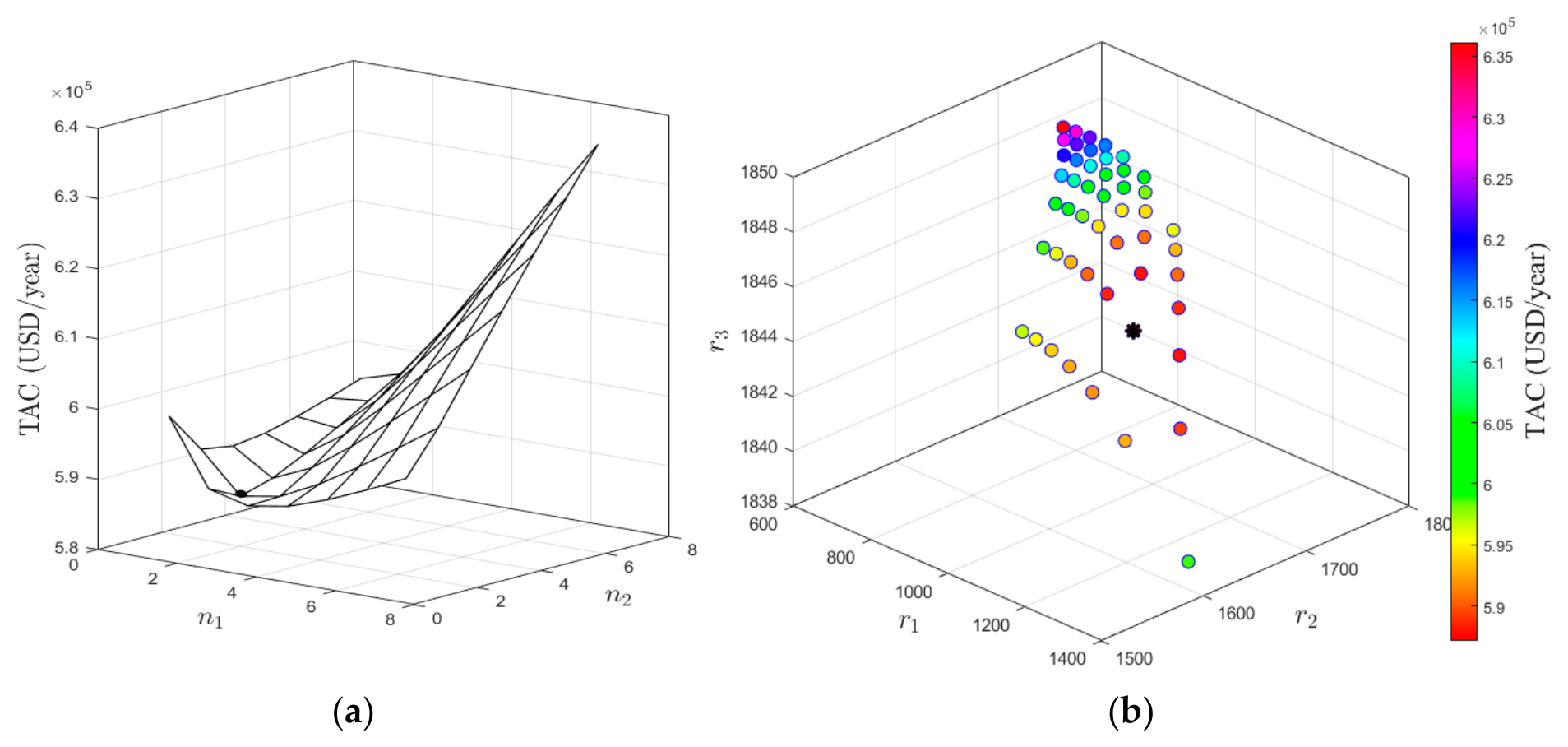
Figure 4a presents the total average cost (TAC) landscape over the discrete decision space defined by the shipment numbers of CW and RH, offering a clear visualization of how coordination between echelons influences system-wide cost. According to the plot, the TAC decreases initially as both n 1 and n 2 increase from low values, reaches a minimum region, and then rises again as the shipment frequencies become excessively high. This indicates the presence of a unique cost-efficient balance between ordering frequency and inventory holding. The highlighted point corresponds to the global minimum TAC, representing the optimal coordination policy with respect to n 1 and n 2 , which are two of a total of five decision variables of the proposed total cost function (Equation (6)). In Figure 4b, the points form a clustered scatter plot, reflecting that the reorder points are not independently chosen but are jointly determined through the optimization procedure and the underlying system constraints. As the system moves from lower to higher reorder points, the TAC does not vary randomly but follows a systematic gradient. Regions with relatively lower reorder points tend to exhibit higher costs due to an increased risk of shortages and downtime, while excessively high reorder points correspond to higher holding costs, again increasing the TAC. The optimal solution, marked distinctly, lies in an intermediate region where these opposing cost components are balanced. The clustering of points also indicates that the feasible solutions occupy a constrained manifold rather than the entire three-dimensional space, implying strong interdependence among r 1 , r 2 , and r 3 . In particular, the consistent ordering r 1 < r 2 < r 3 is preserved across all feasible solutions, reinforcing the hierarchical nature of safety-stock allocation in the multi-echelon system.

5.2. Case 2 (Lead-Time Pairs with Normal and Weibull Distribution)

Assume that the lead times are modeled using the disruption-dependent mixture formulation in Equation (1), where the lead time under normal supply conditions follows a normal distribution with a mean of 25 days and a standard deviation of 8 days, representing relatively stable replenishment under regular operating conditions. In contrast, the lead time under disrupted conditions follows a Weibull distribution with a shape parameter of 3.0 and a scale parameter of 100 days, reflecting the right-skewed and highly variable delays associated with weather-related interruptions, difficult site accessibility, and transportation uncertainty. This specification enables the numerical analysis to capture both routine lead-time variation and severe disruption-induced delays within a single probabilistic framework.
The results presented in Table 3 summarize the feasible solutions generated by the proposed algorithm for different combinations of shipment multipliers ( n 1 , n 2 ) , along with the corresponding values of all decision variables ( Q i , r i ) and the resulting total average cost ( T A C ). In this case, the NEBA reached optimality during the sixth loop. Each row reflects a coordinated inventory policy, where the shipment structure ( n 1 , n 2 ) directly influences both the order quantity and the echelon-wise reorder points, highlighting the strong coupling between shipment decisions and inventory control parameters. A clear pattern emerges in the behavior of the decision variables: as the shipment multipliers increase, the order quantity of LMB, Q 3 = Q , decreases due to more frequent replenishment, while the reorder points adjust upward—particularly at downstream echelons—to maintain service levels under stochastic and disruption-prone lead times. The ordering r 1 < r 2 < r 3 is consistently preserved across all feasible solutions, indicating progressively higher safety-stock requirements toward the local maintenance base, where demand is realized and the impact of delays is most severe. Among all feasible combinations, the minimum TAC of $671,545/year is achieved at ( r 1 , r 2 , r 3 , n 1 , n 2 ) = (1439, 1737, 2313, 1, 2), which is marked in Table 3 as the optimal solution. This configuration provides the most effective balance between ordering, holding, shortage, and disruption-related costs. Compared to neighboring solutions, deviations from this optimal pair lead to higher TAC values, either due to insufficient coordination (at lower shipment frequencies) or excessive holding and coordination costs (at higher frequencies). This confirms that the optimal policy lies in a narrow region of the feasible solution space, where the trade-offs among all cost components are optimally balanced.
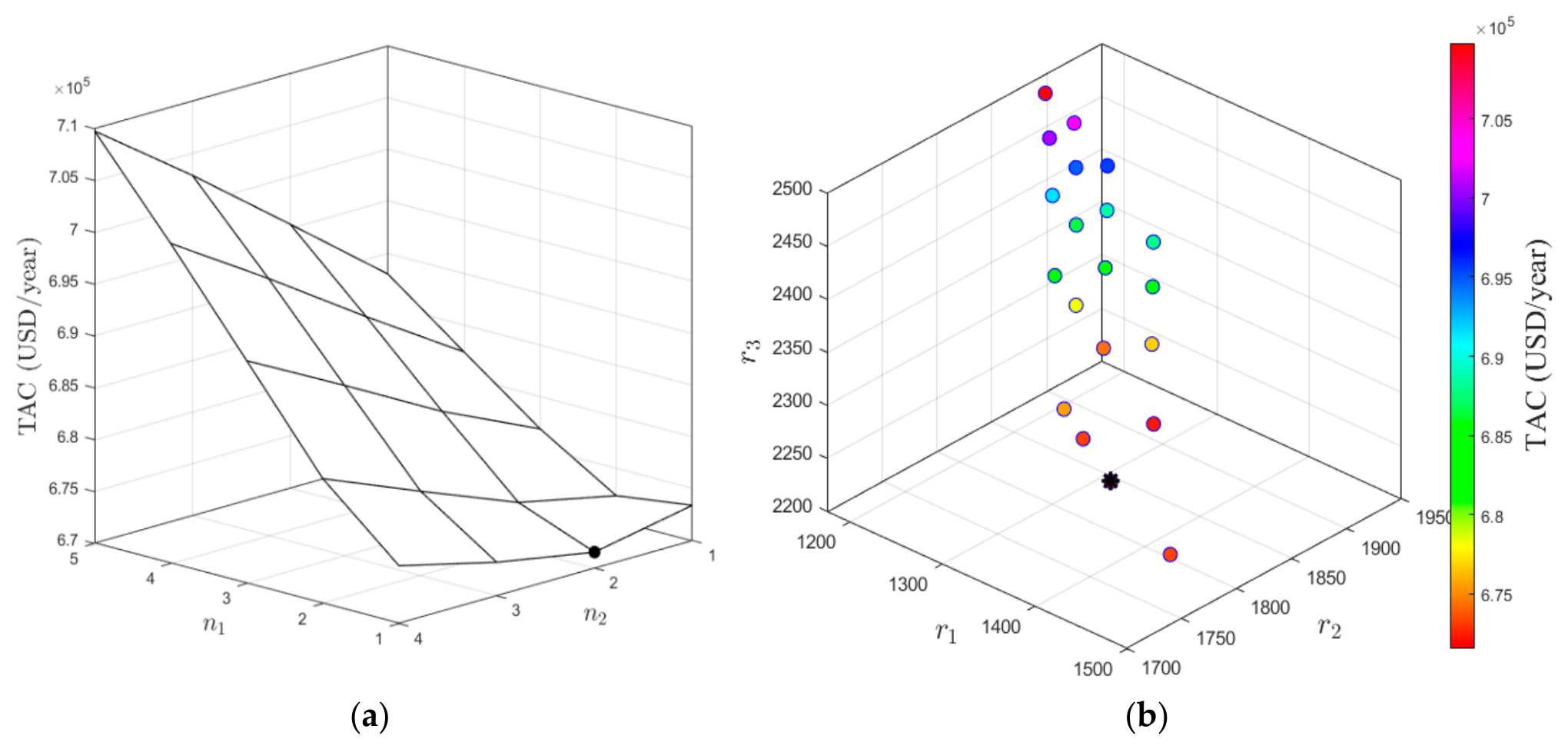
Figure 5a illustrates the three-dimensional variation in the total average cost (TAC) over the shipment multiplier decision space ( n 1 , n 2 ) . The surface exhibits a distinct downward trend toward a minimum region, followed by an increase in the TAC as the shipment frequencies move away from this region. This pattern indicates the existence of an optimal coordination level between echelons, where ordering, holding, and shortage-related costs are balanced. The highlighted point represents the minimum TAC, confirming that intermediate shipment frequencies yield the most cost-efficient policy, while both lower and higher values of ( n 1 , n 2 ) lead to increased system cost. Figure 5b presents the distribution of feasible solutions in the reorder-point space ( r 1 , r 2 , r 3 ) , with the TAC represented through the color gradient. The solutions form a structured cluster rather than being randomly scattered, indicating a strong interdependence among the reorder points across echelons. Lower TAC values are concentrated in a specific region of space, where the trade-off between holding and shortage costs is optimized. The marked point denotes the optimal solution, positioned within this low-cost region, while deviations in any direction lead to a higher TAC, demonstrating the sensitivity of the system to changes in reorder-point decisions under stochastic and disruption-driven lead times.

6. Impact of Variable Lead Time on the Proposed Inventory System

A sensitivity analysis has been conducted to examine the influence of disruption-dependent lead-time behavior on the total average cost of the proposed three-echelon inventory system. To ensure transparency in the distributional sensitivity analysis, each lead-time scenario is defined by a specific probability distribution and parameter set. The purpose of this analysis is to compare plausible non-disrupted and disrupted-condition lead-time regimes within the proposed mixture function, f i ( τ ) = ( 1 p i ) ϕ i ( τ ) + p i ψ i ( τ ) , rather than to isolate the effect of distributional family under identical moments. Lead times during the non-disrupted condition are parameterized to represent relatively shorter and less variable replenishment behavior, while the disrupted-condition lead times are parameterized to represent longer and more uncertain delay behavior. Therefore, the resulting TAC values should be interpreted as the cost impact of alternative lead-time scenarios, reflecting both distributional shape and parameter-driven differences in mean, dispersion, and tail behavior. To capture the effect more comprehensively, different truncated probability distributions were assigned to ϕ i ( τ ) and ψ i ( τ ) , including Uniform, Triangular, Normal, Weibull, Exponential, and Gamma forms, and their pairwise combinations were evaluated within the proposed optimization framework using their specified parameters (Appendix C).
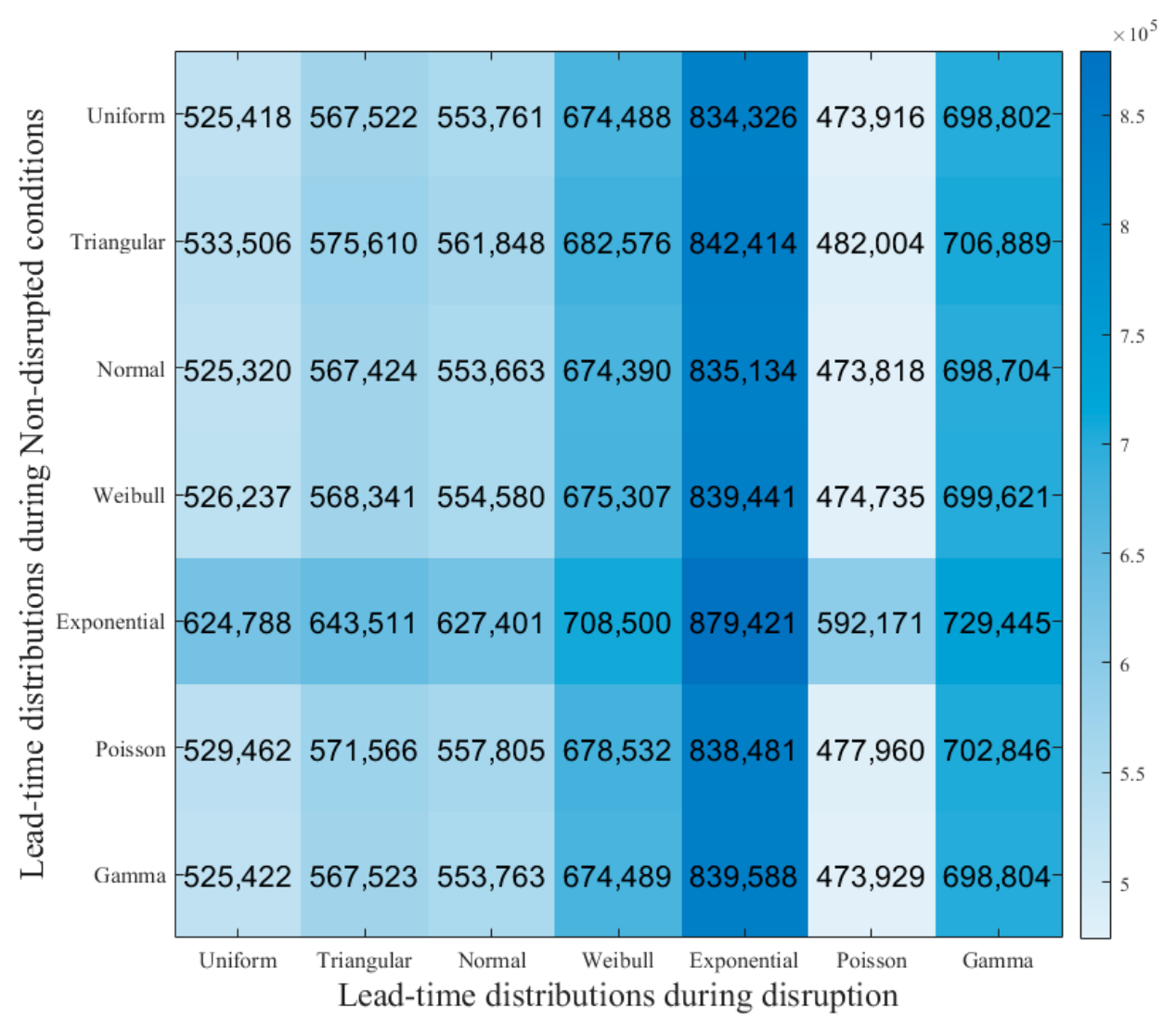
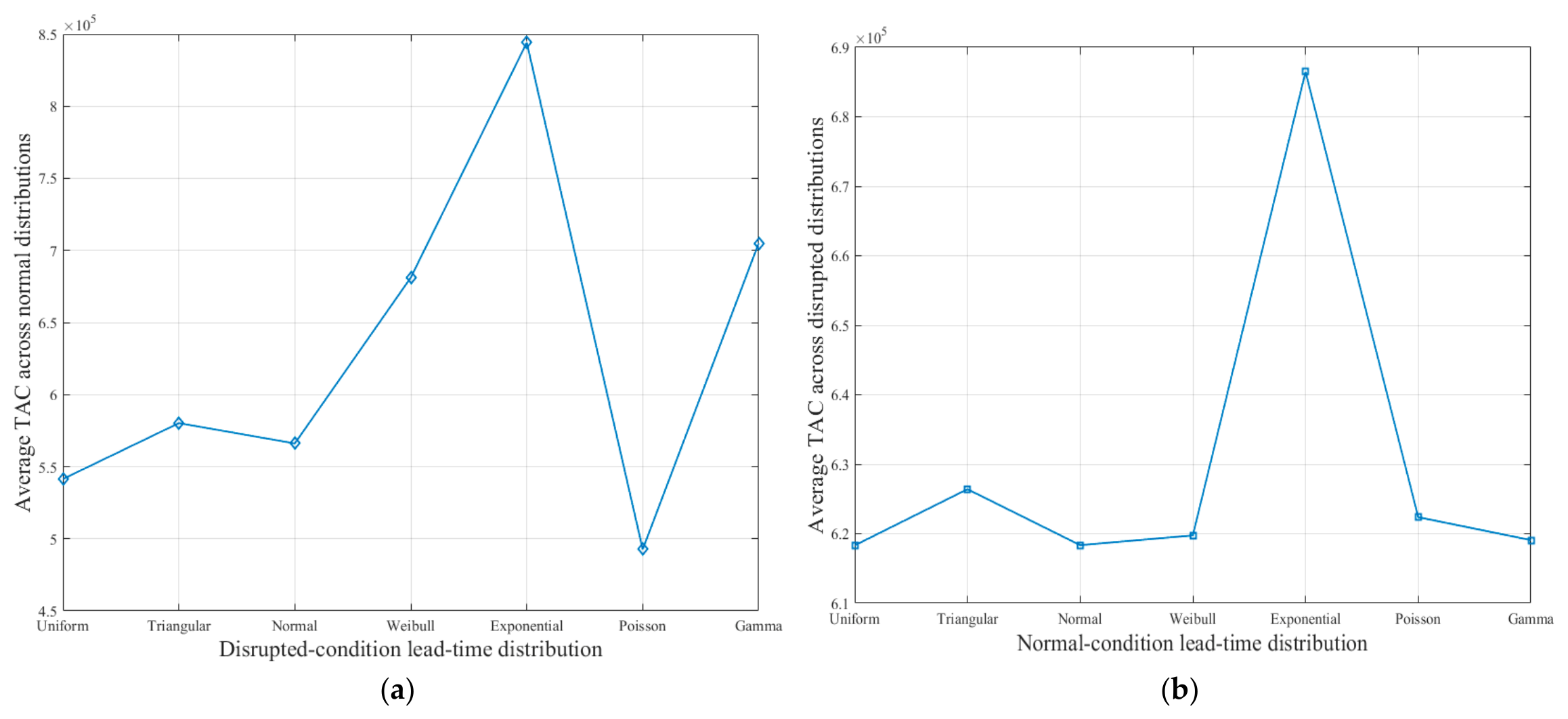
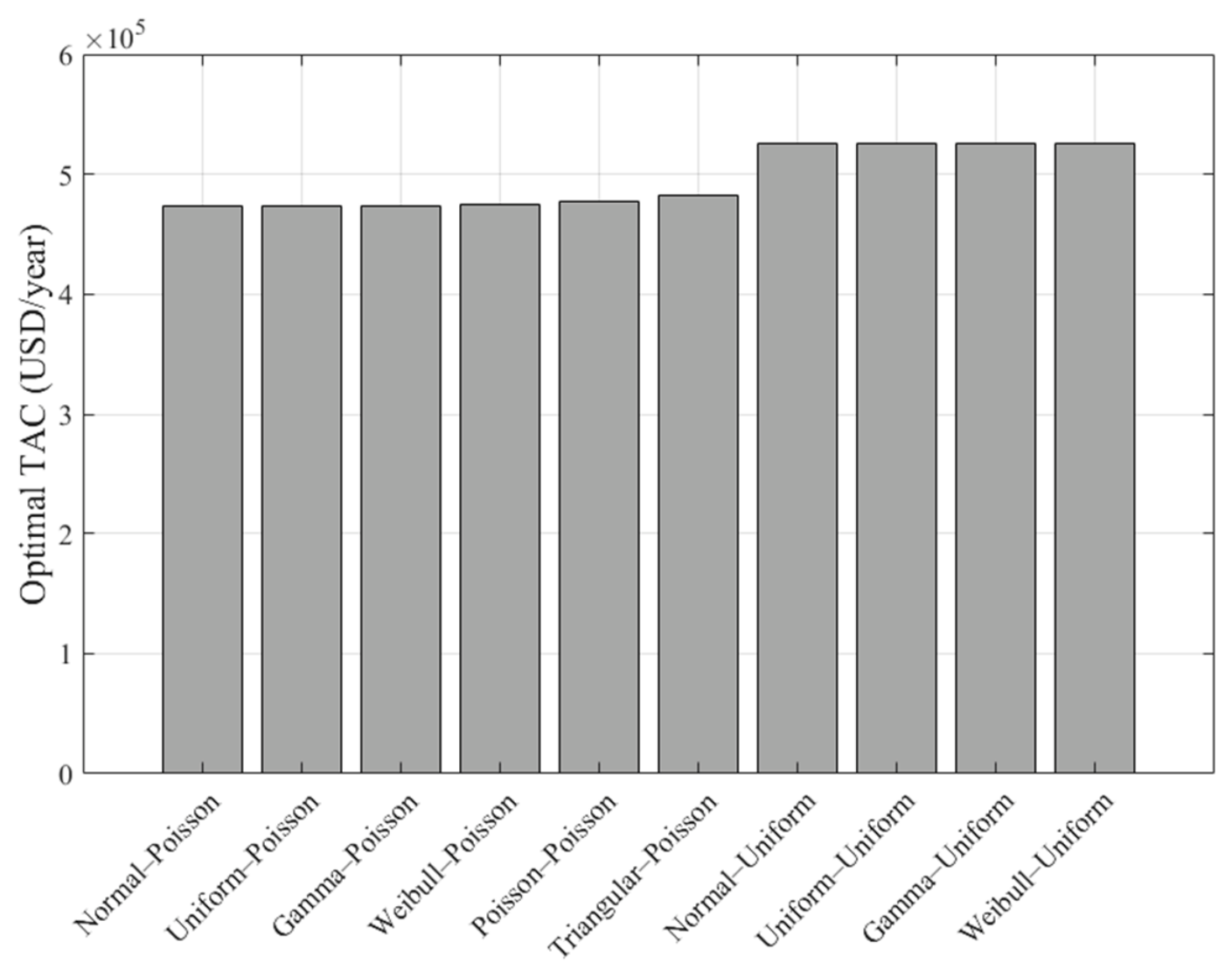
The results presented in Appendix D and Figure 6 provide a comprehensive comparison of all possible combinations of lead-time distributions under normal ϕ i ( τ ) and disrupted ψ i ( τ ) operating conditions, along with their impact on the optimal decision variables and total average cost (TAC). A clear and consistent pattern emerges from both representations: the distributional form of the disrupted lead time ψ i ( τ ) plays a far more dominant role in determining the magnitude of the TAC than the normal-condition distribution ϕ i ( τ ) . This is visually reinforced in the heatmap, where variations across columns (disrupted distributions) are significantly more pronounced than across rows (normal distributions). For instance, when the disrupted lead time follows heavy-tailed or highly dispersed distributions, such as Exponential or Weibull, the TAC increases substantially (often exceeding 8.3 × 10 5 USD/year), regardless of whether the normal-condition distribution is Uniform, Normal, or Gamma. This behavior arises because such distributions assign higher probability mass to extreme delays, which directly amplifies the expected shortage and lateness penalty components embedded in the TAC formulation.
In contrast, when the disrupted lead time follows more concentrated or less variable distributions, such as Uniform or Poisson, the TAC is consistently lower (approximately 4.7 × 10 5 to 5.3 × 10 5 USD/year), as indicated by the darker regions in the heatmap. Among all combinations, the lowest TAC is observed when the disrupted lead time follows a Poisson distribution, suggesting that a more predictable and discretely distributed delay structure significantly reduces system cost. Furthermore, the normal-condition distribution ϕ i ( τ ) has a comparatively smaller influence on the TAC, which is evident from the relatively uniform color patterns across rows for a fixed disrupted distribution. An exception is observed when the normal-condition lead time itself follows a highly variable distribution, such as Exponential, which leads to an overall upward shift in the TAC across all disruption scenarios, although its impact remains secondary compared to the disrupted condition. Another important insight is the adaptive behavior of the optimal decision variables. As the disrupted lead-time distribution becomes more variable or heavy-tailed, the model responds by increasing reorder points ( r 1 , r 2 , r 3 ) and adjusting shipment multipliers ( n 1 , n 2 ) to hedge against increased uncertainty and risk of delay.
This is particularly evident from Figure 6 under exponential disruption, where reorder points rise sharply and the system adopts a more conservative inventory strategy. Conversely, under stable disrupted distributions, such as Uniform or Poisson, the system operates with lower safety-stock levels and more balanced replenishment policies, reflecting reduced uncertainty. For non-disrupted conditions, truncated Normal, Triangular, Uniform, Gamma, or Weibull distributions may be used depending on the available data and observed lead-time behavior. Normal/Triangular forms represent lead times around a most likely value; Uniform is useful when only lower and upper bounds are known; and Gamma/Weibull are suitable for non-negative, right-skewed lead times. The inventory literature also notes that real lead-time distributions may be nonstandard, so using a single conventional approximation can distort cost and service-level estimates [63]. For disrupted conditions, Weibull, Gamma, and Lognormal-type distributions are more realistic because disruptions often produce right-skewed and long-tailed delays. In wind farm O&M, weather windows, vessel availability, access restrictions, and logistics coordination affect maintenance execution and downtime, supporting right-skewed disrupted lead-time assumptions [62]. Exponential distribution is retained only as a conservative stress-test case, while Gamma remains useful because of its flexibility for positive, skewed lead-time behavior [63].

6.1. Marginal Impact of Lead-Time Distribution Types on T A C

Figure 7a shows the variation in the total average cost (TAC) across different disrupted-condition lead-time distributions, aggregated over all normal-condition distributions. A clear pattern is observed, indicating that the disrupted lead-time distribution has a strong and nonlinear effect on system cost. In particular, the TAC increases as the distribution changes from more stable forms, such as Uniform and Normal, to more variable distributions, such as Weibull and Exponential. The Exponential case results in the highest TAC as it assigns a higher probability of longer delays, which increases shortage and lateness costs. In contrast, Poisson distribution produces the lowest TAC among all disrupted distributions, suggesting that a more concentrated and predictable delay structure reduces overall cost. The sharp decrease from Exponential to Poisson highlights the sensitivity of the system to the variability and tail behavior of disrupted lead times. Overall, the figure shows that disruption-related uncertainty is a major factor affecting the cost of the proposed three-echelon inventory system.
Figure 7b shows the TAC across different normal-condition lead-time distributions, aggregated over all disrupted distributions. Compared to the first figure, the variation in TAC is smaller, indicating that the system is less sensitive to the choice of distribution under normal operating conditions. Most distributions, including Uniform, Normal, Weibull, and Gamma, result in similar TAC values, which suggests that regular lead-time variability has a limited effect on total cost. However, the Exponential distribution leads to a higher TAC, even under normal conditions, due to its higher variability. This indicates that unstable or highly variable normal lead times can increase system cost, although their impact is smaller than that of disrupted conditions. The overall pattern confirms that normal-condition lead-time uncertainty plays a secondary role, while disrupted lead-time uncertainty remains the main factor influencing cost. Together, these figures show that controlling variability in disrupted lead times is more important for reducing total cost than refining assumptions about normal operating conditions.
Figure 8 presents the optimal total average cost ( T A C ) for selected combinations of normal-condition and disrupted-condition lead-time distributions, with particular emphasis on cases where the disrupted distribution is either Poisson or Uniform. Each bar represents a specific pair of ( ϕ i ( τ ) , ψ i ( τ ) ) , such as Normal–Poisson, Uniform–Poisson, and Weibull–Uniform, along with their corresponding optimal TAC values. A clear pattern can be observed: combinations where the disrupted lead time follows a Poisson distribution consistently yield lower TAC values, clustered around 4.7 × 10 5 USD/year. In contrast, when the disrupted lead time follows a Uniform distribution, the TAC values increase to approximately 5.2 × 10 5 USD/year, regardless of the normal-condition distribution. This indicates that even among stable distributions, the structure of the disrupted lead time has a noticeable impact on cost.
Another important observation is that variations in the normal-condition distribution have only a minor effect on the TAC within each disrupted category. For example, under Poisson disruption, the TAC remains unchanged across Normal, Uniform, Gamma, Weibull, and Triangular normal-condition distributions. A similar pattern is observed for Uniform disruption. This further confirms that the system is less sensitive to the probabilistic form of ϕ i ( τ ) and more sensitive to ψ i ( τ ) . Additionally, the narrow spread of TAC values within each group suggests that once the disrupted lead-time distribution is fixed, the system cost becomes stable with respect to normal operating conditions. In conclusion, this figure reinforces the key findings of the sensitivity analysis: the disrupted-condition lead-time distribution is the primary factor influencing system cost, while the normal-condition distribution plays a secondary role. Even when both distributions are stable, differences in disruption behavior led to measurable changes in the TAC. Therefore, accurate modeling and control of disruption-related lead-time uncertainty are essential for achieving cost-efficient inventory policies in the proposed three-echelon system. This highlights the importance of incorporating disruption-sensitive lead-time modeling in practical applications, as neglecting this aspect may lead to suboptimal decisions and underestimation of the total system cost.

6.2. Results and Discussion

The obtained results indicate that disruption-dependent lead-time uncertainty has a strong influence on the optimal performance of the proposed three-echelon spare-parts inventory system. The analysis shows that the disrupted-condition lead-time distribution plays a more decisive role than the normal-condition distribution in shaping the total average cost. This implies that the system is more sensitive to delay behavior during disrupted operations than to routine replenishment variability. When the disrupted lead time becomes more variable or more dispersed, the model generates a higher cost because the likelihood of prolonged replenishment delays increases, which directly raises expected shortages, disruption penalties, and downtime-related losses. The optimized inventory policies also show that the model responds logically to higher disruption risk. Under more uncertain disruption scenarios, the reorder points increase to provide stronger protection against delayed replenishment. This behavior is particularly important in a wind-energy maintenance context because shortages at the local maintenance base can postpone repair activities and reduce turbine availability. Therefore, the model does not simply minimize inventory investment; it balances holding costs against the operational risk of stockout propagation across the central warehouse, regional hub, and local maintenance base. The results further suggest that stable disrupted lead-time patterns lead to more balanced replenishment decisions and a lower system cost. In such cases, the model can maintain reliable spare-parts availability without excessive safety stock. By contrast, highly variable disruption patterns require more conservative inventory positioning, especially at downstream echelons where service failure has the most direct operational consequence. This finding highlights the importance of accurately characterizing the disrupted-state lead-time distribution rather than relying only on average lead-time estimates.
Overall, the results confirm the practical value of incorporating disruption-sensitive stochastic lead times into multi-echelon spare-parts inventory planning. For wind-energy logistics, ignoring disruption behavior may underestimate shortage risk and lead to insufficient reorder-point decisions. The proposed model provides a structured decision-support framework for jointly determining shipment sizes, reorder points, and echelon coordination policies while accounting for disruption, shortage, and downtime effects. Thus, the findings emphasize that reliable spare-parts planning should focus not only on inventory cost minimization but also on managing the distributional behavior of disruption-driven replenishment delays.

7. Conclusions

This study proposes a three-echelon spare-parts inventory optimization model for wind energy systems that explicitly incorporates disruption-dependent lead-time uncertainty. The model represents lead time as a mixture of normal and disrupted operating conditions, enabling a more realistic characterization of replenishment delays. A Nested Enumeration–Bisection Algorithm (NEBA) is developed to efficiently determine the optimal order quantity, reorder points, and shipment multipliers under this complex stochastic setting. The numerical results show that the proposed framework yields a unique global optimal solution and preserves a consistent structural relationship among decision variables across echelons. In particular, reorder points increase from the central warehouse to the local maintenance base, reflecting the increasing exposure to uncertainty and disruption toward downstream levels. Shipment multipliers are also shown to play a key coordination role, where intermediate values achieve a balance among ordering, holding, and shortage costs, while extreme values lead to a higher total cost.
A major finding of this study is that the disrupted-condition lead-time distribution is the dominant factor influencing total system cost. Heavy-tailed distributions, such as Exponential and Weibull, significantly increase TAC due to a higher likelihood of extreme delays, which amplify shortage and lateness penalties. In contrast, more stable distributions, such as Poisson and Uniform, result in lower and more stable cost levels. The impact of the normal-condition distribution is comparatively limited, although highly variable forms can still increase cost under regular operations. These results confirm that disruption-related uncertainty must be explicitly incorporated to obtain reliable and cost-effective inventory policies. The model also demonstrates adaptive behavior under varying uncertainty conditions. As disruption variability increases, the system responds by increasing reorder points and adjusting shipment structures to reduce the risk of stockouts and downtime. This reflects realistic decision-making in wind-turbine maintenance systems, where delays and accessibility constraints are common. Overall, the findings indicate that neglecting disruption-dependent lead-time variability may lead to significant underestimation of the total cost and suboptimal policy decisions.
A limitation of this study is that spare-parts demand is represented by a constant average rate within a single-item, three-echelon serial system. In practice, wind-turbine spare-parts demand may be intermittent, stochastic, and condition-dependent, while regional hubs may serve multiple maintenance bases with alternative sourcing or lateral transshipment options. Future research can extend the proposed framework by incorporating compound Poisson or condition-based demand models informed by SCADA and maintenance records, multi-item inventory structures, network-based multi-echelon configurations, time-varying lead-time distributions updated from real-time operational data, and machine learning–based estimation of failure rates and replenishment delays. Computational extensions may also explore decomposition methods, metaheuristics, or surrogate-based optimization for large-scale applications. Moreover, the proposed model provides a baseline framework for analyzing disruption-dependent lead-time effects in a three-echelon serial spare-parts system. Future research may extend this framework by considering multi-item inventory interactions, lateral transshipments, stochastic or condition-based demand, machine learning–based estimation of failure and lead-time parameters, and decomposition or metaheuristic optimization methods for large-scale applications.

Author Contributions

Conceptualization, A.M.; methodology and mathematical analysis, A.M.; visualization, A.M.; writing—original draft preparation, A.M.; software, A.M.; validation, A.M.; writing—review and editing, A.M. and B.R.S.; supervision, B.R.S. All authors have read and agreed to the published version of the manuscript.

Funding

This research received no external funding.

Institutional Review Board Statement

Not applicable.

Informed Consent Statement

Not applicable.

Data Availability Statement

The original calculations presented in this study are included in the article. Further inquiries can be directed to the corresponding author.

Acknowledgments

During the preparation of this manuscript/study, the authors used ChatGPT (GPT-5.5 Thinking, OpenAI) for the purpose of rephrasing the text. The authors have reviewed and edited the output and take full responsibility for the content of this publication.

Conflicts of Interest

The authors declare no conflicts of interest.

Appendix A

Substitute Equation (1) into each integral definition and use linearity of integration (Equations (7)–(9)). For example,
R i ( r i )   = a i u i ( r i D t ) [ ( 1 p i ) ϕ i ( t ) + p i ψ i ( t ) ] d t = ( 1 p i ) a i u i ( r i D t ) ϕ i ( t ) d t + p i a i u i ( r i D t ) ψ i ( t ) d t = ( 1 p i ) R i ϕ ( r i ) + p i R i ψ ( r i ) ;
where we denote R i ϕ ( r i ) = a i u i ( r i D t ) ϕ i ( t ) d t and R i ψ ( r i ) = a i u i ( r i D t ) ψ i ( t ) d t .
The same argument applies to B i ( r i ) and L i ( r i ) .

Appendix B

Using Equation (1), Leibniz’s rule is applied directly to the mixture of integrals. For R i ( r i ) ,
R i ( r i ) = a i u i ( r i D t ) [ ( 1 p i ) ϕ i ( t ) + p i ψ i ( t ) ] d t
Differentiating,
d R i d r i = a i u i [ ( 1 p i ) ϕ i ( t ) + p i ψ i ( t ) ] d t
As the boundary term vanishes. Therefore,
d R i d r i = ( 1 p i ) Φ i ( r i / D ) + p i Ψ i ( r i / D )
Similarly, for B i ( r i ) and L i ( r i ) , we get,
d B i d r i = [ ( 1 p i ) ( 1 Φ i ( r i D ) ) + p i ( 1 Ψ i ( r i D ) ) ]
d R i d r i = η i / D [ ( 1 p i ) ( 1 Φ i ( η i r i D ) ) + p i ( 1 Ψ i ( η i r i D ) ) ]
Now, for fixed Q i , we define G i ( r i Q i ) = h i R i ( r i ) + D κ i q i B i ( r i ) + D c i q i L i ( r i ) . Now by differentiating G i and substituting the derivative formulas (B1, B2, and B3) we get our expected Φ i m i x ( r i ; Q i ) .

Appendix C

Table A1. Parameter settings for non-disrupted and disrupted-condition lead-time distributions used in the sensitivity analysis.
Lead-Time StateDistributionDistribution ParametersInterpretation
Non-disruptedUniform a = 15 ,   b = 35 daysShorter bounded lead-time variation
Non-disruptedTriangular a = 12 ,   b = 35 ,   c = 22 daysShorter lead time with most likely value at 22 days
Non-disruptedNormal μ =   25 ,   σ = 8 daysModerate routine variation
Non-disruptedWeibull k = 2.2, λ =   28 daysRoutine asymmetric variation
Non-disruptedExponential μ = 22 daysMore variable routine delay
Non-disruptedPoisson λ = 24 daysDiscrete lead-time approximation
Non-disruptedGamma k = 5 ,   θ = 5 daysMean (=25) days
DisruptedUniform a = 50 , b = 130 daysLonger bounded disruption delay
DisruptedTriangular a = 35 , b = 150 , c = 85 daysLonger delay with most likely value at 85 days
DisruptedNormal μ = 90, σ = 20 daysHigh disrupted-state variability
DisruptedWeibull k = 3 . 0 ,   λ =   100 daysSkewed disrupted delay
DisruptedExponential μ = 80 daysHeavy-tailed disruption delay
DisruptedPoisson λ = 95 daysDiscrete disrupted lead-time approximation
DisruptedGamma k = 9, θ = 10 daysMean (=90) days

Appendix D

Table A2. Distribution combination of normal lead times and lead times during disrupted supply chains and their combined effect on the total average cost of the three-echelon inventory system.
NormalDisrupted n 2 n 1 Q r 1 r 2 r 3 T A C ($)
UniformUniform12189144915751601525,418
UniformTriangular12236138416651806567,522
UniformNormal11361136715281818553,761
UniformWeibull21273141817202301674,488
UniformExponential4220445219723059834,326
UniformPoisson11290131113891537473,916
UniformGamma21319132716732495698,802
TriangularUniform12189144915751601533,506
TriangularTriangular12236138416651806575,610
TriangularNormal11361136715281818561,848
TriangularWeibull21273141817202301682,576
TriangularExponential4220445219723059842,414
TriangularPoisson11290131113891537482,004
TriangularGamma21319132716732495706,889
NormalUniform12189144915751601525,320
NormalTriangular12236138416651806567,424
NormalNormal11361136715281818553,663
NormalWeibull21273141817202301674,390
NormalExponential4219256220083061835,134
NormalPoisson11290131113891537473,818
NormalGamma21319132716732495698,704
WeibullUniform12189144915751601526,237
WeibullTriangular12236138416651806568,341
WeibullNormal11361136715281818554,580
WeibullWeibull21273141817202301675,307
WeibullExponential4130975216813048839,441
WeibullPoisson11290131113891537474,735
WeibullGamma21319132716732495699,621
ExponentialUniform11407147615662033624,788
ExponentialTriangular11454144916302004643,511
ExponentialNormal11471138015452008627,401
ExponentialWeibull11497150217702276708,500
ExponentialExponential41261115418393053879,421
ExponentialPoisson11464131214091998592,171
ExponentialGamma11562143617412421729,445
PoissonUniform12189144915751601529,462
PoissonTriangular12236138416651806571,566
PoissonNormal11361136715281818557,805
PoissonWeibull21273141817202301678,532
PoissonExponential4220048619833060838,481
PoissonPoisson11290131113891537477,960
PoissonGamma21319132716732495702,846
GammaUniform12189144915751601525,422
GammaTriangular12236138416651806567,523
GammaNormal11361136715281818553,763
GammaWeibull21273141817202301674,489
GammaExponential4130578116913048839,588
GammaPoisson11290131113891537473,929
GammaGamma21319132716732495698,804

References

  1. Ben-Daya, M.; Hariga, M. Integrated single vendor single buyer model with stochastic demand and variable lead time. Int. J. Prod. Econ. 2004, 92, 75–80. [Google Scholar] [CrossRef]
  2. Ouyang, L.-Y.; Chang, H.-C. A minimax distribution free procedure for mixed inventory models involving variable lead time with fuzzy lost sales. Int. J. Prod. Econ. 2002, 76, 1–12. [Google Scholar] [CrossRef]
  3. Chang, H.-C.; Ouyang, L.-Y.; Wu, K.-S.; Ho, C.-H. Integrated vendor–buyer cooperative inventory models with controllable lead time and ordering cost reduction. Eur. J. Oper. Res. 2006, 170, 481–495. [Google Scholar] [CrossRef]
  4. Glock, C.H. Coordination of a production network with a single buyer and multiple vendors. Int. J. Prod. Econ. 2012, 135, 771–780. [Google Scholar] [CrossRef]
  5. Lin, H.-J. Investing in lead-time variability reduction in a collaborative vendor–buyer supply chain model with stochastic lead time. Comput. Oper. Res. 2016, 72, 43–49. [Google Scholar] [CrossRef]
  6. Sarkar, S.; Giri, B.C. Safety stock management in a supply chain model with waiting time and price discount dependent backlogging rate in stochastic environment. Oper. Res. Int. J. 2022, 22, 917–946. [Google Scholar] [CrossRef]
  7. Sarkar, S.; Tiwari, S.; Giri, B.C. Impact of uncertain demand and lead-time reduction on two-echelon supply chain. Ann. Oper. Res. 2022, 315, 2027–2055. [Google Scholar] [CrossRef]
  8. Chen, Z.X.; Sarker, B.R. Multi-vendor integrated procurement-production system under shared transportation and just-in-time delivery system. J. Oper. Res. Soc. 2010, 61, 1654–1666. [Google Scholar] [CrossRef]
  9. Tsai, D.-M. An optimal production and shipment policy for a single-vendor single-buyer integrated system with both learning effect and deteriorating items. Int. J. Prod. Res. 2011, 49, 903–922. [Google Scholar] [CrossRef]
  10. Liu, Y.; Li, Q.; Yang, Z. A new production and shipment policy for a coordinated single-vendor single-buyer system with deteriorating items. Comput. Ind. Eng. 2019, 128, 492–501. [Google Scholar] [CrossRef]
  11. Hossain, M.S.J.; Ohaiba, M.M.; Sarker, B.R. An optimal vendor-buyer cooperative policy under generalized lead-time distribution with penalty cost for delivery lateness. Int. J. Prod. Econ. 2017, 188, 50–62. [Google Scholar] [CrossRef]
  12. Das Roy, M.; Sarker, B.R. Optimizing a supply chain problem with nonlinear penalty costs for early and late delivery under generalized lead time distribution. Comput. Ind. Eng. 2021, 160, 107536. [Google Scholar] [CrossRef]
  13. Venegas, B.B.; Ventura, J.A. A two-stage supply chain coordination mechanism considering price sensitive demand and quantity discounts. Eur. J. Oper. Res. 2018, 264, 524–533. [Google Scholar] [CrossRef]
  14. Zhao, Y.; Wang, S.; Cheng, T.C.E.; Yang, X.; Huang, Z. Coordination of supply chains by option contracts: A cooperative game theory approach. Eur. J. Oper. Res. 2010, 207, 668–675. [Google Scholar] [CrossRef]
  15. Zhu, S.X. Integration of capacity, pricing, and lead-time decisions in a decentralized supply chain. Int. J. Prod. Econ. 2015, 164, 14–23. [Google Scholar] [CrossRef]
  16. Jia, T.; Liu, Y.; Wang, N.; Lin, F. Optimal production-delivery policy for a vendor-buyers integrated system considering postponed simultaneous delivery. Comput. Ind. Eng. 2016, 99, 1–15. [Google Scholar] [CrossRef]
  17. Bushuev, M.A. Delivery performance improvement in two-stage supply chain. Int. J. Prod. Econ. 2018, 195, 66–73. [Google Scholar] [CrossRef]
  18. Dash, A.; Giri, B.C.; Sarkar, A.K. Coordination of a single-manufacturer multi-retailer supply chain with price and green sensitive demand under stochastic lead time. Decis. Mak. Appl. Manag. Eng. 2023, 6, 679–715. [Google Scholar] [CrossRef]
  19. Debnath, A.; Sarkar, B. Supply chain model having stochastic lead time demand with variable production rate and demand dependent on price and advertisement. RAIRO-Oper. Res. 2024, 58, 2645–2667. [Google Scholar] [CrossRef]
  20. Utama, D.M.; Kusuma, I.R.; Amallynda, I.; Baroto, T.; Jauhari, W.A. A single-vendor multi-buyer inventory model with multiple raw material and quality degradation: A case study on agri-food industry. Results Control. Optim. 2024, 14, 100353. [Google Scholar] [CrossRef]
  21. Alessandria, G.; Khan, S.Y.; Khederlarian, A.; Mix, C.; Ruhl, K.J. The aggregate effects of global and local supply chain disruptions: 2020–2022. J. Int. Econ. 2023, 146, 103788. [Google Scholar] [CrossRef]
  22. Jin, H.; Li, H.; Bi, J.; Li, M. Joint optimization of spare parts inventory and maintenance for wind turbine systems. Expert Syst. Appl. 2025, 292, 128588. [Google Scholar] [CrossRef]
  23. Benbouzid, M.; Berghout, T.; Sarma, N.; Djurović, S.; Wu, Y.; Ma, X. Intelligent Condition Monitoring of Wind Power Systems: State of the Art Review. Energies 2021, 14, 5967. [Google Scholar] [CrossRef]
  24. Cuesta, J.; Leturiondo, U.; Vidal, Y.; Pozo, F. Challenges on prognostics and health management for wind turbine components. J. Phys. Conf. Ser. 2024, 2745, 012003. [Google Scholar] [CrossRef]
  25. Li, M.; Xu, Z.; Li, S.; Kikuchi, Y.; Dong, Y.; Gryllias, K.C.; Baraldi, P.; Zio, E.; Carroll, J. Health prognostics and maintenance decision-making for wind energy: A comprehensive overview. Renew. Sustain. Energy Rev. 2026, 226, 116269. [Google Scholar] [CrossRef]
  26. Tchakoua, P.; Wamkeue, R.; Ouhrouche, M.; Slaoui-Hasnaoui, F.; Tameghe, T.; Ekemb, G. Wind Turbine Condition Monitoring: State-of-the-Art Review, New Trends, and Future Challenges. Energies 2014, 7, 2595–2630. [Google Scholar] [CrossRef]
  27. Carroll, J.; Koukoura, S.; McDonald, A.; Charalambous, A.; Weiss, S.; McArthur, S. Wind turbine gearbox failure and remaining useful life prediction using machine learning techniques. Wind Energy 2019, 22, 360–375. [Google Scholar] [CrossRef]
  28. Turnbull, A.; Carroll, J.; Koukoura, S.; McDonald, A. Prediction of wind turbine generator bearing failure through analysis of high-frequency vibration data and the application of support vector machine algorithms. J. Eng. 2019, 2019, 4965–4969. [Google Scholar] [CrossRef]
  29. Pandit, R.K.; Astolfi, D.; Durazo Cardenas, I. A Review of Predictive Techniques Used to Support Decision Making for Maintenance Operations of Wind Turbines. Energies 2023, 16, 1654. [Google Scholar] [CrossRef]
  30. Elasha, F.; Shanbr, S.; Li, X.; Mba, D. Prognosis of a Wind Turbine Gearbox Bearing Using Supervised Machine Learning. Sensors 2019, 19, 3092. [Google Scholar] [CrossRef]
  31. Yan, T.; Lei, Y.; Wang, B.; Han, T.; Si, X.; Li, N. Joint maintenance and spare parts inventory optimization for multi-unit systems considering imperfect maintenance actions. Reliab. Eng. Syst. Saf. 2020, 202, 106994. [Google Scholar] [CrossRef]
  32. Wang, X.; Chen, Q.; Fu, L.; Yang, Q. Optimization on Management Strategies for Spare Parts Inventories of Wind Turbine Components. In 2018 IEEE 8th Annual International Conference on CYBER Technology in Automation, Control, and Intelligent Systems (CYBER); IEEE: Piscataway, NJ, USA, 2018; pp. 1472–1477. [Google Scholar] [CrossRef]
  33. Abderrahmane, F.; Bouslikhane, S.; Hajej, Z.; Dellagi, S.; Trabelsi, W. An improved integrated maintenance/spare parts management for wind turbine systems with adopting switching concept. Energy Rep. 2022, 8, 936–955. [Google Scholar] [CrossRef]
  34. Yan, B.; Ma, Y.; Zhou, Y. Research on spare parts inventory optimization in wind power industry. In 2020 Global Reliability and Prognostics and Health Management (PHM-Shanghai); IEEE: Piscataway, NJ, USA, 2020; pp. 1–5. [Google Scholar] [CrossRef]
  35. Schuh, P.; Schneider, D.; Funke, L.; Tracht, K. Cost-optimal spare parts inventory planning for wind energy systems. Logist. Res. 2015, 8, 4. [Google Scholar] [CrossRef]
  36. Zhang, X.; Liao, H.; Zeng, J.; Shi, G.; Zhao, B. Optimal Condition-based Opportunistic Maintenance and Spare Parts Provisioning for a Two-unit System using a State Space Partitioning Approach. Reliab. Eng. Syst. Saf. 2021, 209, 107451. [Google Scholar] [CrossRef]
  37. Fan, J.; Hu, L.; Peng, R.; Li, J. Reliability-driven inventory policy optimization for spare parts in k -out-of- n redundant systems under extreme shocks. Comput. Ind. Eng. 2026, 212, 111686. [Google Scholar] [CrossRef]
  38. Yan, B.; Zhou, Y.; Zhang, M.; Li, Z. Reliability-Driven Multiechelon Inventory Optimization With Applications to Service Spare Parts for Wind Turbines. IEEE Trans. Reliab. 2023, 72, 748–758. [Google Scholar] [CrossRef]
  39. Daryanto, Y.; Wee, H.M.; Astanti, R.D. Three-echelon supply chain model considering carbon emission and item deterioration. Transp. Res. Part E Logist. Transp. Rev. 2019, 122, 368–383. [Google Scholar] [CrossRef]
  40. Gumus, A.T.; Guneri, A.F. A multi-echelon inventory management framework for stochastic and fuzzy supply chains. Expert Syst. Appl. 2009, 36, 5565–5575. [Google Scholar] [CrossRef]
  41. Hajiaghaei-Keshteli, M.; Sajadifar, S.M.; Haji, R. Determination of the economical policy of a three-echelon inventory system with (R, Q) ordering policy and information sharing. Int. J. Adv. Manuf. Technol. 2011, 55, 831–841. [Google Scholar] [CrossRef]
  42. Sebatjane, M.; Adetunji, O. Three-echelon supply chain inventory model for growing items. J. Model. Manag. 2019, 15, 567–587. [Google Scholar] [CrossRef]
  43. Geevers, K.; Van Hezewijk, L.; Mes, M.R.K. Multi-echelon inventory optimization using deep reinforcement learning. Cent. Eur. J. Oper. Res. 2024, 32, 653–683. [Google Scholar] [CrossRef]
  44. Kurian, D.S.; Pillai, V.M.; Raut, A.; Gautham, J. Deep reinforcement learning-based ordering mechanism for performance optimization in multi-echelon supply chains. Appl. Stoch. Models Bus. Ind. 2024, 40, 1433–1454. [Google Scholar] [CrossRef]
  45. Liu, X.; Hu, M.; Peng, Y.; Yang, Y. Multi-Agent Deep Reinforcement Learning for Multi-Echelon Inventory Management. Prod. Oper. Manag. 2025, 34, 1836–1856. [Google Scholar] [CrossRef] [PubMed]
  46. Lu, X.; Wang, H.; Peng, Z.; Liao, C.; Liu, C. Dynamic Optimization of Multi-Echelon Supply Chain Inventory Policies Under Disruptive Scenarios: A Deep Reinforcement Learning Approach. Symmetry 2025, 17, 2078. [Google Scholar] [CrossRef]
  47. Mutyala, P.K.; Kaur, A. Inventory Optimization of Multi-Echelon Supply Chain Under Market Uncertainties. In 2024 First International Conference on Pioneering Developments in Computer Science & Digital Technologies (IC2SDT); IEEE: Piscataway, NJ, USA, 2024; pp. 257–262. [Google Scholar] [CrossRef]
  48. Qu, T.; Huang, T.; Nie, D.; Fu, Y.; Ma, L.; Huang, G.Q. Joint Decisions of Inventory Optimization and Order Allocation for Omni-Channel Multi-Echelon Distribution Network. Sustainability 2022, 14, 5903. [Google Scholar] [CrossRef]
  49. Santos, J.A.M.; Sousa, J.M.C.; Vieira, S.M.; Ferreira, A.F. Many-objective optimization of a three-echelon supply chain: A case study in the pharmaceutical industry. Comput. Ind. Eng. 2022, 173, 108729. [Google Scholar] [CrossRef]
  50. Zhang, Y.; Chai, Y.; Ma, L. Research on Multi-Echelon Inventory Optimization for Fresh Products in Supply Chains. Sustainability 2021, 13, 6309. [Google Scholar] [CrossRef]
  51. Molenaers, A.; Baets, H.; Pintelon, L.; Waeyenbergh, G. Criticality classification of spare parts: A case study. Int. J. Prod. Econ. 2012, 140, 570–578. [Google Scholar] [CrossRef]
  52. Snyder, L.V.; Atan, Z.; Peng, P.; Rong, Y.; Schmitt, A.J.; Sinsoysal, B. OR/MS models for supply chain disruptions: A review. IIE Trans. 2016, 48, 89–109. [Google Scholar] [CrossRef]
  53. Gürler, Ü.; Parlar, M. An Inventory Problem with Two Randomly Available Suppliers. Oper. Res. 1997, 45, 904–918. [Google Scholar] [CrossRef]
  54. Mohebbi, E.; Hao, D. An inventory model with non-resuming randomly interruptible lead time. Int. J. Prod. Econ. 2008, 114, 755–768. [Google Scholar] [CrossRef]
  55. Qi, L.; Shen, Z.M.; Snyder, L.V. A Continuous-Review Inventory Model with Disruptions at Both Supplier and Retailer. Prod. Oper. Manag. 2009, 18, 516–532. [Google Scholar] [CrossRef]
  56. Shafiee, M. Maintenance logistics organization for offshore wind energy: Current progress and future perspectives. Renew. Energy 2015, 77, 182–193. [Google Scholar] [CrossRef]
  57. Tusar, M.I.H.; Sarker, B.R. Spare parts control strategies for offshore wind farms: A critical review and comparative study. Wind. Eng. 2022, 46, 1629–1656. [Google Scholar] [CrossRef]
  58. Cevasco, D.; Koukoura, S.; Kolios, A.J. Reliability, availability, maintainability data review for the identification of trends in offshore wind energy applications. Renew. Sustain. Energy Rev. 2021, 136, 110414. [Google Scholar] [CrossRef]
  59. Santos, F.; Teixeira, Â.P.; Soares, C.G. Modelling and simulation of the operation and maintenance of offshore wind turbines. Proc. Inst. Mech. Eng. Part O J. Risk Reliab. 2015, 229, 385–393. [Google Scholar] [CrossRef]
  60. Zhang, D.; Qian, L.; Mao, B.; Huang, C.; Huang, B.; Si, Y. A Data-Driven Design for Fault Detection of Wind Turbines Using Random Forests and XGboost. IEEE Access 2018, 6, 21020–21031. [Google Scholar] [CrossRef]
  61. Poulsen, T.; Lema, R. Is the supply chain ready for the green transformation? The case of offshore wind logistics. Renew. Sustain. Energy Rev. 2017, 73, 758–771. [Google Scholar] [CrossRef]
  62. Paquette, J.; Williams, M.; Clarke, R.; Devin, M.; Sheng, S.; Constant, C.; Clark, C.; Fields, J.; Gevorgian, V.; Hall, M.; et al. An Operations and Maintenance Roadmap for U.S. Offshore Wind: Enabling a Cost-Effective and Sustainable U.S. Offshore Wind Energy Industry Through Innovative Operations and Maintenance; NREL/TP–5000-87371, 2361054, MainId:88146; National Renewable Energy Laboratory (NREL): Golden, CO, USA; Sandia National Laboratories (SNL-NM): Albuquerque, NM, USA, 2024. [CrossRef]
  63. Tyworth, J.E. The Gamma Distribution and Inventory Control: Disruptive Lead Times Under Conventional and Nonclassical Conditions. Logistics 2025, 9, 67. [Google Scholar] [CrossRef]
Figure 1. Three-echelon spare-parts supply system with corresponding order quantities where the dotted lines represent the flow of orders and solid lines represent the flow of products.
Logistics 10 00131 g001
Figure 2. Spare-parts inventory diagram of three-echelon supply chain without any supply disruption.
Logistics 10 00131 g002
Figure 3. Spare-parts inventory level in a three−echelon supply chain under disrupted conditions.
Logistics 10 00131 g003
Figure 4. (a) Three-dimensional representation of T A C over the discrete shipment ( n 1 , n 2 ) decision space; (b) distribution of T A C over reorder points ( r 1 , r 2 , r 3 ) for case study 1.
Logistics 10 00131 g004
Figure 5. (a) Three-dimensional representation of TAC over the discrete shipment ( n 1 , n 2 ) decision space; (b) distribution of TAC over reorder points ( r 1 , r 2 , r 3 ) for case study 2.
Logistics 10 00131 g005
Figure 6. Behavior of total cost function under different lead-time distribution combinations.
Logistics 10 00131 g006
Figure 7. (a) Marginal impact of different probabilistic distributions during non-disrupted condition on average cost; (b) Marginal impact of different probabilistic distributions during disrupted condition on average cost.
Logistics 10 00131 g007
Figure 8. Best 10 pairs of lead-time distributions resulting in minimal T A C .
Logistics 10 00131 g008
Table 1. Comparison of representative three-echelon inventory models with the proposed disruption-sensitive spare-parts inventory framework.
StudyThree-Echelon StructureSystem-Cost MinimizationUncertain Lead TimeDisruption-Dependent Lead TimeReorder Point Shortage CostDowntime or Service-Failure Penalty
Daryanto et al. [39]Supplier–3PL–buyer
Gumus and Guneri [40]Three-echelon tree structure
Hajiaghaei-Keshteli et al. [41]Warehouse I–warehouse II–retailerPartly
Sebatjane and Adetunji [42]Farmer–processor–retailer
Proposed modelCentral warehouse–regional hub–local maintenance base
Table 2. Feasible solutions achieved from NEBA for the proposed numerical case study 1.
Loop n 1 n 2 Q 1  (Bolts) Q 2 (Bolts) Q 3 (Bolts) r 1 (Bolts) r 2 (Bolts) r 3 (Bolts) T A C ($)
111418418418128116301838598,760
221612306306112016821841589,410
331732244244103617131843587,941
44182020520598017331844588,862
55189517917993917471844590,773
66195415915990617581845593,157
771100814414487817661845595,783
812498498249121015951843592,843
92 *2 *704 *352 *176 *1056 *1661 *1845 *587,143 *
103282827613897716971846588,083
114292023011592517201846590,843
12529901989988517361847594,272
136210561768885217481847597,970
147211061587982517581847601,770
1513540540180117415761844592,074
1623756378126102116481846588,484
Note: * represents the row with the optimal solution.
Table 3. Feasible solutions achieved from NEBA for the proposed numerical case study 2.
Loop n 1 n 2 Q 1  (Bolts) Q 2 (Bolts) Q 3 (Bolts) r 1 (Bolts) r 2 (Bolts) r 3 (Bolts) T A C ($)
111461461461147417612244673,389
221644322322137418302288672,383
331756252252131918752316676,900
441840210210128219072338682,387
551905181181125319312354687,966
61 *2 *520 *520 *260 *439 *1737 *2313 *671,545 *
722708354177134118122357674,402
832828276138128818592385681,246
942912228114125018922405688,456
Note: * represents the row with the optimal solution.
Disclaimer/Publisher’s Note: The statements, opinions and data contained in all publications are solely those of the individual author(s) and contributor(s) and not of MDPI and/or the editor(s). MDPI and/or the editor(s) disclaim responsibility for any injury to people or property resulting from any ideas, methods, instructions or products referred to in the content.