
Evaluating Operational and Environmental Factors in Circular Supply Chains: A Decision-Making Model Integrating Sustainability Dimensions

 , and
, and 
Abstract
1. Introduction
2. Literature Review
2.1. Sustainable CSC
2.2. Operational Performance Objectives
2.3. Political, Economic, Social, Technological, Environmental, and Legal
2.4. Research Gaps Addressed
3. Methodology
3.1. Research Design
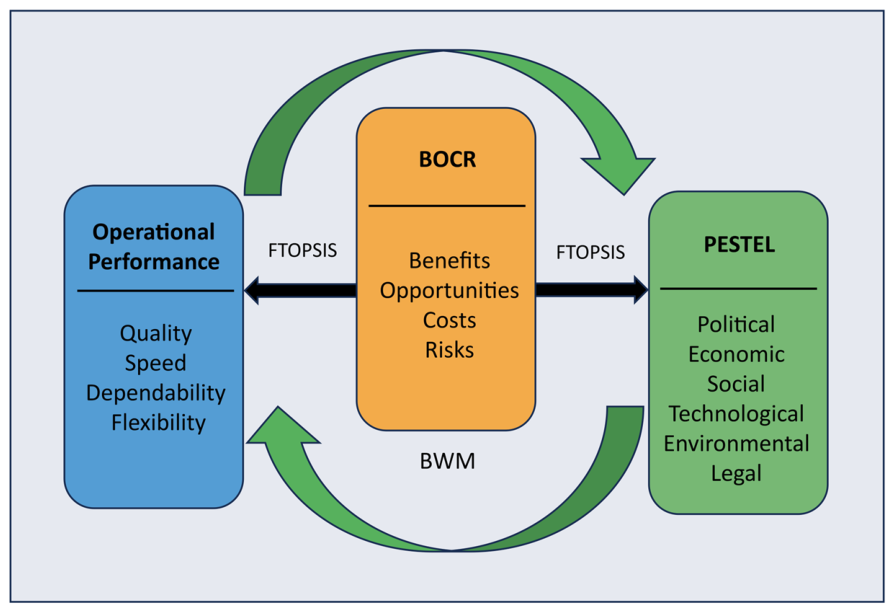
- Benefits: Factors that ensure positive consistency for the company when financial, qualitative, and quantitative aspects are considered in the processes.
- Opportunities: Improvements in processes through the implementation of identified critical success factors, aiming at positive financial or operational outcomes.
- Costs: Elements that generate initial expenses for the company, designed to bring benefits in the medium to long term.
- Risks: Applications or initiatives that may not lead to positive outcomes when implemented.
3.2. Best-Worst Method
- A.
- Identify the criteria, represented as .
- B.
- Identify the criterion considered most important and the one deemed least relevant.
- C.
- Conduct pairwise judgments among the criteria, applying a 1–9 rating scale. The best-to-other representation is expressed as , where denotes the preference of B over j.
- D.
- The worst-to-others representation is expressed as , where T indicates the transpose of the vector.
- E.
- Determine the optimal set of weights .
- F.
- Execute an integrity check. The consistency ratio (CR) is calculated using , where represents the optimal consistency value obtained from the linear optimization model. Equation (1) presents the calculation of the CR, which measures the reliability of the weights obtained in BWM. The parameter represents the maximum deviation in the pairwise comparisons, while CI denotes the consistency index.
3.3. Fuzzy TOPSIS
- A.
- The criteria are defined, and a fuzzy scale is introduced. Performance levels are expressed through linguistic terms mapped to triangular fuzzy values. The scale progresses from no influence (values close to 0), through low and medium influence (intermediate values between 0.25 and 0.75), up to high and strong influence (values approaching 1.0). This linguistic-to-numeric mapping provides a structured way to capture subjective judgments, as reported in the methodological literature [95,97].
- B.
- Build the fuzzy decision matrix . In the fuzzy decision matrix, represent the lower, middle, and upper bounds of the influence of criterion on criterion , where is the influencing criterion and is the influenced criterion.
- C.
- Derive the area center numbers using Equation (2) [98]. Equation (2) derives the area center number (AC), summarizing the fuzzy judgments into a single representative value.
- D.
- Adjust the weights of the criteria. Define for j Equation (3).where denotes the normalized weight of criterion represents the adjusted coefficient value associated with criterion j, and i and j denote the influencing and influenced criteria, respectively. These weights are later used in TOPSIS to build the proximity index.
- E.
- Employ TOPSIS to sort the choices. After fuzzy scores are defined, the method ranks them by closeness to the best reference. Each option is evaluated between the positive ideal and the negative ideal, with its value based on distance to these points [99].
- E.1
- Normalize option scores Equation (4).
- E.2
- Obtain weighted scores using Equation (5).
- E.3
- E.4
- Distances to (IS+) and (IS−) Equations (8) and (9).
- E.5
- Proximity index (CCi) per option Equation (10).
4. CSC Framework Application
4.1. Evidence from Case Analyses
4.2. BWM Results
4.3. FTOPSIS Results
5. Discussion
Managerial Implications
6. Conclusions
Author Contributions
Funding
Institutional Review Board Statement
Informed Consent Statement
Data Availability Statement
Conflicts of Interest
References
- Tramarico, C.; Petrillo, A.; Andrade, H.; Salomon, V. Advancing circular supplier selection: Multi-criteria perspectives on risk and sustainability. Sustainability 2025, 17, 6814. [Google Scholar] [CrossRef]
- Mathiyazhagan, K.; Agarwal, V.; Malhotra, S.; Scuotto, V. (Eds.) Humanizing Circular Supply Chain Management; Springer: Berlin/Heidelberg, Germany, 2025. [Google Scholar]
- Werner-Lewandowska, K.; Golinska-Dawson, P.; Mierzwiak, R. Enablers and barriers in building the circular supply chain through remanufacturing—Grey DEMATEL approach. Int. J. Prod. Econ. 2025, 284, 109617. [Google Scholar] [CrossRef]
- Akash, M.H.; Aziz, R.A.; Karmaker, C.L.; Bari, A.B.; Kabir, K.M.; Islam, A.R. Investigating the attributes for implementing circular economy in the textile manufacturing supply chain: Implications for the triple bottom line of sustainability. Sustain. Horiz. 2024, 14, 100129. [Google Scholar] [CrossRef]
- Das, A.K.; Hossain, M.F.; Khan, B.U.; Rahman, M.M.; Asad, M.A.Z.; Akter, M. Circular economy: A sustainable model for waste reduction and wealth creation in the textile supply chain. SPE Polym. 2025, 6, e10171. [Google Scholar] [CrossRef]
- Dieguez-Santana, K.; Sarduy-Pereira, L.; Ruiz-Reyes, E.; Sablón Cossío, N. Application of the circular economy in research in the agri-food supply chain: Bibliometric, network, and content analysis. Sustainability 2025, 17, 1899. [Google Scholar] [CrossRef]
- Martínez-Falcó, J.; Sánchez-García, E.; Marco-Lajara, B.; Andreu, R. Green supply chain management and sustainable performance: Exploring the role of circular economy capability and green ambidexterity innovation. Br. Food J. 2024, 126, 3985–4011. [Google Scholar] [CrossRef]
- Braz, A.C.; De Mello, A.M. Supply chain management strategies, types and tactics for circular economy transitions. Manag. Rev. Q. 2023, 74, 2121–2148. [Google Scholar] [CrossRef]
- Marquina, M.V.H.; Le Dain, M.A.; Joly, I.; Zwolinski, P. Exploring determinants of collaboration in circular supply chains: A social exchange theory perspective. Sustain. Prod. Consum. 2024, 50, 1–19. [Google Scholar] [CrossRef]
- Bals, L.; Taylor, K.M.; Rosca, E.; Ciulli, F. Toward a circular supply chain: The enabling role of information and financial flows in open and closed loop designs. Resour. Conserv. Recycl. 2024, 209, 107781. [Google Scholar] [CrossRef]
- Rajesh, R.; Aljabhan, B. A novel grey stratified decision-making (GSDM) model for social sustainability-based supplier selection. IEEE Trans. Comput. Soc. Syst. 2022, 11, 531–545. [Google Scholar] [CrossRef]
- Gholian-Jouybari, F.; Hashemi-Amiri, O.; Mosallanezhad, B.; Hajiaghaei-Keshteli, M. Metaheuristic algorithms for a sustainable agri-food supply chain considering marketing practices under uncertainty. Expert Syst. Appl. 2023, 213, 118880. [Google Scholar] [CrossRef]
- Kannan, D.; Mina, H.; Nosrati-Abarghooee, S.; Khosrojerdi, G. Sustainable circular supplier selection: A novel hybrid approach. Sci. Total Environ. 2020, 722, 137936. [Google Scholar] [CrossRef] [PubMed]
- Mishra, A.R.; Rani, P.; Pandey, K. Fermatean fuzzy CRITIC-EDAS approach for the selection of sustainable third-party reverse logistics providers using improved generalized score function. Ambient Intell. Humaniz. Comput. 2022, 13, 295–311. [Google Scholar] [CrossRef]
- Khishtandar, S.; Zandieh, M.; Dorri, B. A multi criteria decision making framework for sustainability assessment of bioenergy production technologies with hesitant fuzzy linguistic term sets: The case of Iran. Renew. Sustain. Energy Rev. 2017, 77, 1130–1145. [Google Scholar] [CrossRef]
- Stojčić, M.; Zavadskas, E.K.; Pamučar, D.; Stević, Ž.; Mardani, A. Application of MCDM methods in sustainability engineering: A literature review 2008–2018. Symmetry 2019, 11, 350. [Google Scholar] [CrossRef]
- Tramarico, C.L. Circular Supply Chain: Addressing Critical Success Factors Through Multi-criteria Analysis. In Industrial Engineering and Operations Management. Proceedings of the XXX IJCIEOM, Salvador, Brazil, 26–28 June 2024; dos Reis, J.C.G., Freires, F.G.M., Junior, M.V., Barbastefano, R.G., Sant’Anna, Â.M.O., Eds.; Springer: Cham, Switzerland, 2025; pp. 357–368. [Google Scholar] [CrossRef]
- Tramarico, C.L. A multi-criteria assessment of readiness for disruptive technology implementation in supply chain management: A risk response framework perspective. Pesqui. Oper. 2024, 44, e282884. [Google Scholar] [CrossRef]
- Naeemah, A.J.; Wong, K.Y. A weighted fuzzy approach for choosing lean manufacturing tools based on their effects on sustainability. In International Conference on Soft Computing and Pattern Recognition; Springer Nature: Cham, Switzerland, 2022; pp. 634–646. [Google Scholar] [CrossRef]
- Singh, K.; Chaudhuri, R.; Chatterjee, S. Assessing the impact of digital transformation on green supply chain for achieving carbon neutrality and accelerating circular economy initiatives. Comput. Ind. Eng. 2025, 201, 110943. [Google Scholar] [CrossRef]
- Duan, Y.; Khokhar, M.; Raza, A.; Sharma, A.; Islam, T. The role of digital technology and environmental sustainability in circular supply chains based on the fuzzy TOPSIS model. Environ. Dev. Sustain. 2025, 1–32. [Google Scholar] [CrossRef]
- Masa’deh, R.E.; Jaber, M.; Sharabati, A.A.A.; Nasereddin, A.Y.; Marei, A. The blockchain effect on courier supply chains digitalization and its contribution to industry 4.0 within the circular economy. Sustainability 2024, 16, 7218. [Google Scholar] [CrossRef]
- Sorooshian, S.; Khiavi, S.F.; Karimi, F.; Mina, H. Link between sustainable circular supply chain and Internet of Things technology in electric vehicle battery manufacturing industry: A business strategy optimization for pickup and delivery. Bus. Strategy Environ. 2024, 33, 8211–8232. [Google Scholar] [CrossRef]
- Bocken, N.M.; Kimpimäki, J.P.; Ritala, P.; Konietzko, J. How circular are large corporations? Evidence from a large-scale survey with senior leaders. Resour. Conserv. Recycl. 2025, 215, 108151. [Google Scholar] [CrossRef]
- Srhir, S.; Jaegler, A.; Montoya-Torres, J.R. Introducing a framework toward sustainability goals in a supply chain 4.0 ecosystem. J. Clean. Prod. 2023, 418, 138111. [Google Scholar] [CrossRef]
- Sariisik, G.; Demir, S. Industry 5.0: A human-centric paradigm for sustainable and resilient industrial transformation. J. Soc. Perspect. Stud. 2025, 2, 50–66. [Google Scholar] [CrossRef]
- Al Amin, M.; Chakraborty, A.; Baldacci, R. Industry 5.0 and green supply chain management synergy for sustainable development in Bangladeshi RMG industries. Clean. Logist. Supply Chain 2025, 14, 100208. [Google Scholar] [CrossRef]
- Seuring, S.; Müller, M. From a literature review to a conceptual framework for sustainable supply chain management. J. Clean. Prod. 2008, 16, 1699–1710. [Google Scholar] [CrossRef]
- Vegter, D.; van Hillegersberg, J.; Olthaar, M. Performance measurement system for circular supply chain management. Sustain. Prod. Consum. 2023, 36, 171–183. [Google Scholar] [CrossRef]
- D’Adamo, I.; Gastaldi, M.; Giacalone, R.; Kazancoglu, Y. A strategic and social analytics model for sustainable packaging in the cosmetic industry. Supply Chain Anal. 2024, 8, 100090. [Google Scholar] [CrossRef]
- Kharat, M.G.; Kapoor, S.; Parhi, S.; Kharat, M.G.; Pandey, S. Operationalizing sustainability in pharmaceuticals: Green supply chain metrics for circular economy. Sustain. Futures 2025, 9, 100413. [Google Scholar] [CrossRef]
- Sanchez-Garcia, E.; Martinez-Falco, J.; Marco-Lajara, B.; Millan-Tudela, L.A. Looking into literature in the field of circular supply chain and the subtopic from a customers’ perspective: A bibliometric approach. J. Clean. Prod. 2023, 417, 137900. [Google Scholar] [CrossRef]
- Kundu, T.; Goh, M. Environmentally responsible supply chain operations and digital transformation. Encycl. Oper. Manag. 2026, 4, 282–293. [Google Scholar] [CrossRef]
- Slack, N.; Lewis, M. Operations Strategy, 5th ed.; Pearson Education Ltd.: Harlow, UK, 2017. [Google Scholar]
- Saipidinov, I.M.; Khamdamov, O.N.; Bandurina, I.P.; Fomenko, N.M.; Karanina, E.V. Environmental management of quality: The modern vision of sustainable business. Int. J. Qual. Res. 2025, 19, 535–547. [Google Scholar] [CrossRef]
- Liu, S. Green management promotes long-term business competitive advantage through the resource-based view. Total Qual. Manag. Bus. Excell. 2025, 36, 946–973. [Google Scholar] [CrossRef]
- Dhaigude, A.S.; Verma, A.; Nayak, G. Sustainable production and consumption: A bibliometric analysis of SDG-12 literature through a financial management lens. Cogent Econ. Finance 2025, 13, 2467882. [Google Scholar] [CrossRef]
- Kumari, A.; Ghosh, M.; Singh, M.P. Deep dive into sustainable development goals through the lens of triple bottom line: Past, present, and future. Can. J. Adm. Sci. 2025, 42, 352–376. [Google Scholar] [CrossRef]
- Gatewood, A.K.; Drake, M.J. ASCM Supply Chain Dictionary, 19th ed.; ASCM: Chicago, IL, USA, 2025. [Google Scholar]
- Gandia, J.A.G.; Gavrila, S.G.; de Lucas Ancillo, A.; del Val Núñez, M.T. Towards sustainable business in the automation era: Exploring its transformative impact from top management and employee perspective. Technol. Forecast. Soc. Change 2025, 210, 123908. [Google Scholar] [CrossRef]
- Dehshiri, S.J.H. An integrated decision-making framework for evaluating Industry 5.0 and circular economy in supply chain management using Z-numbers. Appl. Soft Comput. 2025, 181, 113504. [Google Scholar] [CrossRef]
- Dixit, V.K.; Malviya, R.K. Analysing critical success factors of digital supply chain implementation in automobile organisations to achieve sustainability in operations. Process Integr. Optim. Sustain. 2025, 9, 31–55. [Google Scholar] [CrossRef]
- Xie, X.; Parry, G.; Altrichter, B. Factors influencing the implementation success of blockchain technology: A systematic literature review. In International Conference on AI and the Digital Economy (CADE 2023); IET: Venice, Italy, 2023; pp. 49–52. [Google Scholar] [CrossRef]
- Malhotra, G. Impact of circular economy practices on supply chain capability, flexibility and sustainable supply chain performance. Int. J. Logist. Manag. 2024, 35, 1500–1521. [Google Scholar] [CrossRef]
- Matarneh, S.; Piprani, A.Z.; Ellahi, R.M.; Nguyen, D.N.; Le, T.M.; Nazir, S. Industry 4.0 technologies and circular economy synergies: Enhancing corporate sustainability through sustainable supply chain integration and flexibility. Environ. Technol. Innov. 2024, 35, 103723. [Google Scholar] [CrossRef]
- Taddei, E.; Sassanelli, C.; Rosa, P.; Terzi, S. Circular supply chains theoretical gaps and practical barriers: A model to support approaching firms in the era of industry 4.0. Comput. Ind. Eng. 2024, 190, 110049. [Google Scholar] [CrossRef]
- Li, J.; Lai, K.K.; Li, Y. Remanufacturing and low-carbon investment strategies in a closed-loop supply chain under multiple carbon policies. Int. J. Logist. Res. Appl. 2024, 27, 170–192. [Google Scholar] [CrossRef]
- Nath, S.D.; Mustayin, S.S.; Eweje, G. Circular economy in a developing country’s textile and apparel industry: Managerial perspectives on challenges and motivators. Bus. Strategy Environ. 2025, 34, 3600–3617. [Google Scholar] [CrossRef]
- Gunasekara, L.; Robb, D.J. Optimisation of retailer take-back of low and medium-value products for a circular economy. Comput. Ind. Eng. 2025, 201, 110739. [Google Scholar] [CrossRef]
- Joshi, S.; Sharma, M.; Luthra, S.; Agarwal, R.; Rathi, R. Role of industry 4.0 in augmenting endurability of agri-food supply chains amidst pandemic: Organisation flexibility as a moderator. Oper. Manag. Res. 2025, 18, 768–782. [Google Scholar] [CrossRef]
- Aguilar, F.J. Scanning the Business Environment; MacMillan Co.: New York, NY, USA, 1967. [Google Scholar]
- Diaz Ruiz, C.A.; Baker, J.J.; Mason, K.; Tierney, K. Market-scanning and market-shaping: Why are firms blindsided by market-shaping acts? J. Bus. Ind. Mark. 2020, 35, 1389–1401. [Google Scholar] [CrossRef]
- Dos Santos, M.E.M.; Silveira, B.; dos Santos, H.L.M.; Maia, F.J.F.; Basso, A.P.; de Medeiros Costa, H.K. Assessing the macro environmental factors for waste to energy in Brazil: A comparative study with the USA, China, the EU, and India using PESTEL and panel data analysis. Renew. Energy 2026, 256, 124311. [Google Scholar] [CrossRef]
- Mishra, S.; Singh, S.P.; Johansen, J.; Cheng, Y.; Farooq, S. Evaluating indicators for international manufacturing network under circular economy. Manag. Decis. 2019, 57, 811–839. [Google Scholar] [CrossRef]
- Bąk, P.; Sukiennik, M.; Kowal, B. The main drivers of the raw materials and ICT sectors in Poland using PESTEL analysis. Energies 2025, 18, 1987. [Google Scholar] [CrossRef]
- Vardopoulos, I.; Tsilika, E.; Sarantakou, E.; Zorpas, A.A.; Salvati, L.; Tsartas, P. An integrated SWOT PESTLE AHP model assessing sustainability in adaptive reuse projects. Appl. Sci. 2021, 11, 7134. [Google Scholar] [CrossRef]
- Tröger, D.; Araneda, A.A.B.; Busnelli, R.; Yajnes, M.; Williams, F.; Braun, A.C. Exploring eco industrial development in the global south: Recognizing informal waste picking as urban industrial symbiosis? Clean. Waste Syst. 2023, 5, 100096. [Google Scholar] [CrossRef]
- Järvenpää, A.M.; Kunttu, I.; Mäntyneva, M. Using foresight to shape future expectations in circular economy SMEs. Technol. Innov. Manag. Rev. 2020, 10, 42–51. [Google Scholar] [CrossRef]
- Loizia, P.; Voukkali, I.; Zorpas, A.A.; Pedreño, J.N.; Chatziparaskeva, G.; Inglezakis, V.J.; Doula, M. Measuring the level of environmental performance in insular areas, through key performed indicators, in the framework of waste strategy development. Sci. Total Environ. 2021, 753, 141974. [Google Scholar] [CrossRef]
- Dioba, A.; Schmid, A.; Aliahmad, A.; Struthers, D.; Fróes, I. Human excreta recycling in Sweden: A PESTEL SWOT framework analysis—Review. J. Environ. Manag. 2025, 389, 126242. [Google Scholar] [CrossRef]
- Derse, O.; Polat, E.G. Evaluation of implementation strategies in the context of zero waste city and circular economy concept. Environ. Eng. Manag. J. 2025, 24, 1475. [Google Scholar] [CrossRef]
- Pfoser, S.; Herman, K.; Massimiani, A.; Brandtner, P.; Schauer, O. From linear to circular packaging: Enablers and challenges in the fashion industry. In International Conference on Dynamics in Logistics; Springer International Publishing: Cham, Switzerland, 2022; pp. 435–445. [Google Scholar] [CrossRef]
- Liu, S.; Yu, J.J.; Feng, T. The impact of green innovations on firm’s sustainable operations: Process innovation and recycling 810 innovation. Omega 2025, 130, 103170. [Google Scholar] [CrossRef]
- Gupta, H.; Kusi-Sarpong, S.; Rezaei, J. Barriers and overcoming strategies to supply chain sustainability innovation. Resour. Conserv. Recycl. 2020, 161, 104819. [Google Scholar] [CrossRef]
- Cheng, T.C.E.; Kamble, S.S.; Belhadi, A.; Ndubisi, N.O.; Lai, K.H.; Kharat, M.G. Linkages between big data analytics, circular economy, sustainable supply chain flexibility, and sustainable performance in manufacturing firms. Int. J. Prod. Res. 2022, 60, 6908–6922. [Google Scholar] [CrossRef]
- Tolio, T.; Bernard, A.; Colledani, M.; Kara, S.; Seliger, G.; Duflou, J.; Takata, S. Design, management and control of demanufacturing and remanufacturing systems. CIRP Ann. 2017, 66, 585–609. [Google Scholar] [CrossRef]
- Barney, J. Firm resources and sustained competitive advantage. J. Manag. 1991, 17, 99–120. [Google Scholar] [CrossRef]
- Sun, Y.; Xu, C.; Davey, H.; Lu, Y. Digitalization drives innovation in ESG disclosure: An integrated reporting perspective. Bus. Strategy Environ. 2026, 1–27. [Google Scholar] [CrossRef]
- Wararatchai, P.; Shaharudin, M.R.; Mokhtar, A.R.M.; Hassam, S.F.; Aunyawong, W. A comparative analysis of the development of circular supply chain management in Malaysia and Thailand. J. Environ. Manag. 2026, 402, 129128. [Google Scholar] [CrossRef] [PubMed]
- Teece, D.J.; Pisano, G.; Shuen, A. Dynamic capabilities and strategic management. Strateg. Manag. J. 1997, 18, 509–533. [Google Scholar] [CrossRef]
- Verona, G.; Ravasi, D. Unbundling dynamic capabilities: An exploratory study of continuous product innovation. Ind. Corp. Change 2003, 12, 577–606. [Google Scholar] [CrossRef]
- Testa, F.; Mecca, D.; Corsini, F.; Gusmerotti, N.M.; Iraldo, F. Boosting the circular transition in manufacturing firms: The interplay between absorptive capacity and dynamic capabilities. Creat. Innov. Manag. 2025, 35, 374–394. [Google Scholar] [CrossRef]
- YahiaMarzouk, Y. What underpins the strategic change decision of digital transformation? Roles of organizational mindfulness and strategic reconfiguration. J. Strategy Manag. 2026, 1–38. [Google Scholar] [CrossRef]
- DiMaggio, P.J.; Powell, W.W. The iron cage revisited: Institutional isomorphism and collective rationality in organizational fields. Am. Sociol. Rev. 1983, 48, 147–160. [Google Scholar] [CrossRef]
- Ma, H.; Zhou, T.; Chen, Y.; Chi, M. Peer effects on digital innovation: A multiple context analysis based on decision-making reference. Ind. Manag. Data Syst. 2026, 126, 392–412. [Google Scholar] [CrossRef]
- Li, M.; Gan, Y. From disclosure to distortion: How strategic ESG disclosure shapes green innovation bubbles. Borsa Istanb. Rev. 2025, 26, 100746. [Google Scholar] [CrossRef]
- Triantaphyllou, E. Multi-Criteria Decision Making Methods. In Multi-Criteria Decision Making Methods: A Comparative Study; Applied Optimization; Springer: Boston, MA, USA, 2000; Volume 44. [Google Scholar] [CrossRef]
- Belton, V.; Stewart, T.J. Multiple Criteria Decision Analysis: An Integrated Approach; Springer Science & Business Media: Berlin/Heidelberg, Germany, 2002. [Google Scholar]
- Roy, B. Multicriteria Methodology for Decision Aiding; Kluwer Academic Publishers: Dordrecht, The Netherlands, 1996. [Google Scholar]
- Tramarico, C.L.; Paredes, J.A.L.; Salomon, V.A.P. Process and strategic criteria assessment in platform-based supply chains: A framework for identifying operational vulnerabilities. Systems 2026, 14, 75. [Google Scholar] [CrossRef]
- Alimohammadlou, M.; Alinejad, S. Challenges of blockchain implementation in SMEs’ supply chains: An integrated IT2F-BWM and IT2F-DEMATEL method. Electron. Commer. Res. 2025, 25, 907–949. [Google Scholar] [CrossRef]
- Singh, P.K.; Maheswaran, R. Analysis of social barriers to sustainable innovation and digitisation in supply chain. Environ. Dev. Sustain. 2024, 26, 5223–5248. [Google Scholar] [CrossRef] [PubMed]
- Ardra, S.; Barua, M.K. Sustainable supplier selection among supermarket’s fresh fruits and vegetable supply chains based on circular practices in India. Environ. Dev. Sustain. 2024, 28, 14903–14939. [Google Scholar] [CrossRef]
- Saaty, T.L. Fundamentals of Decision Making and Priority Theory with the Analytic Network Process; RWS Publications: Pittsburgh, PA, USA, 1994. [Google Scholar]
- Wijnmalen, D.J. Analysis of benefits, opportunities, costs, and risks (BOCR) with the AHP–ANP: A critical validation. Math. Comput. Model. 2007, 46, 892–905. [Google Scholar] [CrossRef]
- Silva, A.M.; Tramarico, C.L. Multi-criteria analysis of big data and big data analytics on supply chain management. Int. J. Integr. Supply Manag. 2022, 15, 280–303. [Google Scholar] [CrossRef]
- Petrillo, A.; Salomon, V.A.P.; Tramarico, C.L. State-of-the-art review on the analytic hierarchy process with benefits, opportunities, costs, and risks. J. Risk Financ. Manag. 2023, 16, 372. [Google Scholar] [CrossRef]
- Saaty, T.L. Principia Mathematica Decernendi: Mathematical Principles of Decision Making: Generalization of the Analytic Network Process to Neural Firing and Synthesis; RWS Publications: Pittsburgh, PA, USA, 2010. [Google Scholar]
- Gabus, A.; Fontela, E. Perceptions of the World Problematique: Communication Procedure, Communicating with Those Bearing Collective Responsibility (DEMATEL Report No. 1); Battelle Geneva Research Centre: Geneva, Switzerland, 1973. [Google Scholar]
- Si, S.L.; You, X.Y.; Liu, H.C.; Zhang, P. DEMATEL technique: A systematic review of the state-of-the-art literature on methodologies and applications. Math. Probl. Eng. 2018, 2018, 3696457. [Google Scholar] [CrossRef]
- Okoli, C.; Pawlowski, S.D. The Delphi method as a research tool: An example, design considerations and applications. Inf. Manag. 2004, 42, 15–29. [Google Scholar] [CrossRef]
- Falatoonitoosi, E.; Ahmed, S.; Sorooshian, S. Expanded DEMATEL for determining cause and effect group in bidirectional relations. Sci. World J. 2014, 2014, 103846. [Google Scholar] [CrossRef]
- Rezaei, J. Best-worst multi-criteria decision-making method. Omega 2015, 53, 49. [Google Scholar] [CrossRef]
- Yadav, G.; Mangla, S.K.; Luthra, S.; Jakhar, S. Hybrid BWM-ELECTRE-based decision framework for effective offshore outsourcing adoption: A case study. Int. J. Prod. Res. 2018, 56, 6259–6278. [Google Scholar] [CrossRef]
- Chen-Yi, H.; Ke-Ting, C.; Gwo-Hshiung, T. FMCDM with fuzzy DEMATEL approach for customers’ choice behavior model. Int. J. Fuzzy Syst. 2007, 9, 236–246. [Google Scholar]
- You, P.; Liu, S.; Guo, S. A hybrid novel fuzzy MCDM method for comprehensive performance evaluation of pumped storage power station in China. Mathematics 2021, 10, 71. [Google Scholar] [CrossRef]
- John, R.; Singh, A.K. A DEMATEL approach for analysing the interdependence among the efficiency barriers in the agri-fresh produce supply chains. Supply Chain Anal. 2025, 10, 100106. [Google Scholar] [CrossRef]
- Tramarico, C.L.; Da Silva, A.F.; Branco, J.E.H. Mapping decision-making structures in supply chain contexts: A fuzzy DEMATEL approach. Logistics 2025, 9, 76. [Google Scholar] [CrossRef]
- Hwang, C.L.; Yoon, K. Multiple Attribute Decision Making: Methods and Applications; Springer: Berlin/Heidelberg, Germany, 1981. [Google Scholar]
- Moktadir, M.A.; Paul, S.K.; Bai, C.; Santibanez Gonzalez, E.D. The current and future states of MCDM methods in sustainable supply chain risk assessment. Environ. Dev. Sustain. 2025, 27, 7435–7480. [Google Scholar] [CrossRef]
- Sathyan, R.; Parthiban, P.; Dhanalakshmi, R.; Sachin, M.S. An integrated fuzzy MCDM approach for modelling and prioritising the enablers of responsiveness in automotive supply chain using fuzzy DEMATEL, fuzzy AHP and fuzzy TOPSIS. Soft Comput. 2023, 27, 257–277. [Google Scholar] [CrossRef]
- Tighnavard Balasbaneh, A.; Aldrovandi, S.; Sher, W. A systematic review of implementing multi-criteria decision-making (MCDM) approaches for the circular economy and cost assessment. Sustainability 2025, 17, 5007. [Google Scholar] [CrossRef]
- Bashir, S.; Javaid, M.; Haleem, A.; Khan, Z.A. Barriers to adopting additive manufacturing in healthcare: An analysis towards their mitigation. Intell. Hosp. 2025, 1, 100009. [Google Scholar] [CrossRef]



| Alternative | Description | References |
|---|---|---|
| Quality | Delivering products and services that meet specifications, are free of defects, and consistently satisfy customer expectations. | [34] |
| Speed | Refers to how quickly products or services are delivered; advanced technologies enhance responsiveness and adoption of sustainable practices. | [39,40,41] |
| Dependability | Consistency of product and service delivery, reinforced by digital supply chains, IoT readiness, and resilience strategies in sustainability contexts. | [34,42,43] |
| Flexibility | Capacity to adapt to changes in demand, processes, or supply; pivotal for resilience and CE adoption through technologies and alliances. | [39,44,45] |
| Cost | Minimizing operational expenses to strengthen competitiveness and support long-term sustainability strategies. | [34] |
| Alternative | Description | References |
|---|---|---|
| Political | Influence of government policies, regulations, and international agreements on supply chains and CE transitions. | [53] |
| Economic | Market conditions, investment strategies, and competitive pressures are shaping resource allocation and profitability. | [54,55] |
| Social | Societal values, cultural expectations, and community needs are driving sustainable practices, and CE initiatives and social sustainability also encompass broader consequences for society, including labor conditions, equity, health, and community well-being. This dual perspective ensures that CSC strategies consider both societal acceptance and their wider social impacts. | [56,57] |
| Technological | Innovations and digital tools enabling efficiency, transparency, and sustainability in dynamic environments. | [58] |
| Environmental | Ecological considerations, sustainability targets, and resource management practices across the product life cycle. | [39,59,60,61] |
| Legal | Laws, standards, and compliance requirements regulating sustainable operations and CE adoption. | [62] |
| MCDM Technique | Application Context | Related SDGs | Reference |
|---|---|---|---|
| AHP Risk-integrated MCDM | CSC risk assessment | SDG 12.5 (Waste Reduction) | [1] |
| BWM + FTOPSIS (Hybrid fuzzy approach) | Lean manufacturing tool selection (cement industry) | SDG 9 (Industry, Innovation, Infrastructure), SDG 12 (Responsible Consumption) | [19] |
| GSDM (Grey Stratified Decision-Making) | Social sustainability in supplier selection (electronics industry) | SDG 8 (Decent Work), SDG 12 (Responsible Consumption) | [11] |
| Hybrid MCDM (Fermatean fuzzy CRITIC-EDAS) | Reverse logistics provider selection | SDG 12 (Responsible Consumption), SDG 9 (Innovation) | [14] |
| Hybrid MCDM (Hesitant fuzzy linguistic) | Bioenergy technology sustainability assessment | SDG 7 (Clean Energy), SDG 12 (Responsible Consumption), SDG 8 (Decent Work) | [15] |
| Metaheuristic + LP-metric + supportive MCDM | Agri-food supply chain (saffron) | SDG 2 (Zero Hunger), SDG 12 (Responsible Consumption) | [12] |
| TOPSIS | Readiness for disruptive technology in supply chain | SDG 9 (Industry, Innovation, Infrastructure), SDG 12 (Responsible Consumption) | [18] |
| Theory | References | Context | Contribution |
|---|---|---|---|
| Dynamic Capabilities | [71,72,73] | Continuous innovation; circular transitions; digitalization in SMEs | Explains how reconfiguration of resources sustains innovation and resilience; absorptive capacity and organizational mindfulness enhance dynamic capabilities in digital and circular contexts. |
| Institutional Theory | [74,75,76] | Organizations; digital innovation; ESG disclosure | Shows how coercive, normative, and mimetic pressures shape practices; peer norms influence competitiveness; institutional recognition can legitimize or distort sustainability adoption. |
| Resource-Based View | [67,68,69] | Strategy; ESG digitalization; CSC and MSMEs | Internal resources sustain competitive advantage; digitalization as an enabler of ESG disclosures; circular innovation explained through RBV in SMEs. |
| Judgment (BO/OW) | B | O | C | R |
|---|---|---|---|---|
| BO (Best = B, O = Others) | 1 | 4 | 3 | 7 |
| OW (O = Others, Worst = R) | 2 | 3 | 4 | 1 |
| Criteria | B | O | C | R |
|---|---|---|---|---|
| Criteria weights | 0.32 | 0.24 | 0.31 | 0.13 |
| Operational Performance/Criteria | B | O | C | R |
|---|---|---|---|---|
| Quality | 0.571 | 0.525 | 0.534 | 0.497 |
| Speed | 0.505 | 0.519 | 0.500 | 0.504 |
| Dependability | 0.428 | 0.463 | 0.468 | 0.492 |
| Flexibility | 0.486 | 0.491 | 0.497 | 0.507 |
| PESTEL/Criteria | B | O | C | R |
|---|---|---|---|---|
| Political | 0.457 | 0.460 | 0.482 | 0.517 |
| Economic | 0.469 | 0.515 | 0.481 | 0.475 |
| Social | 0.545 | 0.512 | 0.481 | 0.536 |
| Technological | 0.523 | 0.511 | 0.552 | 0.468 |
| Environmental | 0.516 | 0.516 | 0.541 | 0.428 |
| Legal | 0.467 | 0.477 | 0.520 | 0.650 |
| Operational Performance/Criteria | B | O | C | R |
|---|---|---|---|---|
| Quality | 0.183 | 0.126 | 0.165 | 0.065 |
| Speed | 0.162 | 0.125 | 0.155 | 0.065 |
| Dependability | 0.137 | 0.111 | 0.145 | 0.064 |
| Flexibility | 0.155 | 0.118 | 0.154 | 0.066 |
| PESTEL/Criteria | B | O | C | R |
|---|---|---|---|---|
| Political | 0.146 | 0.111 | 0.150 | 0.067 |
| Economic | 0.150 | 0.124 | 0.149 | 0.062 |
| Social | 0.174 | 0.123 | 0.149 | 0.070 |
| Technological | 0.167 | 0.123 | 0.171 | 0.061 |
| Environmental | 0.165 | 0.124 | 0.168 | 0.056 |
| Legal | 0.149 | 0.115 | 0.161 | 0.085 |
| Proximity Index | Value | Operational Performance | Rank |
|---|---|---|---|
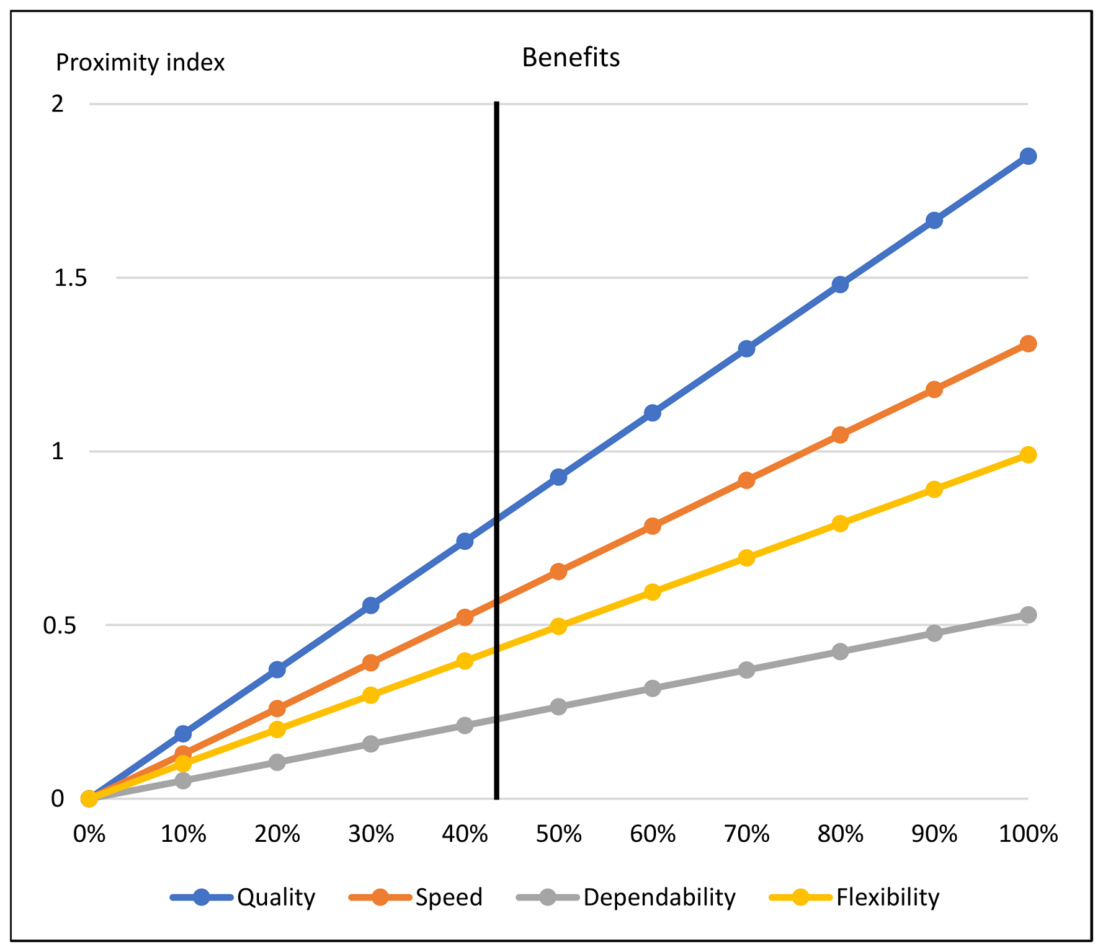
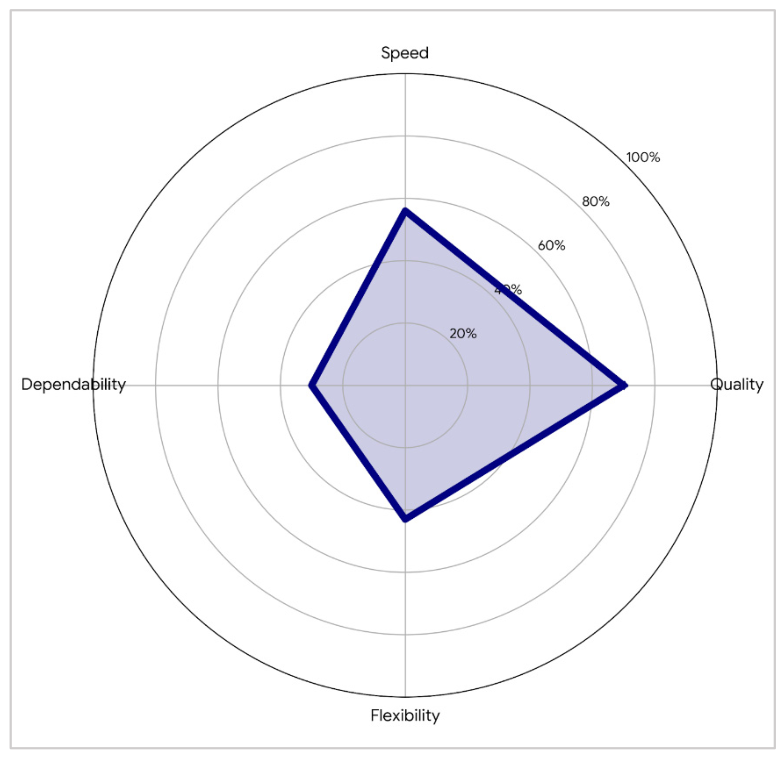
| CC1 | 0.702 | Quality | 1st |
| CC2 | 0.561 | Speed | 2nd |
| CC3 | 0.299 | Dependability | 4th |
| CC4 | 0.432 | Flexibility | 3rd |
| Proximity Index | Value | PESTEL | Rank |
|---|---|---|---|
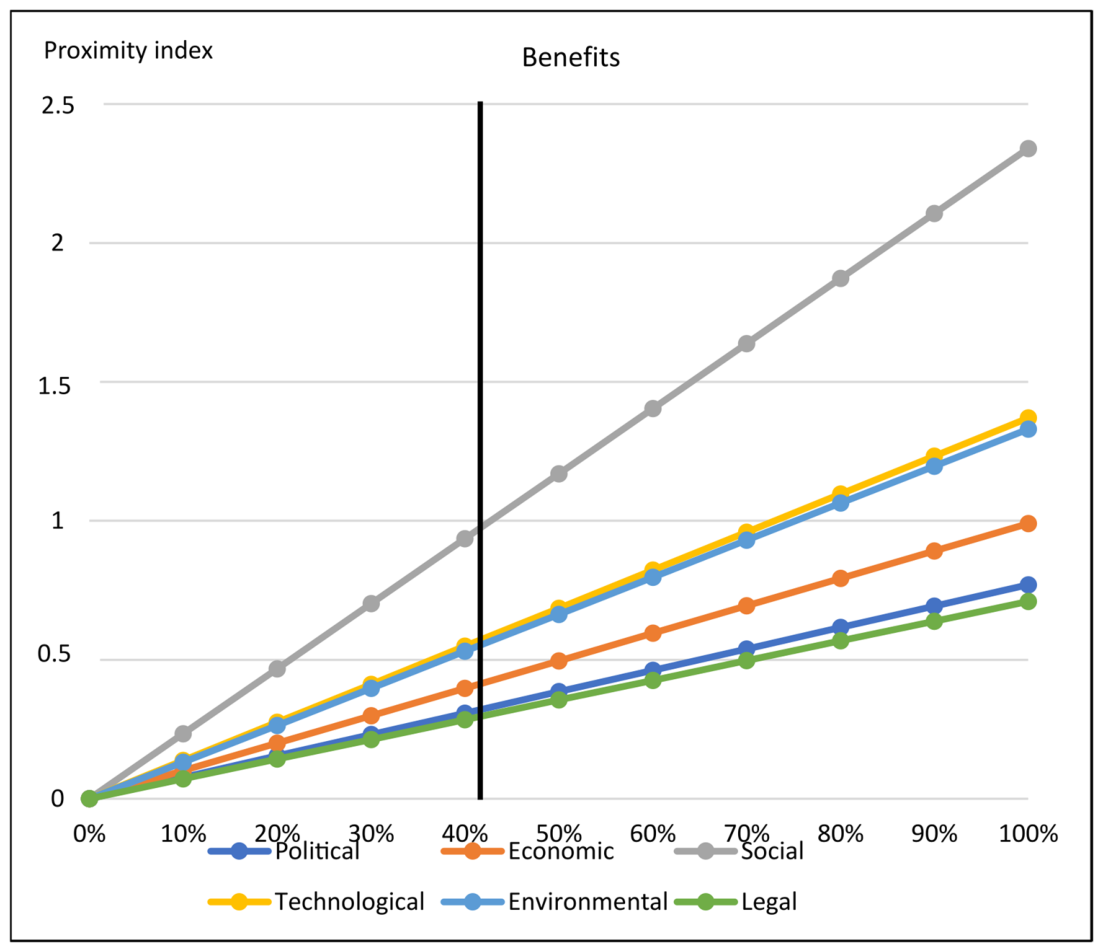
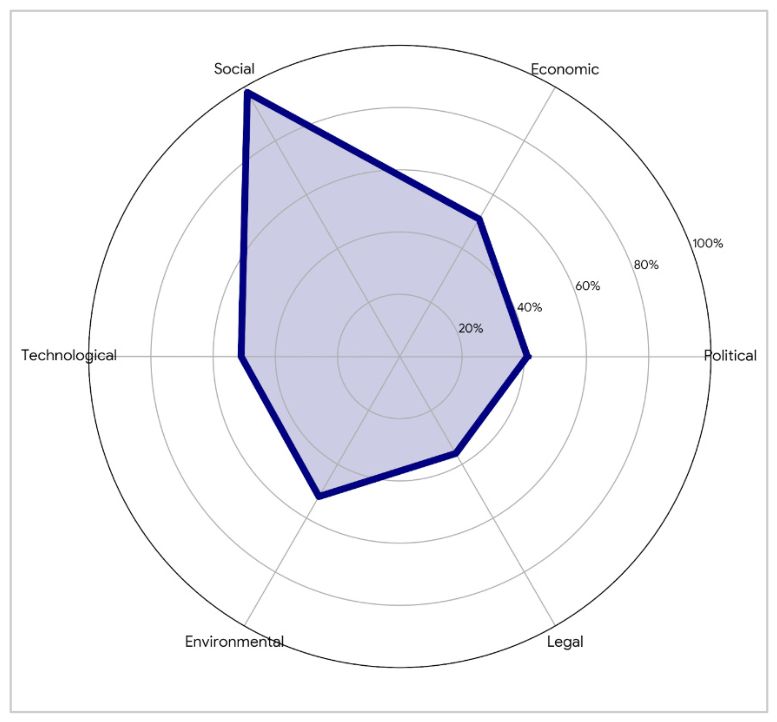
| CC1 | 0.410 | Political | 5th |
| CC2 | 0.513 | Economic | 3rd |
| CC3 | 0.977 | Social | 1st |
| CC4 | 0.509 | Technological | 4th |
| CC5 | 0.517 | Environmental | 2nd |
| CC6 | 0.359 | Legal | 6th |
Disclaimer/Publisher’s Note: The statements, opinions and data contained in all publications are solely those of the individual author(s) and contributor(s) and not of MDPI and/or the editor(s). MDPI and/or the editor(s) disclaim responsibility for any injury to people or property resulting from any ideas, methods, instructions or products referred to in the content. |
© 2026 by the authors. Licensee MDPI, Basel, Switzerland. This article is an open access article distributed under the terms and conditions of the Creative Commons Attribution (CC BY) license.
Share and Cite
Tramarico, C.L.; Ortiz Barrios, M.A.; Salomon, V.A.P. Evaluating Operational and Environmental Factors in Circular Supply Chains: A Decision-Making Model Integrating Sustainability Dimensions. Logistics 2026, 10, 129. https://doi.org/10.3390/logistics10060129
Tramarico CL, Ortiz Barrios MA, Salomon VAP. Evaluating Operational and Environmental Factors in Circular Supply Chains: A Decision-Making Model Integrating Sustainability Dimensions. Logistics. 2026; 10(6):129. https://doi.org/10.3390/logistics10060129
Chicago/Turabian StyleTramarico, Claudemir Leif, Miguel Angel Ortiz Barrios, and Valério Antonio Pamplona Salomon. 2026. "Evaluating Operational and Environmental Factors in Circular Supply Chains: A Decision-Making Model Integrating Sustainability Dimensions" Logistics 10, no. 6: 129. https://doi.org/10.3390/logistics10060129
APA StyleTramarico, C. L., Ortiz Barrios, M. A., & Salomon, V. A. P. (2026). Evaluating Operational and Environmental Factors in Circular Supply Chains: A Decision-Making Model Integrating Sustainability Dimensions. Logistics, 10(6), 129. https://doi.org/10.3390/logistics10060129