Article

Integrating Efficiency and Priority in Circular Energy Supply Chains: A DEA-Informed BWM Analysis of Second-Life EV Battery Ecosystems in Emerging Economies


by
Ilyas Masudin
1,2,*,
Dian Palupi Restuputri
1,
Dwi Iryaning Handayani
3 and
Erly Ekayanti Rosyida
4
1
Industrial Engineering Department, Universitas Muhammadiyah Malang, Jl. Raya Tlogomas 246, Malang 65144, Indonesia
2
Centre of Supply Chain Research & Innovation, Universitas Muhammadiyah Malang, Jl. Raya Tlogomas 246, Malang 65144, Indonesia
3
Industrial Engineering Department, Universitas Panca Marga, Jl. Raya Dringu, Probolinggo 67216, Indonesia
4
Logistics Engineering Department, Universitas Telkom Surabaya, Jl. Ketintang 156, Surabaya 60231, Indonesia
*
Author to whom correspondence should be addressed.
Logistics 2026, 10(5), 114; https://doi.org/10.3390/logistics10050114
Submission received: 14 April 2026 / Revised: 9 May 2026 / Accepted: 12 May 2026 / Published: 14 May 2026

Abstract

Background: The global transition to low-carbon energy systems has intensified the need for circular approaches in energy supply chains, yet studies on second-life EV battery ecosystems in emerging economies remain fragmented between barrier prioritization and efficiency assessment. Methods: This study addresses this gap by integrating the Best–Worst Method (BWM) and Data Envelopment Analysis (DEA) to connect subjective expert-based prioritization with objective efficiency benchmarking. Using expert panel inputs and scenario-based circular energy configurations representing emerging economy conditions, the results indicate that technical barriers (28.4%) and economic barriers (24.9%) dominate the priority structure, with battery performance uncertainty and high initial investment as the most critical constraints. Results: DEA results show that configurations with formal reverse logistics and certification mechanisms achieve frontier efficiency (θ = 1.000), whereas fragmented informal configurations exhibit the lowest efficiency (θ = 0.712). High-tech configurations with weak regulation demonstrate that technological investment alone is insufficient without institutional development. Conclusions: The novelty lies in developing a context-sensitive BWM–DEA framework that embeds barrier priorities into efficiency evaluation, an approach rarely explored in prior circular supply chain research. The study provides a holistic decision-support tool for policymakers and industry stakeholders seeking to accelerate circular energy transitions in emerging economies.

1. Introduction

The global transition toward low-carbon energy systems has intensified the need for circular approaches in energy supply chains, particularly in the context of rapidly growing electric vehicle (EV) markets. As EV adoption accelerates, so does the volume of end-of-life lithium-ion batteries, raising critical concerns regarding resource depletion, environmental impacts, and waste management [1]. Second-life applications of EV batteries, where used batteries are repurposed for less demanding energy storage uses such as microgrids and stationary storage, offer a promising pathway to extend battery lifecycles while supporting renewable energy integration [2,3]. This approach is particularly significant in emerging economies, where energy access challenges, infrastructure gaps, and cost constraints necessitate innovative and resource-efficient solutions. Thakur, Martins Leite de Almeida [3] affirmed that by embedding second-life battery systems within circular energy supply chains, these economies can simultaneously address sustainability, affordability, and energy resilience, making the topic both timely and policy-relevant. Moreover, the strategic reuse of EV batteries can reduce dependence on critical raw materials such as lithium, cobalt, and nickel, whose supply chains are often geographically concentrated and vulnerable to disruption [4]. This reinforces the importance of developing circular energy ecosystems that not only enhance environmental performance but also strengthen energy security and economic resilience in emerging markets.
Despite growing scholarly attention to circular economy practices and battery reuse systems, existing studies exhibit several important limitations. A substantial portion of the literature focuses on technical feasibility, lifecycle assessment, and economic evaluation of second-life batteries, often treating the system as a linear or partially closed loop rather than a fully integrated circular supply chain [5]. Moreover, decision-making approaches in this domain frequently rely on conventional multi-criteria decision-making (MCDM) methods such as the Analytic Hierarchy Process (AHP) or simple weighted scoring models, which may impose high cognitive burdens and suffer from inconsistency when handling numerous and interrelated criteria [6]. While the Best–Worst Method (BWM) has been introduced as a more consistent and efficient alternative for prioritizing decision criteria, its application in circular energy systems remains relatively limited and often disconnected from performance-based validation frameworks. In addition, many prior studies adopt static evaluation perspectives, failing to capture the dynamic interactions among stakeholders, technologies, and policies that evolve over time in circular supply chains [7]. This limits their ability to provide actionable insights for decision-makers operating in rapidly changing environments, particularly in emerging economies where institutional and market conditions are still developing. More importantly, prior studies tend to treat barrier prioritization and efficiency evaluation as separate analytical exercises rather than interconnected dimensions of circular supply chain performance. Existing MCDM-based studies mainly focus on identifying and ranking critical barriers [8,9], whereas DEA-based studies emphasize operational efficiency assessment without incorporating the strategic importance of contextual barriers into the evaluation structure [10,11,12]. Consequently, the relationship between barrier severity and actual system performance remains insufficiently explored, creating a methodological gap in circular energy supply chain research, particularly in emerging economies characterized by institutional and infrastructural heterogeneity [13,14].
In a related but distinct stream of research, efficiency assessment techniques such as Data Envelopment Analysis (DEA) have been widely employed to evaluate the operational performance of energy systems, logistics networks, and sustainability initiatives [15]. However, these studies typically emphasize input–output efficiency without adequately incorporating the underlying structural or institutional barriers that shape system performance. As a result, there exists a disconnect between identifying what hinders circular supply chain implementation and evaluating how efficiently such systems operate under real-world constraints. Furthermore, in emerging economy contexts, where institutional voids, regulatory uncertainty, and infrastructural limitations are more pronounced, the lack of integrated analytical frameworks becomes even more problematic, limiting the practical applicability of existing models [13]. In addition, conventional DEA applications often assume homogeneous decision-making units and stable operating environments, assumptions that are rarely satisfied in nascent circular ecosystems characterized by high uncertainty and evolving stakeholder roles [14]. This limitation reduces the explanatory power of efficiency scores, as they may fail to reflect the contextual complexities and transitional dynamics inherent in second-life EV battery systems in emerging markets.
Addressing these gaps, this study proposes an integrated analytical framework that combines the Best–Worst Method (BWM) and Data Envelopment Analysis (DEA) to simultaneously capture the priority of barriers and the efficiency of circular energy supply chain configurations. Focusing on second-life EV battery ecosystems in emerging economies, the study aims to (i) identify and prioritize key barriers affecting the development of circular battery supply chains using BWM, and (ii) evaluate the relative efficiency of different system configurations or decision-making units using DEA. The integration of MCDM and efficiency assessment methods has been increasingly recognized as a promising approach to enhance decision robustness by linking subjective judgments with objective performance evaluation [16,17]. Furthermore, prior studies highlight the need for hybrid analytical frameworks to better capture the complexity of sustainable supply chains and support more informed policy and managerial decisions [18,19]. By linking barrier prioritization with performance assessment, this research contributes to bridging the gap between strategic decision-making and operational evaluation in circular energy systems. The selection of the BWM–DEA combination is motivated by both methodological and contextual considerations. Compared to traditional MCDM approaches such as AHP or ANP, BWM requires fewer pairwise comparisons, produces higher consistency in expert judgments, and reduces cognitive burden, making it particularly suitable for evaluating complex circular energy systems involving multiple interdependent barriers [9]. In parallel, DEA complements BWM by enabling objective efficiency benchmarking across heterogeneous system configurations without requiring predefined functional relationships among variables [10]. Unlike other hybrid approaches that focus primarily on ranking alternatives, the integrated BWM–DEA framework allows barrier importance to be directly embedded into efficiency evaluation, thereby generating more context-sensitive and operationally meaningful insights for emerging circular energy ecosystems. Ultimately, the proposed approach provides both theoretical advancement and practical insights for policymakers, industry stakeholders, and researchers seeking to accelerate the transition toward sustainable and circular energy infrastructures, particularly in the context of emerging economies where integrated and data-driven decision support tools remain limited.

2. Materials and Methods

2.1. Circular Energy Supply Chains in Emerging Economies

The transition from linear to circular models has become a central theme in the evolution of sustainable energy systems, particularly as global pressures intensify to reduce carbon emissions and improve resource efficiency. Circular energy supply chains extend traditional supply chain configurations by incorporating reverse flows, resource recovery, and lifecycle extension strategies, thereby minimizing waste and maximizing value retention [7]. Within the energy sector, this transition is closely linked to the integration of renewable energy technologies, energy storage systems, and digital monitoring tools that enable more efficient and adaptive resource utilization [20]. Unlike conventional linear systems, circular energy supply chains emphasize closed-loop material cycles, particularly for critical components such as batteries, which play a pivotal role in electrification and decarbonization efforts [21]. Furthermore, the circular approach contributes not only to environmental sustainability but also to economic resilience by reducing dependence on virgin raw materials and mitigating supply chain vulnerabilities associated with geopolitical and market uncertainties [22]. As a result, circular energy supply chains are increasingly viewed as a strategic pathway for achieving both climate goals and long-term energy security.
In the context of emerging economies, the implementation of circular energy supply chains presents both significant opportunities and complex challenges shaped by institutional, economic, and infrastructural conditions. These economies often face rapid urbanization, growing energy demand, and limited access to reliable electricity, making decentralized and resource-efficient energy solutions particularly valuable [23,24]. Circular approaches, such as localized energy systems and distributed storage, can enhance energy access while reducing environmental burdens, especially in underserved or off-grid regions [25]. However, the transition is constrained by institutional voids, regulatory ambiguity, and underdeveloped reverse logistics networks, which hinder the effective circulation of materials and components within the supply chain [26]. Additionally, informal sectors often play a dominant role in waste collection and recycling activities in emerging economies, creating both opportunities for inclusive circular practices and challenges related to standardization, safety, and governance [27]. These contextual complexities highlight the need for tailored analytical frameworks that can capture the multidimensional nature of circular energy supply chains in emerging markets, where technological innovation must be aligned with institutional development and socio-economic realities.

2.2. Second-Life EV Batteries and Circular Energy Ecosystems

Second-life applications of electric vehicle (EV) batteries have emerged as a critical enabler of circular energy systems, offering a viable pathway to extend the functional lifespan of lithium-ion batteries beyond their initial automotive use. Typically retired from EVs when their capacity declines to around 70–80%, these batteries still retain sufficient performance for less demanding stationary energy storage applications, such as renewable energy integration, peak shaving, and microgrid support [28]. By repurposing these batteries, second-life strategies contribute to delaying recycling processes, reducing environmental burdens, and improving the overall lifecycle efficiency of battery systems [29]. Moreover, second-life EV batteries play a crucial role in supporting the integration of intermittent renewable energy sources, such as solar and wind, by providing cost-effective storage solutions that enhance grid stability and energy reliability [30]. This dual benefit, environmental and operational, positions second-life batteries as a cornerstone technology in the transition toward low-carbon and resource-efficient energy systems.
Beyond their technical and economic potential, second-life EV batteries must be understood within a broader circular energy ecosystem that involves multiple stakeholders, interconnected processes, and evolving value chains. This ecosystem typically includes automotive manufacturers, battery suppliers, third-party repurposing firms, energy service providers, end users, and regulatory bodies, all of whom play interdependent roles in enabling battery reuse and value recovery [31]. The complexity of this ecosystem is further amplified by uncertainties related to battery state-of-health, lack of standardization in battery design, and challenges in establishing efficient reverse logistics networks for collection and redistribution [32]. In addition, economic viability remains a key concern, as the costs associated with testing, repurposing, and integration must be balanced against declining prices of new batteries and evolving market conditions [33]. These interrelated technical, economic, and institutional factors highlight that second-life EV battery systems cannot be effectively analyzed in isolation [34]; rather, they require a systemic perspective that captures the dynamic interactions across the circular energy ecosystem, particularly in emerging economies where market structures and regulatory frameworks are still developing.
Recent studies have increasingly examined the evaluation of circular supply chain strategies for second-life EV battery ecosystems, emphasizing the importance of reverse logistics coordination, closed-loop supply chain design, and sustainability performance assessment. Existing research has explored topics such as battery repurposing strategies, lifecycle optimization, economic feasibility of second-life applications, and environmental trade-offs associated with battery reuse and recycling [29,30]. Several studies also highlight the growing role of digital technologies, battery traceability systems, and policy coordination mechanisms in improving circularity and resource recovery efficiency within EV battery value chains [30,32]. Furthermore, emerging research has adopted multi-criteria and systems-oriented approaches to support decision-making and evaluate alternative circular strategies under technological and regulatory uncertainty [34]. Despite these advances, most prior studies evaluate circular battery systems either from technical–economic perspectives or sustainability assessment perspectives independently, with limited integration between strategic barrier prioritization and operational efficiency evaluation. This limitation restricts the ability of existing models to provide holistic decision support for emerging economy contexts characterized by institutional heterogeneity and evolving circular infrastructures.

2.3. Barriers to Circular Supply Chain Implementation

The implementation of circular supply chains, particularly in energy-related sectors, is hindered by a wide range of interrelated barriers spanning technical, economic, regulatory, infrastructural, and socio-cultural dimensions. Technical challenges are often among the most critical, especially in complex systems such as second-life EV batteries, where uncertainties in product quality, lack of standardization, and difficulties in assessing remaining useful life complicate reuse and repurposing processes [35]. Variability in battery chemistry, design, and usage history further intensifies these issues, making it difficult to ensure consistent safety and performance standards across applications [36]. At the same time, economic barriers such as high upfront investment, uncertain return on investment, and fluctuating market dynamics for both new and reused components significantly constrain scalability [37]. These challenges are exacerbated by the absence of mature business models and limited financial incentives, which reduce the attractiveness of circular initiatives for private sector actors. Importantly, these technical and economic constraints are deeply intertwined, as technological uncertainties often translate into financial risks, thereby reinforcing resistance to adoption.
Regulatory, infrastructural, and socio-cultural barriers further complicate the transition toward circular supply chains, particularly in emerging economy contexts. The lack of clear and consistent regulatory frameworks, such as policies on extended producer responsibility, end-of-life ownership, and safety certification, creates ambiguity that discourages investment and slows innovation [34,38]. In parallel, inadequate reverse logistics systems, limited repurposing and recycling facilities, and weak transportation networks restrict the efficient circulation of materials within the supply chain [39]. Socio-cultural factors, including low consumer awareness, limited trust in reused products, and resistance to behavioral change, further impede market acceptance of circular solutions [38,40]. These barriers are particularly pronounced in emerging economies, where institutional voids, informal sector dominance, and limited technological capabilities create additional layers of complexity [38,41]. As a result, the challenges of implementing circular supply chains are not only multifaceted but also highly context-dependent, underscoring the need for systematic approaches to identify, structure, and prioritize these barriers to support effective decision-making.

2.4. Decision-Making and Efficiency Evaluation Methods in Circular Systems

The growing complexity of circular supply chains has led to increased reliance on structured decision-making tools capable of addressing multiple, often conflicting criteria. Multi-Criteria Decision-Making (MCDM) methods have been widely adopted in this regard, particularly for evaluating sustainability performance, selecting technologies, and prioritizing barriers in circular economy contexts. Among these, methods such as the Analytic Hierarchy Process (AHP), Analytic Network Process (ANP), and Technique for Order Preference by Similarity to Ideal Solution (TOPSIS) have been frequently applied due to their flexibility and intuitiveness [34]. However, these approaches are often criticized for imposing a high cognitive burden on decision-makers, especially when dealing with a large number of criteria and pairwise comparisons, which can lead to inconsistency and reduced reliability of results [8,42]. In response to these limitations, the Best–Worst Method (BWM) has emerged as a more efficient and consistent alternative, requiring fewer comparisons while maintaining robust prioritization outcomes [9]. Recent studies have demonstrated the applicability of BWM in various sustainability-related domains, including supplier selection, energy planning, and circular economy assessments, highlighting its potential to improve decision quality under complex conditions [43]. Nevertheless, most applications of BWM remain focused on ranking or weighting criteria without linking these priorities to actual system performance, thereby limiting their practical relevance for operational decision-making.
In parallel, Data Envelopment Analysis (DEA) has been extensively used as a non-parametric technique for evaluating the relative efficiency of decision-making units (DMUs) based on multiple inputs and outputs [10]. DEA is particularly well-suited for assessing performance in energy systems, environmental management, and supply chain operations, where efficiency must be evaluated across diverse and often non-commensurable indicators [12]. Its ability to handle multiple inputs and outputs without requiring predefined functional relationships makes it a powerful tool for benchmarking and identifying best practices [44]. However, traditional DEA applications tend to focus primarily on operational efficiency while overlooking the contextual and structural factors, such as regulatory constraints, technological limitations, and market barriers, that influence performance outcomes. Moreover, DEA typically assumes homogeneity among decision-making units and stable operating environments, assumptions that are often violated in emerging circular ecosystems characterized by high uncertainty and evolving stakeholder roles [11]. As a result, while both MCDM methods and DEA offer valuable insights independently, their isolated application creates a methodological gap, as neither approach fully captures the interplay between priority setting and efficiency evaluation in circular energy supply chains.

2.5. Synthesis of Prior Studies and Identification of Research Gaps in Circular Energy Supply Chains

A synthesis of the existing literature reveals that, while significant progress has been made in understanding circular energy supply chains and second-life EV battery ecosystems, current studies remain fragmented across disciplinary and methodological boundaries. As summarized in Table 1, prior research has predominantly focused on (i) conceptualizing circular energy systems and their sustainability potential [7,22], (ii) examining the technical and economic feasibility of second-life EV batteries [29,30], and (iii) identifying barriers to circular supply chain implementation across multiple dimensions [5,35]. In parallel, methodological advancements have introduced structured decision-making tools such as BWM to improve prioritization consistency [8,9] and DEA to evaluate system efficiency [12]. However, these streams of research largely evolve in isolation. Studies on circular energy systems often adopt descriptive or conceptual approaches without operationalizing decision-support mechanisms, while second-life battery research tends to emphasize technical optimization without adequately incorporating systemic barriers or stakeholder complexity [32]. Similarly, barrier-focused studies provide valuable classifications but lack integration with performance evaluation tools, limiting their applicability in real-world decision-making contexts, particularly in emerging economies where institutional and infrastructural constraints are highly dynamic [13]. This fragmentation highlights a critical need for integrative frameworks that can bridge conceptual, technical, and analytical dimensions within circular energy supply chains.
Building on the gaps identified in Table 1, this study positions itself at the intersection of these fragmented research streams by proposing an integrated analytical framework that combines BWM and DEA to address both priority setting and efficiency evaluation within circular energy supply chains. Specifically, while prior studies have either emphasized “what matters most” (through MCDM approaches) or “how well systems perform” (through DEA), very few have attempted to link these perspectives in a unified framework capable of generating actionable insights [16,17]. This gap is particularly critical in the context of second-life EV battery ecosystems, where decision-makers must simultaneously navigate complex trade-offs among technical feasibility, economic viability, regulatory uncertainty, and infrastructural limitations [32,34]. Furthermore, the dynamic and heterogeneous nature of emerging economies challenges the assumptions of conventional analytical models, reinforcing the need for hybrid approaches that can capture both subjective expert judgments and objective system performance [11,13]. By integrating BWM-based barrier prioritization with DEA-based efficiency assessment, this study contributes to advancing the methodological frontier of circular supply chain research while offering a more holistic decision-support tool tailored to the complexities of emerging circular energy ecosystems.

3. Results

3.1. Integrated Research Design for Circular Energy Supply Chain Evaluation

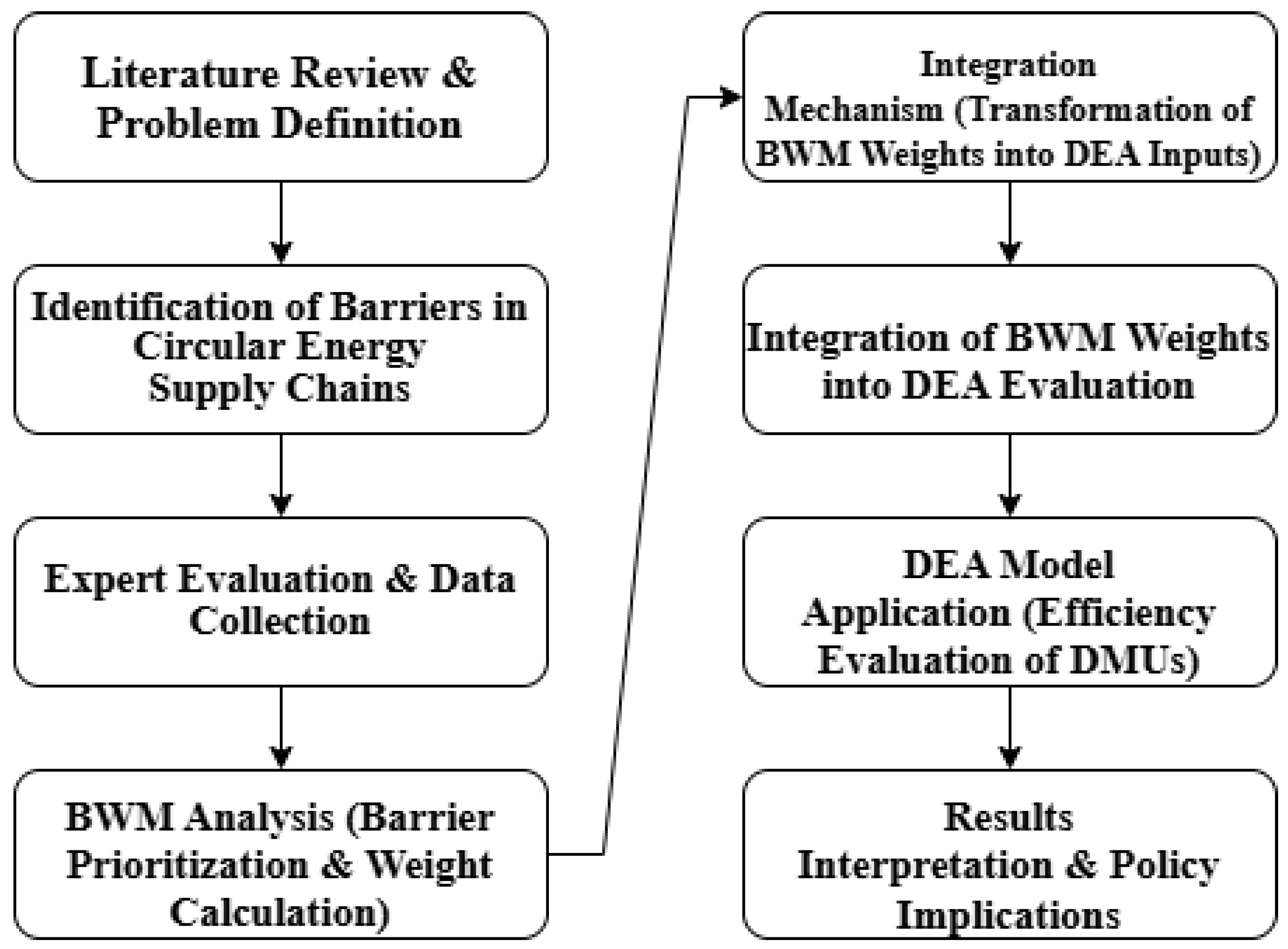
This study adopts a sequential multi-method research design to systematically evaluate circular energy supply chains for second-life EV battery ecosystems by integrating barrier prioritization and efficiency assessment within a unified analytical framework. The research design is grounded in the recognition that circular systems in emerging economies are characterized by high complexity, uncertainty, and interdependence among technological, institutional, and market factors [7,13]. To address these challenges, the study combines the Best–Worst Method (BWM) and Data Envelopment Analysis (DEA) in a structured sequence, enabling the incorporation of both expert-driven judgments and data-driven performance evaluation. Specifically, BWM is employed to identify and prioritize critical barriers affecting the implementation of circular energy supply chains, leveraging its ability to produce consistent and reliable weights with reduced cognitive burden compared to traditional MCDM methods [9]. These prioritized barriers are subsequently integrated into a DEA framework to assess the relative efficiency of different system configurations or decision-making units (DMUs), thereby linking strategic importance with operational performance. Such an integrated approach responds to calls in the literature for hybrid analytical frameworks capable of capturing the multidimensional nature of sustainable supply chains and improving decision robustness [16,17].
As illustrated in Figure 1, the research design follows a logically connected and iterative analytical flow that bridges qualitative insights and quantitative evaluation. The process begins with a comprehensive literature review and problem definition stage, which establishes the conceptual foundation for identifying relevant barriers within circular energy supply chains, particularly in the context of second-life EV battery ecosystems [32,34]. These barriers are then validated and refined through expert input, ensuring contextual relevance and practical applicability in emerging economy settings characterized by institutional voids and infrastructural constraints [13]. The subsequent BWM phase generates a set of prioritized weights that reflect the relative importance of each barrier, effectively translating subjective expert knowledge into structured decision criteria [9,43,45]. These weights are then embedded into the DEA model through a defined integration mechanism, allowing the efficiency assessment to account for contextual constraints rather than relying solely on conventional input–output relationships [11,12]. The final stage involves interpreting the efficiency results in light of the prioritized barriers, enabling a more nuanced understanding of system performance and providing actionable insights for policymakers and industry stakeholders. Overall, this research design ensures that the analysis not only identifies what factors are most critical but also evaluates how effectively different system configurations respond to these challenges, thereby enhancing both the analytical rigor and practical relevance of the study.

3.2. Identification and Structuring of Barriers and Expert Panel Selection

The identification and structuring of barriers in circular energy supply chains for second-life EV battery ecosystems were conducted through a systematic and iterative approach that integrates insights from the literature with expert-informed refinement. Building on the review in Section 2, an initial pool of barriers was compiled and subsequently organized into six key dimensions reflecting the pillars of sustainability and system implementation: technical, economic, regulatory, infrastructural, socio-cultural, and environmental [5,35]. The inclusion of the environmental dimension strengthens the analytical framework by explicitly capturing sustainability-related risks such as emissions, waste leakage, and environmental compliance, which are central to circular energy systems [20]. The identified barriers encompass challenges such as battery performance uncertainty, lack of standardization, high capital investment, regulatory ambiguity, infrastructure limitations, and environmental externalities associated with improper handling of second-life batteries. To ensure conceptual clarity and avoid redundancy, overlapping factors were consolidated and operational definitions were standardized. Redundancy among barriers was minimized through iterative expert validation and conceptual cross-checking during the refinement stage. Barriers exhibiting substantial overlap in operational meaning or causal interpretation were merged or redefined to improve conceptual distinctiveness and avoid double counting in the subsequent BWM analysis. This process was guided by thematic consistency across prior literature and expert consensus regarding the functional boundaries of each barrier category [5,35]. This process resulted in a refined set of 16 barriers, structured to reflect the multidimensional and context-dependent nature of circular energy supply chains in emerging economies. As presented in Table 2, each barrier is clearly categorized and defined to ensure consistency in interpretation during the subsequent BWM analysis.
To ensure the contextual relevance and practical validity of the identified barriers, this study engaged a panel of experts using a purposive sampling strategy. The expert panel was designed to reflect the multi-stakeholder nature of circular energy ecosystems, incorporating perspectives from academia, industry, and policy domains [31,46]. Consistent with methodological recommendations for MCDM applications, a panel size within the range of 8–15 experts was adopted to balance diversity and consistency of judgments [47]. As summarized in Table 3, the selected experts possess substantial experience in areas such as electric mobility, battery technology, energy systems, environmental management, and sustainable supply chain management. Data collection was conducted through structured questionnaires complemented by follow-up interactions to ensure clarity and consistency in responses. The experts were first asked to validate and refine the identified barriers, ensuring their relevance to emerging economy contexts, and subsequently to perform the pairwise comparisons required for the BWM analysis. This integration of expert knowledge enhances the robustness of the study by aligning theoretical constructs with real-world insights, thereby improving the reliability and applicability of the results.
Although the expert panel size is relatively limited, the combination of expert diversity, acceptable BWM consistency ratios, geometric mean aggregation, and subsequent sensitivity analysis helps reduce potential aggregation bias and improve the robustness of the prioritization results [9,47].

3.3. Barrier Prioritization Using the Best–Worst Method (BWM)

To prioritize the identified barriers, this study employs the Best–Worst Method (BWM), a structured multi-criteria decision-making approach known for its ability to generate consistent and reliable weights with a reduced number of pairwise comparisons [48]. Compared to conventional methods such as AHP, BWM minimizes cognitive burden while maintaining robustness in judgment, making it particularly suitable for complex decision environments such as circular energy supply chains characterized by multiple interdependent barriers [49]. In this study, each of the 16 barriers identified in Section 3.2 is treated as a decision criterion. The BWM procedure begins with experts selecting the most critical (best) and least critical (worst) barriers from the set. Subsequently, pairwise comparisons are conducted in two stages: (i) the preference of the best barrier over all other barriers, and (ii) the preference of all barriers over the worst barrier. These preferences are expressed using a numerical scale (typically 1–9), resulting in two comparison vectors: the Best-to-Others (BO) and Others-to-Worst (OW) vectors. This structured comparison process enables the transformation of qualitative expert judgments into quantifiable inputs for optimization, ensuring that the prioritization reflects both expert knowledge and methodological rigor [43]. The optimal weights of the barriers are then obtained by solving a linear optimization problem that minimizes the maximum deviation between pairwise comparisons and derived weights. Let wj denote the weight of barrier j, where j = 1,2,…,16. If B and W represent the indices of the best and worst barriers, respectively, and aBj and ajW denote the preference values from the BO and OW vectors, the optimization model can be formulated as:
O b j e c t i v e     Min w , ε ε
s . t     w B w j a B j ε ,
  w j w W a j W ε ,
  j = 1 16 w j = 1 ,
  w j 0
The solution of this model yields a set of optimal weights wj* and a consistency ratio ξ*, where lower values of ξ* indicate higher consistency in expert judgments [9]. In the context of this study, these weights represent the relative importance of technical, economic, regulatory, infrastructural, socio-cultural, and environmental barriers in shaping the implementation of circular energy supply chains for second-life EV batteries. By systematically quantifying the significance of each barrier, the BWM results provide a robust foundation for subsequent analysis and serve as critical inputs for the DEA model. This integration ensures that efficiency evaluation is not conducted in isolation but is instead informed by the prioritized structural constraints identified through expert knowledge, addressing a key gap in prior circular supply chain research [12,50].

3.4. Efficiency Assessment of Circular Energy Configurations Using Data Envelopment Analysis (DEA)

To evaluate the operational performance of circular energy supply chain configurations for second-life EV battery ecosystems, this study employs Data Envelopment Analysis (DEA) as a non-parametric efficiency assessment technique. DEA is particularly suitable for this research context due to its ability to handle multiple inputs and outputs without requiring predefined functional relationships, making it widely applicable in energy systems, environmental performance evaluation, and supply chain analysis [10,50]. In this study, each decision-making unit (DMU) represents a specific circular energy configuration, which may correspond to different operational scenarios, regions, or system designs involving second-life EV battery utilization. The selection of input and output variables is informed by both the literature and the barrier structure developed in Section 3.2. Specifically, inputs reflect resource consumption and operational constraints, such as investment cost, infrastructure limitations, and barrier-weighted factors derived from BWM, while outputs capture desirable system outcomes, including energy efficiency, emission reduction, and lifecycle extension of batteries [44]. Given the heterogeneity and evolving nature of circular ecosystems in emerging economies, this study adopts a variable returns to scale (VRS) model (BCC formulation) with an output-oriented perspective, allowing the analysis to focus on maximizing system performance under existing constraints [11]. This choice is particularly relevant where decision-makers have limited control over inputs but aim to improve sustainability outcomes.
The DEA model is formulated as a linear programming problem that evaluates the relative efficiency of each DMU by comparing it to a frontier constructed from the best-performing units. For a given DMU, the output-oriented BCC model can be expressed as follows:
O b j e c t i v e     Max θ
s . t   j = 1 n λ j . x i j x i o ,   i ;     j = 1 n λ j . y r j θ y r o , r ;     j = 1 n λ j = 1 ,   λ j 0
where xij and yrj represent the inputs and outputs of DMU j, respectively, λj are intensity variables, and θ denotes the efficiency score of the evaluated DMU. An efficiency score of θ = 1 indicates that the DMU lies on the efficient frontier, while values greater than 1 suggest inefficiency under the output-oriented formulation [12]. The inclusion of the convexity constraint λ j = 1 ensures the VRS assumption, allowing for scale heterogeneity among DMUs [11]. By incorporating barrier-informed inputs and sustainability-oriented outputs, the DEA model in this study moves beyond traditional efficiency measurement to reflect the contextual and structural constraints inherent in circular energy systems. This approach enhances the explanatory power of efficiency scores and provides more realistic benchmarking for decision-makers operating in emerging economies, where institutional, infrastructural, and technological conditions vary significantly [34].

3.5. Integration of BWM-Based Barrier Priorities and DEA Efficiency Evaluation

The core contribution of this study lies in the integration of BWM-derived barrier priorities with DEA-based efficiency evaluation, enabling a more context-sensitive assessment of circular energy supply chain performance. While BWM identifies “what matters most” by assigning relative importance to the 16 barriers, DEA evaluates “how well” different system configurations perform; however, when applied independently, these methods fail to capture the interaction between structural constraints and operational outcomes [14,51]. To bridge this gap, the present study incorporates the BWM weights into the DEA framework by transforming prioritized barriers into weighted input variables. Specifically, each barrier j is assigned a weight wj* derived from the BWM model (Section 3.3), which is then used to adjust the corresponding input indicators in the DEA model. This transformation ensures that barriers with higher strategic importance exert greater influence on efficiency evaluation, thereby aligning operational assessment with expert-informed priorities. Such an approach responds to the limitations of conventional DEA models that often overlook contextual and institutional constraints, particularly in emerging economies where system performance is heavily shaped by external barriers [11].
The raw input values (xij) used in the DEA model represent the severity level of each barrier j for a given decision-making unit (DMU) i. These values were obtained through expert evaluation using a five-point Likert scale, where 1 indicates very low constraint severity, and 5 indicates very high constraint severity (Table 4). To ensure comparability across barriers and avoid scale dominance in the DEA model, the raw scores were normalized using min–max normalization. The normalized value for each barrier was calculated as:
x i j n o r m = x i j min ( x j ) max ( x j m i n ( x j ) )
where xijnorm denotes the normalized severity score of barrier j for DMU i, while min(xj) and max(xj) represent the minimum and maximum observed values for barrier j across all DMUs. This transformation converts all input variables into a comparable scale ranging from 0 to 1, where higher values indicate greater constraint severity. Subsequently, the normalized scores were aggregated using the BWM-derived weights (wj*) to construct the composite DEA input indices, ensuring that barriers identified as more critical exerted proportionally greater influence on efficiency evaluation.
Operationally, the integration is implemented by constructing composite weighted inputs, where original input variables xij are adjusted using the BWM-derived weights to reflect the severity and importance of each barrier. The adjusted input for DMU i can be expressed as:
x i a d j = j = 1 16 w j * . x i j
where xij represents the performance of DMU i with respect to barrier j, and wj* denotes the corresponding BWM weight. This formulation allows the DEA model to internalize both quantitative performance data and qualitative expert judgments, thereby generating efficiency scores that are sensitive to real-world constraints. The integrated workflow follows a sequential process: (i) identification and validation of barriers, (ii) prioritization using BWM, (iii) transformation of weights into DEA-compatible inputs, and (iv) efficiency evaluation and benchmarking of DMUs. By embedding barrier priorities into efficiency measurement, the proposed framework advances beyond traditional approaches that treat all inputs as equally important, offering a more nuanced and realistic representation of circular energy supply chain performance [11,51]. This integration is particularly valuable in the context of second-life EV battery ecosystems, where decision-makers must navigate complex trade-offs among technical feasibility, economic viability, regulatory compliance, and environmental sustainability [32]. Ultimately, the proposed BWM–DEA framework enhances both the analytical rigor and practical relevance of decision-making by linking strategic prioritization with operational efficiency in a unified and data-driven manner.
The integration assumes that barriers with higher BWM-derived weights exert proportionally greater influence on the operational performance of circular energy configurations. Accordingly, the transformation of raw input indicators into weighted composite indices allows the DEA model to internalize expert-prioritized structural constraints rather than treating all barriers as equally important. This approach further assumes linear aggregation and comparability among normalized barrier indicators, which is consistent with prior hybrid MCDM–DEA applications in sustainability and supply chain evaluation [16,52]. By embedding contextual barrier severity into DEA inputs, the framework enhances the interpretability and practical relevance of efficiency benchmarking under heterogeneous emerging economy conditions.
All BWM optimization and DEA efficiency calculations were performed using Microsoft Excel Solver and LINGO 18.0. Excel Solver was employed for preliminary data processing, normalization, and implementation of the linear optimization procedures associated with the Best–Worst Method (BWM), including the derivation of optimal barrier weights and consistency ratios. The DEA models, including the output-oriented BCC formulations under variable returns to scale assumptions, were solved using LINGO 18.0 to ensure computational accuracy and optimization stability. Sensitivity and robustness analyses were also conducted within the same computational framework to maintain consistency across perturbation scenarios. The combined use of Excel Solver and LINGO facilitated systematic integration between the BWM-derived weights and DEA input construction process, thereby enhancing the transparency and reproducibility of the proposed analytical framework.

4. Discussion

4.1. Expert Consensus and Consistency Analysis in Barrier Prioritization

The reliability of the barrier prioritization process was assessed by examining the level of consensus among experts and the consistency of their judgments within the Best–Worst Method (BWM) framework. Following the data collection described in Section 3.2, individual Best-to-Others (BO) and Others-to-Worst (OW) comparison vectors were obtained from ten experts representing academia, industry, and policy domains. The aggregated group judgments were derived using the geometric mean approach, which is widely recommended in group decision-making contexts to preserve proportionality and reduce the influence of extreme values [9,53]. The resulting consistency ratios (ξ*) for each expert were calculated and subsequently averaged to assess overall judgment reliability. As reported in Table 5, all individual consistency ratios fall well within the acceptable threshold range suggested in prior BWM studies, indicating a high level of internal consistency across expert evaluations [48,49]. This finding suggests that the experts were able to make stable and logically coherent pairwise comparisons despite the complexity and multidimensionality of the identified barriers. Furthermore, the relatively low dispersion of consistency scores across experts implies that the cognitive burden associated with the evaluation task was effectively managed, reinforcing the suitability of BWM for analyzing complex circular supply chain problems.
Beyond internal consistency, the degree of consensus across the expert panel was further examined by analyzing the convergence of selected “best” and “worst” barriers and the variability of their associated preference structures. As shown in Table 5, barriers related to technical uncertainty (T1: battery performance uncertainty) and economic constraints (E1: high initial investment) were most frequently identified as the “best” (i.e., most critical) barriers, while socio-cultural and environmental enforcement barriers (e.g., S1 and EN3) were commonly selected as the least critical. This convergence indicates a shared perception among experts that technological reliability and financial feasibility represent the primary bottlenecks in the implementation of circular energy supply chains for second-life EV batteries. Such findings are consistent with prior studies emphasizing the dominant role of technical uncertainty and investment risk in shaping the viability of battery reuse systems [29,34]. At the same time, the relatively lower prioritization of socio-cultural and enforcement-related barriers does not imply their insignificance; rather, it suggests that these factors may exert indirect or context-dependent influences compared to more immediate operational constraints.

4.2. Priority Structure of Barriers in Circular Energy Supply Chains

Building on the consistent expert judgments established in Section 4.1, the Best–Worst Method (BWM) was applied to derive the final weights and ranking of the 16 identified barriers, thereby revealing the relative priority structure shaping circular energy supply chains for second-life EV battery ecosystems. As presented in Table 6, the results indicate a clear dominance of technical and economic barriers, with battery performance uncertainty (T1), high initial investment (E1), and lack of standardization (T2) emerging as the top three critical constraints. These findings underscore that uncertainties related to battery state-of-health, degradation patterns, and reliability remain the most significant impediments to scaling second-life applications, consistent with prior studies highlighting the complexity of assessing residual battery value and ensuring safe reuse [29,35]. Similarly, the high capital requirements associated with repurposing infrastructure and integration into energy systems reinforce the economic risks faced by stakeholders, particularly in emerging economies where financing mechanisms and investment incentives are often limited [37]. The prominence of standardization-related barriers further reflects the fragmented nature of battery design and testing protocols, which complicates interoperability and increases operational uncertainty across the supply chain [36]. Collectively, these results suggest that technological reliability and financial feasibility constitute the primary bottlenecks in advancing circular energy systems, aligning with the broader literature on circular supply chain implementation challenges [5].
Beyond individual rankings, the distribution of weights reveals important structural insights into the multidimensional nature of barriers in circular energy supply chains. Notably, regulatory and infrastructural barriers occupy mid-level positions, indicating that while they are not the most critical constraints, they play a significant enabling role in shaping system performance. For instance, regulatory ambiguity (R1) and lack of certification standards (R2) remain key institutional bottlenecks that can delay market development and discourage private sector participation, as also emphasized in studies on policy uncertainty in circular systems [38]. In contrast, socio-cultural barriers and environmental enforcement issues rank comparatively lower, suggesting that these factors, although relevant, exert more indirect or long-term influences on system adoption. This pattern aligns with prior research indicating that behavioral and awareness-related challenges tend to follow rather than lead technological and economic transitions [40]. Importantly, the relatively balanced distribution of weights across dimensions highlights the systemic nature of circular energy supply chains, where multiple interdependent barriers must be addressed simultaneously rather than in isolation. Overall, the dominance of technical and economic barriers observed in this study is consistent with prior empirical investigations on second-life EV battery ecosystems and circular supply chains, which similarly identify battery uncertainty, standardization limitations, and investment risks as primary constraints to large-scale implementation [29,35].

4.3. Dimension-Level Insights into Barrier Structures in Circular Energy Supply Chains

To further elucidate the structural composition of barriers, the individual BWM weights were aggregated at the dimension level, enabling a higher-order interpretation of how different categories of constraints shape the implementation of circular energy supply chains. As shown in Table 7, the results reveal that the technical (28.4%) and economic (24.9%) dimensions collectively account for more than half of the total barrier weight, confirming their dominant influence in the development of second-life EV battery ecosystems. This finding reinforces prior research emphasizing that technological uncertainties, particularly related to battery degradation, safety, and lack of standardization, remain central challenges in circular battery systems [29,36]. Simultaneously, economic barriers such as high capital investment and uncertain returns continue to constrain large-scale adoption, especially in emerging economies where financial resources and risk-sharing mechanisms are limited [37]. The prominence of these two dimensions highlights that advancing circular energy systems requires not only technological innovation but also viable economic models capable of supporting investment under uncertainty, aligning with broader discussions on the feasibility of circular supply chains [5].
Beyond the dominance of technical and economic factors, the regulatory (19.9%) and infrastructural (13.2%) dimensions emerge as critical enabling conditions that mediate the effectiveness of circular energy supply chains. Regulatory barriers, including ambiguity in policy frameworks and lack of certification standards, play a pivotal role in shaping market confidence and investment decisions, as highlighted in prior studies on governance challenges in circular systems [34]. Similarly, infrastructural limitations, such as insufficient reverse logistics systems and repurposing facilities, constrain the operationalization of circular strategies, particularly in geographically dispersed and resource-constrained environments typical of emerging economies [39]. In contrast, environmental and socio-cultural dimensions exhibit relatively lower weights, suggesting that while these factors remain relevant, they exert more indirect or long-term influence compared to immediate technical and financial constraints. This pattern is consistent with the literature indicating that environmental enforcement and consumer awareness tend to follow technological and institutional advancements rather than drive them in early-stage circular transitions [40]. Overall, the dimension-level analysis underscores the systemic and interdependent nature of circular energy supply chains, implying that effective policy and managerial interventions must adopt a coordinated approach that simultaneously addresses technological feasibility, economic viability, and institutional support [7]. Importantly, the dimensions do not operate independently. Regulatory support and certification mechanisms often act as enabling conditions that strengthen technical reliability and improve the effectiveness of reverse logistics systems, while infrastructural maturity facilitates the operationalization of technological capabilities. This interaction highlights that improvements in circular energy supply chains require coordinated progress across multiple dimensions rather than isolated interventions targeting single barriers.

4.4. Efficiency Evaluation of Circular Energy Configurations Using DEA

Building on the barrier priority structure established through BWM, this section evaluates the relative operational efficiency of distinct circular energy supply chain configurations for second-life EV battery ecosystems using Data Envelopment Analysis (DEA). In this study, each decision-making unit (DMU) represents a distinct circular configuration, differentiated by variations in repurposing technology maturity, reverse logistics coverage, regulatory enforcement level, and market integration mechanism, factors that collectively reflect the heterogeneous conditions prevalent in emerging economies [14,34]. Applying the output-oriented BCC (variable returns to scale) model described in Section 3.4, the DEA incorporates three composite inputs derived from the BWM-weighted barriers: (i) technical–economic constraint index (aggregating T1, T2, T3, E1, E2), (ii) regulatory-infrastructural rigidity index (aggregating R1, R2, I1, I2), and (iii) socio-environmental friction index (aggregating S1, S2, EN1, EN2). Two outputs are specified: energy service reliability (measured as hours of stable microgrid operation per day) and lifecycle extension efficiency (measured as additional years of functional battery life post-repurposing). This specification ensures that efficiency assessment moves beyond conventional input–output optimization to reflect the contextual constraints identified as critical by expert panels [11].
To improve interpretability and comparability, the decision-making units (DMUs) in this study were operationalized as scenario-based circular energy ecosystem configurations representing distinct implementation conditions commonly observed in emerging economies. Rather than representing individual firms or geographic regions, each DMU reflects a composite operational scenario characterized by varying levels of technological maturity, regulatory support, reverse logistics capability, and market integration. The DMUs were developed through a combination of literature synthesis, expert consultation, and contextual benchmarking of circular energy practices reported in prior studies [32,34]. Key differentiating attributes used to construct the configurations included the maturity of repurposing technologies, degree of reverse logistics integration, availability of certification systems, and extent of formal versus informal sector participation. This scenario-based approach enables the DEA model to evaluate how different combinations of institutional, infrastructural, and operational conditions influence the efficiency of second-life EV battery ecosystems under emerging economy contexts.
The input and output values for each DMU were derived from scenario-based operational benchmarking informed by literature synthesis, expert consultation, and contextual approximation of emerging economy conditions (Table 8). All input indicators were normalized using a 0–1 scale, where higher values represent greater barrier severity or operational constraint intensity. Output indicators were measured using comparable operational performance metrics, including average daily energy service reliability (hours/day) and estimated lifecycle extension duration (years). Because the study adopts a scenario-based analytical design, the DMUs represent hypothetical but contextually grounded circular energy configurations rather than individual empirical firms or geographic regions.
The DEA results, summarized in Table 8, reveal substantial variation in efficiency scores across the six DMUs, ranging from 0.712 to 1.000. DMU3 (integrated repurposing with formal reverse logistics) and DMU5 (policy-supported cluster with certification standards) achieve full efficiency (θ = 1.000), indicating that these configurations operate on the efficient frontier by maximizing outputs given their weighted input constraints. Notably, both efficient DMUs share two characteristics: presence of standardized testing protocols (addressing T2 and T3) and functional regulatory oversight (mitigating R1 and R2). This finding aligns with the BWM prioritization results (Section 4.2), where technical and regulatory barriers ranked highest, confirming that configurations actively mitigating these constraints achieve superior performance [9]. In contrast, DMU4 (fragmented collection with informal repurposing) exhibits the lowest efficiency (θ = 0.712), primarily due to high technical–economic constraint inputs without corresponding gains in energy reliability, a pattern consistent with prior observations that infrastructural voids and lack of standardization disproportionately degrade system performance in emerging economy settings [32,39]. DMU1 and DMU2, representing early-stage configurations with limited repurposing infrastructure, show moderate inefficiencies (θ = 0.845 and 0.823 respectively), suggesting that incremental improvements in reverse logistics and certification could yield substantial efficiency gains before reaching the frontier. These results underscore that efficiency in circular energy systems is not solely determined by technological inputs but is critically mediated by institutional and infrastructural enabling conditions, a dimension often overlooked in conventional DEA applications [14]. By integrating BWM-weighted barriers into the DEA framework, the analysis provides a more context-sensitive benchmarking tool, revealing that for emerging economies, policy interventions targeting regulatory clarity and standardization may deliver higher efficiency dividends than purely technology-focused investments.
The results further suggest that efficiency is primarily driven by the combined presence of technical standardization, institutional coordination, and reverse logistics maturity rather than by technological sophistication alone. Configurations integrating certification systems and formal collection networks consistently outperform fragmented systems because these mechanisms reduce uncertainty, improve operational reliability, and facilitate lifecycle extension. This indicates that institutional and infrastructural alignment acts as a critical enabling condition for translating technical capabilities into operational efficiency within circular energy ecosystems.

4.5. Integrated Interpretation: Linking Barrier Priorities to Efficiency Outcomes

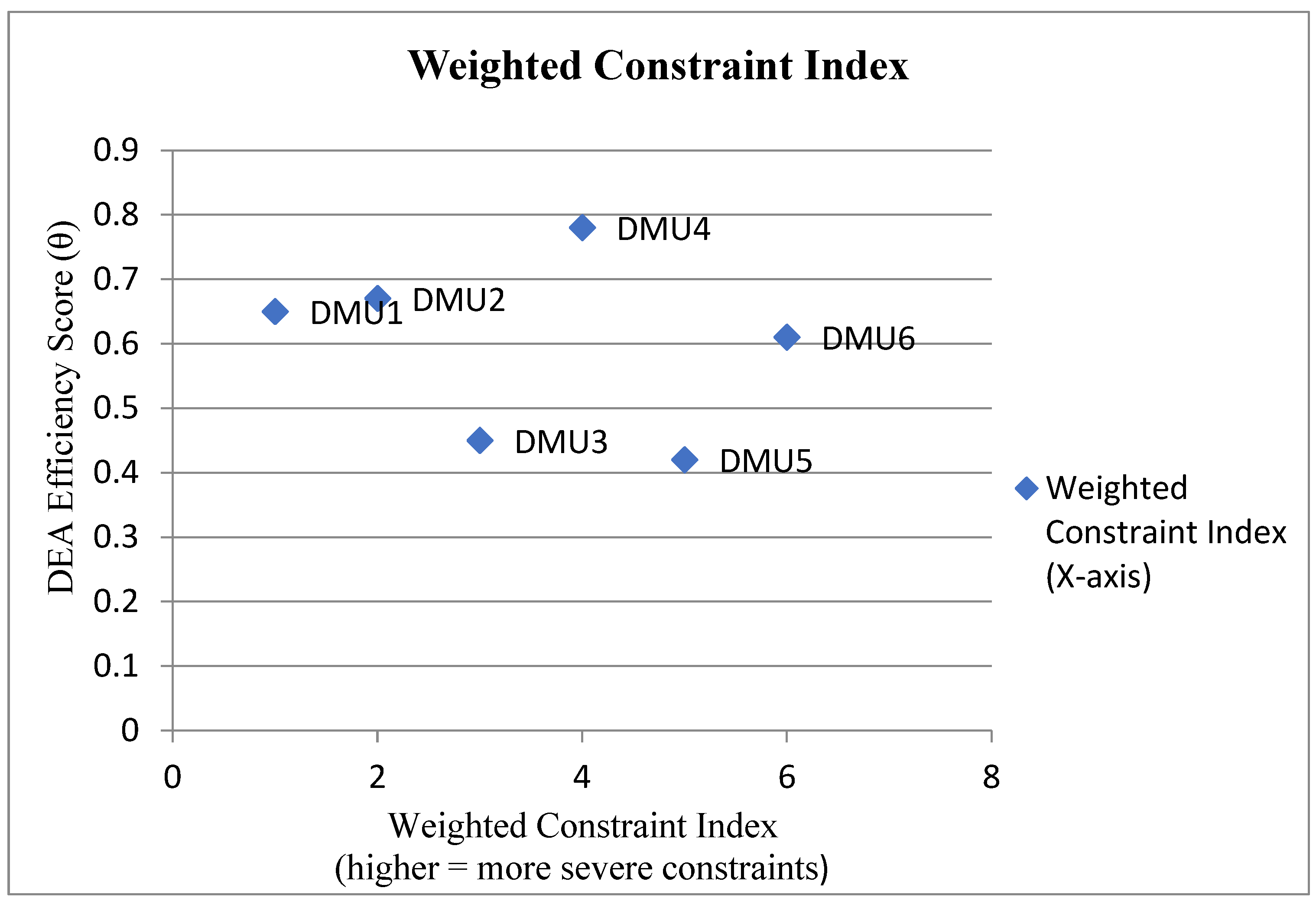
The integration of BWM-derived barrier weights (Section 4.2) with DEA efficiency scores (Section 4.4) enables a more nuanced interpretation of how specific constraints shape the performance of circular energy supply chain configurations. Rather than treating barrier prioritization and efficiency assessment as separate exercises, the proposed framework explicitly links what matters most (barrier importance) with how well systems perform (efficiency), addressing a key methodological gap identified in prior studies [16]). As shown in Figure 2, plotting DMU efficiency scores against their weighted constraint indices reveals a clear inverse relationship: configurations operating under severe technical–economic or regulatory-infrastructural constraints consistently exhibit lower efficiency. Notably, DMU4 (fragmented collection with informal repurposing) records both the highest constraint indices (0.88 and 0.85) and the lowest efficiency score (0.712), whereas DMU5 (policy-supported cluster with certification) achieves frontier efficiency with the lowest constraint indices (0.52 and 0.38). This pattern empirically validates the BWM prioritization results, confirming that technical barriers (T1, T2, T3) and regulatory barriers (R1, R2) are not merely perceived as important by experts but are demonstrably associated with degraded operational performance [43]. Furthermore, the intermediate positioning of DMU6 (high-tech repurposing, weak regulation) is particularly instructive: despite advanced technical capabilities (reflected in moderate technical–economic index of 0.61), its high regulatory-infrastructural index (0.79) suppresses efficiency to 0.891, underscoring that technological investment alone is insufficient without parallel institutional development [11]. While regulatory and infrastructural factors are often conceptualized as barriers, the results suggest a more nuanced interpretation: these dimensions operate primarily as enabling conditions rather than direct drivers of efficiency. Specifically, the presence of certification standards (R2) and formal reverse logistics (I1) does not by itself create frontier efficiency; rather, their absence prevents other investments from yielding returns. This is evident in the comparison between DMU5 (θ = 1.000, with policy support and certification) and DMU6 (θ = 0.891, with high technology but weak regulation). Functionally, regulatory clarity and infrastructure reduce transaction costs, enable performance benchmarking, and lower information asymmetry between battery suppliers and repurposers [27,34]. In this sense, they act as institutional lubricants that unlock the productive potential of technical and economic resources, consistent with prior work emphasizing that governance mechanisms mediate the relationship between circular supply chain capabilities and operational outcomes [7,31].
Beyond confirming the relevance of top-ranked barriers, the integrated analysis reveals more subtle interdependencies that would remain hidden if BWM and DEA were applied independently. For instance, while socio-cultural barriers (S1, S2) and environmental enforcement barriers (EN3) received relatively low weights in the BWM prioritization (Table 5), their influence on efficiency appears to be indirect and mediated by other dimensions. DMU2 (informal sector dominated, no certification) exhibits moderate socio-environmental friction (0.52) but substantially lower efficiency (0.823) compared to DMU1, despite similar technical–economic profiles. This suggests that lack of consumer trust (S2) and improper disposal risks (EN1) may amplify operational inefficiencies by increasing transaction costs, reducing market acceptance, and exposing firms to reputational or regulatory liabilities [27,40]. Similarly, the efficiency gap between DMU3 (θ = 1.000) and DMU6 (θ = 0.891), despite comparable technical–economic indices (0.55 vs. 0.61), highlights the enabling role of infrastructural factors, specifically reverse logistics systems (I1) and repurposing facilities (I2), which were assigned moderate but not dominant weights in the dimensional analysis (13.2%, Table 6). This finding aligns with prior research emphasizing that logistical coordination and facility density are critical moderators of circular supply chain performance, particularly in geographically dispersed emerging economy contexts [32,39]. Collectively, these results demonstrate that the proposed BWM-DEA integration provides a more complete diagnostic tool than either method alone: BWM identifies which barriers stakeholders perceive as most critical, while DEA reveals which constraints actually differentiate efficient from inefficient configurations. The convergence between perceived importance and measured impact for technical and regulatory barriers strengthens confidence in both analyses, while the divergence for socio-cultural and environmental factors suggests that these may be necessary but not sufficient conditions for efficiency [54]. Therefore, the integrated BWM–DEA framework provides more actionable and context-sensitive decision support than standalone MCDM or DEA approaches by simultaneously capturing barrier importance and operational performance within a unified analytical structure.

4.6. Sensitivity and Robustness Analysis of the BWM–DEA Framework

To assess the robustness of the integrated BWM–DEA framework, a sensitivity analysis was conducted by systematically varying the BWM-derived barrier weights and observing the corresponding changes in DEA efficiency rankings. Given that the prioritization of barriers relies on subjective expert judgments, it is essential to test whether small perturbations in the weight vector produce materially different conclusions regarding which configurations are efficient or inefficient [9,48]. Following established practices in hybrid MCDM-DEA studies, the sensitivity analysis was implemented by adjusting the top three barrier weights (T1: battery performance uncertainty; E1: high initial investment; T2: lack of standardization) by ±10%, ±20%, and ±30% while proportionally redistributing the remaining weights to maintain summation to unity [16]. The DEA model was then re-run for each perturbation scenario, and the efficiency scores of all six DMUs were recalculated. The results, summarized in Table 9, indicate that the efficiency status of DMU3 and DMU5 remained robust at θ = 1.000 across all perturbation levels, confirming that these configurations are genuinely efficient rather than artifacts of a specific weight vector. Similarly, DMU4 consistently remained the least efficient configuration (θ ranging from 0.698 to 0.728), demonstrating that the conclusion regarding its poor performance is stable under reasonable weight variations. These findings align with prior research emphasizing that BWM’s inherent consistency advantages reduce sensitivity to minor judgmental errors compared to less structured MCDM approaches such as AHP [8,49].
To further assess the robustness of the DEA efficiency differences, an additional perturbation-based interval analysis was conducted by repeatedly varying the composite input weights and recalculating efficiency scores across multiple simulation runs (Table 10). The resulting efficiency intervals remained non-overlapping between frontier-efficient DMUs (DMU3 and DMU5) and lower-performing configurations such as DMU4, confirming the stability of efficiency classifications under alternative weighting conditions. In particular, although DMU6 demonstrated moderate sensitivity to regulatory weight perturbations, its efficiency range (0.845–0.924) remained consistently below the frontier efficiency threshold of DMU3 and DMU5 (θ = 1.000), suggesting that the observed efficiency differences are structurally meaningful rather than artifacts of minor parameter fluctuations. This robustness-oriented validation approach is consistent with prior DEA studies emphasizing sensitivity and stability analysis in contexts with limited DMU observations and scenario-based configurations [44,50].
Beyond confirming rank stability, the sensitivity analysis revealed differential responsiveness among DMUs to changes in specific barrier weights, offering additional strategic insights for decision-makers. DMU6 (high-tech repurposing, weak regulation) exhibited the highest sensitivity, with its efficiency score varying from 0.845 to 0.924 as the weight assigned to regulatory barriers (R1, R2) was increased or decreased, respectively. This finding reinforces the integrated insight from Section 4.6 that DMU6’s performance is disproportionately constrained by institutional rather than technical factors, suggesting that for this configuration type, policy interventions targeting certification and regulatory clarity would yield greater efficiency improvements than additional technology investments [11]. In contrast, DMU1 and DMU2 showed greater sensitivity to variations in technical barrier weights (T1, T2, T3), indicating that for early-stage and informal configurations, technological standardization and performance predictability are the primary levers for improvement, a result consistent with prior observations that basic technical gaps dominate in nascent circular ecosystems [35]. Notably, the ranking of the three most critical barriers (T1, E1, T2) remained unchanged across all perturbation scenarios, and the dimensional order (technical > economic > regulatory > infrastructural > environmental > socio-cultural) also proved stable, with only minor within-dimension fluctuations. This robustness supports the confidence with which the prioritization results can inform policy and managerial decisions [12,50]. The sensitivity analysis also examined alternative DEA model specifications, including input-oriented versus output-oriented orientations and constant returns to scale (CRS) versus variable returns to scale (VRS) assumptions. The VRS (BCC) model was retained as the most appropriate given the heterogeneous operating scales of the six DMUs, but the efficiency rankings under CRS exhibited a Spearman rank correlation of 0.89 with the VRS results, further confirming the framework’s robustness [14,44]. Collectively, these sensitivity tests demonstrate that the integrated BWM–DEA framework produces stable and reliable conclusions, enhancing its credibility as a decision-support tool for circular energy supply chain evaluation in emerging economies.

4.7. Integrated Insights Linking Barrier Priorities with System Performance

The integration of BWM-derived barrier weights with DEA efficiency scores reveals that the most highly prioritized barriers are not merely expert perceptions but are empirically associated with degraded system performance across circular energy configurations. As demonstrated in Figure 2, DMU3 (integrated repurposing with formal reverse logistics) and DMU5 (policy-supported cluster with certification) achieve frontier efficiency (θ = 1.000) while exhibiting the lowest weighted constraint indices, particularly in technical and regulatory dimensions. This finding directly validates the BWM prioritization results from Section 4.2, where battery performance uncertainty (T1) and high initial investment (E1) emerged as the two most critical barriers, followed closely by lack of standardization (T2). Configurations that actively mitigate these constraints, through standardized testing protocols, certification mechanisms, and formal reverse logistics, consistently outperform those that do not, confirming that technical and economic barriers are not only perceived as important but are genuinely consequential for operational outcomes [29,35]. Conversely, DMU4 (fragmented collection with informal repurposing) records both the highest constraint indices and the lowest efficiency score (θ = 0.712), illustrating how the simultaneous presence of multiple unmitigated barriers compounds inefficiency. This pattern aligns with prior observations that circular supply chains in emerging economies face systemic rather than isolated challenges, where technical uncertainty, regulatory ambiguity, and infrastructural voids interact to suppress performance beyond what any single barrier would predict [55].
Beyond confirming the importance of top-ranked barriers, the integrated analysis uncovers more nuanced insights regarding the role of regulatory and infrastructural factors as efficiency moderators. DMU6 (high-tech repurposing, weak regulation) presents a particularly instructive case: despite advanced technical capabilities reflected in its moderate technical–economic index (0.61), the configuration achieves only 0.891 efficiency due to a high regulatory-infrastructural index (0.79). This finding demonstrates that technological investment alone is insufficient to achieve frontier performance when certification standards (R2) and reverse logistics systems (I1) remain underdeveloped, a result that extends prior studies emphasizing the enabling role of institutional frameworks in circular transitions [31]. Similarly, the efficiency gap between DMU1 (θ = 0.845) and DMU3 (θ = 1.000), despite similar socio-environmental profiles, suggests that incremental improvements in regulatory clarity and infrastructure can yield substantial efficiency dividends even without radical technological upgrades. This insight is particularly relevant for policymakers in emerging economies, where capital for high-tech solutions may be scarce but institutional reforms and logistics investments are comparatively feasible [26]. Furthermore, the relatively lower weights assigned to socio-cultural and environmental barriers in the BWM analysis (7.0% and 11.6%, respectively) do not indicate irrelevance; rather, their influence appears indirect, operating through mediation by technical and regulatory factors. For instance, lack of consumer trust (S2) and improper disposal risks (EN1) likely amplify transaction costs and reputational risks, but only when technical and regulatory safeguards are already weak [22]. Collectively, these integrated insights underscore that effective intervention strategies must prioritize technical standardization and regulatory development as foundational enablers, while recognizing that socio-cultural and environmental factors, though secondary in direct impact, remain important for long-term system legitimacy and scalability [5].

4.8. Circular Energy Supply Chains Contextual Insights from Barrier Prioritization and Efficiency Assessment

The observed dominance of technical and economic barriers can be theoretically situated within the Resource-Based View (RBV) of supply chain management, where firm-level technological capabilities and financial resources represent strategic assets that determine competitive advantage in circular systems [5]. In emerging economies, the absence of these resources creates sustained competitive disadvantage. Concurrently, Institutional Theory helps explain why regulatory ambiguity (R1) and weak certification standards (R2) persist: institutional voids reduce the legitimacy pressures that typically drive organizations toward standardized circular practices [34,38]. From a Socio—Technical Transition Theory perspective, the findings indicate that second-life EV battery ecosystems in emerging economies remain in the ‘niche’ phase, where technical experimentation and economic viability dominate over regime-level regulatory and cultural shifts, consistent with prior observations of developing-country sustainability transitions [7,22].
The findings of this study reveal several contextual insights specific to circular energy supply chains in emerging economies, where institutional voids, infrastructural gaps, and resource constraints create a distinct barrier landscape for second-life EV battery ecosystems. The dominant ranking of technical barriers (28.4% aggregate weight) and economic barriers (24.9%) reflects the structural realities of emerging markets, where fragmented industrial bases, limited access to quality control technologies, and high capital costs constrain circular transitions more severely than in developed economies [13,26]. Unlike mature markets where battery testing and repurposing infrastructure is increasingly standardized and accessible, emerging economies often lack even basic diagnostic equipment for assessing battery state-of-health, making battery performance uncertainty (T1) and lack of standardization (T2) particularly acute [35]. The DEA results reinforce this observation: DMU4 (fragmented collection, informal repurposing) and DMU2 (informal sector dominated, no certification) exhibit both high technical–economic constraint indices and low efficiency scores (θ = 0.712 and 0.823, respectively). These configurations closely mirror real-world conditions in many emerging economies, where informal actors play a dominant role in battery collection and rudimentary repurposing, often operating without standardized protocols, safety certifications, or access to formal financing mechanisms [27,39]. The persistence of inefficiency in these configurations suggests that emerging economies cannot simply leapfrog to advanced circular models without first addressing foundational technical and economic gaps, a finding consistent with observations of other sustainability transitions in developing country contexts [22,25].
A further contextual insight emerges from the intermediate positioning of regulatory barriers (19.9%) and infrastructural barriers (13.2%) in the priority structure, highlighting that emerging economies often face regulatory ambiguity and infrastructural deficits simultaneously, creating compound constraints less common in mature markets [34,38]. The case of DMU6 (high-tech repurposing, weak regulation) is particularly instructive for emerging economy contexts. Despite possessing advanced technical capabilities reflected in its moderate technical–economic index (0.61), DMU6 achieves only 0.891 efficiency due to a high regulatory-infrastructural index (0.79). This configuration type is increasingly observable in some emerging economies where foreign technology transfer or local innovation has produced sophisticated repurposing capabilities, yet domestic regulatory frameworks for battery certification, safety standards, and end-of-life liability remain underdeveloped or unenforced [31,32]. The efficiency gap between DMU6 and frontier configurations (DMU3 and DMU5) suggests that technological advancement without corresponding institutional development yields diminishing returns in emerging economy settings, a pattern that echoes broader findings on technology adoption in developing country supply chains [36]. Additionally, the relatively low weight assigned to environmental barriers (11.6%) and socio-cultural barriers (7.0%) provides an important contextual insight: in emerging economies where basic technical and institutional safeguards are absent, environmental and social concerns often become secondary to immediate operational survival and economic feasibility [3]. This finding diverges from studies conducted in developed economies, where consumer awareness and environmental compliance frequently rank more prominently, reflecting different maturity stages of circular transitions [22,56]. Collectively, these contextual insights indicate that circular energy supply chains in emerging economies face a distinct barrier configuration characterized by the simultaneous presence of technical, economic, regulatory, and infrastructural constraints, requiring integrated rather than sequential intervention strategies tailored to local institutional realities.
Although socio-cultural (7.0%) and environmental (11.6%) barriers received lower immediate weights, their long-term implications for system adoption and scalability should not be underestimated in emerging economies. In the short term, low consumer awareness (S1) and lack of trust in reused products (S2) may be overshadowed by technical and economic constraints, but as these foundational barriers are gradually resolved, socio-cultural factors increasingly determine market acceptance and diffusion rates [40]. Longitudinal evidence from other circular economy domains suggests that negative public perceptions of reused components can create demand-side failures that persist even after technical reliability is established [27]. Similarly, weak environmental regulation enforcement (EN3) may allow early-stage circular systems to operate without compliance costs, but as regulatory regimes mature under international pressure (e.g., Basel Convention amendments on battery waste), firms that have not internalized environmental standards face sudden obsolescence or exclusion from export markets [38]. Therefore, socio-cultural and environmental factors act as scalability gatekeepers that determine whether niche circular innovations can transition to mainstream adoption, even if they are not immediate efficiency determinants.

4.9. Theoretical Contributions and Practical Implications

The findings of this study offer several theoretical contributions to the literature on circular energy supply chains, sustainable operations management, and hybrid MCDM-DEA methodologies. First, by integrating barrier prioritization (BWM) with efficiency assessment (DEA), the study advances beyond fragmented approaches that treat “what matters most” and “how well systems perform” as separate analytical exercises [16,52]. This integration responds directly to calls for hybrid frameworks capable of capturing both subjective expert judgments and objective performance data within a unified analytical structure [18,19]. The finding that technical and economic barriers dominate both expert prioritization (28.4% and 24.9% aggregate weights) and efficiency differentiation (DMU3 and DMU5 at frontier, DMU4 at 0.712) provides empirical validation that perceived importance and operational impact converge for these dimensions, while diverging for socio-cultural and environmental factors. This divergence suggests that barrier research in circular supply chains must distinguish between factors that stakeholders believe are important and factors that actually differentiate efficient from inefficient configurations, a distinction rarely made explicit in prior studies [5]. Second, the study contributes to contextualizing circular economy theory for emerging economies by demonstrating that barrier structures are not universal but vary systematically with institutional maturity. Unlike developed economy studies where regulatory and socio-cultural factors often feature prominently [40], the present findings indicate that technical and economic barriers are disproportionately salient in emerging contexts, where basic industrial and financial infrastructures remain underdeveloped [13,26]. This suggests that circular economy theories developed in high-income settings may require substantial adaptation before application in emerging economies, where the sequence and priority of interventions differ fundamentally. Third, the sensitivity analysis revealing differential DMU responsiveness to specific barrier weights contributes methodologically by showing that the impact of barriers is configuration-dependent: DMU6 responded most strongly to regulatory weight variations, while DMU1 and DMU2 responded more strongly to technical weight variations. This finding advances beyond static barrier taxonomies by introducing the concept of barrier-configuration fit, wherein the relative importance of a given barrier depends on the specific characteristics of the circular system under evaluation [32].
From a practical standpoint, the findings provide actionable insights for policymakers, industry managers, and development practitioners seeking to accelerate circular energy transitions in emerging economies. For policymakers, the consistent efficiency of DMU5 (policy-supported cluster with certification) demonstrates that strategic institutional interventions, including certification standards, regulatory clarity, and public–private coordination mechanisms, can enable frontier performance even without cutting-edge technology. This suggests that policy efforts should prioritize the development of battery testing standards, safety certification protocols, and extended producer responsibility frameworks before or alongside infrastructure investments [57]. The underperformance of DMU6 (high-tech repurposing, weak regulation) serves as a cautionary example: subsidizing advanced repurposing equipment without simultaneously addressing regulatory voids yields suboptimal returns, reinforcing the need for coordinated policy packages rather than technology-only approaches [33]. For industry managers, the efficiency ranking indicates that investment in formal reverse logistics networks and certification processes (as exemplified by DMU3) yields higher efficiency gains than purely technological upgrades, particularly in early-stage markets. Managers operating in informal-dominated contexts (similar to DMU2 and DMU4) should prioritize basic standardization and quality control as first steps, rather than attempting to leap directly to advanced repurposing technologies [39]. For development practitioners and international donors, the findings suggest that funding allocations should balance technical assistance (for battery testing and standardization) with institutional capacity building (for regulatory development and certification systems), rather than favoring capital-intensive infrastructure projects. The relatively low weight of socio-cultural barriers (7.0%) indicates that awareness campaigns and trust-building initiatives, while not unimportant, should be sequenced after foundational technical and institutional enablers are in place, maximizing resource efficiency in capital-scarce environments [3]. Finally, the robustness of the efficiency rankings under sensitivity analysis provides confidence that these practical recommendations are not artifacts of specific weight assumptions, enhancing their credibility for real-world decision-making.
The practical value of the integrated BWM–DEA framework also lies in its ability to serve as a diagnostic and prioritization tool for practitioners. Unlike standalone MCDM, which only ranks barriers, or standalone DEA, which only benchmarks efficiency. For example, an industry manager in a context similar to DMU6 would learn that investing in regulatory compliance (reducing R1 and R2) yields higher efficiency returns than additional repurposing equipment purchases. This configuration-specific guidance is only possible through the BWM–DEA linkage [16,17].

4.10. Expected Versus Observed Findings

Several findings deviate from what prior literature might predict, highlighting novel insights that emerge specifically from the integrated BWM–DEA framework applied to emerging economy contexts. First, while we expected based on developed-economy circular economy studies that socio-cultural barriers such as consumer awareness and trust would rank prominently [41], the observed result placed socio-cultural barriers at the lowest aggregate weight (7.0%), suggesting that in emerging economies where basic technical and institutional safeguards are absent, social acceptance becomes a secondary concern to immediate operational and economic feasibility, indicating a sequencing effect in circular transitions (technical, then economic, then regulatory, then socio-cultural) rather than simultaneous intervention. Second, while it is expected from technical feasibility studies that technology-intensive configurations would achieve frontier efficiency regardless of regulatory context [29], the observed finding that DMU6 (high-tech repurposing with weak regulation) achieved only θ = 0.891, well below the frontier efficiency of DMU3 and DMU5 (θ = 1.000), contradicts technology-leapfrogging narratives often applied to emerging economies [25,58,59] and demonstrates that institutional development is a necessary co-condition for technological investments to yield efficiency returns. Third, though it is expected from environmental management literature that environmental barriers would show a strong direct association with operational efficiency [20], the observed result placed limited environmental regulation enforcement (EN3) as the lowest-ranked barrier overall (weight 0.027), suggesting that in early-stage circular ecosystems, environmental externalities are effectively externalized or ignored until technical and economic viability is achieved, a pattern that aligns with an environmental Kuznets curve logic within circular supply chains where enforcement only intensifies after basic system functionality is established [38]. Collectively, these unexpected findings underscore that circular economy frameworks developed in high-income settings cannot be directly transplanted to emerging economies without contextual recalibration, and that the BWM–DEA integration is particularly valuable for revealing such context-dependent deviations because it links subjective prioritization (what experts expect to matter) with objective efficiency outcomes (what actually differentiates performance), thereby exposing assumptions that hold only in mature institutional environments [11,13].

5. Conclusions

This study set out to integrate barrier prioritization and efficiency assessment within a unified analytical framework for circular energy supply chains, focusing specifically on second-life EV battery ecosystems in emerging economies. Drawing on the Best–Worst Method (BWM) and Data Envelopment Analysis (DEA), the research addressed a critical gap where prior studies have largely treated stakeholder perceptions of barriers and operational performance evaluation as separate endeavors. The key findings reveal that technical barriers (particularly battery performance uncertainty and lack of standardization) and economic barriers (particularly high initial investment and uncertain return on investment) dominate the priority structure. These barriers are not merely perceived as important but are empirically associated with degraded efficiency: configurations operating under severe technical–economic constraints, such as fragmented collection with informal repurposing, achieved the lowest efficiency scores, while configurations that mitigated these constraints through formal reverse logistics and certification mechanisms achieved frontier efficiency. Regulatory and infrastructural barriers occupied intermediate positions, with technology-rich but regulation-weak configurations demonstrating that technological advancement without corresponding institutional development yields diminishing returns. Methodologically, the key contribution of the integrated BWM–DEA framework lies in its ability to link subjective expert prioritization with objective efficiency benchmarking within a single analytical structure. Unlike standalone BWM or conventional DEA models, the proposed framework embeds barrier weights directly into efficiency evaluation, enabling decision-makers to distinguish between barriers that are merely perceived as important and those that actually differentiate efficient from inefficient configurations.
For stakeholders in emerging economies, several actionable recommendations emerge. Policymakers should prioritize battery testing certification standards and extended producer responsibility frameworks before subsidizing repurposing equipment, as regulatory clarity enables frontier efficiency even with moderate technology. Industry managers should formalize reverse logistics networks and implement basic state-of-health testing protocols as first steps, rather than investing directly in advanced repurposing technologies, because formalization yields higher efficiency gains than technology-only upgrades under weak regulation. Development practitioners should allocate funding proportionally across technical assistance and institutional capacity building, avoiding over-investment in capital-intensive infrastructure without parallel governance reforms. Industry associations should develop voluntary certification schemes to reduce information asymmetry between battery suppliers and repurposers, thereby mitigating battery performance uncertainty, the highest-weighted barrier. Several limitations must be acknowledged, including reliance on ten expert judgments (excluding informal sector perspectives), assumptions of linear aggregation and barrier independence in DEA, scenario-based DMUs limiting generalizability without local recalibration, the static framework failing to capture temporal dynamics, and Likert-scale normalization not fully reflecting cardinal differences in constraint severity.
Future research should extend the proposed framework by incorporating longitudinal data, additional DMUs from diverse emerging economy regions, and network DEA models to capture stakeholder interdependencies. Additionally, future research should incorporate human-centric supply chain design principles aligned with the emerging Industry 5.0 paradigm. While the current study emphasizes technical, economic, and institutional barriers, the social dimension, particularly worker safety in informal battery dismantling, community engagement in repurposing facilities, and inclusive stakeholder participation, remains underexplored. Integrating human factors such as skill development, occupational health standards, and social acceptance into the BWM–DEA framework could reveal how human-centric interventions mediate barrier mitigation and system efficiency. Synergies between Industry 5.0’s resilience focus and green supply chain management, demonstrated in emerging economy manufacturing contexts, may similarly exist in circular energy supply chains where human expertise complements automation in battery testing and repurposing. Comparative studies between emerging and developed economies would help validate the context-dependence of the observed barrier priority structure, while mixed-method approaches combining quantitative efficiency assessment with qualitative case studies could illuminate causal mechanisms linking specific barriers to operational performance.

Author Contributions

All authors were involved in the study’s conceptualization and design. I.M. took the lead in developing the methodology and drafting the initial manuscript. D.P.R., D.I.H. & E.E.R. handled data collection and analysis. I.M. & D.P.R. conducted critical revisions and edited the manuscript. All authors have read and agreed to the published version of the manuscript.

Funding

This research received no external funding.

Institutional Review Board Statement

The study was conducted in accordance with the Declaration of Helsinki, and the protocol was approved by the Ethics Committee of the Directorate of Research and Community Services, University of Muhammadiyah Malang (No.E.5a/21/FT-UMM/I/2026) on 2 January 2026.

Informed Consent Statement

Informed consent for participation was obtained from all subjects involved in the study.

Data Availability Statement

The raw data supporting the conclusions of this article will be made available by the authors on request.

Conflicts of Interest

The authors declare no conflicts of interest.

References

  1. Lander, L.; Cleaver, T.; Rajaeifar, M.A.; Nguyen-Tien, V.; Elliott, R.J.R.; Heidrich, O.; Kendrick, E.; Edge, J.S.; Offer, G. Financial viability of electric vehicle lithium-ion battery recycling. iScience 2021, 24, 102787. [Google Scholar] [CrossRef]
  2. Aguilar Lopez, F.; Lauinger, D.; Vuille, F.; Müller, D.B. On the potential of vehicle-to-grid and second-life batteries to provide energy and material security. Nat. Commun. 2024, 15, 4179. [Google Scholar] [CrossRef]
  3. Thakur, J.; Martins Leite de Almeida, C.; Baskar, A.G. Electric vehicle batteries for a circular economy: Second life batteries as residential stationary storage. J. Clean. Prod. 2022, 375, 134066. [Google Scholar] [CrossRef]
  4. Xu, C.; Dai, Q.; Gaines, L.; Hu, M.; Tukker, A.; Steubing, B. Future material demand for automotive lithium-based batteries. Commun. Mater. 2020, 1, 99. [Google Scholar] [CrossRef]
  5. Altuntas Vural, C.; van Loon, P.; Halldórsson, Á.; Fransson, J.; Josefsson, F. Life after use: Circular supply chains for second-life of electric vehicle batteries. Prod. Plan. Control 2025, 36, 1229–1246. [Google Scholar] [CrossRef]
  6. Pascoe, S. A Simplified Algorithm for Dealing with Inconsistencies Using the Analytic Hierarchy Process. Algorithms 2022, 15, 442. [Google Scholar] [CrossRef]
  7. Geissdoerfer, M.; Savaget, P.; Bocken, N.M.P.; Hultink, E.J. The Circular Economy—A new sustainability paradigm? J. Clean. Prod. 2017, 143, 757–768. [Google Scholar] [CrossRef]
  8. Dodevska, Z.; Radovanović, S.; Petrović, A.; Delibašić, B. When Fairness Meets Consistency in AHP Pairwise Comparisons. Mathematics 2023, 11, 604. [Google Scholar] [CrossRef]
  9. Rezaei, J. Best-worst multi-criteria decision-making method: Some properties and a linear model. Omega 2016, 64, 126–130. [Google Scholar] [CrossRef]
  10. Adler, N.; Friedman, L.; Sinuany-Stern, Z. Review of ranking methods in the data envelopment analysis context. Eur. J. Oper. Res. 2002, 140, 249–265. [Google Scholar] [CrossRef]
  11. Olesen, O.B.; Petersen, N.C. Stochastic Data Envelopment Analysis—A review. Eur. J. Oper. Res. 2016, 251, 2–21. [Google Scholar] [CrossRef]
  12. Sueyoshi, T.; Goto, M. Difficulties and remedies on DEA environmental assessment. J. Econ. Struct. 2018, 7, 17. [Google Scholar] [CrossRef]
  13. Silvestre, B.S. Sustainable supply chain management in emerging economies: Environmental turbulence, institutional voids and sustainability trajectories. Int. J. Prod. Econ. 2015, 167, 156–169. [Google Scholar] [CrossRef]
  14. Cook, W.D.; Harrison, J.; Imanirad, R.; Rouse, P.; Zhu, J. Data Envelopment Analysis with Nonhomogeneous DMUs. Oper. Res. 2013, 61, 666–676. [Google Scholar] [CrossRef]
  15. Xu, T.; You, J.; Li, H.; Shao, L. Energy Efficiency Evaluation Based on Data Envelopment Analysis: A Literature Review. Energies 2020, 13, 3548. [Google Scholar] [CrossRef]
  16. Wang, P.; Zhu, Z.; Wang, Y. A novel hybrid MCDM model combining the SAW, TOPSIS and GRA methods based on experimental design. Inf. Sci. 2016, 345, 27–45. [Google Scholar] [CrossRef]
  17. Saputro, T.E.; Figueira, G.; Almada-Lobo, B. Hybrid MCDM and simulation-optimization for strategic supplier selection. Expert. Syst. Appl. 2023, 219, 119624. [Google Scholar] [CrossRef]
  18. Paul, A.; Shukla, N.; Paul, S.K.; Trianni, A. Sustainable Supply Chain Management and Multi-Criteria Decision-Making Methods: A Systematic Review. Sustainability 2021, 13, 7104. [Google Scholar] [CrossRef]
  19. Tsai, J.-F.; Shen, S.-P.; Lin, M.-H. Applying a Hybrid MCDM Model to Evaluate Green Supply Chain Management Practices. Sustainability 2023, 15, 2148. [Google Scholar] [CrossRef]
  20. Xiao, D.; Xu, X.; Xu, Z. Circular economy and energy storage technologies: A comprehensive approach to reduce emission and promoting sustainable growth. Energy Rep. 2025, 13, 6596–6608. [Google Scholar] [CrossRef]
  21. Zhu, H.; Hu, J.; Yang, Y. Towards a circular supply chain for retired electric vehicle batteries: A systematic literature review. Int. J. Prod. Econ. 2025, 282, 109556. [Google Scholar] [CrossRef]
  22. Carissimi, M.C.; Bin Hameed, H.; Creazza, A. Circular economy: The future nexus for sustainable and resilient supply chains? Sustain. Futures 2024, 8, 100365. [Google Scholar] [CrossRef]
  23. Schmid, C.V.; Ngagoum Ndalloka, Z.; Kośny, J. Transforming urban energy: Developments and challenges in photovoltaic integration. Front. Sustain. Cities 2025, 7, 1584917. [Google Scholar] [CrossRef]
  24. Li, K.; Zu, J.; Musah, M.; Mensah, I.A.; Kong, Y.; Owusu-Akomeah, M.; Shi, S.; Jiang, Q.; Antwi, S.K.; Agyemang, J.K. The link between urbanization, energy consumption, foreign direct investments and CO2 emanations: An empirical evidence from the emerging seven (E7) countries. Energy Explor. Exploit. 2022, 40, 477–500. [Google Scholar] [CrossRef]
  25. Gebreslassie, M.G.; Cuvilas, C.; Zalengera, C.; To, L.S.; Baptista, I.; Robin, E.; Bekele, G.; Howe, L.; Shenga, C.; Macucule, D.A.; et al. Delivering an off-grid transition to sustainable energy in Ethiopia and Mozambique. Energy Sustain. Soc. 2022, 12, 23. [Google Scholar] [CrossRef]
  26. Dordai, L.; Roman, M.; Becze, A. Circular Economy Approaches for Sustainable Energy Supply Chains: A Systematic Review of Concepts, Models and Performance Assessment. Sustainability 2026, 18, 3371. [Google Scholar] [CrossRef]
  27. Wilson, D.C.; Velis, C.; Cheeseman, C. Role of informal sector recycling in waste management in developing countries. Habitat. Int. 2006, 30, 797–808. [Google Scholar] [CrossRef]
  28. Roslan, M.F.; Satpathy, P.R.; Prasankumar, T.; Ramachandaramurthy, V.K.; Mansor, M.; Walker, S.L. Second-life battery energy storage system for energy sustainability: Recent advancements, key takeaways and future perspectives. J. Energy Storage 2025, 123, 116808. [Google Scholar] [CrossRef]
  29. Cui, J.; Tan, Q.; Liu, L.; Li, J. Environmental Benefit Assessment of Second-Life Use of Electric Vehicle Lithium-Ion Batteries in Multiple Scenarios Considering Performance Degradation and Economic Value. Environ. Sci. Technol. 2023, 57, 8559–8567. [Google Scholar] [CrossRef]
  30. Campoverde-Pillco, J.; Ochoa-Correa, D.; Villa-Ávila, E.; Astudillo-Salinas, P. Reuse of Electrical Vehicle Batteries for Second Life Applications in Power Systems with a High Penetration of Renewable Energy: A Systematic Literature Review. Ingenius. Rev. Cienc. Tecnol. 2024, 95–105. [Google Scholar] [CrossRef]
  31. Hellström, M.; Wrålsen, B. Towards a circular business ecosystem of used electric vehicle batteries—A modelling approach. Sustain. Futures 2024, 8, 100325. [Google Scholar] [CrossRef]
  32. Chirumalla, K.; Kulkov, I.; Vu, F.; Rahic, M. Second life use of Li-ion batteries in the heavy-duty vehicle industry: Feasibilities of remanufacturing, repurposing, and reusing approaches. Sustain. Prod. Consum. 2023, 42, 351–366. [Google Scholar] [CrossRef]
  33. Das, P.K. A Perspective on the Challenges and Prospects of Realizing the Second Life of Retired EV Batteries. Batteries 2025, 11, 176. [Google Scholar] [CrossRef]
  34. Iqbal, H.; Sarwar, S.; Kirli, D.; Shek, J.K.H.; Kiprakis, A.E. A survey of second-life batteries based on techno-economic perspective and applications-based analysis. Carbon. Neutrality 2023, 2, 8. [Google Scholar] [CrossRef]
  35. Azizighalehsari, S.; Venugopal, P.; Pratap Singh, D.; Batista Soeiro, T.; Rietveld, G. Empowering Electric Vehicles Batteries: A Comprehensive Look at the Application and Challenges of Second-Life Batteries. Batteries 2024, 10, 161. [Google Scholar] [CrossRef]
  36. Hasan, M.I.; Lei, G.; Lu, D.; Durruty, P.P. A Review of Thermal Safety and Management of Second-Life Batteries: Cell Screening, Pack Configuration and Health Estimation. Batteries 2026, 12, 99. [Google Scholar] [CrossRef]
  37. Al-Alawi, M.K.; Cugley, J.; Hassanin, H. Techno-economic feasibility of retired electric-vehicle batteries repurpose/reuse in second-life applications: A systematic review. Energy Clim. Change 2022, 3, 100086. [Google Scholar] [CrossRef]
  38. Kristiningrum, E.; Nurcahyo, R.; Madsuha, A.F.; Ali, I.; Sumaedi, S.; Setyoko, A.T. Second life business model for electric vehicle batteries: Patterns, structures and future challenges. Sustain. Futures 2025, 10, 101437. [Google Scholar] [CrossRef]
  39. Rönkkö, P.; Majava, J.; Hyvärinen, T.; Oksanen, I.; Tervonen, P.; Lassi, U. The circular economy of electric vehicle batteries: A Finnish case study. Environ. Syst. Decis. 2024, 44, 100–113. [Google Scholar] [CrossRef]
  40. Osawa, J. Consumer preferences for second-life electric vehicle batteries across multiple applications. Clean. Responsible Consum. 2025, 19, 100337. [Google Scholar] [CrossRef]
  41. Azad, A.; Nia, F.F.; Anvari-Moghaddam, A.; Flynn, D.; Longo, M.; Shafie-khah, M. Second-life applications for retired electric vehicle batteries: Challenges, opportunities, and future directions. J. Energy Storage 2026, 151, 120190. [Google Scholar] [CrossRef]
  42. Yuen, K.K.F. Fuzzy cognitive network process for software reliability and quality measurement: Comparisons with fuzzy analytic hierarchy process. J. Reliab. Intell. Environ. 2024, 10, 319–336. [Google Scholar] [CrossRef]
  43. Rezaei, J.; Nispeling, T.; Sarkis, J.; Tavasszy, L. A supplier selection life cycle approach integrating traditional and environmental criteria using the best worst method. J. Clean. Prod. 2016, 135, 577–588. [Google Scholar] [CrossRef]
  44. Lee, H.; Kim, C. Benchmarking of service quality with data envelopment analysis. Expert Syst. Appl. 2014, 41, 3761–3768. [Google Scholar] [CrossRef]
  45. Masudin, I.; Zuliana, P.E.; Utama, D.M.; Restuputri, D.P. Assessment and risk mitigation on halal meat supply chain using fuzzy best-worst method (BWM) and risk mitigation number (RMN). J. Islam. Mark. 2023, 15, 842–865. [Google Scholar] [CrossRef]
  46. Masudin, I.; Primadasa, R.; Restuputri, D.P.; Rosyida, E.E. From Symptoms to Root Causes: An Integrated Structural Model of Decarbonization Risks in Emerging Hydrogen Supply Chains. Process Integr. Optim. Sustain. 2026. [Google Scholar] [CrossRef]
  47. Sun, X.; Yu, B.; Li, R. Designing an innovative Multi-Criteria Decision Making (MCDM) framework for optimized teaching and delivery of physical education curriculum. Sci. Rep. 2025, 15, 29598. [Google Scholar] [CrossRef] [PubMed]
  48. Peykani, P.; Emrouznejad, A.; Nouri, M. Best-worst multi-criteria decision-making method: A review of the literature. Socio-Econ. Plan. Sci. 2026, 104, 102345. [Google Scholar] [CrossRef]
  49. Wu, Q.; Liu, X.; Zhou, L.; Qin, J.; Rezaei, J. An analytical framework for the best–worst method. Omega 2024, 123, 102974. [Google Scholar] [CrossRef]
  50. Masudin, I.; Safitri, W.D.R.; Wardana, R.W.; Restuputri, D.P.; Alfarisi, S. Enhancing supplier selection with Z-number data envelopment analysis in sustainable supply chains. J. Data Inf. Manag. 2025, 7, 51–67. [Google Scholar] [CrossRef]
  51. Wardana, R.W.; Masudin, I.; Restuputri, D.P.; Nugraha, A. A novel decision-making method using fuzzy DEA credibility constrained and RC index. Cogent Eng. 2021, 8, 1917328. [Google Scholar] [CrossRef]
  52. Saputro, T.E.; Figueira, G.; Almada-Lobo, B. Integration of Supplier Selection and Inventory Management under Supply Disruptions. IFAC-PapersOnLine 2019, 52, 2827–2832. [Google Scholar] [CrossRef]
  53. Saaty, T.L.; Vargas, L.G. The possibility of group choice: Pairwise comparisons and merging functions. Soc. Choice Welf. 2012, 38, 481–496. [Google Scholar] [CrossRef]
  54. Pamidimukkala, A.; Kermanshachi, S.; Rosenberger, J.M.; Hladik, G. Barriers and motivators to the adoption of electric vehicles: A global review. Green Energy Intell. Transp. 2024, 3, 100153. [Google Scholar] [CrossRef]
  55. Dzikriansyah, M.A.; Masudin, I.; Zulfikarijah, F.; Jihadi, M.; Jatmiko, R.D. The role of green supply chain management practices on environmental performance: A case of Indonesian small and medium enterprises. Clean. Logist. Supply Chain 2023, 6, 100100. [Google Scholar] [CrossRef]
  56. Masudin, I.; Lestari, I.D.; Khoidir, A.; Restuputri, D.P. Sustainable Procurement Barriers in Indonesian Food Manufacturing SMEs: An ISM–Fuzzy MICMAC Analysis. Logistics 2025, 9, 175. [Google Scholar] [CrossRef]
  57. Patel, A.N.; Lander, L.; Ahuja, J.; Bulman, J.; Lum, J.K.H.; Pople, J.O.D.; Hales, A.; Patel, Y.; Edge, J.S. Lithium-ion battery second life: Pathways, challenges and outlook. Front. Chem. 2024, 12, 1358417. [Google Scholar] [CrossRef] [PubMed]
  58. SariiŞIk, G.; Demir, S. Industry 5.0: A Human-Centric Paradigm for Sustainable and Resilient Industrial Transformation. J. Soc. Perspect. Stud. 2025, 2, 50–66. [Google Scholar] [CrossRef]
  59. Amin, M.A.; Chakraborty, A.; Baldacci, R. Industry 5.0 and green supply chain management synergy for sustainable development in Bangladeshi RMG industries. Clean. Logist. Supply Chain 2025, 14, 100208. [Google Scholar] [CrossRef]
Figure 1. Research Design of the Integrated BWM–DEA Framework.
Logistics 10 00114 g001
Figure 2. Relationship Between Weighted Constraint Indices and DEA Efficiency Scores of Circular Energy Configurations.
Logistics 10 00114 g002
Table 1. Synthesis of Existing Studies and Identified Research Gaps.
Research StreamFocus of Existing StudiesReferencesIdentified Gaps
Circular Energy Supply ChainsConceptualization of circular systems, sustainability benefits, resource efficiency[7,22]Limited integration with quantitative decision-support and performance evaluation tools
Second-Life EV BatteriesTechnical feasibility, lifecycle benefits, renewable energy integration[29,30]Lack of systemic perspective incorporating stakeholder interactions and supply chain dynamics
Barriers to Circular Supply ChainsIdentification of technical, economic, regulatory, and socio-cultural barriers[5,35]Absence of prioritization-performance linkage for actionable decision-making
MCDM Methods (e.g., BWM, AHP)Criteria prioritization with improved consistency and reduced cognitive burden[8,9]Limited application in circular energy systems and lack of integration with efficiency analysis
DEA ApplicationsEfficiency evaluation of energy systems and supply chains[11,12,44]Neglect of contextual barriers and limited ability to inform strategic prioritization
Table 2. Identified and Structured Barriers in Circular Energy Supply Chains.
DimensionCodeBarrierDescriptionSource
TechnicalT1Battery performance uncertaintyVariability in state-of-health and remaining useful life of second-life batteries[29,35]
T2Lack of standardizationAbsence of uniform battery design, format, and testing protocols[36,38]
T3Safety and reliability concernsRisks related to degradation, thermal instability, and operational failure[35,36]
EconomicE1High initial investmentSignificant capital required for repurposing and integration infrastructure[35,37]
E2Uncertain return on investmentLimited predictability of financial benefits from second-life applications[33,37]
E3Market competition with new batteriesDeclining cost of new batteries reducing economic attractiveness[33]
RegulatoryR1Regulatory ambiguityLack of clear policies on ownership, reuse, and disposal[34,38]
R2Absence of safety and certification standardsLimited regulatory frameworks for second-life battery applications[36,38]
R3Weak policy incentivesInsufficient government support for circular initiatives[34,38]
InfrastructuralI1Limited reverse logistics systemsInefficient collection and transportation of used batteries[26,39]
I2Lack of repurposing facilitiesInsufficient infrastructure for testing and reconfiguration[32,39]
Socio-culturalS1Low consumer awarenessLimited understanding of second-life battery benefits[38,40]
S2Lack of trust in reused productsPerceived risks associated with reused batteries[27,40]
EnvironmentalEN1Risk of improper disposalPotential environmental harm due to inadequate end-of-life handling[20,38]
EN2Emissions from repurposing processesEnvironmental impacts associated with testing and refurbishment activities[20,29]
EN3Limited environmental regulation enforcementWeak enforcement of environmental protection standards[38,41]
Table 3. Profile of Expert Panel.
Expert CodeAffiliation TypeArea of ExpertiseYears of Experience
EX1AcademiaCircular Economy & Supply Chain12
EX2IndustryEV Battery Manufacturing10
EX3AcademiaEnergy Systems Engineering15
EX4IndustryRenewable Energy & Storage9
EX5PolicyEnergy Regulation & Policy14
EX6IndustryBattery Repurposing & Recycling11
EX7AcademiaSustainable Operations Management13
EX8IndustrySmart Grid & Energy Integration8
EX9PolicyEnvironmental Policy & Governance16
EX10AcademiaIndustrial Engineering & Decision Science12
Table 4. Measurement and Normalization of DEA Input Variables.
Barrier CodeBarrier DescriptionMeasurement ScaleRaw Score InterpretationNormalization MethodDEA Interpretation
T1Battery performance uncertainty1–5 Likert scaleHigher score = greater uncertainty in battery state-of-health and remaining useful lifeMin–max normalizationHigher value = greater technical constraint severity
T2Lack of standardization1–5 Likert scaleHigher score = lower availability of standardized battery formats and testing protocolsMin–max normalizationHigher value = greater technical constraint severity
T3Safety and reliability concerns1–5 Likert scaleHigher score = greater perceived safety and operational risksMin–max normalizationHigher value = greater technical constraint severity
E1High initial investment1–5 Likert scaleHigher score = greater capital investment burdenMin–max normalizationHigher value = greater economic constraint severity
E2Uncertain return on investment1–5 Likert scaleHigher score = greater financial uncertainty and riskMin–max normalizationHigher value = greater economic constraint severity
E3Market competition with new batteries1–5 Likert scaleHigher score = stronger competitive pressure from declining new battery pricesMin–max normalizationHigher value = greater economic constraint severity
R1Regulatory ambiguity1–5 Likert scaleHigher score = greater lack of policy clarity regarding battery reuse and disposalMin–max normalizationHigher value = greater regulatory constraint severity
R2Absence of safety and certification standards1–5 Likert scaleHigher score = lower availability of formal certification and compliance standardsMin–max normalizationHigher value = greater regulatory constraint severity
R3Weak policy incentives1–5 Likert scaleHigher score = lower level of governmental and institutional supportMin–max normalizationHigher value = greater regulatory constraint severity
I1Limited reverse logistics systems1–5 Likert scaleHigher score = greater inefficiency in battery collection and transportation systemsMin–max normalizationHigher value = greater infrastructural constraint severity
I2Lack of repurposing facilities1–5 Likert scaleHigher score = lower availability of testing and refurbishment infrastructureMin–max normalizationHigher value = greater infrastructural constraint severity
S1Low consumer awareness1–5 Likert scaleHigher score = lower public awareness regarding second-life battery applicationsMin–max normalizationHigher value = greater socio-cultural constraint severity
S2Lack of trust in reused products1–5 Likert scaleHigher score = greater consumer distrust toward reused batteriesMin–max normalizationHigher value = greater socio-cultural constraint severity
EN1Risk of improper disposal1–5 Likert scaleHigher score = greater perceived environmental risk from inadequate battery disposalMin–max normalizationHigher value = greater environmental constraint severity
EN2Emissions from repurposing processes1–5 Likert scaleHigher score = greater environmental impact associated with repurposing activitiesMin–max normalizationHigher value = greater environmental constraint severity
EN3Limited environmental regulation enforcement1–5 Likert scaleHigher score = weaker enforcement of environmental protection standardsMin–max normalizationHigher value = greater environmental constraint severity
Table 5. Consistency Analysis of Expert Judgments in BWM.
Expert CodeBest BarrierWorst BarrierConsistency Ratio (ξ*)
EX1T1EN30.041
EX2E1S10.052
EX3T2EN20.038
EX4E2S20.047
EX5R1EN30.044
EX6T3S10.050
EX7E1EN20.036
EX8I1S20.048
EX9R2EN10.043
EX10T1S10.039
Average0.044
Table 6. Final Weights and Ranking of Barriers.
RankCodeBarrierWeight
1T1Battery performance uncertainty0.112
2E1High initial investment0.104
3T2Lack of standardization0.096
4E2Uncertain return on investment0.088
5R1Regulatory ambiguity0.081
6T3Safety and reliability concerns0.076
7I1Limited reverse logistics systems0.071
8R2Lack of certification standards0.066
9I2Lack of repurposing facilities0.061
10E3Market competition with new batteries0.057
11R3Weak policy incentives0.052
12EN1Risk of improper disposal0.047
13EN2Emissions from repurposing0.042
14S2Lack of trust in reused products0.037
15S1Low consumer awareness0.033
16EN3Limited environmental regulation enforcement0.027
Table 7. Aggregated Barrier Weights by Dimension.
DimensionIncluded BarriersTotal WeightPercentage (%)
TechnicalT1, T2, T30.28428.4%
EconomicE1, E2, E30.24924.9%
RegulatoryR1, R2, R30.19919.9%
InfrastructuralI1, I20.13213.2%
EnvironmentalEN1, EN2, EN30.11611.6%
Socio-culturalS1, S20.0707.0%
Table 8. Efficiency Scores and Input–Output Profiles of Circular Energy Configurations (DMUs).
DMUScenario-Based Circular Energy ConfigurationInputsOutputsEfficiency Score (θ)
Technical—Economic IndexRegulatory—Infrastructural IndexSocio—Environmental IndexEnergy Reliability (h/D)Lifecycle Extension (Y)
DMU1Early-stage ecosystem with limited repurposing and weak reverse logistics0.780.720.4514.22.10.845
DMU2Informal-sector-driven ecosystem without certification systems0.820.680.5212.81.90.823
DMU3Integrated circular ecosystem with formal reverse logistics and standardized repurposing0.550.410.3818.53.41.000
DMU4Fragmented collection and informal battery repurposing ecosystem0.880.850.6110.21.50.712
DMU5Policy-supported certified circular energy cluster0.520.380.3519.13.61.000
DMU6Technology-intensive ecosystem with weak institutional regulation0.610.790.4215.62.80.891
Note: Input indices are normalized (0–1 scale, higher values indicate greater constraint severity). An efficiency score θ = 1.000 indicates frontier efficiency under the output-oriented BCC model. DMUs represent hypothetical but literature-informed operational scenarios commonly observed in emerging economy circular energy ecosystems rather than specific firms or geographic regions.
Table 9. Sensitivity Analysis: Efficiency Score Variations under Weight Perturbations.
DMUBaseline θT1 Weight (±20%)E1 Weight (±20%)T2 Weight (±20%)Regulatory Weight (±20%)Range (Min–Max)
DMU10.8450.832–0.8560.838–0.8510.840–0.8490.841–0.8480.832–0.856
DMU20.8230.811–0.8340.815–0.8300.818–0.8270.819–0.8260.811–0.834
DMU31.0001.000–1.0001.000–1.0001.000–1.0001.000–1.0001.000–1.000
DMU40.7120.698–0.7250.702–0.7210.705–0.7180.706–0.7280.698–0.728
DMU51.0001.000–1.0001.000–1.0001.000–1.0001.000–1.0001.000–1.000
DMU60.8910.878–0.9030.882–0.8990.885–0.8960.845–0.9240.845–0.924
Note: Baseline θ from Table 7. Perturbations were applied individually at ±20% for each barrier group while redistributing remaining weights proportionally.
Table 10. Robustness Intervals of DEA Efficiency Scores Under Weight Perturbation Scenarios.
DMUBaseline Efficiency (θ)Robustness IntervalStability Classification
DMU10.8450.832–0.856Stable Moderately Efficient
DMU20.8230.811–0.834Stable Moderately Efficient
DMU31.0001.000–1.000Fully Stable Efficient
DMU40.7120.698–0.728Stable Inefficient
DMU51.0001.000–1.000Fully Stable Efficient
DMU60.8910.845–0.924Moderately Sensitive
Disclaimer/Publisher’s Note: The statements, opinions and data contained in all publications are solely those of the individual author(s) and contributor(s) and not of MDPI and/or the editor(s). MDPI and/or the editor(s) disclaim responsibility for any injury to people or property resulting from any ideas, methods, instructions or products referred to in the content.