
Dynamic Analysis of the Impact of U.S. Tariff Policies on Automotive Production in Mexico

 ,
,  and
and 
Abstract
1. Introduction

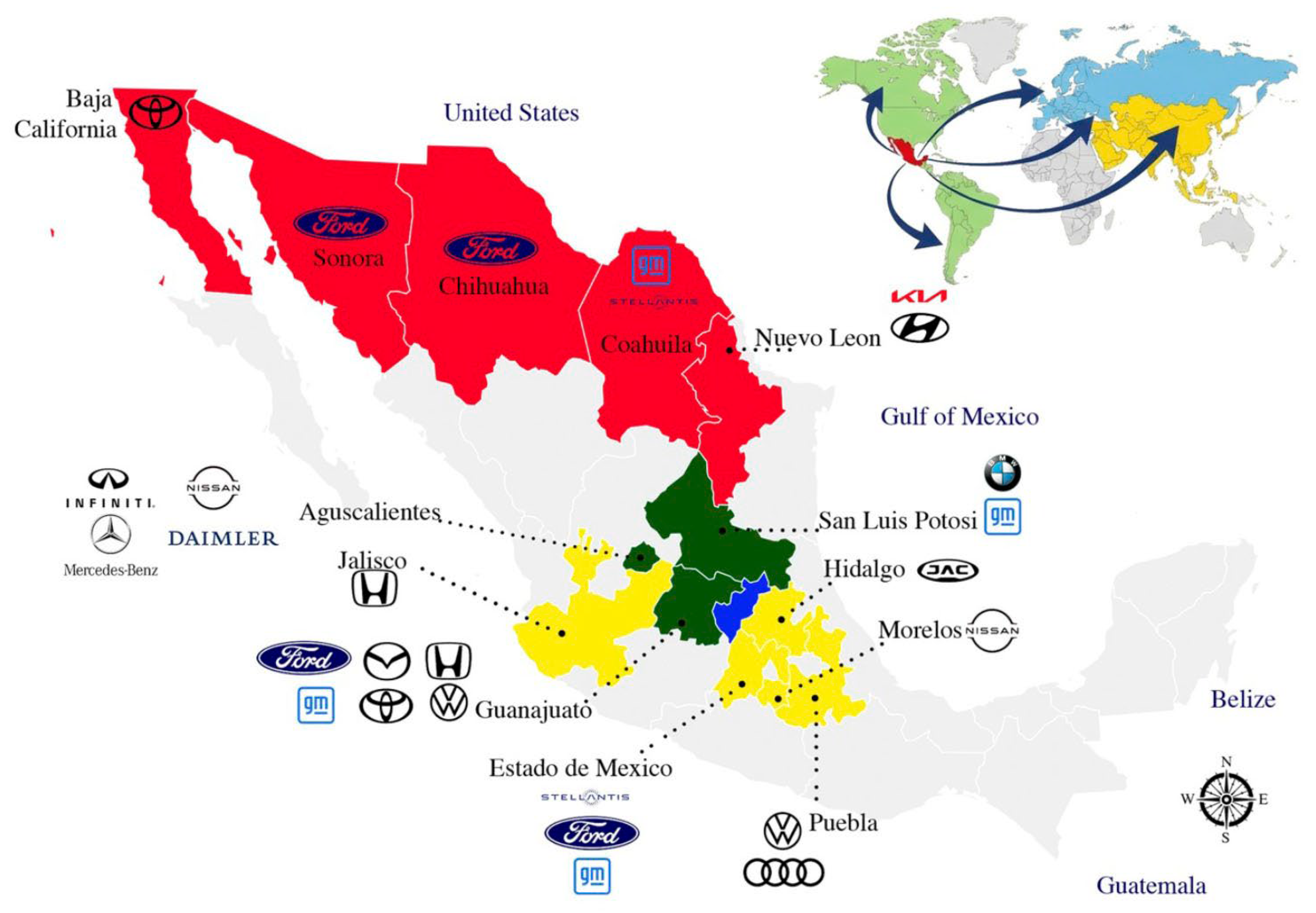
| Continent | Country | Exports from Mexico | Import Tariff (Light Vehicles) | Preferential Conditions |
|---|---|---|---|---|
| America | U.S. | 87.2% | 25% | USMCA and rules of origin applicable to regional content [1,12] |
| Canada | 3.7% | 0% | USMCA and rules of origin applicable to regional content [13] | |
| Brazil | 0–20% | Tariff reduced under preferential agreements [14] | ||
| Argentina | 0–5% | Reduced tariff under preferential agreements [15] | ||
| Colombia | 0–20% | Preferences under the Mexico–Colombia FTA [16] | ||
| Chile | 0% | Pacific Alliance Preferential Agreement [17] | ||
| Peru | 0% | Pacific Alliance Preferential Agreement [18] | ||
| MERCOSUR | 0% (with 40% regional content); 20% outside the quota | Preferential Trade Agreement [19] | ||
| Asia | China | 1.7% | 20% for cars | No specific FTA for light vehicles [20] |
| Japan | 0% | Mexico–Japan FTA [21] | ||
| South Korea | 20% | Mexico–Korea FTA [22] | ||
| India | 20% | No trade agreement in force [23] | ||
| Singapore | 0% | ASEAN [24] | ||
| Malaysia | 0% | ASEAN Free Trade [25] | ||
| Thailand | 0–20% (depending on CPTPP compliance) | ASEAN Free Trade [25] | ||
| Europe | European Union | 3.5% | 0% | EU-US FTA and rules of origin [26] |
| United Kingdom | 0% | Post-Brexit bilateral agreement [27] | ||
| Switzerland | 0% | Bilateral agreement with the EU [26] | ||
| Norway | 0% | Agreement with the European Economic Area [26] |
- How do changes in tariffs affect the volume of exports in Mexico’s automotive sector?
- What effects does the increase in tariffs have on employment and GDP growth in the Mexican automotive sector?
2. State of the Art
2.1. Tariffs
2.2. Impact of Tariffs on Supply Chains
2.3. Methodologies Used in Tariff Analysis
2.4. System Dynamics and Tariffs
3. Methodology
3.1. Conceptualization of the Model
3.2. Model Formulation
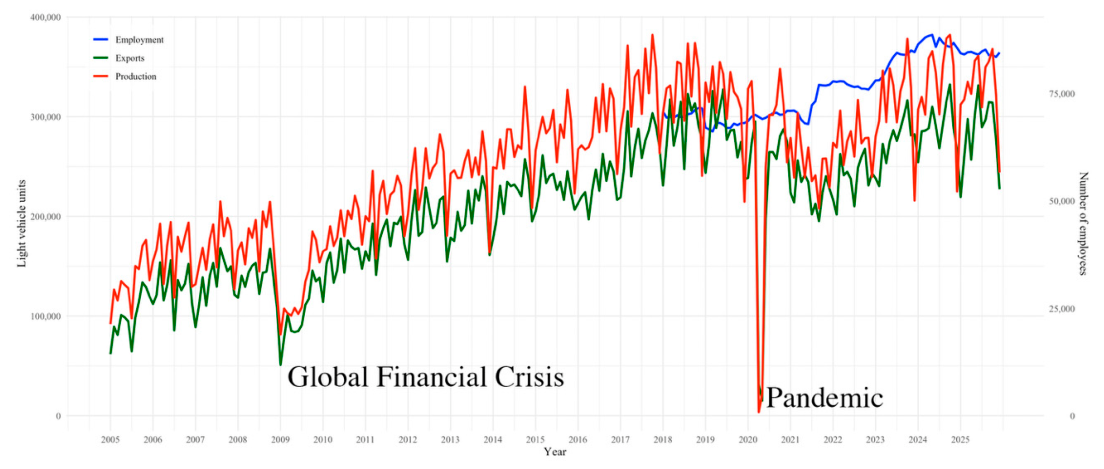
- Phase 1. Construction and validation of the baseline model (January 2005–February 2025): In this stage, forecasting models are developed using historical data on production, exports, employment, and GDP. The objective of this phase is to calibrate and validate the model’s ability to replicate sectoral dynamics in an environment free of the proposed new tariff impositions, thereby establishing a solid baseline for comparison.
- Phase 2. Model calibration and simulation of tariff scenarios: For the period from March to December 2025, the baseline model is calibrated to quantify the initial sensitivity of production, labor, and GDP to the implementation of tariffs. Once the magnitude of this initial impact has been validated and the system calibrated, the scenarios are analyzed, evaluating the projected effects on the sector’s key variables for the time horizon spanning from January 2026 to December 2027.
3.2.1. Phase 1
Light Vehicle Production
- : production level in period t.
- : total observed production volume in month t.
- : seasonal production index corresponding to the same month; Table 6.
- : production level in the immediately preceding period.
- : production trend for the immediately preceding period.
| Month | |
|---|---|
| 1 | −17,428.58 |
| 2 | −8702.57 |
| 3 | −1562.32 |
| 4 | −20,395.60 |
| 5 | 1816.19 |
| 6 | 14,997.30 |
| 7 | −29,992.64 |
| 8 | 23,937.65 |
| 9 | 10,907.12 |
| 10 | 33,815.92 |
| 11 | 21,867.11 |
| 12 | −32,200.95 |
Light Vehicle Exports
Direct Labor
Gross Domestic Product
3.2.2. Phase 2
- The total historical values with tariffs were quantified.
- The variables without tariffs were forecasted via the equations from Phase 1.
- The difference between the historical variables (Step 1) and the forecasted variables (Step 2) was calculated.
- The ratio between the difference from step 3 and the forecast from step 2 was calculated (Step 3/Step 2).
- Aggregate elasticity was estimated by dividing the percentage change (Step 4) by the applied tariff.
Light Vehicle Production
- : Market share or sales rate achieved in the market during period . Initial conditions .
- : Market diversification target. Initial values: .
- : Months required for entry/exit in each market . Assigned values: ().
- When the diversification target exceeds the current market share (, the goal is to reach the upper limit of market share, incentivizing the flow of production toward regions with growth potential, and the following functions are applied: and .
- In markets where the goal is to reduce exposure, , the functions and are used. This approach limits production to the minimum available value, avoiding excess inventory and adjusting production in response to unfavorable market conditions.
Light Vehicle Exports
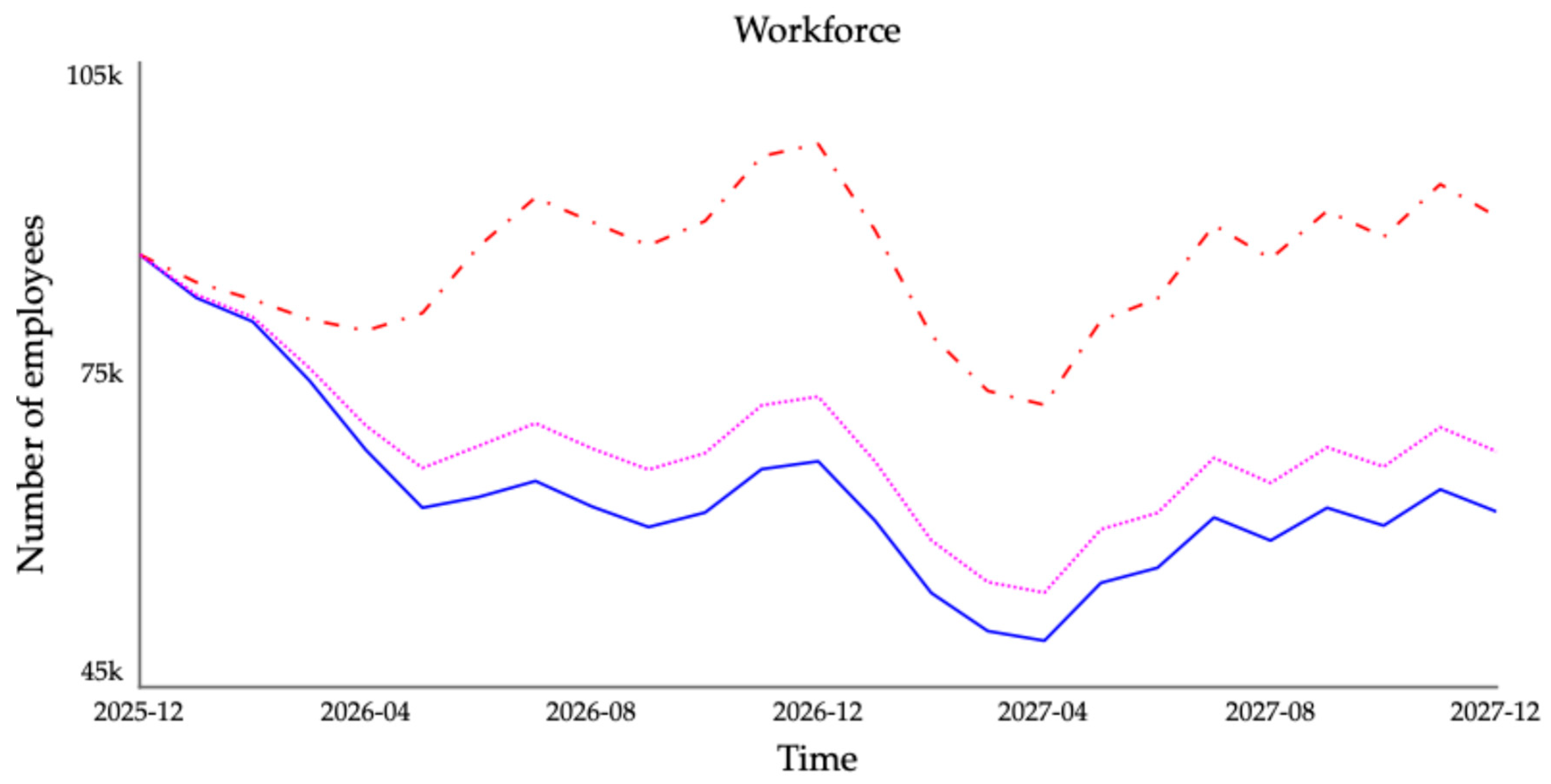
Direct Labor
Gross Domestic Product
4. Results
4.1. Validation
4.1.1. Scenario One: No Tariffs
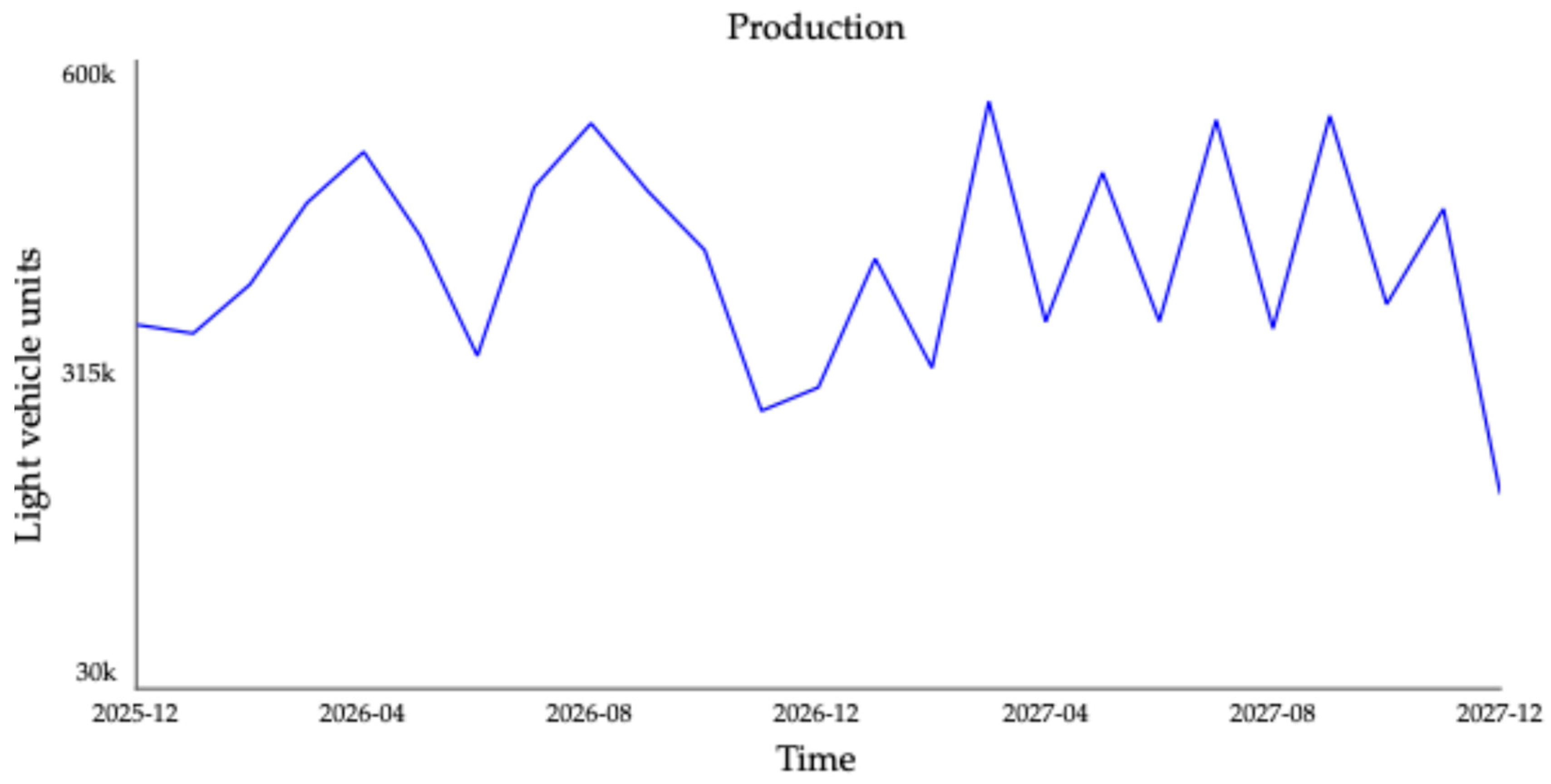
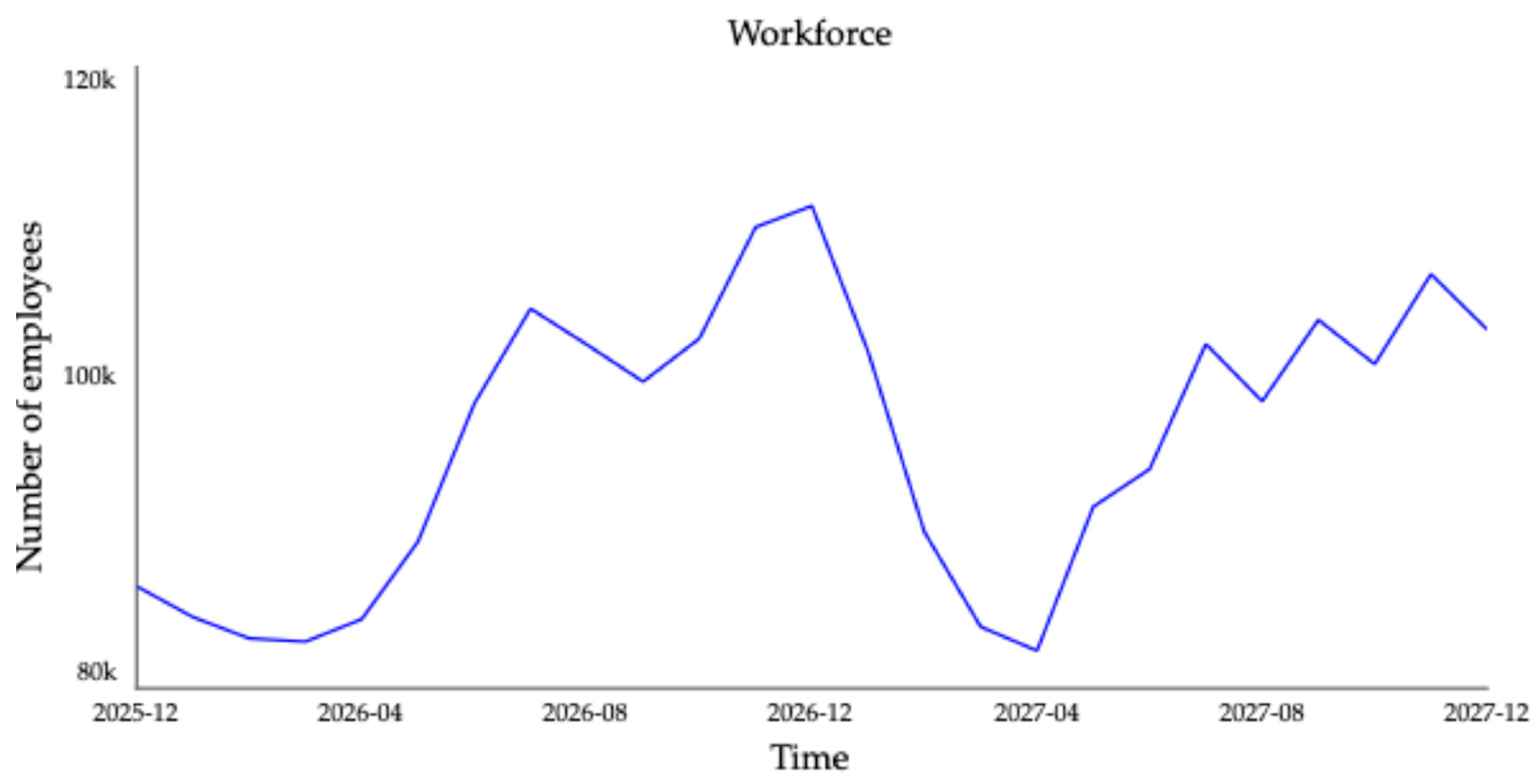
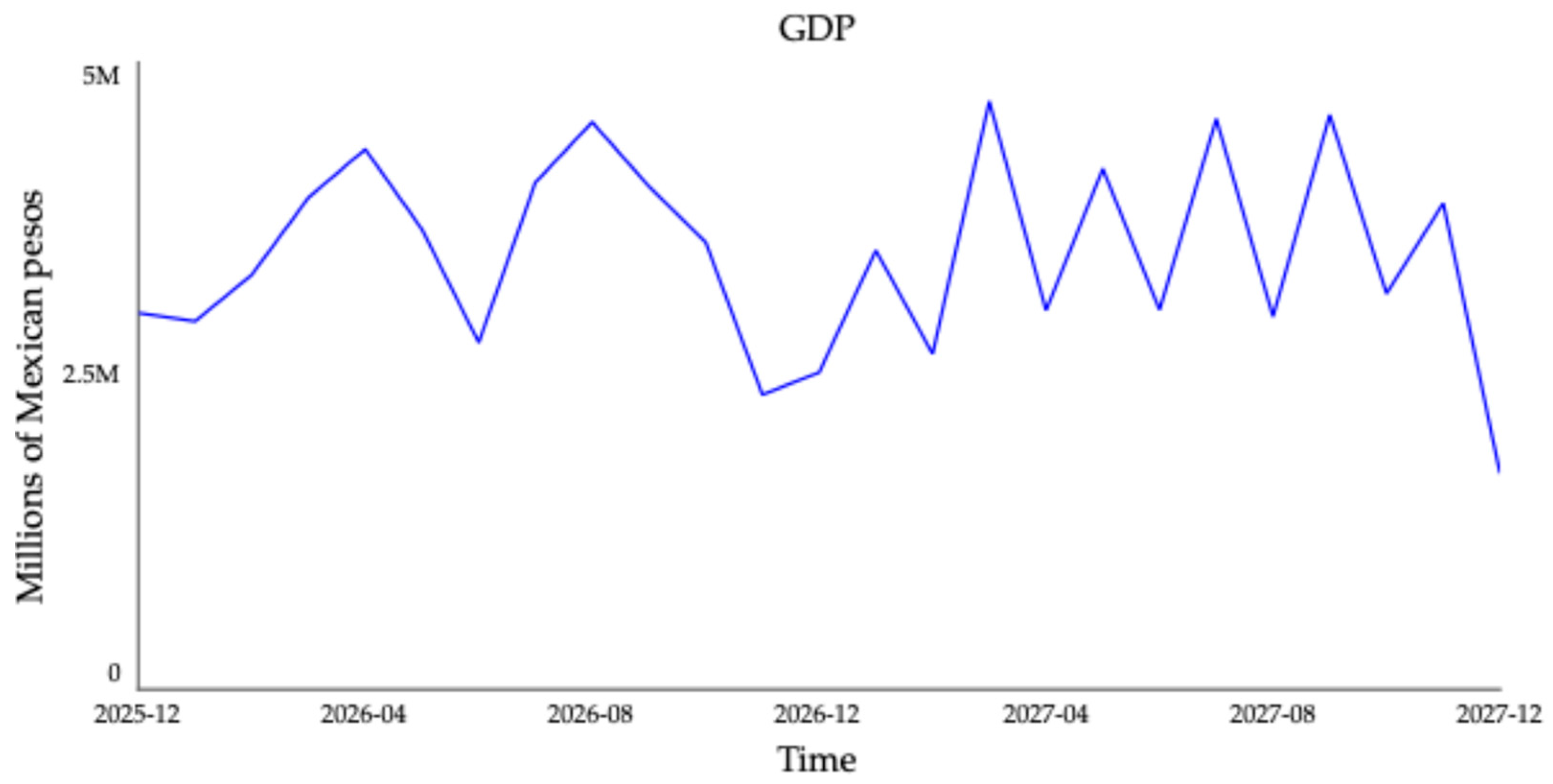
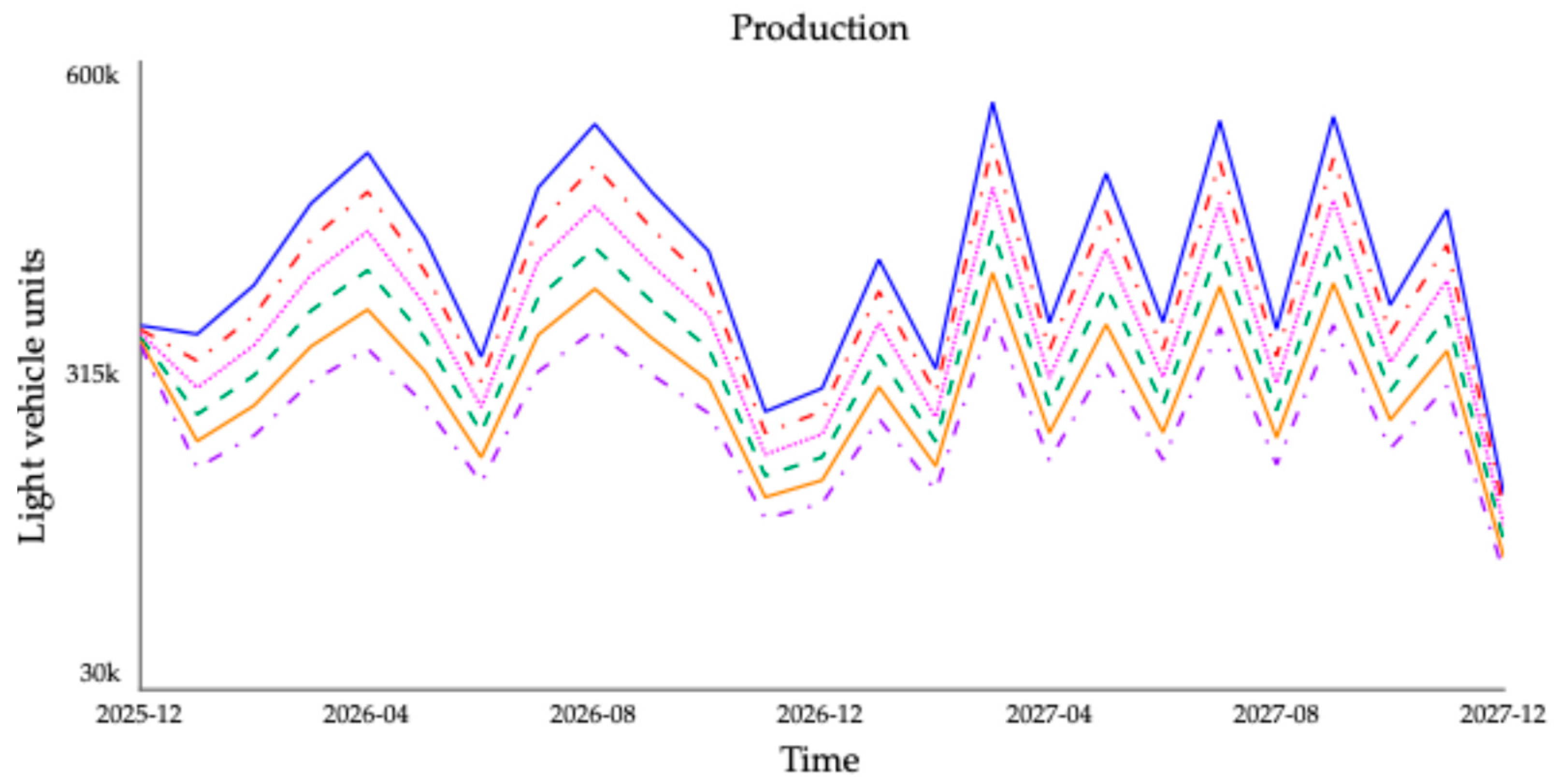
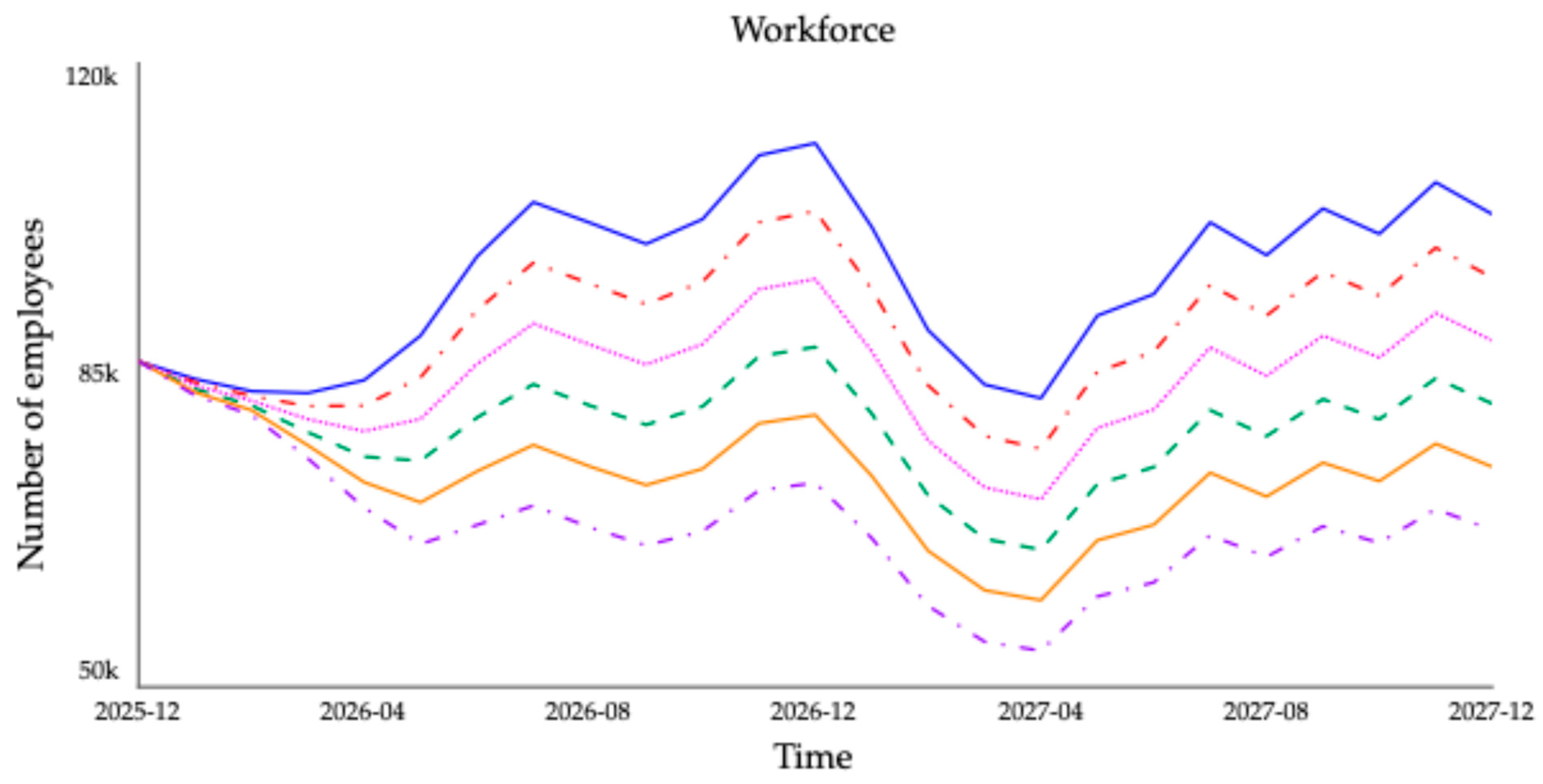
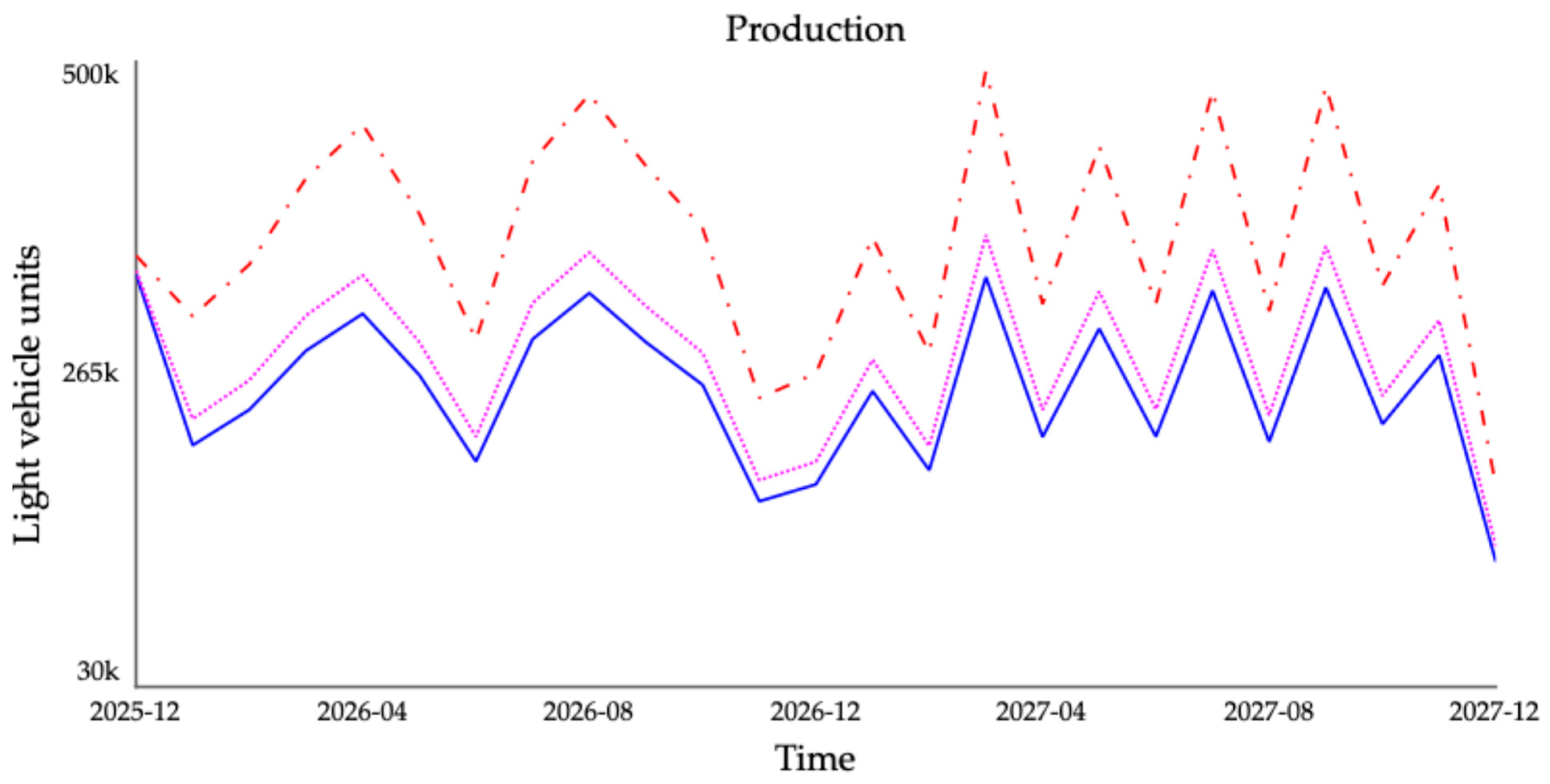
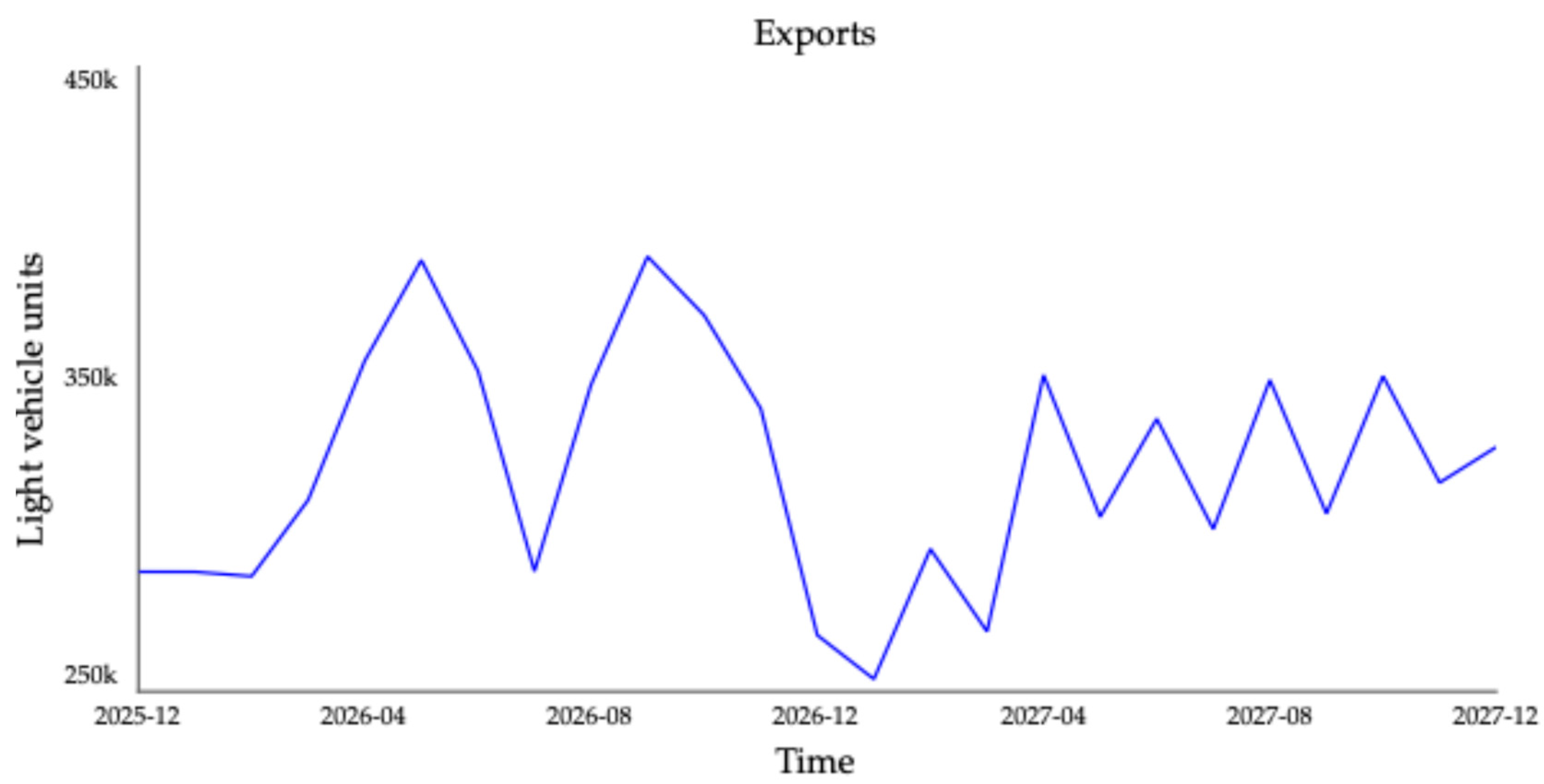
4.1.2. Scenario Two: Tariff Increase in the U.S. 0–25%
4.1.3. Scenario Three: 25% Tariff and Change in Production Elasticity Coefficients
5. Discussion
5.1. Implications for Theory
5.2. Implications for Practice
5.3. Implications for Policy
5.4. Limitations of the Study and Future Research
6. Conclusions
Author Contributions
Funding
Institutional Review Board Statement
Informed Consent Statement
Data Availability Statement
Conflicts of Interest
Abbreviations
| U.S. | United States |
| GDP | Gross Domestic Product |
| INA | National Auto Parts Industry |
| NAFTA | North American Free Trade Agreement |
| USMCA | United States–Mexico–Canada Agreement |
| IIEPA | International Emergency Economic Powers Act |
| SME | Semiconductor Manufacturing Equipment |
| MSRP | Manufacturer Suggested Retail Price |
| SD | System Dynamics |
| OLS | Ordinary Least Squares |
| ARIMA | Autoregressive Integrated Moving Average |
| INEGI | National Institute of Statistics and Geography |
| EMIM | Monthly Manufacturing Industry Survey |
| SI | Seasonal Index |
References
- Silvia, R.; Arce, A. Descentralización y reconfiguración productiva en la industria automotriz mexicana. Espac. Desarro. 2019, 34, 87–116. [Google Scholar] [CrossRef]
- INA—National Auto Parts Industry Association. The Other Side of the Coin: Mexico Auto Parts Industry Report; INA: Ciudad de Mexico, Mexico, 2024. Available online: https://ina.com.mx/wp-content/uploads/2025/02/The-other-side-of-the-coin-V.F.pdf (accessed on 17 September 2025).
- AMIA—Asociación Mexicana de la Industria Automotriz. Plantas de Ensamble, Motores y Transmisiones de Empresas Asociadas—AMIA. Available online: https://www.amia.com.mx/about/plantas_ensamble/ (accessed on 16 September 2025).
- PRODENSA. Automotive Manufacturing in Mexico. Available online: https://www.prodensa.com/insights/blog/automotive-manufacturing-in-mexico (accessed on 16 September 2025).
- INEGI. Venta, Producción y Exportación de Vehículos Ligeros. Available online: https://www.inegi.org.mx/app/tabulados/default.html?nc=100100090_a (accessed on 31 March 2025).
- Thomson Reuters Mexico. Desarrollo de la Industria Automotriz: ¿Cómo impacta a México? Thomson Reuters, 2023. Available online: https://www.thomsonreutersmexico.com/es-mx/soluciones-fiscales/blog-fiscal/desarrollo-de-la-industria-automotriz-como-impacta-a-mexico (accessed on 28 April 2025).
- Instituto Nacional de Estadística y Geografía (INEGI). Estadísticas a Propósito de… la Industria Automotriz; Instituto Nacional de Estadística y Geografía (INEGI): Aguascalientes, Mexico, 2016; Available online: https://www.inegi.org.mx/contenidos/productos/prod_serv/contenidos/espanol/bvinegi/productos/nueva_estruc/702825079963.pdf (accessed on 20 April 2025).
- Pro Mexico Industry. Automotive Industry, Pillar of the Mexican Economy. Available online: http://www.promexicoindustry.com/en/article/automotive-industry-pillar-of-the-mexican-economy (accessed on 28 April 2025).
- Maya, J.C.G. Mexico’s Trade Relationship with China in the Context of the United States-China Trade war. J. Curr. Chin. Aff. 2022, 51, 83–107. [Google Scholar] [CrossRef]
- United States-Mexico-Canada Agreement United States Trade Representative. 2026. Available online: https://ustr.gov/trade-agreements/free-trade-agreements/united-states-mexico-canada-agreement (accessed on 18 April 2025).
- INA—Automotive industry in Mexico. Automotive Industry in Mexico Overview Committed to the Future of Mobility; INA: Ciudad de Mexico, Mexico, 2024; Available online: https://ina.com.mx/wp-content/uploads/2024/09/AUTOMOTIVE-INDUSTRY-IN-MEXICO-Overview.pdf#:~:text=87%25%20of%20total%20production%20is%20earmarked (accessed on 16 September 2025).
- Crossa, M. USMCA and Uneven Regionalized Protectionism: Automotive Industry in Mexico under US Corporate Control. Int. J. Political Econ. 2024, 53, 492–505. [Google Scholar] [CrossRef]
- International Trade Administration. USMCA Auto Report. Available online: https://www.trade.gov/usmca-auto-report (accessed on 4 April 2026).
- Secretaría de Economía de México. ACUERDO Por el Que se da a Conocer el Séptimo Protocolo Adicional al Apéndice II “Sobre el Comercio en el Sector Automotor Entre Brasil y México”, del Acuerdo de Complementación Económica no. 55 Celebrado Entre el Mercosur y los Estados Unidos Mexicanos; Secretaría de Economía de México: Ciudad de Mexico, Mexico. Available online: https://www.gob.mx/cms/uploads/attachment/file/607451/S_ptimo_Protocolo_Adicional_Ap_ndice_II_ACE_55_DOF_-_Diario_Oficial_de_la_Federaci_n.pdf (accessed on 4 April 2026).
- Todesca Bocco, C. Nuevo Acuerdo de Preferencias Arancelarias Entre Argentina y México para Ampliar el Comercio Bilateral. Available online: https://www.cancilleria.gob.ar/es/actualidad/noticias/nuevo-acuerdo-de-preferencias-arancelarias-entre-argentina-y-mexico-para-ampliar (accessed on 21 June 2025).
- Ministerio de Comercio Industria y Turismo. Tratado de Libre Comercio Entre los Estados Unidos Mexicanos y la República de Colombia. Available online: https://www.tlc.gov.co/acuerdos/vigente/tratado-de-libre-comercio-entre-colombia-mexico/importante/resumen-del-acuerdo (accessed on 21 June 2025).
- Aduanas Chile. Tratado de Libre Comercio Entre Chile y México. Available online: https://www.aduana.cl/tratado-de-libre-comercio-chile-mexico/aduana/2007-02-28/101531.html (accessed on 21 June 2025).
- Acuerdos Comerciales del Perú. Acuerdo de Integración Comercial Entre México y Perú. Available online: https://economia.gob.mx/files/transparencia/informe_APF/memorias/4_md_aic_mexico_peru_sce.pdf (accessed on 21 June 2025).
- Secretaría General de la ALADI. Acuerdo de Complementación Económica N° 55 Entre México y el Mercado Común del Sur (MERCOSUR). Available online: http://www.sice.oas.org/trade/mercosurmexace55/mermexauto_s.asp (accessed on 21 June 2025).
- Asian Integration. People’s Republic of China-Mexico Free Trade Agreement. Available online: https://aric.adb.org/fta/prc-mexico-fta (accessed on 21 June 2025).
- Gobierno de los Estados Unidos Mexicanos & Gobierno del Japón, Resumen del Acuerdo para el Fortalecimiento de la Asociación Económica entre los Estados Unidos Mexicanos y Japón. 2005. Available online: https://www.economia.gob.mx/files/texto_acuerdo.pdf (accessed on 18 April 2025).
- Mexican Ministry of Economy. TLC Centroamérica-República de Corea: Ofreciendo Oportunidades para el Desarrollo; Mexican Ministry of Economy: Ciudad de Mexico, Mexico, 2023.
- Mexican Ministry of Economy. Latest Updates on India’s FTAs in 2022. Available online: https://www.india-briefing.com/news/india-fta-2022-status-update-23513.html/ (accessed on 21 June 2025).
- Secretaría de Economía, Mexican Ministry of Economy; Singapore’s Ministry of Trade and Industry. Tratado de Libre Comercio Entre la Alianza del Pacífico y Singapur. Available online: https://www.gob.mx/se/acciones-y-programas/capitulado-completo-del-tratado-de-libre-comercio-entre-la-alianza-del-pacifico-y-singapur-pasfta?state=published (accessed on 21 June 2025).
- Mexican Ministry of Economy; Malaysia’s Ministry of International Trade and Industry. Mexico and Malaysia: 50th Anniversary of Diplomatic Relations. Available online: https://www.gob.mx/cms/uploads/attachment/file/1001283/Libro_CD20-Malasia-2025-web.pdf (accessed on 21 June 2025).
- Mexican Ministry of Economy; European Commission. Tratado de Libre Comercio México-Unión Europea (TLCUEM). Available online: https://www.diputados.gob.mx/sedia/sia/dir/DIR-RI-A-01-16_anexo.pdf (accessed on 21 June 2025).
- Mexican Ministry of Economy; UK Department for International Trade. México-Reino Unido (Acuerdo de Continuidad Comercial). Available online: https://www.gob.mx/se/articulos/mexico-y-reino-unido-firman-acuerdo-de-continuidad-comercial-que-mantiene-el-libre-comercio-entre-ambos-paises (accessed on 21 June 2025).
- Instituto Nacional de Estadística y Geografia. Encuesta Mensual de la Industria Manufacturera (EMIM). January 2026. Available online: https://www.inegi.org.mx/programas/emim/2018/ (accessed on 25 March 2026).
- Baldwin, R.; Lopez-Gonzalez, J. Supply-Chain Trade: A Portrait of Global Patterns and Several Testable Hypotheses; National Bureau of Economic Research: Cambridge, MA, USA, 2013. [Google Scholar] [CrossRef]
- Grossman, G.M.; Helpman, E.; Redding, S.J. When Tariffs Disrupt Global Supply Chains. Am. Econ. Rev. 2024, 114, 988–1029. [Google Scholar] [CrossRef]
- Min, R. An Empirical Analysis of Tiff’s Impact on American Business Formation. arXiv 2025, arXiv:2506.00999. [Google Scholar]
- Kaloyanova, G. Effects of the End of Free Movement on the Supply Chains in the United Kingdom. Izv. J. Union Sci. Varna. Econ. Sci. Ser. 2023, 12, 234–240. [Google Scholar] [CrossRef]
- Congressional Research Service. Escalating U.S. Tariffs: Affected Trade. Available online: https://sgp.fas.org/crs/row/IN10971.pdf (accessed on 2 April 2025).
- Autor, D.; Beck, A.; Dorn, D.; Hanson, G.H. Help for the Heartland? The Employment and Electoral Effects of the Trump Tariffs in the United States. 2024. Available online: http://www.nber.org/papers/w32082 (accessed on 30 March 2025).
- Flaaen, A.; Pierce, J. Disentangling the effects of the 2018–2019 tariffs on a globally connected U.S. manufacturing sector. Rev. Econ. Stat. 2024, 1–45. [Google Scholar] [CrossRef]
- Boller, L.; Carmody, K.; Huntley, J.; Reichling, F.; Smetters, K. The Economic Effects of President Trump’s Tariffs. Penn Wharton Budget Model. Available online: https://budgetmodel.wharton.upenn.edu/p/2025-04-10-the-economic-effects-of-president-trumps-tariffs/ (accessed on 2 April 2026).
- Williams, A.; Sevastopulo, D.; Gridneff, I.; Murray, C.; Hale, T. Donald Trump Hits Canada, Mexico and China with Steep Tariffs. Available online: https://www.ft.com/content/b9101226-edc1-4cde-93ec-186bc95021d7 (accessed on 31 March 2025).
- TheWhiteHouse. Fact Sheet: President Donald J. Trump Declares National Emergency to Increase Our Competitive Edge, Protect Our Sovereignty, and Strengthen Our National and Economic Security—The White House. Available online: https://www.whitehouse.gov/fact-sheets/2025/04/fact-sheet-president-donald-j-trump-declares-national-emergency-to-increase-our-competitive-edge-protect-our-sovereignty-and-strengthen-our-national-and-economic-security/ (accessed on 2 April 2025).
- TheWhiteHouse. Presidential Actions—The White House. Available online: https://www.whitehouse.gov/presidential-actions/ (accessed on 31 March 2025).
- De Silva, M.M.; Herath, O.K.; Nakayama, T.; Kumarage, A.S. A system dynamics model for vehicle fleet transformation towards energy efficiency and low-carbon development: A case study of Sri Lanka and its strategies. Transp. Policy 2024, 147, 244–258. [Google Scholar] [CrossRef]
- Hu, X.; Fu, K.; Chen, Z.; Du, Z. Decision-Making of Transnational Supply Chain Considering Tariff and Third-Party Logistics Service. Mathematics 2022, 10, 770. [Google Scholar] [CrossRef]
- Rogers, Z.S.; Golara, S.; Abdulsalam, Y.; Rogers, D.S. Protect me not: The effect of tariffs on U.S. supply networks. J. Purch. Supply Manag. 2024, 30, 100897. [Google Scholar] [CrossRef]
- Furceri, D.; Hannan, S.A.; Ostry, J.D.; Rose, A.K. The Macroeconomy After Tariffs. World Bank Econ. Rev. 2022, 36, 361–381. [Google Scholar] [CrossRef]
- Dong, L.; Kouvelis, P. Impact of Tariffs on Global Supply Chain Network Configuration: Models, Predictions, and Future Research. Manuf. Serv. Oper. Manag. 2019, 22, 25–35. [Google Scholar] [CrossRef]
- Pan, W. The Effects of U.S. Tariff Increases on Chinese Automotive Parts Trade. Front. Bus. Econ. Manag. 2024, 15, 398–400. [Google Scholar] [CrossRef]
- Ivanov, D.; Dolgui, A. Tariff shocks, ripple effect, and deep uncertainty in supply chains: We are entering a turbulence zone, please fasten your seatbelts. Int. J. Prod. Res. 2025, 63, 7305–7317. [Google Scholar] [CrossRef]
- Swenson, D.L. Trade-war Tariffs and Supply Chain Trade. Asian Econ. Pap. 2024, 23, 66–86. [Google Scholar] [CrossRef]
- Gereffi, G.; Lim, H.-C.; Lee, J. Trade policies, firm strategies, and adaptive reconfigurations of global value chains. J. Int. Bus. Policy 2021, 4, 506–522. [Google Scholar] [CrossRef]
- Munikhah, I.A.T.; Ramdhani, A.Y.; Pratama, A.Y.; Arini, R.W. Scenario Analysis of Indonesian Ferronickel Supply Chain Resilience with System Dynamics. J. Tek. Ind. J. Keilmuan Dan Apl. Tek. Ind. 2022, 24, 129–140. [Google Scholar] [CrossRef]
- Ma, M.; Tam, V.W.; Le, K.N.; Osei-Kyei, R. A system dynamics model for assessing impacts of policies on supply and demand of recycled aggregate. J. Build. Eng. 2023, 75, 107050. [Google Scholar] [CrossRef]
- Layani, G.; Mehrjou, S.; Farajzadeh, Z. Effects of government policies reform on environmental sustainability: An integrated approach of PMP and system dynamics simulation model. J. Clean. Prod. 2023, 426, 138985. [Google Scholar] [CrossRef]
- Handley, K.; Kamal, F.; Monarch, R. Rising Import Tariffs, Falling Exports: When Modern Supply Chains Meet Old-Style Protectionism. Am. Econ. J. Appl. Econ. 2025, 17, 208–238. [Google Scholar] [CrossRef]
- Karkason, D. Navigating Tariffs: Strengthening Global Supply Chains. Available online: https://www.transnationalmatters.com/the-impact-of-trade-tariffs-on-global-supply-chain-strategies/ (accessed on 2 April 2025).
- Canis, B.; Villareal, M.; Jones, V. NAFTA and Motor Vehicle Trade. Congressional Research Service. Available online: https://sgp.fas.org/crs/row/R44907.pdf (accessed on 2 April 2025).
- Clausing, K.; Lovely, M.E. Trump’s Tariffs on Canada, Mexico, and China Would Cost the Typical US Household Over $1,200 a Year. Available online: https://www.piie.com/research/piie-charts/2025/trumps-tariffs-canada-mexico-and-china-would-cost-typical-us-household (accessed on 31 March 2025).
- Zou, Z.; Chen, L.; Liang, Y. The Impact of Tariffs on a Transnational Supply Chain under Different Power Structures in China. Mathematics 2024, 12, 3134. [Google Scholar] [CrossRef]
- Gnutzmann-Mkrtchyan, A.; Hugot, J. Gravity-Based Tools to Assess the Impact of Tariff Changes: An Application to Armenia. Asian Dev. Rev. 2024, 41, 219–256. [Google Scholar] [CrossRef]
- Alviarez, V.; Fioretti, M.; Kikkawa, K.; Morlacco, M. Two-Sided Market Power in Firm-to-Firm Trade; Inter-American Development Bank: Washington, DC, USA, 2023. [Google Scholar] [CrossRef]
- Blanchard, E.J.; Bown, C.P.; Johnson, R.C. Global Supply Chains and Trade Policy; World Bank Group: Washington, DC, USA, 2016. [Google Scholar] [CrossRef]
- Zhang, D.J.; Dabadghao, S.S.; Udenio, M. Global Sourcing Under Tariffs: A Perspective of Time Series Analysis. Int. J. Prod. Econ. 2025, 280, 109473. [Google Scholar] [CrossRef]
- Hsu, J.; Li, Z.; Wu, J. Supply chain nearshoring in response to regional value content requirements. Manuf. Serv. Oper. Manag. 2026. [Google Scholar] [CrossRef]
- Eugster, J.; Jaumotte, F.; MacDonald, M.; Piazza, R. The Effect of Tariffs in Global Value Chains. SSRN 2023. [Google Scholar] [CrossRef]
- Yanikkaya, H.; Tat, P.; Altun, A. Do Lower Tariff Rates Promote Global Value Chain Participation? World Trade Rev. 2024, 23, 1–19. [Google Scholar] [CrossRef]
- Handley, K.; Kamal, F.; Monarch, R. Supply chain adjustments to tariff shocks: Evidence from firm trade linkages in the 2018-2019 U.S. trade war. Econ. Lett. 2024, 244, 112009. [Google Scholar] [CrossRef]
- Luo, C.; Wang, N. U.S.-China trade frictions and supply chain reconstruction: Perspective from indirect links. J. Int. Money Financ. 2025, 151, 103256. [Google Scholar] [CrossRef]
- Zhao, J.; Tang, O.; Zhang, Q.; Zhou, D. Can reshoring policies hinder China’s photovoltaic module exports? A dynamic perspective. Energy 2025, 327, 136382. [Google Scholar] [CrossRef]
- Hamed, M.M.; Turan, H.H.; Elsawah, S. Balancing supply diversification and environmental impacts: A system dynamics approach to de-risk rare earths supply chain. Resour. Policy 2024, 92, 105038. [Google Scholar] [CrossRef]
- Cai, B.; Liu, Y. Automotive industry development versus environment and policy: An integration of system dynamics and life cycle assessment. Int. Rev. Econ. Financ. 2025, 103, 104382. [Google Scholar] [CrossRef]
- Lai, X.; Wang, X.; Chen, Z. A System Dynamics Simulation on International Dual-Source Procurement Strategy under the Influence of Tariff and Supplier Reliability. Adv. Control. Optim. Dyn. Syst. 2022, 55, 3022–3027. [Google Scholar] [CrossRef]
- Mohammadi, M.A.; Sayadi, A.R.; Khoshfarman, M.; Kashan, A.H. A systems dynamics simulation model of a steel supply chain-case study. Resour. Policy 2022, 77, 102690. [Google Scholar] [CrossRef]
- Han, Y.; Wang, P.; Liao, Z.; Tang, L.; Song, W.; Gao, T.; Hao, H.; Chen, W.-Q. Exploring the divergence of rare earth trade networks with a global simulation model. iScience 2025, 28, 113658. [Google Scholar] [CrossRef]
- Sterman, J. Business Dynamics: Systems Thinking and Modeling for a Complex World; Irwin/McGraw-Hill: Columbus, OH, USA, 2000. [Google Scholar]
- Liu, F.; Lee, C.K.M.; Xu, M. Electric vehicle supply chain investment under demand uncertainty: A jointly held real options perspective. Comput. Ind. Eng. 2025, 200, 110840. [Google Scholar] [CrossRef]
- Zélity, B. Export diversification and macroeconomic shocks. World Econ. 2025, 48, 742–778. [Google Scholar] [CrossRef]
- Hamidi, A.; Salavati, S. Modeling system dynamics in computational thinking integration using causal loop diagrams. Think. Ski. Creat. 2026, 59, 102003. [Google Scholar] [CrossRef]
- Instituto Nacional de Estadística y Geografía (INEGI). Producto Interno Bruto por Actividad Económica: 3361—Fabricación de Automóviles y Camiones (2005–2025). Sistema de Cuentas Nacionales de México. Available online: https://www.inegi.org.mx/temas/pib/ (accessed on 27 March 2026).
- Leard, B.; Wu, Y. New Passenger Vehicle Demand Elasticities: Estimates and Policy Implications About the Authors; Resources for the Future: Washington, DC, USA, 2023. [Google Scholar]




| Target | Date of Announcement | Implementation Date | Imports Affected | Applicable Rate | Authority |
|---|---|---|---|---|---|
| Steel and Aluminum | 10 February | 12 March | Ending steel exemptions: $29 billion; ending aluminum exemptions: $12 billion; expanding derivatives: $44 billion under chapters 73 & 76, plus a metals content of an additional $100 billion. | 25%, increased to 50% | Section 232 |
| Cars Auto parts | 12 February | April | Cars: $153 billion, Auto Parts $279 billion | 25 | Section 232 |
| Copper | 25 February | Not yet implemented (Potential implementation mid-July 2025, pending investigation outcome) | Copper (mined, smelted, refined, scrap copper, and derivative products) | Speculated 25% (not confirmed) | Section 232 |
| Semiconductors | 18 February 2025 (Initial announcement)/ 1 April 2025 (Formal investigation start) | Not yet implemented | Semiconductors (including semiconductor substrates, bare wafers, legacy chips, leading-edge chips, microelectronics, semiconductor manufacturing equipment (SME), and downstream products such as smartphones, laptops, and other electronics containing semiconductors) | 25 | Section 232 |
| Sector | Affected Channel | Main Effect | Evidence | |
|---|---|---|---|---|
| Short-Term | Long-Term | |||
| Manufacturing | Costs, sourcing, disruption propagation, and adaptation | Tariff shocks increase costs, trigger ripple effects, and force immediate reactive adjustments | Firms redesign supply networks toward adaptability and viability, with broader effects on trade and inflation | Conceptual evidence of ripple effects, deep uncertainty, and adaptive supply chain responses under tariff shocks [46] |
| Technology and semiconductors | Disruption of global supply chains and components | Declines in trade | Geographic of suppliers | More intense reactions in related products [47] |
| Agriculture and agribusiness | Tariffs on inputs and exports | Price fluctuations and loss of markets | Supply chain adjustments and changes in external demand | Adverse effects on exports due to tariff policies [42,52] |
| Textile | Rapid search for production alternatives | Diversion to other countries, relocation | Reconfiguration of supply chains and potential upgrading | Historical sectoral restructuring [48] |
| Automotive | Components and logistics | Disruption in just-in-time supply | Supplier restructuring and nearshoring | Supply chain reconfiguration [30,48] |
| Method | Data Required | Findings | Limitations |
|---|---|---|---|
| A calibrated structural model of global supply chains includes supplier search, negotiation, and supply reconfiguration in response to unanticipated tariffs. | Trade/manufacturing, demand elasticities, productivity and negotiation parameters, search costs, and empirical responses of prices and imports to U.S.-China tariffs. | Trump’s tariffs disrupted global supply chains through supplier renegotiation and relocation; the model estimates a welfare loss for the U.S. of 0.12% of GDP, with significant contributions from changes in sourcing and search costs [30]. | This structural and calibrated approach relies on parametric assumptions and simplifications about wages, final trade, and alternative sourcing destinations; it does not constitute a direct causal estimate. |
| Empirical analysis using difference-in-differences and firm/product-level trade data. | Product-level import data, firm-level sourcing data, trade flows by origin country, and information on regional value content requirements under USMCA. | Stricter regional value content requirements induced nearshoring, especially toward Mexico and Canada; the effect was stronger for simpler complementary components and was associated with lower inventories, higher inventory turnover, higher average cost, and lower gross margins [61]. | Focused on the U.S. automotive industry and the USMCA context; results may have limited generalizability to other sectors, countries, or trade policy regimes. |
| Event analysis and random effects regression to assess the impact of the 2018 tariffs on protected firms and their partners in the supply chain. | Stock prices, dates of tariff announcements/implementation, sectoral classification of firms, position in the chain, input-output tables, and financial variables. | Tariffs did not protect target firms; they generated negative financial effects and indirect consequences throughout the supply chain, with differentiated impacts for customers and suppliers [42]. | Stock market-based approach, reduced ability to capture long-term operational effects, and supplier- customer relationships are inferred at the industry level rather than at the firm-to-firm level. |
| This study conducts a qualitative–comparative analysis of global supply chains by applying an analytical framework that examines trade policies, business strategies, and supply chain reconfiguration. | Historical-sectoral evidence on trade restrictions/agreements, firm decisions, and geographic-organizational changes in apparel, automotive, and electronics. | Historical-sectoral evidence on trade restrictions/agreements, firm decisions, and geographic-organizational changes in apparel, automotive, and electronics [48]. | A noneconometric and noncausal approach requires more systematic data and broader comparisons, as the results are conditioned by sector-specific and temporal factors. |
| Game theory using Stackelberg and equal-power models, applied to a bilateral monopoly and duopolistic competition in a transnational supply chain with tariffs. | The theoretical parameters of the model, primarily market size, substitutability, tariffs, costs, prices, and quantities, do not rely on an observational empirical basis. | Tariffs reduce profits and consumer surplus; in bilateral monopolies, they harm the manufacturer more under manufacturer leadership; in competition, the relative effect depends on market size; and under manufacturer leadership in duopolies, the greatest benefits are obtained [56]. | Theoretical approach with strong assumptions; it does not incorporate production uncertainty, logistical/technological disruptions, or detailed comparison with local production or other strategic decisions. |
| Empirical tools based on structural gravity models, combining partial equilibrium at the product level and general equilibrium at the product level. Aggregate, with PPML estimation of trade elasticities. | Bilateral trade, bilateral tariffs, gravitational variables, institutional dummies, and domestic production/consumption data for manufacturing. | Tariff changes affect bilateral trade, trade diversion, and welfare; in Armenia, the EAEU’s CET reduces welfare, while FTAs with Iran and China partially offset this [57]. | The general equilibrium model has less detail, relies on manufacturing because of insufficient disaggregated data, may underestimate commodity-based economies, and faces risks of residual endogeneity. |
| Empirical analysis of global sourcing using multivariate time series clustering, ARIMA, and logistic regression | Data on maritime imports by firm, product, and month; number and variety of suppliers/countries/HTS codes; and firm financial variables. | The 2018–2019 tariffs generated heterogeneous responses in global sourcing; some firms temporarily increased inventories and then returned to previous levels, while others persistently reduced their sourcing. Furthermore, size, growth, and profitability help explain the probability of disruption [60]. | Difficulty in determining the optimal number of clusters, use of aggregated data, lack of precise traceability of the actual origin of products, and possible undercapture of finer strategic decisions at the product or firm level. |
| Exploratory, with a qualitative approach. | Interviews with executives, evidence of supply/demand disruptions, information on lead times, procurement, inventories, risks, and resilience. | COVID-19, tariffs, and Brexit are accelerating a redesign of supply chains toward more resilient, lean, localized configurations guided by total cost rather than purchase/import cost [62]. | Small sample size, qualitative evidence, lack of econometric validation, and limited scope for generalization |
| Fixed-effects panel model, combined with calculations of simple and cumulative tariffs on value added to measure their effect on total, forward, and backward participation in GVCs | Position in the chain, capital intensity, FDI, and educational attainment | Tariffs reduce participation in GVCs; furthermore, tariffs are amplified along the chain, and the negative effect is stronger in manufacturing, low-tech sectors, and developing countries [63]. | The observational approach should consider sensitivity to sectoral and national heterogeneities, as well as the possible attenuation of effects caused by exemption regimes like the inward processing trade regime. |
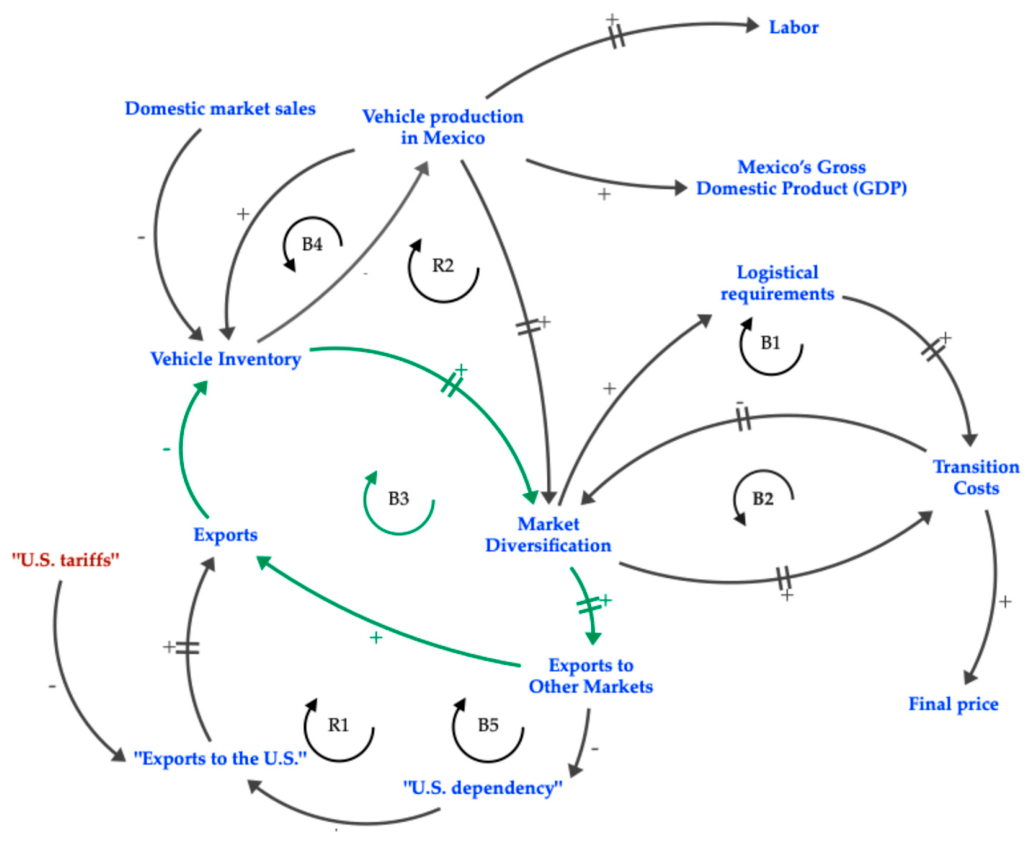
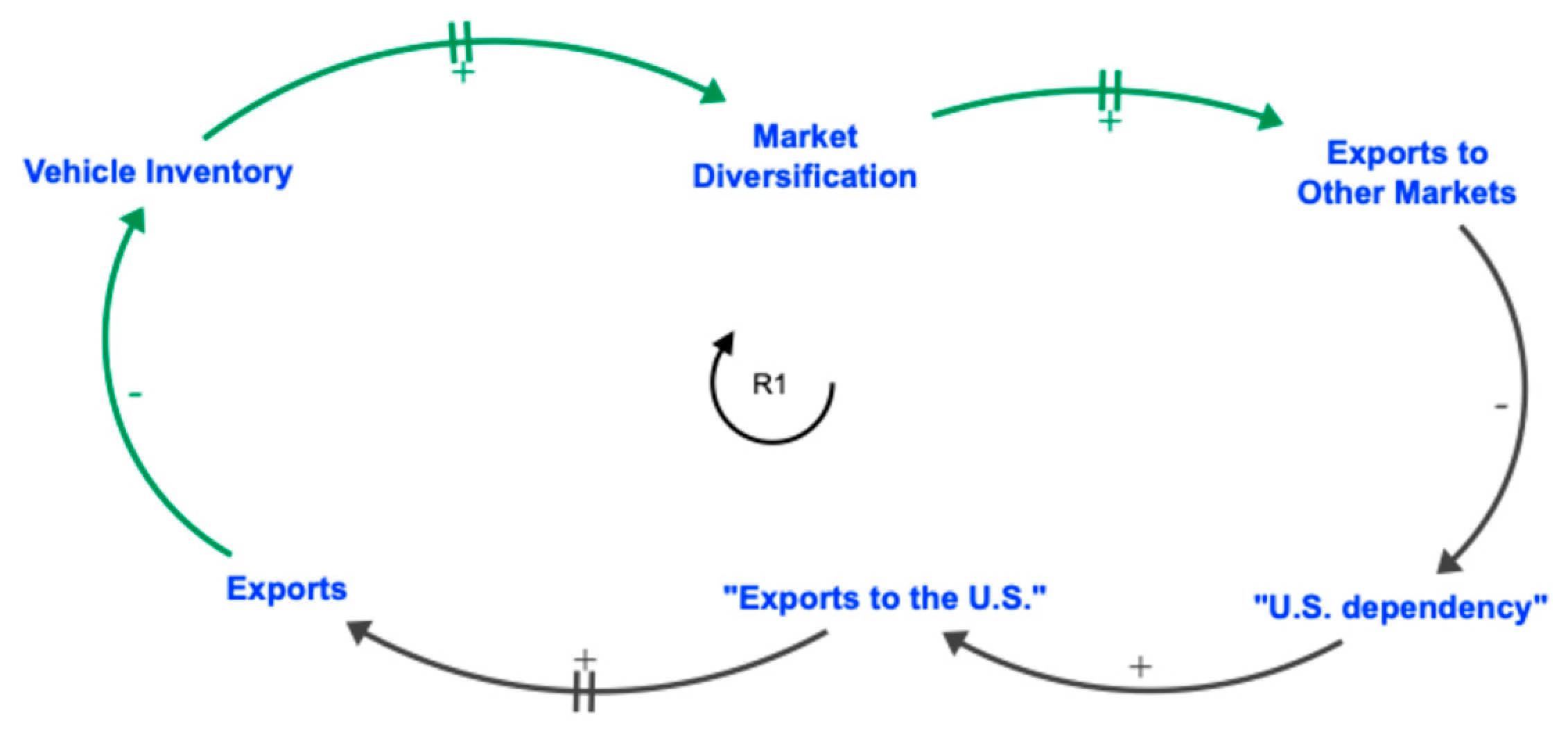
| Variable | Definition |
|---|---|
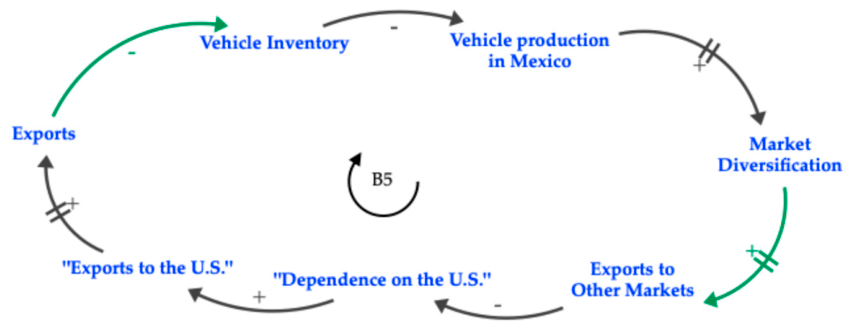
| Exports to the U.S. | Volume of light vehicles shipped from Mexico to the U.S. [52]. |
| U.S. tariffs | Tariff rate imposed by the U.S. on Mexican vehicles [30]. |
| Domestic market sales | Light vehicles sold in Mexico [30]. |
| Exports | Total volume of light vehicles shipped abroad (Latin America, Europe, Asia) [43]. |
| Exports to Other Markets | Total volume of light vehicles shipped abroad (U.S., Latin America, Europe, Asia) [30]. |
| Final price | The unit price is determined by incorporating all relevant costs and adjustments related to the commercial and logistics processes [56]. |
| Labor | Number of people directly employed in the manufacturing of light vehicles in Mexico [43]. |
| Logistical requirements | A set of requirements regarding transportation, storage, distribution, and regulatory procedures for transporting vehicles from Mexican plants to destination markets [10]. |
| Market Diversification | A strategy to increase market share in other markets (Asia, Europe, Latin America, Canada, and the domestic market) [73]. |
| Mexico’s Gross Domestic Product (GDP) | The automotive sector’s contribution to Mexico’s GDP; it shrinks if production falls [30]. |
| Transition Costs | Production, logistics, and regulatory compliance costs that reduce profit margins [44]. |
| Dependence on the U.S. | Dependence on total exports concentrated in the U.S. market reflects exposure to trade disruptions originating from that destination [74]. |
| Vehicle Inventory | Inventory of finished units that have not been allocated to a market [60]. |
| Vehicle production in Mexico | Total number of light vehicles manufactured in Mexico [75]. |
| Phase 1: Historical Data Without Tariffs | Phase 2: Historical Data with Tariffs | |||||||
|---|---|---|---|---|---|---|---|---|
| Variable | MAE | RMSE | MAPE (%) | Correlation Pearson (r) | MAE | RMSE | MAPE (%) | Correlation Pearson (r) |
| Export | 22,109.85 | 28,456.12 | 8.94 | 0.935 | 31,987.56 | 45,618.32 | 11.21 | 0.792 |
| Production | 41,235.18 | 52,901.44 | 14.52 | 0.912 | 99,442.22 | 114,834.70 | 30.67 | 0.841 |
| Labor | 1421.34 | 1894.22 | 1.87 | 0.976 | 2754.11 | 3122.45 | 3.24 | 0.887 |
| GDP | 542,118.3 | 689,451.9 | 6.12 | 0.958 | 1,189,523.6 | 1,421,902.1 | 10.14 | 0.815 |
| Variable (Cumulative/Average) | Scenario −0.5 | Scenario −1.3756 | Scenario −1.6 | % Change (−1.3756 vs. −0.5) | % Change (−1.6 vs. −0.5) |
|---|---|---|---|---|---|
| Production | 8,625,000 | 6,467,000 | 5,914,000 | −25.02% | −31.43% |
| Exports | 7,450,000 | 5,640,000 | 5,180,000 | −24.29% | −30.46% |
| Sectoral GDP | 71,800,000 | 53,835,000 | 49,233,000 | −25.02% | −31.43% |
| Labor | 2,060,000 | 1,680,000 | 1,580,000 | −18.44% | −23.30% |
| Domestic Market | 1,050,000 | 787,290 | 720,000 | −25.02% | −31.43% |
Disclaimer/Publisher’s Note: The statements, opinions and data contained in all publications are solely those of the individual author(s) and contributor(s) and not of MDPI and/or the editor(s). MDPI and/or the editor(s) disclaim responsibility for any injury to people or property resulting from any ideas, methods, instructions or products referred to in the content. |
© 2026 by the authors. Licensee MDPI, Basel, Switzerland. This article is an open access article distributed under the terms and conditions of the Creative Commons Attribution (CC BY) license.
Share and Cite
Bocanegra-Villegas, L.V.; Sánchez-Ramírez, C.; García-Alcaraz, J.L. Dynamic Analysis of the Impact of U.S. Tariff Policies on Automotive Production in Mexico. Logistics 2026, 10, 108. https://doi.org/10.3390/logistics10050108
Bocanegra-Villegas LV, Sánchez-Ramírez C, García-Alcaraz JL. Dynamic Analysis of the Impact of U.S. Tariff Policies on Automotive Production in Mexico. Logistics. 2026; 10(5):108. https://doi.org/10.3390/logistics10050108
Chicago/Turabian StyleBocanegra-Villegas, Laura Valentina, Cuauhtémoc Sánchez-Ramírez, and Jorge Luis García-Alcaraz. 2026. "Dynamic Analysis of the Impact of U.S. Tariff Policies on Automotive Production in Mexico" Logistics 10, no. 5: 108. https://doi.org/10.3390/logistics10050108
APA StyleBocanegra-Villegas, L. V., Sánchez-Ramírez, C., & García-Alcaraz, J. L. (2026). Dynamic Analysis of the Impact of U.S. Tariff Policies on Automotive Production in Mexico. Logistics, 10(5), 108. https://doi.org/10.3390/logistics10050108