
Mapping the Landscape of Healthcare Supply Chain Management Through an NLP-Driven Systematic Review



Abstract
1. Introduction
- RQ1: How can the existing literature on healthcare supply chain management be systematically structured to identify the main thematic clusters within the field?
- RQ2: To what extent do these thematic clusters address the key challenges faced by healthcare supply chains, such as ensuring the availability of pharmaceuticals, medical devices, and electromedical equipment?
- RQ3: What gaps and limitations emerge from the current thematic structure of the literature, and how can these inform future research directions and practical improvements in healthcare supply chain management?
2. Methodology
2.1. Primary Sources Selection
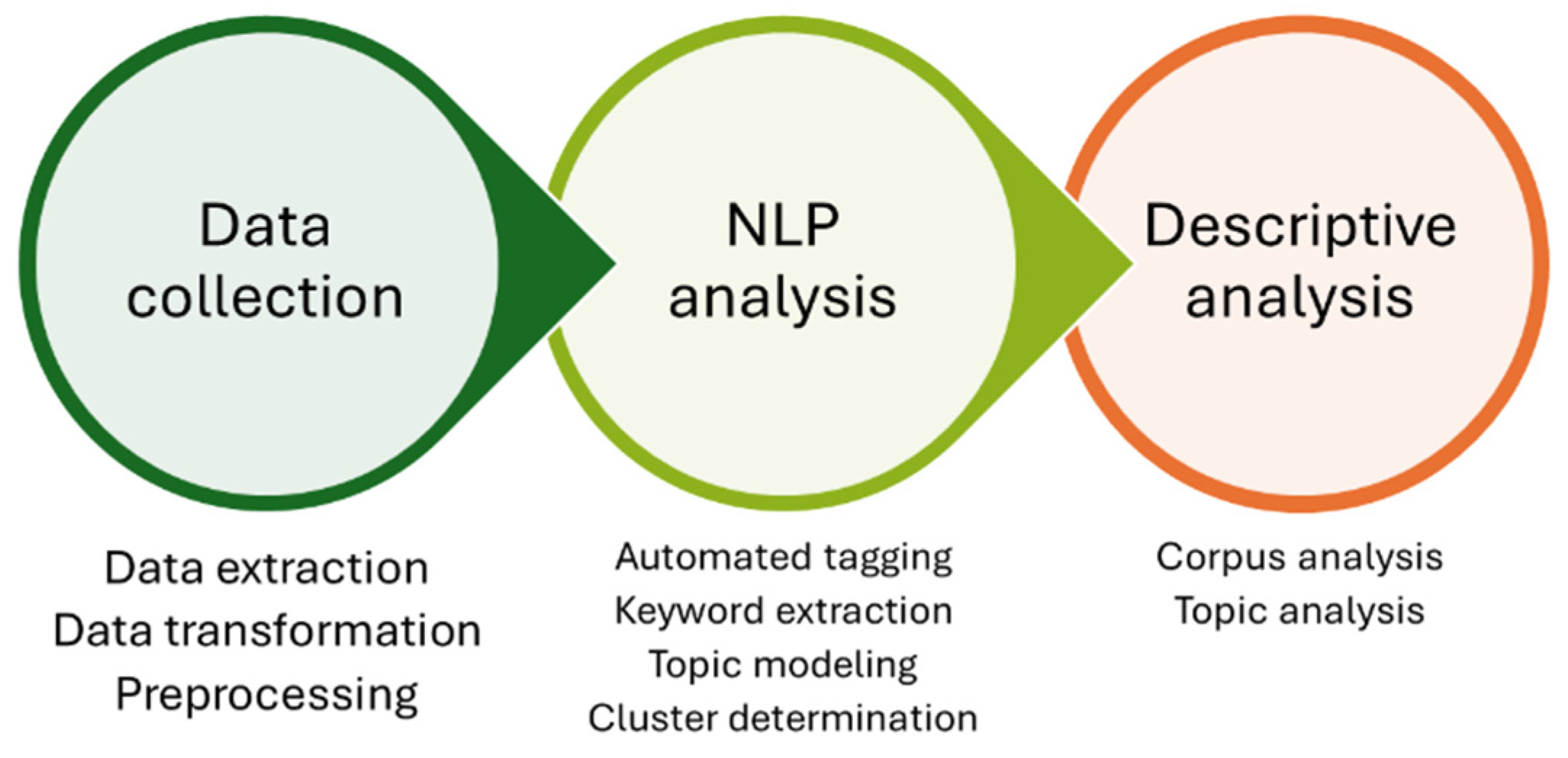
2.2. Analysis Using ML Algorithms to Analyze the Data Extracted in the LT
3. Results
3.1. Tagging for Visualization Using Markdown-Based Tools
3.2. Corpus Analysis
4. Discussion
4.1. Implications for Theory
4.2. Implications for Practitioners and Policymakers
4.3. Limitations and Future Research Directions
5. Conclusions
Supplementary Materials
Author Contributions
Funding
Institutional Review Board Statement
Informed Consent Statement
Data Availability Statement
Conflicts of Interest
Appendix A. Python-Based Scripts for the NLP Analysis Pipeline
Appendix A.1. Excel to Markdown Conversion
| import pandas as pd import os excel_path = r”PATH_TO_EXCEL” output_folder = r”OUTPUT_FOLDER” os.makedirs(output_folder, exist_ok=True) df = pd.read_excel(excel_path) for index, row in df.iterrows(): titolo = str(row[‘ID’]) testo = str(row[‘Abstract’]) file_path = os.path.join(output_folder, f”{titolo}.md”) with open(file_path, ‘w’, encoding=‘utf-8’) as file: file.write(f”# {titolo}\n\n”) file.write(testo) print(“Markdown files created successfully.”) |
Appendix A.2. Text Pre-Processing
| import nltk import os import re from nltk.corpus import stopwords import string nltk.download(‘stopwords’) stop_words = set(stopwords.words(‘english’)) def clean_text(text, stop_words): translator = str.maketrans(‘’, ‘’, string.punctuation) text = text.translate(translator) text = text.lower() text = re.sub(r’\b\d+\b’, ‘’, text) words = text.split() filtered_words = [word for word in words if word not in stop_words] return ‘ ‘.join(filtered_words) |
Appendix A.3. Removal of Irrelevant Terms
| import pandas as pd import re df = pd.read_excel(“file_output.xlsx”) parole_da_eliminare = df[‘type’].dropna().astype(str).tolist() pattern = re.compile(r”\b(“ + “|”.join(map(re.escape, parole_da_eliminare)) + r”)\b”, re.IGNORECASE) modified_content = pattern.sub(“ “, content) |
Appendix A.4. Markdown to Text Conversion
| import markdown import re def markdown_to_text(markdown_content): html = markdown.markdown(markdown_content) text = re.sub(r’<[^>]+>’, ‘’, html) return text |
Appendix A.5. Tag Extraction and Matrix Creation
| import re def extract_tags(filepath): with open(filepath, “r”, encoding=“utf-8”) as file: content = file.read() tags = re.findall(r”#(\w+)”, content) return tags |
Appendix A.6. TF-IDF Computation
| from math import log def calcola_tfidf_completo(documenti): term_freq = {} doc_freq = {} total_documents = len(documenti) for doc, testo in documenti.items(): parole = re.findall(r”\w+”, testo.lower()) tag_parole = estrai_tag(testo) tag_parole = [parola[1:].lower() for parola in tag_parole] term_freq[doc] = {} unique_tags = set(tag_parole) for tag in unique_tags: term_freq[doc][tag] = tag_parole.count(tag) / len(parole) doc_freq[tag] = doc_freq.get(tag, 0) + 1 tfidf = {} for doc, terms in term_freq.items(): tfidf[doc] = {} for tag, tf in terms.items(): idf = log((total_documents + 1) / (doc_freq[tag] + 1)) + 1 tfidf[doc][tag] = tf * idf * 1000 return tfidf |
Appendix A.7. Elbow Method (Cluster Selection)
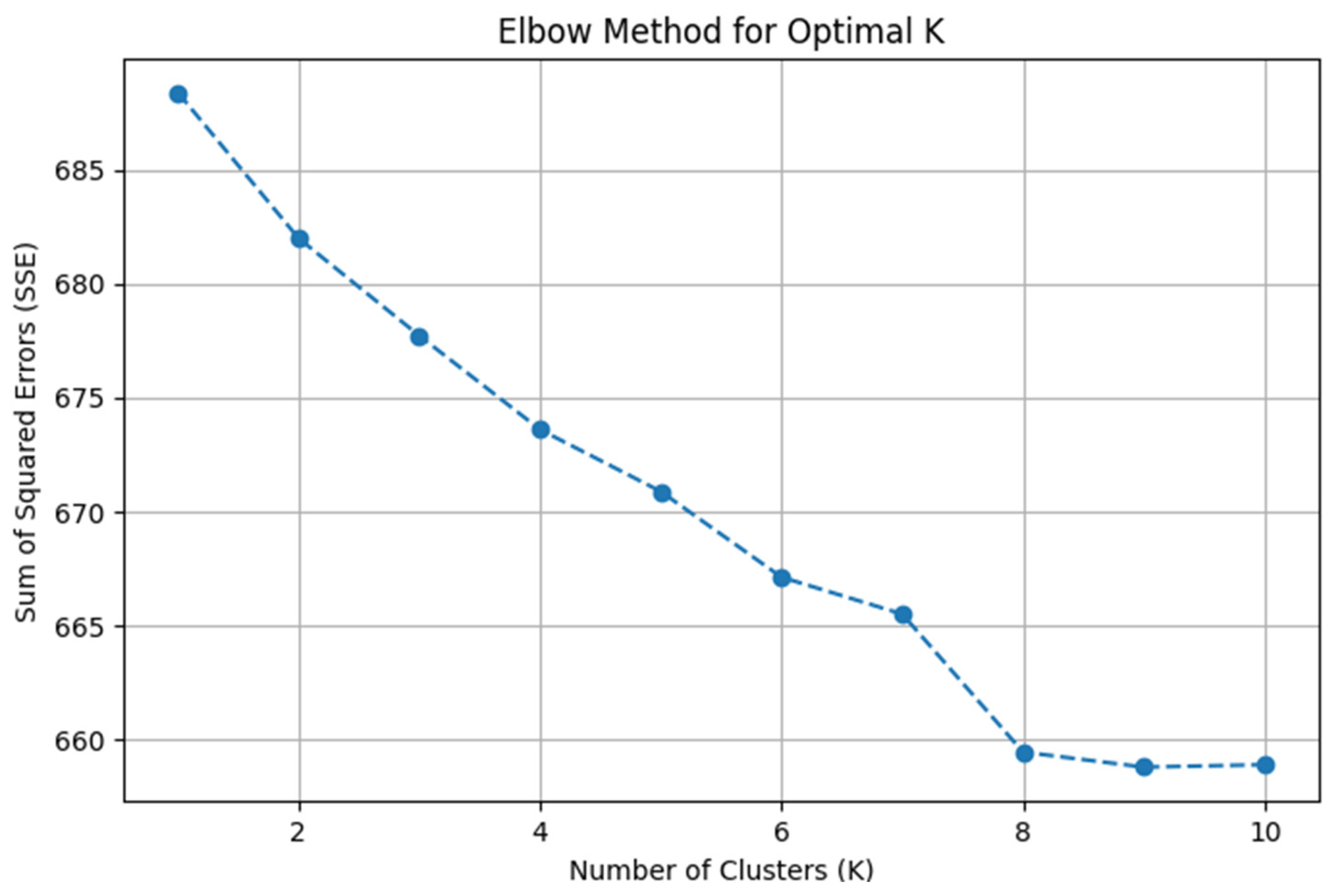
| from sklearn.feature_extraction.text import TfidfVectorizer from sklearn.cluster import KMeans vectorizer = TfidfVectorizer(stop_words=‘english’) X = vectorizer.fit_transform(file_contents) sse = [] for k in range(1, 11): kmeans = KMeans(n_clusters=k) kmeans.fit(X) sse.append(kmeans.inertia_) |
Appendix A.8. Topic Modeling (LDA)
| from gensim.models.ldamodel import LdaModel lda_model = LdaModel(corpus, num_topics=5, id2word=dictionary, passes=15) |
Appendix A.9. Heatmap Visualization
| from openpyxl.styles import PatternFill if cell.value <= 5: color = “E0FFFF” elif cell.value <= 10: color = “ADD8E6” |
Appendix A.10. Keyword Extraction and Semantic Similarity
| import pandas as pd from sklearn.feature_extraction.text import TfidfVectorizer from sklearn.metrics.pairwise import cosine_similarity # Lettura dei documenti documents = [] filenames = [] for filename in os.listdir(input_directory): if filename.endswith(“.md”): with open(os.path.join(input_directory, filename), ‘r’, encoding=‘utf-8’) as f: documents.append(f.read()) filenames.append(filename) # Calcolo TF-IDF vectorizer = TfidfVectorizer(stop_words=‘english’) X = vectorizer.fit_transform(documents) # Estrazione delle parole chiave feature_names = vectorizer.get_feature_names_out() keywords = {} for i, doc in enumerate(X): sorted_indices = doc.toarray().argsort()[0][::-1] top_keywords = [feature_names[idx] for idx in sorted_indices[:10]] keywords[filenames[i]] = top_keywords # Calcolo similarità coseno tra documenti cosine_sim = cosine_similarity(X) print(“Keyword extraction and similarity analysis completed.”) |
Appendix A.11. Automated Tagging Script
| # Cartella contenente i file Markdown $inputFolder = “C:\Path\To\Input” $outputFolder = “C:\Path\To\Output” # Lista di parole chiave da taggare $keywords = @(“supply”, “chain”, “healthcare”, “logistics”, “resilience”) # Crea la cartella di output se non esiste New-Item -ItemType Directory -Force -Path $outputFolder|Out-Null # Ciclo sui file Markdown Get-ChildItem -Path $inputFolder -Filter *.md|ForEach-Object { $content = Get-Content $_.FullName -Raw $tags = @() foreach ($word in $keywords) { if ($content -match “\b$word\b”) { $tags += “#$word” } } # Aggiunge i tag in fondo al file $newContent = $content + “`n`n” + ($tags -join “ “) # Salva il file modificato $outputPath = Join-Path $outputFolder $_.Name Set-Content-Path $outputPath-Value $newContent } Write-Output “Tagging completed.” |
References
- Håkansson, H.; Persson, G. Supply Chain Management: The Logic of Supply Chains and Networks. Int. J. Logist. Manag. 2004, 15, 11–26. [Google Scholar] [CrossRef]
- Costantino, F.; Di Gravio, G.; Shaban, A.; Tronci, M. The impact of information sharing and inventory control coordination on supply chain performances. Comput. Ind. Eng. 2014, 76, 292–306. [Google Scholar] [CrossRef]
- Colabianchi, S.; Bernabei, M.; Costantino, F.; Romano, E.; Falegnami, A. MARLIN Method: Enhancing Warehouse Resilience in Response to Disruptions. Logistics 2023, 7, 95. [Google Scholar] [CrossRef]
- Vidrova, Z. Supply chain management in the aspect of globalization. SHS Web Conf. 2020, 74, 04031. [Google Scholar] [CrossRef]
- Khoukhi, S.; Bojji, C.; Bensouda, Y. A review of medical distribution logistics in pharmaceutical supply chain. Int. J. Logist. Syst. Manag. 2019, 34, 297–326. [Google Scholar] [CrossRef]
- Spieske, A.; Gebhardt, M.; Kopyto, M.; Birkel, H. Improving resilience of the healthcare supply chain in a pandemic: Evidence from Europe during the COVID-19 crisis. J. Purch. Supply Manag. 2022, 28, 100748. [Google Scholar] [CrossRef]
- Tomassi, A.; Falegnami, A.; Romano, E. Unveiling simplexity: A new paradigm for understanding complex adaptive systems and driving technological innovation. Innovation 2025, 6, 100954. [Google Scholar] [CrossRef] [PubMed]
- Falegnami, A.; Tomassi, A.; Gunella, C.; Amalfitano, S.; Corbelli, G.; Armonaite, K.; Fornaro, C.; Giorgi, L.; Pollini, A.; Caforio, A. Defining conceptual artefacts to manage and design simplicities in complex adaptive systems. Heliyon 2024, 10, e41033. [Google Scholar] [CrossRef] [PubMed]
- Bernabei, M.; Colabianchi, S.; Costantino, F. Actions and Strategies for Coronavirus to Ensure Supply Chain Resilience: A Systemic Review. Sustainability 2022, 14, 13243. [Google Scholar] [CrossRef]
- Cohen, J.; Rodgers, Y.V.D.M. Contributing factors to personal protective equipment shortages during the COVID-19 pandemic. Prev. Med. 2020, 141, 106263. [Google Scholar] [CrossRef]
- Wagner, S.M.; Bode, C. An empirical investigation into supply chain vulnerability. J. Purch. Supply Manag. 2006, 12, 301–312. [Google Scholar] [CrossRef]
- Woodcock, J.; Wosinska, M. Economic and Technological Drivers of Generic Sterile Injectable Drug Shortages. Clin. Pharmacol. Ther. 2012, 93, 170–176. [Google Scholar] [CrossRef]
- National Academies of Sciences, Engineering, and Medicine; Health and Medicine Division; Board on Health Sciences Policy; Committee on Security of America’s Medical Product Supply Chain; Shore, C.; Brown, L.; Hopp, W.J. (Eds.) Causes and Consequences of Medical Product Supply Chain Failures. In Building Resilience into the Nation’s Medical Product Supply Chains; National Academies Press: Washington, DC, USA, 2022. Available online: https://www.ncbi.nlm.nih.gov/books/NBK583734/ (accessed on 15 February 2025).
- Tomassi, A.; Falegnami, A.; Romano, E. Mapping automatic social media information disorder. The role of bots and AI in spreading misleading information in society. PLoS ONE 2024, 19, e0303183. [Google Scholar] [CrossRef] [PubMed]
- Bernabei, M.; Colabianchi, S.; Costantino, F. Natural Language Processing Applications in Manufacturing: A Systematic Literature Review. 2022. Available online: https://iris.uniroma1.it/handle/11573/1664079 (accessed on 12 December 2025).
- Blei, D.M.; Ng, A.Y.; Jordan, M.I. Latent dirichlet allocation. J. Mach. Learn. Res. 2003, 3, 993–1022. [Google Scholar]
- Grubbs, A.E.; Sinha, N.; Garg, R.; Barber, E.L. Use of topic modeling to assess research trends in the journal Gynecologic Oncology. Gynecol. Oncol. 2023, 172, 41–46. [Google Scholar] [CrossRef] [PubMed]
- Colabianchi, S.; Bernabei, M.; Costantino, F. Chatbot for training and assisting operators in inspecting containers in seaports. Transp. Res. Procedia 2022, 64, 6–13. [Google Scholar] [CrossRef]
- Luhn, H.P. Key wordincontext index for technical literature (kwic index). Am. Doc. 1960, 11, 288–295. [Google Scholar] [CrossRef]
- Mello, R.A. Collocation analysis: A method for conceptualizing and understanding narrative data. Qual. Res. 2002, 2, 231–243. [Google Scholar] [CrossRef]
- Tomassi, A.; Caforio, A.; Romano, E.; Lamponi, E.; Pollini, A. The development of a Competence Framework for Environmental Education complying with the European Qualifications Framework and the European Green Deal. J. Environ. Educ. 2024, 55, 153–179. [Google Scholar] [CrossRef]
- Sarica, S.; Luo, J. Stopwords in technical language processing. PLoS ONE 2021, 16, e0254937. [Google Scholar] [CrossRef]
- Speer, R.; Chin, J.; Havasi, C. ConceptNet 5.5: An Open Multilingual Graph of General Knowledge. In Proceedings of the AAAI Conference on Artificial Intelligence, San Francisco, CA, USA, 4–9 February 2017; Volume 31, pp. 4444–4451. [Google Scholar] [CrossRef]
- Leung, C.D.; Chow, M.V.; Ge, H. Compiling data for investigating language use in classroom discourse: A corpus-driven method. MethodsX 2024, 13, 103048. [Google Scholar] [CrossRef]
- Amur, Z.H.; Hooi, Y.K.; Soomro, G.M.; Bhanbhro, H.; Karyem, S.; Sohu, N. Unlocking the Potential of Keyword Extraction: The Need for Access to High-Quality Datasets. Appl. Sci. 2023, 13, 7228. [Google Scholar] [CrossRef]
- Jelodar, H.; Wang, Y.; Yuan, C.; Feng, X.; Jiang, X.; Li, Y.; Zhao, L. Latent Dirichlet allocation (LDA) and topic modeling: Models, applications, a survey. Multimed. Tools Appl. 2019, 78, 15169–15211. [Google Scholar] [CrossRef]
- Sievert, C.; Shirley, K. LDAvis: A method for visualizing and interpreting topics. In Proceedings of the Workshop on Interactive Language Learning, Visualization, and Interfaces, Baltimore, MD, USA; Association for Computational Linguistics: Stroudsburg, PA, USA, 2014; pp. 63–70. [Google Scholar] [CrossRef]
- Marutho, D.; Handaka, S.H.; Wijaya, E.; Muljono. The Determination of Cluster Number at k-Mean Using Elbow Method and Purity Evaluation on Headline News. In 2018 International Seminar on Application for Technology of Information and Communication; IEEE: Semarang, Indonesia, 2018; pp. 533–538. [Google Scholar] [CrossRef]
- Abu-Salih, B.; Alotaibi, S. A systematic literature review of knowledge graph construction and application in education. Heliyon 2024, 10, e25383. [Google Scholar] [CrossRef] [PubMed]
- Falegnami, A.; Romano, E.; Tomassi, A. The Emergence of the GreenSCENT Competence Framework. In The European Green Deal in Education, 1st ed.; Routledge: London, UK, 2024; pp. 204–216. [Google Scholar] [CrossRef]
- Tomassi, A.; Falegnami, A.; Meleo, L.; Romano, E. The GreenSCENT Competence Frameworks. In The European Green Deal in Education; Routledge: London, UK, 2024. [Google Scholar] [CrossRef]
- Nakhal, A.A.J.; Patriarca, R.; Di Gravio, G.; Antonioni, G.; Paltrinieri, N. Investigating occupational and operational industrial safety data through Business Intelligence and Machine Learning. J. Loss Prev. Process Ind. 2021, 73, 104608. [Google Scholar] [CrossRef]
- Nakhal Akel, A.J.; Hovstad, J.S.; Ruth, M.S.; Parmeggiani, S.; Patriarca, R.; Paltrinieri, N. A Machine Learning Approach to Analyze Natural Hazards Accidents Scenarios. Chem. Eng. Trans. 2022, 91, 397–402. [Google Scholar] [CrossRef]
- Simone, F.; Akel, A.J.N.; Patriarca, R. Supporting Warehouse Management Through Machine Learning. In Proceedings Summer School Francesco Turco, AIDI—Italian Association of Industrial Operations Professors. 2022. Available online: https://www.scopus.com/pages/publications/85142819559 (accessed on 10 December 2025).
- Falegnami, A.; Tomassi, A.; Corbelli, G.; Romano, E. Resilience Analysis Grid–Rasch Rating Scale Model for Measuring Organizational Resilience Potential. Appl. Sci. 2025, 15, 1695. [Google Scholar] [CrossRef]
- Tomassi, A.; Falegnami, A.; Romano, E. Talking Resilience: Embedded Natural Language Cyber-Organizations by Design. Systems 2025, 13, 247. [Google Scholar] [CrossRef]
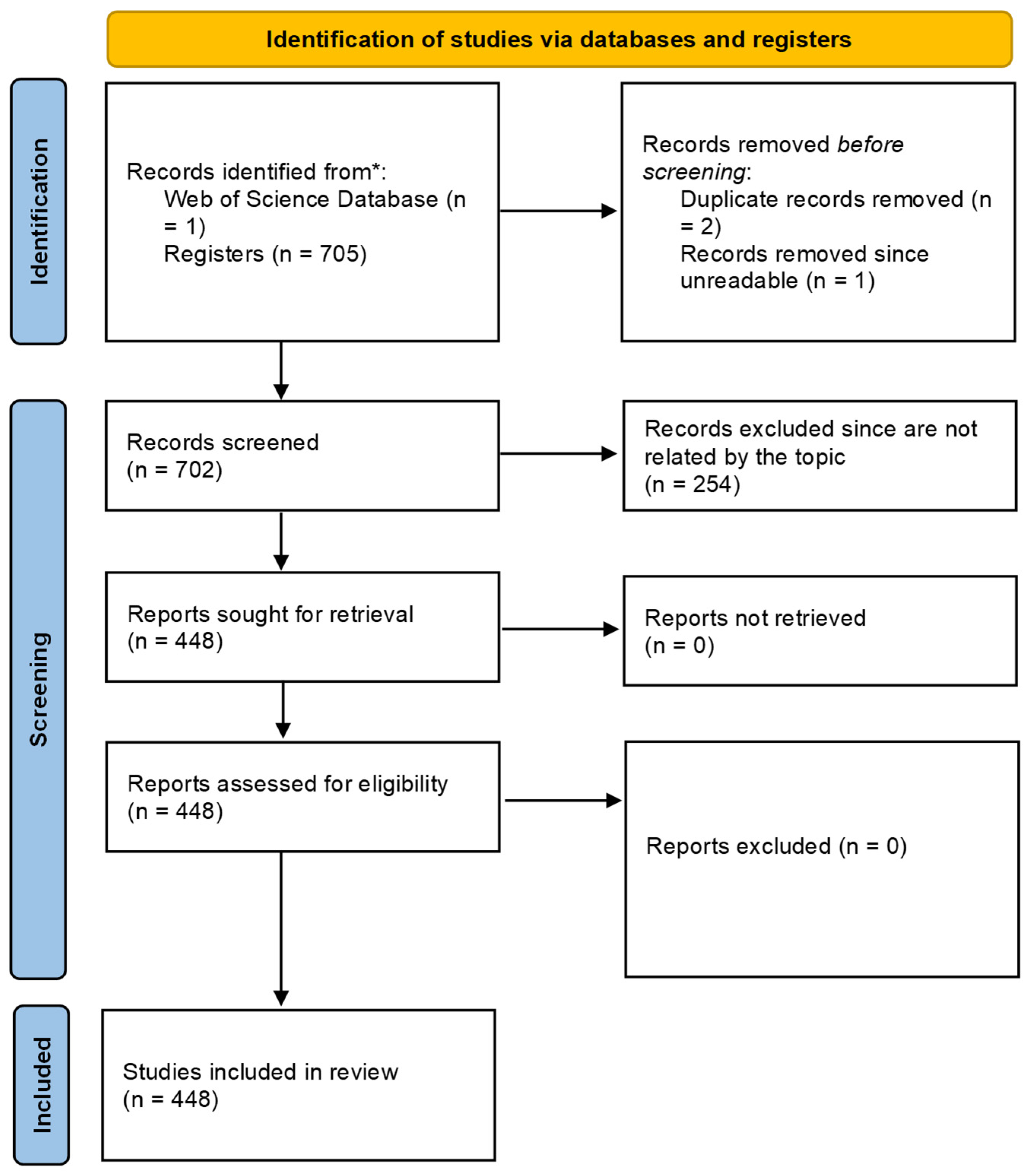
- Page, M.J.; McKenzie, J.E.; Bossuyt, P.M.; Boutron, I.; Hoffmann, T.C.; Mulrow, C.D.; Shamseer, L.; Tetzlaff, J.M.; Akl, E.A.; Brennan, S.E.; et al. The PRISMA 2020 statement: An updated guideline for reporting systematic reviews. BMJ 2021, 372, n71. [Google Scholar] [CrossRef]




| Criteria Type | Description |
|---|---|
| Inclusion Criteria | Peer-reviewed journal articles |
| Inclusion Criteria | Articles written in English |
| Inclusion Criteria | Studies indexed in the Web of Science (WoS) database |
| Inclusion Criteria | Studies addressing healthcare supply chains or related topics |
| Inclusion Criteria | Articles containing keywords related to “supply chain”, “design”, and “healthcare” |
| Inclusion Criteria | Availability of title and abstract for analysis |
| Eligibility Criteria | Articles providing sufficient information for thematic and textual analysis |
| Eligibility Criteria | Studies relevant to the research questions of the review |
| Eligibility Criteria | Articles suitable for NLP-based analysis (textual content available) |
| Exclusion Criteria | Conference papers, book chapters, editorials, and non-peer-reviewed documents |
| Exclusion Criteria | Articles not written in English |
| Exclusion Criteria | Studies not related to healthcare supply chain management |
| Exclusion Criteria | Articles lacking sufficient textual data (e.g., missing abstract) |
| Exclusion Criteria | Duplicate records |
| ID | Abstract |
|---|---|
| 1 | Healthcare and disaster supply chain have become a more important and popular research issues recently. However, only a few papers are known about the current issues both healthcare and disaster supply chain especially in natural disaster case. This paper is a preliminary report of research on healthcare and disaster supply chain. The paper intends to review and analyze several papers on above topic published during the last ten years. Published papers on healthcare and disaster supply chain research from 2005 and 2014 were classified into three main themes: (1) healthcare supply chain, (2) disaster supply chain and (3) healthcare supply chain in natural disaster. The topic issues in each main themes include operational management, information technology, inventory and control management, strategic management, and service management. Besides, the type of research methods contains empirical study, case study, modelling and simulation, literature review, and conceptual theory. Result of the review will provide the basis for the direction of future research in these three themes. |
| 2 | Healthcare remains a very crucial sector for every economy. Medicines or drugs serve as essential consumables for the treatment of ailments and hence making them essential commodities in healthcare delivery. The hospital pharmaceutical supply chain of most emerging economies has not been given the requisite attention in relation to enhancing visibility among the stakeholders. The lack of visibility within the supply chain leads to drug shortages in hospitals. Some studies have identified the problem of visibility in pharmaceutical supply chains. However, a few of these studies tend to offer solutions to deal with this crucial issue. From a design science perspective, the current study relies on information systems research framework to design an architecture for a class of systems aimed at enhancing supply chain visibility and in effect help to mitigate the issue of drug shortage resulting from ineffective supply chain management. |
| 3 | Supply chain management in healthcare is evaluated with a particular focus on the distribution of medicines from a wholesaler to clinics. Currently, there are issues with service levels to clinics that need addressing. The value of the paper arises from providing a detailed analysis of a healthcare supply chain in the developing world and diagnosis of the parameter involved in inventory. |
| 4 | This study was designed primarily to assess the relationships among the implementation of e-commerce, the external collaboration and supply chain performance in the healthcare industry of Taiwan. To examine the impact of e-commerce on SCM in the healthcare industry, its relationship with external collaboration and supply chain performance were empirically tested. The statistical results of analyses showed that the implementation of e-commerce, the external relationship between trading partners and supply chain performance were highly correlated to each other. Supply chain performance is also highly correlated with customer satisfaction. |
| … | … |
| Text ID | Keyword | Score |
|---|---|---|
| 1 | disaster supply chain | 0.78 |
| 1 | chain disaster supply | 0.72 |
| 1 | supply chain disaster | 0.66 |
| 1 | healthcare disaster supply | 0.65 |
| 1 | supply chain healthcare | 0.62 |
| 2 | pharmaceutical supply chain | 0.65 |
| 2 | pharmaceutical supply chains | 0.63 |
| 2 | visibility pharmaceutical supply | 0.63 |
| 2 | hospital pharmaceutical supply | 0.59 |
| 2 | problem visibility pharmaceutical | 0.57 |
| 3 | healthcare supply chain | 0.80 |
| 3 | analysis healthcare supply | 0.68 |
| 3 | distribution medicine wholesaler | 0.68 |
| 3 | medicine wholesaler clinics | 0.67 |
| 3 | supply chain | 0.66 |
| 4 | commerce external collaboration | 0.56 |
| Text ID | Keyword | Score | Cluster |
|---|---|---|---|
| 1 | disaster supply chain | 0.78 | Disaster |
| 1 | chain disaster supply | 0.72 | Disaster |
| 1 | supply chain disaster | 0.66 | Disaster |
| 1 | healthcare disaster supply | 0.65 | Disaster |
| 1 | supply chain healthcare | 0.62 | Design |
| 2 | pharmaceutical supply chain | 0.65 | Pharmaceutical |
| 2 | pharmaceutical supply chains | 0.63 | Pharmaceutical |
| 2 | visibility pharmaceutical supply | 0.63 | Pharmaceutical |
| 2 | hospital pharmaceutical supply | 0.59 | Pharmaceutical |
| 2 | problem visibility pharmaceutical | 0.57 | Pharmaceutical |
| Keyword | Score | Cluster |
|---|---|---|
| additive manufacturing | 0.55 | Additive manufacturing |
| manufacturing additive | 0.55 | Additive manufacturing |
| printing | 0.55 | Additive manufacturing |
| ai | 0.51 | AI |
| deep learning | 0.55 | AI |
| learning deep | 0.55 | AI |
| deep reinforcement | 0.58 | AI |
| reinforcement deep | 0.58 | AI |
| optimizer mogwo | 0.51 | AI |
| mogwo optimizer | 0.51 | AI |
| analytics | 0.52 | Analytics |
| cps | 0.56 | Big data |
| dea | 0.61 | Big data |
| digital twin | 0.56 | Big data |
| Area | Identified Gap | Recommendation | Expected Impact |
|---|---|---|---|
| System Integration | Fragmentation across supply chain tiers and lack of end-to-end coordination | Develop integrated, multi-tier supply chain models that connect manufacturers, distributors, and healthcare providers | Improved coordination, reduced inefficiencies, and enhanced system resilience |
| Digital Technologies | Strong focus on conceptual technologies (e.g., blockchain) but limited real-world implementation | Promote applied research and pilot projects for integrating digital solutions into healthcare systems | Increased adoption of digital tools and improved traceability |
| Resilience | Lack of unified approach to resilience across different supply chain stages | Develop cross-cutting resilience frameworks that consider the entire supply chain | Enhanced preparedness for disruptions (e.g., pandemics, crises) |
| Sustainability | Sustainability is marginal and not treated as a core theme | Integrate environmental sustainability into supply chain design and decision-making processes | Reduced environmental impact and alignment with global sustainability goals |
| Data and Interoperability | Limited integration of data-sharing and interoperability across actors | Develop standardized data-sharing protocols and interoperable information systems | Improved visibility and decision-making across the supply chain |
| Regulatory Alignment | Regulatory aspects are addressed mainly for pharmaceuticals, not across all domains | Extend regulatory analysis to include medical devices and broader healthcare logistics | Improved compliance and reduced operational risks |
| Research Integration | Strong thematic silos with limited cross-disciplinary research | Encourage interdisciplinary studies combining logistics, policy, and technology perspectives | More comprehensive and systemic solutions |
| Implementation Focus | Gap between theoretical models and practical applications | Increase collaboration between academia and practitioners to test models in real contexts | Greater applicability and impact of research findings |
Disclaimer/Publisher’s Note: The statements, opinions and data contained in all publications are solely those of the individual author(s) and contributor(s) and not of MDPI and/or the editor(s). MDPI and/or the editor(s) disclaim responsibility for any injury to people or property resulting from any ideas, methods, instructions or products referred to in the content. |
© 2026 by the authors. Licensee MDPI, Basel, Switzerland. This article is an open access article distributed under the terms and conditions of the Creative Commons Attribution (CC BY) license.
Share and Cite
Tomassi, A.; Nakhal Akel, A.J.; Falegnami, A.; Bilotta, F. Mapping the Landscape of Healthcare Supply Chain Management Through an NLP-Driven Systematic Review. Logistics 2026, 10, 55. https://doi.org/10.3390/logistics10030055
Tomassi A, Nakhal Akel AJ, Falegnami A, Bilotta F. Mapping the Landscape of Healthcare Supply Chain Management Through an NLP-Driven Systematic Review. Logistics. 2026; 10(3):55. https://doi.org/10.3390/logistics10030055
Chicago/Turabian StyleTomassi, Andrea, Antonio Javier Nakhal Akel, Andrea Falegnami, and Federico Bilotta. 2026. "Mapping the Landscape of Healthcare Supply Chain Management Through an NLP-Driven Systematic Review" Logistics 10, no. 3: 55. https://doi.org/10.3390/logistics10030055
APA StyleTomassi, A., Nakhal Akel, A. J., Falegnami, A., & Bilotta, F. (2026). Mapping the Landscape of Healthcare Supply Chain Management Through an NLP-Driven Systematic Review. Logistics, 10(3), 55. https://doi.org/10.3390/logistics10030055