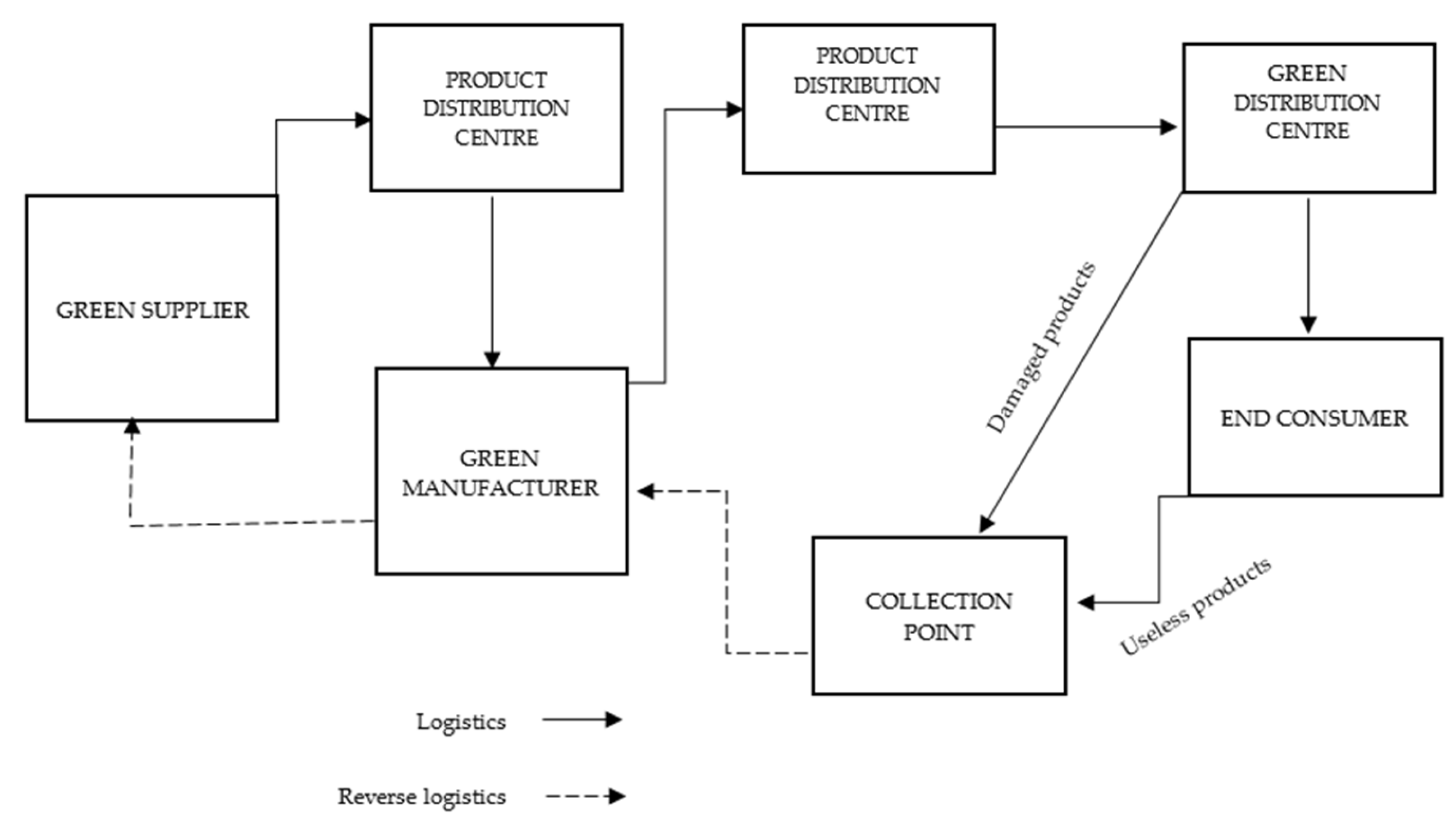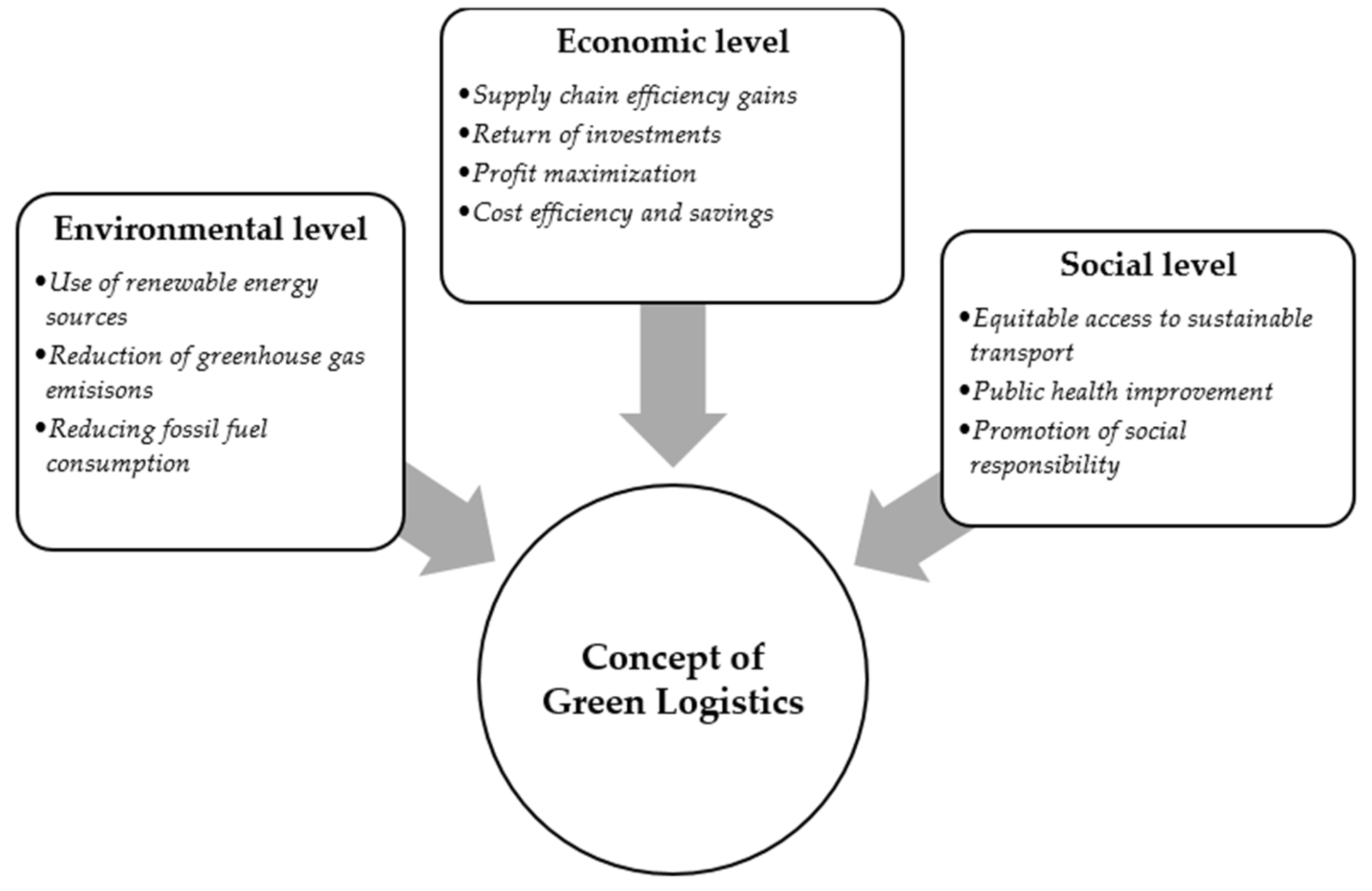
A Conceptual Framework for Evaluating Green Logistics Practices Through Multi-Criteria Decision-Making Methods

Abstract
1. Introduction
- What are the key criteria and sub-criteria for evaluating green logistics practices in SMEs using the AHP and SAW?
- What is the relative importance of green logistics practices in SMEs based on the AHP–SAW evaluation?
- How can SMEs utilise these insights to implement and promote effective green logistics initiatives for sustainable organisational development?
2. Literature Review
2.1. Green Logistics: Concept and the Importance of Implementation
2.2. Green Logistics Practices
3. Methodology
3.1. Sampling and Research Method
3.2. Data Evaluation Methods and Measurement
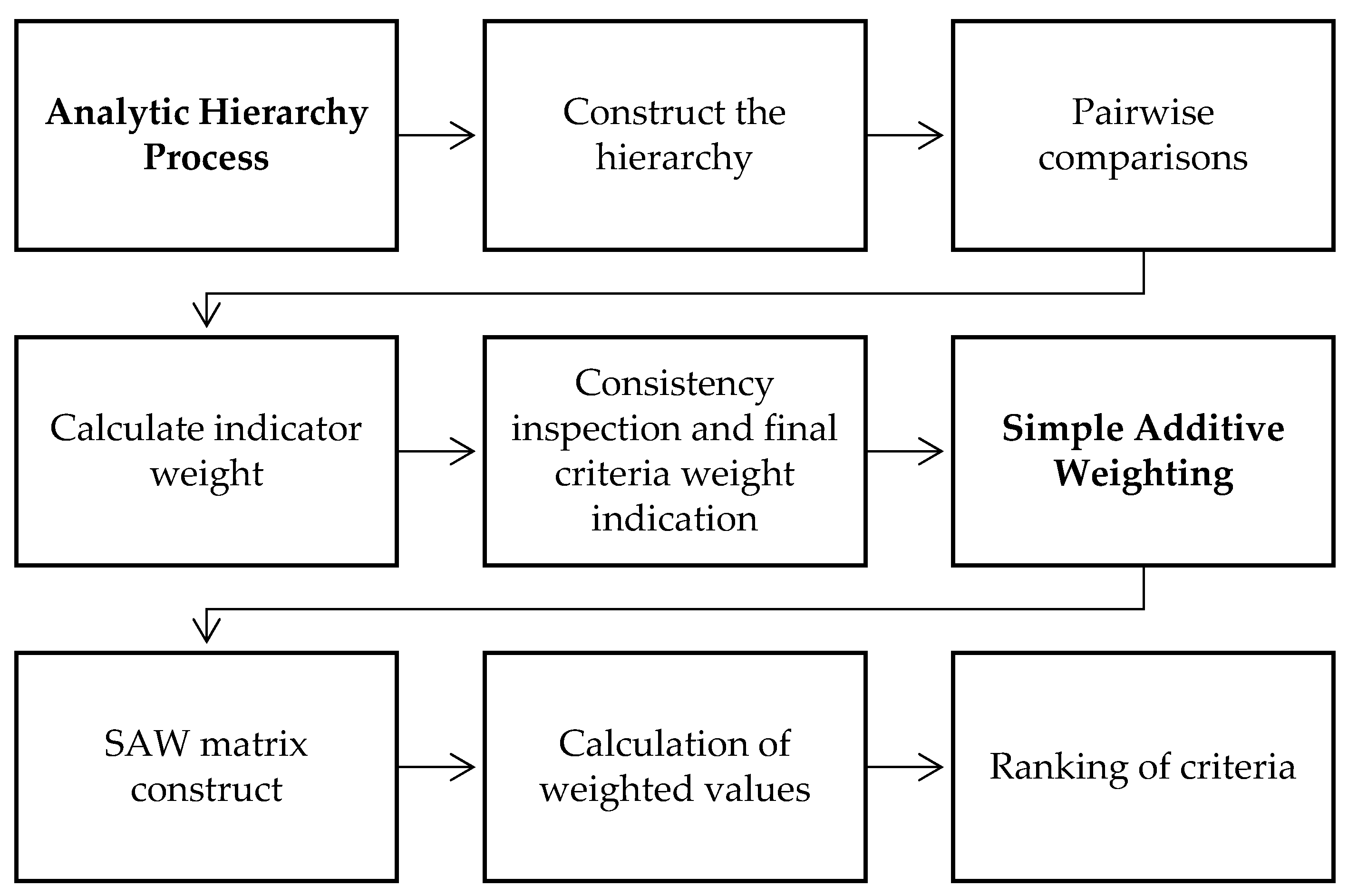
- Establishing a hierarchical framework for evaluation involves assessing green logistics practices and their components, with the aim of ranking them according to implementation priorities. This approach facilitates a structured analysis to identify the most critical elements for effective deployment.
- Calculating the element weights for various hierarchies involves deriving weight coefficients from the pairwise comparison matrix data to assess the relative importance of criteria and sub-criteria, ranking them accordingly. The weight coefficient for each criterion is obtained by normalising the pairwise comparison matrix.
- Calculating eigenvalues: the purpose of this indicator is twofold: firstly, it helps assess how accurately the pairwise comparison matrix reflects expert decision logic, and secondly, it aims to determine whether the data supplied by experts is sufficiently consistent:
- Calculation of the consistency index (CI) and consistency ratio (CR): these data are an important part of the AHP multi-criteria evaluation methodology, as they ensure the logic and reliability of expert assessment:
4. Evaluation of Green Logistics Practices Using the AHP–SAW Multi-Criteria Decision-Making Approach
5. Discussion and Conclusions
Author Contributions
Funding
Institutional Review Board Statement
Informed Consent Statement
Data Availability Statement
Conflicts of Interest
References
- Zhang, W.; Zhang, M.; Zhang, W.; Zhou, Q.; Zhang, X. What Influences the Effectiveness of Green Logistics Policies? A Grounded Theory Analysis. Sci. Total Environ. 2020, 714, 136731. [Google Scholar] [CrossRef]
- Baah, C.; Amponsah, K.T.; Issau, K.; Ofori, D.; Acquah, I.S.K.; Agyeman, D.O. Examining the Interconnections Between Sustainable Logistics Practices, Environmental Reputation and Financial Performance: A Mediation Approach. Vis. J. Bus. Perspect. 2021, 25, 47–64. [Google Scholar] [CrossRef]
- Karaman, A.S.; Kilic, M.; Uyar, A. Green Logistics Performance and Sustainability Reporting Practices of the Logistics Sector: The Moderating Effect of Corporate Governance. J. Clean. Prod. 2020, 258, 120718. [Google Scholar] [CrossRef]
- Lew, A.F.R.; Chew, B.C.; Hamid, S.R. Green Logistics Implementation Factors: A Study on a Global Logistics Provider. J. Adv. Manuf. Technol. 2017, 12, 115–128. [Google Scholar]
- Patra, P. Green Logistics: Eco-Friendly Measure in Supply-Chain. Manag. Insight-J. Incisive Anal. 2018, 14, 65–71. [Google Scholar] [CrossRef]
- Dzwigo, H.; Trushkina, N.; Kwilinski, A. The Organizational and Economic Mechanism of Implementing the Concept of Green Logistics. Virtual Econ. 2021, 4, 41–75. [Google Scholar] [CrossRef]
- Do Carmo Netto, N.W.; De Farias Oliveira Cardoso, B.; Do Carmo, L.F.R.R.S.; Pinto, R.M. Green Logistics: A Tertiary Study and a Research Agenda. In Operations Management for Social Good; Leiras, A., González-Calderón, C.A., De Brito Junior, I., Villa, S., Yoshizaki, H.T.Y., Eds.; Springer Proceedings in Business and Economics; Springer International Publishing: Cham, Switzerland, 2020; pp. 1055–1063. [Google Scholar]
- Kanyepe, J.; Alfaneta, M.; Zizhou, B. Green Logistics Adoption and Operational Performance within the Road Freight Sector: The Moderating Role of Management Commitment. Logist. Res. Bundesver. Logist. BVL 2023, 16, 1–14. [Google Scholar] [CrossRef]
- Chatzoudes, D.; Kadłubek, M.; Maditinos, D. Green Logistics Practices: The Antecedents and Effects for Supply Chain Management in the Modern Era. Equilib. Q. J. Econ. Econ. Policy 2024, 19, 991–1034. [Google Scholar] [CrossRef]
- Tetteh, F.K.; Mensah, J.; Owusu Kwateng, K. Understanding What, How and When Green Logistics Practices Influence Carbon-Neutral Supply Chain Performance. Int. J. Product. Perform. Manag. 2025, 74, 2211–2244. [Google Scholar] [CrossRef]
- Agyabeng-Mensah, Y.; Afum, E.; Ahenkorah, E. Exploring Financial Performance and Green Logistics Management Practices: Examining the Mediating Influences of Market, Environmental and Social Performances. J. Clean. Prod. 2020, 258, 120613. [Google Scholar] [CrossRef]
- Rahman, T.; Ali, S.M.; Moktadir, M.A.; Kusi-Sarpong, S. Evaluating Barriers to Implementing Green Supply Chain Management: An Example from an Emerging Economy. Prod. Plan. Control 2020, 31, 673–698. [Google Scholar] [CrossRef]
- De Souza, E.D.; Kerber, J.C.; Bouzon, M.; Rodriguez, C.M.T. Performance Evaluation of Green Logistics: Paving the Way towards Circular Economy. Clean. Logist. Supply Chain 2022, 3, 100019. [Google Scholar] [CrossRef]
- Sharma, M.; Luthra, S.; Joshi, S.; Kumar, A.; Jain, A. Green Logistics Driven Circular Practices Adoption in Industry 4.0 Era: A Moderating Effect of Institution Pressure and Supply Chain Flexibility. J. Clean. Prod. 2023, 383, 135284. [Google Scholar] [CrossRef]
- Jefimovaitė, L.; Vienažindienė, M. Modeling the Implementation of Green Logistics Principles: Theoretical Aspect. Public Secur. Public Order 2021, 26, 93. [Google Scholar]
- Jazairy, A.; Pohjosenperä, T.; Prataviera, L.B.; Juntunen, J. Innovators and Transformers: Revisiting the Gap between Academia and Practice: Insights from the Green Logistics Phenomenon. Int. J. Phys. Distrib. Logist. Manag. 2025, 55, 341–360. [Google Scholar] [CrossRef]
- Jefimovaitė, L.; Vienažindienė, M. Green Logistics Concept and the Impact of Its Implementation in the Organisation: A Systematic Literature Review and Meta-Analysis. Eng. Manag. Prod. Serv. 2025, 17, 39–51. [Google Scholar] [CrossRef]
- Khayyat, M.; Balfaqih, M.; Balfaqih, H.; Ismail, M. Challenges and Factors Influencing the Implementation of Green Logistics: A Case Study of Saudi Arabia. Sustainability 2024, 16, 5617. [Google Scholar] [CrossRef]
- Hoang, T.-H.; Tran, T.-T.; Huynh, L.N.T.; Vo, D.K.; Huynh, B.G.; Tran, T.M.T.; Le Nguyen, N.D. Advances and Barriers in Promoting Green Logistics 4.0 from a Multi-Stakeholder Perspective–a Systematic Review. Environ. Syst. Decis. 2025, 45, 14. [Google Scholar] [CrossRef]
- Kumar, A.; Zavadskas, E.K.; Mangla, S.K.; Agrawal, V.; Sharma, K.; Gupta, D. When Risks Need Attention: Adoption of Green Supply Chain Initiatives in the Pharmaceutical Industry. Int. J. Prod. Res. 2019, 57, 3554–3576. [Google Scholar] [CrossRef]
- Kotlars, A.; Skribans, V. Model of Logistics Service Providers Transition to “Green” Services. Transp. Telecommun. J. 2025, 26, 23–32. [Google Scholar] [CrossRef]
- Gonçalves, H.; Magalhães, V.S.M.; Ferreira, L.M.D.F.; Arantes, A. Overcoming Barriers to Sustainable Supply Chain Management in Small and Medium-Sized Enterprises: A Multi-Criteria Decision-Making Approach. Sustainability 2024, 16, 506. [Google Scholar] [CrossRef]
- Kiesnere, A.; Baumgartner, R. Sustainability Management in Practice: Organizational Change for Sustainability in Smaller Large-Sized Companies in Austria. Sustainability 2019, 11, 572. [Google Scholar] [CrossRef]
- Cosimato, S.; Troisi, O. Green Supply Chain Management: Practices and Tools for Logistics Competitiveness and Sustainability. DHL Case Study. TQM J. 2015, 27, 256–276. [Google Scholar] [CrossRef]
- Baah, C.; Jin, Z.; Tang, L. Organizational and Regulatory Stakeholder Pressures Friends or Foes to Green Logistics Practices and Financial Performance: Investigating Corporate Reputation as a Missing Link. J. Clean. Prod. 2020, 247, 119125. [Google Scholar] [CrossRef]
- Ahmed, R.R.; Akbar, W.; Aijaz, M.; Channar, Z.A.; Ahmed, F.; Parmar, V. The Role of Green Innovation on Environmental and Organizational Performance: Moderation of Human Resource Practices and Management Commitment. Heliyon 2023, 9, e12679. [Google Scholar] [CrossRef]
- Hernández-Mejía, C.; Torres-Muñoz, D.; Inzunza-González, E.; Sánchez-López, C.; García-Guerrero, E.E. A Novel Green Logistics Technique for Planning Merchandise Deliveries: A Case Study. Logistics 2022, 6, 59. [Google Scholar] [CrossRef]
- Cil, I.; Demir, H.I.; Yaman, B. Lean Logistics in the 2020s and a Cast Study About Logistics and Supply Chain Management in Toyota Boshoku Turkey. In Advances in Logistics, Operations, and Management Science; Khan, S.A.R., Ed.; IGI Global: Hershey, PA, USA, 2020; pp. 276–315. [Google Scholar]
- Erkan, B. The Importance and Determinants of Logistics Performance of Selected Countries. J. Emerg. Issues Econ. Financ. Bank. 2014, 3, 1237–1254. [Google Scholar]
- Straka, M. The Position of Distribution Logistics in the Logistic System of an Enterprise. Acta Logist. 2017, 4, 23–26. [Google Scholar] [CrossRef]
- Khan, S.A.R.; Jian, C.; Zhang, Y.; Golpîra, H.; Kumar, A.; Sharif, A. Environmental, Social and Economic Growth Indicators Spur Logistics Performance: From the Perspective of South Asian Association for Regional Cooperation Countries. J. Clean. Prod. 2019, 214, 1011–1023. [Google Scholar] [CrossRef]
- Mikhno, I.; Koval, V.; Shvets, G.; Garmatiuk, O.; Tamošiūnienė, R. Green Economy in Sustainable Development and Improvement of Resource Efficiency. Cent. Eur. Bus. Rev. 2021, 10, 99–113. [Google Scholar] [CrossRef]
- Seroka-Stolka, O.; Ociepa-Kubicka, A. Green Logistics and Circular Economy. Transp. Res. Procedia 2019, 39, 471–479. [Google Scholar] [CrossRef]
- Atmayudha, A.; Syauqi, A.; Purwanto, W.W. Green Logistics of Crude Oil Transportation: A Multi-Objective Optimization Approach. Clean. Logist. Supply Chain 2021, 1, 100002. [Google Scholar] [CrossRef]
- Lerher, T.; Pejić, V.; Jereb, B.; Kramberger, T.; Rosi, B. Lean and Green Logistics: A Theoretical Framework Approach. In CIL 2016-Conference Proceedings, Proceedings of the International Conference on Industrial Logistics, Zakopane, Poland, 28 September–1 October 2016; pp. 136–143. [Google Scholar]
- Wang, X. Study on Relationship between Green Logistics Activity and Logistics Performance. Clust. Comput. 2019, 22, 6579–6588. [Google Scholar] [CrossRef]
- Pham, N.D.K.; Dinh, G.H.; Pham, H.T.; Kozak, J.; Nguyen, H.P. Role of Green Logistics in the Construction of Sustainable Supply Chains. Pol. Marit. Res. 2023, 30, 191–211. [Google Scholar] [CrossRef]
- Larina, I.V.; Larin, A.N.; Kiriliuk, O.; Ingaldi, M. Green Logistics—Modern Transportation Process Technology. Prod. Eng. Arch. 2021, 27, 184–190. [Google Scholar] [CrossRef]
- Vasiliauskas, A.V.; Zinkevičiūtė, V.; Šimonytė, E. Implementation of the Concept of Green Logistics Reffering to It Applications for Road Freight Transport Enterprises. Bus. Theory Pract. 2013, 14, 43–50. [Google Scholar] [CrossRef]
- Nteta, A.; Mushonga, J. Drivers and Barriers to Green Supply Chain Management in the South African Cement Industry. J. Transp. Supply Chain Manag. 2021, 15, 17. [Google Scholar] [CrossRef]
- Hebaz, A.; Oulfarsi, S. The Drivers and Barriers of Green Supply Chain Management Implementation: A Review. Acta Logist. 2021, 8, 123–132. [Google Scholar] [CrossRef]
- Fen, C.C.; Kamaruddin, N.K.; Nor, M. Drivers and Barriers Implementing Green Logistics Among Logistics Companies in Selangor, Malaysia. Res. Manag. Technol. Bus. 2020, 1, 41–54. [Google Scholar]
- Tseng, M.-L.; Islam, M.S.; Karia, N.; Fauzi, F.A.; Afrin, S. A Literature Review on Green Supply Chain Management: Trends and Future Challenges. Resour. Conserv. Recycl. 2019, 141, 145–162. [Google Scholar] [CrossRef]
- Govindan, K.; Bouzon, M. From a Literature Review to a Multi-Perspective Framework for Reverse Logistics Barriers and Drivers. J. Clean. Prod. 2018, 187, 318–337. [Google Scholar] [CrossRef]
- Sureeyatanapas, P.; Poophiukhok, P.; Pathumnakul, S. Green Initiatives for Logistics Service Providers: An Investigation of Antecedent Factors and the Contributions to Corporate Goals. J. Clean. Prod. 2018, 191, 1–14. [Google Scholar] [CrossRef]
- Hashmi, R. Business Performance Through Government Policies, Green Purchasing, and Reverse Logistics. S. Asian J. Oper. Logist. 2023, 2, 1–10. [Google Scholar] [CrossRef]
- Jazairy, A. Aligning the Purchase of Green Logistics Practices between Shippers and Logistics Service Providers. Transp. Res. Part Transp. Environ. 2020, 82, 102305. [Google Scholar] [CrossRef]
- Foo, M. Green Purchasing: Capabilities, Practices and Effects on Firms’ Triple Bottom Line Performance. Stud. Appl. Econ. 2021, 39. [Google Scholar] [CrossRef]
- Anser, M.K.; Yousaf, Z.; Zaman, K. Green Technology Acceptance Model and Green Logistics Operations: “To See Which Way the Wind Is Blowing”. Front. Sustain. 2020, 1, 3. [Google Scholar] [CrossRef]
- Kong, L.; Wang, L.; Li, F.; Guo, J. Toward Product Green Design of Modeling, Assessment, Optimization, and Tools: A Comprehensive Review. Int. J. Adv. Manuf. Technol. 2022, 122, 2217–2234. [Google Scholar] [CrossRef]
- Yuan, Q.H.; Tang, L.Y. The Principles in Green Design. E3S Web Conf. 2021, 259, 02002. [Google Scholar] [CrossRef]
- Ballouki, I.; Douimi, M.; Ouzizi, L. Decision Support Tool Selection for Eco-Design Integration into the Simultaneous Design of Product and Its Supply Chain. J. Environ. Assess. Policy Manag. 2018, 20, 1850007. [Google Scholar] [CrossRef]
- Ahmad, S.; Wong, K.Y.; Tseng, M.L.; Wong, W.P. Sustainable Product Design and Development: A Review of Tools, Applications and Research Prospects. Resour. Conserv. Recycl. 2018, 132, 49–61. [Google Scholar] [CrossRef]
- Dangelico, R.M.; Pujari, D.; Pontrandolfo, P. Green Product Innovation in Manufacturing Firms: A Sustainability-Oriented Dynamic Capability Perspective. Bus. Strategy Environ. 2017, 26, 490–506. [Google Scholar] [CrossRef]
- Khan, S.A.R.; Qianli, D. Impact of Green Supply Chain Management Practices on Firms’ Performance: An Empirical Study from the Perspective of Pakistan. Environ. Sci. Pollut. Res. 2017, 24, 16829–16844. [Google Scholar] [CrossRef] [PubMed]
- Fernando, Y.; Ibrahim, A. Ten-Year Thematic Review and Future Trends of Green Warehouse. Int. J. Manag. Concepts Philos. 2023, 1, 1. [Google Scholar] [CrossRef]
- Bartolini, M.; Bottani, E.; Grosse, E.H. Green Warehousing: Systematic Literature Review and Bibliometric Analysis. J. Clean. Prod. 2019, 226, 242–258. [Google Scholar] [CrossRef]
- Jia Xin, L.; Ching Xien, K.; Norida Wahab, S. A Study on the Factors Influencing Green Warehouse Practice. E3S Web Conf. 2019, 136, 01040. [Google Scholar] [CrossRef]
- Wahab, S.N.; Sayuti, N.M.; Talib, M.S.A. Antecedents of Green Warehousing: A Theoretical Framework and Future Direction. Int. J. Supply Chain Manag. 2018, 7, 382–388. [Google Scholar]
- Wandosell, G.; Parra-Meroño, M.C.; Alcayde, A.; Baños, R. Green Packaging from Consumer and Business Perspectives. Sustainability 2021, 13, 1356. [Google Scholar] [CrossRef]
- Moustafa, H.; Youssef, A.M.; Darwish, N.A.; Abou-Kandil, A.I. Eco-Friendly Polymer Composites for Green Packaging: Future Vision and Challenges. Compos. Part B Eng. 2019, 172, 16–25. [Google Scholar] [CrossRef]
- García-Arca, J.; Garrido, A.; Prado-Prado, J. “Sustainable Packaging Logistics”. The Link between Sustainability and Competitiveness in Supply Chains. Sustainability 2017, 9, 1098. [Google Scholar] [CrossRef]
- Chen, Y.-S.; Hung, S.-T.; Wang, T.-Y.; Huang, A.-F.; Liao, Y.-W. The Influence of Excessive Product Packaging on Green Brand Attachment: The Mediation Roles of Green Brand Attitude and Green Brand Image. Sustainability 2017, 9, 654. [Google Scholar] [CrossRef]
- Shah, K.J.; Pan, S.-Y.; Lee, I.; Kim, H.; You, Z.; Zheng, J.-M.; Chiang, P.-C. Green Transportation for Sustainability: Review of Current Barriers, Strategies, and Innovative Technologies. J. Clean. Prod. 2021, 326, 129392. [Google Scholar] [CrossRef]
- Lu, M.; Xie, R.; Chen, P.; Zou, Y.; Tang, J. Green Transportation and Logistics Performance: An Improved Composite Index. Sustainability 2019, 11, 2976. [Google Scholar] [CrossRef]
- Wichaisri, S.; Sopadang, A. Trends and Future Directions in Sustainable Development. Sustain. Dev. 2018, 26, 1–17. [Google Scholar] [CrossRef]
- Wijewickrama, M.K.C.S.; Chileshe, N.; Rameezdeen, R.; Ochoa, J.J. Information Sharing in Reverse Logistics Supply Chain of Demolition Waste: A Systematic Literature Review. J. Clean. Prod. 2021, 280, 124359. [Google Scholar] [CrossRef]
- Banihashemi, T.A.; Fei, J.; Chen, P.S.-L. Exploring the Relationship between Reverse Logistics and Sustainability Performance: A Literature Review. Mod. Supply Chain Res. Appl. 2019, 1, 2–27. [Google Scholar] [CrossRef]
- Cezarino, L.O.; Tavares, D.B.; Teixeira, T.R.B.A. Green Logistics as Urban Transportation Category. Int. J. Logist. Syst. Manag. 2016, 25, 283. [Google Scholar] [CrossRef]
- Salles, A.C.; Lunardi, G.L.; Thompson, F. A Framework Proposal to Assess the Maturity of Green IT in Organizations. Sustainability 2022, 14, 12348. [Google Scholar] [CrossRef]
- Singh, M.; Sahu, G.P. Towards Adoption of Green IS: A Literature Review Using Classification Methodology. Int. J. Inf. Manag. 2020, 54, 102147. [Google Scholar] [CrossRef]
- Abu Al-Rejal, H.M.E.; Udin, Z.M.; Hassan, M.G.; Sharif, K.I.M.; Al-Rahmi, W.M.; Al-kumaim, N.H. Green Information Technology Adoption Antecedence: A Conceptual Framework. In Emerging Trends in Intelligent Computing and Informatics; Saeed, F., Mohammed, F., Gazem, N., Eds.; Advances in Intelligent Systems and Computing; Springer International Publishing: Cham, Switzerland, 2020; Volume 1073, pp. 1098–1108. [Google Scholar]
- El-Kassar, A.-N.; Singh, S.K. Green Innovation and Organizational Performance: The Influence of Big Data and the Moderating Role of Management Commitment and HR Practices. Technol. Forecast. Soc. Change 2019, 144, 483–498. [Google Scholar] [CrossRef]
- Sharma, V.K.; Chandna, P.; Bhardwaj, A. Green Supply Chain Management Related Performance Indicators in Agro Industry: A Review. J. Clean. Prod. 2017, 141, 1194–1208. [Google Scholar] [CrossRef]
- Govindan, K.; Mina, H.; Esmaeili, A.; Gholami-Zanjani, S.M. An Integrated Hybrid Approach for Circular Supplier Selection and Closed Loop Supply Chain Network Design under Uncertainty. J. Clean. Prod. 2020, 242, 118317. [Google Scholar] [CrossRef]
- Dos Santos, B.M.; Godoy, L.P.; Campos, L.M.S. Performance Evaluation of Green Suppliers Using Entropy-TOPSIS-F. J. Clean. Prod. 2019, 207, 498–509. [Google Scholar] [CrossRef]
- Carvalho, H.; Govindan, K.; Azevedo, S.G.; Cruz-Machado, V. Modelling Green and Lean Supply Chains: An Eco-Efficiency Perspective. Resour. Conserv. Recycl. 2017, 120, 75–87. [Google Scholar] [CrossRef]
- Tsai, S.-B.; Wei, Y.-M.; Chen, K.-Y.; Xu, L.; Du, P.; Lee, H.-C. Evaluating Green Suppliers from a Green Environmental Perspective. Environ. Plan. B Plan. Des. 2016, 43, 941–959. [Google Scholar] [CrossRef]
- Sarkis, J.; Dhavale, D.G. Supplier Selection for Sustainable Operations: A Triple-Bottom-Line Approach Using a Bayesian Framework. Int. J. Prod. Econ. 2015, 166, 177–191. [Google Scholar] [CrossRef]
- Mirzaee, H.; Naderi, B.; Pasandideh, S.H.R. A Preemptive Fuzzy Goal Programming Model for Generalized Supplier Selection and Order Allocation with Incremental Discount. Comput. Ind. Eng. 2018, 122, 292–302. [Google Scholar] [CrossRef]
- Genovese, A.; Acquaye, A.A.; Figueroa, A.; Koh, S.C.L. Sustainable Supply Chain Management and the Transition towards a Circular Economy: Evidence and Some Applications. Omega 2017, 66, 344–357. [Google Scholar] [CrossRef]
- Khan, S.A.R.; Zhang, Y.; Nathaniel, S. Green Supply Chain Performance and Environmental Sustainability: A Panel Study. Logforum 2020, 16, 141–159. [Google Scholar] [CrossRef]
- Hasan, M.M.; Nekmahmud, M.; Yajuan, L.; Patwary, M.A. Green Business Value Chain: A Systematic Review. Sustain. Prod. Consum. 2019, 20, 326–339. [Google Scholar] [CrossRef]
- Batwara, A.; Sharma, V.; Makkar, M.; Giallanza, A. An Empirical Investigation of Green Product Design and Development Strategies for Eco Industries Using Kano Model and Fuzzy AHP. Sustainability 2022, 14, 8735. [Google Scholar] [CrossRef]
- Yan, Z.; Shi, R.; Du, K.; Yi, L. The Role of Green Production Process Innovation in Green Manufacturing: Empirical Evidence from OECD Countries. Appl. Econ. 2022, 54, 6755–6767. [Google Scholar] [CrossRef]
- Yang, C.-S. An Analysis of Institutional Pressures, Green Supply Chain Management, and Green Performance in the Container Shipping Context. Transp. Res. Part Transp. Environ. 2018, 61, 246–260. [Google Scholar] [CrossRef]
- Dudin, M.N.; Voykova, A.; Frolova, E.E.; Artemieva, J.A.; Kucherenko, P.A. Strategic Development of the Textile Industry in the Context of the Use of Green Manufacturing and Logistics Technologies. Rev. Espac. 2017, 38, 30. [Google Scholar]
- Kumar, R.; Rao, P. Green Manufacturing Technology- Solution for Environmental Impact and Waste. Sustain. Dev. 2018, 4, 532–535. [Google Scholar]
- Malinowska, M.; Rzeczycki, A.; Sowa, M. Roadmap to Sustainable Warehouse. SHS Web Conf. 2018, 57, 01028. [Google Scholar] [CrossRef]
- Agyabeng-Mensah, Y.; Ahenkorah, E.; Afum, E.; Dacosta, E.; Tian, Z. Green Warehousing, Logistics Optimization, Social Values and Ethics and Economic Performance: The Role of Supply Chain Sustainability. Int. J. Logist. Manag. 2020, 31, 549–574. [Google Scholar] [CrossRef]
- World Economic Forum. Emissions Measurement in Supply Chains: Business Realities and Challenges; World Economic Forum: Geneva, Switzerland, 2023. [Google Scholar]
- Keleş, A.E.; Güngör, G. Overview of Environmental Problems Caused by Logistics Transportation: Example of European Union Countries. Teh. Glas. 2021, 15, 569–573. [Google Scholar] [CrossRef]
- Anthony, B.J.; Majid, M.A.; Romli, A. Green Information Technology System Practice for Sustainable Collaborative Enterprise: A Structural Literature Review. Int. J. Sustain. Soc. 2017, 9, 242–272. [Google Scholar] [CrossRef]
- Jarašūnienė, A.; Bazaras, D. The Implementation of Green Logistics in Road Transportation. Balt. J. Road Bridge Eng. 2023, 18, 185–207. [Google Scholar] [CrossRef]
- Sidek, S.; Khadri, N.A.M.; Hasbolah, H.; Yaziz, M.F.A.; Rosli, M.M.; Husain, N.M. Society 5.0: Green Logistics Consciousness in Enlightening Environmental and Social Sustainability. IOP Conf. Ser. Earth Environ. Sci. 2021, 842, 012053. [Google Scholar] [CrossRef]
- Layaoen, H.D.; Abareshi, A.; Abdulrahman, M.D.-A.; Abbasi, B. Impacts of Institutional Pressures and Internal Abilities on Green Performance of Transport and Logistics Companies. Int. J. Logist. Manag. 2024, 35, 2087–2113. [Google Scholar] [CrossRef]
- Shibin, K.T.; Dubey, R.; Gunasekaran, A.; Hazen, B.; Roubaud, D.; Gupta, S.; Foropon, C. Examining Sustainable Supply Chain Management of SMEs Using Resource Based View and Institutional Theory. Ann. Oper. Res. 2020, 290, 301–326. [Google Scholar] [CrossRef]
- Valstybės Duomenų Agentūra Verslas Lietuvoje (2023 m. Leidimas). Available online: https://osp.stat.gov.lt/verslas-lietuvoje-2023/apie-leidini (accessed on 10 September 2025).
- Hennink, M.; Kaiser, B.N. Sample Sizes for Saturation in Qualitative Research: A Systematic Review of Empirical Tests. Soc. Sci. Med. 2022, 292, 114523. [Google Scholar] [CrossRef] [PubMed]
- Sebele-Mpofu, F.Y. Saturation Controversy in Qualitative Research: Complexities and Underlying Assumptions. A Literature Review. Cogent Soc. Sci. 2020, 6, 1838706. [Google Scholar] [CrossRef]
- Osintsev, N.; Rakhmangulov, A. Green Logistics Instruments: Systematization and Ranking. Sustainability 2025, 17, 5946. [Google Scholar] [CrossRef]
- Sari, F. Comparison of Topsis and Vikor Multi Criteria Decision Analysis Techniques. Selcuk Univ. J. Eng. Sci. Technol. 2018, 6, 825–831. [Google Scholar] [CrossRef]
- Florencia, T.; Parung, J.; Herowati, E. The Integration of AHP and SAW Methods with Multiple Decision-Makers for Supplier Selection. A Case Study of UD BSA, Surabaya. In Proceedings of the 3rd Asia Pacific International Conference on Industrial Engineering and Operations Management, Jahor Baru, Malaysia, 13–15 September 2022; IEOM Society International: Southfield, MI, USA; pp. 386–396. [Google Scholar]
- Saaty, T.L. Decision Making with the Analytic Hierarchy Process. Int. J. Serv. Sci. 2008, 1, 83. [Google Scholar] [CrossRef]
- Taherdoost, H. Analysis of Simple Additive Weighting Method (SAW) as a MultiAttribute Decision-Making Technique: A Step-by-Step Guide. J. Manag. Sci. Eng. Res. 2023, 6, 21–24. [Google Scholar] [CrossRef]
- Ibrahim, A.; Surya, R.A. The Implementation of Simple Additive Weighting (SAW) Method in Decision Support System for the Best School Selection in Jambi. J. Phys. Conf. Ser. 2019, 1338, 012054. [Google Scholar] [CrossRef]
- Ginevicius, R.; Podvezko, V. Daugiakriterinio vertinimo taikymo galimybes kiekybiniam socialiniu reiskiniu vertinimui. Bus. Theory Pr. 2008, 9, 81–87. [Google Scholar] [CrossRef]
- Mastrocinque, E.; Ramírez, F.J.; Honrubia-Escribano, A.; Pham, D.T. An AHP-Based Multi-Criteria Model for Sustainable Supply Chain Development in the Renewable Energy Sector. Expert Syst. Appl. 2020, 150, 113321. [Google Scholar] [CrossRef]


| Green Logistics Practice | Description | Activities | Authors |
|---|---|---|---|
| Green procurement | This involves the formulation of purchasing rules, actions, and cooperation, all of which are based on environmental principles. | The selection of environmentally conscious purchasers; the utilisation of eco-friendly packaging; and adherence to the criteria for green product selection. | [13,43,46,47,48,49] |
| Green product design | The development of products by manufacturers that are recyclable or reusable and have the potential to reduce or eliminate the use of toxic and harmful substances in the manufacturing process, while also reducing energy and material consumption. | The utilisation of sustainable materials and the durability of the produced goods. | [31,50,51,52,53,54,55] |
| Green warehousing | This management concept integrates and implements environmentally friendly operations with the objective of reducing energy consumption, energy costs, and greenhouse gas emissions in warehousing processes. | The relationship between energy efficiency and warehouse design, with a particular focus on the utilisation of renewable energy sources in such facilities. Additionally, it considers the design and utilisation of warehouse space. | [56,57,58,59] |
| Green packaging | This encompasses the utilisation of eco-friendly packaging materials, collaboration with retailers to standardise packaging, reduction in time spent on packing and unpacking goods, implementation of returnable packaging methods, and promotion of recycling and reuse programmes. | The utilisation of recyclable packaging materials, the selection of green packaging solutions, and the availability of infrastructure for the recycling and disposal of packaging materials. | [11,60,61,62,63] |
| Green transportation | Reducing the environmental impact of transport activities involved in goods movement, including adopting sustainable practices and technologies to cut emissions, energy use, and overall environmental harm. | The selection of lower-emission vehicles, the incorporation of a fuel efficiency indicator, the optimisation of transport, and the enhancement of vehicle loading efficiency are of paramount importance. | [3,11,43,64,65,66] |
| Reverse logistics | The planning, implementation, and control of the efficient and cost-effective flow of raw materials, production stocks, finished goods, and related information from the consumer to the place of origin (production) is of paramount importance. The purpose of this flow is to recover the value of the product and reuse it. | This is the process of returning goods to the place from which they were originally obtained. | [44,46,67,68,69,70] |
| Green data management | Consolidation of processes, people, and software, which helps achieve the company’s short-term and long-term goals while conserving natural resources and helping to protect the environment. In addition, a company policy based on green logistics principles requires a standardised management system and quality management standards. | Digitised data management, improvement of data and information accessibility and transparency, and compliance of data management processes with environmental standards. | [70,71,72,73] |
| Phase | Purpose | Sample | Method |
|---|---|---|---|
| Qualitative | Identify key green logistics practice criteria | 10 experts (middle/senior management, >2 years’ experience) | Systematic literature review, expert interviews and discussions |
| Quantitative | Weight identified criteria and rank practices | 10 SME expert representatives per firm | AHP and SAW |
| n | 1 | 2 | 3 | 4 | 5 | 6 | 7 | 8 | 9 | 10 |
|---|---|---|---|---|---|---|---|---|---|---|
| RI | 0 | 0 | 0.58 | 0.9 | 1.12 | 1.24 | 1.34 | 1.41 | 1.45 | 1.49 |
| A | B | C | D | E | F | G | H | I | J | |
|---|---|---|---|---|---|---|---|---|---|---|
| Green transportation | 0.355 | 0.137 | 0.236 | 0.321 | 0.342 | 0.302 | 0.351 | 0.138 | 0.235 | 0.271 |
| Green warehousing | 0.171 | 0.137 | 0.195 | 0.323 | 0.328 | 0.340 | 0.311 | 0.117 | 0.224 | 0.213 |
| Green packaging | 0.169 | 0.161 | 0.129 | 0.113 | 0.092 | 0.105 | 0.096 | 0.180 | 0.167 | 0.127 |
| Green data management | 0.094 | 0.137 | 0.096 | 0.088 | 0.070 | 0.089 | 0.086 | 0.161 | 0.126 | 0.084 |
| Reverse logistics | 0.068 | 0.161 | 0.078 | 0.049 | 0.044 | 0.035 | 0.036 | 0.124 | 0.095 | 0.054 |
| Green product design | 0.056 | 0.161 | 0.133 | 0.047 | 0.037 | 0.042 | 0.036 | 0.157 | 0.077 | 0.038 |
| Green procurement | 0.087 | 0.106 | 0.133 | 0.059 | 0.088 | 0.087 | 0.085 | 0.124 | 0.077 | 0.213 |
| A | B | C | D | E | F | G | H | I | J | |
|---|---|---|---|---|---|---|---|---|---|---|
| Lambda | 7.66 | 7.31 | 7.10 | 7.66 | 7.66 | 7.28 | 7.25 | 8.19 | 7.67 | 7.64 |
| CI | 0.11 | 0.05 | 0.02 | 0.11 | 0.11 | 0.05 | 0.04 | 0.20 | 0.11 | 0.11 |
| CR | 0.08 | 0.04 | 0.01 | 0.08 | 0.08 | 0.03 | 0.03 | 0.15 | 0.08 | 0.08 |
| Green Practice | Weighted Criteria Ranking |
|---|---|
| Green transportation | 28% |
| Green warehousing | 25% |
| Green packaging | 13% |
| Green procurement | 10% |
| Green data management | 10% |
| Green product design | 7% |
| Reverse logistics | 7% |
Disclaimer/Publisher’s Note: The statements, opinions and data contained in all publications are solely those of the individual author(s) and contributor(s) and not of MDPI and/or the editor(s). MDPI and/or the editor(s) disclaim responsibility for any injury to people or property resulting from any ideas, methods, instructions or products referred to in the content. |
© 2026 by the authors. Licensee MDPI, Basel, Switzerland. This article is an open access article distributed under the terms and conditions of the Creative Commons Attribution (CC BY) license.
Share and Cite
Jefimovaitė, L.; Vienažindienė, M. A Conceptual Framework for Evaluating Green Logistics Practices Through Multi-Criteria Decision-Making Methods. Logistics 2026, 10, 25. https://doi.org/10.3390/logistics10020025
Jefimovaitė L, Vienažindienė M. A Conceptual Framework for Evaluating Green Logistics Practices Through Multi-Criteria Decision-Making Methods. Logistics. 2026; 10(2):25. https://doi.org/10.3390/logistics10020025
Chicago/Turabian StyleJefimovaitė, Laura, and Milita Vienažindienė. 2026. "A Conceptual Framework for Evaluating Green Logistics Practices Through Multi-Criteria Decision-Making Methods" Logistics 10, no. 2: 25. https://doi.org/10.3390/logistics10020025
APA StyleJefimovaitė, L., & Vienažindienė, M. (2026). A Conceptual Framework for Evaluating Green Logistics Practices Through Multi-Criteria Decision-Making Methods. Logistics, 10(2), 25. https://doi.org/10.3390/logistics10020025