Article

The Knowledge Pipeline: How Supply Chain Information Integration Fuels Green Absorptive Capacity, Employee Creativity, and Innovation Performance

by
Safinaz H. Abourokbah
*,
Mohammad Asif Salam
* and
Nada Saleh Badawi
Department of Business Administration, King Abdulaziz University, Jeddah 21589, Saudi Arabia
*
Authors to whom correspondence should be addressed.
Logistics 2026, 10(1), 16; https://doi.org/10.3390/logistics10010016
Submission received: 10 December 2025 / Revised: 31 December 2025 / Accepted: 6 January 2026 / Published: 8 January 2026
(This article belongs to the Topic Sustainable Supply Chain Practices in A Digital Age)

Abstract

Background: With increasing environmental concerns, achieving sustainability in supply chains (SCs) requires strong cooperation among partners. This raises the question of how supply chain information integration (SCII) fosters green supply chain innovation performance (GSCIP). Thus, this study examines the role of SCII in driving GSCIP through the sequential mediation of green absorptive capacity (GACAP) and employees’ green creativity (EGC). Building on the knowledge and resource-based views, this study highlights the importance of SCII, GACAP, and EGC as strategic priorities in sustainable innovation. Methods: Data were obtained from 162 SC managers in the Saudi manufacturing industry, and the proposed framework was tested using partial least squares structural equation modelling (PLS-SEM), complemented by importance–performance map analysis (IPMA) and necessary condition analysis (NCA). Results: SCII has a significant impact on GACAP, which in turn increases EGC, thereby enhancing GSCIP. The hypothesised sequential impact is validated, illustrating the crucial roles of GACAP and EGC in enabling firms to transform SCII into green innovation outcomes. IPMA identifies SCII as a high-impact driver of GSCIP, and NCA confirms that SCII is a necessary prerequisite for achieving GSCIP. This study contributes to the literature on green supply chains by demonstrating the practical and vital role of SCII in achieving sustainable competitive advantages and performance.

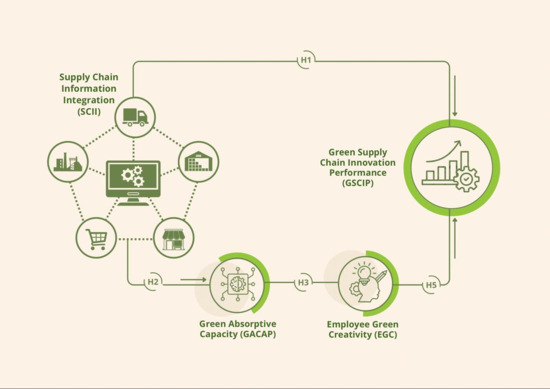
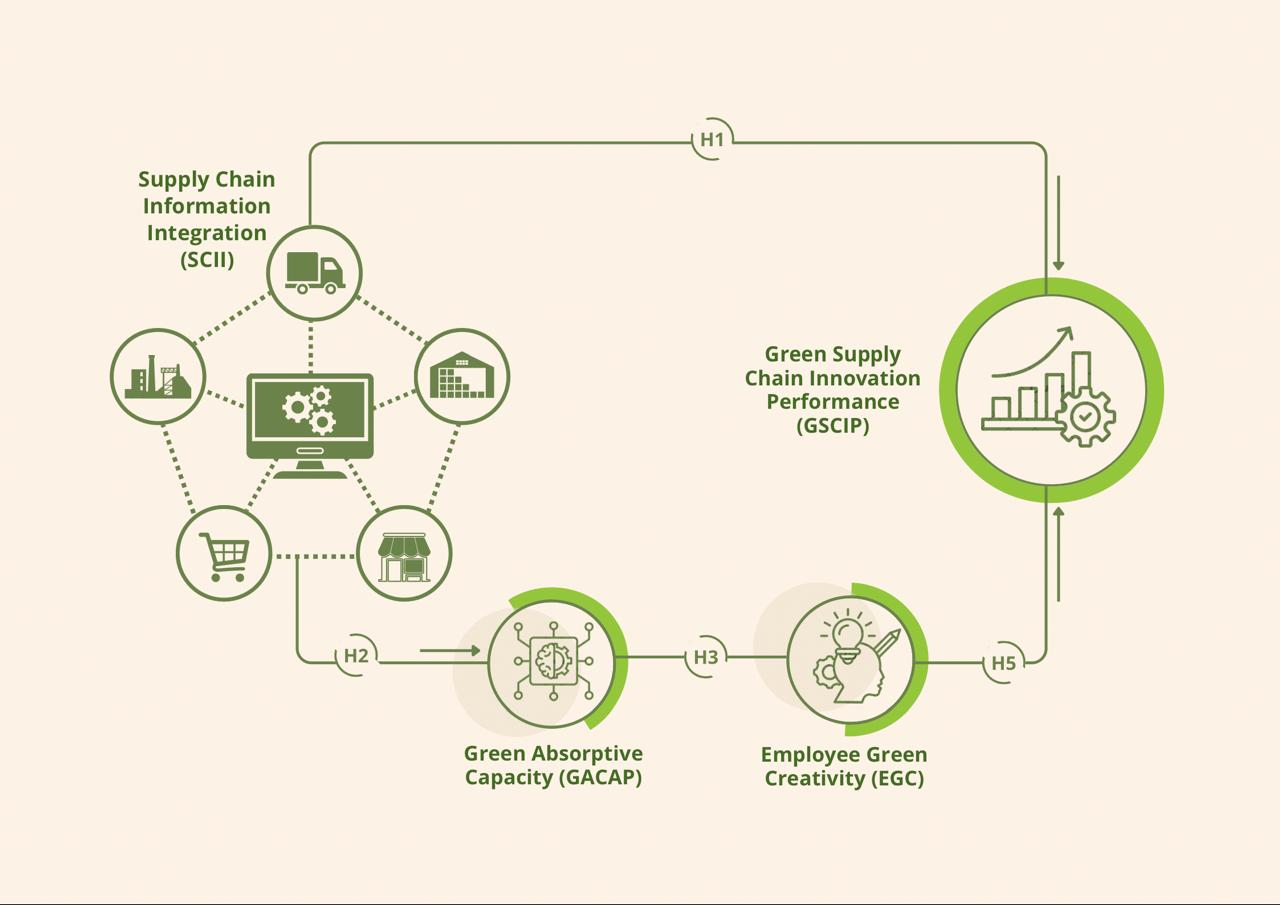
Graphical Abstract

1. Introduction

Escalating environmental crises such as climate change, resource depletion, and pollution have compelled firms to integrate sustainability into their strategic agendas [1]. In response to stringent environmental regulations and increasing customer demand for sustainable products, green innovation (GI) has emerged as a vital approach to achieving both a competitive advantage and sustainable growth [2]. Industry studies [3] have shown that over the last five years, environmentally friendly products have significantly outperformed the market, with average cumulative growth rates of 28% and 20% for non-sustainable products. According to Gartner [4], value chains account for more than 90% of corporate greenhouse gas emissions. Therefore, environmental sustainability is a top strategic priority for global CEOs; 83% believe that sustainability initiatives create value in both the short and long term [4]. The dual pressures of environmental sustainability and value creation potential compel SC managers to reengineer supply networks using GI strategies. As GI is considered a crucial mechanism for reconciling the conflict between economic growth and ecological development, it requires significant investments in talent, capital, and technology as firms often face resource constraints that hinder independent innovation [5].
In a dynamic landscape, to improve GI performance, companies should exceed their organisational boundaries by proactively collaborating with SC partners (SCPs) to access complementary resources [6,7]. These collaborations can lead to effective information integration via the synthesis of critical data on resource utilisation, environmental impacts, and regulatory policies [7]. By implementing SCII, which integrates sustainability-related information with information systems across SCPs [8], firms may enhance the efficiency of their sustainable SC processes, minimise waste, maximise resource use, and achieve superior performance [9]. Therefore, SC information integration (SCII) mechanisms are necessary to catalyse GI performance. Thus, firms need effective strategies to achieve green supply chain innovation performance (GSCIP), which is essential to minimise their environmental footprints, reduce costs, attain competitive advantages, ensure regulatory compliance, integrate stakeholder interests, and achieve long-term sustainability [10].
To enhance the effectiveness of SCII and to convert this knowledge into novel and creative ideas [11], firms need to improve their ability absorb, identify, assimilate, and utilise environmental knowledge, which is known as green absorptive capacity (GACAP) [12]. GACAP strengthens firms’ capabilities to reduce risks and capitalise on emerging sustainability opportunities, thereby improving the utilisation of green core competencies and innovation performance [2]. To succeed in today’s rapidly evolving environment, implementing information sharing alongside GACAP plays a significant role in enhancing creative thinking [13]. Employees’ green creativity (EGC) refers to a firm’s employees’ ability to generate valuable and novel eco-friendly solutions that help the company shift its approach toward sustainability-driven innovation [14]. Drawing on the resource-based view (RBV), this study asserts that SCII, along with GACAP, serves as a strategic resource that fosters employees’ green creativity (EGC) by facilitating knowledge exchange, promoting creative problem solving [15] and ultimately enhancing GSCIP.
Saudi Arabia’s Vision 2030 prioritises sustainable development, natural resource preservation, and digital transformation to achieve sustainability and economic diversification. This twofold strategy enhances manufacturing and logistics by making them more innovative, adaptable, sustainable, carbon-efficient, and economically efficient [16]. Saudi Arabia is developing its sustainability plan by adopting the Saudi Green Initiative (SGI) as a foundational policy to accelerate the integration of innovative green solutions across sectors, thereby supporting sustainable growth and reducing its environmental impact [17]. Saudi Arabia has fully adopted digitalisation, automation, and innovation, leveraging AI, big data, and the Internet of Things to strengthen its SCs by communicating and integrating valuable material, thereby reducing costs and improving operational efficiency [18]. Therefore, Saudi manufacturing firms provide a salient empirical setting for examining how supply chain information integration is transformed into green innovation performance through organisational capability and employee-level mechanisms.
Despite growing interest in green innovation and supply chain collaboration, prior research has provided limited insight into the effect of information technology and information exchange (SCII) on SC performance. Existing studies have primarily examined green absorptive capacity or employee green creativity in isolation, without explaining how externally and internally integrated SCII is transformed into organisational-level green absorptive capacity (GACAP) and subsequently leveraged to stimulate employee-level green creativity. Moreover, most current research emphasises direct interactions, neglecting organisations’ ability to acquire and assimilate environmental knowledge (green absorptive capacity (GACAP)) and then utilise and convert this knowledge into novel ideas through its employees (employees’ green creativity (EGC)). Those two factors are considered potential intermediates on the path to GSCIP. As a result, the sequential process through which information integration enables capability development and, in turn, drives green innovation outcomes remains insufficiently understood. Moreover, although the resource- and knowledge-based view are often used to elucidate competitive advantages in sustainable SCs, few studies integrate these frameworks to explain how the use of technology and information as resources facilitates the development of specific capabilities essential to green innovation performance. This gap prompts an important inquiry:
RQ1: How does SCII influence GSCIP in Saudi manufacturing firms?
RQ2: Do GACAP and EGC sequentially mediate the relationship between SCII and GSCIP?
To address this significant gap in the literature, this study has three objectives: First, to investigate the critical role of global and national SCP collaboration through SCII in improving GSCIP, particularly as the world faces resource deterioration as a result of war. Second, to investigate the effect of SCII and its two dimensions, information sharing and IT systems, on GSCIP. Third, to examine the sequential mediating roles of GACAP and EGC in enhancing the relationship between SCII and GSCIP. Drawing on the KBV and RBV, this study investigates organisational capability and human behaviour as catalysts for sustainability-oriented innovation. These relationships are empirically tested using survey data from manufacturing enterprises in Saudi Arabia that are engaged in sustainability initiatives. This holistic approach offers profound insight into how firms blend strategic functions to benefit from knowledge sharing by absorbing knowledge (GACAP) and generating creative ideas (EGC) to promote GSCIP.
This study contributes to the literature by integrating the KBV and RBV frameworks to elucidate the intricate ways in which SCII influences green innovation within SC through effective collaboration with SCPs. By identifying GACAP and EGC as pivotal sequential mediation capabilities, the results not only enhance theoretical understanding of the resource and knowledge processes that support sustainable innovation, but also provide practical recommendations for managers seeking to use SCII to promote sustainable eco-friendly business practices and attain a sustainable competitive advantage in the digital age.
This paper is organised as follows: Section 2 presents the theoretical background; Section 3 describes the methodology and data analysis; Section 4 reports the results; Section 5 discusses the findings, their implications, and future research directions; and Section 6 provides conclusions.

2. Theoretical Background

2.1. Resource-Based View

According to Barney [19], the RBV posits that firms’ ability to effectively leverage internal resources and foster collaboration among their divisions can result in a competitive advantage. Firms can drive innovation, increase operational efficiency, and improve long-term market positioning by accessing unique, inimitable capabilities [19]. These unique resources include environmental knowledge, eco-friendly technologies, and distinctive sustainable strategies [5]. Thus, cross-functional integration (SCII) is characterised as a firm’s ability to optimise its diverse internal resources, knowledge, and experience to produce novel green products that fulfil social responsibilities that competitors may struggle with [6]. This integration may diminish the firm’s environmental footprint, while increasing productivity, bolstering their image and reputation, and securing a competitive advantage [5].

2.2. Knowledge-Based View (KBV)

The KBV asserts that knowledge is a strategic resource, and that organisations should be evaluated according to their knowledge capability, since it is a fundamental driver of competitive advantage [20]. Knowledge is crucial to a firm’s performance, particularly within the KBV. From this perspective, knowledge is characterised as information and expertise, and an organisation’s capacity to cultivate and disseminate this knowledge may provide a competitive edge [21]. The KBV regards knowledge as a unique and inimitable asset embedded within a firm’s goods, services, and strategic processes [22]. Consequently, organisations that use digital technology in conjunction with information sharing may significantly improve performance [23].
From the KBV perspective, information exchange is crucial for generating value that may enhance corporate performance [24]. From this perspective, classification in knowledge sharing involves the acquisition, dissemination, and application of information, which organisational members use to improve their decision-making capability [23]. The KBV emphasises that a firm’s competitive advantage in a knowledge-driven economy depends on its capacity to integrate various knowledge bases and leverage organisational capacity for innovation [25]. Nevertheless, not all organisations are able to handle information effectively. In this setting, efficient networking, bolstered by institutional frameworks, is essential for cultivating collaborative connections and utilising resources like knowledge to stimulate innovation [26]. Thus, the exchange of information may provide unique resources that enhance sustainable company performance and the vitality of the supply chain.
The RBV conceptualises firms as bundles of heterogeneous resources and capabilities whose strategic value depends on their rarity, inimitability, and ability to enhance performance [19]. From this perspective, green innovation outcomes depend on firms’ possession and deployment of critical organisational resources, including capability, processes, and managerial commitments that enable environmentally oriented strategies [27]. Extending this logic, the KBV positions knowledge as the most strategically significant resource, emphasising firms’ ability to acquire, assimilate, disseminate, and apply specialised knowledge embedded within individuals and organisational routines. The KBV thus explains how externally sourced and internally generated knowledge underpins firm capability, whereas the RBV explains how this knowledge-based capability is leveraged to achieve sustainable competitive and innovative advantages. By integrating the RBV and KBV, green absorptive capacity can be understood as a higher-order, knowledge-based capability through which SCII is transformed into valuable organisational resources, which are subsequently integrated into employee-level creative processes, resulting in green innovation.

2.3. Supply Chain Information Integration

In the modern globalised and technology-driven marketplace, the rapid flow of information across SCs crucial for effective decision-making and sustainable performance [5]. Integrating information enables firms to leverage knowledge both internally and externally to foster innovation [10], enhance capability, seize opportunities, and respond to challenges [26]. SCII involves both technology (i.e., information technology (IT) systems that streamline SC operations) and the social (information sharing) aspect of trust among SCPs [8,28,29,30]. IT tools are essential for managing complex networks and facilitating real-time communication. Thus, in GSCM, this dual integration supports procurement, production, and logistics, which are crucial for firms’ adoption of GI strategies [7]. SCII offers several benefits, including environmental sustainability and compliance, operational efficiency and cost reduction, strategic decision-making and innovation, risk management, and market and stakeholder value [30,31,32] (see Figure 1). This reflects a shift in which environmental sustainability and economic growth are viewed as complementary goals. These outcomes require collaboration among SCPs at various stages [33].

2.4. Supply Chain Information Integration and Green Supply Chain Innovation Performance

In SC, information exchange entails the movement of data between various entities within the SC network through transactions or collaborative efforts [34]. Technology alone is insufficient; it must be integrated into dynamic processes such as green information sharing, which facilitates collaborative decision-making around recycling, packaging, and sustainable sourcing [24]. Using technology effectively to disseminate precise and timely information, particularly for on demand forecasting, sales, inventory, and production timelines, enables firms to enhance operations, reduce waste, and mitigate environmental impacts ultimately leading to improved sustainability outcomes [28]. For example, Chen [21] posits that suppliers’ expertise is essential to enhancing manufacturing process and mitigating pollution especially when engaged in several SC activities, including material management, transportation, product design, and the processing of semi-finished goods.
Information sharing facilitates learning from many sources and enables the adoption or transformation of novel knowledge, concepts, and ideas, thereby supporting economic development, innovation, and corporate opportunities [35]. SC integration improves the capacity of information flow and coordination, standardising business processes and enabling rapid response to changes in the environment [8]. Moreover, SCII helps organisations remain informed about industry trends, change in regulations, and consumer preferences toward green technology and sustainability initiatives [36]. According to Onofrei et al. [37], SCPs build substantial relational capital through the transmission of information and the synchronisation of ideas, goals, and vision that are conducive to feedback and communication, thereby enhancing businesses performance. Thus, adopting green innovation practices allow firms to reduce costs, distinguish themselves in the marketplace, comply with regulations, and improve their reputation [36]. Collectively, the deployment of technology and the strategic integration of information enhance traceability and accountability in procurement and manufacturing, minimise resource wastage and environmental deterioration, promote circular-economy initiatives and environmentally sustainable innovations, and cultivate stakeholder consensus on sustainability objectives [24]. Thus, SCII is pivotal in reducing risks, consolidating resources, and enhancing knowledge sharing among SCPs, thereby enhancing GI performance measures [34]. Therefore, we argue the following:
H1. 
SCII positively influences GSCIP.

2.5. Supply Chain Information Integration, Green Absorptive Capacity, and Green Creativity

GACAP refers to the acquisition, assimilation, and utilisation of structured environmental knowledge [12]. Marzouk and El Ebrashi [38] stated that a firm’s GACAP, its ability to integrate information effectively, relies on its capacity to convert this knowledge. Firms that embrace GACAP recognise the value of integrating knowledge and internal expertise with external ideas to foster synergy between their internal resources and ecological needs [38]. This process enable firms to swiftly identify opportunities and adjust to changing market demands [39]. Moreover, firms that embrace GACAP effectively strengthen collaborations between SCPs and enhance managerial decision-making [2]. Thus, we propose the following:
H2. 
SCII positively influences GACAP.
GACAP enables firms to enhance their environmental awareness and gain a competitive advantage through the efficient use of resources [2]. Creative behaviour is essential for organisational performance in a competitive business landscape characterised by heightened awareness of environmental sustainability [13]. Thus, EGC is crucial for innovation and the development of environmentally friendly solutions while addressing evolving market needs to enhance organisational performance [40,41]. GACAP is a significant predictor of EGC. Grounded in the KBV, which conceptualises knowledge as a dynamic resource that is continuously assimilated, transformed, and recombined within organisations rather than merely stored or transferred. In this regard, GACAP represents knowledge-based organisational capability through which externally integrated green knowledge is internalised and structured. From an RBV perspective, this capability requires micro-level enactment to generate value. EGC thus reflects the behavioural manifestation of GACAP, whereby employees recombine absorbed green knowledge into novel and valuable ideas and practices. Accordingly, if firms leverage their environmental expertise and knowledge, they may mitigate market instability and enhance green creativity among employees, which is crucial when organisations face the escalating challenges posed by the environmental and ecological repercussions of their operations [13]. Consequently, we propose the following hypothesis:
H3. 
GACAP affects EGC positively.
Effective information sharing fosters trust and collaboration with SCPs, enhancing the learning ability required for green creative and innovative output [42]. Strong GACAP enables firms to absorb and operationalise external sustainability-related information, equipping their workers with the essential knowledge to foster green creativity [43] and generate innovative solutions that align with sustainability goals [2,44]. Thus, we hypothesise the following:
H4. 
GACAP mediates the relationship between SCII and EGC.

2.6. Green Absorptive Capacity, Green Creativity, and Green SC Innovation Performance

By leveraging digital technologies, firms can streamline knowledge acquisition, foster collaborative learning among their employees, and strengthen the employees’ creative abilities, which are crucial for innovation [36]. Thus, EGC is considered the basis and initial stage of GIP. The focus on innovation and learning within an organisation that embraces digital culture may motivate employees to continually enhance their skills and expertise while discovering creative business solutions and opportunities to respond effectively to market fluctuations [45].
Thus, EGC is vital for driving the development of novel, sustainable solutions that align with environmental objectives [13]. Moreover, firms under regulatory pressure foster creativity and adopt environmentally friendly initiatives, thereby directly contributing to GI, which enhances earnings, sales, and competitive advantage [41]. Therefore, EGC facilitates SCs evolution toward sustainable innovation, thereby ensuring long-term market relevance and performance. Consequently, we postulate the following:
H5. 
EGC positively influences GSCIP.
GACAP is crucial in acquiring resources and knowledge that employees can apply to generate unique solutions to meet changing market demands [13]. Firms need green creativity to develop sustainable solutions, respond to market demand [40], and achieve a competitive advantage [12]. EGC is recognised for its role in devising creative solutions that promote environmental consciousness; therefore, EGC is fundamental to all green goods and manufacturing and ultimately fosters innovation [41]. By embedding structured information-sharing practices, firms can expand their capacity to internalise and leverage green knowledge, thereby enhancing EGC, strengthening GSCIP, and improving their environmental and competitive positioning. Thus, we postulate the following:
H6. 
EGC mediates the relationship between GACAP and GSCIP.

2.7. Sequential Mediation of Green Absorptive Capacity and Green Creativity

Firms implementing GSCM face challenges absorbing and processing large volumes of environmental information [46]. Effective information integration with SCPs facilitates rapid knowledge exchange and improves operational and process efficiencies [8]. Firms with GACAP can integrate information from multiple sources, facilitating the exploration and exploitation of new ideas and expanding the pool of ideas to generate creative solutions [42]. Therefore, GACAP enables workers to acquire and leverage environmental information to promote sustainable growth and devise creative ideas for environmentally friendly practices, thereby reinforcing their firm’s corporate sustainability image and competitive advantage [13]. EGC depends on information exchange and absorption, which are essential for developing new products that drive market growth and increase profitability, sales, and competitive advantages [41]. Consequently, SCII, GACAP, and EGC are key enablers of GSCIP.
Although SCII enhances firms’ access to environmentally relevant knowledge, this information does not translate directly into green innovation outcomes. From a KBV perspective, integrated information must first be assimilated, interpreted, and transformed into organisational-level capability (GACAP) that enables firms to systematically manage and internalise green knowledge. However, GACAP alone represents latent potential rather than realised innovation. Drawing on micro-foundational logic, the value of GACAP is realised only when employees actively recombine and apply the knowledge they have absorbed in their work. By combining the RBV and KBV, EGC serves as the behavioural mechanism through which GACAP is enacted, enabling the conversion of absorbed green knowledge into novel and valuable ideas that underpin GSCIP, thereby promoting effective resource use and competitiveness. This process implies a sequential mediation pathway in which SCII first builds GACAP, which subsequently stimulates EGC, ultimately leading to enhanced GSCIP. Thus, we posit the following:
H7. 
GACAP and EGC sequentially mediate the relationship between SCII and GSCIP.
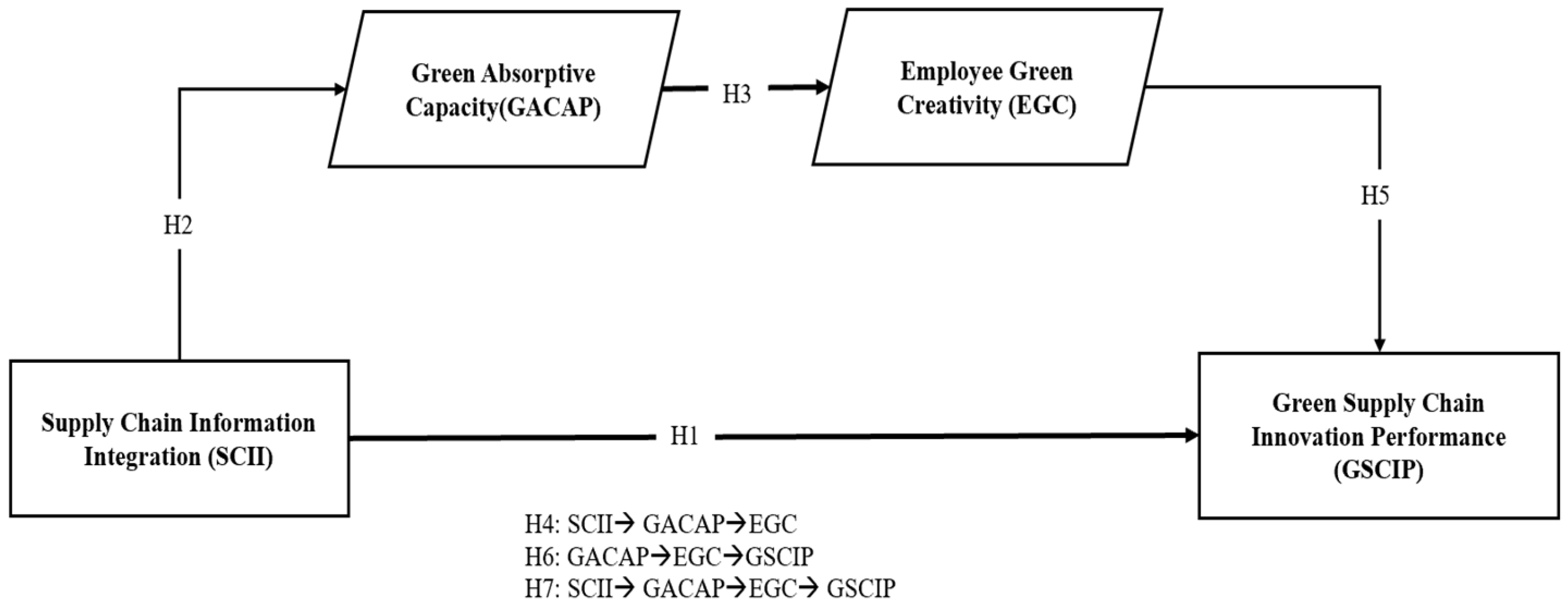
Figure 1 depicts the conceptual framework, in which SCII leads to GACAP, which in turn fosters EGC and ultimately enhances GSCIP.

3. Materials and Methods

3.1. Sampling Technique

This study targeted full-time SC managers in Saudi Arabia’s manufacturing sector. SC managers were selected as key participants because they have direct oversight of supply chain operations and are deeply involved in strategic innovation initiatives. Their role equips them with the most accurate understanding of supply chain innovation outcomes and performance evaluation within their organisations.
Non-probability purposive sampling was used to identify SC managers working in manufacturing firms that adhere to ISO 14001-2015 [47] or intend to adopt it. This sampling technique was complemented by convenience sampling, in which managers were contacted via online networks like LinkedIn, Telegram, and WhatsApp. Moreover, snowball sampling, in which initial participants refer others, facilitated access to targeted respondents and improved the response rate [48]. A total of 162 valid responses were collected through multiple communication channels, including LinkedIn, WhatsApp, Telegram, and email. The adequacy of the sample size was confirmed through statistical power considerations. Based on Cohen’s [49] guidelines for multiple regression and supported by G*Power 3.1.9.7 calculations, a minimum of 55 responses would be sufficient for an R2 for a medium effect size of 0.15, an alpha level of 0.05, and a power of 0.80, accounting for the four predictor variables in our model. Moreover, following Hair et al.’s method [50] of determining the minimum sample size using the inverse square root, assuming a common power level of 80%, a 5% significance level, and a minimum path coefficient of 0.12, the minimum sample size is 155. Therefore, the collected sample of 162 responses exceeds the recommended threshold, ensuring sufficient statistical power and reliable model estimation.

3.2. Questionnaire Design and Data Collection

This study employed a self-administered, quantitative, online survey to investigate the causal relationships among SCII, GSCIP, GSCL, GACAP, and EGC and the moderating role of GEO. This method was selected because this research is confirmatory in nature, meaning that empirical data was used to verify or disprove the links identified in the literature review. The survey items were primarily sourced from existing validated measures. The original survey questions were composed in English and back-translated into Arabic. Three SC experts reviewed the questionnaire to reduce potential interpretation bias arising from the translation.
Data were collected between April and September 2024, and several reminders were sent to increase participation. The questionnaires were disseminated over social media. Participants received a letter outlining the study purpose, and informed consent was obtained at the outset of survey completion. Prior to model estimation, multiple data screening procedures were applied to ensure the quality of responses. First, anonymity was ensured to mitigate common-method bias [51]. Second, because it was necessary to answer all questions, there were no missing data; however, this may have increased the burden on respondents. In total, 165 were completed. To detect careless responses, response patterns were examined for straight-lining and insufficient variance across Likert-scale items; no cases exhibited zero variance across all indicators. Based on these checks, three responses were excluded due to inconsistencies, excessive regularity, or unreliable patterns, leaving 162 valid responses for analysis. The relatively low exclusion rate may be partly attributable to the forced-response survey design and the targeted sampling of knowledgeable respondents.

3.3. Variable Measures

The survey items were primarily sourced from pre-existing validated measures (as described below). Each item in this study was evaluated using a seven-point Likert scale ranging from 1 (strongly disagree) to 7 (strongly agree). The original survey questions were written in English and back-translated to Arabic using Brislin’s [52] back-translation technique. Three SC experts reviewed the questionnaire to mitigate any potential interpretation bias resulting from translation.
To measure SCII with two dimensions, information technology and information sharing, we used the 11-item scale created by Prajogo and Olhager [29] and Lyu et al. [8]. GACAP was assessed using Chen et al.’s [53] six-item scale, and EGC was measured using Chen and Chang’s [54] six-item scale. GSCIP was measured using a single-item indicator adapted from Chen’s [55] eight-item scale assessing green product and process innovation. This approach was chosen to attain an overall evaluation of green innovation performance while reducing the respondent burden. The selected item reflects the core conceptual domain of the original scale and has been used in prior green innovation research (e.g., Khan et al. [56]), supporting its content validity and suitability for this study.

3.4. Data Screening and Cleaning

This study followed Matook et al.’s approach [57] to mitigating common method bias (CMB) and ensuring robustness. Statistical and procedural measures were employed to address potential bias arising from the measurement methodology rather than from the concepts studied. We ensured respondent anonymity to minimise social desirability bias and counterbalanced the question order to reduce potential response patterns. Accordingly, we used Harman’s single-factor test [51]. An exploratory factor analysis of all measurement items revealed that no single factor accounted for more than 50% of the total variance. These results indicates that common method bias is unlikely to be a serious concern in this study.
Consistent with this result, variance inflation factors (VIFs) were used to assess statistical measures. A VIF > 3.3 indicates pathological collinearity and may indicate CMB [58]. To detect deficiencies in common method variance (CMV) in the PLS-SEM model, a marker-variable approach was applied [59]. A random variable was included in the model, with an outer VIF < 5 and an inner VIF < 3.3. These findings confirmed the absence of significant CMB or CMV.
In PLS-SEM analysis, assessing normality is crucial to strengthening the reliability and validity of the findings. An effective method of evaluating normalcy is to analyse the skewness and kurtosis of the data distribution. Skewness quantifies the symmetry of a variable’s distribution, while kurtosis denotes the degree to which a distribution is either excessively peaked or excessively flat in comparison to a normal distribution [60]. Hair et al. [60] posited that for a variable to be deemed normally distributed, its skewness and kurtosis values must be within the range of ±2. The findings indicated that all constructs were within the acceptable range of normalcy, supporting the reliability of this study’s results and the validity of the conclusions derived from the PLS-SEM analysis.

3.5. Data Analysis

This study employed partial least-squares structural equation modelling (PLS-SEM) owing to its predictive capacity and minimal requirements for measurement scales and sample sizes, particularly for smaller samples, which make it ideal for emerging and novel research [50,61,62]. SmartPLS 4.0 software was used to analyse the structural relationships within the model [63]. The SEM procedure comprised two phases: measurement, in which confirmatory factor analysis was used to ensure convergent and discriminant validity, and the construction of a structural model based on β (path coefficient), T (t-statistic), and R2 values to examine the relationships within the theoretical framework [60].
The participants were predominantly male (85.8%). Female participants comprised 14.2% of the sample, reflecting the male-dominated nature of SC roles in this study’s context. Most respondents had 1–10 years of work experience (35.1%), with a few having over 20 years (34.6%). The majority had worked at a green organisation for 1–10 years (68.5%). Approximately one-third of the participants’ firms employ more than 2000 full-time employees (33.3%), followed by medium-sized firms (51–500 employees) with 29.6%. Regarding firm age, the majority of respondents were employed at organisations operating for more than 10 years (66.9%). The sample spanned multiple industrial sectors, including retail, trading, distribution, and logistics (21.6%), food and beverage (11.1%), chemical and pharmaceutical (6.8%), transportation and cargo (5.6%), and construction (6.8%). Furthermore, 52.5% of the participants’ firms had ISO 14001-2015 certification. (see Table 1)

4. Results

4.1. Measurement Model

The measurement model (Figure 1) was assessed using Hair et al.’s approach [50]. Specific threshold values were used in the assessment.

4.1.1. Reliability

The measurement model satisfied all necessary requirements. Table 2, which excludes items with insufficient factor loadings (SCIISR1, GACAP3, and GSCIP3), shows that all remaining items in the model had factor loadings between 0.758 and 0.908, surpassing the minimum requirement of >0.50 [50]. Each loading was found to be significant at the 5% level using a two-tailed test, and all t-statistics exceeded the threshold of 1.96 [64]. Cronbach’s alpha coefficients, Dijkstra-Henseler’s rho, and composite reliability values for all variables exceeded the thresholds of 0.70 [50], confirming the construct reliability of the measurement model.

4.1.2. Validity

Next, we tested the model’s convergent and discriminant validity. Average variance extracted (AVE) values were used to measure convergent validity. Table 2 reveals that all AVE values exceeded 0.5 [65], indicating that 50% of the variability in the indicator was accounted for by the construct [50].
Discriminant validity was evaluated via two methods, using the criteria of Hair et al. [50]. First, for a construct to fulfil the Fornell–Larcker criteria, the square root of its AVE must be greater than the correlations between that construct and any other construct in the model. Second, the heterotrait–monotrait ratio (HTMT) value should be below 0.8. According to Franke and Sarstedt [66], the HTMT ratio of the correlation criterion is a superior estimator of unattenuated (i.e., totally reliable) correlations between variables. Table 3 shows that the model satisfies both discriminant validity criteria.

4.2. Structural Model

Following Hair et al. [50], we examined the VIF for each construct to assess multicollinearity among independent variables within the structural model. Multicollinearity issues are typically indicated by VIF values exceeding 5 [50]. The VIF values ranged from 1.698 to 4.199, which is considered acceptable and confirms the absence of CMB according to Kock [58], who recommended a threshold of 3.3 for all inner VIF values.
Furthermore, following Shmueli et al. [67], we used the PLS Predict approach to assess the predictive relevance of the model with Q2 values. This method enables a more thorough evaluation of the model’s out-of-sample predictive performance by generating predictions for each indicator of the endogenous constructs. Consequently, to enhance the validation of our results, we provided prediction error measures, including the Root Mean Squared Error (RMSE), Mean Absolute Error (MAE), and Q2 predict, for each construct. Upon comparing the RMSE values derived from the PLS-SEM analysis with those of a linear model (LM) benchmark, we noted that the majority of indicators exhibited lower LM benchmark values than RMSE values, indicating medium predictive power [67]. This comparison underscores the model’s improved performance in relation to a basic prediction model, strengthening our analysis. The model’s predictive relevance was evaluated using the predictive sample reuse method, Q2 [68]. Q2 measures the ability of the blindfolding procedure to precisely reconstruct the observed data using the model and PLS parameters. Predictive relevance is confirmed when Q2 > 0 [50,69]. The Q2 values were 0.953 for GACAP, 0.947 for EGC, and 0.977 for GSCIP, showing that all variables had sufficient predictive relevance.

4.3. Hypothesis Testing

SmartPLS 4.0 was employed to evaluate the hypotheses. Bootstrapping was conducted with 10,000 iterations to evaluate the reliability and validity of the sub-construct weights and the statistical significance of the path coefficients [50]. The hypothesis testing results are provided in detail in Table 4.
The effect of SCII on GSCIP was positively significant (β = 0.609, t = 10.237, p < 0.001, f2 = 0.750), thereby supporting H1. Furthermore, the path coefficient for SCII on GACAP was also positive and significant (β = 0.538, t = 6.955, p < 0.001, f2 = 0.363), supporting H2. GACAP affected EGC positively and significantly (β = 0.604, t = 8.672, p < 0.001, f2 = 0.590), indicating that H3 is accepted. Moreover, the indirect effect of SCII on EGC through GACAP is positive and significant (β = 0.325, t = 5.007, p < 0.001), showing that GACAP partially mediates the SCII–EGC relationship, thus confirming H4. Moreover, the path coefficient of EGC’s effect on GSCIP was significantly positive (β = 0.196, t = 3.330, p < 0.001, f2 = 0.091), which supports H5. Finally, the indirect effect of GACAP on GSCIP through EGC was positive and significant (β = 0.118, t = 2.746, p < 0.01), showing that EGC partially mediates the relationship between GACAP and GSCIP, confirming H6.
Effect size (f2) was used to assess the proportion of variance accounted for by each predictor in the structural model. f2 values represent small (0.02), medium (0.15), or large (0.35) effects of exogenous latent variables [49]. Values below 0.02 suggest no effect [50]. As shown in Table 4, SCII had a strong effect (0.750) on GSCIP and a moderate effect on GACAP (0.363). EGC had a small effect (0.091) on GSCIP, while GACAP had a moderate effect on EGC (0.590). Although the effect of EGC on GSCIP is relatively small, this finding should be interpreted in light of EGC’s effect as a mediator rather than a stand-alone predictor. In the proposed knowledge pipeline, employee green creativity functions primarily as a translational mechanism that converts absorbed green knowledge into actionable innovation outcomes. From this perspective, the importance of EGC lies less in the magnitude of its direct effect and in its role in enabling the enactment of GACAP at the employee level. Thus, even a small-to-medium effect size is theoretically meaningful, as it reflects the micro-level activation of organisational knowledge resources rather than an independent driver of performance.

4.4. Serial Mediation

This study evaluated the serial mediation of GACAP and EGC in the relationship between SCII and GSCIP. The results in Table 5 indicate that SCII has a substantial indirect impact on GSCIP through GACAP and EGC (β = 0.064, t = 2.564, p < 0.05), which is consistent with H7. Additionally, in the presence of the two mediators, the direct effect of SCII on GSCIP was significantly positive (β = 0.609, t = 10.237, p < 0.001). Therefore, the SCII–GSCIP relationship is partially mediated by GACAP and EGC. Specifically, as SCII increases, it enhances GACAP, which in turn boosts EGC, ultimately leading to improved GSCIP. This indicates a complementary mediation pattern, whereby the proposed serial mechanism contributes but does not dominate—the relationship between SCII and GSCIP.
In addition to assessing the significance of the mediation paths, the variance accounted for (VAF) by the indirect effects was examined to assess the substantive contribution of the proposed mechanisms. Although the direct and indirect effects are positive and statistically significant, the variance accounted for by the sequential mediation pathway is relatively modest (VAF = 10.04%). Previous results revealed that the sequential mediation is positively significant, but based on the VAF results, this relationship is weak. The results suggest that while SCII exerts a strong direct influence on GSCIP, a smaller yet statistically meaningful portion of this effect is mediated by the sequential process of GACAP and EGC.

4.5. Importance–Performance Map Analysis

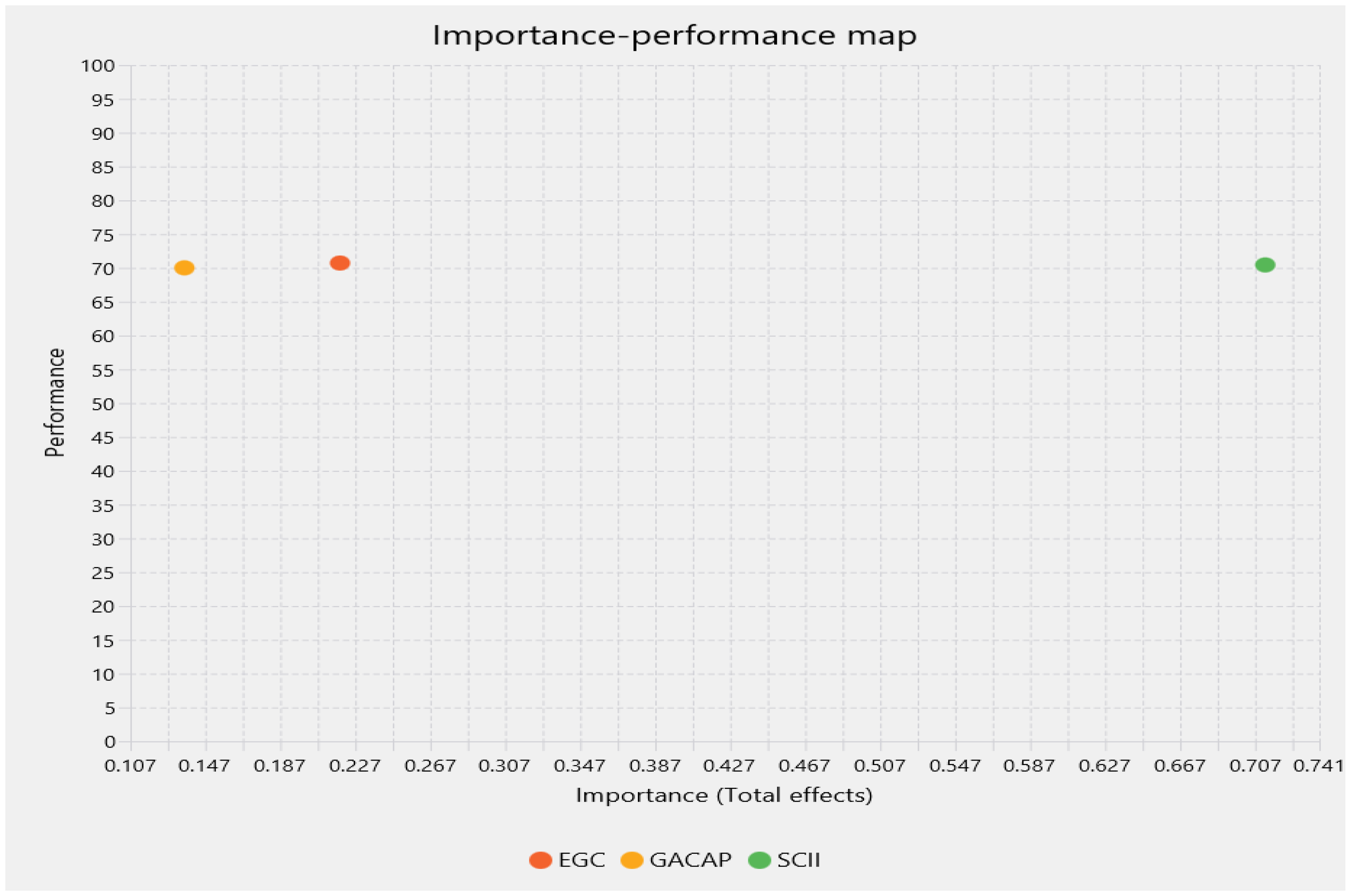
In PLS-SEM, importance–performance map analysis (IPMA) presents conventional values in a practical manner [70]. It evaluates the performance and importance of constructs to determine the overall impact of predicting a target construct [71]. It combines path coefficients with performance scores ranging from 0 to 100 [70] to assess the influence of the antecedent constructs (i.e., SCII, GACAP, and EGC) on the target construct (GSCIP). The results showed that all constructs exhibited relatively high performance (SCII (70.446), GACAP (70.013), and EGC (70.728)).
The significance of each antecedent construct should be assessed according to its overall impact on the target construct. The overall impact of SCII highlights its significance in predicting the target variable, GSCIP. According to IPMA, if the performance of an antecedent construct, such as SCII, increases by one unit, the performance of the outcome construct (i.e., GSCIP) increases by the same amount as the antecedent’s unstandardised total effect [72]. Figure 2 illustrates that SCII has the highest importance score of (0.712), followed by EGC (0.219), and GACAP has the lowest impact (0.136). The highest significance score of 0.712 for SCII indicates that a one-unit increase in SCII performance results in a 0.712 improvement in GSCIP (i.e., GSCIP will increase from 74.374 to 75.086).

4.6. Necessary Condition Analysis

This study employed necessary condition analysis (NCA) to determine critical conditions within datasets [73]. In combination with PLS-SEM, NCA was used to further explore the relationships among SCII, GACAP, EGC, GSCL, GEO, and GSCIP, seeking to identify regions in scatter plots where the necessary conditions were evident [74]. Table 4 outlines the effect sizes, which show that SCII, GSCL, and EGC are essential for achieving GSCIP, demonstrating both practical (d ≥ 0.1) and statistical (p < 0.05) significance. Moreover, the NCA results presented in Table 6 show that SCII, GACAP, and EGC are essential for achieving GSCIP, demonstrating both practical (d ≥ 0.1) and statistical (p < 0.05) significance. Because our data are discrete, use of the ceiling envelopment-free disposal hull technique is recommended, which yielded an accuracy level exceeding the 95% threshold [62]. The bottleneck results in Table 6 show threshold values for achieving GSCIP levels: for 80% (a value of 6 on a scale of 1–7), SCII ≥ 3.63, GACAP ≥ 2, and EGC ≥ 2.172. To achieve a maximum GSCIP score of 100%, the minimum required levels are SCII ≥ 5.735, GACAP ≥ 4.989, and EGC ≥ 5.172.

5. Discussion

The aim of this study was to help SC managers and organisations evaluate the factors and strategies for achieving optimal GSCIP. To that aim, we developed a conceptual model to examine the antecedents of GSCIP in the Saudi context. In particular, we examined the effect of SCII on GSCIP, which is mediated sequentially by GACAP and EGC, in Saudi manufacturing firms. We extend previous research by integrating the PLS-SEM approach and IPMA and NCA methods. The IPMA reveals the importance and performance of antecedents that may enhance GSCIP, while the NCA provides insight into the variables necessary for GSCIP. These strategies improve our understanding of the correlation between the factors and the outcome.
First, the results reveal that SCII positively influences GSCIP, empowering SC managers through IT integration and the exchange of valuable information and thereby improving SC innovation performance. Although prior studies explored the influence of information integration on various performance types, including general [29], innovation [42], and SC performance [44], only one study linked digital knowledge integration with green innovation performance [10]. This study extends prior insight into green SC by providing supporting evidence for the role of SCII in driving innovation performance in Saudi manufacturing firms. Our approach drew on the RBV, which treats information as a valuable, intangible resource and IT as tangible resource. When utilised effectively, these assets can enhance competitiveness. According to the KBV, the continuous integration and dissemination of SC information enable firms to respond dynamically to sustainability challenges by fostering collaboration, sharing best practices, and enhancing innovative capabilities. This study’s IPMA and NCA results also reveal that SCII is the most critical factor influencing GSCIP.
Second, our findings indicate that SCII significantly enhances GACAP. This is consistent with studies reporting that information flow affects ACAP [42,75]. Per the KBV, SCII is as a key resource that strengthens a firm’s GACAP, thereby enabling firms to internalise and use environmental information to develop sustainable, environmentally friendly innovations and to create and sustain competitive advantages in the marketplace.
Third, our findings support the assumption that GACAP positively influences EGC. This relationship illustrates the significance of organisational capability in effectively scanning, integrating, and utilising environmental knowledge to generate new ideas. This result aligns with those of previous studies [12,13] and underscores that GACAP empowers employees to generate eco-creative ideas. Importantly, there are few studies testing the mediating effect of GACAP on SCII-EGC. This relationship reflects the KBV’s assertion that knowledge is fundamental and acquiring and using it (SCII and GACAP) fosters employees’ ability to generate new ideas (EGC). This helps firms respond rapidly to external market demands and environmental challenges, positioning them for sustained innovation.
Fourth, our study provides evidence that EGC positively affects GSCIP, a result consistent with Ma et al.’s findings [41]. Specifically, employees displaying green creativity behaviours can generate novel, environmentally friendly ideas to improve processes, practices, and products that support environmental preservation [11]. These findings revealed that EGC mediates the GACAP-GSCIP relationship, supporting the idea that the generation of novel ideas and solutions can be promoted through the dissemination of knowledge [76] and confirming conclusions from previous studies [41]. Furthermore, building an effective communication system enhances the exchange of knowledge and ideas, catalysing innovation [10]. This confirms that building effective strategies for employees to acquire and use environmental information to generate new ideas can enhance GSCIP.
Finally, this study underscores the value of open-source innovation through SCII, highlighting the value of integrating and utilising external knowledge streams. Through the KBV lens, the findings reveal that integrating external knowledge enables organisations to continuously evolve their innovation capabilities, fostering sustainable and competitive advancement. This approach further stresses the dynamic role of SCII in expanding a firm’s creative potential by synthesising and applying acquired knowledge, enhancing GSCIP. In summary, this study supports the antecedent role of SCII in the sequential mediation of GACAP and EGC, which are crucial drivers of GSCIP. Firms that effectively integrate information enhance their GACAP and foster EGC, both of which are essential to driving sustainable innovation.

5.1. Theoretical Implications

This study makes significant theoretical contributions to the GSCM field by furthering our understanding of the vital role of SCII in driving GSCIP. First, this study extends the KBV and the RBV by advancing a process-oriented explanation of green innovation performance grounded in dynamic capability. Based on the KBV, the findings demonstrate that SCII plays a critical role in enabling the acquisition, integration, and application of environmentally relevant knowledge across organisational boundaries, allowing firms to sense environmental pressures and sustainability-driven opportunities. Extending this logic through the RBV, the study shows that the value of integrated green knowledge as a resource lies not in information access alone but in its transformation into firm-specific capability that confers a competitive advantage. In this regard, GACAP represents a knowledge-based dynamic capability through which integrated information is assimilated and structured. At the same time, EGC is the micro-level enactment that converts absorbed knowledge into novel and practical green solutions. By empirically linking SCII, GACAP, and EGC in an interdependent capability bundle, this study moves beyond the static resource explanations in the RBV and KBV, demonstrating how firms orchestrate information, capability, and human creativity to achieve green innovation performance.
This study also offers empirical evidence regarding the importance of creativity, especially when employees have adequate resources (information) to realise sustainable innovation. Moreover, it contributes to the broader discourse on integrating sustainability into business innovation strategies by demonstrating that disseminating environmental information through SCPs cultivates a collaborative learning culture and enhances GACAP [39] and EGC. These results support the RBV assertion that firms with advanced resources (e.g., knowledge management capabilities) can create unique and inimitable resources, positioning themselves as leaders in sustainable innovation.
Finally, while prior studies have examined the individual relationships among SCII, GACAP, and EGC [75], this study presents an integrated framework in which SCII enhances GACAP, which, in turn, stimulates EGC and ultimately improves GSCIP. Our findings demonstrate that firms with strong information-sharing mechanisms and high GACAP are better positioned to foster EGC, enabling the development of sustainable business solutions.

5.2. Practical Implications

These findings have substantial implications for managers, particularly those aiming to align their strategies with sustainable and innovative solutions. This study emphasises the importance of collaborating with SCPs by integrating information to improve GSCIP. SC managers should invest in structured SCII mechanisms, such as shared digital platforms with suppliers and customers, standardised environmental data reporting, and cross-functional sustainability teams responsible for interpreting and disseminating green knowledge. These investments enable seamless information sharing, coordination, and collaboration with SCPs, thereby improving a firm’s ability to detect, obtain, and assimilate external knowledge and strengthening their GACAP to drive sustainable innovation.
Specifically, managers should design IT systems that make environmental knowledge highly visible and searchable across units (e.g., shared green project databases, collaborative platforms, and dashboards that track eco-innovation ideas) and formalise regular cross-functional meetings, and after-action reviews focused on environmental problems and solutions. Thus, to enhance GACAP, organisations need IT infrastructures and routines that facilitate the acquisition, dissemination, and use of green information. Managers who transform acquired knowledge into actionable insights, by reducing consumption and enhancing resource efficiency, preserve natural resources and safeguard the environment for future generations.
In addition, managers should recognise that GACAP alone does not guarantee innovation outcomes unless employees actively implement it. Integrated digital platforms enabling employees to access environmental data, supplier sustainability details, and ecological performance measurements. Therefore, to foster EGC, organisations should cultivate a supportive climate and incentive structures; thus, firms should cultivate a psychologically safe, pro-environmental climate by encouraging employees to came up with green ideas without fear, and align HR practices (e.g., performance appraisal, recognition, and rewards) to explicitly value green idea generation and experimentation.
Providing employees with access to relevant environmental information, training programmes on green practices, and autonomy to apply new knowledge in their daily tasks can further stimulate creative engagement. By aligning information integration systems with capability-building routines and creativity-supporting practices, managers can more effectively translate absorbed green knowledge into tangible green innovation performance. Therefore, firms can better adapt to dynamic market conditions and environmental pressures and achieve competitive advantage through continuous GI, contributing to both long-term business success and environmental sustainability.

5.3. Limitations and Future Research

Despite its contributions to the GSCM field, this work has some limitations that provide opportunities for further research. First, a cross-sectional design identifies interactions at a single time point, limiting insights into their evolution. For instance, the impact of SCII on GSCIP may fluctuate owing to organisational changes or external environmental factors. Future longitudinal studies would provide deeper insights into the causal mechanisms and temporal dynamics shaping GSCIP. Second, the surveys focused on Saudi enterprises, which may limit generalisability. Saudi Arabia’s distinct economic policies and stable environment, particularly its government-led sustainable initiatives, may affect SCII’s role in achieving GSCIP. Moreover, this study employed non-probability sampling techniques, including purposive, snowball, and convenience sampling, which may limit the sample’s statistical representativeness. Although these approaches are appropriate for accessing knowledgeable respondents in organisational and supply chain research, they constrain the extent to which the findings can be generalised to the broader population of manufacturing firms. To improve generalisability, future research may employ probability-based sampling or multi-country designs to enhance representativeness and external validity. Moreover, future studies could conduct cross-national analyses and compare different regulatory, cultural, and economic contexts to identify universal and context-specific drivers of GI performance.
Third, this study did not incorporate potential moderators that could influence the SCII-GSCIP relationship. For instance, managerial commitment and strategic leadership could strengthen SCII’s impact, while technological uncertainty may shape its effectiveness. Moreover, leadership may moderate the GACAP-EGC relationship by supporting an environment conducive to creativity. Incorporating these moderating effects would offer a more nuanced perspective on the conditions under which SCII optimally drives GSCIP. Finally, while GACAP and EGC serve as key mediators, other potential pathways remain unexplored. Future research could explore the mediating role of sustainable collaboration among SCPs and technological innovation capacity as additional mediators. A multilevel framework that integrates organisational, inter-firm, and industry-level factors could further enrich theoretical and managerial insights.


6. Conclusions

This study advances the literature by demonstrating the importance of SCII in enhancing green innovation, revealing that knowledge is a basis for creating organisational value. The findings indicate that SCII not only directly enhances GIP but also influences it through the sequential mediation of assimilating and acquiring (GACAP) green knowledge, thereby enhancing employees’ creative behaviour (EGC). These insights elucidate the mechanisms and rationale for the transformation of SCII into a strategic asset within sustainability-focused SCs, offering a more sophisticated account than in prior studies.
The results indicate that investments in digital integration alone are insufficient. Companies must simultaneously cultivate the capacity to comprehend and use environmental information while establishing administrative processes that foster green innovation among their employees. Given the urgency of environmental sustainability issues, organisations aiming to improve their green innovation performance should focus on strengthening knowledge processes, facilitating cross-functional learning, and fostering a work environment that promotes experimentation and environmentally focused idea development. Therefore, the findings of this study offer practical insights for managers, underscoring the importance of investing in information integration and cultivating a culture that promotes innovation and the assimilation of knowledge to achieve long-term sustainability and competitive advantages in GSCM.

Author Contributions

Conceptualization, S.H.A. and M.A.S.; methodology, S.H.A.; validation, S.H.A., M.A.S. and N.S.B.; formal analysis, S.H.A.; investigation, S.H.A.; data curation, S.H.A.; writing—original draft preparation, S.H.A.; writing—review and editing, M.A.S. and N.S.B.; visualisation, S.H.A.; supervision, M.A.S. and N.S.B. All authors have read and agreed to the published version of the manuscript.

Funding

This project was funded by the Deanship of Scientific Research (DSR) at King Abdulaziz University, Jeddah, Saudi Arabia under grant no. (IPP: 1622-120-2025).

Institutional Review Board Statement

Ethical review and approval were waived for this study by King Abdulaziz University (KAU) (Reference No for exemption: (21–25)). The waiver was granted because the research did not involve direct interaction with individuals and did not collect any personal or sensitive information.

Informed Consent Statement

Verbal informed consent was obtained from the participants. Verbal consent was obtained rather than written because the research did not involve direct interaction with human subjects and did not collect any personal or sensitive information. The data was analysed using aggregate averages of respondents’ responses, without identifying individual responses.

Data Availability Statement

Acknowledgments

The authors, therefore, acknowledge DSR for the technical and financial support.

Conflicts of Interest

The authors declare no conflicts of interest.

Abbreviations

The following abbreviations are used in this manuscript:
SCPsSupply Cain Partners
GSCMGreen Supply Chain Management
SCIISupply Chain Information Integration
GSCLGreen Supply Chain Learning
GSCIPGreen Supply Chain Innovation Performance
GEOGreen Entrepreneurial Orientation
PLS-SEMPartial Least Squares Structural Equation Modelling
IPMAImportant Performance Map
NCANecessary Condition Analysis

References

  1. Lisi, W.; Zhu, R.; Yuan, C. Embracing Green Innovation via Green Supply Chain Learning: The Moderating Role of Green Technology Turbulence. Sustain. Dev. 2020, 28, 155–168. [Google Scholar] [CrossRef]
  2. Qu, X.; Khan, A.; Yahya, S.; Zafar, A.U.; Shahzad, M. Green Core Competencies to Prompt Green Absorptive Capacity and Bolster Green Innovation: The Moderating Role of Organization’s Green Culture. J. Environ. Plan. Manag. 2022, 65, 536–561. [Google Scholar] [CrossRef]
  3. McKinsey & Company. Sustainability: Sources of Value Creation; McKinsey & Company: New York, NY, USA, 2024; Available online: https://www.marketsandmarkets.com/Market-Reports/sustainable-manufacturing-market-140349832.html#:~:text=Overview,11.3%25%20from%202024%20to%202029 (accessed on 26 August 2025).
  4. Gartner. Supply Chain Sustainability: Critical Tools and Insights; Gartner: Stamford, CT, USA, 2023; Available online: https://www.gartner.com/en/supply-chain/topics/supply-chain-sustainability (accessed on 6 September 2025).
  5. Al-Swidi, A.K.; Al-Hakimi, M.A.; Alyahya, M.S. Green Innovation for Sustainable Development: Leveraging Green Knowledge Integration, Blockchain Technology and Green Supply Chain Integration. Knowl. Manag. 2024, 28, 1746–1770. [Google Scholar] [CrossRef]
  6. Kang, M.; Ki-Hyun, U.; Shou, Y.; Roh, J.J. Matching Goal-Based Incentive Systems with Cross-Functional Integration to Improve Operation and Innovation Performance. Int. J. Oper. Prod. Manag. 2022, 42, 230–254. [Google Scholar] [CrossRef]
  7. Zhang, B.; Zhao, S.; Fan, X.; Wang, S.; Shao, D. Green Supply Chain Integration, Supply Chain Agility and Green Innovation Performance: Evidence from Chinese Manufacturing Enterprises. Front. Environ. Sci. 2022, 10, 1045414. [Google Scholar] [CrossRef]
  8. Lyu, T.; Guo, Y.; Lin, H. Understanding Green Supply Chain Information Integration on Supply Chain Process Ambidexterity: The Mediator of Dynamic Ability and the Moderator of Leaders’ Networking Ability. Front. Psychol. 2022, 13, 1088077. [Google Scholar] [CrossRef]
  9. Zhaolei, L.; Nazir, S.; Hussain, I.; Mehmood, S.; Nazir, Z. Exploration of the Impact of Green Supply Chain Management Practices on Manufacturing Firms’ Performance through a Mediated-Moderated Model. Front. Environ. Sci. 2023, 11, 1291688. [Google Scholar] [CrossRef]
  10. Idrees, H.; Xu, J.; Andriandafiarisoa Ralison, N.A.A. Green Entrepreneurial Orientation and Knowledge Creation Process as Enablers of Green Innovation Performance: The Moderating Role of Resource Orchestration Capability. Eur. J. Innov. Manag. 2025, 28, 754–782. [Google Scholar] [CrossRef]
  11. Ansong, A.; Andoh, R.P.K.; Ansong, L.O.; Hayford, C.; Owusu, N.K. Toward Employee Green Creativity in the Hotel Industry: Implications of Green Knowledge Sharing, Green Employee Empowerment and Green Values. J. Hosp. Tour. Insights 2025, 8, 2482–2498. [Google Scholar] [CrossRef]
  12. Dinibutun, S.R. From Green Inclusive Leadership to Green Creativity: The Mediating Role of Green Passion and Green Absorptive Capacity. J. Open Innov. Technol. Mark. Complex. 2024, 10, 100272. [Google Scholar] [CrossRef]
  13. Murad, M.; Li, C. Impact of Green Inclusive Leadership on Employee Green Creativity: Mediating Roles of Green Passion and Green Absorptive Capacity. Leadersh. Organ. Dev. J. 2025, 46, 118–138. [Google Scholar] [CrossRef]
  14. Sidney, M.T.; Wang, N.; Nazir, M.; Ferasso, M.; Saeed, A. Continuous Effects of Green Transformational Leadership and Green Employee Creativity: A Moderating and Mediating Prospective. Front. Psychol. 2022, 13, 840019. [Google Scholar] [CrossRef]
  15. Gong, Y.; Cheung, S.-Y.; Wang, M.; Huang, J.-C. Unfolding the Proactive Process for Creativity: Integration of the Employee Proactivity, Information Exchange, and Psychological Safety Perspectives. J. Manag. 2012, 38, 1611–1633. [Google Scholar] [CrossRef]
  16. Alojail, M.; Khan, S.B. Impact of Digital Transformation toward Sustainable Development. Sustainability 2023, 15, 14697. [Google Scholar] [CrossRef]
  17. Government of the Kingdom of Saudi Arabia (GOV). Green Technology Adoption. 2025. Available online: https://my.gov.sa/en/content/110089 (accessed on 12 June 2025).
  18. Government of the Kingdom of Saudi Arabia (GOV). Emerging Technologies Adoption. 2025. Available online: https://my.gov.sa/en/content/175 (accessed on 20 September 2025).
  19. Barney, J. Firm Resources and Sustained Competitive Advantage. J. Manag. 1991, 17, 99–120. [Google Scholar] [CrossRef]
  20. Grant, R.M. Toward a Knowledge-based Theory of the Firm. Strateg. Manag. J. 1996, 17, 109–122. [Google Scholar] [CrossRef]
  21. Chen, P. Efficiency of Lean Practices and Blockchain Combinations for Green Supplier Integration Improvements in Sustainable Development. Sustain. Dev. 2023, 31, 555–571. [Google Scholar] [CrossRef]
  22. Pereira, V.; Bamel, U. Extending the Resource and Knowledge Based View: A Critical Analysis into Its Theoretical Evolution and Future Research Directions. J. Bus. Res. 2021, 132, 557–570. [Google Scholar] [CrossRef]
  23. Yaroson, E.V.; Chowdhury, S.; Mangla, S.K.; Dey, P.K. Unearthing the Interplay between Organisational Resources, Knowledge and Industry 4.0 Analytical Decision Support Tools to Achieve Sustainability and Supply Chain Wellbeing. Ann. Oper. Res. 2024, 342, 1321–1368. [Google Scholar] [CrossRef]
  24. Mohamed, S.K.; Haddad, S.; Barakat, M.; Rosi, B. Blockchain Technology Adoption for Improved Environmental Supply Chain Performance: The Mediation Effect of Supply Chain Resilience, Customer Integration, and Green Customer Information Sharing. Sustainability 2023, 15, 7909. [Google Scholar] [CrossRef]
  25. Fulgence, B.E.; Hu, X.; Larbi-Siaw, O.; Tuo, S.J.; Gnahe, F.E. Impact of Knowledge Absorptive Capacity on Innovative Performance in SMEs: Mediating Effect of Cluster Environment. Kybernetes 2023, 52, 6001–6024. [Google Scholar] [CrossRef]
  26. Ullah, S.; Ahmad, T.; Kukreti, M.; Sami, A.; Shaukat, M.R. How Organizational Readiness for Green Innovation, Green Innovation Performance and Knowledge Integration Affects Sustainability Performance of Exporting Firms. J. Asia Bus. Stud. 2024, 18, 519–537. [Google Scholar] [CrossRef]
  27. Shahzad, M.; Qu, Y.; Zafar, A.U.; Rehman, S.U.; Islam, T. Exploring the Influence of Knowledge Management Process on Corporate Sustainable Performance through Green Innovation. J. Knowl. Manag. 2020, 24, 2079–2106. [Google Scholar] [CrossRef]
  28. Dubey, R.; Gunasekaran, A.; Childe, S.J.; Papadopoulos, T.; Luo, Z.; Roubaud, D. Upstream Supply Chain Visibility and Complexity Effect on Focal Company’s Sustainable Performance: Indian Manufacturers’ Perspective. Ann. Oper. Res. 2020, 290, 343–367. [Google Scholar] [CrossRef]
  29. Prajogo, D.; Olhager, J. Supply Chain Integration and Performance: The Effects of Long-Term Relationships, Information Technology and Sharing, and Logistics Integration. Int. J. Prod. Econ. 2012, 135, 514–522. [Google Scholar] [CrossRef]
  30. Shibin, K.T.; Dubey, R.; Gunasekaran, A.; Hazen, B.; Roubaud, D.; Gupta, S.; Foropon, C. Examining Sustainable Supply Chain Management of SMEs Using Resource Based View and Institutional Theory. Ann. Oper. Res. 2020, 290, 301–326. [Google Scholar] [CrossRef]
  31. Kolinski, A.; Dujak, D.; Golinska-Dawson, P. Integration of information flow for greening supply chain management. In Ecoproduction; Golinska-Dawson, P., Kolinski, A., Eds.; Springer: Cham, Switzerland, 2019. [Google Scholar] [CrossRef]
  32. Setiawan, H.S.; Tarigan, Z.J.H.; Siagian, H. Digitalization and Green Supply Chain Integration to Build Supply Chain Resilience toward Better Firm Competitive Advantage. Uncertain Supply Chain Manag. 2023, 11, 683–696. [Google Scholar] [CrossRef]
  33. Obrecht, M. Integrating Life Cycle Thinking, Ecolabels and Ecodesign Principles into Supply Chain Management. In Integration of Information Flow for Greening Supply Chain Management; Kolinski, A., Dujak, D., Golinska-Dawson, P., Eds.; EcoProduction; Springer International Publishing: Cham, Switzerland, 2020; pp. 219–249. ISBN 978-3-030-24354-8. [Google Scholar]
  34. Kong, T.; Feng, T.; Huo, B. Green Supply Chain Integration and Financial Performance: A Social Contagion and Information Sharing Perspective. Bus. Strategy Environ. 2021, 30, 2255–2270. [Google Scholar] [CrossRef]
  35. Hanifah, H.; Abd Halim, N.; Vafaei-Zadeh, A.; Nawaser, K. Effect of Intellectual Capital and Entrepreneurial Orientation on Innovation Performance of Manufacturing SMEs: Mediating Role of Knowledge Sharing. J. Intellect. Cap. 2022, 23, 1175–1198. [Google Scholar] [CrossRef]
  36. Jalil, M.F.; Isa, A.H.B.M.; Awang Marikan, D.A.B.; Jais, M.B. Sharing Is Caring: Exploring Digital Knowledge Sharing and SMEs’ Green Innovative Performance through the Mediating Role of Green Technology Dynamism. Int. J. Eng. Bus. Manag. 2025, 17, 18479790251359378. [Google Scholar] [CrossRef]
  37. Onofrei, G.; Nguyen, H.M.; Zhang, M.; Fynes, B. Building Supply Chain Relational Capital: The Impact of Supplier and Customer Leveraging on Innovation Performance. Bus. Strategy Environ. 2020, 29, 3422–3434. [Google Scholar] [CrossRef]
  38. Marzouk, J.; El Ebrashi, R. The Interplay among Green Absorptive Capacity, Green Entrepreneurial, and Learning Orientations and Their Effect on Triple Bottom Line Performance. Bus. Strategy Environ. 2024, 33, 1962–1976. [Google Scholar] [CrossRef]
  39. Difrancesco, R.M.; Luzzini, D.; Patrucco, A.S. Purchasing Realized Absorptive Capacity as the Gateway to Sustainable Supply Chain Management. Int. J. Oper. Prod. Manag. 2022, 42, 603–636. [Google Scholar] [CrossRef]
  40. Liu, J.; Liu, J. The Greater the Incentives, the Better the Effect? Interactive Moderating Effects on the Relationship between Green Motivation and Green Creativity. Int. J. Contemp. Hosp. Manag. 2023, 35, 919–932. [Google Scholar] [CrossRef]
  41. Ma, L.; Ali, A.; Shahzad, M.; Khan, A. Factors of Green Innovation: The Role of Dynamic Capabilities and Knowledge Sharing through Green Creativity. Kybernetes 2025, 54, 54–70. [Google Scholar] [CrossRef]
  42. Oke, A.; Prajogo, D.; Idiagbon-Oke, M.; Cheng, T.C.E. Linking Environmental Forces, Absorptive Capacity, Information Sharing and Innovation Performance. Ind. Manag. Data Syst. 2022, 122, 1738–1755. [Google Scholar] [CrossRef]
  43. Iqbal, S.; Akhtar, S.; Anwar, F.; Kayani, A.J.; Sohu, J.M.; Khan, A.S. Linking Green Innovation Performance and Green Innovative Human Resource Practices in SMEs; a Moderation and Mediation Analysis Using PLS-SEM. Curr. Psychol. 2023, 42, 11250–11267. [Google Scholar] [CrossRef]
  44. Ma, J.-Y.; Shi, L.; Kang, T.-W. The Effect of Digital Transformation on the Pharmaceutical Sustainable Supply Chain Performance: The Mediating Role of Information Sharing and Traceability Using Structural Equation Modeling. Sustainability 2022, 15, 649. [Google Scholar] [CrossRef]
  45. Wang, S.; Zhang, H. How Does Digital Supply Chain Transformation Determine Environmental, Social, and Governance (ESG) Performance? Mediating Role of Firm Integration and Moderating Effect of Organizational Digital Culture. Oper. Manag. Res. 2025, 18, 960–986. [Google Scholar] [CrossRef]
  46. Kong, T.; Feng, T.; Huang, Y.; Cai, J. How to Convert Green Supply Chain Integration Efforts into Green Innovation: A Perspective of Knowledge-based View. Sustain. Dev. 2020, 28, 1106–1121. [Google Scholar] [CrossRef]
  47. ISO 14001:2015; Environmental Management Systems — Requirements with Guidance for Use. ISO: Geneva, Switzerland, 2015.
  48. Saunders, M.N.K.; Lewis, P.; Thornhill, A. Research Methods for Business Students, 8th ed.; Pearson: New York, NY, USA, 2019; ISBN 978-1-292-20878-7. [Google Scholar]
  49. Cohen, J. Statistical Power Analysis for the Behavioral Sciences, 2nd ed.; L. Erlbaum Associates: Hillsdale, NJ, USA, 1988; ISBN 978-0-8058-0283-2. [Google Scholar]
  50. Hair, J.F.; Hult, G.T.M.; Ringle, C.M.; Sarstedt, M.; Danks, N.P.; Ray, S. Partial Least Squares Structural Equation Modeling (PLS-SEM) Using R: A Workbook; Classroom Companion: Business; Springer International Publishing: Cham, Switzerland, 2021; ISBN 978-3-030-80518-0. [Google Scholar]
  51. Podsakoff, P.M.; MacKenzie, S.B.; Lee, J.-Y.; Podsakoff, N.P. Common Method Biases in Behavioral Research: A Critical Review of the Literature and Recommended Remedies. J. Appl. Psychol. 2003, 88, 879–903. [Google Scholar] [CrossRef]
  52. Brislin, R.W. Translation and content analysis of oral and written material. In Handbook of Cross-Cultural Psychology: Methodology; Triandis, H.C., Berry, J.W., Eds.; Allyn and Bacon: Boston, MA, USA, 1980; pp. 389–444. [Google Scholar]
  53. Chen, Y.-S.; Chang, C.-H.; Lin, Y.-H. The Determinants of Green Radical and Incremental Innovation Performance: Green Shared Vision, Green Absorptive Capacity, and Green Organizational Ambidexterity. Sustainability 2014, 6, 7787–7806. [Google Scholar] [CrossRef]
  54. Chen, Y.-S.; Chang, C.-H. The Determinants of Green Product Development Performance: Green Dynamic Capabilities, Green Transformational Leadership, and Green Creativity. J. Bus. Ethics 2013, 116, 107–119. [Google Scholar] [CrossRef]
  55. Chen, Y.-S. The Driver of Green Innovation and Green Image—Green Core Competence. J. Bus. Ethics 2008, 81, 531–543. [Google Scholar] [CrossRef]
  56. Khan, M.T.; Idrees, M.D.; Haider, Y. Industry 4.0 Impacts on Operational and Green Innovation Performances with the Mediation of Green Practices. Int. J. Product. Perform. Manag. 2024, 73, 1405–1426. [Google Scholar] [CrossRef]
  57. Matook, S.; Cummings, J.; Bala, H. Are You Feeling Lonely? The Impact of Relationship Characteristics and Online Social Network Features on Loneliness. J. Manag. Inf. Syst. 2015, 31, 278–310. [Google Scholar] [CrossRef]
  58. Kock, N. Common Method Bias in PLS-SEM: A Full Collinearity Assessment Approach. Int. J. e-Collab. 2015, 11, 1–10. [Google Scholar] [CrossRef]
  59. Sarstedt, M.; Radomir, L.; Moisescu, O.I.; Ringle, C.M. Latent Class Analysis in PLS-SEM: A Review and Recommendations for Future Applications. J. Bus. Res. 2022, 138, 398–407. [Google Scholar] [CrossRef]
  60. Hair, J.F.; Hult, G.T.; Ringle, C.M.; Sarstedt, M. A Primer on Partial Least Squares Structural Equation Modeling (PLS-SEM), 3rd ed.; SAGE: Thousand Oaks, CA, USA, 2022. [Google Scholar]
  61. Henseler, J. Partial Least Squares Path Modeling: Quo Vadis? Qual. Quant. 2018, 52, 1–8. [Google Scholar] [CrossRef]
  62. Richter, N.F.; Hauff, S.; Ringle, C.M.; Sarstedt, M.; Kolev, A.E.; Schubring, S. How to Apply Necessary Condition Analysis in PLS-SEM. In Partial Least Squares Path Modeling; Latan, H., Hair, J.F., Noonan, R., Eds.; Springer International Publishing: Cham, Switzerland, 2023; pp. 267–297. ISBN 978-3-031-37771-6. [Google Scholar]
  63. Sarstedt, M.; Ringle, C.M.; Hair, J.F. Partial Least Squares Structural Equation Modeling. In Handbook of Market Research; Homburg, C., Klarmann, M., Vomberg, A.E., Eds.; Springer International Publishing: Cham, Switzerland, 2021; pp. 1–47. ISBN 978-3-319-05542-8. [Google Scholar]
  64. Roldán, J.L.; Gelman, O. (Eds.) Research Methodologies, Innovations and Philosophies in Software Systems Engineering and Information Systems; IGI Global: Hershey, PA, USA, 2012; ISBN 978-1-4666-0179-6. [Google Scholar]
  65. Fornell, C.; Larcker, D.F. Evaluating Structural Equation Models with Unobservable Variables and Measurement Error. J. Mark. Res. 1981, 18, 39–50. [Google Scholar] [CrossRef]
  66. Franke, G.; Sarstedt, M. Heuristics versus Statistics in Discriminant Validity Testing: A Comparison of Four Procedures. Internet Res. 2019, 29, 430–447. [Google Scholar] [CrossRef]
  67. Shmueli, G.; Sarstedt, M.; Hair, J.F.; Cheah, J.-H.; Ting, H.; Vaithilingam, S.; Ringle, C.M. Predictive Model Assessment in PLS-SEM: Guidelines for Using PLSpredict. Eur. J. Mark. 2019, 53, 2322–2347. [Google Scholar] [CrossRef]
  68. Chin, W.W.; Peterson, R.A.; Brown, S.P. Structural Equation Modeling in Marketing: Some Practical Reminders. J. Mark. Theory Pract. 2008, 16, 287–298. [Google Scholar] [CrossRef]
  69. Fornell, C.; Cha, J. Partial Least Squares (PLS); Unpublished Working Paper; University of Michigan Business School: Ann Arbor, MI, USA, 1993. [Google Scholar]
  70. Hauff, S.; Richter, N.F.; Sarstedt, M.; Ringle, C.M. Importance and Performance in PLS-SEM and NCA: Introducing the Combined Importance-Performance Map Analysis (cIPMA). J. Retail. Consum. Serv. 2024, 78, 103723. [Google Scholar] [CrossRef]
  71. Hair, J.F. Advanced Issues in Partial Least Squares Structural Equation Modeling; SAGE: Los Angeles, CA, USA, 2018; ISBN 978-1-4833-7739-1. [Google Scholar]
  72. Hair, J.F., Jr.; Sarstedt, M.; Matthews, L.M.; Ringle, C.M. Identifying and Treating Unobserved Heterogeneity with FIMIX-PLS: Part I – Method. Eur. Bus. Rev. 2016, 28, 63–76. [Google Scholar] [CrossRef]
  73. Dul, J. Necessary Condition Analysis (NCA): Logic and Methodology of “Necessary but Not Sufficient” Causality. Organ. Res. Methods 2016, 19, 10–52. [Google Scholar] [CrossRef]
  74. Richter, N.F.; Hauff, S.; Ringle, C.M.; Gudergan, S.P. The Use of Partial Least Squares Structural Equation Modeling and Complementary Methods in International Management Research. Manag. Int. Rev. 2022, 62, 449–470. [Google Scholar] [CrossRef]
  75. Makhloufi, L.; Laghouag, A.A.; Ali Sahli, A. Mediating Effect of Absorptive Capacity on the Relationship between Knowledge Sharing and Entrepreneurial Orientation and the Moderating Role of Opportunity Recognition. J. Res. Mark. Entrep. 2024, 26, 415–439. [Google Scholar] [CrossRef]
  76. Ferreira, J.; Coelho, A.; Moutinho, L. Dynamic Capabilities, Creativity and Innovation Capability and Their Impact on Competitive Advantage and Firm Performance: The Moderating Role of Entrepreneurial Orientation. Technovation 2020, 92–93, 102061. [Google Scholar] [CrossRef]
Figure 1. The conceptual model.
Logistics 10 00016 g001
Figure 2. Importance performance map (IPMA).
Logistics 10 00016 g002
Table 1. Sample characteristics.
VariablesFrequency (N = 162)Percentage (%)
Sex
 Male13985.8%
 Female2314.2%
Work experience (years)
 <131.9%
 1–105735.1%
 11–204628.4%
 >205634.6%
Work experience in green organisations (years)
 <13622.2%
 1–1011168.5%
 11–2074.3%
 >2084.9%
Size (no. full-time employees)
 ≤502515.4%
 51–5004829.6%
 501–20003521.6%
 >20005433.3%
Company age (years)
 6 years or less3219.7%
 7 to 10 years2213.6%
 More than 10 years10866.7%
Industry sector
 Chemical and pharmaceutical116.8%
 Construction116.8%
 Food and beverage1811.1%
 Retail, trading, distribution and logistics3521.6%
 Service-related business1710.5%
 Transportation and cargo95.6%
 Minerals42.5%
 Technology53.1%
 Tourism127.4%
 Others4024.7%
ISO 14001-2015 certification
 Yes8552.5%
 No7747.5%
Table 2. Reliability and convergent validity results.
VariablesItemsFLVIFCronbach’s AlphaRho_aComposite Reliability Average Variance Extracted (AVE)
Green Absorptive Capacity GACAP10.8432.9740.9060.910.930.729
GACAP20.8793.507
GACAP40.8803.311
GACAP50.9023.793
GACAP60.7581.698
Employees’ Green CreativityEGC10.7702.8260.9260.9290.9420.73
EGC20.8674.134
EGC30.8703.091
EGC40.8983.66
EGC50.8723.975
EGC60.8453.559
Supply Chain Information IntegrationSCIIT10.8002.9530.9280.9310.9390.609
SCIIT20.8453.676
SCIIT30.8813.169
SCIIT40.8813.182
SCIIT50.7972.361
SCIIT60.8062.393
SCIISR20.8031.799
SCIISR30.8121.972
SCIISR40.9083.172
SCIISR50.8712.536
Green Supply Chain Innovation PerformanceGSCIP10.8432.7610.9290.930.9430.704
GSCIP20.8052.441
GSCIP40.8823.416
GSCIP50.8522.691
GSCIP60.8984.199
GSCIP70.8242.886
GSCIP80.7621.991
GACAP: green absorptive capacity; GSCIP: green supply chain innovation performance; EGC: employee green creativity; FL: factor loadings; SCIIT: Supply Chain Information Integration (information technology); SCIISR: Supply Chain Information Integration (information sharing); VIF: variance inflation factors.
Table 3. Discriminant validity results: Fornell–Larcker and HTMT.
VariablesEGCGACAPGSCIPSCIISRSCIIT
EGC0.8550.661 h0.495 h0.480 h0.329 h
GACAP0.6090.8540.728 h0.530 h0.525 h
GSCIP0.4620.6690.8390.763 h0.710 h
SCIISR0.4270.4800.6950.8500.789 h
SCIIT0.3050.4760.6560.7130.836
N: 162; GACAP: green absorptive capacity; GSCIP: green supply chain innovation performance; EGC: employee green creativity; SCIIT: Supply Chain Information Integration (information technology); SCIISR: Supply Chain Information Integration (information sharing); h: values of the heterotrait–monotrait ratio (HTMT).
Table 4. Structural model results.
Variables RelationshipPath Coefficients95% BCA Confidence IntervalT StatisticsEffect Size (f2)Decision
Direct effect
SCII → GACAP0.538 ***(0.380, 0.681)6.9550.363Accepted
SCII → GSCIP0.609 ***(0.496, 0.727)10.2370.750Accepted
GACAP → EGC0.604 ***(0.455, 0.727)8.6720.590Accepted
EGC → GSCIP0.196 ***(0.081, 0.312)3.3300.091Accepted
Specific indirect effect
GACAP → EGC → GSCIP0.118 **(0.042, 0.206)2.746 Partial
SCII → GACAP → EGC0.325 ***(0.206, 0.455)5.007 Partial
SCII → GACAP → EGC → GSCIP0.064 **(0.023, 0.119)2.564 Partial
* |t| ≥ 1.65 at p 0.05 level; ** |t| ≥ 2.33 at p 0.01 level; *** |t| ≥ 3.09 at p 0.001 level; BCA = Bias-corrected and accelerated; EGC: employees’ green creativity; GACAP: green absorptive capacity; GSCIP: green supply chain innovation performance; SCII: supply chain information integration.
Table 5. Serial mediation.
SCII → GSCIPRelationshipIndirect EffectConfidence Interval (Lower Bound)Confidence Interval (Upper Bound)T StatisticsVAF
Total EffectDirect Effect
0.673 ***0.609 ***H7: (SCII → GACAP → EGC → GSCIP)0.064 **0.0230.1192.56410.04%
* |t| ≥ 1.65 at p 0.05 level; ** |t| ≥ 2.33 at p 0.01 level; *** |t| ≥ 3.09 at p 0.001 level; EGC: employees’ green creativity; GACAP: green absorptive capacity; GSCIP: green supply chain innovation performance; SCII: supply chain information integration.
Table 6. Bottleneck and NCA effect sizes.
Bottleneck CPBGSCIPEGCGACAPSCII
0.00%2NNNNNN
10.00%2.5NNNNNN
20.00%3NNNNNN
30.00%3.5NN21.415
40.00%4NN22.140
50.00%4.5222.140
60.00%52.17222.140
70.00%5.52.17223.575
80.00%62.17223.633
90.00%6.52.3443.0073.633
100.00%75.1724.9895.735
NCA effect size (100% accuracy)
ConstructCPB CE-FDHPermutation p-value
GACAP0.096 ***0.000
EGC0.1070.070
SCII0.244 ***0.000
* |t| ≥ 1.65 at p 0.05 level; ** |t| ≥ 2.33 at p 0.01 level; *** |t| ≥ 3.09 at p 0.001 level; CE-FDH: ceiling envelopment-free disposal hull; EGC = employee green creativity; GACAP = green absorptive capacity; GSCIP = green supply chain innovation performance; NCA= Necessary Condition Analysis; SCII = supply chain information integration.
Disclaimer/Publisher’s Note: The statements, opinions and data contained in all publications are solely those of the individual author(s) and contributor(s) and not of MDPI and/or the editor(s). MDPI and/or the editor(s) disclaim responsibility for any injury to people or property resulting from any ideas, methods, instructions or products referred to in the content.