
Intercultural Dialogue Begins at the Dining Table: A Unilateral Kosovo Perspective on Turkish–Kosovar Fusion Cuisine




Abstract
1. Introduction
2. Materials and Methods
2.1. Participants
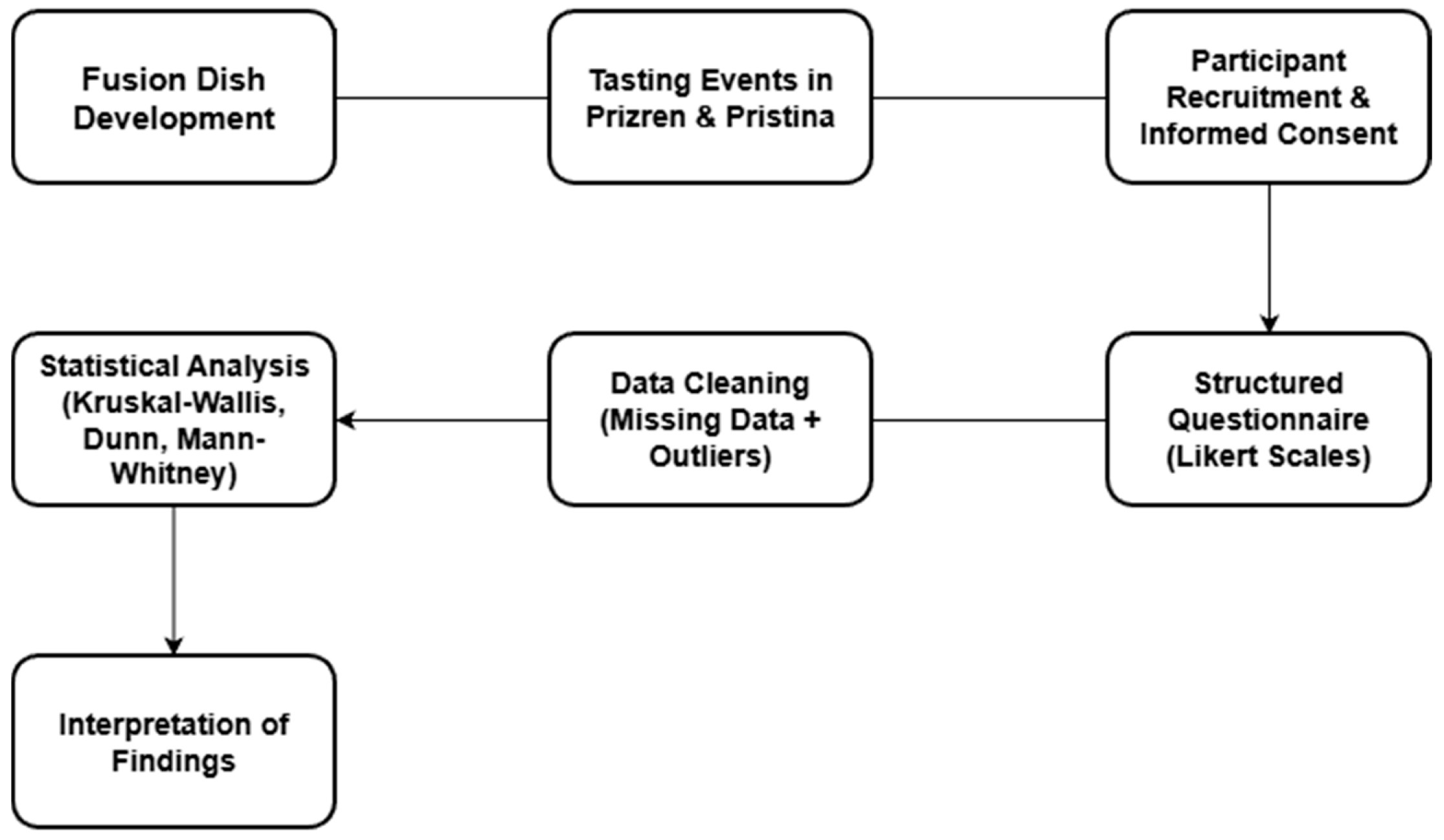
2.2. Context of the Event and Execution of the Survey
- Kosovo and Turkish cuisines have historical gastronomic roots, including influences from Ottoman cuisine and Mediterranean dietary practices. Fundamental ingredients, such as spices (cumin, sumac, coriander powder), grains products (bulgur as a whole grain; cornflour as a refined grain product), meats (lamb, beef), dairy (yoghurt, white cheese) and legumes (chickpeas, lentils), common to both cuisines, were emphasized in the meal selection process. Novel flavours emerged from the fusion of roasting and stewing techniques prevalent in Turkish cuisine when combined with the baking and prolonged cooking procedures characteristic of Kosovan cuisine.
- By means of research, the taste profiles (sweet, sour, umami, bitter, salty) were harmonized, and cross-flavour combinations that were designed to appeal to both Kosovo and Turkish cultures were developed.
2.3. Data Collection
2.4. Data Analysis
3. Results
3.1. Education Level and Fusion Cuisine Preference
3.2. Age and Preference for Fusion Cuisine
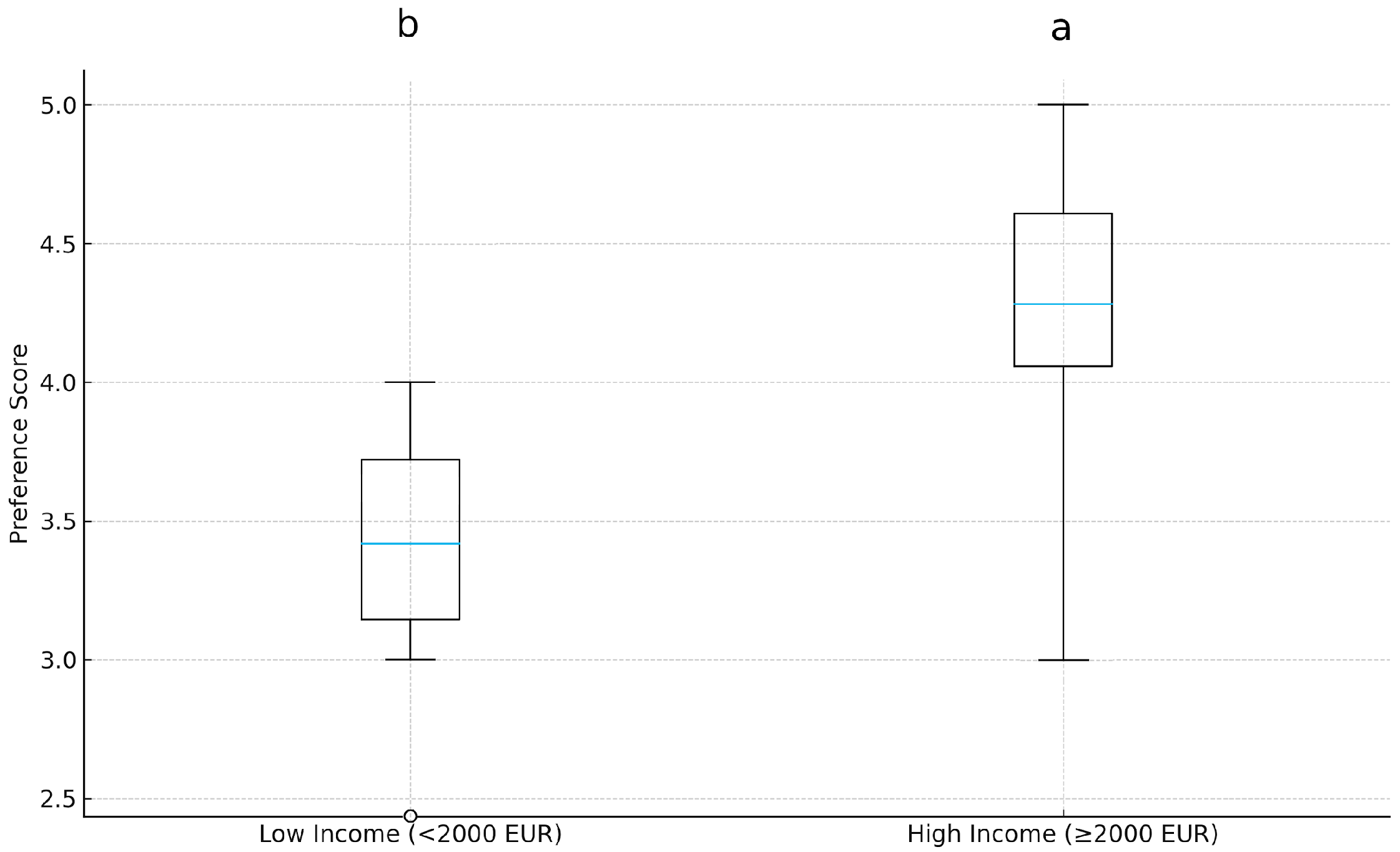
3.3. Income Level and Preference for Fusion Cuisine
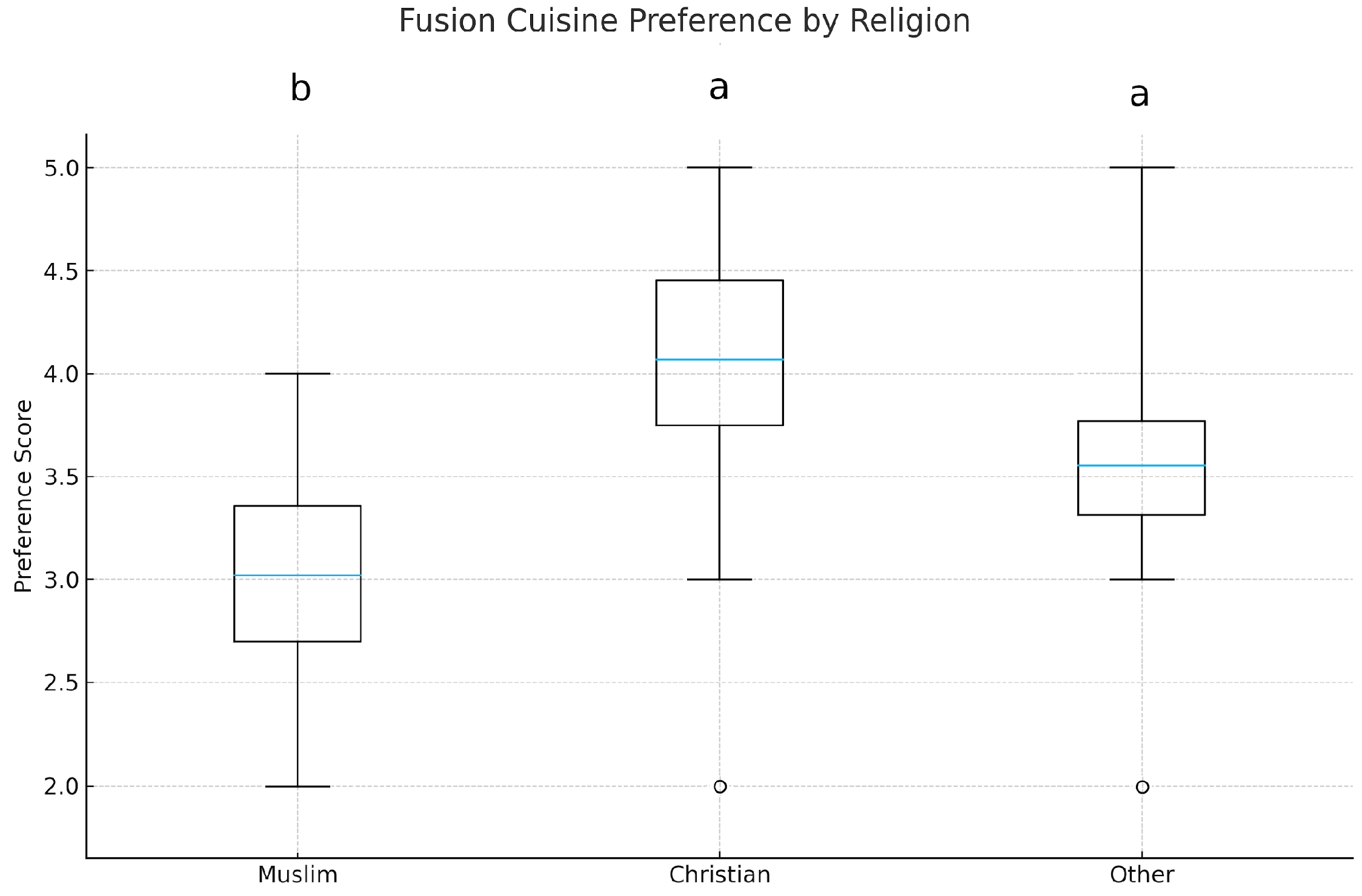
3.4. Religion and Fusion Cuisine Preference
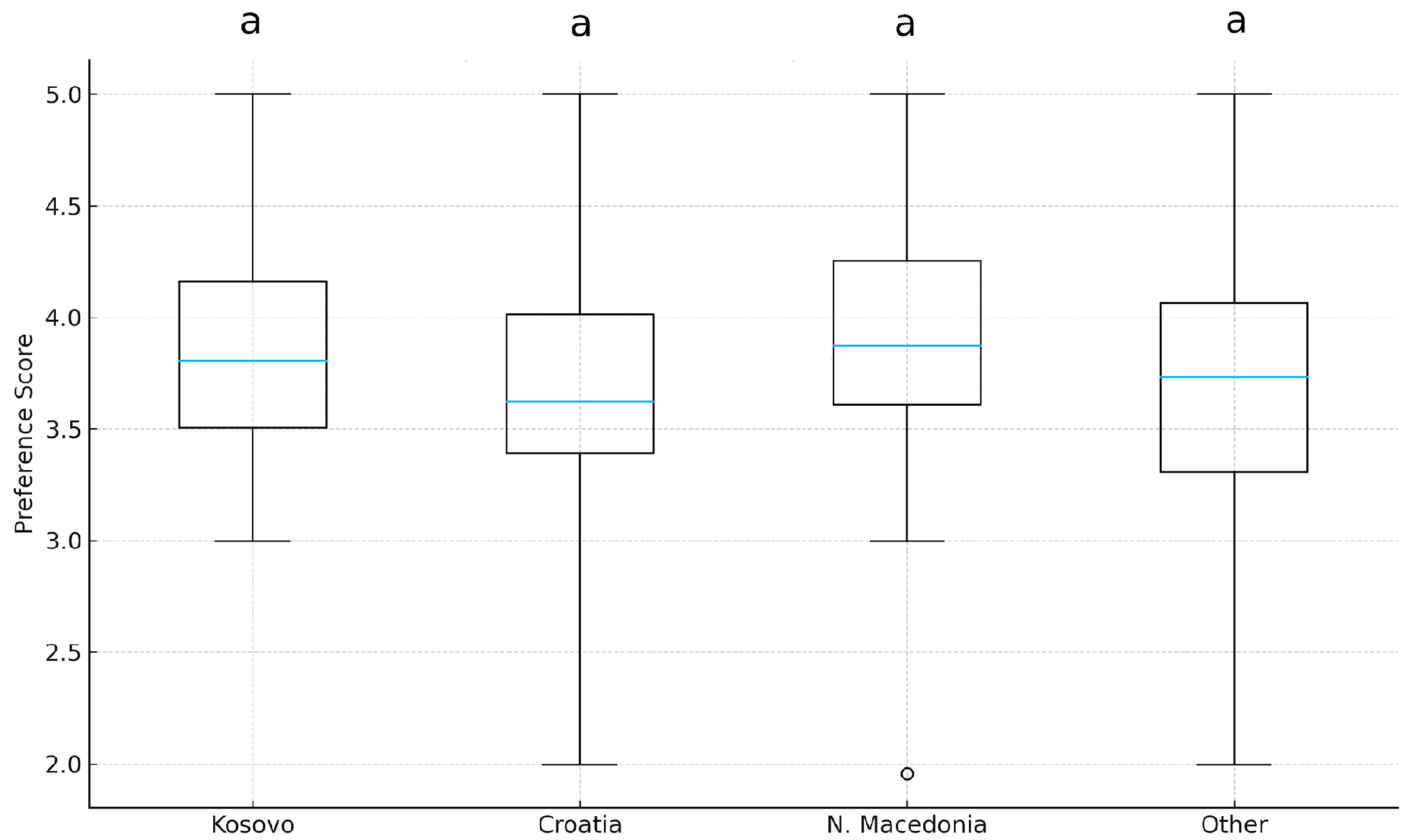
3.5. Nationality and Preference for Fusion Cuisine
3.6. Income Level and Culinary Diversity Interest Among Highly Educated Individuals
4. Discussion
5. Conclusions
Limitations
Author Contributions
Funding
Institutional Review Board Statement
Informed Consent Statement
Data Availability Statement
Conflicts of Interest
Appendix A
Sizi “Füzyon Mutfak: Kosova&Türkiye Karşılaştırması” başlıklı araştırmaya davet ediyoruz. Bu araştırmaya katılıp katılmama kararını vermeden önce, araştırmanın neden ve nasıl yapılacağını bilmeniz gerekmektedir. Bu nedenle bu formun okunup anlaşılması büyük önem taşımaktadır. Eğer anlayamadığınız ve sizin için açık olmayan şeyler varsa, ya da daha fazla bilgi isterseniz bize sorunuz.
Bu çalışmaya katılmak tamamen gönüllülük esasına dayanmaktadır. Çalışmaya katılmama veya katıldıktan sonra herhangi bir anda çalışmadan çıkma hakkında sahipsiniz. Çalışmayı yanıtlamanız, araştırmaya katılım için onam verdiğiniz biçiminde yorumlanacaktır. Size verilen formlardaki soruları yanıtlarken kimsenin baskısı veya telkini altında olmayın. Bu formlardan elde edilecek bilgiler tamamen araştırma amacı ile kullanılacaktır.Dr. Ceyhun UÇUK (ceyhunucuk@gmail.com), Gaziantep Üniversitesi
Ju ftojmë në hulumtimin me titull “Kuzhina Fusion: Krahasimi Kosovë&Turqi”. Përpara se të vendosni nëse do të merrni pjesë në këtë hulumtim apo jo, është e nevojshme të dini pse dhe si do të bëhet ky hulumtim. Prandaj, është shumë e rëndësishme që ky formular të lexohet dhe të kuptohet. Nëse ka gjëra që nuk i kuptoni ose që nuk janë të qarta për ju, ose nëse dëshironi më shumë informacion, ju lutemi na pyesni.
Pjesëmarrja në këtë studim është plotësisht vullnetare. Ju keni të drejtë të mos merrni pjesë në studim ose të largoheni nga studimi në çdo moment pas pjesëmarrjes. Përgjigjja juaj ndaj studimit do të interpretohet si dhënie e pëlqimit për pjesëmarrje në hulumtim. Mos lejoni që të jeni nën presion ose sugjerim nga dikush tjetër kur përgjigjeni pyetjeve në formularët e dhënë. Informacioni i marrë nga këto formularë do të përdoret vetëm për qëllime kërkimore.Dr. Ceyhun UÇUK (ceyhunucuk@gmail.com), Universiteti i Gaziantep
You are invited to take part in a research study titled “Fusion Cuisine: A Comparative Study between Kosovo & Türkiye.” Before deciding whether to take part in this study, it is important that you understand why the research is being conducted and how it will be carried out. Therefore, carefully reading and fully understanding this form is highly important. If there is anything unclear or if you would like more information, please do not hesitate to ask us.
Participation in this study is entirely voluntary. You have the right to decline participation or to withdraw from the study at any time, even after you have agreed to take part. Completing the survey will be considered as your consent to participate in the study. While answering the questions provided, please ensure that you are not influenced or pressured by anyone. The information collected from these forms will be used solely for research purposes.Dr. Ceyhun UÇUK (ceyhunucuk@gmail.com), University of Gaziantep
- Yaşınız (Mosha juaj, Age in years) *
- 18–29
- 30–39
- 40–49
- 50–59
- 60 ve üzeri (58 dhe mbi/60 and above)
- 2.
- Cinsiyetiniz (Gjinia juaj/Gender) *
- Kadın (Grua/Female)
- Erkek (Burrë/Male)
- Belirtmek İstemiyorum (Nuk dua të tregoj/Prefer not to say)
- 3.
- En Son Mezun Olunan Derece (Shkalla e fundit e përfunduar/ Highest level of education completed) *
- İlkokul (Shkolla fillore/Primary School)
- Ortaokul (Shkolla e mesme e ulët/Lower secondary school-Middle school)
- Lise (Shkolla e mesme e lartë/High School)
- Önlisans (Diplomë e shkollës së lartë/Associate Degree)
- Lisans (Diplomë Bachelor/Bachelor’s Degree)
- Yüksek Lisans (Master/Master’s Degree)
- Doktora (Doktoraturë/Doctorate-PhD)
- 4.
- Medeni Durum (Statusi martesor Marital Status) *
- Evli (I martuar/married)
- Bekar (Beqar/single)
- 5.
- Meslek (Profesioni/Occupation-Profession) *
- 6.
- Aylık Geliriniz (Të ardhurat tuaja mujore/Monthly income) *
- <1000 EUR
- 1000–1999 EUR
- 2000–3999 EUR
- ≥4000 EUR
- 7.
- Hangi Ülkede İkamet Ediyorsunuz? (Në cilin vend banoni/Which country do you reside in?) *
- 8.
- Etnik Kökeniniz Nedir? (Cili është origjina juaj etnike?/What is your ethnic origin?) *
- 9.
- Hangi Dine Mensupsunuz? (Cilit besim i përkisni?/What is your religion?) *
- Hristiyan (I krishterë/Christian)
- Müslüman (Mysliman/Muslim)
- Diğer (Tjetër/Other)
- 10.
- Bir tabakta farklı ulusların malzemelerini birleştiren lezzetleri tatmayı tercih ederim. (Preferoj të shijoj shijet që kombinojnë përbërësit e kombeve të ndryshme në një pjatë/I prefer to taste flavours that combine ingredients from different national cuisines in a single dish) *
- Kesinlikle Katılmıyorum (Nuk jam absolutisht dakord/Strongly Disagree)
- Katılmıyorum (Nuk jam dakord/Disagree)
- Ne Katılıyorum Ne Katılmıyorum (As jam dakord, as nuk jam dakord/Neither Agree nor Disagree)
- Katılıyorum (Jam dakord/Agree)
- Kesinlikle Katılıyorum (Jam absolutisht dakord/Strongly Agree)
- 11.
- Bir tabakta farklı ulusların pişirme tekniklerini birleştiren lezzetleri tatmayı tercih ederim. (Preferoj të shijoj shijet që kombinojnë teknikat e gatimit të kombeve të ndryshme në një pjatë/I prefer to taste flavours that combine cooking techniques from different national cuisines in a single dish) *
- Kesinlikle Katılmıyorum (Nuk jam absolutisht dakord/Strongly Disagree)
- Katılmıyorum (Nuk jam dakord/Disagree)
- Ne Katılıyorum Ne Katılmıyorum (As jam dakord, as nuk jam dakord/Neither Agree nor Disagree)
- Katılıyorum (Jam dakord/Agree)
- Kesinlikle Katılıyorum (Jam absolutisht dakord/Strongly Agree)
- 12.
- Farklı mutfak kültürlerinin birleşiminden oluşan, ancak birinin diğerine baskın olmadığı gıdaları denemekten hoşlanırım. (Më pëlqen të provoj ushqime që përbëhen nga kombinimi i kulturave të ndryshme të kuzhinës, por ku asnjëra prej tyre nuk dominon mbi tjetrën/I enjoy trying foods created by the combination of different culinary cultures, where none is dominant over the other) *
- Kesinlikle Katılmıyorum (Nuk jam absolutisht dakord/Strongly Disagree)
- Katılmıyorum (Nuk jam dakord/Disagree)
- Ne Katılıyorum Ne Katılmıyorum (As jam dakord, as nuk jam dakord/Neither Agree nor Disagree)
- Katılıyorum (Jam dakord/Agree)
- Kesinlikle Katılıyorum (Jam absolutisht dakord/Strongly Agree)
- 13.
- Farklı kültürlere ait yiyecek ve içecek malzemelerinin bir araya getirilerek sıra dışı bir şekilde sunulan yiyecek ve içecekler ilgilimi çeker. (Jam i interesuar për ushqimet dhe pijet që përbëhen nga përbërës të ndryshëm nga kultura të ndryshme dhe që ofrohen në një mënyrë të pazakontë/ I am interested in food and beverages that creatively combine ingredients from different cultures and present them in an unusual way) *
- Kesinlikle Katılmıyorum (Nuk jam absolutisht dakord/Strongly Disagree)
- Katılmıyorum (Nuk jam dakord/Disagree)
- Ne Katılıyorum Ne Katılmıyorum (As jam dakord, as nuk jam dakord/Neither Agree nor Disagree)
- Katılıyorum (Jam dakord/Agree)
- Kesinlikle Katılıyorum (Jam absolutisht dakord/Strongly Agree)
- 14.
- Farklı kültürlere ait yiyecek ve içecek malzemelerinin bir araya getirilmesi ile hazırlanan sıra dışı tatlara sahip olan yiyecek ve içecekler ilgilimi çeker. (Jam i interesuar për ushqime dhe pije që kanë shije të pazakonta dhe që përgatiten duke kombinuar përbërës nga kultura tëndryshme/ I am interested in food and beverages that have unusual flavours as a result of combining ingredients from different cultures) *
- Kesinlikle Katılmıyorum (Nuk jam absolutisht dakord/Strongly Disagree)
- Katılmıyorum (Nuk jam dakord/Disagree)
- Ne Katılıyorum Ne Katılmıyorum (As jam dakord, as nuk jam dakord/Neither Agree nor Disagree)
- Katılıyorum (Jam dakord/Agree)
- Kesinlikle Katılıyorum (Jam absolutisht dakord/Strongly Agree)
- 15.
- Farklı kültürlere ait yiyecek ve içecek malzemelerinin bir araya getirilmesi ile hazırlanan sıra dışı kokulara sahip olan yiyecek ve içecekler ilgilimi çeker. (Jam i interesuar për ushqime dhe pije që kanë aroma të pazakonta dhe që përgatiten duke kombinuar përbërës nga kultura tëndryshme/I am interested in food and beverages that have unusual aromas created by combining ingredients from different cultures) *
- Kesinlikle Katılmıyorum (Nuk jam absolutisht dakord/Strongly Disagree)
- Katılmıyorum (Nuk jam dakord/Disagree)
- Ne Katılıyorum Ne Katılmıyorum (As jam dakord, as nuk jam dakord/Neither Agree nor Disagree)
- Katılıyorum (Jam dakord/Agree)
- Kesinlikle Katılıyorum (Jam absolutisht dakord/Strongly Agree)
- 16.
- Farklı kültürlere ait yiyecek ve içecek malzemelerinin bir araya getirilmesi ile hazırlanan özgün yiyecek ve içecekler ilgimi çeker. (Jam i interesuar për ushqime dhe pije unike që përgatiten duke kombinuar përbërës nga kultura të ndryshme/I am interested in novel foods and beverages created by combining ingredients from different cultures) *
- Kesinlikle Katılmıyorum (Nuk jam absolutisht dakord/Strongly Disagree)
- Katılmıyorum (Nuk jam dakord/Disagree)
- Ne Katılıyorum Ne Katılmıyorum (As jam dakord, as nuk jam dakord/Neither Agree nor Disagree)
- Katılıyorum (Jam dakord/Agree)
- Kesinlikle Katılıyorum (Jam absolutisht dakord/Strongly Agree)
- 17.
- Farklı mutfak kültürlerine ait pişirme teknikleri bir araya getirilerek sıra dışı bir şekilde sunulan yiyecek ve içecekler ilgilimi çeker. (Jam i interesuar për ushqime dhe pije që ofrohen në një mënyrë të pazakontë duke kombinuar teknika gatimi nga kultura të ndryshme të kuzhinës/I am interested in food and beverages that are presented in an unusual way by combining cooking techniques from different culinary cultures) *
- Kesinlikle Katılmıyorum (Nuk jam absolutisht dakord/Strongly Disagree)
- Katılmıyorum (Nuk jam dakord/Disagree)
- Ne Katılıyorum Ne Katılmıyorum (As jam dakord, as nuk jam dakord/Neither Agree nor Disagree)
- Katılıyorum (Jam dakord/Agree)
- Kesinlikle Katılıyorum (Jam absolutisht dakord/Strongly Agree)
- 18.
- Farklı mutfak kültürlerine ait pişirme tekniklerinin bir araya getirilmesi ile hazırlanan sıra dışı tatlara sahip olan yiyecek ve içecekler ilgilimi çeker. (Jam i interesuar për ushqime dhe pije që kanë shije të pazakonta dhe që përgatiten duke kombinuar teknika gatimi nga kultura të ndryshme të kuzhinës/ I am interested in food and beverages that have unusual flavours created by combining cooking techniques from different culinary cultures) *
- Kesinlikle Katılmıyorum (Nuk jam absolutisht dakord/Strongly Disagree)
- Katılmıyorum (Nuk jam dakord/Disagree)
- Ne Katılıyorum Ne Katılmıyorum (As jam dakord, as nuk jam dakord/Neither Agree nor Disagree)
- Katılıyorum (Jam dakord/Agree)
- Kesinlikle Katılıyorum (Jam absolutisht dakord/Strongly Agree)
- 19.
- Farklı mutfak kültürlerine ait pişirme tekniklerinin bir araya getirilmesi ile hazırlanan sıra dışı kokulara sahip olan yiyecek ve içecekler ilgilimi çeker. (Jam i interesuar për ushqime dhe pije që kanë aroma të pazakonta dhe që përgatiten duke kombinuar teknika gatimi nga kultura të ndryshme të kuzhinës/I am interested in food and beverages that have unusual aromas created by combining cooking techniques from different culinary cultures) *
- Kesinlikle Katılmıyorum (Nuk jam absolutisht dakord/Strongly Disagree)
- Katılmıyorum (Nuk jam dakord/Disagree)
- Ne Katılıyorum Ne Katılmıyorum (As jam dakord, as nuk jam dakord/Neither Agree nor Disagree)
- Katılıyorum (Jam dakord/Agree)
- Kesinlikle Katılıyorum (Jam absolutisht dakord/Strongly Agree)
- 20.
- Farklı mutfak kültürlerine ait pişirme tekniklerinin bir araya getirilmesi ile hazırlanan özgün yiyecek ve içecekler ilgilimi çeker. (Jam i interesuar për ushqime dhe pije unike që përgatiten duke kombinuar teknika gatimi nga kultura të ndryshme të kuzhinës/ I am interested in unique foods and beverages that are created by combining cooking techniques from different culinary traditions.)
- Kesinlikle Katılmıyorum (Nuk jam absolutisht dakord/Strongly Disagree)
- Katılmıyorum (Nuk jam dakord/Disagree)
- Ne Katılıyorum Ne Katılmıyorum (As jam dakord, as nuk jam dakord/Neither Agree nor Disagree)
- Katılıyorum (Jam dakord/Agree)
- Kesinlikle Katılıyorum (Jam absolutisht dakord/Strongly Agree)
Appendix B
| Food Name: Krempita & Baklava | About: This recipe combines Krempita, a traditional layered cream pastry popular in the Balkans, and Baklava, a symbolic dessert of Turkish cuisine. Designed as a fusion dessert, it represents the gastronomic and cultural connection between Türkiye and Kosovo, offering high sensory richness through creamy texture and pistachio aroma. | 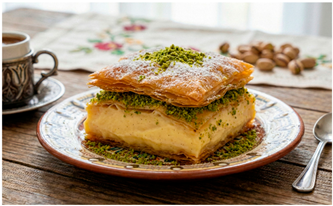 | ||
| Total Time: 4 h | ||||
| Pax: 10 | ||||
| Ingredients | ||||
For Cream Layer
| For Baklava Sheet Layer
| |||
Mise en Place Procedure:
| ||||
| Requirements (Tools & Equipment) | ||||
|
| |||
| Stage | Procedure | |||
| 1 | Heat milk and 150 g sugar at 90–95 °C until dissolved | |||
| 2 | Whisk egg yolks, remaining sugar, cornstarch, and vanilla until smooth | |||
| 3 | Temper hot milk into yolk mixture slowly | |||
| 4 | Return to heat, cook until cream reaches 83–85 °C and thickens | |||
| 5 | Remove from heat, add butter, cool rapidly to 25–30 °C | |||
| 6 | Fold cream with cold heavy cream to achieve aerated structure | |||
| 7 | Brush phyllo sheets individually with butter, layer 10 sheets in tray | |||
| 8 | Spread half pistachio | |||
| 9 | Add remaining 10 sheets, finish with butter brushing | |||
| 10 | Bake at 185 °C for 24 min until golden | |||
| 11 | Prepare hot syrup: boil 300 g sugar + 200 mL water for 6 min, add lemon | |||
| 12 | Pour hot syrup over baked layers, rest 60 min | |||
| 13 | Spread cream layer evenly (3–4 cm thickness) | |||
| 14 | Chill in blast chiller +4 °C for min. 120 min | |||
| 15 | Portion as 8 × 8 cm squares for sensory testing | |||
| Food Name: Ajvar & Haydari Canapés | About: Ajvar, a Balkan-origin roasted pepper-eggplant paste, and Haydari, a traditional Turkish strained yoghurt dip, are combined on toasted baguette slices to create a fusion cold starter. This appetizer represents Kosovo–Türkiye culinary diplomacy through complementary flavour profiles and shared meze culture. |  | ||
| Total Time: 2 h | ||||
| Pax: 10 | ||||
| Ingredients | ||||
For Ajvar
| For Haydari
| |||
Mise en Place Procedure:
| ||||
| Requirements (Tools & Equipments) | ||||
|
| |||
| Stage | Procedure | |||
| 1 | Roast peppers & eggplants at 220 °C for 25–30 min until charred | |||
| 2 | Transfer to covered container for 10 min → steam → easy peeling | |||
| 3 | Peel skins, remove seeds, drain excess water | |||
| 4 | Blend roasted vegetables, garlic, salt, pepper, vinegar | |||
| 5 | Add olive oil gradually to emulsify Ajvar structure | |||
| 6 | Chill Ajvar to 10 °C before plating | |||
| 7 | Combine strained yoghurt, white cheese, finely chopped dill & mint | |||
| 8 | Add olive oil, garlic, salt → mix until smooth | |||
| 9 | Toast bread slices at 180 °C for 6–7 min | |||
| 10 | Spread Haydari (10–12 g each), top with Ajvar (20–25 g) | |||
| 11 | Garnish with cucumber slice | |||
| 12 | Serve immediately at 10–12 °C | |||
| Food Name: Flija & Sac Tava | About: Flija is a layered baked batter dish carrying strong cultural value in Kosovo and for broader Balkan culinary heritage. Sac Tava, on the other hand, is a traditional Turkish main course in which meat and vegetables are cooked over high heat to achieve a rich savoury profile. The two dishes are combined into a single plate format, representing a fusion interpretation of the shared gastronomic heritage of Türkiye and Kosovo. |  | ||
| Total Time: 6 | ||||
| Pax: 10 | ||||
| Ingredients | ||||
For Flija Batter
| For Sac Tava
| |||
Mise en Place Procedure:
| ||||
| Requirements (Tools & Equipments) | ||||
|
| |||
| Stage | Procedure | |||
| 1 | Combine flour, milk, eggs, yoghurt, salt → whisk until homogeneous | |||
| 2 | Pour a thin layer of batter into tray | |||
| 3 | Brush lightly with melted butter | |||
| 4 | Cook under heated sac lid for 5–7 min | |||
| 5 | Repeat steps 2–4 for 15–18 layers total | |||
| 6 | After final layer, cool to 40 °C | |||
| 7 | Heat sauté pan with olive oil at 200 °C | |||
| 8 | Brown diced meat on high heat: 5–7 min | |||
| 9 | Add onions, peppers, tomatoes, garlic → sauté 10 min | |||
| 10 | Add spices & butter → simmer 45–60 min at 95–98 °C | |||
| 11 | Plate Sac Tava over sliced Flija squares (10 × 10 cm each) | |||
| 12 | Rest dish at 60–65 °C during service window | |||
References
- Spence, C. Contemporary fusion foods: How are they to be defined, and when do they succeed/fail? Int. J. Gastron. Food Sci. 2018, 13, 101–107. [Google Scholar] [CrossRef]
- Peters, C.; Broersma, M. Fusion cuisine: A functional approach to interdisciplinary cooking in journalism studies. Journalism 2019, 20, 660–669. [Google Scholar] [CrossRef]
- Sarioglan, M. Fusion cuisine education and its relation with molecular gastronomy education (comparative course content analysis). Online Submiss. 2014, 5, 64–70. [Google Scholar]
- Sarioglan, M.; Sezen, T.S. Project-based learning approach in fusion cuisine education: A model proposal. New Trends Issues Proc. Humanit. Soc. Sci. 2017, 4, 574–578. [Google Scholar] [CrossRef]
- Vogler, P. Scoff: A History of Food and Class in Britain; Atlantic Books: London, UK, 2020. [Google Scholar]
- Dogan, Y.; Nedelcheva, A.; Łuczaj, Ł.; Drăgulescu, C.; Stefkov, G.; Maglajlić, A.; Ferrier, J.; Papp, N.; Hajdari, A.; Mustafa, B.; et al. Of the importance of a leaf: The ethnobotany of sarma in Turkey and the Balkans. J. Ethnobiol. Ethnomed. 2015, 11, 26. [Google Scholar] [CrossRef]
- Girgin, K.; Demir, Ö.; Çetinkaya, V. The Best Cuisines in the World and Turkish Cuisine. J. Tour. Gastron. Stud. 2023, 5, 219–229. Available online: https://jotags.net/index.php/jotags/article/view/288 (accessed on 8 August 2025).
- Spence, C. Multisensory flavour perception: Blending, mixing, fusion, and pairing within and between the senses. Foods 2020, 9, 407. [Google Scholar] [CrossRef]
- Mak, A.H.N.; Lumbers, M.; Eves, A. Globalisation and food consumption in tourism. Ann. Tour. Res. 2012, 39, 171–196. [Google Scholar] [CrossRef]
- Stano, S. ‘Con-fusion cuisines’: Melting foods and hybrid identities. In New Semiotics: Between Tradition and Innovation; Bankov, K., Kasabov, I., Almalech, M., Gueorguiev, B., Tsonev, G., Iankova, R., Trendafilov, D., Velinov, I.I., Manova, Y., Batchvarova, B., Eds.; NBU Publishing House: Sofia, Bulgaria, 2017; pp. 904–913. [Google Scholar]
- Azmi, A.; Rosian, M.S.A.; Zubir, H.A.; Adnan, N.I. Fusion cuisine: A study of domestic tourist’s perspectives in Malaysia. Glob. Bus. Manag. Res. 2023, 15, 133–152. [Google Scholar]
- Raji, M.N.A.; Ab Karim, S.; Ishak, F.A.C.; Arshad, M.M. Past and present practices of the Malay food heritage and culture in Malaysia. J. Ethn. Foods 2017, 4, 221–231. [Google Scholar] [CrossRef]
- Leong, M.W.A.; Yeh, S.S.; Fan, Y.L.; Huan, T.C. The effect of cuisine creativity on customer emotions. Int. J. Hosp. Manag. 2020, 85, 102346. [Google Scholar] [CrossRef]
- Dolphijn, R. An aesthetics of the mouth: Creativity between the culinary and the arts. Angelaki 2006, 11, 179–188. [Google Scholar] [CrossRef]
- Kulshrestha, R. Changing tastes: How globalization is shaping regional cuisines-culinary innovation and fusion cuisine, variety, and availability of ingredients. In Global Sustainable Practices in Gastronomic Tourism; IGI Global Scientific Publishing: Hershey, PA, USA, 2025; pp. 231–242. [Google Scholar]
- Guiné, R.P.; Florença, S.G.; Barroca, M.J.; Anjos, O. The link between the consumer and the innovations in food product development. Foods 2020, 9, 1317. [Google Scholar] [CrossRef] [PubMed]
- Kusnedi, R.; Elsty, K.; Irfan, M.; Hariyanto, L.; Choesrani, D.Z.; Nurhasanah, A. Culinary fusion in transforming traditional recipes for modern tastes. J. Ilm. Manaj. Kesatuan 2025, 13, 325–334. [Google Scholar] [CrossRef]
- Dikme, S.; Akar Şahingöz, S. Füzyon mutfak yeme eğiliminin demografik özellikler üzerinden incelenmesi (Analyzing fusion cuisine eating tendency based on demographic characteristics). J. Tour. Gastron. Stud. 2023, 11, 1983–1995. [Google Scholar] [CrossRef]
- Monteiro, R. Semiotics of cultural heritages: The dialectical process of assimilation and rejection of otherness in the cultural heritage of the Al-Andalus civilization. In Proceedings of the 12th World Congress of the International Association for Semiotic Studies, Sofia, Bulgaria, 16–20 September 2014. [Google Scholar] [CrossRef]
- PreGel America. The Fusion Revolution: The Evolution of Fusion Cuisine; PreGel America Magazine: Concord, NC, USA, 2016. [Google Scholar]
- Jiménez-Beltrán, F.J.; López-Guzmán, T.; González Santa Cruz, F. Analysis of the relationship between tourism and food culture. Sustainability 2016, 8, 418. [Google Scholar] [CrossRef]
- Kovalenko, A.; Dias, Á.; Pereira, L.; Simões, A. Gastronomic experience and consumer behavior: Analyzing the influence on destination image. Foods 2023, 12, 315. [Google Scholar] [CrossRef]
- Başutku, S.; Varışoğlu, B. Turkish as a heritage language in Skopje. Sak. Univ. J. Educ. 2022, 12, 1043–1053. [Google Scholar] [CrossRef]
- Kommeci, B. Gastronomy as a soft power tool: Turkish gastrodiplomacy activities in Africa. Hung. J. Afr. Stud. 2024, 18, 45. [Google Scholar] [CrossRef]
- Kihlgren Grandi, L. Branding, Diplomacy, and Inclusion: The role of migrant cuisines in cities’ local and international action. Societies 2023, 13, 151. [Google Scholar] [CrossRef]
- Kipng’etich, L. Cultural hybridity and identity formation in globalized societies. Int. J. Human. Soc. Sci. 2024, 2, 14–25. [Google Scholar] [CrossRef]
- Pathak, H.P. Exploring the Nexus of Globalization, Ethnic Fusion, Authenticity, and Construction of Cultural Identity via Ethnic Nepali Restaurants in Finland. Master’s Thesis, University of Jyväskylä, Jyväskylä, Finland, 2024. [Google Scholar]
- Liu, S.Q.; Wu, L.L.; Wang, C.Y. A creative-mix or variety-mix fusion experience? Examining marketing strategies for ethnic fusion restaurants. Int. J. Hosp. Manag. 2020, 89, 102596. [Google Scholar] [CrossRef]
- Bellesia, G. Comfort food, acquired taste, and fusion cuisine: A migrant journey. Comp. Stud. Mod. 2017, 10, 85–98. [Google Scholar]
- Świtała-Trybek, D. New trends in culinary tourism-regional (Silesian) fusion cuisine. Geogr. Tour. 2020, 8, 47–54. Available online: https://czasopisma.ukw.edu.pl/index.php/gat/article/view/132 (accessed on 6 June 2025).
- Kang, H.J. A study on the influence of food styling factors on customer satisfaction, revisit intention, and recommendation intention-focusing on Korean fusion cuisine. Cul. Sci. Hosp. Res. 2014, 20, 100–114. [Google Scholar]
- Manuel, G. The cultural politics of fusion cuisine under liberal multiculturalism. Grad. J. Food Stud. 2019, 5, 2. [Google Scholar] [CrossRef]
- Srivastav, D.; Goel, G.J.; Tripathi, S. Examining the potentiality of growth of fusion cuisine in Meerut. Int. J. Innov. Res. Technol. 2021, 8, 351–357. [Google Scholar]
- Dimoula, A.; Koulidou, S.; Tsirtsoni, Z.; Standall, E.; Craig, O.; Valamoti, S.M. Fusion cuisine in the shadow of Mount Olympus: An integrated study of middle and late bronze age cooking pots. J. Greek Archaeol. 2022, 7, 37–66. [Google Scholar] [CrossRef]
- Rodrigues, M.F. Macanese cuisine: Fusion or evolution? Rev. Cult. 2020, 62, 17–25. [Google Scholar]
- Kim, Y.Y. Cross-cultural adaptation. In Oxford Research Encyclopedia of Communication; Oxford University Press: Oxford, UK, 2017. [Google Scholar]
- Salazar, D.S. The multiple edges of gastrodiplomacy: The paradoxes of the Basque case. Place Brand. Public Diplom. 2024, 20, 244–252. [Google Scholar] [CrossRef]
- Türker, N. Gastrodiplomasi türk mutfağının tanıtımında bir araç olabilir mi? [Can gastrodiplomacy be used as a tool for promoting Turkish cuisine?]. Güncel Tur. Araştırmaları Derg. 2018, 2, 14–29. [Google Scholar]
- Rockower, P. The state of gastrodiplomacy. Public Dipl. Mag. 2014, 11, 434–435. [Google Scholar]
- Nye, J. Soft power: The origins and political progress of a concept. Palgrave Commun. 2017, 3, 17008. [Google Scholar] [CrossRef]
- Luša, Đ.; Jakešević, R. The role of food in diplomacy: Communicating and “winning hearts and minds” through food. Media Stud. 2017, 8, 99–119. [Google Scholar] [CrossRef]
- Gündüz, C.; Rezaei, M.; Quaglia, R.; Pironti, M. Culinary tourism: Exploring cultural diplomacy through gastronomy festivals in Turkey and Italy. Br. Food J. 2024, 126, 2621–2645. [Google Scholar] [CrossRef]
- Lee, C.L.; Lee, S.H.; Seo, G.G.; Hong, J.H. The effect of plating, ingredients, and cooking processes on the acceptance and authenticity of ethnic rice dishes. Foods 2020, 9, 976. [Google Scholar] [CrossRef] [PubMed]
- Luan, Y.; Kim, Y.J. An integrative model of new product evaluation: A systematic investigation of perceived novelty and product evaluation in the movie industry. PLoS ONE 2022, 17, e0265193. [Google Scholar] [CrossRef]
- Richards, G. Evolving gastronomic experiences: From food to foodies to foodscapes. Gastron. Tour. 2015, 1, 5–17. [Google Scholar] [CrossRef]
- Spence, C. On the empirical aesthetics of plating. In The Routledge International Handbook of Neuroaesthetics; Nadal, M., Vartanian, O., Eds.; Routledge: London, UK, 2022; pp. 1027–1051. [Google Scholar]
- Bergeaud-Blackler, F. New challenges for Islamic ritual slaughter: A European perspective. J. Ethn. Migr. Stud. 2007, 33, 965–980. [Google Scholar] [CrossRef]
- Essoo, N.; Dibb, S. Religious influences on shopping behaviour: An exploratory study. J. Mark. Manag. 2004, 20, 683–712. [Google Scholar] [CrossRef]
- Shafie, S.; Othman, M.N. Halal certification: An international marketing issue and challenge. In Proceedings of the the International IFSAM VIIIth World Congress, Berlin, Germany, 28–30 September 2006; University of Malaya Press: Kuala Lumpur, Malaysia, 2006. [Google Scholar]
- Roudometof, V. Globalization and orthodox Christianity: The transformations of a religious tradition. J. Mod. Greek Stud. 2002, 20, 337–358. [Google Scholar] [CrossRef]
- Mikulić, J.; Prebežac, D. What drives passenger loyalty to traditional and low-cost airlines? A formative partial least squares approach. J. Air Transp. Manag. 2011, 17, 237–240. [Google Scholar] [CrossRef]
- Rysha, A. Food, nutrition, and health in Kosovo. In Nutritional and Health Aspects of Food in the Balkans; Gostin, A.I., Bogueva, D., Kakurinov, V., Eds.; Academic Press: London, UK, 2021; pp. 125–141. [Google Scholar] [CrossRef]
- Vuković, A.J.; Terzić, A. Gastronomy and regional identity: Balkan versus national cuisine. In Gastronomy for Tourism Development; Peštek, A., Kukanja, M., Renko, S., Eds.; Emerald Publishing Limited: Bingley, UK, 2020; pp. 1–25. [Google Scholar] [CrossRef]
- Kılıçhan, R.; Karamustafa, K.; Birdir, K. Gastronomic trends and tourists’ food preferences: Scale development and validation. Int. J. Contemp. Hosp. Manag. 2022, 34, 201–230. [Google Scholar] [CrossRef]
- Terason, S.; Zheng, H.; Sangsrijan, J. Flavors of fusion: The role of Thai street food in shaping culinary experiences for Chinese tourists. Evol. Stud. Imagin. Cult. 2024, 8, 1700–1720. [Google Scholar] [CrossRef]
- Van Lenthe, F.J.; Jansen, T.; Kamphuis, C.B. Understanding socio-economic inequalities in food choice behaviour: Can Maslow’s pyramid help? Br. J. Nutr. 2015, 113, 1139–1147. [Google Scholar] [CrossRef]
- Muhammad, A.; D’Souza, A.; Meade, B.; Micha, R.; Mozaffarian, D. How income and food prices influence global dietary intakes by age and sex: Evidence from 164 countries. BMJ Glob. Health 2017, 2, e000184. [Google Scholar] [CrossRef]
- Jamieson, S. Likert scales: How to (ab)use them? Med. Educ. 2004, 38, 1217–1218. [Google Scholar] [CrossRef]
- Norman, G. Likert scales, levels of measurement and the “laws” of statistics. Adv. Health Sci. Educ. 2010, 15, 625–632. [Google Scholar] [CrossRef]
- Cappucci, J. Retain or reject: The adherence to the kosher laws in a Canadian city. Contemp. Jew. 2021, 41, 411–435. [Google Scholar] [CrossRef] [PubMed]
- Chouraqui, J.P.; Turck, D.; Briend, A.; Darmaun, D.; Bocquet, A.; Feillet, F.; Frelut, M.-L.; Girardet, J.-P.; Guimber, D.; Hankard, R.; et al. Religious dietary rules and their potential nutritional and health consequences. Int. J. Epidemiol. 2021, 50, 12–26. [Google Scholar] [CrossRef] [PubMed]
- Domínguez, L.J.; Veronese, N.; Ragusa, F.S.; Petralia, V.; Ciriminna, S.; Di Bella, G.; Schirò, P.; Sabico, S.; Al-Daghri, N.M.; Barbagallo, M. Mediterranean diet and spirituality/religion: Eating with meaning. Aging Clin. Exp. Res. 2024, 36, 223. [Google Scholar] [CrossRef]
- Konttinen, H.; Halmesvaara, O.; Fogelholm, M.; Saarijärvi, H.; Nevalainen, J.; Erkkola, M. Sociodemographic differences in motives for food selection: Results from the LoCard cross-sectional survey. Int. J. Behav. Nutr. Phys. Act. 2021, 18, 71. [Google Scholar] [CrossRef]
- Livingstone, K.M.; Pnosamy, H.; Riddell, L.J.; Cicerale, S. Demographic, behavioural and anthropometric correlates of food liking: A cross-sectional analysis of young adults. Nutrients 2020, 12, 3078. [Google Scholar] [CrossRef]
- Jin, H.; Hwang, J. The dual lens of authenticity and likability: The effect of cultural familiarity on consumer responses to ethnic foods. Int. J. Hosp. Manag. 2024, 117, 103655. [Google Scholar] [CrossRef]
- Guan, J.; Chan, J.H.; Bi, J.; Qi, X. Cultural proximity, destination familiarity and tourists’ sense of away-from-home (SAFH). J. Destin. Mark. Manag. 2022, 23, 100670. [Google Scholar] [CrossRef]
- Zhu, Y.X.; Huang, J.; Zhang, Z.K.; Zhang, Q.M.; Zhou, T.; Ahn, Y.Y. Geography and similarity of regional cuisines in China. PLoS ONE 2013, 8, e79161. [Google Scholar] [CrossRef] [PubMed]
- Takenaka, A. “Nikkei Food” for Whom? Gastro-Politics and Culinary Representation in Peru. Anthropol. Food 2019, 14. [Google Scholar] [CrossRef]
- Sonenshine, T.; Rockower, P.; Chapple-Sokol, S.; Weaver, G. The Conflict Cuisine Project. Culinary Diplomacy, Gastrodiplomacy, and Conflict Cuisine: Defining the Field. In Is the Kitchen the New Venue of Foreign Policy?: Ideas on Food as a Tool for Diplomacy, Building Peace and Cultural Awareness; Stimson Center: Washington, DC, USA, 2016; pp. 9–11. Available online: http://www.jstor.org/stable/resrep10919.6 (accessed on 11 August 2025).



| Category | n | Percentage (%) | |
|---|---|---|---|
| Educational Attainment | Primary | 50 | 11.1% |
| Secondary | 65 | 14.4% | |
| High School | 110 | 24.4% | |
| Undergraduate | 130 | 28.8% | |
| Postgraduate | 96 | 21.3% | |
| Income Level (€/month) | Low (<1000) | 120 | 26.6% |
| Medium (1000–1999) | 150 | 33.3% | |
| High (2000–3999) | 105 | 23.3% | |
| Very High (>4000) | 76 | 16.8% | |
| Total | 451 | 100.0% |
| Nationality | n | Female (%) | Male (%) | Age (%) | ||||
|---|---|---|---|---|---|---|---|---|
| 18–29 | 30–39 | 40–49 | 50–59 | 60+ | ||||
| Kosovo | 78 | 44.9 | 55.1 | 26.9 | 23.1 | 19.2 | 17.9 | 12.9 |
| Albania | 70 | 45.7 | 54.3 | 25.7 | 24.3 | 18.6 | 20.0 | 11.4 |
| Serbia | 60 | 46.7 | 53.3 | 23.3 | 25.0 | 20.0 | 18.3 | 13.4 |
| North Macedonia | 56 | 42.9 | 57.1 | 21.4 | 26.8 | 19.6 | 17.9 | 14.3 |
| Montenegro | 42 | 47.6 | 52.4 | 19.0 | 23.8 | 21.4 | 21.4 | 14.3 |
| Romania | 35 | 48.6 | 51.4 | 22.9 | 25.7 | 20.0 | 20.0 | 11.4 |
| Bulgaria | 32 | 46.9 | 53.1 | 21.9 | 25.0 | 21.9 | 18.8 | 12.5 |
| Bosnia and Herzegovina | 30 | 43.3 | 56.7 | 23.3 | 26.7 | 20.0 | 16.7 | 13.3 |
| Croatia | 28 | 46.4 | 53.6 | 25.0 | 25.0 | 17.9 | 17.9 | 14.3 |
| Other | 20 | 50.0 | 50.0 | 20.0 | 25.0 | 25.0 | 15.0 | 15.0 |
| Total | 451 | 45.0 | 55.0 | 23.3 | 24.0 | 18.2 | 18.8 | 15.7 |
| Hypothesis | Test | df | Statistic | p-Value | Effect Size |
|---|---|---|---|---|---|
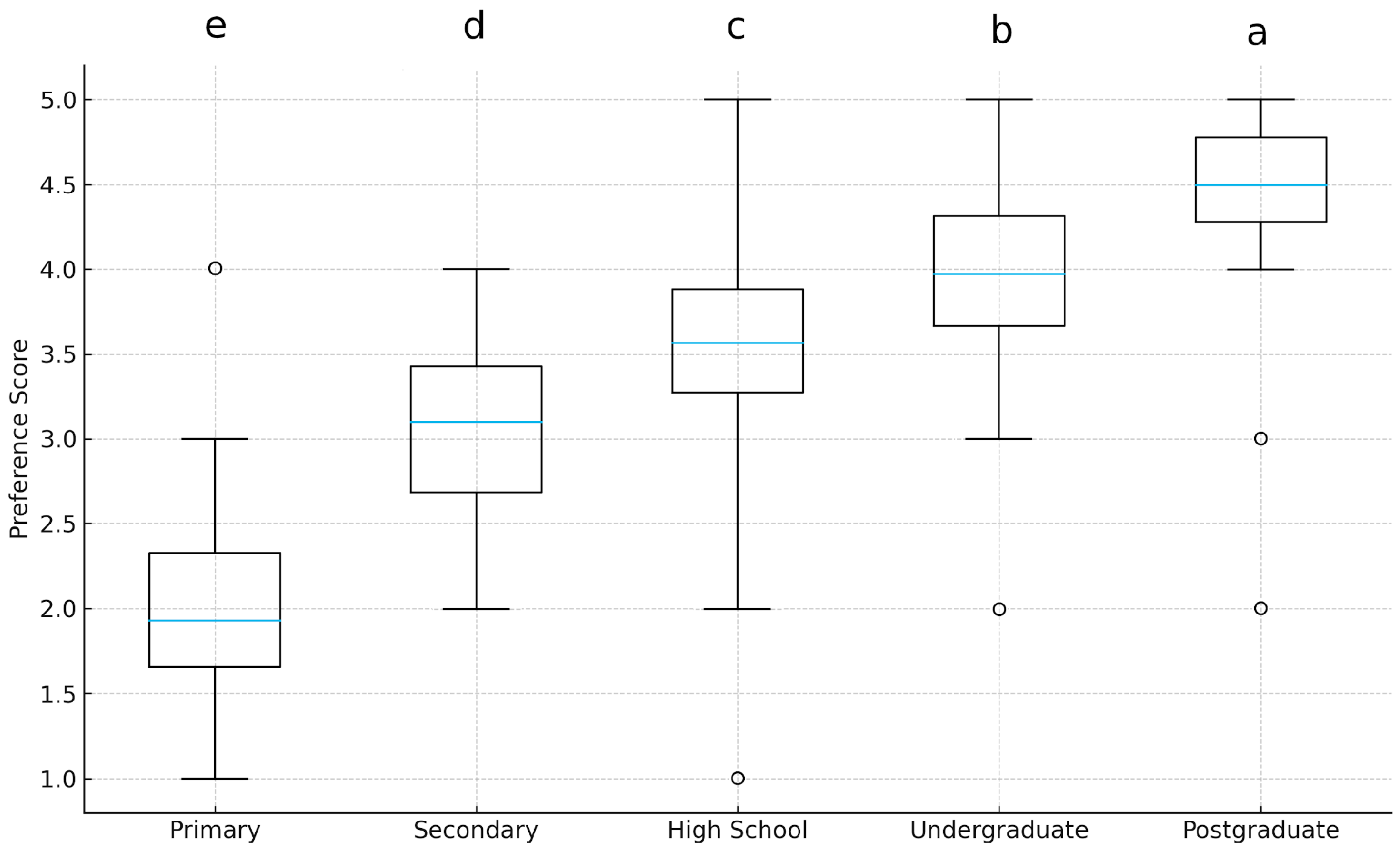
| H1 (Education) | Kruskal–Wallis | 4 | H = 32.41 | <0.001 | η2o = 0.11 |
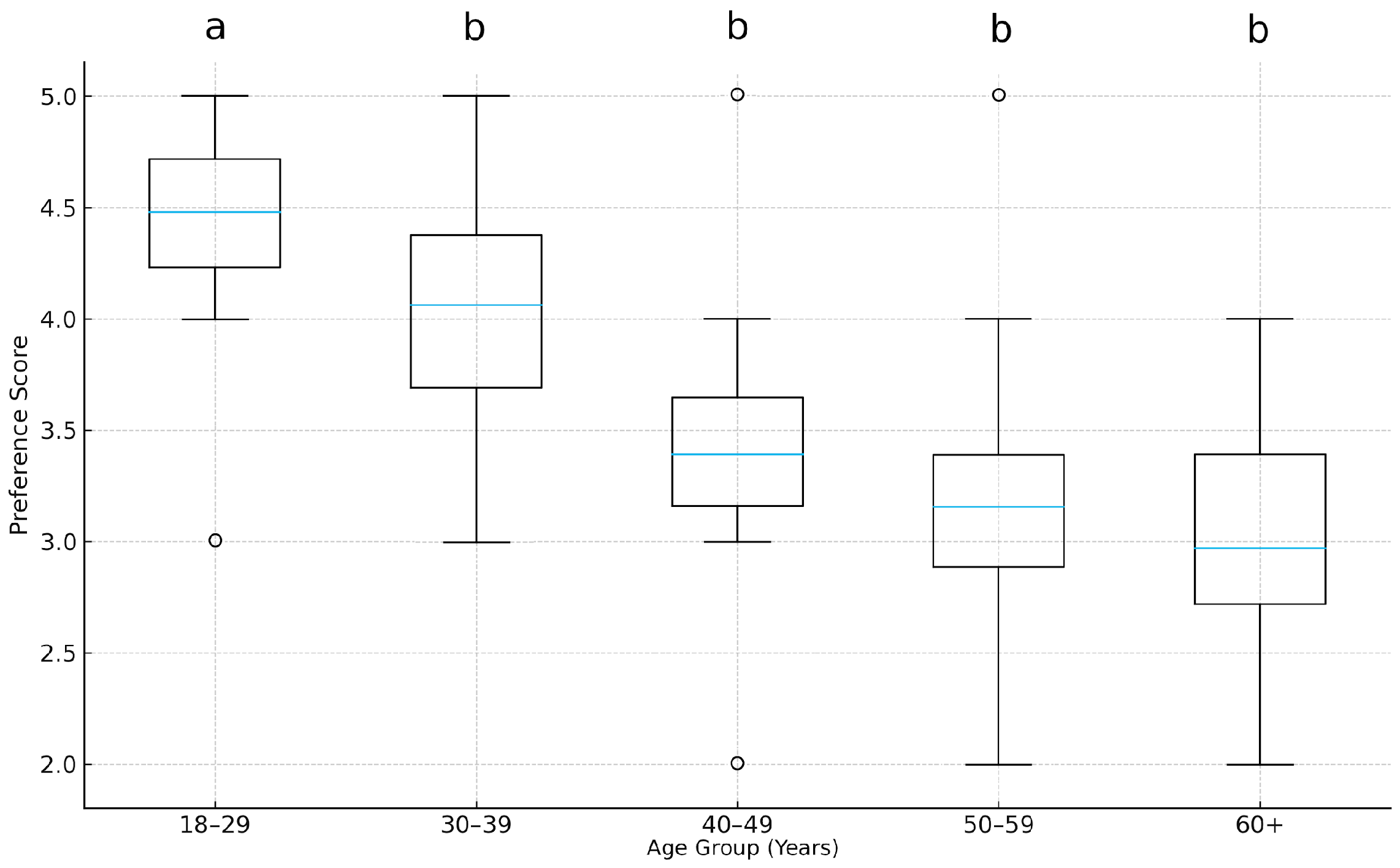
| H2 (Age) | Kruskal–Wallis | 2 | H = 28.87 | <0.001 | η2o = 0.09 |
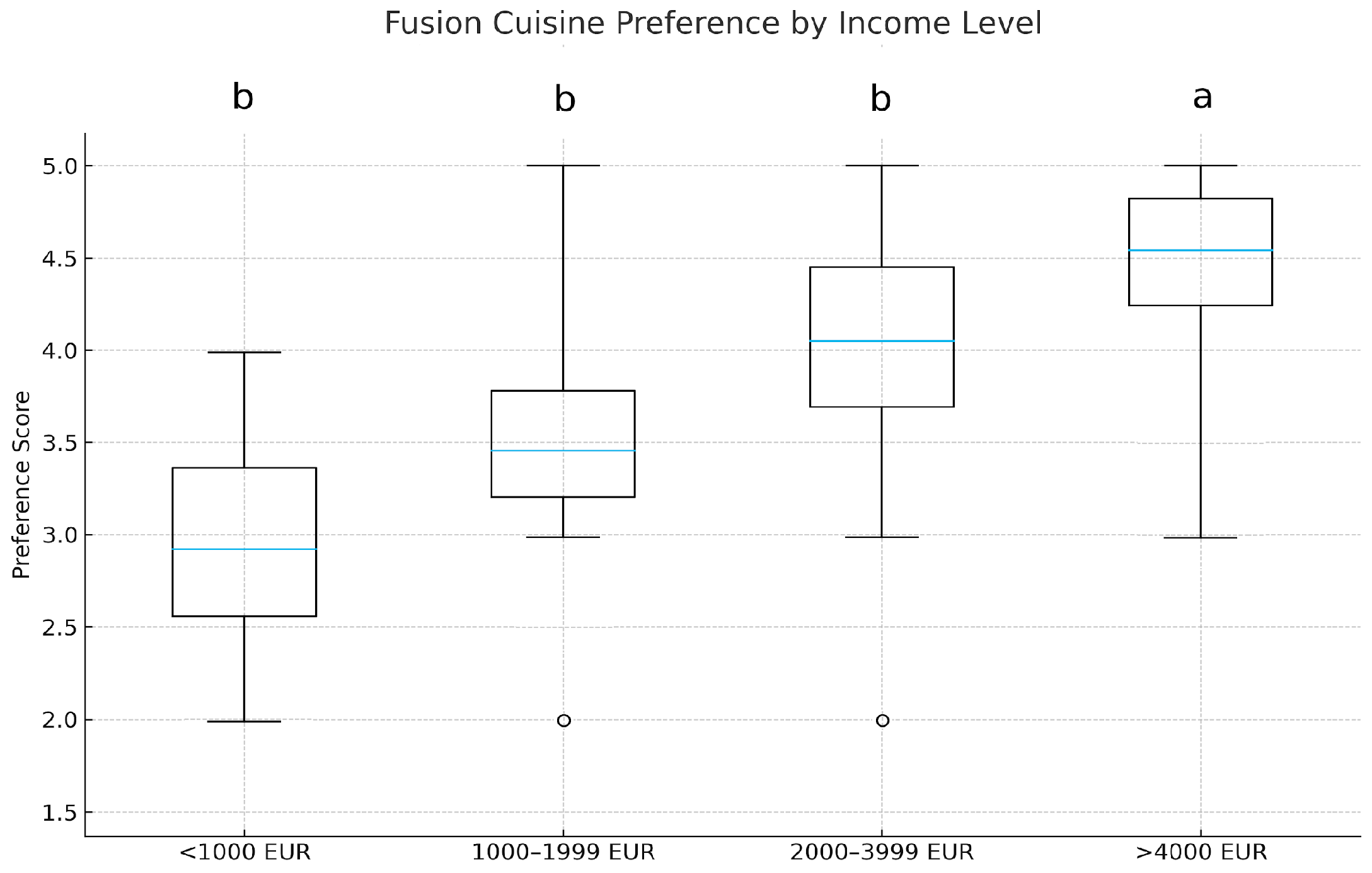
| H3 (Income) | Kruskal–Wallis | 3 | H = 7.21 | 0.042 | η2o = 0.02 |
| H4 (Religion) | Kruskal–Wallis | 2 | H = 14.73 | 0.001 | η2o = 0.05 |
| H5 (Nationality) | Kruskal–Wallis | 3 | H = 3.19 | 0.365 | η2o = 0.01 |
| H6 (Income × Education) | Mann–Whitney U | - | U = 5921 | 0.041 | Cliff’s δ = 0.24 |
Disclaimer/Publisher’s Note: The statements, opinions and data contained in all publications are solely those of the individual author(s) and contributor(s) and not of MDPI and/or the editor(s). MDPI and/or the editor(s) disclaim responsibility for any injury to people or property resulting from any ideas, methods, instructions or products referred to in the content. |
© 2026 by the authors. Licensee MDPI, Basel, Switzerland. This article is an open access article distributed under the terms and conditions of the Creative Commons Attribution (CC BY) license.
Share and Cite
Uçuk, C.; Çevik, Ç.; Arman, O.; Spence, C. Intercultural Dialogue Begins at the Dining Table: A Unilateral Kosovo Perspective on Turkish–Kosovar Fusion Cuisine. Foods 2026, 15, 222. https://doi.org/10.3390/foods15020222
Uçuk C, Çevik Ç, Arman O, Spence C. Intercultural Dialogue Begins at the Dining Table: A Unilateral Kosovo Perspective on Turkish–Kosovar Fusion Cuisine. Foods. 2026; 15(2):222. https://doi.org/10.3390/foods15020222
Chicago/Turabian StyleUçuk, Ceyhun, Çağın Çevik, Onurcan Arman, and Charles Spence. 2026. "Intercultural Dialogue Begins at the Dining Table: A Unilateral Kosovo Perspective on Turkish–Kosovar Fusion Cuisine" Foods 15, no. 2: 222. https://doi.org/10.3390/foods15020222
APA StyleUçuk, C., Çevik, Ç., Arman, O., & Spence, C. (2026). Intercultural Dialogue Begins at the Dining Table: A Unilateral Kosovo Perspective on Turkish–Kosovar Fusion Cuisine. Foods, 15(2), 222. https://doi.org/10.3390/foods15020222