Next Article in Journal
New Strategies to Improve the Quality and Safety of Seafoods and the Efficient Utilization of Their By-Products
Previous Article in Journal
Fruit Nutritional Composition and Seed Reserve Mobilization as Tools for Phenotypic Selection in Eugenia patrisii (Myrtaceae)
Previous Article in Special Issue
Prevalence, Molecular Characterization, and Antimicrobial Resistance Profile of Enterotoxigenic Escherichia coli Isolates from Pig Farms in China
error_outline You can access the new MDPI.com website here. Explore and share your feedback with us.
 
 
Article

Microarray-Based Serotyping and Molecular Characterization of Virulence and Antimicrobial Resistance of Salmonella enterica from Swine Meat Samples in Abattoirs and Wet Markets of Metro Manila, Philippines


by
Rance Derrick N. Pavon
1,
Jonah Feliza B. Mora
1,
Michael Joseph M. Nagpala
1,
Abbie Codia
2,
Homer D. Pantua
2 and
Windell L. Rivera
1,*
1
Pathogen-Host-Environment Interactions Research Laboratory, Institute of Biology, College of Science, University of the Philippines Diliman, Quezon City 1101, Metro Manila, Philippines
2
BioAssets Corporation, City of Santo Tomas 4234, Batangas, Philippines
*
Author to whom correspondence should be addressed.
Foods 2026, 15(2), 187; https://doi.org/10.3390/foods15020187
Submission received: 15 November 2025 / Revised: 19 December 2025 / Accepted: 29 December 2025 / Published: 6 January 2026

Abstract

Salmonella is a globally prevalent and diverse group of pathogenic bacteria that reside in food animals, such as swine. They possess transmissible antimicrobial resistance (AMR) and virulence factors, causing outbreaks with varying disease outcomes. This study identified and characterized 110 Salmonella enterica isolates from swine meat in abattoirs and wet markets of Metro Manila, Philippines. Thirteen different S. enterica serovars were identified using the Check & Trace microarray platform. The most prevalent were Rissen, Typhimurium 1, 4, [5], 12:i:-, Anatum, and Derby. This study is also the first to report serovar Soerenga in the Philippines and Asia. A high prevalence of virulence genes was observed, namely, hilA (75.45%), avrA (73.64%), mgtC (72.73%), pipB (66.36%), sseC (58.18%), and spi4R (53.64%), with no plasmid-borne spvC and spvR. A high prevalence of blaTEM (44.55%) was also observed, consistent with the phenotypic AMR profiles. Additionally, 14.81% of the isolates exhibited multidrug resistance. Statistical associations and predictions were also found among virulence genes, serovars, and location types, which highlight implications of Salmonella contamination and serovar variations. These findings suggest the need for continuous surveillance of Salmonella, especially for emerging or rare serovars, the deeper investigation of virulence and AMR mechanisms, and improved regulation and sanitation throughout food animal industries.

1. Introduction

Salmonella is a foodborne, pathogenic, and Gram-negative bacterium classified into two species, namely S. enterica and S. bongori. S. enterica is divided into six subspecies comprising around 3000 known serovars [1]. Humans often become infected with Salmonella through the consumption of contaminated food of animal and plant origin, as well as contact with infected domestic animals [2,3]. Infections result in serovar-specific pathologies, whether typhoidal (e.g., Typhi), which manifest as mild to severe fevers, or nontyphoidal (e.g., Typhimurium and Enteritidis), which primarily cause self-limiting diarrhea [2]. Salmonella is also considered a critical priority pathogen with alarming resistance rates to third-generation cephalosporins, carbapenems, and fluoroquinolones [4]. This pathogen also carries diverse virulence genes, which are clustered in the currently identified 24 Salmonella pathogenicity islands (SPIs), contributing to host cell adhesion, invasion, and survival mechanisms [5].
Accurate tools for detection and serovar identification are crucial for the surveillance of Salmonella, which remains a global public health concern. However, the gold standard for S. enterica serotyping remains serological testing under the Kauffmann–White–Le Minor scheme (KWL), which relies on the discrimination of 46 O-antigens, 114 H-antigens, and typhoidal serovar-specific Vi-antigens [6,7,8,9]. Unfortunately, this requires the storage of more than 250 antisera and 350 antigens, is laborious and time-consuming, subjective and complicated to interpret, with tendencies for cross-reactivity and variable antigenic expression [7,9,10,11]. Molecular tools, such as the polymerase chain reaction (PCR), enabled faster and more sensitive serotyping of S. enterica O- and H-antigen-associated genes. However, complex banding patterns can occasionally prevent precise identification of rare serovars or lead to cross-reactivity [12,13]. Meanwhile, whole-genome sequencing (WGS) possesses greater discriminatory and informative power, although it remains costly, complicated, and requires bioinformatic expertise [14]. Alternatively, DNA microarrays rely on the hybridization of complementary probes to post-amplified target DNA for rapid, accurate, and high-throughput gene detection for applications such as identification, subtyping, characterization, and expression quantification [15]. Check & Trace Salmonella (CTS) is a microarray-based method developed and commercialized by Check-Points B.V. in Wageningen, the Netherlands, that generates serovar-discriminatory patterns from PCR amplification products without the need for complex bioinformatic analyses. Serovars that remain uncharacterized in this platform are labeled as genovars [16].
In the Philippines, the swine industry is a significant contributor to food animal production, accounting for approximately 14% of the agricultural value from 2000 to 2020, with a trend of increasing growth [17]. A high prevalence of S. enterica has been reported in slaughtered swine and wet market meats in Metro Manila, Philippines, suggesting potential threats to producers and consumers, as well as significant impacts on production yields [13,18,19,20]. However, most previous studies in the country relied only on multiplex PCR banding patterns, which require further validation through the KWL scheme. Therefore, this study used microarray technology to determine the serovar identities of Salmonella isolates collected from swine samples from wet markets and slaughterhouses. Isolates were then characterized and associated with their genotypic virulence patterns. Additionally, their genotypic and phenotypic AMR profiles were determined and corroborated.

2. Materials and Methods

2.1. Revival and Recovery of S. enterica Isolates

A total of one hundred and ten (n = 110) S. enterica isolates were previously isolated in 2018–2019 from abattoirs (n = 70) and wet markets (n = 40) and stored in glycerol stocks at −20 °C at the Pathogen-Host-Environment Interactions Research Laboratory, Institute of Biology, College of Science, University of the Philippines Diliman. Isolates were obtained from various swine meat samples from wet markets and tonsil and jejunum samples from slaughterhouses in Metro Manila, Philippines. Ethical review and approval were waived for this study due to informed consent obtained from the Philippine National Meat Inspection Service. Animal slaughter and evisceration were performed according to national regulations. Informed consent was also obtained from veterinarians in charge of the abattoirs for sample collection. For the current study, isolates were subjected to revival and recovery using standard procedures with some modifications [13,21]. Initially, 100 μL of glycerol stock cultures were inoculated into 900 μL of Trypticase Soy Broth (TSB) (Becton, Dickinson and Company, Franklin Lakes, NJ, USA), followed by incubation at 37 °C for 18–24 h. For isolation, loopfuls of TSB cultures were streaked onto Xylose Lysine Deoxycholate (XLD) agar plates (Becton, Dickinson and Company, NJ, USA), followed by incubation at 37 °C for 18–24 h. Presumptive S. enterica isolates (black colonies on red agar media) were then transferred and purified on Trypticase Soy agar (TSA) (Becton, Dickinson and Company, NJ, USA) for downstream processes.

2.2. DNA Extraction

The boil-lysis method was used for DNA extraction, following standard protocols [13,18]. Colonies from 18- to 24 h old S. enterica cultures were suspended in 50 μL of 1X Tris-EDTA (TE) buffer, followed by boiling at 100 °C for 10 min, and then cooled. This is followed by centrifugation at 2656× g for 5 min. Supernatants were then collected and stored at −20 °C for subsequent confirmatory and characterization assays.

2.3. PCR Confirmation of Salmonella enterica

To confirm the identity of S. enterica, DNA extracts were subjected to invA gene PCR, following the protocols and primers well-established in previous studies [20,22,23]. All reactions had a total volume of 12.5 μL, consisting of 6.25 μL of 2X GoTaq® Green Master Mix (Promega, Madison, WI, USA), 0.5 μL each of invA gene primers [22] at 10 μM concentrations, 4.25 μL of nuclease-free water, and 1 μL of DNA template. Salmonella enterica subsp. enterica ATCC® (American Type Culture Collection) serovar Typhimurium (ATCC 14028TM) via Kwik-StikTM (Microbiologics, St Cloud, MN, USA) was used as the positive control. More information regarding all genes investigated in this study is presented in Table 1, while PCR protocols can be found in Table 2.

2.4. Microarray-Based Salmonella enterica Serotyping

To identify serovars, Check & Trace Salmonella (CTS) (Check-Points B.V., Wageningen, The Netherland), a World Organization for Animal Health (OIE registration number: 20110106) and Association of Official Analytical Collaboration International (AOAC license number: 121001) validated and certified DNA microarray-based kit, was used following the manufacturer’s instructions. A single colony from 18–24 h cultures of confirmed S. enterica was pierced by a colony sampler, followed by suspension in 100 μL lysis buffer and heating at 99 °C for 15 min for DNA extraction. DNA extracts were then subjected to several DNA recognition steps through PCR, followed by serovar determination using the ArrayTube™ DNA microarray platform and Check-Points™ software version 4.11.0.72.

2.5. Detection of Virulence and Antimicrobial Resistance Genes

Eight representative chromosomal virulence genes from Salmonella pathogenicity islands (SPIs) 1–5, namely, avrA, hilA, sseC, mgtC, spi4R, and pipB, were analyzed alongside two plasmid-borne genes, spvC and spvR, and three β-lactam resistance genes, blaTEM, blaCTX-M, and blaSHV using previously optimized protocols and conditions [23,31]. A total of 110 confirmed S. enterica isolates were screened for these genes. Each virulence multiplex PCR reaction was 12.5 μL in volume, consisting of 6.25 μL of 5X MyTaq™ HS Red Mix (Bioline, London, UK), 0.25 μL each of 10 µM primers, 2 μL of DNA template, and nuclease-free water to complete the total volume. Singleplex PCR reactions followed the same composition, except for spi4R, which used primer concentrations of 20 μM. For multiplex PCR for bla genes, we performed 12.5 μL reactions comprising 6.25 μL of 5× MyTaq HS Red Mix (Bioline), 0.25 μL of each primer (blaTEM at 10 μM, blaCTX-M, and blaSHV at 30 μM), 2 μL of DNA template, and nuclease-free water to make up the total volume.
Singleplex and multiplex PCR primer details are in Table 1 while PCR conditions can be found in Table 2. For virulence gene controls, Kwik-StikTM (Microbiologics) kits were used, involving ATCC S. enterica serovars Typhimurium (14028TM) and Enteritidis (13076TM) for avrA, sseC, mgtC, pipB, and spi4R, and serovar Choleraesuis (7001TM) for hilA, spvC, and spvR. For bla gene controls, previously confirmed blaTEM- and blaCTX-M-positive S. enterica isolates in the laboratory [21], and ATCC Klebsiella pneumoniae (700603TM) for blaSHV were used.

2.6. PCR Product Visualization

Following amplification, all PCR products were subjected to electrophoresis on 2% agarose gels (Vivantis, Subang Jaya, Malaysia) containing 1x Gel Red® DNA Gel Stain (Biotium, Fremont, CA, USA). Five microliters of each PCR product were loaded into individual wells, accompanied by a 100 bp Bioline Hyperladder™ DNA molecular weight marker (Meridian Bioscience, MEM, Cincinnati, OH, USA) for accurate estimation of product sizes. Electrophoretic separation was performed using a CBS Scientific gel electrophoresis system (Thermo Fisher Scientific, Waltham, MA, USA), with a 1× Tris-Acetate-EDTA (TAE) running buffer, at 280 V for 45 min. Visualization of the PCR products was achieved through a Vilber Lourmat gel documentation system (Vilber, Collégien, France).

2.7. Antimicrobial Susceptibility Testing

Antimicrobial susceptibility testing was performed using the automated VITEK® 2 system (bioMérieux, Marcy-l’Étoile, France) and its proprietary GN70 cards following the manufacturer’s instructions. A total of 12 antimicrobials, namely, ampicillin (AMP), ampicillin/sulbactam (SAM), piperacillin/tazobactam (TZP), ceftriaxone (CRO), cefepime (FEP), aztreonam (ATM), ertapenem (ETP), meropenem (MEM), amikacin (AMK), gentamicin (GEN), tobramycin (TOB), and trimethoprim/sulfamethoxazole (SXT), were tested and interpreted. The latest breakpoints (version 15.0 for 2025) for minimum inhibitory concentrations (MICs) of antimicrobials under Enterobacterales were based on the European Committee on Antimicrobial Susceptibility Testing (EUCAST) to determine susceptibility at standard dosage (S) and resistance (R). Briefly, three to four colonies of fresh NA cultures of S. enterica isolates were suspended in 0.45% sterile saline solution using sterile cotton swabs with an adjusted density of 0.5 McFarland measured using their proprietary DensiChek™ device (bioMérieux, Marcy-l’Étoile, France). Following this, suspensions were loaded into cassettes and into the VITEK® 2 system for card-filling and sealing before being transferred into the incubation (35.5 °C) and analysis chamber for up to 18 h with automatic visualization and analysis every 15 min to reveal MICs for manual interpretation.

2.8. Data Analysis

Excel Office 365 (Microsoft) was used to analyze and visualize serovar, virulence, and AMR data, and generate graphs and heat maps. Meanwhile, the Flourish© visualization platform (Canva, London, UK) was used to generate tree maps for serovar distributions. SPSS Build 1.0.0.1447 (IBM, Armonk, NY, USA) was used for statistical analyses. Descriptive statistical analysis, particularly Fisher’s exact test, was used to determine significant associations between virulence genes and to evaluate the correlation between genotypic and phenotypic AMR data. Meanwhile, binary logistic regression was used to determine whether specific S. enterica serovars (independent variables) can predict location type, virulence, and bla gene presence (dependent variables), thereby determining potential pathogenicity and AMR variations across serovars. Odds ratios, p-values, and 95% confidence intervals (CI) were determined to signify the predictor effects on location type and the prevalence of bla and virulence genes. Statistical significance of all analyses was based on a p-value less than 0.05.

3. Results

3.1. Distribution of Salmonella enterica Serovars

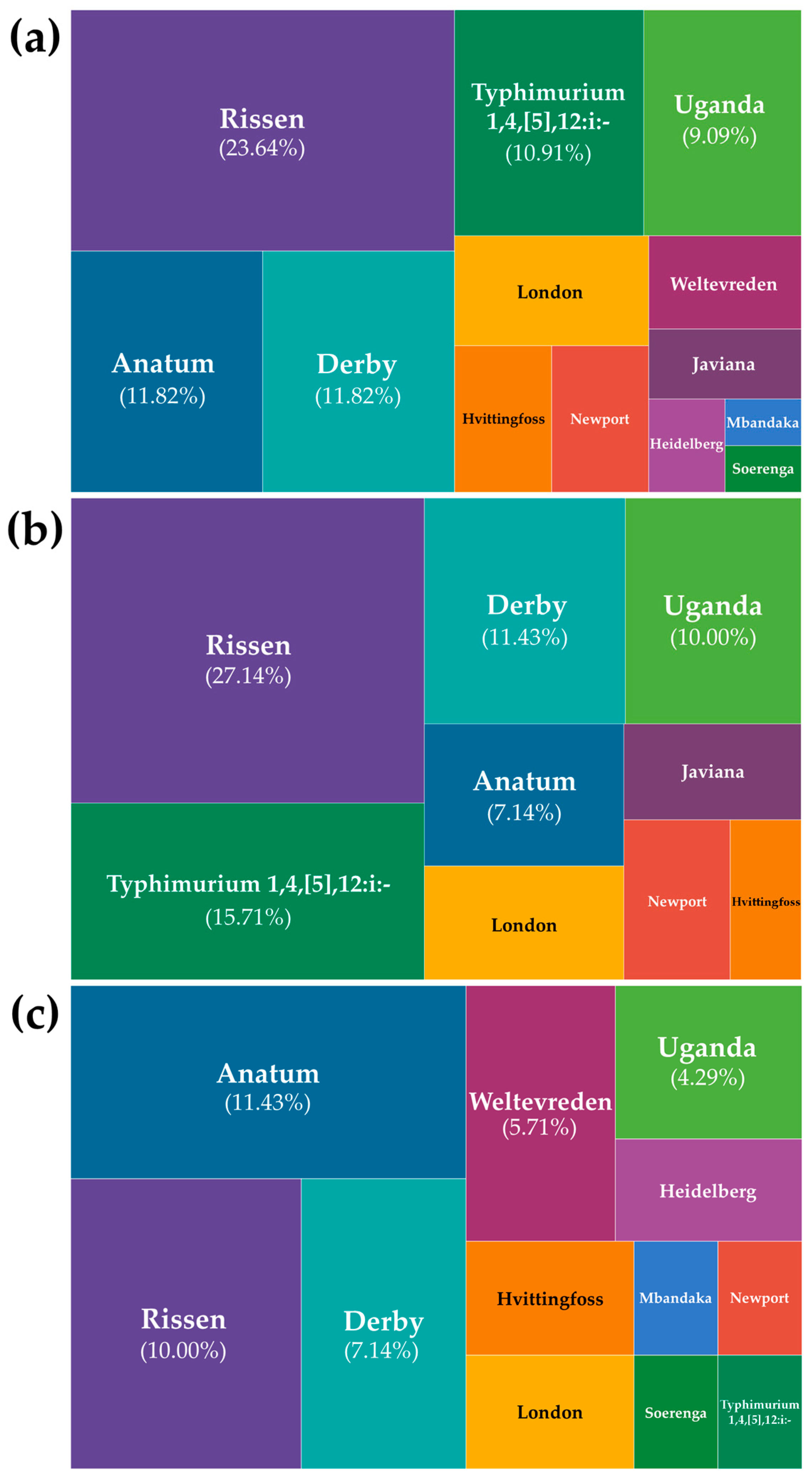
All 110 isolates were subjected to microarray-based serotyping through CTS, which successfully classified 90% (99/110) of S. enterica into 13 known serovars. However, 10% (11/110) were unassigned due to incomplete or no prediction, and were instead designated as genovar codes. As shown in Figure 1a, the five most prevalent S. enterica serovars were Rissen (23.64%, 26/110), followed by both Anatum and Derby (11.82%, 13/110), monophasic variant Typhimurium 1, 4, [5], 12:i:- (10.91%, 12/110), and Uganda (9.09%, 10/110), with this study, being the first to report serovar Soerenga (0.91%, 1/110) in the Philippines and in Asia, isolated from a raw pork chop sample from a wet market in Manila.
Variations in serovar prevalence across location types (abattoirs and wet markets) were also observed (Figure 1b,c), although statistical analysis and frequencies may be affected by the difference in sample size between the two location types. Typhimurium 1, 4, [5], 12:i:- was the second most prevalent serovar among abattoir isolates at 15.71% (11/70), while it was found in only 1.43% (1/40) of wet market isolates. In contrast, Anatum was the most prevalent serovar among wet market isolates at 11.43% (8/40), while Rissen was the most prevalent serovar (27.14%, 19/70) among abattoir isolates, with Anatum only at 7.14% (5/70).
Statistical analysis using binary logistic regression to determine whether serovars can predict location types (abattoirs and wet markets), with serovar Rissen as the reference category due to its high prevalence and relevance among other Salmonella serovars in the global swine industry as well as being the most detected in the current study, and excluding genovars from the analysis, showed that only one out of 13 serovars was significant (p < 0.05). Serovar Anatum was observed to be 4.343 times more likely to be found in wet markets than in abattoirs, relative to serovar Rissen (p-value = 0.042; odds ratio = 4.343; 95% CI: 1.056–17.860). Interestingly, serovar Typhimurium 1, 4, [5], 12:i:-, although it showed less frequency in wet markets than abattoirs, was not significant (p > 0.05) in regression analysis (p-value = 0.217; odds ratio = 0.247). It is also worth noting that differences in isolate counts from abattoirs (n = 70) and wet markets (n = 40) may also affect regression analysis, resulting in wider 95% confidence intervals.

3.2. Frequency of AMR and Virulence Genes

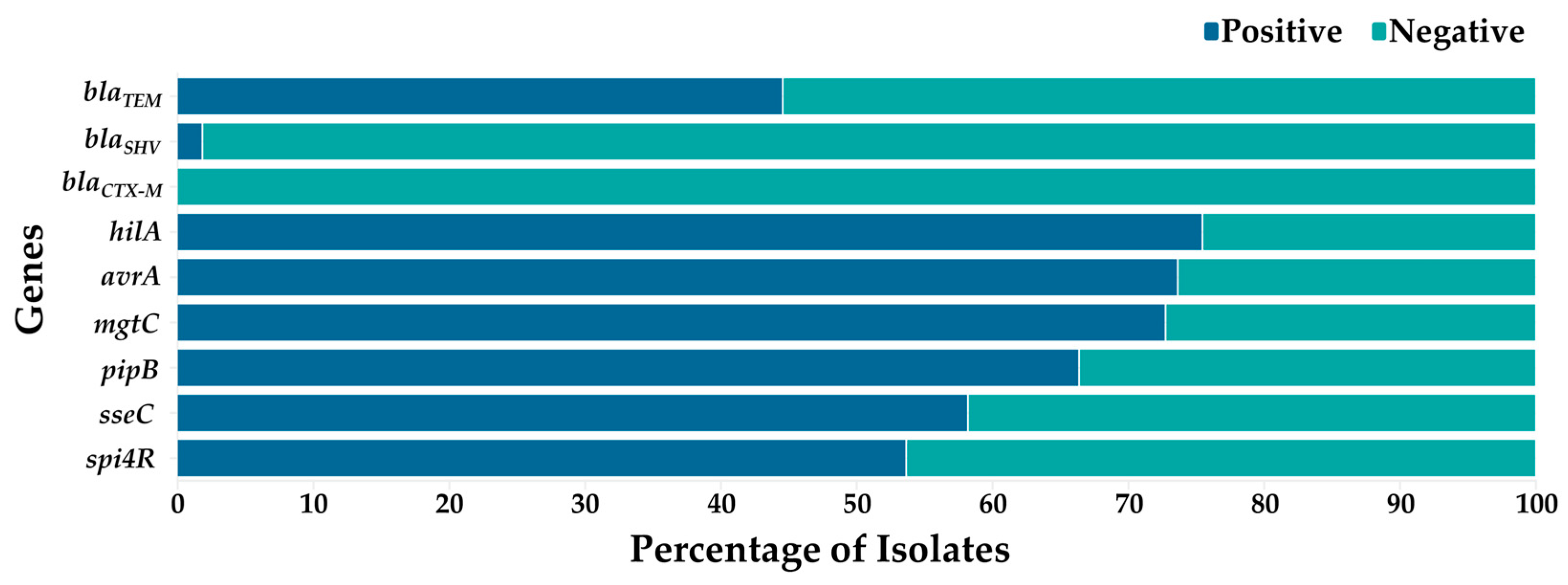
Variations in AMR and virulence gene prevalence were observed among Salmonella isolates (Figure 2). For AMR genes, the most prevalent was blaTEM at 44.55%, followed by blaSHV at 1.82%, with no positive isolates for blaCTX-M. Meanwhile, for the eight virulence genes detected within SPIs 1 to 5, the most prevalent was hilA (75.45%), followed by avrA (73.64%), mgtC (72.73%), pipB (66.36%), sseC (58.18%), and spi4R (53.64%), with no positive isolates for plasmid virulence genes spvC and spvR.
Fisher’s exact test among 15 virulence gene pairs, excluding spvC and spvR, revealed nine significant associations (p < 0.05, two-sided), namely, avrA with mgtC, pipB, and sseC, mgtC with hilA and pipB, pipB with hilA and spi4R, and lastly, sseC with mgtC and pipB (Table 3).

3.3. Variations in Gene Prevalence Among Salmonella enterica Serovars

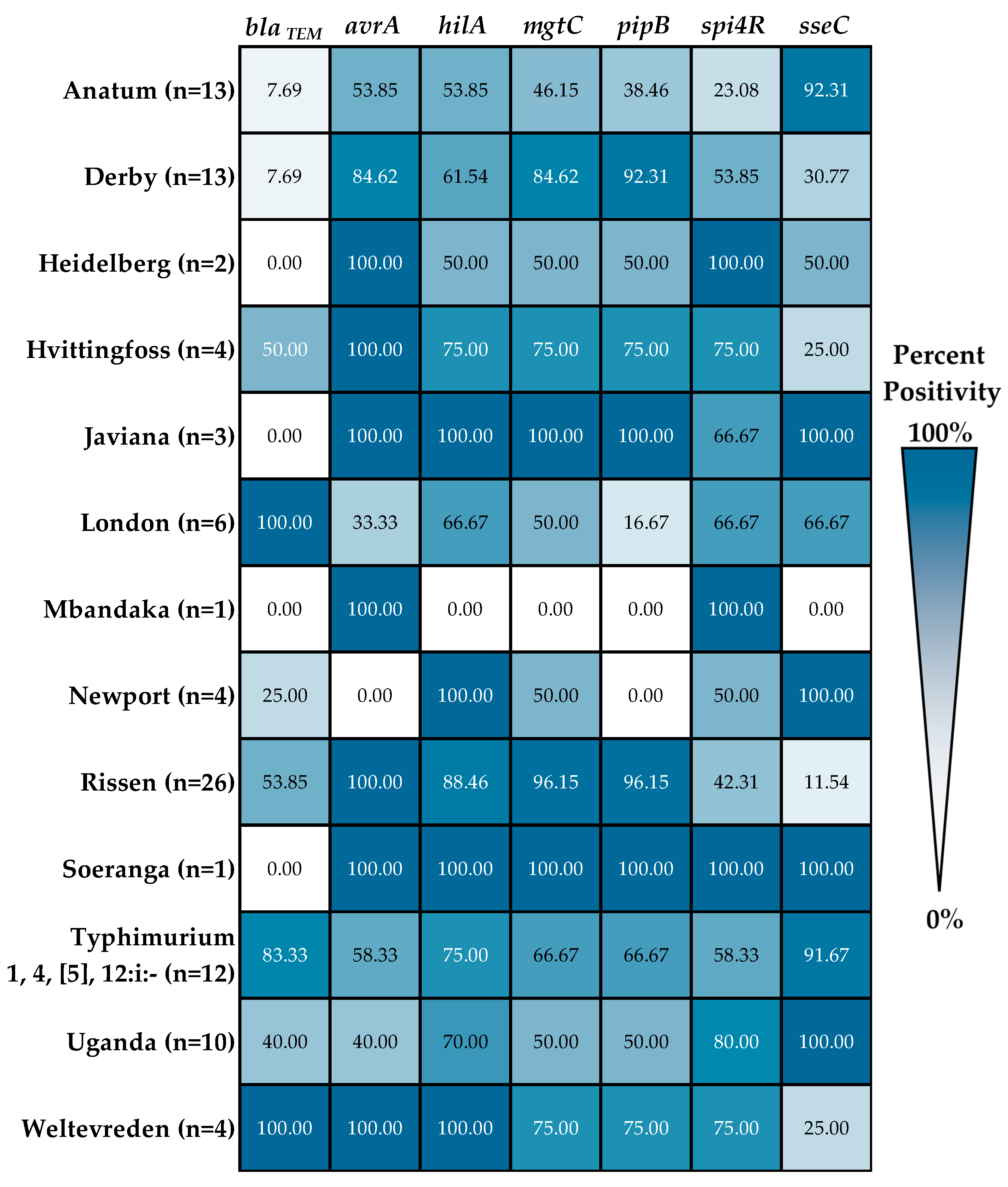
S. enterica serovars in this study possessed varying AMR and virulence gene prevalence, although these numbers may also be affected by isolate counts. Since no isolates were positive for spvC, spvR, and blaCTX-M, and only two isolates were positive for blaSHV, these genes were excluded from the analyses. Unknown serovars or genovars were also excluded. For AMR genes, blaTEM showed a lower prevalence (7.69%) in serovars Anatum and Derby compared to Typhimurium 1, 4, [5], 12:i:- (83.33%) and Rissen (53.85%) isolates (Figure 3). For virulence genes, serovars London, Anatum, Uganda, and Typhimurium 1, 4, [5], 12:i:- showed lower prevalence (16.67–66.67%) for avrA, mgtC, and pipB, than serovars Derby and Rissen (84.62–100%). Interestingly, the sseC gene showed an opposite trend; being more prevalent (91–100%) among serovars Anatum, Uganda, and Typhimurium 1, 4, [5], 12:i:-, but less prevalent in Derby (30.77%) and Rissen (11.54%) (Figure 3).
Binary logistic regression analysis revealed significant variations among S. enterica serovars, all relative to serovar Rissen, in the odds of blaTEM AMR and several virulence genes, except for avrA and spi4R. blaTEM gene presence was less likely among serovars Anatum and Derby (p-value = 0.018; odds ratio = 0.071; 95% CI = 0.008–0.632). For virulence genes, hilA was less likely to be detected in only serovar Anatum (p-value = 0.023; odds ratio = 0.152; 95% CI = 0.040–0.772). Serovars Anatum, Uganda, Typhimurium 1, 4, [5], 12:i:-, and London isolates were less likely (odds ratio < 1) to carry mgtC and pipB (p-value < 0.05), relative to serovar Rissen, with an acceptable 95% CI. Meanwhile, opposite trends were observed for sseC; being more likely in Anatum, Typhimurium 1, 4, [5], 12:i:-, and London, albeit with high odds ratio values and wide 95% CI, which may suggest low precision due to isolate number differences among serovars and between abattoirs and wet markets.

3.4. Phenotypic AMR and Associations Among Salmonella enterica Isolates

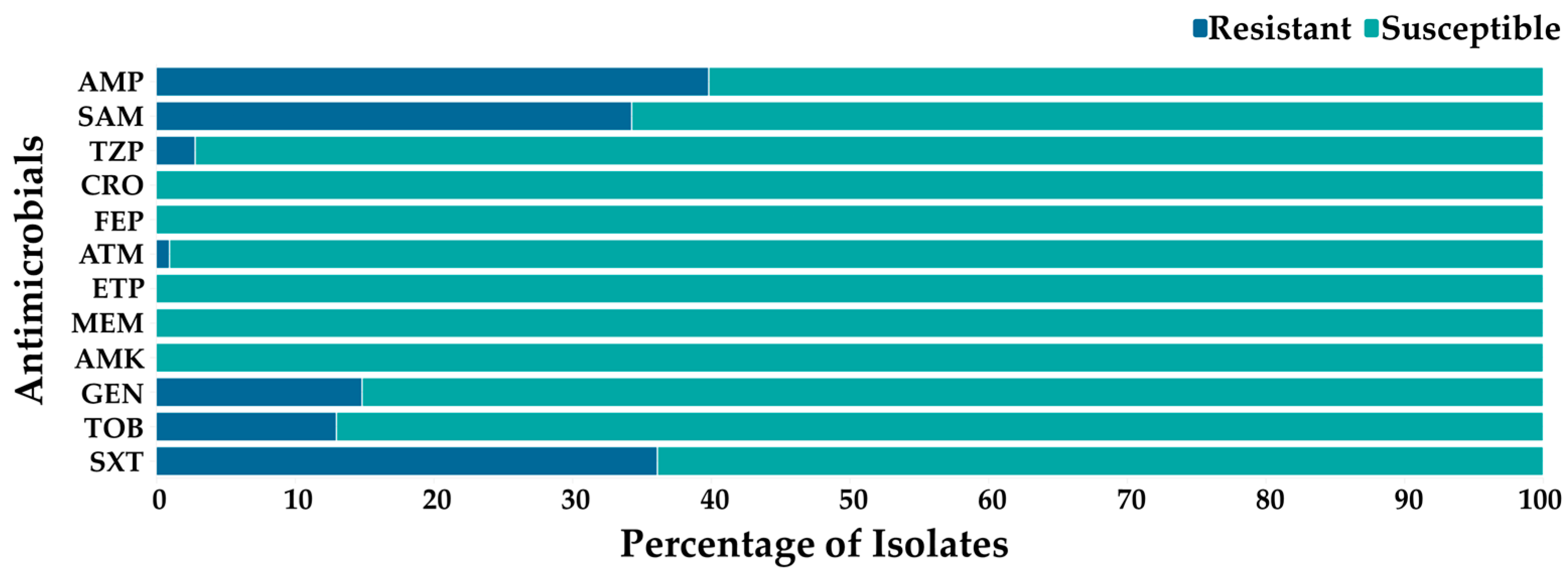
Antimicrobial susceptibility testing using the automated VITEK® 2 system of known serovars and unestablished genovars revealed resistance primarily to β-lactams, aminoglycosides, and a folate pathway inhibitor. The three highest resistances were from ampicillin (39.81%), trimethoprim/sulfamethoxazole (36.11%), and ampicillin and sulbactam (34.26%), with no resistance to cephalosporins and carbapenems (Figure 4). Most isolates that were resistant to ampicillin were also resistant to ampicillin with β-lactamase inhibitor sulbactam. Multidrug resistance (MDR), which is the resistance to ≥3 antimicrobial classes, was also observed in 14.81% of S. enterica isolates with the only MDR pattern involving three antimicrobial classes and five antibiotics, namely ampicillin (β-lactam), ampicillin and sulbactam, gentamicin (aminoglycoside), tobramycin (aminoglycoside), and trimethoprim/sulfamethoxazole (folate pathway inhibitor).
Statistical analysis of phenotypic and genotypic AMR using Fisher’s exact test, specifically with blaTEM, showed significant associations (p < 0.05) between this gene and resistance to β-lactams, ampicillin, as well as ampicillin and sulbactam, but no significant associations (p > 0.05) between blaTEM and trimethoprim/sulfamethoxazole.

4. Discussion

Most molecular studies in the Philippines utilize multiplex PCR of O- and H-antigen-associated genes for Salmonella serogrouping and serotyping, which result in putative serovar identification, requiring confirmation with the KWL scheme or WGS. The current study revealed high assignment rates (90%) using the CTS assay. Previous studies using CTS also reported high accuracy (>96%) for commonly occurring serovars with 85–100% concordance to the conventional KWL scheme and WGS. However, CTS falls short with some rare serovars due to database limitations and antigenic phase variations [16,32,33]. Some rare serovars that were discrepant included Adelaide, Arechavaleta, Bracknell, Poona, and Virchow, with some conflicts in Typhimurium 1, 4, [5], 12:i:- and Enteritidis [16,33,34]. However, despite CTS ranking only third with 82.9% correct identification when compared with other commercial molecular-based kits, such as SGSA (microarray), Salm SeroGen (bead-based hybridization), and xMAP (bead-based hybridization), CTS possessed a greater pool of detectable serovars. The current study further supports the accuracy and reliability of the CTS system as a middle-ground for Salmonella serotyping, even detecting rare serovar Soerenga, which improves upon subjective and resource-intensive traditional serological testing and is more accessible and cost-effective than WGS for routine surveillance.
Diverse S. enterica serovars from different serogroups were observed among isolates in the current study. Serovars Rissen, Derby, Typhimurium (1, 4, [5], 12:i:-), and Heidelberg belong in serogroup B. Uganda, London, Weltevreden, Hvittingfoss, and Mbandaka belong in serogroup C1. Newport and Soerenga belong in serogroup C2–3. Javiana belongs in serogroup D. Anatum belongs in serogroup E. This means that the most dominant serogroup in the current study was B (53.54%), followed by C1 (25.25%), E (13.13%), C2–3 (5.05%), and D (3.03%) in last place. Previous reports in the Philippines also reflect these occurrences. Molecular serotyping of S. enterica from retail meats in wet markets in Metro Manila revealed serogroup E, such as Anatum, as the most prevalent [13,18,35]. On the other hand, serogroup B, specifically serovar Typhimurium, was the most prevalent from swine jejunum and tonsil samples in Metro Manila abattoirs [19]. Meanwhile, Calayag et al. [20] reported serogroups E and C1 as the most prevalent among abattoir isolates. In Philippine clinical settings, the most common serovars infecting humans include Typhi, Typhimurium 1, 4, [5], 12:i:-, and Enteritidis, with some frequency of Weltevreden, Anatum, Rissen, and Derby [36,37], suggesting a potential zoonotic threat.
Animal sources, location types, and contamination points may serve as drivers for S. enterica serovar diversity. The current study found an overall predominance of serovar Rissen, especially from abattoir swine samples, which may be attributed to their endemicity in swine [38]. Rissen is one of the most common S. enterica serovars in Asia and Europe, often implicated in swine [39,40,41,42], attributed to zoonotic transmission, as well as carriage of AMR plasmids [38]. This is further evidenced by an emerging trend reported in China from 1995 to 2019, with a predominant detection of Rissen in humans (63%) compared to foods, animals, or the environment [43]. Following serovar Rissen in prevalence, Derby and Typhimurium 1, 4, [5], 12:i:- have also been documented to be endemic in swine. Both Derby and Typhimurium 1, 4, [5], 12:i:- were among the most common serovars reported in swine from the UK and US [44,45], France [46,47], Europe [48,49], and China [50], with frequent associations to MDR phenotypes. In Europe, S. Typhimurium 1, 4, [5], 12:i:- is the third most common serovar in human infections, exhibiting extremely high MDR rates including resistance to last-line antibiotics like colistin [49]. These implications have been attributed to infected but often asymptomatic swine prior to slaughter or to cross-contamination in abattoir settings. As a result, pork ranks third in causing human salmonellosis outbreaks in Europe, with strong epidemiological association and source attribution, following eggs and baked products [48]. Similarly, human infections caused by S. Derby, although less severe [46], have also been associated with swine, exhibiting similar genetic and genomic characteristics, as well as AMR profiles [48]. Taken together, these studies suggest that these three serovars are persistent in swine reservoirs, which drives their dominance throughout the swine production chain and presents significant public health implications.
Meanwhile, Anatum was the second most prevalent serovar in the current study, with a higher likelihood in wet markets compared to abattoirs, suggesting a contamination pathway rather than a farm origin. In most literature, serovar Anatum is more commonly associated with calves, cattle, or bovines, as seen in Mexico [51], calves from France [52], and beef from retail markets in Vietnam [53]. It has also been found to be rare in pork meat [54]. Madoroba et al. [55] reported that serovar Anatum was only isolated from hides, but not from carcasses or intestinal contents, of cattle from South Africa, which also suggests external contamination. In Sichuan, China, the most detected serovars among swine farms, abattoirs, and market samples were Derby and Typhimurium, with little to no Anatum detected [56,57]. Despite its higher prevalence and AMR rates in food animals, S. Anatum is less frequently implicated in human salmonellosis, although its clinical significance may be emerging, region-specific, and understudied [51,53]. These results suggest that the prevalence of Anatum in the current study may have resulted from post-harvest cross-contaminations, especially during processing in abattoirs and wet markets, rather than persistence in source reservoirs. Nevertheless, this presents food safety risks and the need for abattoir- and market-level interventions to prevent dissemination of S. enterica and other foodborne pathogens in the Philippine swine industry.
The current study is also the first to detect the rare serovar Soerenga in the Philippines and in Asia. This finding is noteworthy considering that there is scarce global information about this serovar and a lack of data on its public health or clinical significance. Serovar Soerenga was first isolated and documented by Kauffmann and Bovre in Oslo, Norway [58]. Recently, it was also isolated from a pregnant swine in an intensive farm in La Pampa, Argentina, showing resistance to 17 antimicrobials and possessing numerous virulence genes [59]. This serovar has also been detected, albeit in very low prevalence, from various feedstuffs in Costa Rica [60], in raw and processed broiler chicken feeds, and pelleting equipment from the UK [61], and irrigation water from a country in West Africa [62], suggesting its nature as a sporadic and emerging contaminant. Genomic sequencing of this serovar, isolated from the feces of captive wild birds in Nigeria, has also been recently reported [63]. Although serovar Soerenga is rarely detected, its presence in the local context highlights the importance of continuous surveillance to uncover emerging and rare serovars that may remain undetected and have unestablished public health implications.
β-lactamases are enzymes that confer resistance to clinically significant β-lactam antibiotics, including penicillins, cephalosporins, carbapenems, and monobactams. They are conferred by numerous subtypes of bla genes, with blaTEM, blaSHV, and blaCTX-M among the common class A β-lactamases. Typically, blaTEM and blaSHV confer resistance to a narrow range of antibiotics, including ampicillins and early-generation cephalosporins. At the same time, blaCTX-M is capable of conferring extended-spectrum β-lactamase (ESBL) resistance, including resistance to third-generation cephalosporins and β-lactamase inhibitors [64]. These three bla genes are often reported among Enterobacteriaceae of human and animal origin and remain a significant public health threat worldwide [65]. The current study showed a prevalence of blaTEM exceeding 40% among swine isolates, with a few positives for blaSHV, and none for blaCTX-M. These results were corroborated by the observed phenotypic resistances to ampicillin (39%) and ampicillin-sulbactam (34%). However, no resistance to cephalosporins was observed, although some resistance to aminoglycoside and sulfonamide antibiotics was noted. Similarly, Calayag et al. [21] reported >60% prevalence of blaTEM from Metro Manila abattoir samples, showing co-carriage with qnr genes among 45% of isolates but only 3% co-carriage with blaCTX-M, with the highest phenotypic resistance to ampicillin (>70%) and few resistances to cephalosporins (<10%). In the UK, blaTEM was the most common AMR gene in Salmonella from the environment, humans, swine, poultry, and sheep, but not in cattle, with considerable resistance to ampicillin (>20%) and other non-β-lactam antibiotics [66].
Meanwhile, in poultry and broiler populations, blaCTX-M is more commonly reported and has been associated with specific S. enterica serovar Infantis throughout Europe and Asia, contributing to high MDR rates and presence of numerous AMR and virulence genes [49,67,68,69,70]. Serovar Infantis has been extensively reported to carry pESI plasmids, which are large (~280 kbp) transmissible megaplasmids that encode numerous antimicrobial, antiseptic, and heavy metal resistance determinants, as well as virulence factors that contribute to bacterial fitness and persistence [71]. In the Philippines, Infantis was also the most detected serovar (>50%) in chicken meats from wet markets, with high ampicillin and cephalosporin resistance, and pESI-like characteristics carrying blaCTX-M-65, IncFIB(K)_1_Kpn3, and other MDR plasmids such as IncFIA(HI1)_1_HI1 and IncX1_1 [72,73]. Similarly, Madayag et al. [68] reported a prevalence of more than 20% for blaCTX-M and only 10% for blaTEM, with corroborated extended-spectrum cephalosporin resistance found in raw chicken meat at wet markets in Metro Manila. These findings may explain the absence of serovar Infantis and blaCTX-M in the current study, as the isolates were obtained from swine samples.
The current study also showed that blaTEM was significantly less likely to be present in serovars Anatum and Derby than serovar Rissen, suggesting possible serovar-linked plasmid differences in local contexts. However, the previous literature has shown that, unlike blaCTX-M, both blaTEM and blaSHV are more widespread among diverse Salmonella serovars, animal reservoirs, and plasmid families. Despite the detection of predominantly blaTEM, 14% of S. enterica isolates in the current study exhibited MDR phenotypes encompassing β-lactams, aminoglycosides, and sulfonamides, which present undetected AMR genes and plasmids. Genomic scale analysis of more than 183,000 Salmonella plasmids showed that blaTEM-1 exhibited high serovar and plasmid entropy, suggesting disseminated carriage in many serovars and plasmid backbones [74]. In another study, IncHI2 plasmids were found to be the most predominant plasmid type among antibiotic-resistant Salmonella, housing various bla genes such as blaTEM-1 and blaOXA-1, and quinolone resistance genes qnr and aac(6′)-Ib-cr [75]. In Europe and the US, serovars Typhimurium 1, 4, [5], 12:i:-, Heidelberg, Agona, Derby, and Infantis, from various food animals, have also been reported to carry varying plasmids such as IncF, Inc1, or IncP containing diverse AMR genes, such as aac, aad, blaTEM, and sul genes, covering different antibiotic classes such as aminoglycosides, sulfonamides, and β-lactams [76,77,78,79]. Similarly, blaSHV has been found in broad-host-range plasmids such as IncI1 and IncP [80]. These suggest that the presence of blaTEM or blaSHV is potentially indicative of carriage of diverse plasmids that require further genome-scale surveillance to uncover further emerging serovars that present concerns for dissemination of virulence, AMR, and MDR genes within the food animal industry.
The current study determined the prevalence of virulence genes within SPIs 1-5 (53–75%) and two plasmid-borne genes, with the most frequent being hilA, followed by avrA, mgtC, pipB, sseC, and spi4R. Additionally, the study found the absence of plasmid-borne spvC and spvR. SPIs 1-5 are well-documented as the most conserved and genetically stable SPIs across most non-typhoidal Salmonella serovars [81,82]. Interestingly, WGS analysis of Salmonella Enteritidis and Kentucky isolates from chickens in Iran showed that SPI4 was only present among Enteritidis [83], which may suggest serovar variations and explain the lesser frequency of spi4R in the current study. Recent surveillance in local and international contexts also reflects a high prevalence of these SPI 1-5 genes, but with little to no detection of plasmid-borne spv genes [23,81,84,85]. However, some studies reported a higher prevalence (30–50%) of spv genes or associations with ESBL genes, albeit from different animal reservoirs [86,87]. These suggest variations in virulence gene prevalence and pathogenic potential among Salmonella across serovars and reservoirs.
Virulence gene pair associations and co-occurrences in the current study align with previous findings [23,86] and suggest potential cross-talks and complementary functions among SPIs that contribute to Salmonella pathogenicity. The avrA gene is known to promote intramacrophage survival and modulate the host inflammatory response by reducing Beclin-1 protein expression and stabilizing cell tight junctions [88,89], thereby complementing the functions of sseC (SPI2) and mgtC (SPI3), which are also involved in intramacrophage survival. While avrA and pipB are distinct, they are often co-detected and implicated in enteropathogenesis, wherein the former acts on early infection by attenuating inflammation. At the same time, the latter contributes to the intracellular modification of the Salmonella-containing vacuole, facilitating its survival [90]. Interestingly, avrA is reported not to be regulated by the two SPI1 transcriptional regulator genes, hilA and invF, which supports the lack of association observed in the current study [91].
Meanwhile, mgtC is reported to be essential for long-term intramacrophage survival through Mg2+ uptake [92]. While mgtC is in SPI3, and hilA primarily regulates expression of SPI1 genes during early infection, their co-existence has been reported to enhance systemic infection [93]. This can be attributed to their contribution to the latter intracellular stages of Salmonella infection, which facilitates survival and replication [5,90]. The transcriptional activity of hilA has also been shown to induce SPI4 and SPI5 gene expression, which are responsible for adhesion and intracellular survival, respectively [94], supporting the associations of pipB with hilA and spi4R observed in the current study. Meanwhile, associations of sseC (SPI2) with mgtC and pipB may be due to their involvement in intramacrophage survival and effector translocation during later stages of the Salmonella-containing vacuole, respectively [92,95,96]. Taken together, the observed virulence gene associations in the current study highlight potential interplays within and across SPIs. Although a high prevalence and statistical associations between these genes were detected, it is worth noting that their presence alone does not necessarily signify functionality or cross-talk pathways, which require further expression and mechanistic analyses to elucidate.
The current study showed that avrA and spi4R were not significantly associated with specific S. enterica serovars, in contrast to hilA, mgtC, pipB, and sseC. Previous studies have also reported differences. WGS analysis of S. enterica from Metro Manila wet markets and abattoirs showed that while mgtC, pipB, and sseC were detected in all serovars, including Anatum, Rissen, and Typhimurium 1, 4, [5], 12:i:-, avrA was not present in one Infantis strain [97]. In another study, the presence of avrA and spi4R varied between two strains of the same serovar, isolated from the same samples, while hilA, mgtC, and pipB were more conserved [98]. Insertions, deletions, and loss or gain of restriction endonuclease cleavage sites may also contribute to variations within SPIs. Amavisit et al. [99] observed that avrA (SPI1) was replaced by a 200 bp fragment in serovars Choleraesuis and Ohio. Comparative genomics of serovars Derby and Mbandaka revealed numerous lost or gained genes across SPIs, but notably lacked the supposedly essential mgtC gene, unlike serovar Typhimurium [100]. Plasmid-borne virulence genes spvC and spvR are often required for the complete virulence and systemic infection capability of Salmonella. However, these genes are typically present only in a few serovars such as Typhimurium, Enteritidis, and Choleraesuis [101]. Serovar Typhimurium and its monophasic variant 1, 4, [5], 12:i:- have also shown differences with spvC presence [102]. Hence, virulence and pathogenicity vary extensively among Salmonella serovars, emphasizing the need for molecular surveillance, characterization, and in-depth genomic and transcriptomic analyses to understand pathogenic mechanisms to inform policies and interventions in the food animal industry.
While informative, the current study’s findings have limitations that require cautious interpretations. These include the uneven number of isolates across serovars, which may affect statistical accuracy; a limited and varied number of wet market and abattoir isolates which may cause generalizations and affect statistical accuracy; reliance on presence or absence of genes to infer virulence and antimicrobial resistance, which may not necessarily reflect expression, phenotypic profiles or functional capability; the limited number of virulence genes tested which may impact associations and representations of SPIs; detection of only one antimicrobial resistance gene class (bla); lack of plasmid extraction and profiling; and more in-depth workflows and analysis such as whole-genome sequencing to uncover diverse unidentified plasmids.

5. Conclusions

The current study provides insights into the diverse S. enterica serovars that carry numerous virulence and β-lactam antibiotic resistance genes and exhibit various resistance phenotypes, as observed in swine samples from wet markets and abattoirs in Metro Manila, Philippines. The utility of the CTS assay was demonstrated by >90% classification of Salmonella isolates into known serovars, with the most predominant being Rissen, Anatum, Derby, Typhimurium monophasic variant 1, 4, [5], 12:i:-, and Uganda, with their diverse distributions in abattoirs and wet markets, reflecting the potential impacts of source environments and contamination points throughout the swine production and processing chain. The detection of serovar Soerenga in the Philippines and Asia for the first time also highlights the need for further surveillance efforts to capture other rare and emerging serovars, as well as other foodborne pathogens. Genotypic detection of bla AMR and virulence genes revealed a high prevalence among Salmonella isolates, indicating their resistance and pathogenic potential. SPIs 1-5 virulence genes showed a prevalence of more than 53%, with hilA being the most common, followed by avrA, pipB, sseC, and spi4R, which reflect. Their widespread distribution and absence of plasmid-borne spvC and spvR, which are more often associated with a few serovars, is notable. Significant associations between virulence genes suggest possible related or complementary roles in expression and function during Salmonella pathogenicity programs that require further elucidation of mechanistic cross-talks. Virulence gene variations were also demonstrated in the current study with significant predictions to specific serovars, except for avrA and spi4R, which further supports the diverse disease-causing potential and clinical manifestations among Salmonella serovars. Lastly, AMR profiling of the Salmonella isolates revealed a high prevalence of blaTEM, a few blaSHV, and the absence of blaCTX-M, which corroborated phenotypic resistance to ampicillin but not to higher-generation cephalosporins. Resistances were also observed to other antimicrobial classes, including aminoglycosides and sulfonamides, with MDR phenotypes. This study highlights the complex and dynamic nature of Salmonella contamination, virulence, and resistance among the swine industry in Metro Manila, Philippines. Hence, there is a need for extensive genotypic and phenotypic characterizations of Salmonella and other foodborne pathogens, as well as continuous and comprehensive surveillance throughout the production chain, accompanied by stricter antimicrobial regulations and improved food safety and sanitation measures, to ensure both animal and human health.

Author Contributions

Conceptualization, R.D.N.P. and W.L.R.; methodology, R.D.N.P.; software, R.D.N.P.; validation, R.D.N.P. and W.L.R.; formal analysis, R.D.N.P.; investigation, R.D.N.P., J.F.B.M., M.J.M.N. and A.C.; resources, W.L.R. and H.D.P.; data curation, R.D.N.P.; writing—original draft preparation, R.D.N.P.; writing—review and editing, R.D.N.P., J.F.B.M., M.J.M.N., A.C., H.D.P. and W.L.R.; visualization, R.D.N.P.; supervision, W.L.R. and H.D.P.; project administration, W.L.R.; funding acquisition, W.L.R. and H.D.P. All authors have read and agreed to the published version of the manuscript.

Funding

This research was funded by the Department of Agriculture-Biotechnology Program Office of the Philippines (Project Code DABIOTECH-R1808).

Institutional Review Board Statement

Not applicable.

Informed Consent Statement

Not applicable.

Data Availability Statement

The original contributions presented in this study are included in the article. Further inquiries can be directed to the corresponding author.

Acknowledgments

The authors would like to acknowledge John Ceddrick L. Florentino and Ruffa Maze C. Balmes of the BioAssets Corporation for their technical support and assistance.

Conflicts of Interest

Authors Abbie Codia and Homer D. Pantua was employed by the company BioAssets Corporation. The remaining authors declare that the research was conducted in the absence of any commercial or financial relationships that could be construed as a potential conflict of interest.

References

  1. Worley, M.J. Salmonella bloodstream infections. Trop. Med. Infect. Dis. 2023, 8, 487. [Google Scholar] [CrossRef] [PubMed]
  2. Ferrari, R.G.; Rosario, D.K.A.; Cunha-Neto, A.; Mano, S.B.; Figueiredo, E.E.S.; Conte-Junior, C.A. Worldwide epidemiology of Salmonella serovars in animal-based foods: A meta-analysis. Appl. Environ. Microbiol. 2019, 85, e00591-19. [Google Scholar] [CrossRef] [PubMed]
  3. Pees, M.; Brockmann, M.; Steiner, N.; Marschang, R.E. Salmonella in reptiles: A review of occurrence, interactions, shedding and risk factors for human infections. Front. Cell Dev. Biol. 2023, 11, 1251036. [Google Scholar] [CrossRef] [PubMed]
  4. WHO Bacterial Priority Pathogens List, 2024: Bacterial Pathogens of Public Health Importance to Guide Research, Development, and Strategies to Prevent and Control Antimicrobial Resistance. Available online: https://www.who.int/publications/i/item/9789240093461#:~:text=The%202024%20WHO%20Bacterial%20Priority%20Pathogens%20List,gonorrhoeae%20*%20Pseudomonas%20aeruginosa%20*%20Staphylococcus%20aureus (accessed on 3 November 2025).
  5. Kombade, S.; Kaur, N. Pathogenicity Island in Salmonella. In Salmonella spp.—A Global Challenge; Lamas, A., Regal, P., Abuin, C.M.F., Eds.; IntechOpen Limited: London, UK, 2021. [Google Scholar] [CrossRef]
  6. Giannella, R.A.  Salmonella. In Medical Microbiology, 4th ed.; Baron, S., Ed.; IntechOpen Limited: Houston, TX, USA, 1996. [Google Scholar]
  7. Wain, J.; House, D.; Zafar, A.; Baker, S.; Nair, S.; Kidgell, C.; Bhutta, Z.; Dougan, G.; Hasan, R. Vi antigen expression in Salmonella enterica serovar Typhi clinical isolates from Pakistan. J. Clin. Microbiol. 2005, 43, 1158–1165. [Google Scholar] [CrossRef] [PubMed]
  8. McQuiston, J.R.; Waters, R.J.; Dinsmore, B.A.; Mikoleit, M.L.; Fields, P.I. Molecular determination of H antigens of Salmonella by use of a microsphere-based liquid array. J. Clin. Microbiol. 2011, 49, 565–573. [Google Scholar] [CrossRef]
  9. Sundaresan, S.; Rathinavelan, T. SSP: An in silico tool for Salmonella species serotyping using the sequences of O-antigen biosynthesis proteins and H-Antigen filament proteins. J. Mol. Biol. 2023, 435, 168046. [Google Scholar] [CrossRef]
  10. Farzan, A.; Friendship, R.M.; Dewey, C.E. Evaluation of enzyme-linked immunosorbent assay (ELISA) tests and culture for determining Salmonella status of a pig herd. Epidemiol. Infect. 2006, 135, 238–244. [Google Scholar] [CrossRef]
  11. Pulido-Landínez, M.; Sánchez-Ingunza, R.; Guard, J.; Nascimento, V.P.D. Assignment of serotype to Salmonella enterica isolates obtained from poultry and their environment in southern Brazil. Lett. Appl. Microbiol. 2013, 57, 288–294. [Google Scholar] [CrossRef]
  12. Herrera-León, S.; Ramiro, R.; Arroyo, M.; Díez, R.; Usera, M.A.; Echeita, M.A. Blind comparison of traditional serotyping with three multiplex PCRs for the identification of Salmonella serotypes. Res. Microbiol. 2007, 158, 122–127. [Google Scholar] [CrossRef]
  13. Santos, P.D.M.; Widmer, K.W.; Rivera, W.L. PCR-based detection and serovar identification of Salmonella in retail meat collected from wet markets in Metro Manila, Philippines. PLoS ONE 2020, 15, e0239457. [Google Scholar] [CrossRef]
  14. Ibrahim, G.M.; Morin, P.M. Salmonella serotyping using whole genome sequencing. Front. Microbiol. 2018, 9, 2993. [Google Scholar] [CrossRef]
  15. Al-Khaldi, S.F.; Mossoba, M.M.; Allard, M.M.; Lienau, E.K.; Brown, E.D. Bacterial identification and subtyping using DNA microarray and DNA sequencing. Methods Mol. Biol. 2012, 881, 73–95. [Google Scholar] [CrossRef] [PubMed]
  16. Diep, B.; Barretto, C.; Portmann, A.C.; Fournier, C.; Karczmarek, A.; Voets, G.; Li, S.; Deng, X.; Klijn, A. Salmonella serotyping: Comparison of the traditional method to a microarray-based method and an in silico platform using whole genome sequencing data. Front. Microbiol. 2019, 10, 2554. [Google Scholar] [CrossRef] [PubMed]
  17. Fang, C.P.L.; Elca, C.D. An assessment of swine industry in the Philippines. AgEcon Search 2021, 7, 21–48. [Google Scholar] [CrossRef]
  18. Soguilon-del Rosario, S.; Rivera, W.L. Incidence and molecular detection of Salmonella enterica serogroups and spvC virulence gene in raw and processed meats from selected wet markets in Metro Manila, Philippines. Int. J. Philipp. Sci. Technol. 2015, 8, 52–55. [Google Scholar] [CrossRef]
  19. Ng, K.C.S.; Rivera, W.L. Multiplex PCR-based serogrouping and serotyping of Salmonella enterica from tonsil and jejunum with jejunal lymph nodes of slaughtered swine in Metro Manila, Philippines. J. Food Prot. 2015, 78, 873–880. [Google Scholar] [CrossRef]
  20. Calayag, A.M.B.; Paclibare, P.A.P.; Santos, P.D.; Bautista, C.A.C.; Rivera, W.L. Molecular characterization and antimicrobial resistance of Salmonella enterica from swine slaughtered in two different types of Philippine abattoir. Food Microbiol. 2017, 65, 51–56. [Google Scholar] [CrossRef]
  21. Calayag, A.M.B.; Widmer, K.W.; Rivera, W.L. Antimicrobial susceptibility and frequency of bla and qnr Genes in Salmonella enterica isolated from slaughtered pigs. Antibiotics 2021, 10, 1442. [Google Scholar] [CrossRef]
  22. Chiu, C.H.; Ou, J.T. Rapid identification of Salmonella serovars in feces by specific detection of virulence genes, invA and spvC, by an enrichment broth culture-multiplex PCR combination assay. J. Clin. Microbiol. 1996, 34, 2619–2622. [Google Scholar] [CrossRef]
  23. Pavon, R.D.N.; Mendoza, P.D.G.; Flores, C.A.R.; Calayag, A.M.B.; Rivera, W.L. Genotypic virulence profiles and associations in Salmonella isolated from meat samples in wet markets and abattoirs of Metro Manila, Philippines. BMC Microbiol. 2022, 22, 292. [Google Scholar] [CrossRef]
  24. Borges, K.A.; Furian, T.Q.; Borsoi, A.; Moraes, H.L.S.; Salle, C.T.P.; Nascimento, V.P. Detection of virulence-associated genes in Salmonella Enteritidis isolates from chicken in South of Brazil. Pesq. Vet. Bras. 2013, 33, 1416–1422. [Google Scholar] [CrossRef]
  25. Fazl, A.A.; Salehi, T..Z.; Jamshidian, M.; Amini, K.; Jangjou, A.H. Molecular detection of invA, ssaP, sseC and pipB genes in Salmonella Typhimurium isolated from human and poultry in Iran. Afr. J. Microbiol. Res. 2013, 7, 1104–1108. [Google Scholar] [CrossRef]
  26. Sánchez-Jiménez, M.M.; Cardona-Castro, N.M.; Canu, N.; Uzzau, S.; Rubino, S. Distribution of pathogenicity islands among Colombian isolates of Salmonella. J. Infect. Dev. Ctries. 2010, 4, 555–559. [Google Scholar] [CrossRef] [PubMed]
  27. Soto, S.M.; Rodríguez, I.; Rodicio, M.R.; Vila, J.; Mendoza, M.C. Detection of virulence determinants in clinical strains of Salmonella enterica serovar Enteritidis and mapping on macrorestriction profiles. J. Med. Microbiol. 2006, 55, 365–373. [Google Scholar] [CrossRef] [PubMed]
  28. Knodler, L.A.; Celli, J.; Hardt, W.-D.; Vallance, B.A.; Yip, C.; Finlay, B.B. Salmonella effectors within a single pathogenicity island are differentially expressed and translocated by separate type III secretion systems. Mol. Microbiol. 2002, 43, 1089–1103. [Google Scholar] [CrossRef] [PubMed]
  29. Derakhshandeh, A.; Firouzi, R.; Khoshbakht, R. Association of three plasmid-encoded spv genes among different Salmonella serotypes isolated from different origins. Indian J. Microbiol. 2012, 53, 106–110. [Google Scholar] [CrossRef]
  30. Monstein, H.J.; Ostholm-Balkhed, A.; Nilsson, M.V.; Nilsson, M.; Dornbusch, K.; Nilsson, L.E. Multiplex PCR amplification assay for the detection of blaSHV, blaTEM and blaCTX-M genes in Enterobacteriaceae. APMIS 2007, 115, 1400–1408. [Google Scholar] [CrossRef]
  31. Pavon, R.D.N.; Rivera, W.L. Virulence and antimicrobial resistance gene profiling of Salmonella isolated from swine meat samples in abattoirs and wet markets of Metro Manila, Philippines. Microbiol. Biotechnol. Lett. 2023, 51, 390–402. [Google Scholar] [CrossRef]
  32. Ferrato, C.; Chui, L.; King, R.; Louie, M. Utilization of a molecular serotyping method for Salmonella enterica in a routine laboratory in Alberta Canada. J. Microbiol. Methods 2017, 135, 14–19. [Google Scholar] [CrossRef]
  33. Chui, L.; Ferrato, C.; Li, V.; Christianson, S. Comparison of molecular and in silico Salmonella serotyping for Salmonella surveillance. Microorganisms 2021, 9, 955. [Google Scholar] [CrossRef]
  34. Yoshida, C.; Gurnik, S.; Ahmad, A.; Blimkie, T.; Murphy, S.A.; Kropinski, A.M.; Nash, J.H.E. Evaluation of molecular methods for identification of Salmonella serovars. J. Clin. Microbiol. 2016, 54, 1992–1998. [Google Scholar] [CrossRef] [PubMed]
  35. Paclibare, P.A.P.; Calayag, A.M.B.; Santos, P.D.M.; Rivera, W.L. Molecular characterization of Salmonella enterica isolated from raw and processed meats from selected wet markets in Metro Manila, Philippines. Philipp. Agric. Sci. 2017, 100, 55–62. [Google Scholar]
  36. Sia, S.; Lagrada, M.; Olorosa, A.; Limas, M.; Jamoralin, M.; Macaranas, P.K.; Espiritu, H.G.; Gayeta, J.; Masum, M.M.; Ablola, F.B.; et al. A fifteen-tear report of serotype distribution and antimicrobial resistance of Salmonella in the Philippines. Philipp. J. Pathol. 2020, 5, 19–29. [Google Scholar] [CrossRef]
  37. Lagrada, M.L.; Argimón, S.; Borlasa, J.B.; Abad, J.P.; Gayeta, J.M.; Masim, M.L.; Olorosa, A.M.; Cohen, V.; Jeffrey, B.; Abudahab, K.; et al. Genomic surveillance of Salmonella spp. in the Philippines during 2013–2014. Trans. R. Soc. Trop. Med. Hyg. 2022, 116, 1202–1213. [Google Scholar] [CrossRef]
  38. Wang, Z.; Zhang, Y.; Xu, H.; Chu, C.; Wang, J.; Jiao, X.; Li, Q. Whole-genome sequencing analysis reveals pig as the main reservoir for persistent evolution of Salmonella enterica serovar Rissen causing human salmonellosis. Food Res. Int. 2022, 154, 111007. [Google Scholar] [CrossRef]
  39. Galanis, E.; Lo Fo Wong, D.M.; Patrick, M.E.; Binsztein, N.; Cieslik, A.; Chalermchaikit, T.; Aidara-Kane, A.; Ellis, A.; Angulo, F.J.; Wegener, H.C. Web-based surveillance and global Salmonella distribution, 2000–2002. Emerg. Infect. Dis. 2006, 12, 381–388. [Google Scholar] [CrossRef]
  40. Keelara, S.; Scott, H.M.; Morrow, W.M.; Gebreyes, W.A.; Correa, M.; Nayak, R.; Stefanova, R.; Thakur, S. Longitudinal study of distributions of similar antimicrobial-resistant Salmonella serovars in pigs and their environment in two distinct swine production systems. Appl. Environ. Microbiol. 2013, 79, 5167–5178. [Google Scholar] [CrossRef]
  41. European Food Safety Authority; European Centre for Disease Prevention and Control. The European Union summary report on antimicrobial resistance in zoonotic and indicator bacteria from humans, animals and food in 2017. EFSA J. 2020, 18, 6007. [Google Scholar] [CrossRef]
  42. Tadee, P.; Boonkhot, P.; Pornruangwong, S.; Patchanee, P. Comparative phenotypic and genotypic characterization of Salmonella spp. in pig farms and slaughterhouses in two provinces in Northern Thailand. PLoS ONE 2015, 10, e0116581. [Google Scholar] [CrossRef]
  43. Elbediwi, M.; Shi, D.; Biswas, S.; Xu, X.; Yue, M. Changing patterns of Salmonella enterica serovar Rissen from humans, food animals, and animal-derived foods in China, 1995–2019. Front. Microbiol. 2021, 12, 702909. [Google Scholar] [CrossRef]
  44. Mannion, C.; Lynch, P.; Egan, J.; Leonard, F. Seasonal effects on the survival characteristics of Salmonella Typhimurium and Salmonella Derby in pig slurry during storage. J. Appl. Microbiol. 2007, 103, 1386–1392. [Google Scholar] [CrossRef]
  45. Naberhaus, S.A.; Krull, A.C.; Arruda, B.L.; Arruda, P.; Sahin, O.; Schwartz, K.J.; Burrough, E.R.; Magstadt, D.R.; Ferreyra, F.M.; Gatto, I.R.H.; et al. Pathogenicity and competitive fitness of Salmonella enterica serovar 4,[5],12:i:- compared to Salmonella Typhimurium and Salmonella Derby in swine. Front. Vet. Sci. 2020, 6, 502. [Google Scholar] [CrossRef]
  46. Denis, M.; Houard, E.; Fablet, A.; Rouxel, S.; Salvat, G. Distribution of serotypes and genotypes of Salmonella enterica species in French pig production. Vet. Rec. 2013, 173, 370. [Google Scholar] [CrossRef]
  47. Cevallos-Almeida, M.; Martin, L.; Houdayer, C.; Rose, V.; Guionnet, J.; Paboeuf, F.; Denis, M.; Kerouanton, A. Experimental infection of pigs by Salmonella Derby, S. Typhimurium and monophasic variant of S. Typhimurium: Comparison of colonization and serology. Vet. Microbiol. 2019, 231, 147–153. [Google Scholar] [CrossRef]
  48. Bonardi, S. Salmonella in the pork production chain and its impact on human health in the European Union. Epidemiol. Infect. 2017, 145, 1513–1526. [Google Scholar] [CrossRef] [PubMed]
  49. European Food Safety Authority; European Centre for Disease Prevention and Control. The European Union summary report on antimicrobial resistance in zoonotic and indicator bacteria from humans, animals and food in 2015. EFSA J. 2017, 15, e04694. [Google Scholar] [CrossRef] [PubMed]
  50. Tian, Y.; Gu, D.; Wang, F.; Liu, B.; Li, J.; Kang, X.; Meng, C.; Jiao, X.; Pan, Z. Prevalence and characteristics of Salmonella spp. from a pig farm in Shanghai, China. Foodborne Pathog. Dis. 2021, 18, 477–488. [Google Scholar] [CrossRef] [PubMed]
  51. Godínez-Oviedo, A.; Tamplin, M.L.; Bowman, J.P.; Hernández-Iturriaga, M. Salmonella enterica in Mexico 2000–2017: Epidemiology, antimicrobial resistance, and prevalence in food. Foodborne Pathog. Dis. 2019, 17, 98–118. [Google Scholar] [CrossRef]
  52. Bonifait, L.; Thépault, A.; Baugé, L.; Rouxel, S.; Gall, F.L.; Chemaly, M. Occurrence of Salmonella in the cattle production in France. Microorganisms 2021, 9, 872. [Google Scholar] [CrossRef]
  53. Thai, T.H.; Hirai, T.; Lan, N.T.; Yamaguchi, R. Antibiotic resistance profiles of Salmonella serovars isolated from retail pork and chicken meat in North Vietnam. Int. J. Food Microbiol. 2012, 156, 147–151. [Google Scholar] [CrossRef]
  54. Reynoso, E.C.; Delgado-Suárez, E.J.; Hernández-Pérez, C.F.; Chavarin-Pineda, Y.; Godoy-Lozano, E.E.; Fierros-Zárate, G.; Aguilar-Vera, O.A.; Castillo-Ramírez, S.; Del Carmen Sierra Gómez-Pedroso, L.; Sánchez-Zamorano, L.M. Geography, antimicrobial resistance, and genomics of Salmonella enterica (serotypes Newport and Anatum) from meat in Mexico (2021–2023). Microorganisms 2024, 12, 2485. [Google Scholar] [CrossRef] [PubMed]
  55. Madoroba, E.; Kapeta, D.; Gelaw, A.K. Salmonella contamination, serovars and antimicrobial resistance profiles of cattle slaughtered in South Africa. Onderstepoort J. Vet. Res. 2016, 83, a1109. [Google Scholar] [CrossRef] [PubMed]
  56. Li, R.; Lai, J.; Wang, Y.; Liu, S.; Li, Y.; Liu, K.; Shen, J.; Wu, C. Prevalence and characterization of Salmonella species isolated from pigs, ducks and chickens in Sichuan Province, China. Int. J. Food Microbiol. 2013, 163, 14–18. [Google Scholar] [CrossRef] [PubMed]
  57. Ma, S.; Lei, C.; Kong, L.; Jiang, W.; Liu, B.; Men, S.; Yang, Y.; Cheng, G.; Chen, Y.; Wang, H. Prevalence, antimicrobial resistance, and relatedness of Salmonella isolated from chickens and pigs on farms, abattoirs, and markets in Sichuan Province, China. Foodborne Pathog. Dis. 2017, 14, 667–677. [Google Scholar] [CrossRef]
  58. Kauffmann, F.; Bövre, K. Two new Salmonella types: Salmonella Loenga= 1, 42: z10: z6 and Salmonella Soerenga= 30: i: 1, w. Acta Pathol. Microbial. Scand. 1957, 41, 159–160. [Google Scholar] [CrossRef]
  59. Joaquim, P.; Herrera, M.; Moroni, M.; Chacana, P. Primer aislamiento de Salmonella enterica serovar Soerenga a partir de cerdas gestantes en Argentina. Rev. Vet. 2024, 35, 8–11. [Google Scholar] [CrossRef]
  60. Molina, A.; Granados-Chinchilla, F.; Jiménez, M.; Acuña-Calvo, M.T.; Alfaro, M.; Chavarría, G. Vigilance for Salmonella in feedstuffs available in Costa Rica: Prevalence, serotyping and tetracycline resistance of isolates obtained from 2009 to 2014. Foodborne Pathog. Dis. 2015, 13, 119–127. [Google Scholar] [CrossRef]
  61. Pulido-Landínez, M. Food safety—Salmonella update in broilers. Anim. Feed Sci. Technol. 2019, 250, 53–58. [Google Scholar] [CrossRef]
  62. Somda, N.S.; Bonkoungou, I.J.O.; Sambe-Ba, B.; Drabo, M.S.; Wane, A.A.; Sawadogo-Lingani, H.; Savadogo, A. Diversity and antimicrobial drug resistance of non-typhoid Salmonella serotypes isolated in lettuce, irrigation water and clinical samples in Burkina Faso. J. Agric. Food Res. 2021, 5, 100167. [Google Scholar] [CrossRef]
  63. Raufu, I.A.; Lawal, O.U.; Parreira, V.R.; Soni, M.; Kaur, H.; Ahmed, A.O.; Aremu, A.; Al-Mustapha, A.I.; Goodridge, L. Draft genome sequences of multiple Salmonella enterica serotypes isolated from eight different animals in Nigeria. Microbiol. Resour. Announc. 2025, 14, e0020425. [Google Scholar] [CrossRef]
  64. Partridge, S.R. Resistance mechanisms in Enterobacteriaceae. Pathology 2015, 47, 276–284. [Google Scholar] [CrossRef]
  65. Abrar, S.; Ain, N.U.; Liaqat, H.; Hussain, S.; Rasheed, F.; Riaz, S. Distribution of blaCTX − M, blaTEM, blaSHV and blaOXA genes in extended-spectrum-β-lactamase-producing clinical isolates: A three-year multi-center study from Lahore, Pakistan. Antimicrob. Resist. Infect. Control. 2019, 8, 80. [Google Scholar] [CrossRef] [PubMed]
  66. Randall, L.P. Antibiotic resistance genes, integrons and multiple antibiotic resistance in thirty-five serotypes of Salmonella enterica isolated from humans and animals in the UK. J. Antimicrob. Chemother. 2004, 53, 208–216. [Google Scholar] [CrossRef] [PubMed]
  67. Mori, T.; Okamura, N.; Kishino, K.; Wada, S.; Zou, B.; Nanba, T.; Ito, T. Prevalence and antimicrobial resistance of Salmonella serotypes isolated from poultry meat in Japan. Food Saf. 2018, 6, 126–129. [Google Scholar] [CrossRef]
  68. Madayag, M.; Pavon, R.D.; Mora, J.F.; Balaga, K.; Rivera, W. Surveillance of β-lactamase genes of Salmonella from chicken in wet markets of Metro Manila, Philippines. Biotropia 2024, 31, 339–348. [Google Scholar] [CrossRef]
  69. Kim, M.B.; Jung, H.; Lee, Y.J. Emergence of Salmonella Infantis carrying the pESI megaplasmid in commercial farms of five major integrated broiler operations in Korea. Poult. Sci. 2024, 103, 103516. [Google Scholar] [CrossRef]
  70. Jiang, X.; Siddique, A.; Zhu, L.; Teng, L.; Umar, S.; Li, Y.; Yue, M. Ecological prevalence and genomic characterization of Salmonella isolated from selected poultry farms in Jiangxi province, China. Poult. Sci. 2025, 104, 105197. [Google Scholar] [CrossRef]
  71. Lee, W.W.Y.; Mattock, J.; Greig, D.R.; Langridge, G.C.; Baker, D.; Bloomfield, S.; Mather, A.E.; Wain, J.R.; Edwards, A.M.; Hartman, H.; et al. Characterization of a pESI-like plasmid and analysis of multidrug-resistant Salmonella enterica Infantis isolates in England and Wales. Microb. Genom. 2021, 7, 000658. [Google Scholar] [CrossRef]
  72. Nagpala, M.J.M.; Mora, J.F.B.; Pavon, R.D.N.; Rivera, W.L. Genomic characterization of antimicrobial-resistant Salmonella enterica in chicken meat from wet markets in Metro Manila, Philippines. Front. Microbiol. 2025, 16, 1496685. [Google Scholar] [CrossRef]
  73. Nagpala, M.J.M.; Montecillo, A.D.; Mora, J.F.B.; Pavon, R.D.N.; Pantua, H.D.; Rivera, W.L. Complete genome sequence of a pESI-Carrying Salmonella Infantis from raw chicken meat in a Metro Manila wet market, Philippines. Microbiol. Resour. Announc. 2025, 14, e0052725. [Google Scholar] [CrossRef]
  74. Robertson, J.; Schonfeld, J.; Bessonov, K.; Bastedo, P.; Nash, J.H.E. A global survey of Salmonella plasmids and their associations with antimicrobial resistance. Microb. Genom. 2023, 9, 001002. [Google Scholar] [CrossRef]
  75. Chen, W.; Fang, T.; Zhou, X.; Zhang, D.; Shi, X.; Shi, C. IncHI2 plasmids are predominant in antibiotic-resistant Salmonella isolates. Front. Microbiol. 2016, 7, 1566. [Google Scholar] [CrossRef] [PubMed]
  76. García, P.; Hopkins, K.L.; García, V.; Beutlich, J.; Mendoza, M.C.; Threlfall, J.; Mevius, D.; Helmuth, R.; Rodicio, M.R.; Guerra, B. Diversity of plasmids encoding virulence and resistance functions in Salmonella enterica subsp. enterica serovar Typhimurium monophasic variant 4,[5],12:i:- strains circulating in Europe. PLoS ONE 2014, 9, e89635. [Google Scholar] [CrossRef] [PubMed]
  77. Folster, J.; Pecic, G.; Singh, A.; Duval, B.; Rickert, R.; Ayers, S.; Abbott, J.; McGlinchey, B.; Bauer-Turpin, J.; Haro, J.; et al. Characterization of extended-spectrum cephalosporin–resistant Salmonella enterica serovar Heidelberg isolated from food animals, retail meat, and humans in the United States 2009. Foodborne Pathog. Dis. 2012, 9, 638–645. [Google Scholar] [CrossRef] [PubMed]
  78. Han, J.; Lynne, A.M.; David, D.E.; Tang, H.; Xu, J.; Nayak, R.; Kaldhone, P.; Logue, C.M.; Foley, S.L. DNA sequence analysis of plasmids from multidrug resistant Salmonella enterica serotype Heidelberg isolates. PLoS ONE 2012, 7, e51160. [Google Scholar] [CrossRef]
  79. Cloeckaert, A.; Praud, K.; Doublet, B.; Bertini, A.; Carattoli, A.; Butaye, P.; Imberechts, H.; Bertrand, S.; Collard, J.; Arlet, G.; et al. Dissemination of an extended-spectrum-β-lactamase blaTEM-52 gene-carrying IncI1 plasmid in various Salmonella enterica serovars isolated from poultry and humans in Belgium and France between 2001 and 2005. Antimicrob. Agents Chemother. 2007, 51, 1872–1875. [Google Scholar] [CrossRef]
  80. Pouget, J.G.; Coutinho, F.J.; Reid-Smith, R.J.; Boerlin, P. Characterization of blaSHV genes on plasmids from Escherichia coli and Salmonella enterica isolates from Canadian food animals (2006–2007). Appl. Environ. Microbiol. 2013, 79, 3864–3866. [Google Scholar] [CrossRef]
  81. Ren, X.; Li, M.; Xu, C.; Cui, K.; Feng, Z.; Fu, Y.; Zhang, J.; Liao, M. Prevalence and molecular characterization of Salmonella enterica isolates throughout an integrated broiler supply chain in China. Epidemiol. Infect. 2016, 144, 2989–2999. [Google Scholar] [CrossRef]
  82. Barrera, S.; Vázquez-Flores, S.; Needle, D.; Rodríguez-Medina, N.; Iglesias, D.; Sevigny, J.L.; Gordon, L.M.; Simpson, S.; Thomas, W.K.; Rodulfo, H.; et al. Serovars, virulence and antimicrobial resistance genes of non-typhoidal Salmonella strains from dairy systems in Mexico. Antibiotics 2023, 12, 1662. [Google Scholar] [CrossRef]
  83. Vakili, S.; Haeili, M.; Feizi, A.; Moghaddasi, K.; Omrani, M.; Ghodousi, A.; Cirillo, D.M. Whole-genome sequencing-based characterization of Salmonella enterica serovar Enteritidis and Kentucky isolated from laying hens in northwest of Iran, 2022–2023. Gut Pathog. 2025, 17, 2. [Google Scholar] [CrossRef]
  84. Thung, T.Y.; Radu, S.; Mahyudin, N.A.; Rukayadi, Y.; Zakaria, Z.; Mazlan, N.; Tan, B.H.; Lee, E.; Yeoh, S.L.; Chin, Y.Z.; et al. Prevalence, virulence genes and antimicrobial resistance profiles of Salmonella serovars from retail beef in Selangor, Malaysia. Front. Microbiol. 2018, 8, 2697. [Google Scholar] [CrossRef]
  85. Joaquim, P.; Herrera, M.; Dupuis, A.; Chacana, P. Virulence genes and antimicrobial susceptibility in Salmonella enterica serotypes isolated from swine production in Argentina. Rev. Argent. Microbiol. 2021, 53, 233–239. [Google Scholar] [CrossRef] [PubMed]
  86. Shu, G.; Qiu, J.; Zheng, Y.; Chang, L.; Li, H.; Xu, F.; Zhang, W.; Yin, L.; Fu, H.; Yan, Q.; et al. Association between phenotypes of antimicrobial resistance, ESBL resistance genes, and virulence genes of Salmonella isolated from chickens in Sichuan, China. Animals 2023, 13, 2770. [Google Scholar] [CrossRef] [PubMed]
  87. Kabir, A.; Kelley, W.G.; Glover, C.; Erol, E.; Helmy, Y.A. Phenotypic and genotypic characterization of antimicrobial resistance and virulence profiles of Salmonella enterica serotypes isolated from necropsied horses in Kentucky. Microbiol. Spectr. 2025, 13, e0250124. [Google Scholar] [CrossRef] [PubMed]
  88. Liao, A.P.; Petrof, E.O.; Kuppireddi, S.; Zhao, Y.; Xia, Y.; Claud, E.C.; Sun, J. Salmonella Type III effector AvrA stabilizes cell tight junctions to inhibit inflammation in intestinal epithelial cells. PLoS ONE 2008, 3, e2369. [Google Scholar] [CrossRef]
  89. Jiao, Y.; Zhang, Y.; Lin, Z.; Lu, R.; Xia, Y.; Meng, C.; Pan, Z.; Xu, X.; Jiao, X.; Sun, J. Salmonella Enteritidis effector AvrA suppresses autophagy by reducing beclin-1 protein. Front. Immunol. 2020, 11, 686. [Google Scholar] [CrossRef]
  90. Worley, M.J. Salmonella Type III secretion system effectors. Int. J. Mol. Sci. 2025, 26, 2611. [Google Scholar] [CrossRef]
  91. Eichelberg, K.; Galán, J.E. Differential regulation of Salmonella Typhimurium Type III secreted proteins by pathogenicity island 1 (SPI-1)-encoded transcriptional activators invA and hilA. Infect. Immun. 1999, 67, 4099–4105. [Google Scholar] [CrossRef]
  92. Moncrief, M.B.C.; Maguire, M.E. Magnesium and the role of mgtC in growth of Salmonella Typhimurium. Infect. Immun. 1998, 66, 3802–3809. [Google Scholar] [CrossRef]
  93. Lawley, T.D.; Chan, K.; Thompson, L.J.; Kim, C.C.; Govoni, G.R.; Monack, D.M. Genome-wide screen for Salmonella genes required for long-term systemic infection of the mouse. PLoS Pathog. 2006, 2, e11. [Google Scholar] [CrossRef]
  94. Fàbrega, A.; Vila, J. Salmonella enterica serovar Typhimurium skills to succeed in the host: Virulence and regulation. Clin. Microbiol. Rev. 2013, 26, 308–341. [Google Scholar] [CrossRef] [PubMed]
  95. Steele-Mortimer, O. The Salmonella-containing vacuole—Moving with the times. Curr. Opin. Microbiol. 2008, 11, 38–45. [Google Scholar] [CrossRef] [PubMed]
  96. Yu, X.; Xie, H.; Li, Y.; Liu, M.; Hou, R.; Predeus, A.V.; Sepulveda, B.M.P.; Hinton, J.C.D.; Holden, D.W.; Thurston, T.L.M. Modulation of Salmonella virulence by a novel SPI-2 injectisome effector that interacts with the dystrophin-associated protein complex. mBio 2024, 15, e0112824. [Google Scholar] [CrossRef] [PubMed]
  97. Mora, J.F.B.; Meclat, V.Y.B.; Calayag, A.M.B.; Campino, S.; Hafalla, J.C.R.; Hibberd, M.L.; Phelan, J.E.; Clark, T.G.; Rivera, W.L. Genomic analysis of Salmonella enterica from Metropolitan Manila abattoirs and markets reveals insights into circulating virulence and antimicrobial resistance genotypes. Front. Microbiol. 2024, 14, 1304283. [Google Scholar] [CrossRef]
  98. Zou, W.; Al-Khaldi, S.F.; Branham, W.S.; Han, T.; Fuscoe, J.C.; Han, J.; Foley, S.L.; Xu, J.; Fang, H.; Cerniglia, C.E.; et al. Microarray analysis of virulence gene profiles in Salmonella serovars from food/food animal environment. J. Infect. Dev. Ctries. 2010, 5, 94–105. [Google Scholar] [CrossRef]
  99. Amavisit, P.; Lightfoot, D.; Browning, G.F.; Markham, P.F. Variation between pathogenic serovars within Salmonella pathogenicity islands. J. Bacteriol. 2003, 185, 3624–3635. [Google Scholar] [CrossRef]
  100. Hayward, M.R.; Jansen, V.A.; Woodward, M.J. Comparative genomics of Salmonella enterica serovars Derby and Mbandaka, two prevalent serovars associated with different livestock species in the UK. BMC Genom. 2013, 14, 365. [Google Scholar] [CrossRef]
  101. Silva, C.; Puente, J.L.; Calva, E. Salmonella virulence plasmid: Pathogenesis and ecology. Pathog. Dis. 2017, 75, ftx070. [Google Scholar] [CrossRef]
  102. Proroga, Y.T.R.; Mancusi, A.; Peruzy, M.F.; Carullo, M.R.; Montone, A.M.I.; Fulgione, A.; Capuano, F. Characterization of Salmonella Typhimurium and its monophasic variant 1,4, [5],12:i:- isolated from different sources. Folia Microbiol. 2019, 64, 711–718. [Google Scholar] [CrossRef]
Figure 1. Tree maps showing the relative distributions and frequency variations of Salmonella enterica subsp. enterica serovars from swine samples in Metro Manila, Philippines, among (a) all 110 isolates; (b) abattoir isolates (n = 70); and (c) wet market isolates (n = 40).
Foods 15 00187 g001
Figure 2. Prevalence of AMR and virulence genes among S. enterica isolates.
Foods 15 00187 g002
Figure 3. Heatmap of bla and virulence genes prevalence among known S. enterica serovars generated using Microsoft Office 365 Excel software. Darker shades on the heatmap indicate a higher positivity rate, while lighter shades approaching white indicate lower to no positivity.
Foods 15 00187 g003
Figure 4. Antimicrobial resistance frequency of S. enterica isolates using the VITEK® 2 system.
Foods 15 00187 g004
Table 1. Primer sequences, amplicon sizes, and references for PCR assays.
GenesPrimersSequences
(5′-3′ Direction)
Amplicon
Size (bp)
References
Virulence
invA
(SPI1)
invA FACAGTGCTCGTTTACGACCTGAAT244[22]
invA RAGACGACTGGTACTGATCTAT
avrA
(SPI1)
avrA FGTTATGGGACGGAACGACATCGG385[24]
avrA RATTCTGCTTCCCGCCGCC
hilA
(SPI1)
hilA FCTGCCGCAGTGTTAAGGATA497
hilA RCTGTCGCCTTAATCGCATCGT
sseC
(SPI2)
sseC FTATGGTAGGTGCAGGGGAAG121[25]
sseC RCTCATTCGCCATAGCCATTT
mgtC
(SPI3)
mgtC FTGACTATCCAATGCTCCAGTGAAT655[26]
mgtC RATTTACTGGCCGCTATGCTGTTG
spi4R
(SPI4)
spi4R FGATATTTATCAGTCTATAACAGC1269[27]
spi4R RATTCTCATCCAGATTTGATGTTG
pipB
(SPI5)
pipB FTAATGTGCCACATACAGGTAACGC789[28]
pipB RTTCTGGAGGATGTCAACGGGTG
spvC
(Plasmid)
spvC FACTCCTTGCACAACCAAATGCGGA571[22]
spvC RTGTCTTCTGCATTTCGCCACATCA
spvR
(Plasmid)
spvR FATGGATTTCATTAATAAAAAATTA894[29]
spvR RTCAGAAGGTGGACTGTTTCAGTTT
β-Lactam Antibiotic Resistance
blaTEMblaTEM FTCGCCGCATACACTATTCTCAGAATGA445[30]
blaTEM RACGCTCACCGGCTCCAGATTTAT
blaCTX-MblaCTX-M FATGTGCAGYACCAGTAARGTKATGGC593
blaCTX-M RTGGGTRAARTARGTSACCAGAAYCAGCGG
blaSHVblaSHV FATGCGTTATATTCGCCTGTG747
blaSHV RTGCTTTGTTATTCGGGCCAA
F Forward primers, R Reverse primers.
Table 2. Singleplex and multiplex PCR protocols for virulence and antimicrobial resistance genes detection.
GeneIDDAECFE
Virulence
invA95 °C
2 min
95 °C
30 s
60 °C
30 s
72 °C
30 s
30x72 °C
5 min
avrA, sseC, mgtC, and pipB94 °C
4 min
94 °C
1 min
58 °C
2 min
72 °C
2 min
35x72 °C
5 min
hilA and spvR95 °C
3 min
95 °C
30 s
50 °C
30 s
72 °C
30 s
35x72 °C
5 min
spvC
spi4R94 °C
4 min
94 °C
1 min
58 °C
1 min
72 °C
2 min
35x72 °C
5 min
β-Lactam Antibiotic Resistance
blaTEM, blaCTX-M, and blaSHV95 °C
3 min
95 °C
30 s
60 °C
30 s
72 °C
1 min
30x72 °C
10 min
ID-Initial denaturation, D: Denaturation, A: Annealing, E: Extension, C: Number of cycles, FE: Final extension. Note: Rows indicate separate singleplex or multiplex PCR protocols.
Table 3. Virulence gene pair associations among S. enterica isolates showing two-sided p-value significance under Fisher’s exact test performed in SPSS Build 1.0.0.1447 (IBM).
Virulence Genes PairsTwo-Sided p-Values
avrA + hilA0.208
avrA + mgtC<0.001
avrA + pipB<0.001
avrA + spi4R0.286
avrA + sseC<0.001
mgtC + hilA<0.001
mgtC + pipB<0.001
mgtC + spi4R0.204
pipB + hilA0.009
pipB + spi4R0.026
spi4R + hilA0.182
sseC + hilA0.824
sseC + mgtC0.018
sseC + pipB<0.001
sseC + spi4R0.336
Virulence gene pairs in bold font indicate significant association (p < 0.05).
Disclaimer/Publisher’s Note: The statements, opinions and data contained in all publications are solely those of the individual author(s) and contributor(s) and not of MDPI and/or the editor(s). MDPI and/or the editor(s) disclaim responsibility for any injury to people or property resulting from any ideas, methods, instructions or products referred to in the content.