Characterization of Umami Compounds and Volatile Profiles of Honeybee Brood Umami Powder Under Optimized Drying Conditions: Implications for Sensory Properties

 , , ,
, , ,  ,
,  , , , ,
Abstract
1. Introduction
2. Materials and Methods
2.1. Materials and Chemical Reagents
2.2. Preparation and Drying Optimization of Honeybee Brood for Umami Powder Production
2.3. Physicochemical Properties and Umami Composition of Honeybee Brood
2.3.1. Color Values Analysis
2.3.2. Water Activity (aw) and Moisture Content
2.3.3. Amino Acids Profile Analysis
2.3.4. 5′-Nucleotide Compounds and Equivalent Umami Concentration (EUC) Analysis
2.4. Sensory Evaluation and Descriptive Analysis (DA)
2.5. Instrumental Analysis of Flavor and Taste Compounds in Optimized HBb-Up
2.5.1. Flavor Profiling Analysis Using Gas Chromatograph–Electronic Nose (GC–E-Nose)
2.5.2. Taste Profile Analysis Using Electronic Tongue (E-Tongue)
2.5.3. Volatile Compounds Analysis Using Gas Chromatography–Mass Spectrometry (GC–MS)
2.6. Statistical Analysis
3. Results and Discussion
3.1. Influence of Drying Conditions on the Physicochemical Properties, Umami Composition and Sensory Evaluation of D-HBb
3.1.1. Physicochemical Properties and Umami Composition of D-HBb
3.1.2. Sensory Evaluation Responses Under Different Drying Conditions of D-HBb
3.1.3. Influence of Drying Temperature and Time on the Physicochemical Properties and Umami Composition of D-HBb
3.1.4. Optimization of Drying Temperature and Time for D-HBb Production
3.2. Comparison of Gas Chromatography–Mass Spectrometry (GC-MS) and Electronic Nose (E-Nose) Analyses of Volatile Compounds in Optimized HBb-Up
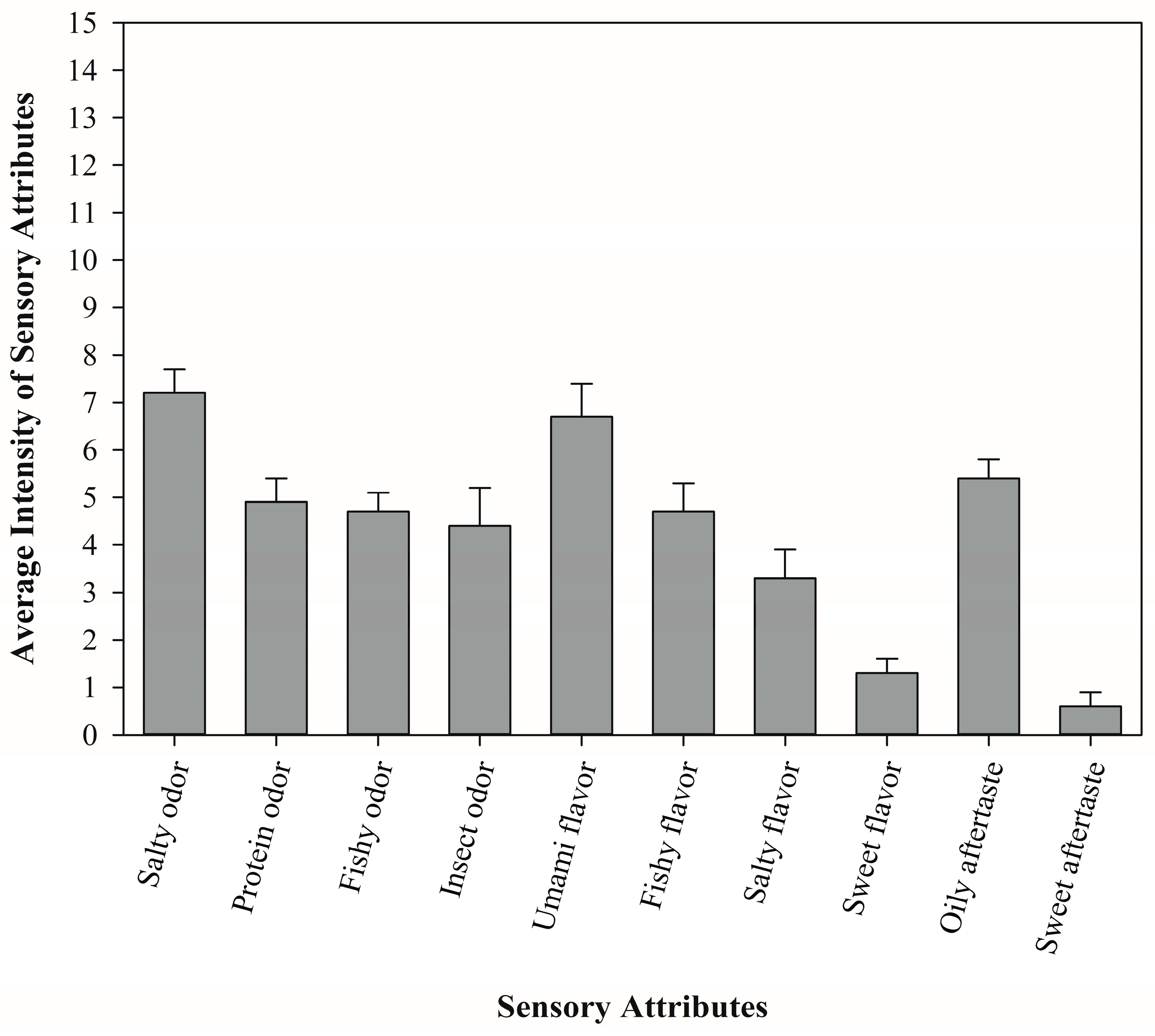
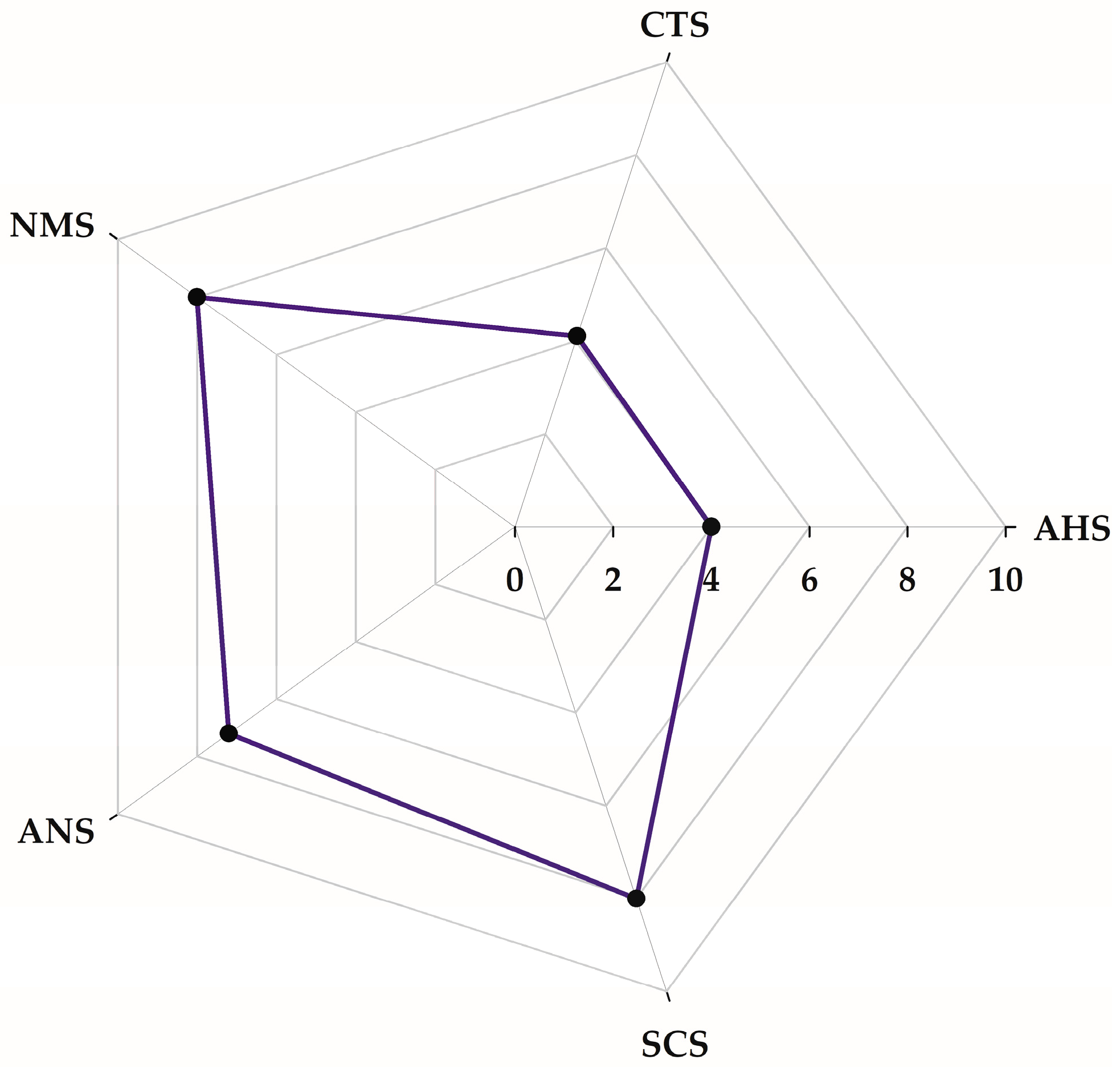
3.3. Evaluation of Optimized HBb-Up Using Descriptive Analysis (DA) and Electronic Tongue (E-Tongue)
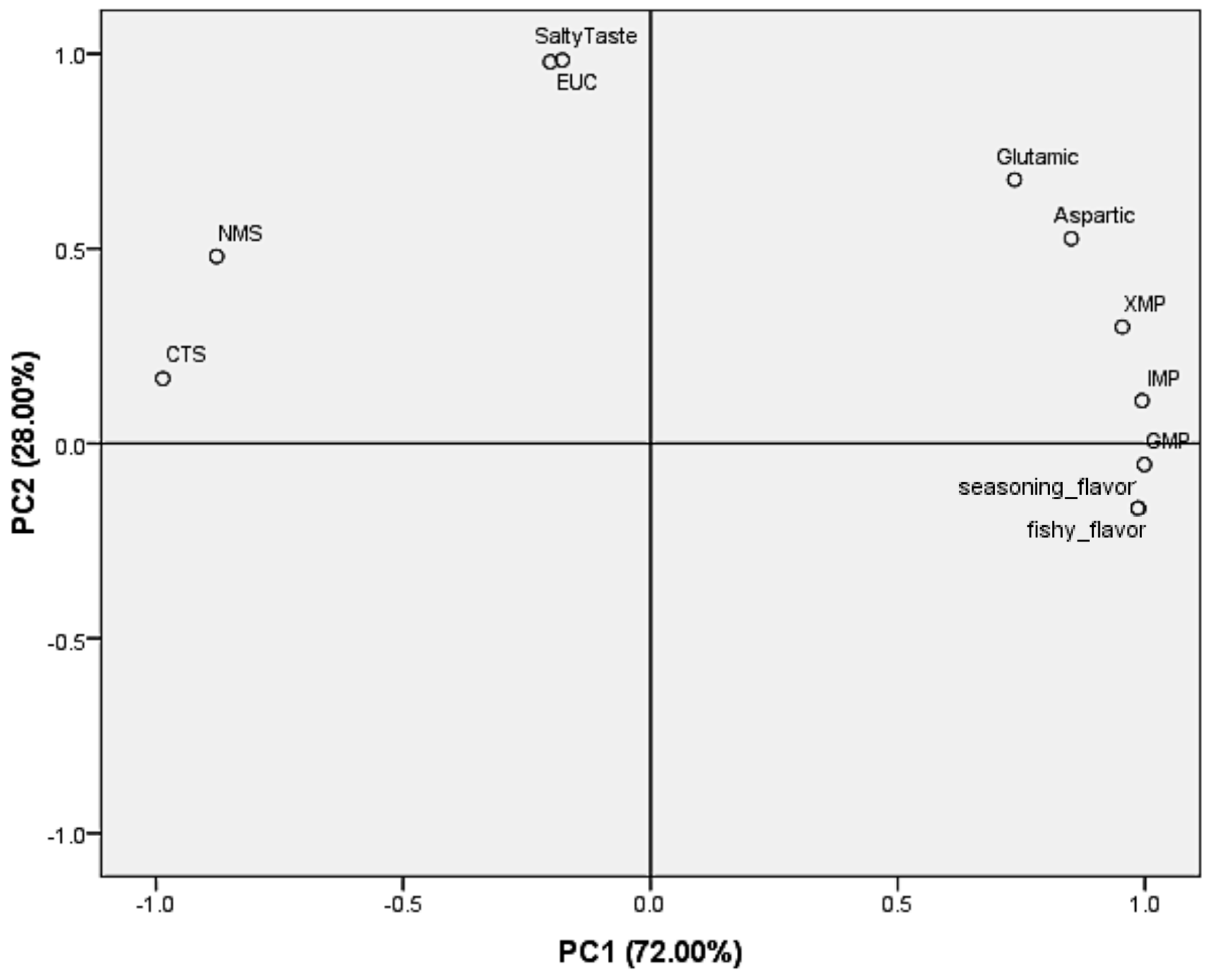
3.4. Correlation Between Physicochemical Properties, Umami Composition, and Descriptive Analysis of Optimized HBb-Up
4. Conclusions
Supplementary Materials
Author Contributions
Funding
Institutional Review Board Statement
Informed Consent Statement
Data Availability Statement
Acknowledgments
Conflicts of Interest
Abbreviations
| a* | The red component |
| AHS | Sourness |
| ANOVA | Analysis of variance |
| ANS | Sweetness |
| aw | Water activity |
| b* | The yellow component |
| CTS | Saltiness |
| DA | Descriptive Analysis |
| D-HBb | Dried honeybee brood |
| E-tongue | Electronic tongue |
| EUC | Equivalent umami concentration |
| GC-E-Nose | Gas chromatograph–electronic nose |
| GC-MS | Gas chromatography–mass spectrometry |
| HBb-UP | Honeybee brood umami powder |
| L* | Brightness |
| NMS | Umami |
| SCS | Bitterness |
References
- Lange, K.W.; Nakamura, Y. Potential contribution of edible insects to sustainable consumption and production. Front. Sustain. 2023, 4, 1112950. [Google Scholar] [CrossRef]
- Choi, J.-S. Nutrition, safety, health functional effects, and availability of honeybee (Apis mellifera L.) drone pupae. Insects 2021, 12, 771. [Google Scholar] [CrossRef] [PubMed]
- Ghosh, S.; Meyer-Rochow, V.B.; Jung, C. Honey bees and their brood: A potentially valuable resource of food, worthy of greater appreciation and scientific attention. J. Ecol. Environ. 2021, 45, 31. [Google Scholar] [CrossRef]
- Guiné, R.P.F.; Florença, S.G.; Correia, P.M.R.; Anjos, O.; Coelho, C.; Costa, C.A. Honey bee (Apis mellifera L.) broods: Composition, technology and gastronomic applicability. Foods 2022, 11, 2750. [Google Scholar] [CrossRef] [PubMed]
- Lange, K.; Nakamura, Y. Edible insects as a source of food bioactives and their potential health effects. J. Food Bioact. 2021, 14, 4–9. [Google Scholar] [CrossRef]
- Schiel, L.; Wind, C.; Ulmer, M.; Braun, P.G.; Koethe, M. Honey bee drone brood used as food. Ernähr. Umsch. Int. 2022, 69, 96–104. [Google Scholar]
- Evans, J.; Müller, A.; Jensen, A.B.; Dahle, B.; Flore, R.; Eilenberg, J.; Frøst, M.B. A descriptive sensory analysis of honeybee drone brood from Denmark and Norway. J. Insects Food Feed 2016, 2, 277–284. [Google Scholar] [CrossRef]
- Ulmer, M.; Smetana, S.; Heinz, V. Utilizing honeybee drone brood as a protein source for food products: Life cycle assessment of apiculture in Germany. Resour. Conserv. Recycl. 2020, 154, 104576. [Google Scholar] [CrossRef]
- Finke, M.D. Nutrient composition of bee brood and its potential as human food. Ecol. Food Nutr. 2005, 44, 257–270. [Google Scholar] [CrossRef]
- Haber, M.; Mishyna, M.; Martinez, J.J.I.; Benjamin, O. Edible larvae and pupae of honey bee (Apis mellifera): Odor and nutritional characterization as a function of diet. Food Chem. 2019, 292, 197–203. [Google Scholar] [CrossRef] [PubMed]
- Lim, S.; Jung, J.; Yunusbaev, U.; Ilyasov, R.; Kwon, H.W. Characterization and its implication of a novel taste receptor detecting nutrients in the honey bee, Apis mellifera. Sci. Rep. 2019, 9, 11620. [Google Scholar] [CrossRef] [PubMed]
- Chaipoot, S.; Phongphisutthinant, R.; Wiriyacharee, P.; Kanthakat, G.; Wongwatcharayothin, W.; Somjai, C.; Danmek, K.; Chuttong, B. Application of carboxymethyl cellulose and glycerol monostearate as binder agents for protein powder production from honey bee brood using foam-mat drying technique. Foods 2024, 13, 2265. [Google Scholar] [CrossRef] [PubMed]
- Baek, S.; Agapito Sheryl Mae, A.; Nam, I.S. Optimization of the Heat-Drying Conditions of Drone Pupae by Response Surface Methodology (RSM). Foods 2023, 12, 3062. [Google Scholar] [CrossRef] [PubMed]
- Chaipoot, S.; Wiriyacharee, P.; Pathomrungsiyounggul, P.; Kanthakat, G.; Somjai, C.; Boonyapranai, K.; Srinuanpan, S.; Wongwatcharayothin, W.; Phongphisutthinant, R. Antioxidant activity and chemical alterations of honeybee brood bio-peptides interacting with honey under moist-dried thermal aging. Antioxidants 2025, 14, 254. [Google Scholar] [CrossRef] [PubMed]
- AOAC. Official Methods of Analysis of the Association of Official Analytical Chemists, 18th ed.; AOAC International: Washington, DC, USA, 2010. [Google Scholar]
- Somjai, C.; Siriwoharn, T.; Kulprachakarn, K.; Chaipoot, S.; Phongphisutthinant, R.; Wiriyacharee, P. Utilization of Maillard reaction in moist-dry-heating system to enhance physicochemical and antioxidative properties of dried whole longan fruit. Heliyon 2021, 7, e07094. [Google Scholar] [CrossRef] [PubMed]
- Harada-Padermo, S.D.S.; Dias-Faceto, L.S.; Selani, M.M.; Alvim, I.D.; Floh, E.I.S.; Macedo, A.F.; Bogusz, S.; Dias, C.T.D.S.; Conti-Silva, A.C.; Vieira, T.M.F.S. Umami ingredient: Flavor enhancer from shiitake (Lentinula edodes) by-products. Food Res. Int. 2020, 137, 109540. [Google Scholar] [CrossRef] [PubMed]
- Chen, L.; Zeng, W.; Rong, Y.; Lou, B. Characterisation of taste-active compositions, umami attributes and aroma compounds in Chinese shrimp. Int. J. Food Sci. Technol. 2021, 56, 6311–6321. [Google Scholar] [CrossRef]
- Chaipoot, S.; Wiriyacharee, P.; Phongphisutthinant, R.; Buadoktoom, S.; Srisuwun, A.; Somjai, C.; Srinuanpan, S. Changes in physicochemical characteristics and antioxidant activities of dried shiitake mushroom in dry-moist-heat aging process. Foods 2023, 12, 2714. [Google Scholar] [CrossRef] [PubMed]
- Wang, Z.; Li, J.; Hong, X.; Han, X.; Liu, B.; Li, X.; Zhang, H.; Gao, J.; Liu, N.; Gao, X.; et al. Taste masking study based on an electronic tongue: The formulation design of 3D printed levetiracetam instant-dissolving tablets. Pharm. Res. 2021, 38, 831–842. [Google Scholar] [CrossRef] [PubMed]
- Ikhsan, L.N.; Chin, K.Y.; Ahmad, F. Methods of the dehydration process and its effect on the physicochemical properties of stingless bee honey: A review. Molecules 2022, 27, 7243. [Google Scholar] [CrossRef] [PubMed]
- Shen, Q.; He, Z.; Ding, Y.; Sun, L. Effect of different drying methods on the quality and nonvolatile flavor components of Oudemansiella raphanipes. Foods 2023, 12, 676. [Google Scholar] [CrossRef] [PubMed]
- Wang, J.; Jiang, S.; Miao, S.; Zhang, L.; Deng, K.; Zheng, B. Effects of drying on the quality characteristics and release of umami substances of Flammulina velutipes. Food Biosci. 2023, 51, 102338. [Google Scholar] [CrossRef]
- Yang, W.; Shi, W.; Zhou, S.; Qu, Y.; Wang, Z. Research on the changes of water-soluble flavor substances in grass carp during steaming. J. Food Biochem. 2019, 43, e12993. [Google Scholar] [CrossRef] [PubMed]
- Hou, Z.; Wei, Y.; Sun, L.; Xia, R.; Xu, H.; Li, Y.; Feng, Y.; Fan, W.; Xin, G. Effects of drying temperature on umami taste and aroma profiles of mushrooms (Suillus granulatus). J. Food Sci. 2022, 87, 1983–1998. [Google Scholar] [CrossRef] [PubMed]
- Bryś, M.S.; Strachecka, A. The key role of amino acids in pollen quality and honey bee physiology—A review. Molecules 2024, 29, 2605. [Google Scholar] [CrossRef] [PubMed]
- Ghosh, S.; Jung, C.; Meyer-Rochow, V.B. Nutritional value and chemical composition of larvae, pupae, and adults of worker honey bee, Apis mellifera ligustica, as a sustainable food source. J. Asia-Pac. Entomol. 2016, 19, 487–495. [Google Scholar] [CrossRef]
- Abasi, S.; Mousavi, S.M.; Mohebi, M.; Kiani, S. Effect of time and temperature on moisture content, shrinkage, and rehydration of dried onion. Iran. J. Chem. Eng. 2009, 6, 57–70. [Google Scholar]
- Lutovska, M.; Mitrevski, K.; Geramitcioski, J. Water activity vs. equilibrium moisture content. J. Process. Energy Agric. 2016, 20, 69–72. [Google Scholar]
- Sombutyanuchit, P.; Suphantharika, M.; Verduyn, C. Preparation of 5′-GMP-rich yeast extracts from spent brewer’s yeast. World J. Microbiol. Biotechnol. 2001, 17, 163–168. [Google Scholar] [CrossRef]
- Azmi, M.M.Z.; Taip, F.S.; Mustapa Kamal, S.M.; Chin, N.L. Effects of temperature and time on the physical characteristics of moist cakes baked in air fryer. J. Food Sci. Technol. 2019, 56, 4616–4624. [Google Scholar] [CrossRef] [PubMed]
- Kangkawisut, N.; Khunphutthiraphi, T.; Tubklang, R. Effects of baking time and temperature on product quality of ready-to-eat crispy stretched shrimp. Food Agric. Sci. Technol. 2022, 8, 87–96. [Google Scholar] [CrossRef]
- Han, D.; Deng, S.; Wang, H.; Huang, F.; Fauconnier, M.-L.; Li, H.; Zheng, J.; Meng, L.; Zhang, C.; Li, X. Lipid oxida-tion and flavor changes in saturated and unsaturated fat fractions from chicken fat during a thermal process. Food Funct. 2023, 14, 6554–6569. [Google Scholar] [CrossRef] [PubMed]
- van Boekel, M.A.J.S. Formation of flavour compounds in the Maillard reaction. Biotechnol. Adv. 2006, 24, 230–233. [Google Scholar] [CrossRef] [PubMed]
- Zhuang, Y.; Gao, J.; Zhang, Y.; Yu, L.; Liu, X.; Li, H.; Zhang, Y.; Liu, C. Impact of heating temperature and fatty acid type on the formation of lipid oxidation products during thermal processing. Front. Nutr. 2022, 9, 913297. [Google Scholar] [CrossRef] [PubMed]
- Ampuero, S.; Bosset, J.O. The electronic nose applied to dairy products: A review. Sens. Actuators B Chem. 2003, 94, 1–12. [Google Scholar] [CrossRef]
- The Good Scents Company. Available online: http://www.thegoodscentscompany.com (accessed on 16 January 2026).
- Xu, P.; Liu, L.; Liu, K.; Wang, J.; Gao, R.; Zhao, Y.; Bai, F.; Li, Y.; Wu, J.; Zeng, M.; et al. Flavor formation analysis based on sensory profiles and lipidomics of unrinsed mixed sturgeon surimi gels. Food Chem. X 2022, 17, 100534. [Google Scholar] [CrossRef] [PubMed]
- Li, J.; Zhong, F.; Spence, C.; Xia, Y. Synergistic effect of combining umami substances enhances perceived saltiness. Food Res. Int. 2024, 189, 114516. [Google Scholar] [CrossRef] [PubMed]
- Wu, B.; Eldeghaidy, S.; Ayed, C.; Fisk, I.D.; Hewson, L.; Liu, Y. Mechanisms of umami taste perception: From molecular level to brain imaging. Crit. Rev. Food Sci. Nutr. 2022, 62, 7015–7024. [Google Scholar] [PubMed]
- Diepeveen, J.; Moerdijk-Poortvliet, T.C.W.; van der Leij, F.R. Molecular insights into human taste perception and umami tastants: A review. J. Food Sci. 2022, 87, 1449–1465. [Google Scholar] [CrossRef] [PubMed]
- Song, C.; Yang, Y.; Zhao, Z.; Tan, M.; Chen, Z.; Zheng, H.; Gao, J.; Lin, H.; Zhu, G.; Cao, W. Insight into the correlation of taste substances and salty–umami taste from Monetaria moneta hydrolysates prepared using different proteases. Food Chem. X 2024, 24, 102056. [Google Scholar] [CrossRef] [PubMed]



| Level Code | Variables and Factor Level | |
|---|---|---|
| Temperature (°C) | Time (h) | |
| − | 50 | 3 |
| 0 | 65 | 13.50 |
| + | 80 | 24 |
| Run | Temperature | Time |
| 1 | − | − |
| 2 | + | − |
| 3 | − | + |
| 4 | + | + |
| 5 | − | 0 |
| 6 | + | 0 |
| 7 | 0 | − |
| 8 | 0 | + |
| 9 | 0 | 0 |
| 10 | 0 | 0 |
| Run | Responses | |||||||||
|---|---|---|---|---|---|---|---|---|---|---|
| Moisture Contents (%) | Color Values | aw | 5′-Nucleotide Compounds (mg/100 g db) | Protein Contents (g/100 g db) | EUC (g MSG/100 g db) | |||||
| L* | a* | b* | 5′-GMP | 5′-IMP | 5′-XMP | |||||
| 1 | 53.31 ± 2.60 | 62.78 ± 0.06 | 5.46 ± 0.07 | 12.24 ± 0.05 | 0.93 ± 0.01 | 3.91 ± 0.25 | 14.17 ± 0.14 | 162.45 ± 0.16 | 35.60 ± 0.89 | 13.96 ± 0.19 |
| 2 | 34.23 ± 4.78 | 58.48 ± 0.55 | 6.10 ± 0.08 | 11.73 ± 0.58 | 0.93 ± 0.02 | 56.51 ± 0.89 | 18.52 ± 0.34 | 289.27 ± 0.80 | 39.29 ± 0.94 | 41.60 ± 0.68 |
| 3 | 39.15 ± 4.16 | 62.18 ± 1.20 | 6.14 ± 0.06 | 15.66 ± 0.40 | 0.93 ± 0.01 | 81.82 ± 4.90 | 10.08 ± 0.03 | 278.16 ± 0.96 | 38.62 ± 0.52 | 80.58 ± 1.96 |
| 4 | 2.17 ± 0.07 | 58.51 ± 1.46 | 11.23 ± 0.03 | 15.55 ± 0.26 | 0.33 ± 0.05 | 9.35 ± 0.34 | 27.51 ± 0.50 | 168.16 ± 0.23 | 36.81 ± 0.04 | 18.88 ± 0.35 |
| 5 | 48.03 ± 0.42 | 60.08 ± 0.89 | 5.21 ± 0.10 | 12.49 ± 0.21 | 0.92 ± 0.01 | 25.11 ± 3.10 | 21.92 ± 0.20 | 243.53 ± 0.35 | 48.86 ± 0.73 | 49.25 ± 1.22 |
| 6 | 3.59 ± 0.08 | 60.01 ± 0.04 | 5.61 ± 0.23 | 11.46 ± 1.82 | 0.49 ± 0.02 | 36.16 ± 0.41 | 20.62 ± 0.63 | 176.64 ± 2.07 | 38.19 ± 0.28 | 30.36 ± 1.04 |
| 7 | 52.18 ± 3.53 | 63.20 ± 0.03 | 9.26 ± 0.22 | 18.01 ± 1.03 | 0.94 ± 0.01 | 19.38 ± 2.26 | 8.66 ± 0.01 | 183.13 ± 0.51 | 52.22 ± 0.35 | 18.44 ± 0.92 |
| 8 | 4.38 ± 0.38 | 60.45 ± 0.16 | 7.47 ± 0.47 | 15.74 ± 1.18 | 0.58 ± 0.01 | 44.27 ± 2.83 | 13.38 ± 0.19 | 202.72 ± 1.26 | 39.08 ± 0.69 | 25.01 ± 1.43 |
| 9 | 37.09 ± 2.31 | 54.69 ± 0.57 | 6.40 ± 0.66 | 14.17 ± 0.10 | 0.92 ± 0.01 | 49.12 ± 2.59 | 17.42 ± 0.36 | 265.20 ± 0.19 | 40.19 ± 1.43 | 50.49 ± 1.05 |
| 10 | 30.56 ± 4.24 | 55.00 ± 1.03 | 6.50 ± 0.32 | 12.70 ± 0.15 | 0.91 ± 0.02 | 38.66 ± 2.58 | 13.19 ± 0.37 | 235.01 ± 0.64 | 36.62 ± 2.06 | 29.98 ± 1.20 |
| Amino Acids (mg/100 g db) | Runs | |||||||||
|---|---|---|---|---|---|---|---|---|---|---|
| 1 | 2 | 3 | 4 | 5 | 6 | 7 | 8 | 9 | 10 | |
| Aspartic acid | 3.88 ± 0.15 | 3.35 ± 0.14 | 3.88 ± 0.22 | 3.21 ± 0.28 | 6.61 ± 0.13 | 5.52 ± 0.11 | 2.50 ± 0.04 | 3.28 ± 0.12 | 7.61 ± 0.12 | 4.14 ± 0.01 |
| Threonine | 15.46 ± 0.21 | 13.53 ± 0.02 | 16.85 ± 0.55 | ND | 16.92 ± 0.20 | 19.19 ± 0.26 | 17.08 ± 0.35 | 11.04 ± 0.74 | 16.94 ± 0.03 | 12.69 ± 0.01 |
| Serine | 1.94 ± 0.08 | 14.39 ± 0.49 | 16.45 ± 0.07 | 15.36 ± 0.08 | 16.52 ± 0.01 | 5.86 ± 0.58 | 1.71 ± 0.06 | 4.30 ± 0.08 | 7.04 ± 0.21 | 5.22 ± 0.06 |
| Glutamic acid | 94.07 ± 2.21 | 105.53 ± 3.71 | 180.47 ± 0.26 | 102.61 ± 2.65 | 177.95 ± 0.58 | 117.94 ± 0.01 | 92.18 ± 0.92 | 86.14 ± 0.15 | 142.20 ± 0.87 | 100.60 ± 0.01 |
| Proline | 76.14 ± 0.35 | 73.22 ± 0.45 | 84.18 ± 0.26 | 59.31 ± 0.63 | 96.70 ± 0.25 | 60.81 ± 0.12 | 71.28 ± 0.53 | 53.28 ± 0.71 | 81.36 ± 0.49 | 65.95 ± 0.01 |
| Glycine | 13.53 ± 0.23 | 18.37 ± 0.20 | 22.22 ± 0.16 | 14.13 ± 0.19 | 25.44 ± 0.04 | 17.02 ± 0.08 | 13.85 ± 0.16 | 14.16 ± 0.09 | 23.01 ± 0.35 | 17.55 ± 0.03 |
| Alanine + Cystine | 90.07 ± 2.66 | 117.93 ± 1.45 | 129.40 ± 8.04 | 276.60 ± 2.61 | 176.39 ± 0.98 | 181.98 ± 2.80 | 83.84 ± 3.65 | 108.61 ± 0.01 | 253.06 ± 5.47 | 156.47 ± 0.01 |
| Valine | 13.19 ± 1.61 | 18.68 ± 0.45 | 20.72 ± 1.39 | 19.74 ± 0.71 | 23.81 ± 0.33 | 21.25 ± 0.14 | 13.74 ± 5.50 | 14.30 ± 0.64 | 23.69 ± 0.18 | 16.92 ± 0.01 |
| Methionine | 1.32 ± 1.01 | 1.52 ± 0.11 | 2.89 ± 1.20 | 1.63 ± 0.01 | 3.03 ± 0.29 | 1.86 ± 0.49 | 2.01 ± 3.84 | 1.10 ± 0.27 | 1.83 ± 0.04 | 1.26 ± 0.05 |
| Isoleucine | 2.39 ± 0.21 | 5.58 ± 0.19 | 5.17 ± 0.15 | 5.93 ± 0.34 | 6.07 ± 0.01 | 6.38 ± 0.18 | 2.84 ± 0.12 | 4.46 ± 0.12 | 7.52 ± 0.14 | 5.52 ± 0.01 |
| Leucine | 5.92 ± 0.01 | 7.90 ± 0.17 | 8.19 ± 0.45 | 9.15 ± 0.18 | 10.41 ± 1.23 | 9.46 ± 0.38 | 5.36 ± 0.07 | 6.48 ± 0.65 | 11.11 ± 0.06 | 8.14 ± 0.02 |
| Tyrosine | ND | 7.98 ± 0.24 | 4.71 ± 0.07 | 5.48 ± 0.29 | 15.10 ± 0.39 | 14.79 ± 0.13 | ND | 6.46 ± 2.31 | 10.47 ± 3.58 | 7.92 ± 0.01 |
| Phenyl- alanine | 152.70 ± 2.02 | 203.49 ± 3.52 | 248.88 ± 3.10 | 167.46 ± 1.27 | 263.07 ± 1.30 | 198.05 ± 0.02 | 149.63 ± 0.38 | 155.27 ± 4.23 | 251.03 ± 0.81 | 187.74 ± 0.03 |
| Histidine | 4.16 ± 1.06 | 5.93 ± 0.06 | 7.38 ± 0.17 | 12.96 ± 0.71 | 9.46 ± 1.46 | 8.13 ± 0.17 | 3.89 ± 1.07 | 5.29 ± 0.21 | 10.19 ± 0.92 | 6.59 ± 0.01 |
| Lysine | 23.18 ± 0.65 | 33.47 ± 1.06 | 36.91 ± 0.47 | 23.17 ± 0.52 | 41.52 ± 1.88 | 29.14 ± 0.75 | 22.80 ± 0.40 | 23.65 ± 0.58 | 36.66 ± 0.21 | 28.68 ± 0.01 |
| Arginine | ND | 20.77 ± 0.32 | ND | 16.44 ± 3.18 | ND | 20.64 ± 1.24 | ND | 14.57 ± 0.15 | 22.99 ± 1.92 | 15.50 ± 0.02 |
| TAAs | 497.95 | 651.64 | 788.30 | 733.18 | 889.00 | 718.02 | 482.71 | 512.39 | 906.71 | 640.89 |
| Runs | Product Attributes | |||
|---|---|---|---|---|
| Appearance | Color | Aroma | Overall Acceptance | |
| 1 | 3.10 ± 1.62 | 4.10 ± 2.00 | 4.40 ± 1.88 | 3.70 ± 1.66 |
| 2 | 6.10 ± 1.52 | 6.15 ± 1.39 | 5.50 ± 1.73 | 5.45 ± 1.57 |
| 3 | 5.25 ± 1.41 | 5.80 ± 1.32 | 4.20 ± 1.32 | 4.45 ± 1.05 |
| 4 | 6.60 ± 1.14 | 6.55 ± 1.15 | 6.55 ± 1.19 | 6.45 ± 0.94 |
| 5 | 5.05 ± 1.50 | 5.65 ± 1.35 | 3.90 ± 1.33 | 4.00 ± 1.12 |
| 6 | 7.30 ± 0.80 | 7.05 ± 0.89 | 6.80 ± 1.40 | 6.75 ± 1.37 |
| 7 | 5.80 ± 1.06 | 6.10 ± 1.25 | 5.90 ± 1.29 | 5.85 ± 1.27 |
| 8 | 7.20 ± 0.77 | 7.20 ± 0.70 | 6.50 ± 1.32 | 6.85 ± 1.18 |
| 9 | 6.00 ± 1.26 | 6.10 ± 1.12 | 5.60 ± 1.27 | 5.65 ± 1.27 |
| 10 | 5.40 ± 1.31 | 5.70 ± 0.92 | 5.25 ± 1.29 | 5.25 ± 0.97 |
| Responses | Equations | Adjusted R2 | p-Value |
|---|---|---|---|
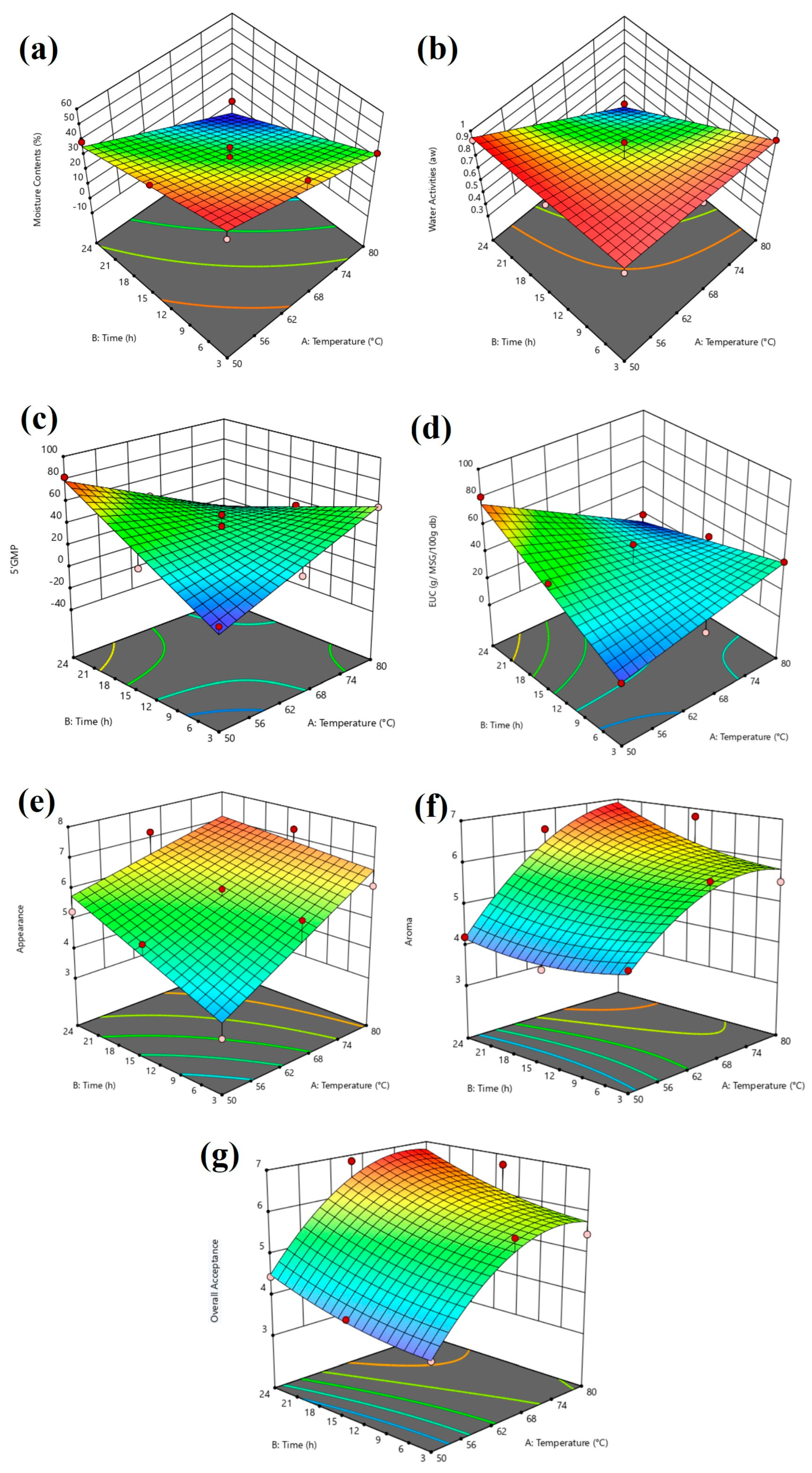
| Moisture Contents(%) Water Activities(aw) 5′-GMP(mg/100 g db) EUC(g MSG/100 g db) | =98.26 − 0.73(A) + 0.36(B) − 0.03(AB) =0.92 + 0.01(A) + 0.05(B) − 0.01(AB) =− 143.33 + 2.58(A) + 13.79(B) − 0.20(AB) =− 61.15 + 1.33(A) + 10.02(B) − 0.14(AB) | 0.8343 0.8276 0.8588 0.6767 | 0.0028 0.0032 0.0018 0.0200 |
| Appearance Aroma Overall Acceptance | =− 2.15 + 0.11(A) + 0.23(B) − 0.01(AB) =− 8.81 + 0.40(A) − 0.16(B) + 0.01(AB) − 0.01(A)2 + 0.01(B)2 =− 13.78 + 0.53(A) − 0.03(B) + 0.01(AB) − 0.01(A)2 + 0.01(B)2 | 0.7047 0.7479 0.7453 | 0.0154 0.0489 0.0498 |
| No. | Compound | Chemical Class | CAS No. | Aroma Description | |
|---|---|---|---|---|---|
| Odor Type | Flavor Type | ||||
| 1 | 3-Methylbutanal (Isovaleraldehyde) | Aldehyde | 590-86-3 | Nutty, chocolate-like, malty | Roasted, nutty, malty |
| 2 | Pent-1-en-3-ol | Alcohol | 616-25-1 | Green, metallic, fresh | Green, fresh note |
| 3 | 1-Hexanol | Alcohol | 111-27-3 | Grassy, floral, green | Green, floral |
| 4 | β-Pinene | Terpene | 127-91-3 | Woody, pine-like | Herbal, resinous |
| 5 | Limonene | Terpene | 138-86-3 | Citrus, lemon-like, fruity | Citrus, fruity |
| 6 | 2-Ethyl-3,6-dimethylpyrazine | Pyrazine | 13925-07-0 | Roasted, earthy, nutty | Roasted, savory |
| 7 | Nonanal | Aldehyde | 124-19-6 | Fatty, citrus, green | Fresh, citrusy, green |
| 8 | 4-Hydroxy-5-methyl-3(2H)-furanone | Furanone derivative | 118-71-8 | Cotton candy, caramel-like, sweet | Sweet, candy-like |
| 9 | p-Methylacetophenone | Ketone/Phenone | 122-00-9 | Floral, sweet, mild aromatic | Floral-sweet |
| 10 | Dodecane | Hydrocarbon (Alkane) | 112-40-3 | Waxy, faint oily | Neutral, background note |
| 11 | (Z)-Citral (Geranial isomer) | Aldehyde (Terpenoid) | 141-27-5 | Lemon, citrus, fresh | Sweet citrus |
| 12 | δ-Decalactone | Lactone | 705-86-2 | Fruity, peach-like, creamy | Fruity, creamy, peach-like |
Disclaimer/Publisher’s Note: The statements, opinions and data contained in all publications are solely those of the individual author(s) and contributor(s) and not of MDPI and/or the editor(s). MDPI and/or the editor(s) disclaim responsibility for any injury to people or property resulting from any ideas, methods, instructions or products referred to in the content. |
© 2026 by the authors. Licensee MDPI, Basel, Switzerland. This article is an open access article distributed under the terms and conditions of the Creative Commons Attribution (CC BY) license.
Share and Cite
Chaipoot, S.; Jaijoi, S.; Kanthakat, G.; Chaimueng, K.; Somjai, C.; Wiriyacharee, P.; Samakradhamrongthai, R.S.; Pathomrungsiyounggul, P.; Wongwatcharayothin, W.; Phongphisutthinant, R. Characterization of Umami Compounds and Volatile Profiles of Honeybee Brood Umami Powder Under Optimized Drying Conditions: Implications for Sensory Properties. Foods 2026, 15, 2234. https://doi.org/10.3390/foods15122234
Chaipoot S, Jaijoi S, Kanthakat G, Chaimueng K, Somjai C, Wiriyacharee P, Samakradhamrongthai RS, Pathomrungsiyounggul P, Wongwatcharayothin W, Phongphisutthinant R. Characterization of Umami Compounds and Volatile Profiles of Honeybee Brood Umami Powder Under Optimized Drying Conditions: Implications for Sensory Properties. Foods. 2026; 15(12):2234. https://doi.org/10.3390/foods15122234
Chicago/Turabian StyleChaipoot, Supakit, Sirinthip Jaijoi, Gochakorn Kanthakat, Kuntathee Chaimueng, Chalermkwan Somjai, Pairote Wiriyacharee, Rajnibhas Sukeaw Samakradhamrongthai, Pattavara Pathomrungsiyounggul, Worachai Wongwatcharayothin, and Rewat Phongphisutthinant. 2026. "Characterization of Umami Compounds and Volatile Profiles of Honeybee Brood Umami Powder Under Optimized Drying Conditions: Implications for Sensory Properties" Foods 15, no. 12: 2234. https://doi.org/10.3390/foods15122234
APA StyleChaipoot, S., Jaijoi, S., Kanthakat, G., Chaimueng, K., Somjai, C., Wiriyacharee, P., Samakradhamrongthai, R. S., Pathomrungsiyounggul, P., Wongwatcharayothin, W., & Phongphisutthinant, R. (2026). Characterization of Umami Compounds and Volatile Profiles of Honeybee Brood Umami Powder Under Optimized Drying Conditions: Implications for Sensory Properties. Foods, 15(12), 2234. https://doi.org/10.3390/foods15122234