
Tasting with Feelings: Socioeconomic Differences in Children’s Emotional and Sensory Description of Vegetables

Abstract
1. Introduction
2. Materials and Methods
2.1. Participants and Sampling Design
2.2. Vegetable Samples
2.3. Sensory Evaluation Procedure
2.4. Data Analysis
3. Results
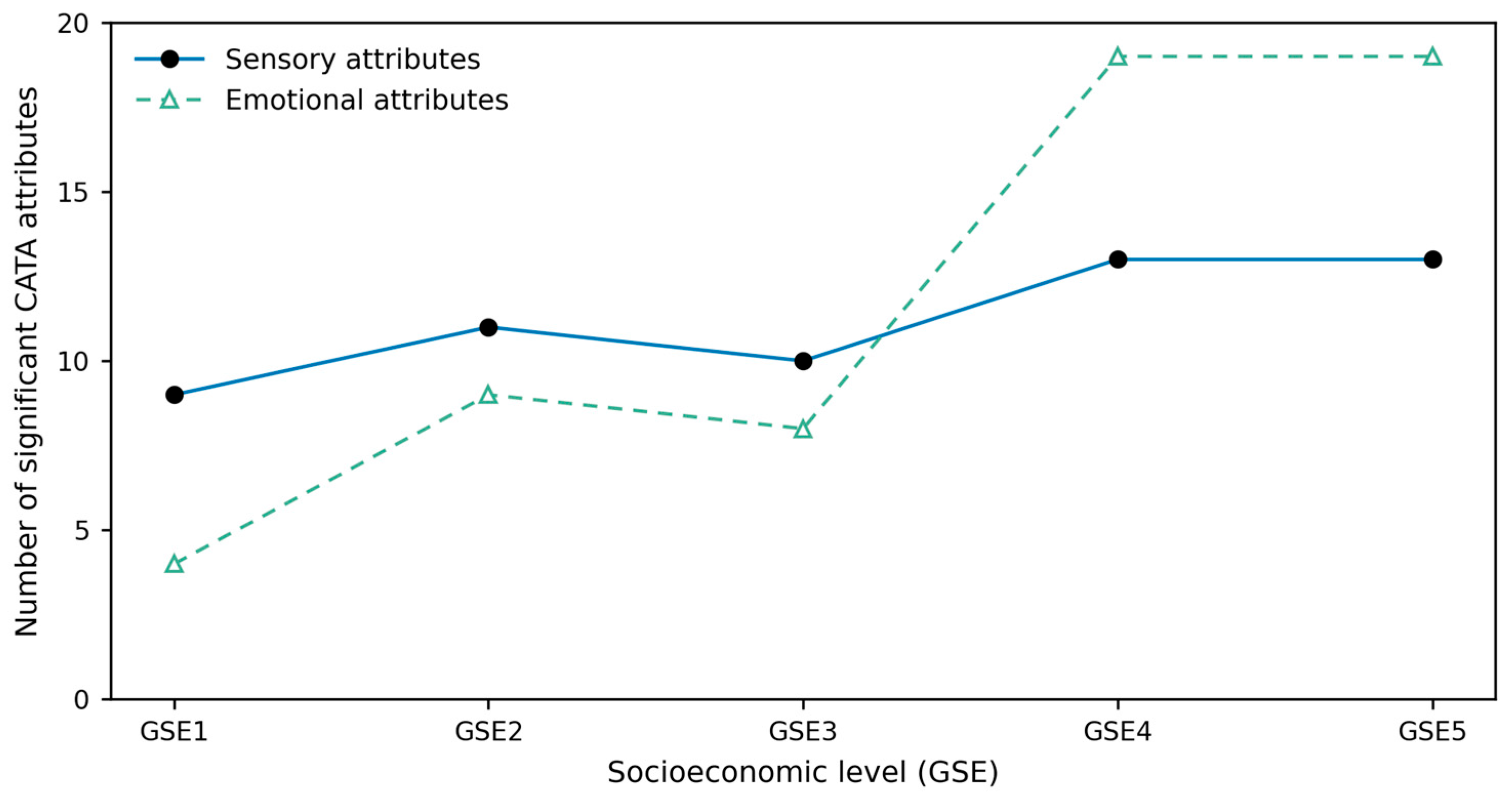
3.1. Sensory Attributes Selection and Discriminative Patterns Across Socioeconomic Groups
3.2. Emotional Attribute Selection and Expression Patterns
 ,
,  ,
,  ,
,  ,
,  , and
, and  did not show significant differences across samples (p > 0.05).
 ,
,  ,
,  ,
,  ,
,  ,
,  ,
,  ,
,  ,
,  ,
,  ,
,  ,
,  , and
, and  ). For the Middle socioeconomic group, 8 emojis were non-significant in discriminating among samples (, , ,
  , , , , and
  ). In contrast, for the higher socioeconomic groups (Upper-middle and High), all emojis used were significant. This pattern mirrored that observed for sensory descriptors, suggesting greater emotional differentiation and expressiveness among children from higher socioeconomic backgrounds.
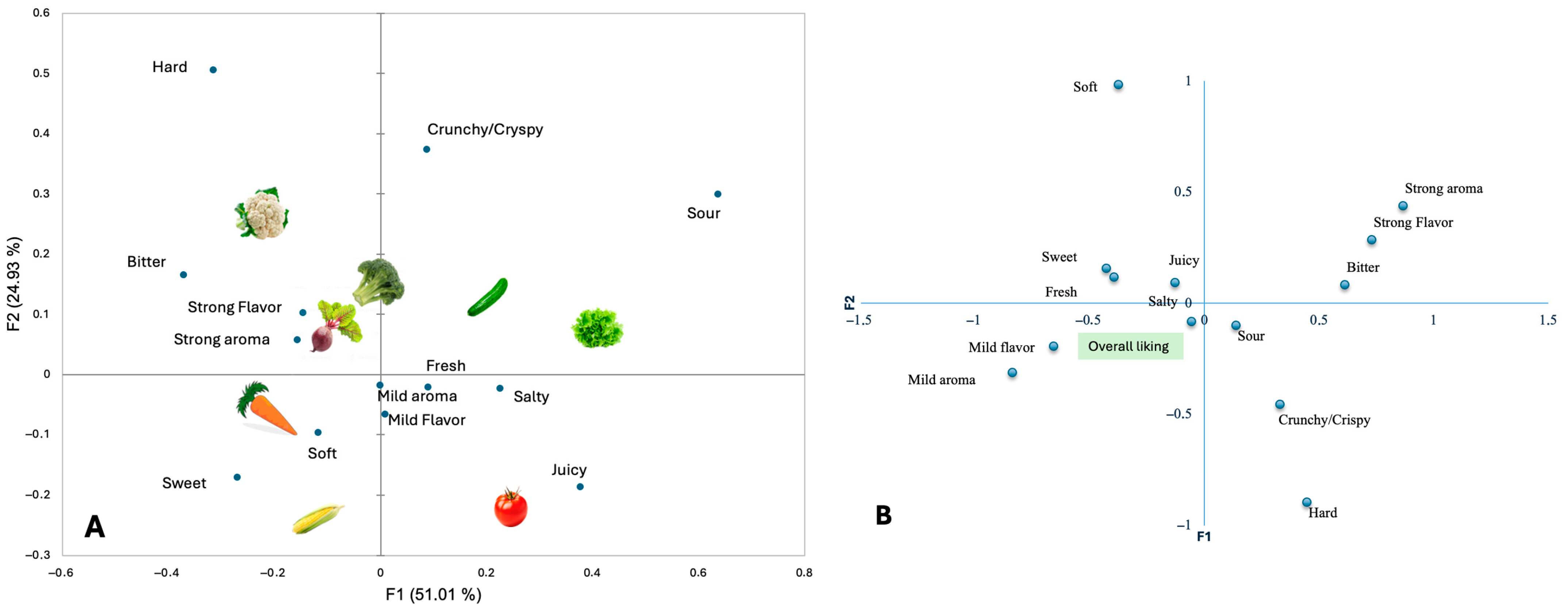
3.3. Sensory and Emotional Spaces and Their Relationship with Overall Liking
 , ,
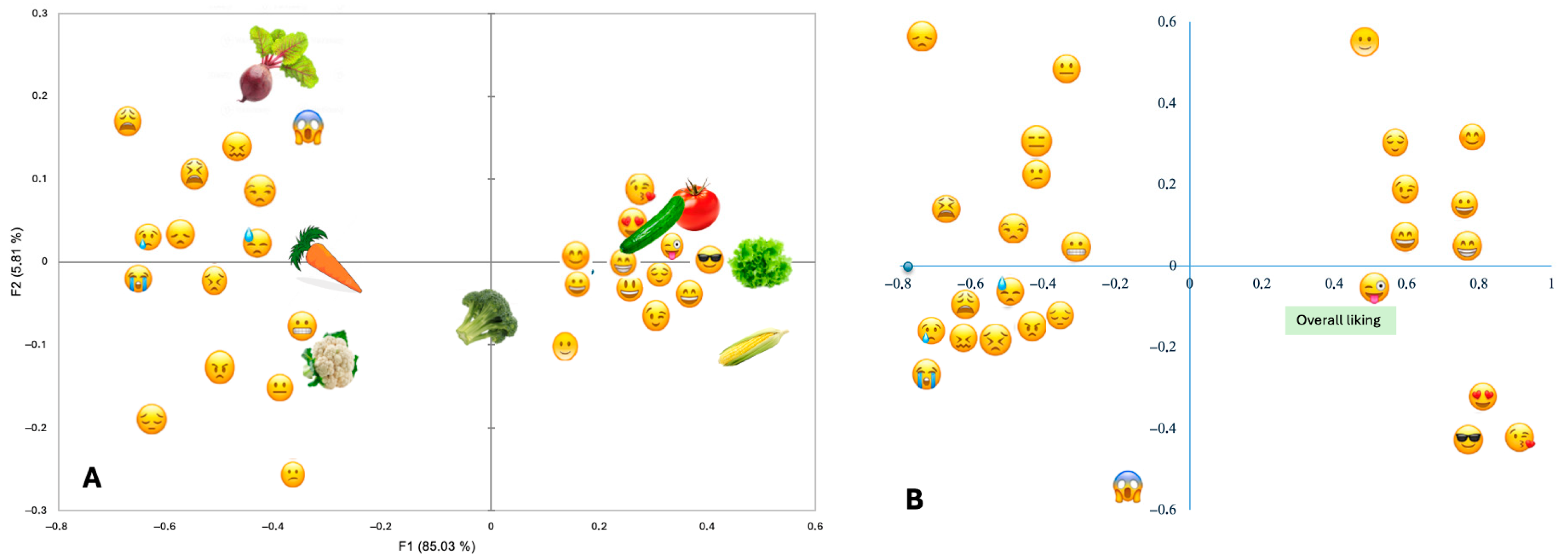
, ,  , and were grouped near vegetables associated with higher liking (tomato, corn, lettuce, and cucumber), whereas negative emojis (, , , and
  ) appeared close to less liked vegetables (beetroot). For cauliflower, neutral emojis ( and
  ) were selected. When overall liking was projected onto the emotional space (Figure 3B), it was located in the region dominated by positive emojis, suggesting that positive affective responses were systematically aligned with higher preference.
3.4. Contribution of Sensory Emotional Descriptors to Hedonic Responses
(+1), (+0.9), (+0.9), and (+0.7) were associated with an increase in liking, indicating that their selection corresponded to higher mean hedonic scores. This pattern reflects a consistent co-occurrence between positive emotional expressions and increases in liking. (+0.8), (+0.7), (+0.6), (+0.6), were associated with an increase in liking. In the High SES group, five emojis: (+1.5), (+1.4), (+1.3), (+0.1),  (+0.6) showed a positive impact, indicating that their selection corresponded to higher mean liking scores.
4. Discussion
4.1. Socioeconomic Differences in Children’s Descriptive Ability
4.2. Sensory and Emotional Dimensions of Children’s Responses Across SES
 , , or —were strongly associated with higher hedonic ratings, reflecting pleasant affective engagement, whereas negative or low-arousal emotions were linked to lower liking. This correspondence between emotional valence and hedonic evaluation supports the idea that emoji-based measures can effectively capture children’s affective reactions to food in an intuitive and age-appropriate way [29,42]., , , , , and . Their low discriminative power may indicate that these expressions represent more ambiguous or context-independent reactions rather than specific affective responses to the vegetables themselves. For example, and may capture playful or socially driven reactions, while and denote confusion or low arousal states that are less directly linked to taste evaluation. Similar patterns have been reported in previous studies using emoji-based emotion measures with children, where low-arousal or mixed-valence emotions show weaker associations with specific food stimuli [29,42,43]. These findings suggest that children’s emotional responses to food are organized primarily around clear positive and negative valence cues.
4.3. Emotional and Sensory Correlates of Preference
, , , and showed the strongest association with increased liking, indicating a clear correspondence between hedonic pleasure and positive affective expression. Interestingly, no negative or ambiguous emojis showed a significant effect on liking—either in the combined analysis or within socioeconomic groups—suggesting that expressions of rejection, confusion, or playfulness (e.g., , , ) may represent peripheral or socially driven reactions rather than direct hedonic evaluations. This pattern reinforces that only positive affective cues contribute meaningfully to hedonic appraisal in this age group, consistent with previous findings that children’s emotional lexicon for food is dominated by expressions of liking and enjoyment [29,42]. and , indicating that sensory comfort and positive affect jointly shape vegetable acceptance. As noted by Tan et al. (2024), emotional responses can vary even when liking remains relatively stable, revealing perceptual nuances that hedonic scores alone do not capture—a pattern also evident in the present study, where the alignment between sensory and emotional dimensions provided a richer understanding of children’s preferences beyond liking alone [38]. The combined use of sensory and emoji-based CATA methods thus offers a powerful framework for capturing both perceptual and affective dimensions of food experience in children, bridging the gap between what they taste and how they feel about it.4.4. Study Limitations and Strengths
5. Conclusions
Author Contributions
Funding
Institutional Review Board Statement
Informed Consent Statement
Data Availability Statement
Acknowledgments
Conflicts of Interest
References
- Joshipura, K.J.; Ascherio, A.; Manson, J.E.; Stampfer, M.J.; Rimm, E.B.; Speizer, F.E.; Hennekens, C.H.; Spiegelman, D.; Willett, W.C. Fruit and vegetable intake in relation to risk of ischemic stroke. JAMA 1999, 282, 1233–1239. [Google Scholar] [CrossRef] [PubMed]
- Boffetta, P.; Couto, E.; Wichmann, J.; Ferrari, P.; Trichopoulos, D.; Bueno-de-Mesquita, H.B.; van Duijnhoven, F.J.B.; Büchner, F.L.; Key, T.; Boeing, H.; et al. Fruit and vegetable intake and overall cancer risk in the European Prospective Investigation into Cancer and Nutrition (EPIC). J. Natl. Cancer Inst. 2010, 102, 529–537. [Google Scholar] [CrossRef] [PubMed]
- Cooper, A.J.; Forouhi, N.G.; Ye, Z.; Buijsse, B.; Arriola, L.; Balkau, B.; Barricarte, A.; Beulens, J.W.; Boeing, H.; Büchner, F.L.; et al. Fruit and vegetable intake and type 2 diabetes: EPIC-InterAct prospective study and meta-analysis. Eur. J. Clin. Nutr. 2012, 66, 1082–1092. [Google Scholar] [CrossRef] [PubMed]
- World Health Organization. Healthy Diet. 2025. Available online: https://www.who.int/news-room/fact-sheets/detail/healthy-diet (accessed on 14 November 2025).
- World Health Organization. Diet, Nutrition and the Prevention of Chronic Diseases: Report of a Joint WHO/FAO Expert Consultation; WHO Technical Report Series No. 916; World Health Organization: Geneva, Switzerland, 2003. [Google Scholar]
- Currie, C.; Roberts, C.; Morgan, A.; Smith, R.; Settertobulte, W.; Samdal, O.; Rasmussen, V.B. Young People’s Health in Context. Health Behaviour in School-Aged Children (HBSC) Study: International Report from the 2001/02 Survey; WHO Regional Office for Europe: Copenhagen, Denmark, 2004. [Google Scholar]
- McCarthy, R.; Kehoe, L.; Walton, J.; Flynn, A.; Livingstone, M.B.E. The role of fruit and vegetables in the diets of children in Europe: Current state and challenges. Proc. Nutr. Soc. 2020, 79, 479–486. [Google Scholar] [CrossRef]
- Centers for Disease Control and Prevention. Childhood Nutrition Facts. 2023. Available online: https://www.cdc.gov/healthyschools/nutrition/facts.htm (accessed on 14 November 2025).
- Queral, J.; Wargers, A.; Tarro, L.; Llauradó, E.; Solà, R.; Jansen, W. Changes over time of fruit, vegetable and sweets consumption among European adolescents and associations with sociodemographic characteristics: An HBSC study. J. Public Health 2024, 46, 392–402. [Google Scholar] [CrossRef]
- World Health Organization. WHO European Regional Obesity Report 2022; WHO Regional Office for Europe: Copenhagen, Denmark, 2022. [Google Scholar]
- Lange, S.J.; Moore, L.V.; Harris, D.M.; Merlo, C.L.; Lee, S.H.; Galuska, D.A. Percentage of adolescents meeting federal fruit and vegetable intake recommendations—Youth Risk Behavior Surveillance System, United States. Mmwr-Morbidity Mortal. Wkly. Rep. 2021, 70, 69–74. [Google Scholar] [CrossRef]
- Williams, J.; Buoncristiano, M.; Nardone, P.; Rito, A.I.; Spinelli, A.; Hejgaard, T.; Kierkegaard, L.; Nurk, E.; Kunešová, M.; Milanović, S.M.; et al. A snapshot of European children’s eating habits: Results from the fourth round of the WHO European Childhood Obesity Surveillance Initiative (COSI). Nutrients 2020, 12, 2481. [Google Scholar] [CrossRef]
- ENCA (Encuesta Nacional de Consumo Alimentario). Informe Final; Ministerio de Salud de Chile: Santiago, Chile, 2014. [Google Scholar]
- Krueger, P.M.; Bayerman, S.F.; Reither, E.N. Race/ethnic and socioeconomic disparities in obesity. In International Handbook of the Demography of Obesity; Garcia-Alexander, G., Poston, D.L., Jr., Eds.; Springer International Publishing: Cham, Switzerland, 2022; pp. 153–172. [Google Scholar]
- Junta Nacional de Auxilio Escolar y Becas (JUNAEB). Mapa Nutricional 2023: Resultados; Ministerio de Educación, Gobierno de Chile: Santiago, Chile, 2024; Available online: https://www.junaeb.cl/wp-content/uploads/2024/05/Mapa-Nutricional-2023-Resultados.pdf (accessed on 14 November 2025).
- Skinner, J.D.; Carruth, B.R.; Bounds, W.; Ziegler, P.J. Children’s food preferences: A longitudinal analysis. J. Am. Diet. Assoc. 2002, 102, 1638–1647. [Google Scholar] [CrossRef]
- Beauchamp, G.K.; Mennella, J.A. Early flavor learning and its impact on later feeding behavior. J. Pediatr. Gastroenterol. Nutr. 2009, 48, S25–S30. [Google Scholar] [CrossRef]
- Birch, L.L. Development of food preferences. Annu. Rev. Nutr. 1999, 19, 41–62. [Google Scholar] [CrossRef]
- Cooke, L. The importance of exposure for healthy eating in childhood: A review. J. Hum. Nutr. Diet. 2007, 20, 294–301. [Google Scholar] [CrossRef] [PubMed]
- Aldridge, V.; Dovey, T.M.; Halford, J.C. The role of familiarity in dietary development. Dev. Rev. 2009, 29, 32–44. [Google Scholar] [CrossRef]
- Lakkakula, A.; Geaghan, J.; Zanovec, M.; Pierce, S.; Tuuri, G. Repeated taste exposure increases liking for vegetables by low-income elementary school children. Appetite 2010, 55, 226–231. [Google Scholar] [CrossRef] [PubMed]
- Estay, K.; Escalona, V. Raw or Cooked? Exploring Vegetable Acceptance Among Chilean Children from Different Socioeconomic Backgrounds. Foods 2025, 14, 1133. [Google Scholar] [CrossRef]
- Dalenberg, J.R.; Gutjar, S.; Ter Horst, G.J.; de Graaf, C.; Jager, G. Evoked emotions predict food choice. PLoS ONE 2014, 9, e115388. [Google Scholar] [CrossRef]
- Spinelli, S.; Monteleone, E. Emotional responses to products. In Methods in Consumer Research, Volume 1; Ares, G., Varela, P., Eds.; Woodhead Publishing: Cambridge, UK, 2018; pp. 261–296. [Google Scholar]
- Estay, K.; Pan, S.; Zhong, F.; Capitaine, C.; Guinard, J.-X. A cross-cultural analysis of children’s vegetable preferences. Appetite 2019, 142, 104346. [Google Scholar] [CrossRef]
- Laureati, M.; Pagliarini, E. New developments in sensory and consumer research with children. In Methods in Consumer Research, Volume 2; Ares, G., Varela, P., Eds.; Woodhead Publishing: Cambridge, UK, 2018; pp. 321–353. [Google Scholar]
- Weerawarna, M.N.R.P.; Godfrey, A.J.R.; Ellis, A.; Hort, J. Identifying temporal drivers of product acceptance and rejection across sips during whole product consumption. J. Sens. Stud. 2023, 38, e12855. [Google Scholar] [CrossRef]
- Laureati, M.; Cattaneo, C.; Lavelli, V.; Bergamaschi, V.; Riso, P.; Pagliarini, E. Application of the check-all-that-apply method (CATA) to get insights on children’s drivers of liking of fibre-enriched apple purees. J. Sens. Stud. 2017, 32, e12253. [Google Scholar] [CrossRef]
- Schouteten, J.J.; Verwaeren, J.; Lagast, S.; Gellynck, X.; De Steur, H. Emoji as a tool for measuring children’s emotions when tasting food. Food Qual. Prefer. 2018, 68, 322–331. [Google Scholar] [CrossRef]
- Sick, J.; Almli, V.L.; Dinnella, C.; Berget, I.; Monteleone, E.; Spinelli, S. Cross-national comparison on the meaning of emoji to describe emotions elicited by foods in preadolescents. Food Qual. Prefer. 2023, 106, 104791. [Google Scholar] [CrossRef]
- Verwaeren, J.; Gellynck, X.; Lagast, S.; Schouteten, J.J. Predicting children’s food choice using check-all-that-apply questions. J. Sens. Stud. 2019, 34, e12471. [Google Scholar] [CrossRef]
- Ministerio de Educación de Chile (MINEDUC). Metodología de Construcción de Grupos Socioeconómicos: Pruebas SIMCE 2013; Agencia de Calidad de la Educación: Santiago, Chile, 2013. [Google Scholar]
- Kim, M.R.; Heo, J.; Kwak, H.S. Comparison of sensory profiles by two different check-all-that-apply (CATA) terms developed from trained panelists and naïve consumers. Food Qual. Prefer. 2023, 109, 104902. [Google Scholar] [CrossRef]
- Shapiro, A.L.; Lawless, M.C.; Flesher, A.; Lattanzi, K.; Charlifue-Smith, R.; Johnson, S.L. Acceptance of a novel food is related to caregiver perceptions of infant and toddler food-related receptive language. J. Nutr. Educ. Behav. 2022, 54, 684–689. [Google Scholar] [CrossRef] [PubMed]
- Ares, G.; De Rosso, S.; Mueller, C.; Philippe, K.; Pickard, A.; Nicklaus, S.; van Kleef, E.; Varela, P. Development of food literacy in children and adolescents: Implications for the design of strategies to promote healthier and more sustainable diets. Nutr. Rev. 2024, 82, 536–552. [Google Scholar] [CrossRef]
- Laureati, M.; Pagliarini, E.; Toschi, T.G.; Monteleone, E. Research challenges and methods to study food preferences in school-aged children: A review of the last 15 years. Food Qual. Prefer. 2015, 46, 92–102. [Google Scholar] [CrossRef]
- Mustonen, S.; Tuorila, H. Sensory education decreases food neophobia score and encourages trying unfamiliar foods in 8–12-year-old children. Food Qual. Prefer. 2010, 21, 353–360. [Google Scholar] [CrossRef]
- Tan, X.; Abdul Shukor, S.F.; Soh, K.G. Visual Cues, Liking, and Emotional Responses: What Combination of Factors Result in the Willingness to Eat Vegetables among Children with Food Neophobia? Foods 2024, 13, 3294. [Google Scholar] [CrossRef]
- Keast, R.S.; Roper, J. A complex relationship among chemical concentration, detection threshold, and suprathreshold intensity of bitter compounds. Chem. Senses 2007, 32, 245–253. [Google Scholar] [CrossRef]
- Prescott, J. Flavours: The pleasure principle. Flavour 2015, 4, 15. [Google Scholar] [CrossRef]
- Majid, A.; Burenhult, N.; Stensmyr, M.; de Valk, J.; Hansson, B.S. Olfactory language and abstraction across cultures. Philos. Trans. R. Soc. B 2018, 373, 20170139. [Google Scholar] [CrossRef]
- Sick, J.; Monteleone, E.; Pierguidi, L.; Ares, G.; Spinelli, S. The meaning of emoji to describe food experiences in pre-adolescents. Foods 2020, 9, 1307. [Google Scholar] [CrossRef]
- Jaeger, S.R.; Ares, G. Dominant meanings of facial emoji: Insights from Chinese consumers and comparison with meanings from internet resources. Food Qual. Prefer. 2017, 62, 275–283. [Google Scholar] [CrossRef]
- Zeinstra, G.G.; Koelen, M.A.; Kok, F.J.; de Graaf, C. Children’s hard-wired aversion to pure vegetable tastes. A ‘failed’ flavour–nutrient learning study. Appetite 2009, 52, 528–530. [Google Scholar] [CrossRef]
- Coulthard, H.; Blissett, J. Fruit and vegetable consumption in children and their mothers. Moderating effects of child sensory sensitivity. Appetite 2009, 52, 410–415. [Google Scholar] [CrossRef]
- Poelman, A.A.; Delahunty, C.M.; de Graaf, C. Cooking time but not cooking method affects children’s acceptance of Brassica vegetables. Food Qual. Prefer. 2013, 28, 441–448. [Google Scholar] [CrossRef]
- OECD. OECD Economic Outlook; Issue 2, No. 116; OECD Publishing: Paris, France, 2024; Volume 2024. [Google Scholar]



| Variable | Category | n | % |
|---|---|---|---|
| SES * | Low | 65 | 17.9 |
| Low-medium | 82 | 22.6 | |
| Medium | 66 | 18.2 | |
| Medium-high | 77 | 21.2 | |
| High | 73 | 20.1 | |
| Sex | F | 193 | 53.2 |
| M | 170 | 46.8 |
| Vegetable | Preparation/Serving Condition | Serving Temperature |
|---|---|---|
| Lettuce | Raw and slightly seasoned with salt, lemon, and sunflower oil | Room temperature |
| Tomatoes | Raw and slightly seasoned with salt and sunflower oil | Room temperature |
| Corn | Boiled with salt and slightly seasoned with sunflower oil | Room temperature |
| Cucumber | Raw and slightly seasoned with salt, lemon, and sunflower oil | Room temperature |
| Broccoli | Boiled with salt | Warm |
| Carrots | Boiled with salt | Warm |
| Cauliflower | Boiled with salt | Warm |
| Beets | Boiled and slightly seasoned with salt, lemon, and sunflower oil | Room temperature |
| Emoji | Valence Classification |
|---|---|
     | Positive |
 | Neutral |
      | Negative |
| Negative/mixed |
| Negative/low arousal |
| GSE | Descriptors Selected by <10% of Children (Within GSE) | Descriptors Not Significantly Discriminant (Cochran’s Q, p < 0.05) |
|---|---|---|
| All | None * | None |
| Low | Crunchy/Crispy | Bitter, Crunchy/Crispy, Strong flavor, Mild flavor |
| Lower-middle | Crunchy/Crispy | Mild aroma, Mild flavor |
| Middle | None | Mild aroma, Mild flavor, Strong flavor |
| Upper-middle | None | None |
| High | None | None |
| GSE | Descriptors Selected < 10% | Descriptors Not Significant |
|---|---|---|
| All | None | |
| Low | | |
| Lower-middle |  | |
| Middle | | |
| Upper-middle | None | None |
| High | None | None |
Disclaimer/Publisher’s Note: The statements, opinions and data contained in all publications are solely those of the individual author(s) and contributor(s) and not of MDPI and/or the editor(s). MDPI and/or the editor(s) disclaim responsibility for any injury to people or property resulting from any ideas, methods, instructions or products referred to in the content. |
© 2026 by the authors. Licensee MDPI, Basel, Switzerland. This article is an open access article distributed under the terms and conditions of the Creative Commons Attribution (CC BY) license.
Share and Cite
Estay, K.; Escalona, V.; Escobar, F. Tasting with Feelings: Socioeconomic Differences in Children’s Emotional and Sensory Description of Vegetables. Foods 2026, 15, 126. https://doi.org/10.3390/foods15010126
Estay K, Escalona V, Escobar F. Tasting with Feelings: Socioeconomic Differences in Children’s Emotional and Sensory Description of Vegetables. Foods. 2026; 15(1):126. https://doi.org/10.3390/foods15010126
Chicago/Turabian StyleEstay, Karinna, Victor Escalona, and Francisca Escobar. 2026. "Tasting with Feelings: Socioeconomic Differences in Children’s Emotional and Sensory Description of Vegetables" Foods 15, no. 1: 126. https://doi.org/10.3390/foods15010126
APA StyleEstay, K., Escalona, V., & Escobar, F. (2026). Tasting with Feelings: Socioeconomic Differences in Children’s Emotional and Sensory Description of Vegetables. Foods, 15(1), 126. https://doi.org/10.3390/foods15010126