


Synergy Analysis Between the Temporal Dominance of Sensations and Temporal Liking Curves of Strawberries

Abstract
1. Introduction
2. Materials and Methods
2.1. TDS and TL Tasks for Strawberries
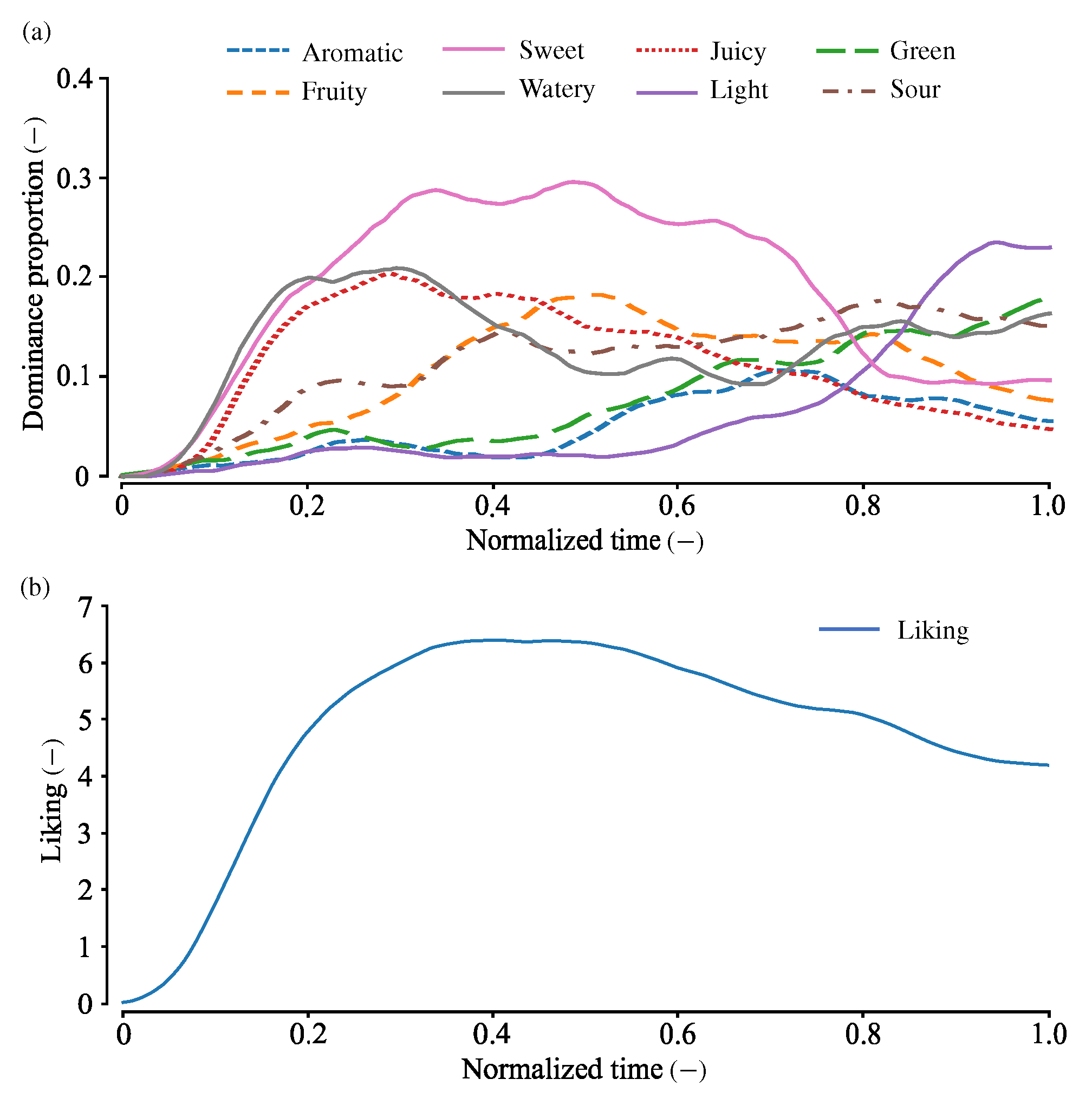
- Aromatic: complex and pleasant smell.
- Juicy: perception of juice and flesh content.
- Sweet: basic sweet taste.
- Fruity: smell of sweet fruits.
- Light: sweet taste that does not linger in the mouth.
- Watery: perception of water content without strong taste.
- Green: smell, taste, and mouthfeel of grass or unripe fruits.
- Sour: basic sour taste.
2.2. TDS and TL Curves Along Normalized Time
2.3. Example of TDS and TL Curves
2.4. Bootstrap Resampling of TDS and TL Curves and Cross-Validation Methods
3. Time-Series Expansion of Supervised Non-Negative Matrix Factorization
3.1. Classification of Matrix Factorization Techniques for Time-Series Data
3.2. Non-Negative Matrix Factorization for Vector-Valued Targets
3.3. Discretization and Alignment of Multivariate Time-Series Data
4. Results
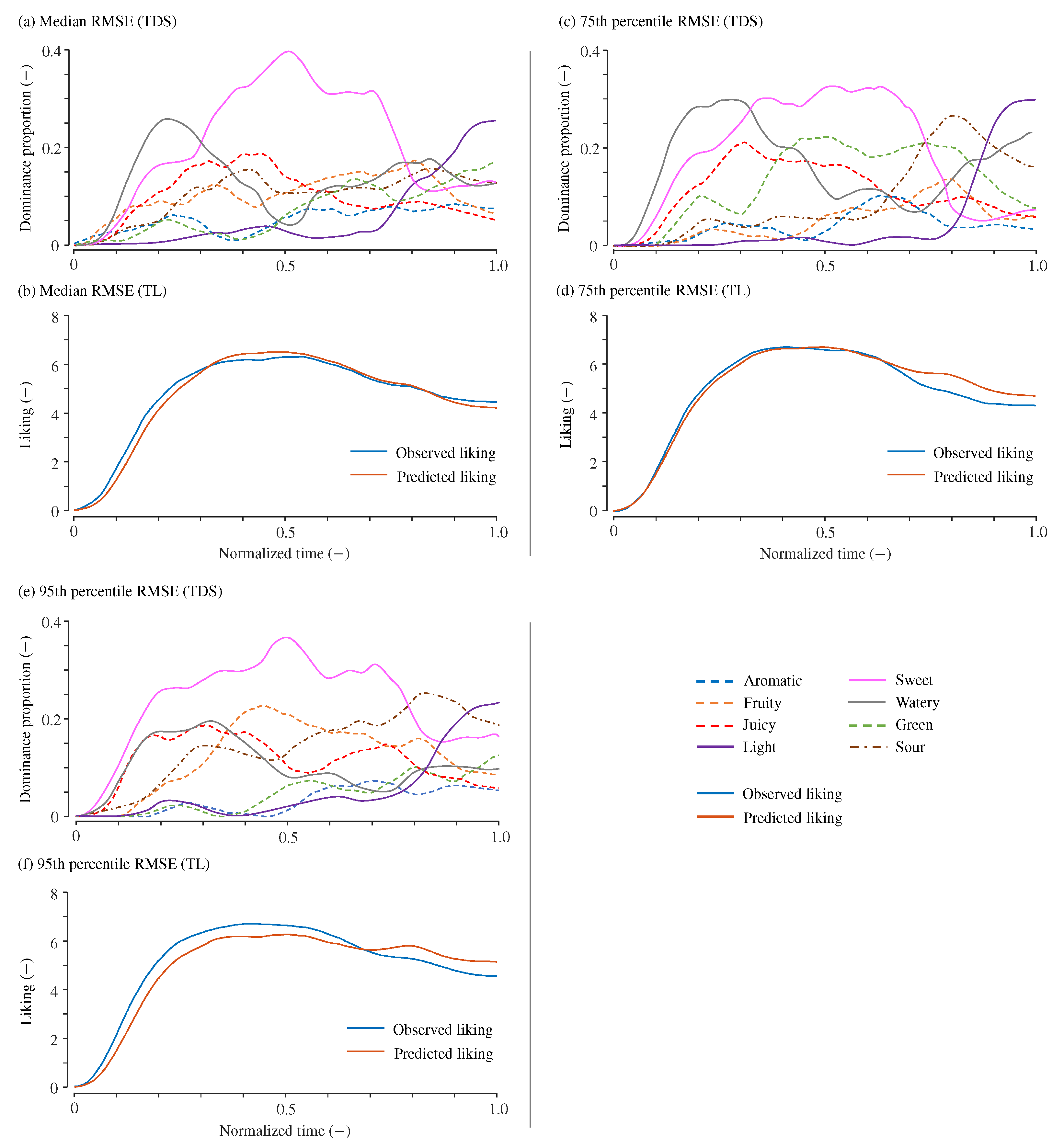
- For , the median RMSE was 0.3887 (25th percentile: 0.28; 75th percentile: 0.44).
- For , the median RMSE was 0.3623 (25th percentile: 0.28; 75th percentile: 0.44).
- For , the median RMSE was 0.3646 (25th percentile: 0.27; 75th percentile: 0.44).
- For , the median RMSE was 0.3679 (25th percentile: 0.27; 75th percentile: 0.44).
5. Discussion
5.1. Interpretation of the Three Principal Motions
5.2. General Discussion
6. Conclusions
Author Contributions
Funding
Institutional Review Board Statement
Informed Consent Statement
Data Availability Statement
Conflicts of Interest
Abbreviations
| TDS | Temporal Dominance of Sensations |
| TL | Temporal Liking |
| PLS | Partial Least Squares |
References
- Pineau, N.; Schlich, P.; Cordelle, S.; Mathonnière, C.; Issanchou, S.; Imbert, A.; Rogeaux, M.; Etiévant, P.; Köster, E. Temporal dominance of sensations: Construction of the TDS curves and comparison with time–intensity. Food Qual. Prefer. 2009, 20, 450–455. [Google Scholar] [CrossRef]
- ISO 13299; Sensory Analysis–Methodology–General Guidance for Establishing a Sensory Profile. Technical Report. International Organization for Standarzation: Geneva, Switzerland, 2016.
- Visalli, M.; Galmarini, M.V.; Schlich, P. Use of temporal sensory evaluation methods with consumers: A position paper. Curr. Opin. Food Sci. 2023, 54, 101102. [Google Scholar] [CrossRef]
- Correia, E.; Amorim, E.; Vilela, A. Structural Equation Modeling (SEM) and Temporal Dominance of Sensations (TDS) in the evaluation of DOC douro red wine’s sensory profile. Foods 2022, 11, 1168. [Google Scholar] [CrossRef] [PubMed]
- Okamoto, S.; Ehara, Y.; Okada, T.; Yamada, Y. Affective dynamics: Principal motion analysis of temporal dominance of sensations data. IEEE Trans. Affect. Comput. 2020, 13, 871–880. [Google Scholar] [CrossRef]
- Siqueira, A.P.S.; Siqueira, J.M.; Lopes, M.d.P.; Carneiro, B.S.; Pimentel, G.D. A preliminary lexicon for Juçara (Euterpe edulis martius) pulp: Possible applications for industry and clinical practice. Appl. Sci. 2024, 14, 11334. [Google Scholar] [CrossRef]
- Delompré, T.; Lenoir, L.; Martin, C.; Briand, L.; Salles, C. Characterizing the dynamic taste and retro-Nasal aroma properties of oral nutritional supplements using Temporal Dominance of Sensation and Temporal Check-All-That-Apply methods. Foods 2020, 9, 1456. [Google Scholar] [CrossRef]
- Castura, J.; Rutledge, D.; Ross, C.; Næs, T. Discriminability and uncertainty in principal component analysis (PCA) of temporal check-all-that-apply (TCATA) data. Food Qual. Prefer. 2022, 96, 104370. [Google Scholar] [CrossRef]
- Natsume, H.; Okamoto, S.; Nagano, H. Trajectory plots that highlight statistically different periods among multiple foods studied using the temporal dominance of sensations method. Food Sci. Technol. Res. 2024, 30, 491–499. [Google Scholar] [CrossRef]
- Baxter, L.; Dolan, E.; Frampton, K.; Richelle, E.; Stright, A.; Ritchie, C.; Moss, R.; McSweeney, M.B. Investigation into the sensory properties of plant-based eggs, as well as acceptance, emotional response, and use. Foods 2024, 13, 1454. [Google Scholar] [CrossRef]
- Thomas, A.; Visalli, M.; Cordelle, S.; Schlich, P. Temporal drivers of liking. Food Qual. Prefer. 2015, 40, 365–375. [Google Scholar] [CrossRef]
- Thomas Carr, B.; Lesniauskas, R.O. Analysis of variance for identifying temporal drivers of liking. Food Qual. Prefer. 2016, 47, 97–100. [Google Scholar] [CrossRef]
- Meyners, M. Temporal liking and CATA analysis of TDS data on flavored fresh cheese. Food Qual. Prefer. 2016, 47, 101–108. [Google Scholar] [CrossRef]
- Ares, G.; Alcaire, F.; Antúnez, L.; Vidal, L.; Giménez, A.; Castura, J.C. Identification of drivers of (dis)liking based on dynamic sensory profiles: Comparison of Temporal Dominance of Sensations and Temporal Check-all-that-apply. Food Res. Int. 2017, 92, 79–87. [Google Scholar] [CrossRef] [PubMed]
- Thomas, A.; Chambault, M.; Dreyfuss, L.; Gilbert, C.; Hegyi, A.; Henneberg, S.; Knippertz, A.; Kostyra, E.; Kremer, S.; Silva, A.; et al. Measuring temporal liking simultaneously to Temporal Dominance of Sensations in several intakes. An application to Gouda cheeses in 6 Europeans countries. Food Res. Int. 2017, 99, 426–434. [Google Scholar] [CrossRef]
- Nguyen, Q.C.; Varela, P. Identifying temporal drivers of liking and satiation based on temporal sensory descriptions and consumer ratings. Food Qual. Prefer. 2021, 89, 104143. [Google Scholar] [CrossRef]
- Natsume, H.; Okamoto, S. Prediction of temporal liking from temporal dominance of sensations by using reservoir computing and its sensitivity analysis. Foods 2024, 13, 3755. [Google Scholar] [CrossRef]
- Greis, M.; Sainio, T.; Katina, K.; Kinchla, A.J.; Nolden, A.; Partanen, R.; Seppä, L. Dynamic texture perception in plant-based yogurt alternatives: Identifying temporal drivers of liking by TDS. Food Qual. Prefer. 2020, 86, 104019. [Google Scholar] [CrossRef]
- Paglarini, C.d.S.; Vidal, V.A.S.; dos Santos, M.; Coimbra, L.O.; Esmerino, E.A.; Cruz, A.G.; Pollonio, M.A.R. Using dynamic sensory techniques to determine drivers of liking in sodium and fat-reduced Bologna sausage containing functional emulsion gels. Food Res. Int. 2020, 132, 109066. [Google Scholar] [CrossRef]
- González-Mohino, A.; Ventanas, S.; Estévez, M.; Olegario, L.S. Sensory characterization of Iberian dry-cured loins by using Check-All-That-Apply (CATA) analysis and multiple-intake temporal dominance of sensations (TDS). Foods 2021, 10, 1983. [Google Scholar] [CrossRef]
- Lenfant, F.; Loret, C.; Pineau, N.; Hartmann, C.; Martin, N. Perception of oral food breakdown. The concept of sensory trajectory. Appetite 2009, 52, 659–667. [Google Scholar] [CrossRef]
- Lecuelle, G.; Visalli, M.; Cardot, H.; Schlich, P. Modeling Temporal Dominance of Sensations with semi-Markov chains. Food Qual. Prefer. 2018, 67, 59–66. [Google Scholar] [CrossRef]
- Cardot, H.; Lecuelle, G.; Schlich, P.; Visalli, M. Estimating finite mixtures of semi-Markov chains: An application to the segmentation of temporal sensory data. J. R. Stat. Soc. Appl. Stat. Ser. C 2019, 68, 1281–1303. [Google Scholar] [CrossRef]
- Okada, T.; Okamoto, S.; Yamada, Y. Affective dynamics: Causality modeling of temporally evolving perceptual and affective responses. IEEE Trans. Affect. Comput. 2022, 13, 628–639. [Google Scholar] [CrossRef]
- Park, F.C.; Jo, K. Movement Primitives and Principal Component Analysis. In On Advances in Robot Kinematics; Lenarčič, J., Galletti, C., Eds.; Springer: Dordrecht, The Netherlands, 2004; pp. 421–430. [Google Scholar]
- Ivanenko, Y.P.; Poppele, R.E.; Lacquaniti, F. Five basic muscle activation patterns account for muscle activity during human locomotion. J. Physiol. 2004, 556, 267–282. [Google Scholar] [CrossRef] [PubMed]
- Funato, T.; Aoi, S.; Oshima, H.; Tsuchiya, K. Variant and invariant patterns embedded in human locomotion through whole body kinematic coordination. Exp. Brain Res. 2010, 205, 497–511. [Google Scholar] [CrossRef]
- Tresch, M.C.; Cheung, V.C.K.; d’Avella, A. Matrix Factorization Algorithms for the Identification of Muscle Synergies: Evaluation on Simulated and Experimental Data Sets. J. Neurophysiol. 2006, 95, 2199–2212. [Google Scholar] [CrossRef]
- Oshima, H.; Aoi, S.; Funato, T.; Tsujiuchi, N.; Tsuchiya, K. Variant and invariant spatiotemporal structures in kinematic coordination to regulate speed during walking and running. Front. Comput. Neurosci. 2019, 13, 63. [Google Scholar] [CrossRef]
- Mishima, K.; Kanata, S.; Nakanishi, H.; Sawaragi, T.; Horiguchi, Y. Extraction of similarities and differences in human behavior using singular value decomposition. IFAC Proc. Vol. 2010, 43, 436–441. [Google Scholar] [CrossRef]
- Shourijeh, M.S.; Flaxman, T.E.; Benoit, D.L. An Approach for Improving Repeatability and Reliability of Non-Negative Matrix Factorization for Muscle Synergy Analysis. J. Electromyogr. Kinesiol. 2016, 26, 36–43. [Google Scholar] [CrossRef]
- Qiu, C.; Okamoto, S.; Akiyama, Y.; Yamada, Y. Application of supervised principal motion analysis to evaluate subjectively easy sit-to-stand motion of healthy people. IEEE Access 2021, 9, 73251–73261. [Google Scholar] [CrossRef]
- Borzelli, D.; De Marchis, C.; Quercia, A.; De Pasquale, P.; Casile, A.; Quartarone, A.; Calabrò, R.S.; d’Avella, A. Muscle synergy analysis as a tool for assessing the effectiveness of gait rehabilitation therapies: A methodological review and rerspective. Bioengineering 2024, 11, 793. [Google Scholar] [CrossRef] [PubMed]
- Scano, A.; Lanzani, V.; Brambilla, C. How recent findings in electromyographic analysis and synergistic control can impact on new directions for muscle synergy assessment in sports. Appl. Sci. 2024, 14, 11360. [Google Scholar] [CrossRef]
- Natsume, H.; Okamoto, S. Cross-Brand Machine Learning of Coffee’s Temporal Liking from Temporal Dominance of Sensations Curves. Appl. Sci. 2025, 15, 948. [Google Scholar] [CrossRef]
- Shimaoka, N.; Okamoto, S.; Akiyama, Y.; Yamada, Y. Linking Temporal Dominance of Sensations for primary-sensory and multi-sensory attributes using canonical correlation analysis. Foods 2022, 11, 781. [Google Scholar] [CrossRef]
- Okamoto, S. Bootstrap Resampling of Temporal Dominance of Sensations Curves to Compute Uncertainties. Foods 2021, 10, 2472. [Google Scholar] [CrossRef]
- Kargo, W.J.; Nitz, D.A. Early Skill Learning Is Expressed through Selection and Tuning of Cortically Represented Muscle Synergies. J. Neurosci. 2003, 23, 11255–11269. [Google Scholar] [CrossRef]
- Ranaldi, S.; De Marchis, C.; Severini, G.; Conforto, S. An Objective, Information-Based Approach for Selecting the Number of Muscle Synergies to be Extracted via Non-Negative Matrix Factorization. IEEE Trans. Neural Syst. Rehabil. Eng. 2021, 29, 2676–2683. [Google Scholar] [CrossRef]
- Chen, X.; Feng, Y.; Chang, Q.; Yu, J.; Chen, J.; Xie, P. Muscle Synergy during Wrist Movements Based on Non-Negative Tucker Decomposition. Sensors 2024, 24, 3225. [Google Scholar] [CrossRef]
- Mileti, I.; Zampogna, A.; Santuz, A.; Asci, F.; Del Prete, Z.; Arampatzis, A.; Palermo, E.; Suppa, A. Muscle synergies in Parkinson’s disease. Sensors 2020, 20, 3209. [Google Scholar] [CrossRef]
- Berry, M.W.; Browne, M.; Langville, A.N.; Pauca, V.P.; Plemmons, R.J. Algorithms and applications for approximate nonnegative matrix factorization. Comput. Stat. Data Anal. 2007, 52, 155–173. [Google Scholar] [CrossRef]
- Torres-Oviedo, G.; Macpherson, J.M.; Ting, L.H. Muscle synergy organization is robust across a variety of postural perturbations. J. Neurophysiol. 2006, 96, 1530–1546. [Google Scholar] [CrossRef] [PubMed]
- Doré, S.; Kearney, R.E. Experimental evaluation of computerised tomography point spread function variability within the field of view: Parametric models. Med. Biol. Eng. Comput. 2004, 42, 591–597. [Google Scholar] [CrossRef] [PubMed]
- Pale, U.; Atzori, M.; Müller, H.; Scano, A. Variability of muscle synergies in hand grasps: Analysis of intra- and inter-session data. Sensors 2020, 20, 4297. [Google Scholar] [CrossRef]
- Oliver, P.; Cicerale, S.; Pang, E.; Keast, R. Check-all-that-applies as an alternative for descriptive analysis to establish flavors driving liking in strawberries. J. Sens. Stud. 2018, 33, e12316. [Google Scholar] [CrossRef]
- Lewers, K.S.; Newell, M.J.; Park, E.; Luo, Y. Consumer preference and physiochemical analyses of fresh strawberries from ten cultivars. Int. J. Fruit Sci. 2020, 20, 733–756. [Google Scholar] [CrossRef]
- Ikegaya, A.; Toyoizumi, T.; Ohba, S.; Nakajima, T.; Kawata, T.; Ito, S.; Arai, E. Effects of distribution of sugars and organic acids on the taste of strawberries. Food Sci. Nutr. 2019, 7, 2419–2426. [Google Scholar] [CrossRef]
- Liem, D.; Degraaf, C. Sweet and sour preferences in young children and adults: Role of repeated exposure. Physiol. Behav. 2004, 83, 421–429. [Google Scholar] [CrossRef]
- Sijtsema, S.J.; Reinders, M.J.; Hiller, S.R.; Dolors Guàrdia, M. Fruit and snack consumption related to sweet, sour and salty taste preferences. Br. Food J. 2012, 114, 1032–1046. [Google Scholar] [CrossRef]
- Törnwall, O.; Silventoinen, K.; Keskitalo-Vuokko, K.; Perola, M.; Kaprio, J.; Tuorila, H. Genetic contribution to sour taste preference. Appetite 2012, 58, 687–694. [Google Scholar] [CrossRef]
- Pagliarini, E.; Proserpio, C.; Spinelli, S.; Lavelli, V.; Laureati, M.; Arena, E.; Di Monaco, R.; Menghi, L.; Gallina Toschi, T.; Braghieri, A.; et al. The role of sour and bitter perception in liking, familiarity and choice for phenol-rich plant-based foods. Food Qual. Prefer. 2021, 93, 104250. [Google Scholar] [CrossRef]
- Liu, C.; Liu, W.; Lu, X.; Ma, F.; Chen, W.; Yang, J.; Zheng, L. Application of multispectral imaging to determine quality attributes and ripeness stage in strawberry fruit. PLoS ONE 2014, 9, e87818. [Google Scholar] [CrossRef] [PubMed]
- Wang, D.; Wang, X.; Chen, Y.; Wu, Y.; Zhang, X. Strawberry ripeness classification method in facility environment based on red color ratio of fruit rind. Comput. Electron. Agric. 2023, 214, 108313. [Google Scholar] [CrossRef]
- Hoyer, P.O. Non-negative matrix factorization with sparseness constraints. J. Mach. Learn. Res. 2004, 5, 1457–1469. [Google Scholar]
- Eggert, J.; Korner, E. Sparse coding and NMF. In Proceedings of the IEEE International Joint Conference on Neural Networks, Budapest, Hungary, 25–29 July 2004; Volume 4, pp. 2529–2533. [Google Scholar] [CrossRef]
- Du, K.L.; Swamy, M.N.S.; Wang, Z.Q.; Mow, W.H. Matrix factorization techniques in machine learning, signal processing, and statistics. Mathematics 2023, 11, 2674. [Google Scholar] [CrossRef]
- Sparacino, A.; Ollani, S.; Baima, L.; Oliviero, M.; Borra, D.; Rui, M.; Mastromonaco, G. Analyzing strawberry preferences: Best–worst scaling methodology and purchase styles. Foods 2024, 13, 1474. [Google Scholar] [CrossRef]
- Pineli, L.d.L.d.O.; Moretti, C.L.; dos Santos, M.S.; Campos, A.B.; Brasileiro, A.V.; Córdova, A.C.; Chiarello, M.D. Antioxidants and other chemical and physical characteristics of two strawberry cultivars at different ripeness stages. J. Food Compos. Anal. 2011, 24, 11–16. [Google Scholar] [CrossRef]

Disclaimer/Publisher’s Note: The statements, opinions and data contained in all publications are solely those of the individual author(s) and contributor(s) and not of MDPI and/or the editor(s). MDPI and/or the editor(s) disclaim responsibility for any injury to people or property resulting from any ideas, methods, instructions or products referred to in the content. |
© 2025 by the authors. Licensee MDPI, Basel, Switzerland. This article is an open access article distributed under the terms and conditions of the Creative Commons Attribution (CC BY) license (https://creativecommons.org/licenses/by/4.0/).
Share and Cite
Okamoto, S.; Natsume, H.; Watanabe, H. Synergy Analysis Between the Temporal Dominance of Sensations and Temporal Liking Curves of Strawberries. Foods 2025, 14, 992. https://doi.org/10.3390/foods14060992
Okamoto S, Natsume H, Watanabe H. Synergy Analysis Between the Temporal Dominance of Sensations and Temporal Liking Curves of Strawberries. Foods. 2025; 14(6):992. https://doi.org/10.3390/foods14060992
Chicago/Turabian StyleOkamoto, Shogo, Hiroharu Natsume, and Hiroki Watanabe. 2025. "Synergy Analysis Between the Temporal Dominance of Sensations and Temporal Liking Curves of Strawberries" Foods 14, no. 6: 992. https://doi.org/10.3390/foods14060992
APA StyleOkamoto, S., Natsume, H., & Watanabe, H. (2025). Synergy Analysis Between the Temporal Dominance of Sensations and Temporal Liking Curves of Strawberries. Foods, 14(6), 992. https://doi.org/10.3390/foods14060992



