Article

Spinach (Spinacia oleracea L.) Flavonoids Are Hydrolyzed During Digestion and Their Bioaccessibility Is Under Stronger Genetic Control Than Raw Material Content

1
USDA-ARS Children’s Nutrition Research Center, Department of Pediatrics, Baylor College of Medicine, 1100 Bates Ave., Houston, TX 77030, USA
2
Department of Biosciences, Rice University, 6100 Main St., Houston, TX 77005, USA
3
Thorne Research, 620 Omni Industrial Blvd., Summerville, SC 29483, USA
4
Independent Researcher, Columbus, OH 43210, USA
*
Author to whom correspondence should be addressed.
Foods 2025, 14(24), 4314; https://doi.org/10.3390/foods14244314
Submission received: 23 September 2025 / Revised: 2 December 2025 / Accepted: 9 December 2025 / Published: 15 December 2025

Abstract

Spinach (Spinacia oleracea L.) is a commonly consumed crop with a diverse array of unique flavonoids. These molecules likely contribute to the health benefits associated with spinach consumption. However, little is known about the genetic diversity of these molecules, their bioaccessibility, and the heritability of these traits. We assembled a diversity panel of 30 F1 and open-pollinated spinach accessions and cultivated them under controlled conditions over two periods. Quantification of 39 flavonoids revealed that their concentration is largely influenced by environmental factors, and at least two divergent branches in the spinach flavonoid biosynthesis pathway may exist. Despite generally similar trends in the amounts of major flavonoids, open-pollinated and F1 varieties of spinach could be distinguished based on the concentrations of minor flavonoid species. Broad-sense heritability estimates for absolute bioaccessibility accounted for more genetic variation than raw material content, suggesting that this trait is preferable for breeders seeking to alter the phytochemical profile of spinach. Lastly, we found that several spinach flavonoids are unstable under digestive conditions, which was made evident by the proportion of aglycones rising from 0.1% to approximately 15% of total flavonoids after digestion. Together, these data suggest that spinach flavonoid biosynthesis and bioaccessibility are complex and contextualize how these molecules may behave in vivo.

1. Introduction

Flavonoids are among an array of phytochemicals associated with positive health benefits from fruit- and vegetable-rich diets. They have been hypothesized to have antioxidative, anti-inflammatory, and anticarcinogenic properties in vivo [1,2,3]. Spinach (Spinacia oleracea L.) is a dietary source of flavonoids with significant concentrations reported up to and beyond 224 mg/100 g fresh weight [4,5,6,7]. While concentrations are high, the profile of flavonoids in spinach departs from what is typically found in fruits and vegetables. Spinach flavonoids feature a patuletin, spinacetin, or jaceidin backbone that is further modified by glycosylation, glucuronidation, and conjugation with phenolic acids [6,8]. Although little is known about the specific roles of spinach flavonoids on human health, they remain a trait of interest due to their structural similarity to more common dietary flavonoids [9,10].
Plant breeding programs tend to focus on increasing nutrients and/or phytochemicals in crops. However, increased amounts of a given substance in a plant do not guarantee greater bioefficacy. Food matrix factors such as protein, starch, and fiber can affect the release of a compound from food (bioaccessibility) and the absorption into the body (bioavailability) [11,12]. Bioaccessibility and bioavailability are becoming key considerations in breeding programs focusing on mineral elements in rice [13], wheat [14], common bean [15], maize [16], and sorghum [17]; carotenoids in maize [18], banana [19], and spinach [20]; and polyphenols in blueberries [21]. While randomized clinical trials in humans are considered the gold standard to assess the impact of either foods or molecules on health outcomes, they are costly and logistically challenging to operate. Bioaccessibility estimates from in vitro models of digestion associate well with human clinical data and are frequently used as a cost-effective surrogate to estimate bioavailability [22,23]. While bioaccessibility does not necessarily guarantee uptake into the body, release from the food matrix is a required step prior to absorption. These models are crucial for efficiently phenotyping populations of plants for plant breeders to make selections that might ultimately be used in clinical applications.
Only limited reports in the context of post-harvest processing exist for spinach flavonoid bioaccessibility. Freezing spinach preserves flavonoid profiles while modestly enhancing bioaccessibility, ostensibly through changes in the food matrix [24]. Processing techniques, such as spray drying and mixing with a protein carrier, have also been shown to modulate spinach flavonoid bioaccessibility in a processing-dependent manner [25]. There are currently no data on the role of genetic background on flavonoid bioaccessibility in spinach, and whether this trait is heritable in this crop. We hypothesized that spinach flavonoid bioaccessibility is heritable and a distinct trait from raw material flavonoid content.
The primary goals of this study were to define the range and concentration of flavonoids in a diverse population of spinach using a comprehensive ultra-high performance liquid chromatography mass spectrometry (UHPLC-MS/MS) method, determine the bioaccessibility of spinach flavonoids using a three-stage static in vitro digestion model coupled with UHPLC-MS/MS, and to determine the broad-sense heritability of spinach bioaccessibility. These data would serve as a resource to plant breeders seeking to optimize the potential health benefits of spinach and to allow for the development of unique germplasm that can be tested in clinical settings.

2. Materials and Methods

2.1. Chemicals and Reagents

Reagents purchased from Sigma Aldrich (Sigma Chemical Co., St. Louis, MO, USA) included quercetin-3-glucoside (99%), naringin (99%), naringenin (99%), mucin, alpha-amylase (lot: SLCM1439), pepsin (lot: SLCG6556), lipase (lot: SLCJ9303), pancreatin (lot: SLCK9806), and bile (lot: SLCJ7934). Urea, uric acid, potassium chloride, sodium sulfate, sodium phosphate, sodium chloride, sodium bicarbonate, LC-MS grade water, acetonitrile, methanol, and formic acid were purchased from Fisher Scientific (Fisher Scientific, Waltham, MA, USA). Patuletin (99%) was purchased from Extrasynthese (Extrasynthese, Genay, France), and jaceidin (99%) and spinacetin (99%) were purchased from Key Organics (Key Organics, Camelford, United Kingdom). Taxifolin (99.99%) was purchased from Selleck Chemicals (Selleck Chemical LLC, Houston, TX, USA). StrataX polymeric reversed-phase solid-phase extraction (SPE) cartridges (30 mg, 33 µm pore size, 1 mL volume) were purchased from Phenomenex (Torrance, CA, USA).

2.2. Germplasm Selection and Growth Conditions

Thirty spinach accessions were selected to maximize genetic variation in our population based on previous sequencing and phenotyping efforts [20,26]. Accessions previously genotyped by Qin and colleagues were selected from unique sub-populations separated by sequence diversity as determined by STRUCTURE2 and MEGA6 [27,28]. Germplasm previously characterized by Hayes and colleagues was selected for this study based on variation in carotenoid bioaccessibility. Additional metadata for each accession can be found in Supplemental Table S1.
Spinach plants were cultivated according to Qin and others, with modifications described by Dzakovich and colleagues [6,26]. For each cultivar, seedlings were thinned to six individual plants per one-gallon pot. Pots were randomly distributed throughout a PGW36 walk-in growth chamber (Conviron; Winnipeg, Canada) maintained at 300 μmols/m2/s photosynthetically active radiation for 12 h per day, 50  ±  10% relative humidity, and 20  ±  0.5 °C/15  ±  0.5 °C day and night temperatures, respectively. Plant positions were re-randomized each day to mitigate positional differences in environmental factors such as light intensity. Plants were considered mature at the six-to-eight leaf stage (five to six weeks after sowing), when edible tissues were harvested and stored at −80 °C until analysis. This population was grown and harvested as described above twice.

2.3. Sample Processing

Frozen tissue was homogenized 1:1 with MilliQ water for approximately one minute using a VWR 250 Homogenizer, 10032-766 (Radnor, PA, USA). Homogenate was immediately aliquoted for raw material analysis, in vitro digestion, and dry matter content. Homogenates were stored at -80 °C until use. All subsequent analyses were conducted in triplicate.

2.4. In Vitro Digestion

Spinach samples were subject to a three-phase static in vitro digestion method described previously for food products, including spinach and sorghum [20,29,30]. In the oral phase, spinach homogenate (0.4 g) was mixed with 1.2 mL of simulated saliva containing 31.8 mg/mL alpha-amylase, incubated at 37 °C for 10 min at 120 oscillations per minute (OPM). During the gastric phase, 0.4 mL of 10 mg/mL pepsin solution in 0.1 M HCl was added, and samples were further diluted with 2.7 mL of saline (0.9% NaCl). Sample pH was adjusted to 2.5 using 1.0 M HCl. Saline was added to dilute samples to 8 mL, and the sample headspace was replaced with nitrogen gas prior to incubation at 37 °C for 1 h at 120 OPM. Sample pH was then adjusted to 5.0 using 1.0 M NaHCO3 to initiate the intestinal phase. Pancreatin-lipase solution (0.4 mL; 20 mg/mL) in 0.1 M NaHCO3 and porcine bile extract (0.6 mL; 30 mg/mL) were added, and the sample pH was adjusted to 7.0. Sample volumes were adjusted to 10 mL using saline prior to an additional blanketing with nitrogen gas. Samples were then incubated at 37 °C for 2 h at 120 OPM. At the end of the intestinal phase, digesta was aliquoted, and 4 mL were stored at −80 °C for later analysis. The remaining digesta were blanketed with nitrogen gas and centrifuged at 3428× g for 75 min at 4 °C (Eppendorf 5920R). Approximately 4 mL of each aqueous fraction was filtered through 0.22 µm cellulose acetate filters and reserved to quantify bioaccessible flavonoids.

2.5. Extraction of Flavonoids from Fresh Spinach and Aqueous Fractions

Flavonoids were extracted in duplicate using the traditional method previously described by Dzakovich and others [6]. Dried spinach flavonoid extracts were redissolved and diluted to an equivalent volume of 25 mL of 1:1 methanol:water + 0.1% formic acid containing 4% 20 µM taxifolin as an internal standard to correct for variation in mass spectrometer response prior to filtration through 0.2 µm PTFE filters. Flavonoids from aqueous fractions were semi-purified using SPE. Aqueous fractions (500 μL) were pipetted into 3 mL Strata-X 33 µm, 30 mg polymeric reversed phase SPE cartridges (Phenomenex), and diluted with 2500 μL of 0.1% formic acid in water. Samples were loaded under vacuum and rinsed with one volume of 0.1% formic acid in water, followed by one volume of 1.0% formic acid in water. Cartridges were dried under vacuum for approximately 10 min and rinsed with one volume of hexane to remove nonpolar and semi-polar impurities (e.g., carotenoids). Cartridges were dried for 2 min under vacuum and analytes were eluted with 2 mL of methanol with 0.1% formic acid. Vials of eluent were dried under a stream of nitrogen gas and resolubilized in 500 μL of 1:1 methanol:water with 0.1% formic acid and 4% 20 µM taxifolin as an internal standard. Samples were passed through 0.2 µm PTFE filters and into LC vials prior to analysis.

2.6. Recovery Estimates from SPE

Separate spike addition experiments were conducted to optimize the recovery of flavonoids from aqueous fractions. Spinach-free digesta was created using the in vitro digestion protocol detailed above and spiked with jaceidin, patuletin, spinacetin, naringenin, and naringin. Various washing and elution conditions were tested using the methods of Mengist and colleagues as a starting point [21]. Methanol with 0.1% formic acid produced the most consistent and high-yielding results with estimated recoveries of 87%, 91%, 111%, 98%, and 99% for jaceidin, patuletin, spinacetin, naringenin, and naringin, respectively.

2.7. Analysis of Spinach Flavonoids

Flavonoids from both spinach fresh tissue and aqueous extracts were analyzed using a UHPLC-MS/MS method developed by Dzakovich and colleagues [6]. Briefly, flavonoids were separated on a Waters Acquity BEH C18 2.1 × 100 mm (1.7 µm particle size) column using a gradient of 0.1% formic acid in water (A) and 0.1% formic acid in acetonitrile (B). Column eluent flowed into a TSQ Altis tandem mass spectrometer (ThermoFisher), and spinach flavonoids were quantified against the external standard quercetin-3-O-glucoside when an authentic standard was not available. Optimized multiple reaction monitoring (MRM) experiments for 39 spinach flavonoids, including isomers, to maximize the signal-to-noise of each analyte. Dwell times were automatically adjusted to maintain 12–15 points per peak, and the analyte signal was corrected for using taxifolin. Spinacetin was excluded from analyses due to being below the limit of quantification for all samples and sample types.

2.8. Statistical Analysis

Plants were grown in a randomized complete block design with two replications in time and analyzed with the following model parameters:
Y ^ i j = µ + G i + B j + G i : B j + ε i j
where Ŷij represents an analyte estimate; μ is the population mean for an analyte; Gi represents genetic factors; Bj represents the contribution from block; Gi:Bj represents the interaction between genotype and block; and ε i j is the residual error.
Relative bioaccessibility was defined as follows:
R B   ( % ) = C o n c e n t r a t i o n   o f   a n a l y t e   i n   a q u e o u s   f r a c t i o n C o n c e n t r a t i o n   o f   a n a l y t e   i n   r a w   m a t e r i a l × 100
Absolute bioaccessibility (mg/100 g FW) was defined as follows:
A B = R B × C o n c e n t r a t i o n   o f   a n a l y t e   i n   r a w   m a t e r i a l
All statistical analyses and data visualization were performed using R statistical software v. 4.5.2 [31]. Linear modeling, including the calculation of best linear unbiased estimates (BLUEs) and random effects modeling, was conducted using the package ‘lme4’ [32]. The restricted maximum likelihood (REML) was used to estimate variance components to calculate broad-sense heritability [32]. Correlations were calculated and visualized using the ‘Corrplot’ package [33], while principal components were calculated using ‘FactoMineR’ and visualized with ‘ggplot2’ and ‘plotly’ [34,35]. Hierarchical clustering to determine chemical similarity using Tanimoto coefficients was conducted with the package ‘ChemmineR’ [36].

3. Results and Discussion

3.1. Spinach Flavonoid Profiles Are Diverse, but Dominated by Five Molecules

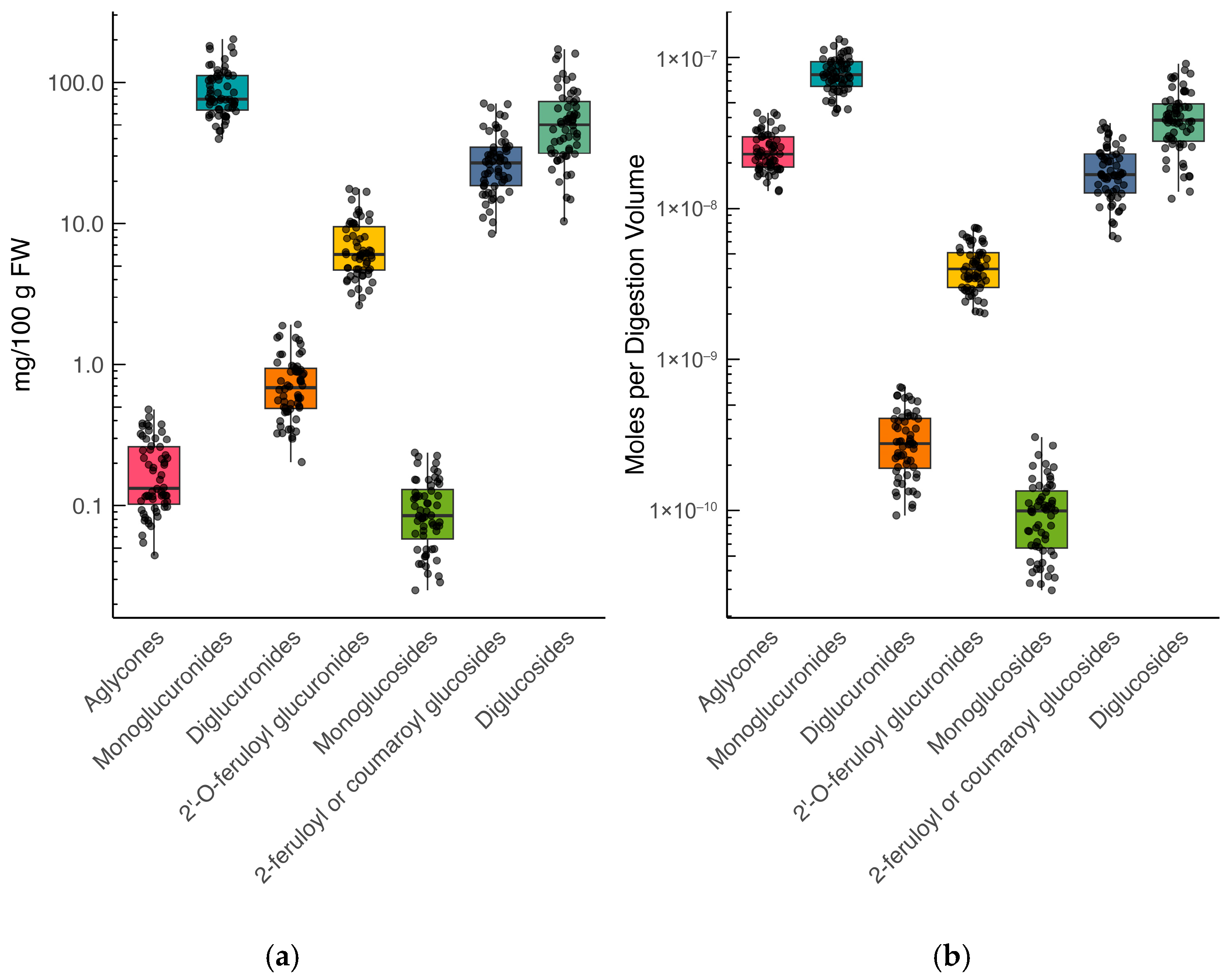
To determine the range and diversity of spinach flavonoid raw material content and bioaccessibility, we grew 30 unique accessions comprising both F1 varieties and open-pollinated accessions over two periods of time. Approximately 56.5% of spinach flavonoids in raw material were patuletin-derived, while the remaining 31.6%, 6.7%, and 5.3% were derived from methylenedioxyflavones, spinacetin, and jaceidin. Concentrations in raw material ranged from 64.3 to 453.7 mg/100 g fresh weight (FW), with an average concentration of 185.8 mg/100 g FW (Supplemental Table S2). On average, approximately 67% of the total flavonoid profile was represented by five analytes, including 5,3’,4’-Trihydroxy-3-methoxy-6:7-methylendioxyflavone-4-β-D-glucuronide (519.08 m/z), Spinatoside (521.09 m/z), Patuletin-3-O-β-D-2-ρ-coumaroyl glucopyranosyl-(1→6)-β-D-glucopyranoside (801.21 m/z), 5,4 -Dihydroxy-3,3-dimethoxy-6:7-methylendioxyflavone-4-β-D-glucuronide (533.09 m/z), and Patuletin-3-O-β-D-(2-feruloyl glucopyranosyl)-(1→6)-[β-D-apiofuranosyl-(1→2)]-β-D-glucopyranoside (963.24 m/z) (Supplemental Table S2). The profile and concentration ranges of spinach flavonoids in our population were consistent with previous reports [6,7,37,38]. Ranges of aggregated flavonoid classes presented on a log10 transformed y-axis can be found in Figure 1.

3.2. Minor Flavonoids Drive Differences Between F1 and Open-Pollinated Spinach Lines

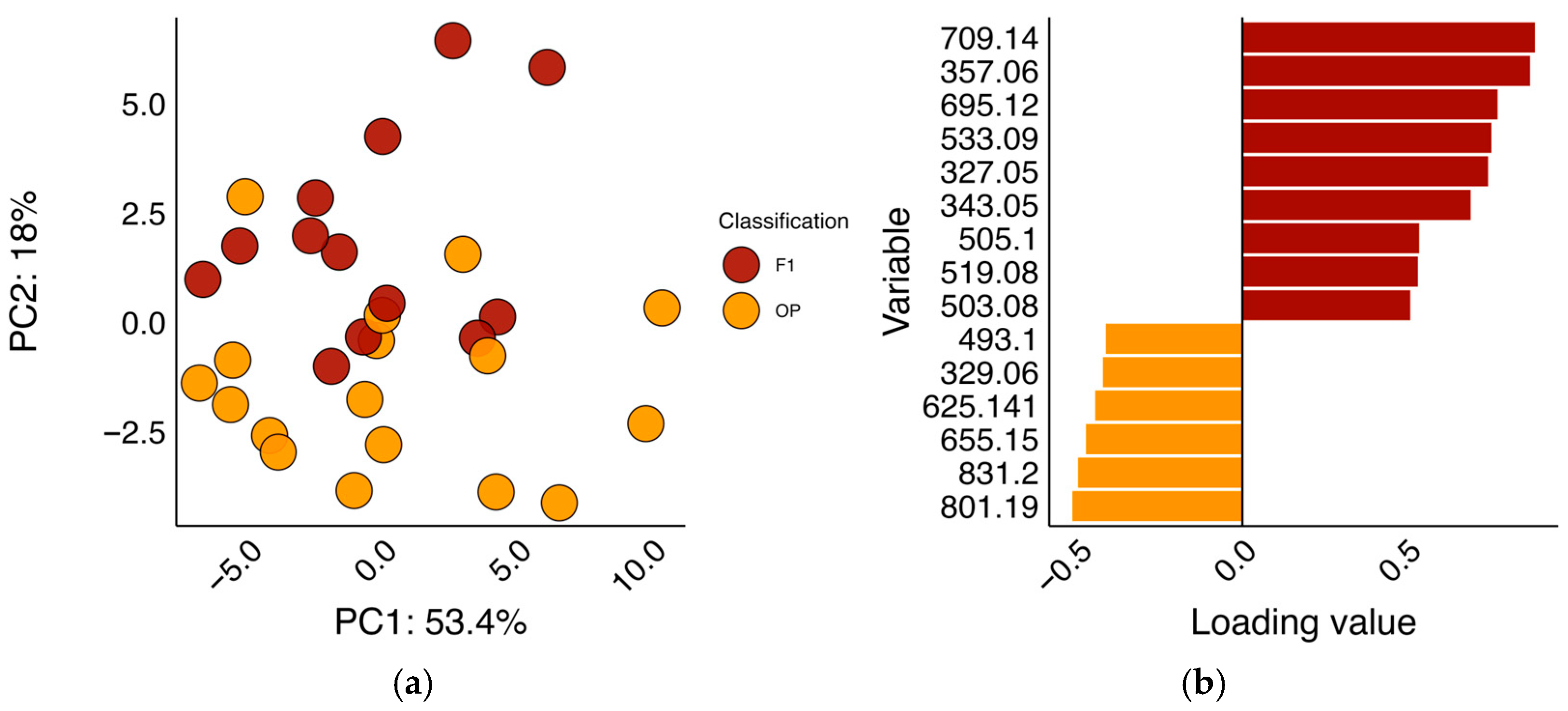
Multivariate analysis using PCA revealed a distinction between open-pollinated and F1 spinach varieties (Figure 2; Supplemental Figure S1). Although PC1 explained a large proportion of total variance (53.4%, Figure 2), F1 varieties and open-pollinated lines separated primarily on PC2 (17.95% total variation). The most influential variables explaining separation in PC2 are shown in Figure 2b and colored based on whether the analyte was higher in F1 or open-pollinated spinach varieties. An interactive loadings plot of all variables can be found in Supplemental Figure S1. Individual loadings for the input variables indicated that several minor flavonoids, such as 5,4’-Dihydroxy-3,3’-dimethoxy-6:7-methylen-dioxyflavone-4’-β-D-2′-O-feurloyl-glucuronide (709.14 m/z), contributed to the differentiation between F1 and open-pollinated lines (Figure 2b). Although low in concentration relative to other flavonoids (0.53–6.62 mg/100 g FW), 709.14 m/z was on average 53.7% higher in F1 spinach varieties compared to open-pollinated lines with similar trends for other variables (p < 0.001; Supplemental Table S3). Similar trends were true for other minor flavonoids that were higher in F1 spinach varieties (Figure 2b). These flavonoids may have been inadvertently selected for commercial germplasm. Flavonoids and other polyphenols have been reported to be influenced by human selection in other crops such as lettuce [39] and apple [40]. Alternatively, differences in minor flavonoids may be due to an overall increase in all flavonoids. Although statistically nonsignificant in our population (p > 0.05), our data shows that F1 spinach varieties were, on average, lower in total flavonoids compared to open-pollinated lines (176.65 vs. 192.93 mg/100 g FW; Supplemental Tables S2 and S3). Increases in minor flavonoids seen in F1 spinach varieties may be a consequence of lower competition for precursors and/or differences in enzymatic gene expression or enzyme efficiency. This phenomenon has been observed for carotenoids in crops such as maize [18,41], soybean [20,42], and tomato [43], as well as polyphenols in apple [44], maize [45], and rice [46,47,48]. Additional follow-up experiments coupling next-generation sequencing with an expanded population of wild and cultivated spinach are necessary to define the mechanism of this phenomenon in spinach.

3.3. Raw Material Content and Absolute Bioaccessibility Are Generally Associated, but Several Negative Associations Exist

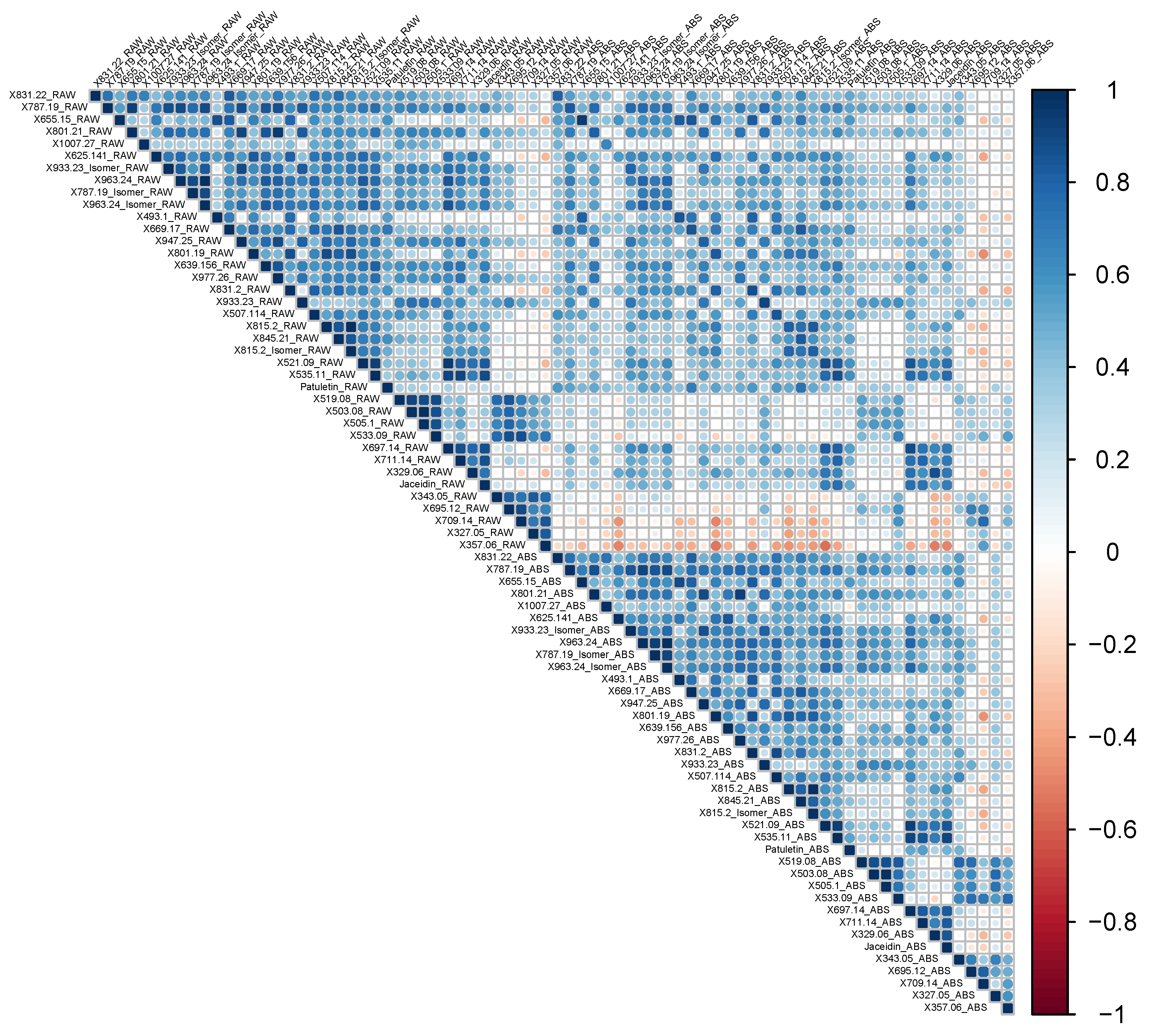
To better understand the relationships between spinach flavonoids as well as raw content and absolute bioaccessibility, we performed correlation analyses (Figure 3). Matrices of Pearson’s correlation coefficients and p-values can be found in Supplemental Table S4. Generally, individual flavonoids were positively associated with each other, indicating that concentrations rose and fell in concert. However, several analytes were negatively correlated with most other spinach flavonoids, including 5,4’-Dihydroxy-3,3’-dimethoxy-6,7-methylenedioxyflavone (357.06 m/z), 5,4’-Dihydrox-3-methoxy-6,7-methylenedioxyflavone (327.05 m/z), 709.14 m/z, 695.12 m/z, 5,3,4-Trihydroxy-3-methoxy-6:7-methylendioxyflavone (343.05 m/z), and, to a limited degree, 5,4-Dihydroxy-3,3-dimethoxy-6:7-methylendioxyflavone-4-β-D-glucuronide (533.09 m/z), as in Figure 3. Interestingly, these are the same analytes that appeared to drive differences between F1 and open-pollinated germplasm (Figure 2). Absolute bioaccessibility correlated well with raw material content (Figure 3), which is consistent with other reports in the literature [21,25,49,50,51]. A few analytes, such as Spinacetin-3-O-β-D-glucopyranosyl-(1→6)-[β-D-apiofuranosyl-(1→2)]-β-D-glucopyranoside (801.19 m/z), displayed negative associations with the analytes mentioned above (e.g., 709.14 m/z), both in raw content and absolute bioaccessibility. Raw data for relative and absolute bioaccessibility can be found in Supplemental Tables S5 and S6, respectively.
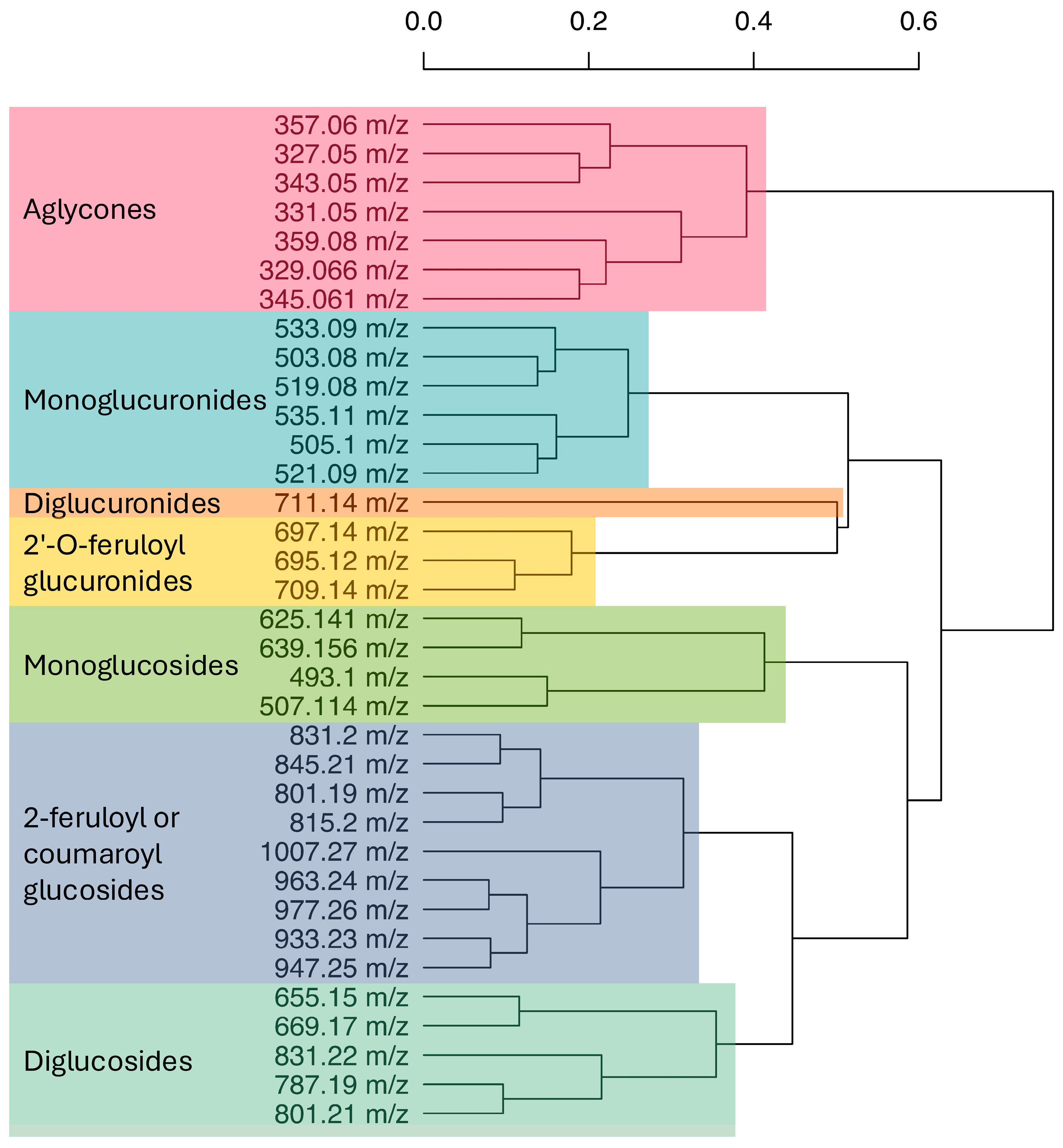
Given that the analytes with negative correlation coefficients are methylenedioxyflavones, we hypothesize that the trends we observed are due to a split in the spinach flavonoid biosynthesis pathway, whereby select methylenedioxyflavones compete for precursor molecules that feed into multiple segments of the pathway. While there have been strides to characterize the flavonoid profiles of spinach [6,7,8], the structural and regulatory aspects of this pathway remain largely unknown. Using Tanimoto coefficients, we sorted analytes profiled by our method using hierarchical clustering (Figure 4). Structures and SMILES abbreviations of each analyte in our UHPLC-MS/MS method can be found in Supplemental Table S7. These data were used in determining groups of aggregated flavonoids presented here (Figure 1; Supplemental Table S2). Clustering organized analytes by structural motifs and may suggest biosynthetic relationships among different spinach flavonoids. Similarity based on structural motifs may indicate common enzymes that act on multiple substrates. Additional studies leveraging genomic tools and techniques, such as virus-induced gene silencing, are necessary to definitively map the spinach flavonoid biosynthesis pathway.

3.4. Spinach Flavonoid Absolute Bioaccessibility Is More Heritable than Flavonoid Content in Raw Material

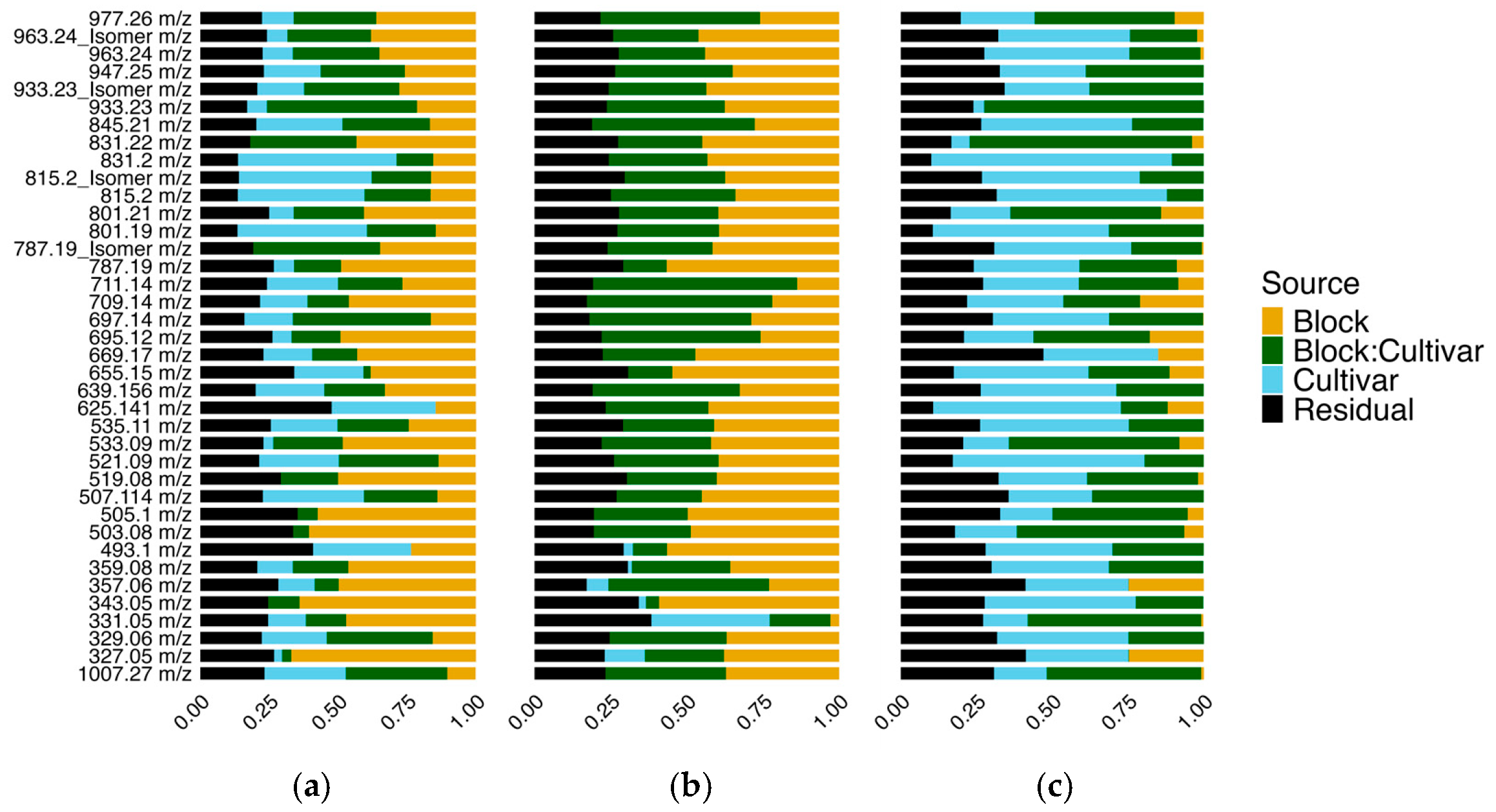
To define the contribution of genetics relative to environmental factors, we calculated broad-sense heritability on a line-mean basis for raw material content, relative bioaccessibility, and absolute bioaccessibility [52]. A graphical illustration of variance partitioning for model components cultivar, block, block:cultivar interaction, and residual can be seen in Figure 5. Variance for each model component for every analyte can be found in Supplemental Table S8. Broad-sense heritability for raw material content ranged from 0 to 63%, with an average of 22% (Supplemental Table S8). Contrary to our expectations, relative bioaccessibility exhibited extremely low estimates of broad-sense heritability, 0–31%, with an average of only 2%. For virtually every analyte in relative bioaccessibility, most of the variation is partitioned into either block or block:cultivar interaction. This interaction was particularly dominant because relative bioaccessibility is a ratio between the concentration of an analyte in the aqueous fraction relative to the starting content in the raw material. Ratios can introduce distortions, as slight changes in the denominator (raw material concentration) can greatly amplify environmental effects. Given how prominent environmental effects are for raw material flavonoid concentration (Figure 5a), this phenomenon explains why the block:cultivar interaction dominated variance estimates contributing to relative bioaccessibility in our data, as well as other published studies. Reports of broad-sense heritability estimates for flavonoids in spinach, or other leafy greens, are scant. A similar trend of moderately high estimates of broad-sense heritability for relative content and absolute bioaccessibility, but extremely low for relative bioaccessibility, has been reported in blueberries [21]. Broad-sense heritability estimates for quercetin-3-arabidonside, quercetin-3-glucoside, and total flavonoids in blueberries were all 10% or less for relative bioaccessibility, but substantially higher for raw material and absolute bioaccessibility [21]. These findings echo our own and highlight a disconnect between raw material content and absolute bioaccessibility.
Interestingly, absolute bioaccessibility, which is a product of raw material content multiplied by relative bioaccessibility, showed the highest estimates of broad-sense heritability (Supplemental Table S8). Broad-sense heritability for absolute bioaccessibility ranged from 4 to 76%, with an average of 34%. Four analytes were estimated to be greater than 50%, which included Spinacetin-3-O-β-D-(2-feruloyl glucopyranosyl)-(1→6)-[β-glucopyranosyl (1→2)]-β-D-glucopyranoside (625.141 m/z), (801.19 m/z), Patuletin-3-O-β-D-2-feruloyl glucopyranosyl-(1→6)-β-D-glucopyranoside (831.2 m/z), and 521.09 m/z (Supplemental Table S8). Only six analytes had broad-sense heritability estimates that were equal to or less than raw material content, supporting the assertion that absolute bioaccessibility is under stronger genetic control than raw material content. This outcome is intriguing given that relative bioaccessibility was estimated near 0% for 30 out of 38 analytes measured.
Absolute bioaccessibility is a product of raw material content and relative bioaccessibility [53]. Our findings that absolute bioaccessibility heritability exceeded raw material heritability suggest that traits related to digestion efficiency (e.g., cell wall composition) are under stronger genetic control and are more stable than flavonoid concentration. Similar findings have been reported for iron in maize [42] and carotenoids in spinach [20]. Heritability of absolute bioaccessibility may appear higher because absolute bioaccessibility combines the genetic differences in relative content with environmental variation in relative bioaccessibility, creating larger total differences in absolute bioaccessibility between genotypes. Even with low relative bioaccessibility, as is the case in our dataset, plants with slightly higher relative content tend to have higher absolute bioaccessibility on average, making absolute bioaccessibility more genetically predictable than relative content alone. Regardless, environmental factors tended to be a major influence on the phenotypes we measured.
While our data suggest that breeding for flavonoid content and profiles in spinach would be possible, but challenging, significant opportunities exist in controlled environment agriculture (CEA) to directly manipulate these traits by controlling plant growth conditions. Flavonoid biosynthesis is strongly controlled by light quantity and quality [54,55], temperature [56,57], and abiotic stress, such as salinity [58]. Advances such as light-emitting diodes (LEDs) allow for precise control of the light environment, and other environmental parameters can be manipulated in modern CEA systems [59,60,61]. Additional research is necessary to determine how environmental conditions can be leveraged to fine-tune the flavonoid profiles of spinach.
Although absolute bioaccessibility exhibited the highest broad-sense heritability of nearly all phenotypes measured in this study, estimates tended to be relatively low compared to other crops [21,62,63,64]. One possibility is due to the nature of spinach itself, which is a highly heterozygous, wind-pollinated outcrossing species [65,66,67]. Of the 30 accessions profiled in our study, 17 were open-pollinated (Supplemental Table S1). Open-pollinated accessions can breed true when cultivated under controlled conditions, but there is no guarantee of genetic uniformity seen in cultivated F1 varieties. As such, it is distinctly possible that some of our open-pollinated or heirloom accessions, many have been segregating for any number of traits. Our population structure may have had unaccounted genetic variation that manifested as environmental variation. Future experiments can be conducted with larger populations comprising cultivated F1 varieties to better understand the consequences of open pollination practices on flavonoid heritability. Regardless, heritability estimates for absolute bioaccessibility outperformed raw material content, and this trait may be preferable for plant breeders to select against when considering potential health implications of their spinach germplasm.

3.5. Some Spinach Flavonoids Are Hydrolyzed During Digestion

Our estimates of relative bioaccessibility align with the limited reports in the literature that only monitored parts of the spinach flavonoid biosynthetic pathway [24,25]. Estimates of relative bioaccessibility theoretically range from 0 to 100%. However, several analytes in our study exceeded 100%, such as 343.05 m/z, with relative bioaccessibility estimates ranging from 569.5 to 9489.1% (Supplemental Table S5). Over 99.9% of spinach flavonoids are O-glycosylated in raw spinach [6], yet this proportion shrinks to approximately 85% after digestion with a proportional rise in aglycones (Figure 1; Supplemental Table S2). Compared to C-linked glycosylated flavonoids, O-linked glycosylated flavonoids are considerably weaker and more prone to chemical hydrolysis [2]. In vitro digestions, such as the one conducted in this study, feature a 1 h gastric phase at pH 2.0 at 37 °C. While there is debate as to whether gastric conditions are sufficient to induce chemical hydrolysis [68,69], there is evidence to suggest that hydrolysis may occur with some polyphenols [21,70]. For example, Mengist and colleagues reported up to 4900% relative bioaccessibility for caffeic acid and over 100% relative bioaccessibility for catechin, epicatechin, flavon-3-ols, and total flavonoids. Given that some of these molecules have been found to be condensed with other analytes, like anthocyanins [45], it is feasible that analytes reported at >100% relative bioaccessibility may be degradation products formed during digestion from more complex phytochemicals. Grace and colleagues did not report relative bioaccessibility over 100% for any of the 18 spinach flavonoids they tracked, but reported 533.09 m/z above 90% in some of their treatments [25]. In animals and humans, we would anticipate this conversion to occur at an even greater rate due to enzymatic activity at the brush border [71,72] and interactions with the gut microbiome [1,73].
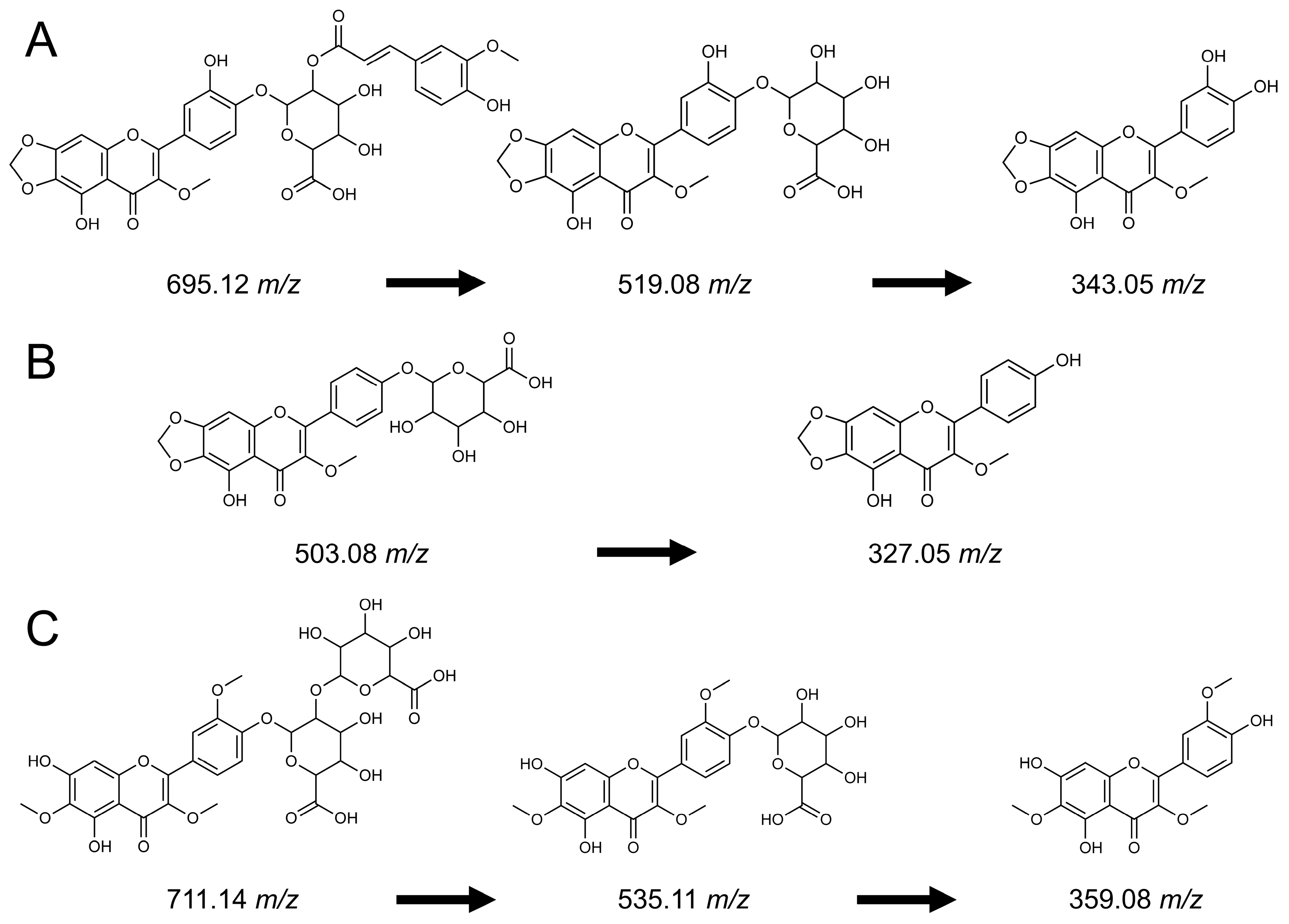
In vitro digestions similar to the one conducted in this study provide a cost-effective way to screen germplasm for bioaccessibility, a measure that generally associates well with bioavailability for many molecules [11]. Analytes we observed to increase after digestion increased at the expense of other analytes. For example, 695.12 m/z had an average relative bioaccessibility of 22.6%, the structurally related 519.08 m/z at 20.6%, and the aglycone 343.05 m/z at 2953.6% (Supplemental Table S5; Figure 6A). We hypothesize that the elevated appearance of 343.05 m/z was due to the successive loss of ferulic acid from 695.12 m/z and the loss of glucuronic acid from 519.08 m/z. Similar trends were noticed for other analytes, and hypothetical degradation reactions are proposed (Figure 6B,C). Additional proposed reactions not shown in Figure 6 include 709.14 m/z to 357.06 m/z and Spinatoside-4’-β-D-(2′-O-feruloyl-glucuronide) (697.14 m/z) to Patuletin (331.05 m/z). While the relative bioaccessibility estimates reported here are quite large for some aglycones, these analytes are among the least abundant flavonoids in raw spinach and are found in nanomolar concentrations. Small increases in these molecules result in relatively large percent increases. While these data suggest a simultaneous over- and slight under-estimation of some analytes, in vitro digestions still represent an invaluable tool to contextualize the potential health benefits of a food or food product. Studies leveraging isolated molecules and potentially intrinsic labeling would be necessary to elucidate their true absorption, distribution, metabolism, and excretion. Regardless, estimates provided here serve as the most comprehensive profiling of spinach flavonoids pre- and post-in vitro digestion to date and will help breeders and nutrition scientists make data-driven decisions about this crop.

4. Conclusions

Here, we reported the range and concentrations of flavonoids in a diverse population of spinach, estimated relative and absolute bioaccessibility of these molecules, and calculated the broad-sense heritability for these traits. These data were generated using a novel mass spectrometry methodology that allows for a comprehensive view of the spinach flavonoid pathway. While follow-up studies are necessary to determine bioavailability, these data address critical gaps in knowledge about the profiles and bioaccessibility of these molecules. Our data suggest that there may be at least one split in the spinach flavonoid biosynthetic pathway, whereby several methylenedioxyflavone species compete for common precursors required for the biosynthesis of other molecules.
We found that absolute bioaccessibility is more heritable than raw material content in the context of spinach flavonoids and will be of interest to plant breeders seeking to improve the phytochemical content of spinach. Indications that environmental factors play a major role in both flavonoid biosynthesis and bioaccessibility provide numerous opportunities for the CEA community to develop environmental manipulation strategies that could alter the phytochemical profile and potential health benefits of spinach. Additionally, we discovered that several spinach flavonoids appear to be susceptible to chemical transformation during digestion, which would be enhanced in vivo due to brush border enzymes and microbiome activity. Many opportunities exist to utilize genomic and metabolomic tools to fully characterize this pathway, define genetic and environmental cues that regulate this pathway, define the bioavailability of these molecules, and determine their impact on human health.

Supplementary Materials

The following supporting information can be downloaded at https://www.mdpi.com/article/10.3390/foods14244314/s1.

Author Contributions

Conceptualization, M.P.D.; methodology, M.P.D., A.L.T., E.A.L., B.W.R., and G.A.D.; software, M.P.D. and R.P.D.; validation, M.P.D.; formal analysis, M.P.D.; investigation, M.P.D., R.P.D., A.L.T., and E.A.L.; resources, M.P.D.; data curation, M.P.D.; writing—original draft preparation, M.P.D.; writing—review and editing, M.P.D., A.L.T., E.A.L., R.P.D., B.W.R., and G.A.D.; visualization, M.P.D. and R.P.D.; supervision, M.P.D.; project administration, M.P.D.; funding acquisition, M.P.D. All authors have read and agreed to the published version of the manuscript.

Funding

This research was funded by USDA-ARS CRIS project 3092-10700-066-001S, as well as by the Texas Children’s Hospital Pediatric Pilot Award 69513-I.

Institutional Review Board Statement

Not applicable.

Informed Consent Statement

Not applicable.

Data Availability Statement

The original contributions presented in this study are included in the article/Supplementary Materials. Further inquiries can be directed to the corresponding author.

Acknowledgments

We greatly appreciate the advice from David Brenner and the USDA-ARS GRIN, as well as Massimo Iorizzo at North Carolina State University, for assistance with developing the spinach population used in this study. We thank Brian Chlouber for helping culture and harvest the plant material.

Conflicts of Interest

The findings and conclusions in this publication are those of the authors and should not be construed to represent any official USDA or U.S. Government determination or policy. Mention of trade names or commercial products in this publication is solely for the purpose of providing specific information and does not imply recommendation or endorsement by the U.S. Department of Agriculture. The USDA is an equal opportunity provider and employer. The author Dr. Benjamin W. Redan was employed by the company Thorne Research. He participated in method development as well as writing and reviewing the manuscript. Thorne Research played no role in the study’s funding, execution, data analysis, or anyother aspects of the study. The remaining authors declare that the research wasconducted in the absence of any commercial or financial relationships that could beconstrued as a potential conflict of interest.

Abbreviations

The following abbreviations are used in this manuscript:
BLUEBest linear unbiased estimate
CEAControlled environment agriculture
FWFresh weight
LEDLight-emitting diode
UHPLC-MS/MSUltra-high performance liquid chromatography mass spectrometry
REMLRestricted maximum likelihood
SPESolid-phase extraction

References

  1. Williamson, G.; Kay, C.D.; Crozier, A. The Bioavailability, Transport, and Bioactivity of Dietary Flavonoids: A Review from a Historical Perspective. Compr. Rev. Food Sci. Food Saf. 2018, 17, 1054–1112. [Google Scholar] [CrossRef] [PubMed]
  2. Xie, L.; Deng, Z.; Zhang, J.; Dong, H.; Wang, W.; Xing, B.; Liu, X. Comparison of Flavonoid O-Glycoside, C-Glycoside and Their Aglycones on Antioxidant Capacity and Metabolism during In Vitro Digestion and In Vivo. Foods 2022, 11, 882. [Google Scholar] [CrossRef]
  3. Williamson, G. The Role of Polyphenols in Modern Nutrition. Nutr. Bull. 2017, 42, 226–235. [Google Scholar] [CrossRef]
  4. Pandjaitan, N.; Howard, L.R.; Morelock, T.; Gil, M.I. Antioxidant Capacity and Phenolic Content of Spinach As Affected by Genetics and Maturation. J. Agric. Food Chem. 2005, 53, 8618–8623. [Google Scholar] [CrossRef]
  5. Gil, M.I.; Ferreres, F.; Tomás-Barberán, F.A. Effect of Postharvest Storage and Processing on the Antioxidant Constituents (Flavonoids and Vitamin C) of Fresh-Cut Spinach. J. Agric. Food Chem. 1999, 47, 2213–2217. [Google Scholar] [CrossRef] [PubMed]
  6. Dzakovich, M.P.; Le, E.A.; Tak, A.L.; Chacko, S.K. A Comprehensive UHPLC-MS/MS and Extraction Method Reveals Flavonoid Profile and Concentration Are Diverse in Spinach (Spinacia oleracea L.). Front. Plant Sci. 2025, 16, 1496200. [Google Scholar] [CrossRef]
  7. Cho, M.J.; Howard, L.R.; Prior, R.L.; Morelock, T. Flavonoid Content and Antioxidant Capacity of Spinach Genotypes Determined by High-Performance Liquid Chromatography/Mass Spectrometry. J. Sci. Food Agric. 2008, 88, 1099–1106. [Google Scholar] [CrossRef]
  8. Singh, A.; Singh, P.; Kumar, B.; Kumar, S.; Dev, K.; Maurya, R. Detection of Flavonoids from Spinacia Oleracea Leaves Using HPLC-ESI-QTOF-MS/MS and UPLC-QqQLIT-MS/MS Techniques. Nat. Prod. Res. 2019, 33, 2253–2256. [Google Scholar] [CrossRef]
  9. Singh, J.; Jayaprakasha, G.K.; Patil, B.S. Extraction, Identification, and Potential Health Benefits of Spinach Flavonoids: A Review. In Advances in Plant Phenolics: From Chemistry to Human Health; American Chemical Society: Washington, DC, USA, 2018; pp. 107–136. ISBN 978-0-8412-3296-9. [Google Scholar]
  10. Pedro, P.; Goncalo, J. Structural Analysis of Flavonoids and Related Compounds—A Review of Spectroscopic Applications. In Phytochemicals—A Global Perspective of Their Role in Nutrition and Health; Rao, V., Ed.; InTech: Berlin, Germany, 2012; ISBN 978-953-51-0296-0. [Google Scholar]
  11. Ferruzzi, M.G.; Kruger, J.; Mohamedshah, Z.; Debelo, H.; Taylor, J.R.N. Insights from In Vitro Exploration of Factors Influencing Iron, Zinc and Provitamin A Carotenoid Bioaccessibility and Intestinal Absorption from Cereals. J. Cereal Sci. 2020, 96, 103126. [Google Scholar] [CrossRef]
  12. Schweiggert, R.M.M.; Carle, R. Carotenoid Deposition in Plant and Animal Foods and Its Impact on Bioavailability. Crit. Rev. Food Sci. Nutr. 2017, 57, 1807–1830. [Google Scholar] [CrossRef]
  13. Senguttuvel, P.; Padmavathi, G.; Jasmine, C.; Sanjeeva Rao, D.R.; Neeraja, C.; Jaldhani, V.; Beulah, P.; Gobinath, R.; Aravind Kumar, J.; Sai Prasad, S.; et al. Rice Biofortification: Breeding and Genomic Approaches for Genetic Enhancement of Grain Zinc and Iron Contents. Front. Plant Sci. 2023, 14, 1138408. [Google Scholar] [CrossRef]
  14. Hakeem, S.; Ali, Z.; Saddique, M.A.B.; Habib-Ur-Rahman, M.; Wiehle, M. Harnessing Genetic Diversity in Wheat to Enhance Grain Nutrition and Yield for Biofortification Breeding. Biol. Res. 2025, 58, 33. [Google Scholar] [CrossRef]
  15. Blair, M.W. Mineral Biofortification Strategies for Food Staples: The Example of Common Bean. J. Agric. Food Chem. 2013, 61, 8287–8294. [Google Scholar] [CrossRef]
  16. Šimić, D.; Sudar, R.; Ledenčan, T.; Jambrović, A.; Zdunić, Z.; Brkić, I.; Kovačević, V. Genetic Variation of Bioavailable Iron and Zinc in Grain of a Maize Population. J. Cereal Sci. 2009, 50, 392–397. [Google Scholar] [CrossRef]
  17. Kruger, J.; Oelofse, A.; Taylor, J.R.N. Effects of Aqueous Soaking on the Phytate and Mineral Contents and Phytate: Mineral Ratios of Wholegrain Normal Sorghum and Maize and Low Phytate Sorghum. Int. J. Food Sci. Nutr. 2014, 65, 539–546. [Google Scholar] [CrossRef]
  18. Kandianis, C.B.; Stevens, R.; Liu, W.; Palacios, N.; Montgomery, K.; Pixley, K.; White, W.S.; Rocheford, T. Genetic Architecture Controlling Variation in Grain Carotenoid Composition and Concentrations in Two Maize Populations. Theor. Appl. Genet. 2013, 126, 2879–2895. [Google Scholar] [CrossRef] [PubMed]
  19. Munoz, A.J.; Ard, J.D.; Heimburger, D.C. The Role of Preventive Nutrition in Clinical Practice. In Preventive Nutrition; Humana Press: Totowa, NJ, USA, 2010; pp. 793–821. [Google Scholar]
  20. Hayes, M.; Pottorff, M.; Kay, C.; Van Deynze, A.; Osorio-Marin, J.; Lila, M.A.; Iorrizo, M.; Ferruzzi, M.G. In Vitro Bioaccessibility of Carotenoids and Chlorophylls in a Diverse Collection of Spinach Accessions and Commercial Cultivars. J. Agric. Food Chem. 2020, 68, 3495–3505. [Google Scholar] [CrossRef] [PubMed]
  21. Mengist, M.F.; Burtch, H.; Debelo, H.; Pottorff, M.; Bostan, H.; Nunn, C.; Corbin, S.; Kay, C.D.; Bassil, N.; Hummer, K.; et al. Development of a Genetic Framework to Improve the Efficiency of Bioactive Delivery from Blueberry. Sci. Rep. 2020, 10, 17311. [Google Scholar] [CrossRef]
  22. Neilson, A.P.; George, J.C.; Janle, E.M.; Mattes, R.D.; Rudolph, R.; Matusheski, N.V.; Ferruzzi, M.G. Influence of Chocolate Matrix Composition on Cocoa Flavan-3-Ol Bioaccessibility In Vitro and Bioavailability in Humans. J. Agric. Food Chem. 2009, 57, 9418–9426. [Google Scholar] [CrossRef] [PubMed]
  23. Reboul, E.; Richelle, M.; Perrot, E.; Desmoulins-Malezet, C.; Pirisi, V.; Borel, P. Bioaccessibility of Carotenoids and Vitamin E from Their Main Dietary Sources. J. Agric. Food Chem. 2006, 54, 8749–8755. [Google Scholar] [CrossRef]
  24. Kamiloglu, S. Industrial Freezing Effects on the Content and Bioaccessibility of Spinach (Spinacia oleracea L.) Polyphenols. J. Sci. Food Agric. 2020, 100, 4190–4198. [Google Scholar] [CrossRef]
  25. Grace, M.H.; Hoskin, R.T.; Hayes, M.; Iorizzo, M.; Kay, C.; Ferruzzi, M.G.; Lila, M.A. Spray-Dried and Freeze-Dried Protein-Spinach Particles; Effect of Drying Technique and Protein Type on the Bioaccessibility of Carotenoids, Chlorophylls, and Phenolics. Food Chemistry 2022, 388, 133017. [Google Scholar] [CrossRef]
  26. Qin, J.; Shi, A.; Mou, B.; Grusak, M.A.; Weng, Y.; Ravelombola, W.; Bhattarai, G.; Dong, L.; Yang, W. Genetic Diversity and Association Mapping of Mineral Element Concentrations in Spinach Leaves. BMC Genom. 2017, 18, 941. [Google Scholar] [CrossRef] [PubMed]
  27. Pritchard, J.K.; Stephens, M.; Donnelly, P. Inference of Population Structure Using Multilocus Genotype Data. Genetics 2000, 155, 945–959. [Google Scholar] [CrossRef]
  28. Tamura, K.; Stecher, G.; Peterson, D.; Filipski, A.; Kumar, S. MEGA6: Molecular Evolutionary Genetics Analysis Version 6.0. Mol. Biol. Evol. 2013, 30, 2725–2729. [Google Scholar] [CrossRef]
  29. Dzakovich, M.P.; Debelo, H.; Albertsen, M.C.; Che, P.; Jones, T.J.; Simon, M.K.; Zhao, Z.-Y.; Glassman, K.; Ferruzzi, M.G. Trait Stacking Simultaneously Enhances Provitamin A Carotenoid and Mineral Bioaccessibility in Biofortified Sorghum Bicolor. Food Funct. 2023, 14, 7053–7065. [Google Scholar] [CrossRef]
  30. Lipkie, T.E.; De Moura, F.F.; Zhao, Z.-Y.; Albertsen, M.C.; Che, P.; Glassman, K.; Ferruzzi, M.G. Bioaccessibility of Carotenoids from Transgenic Provitamin A Biofortified Sorghum. J. Agric. Food Chem. 2013, 61, 5764–5771. [Google Scholar] [CrossRef]
  31. R Development Core Team. R: A Language and Environment for Statistical Computing; R Development Core Team: Vienna, Austria, 2018. [Google Scholar]
  32. Bates, D.; Mächler, M.; Bolker, B.; Walker, S. Fitting Linear Mixed-Effects Models Using lme4. J. Stat. Softw. 2015, 67, 1–48. [Google Scholar] [CrossRef]
  33. Wei, T.; Simko, V. R Package “Corrplot”: Visualization of a Correlation Matrix 2017.
  34. Lê, S.; Josse, J.; Husson, F. FactoMineR: An R Package for Multivariate Analysis. J. Stat. Softw. 2008, 25, 1–18. [Google Scholar] [CrossRef]
  35. Wickham, H. Ggplot2 Elegant Graphics for Data Analysis; Springer: New York, NY, USA, 2016; ISBN 978-0-387-98140-6. [Google Scholar]
  36. Cao, Y.; Charisi, A.; Cheng, L.-C.; Jiang, T.; Girke, T. ChemmineR: A Compound Mining Framework for R. Bioinformatics 2008, 24, 1733–1734. [Google Scholar] [CrossRef]
  37. Bergquist, S.Å.M.; Gertsson, U.E.; Knuthsen, P.; Olsson, M.E. Flavonoids in Baby Spinach (Spinacia oleracea L.):  Changes During Plant Growth and Storage. J. Agric. Food Chem. 2005, 53, 9459–9464. [Google Scholar] [CrossRef]
  38. Koh, E.; Charoenprasert, S.; Mitchell, A.E. Effect of Organic and Conventional Cropping Systems on Ascorbic Acid, Vitamin C, Flavonoids, Nitrate, and Oxalate in 27 Varieties of Spinach (Spinacia oleracea L.). J. Agric. Food Chem. 2012, 60, 3144–3150. [Google Scholar] [CrossRef] [PubMed]
  39. van Treuren, R.; van Eekelen, H.D.L.M.; Wehrens, R.; de Vos, R.C.H. Metabolite Variation in the Lettuce Gene Pool: Towards Healthier Crop Varieties and Food. Metabolomics 2018, 14, 146. [Google Scholar] [CrossRef] [PubMed]
  40. Kschonsek, J.; Wolfram, T.; Stöckl, A.; Böhm, V. Polyphenolic Compounds Analysis of Old and New Apple Cultivars and Contribution of Polyphenolic Profile to the In Vitro Antioxidant Capacity. Antioxidants 2018, 7, 20. [Google Scholar] [CrossRef] [PubMed]
  41. Suwarno, W.B.; Pixley, K.V.; Palacios-Rojas, N.; Kaeppler, S.M.; Babu, R. Genome-Wide Association Analysis Reveals New Targets for Carotenoid Biofortification in Maize. Theor. Appl. Genet. 2015, 128, 851–864. [Google Scholar] [CrossRef]
  42. Katuuramu, D.N.; Wiesinger, J.A.; Luyima, G.B.; Nkalubo, S.T.; Glahn, R.P.; Cichy, K.A. Investigation of Genotype by Environment Interactions for Seed Zinc and Iron Concentration and Iron Bioavailability in Common Bean. Front. Plant Sci. 2021, 12, 670965. [Google Scholar] [CrossRef]
  43. Enfissi, E.M.A.; Nogueira, M.; Bramley, P.M.; Fraser, P.D. The Regulation of Carotenoid Formation in Tomato Fruit. Plant J. 2017, 89, 774–788. [Google Scholar] [CrossRef]
  44. Khan, S.A.; Chibon, P.-Y.; de Vos, R.C.H.; Schipper, B.A.; Walraven, E.; Beekwilder, J.; van Dijk, T.; Finkers, R.; Visser, R.G.F.; van de Weg, E.W.; et al. Genetic Analysis of Metabolites in Apple Fruits Indicates an mQTL Hotspot for Phenolic Compounds on Linkage Group 16. J. Exp. Bot. 2012, 63, 2895–2908. [Google Scholar] [CrossRef]
  45. Chatham, L.A.; Juvik, J.A. Linking Anthocyanin Diversity, Hue, and Genetics in Purple Corn. G3 Genes|Genomes|Genetics 2021, 11, jkaa062. [Google Scholar] [CrossRef]
  46. Furukawa, T.; Maekawa, M.; Oki, T.; Suda, I.; Iida, S.; Shimada, H.; Takamure, I.; Kadowaki, K. The Rc and Rd Genes Are Involved in Proanthocyanidin Synthesis in Rice Pericarp. Plant J. 2007, 49, 91–102. [Google Scholar] [CrossRef] [PubMed]
  47. Yang, W.; Chen, L.; Zhao, J.; Wang, J.; Li, W.; Yang, T.; Dong, J.; Ma, Y.; Zhou, L.; Chen, J.; et al. Genome-Wide Association Study of Pericarp Color in Rice Using Different Germplasm and Phenotyping Methods Reveals Different Genetic Architectures. Front. Plant Sci. 2022, 13, 841191. [Google Scholar] [CrossRef] [PubMed]
  48. Sweeney, M.T.; Thomson, M.J.; Pfeil, B.E.; McCouch, S. Caught Red-Handed: Rc Encodes a Basic Helix-Loop-Helix Protein Conditioning Red Pericarp in Rice. Plant Cell 2006, 18, 283–294. [Google Scholar] [CrossRef]
  49. Bouayed, J.; Hoffmann, L.; Bohn, T. Total Phenolics, Flavonoids, Anthocyanins and Antioxidant Activity Following Simulated Gastro-Intestinal Digestion and Dialysis of Apple Varieties: Bioaccessibility and Potential Uptake. Food Chem. 2011, 128, 14–21. [Google Scholar] [CrossRef]
  50. García-Pérez, P.; Tomas, M.; Rivera-Pérez, A.; Patrone, V.; Giuberti, G.; Capanoglu, E.; Lucini, L. Exploring the Bioaccessibility of Polyphenols and Glucosinolates from Brassicaceae Microgreens by Combining Metabolomics Profiling and Computational Chemometrics. Food Chem. 2024, 452, 139565. [Google Scholar] [CrossRef]
  51. Tomas, M.; Zhang, L.; Zengin, G.; Rocchetti, G.; Capanoglu, E.; Lucini, L. Metabolomic Insight into the Profile, In Vitro Bioaccessibility and Bioactive Properties of Polyphenols and Glucosinolates from Four Brassicaceae Microgreens. Food Res. Int. 2021, 140, 110039. [Google Scholar] [CrossRef]
  52. Cotterill, P. Short Note: On Estimating Heritability According to Practical Applications. Silvae Genet. 1987, 36, 46–48. [Google Scholar]
  53. Garrett, D.A.; Failla, M.L.; Sarama, R.J. Development of an In Vitro Digestion Method To Assess Carotenoid Bioavailability from Meals. J. Agric. Food Chem. 1999, 47, 4301–4309. [Google Scholar] [CrossRef]
  54. Zoratti, L.; Karppinen, K.; Luengo Escobar, A.; Häggman, H.; Jaakola, L. Light-Controlled Flavonoid Biosynthesis in Fruits. Front. Plant Sci. 2014, 5, 534. [Google Scholar] [CrossRef]
  55. Falcone Ferreyra, M.L.; Rius, S.P.; Casati, P. Flavonoids: Biosynthesis, Biological Functions, and Biotechnological Applications. Front. Plant Sci. 2012, 3, 222. [Google Scholar] [CrossRef]
  56. Sytar, O.; Zivcak, M.; Bruckova, K.; Brestic, M.; Hemmerich, I.; Rauh, C.; Simko, I. Shift in Accumulation of Flavonoids and Phenolic Acids in Lettuce Attributable to Changes in Ultraviolet Radiation and Temperature. Sci. Hortic. 2018, 239, 193–204. [Google Scholar] [CrossRef]
  57. Neugart, S.; Kläring, H.-P.; Zietz, M.; Schreiner, M.; Rohn, S.; Kroh, L.W.; Krumbein, A. The Effect of Temperature and Radiation on Flavonol Aglycones and Flavonol Glycosides of Kale (Brassica oleracea var. sabellica). Food Chem. 2012, 133, 1456–1465. [Google Scholar] [CrossRef]
  58. Xu, C.; Mou, B. Responses of Spinach to Salinity and Nutrient Deficiency in Growth, Physiology, and Nutritional Value. J. Am. Soc. Hortic. Sci. 2016, 141, 12–21. [Google Scholar] [CrossRef]
  59. Kaiser, E.; Kusuma, P.; Vialet-Chabrand, S.; Folta, K.; Liu, Y.; Poorter, H.; Woning, N.; Shrestha, S.; Ciarreta, A.; van Brenk, J.; et al. Vertical Farming Goes Dynamic: Optimizing Resource Use Efficiency, Product Quality, and Energy Costs. Front. Sci. 2024, 2. [Google Scholar] [CrossRef]
  60. van Delden, S.H.; SharathKumar, M.; Butturini, M.; Graamans, L.J.A.; Heuvelink, E.; Kacira, M.; Kaiser, E.; Klamer, R.S.; Klerkx, L.; Kootstra, G.; et al. Current Status and Future Challenges in Implementing and Upscaling Vertical Farming Systems. Nat. Food 2021, 2, 944–956. [Google Scholar] [CrossRef]
  61. Mitchell, C.A.; Dzakovich, M.P.; Gomez, C.; Lopez, R.; Burr, J.F.; Hernández, R.; Kubota, C.; Currey, C.J.; Meng, Q.; Runkle, E.S.; et al. Light-Emitting Diodes in Horticulture; Wiley: Hoboken, NJ, USA, 2015; Volume 43. [Google Scholar] [CrossRef]
  62. Simko, I. Spatio-Temporal Dynamics of Lettuce Metabolome: A Framework for Targeted Nutritional Quality Improvement. Plants 2024, 13, 3316. [Google Scholar] [CrossRef]
  63. Cartea, M.E.; Francisco, M.; Soengas, P.; Velasco, P. Phenolic Compounds in Brassica Vegetables. Molecules 2010, 16, 251–280. [Google Scholar] [CrossRef]
  64. Cho, E.; Gurdon, C.; Zhao, R.; Peng, H.; Poulev, A.; Raskin, I.; Simko, I. Phytochemical and Agronomic Characterization of High-Flavonoid Lettuce Lines Grown under Field Conditions. Plants 2023, 12, 3467. [Google Scholar] [CrossRef]
  65. Berlingeri, J.; Fuentes, A.; Ranario, E.; Yun, H.; Rim, E.Y.; Garrett, O.; Howard, A.; LaPorte, M.-F.; Lo, S.; Pauli, D.; et al. Integration of Crop Modeling and Sensing into Molecular Breeding for Nutritional Quality and Stress Tolerance. Theor. Appl. Genet. 2025, 138, 205. [Google Scholar] [CrossRef] [PubMed]
  66. Ma, X.; Yu, L.; Fatima, M.; Wadlington, W.H.; Hulse-Kemp, A.M.; Zhang, X.; Zhang, S.; Xu, X.; Wang, J.; Huang, H.; et al. The Spinach YY Genome Reveals Sex Chromosome Evolution, Domestication, and Introgression History of the Species. Genome Biol. 2022, 23, 75. [Google Scholar] [CrossRef]
  67. Hulse-Kemp, A.M.; Bostan, H.; Chen, S.; Ashrafi, H.; Stoffel, K.; Sanseverino, W.; Li, L.; Cheng, S.; Schatz, M.C.; Garvin, T.; et al. An Anchored Chromosome-Scale Genome Assembly of Spinach Improves Annotation and Reveals Extensive Gene Rearrangements in Euasterids. Plant Genome 2021, 14, e20101. [Google Scholar] [CrossRef]
  68. Wojtunik-Kulesza, K.; Oniszczuk, A.; Oniszczuk, T.; Combrzyński, M.; Nowakowska, D.; Matwijczuk, A. Influence of In Vitro Digestion on Composition, Bioaccessibility and Antioxidant Activity of Food Polyphenols—A Non-Systematic Review. Nutrients 2020, 12, 1401. [Google Scholar] [CrossRef]
  69. Hao, Y.; Yang, J.; Cui, J.; Fan, Y.; Li, N.; Wang, C.; Liu, Y.; Dong, Y. Stability and Mechanism of Phenolic Compounds from Raspberry Extract under In Vitro Gastrointestinal Digestion. LWT 2021, 139, 110552. [Google Scholar] [CrossRef]
  70. Bouayed, J.; Deußer, H.; Hoffmann, L.; Bohn, T. Bioaccessible and Dialysable Polyphenols in Selected Apple Varieties Following In Vitro Digestion vs. Their Native Patterns. Food Chem. 2012, 131, 1466–1472. [Google Scholar] [CrossRef]
  71. Redan, B.W.; Albaugh, G.P.; Charron, C.S.; Novotny, J.A.; Ferruzzi, M.G. Adaptation in Caco-2 Human Intestinal Cell Differentiation and Phenolic Transport with Chronic Exposure to Blackberry (Rubus sp.) Extract. J. Agric. Food Chem. 2017, 65, 2694–2701. [Google Scholar] [CrossRef] [PubMed]
  72. Redan, B.W.; Chegeni, M.; Ferruzzi, M.G. Differentiated Caco-2 Cell Monolayers Exhibit Adaptation in the Transport and Metabolism of Flavan-3-Ols with Chronic Exposure to Both Isolated Flavan-3-Ols and Enriched Extracts. Food Funct. 2017, 8, 111–121. [Google Scholar] [CrossRef] [PubMed]
  73. Goodrich, K.M.; Dorenkott, M.R.; Ye, L.; O’Keefe, S.F.; Hulver, M.W.; Neilson, A.P. Dietary Supplementation with Cocoa Flavanols Does Not Alter Colon Tissue Profiles of Native Flavanols and Their Microbial Metabolites Established During Habitual Dietary Exposure in C57BL/6J Mice. J. Agric. Food Chem. 2014, 62, 11190–11199. [Google Scholar] [CrossRef]
Figure 1. Box and whisker plots of aggregated spinach flavonoids in raw material (a) and aqueous fractions (b). Y-axes are log10 transformed to accommodate the wide range in concentrations calculated for these flavonoids. Each dot within a box and whisker plot represents an individual variety grown in a block. Of note is the increase in relative abundance of aglycones after digestion (b).
Foods 14 04314 g001
Figure 2. Principal components analysis scores plot (a) and stacked bar plots of the top 15 most influential variables from principal component 2 (b) of raw material content. BLUEs for each analyte within a cultivar were utilized as input data to more accurately reflect genetic effects and minimize environmental distortion. “F1” indicates F1 varieties and “OP” indicates open-pollinated lines. The coloration of bars in (b) indicates if an analyte was higher in concentration in either F1 varieties (red) or open-pollinated lines (orange).
Foods 14 04314 g002
Figure 3. Correlation plot of raw material content and absolute bioaccessibility of the analytes measured in this study (n = 90). Dark blue to dark red indicates a Pearson correlation coefficient spanning from 1 to −1, respectively.
Foods 14 04314 g003
Figure 4. Dendrogram grouping spinach flavonoids based on Tanimoto coefficients. The scale bar above indicates Euclidean distance.
Foods 14 04314 g004
Figure 5. Variance partitioning estimates visualized for each flavonoid for raw material content (a), relative bioaccessibility (b), and absolute bioaccessibility (c).
Foods 14 04314 g005
Figure 6. Proposed reactions that occurred during the in vitro digestion, justifying > 100% relative bioaccessibility for multiple spinach flavonoid aglycones not normally seen in high abundance in raw material. These reactions include 695.12 > 343.05 (A), 503.08 > 327.05 (B), and 711.14 > 359.08 (C).
Foods 14 04314 g006
Disclaimer/Publisher’s Note: The statements, opinions and data contained in all publications are solely those of the individual author(s) and contributor(s) and not of MDPI and/or the editor(s). MDPI and/or the editor(s) disclaim responsibility for any injury to people or property resulting from any ideas, methods, instructions or products referred to in the content.