1. Introduction
Royal jelly is a complex natural secretion produced by the hypopharyngeal and mandibular glands of worker honeybees (
Apis mellifera), which are dedicated to nourishing the queen bee and larvae. It plays a decisive role in caste differentiation and ontogenetic development. This milky, viscous substance is rich in proteins, lipids (including the characteristic 10-hydroxy-2-decenoic acid, 10-HDA), carbohydrates, vitamins, and minerals [
1]. Consequently, it exhibits a variety of bioactivities, including antioxidant, anti-inflammatory, immunomodulatory, and anti-aging effects [
2]. These valuable properties render royal jelly a promising ingredient for broad applications in functional foods, dietary supplements, and pharmaceutical and cosmetic products.
China is the world’s largest producer and exporter of royal jelly [
3], with its annual production accounting for over 90% of the global output [
4], with the majority exported to Japan via cold-chain logistics to ensure bioactive integrity, particularly in the freeze-dried powder form, which is occupying a steadily increasing proportion of exports [
5,
6]. However, its high moisture content and nutrient-rich matrix make royal jelly highly susceptible to post-harvest quality deterioration. Factors such as temperature, storage duration, and oxygen exposure can induce protein denaturation and degradation, Maillard reactions, loss of enzymatic activity, and microbial proliferation. These changes adversely affect its sensory attributes (e.g., color, odor, and viscosity) and, more critically, cause the irreversible loss of key bioactive components. This ultimately undermines the product’s purported efficacy and significantly diminishes its commercial value.
The current quality standard system for royal jelly is primarily based on conventional physicochemical parameters. In China, the 10-HDA content is used as a core quality indicator, with a stipulated minimum threshold of 1.8% [
7]. However, growing evidence indicates that 10-HDA possesses considerable chemical stability under commonly used storage conditions. Consequently, its concentration often remains unchanged even as the functional activity of royal jelly declines, rendering it a poor indicator for detecting early-stage quality deterioration. This limitation has prompted researchers to explore more representative indicators of freshness. In recent years, novel molecular markers—such as conformational changes in major royal jelly proteins (MRJPs), the accumulation of Maillard reaction products, the kinetics of enzymatic activity loss, and shifts in energy metabolite profiles—have emerged as more reliable proxies for royal jelly freshness [
8].
Therefore, systematically elucidating the mechanisms affecting royal jelly freshness, scientifically identifying reliable indicators, and developing rapid and effective detection and preservation techniques have become key research priorities in this field. Although several deterioration markers have been reported individually, a systematic framework linking mechanistic pathways to integrated evaluation and preservation strategies remains underdeveloped. This review aims to comprehensively summarize the latest advances in royal jelly freshness research, with a focus on the underlying mechanisms of quality deterioration, the scientific basis and application potential of emerging evaluation markers, and a critical appraisal of the existing detection and preservation technologies, providing a theoretical reference for the improvement of quality control systems and the upgrading of the royal jelly industry.
2. Evaluation Indicators of Royal Jelly Freshness
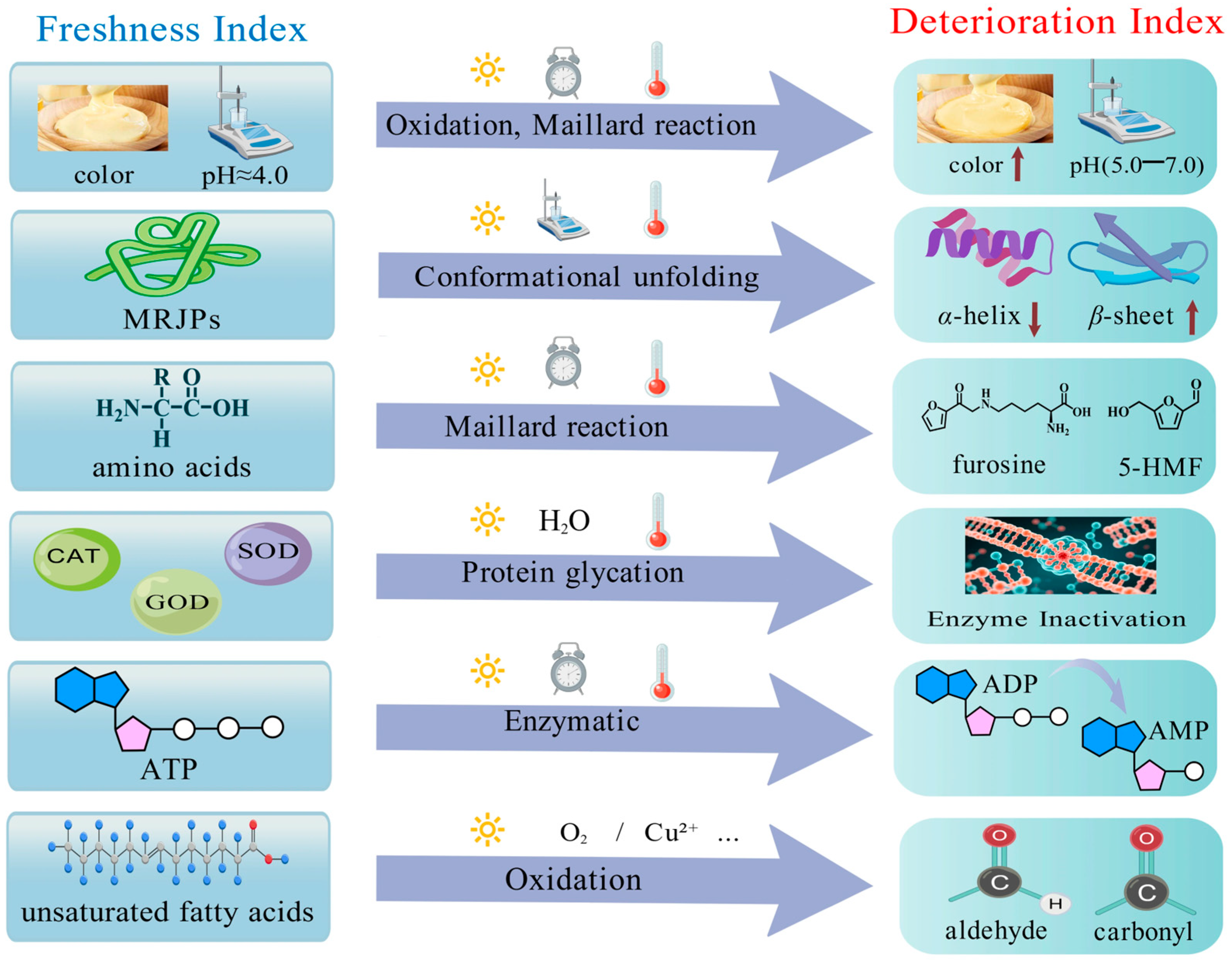
The accurate evaluation of royal jelly freshness relies on a multidimensional analysis of indicators. The current research has progressed from traditional sensory and physicochemical assessments to a comprehensive system encompassing specific molecular markers, functional activities, and microbiological parameters, as shown in
Figure 1.
2.1. Conventional Quality Parameters
2.1.1. Sensory Characteristics
Sensory evaluation is the most traditional method for assessing the freshness of royal jelly, relying on intuitive judgments based on its color, aroma, taste, and texture. Fresh royal jelly typically appears as milky white or pale yellow, with a slight acidic taste and characteristic fragrance. During storage, the Maillard reaction and subsequent melanoidin formation produce high-molecular-weight, brown, water-insoluble nitrogenous compounds, thereby causing color darkening and increased viscosity, respectively. Concurrently, lipid oxidation is responsible for the development of rancid odors [
9]. Although sensory evaluation offers the advantages of speed and does not require complex instruments, it is highly subjective and poorly reproducible. To address this, intelligent sensory technologies such as electronic tongues (e-tongues) and electronic noses (e-noses) have been introduced to achieve objective and quantitative assessments [
10]. Li et al. [
11] demonstrated that metal-oxide-semiconductor-based e-noses can accurately discriminate samples from different storage periods, while e-tongues can provide semi-quantitative predictions of acidity and bitterness changes.
2.1.2. Physicochemical Parameters
Physicochemical parameters are currently the most widely used indicators for assessing the freshness of royal jelly, mainly including acidity, pH, volatile organic compounds (VOCs), and protein degradation products. Among these, acidity is particularly sensitive to storage time, showing a significant increase as the storage duration extends [
12]. In addition, changes in the composition of VOCs can also effectively reveal the process of quality deterioration [
13]. The advantage of physicochemical detection indicators lies in their objectivity, quantifiability, and traceability. However, individual physicochemical markers are easily influenced by raw material variations, collection season, and processing conditions, making it difficult to independently reflect overall freshness. Moreover, metabolomics studies have revealed significant fluctuations in amino acid profiles, organic acids, and certain aldehyde/ketone volatiles during storage, providing new avenues for identifying early freshness warning markers.
2.2. Biomolecular Indicators
2.2.1. Major Royal Jelly Proteins
The stability of MRJPs serves as a core molecular indicator for assessing royal jelly freshness. Since protein denaturation involves alterations in spatial structure, it cannot be directly observed through sensory evaluation, and thus requires corresponding technical methods for detection. Proteomic studies based on liquid chromatography–tandem mass spectrometry (LC-MS/MS) have shown that MRJP1, MRJP4, and MRJP5 are highly sensitive to temperature, with their levels decreasing significantly as storage temperature rises and storage duration lengthens, directly correlating with the loss of royal jelly’s biological functions [
14,
15]. Among them, MRJP1 undergoes a conformational transition from α-helix to β-sheet under thermal stress, leading to aggregation and precipitation, and its degradation products are considered as characteristic molecular markers of royal jelly aging [
16]. In addition, MRJP degradation products are rich in residues such as lysine and glutamine, which readily participate in Maillard reactions and oxidative cross-linking, leading to color darkening, the loss of enzymatic activity, and off-flavor development. Compared with traditional physicochemical indicators, systematic changes in the MRJP secondary structure can serve as sensitive early signals of royal jelly freshness deterioration [
17]. It is important to note that MRJP degradation kinetics can be influenced by bee lineage, diet, and processing methods, necessitating standardized detection protocols for reliable application.
2.2.2. Maillard Reaction Products
The Maillard reaction is a primary chemical pathway responsible for browning and nutrient loss in royal jelly. Furosine content, as an early marker of this reaction, shows a stable increase in royal jelly with rising storage temperatures and prolonged storage time, and has been incorporated into international standards for royal jelly [
18]. Its high sensitivity to thermal history provides quantitative evidence of quality deterioration, often before sensory or functional changes are detectable. However, furosine levels are influenced by matrix composition and processing conditions, and do not directly reflect protein conformational changes or alterations in biological activity [
19]. Therefore, furosine should be used in conjunction with other functional indicators to establish a multidimensional system for assessing royal jelly freshness.
5-hydroxymethylfurfural (5-HMF) is a mid-to-late-stage product of the Maillard reaction and has been adopted by the Codex Alimentarius and the European Union as an indicator of royal jelly freshness [
20]. Its concentration is extremely low in fresh royal jelly but undergoes an exponential increase during ambient storage, making it a sensitive marker for medium- to long-term storage at room temperature. Unlike relatively static markers like 10-HDA, the dynamic accumulation of 5-HMF allows for a more accurate reflection of the product’s actual storage history and thermal exposure. As its concentration can be artificially elevated during improper sample handling, it is recommended to store samples immediately at 4 °C for short-term preservation or at −20/−80 °C for long-term storage to ensure that analytical results accurately represent the original product quality. Meanwhile, Nε-carboxymethyl lysine (CML), a late-stage product of the Maillard reaction, exhibits exponential growth with extended storage time at room temperature, making it a potential indicator for assessing the freshness of royal jelly [
21].
2.2.3. Enzyme Activity
GOD and SOD are key bioactive enzymes in royal jelly, and both are highly sensitive to temperature fluctuations. Ali et al. [
22] reported that GOD and other antioxidant enzyme activities decline significantly within weeks to months at room temperature or higher, while frozen storage markedly decelerates this activity loss. Dong et al. [
23] further demonstrated that GOD activity can decrease by over 97% within 55 days at 27–30 °C. Therefore, enzymatic activity serves as an excellent indicator for assessing royal jelly freshness, especially under short-term storage or cold chain interruptions. The key advantage of using enzyme activity as a marker lies in its direct correlation with antibacterial and antioxidant functions and its sensitivity to short-term temperature fluctuations. However, enzyme activity is easily influenced by sample dilution, protein degradation, and endogenous inhibitors; therefore, the reliance on a single threshold means that results are prone to misinterpretation [
24]. Thus, it is advisable to use enzyme activity in combination with other indicators to establish a more reliable and comprehensive freshness evaluation system.
2.2.4. Energy Metabolites
Adenosine phosphate compounds in royal jelly, such as adenosine triphosphate (ATP), adenosine diphosphate (ADP), and adenosine monophosphate (AMP), directly reflect its post-harvest energy metabolism status. After removal from the bee, endogenous enzymatic systems remain active, driving the sequential degradation of ATP into ADP, AMP, and other products [
25]. This degradation process, governed by both temperature and time, provides a kinetic profile that can quantitatively indicate the metabolic decay rate of royal jelly and the integrity of the cold chain [
26]. Xue et al. [
27] developed an accelerated solvent extraction coupled with online purification and the high-performance liquid chromatography (HPLC) method, significantly improving the extraction efficiency and analytical throughput of these compounds in complex matrices. Energy metabolites can capture early quality deterioration signals at the biochemical level. However, their detection still faces challenges such as complex sample preparation and sensitivity to storage media and pH. Future efforts should focus on standardizing extraction procedures and integrating them with non-destructive detection techniques to promote industrial applications.
3. Mechanisms and Factors Influencing Deterioration of Royal Jelly Freshness
The post-harvest deterioration of royal jelly is a dynamic process of molecular-level changes during storage, influenced by a variety of intrinsic and extrinsic factors. The systematic elucidation of the underlying degradation mechanisms and the impact of external factors is therefore essential for establishing a scientific basis for precise quality control. This section delves into these key deterioration pathways and their driving factors to provide a mechanistic understanding of freshness loss.
3.1. Mechanisms of Deterioration of Royal Jelly Freshness
The quality deterioration of royal jelly during storage primarily stems from its inherent physicochemical properties, such as high moisture content, highly concentrated nutrients, and the structural lability of various active components. These characteristics render it susceptible to a series of molecular-level changes during storage. Specifically, proteins may undergo conformational disruption and degradation; Maillard reaction products between sugars and amino acids gradually accumulate, affecting color and flavor; endogenous enzymes of significant functionality progressively lose activity; and some lipid components are prone to oxidation, as shown in
Figure 1. These processes often occur concurrently and exhibit synergistic effects, ultimately leading to a decline in the sensory quality, diminished nutritional functionality, and reduced bioactivity of royal jelly. Moreover, such deterioration is typically irreversible.
3.1.1. Denaturation and Degradation of MRJPs
MRJPs, which constitute the core architectural proteins of royal jelly, are highly susceptible to denaturation under environmental stressors such as elevated temperature, pH fluctuations, and oxidative stress. As demonstrated by Qiao et al. [
21], MRJPs undergo partial conformational unfolding during storage, characterized by a decrease in α-helix and β-turn content and a concomitant increase in β-sheet structures. This unfolding is accompanied by alterations in tertiary structure, evidenced by red shifts in intrinsic fluorescence emission spectra and a decrease in fluorescence intensity, which indicate the exposure of hydrophobic residues. The denatured proteins subsequently tend to aggregate, leading to a significant loss of solubility and antioxidant capacity [
28]. Under prolonged or severe storage conditions, this denaturation and aggregation can progress to irreversible degradation. Proteomic studies using techniques such as liquid chromatography–tandem mass spectrometry (LC-MS/MS) have confirmed the breakdown of specific MRJPs (including MRJP1, MRJP2, MRJP3, and MRJP5) into fragments during storage, providing direct molecular evidence of protein degradation [
14]. Consequently, the denaturation, aggregation, and eventual degradation of MRJPs serve as a primary indicator and direct cause of freshness loss [
29].
3.1.2. Maillard Reaction
The Maillard reaction represents a key non-enzymatic chemical pathway responsible for the browning and concomitant nutritional degradation of royal jelly. This reaction occurs between the amino groups of proteins or free amino acids and the carbonyl groups of reducing sugars, culminating in the formation of a series of advanced glycation end-products [
30,
31]. The rate of the Maillard reaction is highly temperature-dependent. It proceeds slowly at room temperature, increasing markedly with elevated temperatures. For instance, Chen et al. [
10] reported a significantly lower content of reducing sugars in royal jelly stored at room temperature or under refrigeration compared to frozen samples. Similarly, Marconi et al. [
32] observed a marked increase in furosine content in royal jelly following ten months of storage at room temperature. As an early marker of the Maillard reaction, furosine is widely utilized to evaluate the severity of heat treatment and quality deterioration during storage [
12].
5-HMF is a mid-to-late-stage product of the Maillard reaction. Ciulu et al. [
20] monitored royal jelly stored at −18, 4, and 25 °C for nine months using a reversed-phase high-performance liquid chromatography (RP-HPLC) method. They found that while the 5-HMF concentration in all samples stored at 4 and −18 °C was below the detection limit, its concentration in samples stored at 25 °C increased exponentially with storage time. Meanwhile, CML is one of the markers for advanced glycation end-products in the Maillard reaction. Qiao et al. [
21] determined the CML content in royal jelly samples stored at room temperature (approximately 25 °C) for 1 to 6 months. The results showed that the CML content increased by approximately sixfold during the six-month room temperature storage period, indicating that the levels of both 5-HMF and CML in royal jelly are related to its freshness.
However, the formation of Maillard reaction products is influenced by factors such as the sugar content of the matrix, product formulation, and processing methods like drying. Therefore, a comprehensive assessment of freshness typically requires the integration of furosine, 5-HMF, and CML data with other indicators, such as protein degradation profiles, enzymatic activity, and sensory evaluation [
33].
3.1.3. Enzymatic Inactivation
Endogenous bioactive enzymes, including glucose oxidase (GOD), superoxide dismutase (SOD), and catalase (CAT), constitute a vital natural defense system in royal jelly, conferring intrinsic antimicrobial and antioxidant activities. However, these enzymes are highly labile and susceptible to inactivation under stressors such as high temperature, high humidity, or light exposure, thereby compromising this endogenous defense system [
34]. Li et al. [
29] observed that the storage of royal jelly at room temperature for one year led to an almost complete loss of GOD and CAT activities. Notably, enzymatic activity declines more substantially under refrigeration than under frozen storage. This inactivation is primarily attributed to temperature-induced conformational unfolding of the enzyme proteins, which exposes their catalytic sites to oxidative damage and potential proteolytic cleavage. Furthermore, hydrogen peroxide generated by active glucose oxidase may lead to the production of reactive oxygen species through enzymatic or metal-catalyzed pathways. These reactive species can subsequently oxidize critical amino acid residues within the enzyme structure, contributing to irreversible activity loss, as supported by studies on enzyme stability [
35]. Cold and frozen storage mitigates enzyme inactivation by restricting molecular motion and reducing the generation of hydrogen peroxide and its derived free radicals, underscoring the critical importance of maintaining a low-temperature chain to preserve enzymatic function [
36].
3.1.4. Lipid Oxidation
Royal jelly is rich in unsaturated fatty acids. Its characteristic component, 10-HDA, is particularly susceptible to autoxidation upon exposure to light, oxygen, and metalion catalysts, leading to the formation of secondary oxidation products including hydroperoxides, aldehydes, and ketones. The autoxidation process is initiated by the reaction of lipid radicals with molecular oxygen (O
2), forming peroxyl radicals that subsequently abstract hydrogen to generate unstable lipid hydroperoxides. The decomposition of these hydroperoxides yields reactive short-chain aldehydes and carbonyl compounds. These secondary products can adduct to or cross-link with amino acid residues in proteins, causing functional site damage, protein aggregation, and a consequent decline in biological activity [
37]. Chen et al. [
10] analyzed royal jelly stored at different temperatures using headspace solid-phase micro-extraction gas chromatography–mass spectrometry (HS-SPME-GC/MS). They found that the levels of lipid oxidation products increased significantly over time, concurrent with a rise in fatty acid degradation products, indicating an acceleration of lipid peroxidation. This oxidative process not only generates undesirable rancid odors but also disrupts the structural integrity of the lipid matrix, thereby significantly impairing the antioxidant and antimicrobial properties of royal jelly [
34].
3.2. Influencing Factors of Royal Jelly Freshness
The deterioration of royal jelly quality during storage stems from a complex interplay between its intrinsic chemical composition and external environmental conditions [
38]. As inferred from the aforementioned molecular mechanisms, the rate of freshness loss is co-modulated by intrinsic, extrinsic, and biological factors. Internal factors define the inherent susceptibility and potential pathways for deterioration, whereas external factors act as modulators that directly influence the kinetics of these degradation reactions and microbial growth. Biological factors operate upstream, influencing the initial compositional profile of royal jelly and thereby predetermining its baseline stability for subsequent storage.
3.2.1. Intrinsic Factors
Internal factors (water activity, pH, viscosity, acidity, color) constitute the fundamental material basis for the quality stability of royal jelly and are defined by its intrinsic physicocl properties.
High moisture content is a central intrinsic condition driving multiple deterioration reactions. With a moisture content reaching 60–70%, royal jelly provides a suitable medium for its endogenous enzymes while also creating a favorable environment for the colonization and proliferation of external microorganisms [
39]. This high water activity significantly accelerates enzymatic hydrolysis, Maillard reactions, and microbial metabolism, resulting in increased viscosity, elevated acidity, and the deterioration of flavor.
The initial stability of bioactive components is critical in determining the functional lifespan of royal jelly. Royal jelly is naturally acidic [
4], and this acidic environment is crucial for the stability of MRJPs within it. Mureşan et al. [
40] found that when MRJPs transition from their synthesis environment (pH ≈ 7.0) to the secretion environment of royal jelly (pH ≈ 4.0), both their protein conformation and thermal stability are optimized. Furthermore, pH affects the texture and stability of royal jelly. Buttstedt et al. [
41] discovered that when the pH shifts from acidic (approximately 4.0) to neutral (e.g., pH 5–7), royal jelly changes from a gel-like state to a thinner liquid, which may adversely affect its storage stability as well as sensory properties (color, texture). Therefore, pH is extremely important for maintaining the freshness, physicochemical quality, and biological activity of royal jelly.
3.2.2. Extrinsic Factors
External factors function as primary levers for quality regulation. The main way to affect the preservation effect of the product is by altering the rate of the degradation reaction, and this is the most controllable variable in the production and supply chain process.
Temperature is the primary driving factor for all degradation reactions. According to chemical reaction kinetics, elevated temperatures significantly accelerate protein denaturation, Maillard reactions, lipid oxidation, and enzyme inactivation [
42]. MRJPs and bioactive macromolecules such as GOD have native conformations that are highly sensitive to fluctuations in temperature and pH [
34]. The evidence indicates that MRJP1 is more prone to irreversible denaturation under thermal stress compared to the chemically stable 10-HDA, positioning it as a more promising early warning indicator of freshness loss [
43]. Although the initial content of the characteristic fatty acid 10-HDA is influenced by genetic and dietary factors [
44], its concentration only changes minimally during storage. This stability renders it insufficient for monitoring the early stages of functional activity decline in the product. Consequently, storage at room temperature can lead to a significant deterioration of the sensory and functional properties of royal jelly within just a few weeks [
45]. In contrast, low temperatures, particularly freezing, maximally suppress these reaction rates and effectively extend shelf life.
Storage duration is a critical factor leading to the irreversible deterioration of the freshness and functional quality of royal jelly. This deterioration is a complex and dynamic process involving multiple components and pathways. MRJPs undergo denaturation, aggregation, and degradation, resulting in a significant reduction in their water solubility and antibacterial activity [
14,
17]. Prolonged storage also triggers the Maillard reaction and lipid oxidation, causing undesirable changes in the product’s color and texture, as well as the development of rancid odors [
20]. The duration of storage ultimately dictates the cumulative extent of degradation product formation.
Oxygen and light are the primary triggers of oxidative rancidity and photochemical degradation. Molecular oxygen is an essential reactant in the radical chain reactions of lipid autoxidation, directly leading to the degradation of unsaturated fatty acids, including 10-HDA, and the generation of volatile off-flavor compounds [
46]. Exposure to light, particularly ultraviolet radiation, can directly initiate lipid-free radical reactions and also catalyze Maillard browning. These photochemical processes collectively contribute to color darkening and the development of undesirable flavors.
3.2.3. Biotic Factors
Biological factors predominantly exert their influence during the secretion phase of royal jelly. They regulate its initial biochemical composition and thereby establish the fundamental conditions that predetermine its subsequent storage stability.
The initial microbial load is a pivotal factor governing both the shelf life and safety of royal jelly. Hygiene standards during collection, the health status of the bee colony, and operational practices directly dictate the initial total viable count. Elevated microbial loads act as biological catalysts, not only promoting fermentation and spoilage but also accelerating protein degradation and the formation of off-flavors, thereby exacerbating the overall rate of quality deterioration [
13].
Colony nutrition and gene expression are upstream factors influencing the initial composition of royal jelly. The forage source, particularly the botanical origin of pollen, influences the development of the hypopharyngeal glands in nurse bees and modulates the expression of genes encoding royal jelly proteins, such as MRJP1. Research has demonstrated that while the 10-HDA content may remain comparable in royal jelly produced from different pollen diets, the protein profiles and the activities of key enzymes like GOD can exhibit significant variations [
47]. These findings indicate that nutritional input directly modulates honeybee physiology at a molecular level, leading to alterations in the biochemical composition of royal jelly that precondition its stability during subsequent storage.
4. Analytical Techniques for Royal Jelly Freshness
The accurate assessment of royal jelly freshness relies on reliable analytical techniques. Currently, the field is transitioning from offline, single-point analyses dependent on laboratory precision instruments toward rapid, non-destructive, multi-indicator methods, which are suitable for on-site industrial application. This evolution is forming an integrated system that combines laboratory-grade quantification with real-time, on-site screening, as shown in
Table 1.
4.1. Laboratory Quantitative Analysis Techniques
4.1.1. Chromatographic and Mass Spectrometric Techniques
HPLC is extensively employed for the quantitative analysis of 10-HDA [
48], furosine, and 5-HMF, enabling the monitoring of compositional changes in royal jelly during storage. Wu et al. [
49] developed a rapid ultra-high-performance liquid chromatography (UHPLC) method for separating and quantifying 26 amino acids in royal jelly. Their analysis of free and total amino acid profiles in samples stored under different conditions revealed significant, continuous decreases in total methionine and free glutamine levels, suggesting their potential as quality control parameters.
LC-MS/MS serves as a cornerstone technique for quantifying MRJPs, Maillard reaction products, and ATP metabolites. It enables the highly sensitive detection of characteristic peptide profiles derived from the denaturation and hydrolysis of MRJPs, providing molecular-level evidence for assessing the loss of bioactivity during storage or processing. The technique also enables precise quantification of both early-stage Maillard reaction products, such as furosine, and mid-to-late-stage compounds like 5-HMF [
50], achieving detection limits substantially lower than those of conventional HPLC [
51]. Despite its exceptional precision and capability for simultaneous multi-component analysis, the method remains constrained by high instrument costs and operational complexity, making it applicable for laboratory-based quantitative analysis.
Ultra-performance liquid chromatography–tandem mass spectrometry (UPLC-MS/MS), nanoflow liquid chromatography–tandem mass spectrometry (nanoLC-MS/MS), and matrix-assisted laser desorption ionization–time-of-flight mass spectrometry (MALDI-TOF MS) are applied for the detection of MRJPs in royal jelly via proteomic methodologies. Lin et al. [
52] employed UPLC-MS/MS for the quantitative analysis of royal jelly. The results indicated that the content of MRJP1 in fresh royal jelly ranged from approximately 41.96 to 55.01 mg/g. This method can be applied to quantify MRJP1 in royal jelly and assess its freshness. Li et al. [
29] conducted a systematic analysis of changes in the protein composition of royal jelly under different storage conditions and durations using nanoLC-MS/MS and MALDI-TOF/TOF-TOF proteomic approaches. The study revealed that as storage temperature increased or duration extended, significant alterations occurred in the types, abundance, and aggregation states of MRJPs (particularly MRJP1-3) and enzymes such as glucose oxidase. Notably, MRJP5 was even found to disappear after long-term room temperature storage, suggesting its potential as a sensitive marker for freshness assessment.
4.1.2. Immunoassay Techniques
The enzyme-linked immunosorbent assay (ELISA), based on specific antigen–antibody interactions, enables the targeted quantification of proteins such as MRJP1, providing a direct measure of royal jelly freshness. This approach shows significant potential for development into commercial quantitative test kits. Shen et al. [
53] developed a polyclonal antibody against MRJP1-specific peptides and established an indirect ELISA that demonstrated progressively decreasing MRJP1 content with extended storage duration. It was found that the freshness of royal jelly can be characterized by monitoring the content of MRJP1. In addition, the results obtained by the indirect ELISA method used by Yamaguchi et al. [
54] were consistent with those obtained by the HPLC or gel filtration methods. This confirmed the accuracy and practicability of this method.
In practical applications, ELISA provides more direct and sensitive protein quantification compared to HPLC, which is typically reserved for small molecules like 10-HDA, amino acids, and 5-HMF. This makes ELISA particularly suitable for assessing protein degradation. The future development of standardized ELISA-based kits could enable rapid, routine freshness assessment throughout production, distribution, and quality control facilities.
4.2. Rapid and Non-Destructive Screening Techniques
4.2.1. Spectroscopic Techniques
FTIR and near-infrared (NIR) spectroscopy enable rapid, non-destructive prediction of multiple quality parameters in royal jelly, including moisture, protein, and 10-HDA content, providing insights into storage history and degradation degree. Tarantilis et al. [
55] utilized FTIR spectroscopy to demonstrate that royal jelly proteins remain stable for 3 days at room temperature, 7 weeks at 4 °C, and 21 weeks at −20 °C, showing that it can monitor the degradation of royal jelly proteins. Furthermore, data fusion of FTIR and NIR spectra significantly improves the prediction accuracy for 10-HDA and protein content [
56]. These spectroscopic techniques offer rapid analysis, non-destructive sampling, and potential for online monitoring, making them ideally suited for high-throughput screening in production and storage environments as potential alternatives to conventional chemical analyses.
4.2.2. Sensor-Based Techniques
E-noses and e-tongues represent emerging non-destructive tools for royal jelly freshness evaluation through detection of VOCs and comprehensive flavor profiling. Their core mechanism lies in the fact that during the storage process, VOCs and small molecules related to flavor will undergo chemical reactions, such as oxidation, dehydrogenation, or esterification reactions. These reactions will cause measurable changes in the sensor output, including changes in conductivity or potential patterns. Chen et al. [
10] employed HS-SPME-GC/MS combined with e-nose and e-tongue analyses to monitor royal jelly stored at 25 °C for 21 days, observing a significant increase in VOCs that correlated with sensory-detected off-flavors and bitterness. Combining this with metabolomics methods to verify the characteristics of volatile components and developing a comprehensive electronic fingerprint database can provide intelligent support for rapid sensory-based quality control.
4.2.3. Quick Detection Techniques
Immunochromatographic test strips, based on specific antibodies, can detect MRJPs and enzymatic activities within 10–15 min, enabling the rapid assessment of royal jelly freshness. Immunochromatographic test strips achieve qualitative or semi-quantitative detection of MRJP4 through specific binding between antibodies and MRJP4 [
57]. Hu et al. [
17] developed a colloidal gold immunochromatographic test strip for the detection of MRJP4 in royal jelly. This method offers the advantages of simple operation and short detection time, making it suitable for rapid on-site freshness assessment.
Colorimetric sensors, based on chemical-reaction-induced color changes, provide another rapid assessment approach for indicators including 10-HDA and furosine. Compared to HPLC with its complex sample preparation, colorimetric sensors offer advantages of lower cost and faster operation. Zheng et al. [
58] established a simple colorimetric method using 37.5% HCl that completes freshness assessment within 6 min, suitable for real-time quality determination during commercial transactions. This method capitalizes on the significant decrease in 10-HDA content during storage, particularly under elevated temperatures [
59]. Su et al. [
60] developed a colorimetric method based on the 10-HDA–Ag
+ coordination, which effectively inhibits 3,3’,5,5’-tetramethylbenzidine oxidation. This inhibition induces a distinct blue-to-colorless transition, enabling accurate 10-HDA quantitation and demonstrating strong potential for on-site freshness screening of royal jelly.
Overall, detection technologies for royal jelly freshness are gradually shifting from offline and time-consuming methods to online, rapid, and non-destructive approaches. The focus is evolving from single-parameter evaluation to multi-parameter integration, and from laboratory-based analysis toward portable and intelligent detection systems.
Table 1.
Comparison of analytical techniques for royal jelly freshness.
Table 1.
Comparison of analytical techniques for royal jelly freshness.
| Technique | Detectable Indicators | Advantages | Limitations | Typical Applications | Refs. |
|---|
| HPLC | 10-HDA, furosine, 5-HMF, amino acids | High quantitative accuracy and reproducibility; multi-component analysis | Time-consuming sample preparation; not suitable for on-site use | Storage stability monitoring; quality control during processing | [49] |
| LC-MS/MS | MRJPs, 10-HDA, maillard reaction products, amino acids | High sensitivity and selectivity; provides structural information | High equipment cost; complex operation; lengthy procedures | Laboratory quantification; standardized quality control | [49,51] |
| UPLC-MS/MS | MRJPs | Suitable for the quantification of complex mixtures; offers accurate quantification and good reproducibility | Typically targets only a few marker proteins and may overlook low-abundance proteins | Quantitative freshness assessment | [52] |
| nanoLC-MS/MS | Proteins, enzymes | Capable of detecting low-abundance proteins; well-suited for revealing proteomic changes induced by storage | The sample pretreatment process is complex; high-abundance proteins may mask low-abundance components | Studying the mechanisms of protein degradation, aggregation, and structural alterations | [29] |
| MALDI-TOF MS | Proteins, protein fingerprints | The method is rapid and high-throughput, requiring no complex separation steps | It is difficult to perform absolute quantification; the establishment of databases or spectral libraries demands high standards | Adulteration identification and rapid screening | [29] |
| ELISA | MRJP1, MRJP4 | High throughput, rapid, and highly specific; kit development potential | Limited to known protein targets; indirect degradation assessment | On-site protein quantification; production line monitoring | [53,54] |
| FTIR/NIR | Moisture, proteins, 10-HDA | Rapid, non-destructive; high-throughput multi-parameter analysis | Requires model calibration; matrix interference possible | Online production monitoring; rapid quality screening | [55] |
| E-Nose/Tongue | VOCs, flavor profiles | Rapid, non-destructive; captures overall flavor fingerprint | Susceptible to environmental conditions; needs calibration | Storage duration assessment; batch consistency checking | [10] |
| Immunochromatographic Test Strip | MRJPs, specific enzyme activities | Rapid operation; suitable for field use | Semi-quantitative; target-specific; requires antibody development | Preliminary on-site screening; production line testing | [17,57] |
| Colorimetric Sensor | 10-HDA, furosine | Low cost, simple operation, fast results | Moderate sensitivity; matrix interference | Raw material screening; semi-finished product testing | [58,59] |
5. Preservation Technologies for Royal Jelly Freshness
To delay royal jelly quality deterioration during storage, various physical and physicochemical preservation techniques have been developed and applied, as shown in
Table 2. These methods primarily function by inhibiting microbial growth, reducing the rate of chemical reactions, and protecting the structural stability of functional components, thereby extending the product’s shelf life.
5.1. Physical Preservation Techniques
5.1.1. Low-Temperature Storage Method
Low-temperature storage is the most fundamental and widely applied technique for maintaining the freshness of royal jelly. Freezing (typically at −18 °C) maximally suppresses enzyme activity, delays protein denaturation and lipid oxidation, and thereby better preserves its antioxidant capacity and bioactivity [
10]. Research confirms that freezing conditions effectively minimize the aggregation and inactivation of MRJPs, substantially prolonging the duration of safe storage [
61]. The effectiveness of this technique highly depends on a stable and uninterrupted cold chain, as repeated freeze–thaw cycles can induce irreversible protein denaturation. Therefore, royal jelly should be frozen immediately after harvest.
5.1.2. Freeze-Drying Processing Method
Freeze-drying sublimates the water in royal jelly under low-temperature vacuum conditions, reducing its water activity to extremely low levels and thereby fundamentally inhibiting most chemical and microbial degradation reactions. This process maximally preserves heat-sensitive bioactive components, such as 10-HDA, proteins, and polyphenolic compounds [
9]. Studies have shown that freeze-dried royal jelly powder at the nano- or micro-scale exhibits storage stability superior even to that of fresh samples, and that it can maintain its antioxidant and antibacterial activities for extended periods at room temperature, greatly facilitating storage and transportation [
9].
5.1.3. Non-Thermal Sterilization Method
High-pressure processing and moderate irradiation can effectively inactivate microorganisms at relatively low temperatures, offering unique advantages for preserving the natural composition and bioactivity of royal jelly. Pan et al. [
62] demonstrated that high-pressure processing modifies protein tertiary and quaternary structures while preserving their secondary structures, effectively disrupting MRJP fibrillar aggregation, enhancing protein–water interactions, and improving solubility. However, an excessively high pressure may induce aggregation of protein subunits and irreversible denaturation [
63]. Irradiation serves as a complementary technique to eliminate surface and internal microbial contamination. Appropriate doses of gamma or electron-beam irradiation can significantly extend shelf life, though precise dose control is essential to avoid free-radical-mediated damage to bioactive components [
64]. The safety and functional efficacy of irradiated royal jelly require validation through metabolomic and bioactivity analyses [
65].
5.2. Integrated Physico-Chemical Strategies
5.2.1. Modified Atmosphere Packaging
Packaging and storage atmosphere serve as effective physical barriers against environmental stress. Modified atmosphere packaging preserves quality by altering the internal gas composition. The oxygen and moisture barrier properties, as well as the light-blocking ability, of packaging materials are critical. Vacuum and nitrogen-flushed packaging effectively reduce the oxygen partial pressure in the headspace by removing or displacing oxygen, thereby fundamentally slowing the kinetics of oxidative reactions [
66,
67] and protecting 10-HDA and flavor compounds [
68,
69]. This approach has been proven to be an effective strategy for maintaining the long-term storage stability of royal jelly.
Emerging nanomaterial-based packaging, such as bio-based films incorporated with nano-antimicrobial or antioxidant agents, can continuously exert their effects at the packaging interface, providing additional protection under ambient or mild cold-chain conditions [
70]. The safety of such nanocomposites is crucial, and their component migration behavior must be strictly evaluated before application to ensure compliance with food contact material regulations.
5.2.2. Microencapsulation
Microencapsulation technology entraps active royal jelly components within micro- or nano-scale matrices using wall materials such as maltodextrin, gum arabic, or chitosan, creating a physical barrier against environmental factors [
71]. Processing techniques like spray-drying yield free-flowing powdered products with markedly enhanced stability at room temperature [
72]. The choice of wall materials and processing parameters directly affects the encapsulation efficiency and the retention of bioactivity [
73]. More advanced carrier systems, including alginate–pectin composite gels or protein–polysaccharide nanoparticles, not only provide exceptional storage stability [
74] but also enable controlled release and improved bioavailability, opening new avenues for high-value royal jelly product development [
75].
5.2.3. Additive Protection
Incorporating protective additives during freeze-drying or microencapsulation effectively prevents protein denaturation throughout dehydration. The mechanism involves forming a high-glass-transition matrix and increasing the system’s glass transition temperature, thereby restricting molecular mobility and chemical reaction rates. This suppresses protein folding or aggregation and lipid oxidation during drying and storage. For instance, adding suitable protectants such as trehalose during freeze-drying can reduce protein conformational changes and enhance storage stability [
76]. In practical applications, the formulation design must balance protection efficiency with sensory and processing properties.
Table 2.
Comparison of preservation for royal jelly freshness.
Table 2.
Comparison of preservation for royal jelly freshness.
| Technology | Key Parameters | Quality Impact | Applications and Limitations | Refs. |
|---|
| Low-Temperature Storage | −18 °C freezing; stable cold chain required | Preserves MRJPs and 10-HDA; prevents enzymatic degradation | Universal application; cold-chain dependency critical | [34,77] |
| Freeze-Drying Processing | Low-temperature vacuum; high equipment cost | Maintains bioactivity; enables room-temperature storage | High-value products; energy-intensive process | [9,78] |
| Non-Thermal Sterilization Technologies | 100–200 MPa; specialized equipment | Depolymerizes MRJPs; inhibits microbial growth | Medium–large scale; pressure optimization required | [52,62] |
| Ionizing Irradiation | Controlled dosage; regulated facilities | Reduces microbial load; potential antioxidant loss | Large-scale sterilization; regulatory compliance needed | [64,79] |
| Modified Atmosphere Packaging | Oxygen exclusion; barrier materials | Prevents oxidation; preserves flavor compounds | Multi-scale use; material selection crucial | [68,80] |
| Microencapsulation | Wall materials; spray-drying parameters | Protects bioactives; masks undesirable odors | Functional foods; formula optimization essential | [71,72] |
| Protective Additives | Glass transition modulation; low–medium cost | Stabilizes proteins; enhances storage stability | Wide applicability; sensory balance required | [76,81] |
6. Conclusions and Prospects
This review synthesizes evidence that the deterioration of royal jelly freshness occurs through four interconnected physicochemical and biochemical pathways: protein denaturation and degradation of MRJPs, which impairs solubility and bioactivity; the Maillard reaction, progressing from early markers such as furosine to advanced products including 5-HMF and CML, leading to browning and nutrient loss; enzymatic inactivation, notably of glucose oxidase, compromising natural preservation systems; and lipid oxidation, which generates rancidity and degrades key components such as 10-HDA. Consequently, the quality evaluation paradigm is shifting from reliance on static indicators toward a multi-marker framework that utilizes these pathway-specific biomarkers for more accurate and dynamic assessment.
A variety of rapid screening technologies have emerged to address the need for practical, on-site monitoring. These include ELISA kits targeting MRJPs, which offer high specificity and potential for field deployment; FTIR/NIR spectroscopy for the non-destructive, multi-parameter detection of moisture, protein, and 10-HDA; electronic nose/tongue systems capable of capturing volatile flavor profiles associated with freshness loss; and low-cost colorimetric sensors for the rapid identification of indicators such as 10-HDA and furosine. These methods complement traditional laboratory-based chromatographic and mass spectrometric techniques, which remain essential for validation and standardization, but are less suited for rapid field use.
To bridge the gap between research and industry practice, a tiered and proactive quality control strategy is recommended. Initially, and fundamentally, harvested royal jelly should be immediately placed in light-proof, airtight containers and transferred to frozen storage to maximally inhibit all deterioration pathways and preserve its intrinsic freshness. For routine quality screening, producers can then adopt rapid, accessible methods to assess incoming batches. Subsequently, to enhance stability, reduce long-term storage and transport costs, and minimize quality loss, the conversion of raw royal jelly into freeze-dried powder is strongly advised. This process should be supported by optimized packaging, such as vacuum or nitrogen-flushed containers for both the raw material and the final powder, to prevent oxidation. All these on-site and processing measures should be periodically validated through standardized laboratory analysis of definitive biomarkers to ensure accuracy and maintain alignment with scientific standards.
Looking forward, several strategic directions emerge as critical for advancing the field. First, the development of integrated evaluation models that incorporate multivariate data from proteomic, metabolomic, and functional activity analyses represents a promising approach for comprehensive freshness assessment. Second, the convergence of artificial intelligence with spectroscopic and sensor technologies offers unprecedented opportunities for creating intelligent, portable detection platforms capable of real-time monitoring throughout the supply chain. Third, research should prioritize the development of sustainable preservation strategies, such as edible coatings and smart packaging systems, to reduce the dependence on energy-intensive methods. Additionally, the implementation of blockchain-enabled traceability systems coupled with international standardization efforts will be crucial for enhancing global quality governance and market competitiveness.
In conclusion, the transition from reductionist quality indicators to multidimensional evaluation frameworks, from laboratory-dependent analysis to field-deployable monitoring, and from conventional preservation to intelligent stabilization systems will define the future of royal jelly quality control. Through interdisciplinary integration and technological innovation, the field is poised to establish more scientifically grounded standards and operationally efficient practices, ultimately ensuring the preservation of royal jelly’s premium quality and biological efficacy while supporting the sustainable development of the apiculture industry.
Author Contributions
Y.Z.: formal analysis, investigation, writing—original draft preparation; J.S.: investigation; R.C.: conceptualization, writing—original draft preparation, resources, writing—review and editing; L.Z.: investigation; X.M.: investigation, J.H.: investigation; F.W.: resources, supervision; X.X.: funding acquisition, supervision, project administration; All authors have read and agreed to the published version of the manuscript.
Funding
This work was supported by the Natural Science Foundation of Beijing Municipality [6222057], the National Key Research and Development Program [2023YFF1103804], and the Central Public-Interest Scientific Institution Basal Research Fund [MFSJKF2024-10].
Institutional Review Board Statement
Not applicable.
Informed Consent Statement
Not applicable.
Data Availability Statement
No new data were created or analyzed in this study. Data sharing is not applicable to this article.
Conflicts of Interest
The authors declare no conflict of interest.
Abbreviations
| 10-HDA | 10-hydroxy-2-decenoic acid |
| MRJPs | Major royal jelly proteins |
| FTIR | Fourier transform infrared spectroscopy |
| LC-MS | Liquid chromatography–mass spectrometry |
| LC-MS/MS | Liquid chromatography–tandem mass spectrometry |
| GOD | Glucose oxidase |
| SOD | Superoxide dismutase |
| CAT | Catalase |
| HS-SPME-GC/MS | Headspace solid-phase micro-extraction gas chromatography–mass spectrometry |
| e-tongues | Electronic tongues |
| e-noses | Electronic noses |
| VOCs | Volatile organic compounds |
| 5-HMF | 5-hydroxymethylfurfural |
| ATP | Adenosine triphosphate |
| ADP | Adenosine diphosphate |
| AMP | Adenosine monophosphate |
| HPLC | High-performance liquid chromatography |
| UHPLC | Ultra-high-performance liquid chromatography |
| ELISA | Enzyme-linked immunosorbent assay |
| RP-HPLC | Reversed-phase high-performance liquid chromatography |
| MALDI-TOF MS | Matrix-assisted laser desorption ionization–time-of-flight mass spectrometry |
| nanoLC-MS/MS | Nanoflow liquid chromatography–tandem mass spectrometry |
| UPLC-MS/MS | Ultra-performance liquid chromatography–tandem mass spectrometry |
| CML | Nε-carboxymethyl lysine |
| NIR | Near-infrared |
References
- Wytrychowski, M.; Chenavas, S.; Daniele, G.; Casabianca, H.; Batteau, M.; Guibert, S.; Brion, B. Physicochemical characterisation of French royal jelly: Comparison with commercial royal jellies and royal jellies produced through artificial bee-feeding. J. Food Compos. Anal. 2013, 29, 126–133. [Google Scholar] [CrossRef]
- Muresan, C.I.; Dezmirean, D.S.; Marc, B.D.; Suharoschi, R.; Pop, O.L.; Buttstedt, A. Biological properties and activities of major royal jelly proteins and their derived peptides. J. Funct. Foods 2022, 98, 105286. [Google Scholar] [CrossRef]
- Cao, L.F.; Zheng, H.Q.; Pirk, C.W.W.; Hu, F.L.; Xu, Z.W. High Royal Jelly-Producing Honeybees (Apis mellifera ligustica) (Hymenoptera: Apidae) in China. J. Econ. Entomol. 2016, 109, 510–514. [Google Scholar] [CrossRef] [PubMed]
- Collazo, N.; Carpena, M.; Nunez-Estevez, B.; Otero, P.; Simal-Gandara, J.; Prieto, M.A. Health Promoting Properties of Bee Royal Jelly: Food of the Queens. Nutrients 2021, 13, 543. [Google Scholar] [CrossRef] [PubMed]
- General Administration of Customs of the People‘s Republic of China. Available online: http://stats.customs.gov.cn/ (accessed on 7 December 2025).
- Ahmad, S.; Campos, M.G.; Fratini, F.; Altaye, S.Z.; Li, J. New Insights into the Biological and Pharmaceutical Properties of Royal Jelly. Int. J. Mol. Sci. 2020, 21, 382. [Google Scholar] [CrossRef]
- Antinelli, J.; Zeggane, S.; Davico, R.; Rognone, C.; Faucon, J.; Lizzani, L. Evaluation of (E)-10-hydroxydec-2-enoic acid as a freshness parameter for royal jelly. Food Chem. 2003, 80, 85–89. [Google Scholar] [CrossRef]
- Wytrychowski, M.; Paisse, J.-O.; Casabianca, H.; Daniele, G. Assessment of royal jelly freshness by HILIC LC-MS determination of furosine. Ind. Crops Prod. 2014, 62, 313–317. [Google Scholar] [CrossRef]
- Ghadimi-Garjan, R.; Javadi, A.; Jafarizadeh-Malmiri, H.; Anarjan, N.; Mirzaei, H. Lyophilized royal jelly preparation in nanoscale and evaluation of its physicochemical properties and bactericidal activity. Food Sci. Nutr. 2023, 11, 3404–3413. [Google Scholar] [CrossRef]
- Chen, L.; Ning, F.; Zhao, L.; Ming, H.; Zhang, J.; Yu, W.; Yi, S.; Luo, L. Quality assessment of royal jelly based on physicochemical properties and flavor profiles using HS-SPME-GC/MS combined with electronic nose and electronic tongue analyses. Food Chem. 2023, 403, 134392. [Google Scholar] [CrossRef]
- Li, P.; Li, Z.; Hu, Y.; Niu, Z.; Wang, Z.; Zhou, H.; Sun, X. Evaluation of fish meal freshness using a metal-oxide semiconductor electronic nose combined with the long short-term memory feature extraction method. J. Food Sci. 2024, 89, 5016–5030. [Google Scholar] [CrossRef]
- Tarapoulouzi, M.; Mironescu, M.; Drouza, C.; Mironescu, I.; Agriopoulou, S. Insight into the Recent Application of Chemometrics in Quality Analysis and Characterization of Bee Honey during Processing and Storage. Foods 2023, 12, 473. [Google Scholar] [CrossRef]
- Seker, I.; Karlidag, S.; Akyol, A.; Yil, G.; Koseman, A.; Uyumlu, A.; Erdogan, S.; Yilmaztekin, M. Volatile organic compounds of royal jellies obtained from honeybee (Apis mellifera L.) colonies fed with different industrial sugars at different locations. J. Food Meas. Charact. 2025, 19, 2019–2034. [Google Scholar] [CrossRef]
- Zhuang, S.; Zhang, X.; Ming, H.; Tian, L.; Luo, L. Exploration of quality deterioration mechanisms of royal jelly proteins during storage by LC-MS/MS-based peptidomics. J. Food Compos. Anal. 2025, 140, 107202. [Google Scholar] [CrossRef]
- Matuszewska, E.; Matysiak, J.; Rosinski, G.; Kedzia, E.; Zabek, W.; Zawadzinski, J.; Matysiak, J. Mining the Royal Jelly Proteins: Combinatorial Hexapeptide Ligand Library Significantly Improves the MS-Based Proteomic Identification in Complex Biological Samples. Molecules 2021, 26, 2762. [Google Scholar] [CrossRef]
- Kamakura, M.; Fukuda, T.; Fukushima, M.; Yonekura, M. Storage-dependent degradation of 57-kDa protein in royal jelly: A possible marker for freshness. Biosci. Biotechnol. Biochem. 2001, 65, 277–284. [Google Scholar] [CrossRef]
- Hu, H.; Wei, Q.; Sun, Z.; Zhang, X.; Ma, C.; Feng, M.; Meng, L.; Li, J.; Han, B. Development of a Freshness Assay for Royal Jelly Based on the Temperature- and Time-Dependent Changes of Antimicrobial Effectiveness and Proteome Dynamics of Royal Jelly Proteins. J. Agric. Food. Chem. 2021, 69, 10731–10740. [Google Scholar] [CrossRef]
- Messia, M.; Caboni, M.; Marconi, E. Storage stability assessment of freeze-dried royal jelly by furosine determination. J. Agric. Food. Chem. 2005, 53, 4440–4443. [Google Scholar] [CrossRef] [PubMed]
- Wang, Y.; Hernandez-Alvarez, A.J.; Goycoolea, F.M.; Martinez-Villaluenga, C. A comparative study of the digestion behavior and functionality of protein from chia (Salvia hispanica L.) ingredients and protein fractions. Curr. Res. Food Sci. 2024, 8, 100684. [Google Scholar] [CrossRef]
- Ciulu, M.; Floris, I.; Nurchi, V.M.; Panzanelli, A.; Pilo, M.I.; Spano, N.; Sanna, G. A Possible Freshness Marker for Royal Jelly: Formation of 5-Hydroxymethy1-2-furaldehyde as a Function of Storage Temperature and Time. J. Agric. Food. Chem. 2015, 63, 4190–4195. [Google Scholar] [CrossRef] [PubMed]
- Qiao, J.; Wang, X.; Liu, L.; Zhang, H. Nonenzymatic Browning and Protein Aggregation in Royal Jelly during Room-Temperature Storage. J. Agric. Food Chem. 2018, 66, 1881–1888. [Google Scholar] [CrossRef]
- Ali, A.; Chong, C.H.; Mah, S.H.; Abdullah, L.C.; Choong, T.S.Y.; Chua, B.L. Impact of Storage Conditions on the Stability of Predominant Phenolic Constituents and Antioxidant Activity of Dried Piper betle Extracts. Molecules 2018, 23, 484. [Google Scholar] [CrossRef] [PubMed]
- Dong, H.; Gai, Y.; Fu, S.; Zhang, D. Application of Biotechnology in Specific Spoilage Organisms of Aquatic Products. Front. Bioeng. Biotechnol. 2022, 10, 895283. [Google Scholar] [CrossRef]
- Lei, P.; Chen, H.; Ma, J.; Fang, Y.; Qu, L.; Yang, Q.; Peng, B.; Zhang, X.; Jin, L.; Sun, D. Research progress on extraction technology and biomedical function of natural sugar substitutes. Front. Nutr. 2022, 9, 952147. [Google Scholar] [CrossRef] [PubMed]
- Wu, L.; Chen, L.; Selvaraj, J.N.; Wei, Y.; Wang, Y.; Li, Y.; Zhao, J.; Xue, X. Identification of the distribution of adenosine phosphates, nucleosides and nucleobases in royal jelly. Food Chem. 2015, 173, 1111–1118. [Google Scholar] [CrossRef] [PubMed]
- Liao, W.R.; Huang, J.P.; Chen, S.F. Quantification of adenosine Mono-, Di- and triphosphate from royal jelly using liquid chromatography—Tandem mass spectrometry. J. Food Drug Anal. 2020, 28, 365–374. [Google Scholar] [CrossRef]
- Xue, X.; Wang, F.; Zhou, J.; Chen, F.; Li, Y.; Zhao, J. Online Cleanup of Accelerated Solvent Extractions for Determination of Adenosine 5′-Triphosphate (ATP), Adenosine 5′-Diphosphate (ADP), and Adenosine 5′-Monophosphate (AMP) in Royal Jelly Using High-Performance Liquid Chromatography. J. Agric. Food Chem. 2009, 57, 4500–4505. [Google Scholar] [CrossRef]
- Moriyama, T.; Ito, A.; Omote, S.; Miura, Y.; Tsumoto, H. Heat Resistant Characteristics of Major Royal Jelly Protein 1 (MRJP1) Oligomer. PLoS ONE 2015, 10, 0119169. [Google Scholar] [CrossRef]
- Li, J.k.; Feng, M.; Zhang, L.; Zhang, Z.h.; Pan, Y.h. Proteomics analysis of major royal jelly protein changes under different storage conditions. J. Proteome Res. 2008, 7, 3339–3353. [Google Scholar] [CrossRef]
- El Hosry, L.; Elias, V.; Chamoun, V.; Halawi, M.; Cayot, P.; Nehme, A.; Bou-Maroun, E. Maillard Reaction: Mechanism, Influencing Parameters, Advantages, Disadvantages, and Food Industrial Applications: A Review. Foods 2025, 14, 1881. [Google Scholar] [CrossRef]
- Lund, M.N.; Ray, C.A. Control of Maillard Reactions in Foods: Strategies and Chemical Mechanisms. J. Agric. Food Chem. 2017, 65, 4537–4552. [Google Scholar] [CrossRef]
- Marconi, E.; Caboni, M.F.; Messia, M.C.; Panfili, G. Furosine: A Suitable Marker for Assessing the Freshness of Royal Jelly. J. Agric. Food Chem. 2002, 50, 2825–2829. [Google Scholar] [CrossRef]
- Li, Y.; Liu, X.; Meng, L.; Wang, Y. Qualitative and quantitative analysis of furosine in fresh and processed ginsengs. J. Ginseng Res. 2018, 42, 21–26. [Google Scholar] [CrossRef] [PubMed]
- Sagona, S.; Coppola, F.; Giannaccini, G.; Betti, L.; Palego, L.; Tafi, E.; Casini, L.; Piana, L.; Dall’Olio, R.; Felicioli, A. Impact of Different Storage Temperature on the Enzymatic Activity of Apis mellifera Royal Jelly. Foods 2022, 11, 3165. [Google Scholar] [CrossRef]
- Archakov, A.I.; Mokhosoev, I.M. Modification of proteins by active oxygen and their degradation. Biokhimiia 1989, 54, 179–186. [Google Scholar]
- Hidalgo, A.; Pompei, C.; Zambuto, R. Heat Damage Evaluation during Tomato Products Processing. J. Agric. Food Chem. 1998, 46, 4387–4390. [Google Scholar] [CrossRef]
- Geng, L.; Liu, K.; Zhang, H. Lipid oxidation in foods and its implications on proteins. Front. Nutr. 2023, 10, 1192199. [Google Scholar] [CrossRef] [PubMed]
- Celik, S.; Gercek, Y.C.; Ozkok, A.; Bayram, N.E. Organic acids and their derivatives: Minor components of bee pollen, bee bread, royal jelly and bee venom. Eur. Food Res. Technol. 2022, 248, 3037–3057. [Google Scholar] [CrossRef]
- Botezan, S.; Baci, G.M.; Bagameri, L.; Pasca, C.; Dezmirean, D.S. Current Status of the Bioactive Properties of Royal Jelly: A Comprehensive Review with a Focus on Its Anticancer, Anti-Inflammatory, and Antioxidant Effects. Molecules 2023, 28, 1510. [Google Scholar] [CrossRef] [PubMed]
- Mureşan, C.I.; Buttstedt, A. pH-dependent stability of honey bee (Apis mellifera) major royal jelly proteins. Sci. Rep. 2019, 9, 9014. [Google Scholar] [CrossRef] [PubMed]
- Buttstedt, A.; Muresan, C.I.; Lilie, H.; Hause, G.; Ihling, C.H.; Schulze, S.H.; Pietzsch, M.; Moritz, R.F.A. How Honeybees Defy Gravity with Royal Jelly to Raise Queens. Curr. Biol. 2018, 28, 1095–1100. [Google Scholar] [CrossRef]
- Alu’datt, M.H.; Al-u’datt, D.A.; Rababah, T.; Gammoh, S.; Alrosan, M.; Bani-Melhem, K.; Al-widyan, Y.; Kubow, S.; Abujalban, D.; Al Khateeb, W.; et al. Recent research directions on functional royal jelly: Highlights prospects in food, nutraceutical, and pharmacological industries. Crit. Rev. Food Sci. Nutr. 2025, 65, 5652–5665. [Google Scholar] [CrossRef]
- Becerril-Sanchez, A.L.; Quintero-Salazar, B.; Dublan-Garcia, O.; Escalona-Buendia, H.B. Phenolic Compounds in Honey and Their Relationship with Antioxidant Activity, Botanical Origin, and Color. Antioxidants 2021, 10, 1700. [Google Scholar] [CrossRef]
- Orsolic, N.; Jembrek, M.J. Royal Jelly: Biological Action and Health Benefits. Int. J. Mol. Sci. 2024, 25, 6023. [Google Scholar] [CrossRef]
- Alavi, F.; Ciftci, O. Purification and fractionation of bioactive peptides through membrane filtration: A critical and application review. Trends Food Sci. Technol. 2023, 131, 118–128. [Google Scholar] [CrossRef]
- Vargas-Sanchez, R.D.; Torrescano-Urrutia, G.R.; Torres-Martinez, B.d.M.; Pateiro, M.; Lorenzo, J.M.; Sanchez-Escalante, A. Propolis Extract as Antioxidant to Improve Oxidative Stability of Fresh Patties during Refrigerated Storage. Foods 2019, 8, 614. [Google Scholar] [CrossRef]
- Ghosh, S.; Jang, H.; Sun, S.; Jung, C. Nutrient Composition and Quality Assessment of Royal Jelly Samples Relative to Feed Supplements. Foods 2024, 13, 1942. [Google Scholar] [CrossRef]
- Kokotou, M.G.; Mantzourani, C.; Babaiti, R.; Kokotos, G. Study of the Royal Jelly Free Fatty Acids by Liquid Chromatography-High Resolution Mass Spectrometry (LC-HRMS). Metabolites 2020, 10, 40. [Google Scholar] [CrossRef] [PubMed]
- Wu, L.; Zhou, J.; Xue, X.; Li, Y.; Zhao, J. Fast determination of 26 amino acids and their content changes in royal jelly during storage using ultra-performance liquid chromatography. J. Food Compos. Anal. 2009, 22, 242–249. [Google Scholar] [CrossRef]
- Gan, J.; Zhao, M.; He, Z.; Sun, L.; Li, X.; Feng, Y. The Effects of Antioxidants and Packaging Methods on Inhibiting Lipid Oxidation in Deep Fried Crickets (Gryllus bimaculatus) during Storage. Foods 2022, 11, 326. [Google Scholar] [CrossRef]
- Osiecka, D.; Vakh, C.; Makos-Chelstowska, P.; Kubica, P. Plant-based meat substitute analysis using microextraction with deep eutectic solvent followed by LC-MS/MS to determine acrylamide, 5-hydroxymethylfurfural and furaneol. Anal. Bioanal. Chem. 2024, 416, 1117–1126. [Google Scholar] [CrossRef]
- Lin, N.; Chen, S.; Zhang, H.; Li, J.; Fu, L. Quantification of Major Royal Jelly Protein 1 in Fresh Royal Jelly by Ultraperformance Liquid Chromatography–Tandem Mass Spectrometry. J. Agric. Food Chem. 2018, 66, 1270–1278. [Google Scholar] [CrossRef]
- Shen, L.R.; Wang, Y.R.; Zhai, L.; Zhou, W.X.; Tan, L.L.; Li, M.L.; Liu, D.D.; Xiao, F. Determination of royal jelly freshness by ELISA with a highly specific anti-apalbumin 1, major royal jelly protein 1 antibody. J. Zhejiang Univ.-Sci. B 2015, 16, 155–166. [Google Scholar] [CrossRef]
- Yamaguchi, K.; He, S.; Li, Z.; Murata, K.; Hitomi, N.; Mozumi, M.; Ariga, R.; Enomoto, T. Quantification of major royal jelly protein 1 in fresh royal jelly by indirect enzyme-linked immunosorbent assay. Biosci. Biotechnol. Biochem. 2013, 77, 1310–1312. [Google Scholar] [CrossRef]
- Tarantilis, P.A.; Pappas, C.S.; Alissandrakis, E.; Harizanis, P.C.; Polissiou, M.G. Monitoring of royal jelly protein degradation during storage using Fourier-transform infrared (FTIR) spectroscopy. J. Apic. Res. 2012, 51, 185–192. [Google Scholar] [CrossRef]
- Yang, X.; Li, Y.; Wang, L.; Liqun, L.; Guo, L.; Yang, M.; Huang, F.; Zhao, H. Determination of 10-HDA in royal jelly by ATR-FTMIR and NIR spectral combining with data fusion strategy. Optik 2020, 203, 164052. [Google Scholar] [CrossRef]
- Ge, Z.; Liu, J.C.; Sun, J.A.; Mao, X.Z. Tyrosinase Inhibitory Peptides from Enzyme Hydrolyzed Royal Jelly: Production, Separation, Identification and Docking Analysis. Foods 2023, 12, 2240. [Google Scholar] [CrossRef]
- Zheng, H.Q.; Wei, W.T.; Wu, L.M.; Hu, F.L.; Dietemann, V. Fast Determination of Royal Jelly Freshness by a Chromogenic Reaction. J. Food Sci. 2012, 77, S247–S252. [Google Scholar] [CrossRef]
- Spanidi, E.; Athanasopoulou, S.; Liakopoulou, A.; Chaidou, A.; Hatziantoniou, S.; Gardikis, K. Royal Jelly Components Encapsulation in a Controlled Release System-Skin Functionality, and Biochemical Activity for Skin Applications. Pharmaceuticals 2022, 15, 907. [Google Scholar] [CrossRef] [PubMed]
- Su, S.; Li, S.; Hu, J.; Yu, T.; Tao, L.; Hu, F.; Xianyu, Y. A colorimetric sensing strategy for detecting 10-hydroxy-2-decenoic acid in royal jelly based on Ag(I)-tetramethylbenzidine. Sens. Actuators B Chem. 2022, 354, 131241. [Google Scholar] [CrossRef]
- Pan, F.; Li, X.; Chen, H.; Liu, M.; Fang, X.; Peng, W.; Tian, W. Exploring the effect of high-pressure processing conditions on the deaggregation of natural major royal jelly proteins (MRJPs) fibrillar aggregates. Food Chem. 2024, 452, 139611. [Google Scholar] [CrossRef]
- Pan, F.; Li, X.; Tuersuntuoheti, T.; Wang, W.; Zheng, X.; Fang, X.; Tian, W.; Peng, W. Molecular mechanism of high-pressure processing regulates the aggregation of major royal jelly proteins. Food Hydrocoll. 2023, 144, 108928. [Google Scholar] [CrossRef]
- Gao, Y.; Wang, L.; Qiu, Y.; Fan, X.; Zhang, L.; Yu, Q. Valorization of Cattle Slaughtering Industry By-Products: Modification of the Functional Properties and Structural Characteristics of Cowhide Gelatin Induced by High Hydrostatic Pressure. Gels 2022, 8, 243. [Google Scholar] [CrossRef]
- Irchad, A.; Razouk, R.; Ouaabou, R.; Mouhib, M.; Hssaini, L. Effect of 60Co γ-rays on dried figs adsorption isotherms and thermodynamic properties. Front. Nutr. 2022, 9, 940111. [Google Scholar] [CrossRef] [PubMed]
- Bhatnagar, P.; Gururani, P.; Bisht, B.; Kumar, V.; Kumar, N.; Joshi, R.; Vlaskin, M.S. Impact of irradiation on physico-chemical and nutritional properties of fruits and vegetables: A mini review. Heliyon 2022, 8, 10918. [Google Scholar] [CrossRef] [PubMed]
- Chen, D.; Guo, C.; Lu, W.; Zhang, C.; Xiao, C. Rapid quantification of royal jelly quality by mid-infrared spectroscopy coupled with backpropagation neural network. Food Chem. 2023, 418, 135996. [Google Scholar] [CrossRef] [PubMed]
- Li, S.; Tao, L.; Yu, X.; Zheng, H.; Wu, J.; Hu, F. Royal Jelly Proteins and Their Derived Peptides: Preparation, Properties, and Biological Activities. J. Agric. Food. Chem. 2021, 69, 14415–14427. [Google Scholar] [CrossRef]
- Caleb, O.J.; Mahajan, P.V.; Al-Said, F.A.-J.; Opara, U.L. Modified Atmosphere Packaging Technology of Fresh and Fresh-cut Produce and the Microbial Consequences-A Review. Food Bioprocess Technol. 2013, 6, 303–329. [Google Scholar] [CrossRef]
- Lopez-de-Dicastillo, C.; Lopez-Carballo, G.; Vazquez, P.; Schwager, F.; Aragon-Gutierrez, A.; Alonso, J.M.; Hernandez-Munoz, P.; Gavara, R. Designing an Oxygen Scavenger Multilayer System Including Volatile Organic Compound (VOC) Adsorbents for Potential Use in Food Packaging. Polymers 2023, 15, 3899. [Google Scholar] [CrossRef]
- Garcia, C.V.; Shin, G.H.; Kim, J.T. Metal oxide-based nanocomposites in food packaging: Applications, migration, and regulations. Trends Food Sci. Technol. 2018, 82, 21–31. [Google Scholar] [CrossRef]
- Polania, A.M.; Ramirez, C.; Londono, L.; Bolivar, G.; Aguilar, C.N. Encapsulation of Pineapple Peel Extracts by Ionotropic Gelation Using Corn Starch, Weissella confusa Exopolysaccharide, and Sodium Alginate as Wall Materials. Foods 2023, 12, 2943. [Google Scholar] [CrossRef] [PubMed]
- Dundar, A.N.; Cinar, A.; Altuntas, S.; Ulubayram, N.; Taner, G.; Dagdelen, A.F.; Demircan, H.; Oral, R.A. The role of microencapsulation in maintaining biological activity of royal jelly: Comparison with biological activity and bioaccessibility of microencapsulated, fresh and lyophilized forms during storage. J. Sci. Food Agric. 2022, 102, 5502–5511. [Google Scholar] [CrossRef]
- Pudziuvelyte, L.; Petrauskaite, E.; Stabrauskiene, J.; Bernatoniene, J. Spray-Drying Microencapsulation of Natural Bioactives: Advances in Sustainable Wall Materials. Pharmaceuticals 2025, 18, 963. [Google Scholar] [CrossRef] [PubMed]
- Kyriakoudi, A.; Spanidi, E.; Mourtzinos, I.; Gardikis, K. Innovative Delivery Systems Loaded with Plant Bioactive Ingredients: Formulation Approaches and Applications. Plants 2021, 10, 1238. [Google Scholar] [CrossRef]
- Bajracharya, R.; Song, J.; Back, S.; Han, H. Recent Advancements in Non-Invasive Formulations for Protein Drug Delivery. Comput. Struct. Biotechnol. J. 2019, 17, 1290–1308. [Google Scholar] [CrossRef]
- Awad, M.; Barnes, T.; Prestidge, C. Lyophilized Lipid Liquid Crystalline Nanoparticles as an Antimicrobial Delivery System. Antibiotics 2023, 12, 1405. [Google Scholar] [CrossRef]
- Li, J.; Wang, T.; Zhang, Z.; Pan, Y. Proteomic Analysis of Royal Jelly from Three Strains of Western Honeybees (Apis mellifera). J. Agric. Food Chem. 2007, 55, 8411–8422. [Google Scholar] [CrossRef] [PubMed]
- Nowak, D.; Jakubczyk, E. The Freeze-Drying of Foods-The Characteristic of the Process Course and the Effect of Its Parameters on the Physical Properties of Food Materials. Foods 2020, 9, 1488. [Google Scholar] [CrossRef]
- Yamaoki, R.; Kimura, S.; Ohta, M. Electron spin resonance spectral analysis of irradiated royal jelly. Food Chem. 2014, 143, 479–483. [Google Scholar] [CrossRef] [PubMed]
- Ząbek, K.; Miciński, J.; Milewski, S.; Sobczak, A. Effect of modified atmosphere packaging and vacuum packaging on quality characteristics of lamb meat. Arch. Anim. Breed. 2021, 64, 437–445. [Google Scholar] [CrossRef] [PubMed]
- Ohtake, S.; Wang, Y.J. Trehalose: Current use and future applications. J. Pharm. Sci. 2011, 100, 2020–2053. [Google Scholar] [CrossRef] [PubMed]
| Disclaimer/Publisher’s Note: The statements, opinions and data contained in all publications are solely those of the individual author(s) and contributor(s) and not of MDPI and/or the editor(s). MDPI and/or the editor(s) disclaim responsibility for any injury to people or property resulting from any ideas, methods, instructions or products referred to in the content. |
© 2025 by the authors. Licensee MDPI, Basel, Switzerland. This article is an open access article distributed under the terms and conditions of the Creative Commons Attribution (CC BY) license (https://creativecommons.org/licenses/by/4.0/).




 ,
,