


The Newcastle–Ottawa Scale for Assessing the Quality of Studies in Systematic Reviews



Abstract
1. Introduction
2. Quality Assessment by the Newcastle–Ottawa Scale
2.1. Clearness of the Aim
2.2. Sample Selection
2.2.1. Representativeness
2.2.2. Sample Size
2.2.3. Non-Response Rate
2.2.4. Exposure Assessment
2.3. Comparability
2.3.1. Control of Confounding Factors
2.3.2. Comparability of Groups
2.4. Outcome
2.4.1. Assessment of the Outcome
2.4.2. Statistics
3. Discussion
Supplementary Materials
Author Contributions
Funding
Data Availability Statement
Conflicts of Interest
Abbreviations
| NOS | Newcastle–Ottawa scale |
| PRISMA | Preferred Reporting Items for Systematic Reviews and Meta-Analyses |
| ANCOVA | Analysis of covariance |
| X-ray | Röntgen radiation |
| COVID-19 | COronaVIrus Disease of 2019 |
| ROBINS-I | Risk Of Bias In Non-randomised Studies of Interventions |
Appendix A
References
- Ahmed, S. K. (2024). How to choose a sampling technique and determine sample size for research: A simplified guide for researchers. Oral Oncology Reports, 12, 100662. [Google Scholar] [CrossRef]
- Aksnes, D. W., Langfeldt, L., & Wouters, P. (2019). Citations, citation indicators, and research quality: An overview of basic concepts and theories. Sage Open, 9(1), 2158244019829575. [Google Scholar] [CrossRef]
- Bassett-Gunter, R., McEwan, D., & Kamarhie, A. (2017). Physical activity and body image among men and boys: A meta-analysis. Body Image, 22, 114–128. [Google Scholar] [CrossRef] [PubMed]
- Burns, P. B., Rohrich, R. J., & Chung, K. C. (2011). The levels of evidence and their role in evidence-based medicine. Plastic and Reconstructive Surgery, 128(1), 305–310. [Google Scholar] [CrossRef]
- Deeks, J. J., Dinnes, J., D’Amico, R., Sowden, A. J., Sakarovitch, C., Song, F., Petticrew, M., & Altman, D. G. (2003). International stroke trial collaborative group; European carotid surgery trial collaborative group. Evaluating non-randomised intervention studies. Health Technology Assessment, 7(27), 1–173. [Google Scholar] [CrossRef]
- Delavari, S., Pourahmadi, M., & Barzkar, F. (2023). What quality assessment tool should I use? A practical guide for systematic reviews authors. Iranian Journal of Medical Sciences, 48(3), 229–231. [Google Scholar] [CrossRef]
- Gebrye, T., Fatoye, F., Mbada, C., & Hakimi, Z. (2023). A scoping review on quality assessment tools used in systematic reviews and meta-analysis of real-world studies. Rheumatology International, 43(9), 1573–1581. [Google Scholar] [CrossRef]
- Glass, G. V. (1976). Primary, secondary, and meta-analysis of research. Educational Researcher, 5(10), 3–8. [Google Scholar] [CrossRef]
- Gualdi-Russo, E., Rinaldo, N., Masotti, S., Bramanti, B., & Zaccagni, L. (2022b). Sex differences in body image perception and ideals: Analysis of possible determinants. International Journal of Environmental Research and Public Health, 19, 2745. [Google Scholar] [CrossRef]
- Gualdi-Russo, E., Rinaldo, N., & Zaccagni, L. (2022a). Physical activity and body image perception in adolescents: A systematic review. International Journal of Environmental Research and Public Health, 19(20), 13190. [Google Scholar] [CrossRef]
- Gualdi-Russo, E., & Zaccagni, L. (2024). COVID-19 vaccination and predictive factors in immigrants to Europe: A systematic review and meta-analysis. Vaccines, 12(4), 350. [Google Scholar] [CrossRef] [PubMed]
- Hillen, M. A., Medendorp, N. M., Daams, J. G., & Smets, E. M. A. (2017). Patient-driven second opinions in oncology: A systematic review. Oncologist, 22(10), 1197–1211. [Google Scholar] [CrossRef] [PubMed]
- Kien, N. T., Duc, T. Q., Chi, V. T. Q., Quang, P. N., Tuyen, B. T. T., & Hoa, D. T. P. (2022). Declining trend in anemia prevalence among non-pregnant women of reproductive age in Vietnam over two decades: A systematic review and meta-analysis of population studies. Health Promotion Perspectives, 12(3), 231–239. [Google Scholar] [CrossRef] [PubMed]
- Kim, J., Kim, D. H., & Kwak, S. G. (2024). Comprehensive guidelines for appropriate statistical analysis methods in research. Korean Journal of Anesthesiology, 77(5), 503–517. [Google Scholar] [CrossRef]
- Li, W., Ma, D., Liu, M., Liu, H., Feng, S., Hao, Z., Wu, B., & Zhang, S. (2008). Association between metabolic syndrome and risk of stroke: A meta-analysis of cohort studies. Cerebrovascular Diseases, 25(6), 539–547. [Google Scholar] [CrossRef]
- Lo, C. K., Mertz, D., & Loeb, M. (2014). Newcastle-Ottawa scale: Comparing reviewers’ to authors’ assessments. BMC Medical Research Methodology, 14, 45. [Google Scholar] [CrossRef]
- Luchini, C., Veronese, N., Nottegar, A., Shin, J. I., Gentile, G., Granziol, U., Soysal, P., Alexinschi, O., Smith, L., & Solmi, M. (2021). Assessing the quality of studies in meta-research: Review/guidelines on the most important quality assessment tools. Pharmaceutical Statistics, 20(1), 185–195. [Google Scholar] [CrossRef]
- Lunny, C., Brennan, S. E., McDonald, S., & McKenzie, J. E. (2018). Toward a comprehensive evidence map of overview of systematic review methods: Paper 2-risk of bias assessment; synthesis, presentation and summary of the findings; and assessment of the certainty of the evidence. Systematic Reviews, 7(1), 159. [Google Scholar] [CrossRef]
- Lunny, C., Kanji, S., Thabet, P., Haidich, A. B., Bougioukas, K. I., & Pieper, D. (2024). Assessing the methodological quality and risk of bias of systematic reviews: Primer for authors of overviews of systematic reviews. BMJ Medicine, 3(1), e000604. [Google Scholar] [CrossRef]
- Ma, L. L., Wang, Y. Y., Yang, Z. H., Huang, D., Weng, H., & Zeng, X. T. (2020). Methodological quality (risk of bias) assessment tools for primary and secondary medical studies: What are they and which is better? Military Medical Research, 7, 7. [Google Scholar] [CrossRef]
- Muhamed, A. N., Chekole, B., Tafesse, F. E., Dessie, G., Bantie, B., Habtu, B. F., & Shemsu, A. M. (2023). Quality of life among Ethiopian cancer patients: A systematic review of literatures. SAGE Open Nursing, 9, 23779608231202691. [Google Scholar] [CrossRef] [PubMed]
- Nayebirad, S., Mohamadi, A., Yousefi-Koma, H., Javadi, M., Farahmand, K., Atef-Yekta, R., Tamartash, Z., Jameie, M., Mohammadzadegan, A. M., & Kavosi, H. (2023). Association of anti-Ro52 autoantibody with interstitial lung disease in autoimmune diseases: A systematic review and meta-analysis. BMJ Open Respiratory Research, 10(1), e002076. [Google Scholar] [CrossRef] [PubMed]
- NHMRC (National Health and Medical Research Council). (2019). Guidelines for guidelines: Assessing risk of bias. Available online: https://www.nhmrc.gov.au/guidelinesforguidelines/develop/assessing-risk-bias (accessed on 4 July 2025).
- Norheim, O. F., Abi-Rached, J. M., Bright, L. K., Bærøe, K., Ferraz, O. L. M., Gloppen, S., & Voorhoeve, A. (2021). Difficult trade-offs in response to COVID-19: The case for open and inclusive decision making. Nature Medicine, 27(1), 10–13. [Google Scholar] [CrossRef] [PubMed]
- Page, M. J., McKenzie, J. E., Bossuyt, P. M., Boutron, I., Hoffmann, T. C., Mulrow, C. D., Shamseer, L., Tetzlaff, J. M., & Moher, D. (2021). Updating guidance for reporting systematic reviews: Development of the PRISMA 2020 statement. Journal of Clinical Epidemiology, 134, 103–112. [Google Scholar] [CrossRef]
- Porras-Garcia, B., Exposito-Sanz, E., Ferrer-Garcia, M., Castillero-Mimenza, O., & Gutiérrez-Maldonado, J. (2020). Body-related attentional bias among men with high and low muscularity dissatisfaction. Journal of Clinical Medicine, 9, 1736. [Google Scholar] [CrossRef]
- Samal, A., Menon, I., Jha, K., Kumar, G., & Singh, A. (2024). Oral health inequalities among geriatric population: A systematic review. Journal of Family Medicine and Primary Care, 13(10), 4135–4144. [Google Scholar] [CrossRef]
- Sanderson, S., Tatt, I. D., & Higgins, J. P. (2007). Tools for assessing quality and susceptibility to bias in observational studies in epidemiology: A systematic review and annotated bibliography. International Journal of Epidemiology, 36(3), 666–676. [Google Scholar] [CrossRef]
- Shaheen, N., Shaheen, A., Ramadan, A., Hefnawy, M. T., Ramadan, A., Ibrahim, I. A., Hassanein, M. E., Ashour, M. E., & Flouty, O. (2023). Appraising systematic reviews: A comprehensive guide to ensuring validity and reliability. Frontiers in Research Metrics and Analytics, 8, 1268045. [Google Scholar] [CrossRef]
- Siemens, W., Bantle, G., Ebner, C., Blümle, A., Becker, G., Schwarzer, G., & Meerpohl, J. J. (2023). Evaluation of ‘implications for research’ statements in systematic reviews of interventions in advanced cancer patients—A meta-research study. BMC Medical Research Methodology, 23(1), 302. [Google Scholar] [CrossRef]
- Stang, A. (2010). Critical evaluation of the Newcastle-Ottawa scale for the assessment of the quality of nonrandomized studies in meta-analyses. European Journal of Epidemiology, 25(9), 603–605. [Google Scholar] [CrossRef]
- Sterne, J. A., Hernán, M. A., Reeves, B. C., Savović, J., Berkman, N. D., Viswanathan, M., Henry, D., Altman, D. G., Ansari, M. T., Boutron, I., Carpenter, J. R., Chan, A. W., Churchill, R., Deeks, J. J., Hróbjartsson, A., Kirkham, J., Jüni, P., Loke, Y. K., Pigott, T. D., … Higgins, J. P. T. (2016). ROBINS-I: A tool for assessing risk of bias in non-randomised studies of interventions. BMJ, 355, i4919. [Google Scholar] [CrossRef] [PubMed]
- Viswanathan, M., Patnode, C. D., Berkman, N. D., Bass, E. B., Chang, S., Hartling, L., Murad, M. H., Treadwell, J. R., & Kane, R. L. (2017). Assessing the risk of bias in systematic reviews of health care interventions. In Methods guide for effectiveness and comparative effectiveness reviews [Internet]. Agency for Healthcare Research and Quality (US) 2008. Available online: https://www.ncbi.nlm.nih.gov/books/NBK519366/ (accessed on 8 September 2025).
- Voelker, D. K., Trent, A. P., Reel, J. J., & Gould, D. (2017). Frequency and psychosocial correlates of eating disorder symptomatology in male figure skaters. Journal of Applied Sport Psychology, 30, 119–126. [Google Scholar] [CrossRef]
- Wells, G. A., Brodsky, L., O’Connell, D., Shea, B., Henry, D., Mayank, S., & Tugwell, P. (2003, October 26–31). An evaluation of the Newcastle-Ottawa Scale (NOS): An assessment tool for evaluating the quality of non-randomized studies. XI Cochrane Colloquium: Evidence, Health Care and Culture, Barcelona, Spain. [Google Scholar]
- Wells, G. A., Shea, B., O’Connell, D., Peterson, J., Welch, V., Losos, M., & Tugwell, P. (2000). The Newcastle-Ottawa Scale (NOS) for assessing the quality of nonrandomized studies in meta-analyses. Available online: https://www.ohri.ca/programs/clinical_epidemiology/oxford.asp#:~:text=It%20was%20developed%20to%20assess%20the%20quality%20of,quality%20assessments%20in%20the%20interpretation%20of%20meta-analytic%20results (accessed on 4 July 2025).
- Whitty, C. J. (2015). What makes an academic paper useful for health policy? BMC Medicine, 13, 301. [Google Scholar] [CrossRef] [PubMed]
- Winkler, P. W., Horvath, A., & Senorski, E. H. (2024). Calculation of statistical power and sample size. In J. Espregueira-Mendes, J. Karlsson, V. Musahl, & O. R. Ayeni (Eds.), Orthopaedic sports medicine (pp. 1–15). Springer. [Google Scholar] [CrossRef]
- Wydra, J., Szlendak-Sauer, K., Zgliczyńska, M., Żeber-Lubecka, N., & Ciebiera, M. (2024). Gut microbiota and oral contraceptive use in women with polycystic ovary syndrome: A systematic review. Nutrients, 16(19), 3382. [Google Scholar] [CrossRef]
- Zaccagni, L., & Gualdi-Russo, E. (2023). The impact of sports involvement on body image perception and ideals: A systematic review and meta-analysis. International Journal of Environmental Research and Public Health, 20(6), 5228. [Google Scholar] [CrossRef]
- Zaccagni, L., & Gualdi-Russo, E. (2025). Reduced physical activity and increased weight status in children and adolescents during the COVID-19 pandemic: A systematic review. Children, 12(2), 178. [Google Scholar] [CrossRef]
- Zeng, X., Zhang, Y., Kwong, J. S., Zhang, C., Li, S., Sun, F., & Du, L. (2015). The methodological quality assessment tools for preclinical and clinical studies, systematic review and meta-analysis, and clinical practice guideline: A systematic review. Journal of Evidence-Based Medicine, 8(1), 2–10. [Google Scholar] [CrossRef]
- Zhang, Y., Huang, L., Wang, D., Ren, P., Hong, Q., & Kang, D. (2021). The ROBINS-I and the NOS had similar reliability but differed in applicability: A random sampling observational studies of systematic reviews/meta-analysis. Journal of Evidence-Based Medicine, 14(2), 112–122. [Google Scholar] [CrossRef]

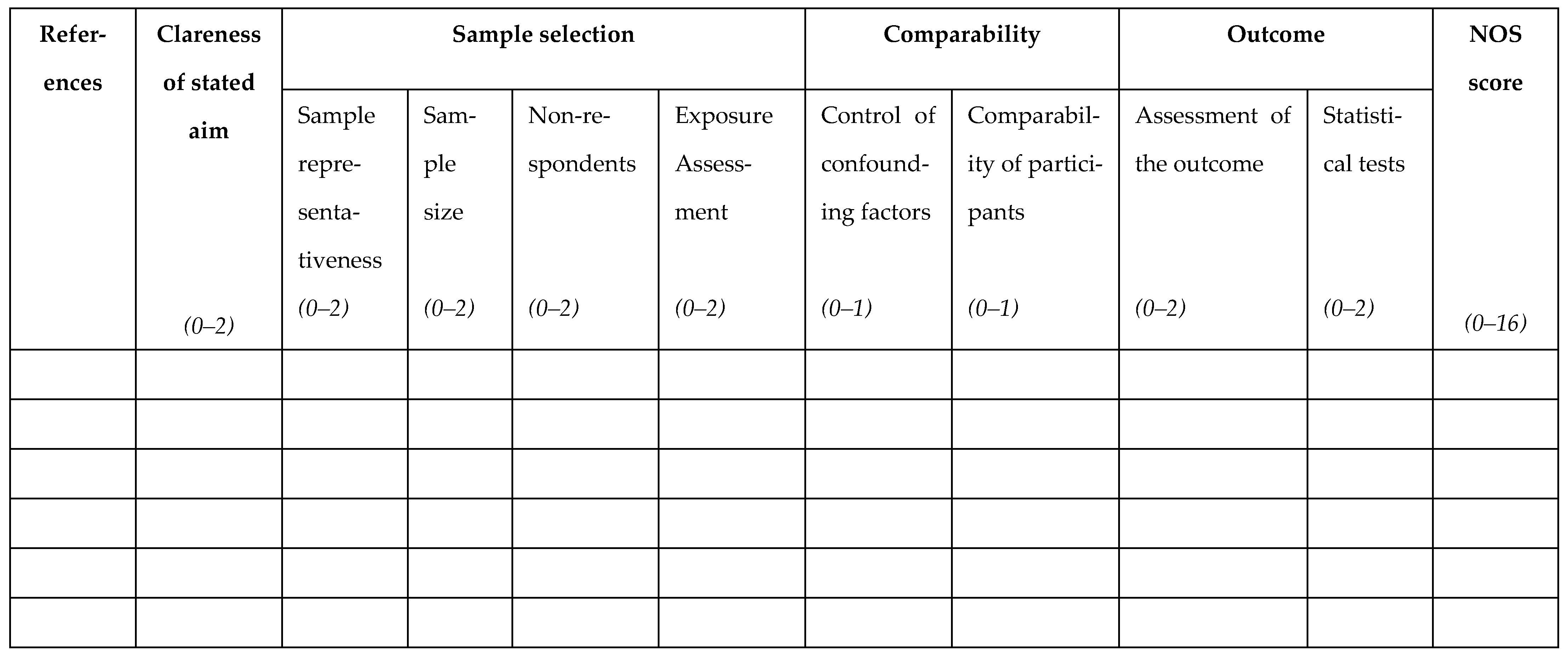
| Studies | Clearness of Stated Aim (0–2) | Sample Selection | Comparability | Outcome | NOS Total Score (Quality Assessment) (0–16) | |||||
|---|---|---|---|---|---|---|---|---|---|---|
| Sample Representativeness (0–2) | Sample Size (0–2) | Non-Respondents (0–2) | Exposure Assessment (0–2) | Control of Confounding Factors (0–1) | Comparability of Participants (0–1) | Assessment of the Outcome (0–2) | Statistical Tests (0–2) | |||
| A | The issue is relevant, and the description includes 25 references | A stratified sampling technique from the national electronic health records of school students | The sample size for each stratum (layer) was in proportion to the layer size | Response rate was assessed (46%); Non-respondents: 54%; no evaluation of respondents’ and non-respondents’ characteristics | Validated questionnaire | Regression models were performed, controlling for different socio-economic and demographic characteristics, including sex. | Boys and girls were equally represented (50.3% females). | National health records | The t-test was used to compare 2 categories, while in the case of more than 2 categories, ANOVA was applied. Linear regression was performed to explore potential predictors | 14 (High quality) |
| 2 | 2 | 2 | 0 | 2 | 1 | 1 | 2 | 2 | ||
| B | The issue is relevant, and the description includes 5 references | Systematic random selection with proportional allocation | The sample size was calculated using a priori power analysis. The sample size was appropriate. | There was no response rate assessment | Direct anthropometric measurements | There was no control over factors that may have influenced other variables | Boys and girls were equally represented (50.6% females). | Changes were assessed using anthropometric data previously collected from hospital records as a comparison | The t-test and one-way ANOVA were used to compare the intergroup differences of two independent groups and more than two groups, respectively. There was no measure of association | 11 (Moderate quality) |
| 1 | 2 | 2 | 0 | 2 | 0 | 1 | 2 | 1 | ||
| C | The issue is relevant, and the description includes 9 references | All the schoolchildren of the elementary schools of a district were included | The target population was all surveyed. The sample size was appropriate. | There was a response rate assessment (75%), but no evaluation of respondents’ and non-respondents’ characteristics | The tool was a non-validated questionnaire without a description | There was no control of factors that may have influenced the variables | The boys and girls were numerically unbalanced (73.3% females). | Self-reported data | Sex-group comparisons were performed on ordinal data using the chi-square test. There was no measure of association | 8 (Low quality) |
| 1 | 2 | 2 | 1 | 0 | 0 | 0 | 1 | 1 | ||
Disclaimer/Publisher’s Note: The statements, opinions and data contained in all publications are solely those of the individual author(s) and contributor(s) and not of MDPI and/or the editor(s). MDPI and/or the editor(s) disclaim responsibility for any injury to people or property resulting from any ideas, methods, instructions or products referred to in the content. |
© 2026 by the authors. Licensee MDPI, Basel, Switzerland. This article is an open access article distributed under the terms and conditions of the Creative Commons Attribution (CC BY) license.
Share and Cite
Gualdi-Russo, E.; Zaccagni, L. The Newcastle–Ottawa Scale for Assessing the Quality of Studies in Systematic Reviews. Publications 2026, 14, 4. https://doi.org/10.3390/publications14010004
Gualdi-Russo E, Zaccagni L. The Newcastle–Ottawa Scale for Assessing the Quality of Studies in Systematic Reviews. Publications. 2026; 14(1):4. https://doi.org/10.3390/publications14010004
Chicago/Turabian StyleGualdi-Russo, Emanuela, and Luciana Zaccagni. 2026. "The Newcastle–Ottawa Scale for Assessing the Quality of Studies in Systematic Reviews" Publications 14, no. 1: 4. https://doi.org/10.3390/publications14010004
APA StyleGualdi-Russo, E., & Zaccagni, L. (2026). The Newcastle–Ottawa Scale for Assessing the Quality of Studies in Systematic Reviews. Publications, 14(1), 4. https://doi.org/10.3390/publications14010004

