1. Introduction
Resin-based composites (RBCs) have replaced amalgam as the gold standard of dental restorative materials [
1,
2,
3,
4]. RBCs are advantageous because of their adhesion to the tooth, which allows for minimally invasive procedures and excellent aesthetics through tooth-colored restorations. Dentin adhesives function as intermediary connections between dentin and RBCs. They are a solvated monomeric blend of lipophilic and hydrophilic components [
5]. Through research, several dental adhesive approaches have been established, such as etch-and-rinse and self-etch systems. Self-etch dentin adhesives reduce the number of application steps by leaving out the separate process of conditioning the tooth structure and thus saving on treatment time [
6,
7,
8,
9]. However, the monomers contained in adhesive systems have also been the subject of research regarding possible cytotoxic and genotoxic effects [
3,
10,
11,
12].
It is important to investigate the cytotoxicity of dentin adhesives according to ISO standards, as these adhesives come into contact with intraoral tissues such as gingival or pulp cells during intraoral application [
10,
13]. Studies have already demonstrated that dentin adhesives can cause cell damage [
10,
14,
15,
16].
In our first study, the eluates of six different dentin adhesives were tested for their cytotoxicity in vitro toward cell cultures with primary fibroblasts after an observation period of 24 h [
17]. This screening study showed an initial ranking of cytotoxicity based on qualitative assessments of dentin adhesives [
17,
18,
19]. In order to lean more towards in vivo situations where residues of adhesives may engage in prolonged cell contact, a longer period should be tested, according to ISO 10993-5 [
18]. Furthermore, determining whether there are differences in the types of adhesives over an extended period is of clinical interest. Therefore, this study functions as an extension of our first study, in which the same dentin adhesives were investigated, but now for a period of 48 h in order to observe cellular reactions beyond the initial reaction [
20].
The critical feature of our study remains the multiparametric evaluation of cytotoxicity [
17,
21]. In order to more accurately determine if in vitro cytotoxicity is unsuitable for clinical in vivo situations, authorities recommend performing several biocompatibility tests to obtain a more precise assessment of the potential biological risk associated with clinical use of the materials [
22]. No one testing method offers universally reliable results; thus, multiple strategies combining at least two different endpoints capture different aspects of cytotoxicity [
21]. While quantitative evaluation offers viability data, qualitative analysis captures structural changes, which are not reflected in cell counts. Further, the reactivity index offers facilitated interpretation within a framework established by ISO 10993-5. Therefore, it is precisely the combination of qualitative and quantitative assessments that is crucial for obtaining more detailed conclusions. As in our first study, comparison with existing studies is difficult because our methods and parameters cannot be found in other studies [
11,
16,
23,
24,
25,
26,
27,
28,
29,
30,
31,
32,
33,
34,
35,
36,
37,
38,
39,
40]. In several studies, cytotoxicity was detected only after 24 h [
16,
27,
28,
30,
34,
36,
37,
38,
39]. These studies show the short-term effect of the cytotoxicity of dentin adhesives. However, only a few studies provide results obtained after the combination of different observation periods, as recommended according to ISO 10993-5 [
18,
20,
24,
26,
32,
35,
40,
41,
42].
In this study, we compared and evaluated the cytotoxicity of self-etch and etch-and-rinse dentin adhesives after 48 h, allowing comparison with the first observation period of 24 h.
The hypotheses for our screening study are as follows:
- -
The self-etch adhesives will show no differences in cytotoxicity relative to the etch-and-rinse adhesives in the multiparametric evaluation.
- -
The sequentially applied substances will have different cytotoxic effects relative to those applied once in the multiparametric evaluation.
3. Results
3.1. Quantitative Results
The results obtained for the viable cell counts were tested if they were normally distributed using the Shapiro–Wilk test, which showed significant deviations from a normal distribution. Therefore, we decided to use the Kruskal–Wallis test for statistical evaluation, which revealed significant differences in the results. By performing Conover–Iman post hoc pairwise comparisons with Bonferroni–Holm corrections, we determined which compared pairs of groups showed significant differences while considering the risk of error.
AdheSE (
p = 0.0006), Clearfil SE Bond (
p = 0.002), One-up Bond F Plus (
p = 0.0001), and Optibond Solo Plus (
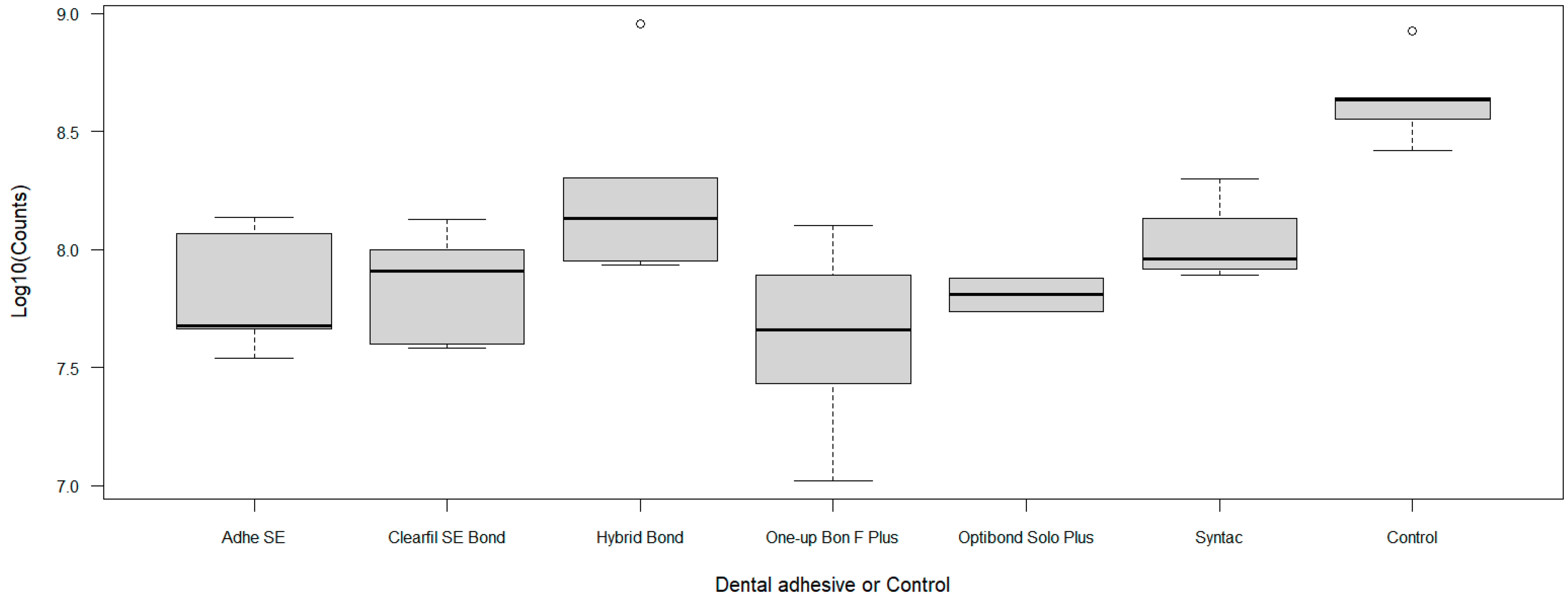
p = 0.03) showed a statistically significant reduction in viable cells in comparison to the cell control after 48 h (
Table 2). While Hybrid Bond offered a higher maximum cell count compared to the control group, the result was not statistically significant. No statistically significant differences could be observed between the different dentin adhesives due to partially high standard deviations (
Figure 1).
Hybrid Bond applied sequentially, as recommended by the manufacturers, resulted in a statistically significant reduction in viable cells in comparison to a single application of Hybrid Brushes after 48 h (p = 0.01).
For One-up Bond F Plus, AdheSE, Clearfil SE Bond, and Syntac, no statistically significant differences between sequential and single application were observed after 48 h.
3.2. Qualitative Results
The results of qualitative evaluation are shown in
Table 3,
Table 4,
Table 5,
Table 6,
Table 7,
Table 8 and
Table 9.
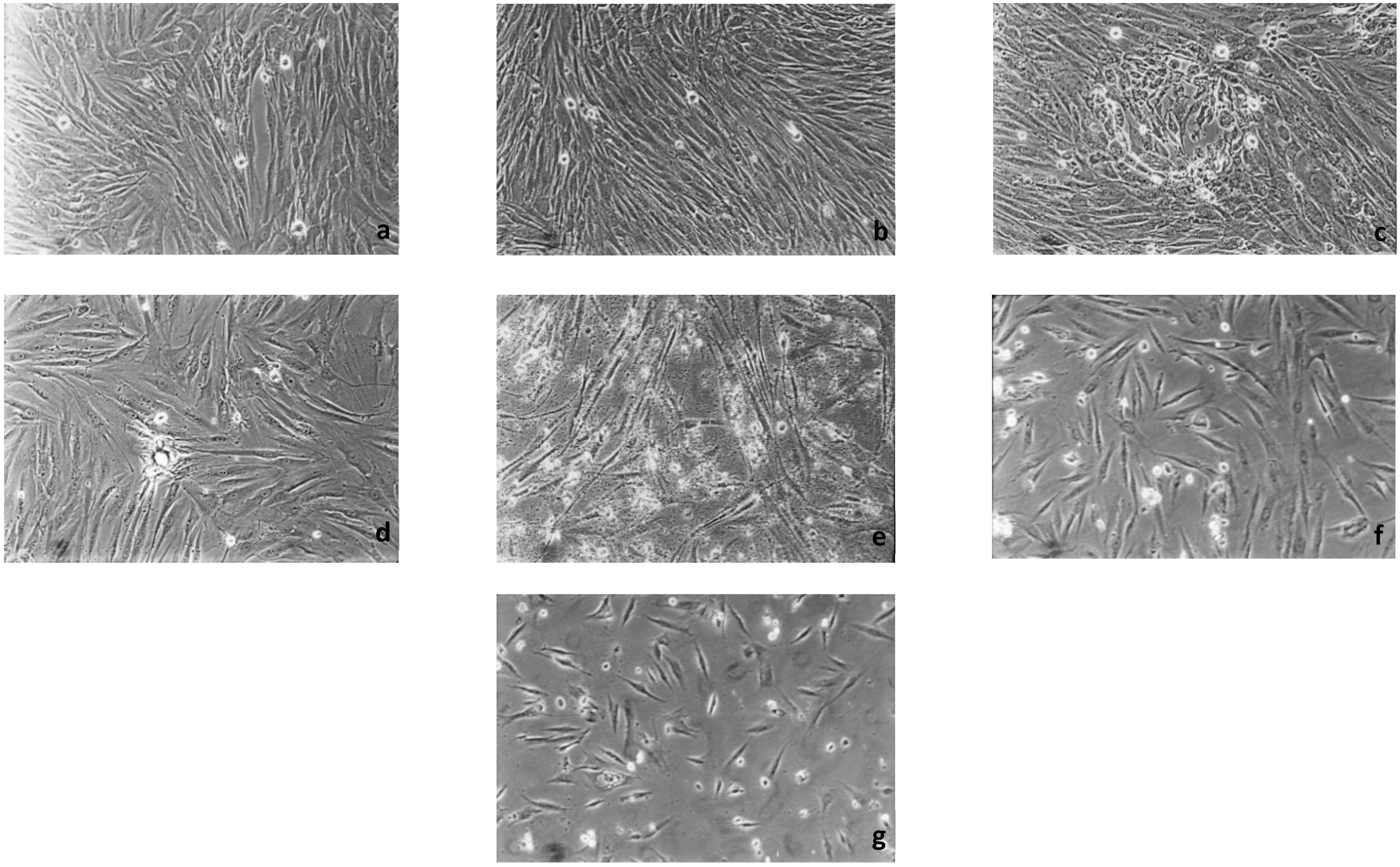
Figure 2 depicts the characteristic appearance of the cell cultures under the influence of the different dentin adhesive materials. The morphological phenotype of this cell line is characterised by spindle-shaped, long cells derived from the gingiva (HGPFCs—human gingival primary fibroblast cells) representing human primary fibroblasts (pMF).
3.3. Reactivity Index Result
The reactivity index showed no statistically significant differences between the individual adhesives. A statistically significant difference was found for this parameter between each dentin adhesive and the cell control.
When applied sequentially as the manufacturers recommend, Hybrid Bond yielded a statistically significantly higher reactivity index relative to a single application of Hybrid Brushes after 48 h (p < 0.1 × 10⁻⁶).
When applied in single treatments, One-up Bond F Plus Agent A (p = 0.5 × 10⁻³) and Agent B (p = 0.03) yielded statistically significant increases in reactivity index values in comparison to sequential application of One-up Bond F Plus after 48 h.
We also found a statistically significantly higher reactivity index for AdheSE Bond when applied once relative to sequential application, as recommended by the manufacturers, after 48 h (p = 0.003). No statistically significant difference between Clearfil SE Bond applied sequentially and the single application of the adhesive was found over the observation period after 48 h. The reactivity index for sequentially applied Syntac was statistically significantly higher than that for a single application of Syntac Primer (p = 0.002).
According to our results, the null hypothesis H01, i.e., that self-etch adhesives would show no differences relative to the etch-and-rinse adhesives, can be accepted.
Our null hypothesis H02, i.e., that sequentially applied adhesive would have different cytotoxic effects relative to a single application of adhesive, can be accepted for Hybrid Bond, One-up Bond F Plus, AdheSE, and Syntac regarding the reactivity index and for Hybrid Bond regarding the quantitative evaluation.
4. Discussion
Materials that come into contact with living cells should be biocompatible; i.e., they should not cause cytotoxic, pro-inflammatory, mutagenic, or adverse immune reactions. Thus, cytotoxicity tests are crucial for evaluating the biocompatibility of materials. Other studies similar to ours researched time-dependent release of monomers due to incomplete polymerization [
3,
41]. This study design was adopted from our first study and is an extension from 24 to 48 h, thus enabling a direct comparison between the results [
17].
The most important conclusion of the second part of our study is that there were no statistically significant differences regarding the cytotoxicity between the self-etch and etch-and-rinse dentin adhesives after 48 h. This finding is consistent with the first part of our study in terms of qualitative evaluation and reactivity index, and it is in accordance with findings from other studies [
17,
23,
24,
25,
26,
27,
28]. Contradictorily, other studies have found that self-etch and etch-and-rinse dentin adhesives show greater cytotoxicity in comparison [
16,
23,
29,
32,
34,
35,
36,
44]. However, in all of the comparative studies performed by other researchers, different methods and materials were used. Notably, in the clinical application of etch-and-rinse adhesives, conditioning with 37% phosphoric acid is necessary. In contrast with our first investigation, this step has not been tested because there are already numerous studies addressing this topic [
17,
45,
46].
First, we must highlight that the cytotoxicity of each dentin adhesive is linked to the cytotoxicity of the individual components of the substances, in which the concentrations of the different monomers play a significant role [
47,
48,
49]. Adhesive systems usually contain a mixture of these monomers, which have already been proven to have cytotoxic and cell-modulating properties [
16,
50,
51,
52]. The typical components are HEMA, bis-GMA, UDMA, and TEGDMA, which have been shown to exhibit cytotoxic effects in a time- and concentration-dependent manner [
41,
53,
54]. The widely accepted ranking of the cytotoxicity of these monomers, from highest to lowest, is as follows: Bis-GMA, UDMA, TEGDMA, and HEMA [
47,
51,
55]. Bis-GMA can impair protein synthesis and induce reactive oxidative stress resulting in cell death, and it has been shown to be more toxic, even in small amounts, than other monomers [
12]. HEMA, while accepted as being the least toxic, can delay cell cycle progression in fibroblasts by increasing the formation of reactive oxygen species (ROS) [
56]. Furthermore, due to the hydrophilic character of small monomers like HEMA and TEGDMA, they can more easily penetrate through cell membranes [
57,
58,
59]. The induced oxidative stress leads to mitochondrial dysfunction, which may lead to cellular damage, inflammatory responses, and caspase-mediated cell death (apoptosis) [
12,
60,
61,
62]. Apart from the monomers, free-radical-based photo-initiators are also expected to induce ROS formation [
3]. Critically, the number of monomers in the eluates of adhesives do not exactly represent the real amount, since more hydrophilic monomers, such as TEGDMA, are more likely to be eluted than bis-GMA [
63]. Nevertheless, all of our tested adhesives contain some or all of the above-mentioned monomers, which might explain the cytotoxic character observed in vitro according to the reactivity index. However, it must be stated that we did not study the specific intracellular pathways and therefore the potential linking of the cytotoxic effects of monomers to our results remains speculative. Further experiments are necessary in order to determine direct links.
As in the first part of the study, it must be stated that the solvents of the dentin adhesives also have an influence on their cytotoxicity [
25,
49]. The test materials are based on acetone, ethanol, and water. The water-based adhesives AdheSE, Clearfil SE Bond, and One-up Bond F Plus and the ethanol-based adhesive Optibond Solo Plus showed statistically significantly fewer viable cells compared to the cell control. For the acetone-based dentin adhesives, this effect could not be observed. As already explained, this might lead one to the conclusion that their cytotoxicity is hardly influenced by the individual composition and is instead influenced by the sum of their ingredients [
25,
40,
49]. However, the effect of the previously mentioned water-based adhesives, which were all self-etch adhesives in our study, might depend on the fact that they contain acidic functional monomers, such as 10-Methacryloyloxydecyl dihydrogen phosphate (10-MDP; Hybrid Bond Base), 11-methacryloyloxyundecan-1,1-decarboxylic acid (MAC-10; One-up Bond F Plus Agent A), and 4-Methacryloxyethyl-trimellitic-anhydride (4-META; Clearfil SE Bond Primer). These monomers’ acidic nature might contribute to the adhesives’ cytotoxicity. It has been shown that 10-MDP promotes inflammatory responses and may suppress cell differentiation [
64]. In contrast, 4-META has been shown to be more biocompatible, which might explain the less toxic effect of the acetone-based adhesive Hybrid Bond observed in our study [
65]. Optibond Solo Plus is the only ethanol-based adhesive we tested. Thus, it is difficult to draw conclusions on its cytotoxic effect based on its solvent. It would be necessary to acquire more adhesives with the same solvent in order to determine whether there is a link to a potential cytotoxicity based on the solvent.
Along with AdheSE, Clearfil SE Bond and One-up Bond F Plus, Optibond Solo Plus showed a statistically significant reduction in viable cells compared to the cell control after 48 h. However, the cultures treated with Optibond Solo Plus did not show evidence of this effect after 24 h. One possible reason for this could be that the full extent of the cytotoxicity of Optibond Solo Plus only becomes apparent after 48 h; alternatively, it may be a product of the fact that cell changes take time before showing an effect. Similar observations were made in a study where the cytotoxicity of universal adhesives was tested after 24, 48, and 72 h. While cytotoxic effects were observed after 48 h and 72 h, no such effects arose after 24 h [
20]. A possible explanation is that residual unpolymerized monomers are released over time.
When applied sequentially, Hybrid Bond resulted in statistically significantly fewer viable cells relative to a single application of Hybrid Brushes. Hybrid Brushes do not contain monomers, which might explain the low cytotoxicity. This effect was also mentioned in the first part of our investigation after 24 h [
17]. Statistically significant differences were observed between the dentin adhesives AdheSE, Hybrid Bond, One-up Bond F Plus, and Syntac between parts treated sequentially and once, a finding that is in accordance with our first investigation [
17]. In contrast, Clearfil SE Bond showed no statistically significant differences between sequential and single application over the observation term of 24 h. Cell regeneration that had already occurred could be a reason for this observation. Authors of recent studies made the same assumption after noting that the toxicity of adhesives appeared to decrease after 72 h [
20].
The number of viable cells, a metric used in our multiparametric strategies, is not sufficient to draw conclusions about possible harmful cellular responses, as not all of them end in cell death [
63].
Contrary to the quantitative assessment, every adhesive showed a statistically significant difference to the cell control regarding the qualitative evaluation, including with respect to the reactivity index, which was consistent after 24 h and 48 h [
17]. Syntac, which is also acetone-based, presented one of the highest reactivity indices, even after 48 h, with no change compared to 24 h. This finding is also in accordance with other investigations, which classified Syntac as highly cytotoxic [
33,
36,
40]. It is argued that Syntac contains a larger proportion of non-linked substances after polymerization; these substances can then be released to the culture medium over a prolonged period [
40]. On the contrary, one study also found lower cytotoxicity of the dentin adhesive Syntac [
66]. As mentioned in the first part of this study, the proportion of glutaraldehyde could play a role in the high cytotoxicity. Free glutaraldehyde is highly cytotoxic [
33,
44]. Most of the glutaraldehyde is bound irreversibly in the bonding process of the dentin adhesives. It stabilizes the collagen fiber network, which is exposed after etching. However, it has not yet been possible to determine how many molecules are free in the clinical application process [
40].
Optibond Solo Plus remains the dentin adhesive with the highest reactivity index after 24 h and 48 h [
17]. Regarding the components, Optibond Solo contains silica in different forms. They have been the subject of studies regarding possible cytotoxic effects. As studies have shown, silica might be responsible for cellular stress responses, which might cause cell death or promote transformation [
67]. Those properties, combined with the cytotoxic effects of the other components of Optibond Solo Plus like bis-GMA, might be a possible explanation for the few viable cells and high reactivity index observed in this study [
68].
It should be emphasized again that the experimental conditions used to apply the quantitative method can best be transferred to further investigations, thereby allowing the best possible comparison of different examinations. We consider this to be the most reliable method for evaluation, as qualitative assessments may vary from person to person. Therefore, it is important to integrate at least more than one observer to decrease subjectivity. In order to reduce bias, evaluations were performed according to predefined criteria and images were recorded for all samples. Formal interobserver agreement statistics were not performed but discrepancies between an experienced lab technician and a doctoral student were discussed and resolved by consensus. For future studies it is recommended to include interobserver agreement statistics, e.g., Cohen’s kappa.
In future research, the evaluation for these adhesives should be extended into a long-term trial conducted over 30 days, as described in 10993-5 [
18]. In order to further reduce the cytotoxicity of the individual dentin adhesives, further investigation methods, such as MTT or WST-1 assays, are planned after screening. This investigation can also be complemented by further screening studies involving other adhesives to confirm the result of the comparison of the cytotoxicity of the self-etch and etch-and-rinse adhesives. Nevertheless, our study does not exactly mimic the environment in the oral cavity, constituting a major limitation. In vivo studies consider reactions of the surrounding tissue and cells, as well as the composition and temperature of human saliva, which is highly complicated to adapt in in vitro studies. However, cell culture models have gained value as an alternative to animal experiments, which are ethically controversial, costly, and time-consuming. These in vitro models are already widely accepted for use in restorative dentistry for testing the biocompatibility of materials, thereby further negating the need for animal experiments [
69,
70]. Undoubtedly, far more detailed studies regarding the mechanisms of toxicity, e.g., using immunohistological staining or flow cytometry, are necessary in order to foster a comprehensive understanding and allow the development of more biocompatible materials in the future [
3,
63]. Therefore, the possible mechanistic considerations that have been discussed regarding our experimental results, are mainly based on comparisons of previously published studies as our study did not directly assess possible mechanisms of cytotoxicity.





 ,
,